Does Soundproof Wallpaper Work? What the Lab Reports Say
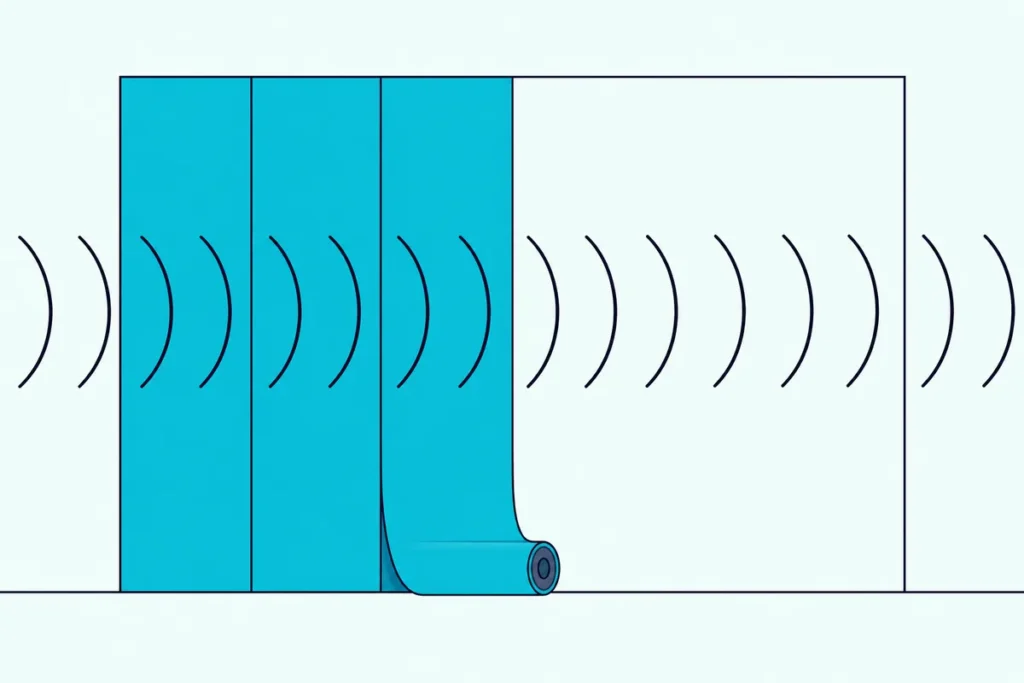
Does soundproof wallpaper work well enough to quiet a thin bedroom wall, or does it only look the part?
You stick up rolls of felt or foam-backed fabric, and the neighbor’s TV still comes through the wall as clearly as before.
Once you know what those rolls are actually tested for, you can spend on the fix that matches your problem: echo inside the room or noise coming through the wall.
In an accredited lab, one 6 mm felt wallpaper rated NRC 0.20, and by the National Research Council of Canada’s mass law its weight adds under 1 dB of blocking to 5/8-inch drywall.
Below are the lab numbers for felt, foam-backed fabric and cork, why weight decides what passes through a wall, and what to buy instead for each problem.
Is There Such a Thing as Acoustic Wallpaper?
Those rolls are a real product category, and yes, acoustic wallpaper exists. It’s a thin, soft wall finish sold to absorb sound inside a room, pasted or stuck on much like ordinary paper.
Commercial Acoustics describes acoustic wall coverings as compressed polyester, typically 3 to 5 mm thick, and calls them decorative finishes that happen to offer some absorption. BuzziSpace’s BuzziSkin is a 6 mm felt made from recycled PET bottles, with a self-adhesive back.
Texdecor’s EOS pairs a polyester faux suede with a polyurethane acoustic foam for a 5 to 6 mm sheet, and Phillip Jeffries laminates plush fabric to a soft foam layer in some of its dimensional designs. Cork shows up too, including Muratto’s thin Primecork sheets, which Momentum Textiles & Wallcoverings lists under acoustic walls.
The ones with published weights are light. BuzziSkin weighs 1,000 grams per square meter, about 0.2 pounds per square foot, and EOS weighs 350 grams per square meter.
Does Wallpaper Help Soundproofing?
That light weight is why wallpaper barely helps soundproofing, which means blocking sound between rooms. Canadian Building Digest 239 from NRC Canada puts a number on it: doubling the mass per unit area of a single layer raises its transmission loss by only about 6 dB (NRC Canada).
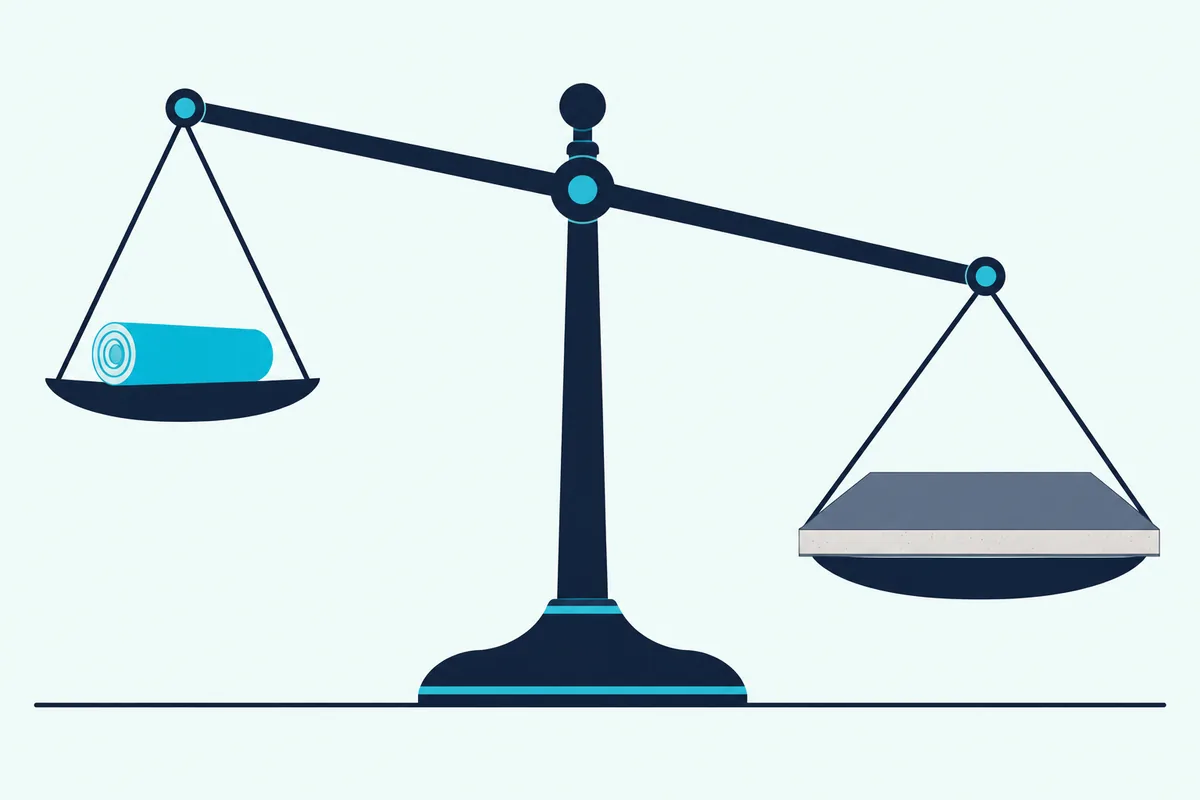
USG lists its 5/8-inch Firecode X drywall at a nominal 2.2 pounds per square foot, so BuzziSkin adds about 9 percent to one sheet and EOS about 3 percent. By that same mass law, those gains work out to roughly 0.8 dB and 0.3 dB, against about 6 dB for a second sheet of drywall that doubles the face.
Soundproof paint ran into the same math, and our answer to whether soundproof paint works walks through a 2012 lab report in which 28 mils of coating added 2 to 3 STC points. That report’s perception chart calls a 1 dB change imperceptible and 3 dB barely perceptible, so wallpaper worth under 1 dB won’t be noticed through the wall.
None of the makers’ sheets and pages read for this guide lists a sound transmission class (STC), the North American lab rating for blocking sound through a wall. Every number they give measures absorption instead.
Get Studio Tips Weekly
Join 5,000+ creators getting acoustic treatment advice every week.
No spam. Unsubscribe anytime.Why Can’t a Thin Wall Covering Stop Neighbor Noise?
Weight isn’t the only problem, because the soft, porous material that absorbs sound is also material that sound passes through easily. NRC Canada’s digest on building acoustics says sound-absorbing materials work by letting sound pass through them easily, while good sound blockers are usually non-porous and reflect sound.
The same digest lists holes, fissures and flanking paths around a wall among the ways sound travels between rooms. A layer of felt leaves the outlet boxes, the gap under the door and the floor and ceiling around the wall exactly as they were.
Picture a bedroom that shares a wall with a neighbor’s living room, where their TV and voices come through. Covering your side changes how your own room sounds, but the drywall, studs and gaps that carry their noise stay the same.
What Does Acoustic Wallpaper Actually Absorb?
That leaves absorption, the job these products are built for, and the honest answer is mostly high-pitched sound. In BuzziSpace’s report from Peutz, an accredited Dutch acoustics lab, BuzziSkin absorbed 66 percent of the sound at 4,000 Hz but 7 percent at 500 Hz and 1 percent at 250 Hz (BuzziSpace).
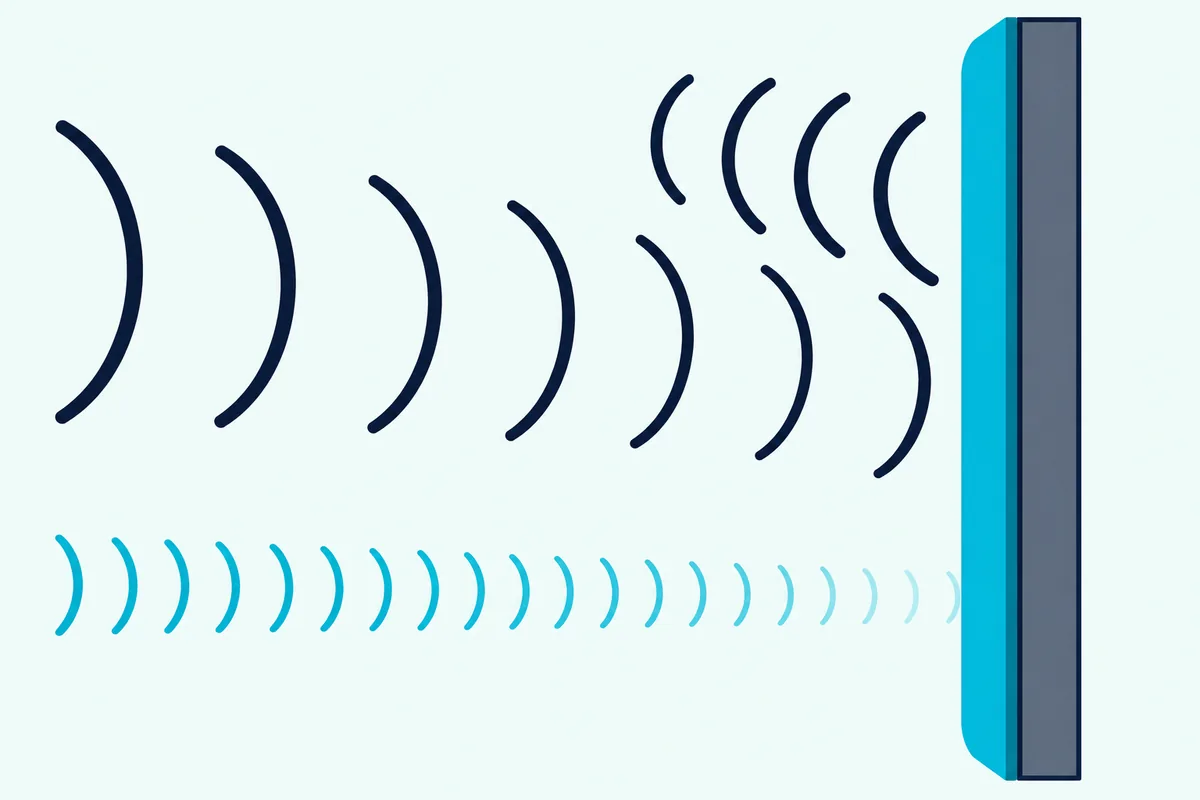
The report rates it NRC 0.20, the number NRC Canada describes as the average of the 250, 500, 1,000 and 2,000 Hz coefficients and a rough way to compare materials. Designtex, which tests its own wallcoverings to ASTM C423 glued straight to the test surface, explains the scale: 0 reflects all sound, 1 absorbs all of it and 0.5 absorbs half.
On that scale, acoustic wallpaper stays well short of a real panel. Commercial Acoustics says acoustic wall coverings max out near NRC 0.40, while its stretched-fabric wall with a 1-inch fiberglass core rates 0.80 and the 2-inch version 1.05 (Commercial Acoustics).
Here’s how the products with published ratings compare, as their makers or sellers list them:
| Wall covering | What it is | Thickness | Absorption rating |
|---|---|---|---|
| BuzziSpace BuzziSkin | Recycled PET felt, self-adhesive | 6 mm | NRC 0.20 (Peutz, ISO 354) |
| Texdecor EOS | Polyester faux suede on polyurethane foam | 5 to 6 mm | NRC 0.40 (ISO 354) |
| Phillip Jeffries dimensional designs | Fabric with a soft foam layer | Not listed | NRC 0.25 to 0.30 (third-party lab) |
| Silence (2013 sheet hosted by Momentum) | Polyester and polypropylene, latex back | 3/8 in | NRC 0.20 (ASTM C423) |
| Muratto Primecork Classic | 87% cork | 0.16 in | NRC 0.00 |
| Muratto Chock cork blocks | 93% cork | 1 in | NRC 0.30 |
Texdecor also gives EOS a weighted alpha (αw) of 0.30 from ISO 354 testing, and BuzziSkin’s report gives it 0.15 on that scale. Phillip Jeffries cites a third-party lab test but names neither the lab nor the standard, so its range is the least specific number in the table.
Try this before buying anything: clap once in the middle of the empty room and listen to the tail. A bright ring is the high-pitched part these rolls can shorten, while a boomy hum sits in the low bands where BuzziSkin absorbed almost nothing.
Are Felt and Cork Wall Coverings Any Better?
Those ratings stay in the same low range whatever the fiber. Cork shows how much thickness matters: Momentum lists Muratto’s 0.16-inch Primecork Classic at NRC 0.00 and its 1-inch Chock cork blocks at 0.30 (Momentum).
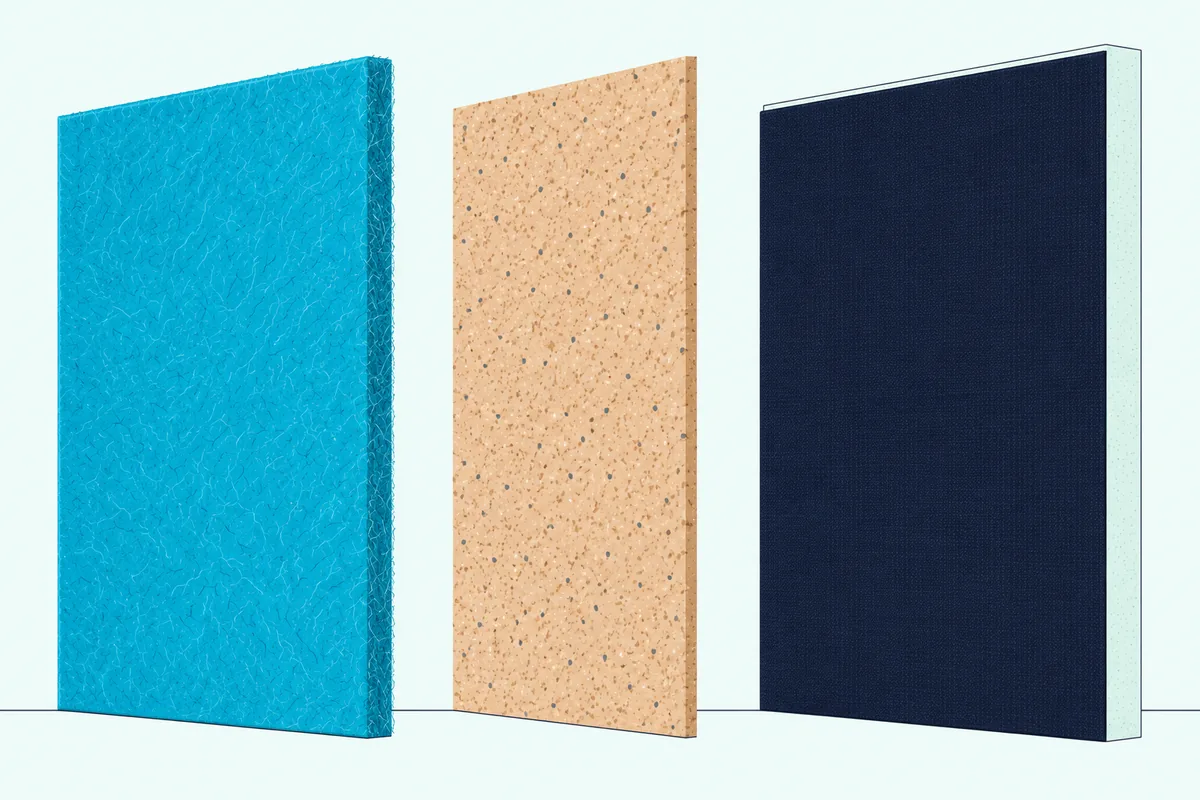
Felt sits in that range too: BuzziSkin’s 6 mm sheet rates 0.20, the same as the 3/8-inch polyester and polypropylene Silence sheet. Thicker felt panels and an air gap behind them are a different product, and this felt for soundproofing explainer covers what they add.
Foam-backed fabric scores highest here, with Texdecor’s EOS at NRC 0.40 and Phillip Jeffries’ designs at 0.25 to 0.30. Even the best of them only matches the ceiling Commercial Acoustics gives the whole category, half of what its 1-inch fabric wall absorbs.
Does Soundproof Wallpaper Work in a Bedroom?
That split between absorbing and blocking settles the bedroom question too: soundproof wallpaper helps a bare, echoey bedroom but not one that hears the neighbors. In a room with hard walls and little furniture, acoustic wallpaper trims the bright part of the echo, where BuzziSkin absorbed 51 percent at 2,000 Hz and 66 percent at 4,000 Hz.
Noise through a shared wall is the harder case, and the mass-law math above gives felt on your side under 1 dB. For that wall, the steps to soundproof a wall start with sealing leaks, then added mass and damping, then decoupling.
BuzziSkin’s self-adhesive rolls come with conditions of their own. BuzziSpace says to prime the wall with a water-based primer, not to apply BuzziSkin over vinyl or other plasticized surfaces, and to leave the installation to professionals.
What Works Better Than Soundproof Wallpaper?
Those two problems need two different fixes, and neither one is a thicker wallpaper. For noise through a wall, NRC Canada’s table shows what insulation and extra drywall do to a steel-stud wall with one layer per side: STC 39 empty, 45 with sound-absorbing insulation and 56 with two layers per side plus insulation.
Common wood-stud walls gain less from insulation alone, about 3 points on a wall NRC Canada rates near STC 33, because sound crosses through the studs. Resilient channels, staggered studs and a second layer of drywall are where the big gains in its table come from.
For echo, an inch of real absorption beats any wallpaper here, since that 1-inch fabric wall’s NRC of 0.80 is four times BuzziSkin’s 0.20. If panels would spoil the look, Burton Acoustix’s guide to hiding acoustic panels covers fabric walls and printed panels that keep their absorption.
On a tight budget, start with the holes and gaps NRC Canada flags, and this budget soundproofing plan puts sealing gaps before any heavier upgrade.
The Bottom Line
Soundproof wallpaper does one job, modestly: the ratings here run from NRC 0.00 to 0.40, the one full lab report puts most of the absorption at high pitches, and the weight adds under 1 dB of blocking to 5/8-inch drywall.
Buy it for a lively room you want to look better and sound a little calmer, and put noise-from-next-door money into sealed gaps, insulation, drywall and decoupling.
Frequently Asked Questions
Is soundproof wallpaper worth it?
Only as acoustic treatment. If a room sounds bright and echoey and you want a finished look, a felt or foam-backed covering rated around NRC 0.20 to 0.40 will take some edge off the high frequencies. If you want to stop noise from another room, its weight adds under 1 dB to 5/8-inch drywall by NRC Canada’s mass law, so the money does more as insulation, an extra layer of drywall or sealed gaps. Check that a roll lists an NRC and a test standard before buying, since one that only says soundproof gives you nothing to compare.
Does soundproof wallpaper work on a ceiling?
Not for footsteps. NRC Canada classes footsteps as impact noise, which travels through the structure and is rated with a standardized tapping device and the impact insulation class (IIC), not by absorption. BuzziSpace also doesn’t recommend installing BuzziSkin on ceilings or floors. For voices or music from upstairs, the same mass-law math applies overhead as on a wall, so a thin covering adds little.
What is the best wall covering for soundproofing?
For blocking sound, it’s another layer of drywall rather than a decorative finish, because doubling a layer’s mass is worth about 6 dB under NRC Canada’s mass law while BuzziSkin’s felt adds under 1 dB. For absorbing echo, the best-rated product found for this guide is Texdecor’s foam-backed EOS at NRC 0.40, which matches the ceiling Commercial Acoustics gives acoustic wall coverings. A stretched-fabric wall with a 1-inch fiberglass core, at NRC 0.80, absorbs twice as much.
Will ultra-thin sound-absorbing wallpaper ever work?
Researchers are working on it. In 2022, a University of Bristol team reported that moth wings absorbed as much as 87 percent of incoming sound energy while sitting on a solid aluminum disc, and said the design could one day lead to ultrathin sound-absorbing wallpaper. That absorption was all in the ultrasound range, above what people can hear, and the next challenge the team named was a structure that works at lower frequencies. So the moth-wing wallpaper in the headlines isn’t a product you can buy yet.