What Frequencies Does A Bass Trap Absorb — And How Low Can They Really Go?
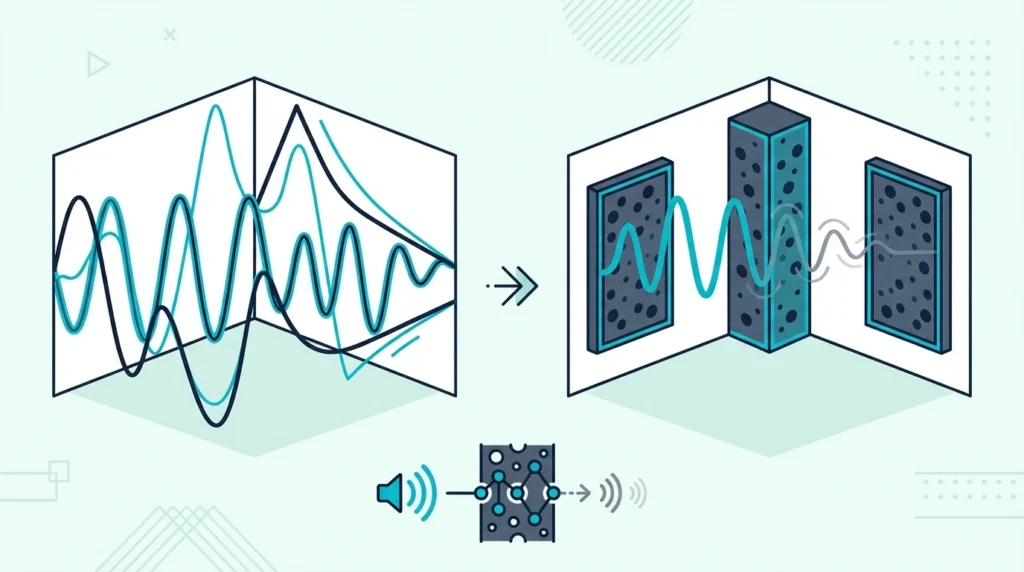
What frequencies does a bass trap absorb — typically 20 to 300 Hz for porous types, but the exact range depends entirely on the trap’s design, thickness, and material density, and most budget traps don’t reach nearly as low as their marketing claims suggest.
Bass traps target the frequency range where room acoustics cause the most damage. Standing waves, modal buildup, and boomy corners all live in the low end, and without absorption tuned to those frequencies, your room distorts everything you hear below about 300 Hz.
Understanding which frequencies your traps actually absorb — not just which frequencies they claim to absorb — is the difference between solving your room’s problems and wasting money on treatment that looks good but doesn’t reach the frequencies causing trouble.
Below, this guide breaks down the absorption ranges for every major trap type, how thickness determines the lowest frequency a trap can handle, why corners matter so much, and whether foam or rockwool delivers better low-end performance.
Porous bass traps (fiberglass, mineral wool) absorb broadly from about 80–300 Hz and above, with thicker panels reaching lower. Resonant traps (Helmholtz, membrane) target narrow frequency bands as low as 30–60 Hz. Foam traps typically only absorb effectively above 250 Hz. For most home studios, 4-inch rigid fiberglass corner traps cover the critical range where room modes cause the worst problems.
What Frequencies Does A Bass Trap Absorb — And Why Does It Matter?
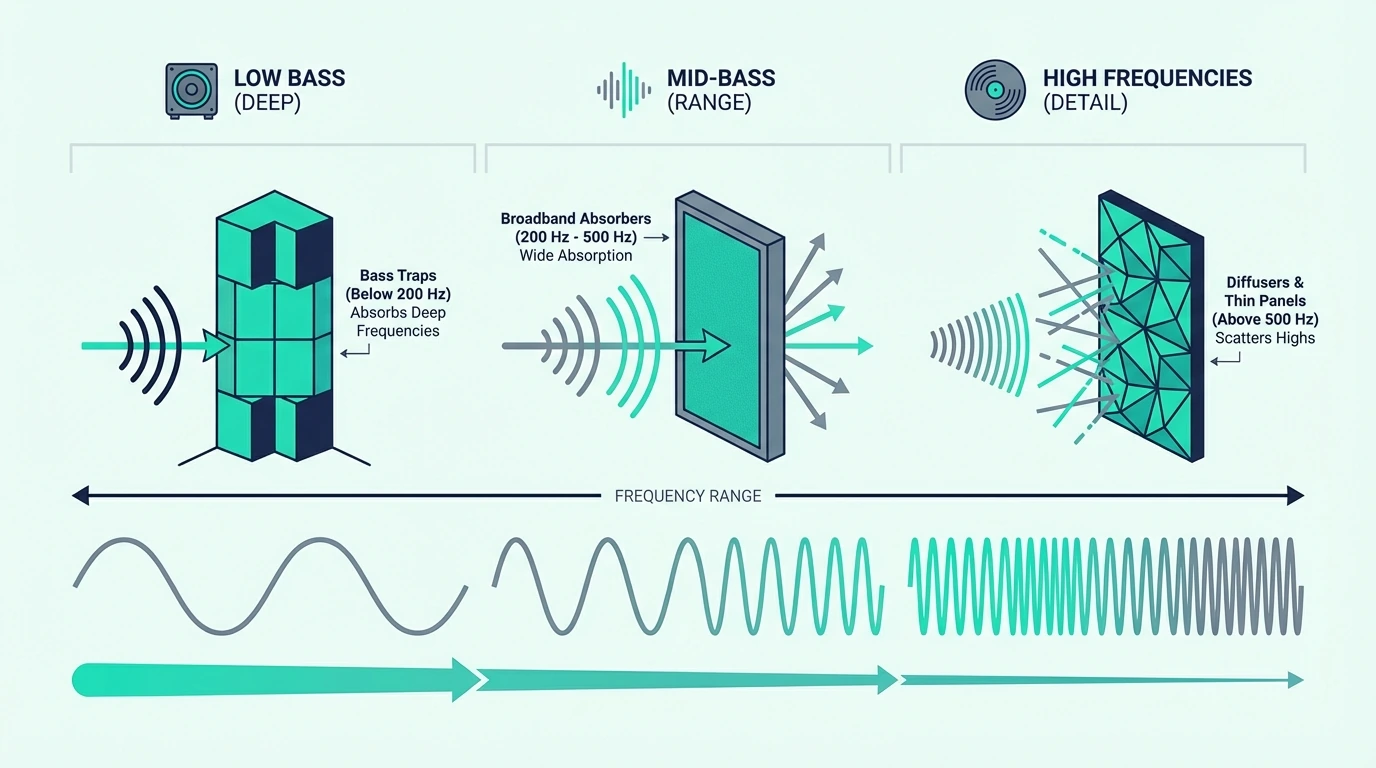
The term “bass” in acoustics covers roughly 20 to 300 Hz — the range where bass traps do their work. But not every bass trap absorbs the full range equally, and that distinction matters more than most people realize.
Room modes — the standing waves created by sound bouncing between parallel surfaces — concentrate in the 30–200 Hz range for typical rooms. A 15-foot room has its fundamental axial mode at about 37 Hz, with harmonics at 74 Hz and 111 Hz stacking on top of each other.
The frequencies your bass traps need to absorb depend on your room’s dimensions and the problems you’re trying to solve. A small bedroom studio might have its worst mode at 90 Hz, while a larger control room battles issues down at 40 Hz.
What Frequency Range Do Different Bass Trap Types Cover?
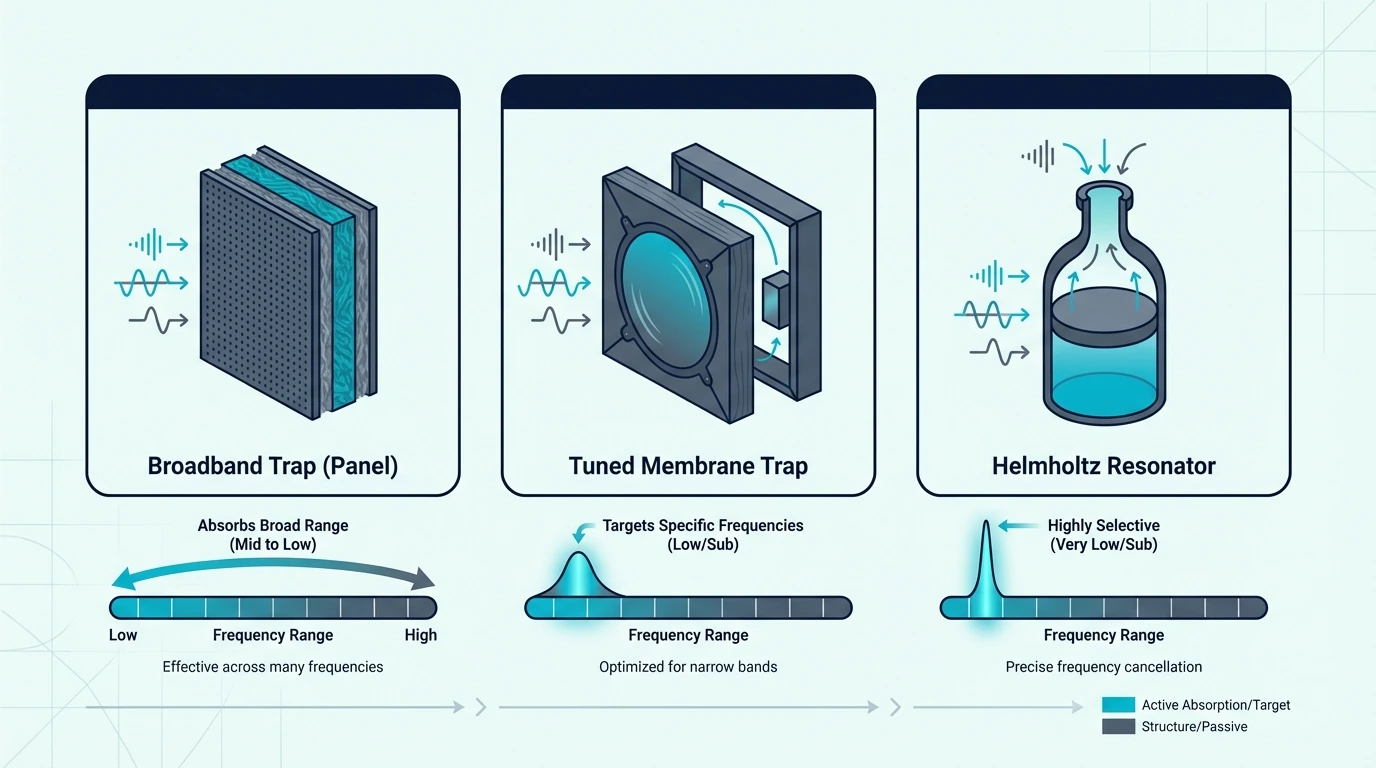
The two main categories of bass traps — porous absorbers and resonant absorbers — handle frequencies in fundamentally different ways, and choosing between them depends on whether you need broadband treatment or surgical precision.
Porous Absorber Frequency Response
Porous absorbers (rigid fiberglass like Owens Corning 703/705, mineral wool like Rockwool, and dense foam) work by converting sound energy into heat as air molecules vibrate through the material’s tiny pores. They absorb across a wide frequency range — broadband — with effectiveness determined primarily by thickness.
A 2-inch porous panel absorbs well from about 500 Hz up but drops off sharply below 250 Hz. A 4-inch panel extends meaningful absorption down to roughly 100–125 Hz, while a 6-inch panel or superchunk (triangle filling an entire corner) reaches 60–80 Hz with useful absorption.
A prebuilt panel like the ATS Acoustics 2-inch panel shows the principle in practice: straddled across a corner, the air gap behind it adds depth, and the deeper the trap, the lower it can absorb.
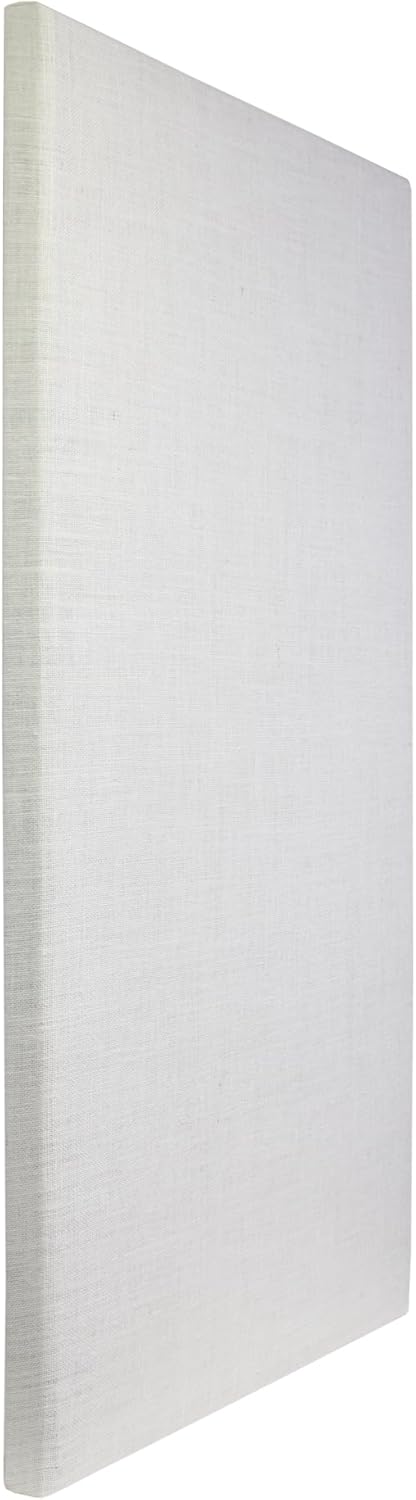
ATS Acoustics 2-inch panel
The key principle: a porous absorber needs to be at least one-quarter of the target wavelength thick to absorb that frequency effectively. At 100 Hz, the wavelength is about 11 feet — so quarter-wavelength is roughly 34 inches, which is why thin panels can’t touch deep bass.
Resonant Absorber Frequency Targeting
Resonant absorbers — Helmholtz resonators and membrane (diaphragmatic) traps — work on a completely different principle. Instead of absorbing broadly, they’re tuned to resonate at specific frequencies, absorbing energy in a narrow band centered on that tuning frequency.
A well-designed Helmholtz resonator can target frequencies as low as 30–40 Hz with high absorption at the tuned frequency. Membrane traps use a vibrating panel over a sealed air cavity and typically target 40–100 Hz depending on the panel mass and cavity depth.
The tradeoff is precision versus coverage. Resonant absorbers hit their target frequency hard but don’t help much outside a 20–30 Hz window around that center point, while porous absorbers handle everything from their low cutoff through the entire midrange.
Get Studio Tips Weekly
Join 5,000+ creators getting acoustic treatment advice every week.
No spam. Unsubscribe anytime.How Does Thickness Affect Frequency Absorption?
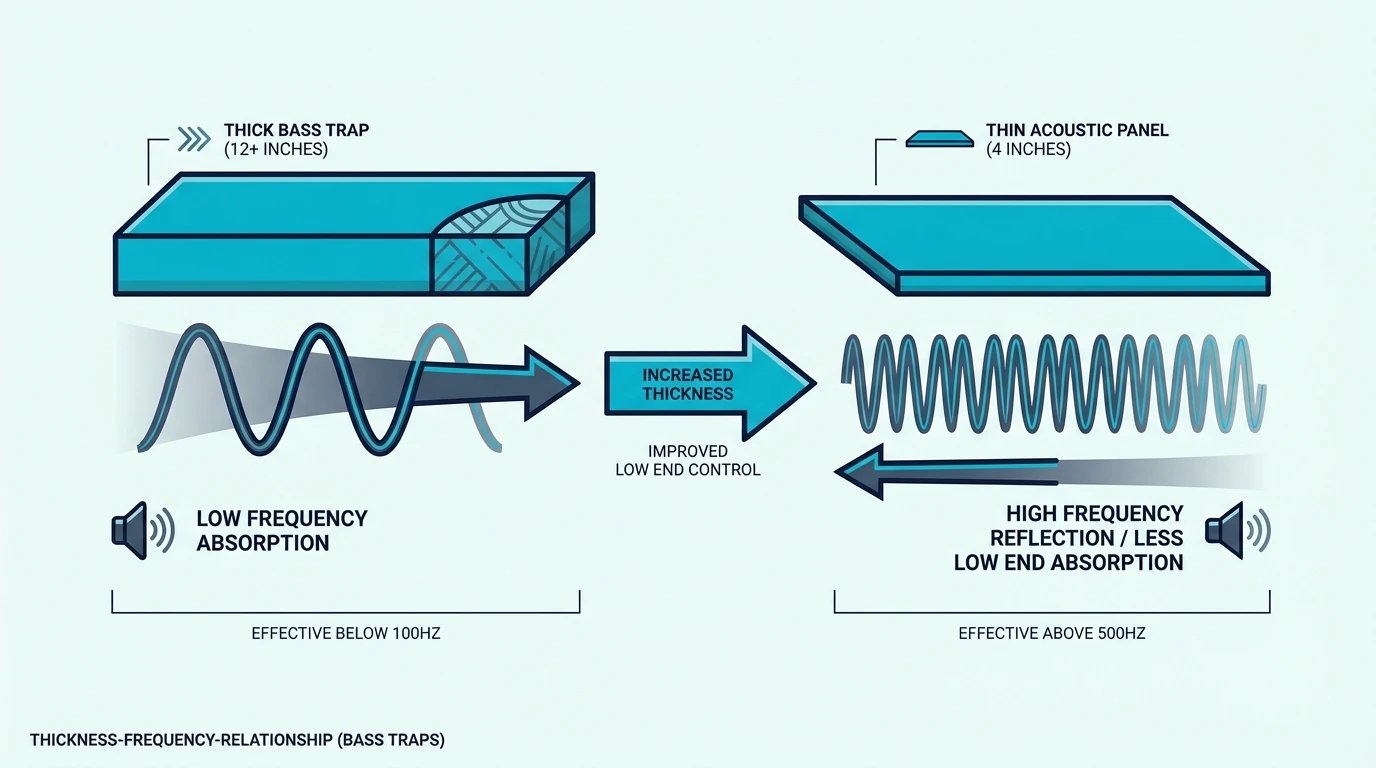
Thickness is the single most important variable in determining how low a porous bass trap can absorb. The physics is simple — thicker material interacts with longer wavelengths.
The quarter-wavelength rule gives you a practical shortcut: divide the speed of sound (1,130 feet/second) by four times the target frequency to get the minimum thickness needed. For 100 Hz, that’s 1,130 ÷ 400 = about 2.8 feet — nearly 34 inches of material depth.
That sounds impractical, and it is for flat wall panels. Corner mounting solves this because placing a trap across a corner creates an air gap behind it that effectively doubles the acoustic thickness.
A 4-inch panel mounted across a corner with 8 inches of air behind it behaves closer to a 12-inch absorber.
Here’s how common thicknesses perform in practice:
- 2-inch foam or fiberglass — Effective above 250–500 Hz, handles mids and highs but doesn’t meaningfully absorb bass.
- 4-inch rigid fiberglass/mineral wool — Effective down to 100–125 Hz when corner-mounted with an air gap, the practical sweet spot for most small studio rooms.
- 6-inch rigid fiberglass — Reaches 60–80 Hz corner-mounted with excellent broadband performance.
- Superchunk (full corner fill) — Fills the entire tri-corner with insulation. Reaches 50–70 Hz depending on density and corner dimensions.
That 4-inch range is the practical starting point for home studios that need real low-end control without building full superchunks.
If you’re building traps yourself, a pack like the ROCKWOOL Rockboard 60 (2-inch, 4-pack) gives you the raw material to stack depth and actually chase the 80–125 Hz range instead of stopping at upper mids.
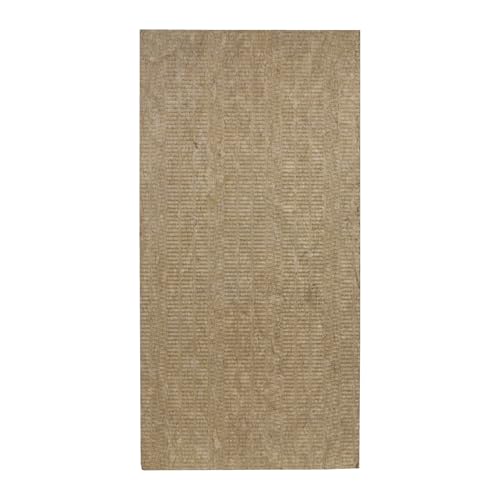
ROCKWOOL Rockboard 60 (2-inch, 4-pack)
The right thickness for your setup depends on which frequencies your room measurements show as problematic. Treating a 90 Hz mode doesn’t require the same depth as treating a 45 Hz mode.
Why Do 90-Degree Corners Trap Bass Frequencies?
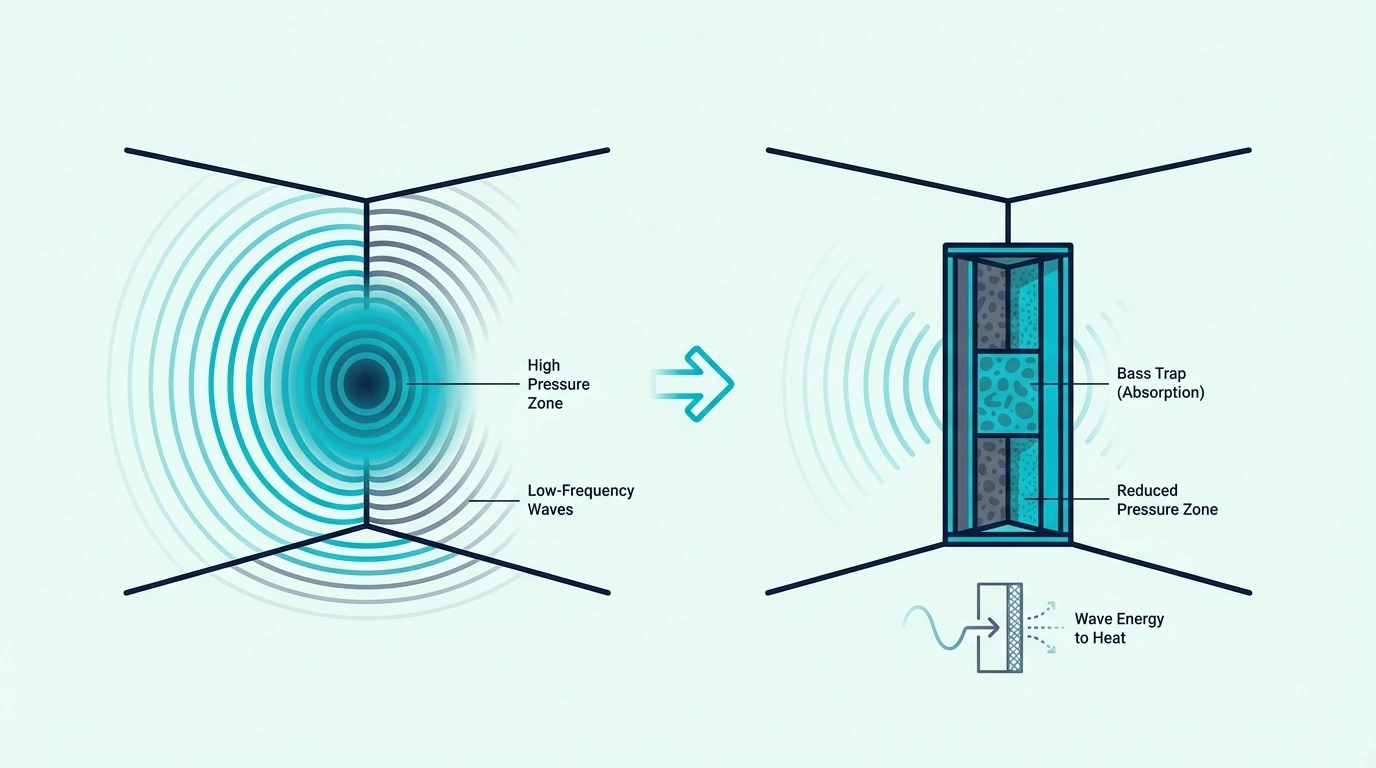
Bass energy accumulates in corners because of how sound waves interact with room boundaries. This isn’t a coincidence of room design — it’s physics that applies to every rectangular room.
When a sound wave hits a wall, the air molecules at the boundary can’t move — they’re blocked by the surface. This creates a pressure maximum at the wall, where the wave’s energy converts from velocity (moving air) to pressure (compressed air).
Where two walls meet at 90 degrees, two boundary pressure maxima overlap, creating even higher pressure. Where three surfaces meet (wall-wall-ceiling or wall-wall-floor), three pressure maxima stack, creating the highest bass energy concentration anywhere in the room.
This is exactly why bass trap placement in corners delivers the most absorption per square foot. A trap in a tri-corner intercepts the highest concentration of bass energy, making it dramatically more effective than the same trap flat on a wall center.
For room modes specifically, the corners are where every axial mode has its maximum pressure regardless of frequency. Whether it’s a 40 Hz fundamental or a 120 Hz harmonic, the corners always see the highest pressure — which is why even a few corner traps make such a large difference.
Foam vs Rockwool — Which Absorbs Lower Frequencies?
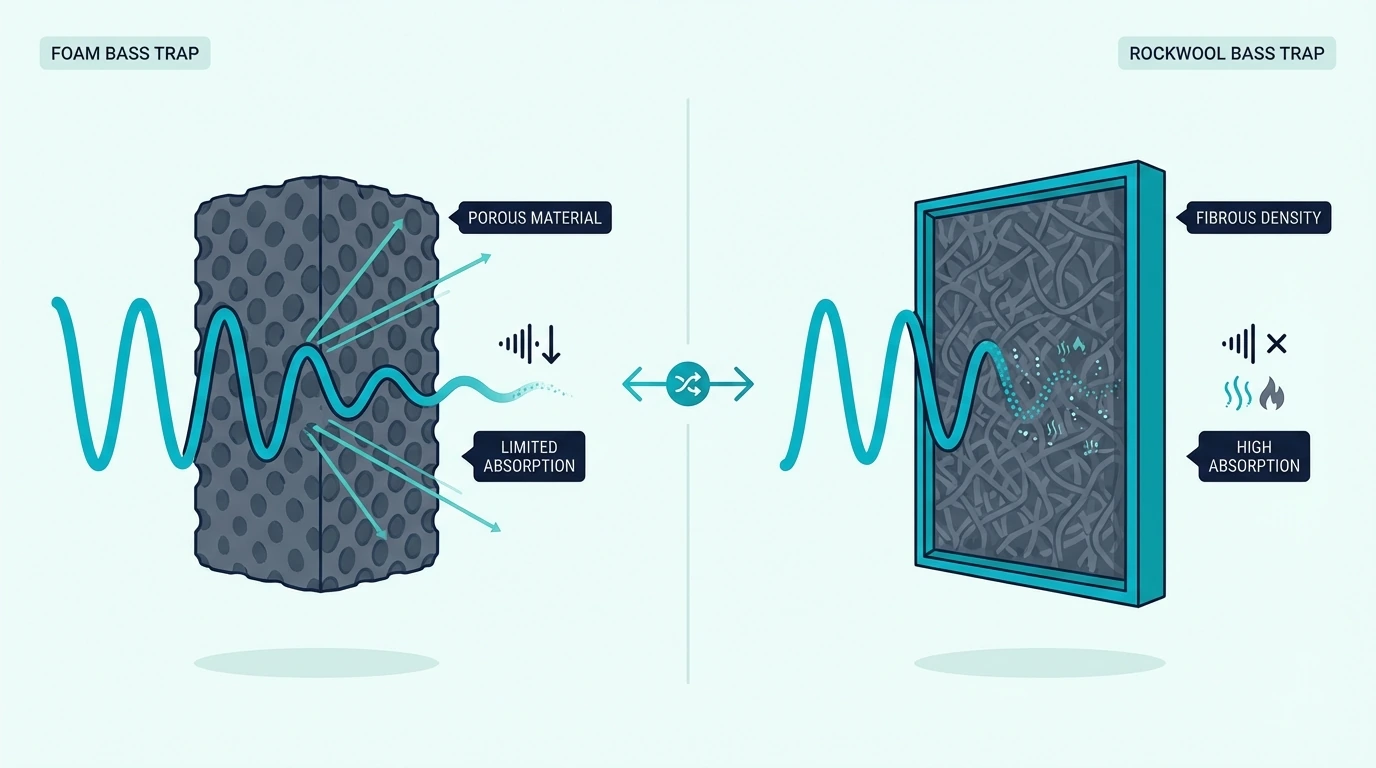
Rockwool (mineral wool) absorbs significantly lower frequencies than foam at the same thickness, and the reason comes down to density and airflow resistance.
Standard acoustic foam has a density around 1–2 lbs per cubic foot. Rockwool (like Roxul Safe’n’Sound or Rockwool ComfortBatt) runs 2.5–4 lbs per cubic foot, while rigid fiberglass panels (Owens Corning 703) sit around 3 lbs per cubic foot.
Higher density means more friction when air molecules vibrate through the material, which translates to more energy converted to heat — especially at lower frequencies where the air displacement is larger.
At 4 inches thick in a corner mount, here’s the practical comparison:
- Acoustic foam — NRC drops below 0.5 at 125 Hz and becomes negligible below 100 Hz, with an effective range of roughly 250 Hz and up.
- Rockwool/mineral wool — Maintains NRC above 0.6 at 125 Hz and still provides useful absorption at 80 Hz, extending the effective range to roughly 80–100 Hz.
- Rigid fiberglass (703) — Similar to rockwool performance, sometimes slightly better at the lowest frequencies due to optimized fiber structure.
For bass traps specifically, the right material choice is rigid fiberglass or mineral wool — not foam. Foam bass traps marketed as “corner traps” work as mid-frequency absorbers, but they don’t reach the frequencies where actual bass problems live.
A foam set like the JBER 4-Pack Foam Corner Bass Traps can still clean up 250–500 Hz muddiness and fluttery low mids in corners, but it is not a substitute for dense mineral wool when the problem lives below 125 Hz.
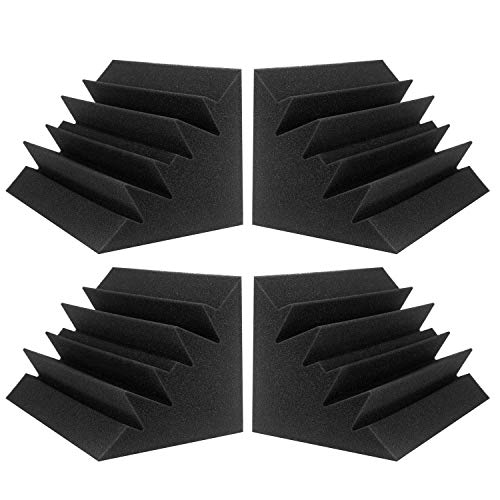
JBER 4-Pack Foam Corner Bass Traps
The Bottom Line
Bass traps absorb frequencies from roughly 20 to 300 Hz, but the specific range depends on trap type, thickness, and material. Porous absorbers handle the broadest range and reach lower with more depth, while resonant absorbers target narrow problem frequencies with surgical precision.
For most rooms, 4-inch mineral wool or rigid fiberglass in the corners covers the 80–300 Hz range where the biggest room problems live. If your room has severe modes below 80 Hz, you’ll need either thicker porous treatment or a tuned resonant absorber for that specific frequency.
Frequently Asked Questions
What is the lowest frequency a bass trap can absorb?
Tuned resonant absorbers (Helmholtz resonators and membrane traps) can target frequencies as low as 20–30 Hz. Porous absorbers in superchunk corner configurations typically reach down to about 50–60 Hz with meaningful absorption, while standard 4-inch panels bottom out around 100 Hz.
Do bass traps only work on bass frequencies?
Porous bass traps absorb across a broad frequency range — everything from their low-frequency cutoff through the entire midrange and high end. A 4-inch fiberglass panel absorbs bass, midrange, and treble simultaneously, which is why they’re called broadband absorbers.
Is rockwool good for bass traps?
Rockwool is one of the best materials for DIY bass traps. Its density (2.5–4 lbs/ft³) provides effective low-frequency absorption, it’s easy to work with for DIY builds, fire-resistant, and significantly cheaper than pre-made acoustic panels while delivering comparable or better performance.