Bass Traps For Small Room — Why Compact Spaces Need More Treatment, Not Less
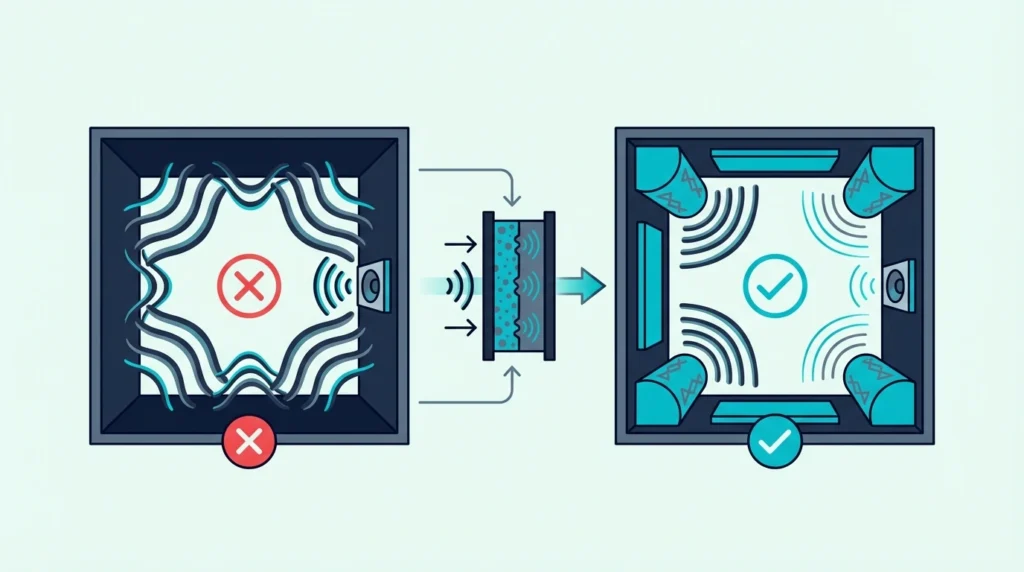
Bass traps for small room setups are counterintuitively more critical than in large rooms — but most people assume a small space needs less treatment, when the physics actually works in reverse. A 10×12 foot bedroom has room modes packed so tightly together in the bass range that untreated corners can boost certain frequencies by 15-20 dB, making accurate listening or mixing virtually impossible.
The challenge with small rooms isn’t just that bass problems are worse — it’s that floor space is precious, so every square inch of treatment needs to earn its place. Bulky corner traps that work perfectly in a large studio can eat up usable space in a bedroom or home office to the point where the room becomes impractical.
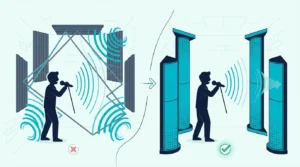
The solution is choosing space-efficient bass trap designs that maximize absorption while minimizing their physical footprint — straddled corner panels with air gaps, ceiling-edge traps that use otherwise dead space, and superchunk designs tucked into corners you weren’t using anyway.
Below, you’ll find why small rooms have the worst bass problems, how many traps you actually need, the most space-efficient designs, whether over-treatment is a real risk, and why commercial traps cost so much (plus cheaper alternatives).
Small rooms need more bass treatment per cubic foot than large rooms because their shorter dimensions create stronger, more closely spaced room modes. Treat all four vertical corners with 4-inch minimum thickness panels as the baseline, then add ceiling-wall edge traps. Use straddled corner panels (not flat-mounted) to maximize absorption depth without eating floor space.
Why Small Rooms Have The Worst Bass Problems
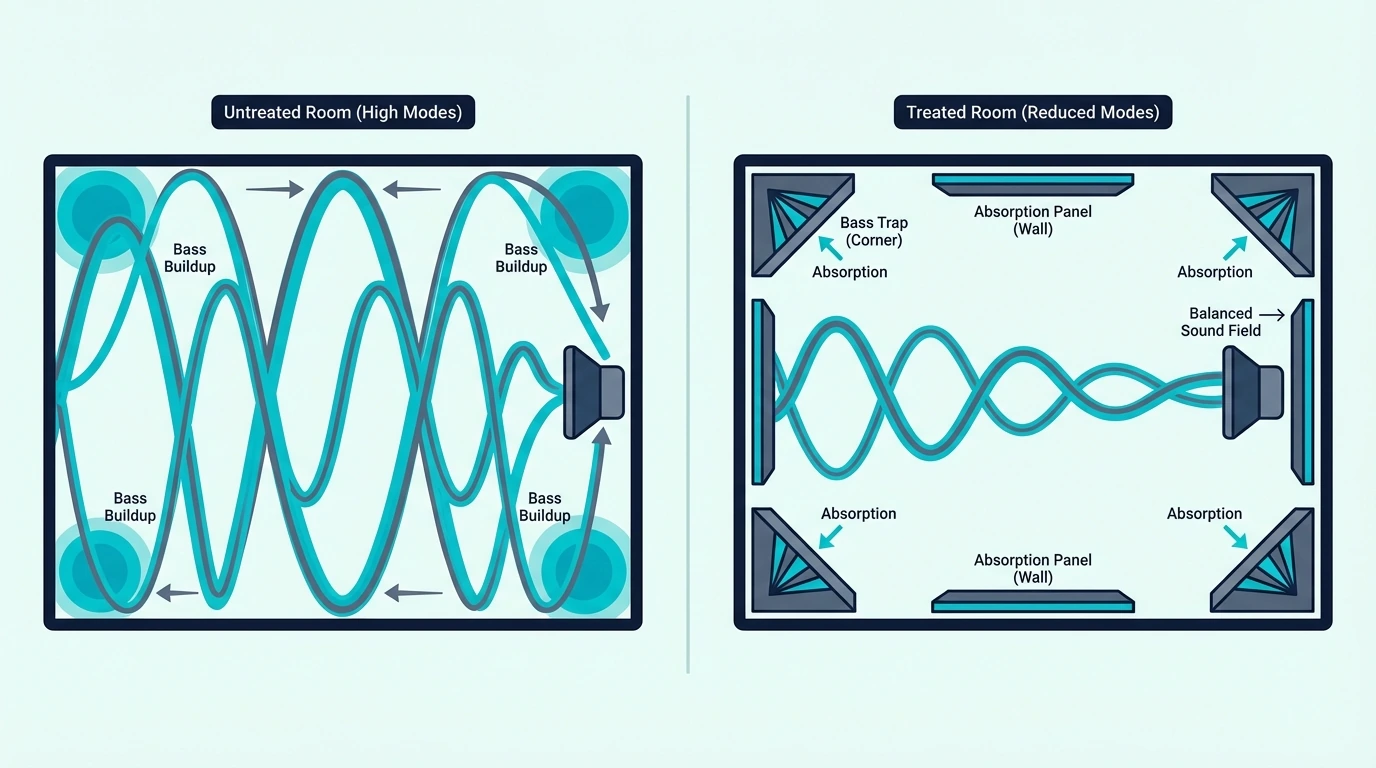
Room modes are standing waves that form between parallel surfaces, and their frequencies are determined by the distance between those surfaces. A 10-foot dimension creates a fundamental mode at approximately 56 Hz, with harmonics at 112 Hz, 168 Hz, and so on — all squarely in the bass range where bass traps absorb.
In a large room (say, 20×30 feet), the fundamental modes start lower and spread out more across the frequency spectrum. In a small room, the modes are crammed into a narrow band between 50 and 300 Hz, creating multiple overlapping peaks and nulls that make the bass response wildly uneven from one listening position to another.
The boundary effect compounds the problem — in a small room, you’re always sitting close to at least one wall, often within a quarter wavelength of the room’s worst modes. This proximity amplifies the bass peaks you hear at your listening position beyond what you’d experience in the same spot of a larger room.
Small rooms also have proportionally more corner length relative to their volume. A 10×12×8 foot room has 160 linear feet of edges (where walls, floor, and ceiling meet) packed into just 960 cubic feet — that’s a lot of high-pressure bass zones crammed into a tiny space.
How Many Bass Traps Does A Small Room Need?
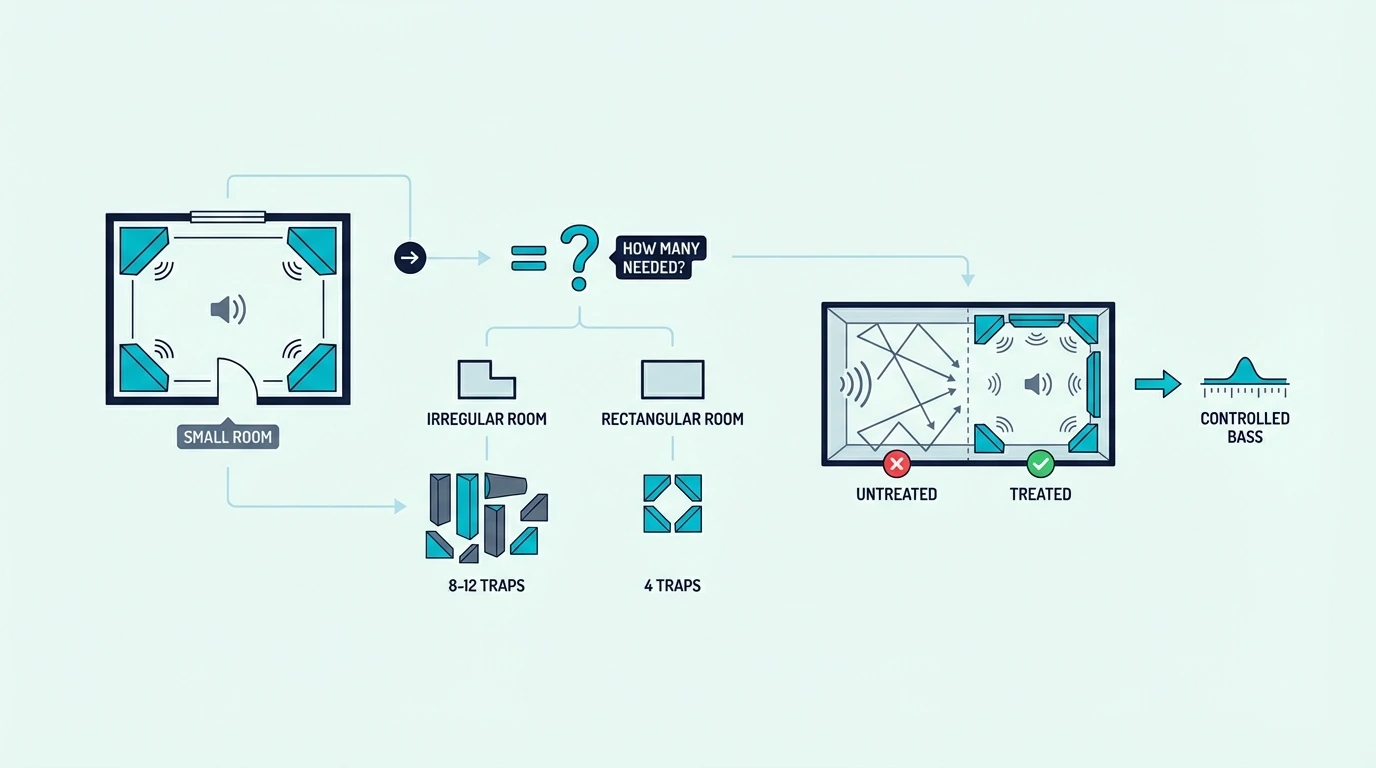
Small rooms need proportionally more treatment than large rooms, but the absolute number of traps is manageable because there are fewer corners and edges to treat. Here’s a practical framework based on room size.
Prioritizing Treatment In A Tight Space
When floor space is limited, prioritize treatments that use vertical and overhead space rather than floor area. Corner traps straddled at 45 degrees use the dead space behind them (which you couldn’t use for anything else) while keeping the room’s usable area intact.
Ceiling-wall edge traps mount in the 90-degree junction where the ceiling meets the wall — space that’s completely wasted otherwise. These positions are high-pressure zones for bass and treating them costs zero floor space.
Wall-mounted panels flat against the wall are the least space-efficient option for bass treatment. They take up wall space you might need for shelving, monitors, or equipment, and their bass absorption is limited without an air gap behind them.
Minimum Effective Treatment For A Small Room
4 corner traps + 2 ceiling edges = the minimum effective package. This covers the four vertical wall-to-wall corners (the strongest bass pressure zones) plus the two front ceiling-wall edges (where bass buildup affects your listening position most directly).
For a bedroom-sized room (roughly 10×12 feet), this minimum package requires: – 4 panels at 2×4 feet each for the vertical corners (straddled at 45 degrees) – 2 panels at 2×4 feet for the front ceiling edges
Total material cost for DIY builds: roughly $80-120 for all six traps. This level of treatment typically reduces the worst room mode peaks by 6-10 dB — enough to make a clearly audible improvement in monitoring accuracy.
Get Studio Tips Weekly
Join 5,000+ creators getting acoustic treatment advice every week.
No spam. Unsubscribe anytime.Best Bass Trap Designs For Small Rooms
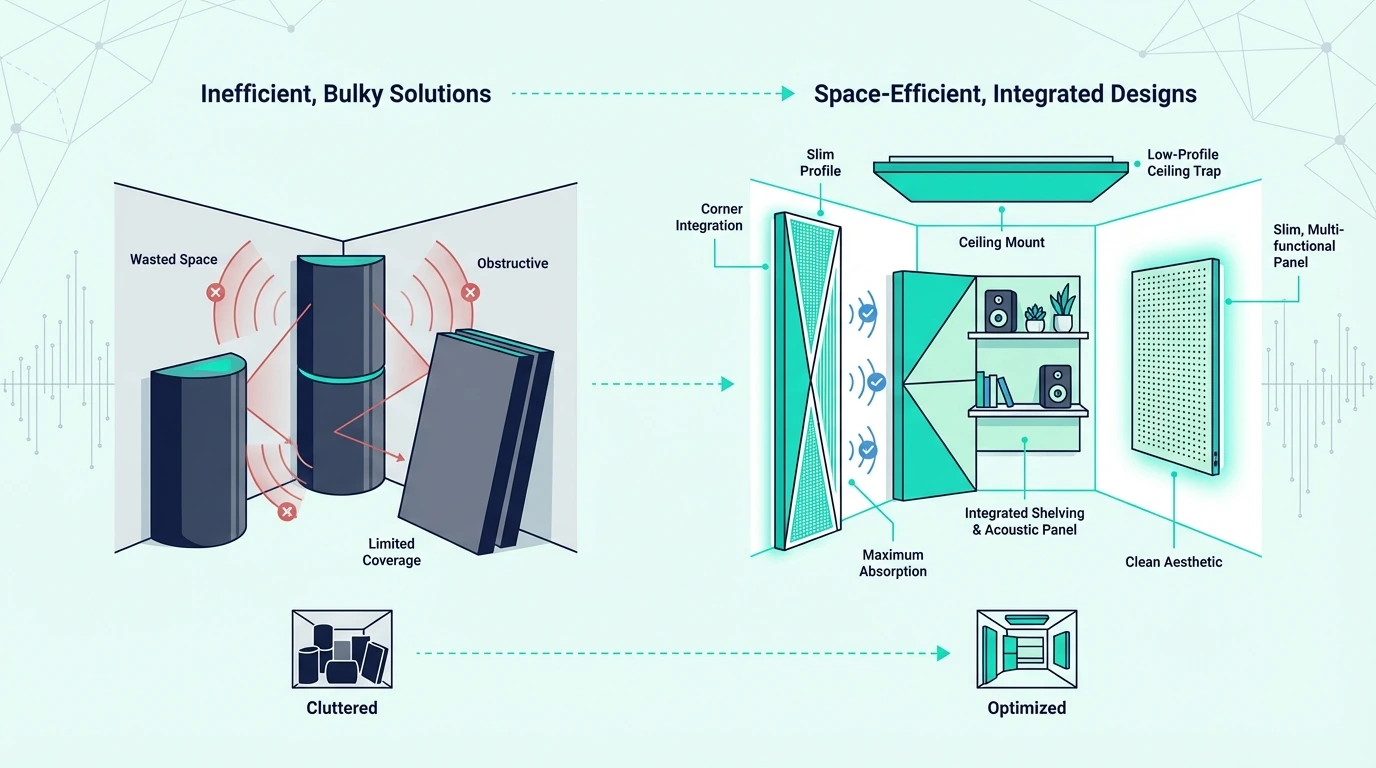
Space efficiency is the deciding factor for small room bass trap designs. The goal is maximum acoustic depth with minimum physical footprint.
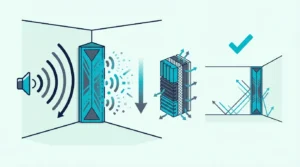
Straddled corner panels are the best overall choice for small rooms — a 4-inch panel mounted at 45 degrees across a corner creates an air gap of 8-12 inches behind it, giving you the acoustic equivalent of a 12-16 inch deep absorber while only projecting about 6 inches into the room from each wall. Install them with L-brackets or French cleats.
Superchunk corner traps fill the corner completely with triangular insulation wedges, creating the deepest possible absorber (17+ inches for a 24-inch batt). They take up more visible corner space than straddled panels, but the space behind a superchunk was unusable anyway — you’re converting dead corner volume into acoustic treatment.
Ceiling cloud panels hung 2-4 inches below the ceiling absorb bass at the ceiling boundary without touching the walls or floor. In a small room where wall and floor space is at a premium, ceiling-mounted traps are the most space-efficient option after corner traps.
Avoid freestanding bass traps or floor-to-ceiling tube traps in small rooms — they consume floor area that you need for furniture, equipment, or simply moving around. Every trap in a small room should mount to a wall, corner, or ceiling.
Can You Over-Treat A Small Room?
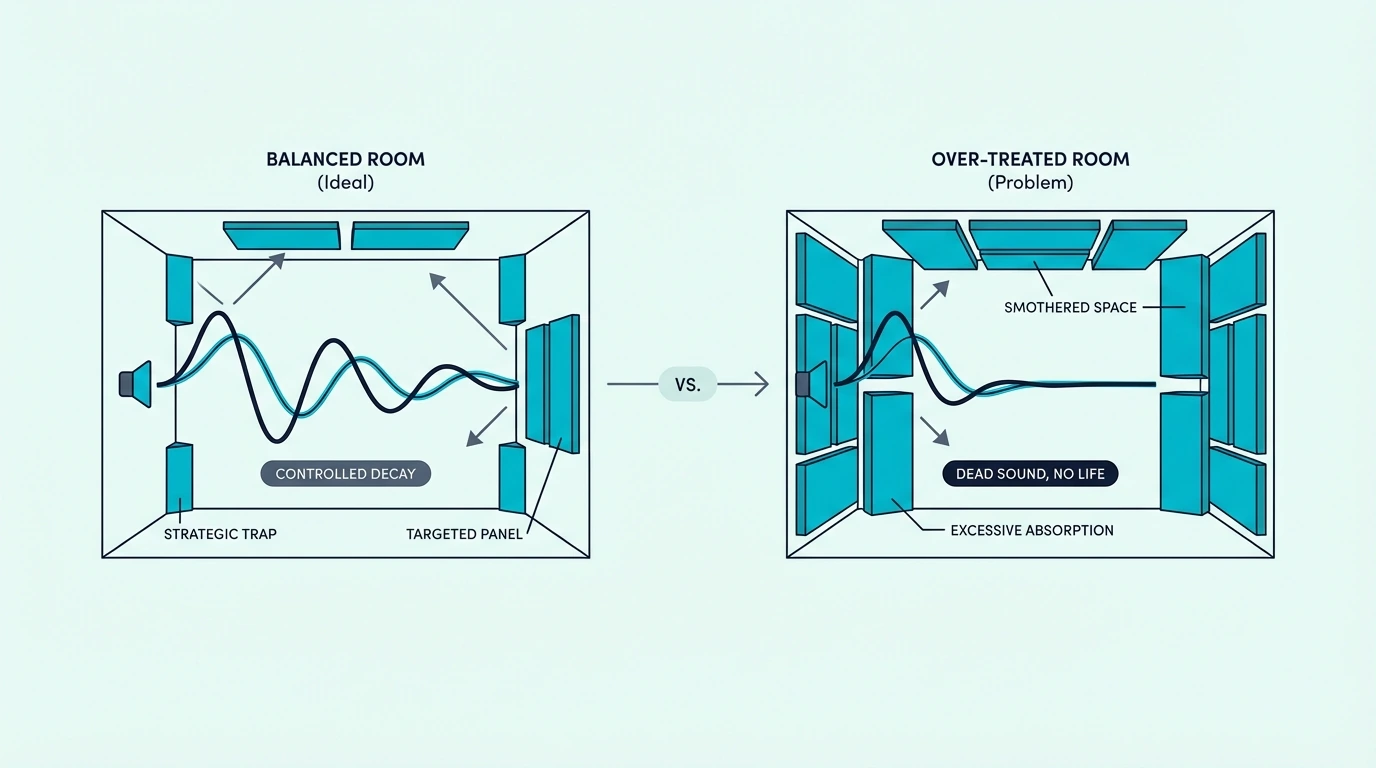
Over-treating a small room with bass absorption is a real risk, and the result is a room that sounds uncomfortably dead — conversations feel muffled, music loses its energy, and the space becomes fatiguing to work in for extended periods.
The rule of thumb is to leave at least 40-50% of your wall and ceiling surface area untreated (or treated with reflective/diffusive elements rather than absorption). Bass traps in corners and edges are fine because those surfaces were already acoustically “dead” zones, but covering large flat wall areas with thick absorption panels can overdamp the room’s natural reverb.
Signs of over-treatment include speech sounding unnaturally dry (no room ambiance at all), clapping producing almost no audible reflection, and a feeling of “pressure” or discomfort when spending time in the room. If you notice these symptoms, remove some flat-wall panels while keeping the corner traps in place.
The ideal balance for a small room is heavy corner treatment (all four corners plus ceiling edges) combined with minimal flat-wall absorption — perhaps just first reflection point panels on the side walls. This addresses the bass modes without killing the room’s natural liveness.
Why Are Bass Traps So Expensive?
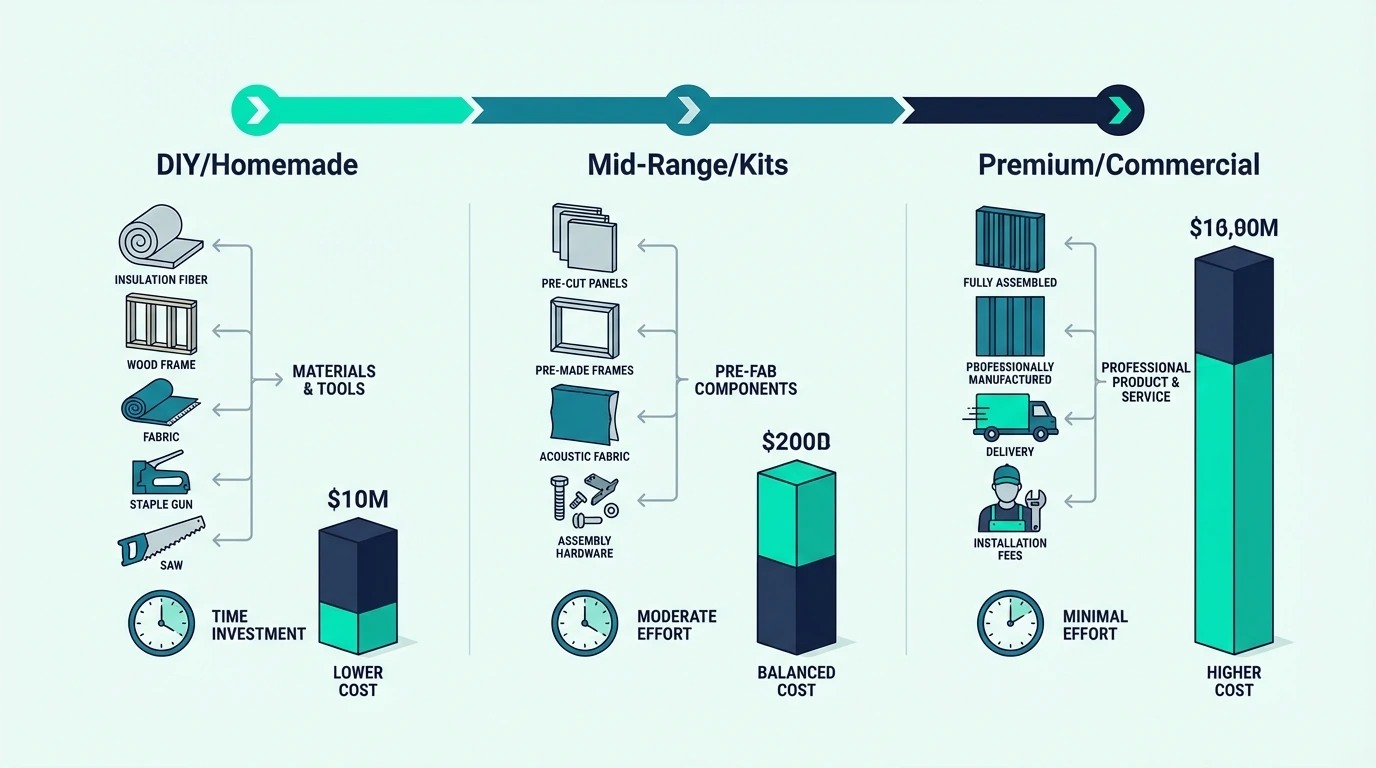
Commercial bass traps from brands like GIK Acoustics, Primacoustic, and RealTraps add up fast when you need 4-8 of them. The cost comes from three factors: materials, labor, and shipping.
The insulation material itself (mineral wool or rigid fiberglass) is the cheapest component — roughly $5-15 per panel worth of material. The frame, professional-grade fabric wrapping, and hardware add $30-50 in materials, and the skilled labor to build a clean, consistent product adds another $30-50.
Shipping is often the biggest surprise — a 2×4 foot, 4-inch thick panel weighs 10-15 lbs and can’t be folded or compressed, so it ships as a large, heavy box. Freight costs for a set of 4-6 panels can easily exceed $50-100.
Building your own bass traps eliminates the labor and shipping costs entirely. A DIY panel using the same insulation and a simple lumber frame costs $15-40 per trap versus $150+ commercial — roughly one-third the price for identical acoustic performance.
If DIY isn’t an option, foam bass traps offer a budget middle ground. The 4 Pack Bass Traps for Ceiling Corner covers four corners in one pack.
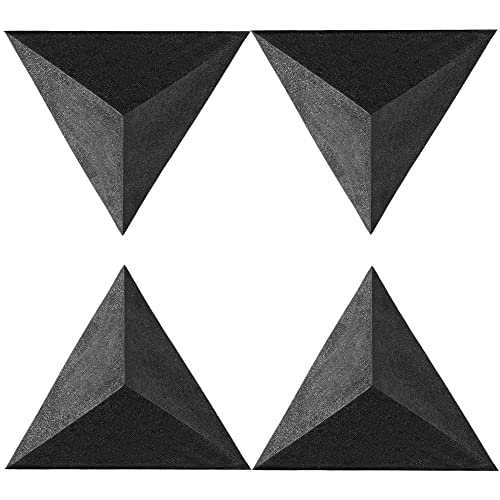
4 Pack Bass Traps for Ceiling Corner
For comprehensive corner coverage, the 8 Pack Bass Traps Acoustic Foam Corner provides enough pieces for all four vertical corners in a small room.
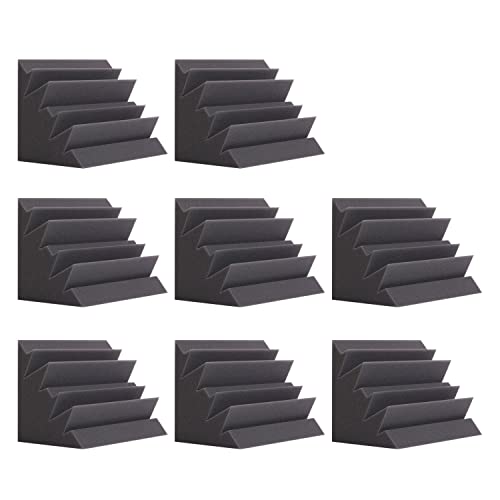
8 Pack Bass Traps Acoustic Foam Corner
The Bottom Line
Bass traps for small rooms are more important than in large spaces because compact dimensions create stronger, more densely packed room modes that wreck bass accuracy. Treat all four vertical corners and at least two ceiling-wall edges as the minimum effective package, using straddled corner panels to maximize acoustic depth without sacrificing floor space.
Four-inch minimum thickness mineral wool or fiberglass is the performance baseline — thinner panels and foam help with mids and highs but won’t address the bass modes that cause the worst problems in small rooms. Budget $80-120 for a complete DIY treatment package, or look at foam alternatives if construction isn’t practical.
Frequently Asked Questions
What size bass traps for a small room?
Standard 2×4 foot panels at 4-inch minimum thickness work well in small rooms when straddled across corners. For maximum bass absorption in tight spaces, superchunk corner traps (triangular insulation wedges stacked floor-to-ceiling) reach deeper into the bass range than any panel design.
Do small rooms need more or fewer bass traps?
Small rooms need more bass treatment per cubic foot than large rooms because their shorter dimensions create stronger room modes concentrated in the bass range. A 10×12 foot room needs at least 4 corner traps and 2 ceiling-edge traps (6 total) to achieve meaningful bass control — proportionally more coverage than a room twice its size.
Can furniture help with bass in a small room?
Heavy furniture like bookshelves, couches, and upholstered chairs absorbs some mid-frequency energy and breaks up flutter echo, but furniture doesn’t meaningfully absorb bass frequencies below 200 Hz. Furniture helps with general room acoustics, but it can’t replace proper bass traps for treating room modes.