Does Wood Absorb Sound? Why Most Wood Reflects It
The new oak floor and pine paneling look warm, but every footstep and every word now rings around the room, so does wood absorb sound at all?
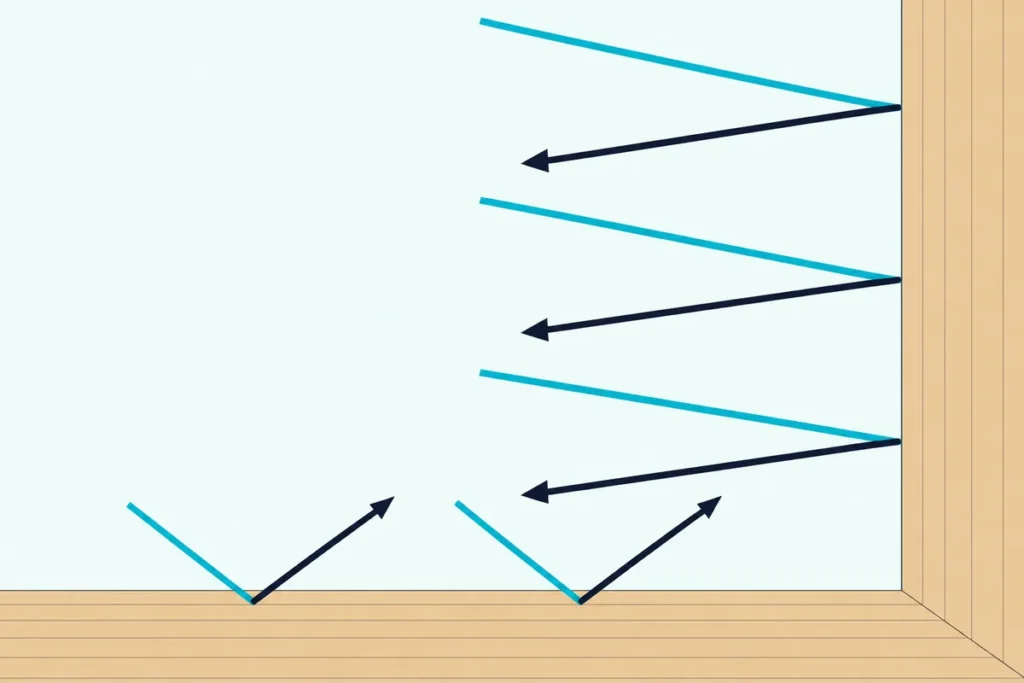
Wood is dense and stiff, and a stiff surface hands most of the sound straight back to you.
In a 2025 tube test, an 11 mm fir board absorbed just 3% of the sound at 250 Hz and 9% at 1,500 Hz, and wood blocks less sound than brick or concrete of the same thickness.
This guide uses that test, a 2023 grain study, HUD’s transmission loss tables and the makers’ own panel data sheets to show what wood does, what it can’t do and how to make it help.
Start with the numbers for plain wood, because every other answer builds on them.
Does Wood Absorb Sound?
Those numbers answer it plainly: bare wood absorbs very little, and the 11 mm fir board in the 2025 tube test took in 3% of the sound at 250 Hz, 7% at 1,000 Hz and 9% at 1,500 Hz (Krhen et al.).
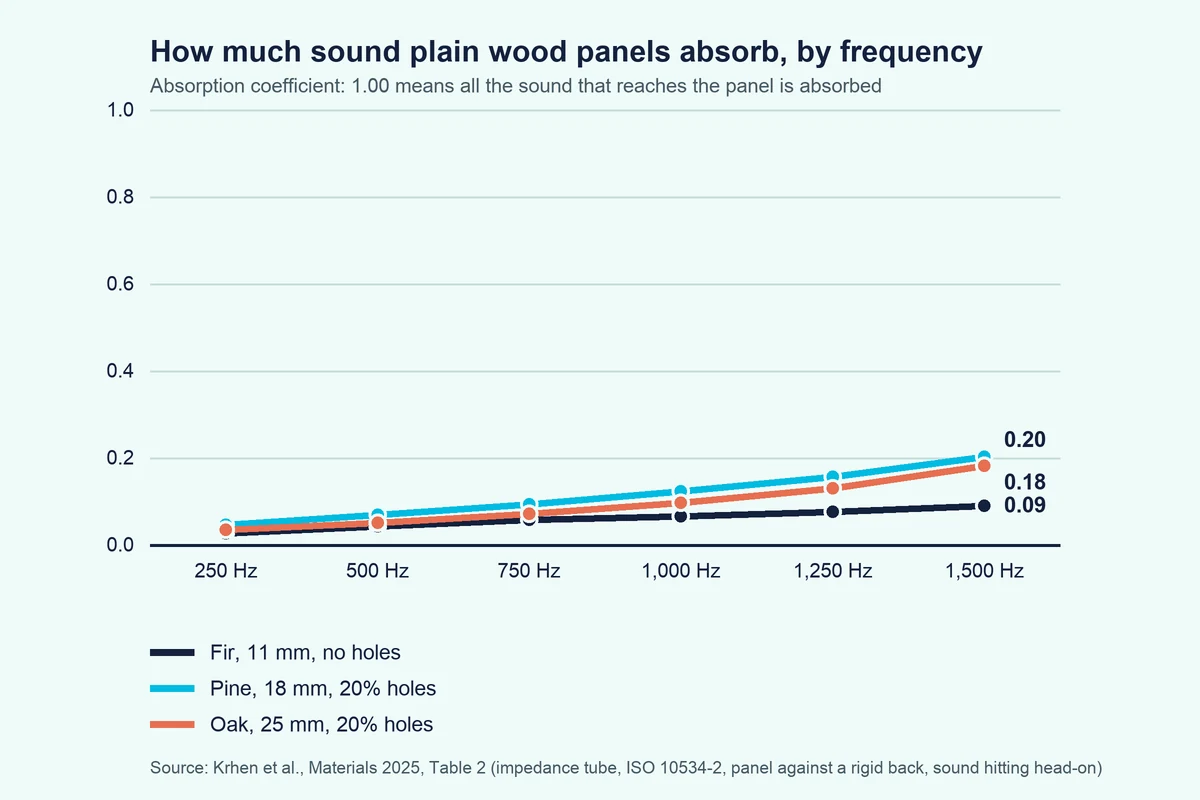
An absorption coefficient is the share of the sound a surface takes in, so 0.09 means 9% absorbed and the other 91% bounced back into the room.
| Wood panel tested | 250 Hz | 500 Hz | 1,000 Hz | 1,500 Hz |
|---|---|---|---|---|
| Fir, 11 mm, no holes | 0.03 | 0.04 | 0.07 | 0.09 |
| Pine, 18 mm, 20% perforation | 0.05 | 0.07 | 0.12 | 0.20 |
| Oak, 25 mm, 20% perforation | 0.03 | 0.05 | 0.10 | 0.18 |
Even with 20% perforation, the thicker pine and oak panels reached only 0.20 and 0.18 at 1,500 Hz.
The sample sat against a rigid back inside a 100 mm tube and the sound hit it head-on, so treat these as material numbers rather than a forecast for a paneled room.
NRC averages the absorption at 250, 500, 1,000 and 2,000 Hz into one number from 0.00 to 1.00, USG says it’s tested per ASTM C423, and our NRC rating explainer shows how to read it.
For scale, Kirei’s spec sheet rates its 9 mm felt NRC 0.97 over 2 in of fiberglass, and our felt soundproofing guide shows how thickness and gaps change that number.
Why Does a Room Full of Wood Sound So Lively?
Because plain wood returns most of the sound, a room finished in it behaves like the hard-surfaced rooms USG describes, where reflective walls and floors such as glass, painted drywall and tile make a space more reverberant.
USG says porous materials such as glass fiber or mineral fiber insulation absorb efficiently while non-porous ones such as stone or gypsum board tend to reflect, and the 3% to 20% absorption in the tube test puts wood on the reflecting side of that line.
So soft furnishings and absorbing panels have to supply the porous surfaces a wood room lacks.
Lively isn’t always a flaw, though, since naturallywood.com says wood is often chosen over steel, concrete and glass for concert halls, classrooms and lecture theatres.
It also lists sound deflection among wood’s acoustic uses and says wood produces sound when struck and amplifies or absorbs sound waves, which is why instruments are made from it.
So reflection suits a hall that wants to carry sound, and it only becomes a problem in a room where you want clarity and quiet.
Get Studio Tips Weekly
Join 5,000+ creators getting acoustic treatment advice every week.
No spam. Unsubscribe anytime.Which Wood Absorbs the Most Sound?
That 3% to 20% range depends on the wood, because density is a primary predictor in the 2025 test: fir and pine, the lighter woods, absorbed more than oak, especially above 750 Hz (Krhen et al.).
| Wood | Density in the test | Absorption above 750 Hz |
|---|---|---|
| Fir | 349 to 431 kg/m³ | Higher |
| Pine | 459 to 497 kg/m³ | Higher |
| Pedunculate oak | 607 to 634 kg/m³ | Lower |
| Sessile oak | 686 to 724 kg/m³ | Lower |
Lower density means more porosity, and porous wood lets more sound in to be turned into heat, which is why the lightest species come out ahead.
Thickness is the next lever: the 18 and 25 mm panels absorbed more than the 11 mm ones, with the clearest gains between 750 and 1,000 Hz.
Holes help up to a point, since the 10% and 20% perforated panels performed about the same and 20% didn’t reliably beat 10%.
The face the sound hits matters as well: in a 2023 test of 11 mm spruce and maple discs, NRC ran from 0.08 to 0.20 depending on the face and on the study’s anatomical quality grade, A or D (Guiman et al.).
| 11 mm disc, NRC | Radial face | Tangential face | End grain |
|---|---|---|---|
| Class A spruce | 0.13 | 0.15 | 0.20 |
| Class D spruce | 0.18 | 0.16 | 0.15 |
| Class A maple | 0.12 | 0.13 | 0.14 |
| Class D maple | 0.08 | 0.10 | 0.17 |
Class A spruce swung the most, with its end grain at 0.20 against 0.13 for its radial face, and even that best case leaves about 80% of the sound bouncing back.
Low frequencies are the exception to all of it, because at 250 Hz, the lowest band tested, absorption stayed low whatever the species, thickness or perforation.
So the best absorbing wood is the lightest, thickest, lightly perforated board, and even that needs something soft behind it to matter.
Is Wood a Good Sound Insulator?
That covers absorbing, but insulating means blocking sound between rooms, and wood’s light weight limits it: HUD’s Noise Guidebook lists 1 in of fir at 20 dB of transmission loss, 1 in of pine at 19 and 1 in of plywood at 23, against 40 for 4 in of dense concrete (HUD).
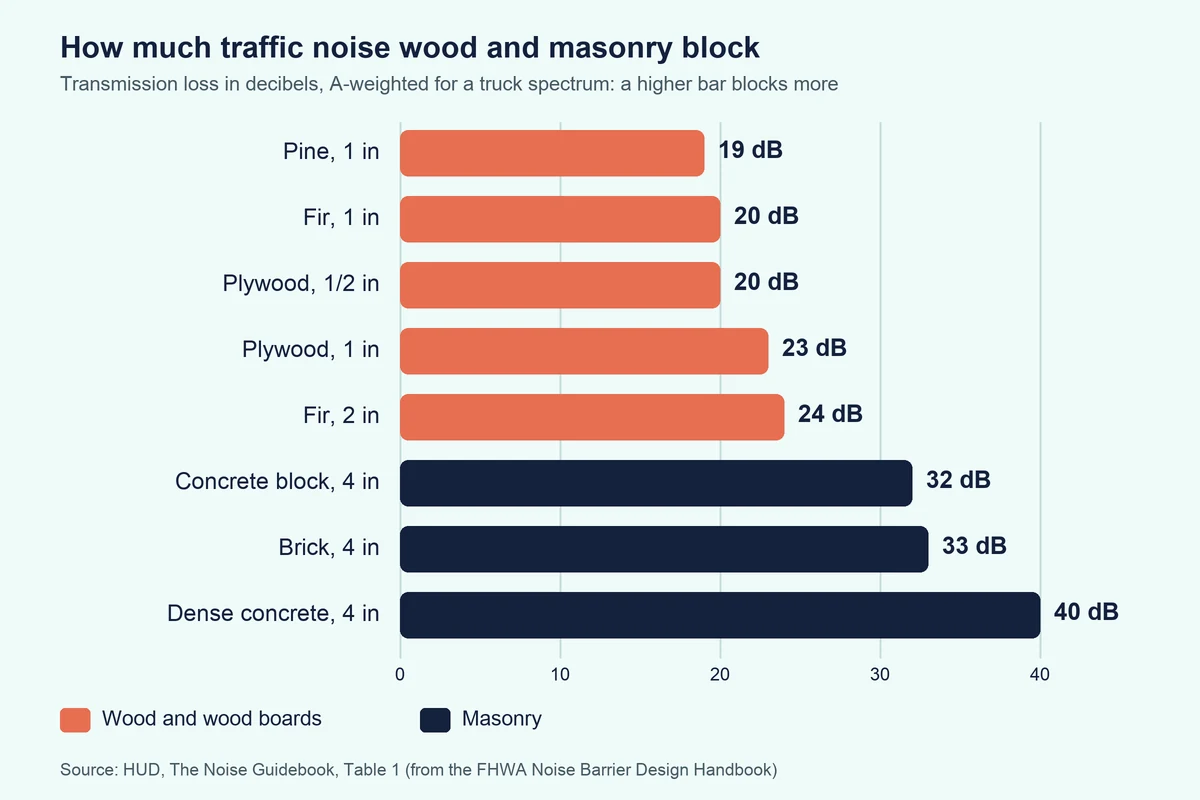
Those are A-weighted figures for a truck-noise spectrum rather than STC ratings, but they rank the materials on one scale.
HUD’s rule explains the gap: the denser the wall material, the more noise it reduces, so concrete walls insulate better than wood walls of equal thickness (HUD).
Thickness helps, but slowly: fir blocks 17 dB at 1/2 in, 20 dB at 1 in and 24 dB at 2 in, and HUD says doubling a partition’s thickness can cut sound by as much as 6 dB.
Even 2 in of fir, at 24 dB, blocks less than 4 in of concrete block, at 32.
Is Wood Soundproof?
Because blocking depends on mass, air spaces and seals, a wood-frame wall’s rating comes from how it’s built, not from the lumber.
HUD’s wall figure rates a common stud wall at STC 35, a staggered-stud wall at 39 and a staggered-stud wall with an absorbent blanket at 43, against 40 for a 4 in brick wall and 52 for a 7 in concrete wall (HUD).
| Wall in HUD’s figure | STC |
|---|---|
| Common stud wall | 35 |
| Staggered-stud wall | 39 |
| Staggered-stud wall with absorbent blanket | 43 |
| 4 in brick wall | 40 |
| 7 in concrete wall | 52 |
So a well-built wood wall can match a 4 in brick wall, but mass still pays: a 2×4 frame wall with siding, sheathing, insulation and drywall rates 39 in HUD’s table of tested examples, and a similar frame with a brick veneer rates 56.
“Soundproof” still overstates it, because every opening undoes the wall: HUD says a one-inch square hole or a 1/16 in crack 16 in long takes a 50 STC wall down to 40.
Two inexpensive changes help a wood frame: HUD says 24 in stud spacing adds 2 to 5 dB of STC over the common 16 in spacing, and resilient clips or layers can raise it by 2 to 5 dB by keeping nails from tying the panels to the studs.
The blanket in that STC 43 wall can be mineral or rock wool, fiberglass, hair felt or wood fibers, which HUD says can cut noise by as much as 10 dB in relatively lightweight construction.
Doors are the usual weak point, since HUD rates the common hollow-core wood door at STC 17, enough to drop a 48 STC wall to 24 when the door takes up about 20% of it, while a well-sealed solid-core wood door with a vinyl seal and carpet leaves the same wall at 33.
HUD’s table of tested components, drawn from National Bureau of Standards data, rates a solid-core wood exterior door at STC 27 with brass weatherstripping and 34 with plastic weatherstripping and an aluminum storm door, and a wood French door at 26.
Our guide to soundproofing a hollow door starts with the gaps that drag those ratings down.
The wood industry makes a similar point: naturallywood.com says wood buildings can match steel and concrete for privacy with proper design, and that mass timber needs added mass, noise barriers or decouplers to get there.
Which Wood Is Best for Soundproofing?
That depends on the job, and for blocking sound the species barely matters.
In HUD’s table, 1 in of fir blocks 20 dB, pine 19, redwood 19 and cedar 18, so the whole spread between species is 2 dB.
| Material in HUD’s Table 1 | 1/2 in | 1 in | 2 in |
|---|---|---|---|
| Fir | 17 dB | 20 dB | 24 dB |
| Pine | 16 dB | 19 dB | 23 dB |
| Redwood | 16 dB | 19 dB | 23 dB |
| Cedar | 15 dB | 18 dB | 22 dB |
| Plywood | 20 dB | 23 dB | not listed |
| Particle board | 20 dB | not listed | not listed |
| Masonite | 20 dB | not listed | not listed |
Adding thickness beats switching species: going from 1 in to 2 in of fir adds 4 dB, twice the gap between the best and worst species.
Engineered boards do a little better per inch, since 1 in of plywood blocks 23 dB and 1/2 in of plywood, particle board and Masonite all block 20.
For absorbing, the advice reverses: pick the lighter, more porous species, such as fir or pine, because they absorbed more than oak in the tube test.
In practice no wood does the soundproofing: the studs hold the wall up, and staggered studs, an absorbent blanket in the cavity and sealed edges do the work, as in HUD’s STC 43 wall.
Does Wood Paneling Soundproof a Wall?
These numbers explain why thin paneling adds so little: HUD says doubling a partition’s thickness can cut sound by as much as 6 dB, and a thin layer of wood over an existing wall is nowhere near a doubling.
What paneling does change is the sound inside the room, and only when it isn’t solid: slotted or perforated wood over felt or mineral wool absorbs, while a plain plank wall reflects.
If the goal is a quieter room next door, spend first on the leaks and the door, because a one-inch hole costs a 50 STC wall 10 points, more than doubling the wall’s thickness could give back.
Can Wood Panels Absorb Sound With Something Behind Them?
Once something porous sits behind the wood, the picture changes, and the makers’ own data sheets show how much.
ASI’s Wood Slat Wall, a 12 mm MDF panel with a 9 mm recycled-fiber felt backing, lists NRC 0.54 to 0.90, and Armstrong’s perforated WoodWorks wall panels list 0.30 to 0.65 depending on the perforation and the backing.
Armstrong’s sheet shows N/A for the unperforated version of the same panel.
Compare numbers only when the mounting matches: Armstrong’s sheet names its two setups, D-20 with acoustical fleece and C-20 with 1 in of fiberglass infill, while ASI’s range doesn’t say which mounting gives which value.
| Form of wood | NRC | Where the absorbing comes from |
|---|---|---|
| Solid spruce and maple discs, 11 mm | 0.08 to 0.20 | The wood itself |
| Perforated veneer panel over fleece or 1 in fiberglass | 0.30 to 0.65 | Perforations plus the backing |
| Felt-backed MDF slat panel | 0.54 to 0.90 | Gaps between slats plus 9 mm of felt |
| Wood fiber board | 0.40 to 1.00 | The fibers, depending on mounting |
Wood fiber is the exception that absorbs by itself: Armstrong’s Tectum wall panel lists NRC 0.40 on its A mounting and up to 1.00 on its C-40 mounting, so even wood fiber depends on how it’s mounted.
naturallywood.com adds that the air gap between the insulation and the fabric improves the acoustic performance of fabric-wrapped wood-frame panels.
For a slat panel that shows its numbers, the TONOR 4-pack covers 31 square feet with 2 by 4 foot panels.
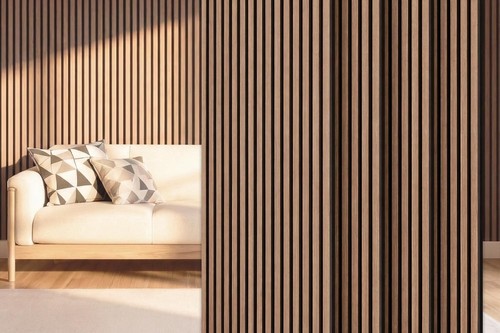
the TONOR 4-pack
For narrower slats and the highest documented number, the Art3d 6-pack covers about 31.5 square feet.
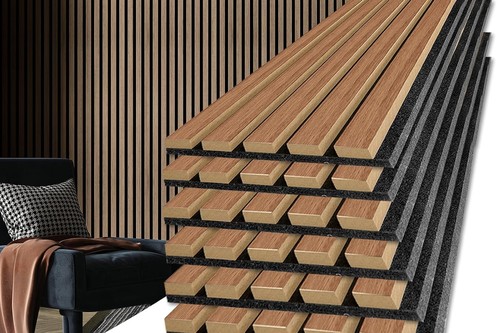
the Art3d 6-pack
Those two are the best documented of the four sets in our guide to slat wall panels, which also covers mounting them on concrete.
What Should You Use Instead of Wood?
If wood isn’t the answer, the fix depends on what the noise is doing, so match the material to the job.
| Your problem | Use instead | Why |
|---|---|---|
| Echo in a lively room | Mineral wool or fiberglass panels, or thick felt | Porous material absorbs, while plain wood reflects |
| Noise through a wall | Staggered studs, an absorbent blanket in the cavity and sealed edges | HUD’s wall figure rises from STC 35 to 43 |
| Noise through a door | A solid-core door with seals | HUD: a hollow-core door drops a 48 STC wall to 24, a sealed solid-core door to 33 |
| A wood look with less echo | Felt-backed slat panels | ASI lists NRC 0.54 to 0.90 |
Mineral wool is the usual filler for both jobs, and our rockwool soundproofing guide shows what it does and doesn’t do inside a wall.
The Bottom Line
Wood reflects most of the sound that hits it, absorbs only when it’s porous, perforated or backed by something soft, and blocks less than the same thickness of masonry.
Pick lighter, thicker boards for a little absorption, build the wall with staggered studs and an absorbent blanket for less noise next door, and seal every gap either way.
Frequently Asked Questions
Does wood absorb sound?
Only a little. In a 2025 tube test an 11 mm fir board absorbed 3% of the sound at 250 Hz and 9% at 1,500 Hz, and the perforated pine and oak panels reached just 0.20 and 0.18 at 1,500 Hz (Krhen et al.).
Does wood reflect sound?
Mostly, yes. The test’s authors note that stiff wooden panels backed by a rigid surface act predominantly as reflectors, so a room finished in plain wood still echoes (Krhen et al.).
Is wood a good sound insulator?
Not by itself. HUD lists 1 in of fir at 20 dB of transmission loss against 40 dB for 4 in of dense concrete, though a staggered-stud wall with an absorbent blanket reaches STC 43 (HUD).
Is wood soundproof?
No. A wood-frame wall rates STC 35 to 43 in HUD’s examples, and a one-inch hole takes a 50 STC wall down to 40.
What is the best wood for soundproofing?
None stands out. One inch of fir, pine, redwood and cedar blocks 20, 19, 19 and 18 dB in HUD’s table, so thickness and sealed edges matter more than species.
Does thicker wood block more sound?
Yes, but slowly. Fir blocks 17 dB at 1/2 in, 20 dB at 1 in and 24 dB at 2 in in HUD’s table, and HUD says doubling a partition’s thickness can cut sound by as much as 6 dB.
Does wood paneling soundproof a wall?
Not much. A thin layer is nowhere near the doubling HUD says it takes for as much as 6 dB, so sealing gaps and adding mass do more, and only slotted or perforated wood over felt or mineral wool absorbs echo.
Do wood slat panels absorb sound?
Yes, because of what’s behind them. ASI lists NRC 0.54 to 0.90 for its felt-backed slat panel and Armstrong lists 0.30 to 0.65 for perforated wall panels over fleece or fiberglass.
Does wood absorb bass?
Not in the 2025 test, which started at 250 Hz and found low absorption there for every species, thickness and perforation. Absorbing deeper bass takes thick porous material: Kirei’s spec sheet lists its 9 mm felt at 0.82 at 125 Hz over 2 in of fiberglass.
Why does a wood room sound echoey?
Because plain wood reflects most of the sound, like the glass, painted drywall and tile that USG says make a space more reverberant, and only porous surfaces bring the echo down.
Does wood amplify sound?
In instruments, yes: naturallywood.com says wood produces sound when struck and amplifies or absorbs sound waves. In walls, HUD warns against constructions that can vibrate at audible frequencies and transmit exterior sound.