Reverberation time (RT60) calculator
How echoey is my room?
Answer three questions. You get how long a sound takes to die away in your room.
How long echoes last
1.28 seconds
That is echoey for a living room or home cinema: aim for 0.5 to 0.8 seconds.
What to do with thisWhat your number means
RT60 is how long a sound takes to die away after it stops; here it is read in the middle of speech. Lower means less echo, and the right number depends on what the room is for. One number can hide a bass problem: "Band by band", under More detail, shows the low notes too.
What to do with this
-
Treat the room
-
What to buy
At this number the room needs no more echo treatment. If it sounds dead, a diffuser brings some life back: sound diffusers.
As an Amazon Associate, we earn from qualifying purchases. How we earnPanels and traps for a room
Every pick: Best Acoustic Treatment Kits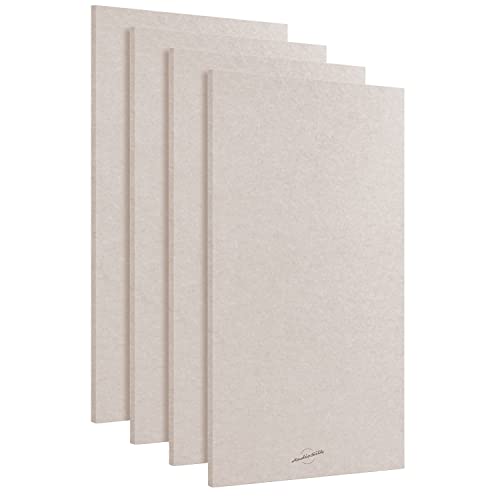 Best Overall Kit4-Pack Room Kit (46 x 23 in)
- Sold as a room kit with mounting hardware included so no separate purchases needed
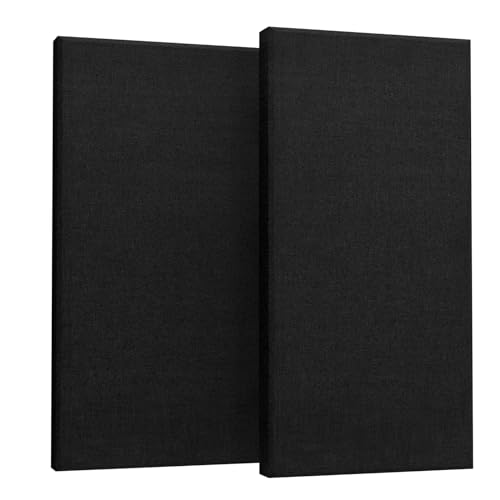 Best Large-Format KitUMIACOUSTICS 2-Pack Large Panels (47.2 x 23.6 in)
- Large panel size covers significant wall area with just two panels reducing installation time
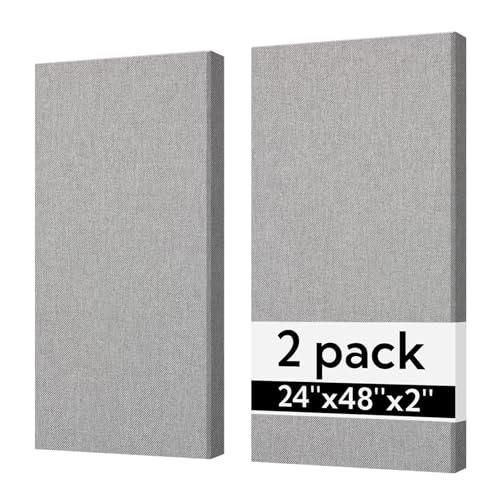 Best Ceiling Cloud KitOlanglab Sound Absorbing Panels 2-Pack (47.2 x 23.6 in)
- Large panels simplify ceiling cloud or rear wall installation where big coverage matters
-
Next
How many acoustic panels does my room need?Acoustic panel calculatorWhere do the panels go in my room?Placement plannerEvery acoustic treatment guide
Good to know
- This is an estimate, not a measurement.
- The deepest bass is where the estimate is least reliable.
- It cannot hear a flutter echo between two bare, parallel walls.
How this works
Estimate how long sound lingers in your room — across all six octave bands, not just one.
Sabine + Eyring formulas · 125 Hz – 4 kHz · Live update, no sign-up
How to use it. Enter your room, pick the materials on each surface, and we’ll tell you how reverberation breaks down across six octave bands. A single RT60 number hides most of the story — bass builds up differently from treble, and treatment has to be designed around that.
How to read your result
RT60 — reverberation time — is the number of seconds a sound takes to decay by 60 dB after the source stops. Lower number, shorter echo. Higher number, more lingering reflection. The “right” RT60 depends entirely on what the room is for.
- 0.3–0.5 s — studio, mix room, voice booth. Tight, controlled, good for critical listening. At the low end it starts to feel oppressive.
- 0.5–0.8 s — living room, home cinema, home studio. Lively enough to feel natural, short enough for dialogue to stay clear.
- 0.8–1.2 s — untreated apartment, hardwood room with minimal furnishing. Slightly echoey; you notice it most on speech and sparse music.
- > 1.2 s — problem territory. Kitchens, bathrooms, empty offices. Mixes won’t translate; speech intelligibility drops.
But these targets apply to RT60 at 500 Hz. The bigger story is the shape of the curve across bands. A room that sits at 0.55 s at 500 Hz but 1.4 s at 125 Hz is not a good room — it has a bass problem that a single number won’t show. That’s why this calculator gives you six numbers, not one.
What this estimator can’t tell you
RT60 is about reverberation — the diffuse decay of sound averaged across the room. It doesn’t tell you about:
- Room modes and bass nulls. Below ~200 Hz, a room doesn’t behave as a diffuse field at all. Standing waves dominate, and your listening position matters more than your RT60. Use a room-mode calculator for those.
- Flutter echo. Two parallel hard surfaces produce a rapid, pitched echo that RT60 averages out. You hear it instantly; the number won’t flag it.
- Frequency response at your chair. RT60 is a room-wide average. The pressure response at your listening position can be dramatically different — and is the thing that actually reaches your ears.
Sabine’s formula assumes a diffuse sound field and uniform absorption distribution. For typical rectangular home rooms it’s accurate to roughly ±15% above Schroeder frequency. The estimator automatically switches to Eyring when average absorption is high, and to Millington-Sette when absorption is concentrated on one or two surfaces. Below Schroeder (the modal regime) the bars are hatched because no diffuse-field formula is reliable there — use a room-mode calculator for that band.
Material references & sources
Every α coefficient in this calculator is drawn from one of the references below. Values are representative composites — real-world batch variation is typically ±10–15%. Where a specific product is known to deviate materially, we note it in the relevant article.
If you have a product datasheet or chamber measurement that disagrees meaningfully with a value above, send it in. We’ll update the library with a source note.
This is an estimate, not a measurement.
Every number on this page comes from geometry and published absorption coefficients. That’s useful for planning — you can see before you buy whether adding 6 m² of panels will move the needle. It is not a substitute for measuring the actual room.
Measuring takes a calibrated microphone, a free piece of software (REW), and about twenty minutes. If the estimate and the measurement disagree by more than ~20%, the measurement wins. The estimate is there to tell you where to start, not where to stop.
If you measure and get very different numbers, we want to see the data. We update the material library when readers send evidence the published values are off for a specific category.