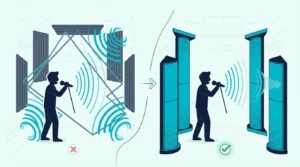
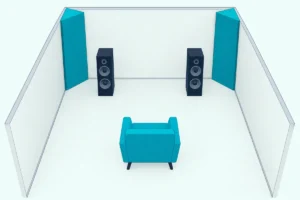
Place bass traps in corners first — tri-corners (where two walls meet the floor or ceiling) are the highest priority, followed by vertical wall-wall corners and wall-ceiling edges.
Bass traps placement determines whether your acoustic treatment solves your room’s bass problems or just decorates the walls.
Corners are where bass energy builds up. Auralex’s Acoustics 101 defines a room mode as a low frequency standing wave in a room, and its home-studio guide names the buildup of low frequencies, especially in corners, as one of the most common problems in small rooms.
Traps flat on wall centers or spread randomly around the room miss those corners.

The sections below cover the priority order for bass trap placement, whether you need traps in every corner, how size and air gaps affect performance, and whether symmetrical placement matters for stereo imaging.
Symmetrical placement preserves stereo imaging for critical listening.
Where Should You Place Bass Traps In A Room?
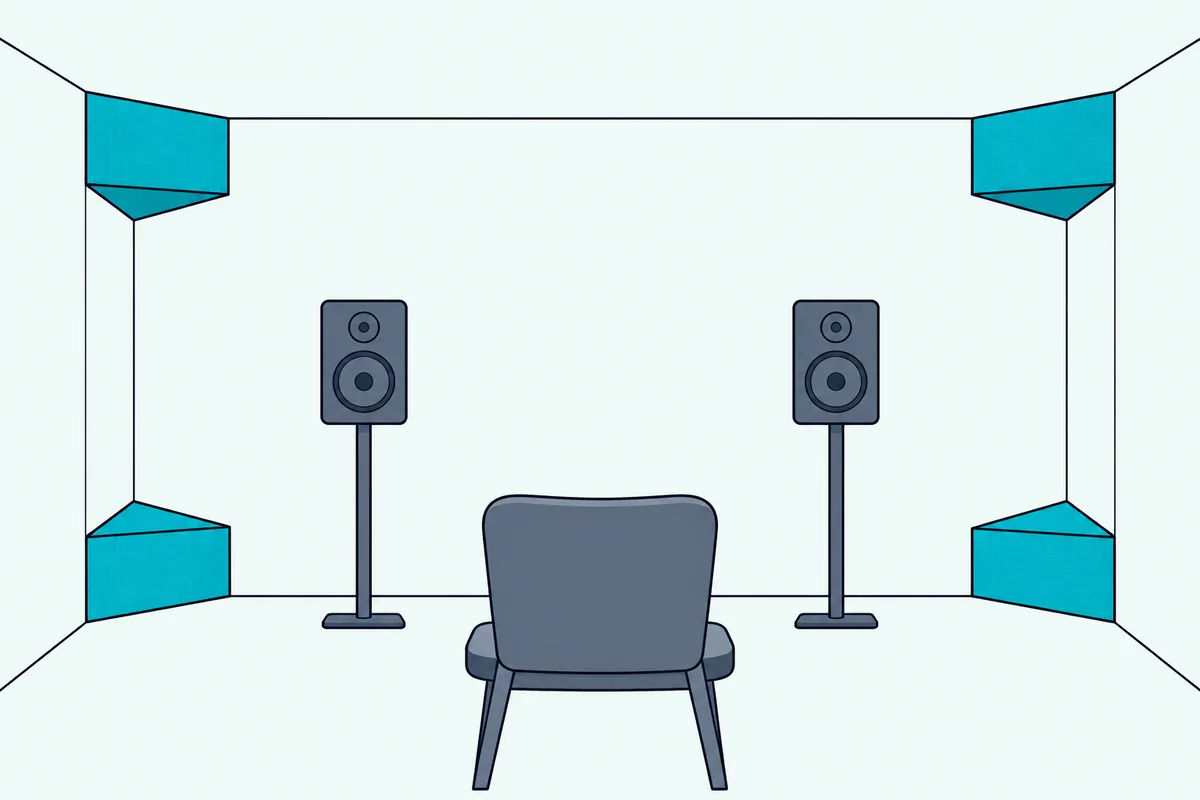
Bass traps placement follows one rule above all others: put them where bass energy is highest. In every rectangular room, that means corners — and not all corners are equally important.
The order for bass trap placement, corners first:
- Tri-corners (where two walls meet the floor or ceiling) — three boundaries meet
- Vertical wall-wall corners — two walls meet, floor to ceiling
- Wall-ceiling edges (the long horizontal lines where walls meet the ceiling)
- Wall-floor edges (often impractical due to furniture)
- Wall centers
All but the last are places where room surfaces meet.
Tri-Corner Placement (Floor-Wall-Wall)
Tri-corners are where three surfaces converge — the two spots on each wall where it meets another wall and the floor, plus the two spots where it meets another wall and the ceiling. A typical rectangular room has eight tri-corners total.
A tri-corner touches all three pairs of parallel surfaces in the room: length, width and height. Auralex’s Acoustics 101 defines axial modes as standing waves between two parallel surfaces.
A tri-corner takes any type of bass trap. If you can place only four traps, put them in the four front tri-corners (the two upper and two lower corners of your front wall).
Wall-Ceiling Corners
Wall-ceiling corners — the long horizontal edges running the length and width of your room — are the second priority after tri-corners. Each edge joins a wall and the ceiling, so it touches two of the room’s pairs of parallel surfaces, and Auralex’s Acoustics 101 defines axial modes as standing waves between two parallel surfaces.
Ceiling-mounted bass traps along these edges treat both vertical and horizontal room modes with a single installation. Floor-to-ceiling vertical corner traps handle the same job from a different angle.
The front wall-ceiling edge (above your monitors) and the two side wall-ceiling edges closest to your listening position deserve treatment first. Rear wall-ceiling edges come after the front is handled.
Should You Put Bass Traps In All Corners?
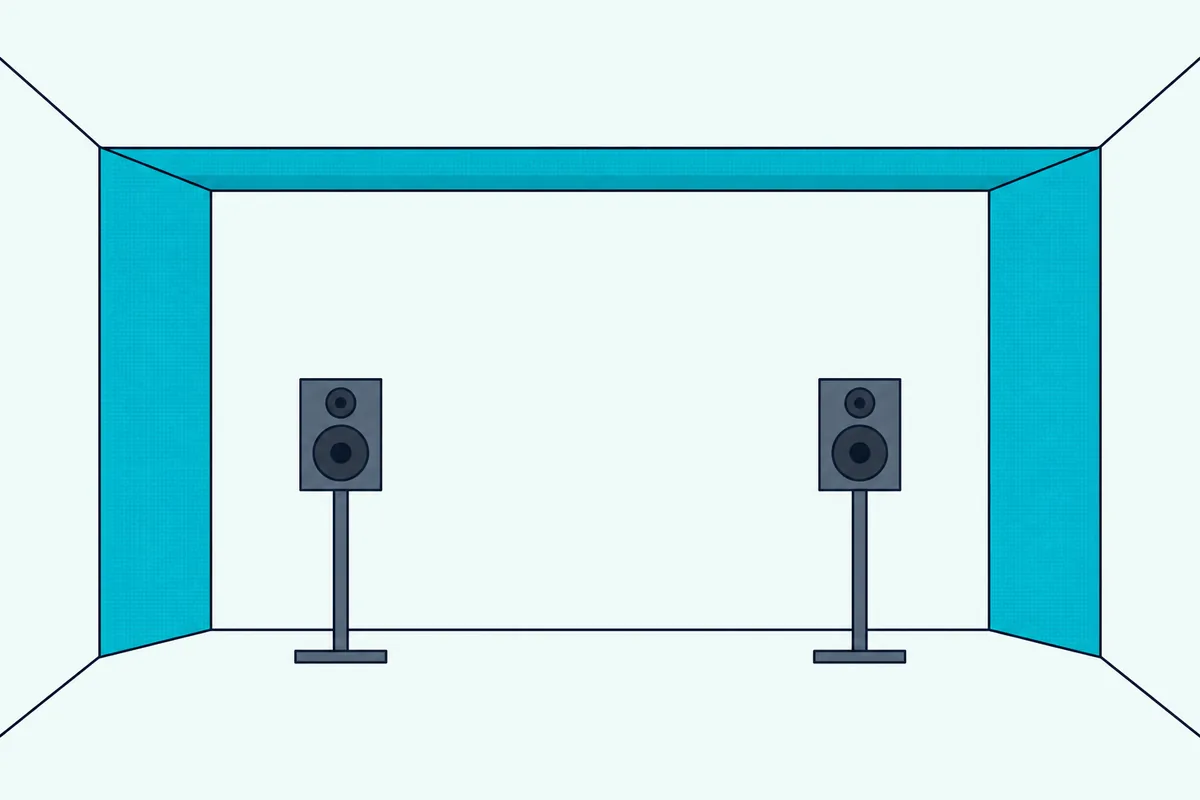
The ideal scenario is bass traps in every corner of the room — all eight tri-corners and all twelve edges. In practice, space and room layout often force you to prioritize.
Auralex’s home-studio guide makes bass traps in all of the corners the first step in any small room. With limited treatment, take the corners in this order:
- First: the front wall’s vertical corners, floor to ceiling.
- Next: the rear wall’s vertical corners, floor to ceiling.
- Then: the wall-ceiling edges along the front and sides.
The front corners matter more than the rear because your monitors excite the front wall first, and the direct reflections from the front wall reach your ears before rear reflections. Whether you need bass traps at all comes down to a few quick tests of the room.
For small rooms short on space for corner traps, even two floor-to-ceiling traps straddling the front corners are a start.
How Big Should Bass Traps Be?
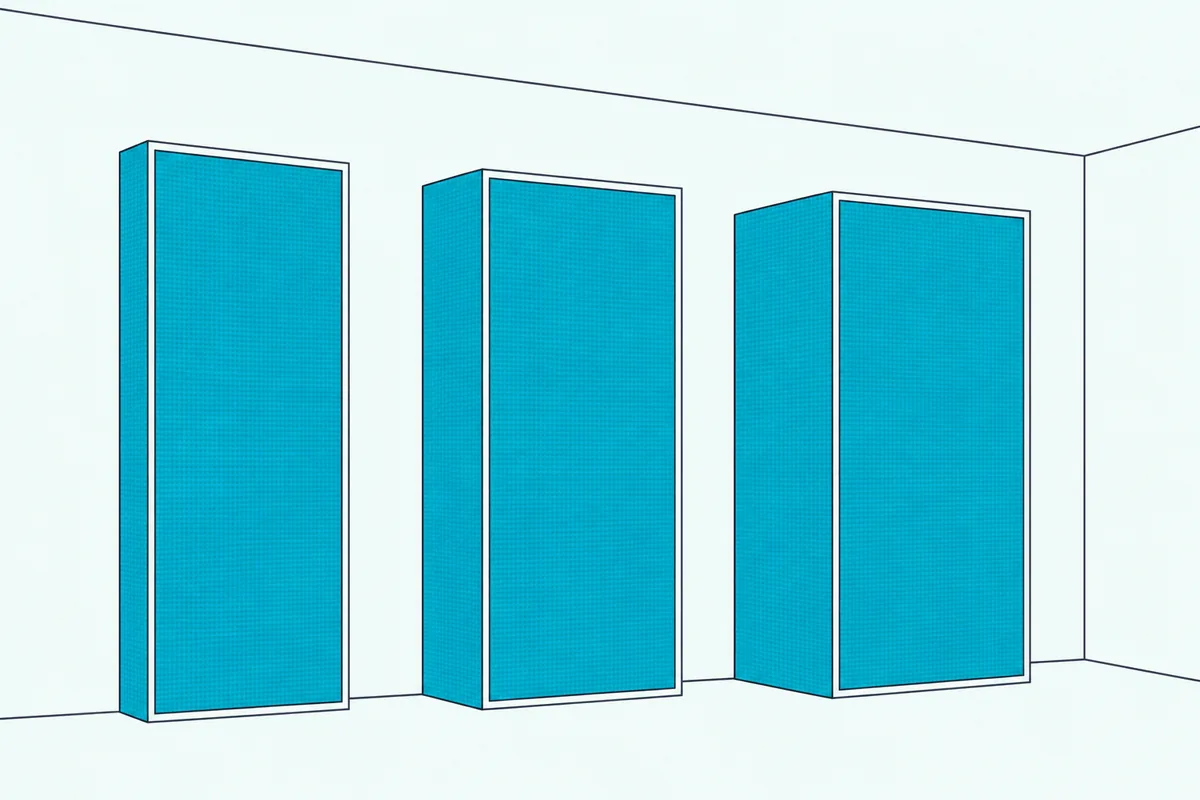
Bigger bass traps absorb lower frequencies more effectively — there’s no way around the physics. The size variables that matter are thickness (depth), height, and width.
Thickness is the most critical dimension, and a 4-inch thick trap absorbs more of the low bass than a 2-inch one: Owens Corning lists its 703 board at 0.15 at 125 Hz at 2 inches and 0.56 at 4 inches. ROCKWOOL lists 6-inch Safe’n’Sound at 1.38 at 125 Hz.
Height determines how much of the corner’s modal energy the trap intercepts — floor-to-ceiling traps capture all vertical modes at that corner. A 4-foot trap mounted at ear height only treats the modes it physically overlaps with, missing the lowest modes that concentrate near the floor and ceiling.
Width (face dimension) matters for how much of the corner the trap spans. A 24-inch wide panel straddling a corner at 45 degrees creates a deeper effective air gap than a 12-inch panel, extending low-frequency reach.
How High Should Bass Traps Be?
Floor-to-ceiling installation treats the corner along its whole height.
If full-height installation isn’t possible, position traps at the top of the wall (touching the ceiling) rather than centered on the wall. Touching the ceiling puts the trap in a tri-corner, the top of the priority list above.
For combined bass and mid-frequency treatment at the listening position, a full-height approach covers both.
How Far Should Bass Traps Be From The Wall?
An air gap between the bass trap and the wall significantly increases low-frequency absorption. The air gap extends the effective acoustic depth of the trap without adding more material.
The air gap works because sound velocity is highest away from boundaries — the trap material sitting in this high-velocity zone converts more energy to heat.
A deeper gap also pushes the trap further into the room, and Owens Corning’s absorption figures are for board placed against a solid backing, so they don’t show what a gap adds. Corner-straddled traps naturally leave an air space behind the angled panel.
Does Bass Trap Placement Need To Be Symmetrical?
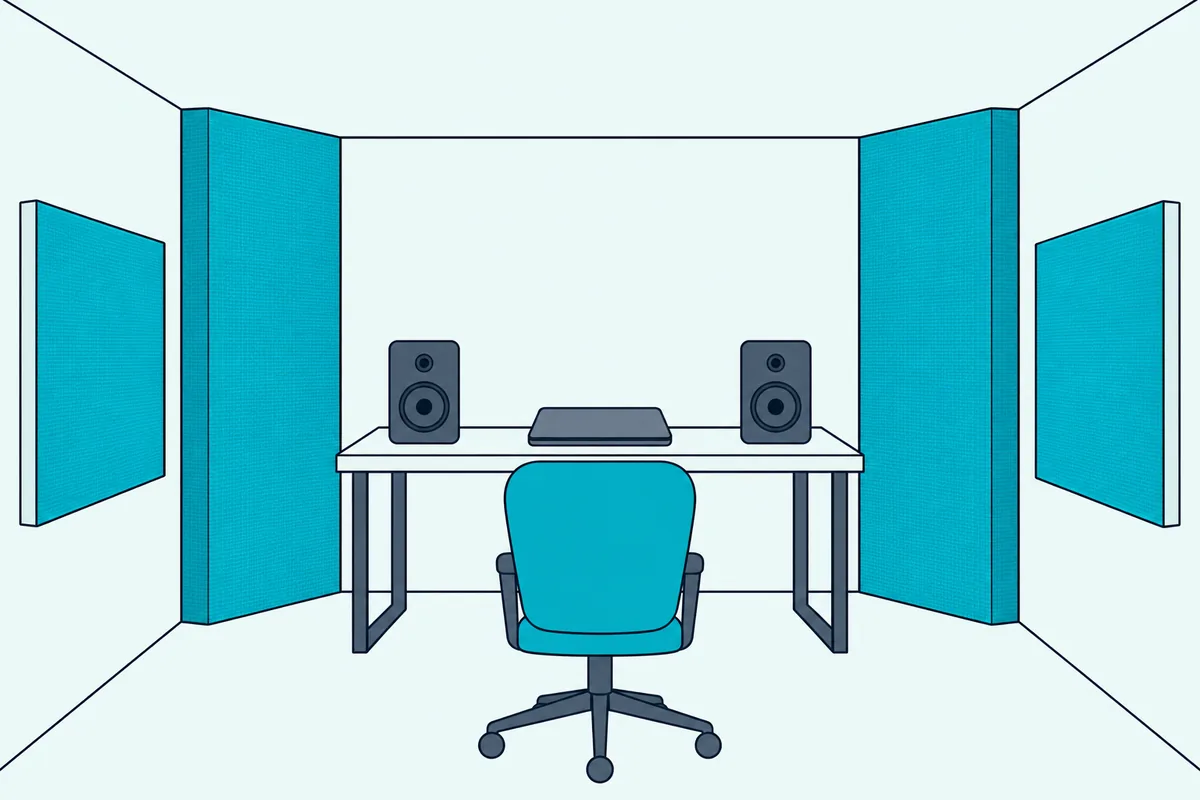
Symmetrical bass trap placement matters if you’re mixing music or doing any work that requires accurate stereo imaging. Asymmetric treatment causes one side of the room to absorb differently than the other, shifting the perceived stereo center.
For critical listening rooms (mixing studios, mastering suites), place traps symmetrically — what’s in the left front corner should match the right front corner. This applies to the number of traps, their size, and their position.
For home theaters, podcast rooms, and casual listening spaces, symmetry is less critical — bass mode reduction benefits your room regardless of whether the left and right sides match perfectly. Treat wherever you can, even if the result is asymmetric.
One exception: if your room is physically asymmetric (one wall has a large window, the other is solid drywall), you may need asymmetric treatment to compensate. The wall with the window reflects bass differently than the solid wall, and matching treatment levels may require different trap quantities on each side.
Bass Traps In Front Or Back Of The Room?
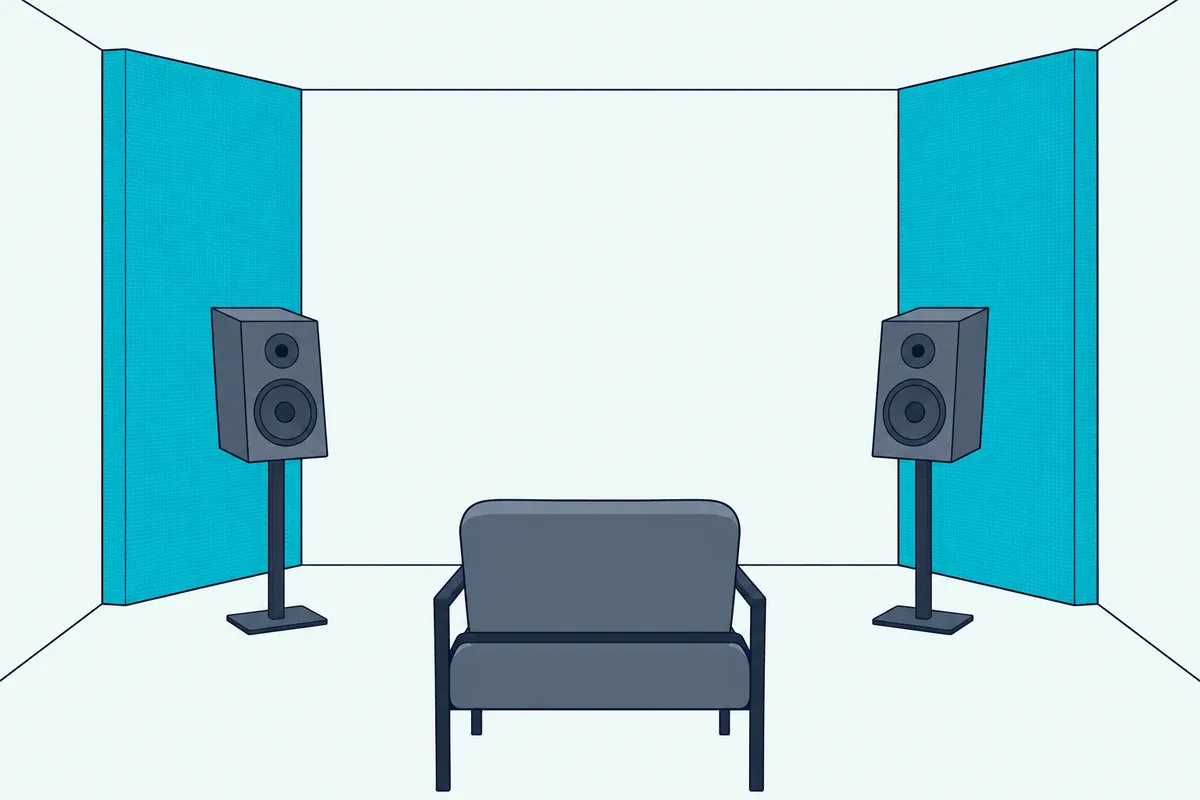
If you have to choose between front and back, treat the front wall first — especially behind and around your monitors. The front wall is the closest boundary to your speakers, and it creates the strongest early bass reflections that interfere with your direct sound.
Flat panels directly behind the monitors are a separate choice, and Burton Acoustix’s guide to panels behind speakers lists the speaker distances monitor makers say to avoid.
The rear wall deserves treatment next because bass that passes your listening position reflects off the back wall and returns, creating a second set of interference patterns. Rear wall corner traps clean up this reflected energy.
A balanced approach treats both: the front wall corners and edges for the initial reflections from the front wall, and the rear for the return reflections.
Side wall corners are the third priority. They address lateral modes (width-based standing waves) that are typically higher in frequency than length-based modes and often partially handled by furniture, bookshelves, and other room contents.
For DIY builders, start with two corner traps on the front wall. Add rear corners next, then install ceiling edge traps last.
The Bottom Line
Bass traps placement follows a clear priority: tri-corners first, then vertical wall-wall corners, then wall-ceiling edges. Front wall corners matter most for mixing accuracy, and an air gap behind each trap extends low-frequency absorption without adding thickness.
Symmetrical placement preserves stereo imaging for critical listening. With only a few traps, start with floor-to-ceiling traps in the front corners.
Frequently Asked Questions
How thick should bass traps be?
Thicker traps absorb more of the low bass by the makers’ own figures: Owens Corning lists its 703 board at 0.15 at 125 Hz at 2 inches and 0.56 at 4 inches thick, and ROCKWOOL lists Safe’n’Sound at 0.44 at 3 inches and 1.38 at 6 inches.
Should bass traps go in middle or top corners?
Top corners (where the wall meets the ceiling) are tri-corner or edge locations, and Auralex’s home-studio guide says low frequencies build up especially in the corners of small rooms. If using partial-height traps, mount them touching the ceiling rather than centered on the wall, so they reach the wall-ceiling corner.
Do Auralex bass traps work in corners?
Auralex’s Acoustics 101 put LENRD Bass Traps in all four vertical corners of one room it treated, a 13’ x 19’ garage used for guitar lessons and rehearsals whose problems included excessive low-end buildup. Auralex also notes that thicker acoustic foam is better at absorbing low frequency sounds, so how well foam bass traps work depends on their thickness.