How to Choose a Record Player or Turntable
Ah, the sweet sound of vinyl, and the question of how to choose a record player that does it justice! There’s something magical about dropping the needle on a record and hearing those warm, rich tones fill the room.
But here’s the thing: choosing the right record player or turntable can be a bit overwhelming, especially if you’re just getting into the world of vinyl.
How to Choose a Record Player or Turntable
Choosing a record player or turntable boils down to understanding your needs and desired sound quality. First, consider the type of turntable – belt-drive for better isolation from motor noise, or direct-drive for precise speed control.
Look at key features like the platter material, tonearm design, and cartridge quality.
Consider additional components you might need, like a preamp or speakers, which is how Burton Acoustix’s beginner turntable picks sort their seven decks. Ultimately, the best choice depends on your listening preferences.
Remember – the perfect turntable is the one that brings you joy when you drop the needle!
Types of Record Players and Turntables
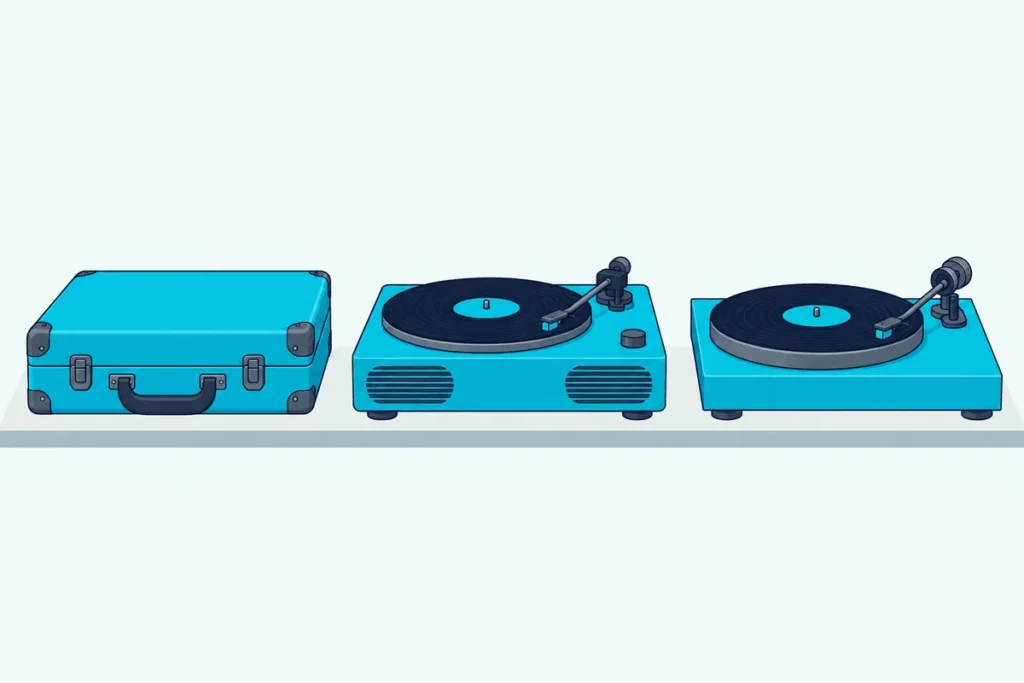
First up, we’ve got belt-drive turntables. These bad boys are a solid pick for home listening.
Why? Well, they use a belt to connect the motor to the platter, which helps isolate the platter from motor vibrations. The result? A cleaner, more accurate sound.
Direct-drive turntables have their place too. These have the motor directly connected to the platter, which gives you more consistent speed and faster start-up times.
They’re great for DJs who need to scratch and beat-match.
Then there are all-in-one record players. These are the jack-of-all-trades of the vinyl world.
They usually come with built-in speakers and sometimes even Bluetooth connectivity. They’re convenient, especially if you’re tight on space or just dipping your toes into vinyl.
But here’s the catch – they often sacrifice sound quality for convenience.
Lastly, we’ve got DJ turntables. These are the tanks of the turntable world – built to withstand heavy use and designed for mixing and scratching.
They’re usually direct-drive and have features like pitch control and high torque motors. Unless you’re planning on becoming the next big thing in the club scene, these might be overkill for home use.
Remember, there’s no one-size-fits-all solution. The best type for you depends on your listening habits and space.
Visit a local hi-fi shop and listen to different types.
Key Features to Consider
If you’re choosing a record player or turntable, there are some key features you’ll want to keep an eye on.
First up, let’s talk about the platter. This is the circular platform that your record sits on, and it’s more important than you might think.
Materials like aluminum or acrylic can help reduce resonance and improve sound quality.
Next, we’ve got the tonearm. This is the arm that holds the cartridge and tracks the record grooves.
Look for a well-balanced tonearm with adjustable counterweight and anti-skate. Getting these settings right can be a bit fiddly, but correct settings improve the sound and reduce record wear.
Speaking of cartridges, this little guy is where the magic happens. It’s the device at the end of the tonearm that holds the stylus (needle) and converts the physical grooves into an electrical signal.
A good cartridge can make a world of difference.
Don’t forget about speed options. Most turntables offer 33 1/3 and 45 RPM, which covers most vinyl records.
But if you’ve got some oldies in your collection, you might want to look for one that also plays at 78 RPM. Just be careful not to play your 33s at 45, or everything will sound like Alvin and the Chipmunks!
Lastly, consider whether you want a built-in preamp. If you’re planning to connect directly to powered speakers or an amplifier without a phono input, a built-in preamp can be super convenient.
But if you’re an audiophile looking for maximum flexibility, you might prefer an external preamp.
Remember, these features all work together to create your listening experience. It’s not about ticking every box, but finding the right combination that works for your needs.
And hey, half the fun is in the journey of discovering what you like!
Budget Considerations
Let’s talk money, honey! Choosing a record player or turntable can be a bit like buying a car – there’s a wide range of options at different price points, and it’s easy to get carried away.
Starting at the entry-level, you can find decent turntables for around $100-$300. These are great for beginners or casual listeners.
They might not have all the bells and whistles, but they’ll get you spinning vinyl without breaking the bank.
Moving up to the mid-range, we’re looking at $300-$1000. This is where things start to get interesting.
You’ll find better build quality, improved cartridges, and more precise speed control. It’s also where you might start to notice significant improvements in sound quality.
Now, if you’ve got deep pockets and a serious passion for audio quality, there’s the high-end audiophile market. We’re talking $1000 and up, way up.
These turntables are the crème de la crème, with precision engineering, exotic materials, and top-of-the-line components.
But here’s the thing – more expensive doesn’t always mean better for you. It’s all about finding the sweet spot where your budget meets your ears’ satisfaction.
And remember, the turntable is just one part of the equation. You’ll also need to factor in the cost of speakers, amplifiers, and maybe even some room treatment if you’re going all out.
Start with what you can comfortably afford, and upgrade over time as your passion (and budget) grows.
And hey, half the fun is in the journey of upgrading and discovering new levels of sound quality along the way!
Additional Components and Accessories
Alright, let’s talk about the supporting cast in your vinyl setup. These additional components and accessories can make or break your listening experience.
First up, speakers and amplifiers. These are crucial – even the best turntable in the world won’t sound great through poor speakers.
Next, let’s talk about phono preamps. If your turntable or amplifier doesn’t have a built-in phono stage, you’ll need one of these.
It boosts the tiny signal from your cartridge to a level that your amp can work with.
Cartridge upgrades can make a big difference too. The cartridge that comes with your turntable is usually decent, but upgrading can really elevate your listening experience.
Just handle the new stylus gently when you install it.
Now, onto cleaning tools and accessories. These might seem boring, but they’re essential for keeping your vinyl and equipment in top shape, and our gift ideas for record collectors start with them.
A good carbon fiber brush is a must for removing dust before each play. Then there are the joys of a record cleaning machine – it’s like sending your vinyl to a spa!
Other accessories to consider include a stylus pressure gauge for ensuring the correct tracking force, a bubble level for properly setting up your turntable, and maybe even some isolation feet to minimize vibrations.
Oh, and if you really want to go down the rabbit hole, look into record weights or clamps. They can help flatten warped records and improve overall sound quality.
Remember, you don’t need to buy everything at once. Build your setup gradually, and enjoy the process of discovery.
Each new component or accessory is an opportunity to fall in love with your music all over again. Happy listening!
Sound Quality and Performance
This is where things get really exciting – and sometimes a bit technical.
First up, we’ve got wow and flutter. No, it’s not a new indie band – it’s a measure of speed consistency.
Wow refers to slower speed variations, while flutter is about faster ones. Both can make your music sound wobbly or off-pitch.
Then there’s the signal-to-noise ratio. This is all about how much of what you’re hearing is music versus unwanted noise.
A higher ratio means cleaner sound.
Now, let’s talk about tracking force and anti-skate adjustments. These are crucial for getting the best sound and protecting your records.
Tracking force is how heavily your stylus sits in the groove, while anti-skate counteracts the tendency of the tonearm to move inward. Getting these right can be a bit fiddly.
Another factor to consider is the turntable’s ability to reject external vibrations. This is where things like the plinth (the base of the turntable) and the feet come into play.
And let’s not forget about cartridge alignment. This ensures that your stylus is tracking the groove accurately.
There are alignment protractors you can use for this.
Remember, achieving great sound quality is a journey, not a destination. It’s about finding the right balance for your ears.
Don’t get too caught up in the numbers and specs: if it sounds good to you, that’s what matters most. Happy listening!
Maintenance and Care
Alright, let’s talk about keeping your vinyl setup in tip-top shape. Proper maintenance and care can make a world of difference in both sound quality and the longevity of your equipment.
First things first: proper setup and alignment. This is crucial for getting the best sound and protecting your records.
Take your time with this step.
Make sure your turntable is level (use a bubble level if you have one), set the tracking force and anti-skate correctly, and align your cartridge properly.
Now, let’s talk about cleaning. Both your records and your stylus need regular cleaning to sound their best.
For records, use a good carbon fiber brush before and after each play.
For deeper cleaning, consider a record cleaning solution and maybe even a record cleaning machine if you’re really serious (or have a lot of dusty old records).
As for the stylus, a gentle brush designed for this purpose works wonders. Just remember to brush from back to front, never side to side or you might damage it.
Storage is another crucial aspect of vinyl care. Always store your records vertically to prevent warping.
Use inner sleeves to protect against dust and static, and outer sleeves for additional protection.
And please, whatever you do, don’t stack your records horizontally.
Now, let’s talk about stylus replacement. This is something that often gets overlooked, but it’s super important.
A worn stylus can damage your records and sound terrible. How often you need to replace it depends on usage, but Fluance puts stylus life at 300 to 1,000 hours of play time, depending on the stylus type and model.
Don’t forget about your turntable itself. Keep it dust-free with a soft, dry cloth.
If you’re not using it, keep the dust cover on. And here’s a pro tip: if you’re moving your turntable, even just a short distance, remove the platter and secure the tonearm.
Lastly, be mindful of your turntable’s environment. Keep it away from sources of vibration (like speakers or foot traffic), direct sunlight, and extreme temperatures.
Remember, a little bit of regular maintenance goes a long way. It might seem like a chore at first, but it becomes an enjoyable ritual.
There’s something deeply satisfying about caring for your vinyl setup, knowing that you’re preserving your music for years to come.
Conclusion
Remember, vinyl is all about enjoying music in one of its most pure and engaging forms.
The key is to find a turntable that suits your needs and brings you joy.
After all, there’s nothing quite like the ritual of selecting a record, gently lowering the needle, and being transported by the warm, rich sound of vinyl.
As you embark on your vinyl journey, experiment and upgrade as you go.