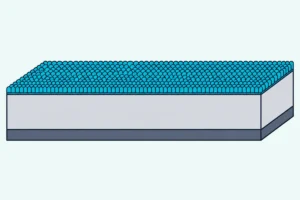
Best Soundproof Curtains for Bedrooms, Street Noise and Sliding Doors
The RYB HOME 3-in-1 Soundproof Blackout Insulation Curtains are the best soundproof curtains for most windows, with a felt middle layer.
| Pick | Best for | Why |
|---|---|---|
| RYB HOME 3-in-1 | Most windows | A felt middle layer behind a linen face |
| Moondream DecibelControl | Street-facing bedrooms | Up to 10 dB less incoming noise |
| NICETOWN Sound Barrier | Day sleepers and nurseries | A felt liner that comes out for washing |
| KGORGE 4-in-1 | Dusty, busy streets | A melt-blown filter cloth over the felt |
| KOUFALL Extra Wide | Sliding doors and wide windows | Panels 70 inches wide |

- ✓ Up to 10 dB less incoming noise
- ✓ Reverberation cut by 0.4 s in a 215 sq ft room
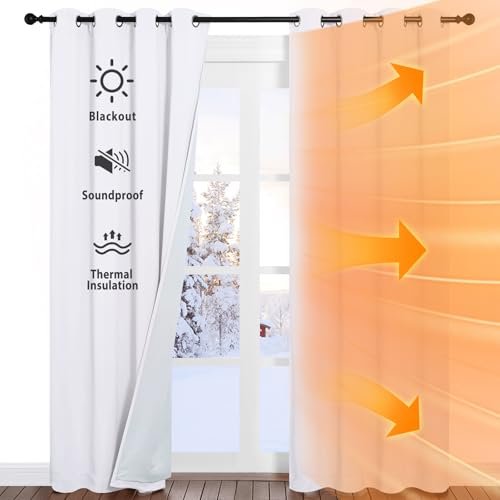
- ✓ Felt liner in the middle of three layers
- ✓ 100% blackout, even in white
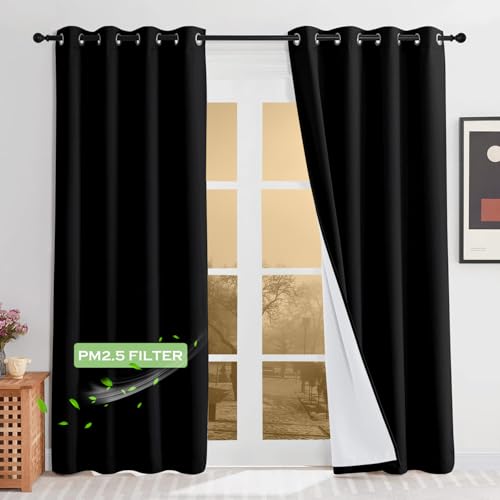
- ✓ Melt-blown filter cloth over a felt lining
- ✓ Triple-weave blackout fabric on both faces
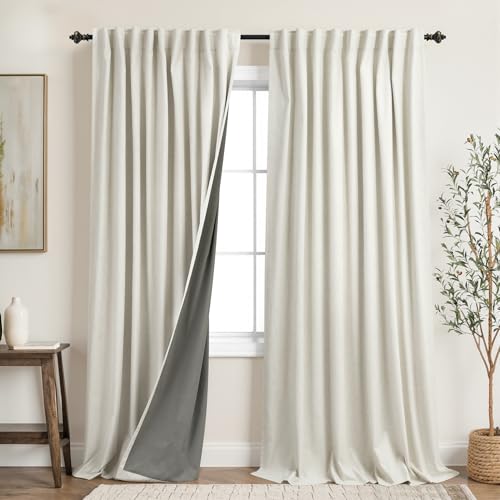
- ✓ Two panels, each 70 inches wide
- ✓ Linen face

Plain curtain fabric barely slows noise: in National University of Singapore lab tests, a standard polyester curtain blocked about 5 decibels through the mid-range.
A curtain with an extra layer inside, hung wide and to the floor, softens voices, horns and traffic hiss, though bass still gets through.
The table comes first, then each curtain in turn, how much noise a curtain can block, why bass gets through, how many layers it needs, blackout versus soundproof, the specs to compare, how wide and long to buy, how to hang them, doors, what to try when curtains aren’t enough, studios, dividing a room, the look, how to wash them and the bottom line.
Find your window’s problem in the table, then read that curtain’s section.
What Are the Best Soundproof Curtains?
That felt layer is where the answer starts. The best soundproof curtains for most windows are the RYB HOME 3-in-1 Soundproof Blackout Insulation Curtains, which RYB HOME builds from a linen front, a detachable felt lining and a grayish-white back.
Each pick below gives its build, sizes and care, and the lab section after them shows how much any curtain can do.
The descriptions come from the makers’ manuals and spec pages.
Every pick met Burton Acoustix’s rating, review and stock checks on 8 November 2026.
Which Curtain Suits Most Windows?
That first row of the table is the safe default. The RYB HOME 3-in-1 Soundproof Blackout Insulation Curtains suit most windows because RYB HOME puts a detachable felt lining between a linen front and a grayish-white back, three layers in all.
Spec: three layers (linen front, felt middle, grayish-white back); sold as two panels, each 52 inches wide; grommet top with a 1.6-inch inner diameter; machine washable.
RYB HOME says the felt middle layer absorbs noise, and it states plainly that the curtains aren’t 100% soundproof. It adds that the effect depends on your room and on how sensitive you are to noise.
That felt does two jobs at once. It soaks up some of the sound passing through, and it adds a third layer of fabric that a single blackout panel doesn’t have.
RYB HOME also lists 100% light blocking and calls the three layers heavy enough to keep out summer heat and winter cold. So the same pair darkens a bedroom for daytime naps as well as taking the edge off street noise.
Each set holds two 52-inch panels, and the sizing section below shows how to size them for your rod. Each panel is hand-made, RYB HOME notes, so a size can be off by 2 to 3 centimeters.
RYB HOME lists the curtains for nurseries, lofts, shared apartments, home theaters, bedrooms, offices and patio sliding doors. That range is the case for calling them the default rather than a specialist.
For a bedroom or nursery, RYB HOME also says the fabric is free of toxic substances and formaldehyde. Its felt lining is detachable, and the care note calls the curtains machine washable.
Skip them if you want a published decibel figure behind your curtain, which the next pick has. Measure the panels when they arrive, before you cut a rod or fix brackets.
For a felt-lined curtain that fits most bedroom and living room windows, the RYB HOME 3-in-1 Soundproof Blackout Insulation Curtains come as a pair.
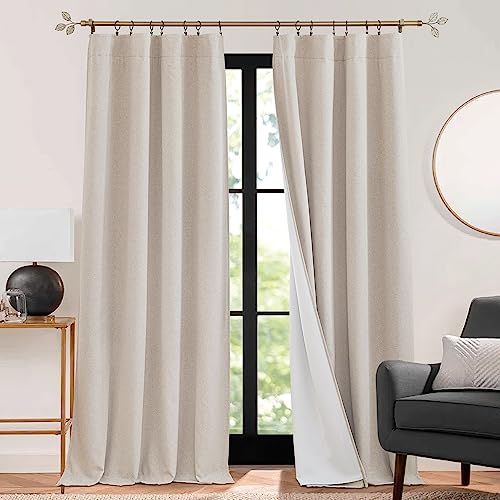
RYB HOME 3-in-1
Does Any Soundproof Curtain Publish Its Test Results?
Unlike the felt-lined RYB HOME pair, the next pick arrives with numbers. The Moondream DecibelControl 3-in-1 Soundproof Curtain does: Moondream’s page for this curtain, model MC634, says it cuts incoming noise by up to 10 decibels in a test Kietudes ran in line with EN ISO 10052.
Spec: three layers (100% polyester; polyester with 0.01% aluminum; 77% recycled cotton and 23% cotton); one panel 55 inches wide, in 63-, 84-, 95- and 108-inch lengths; eight 1.6-inch grommets; dry-clean only; made in Poland.
A 10 dB drop is a big claim, about half as loud to the ear by the scale in the lab section below. Read it as a best case, since Moondream’s own guide says results depend on the kind of noise and on how your building is put together.
Moondream cites a second test for the room side. A report from CEBTP, a building research center, found the curtain cut reverberation time by 0.4 seconds in a room of about 215 square feet.
That second figure is about echo inside the room, not noise coming in. It matters more in a home office or TV room than in a bedroom facing traffic.
Moondream says the three-layer design is covered by its US patent 9,475,260. The same page claims full blackout and lists ten other colors for the same build.
The back of the curtain is a white lining, and Moondream says the fabric is made without harmful substances. That white back is the side the street sees.
The 95- and 108-inch lengths suit a tall window or a rod fixed near the ceiling. Moondream’s measuring guide, covered in the sizing section, explains how to pick between them.
The trade-offs are care and count. Moondream says dry-clean only, and the listing is for a single panel, so a pair of windows or a wide window needs two or more.
Skip it if you want curtains you can wash at home, or a pair in one box. The felt-lined picks on either side of it go in the machine.
For the one curtain here backed by a published noise test, the Moondream DecibelControl 3-in-1 Soundproof Curtain comes in Beige Eggshell, 55 by 84 inches.
Moondream DecibelControl
What Should Day Sleepers and Nurseries Use?
If you sleep by day or are darkening a nursery, light matters as much as noise. The NICETOWN Sound Barrier 100% Blackout Divider Curtains suit both: NICETOWN sells them for noise reducing, nurseries, daytime sleep and bedrooms, with a detachable felt liner in the middle of three layers.
Spec: three layers with a detachable felt liner in the middle; two panels, each 52 inches wide and 84 inches long; 1.6-inch grommets; felt out before washing.
NICETOWN calls the drapes thick enough to block unwanted light and reduce some noise. That careful wording fits the lab numbers further down this page.
The pair on this listing is white, and NICETOWN still sells it as 100% blackout. A white face suits a nursery or a bright bedroom where a dark panel would feel heavy.
NICETOWN also credits the lined panels with keeping a room warmer in winter and blocking heat in summer. It suggests them for a home theater too, for watching in real darkness.
Grommet panels like these hang without pull cords. In a baby’s room, keep the crib away from the window as well, as Burton Acoustix’s nursery soundproofing guide explains with the CPSC’s cord figures.
NICETOWN’s listing also warns that grommet panels narrow on the pole. And they lose some length to the 3-inch header the grommets sit in, so measure with that in mind.
Washing takes one extra step, since the felt liner comes out first. The washing section near the end has NICETOWN’s water temperature and detergent limits.
Skip them if your rod sits more than 84 inches above the floor, because the panels won’t reach it. The sizing section below explains how to measure that drop.
For a white blackout curtain with felt in the middle, the NICETOWN Sound Barrier 100% Blackout Divider Curtains come as two 52-by-84-inch panels.
NICETOWN Sound Barrier
Can a Soundproof Curtain Filter Dust Too?
Both felt-lined picks so far stop at three layers, and the next adds a fourth. The KGORGE 4-in-1 Soundproof Blackout Curtains claim to: KGORGE lays a melt-blown cloth, the raw material of face masks, over a detachable felt lining at the center, between two triple-weave blackout fabrics.
Spec: four layers (triple-weave blackout fabric front and back, felt lining with a melt-blown cloth in the middle); sold as two panels; felt out before a cold, gentle machine wash.
KGORGE says the melt-blown layer filters dust, pollen, odor and small particles from outside air. That filtering only touches air that passes through the fabric, so it counts most beside a window you keep cracked open.
KGORGE pitches the curtains as a last line of defense against outdoor air pollution coming into the home. That makes them a fit for a ground-floor room on a busy road, where dust and traffic noise arrive together.
KGORGE describes the felt as a damping material that helps absorb noise. It adds the same caution RYB HOME gives: the effect depends on your room, and the curtains aren’t 100% soundproof.
The two triple-weave faces are what KGORGE credits for total blackout. It also calls the drapes thick enough to stop drafts as well as sunlight.
Four layers mean more to look after, since the felt comes out before each wash. KGORGE’s steps are in the washing section near the end.
Skip them if the window stays shut all year, since the filter layer then does nothing extra. The RYB HOME pair gives you felt without the extra layer.
For a street where dust comes in with the noise, the KGORGE 4-in-1 Soundproof Blackout Curtains come as a two-panel set.
KGORGE 4-in-1
What Covers a Sliding Door or Wide Window?
The RYB HOME, Moondream and NICETOWN panels run 52 to 55 inches wide, which leaves little to spare on a patio door’s long rod. The KOUFALL Extra Wide Linen Soundproof Blackout Curtains cover one, with each of their two panels 70 inches wide and 84 inches long.
Spec: two panels, each 70 inches wide and 84 inches long; linen face; sold as soundproof, blackout and thermal curtains.
Two 70-inch panels give 140 inches of flat fabric, against 104 inches for two 52-inch panels. The sizing section below works through what that means on a real rod.
KOUFALL’s listing calls them soundproof, noise reducing, blackout and thermal curtains for sliding doors, bedrooms and living rooms. It doesn’t say what’s inside them, so they’re here for their width rather than for a named sound layer.
The listing also names summer heat as one target, which matters on a sunny patio door. Thermal claims, like sound claims, are KOUFALL’s own, with no figure attached.
If width isn’t your problem, a felt-lined pick above is the surer buy for noise. If it is, no other pick here lists a panel as wide.
For the door itself, sealing comes before fabric. Burton Acoustix’s sliding glass door guide covers which gaps to seal first and how to mount a curtain over the track.
Skip them for a standard window, where 70-inch panels bunch up into heavy stacks at each side. Check the care label when they arrive, too, since the listing covers sizes and uses rather than washing.
For a patio door or a wide picture window, the KOUFALL Extra Wide Linen Soundproof Blackout Curtains come as a two-panel set.
KOUFALL Extra Wide
How Much Noise Can a Curtain Block?
Those picks rest on what their makers say, so independent lab work is the check. Less than the word soundproof suggests: a plain polyester curtain in National University of Singapore tests stopped only about 5 dB across the 400 to 1,600 Hz band, while curtains with a vinyl or PVC layer rated STC 17 to 21.
The PVC-coated polyester in the same tests blocked about 15 to 22 dB through the middle and upper range, because its coating is smooth and airtight where woven fabric is porous. The study also rated a commercial two-layer drapery at STC 13.
STC, the sound transmission class, is the single-number rating used for walls, doors and windows. CitiQuiet, which makes window inserts, puts a standard single-pane window at about STC 27 and a basic double-pane one at 28 to 32.
So even a good curtain lining rates below the glass it hangs over. It adds to the window’s blocking rather than replacing it.
Quiet Curtains’ STC 17 lining shows what that rating takes: a sheet of vinyl weighing 0.275 pounds per square foot. Western Electro-Acoustic Laboratory tested it to ASTM E90, with its edges caulked around the whole perimeter.
The University of Adelaide reached the same point from another angle, in work with the maker Acoustic Blinds and Curtains presented to the Acoustical Society of America. In 76 tests, the team found that a heavy interlining sandwiched between two absorbing fabrics can cut perceived noise by more than half.
Quiet Curtains’ own scale turns those decibels into what you hear. A 3 dB change is just perceptible, 5 dB is clearly perceptible and 10 dB roughly halves the noise.
Burton Acoustix sets out the lab results on whether soundproof curtains work in full. That page also explains what STC and insertion loss mean on a product listing.
Why Does Bass Get Through Every Curtain?
Those decibel figures hide a split by pitch. Because a curtain blocks more as frequency rises: the NUS team’s follow-up study found insertion loss climbed with frequency, following the mass law, so low rumble gets through more easily than voices or horns.
The same team found that a curtain’s blocking depends heavily on its surface mass, its weight per square meter. Woven fabrics are generally light and let sound through their weave, which is why they do so little on their own.
Their samples show the scale. Two woolen felts weighed 0.21 and 0.25 kilograms per square meter and a polyester curtain 0.23, against 1.34 for the vinyl lining rated STC 17.
Traffic is where that bites. Andersen’s guide to window sound ratings says OITC, the outdoor-indoor class, is the rating for sounds like traffic, aircraft and construction, and the vinyl lining rated STC 17 scores OITC 12 on it.
Moondream’s guide says motorway noise is the hardest to block because it’s mostly low-frequency. CitiQuiet likewise says subway rumble and bass from traffic are harder to stop than mid and high pitches.
So judge a curtain by the noise you hear. Voices, horns and tire hiss respond, while a neighbor’s subwoofer or a bus idling outside mostly won’t.
Try this before you buy: stand at the window at the time the noise bothers you and name what you hear. If it’s chatter, sirens and hiss, a curtain helps; if it’s a hum you feel as much as hear, start with the window itself.
How Many Layers Does a Soundproof Curtain Need?
That surface-mass rule settles the layer question too. Three is the common build, but what sits in the middle matters more than the count: when the NUS team wrapped a PVC sheet in two layers of a woven curtain, it blocked 1 to 5 dB more than the sheet alone, while a soft textured liner in the same pocket made no noticeable difference.
Makers say much the same. Moondream’s guide says an effective soundproof curtain needs several layers of different fabrics and has to be thick and heavy, and that lightweight sound-blocking curtains are acoustically almost ineffective.
Quiet Curtains builds three layers around its vinyl lining. The University of Adelaide’s design also puts the heavy layer in the middle, with absorbing fabric on both faces.
Quiet Curtains rates the lining, STC 13 or STC 17, and offers each in two-ply and three-ply soft-fold curtains. In its lineup, the rating goes with the lining rather than the number of plies.
So ask what the middle layer is before you count layers. Felt absorbs, a vinyl or PVC sheet blocks, and a fourth layer like KGORGE’s melt-blown cloth does a different job entirely.
Doubling up curtains on one window follows the same logic. The NUS results reward adding a dense, airtight sheet, not simply more soft fabric.
Is a Blackout Curtain the Same as a Soundproof Curtain?
That middle-layer question is also why the word blackout can mislead, because a blackout curtain only has to stop light. No: blackout is about light, and Quiet Curtains says its own curtains’ sound blocking comes from the inner lining, while the face fabric has little effect.
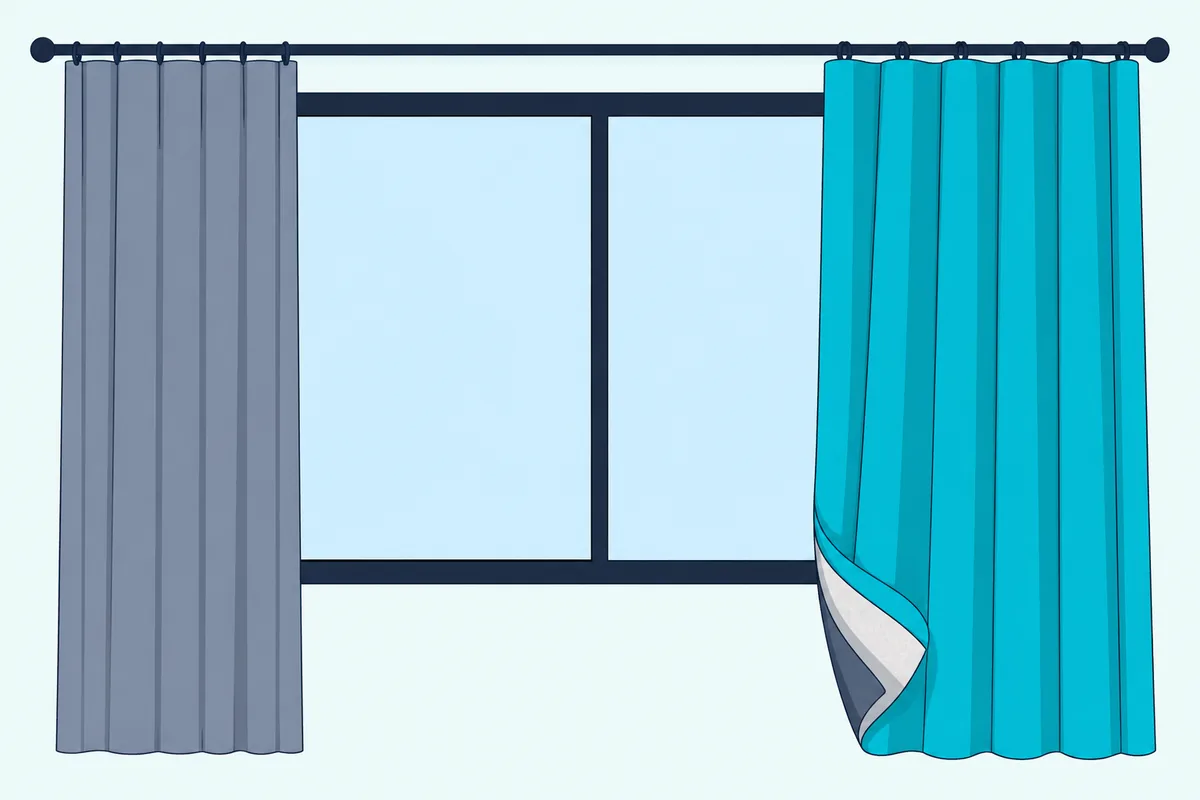
So read the layer list before the title. RYB HOME, NICETOWN and KGORGE each name a felt layer in the middle, and Moondream gives the makeup of all three of its layers.
A listing that names only a face fabric and a blackout backing is selling darkness first. The two-layer drapery the NUS team rated at STC 13 shows where one plain lined curtain landed.
Quiet Curtains says the same proprietary lining also gives all its curtains their blackout. So in Quiet Curtains’ build, one heavy lining does both jobs.
Every pick here is also sold as a blackout curtain, and all but KOUFALL claim 100%. If you came looking for blackout soundproof curtains, any of them darkens the room.
Thermal is a third label you’ll see on the same products. Every pick here is sold as thermal too, which says nothing on its own about sound.
Which Specs Matter When You Compare Curtains?
Once the layer list checks out, three things decide the rest. Weight per square foot, the width of each panel and the care label matter most, because weight sets how much a curtain blocks and width sets how much of the wall it covers.
| Curtain | Middle layer | Panel width | Care |
|---|---|---|---|
| RYB HOME 3-in-1 | Felt, removable | 52 in | Machine wash |
| Moondream DecibelControl | Polyester with aluminum | 55 in | Dry-clean only |
| NICETOWN Sound Barrier | Felt, removable | 52 in | Felt out, wash under 86°F |
| KGORGE 4-in-1 | Felt and melt-blown cloth | Felt out, cold gentle wash | |
| KOUFALL Extra Wide | 70 in |
Weight is the spec to ask for first. For a yardstick, Quiet Curtains lists its STC 13 lining at 0.225 pounds per square foot and its STC 17 lining at 0.275.
If a maker gives a panel’s weight, divide it by the panel’s area to compare. Moondream puts its three-layer soundproof curtains at roughly 4 to 7 pounds a panel, depending on length.
Taking 4 pounds as the 63-inch length and 7 pounds as the 108-inch length of a 55-inch-wide panel like the MC634, both come to about 0.17 pounds per square foot. That’s about three-quarters the weight of Quiet Curtains’ STC 13 lining on its own.
Length comes in the listing too. Moondream sells four lengths from 63 to 108 inches, NICETOWN’s pair is 84 inches, and the KOUFALL set is 84 inches as well.
Grommet size decides which rod fits. The RYB HOME, NICETOWN and Moondream panels all use 1.6-inch grommets, so the rod has to be thinner than that.
How Wide and Long Should Soundproof Curtains Be?
Those panel widths only help if the rod puts them in the right place. Long enough to reach the floor and wide enough to stack clear of the glass: Moondream’s measuring guide measures height from the top of the rail to the floor, adds 1.6 to 2 inches for a hem that breaks on the floor, and says its soundproof panels stack about 10 inches wide when pushed open.
That stack is wider than a lighter curtain’s. Moondream gives about 5.9 inches for its ordinary grommet panels folded back, so a layered curtain needs more room beside the frame.
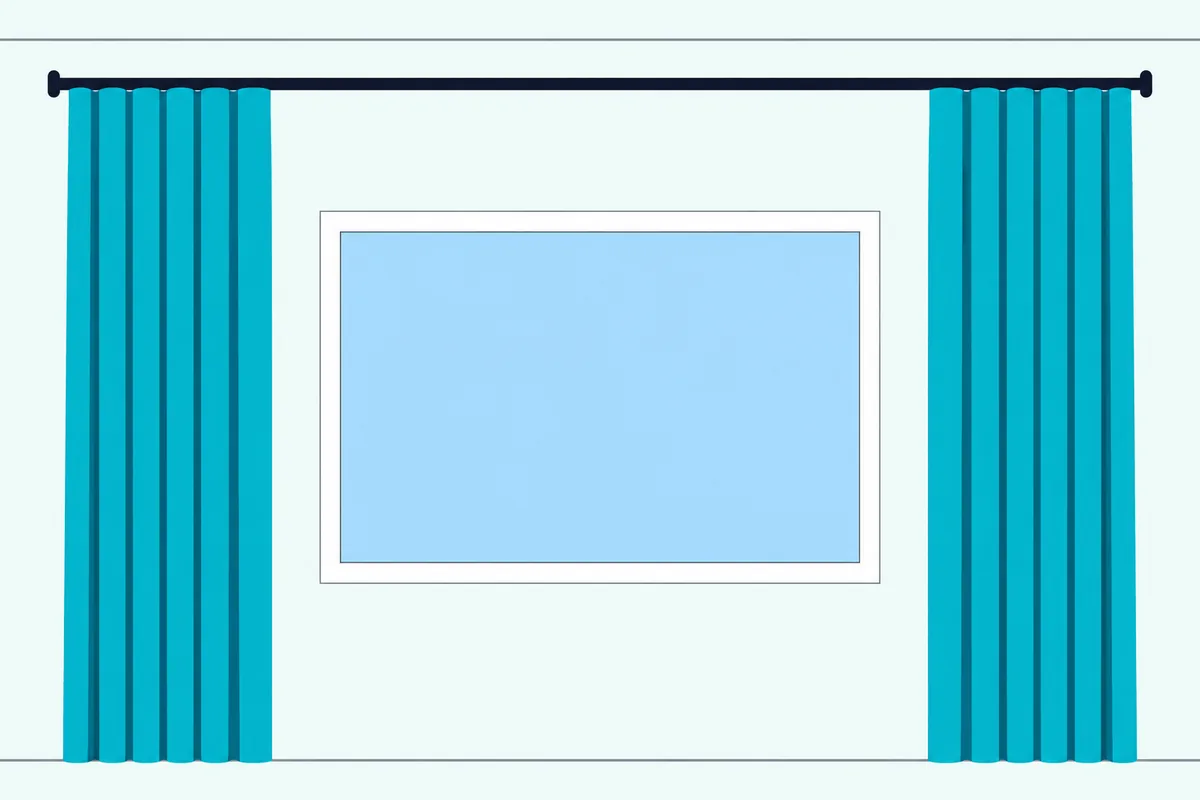
For grommet curtains, Moondream says to leave about an inch between the top of the rail and the ceiling. The fabric above the grommets takes up that space.
Width is measured from one end of the rail to the other, leaving out any decorative finials. Moondream adds that a curtain’s stated width is always its flat width, before any folds.
A rod that runs about 10 inches past each side of the frame lets each open stack sit on the wall rather than over the glass. When the curtains close, the same extra width lets the outer edges lie flat against the wall.
Take a sliding door 72 inches wide with a rod 92 inches long. Two 52-inch panels give 104 inches of flat fabric, about 1.1 times the rod, while the two 70-inch KOUFALL panels give 140, about 1.5 times.
Moondream’s rule for pencil-pleat curtains is 1.5 times the rod’s length for a full, pleated look. By that yardstick, two 52-inch panels hang almost flat on that rod, while the KOUFALL pair keeps its folds.
How Should You Hang Soundproof Curtains?
After the size, the hardware and the edges do the rest. Hang heavy panels on a sturdy rod or track and seal the edges: Quiet Curtains suggests a curtain track for its own heavy-duty curtains, calling tracks smooth and easy to close, and Moondream’s soundproof curtain buying guide suggests double-sided tape along the edges so less sound slips around them.
Gaps matter because sound takes the easiest path. CitiQuiet puts it plainly for windows: even a very small air leak lets significant noise through.
Close the two panels so they overlap at the center rather than just meeting. A strip of light down the middle is a strip where sound gets in too.
Don’t trim a multi-layer curtain with scissors to shorten it. Moondream says to adjust the length with its iron-on tape on the first layer and to leave bigger hems to a professional.
Rugs and carpet help the curtain along. Moondream’s guide suggests adding absorbent floor coverings to improve what its curtains achieve.
Can You Hang a Soundproof Curtain Over a Door?
The same hanging rules carry over to a door. Yes: Moondream’s guide says a soundproof curtain hung in front of a door dampens noise from a corridor or stairs, and suggests a door curtain pole that hooks onto the door so the curtain moves with it.
Close the gap at the floor as well. A door sweep seals the strip under the door that a curtain leaves open.
If the door itself is thin, a curtain only goes so far. Burton Acoustix covers soundproof interior doors as the permanent fix.
For a doorway with no door at all, the room-divider section below applies instead.
What Should You Try When Curtains Aren’t Enough?
Even a well-hung curtain stops at the limit the lab numbers set, and then the fix moves to the window or the wall. A second pane with an air gap comes first for window noise: CitiQuiet’s interior inserts sit inside the existing frame and leave an air gap of 3 inches or more, which it counts among the most powerful tools in window acoustics.
Ratings show how wide that gap is. CitiQuiet puts its own insert systems at STC 45 to 48 or higher, far above any curtain rating on this page.
| Window layer | STC |
|---|---|
| Plain two-layer drapery | 13 |
| Quiet Curtains vinyl lining | 17 |
| PVC curtain | 21 |
| Single-pane window | 27 |
| Basic double-pane window | 28 to 32 |
| CitiQuiet insert system | 45 to 48 |
The curtain rows rate the curtain on its own, not hung over a window, so the numbers don’t simply add together. The jump from the curtain rows to the insert row is why an insert comes first when curtains run out.
Burton Acoustix ranks acoustic window inserts by their published ratings. If you’re weighing a plexiglass sheet taped flat to the glass, its acrylic guide explains why acrylic works best as a second pane with an air gap.
Where the frame itself leaks, the best soundproof windows for home are ranked by their STC and OITC lab ratings. A replacement window is the bigger job of the two.
A heavier curtain is the other route. Quiet Curtains makes custom curtains with a vinyl lining and says they block 15 to 20 dB, depending on the fabric and the lining.
Noise through a shared wall needs work on the wall, not the window. Burton Acoustix covers that in its guide to soundproofing panels and its best soundproofing material guide.
Do Soundproof Curtains Help in a Home Studio?
Once the noise is inside the room, the question flips from blocking it to taming echo. They help with echo more than with isolation: Western Electro-Acoustic Laboratory’s absorption tests on Quiet Curtains fabrics ran from NRC 0.40 for Solitaire, an 8-ounce polyester, to 1.0 for Crescent Velour.
NRC, the noise reduction coefficient, measures how much sound a surface soaks up rather than blocks. Quiet Curtains notes that an NRC of 1.00 absorbs all sound, mostly across speech frequencies.
Moondream’s CEBTP result from earlier shows the same effect at home scale, 0.4 seconds less reverberation in about 215 square feet. Both that result and Quiet Curtains’ NRC figures measure the same thing, sound soaked up inside the room.
So a heavy curtain earns its place behind a desk or across a bare window in a recording room. It won’t keep a drum kit from reaching the neighbors.
For a vocal booth or a corner that needs more absorption, Burton Acoustix compares sound blankets. Its curtains-versus-panels guide covers when panels beat curtains for echo, since panels belong to acoustic treatment rather than soundproofing.
Dividing a Room With a Curtain
That studio corner is one inside use, and splitting a room is the other. A curtain divides a room for sight and light far better than for sound: the NUS figures earlier came from exactly this use, hospital privacy curtains.
The University of Adelaide did test its interlining as a room divider and reports a drop in sound level in the receiving room. Its demo for that setup used the heavier of its two interlinings, 1,500 grams per square meter, close to the 1.34 kilograms per square meter of Quiet Curtains’ vinyl lining.
Moondream’s product comparison lists a four-layer room divider curtain that it rates at up to 9 decibels. It comes in 95- and 108-inch lengths, weighs 7.6 to 8.7 pounds a panel and is reversible.
A divider hangs free at the ceiling, the floor and both walls, so CitiQuiet’s point about small leaks applies with full force. Run it from a ceiling track to the floor and wall to wall for the most it can do for noise.
NICETOWN’s Sound Barrier pair carries “divider” in its name, though its listing sells it for windows in bedrooms, nurseries and living rooms.
Does the Look of a Curtain Change Its Sound Blocking?
Those velour results from the studio section raise a fair question about style. Hardly: Quiet Curtains says the face fabric has little impact on sound blocking, because the lining does that work, so you can choose the face for the room.
The picks here cover the main looks. RYB HOME and KOUFALL both sell linen-faced curtains, Moondream’s MC634 has a cotton-effect face and NICETOWN’s pair here is white.
Moondream also sells its soundproof range in linen-effect and velvet styles, and in colors from white and beige to red, blue and black. Velvet and velour faces absorb a little more echo, going by Quiet Curtains’ fabric results.
If you want soundproof curtains that look good, pick the build first and the face second. The layers inside decide the noise, while the face decides how the room feels.
How Do You Wash Soundproof Curtains?
Once you’ve picked a face, the care label decides how you’ll clean it. It depends on the maker: RYB HOME’s curtains are machine washable, NICETOWN and KGORGE ask you to remove the felt first, and Moondream’s are dry-clean only.

NICETOWN sets the water below 86°F, with a mild detergent, no bleach and a low iron if needed. KGORGE wants a cold, gentle cycle and a low tumble dry, and steam ironing on the back to lift fold marks.
Both of those makers still recommend dry cleaning, and NICETOWN recommends hand washing too. RYB HOME suggests a quick iron or steam after the machine.
Put the felt back flat before rehanging, since it does the absorbing in the middle. A felt layer bunched to one side leaves part of the window with two layers instead of three.
The Bottom Line
Most windows are best served by the RYB HOME 3-in-1 Soundproof Blackout Insulation Curtains, three layers with felt at the center. If you want a published figure, the Moondream DecibelControl 3-in-1 Soundproof Curtain claims up to 10 dB, and for day sleep or a nursery the NICETOWN Sound Barrier 100% Blackout Divider Curtains put a white face over felt.
Choose the KGORGE 4-in-1 Soundproof Blackout Curtains where dust rides in with the noise, and the KOUFALL Extra Wide Linen Soundproof Blackout Curtains for a sliding door, with 70-inch panels. Expect less hiss and chatter rather than silence.
For the walls, doors and floors a curtain can’t reach, start from the soundproofing hub.
Frequently Asked Questions
How do you block out 100% of noise?
No curtain does that: Moondream says no fabric curtain can, and CitiQuiet says even a full soundproof window system leaves some very low rumble. A quiet room comes from closing each path in turn, the window, the door and any shared wall, which Burton Acoustix’s guide to every noise path into a bedroom works through in order.
Is a noise-reducing curtain different from a soundproof one?
Not in practice: the labels overlap on the same products. KOUFALL’s listing uses both words for one set and NICETOWN sells its Sound Barrier pair for noise reducing, while RYB HOME and KGORGE both say their soundproof curtains aren’t 100% soundproof, so noise reducing is the more accurate description of what any of them do.
Do soundproof curtains work with the window open?
The University of Adelaide tested that case. Its four glazing conditions included an open window, and the researchers report their heavy interlining cut perceived noise by more than half with the window open or shut, though the work may not yet have been peer reviewed.
Do soundproof curtains keep a room warmer?
Moondream claims its MC634 can: its page cites an ENVEHO test report from 2009 for up to 60% lower heating costs in winter, and a second ENVEHO report from 2010 for a cooler room in summer. Treat those as one maker’s figures for one curtain.
Are soundproof curtains a good fix for renters?
Moondream’s guide calls a curtain a much more cost-effective step than soundproof windows or thick walls, especially if you’re renting. The rod still needs brackets, so check your lease first; the curtains themselves come down and move with you.