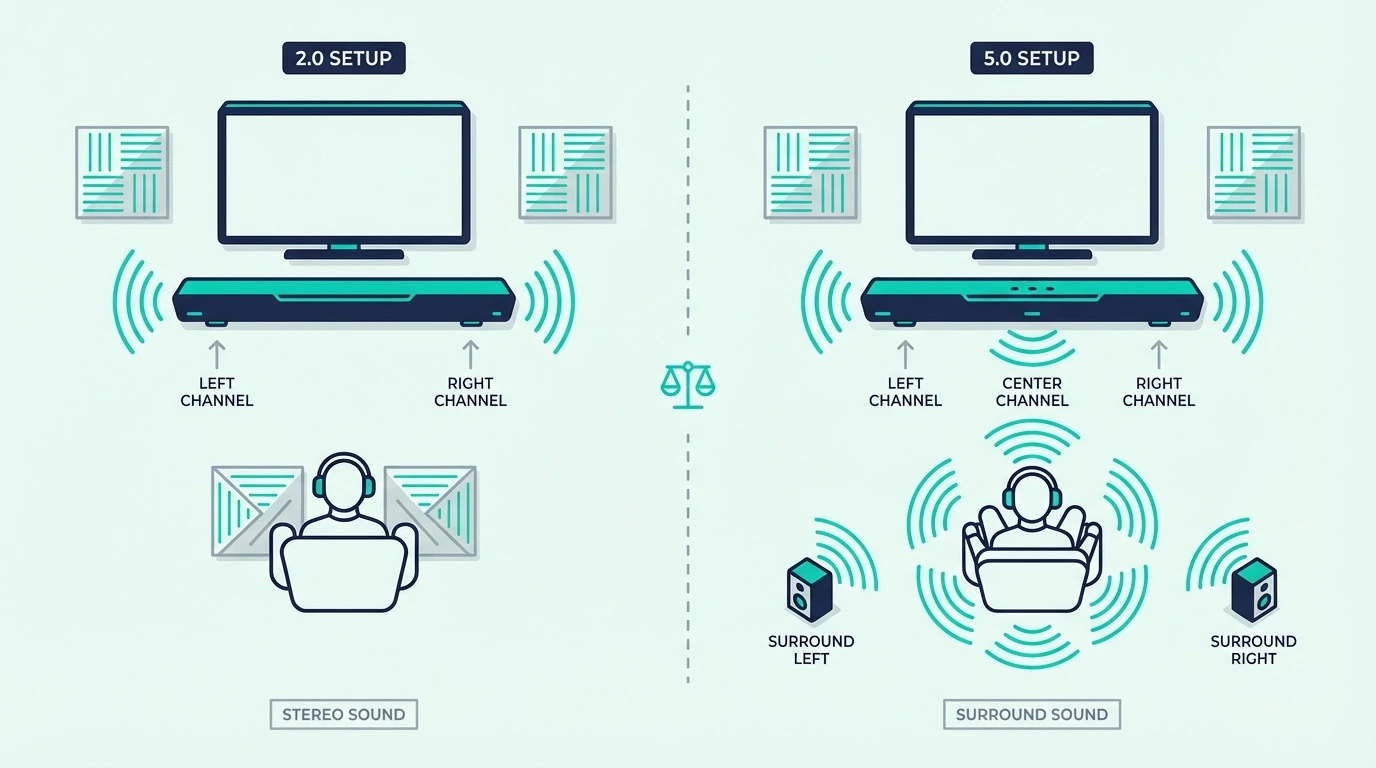
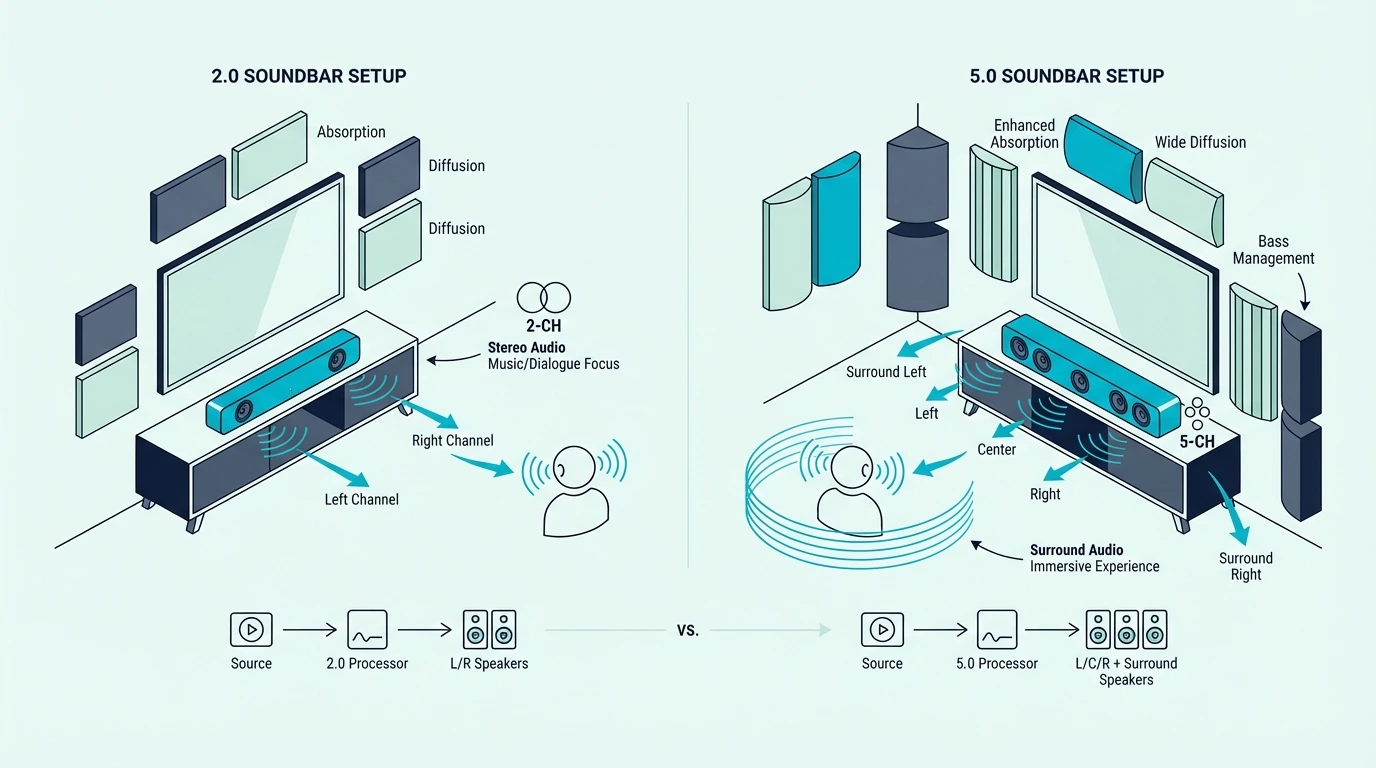
Polk vs Klipsch Soundbar: Warm Comfort or Bright Dynamics? [2026]

Polk vs Klipsch soundbar looks like a simple brand matchup, but the real choice is between warmer everyday comfort and brighter cinematic punch.

Buyers often pick the name they know first. That becomes a problem when the soundbar’s tuning does not match the room or their ears.

Polk usually sounds smoother and easier to live with. Klipsch usually sounds more forward and dramatic because it pushes detail and attack harder.

That difference matters more than a long feature list, so you can avoid buying a bar that feels dull, sharp, or tiring after a week.

Below, we’ll compare Polk and Klipsch across sound and value.

We’ll also cover buyer fit so you can choose the better match for your room and habits.

Quick Takeaway

Choose Polk if you want warmer, smoother sound that stays comfortable during long everyday viewing.

Choose Klipsch if you want brighter, more dynamic sound that makes movies and music feel more dramatic.

Polk is usually the safer all-day option. Klipsch is usually the more exciting option.

How Do Polk and Klipsch Sound Different?
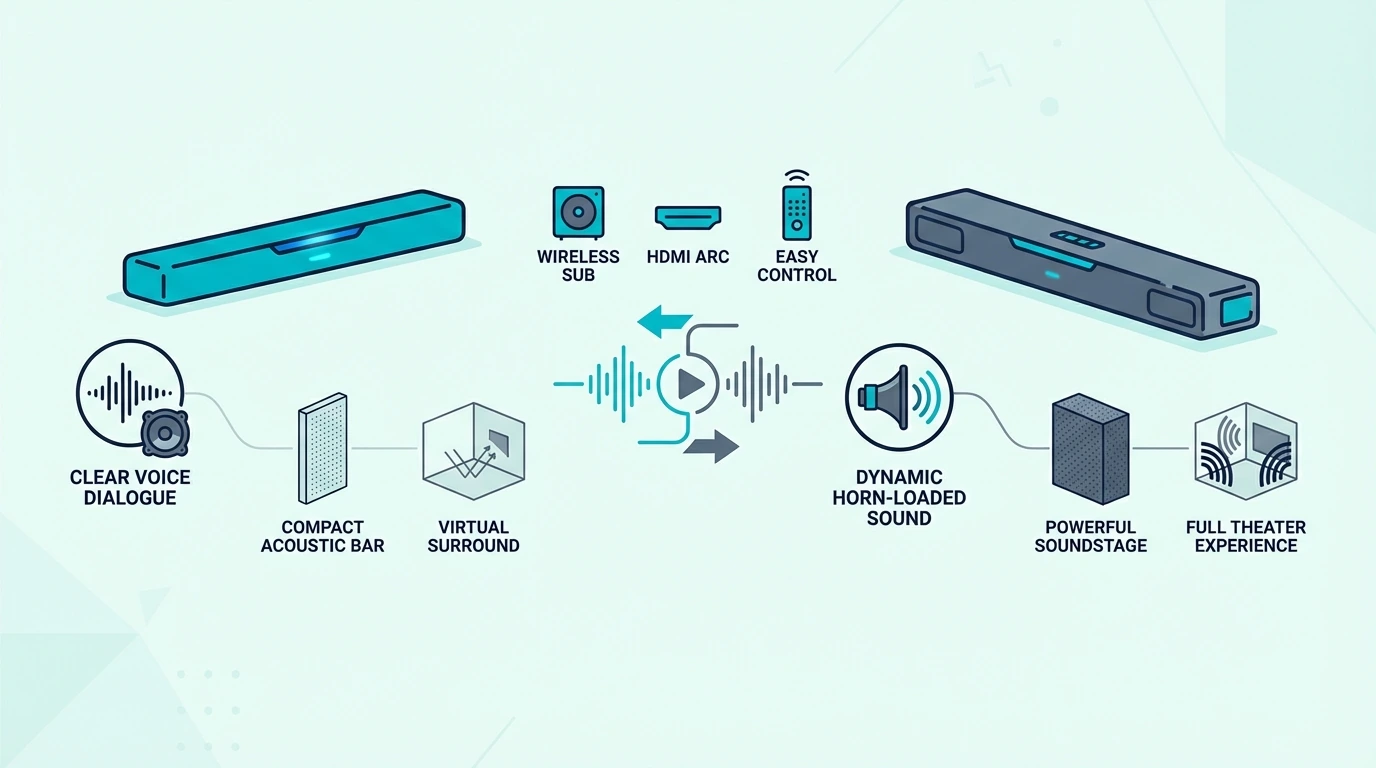
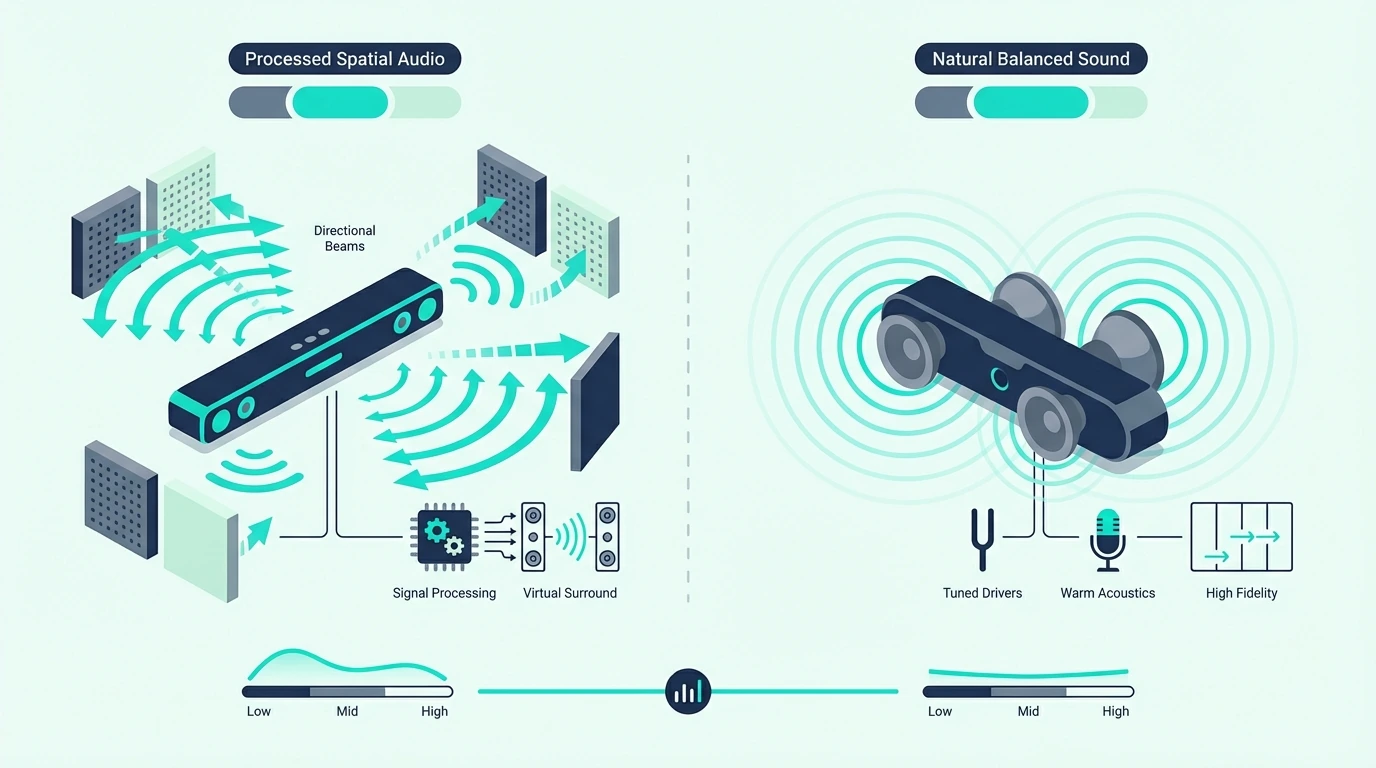
Polk and Klipsch soundbars compared side by side

The biggest difference is not the badge. It is the way each brand voices the room.

Polk Audio: Warm and Smooth

Polk tends to sound warmer and smoother. That makes it easier to recommend for long TV sessions and mixed-content homes.

Its top end is usually gentler. That helps control harsh dialogue, splashy effects, and rough streaming mixes.

Bass usually feels full instead of aggressive. The midrange also stays friendly for voices.

That matters when a soundbar handles many everyday jobs.

Polk often sounds more relaxed across routine TV use.

The Polk Audio MagniFi Max AX is a good example of that approach. It aims for scale and impact, but it still leans calmer than a more attack-heavy Klipsch system.

Polk also feels more forgiving in bright rooms.

That smoother balance is often easier to enjoy in spaces with lots of hard surfaces.

Our soundbar vs speakers guide and what is a soundbar guide help explain where that softer voicing fits in the category.

Klipsch: Bright and Dynamic

Klipsch usually sounds more forward and more energetic. Its horn-loaded approach pushes dialogue, detail, and attack harder.

That extra bite can make movies feel more alive right away. It can also feel tiring if your room is reflective or your ears prefer a calmer balance.

The Klipsch Flexus CORE 210 Dolby Atmos 44″ SoundBar + 10″ Subwoofer shows that character clearly. It leans into sharper edge definition and stronger first-impression impact.

Klipsch is also less forgiving of bad source material. Thin TV mixes and bright rooms sound more obvious when the bar is already tuned for excitement.

That does not make it worse. It just means the right buyer matters more.

Our how to choose a soundbar guide and soundbar setup guide add context if you are comparing brand character instead of chasing specs alone.

Which sound signature fits most buyers?

Pick Polk if you want the safer everyday tuning. It usually fits mixed households and anyone who hates fatiguing treble.

Pick Klipsch if you want the soundbar to feel more dramatic from day one. That usually appeals more to action-movie fans and listeners who already know they like a brighter top end.

Room size and channel count still matter. A compact bar and a subwoofer-backed Atmos system can create very different results even before brand voicing enters the picture.

Our 2.1 vs 5.1 soundbar guide and soundbar vs home theater guide help frame how much of the experience comes from configuration, placement, and room goals.

Can EQ or room correction close the gap?

EQ can trim a few rough edges. It usually cannot turn Polk into Klipsch or Klipsch into Polk.

The driver design, voicing, and overall presentation still stay in place. That is why choosing the right sound character first usually saves more frustration than tweaking later.

If you expect menus and presets to erase the difference, you are often solving the wrong problem. Start with the brand that already sounds closer to what you want.

Which Brand Gives You Better Features and Value?

Choosing between Polk and Klipsch soundbars for TV audio

Sound is the headline difference, but daily ownership usually comes down to value, setup, and how much flexibility you get for the money.

That is where Polk and Klipsch start to separate again. One often feels easier to buy safely, while the other feels easier to love if you already know your taste.

Does Polk usually offer better value?

Polk usually reaches the practical sweet spot faster. It gives more buyers what they need without forcing them too far up the price ladder.

That matters because most living-room setups do not need extreme tuning or a prestige premium. They need clean dialogue, solid bass, and simple daily use.

Features like VoiceAdjust help Polk here. Dialogue control can matter more in daily use than a more dramatic first impression in a store demo.

The Polk Audio Signa S4 TV Sound Bar with Subwoofer is a good example of that value angle. It fits buyers who want an easier Atmos-ready setup without chasing the boldest or brightest presentation.

Polk also tends to offer a gentler learning curve.

It is often the lower-risk starting point when you are still figuring out your preferred sound and setup.

Our how to choose a soundbar guide and soundbar to TV connection guide help with the practical side of that decision.

Does Klipsch justify the higher spend?

Klipsch can justify it when you already know you want more attack and drama. The premium makes less sense if your main goal is easy everyday TV listening.

That is because Klipsch is not just selling features. It is selling a more specific type of excitement.

That can feel worth paying for if you mainly watch action movies or concert videos.

For casual streaming or long background listening, the same edge can feel less useful.

Klipsch also feels more specialized as a lineup. That narrower focus can be a strength for buyers who want that house sound and a weakness for buyers who just want a safe all-rounder.

If your room is bright or your source material is inconsistent, Polk may feel better even when Klipsch sounds more impressive in a quick demo. That is why five-minute first impressions can be misleading.

Our HDMI vs optical guide and 2.1 vs 5.1 soundbar guide help separate setup questions from brand-voicing questions.

Which brand is easier to live with over time?

Polk is usually easier to recommend to mixed households.

It suits everyday TV and casual music without drawing too much attention to itself.

Klipsch is easier to recommend to buyers with a clear preference. If you already love lively speakers, its soundbar lineup makes more sense.

That is the real tradeoff for many shoppers. Polk is often the safer long-term bet, while Klipsch is often the more memorable short-term demo.

This is also why returns happen. Buyers chase the brand that sounded more dramatic for ten minutes, then realize they preferred the calmer option after a week of real TV use.

What should you compare besides the brand name?

Do not stop at the logo. Start with room size and seating distance.

Then think about wall surfaces, listening volume, and how often you watch effects-heavy content.

A brighter bar can wow in a quick demo and become tiring at home. A warmer bar can seem less exciting at first and end up being the better long-term fit.

You should also compare upgrade expectations. If you want simple daily use, your best choice may be the bar that disappears into the routine instead of the one that sounds most dramatic on day one.

Our soundbar vs home theater guide and soundbar setup guide help frame those tradeoffs before you focus on the badge.

Does speaker heritage actually matter here?

Yes, but mostly because it makes both brands more predictable. Polk and Klipsch bring established house sounds instead of treating the soundbar like a generic TV accessory.

That means your choice is less about guessing which brand is legitimate. It is more about deciding which tuning philosophy fits your room and habits.

Polk leans toward balance and comfort. Klipsch leans toward impact and energy.

Neither approach is automatically better. The better brand is the one that still sounds right after a full week in your own room.

Our soundbar vs receiver guide and how to choose a soundbar guide help if you are still deciding whether a soundbar is even the right format for the room.

The Bottom Line

Choose Polk if you want the safer all-day listen. It is usually the better fit for mixed households, bright rooms, and buyers who care more about comfort than flash.

Our best Polk soundbar guide ranks the current Polk lineup by use case and room size.

Choose Klipsch if you want the soundbar to feel more energetic every time you press play. It is usually the better fit for movie fans who know they enjoy brighter, more forward sound.

If dialogue clarity is the deciding factor either way, our best soundbar for dialogue guide covers bars tuned for speech.

If you are still undecided, compare your room and main content before you compare brand reputation.

Listening volume usually tells you more than the logo.

Our how to choose a soundbar guide helps narrow the right category first, and our soundbar setup guide shows how placement can change what you hear from either brand.

Frequently Asked Questions

Does Polk Audio make good soundbars?

Yes. Polk makes strong everyday soundbars with friendly tuning and useful dialogue features.

They are especially easy to recommend for TV-first households that want a smoother listen over long sessions.

Is Klipsch considered high end?

Klipsch is a respected heritage speaker brand with a more premium reputation than many mass-market TV audio brands. Its soundbars carry that same dynamics-first identity.

That does not mean every buyer will prefer it. It usually means the brand appeals more to listeners who already know they like a brighter, more energetic presentation.

Is Polk Audio a high-end brand?

Polk sits closer to the upper-mid range than true luxury audio. The brand focuses on strong performance and practical value rather than ultra-premium pricing.

For many buyers, that is the appeal. Polk offers real speaker heritage without pushing as aggressively into prestige pricing.
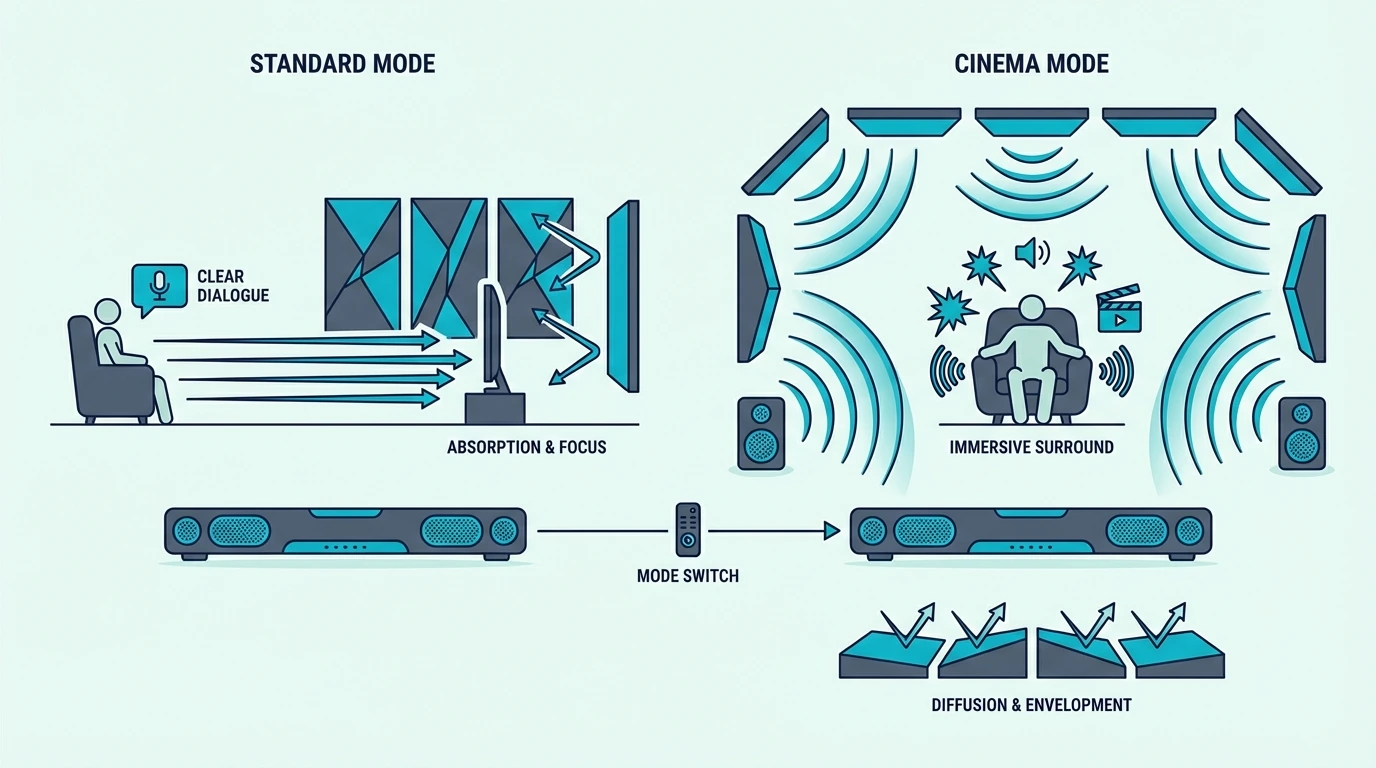
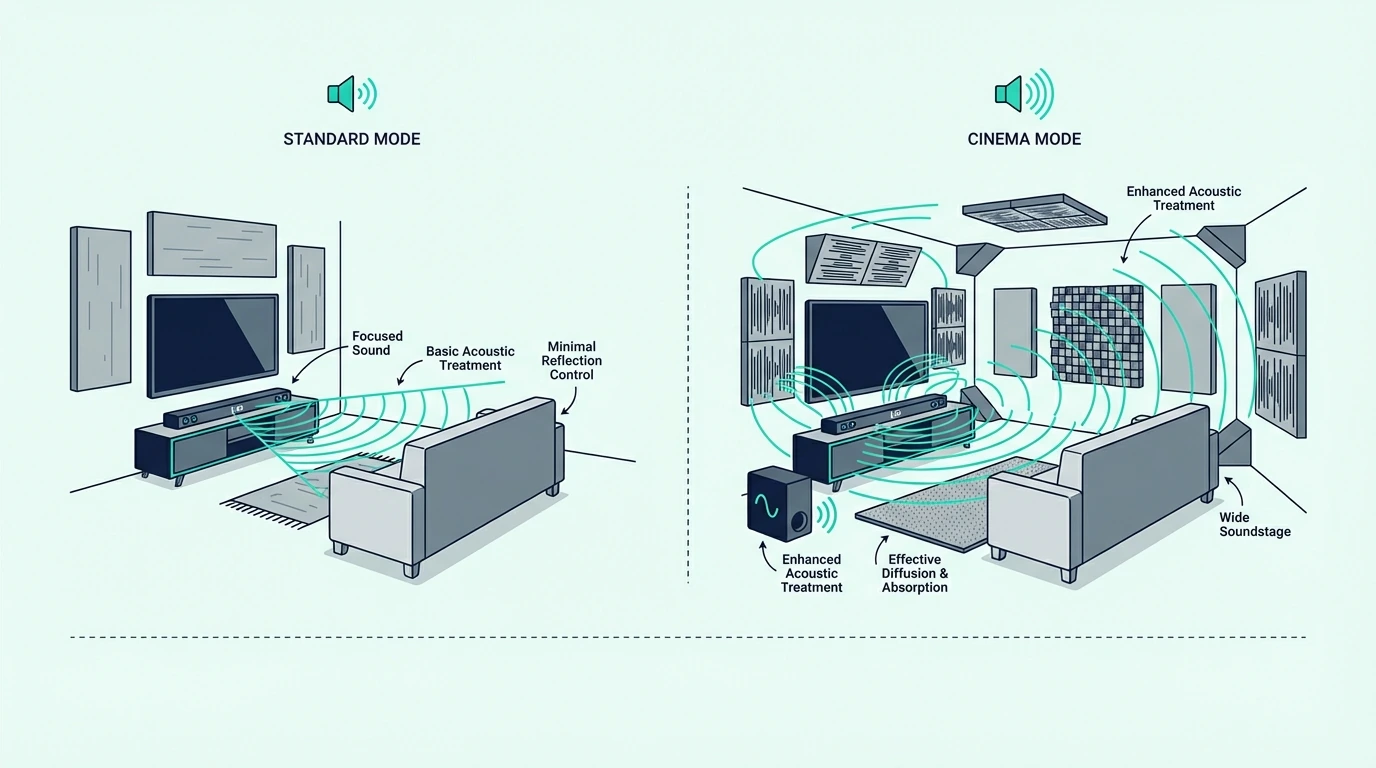
LG Soundbar Standard vs Cinema: Which Mode Sounds Better? [2026]

The lg soundbar standard vs cinema mode question looks like a simple preference toggle, but the wrong setting can make your soundbar sound worse than it should.

Standard mode’s neutral EQ can make movies feel flatter than expected.

Cinema mode’s heavier bass and wider surround effects can make everyday TV dialogue harder to follow.

Understanding what each mode actually changes helps you get better sound from the hardware you already own without spending anything on upgrades.

The problem is that most LG soundbar owners leave the bar on one mode permanently, usually Standard because it is the default.

They never realize Cinema mode can make movie nights more immersive.

They also miss that Standard mode often keeps dialogue cleaner for the TV shows and music they use every day.

LG’s sound modes are software presets rather than hardware limits, so switching between them is one of the easiest ways to improve daily listening.

Knowing exactly what Standard and Cinema modes change helps you optimize your soundbar for every type of content.

It also shows when AI Sound Pro, Music, Game, Night, or Clear Voice may be the smarter choice.

You can stop settling for one-size-fits-all audio and start using the mode that fits what is on screen.

That matters most if your household jumps between news, sitcoms, sports, streaming movies, and background music on the same soundbar.

Below, we’ll break down exactly what Standard and Cinema modes do to your LG soundbar’s audio, when to use each one, and how LG’s other sound modes compare so you can pick the right setting for every viewing situation.

Quick Takeaway

Use Standard mode for everyday TV viewing, news, talk shows, music listening, and any content where dialogue clarity matters most.

Use Cinema mode for movies, action-heavy streaming content, and immersive viewing sessions where you want stronger bass, wider surround effects, and more theatrical impact.

Cinema mode feels bigger, but Standard usually keeps speech cleaner.

What Standard and Cinema Modes Actually Change

LG soundbar Standard and Cinema sound modes compared

Standard and Cinema are software presets that reshape how your LG soundbar’s digital signal processor handles audio.

They do not change your hardware, but they do change tonal balance, virtual surround width, and bass response.

Standard Mode: Neutral and Balanced

Standard mode delivers your LG soundbar’s most neutral audio profile.

The EQ curve is essentially flat, which means the soundbar reproduces audio without artificially boosting or cutting specific frequency ranges.

Dialogue comes through clearly because the midrange frequencies where human speech lives are not fighting boosted bass or exaggerated effects.

The overall tonal balance sounds natural and less processed.

For TV shows, news broadcasts, talk shows, podcasts, and music listening, Standard mode usually delivers the clearest and most natural audio.

It lets the original mix come through instead of reshaping it for a different kind of content.

That makes it especially useful for older cable feeds and compressed streaming mixes that already sound busy before any extra processing is added.

For large-room movie use, a current example is LG S40T 2.1 ch.Soundbar with Wireless Subwoofer, which is a strong fit for TV and movies when you want fuller bass.

The virtual surround processing in Standard mode is modest.

It widens the soundstage slightly beyond the bar’s physical width without aggressive spatial manipulation.

Our soundbar fundamentals guide covers how all soundbar processing works, and our 2.1 vs 5.1 soundbar guide explains the channel configurations that affect how modes perform.

Cinema Mode: Bass Boost and Surround Enhancement

Cinema mode reshapes your LG soundbar’s audio for theatrical impact.

It boosts bass, widens the virtual surround field, and exaggerates dynamic swings so action sequences feel more dramatic.

The goal is to imitate a movie theater presentation with bigger bass and more enveloping effects.

The tradeoff is dialogue clarity.

Cinema mode’s bass boost can mask speech when voices compete with music and effects.

It works best when the soundtrack already has real low-end effects and spacious mixing for the processing to build on.

For large-room movie use, a current example is LG S60T 3.1 ch. Soundbar with Wireless Subwoofer, which is a strong fit for TV and movies when you want fuller bass.

Our soundbar vs surround sound guide explains when virtual surround modes approach physical surround performance, and our 2.1 vs 5.1 soundbar comparison covers how channel count affects mode effectiveness.

Other LG Sound Modes and When to Use Them

When to use Standard or Cinema mode on an LG soundbar

Beyond Standard and Cinema, LG soundbars offer several other sound modes that may be better for specific situations.

Understanding the full mode lineup helps you optimize for the actual content in front of you.

AI Sound Pro: The Automatic Choice

AI Sound Pro on newer LG soundbars uses machine learning to analyze incoming audio in real time.

It identifies whether you’re watching dialogue-heavy drama, action movies, sports, music, or news and adjusts processing automatically.

For owners who do not want to switch modes constantly, AI Sound Pro is often the best default.

That convenience is useful in shared households where nobody wants to open the app or remote menu every time the content changes.

The limitation is that detection is not perfect.

It can misread a scene or apply processing that does not match your taste, which means less manual control.

Our Samsung vs LG soundbar comparison covers how LG’s AI Sound Pro competes with Samsung’s adaptive processing, and our guide to choosing a soundbar helps evaluate whether those extra features are worth paying for.

Music, Game, Night, and Clear Voice

LG’s remaining modes serve narrower use cases.

Music mode enhances stereo separation and midrange presence for a more engaging listen.

Game mode reduces audio latency and emphasizes directional cues so gameplay feels more responsive.

Night mode compresses dynamic range so loud explosions and quiet dialogue stay closer together.

That makes it useful for late-night viewing in apartments or shared spaces.

Clear Voice boosts the speech range to make dialogue easier to follow.

That is especially helpful if you struggle with dialogue regardless of the main mode.

A current premium example is Samsung Q-Series Soundbar, which is a strong fit for TV and movies when you want fuller bass.

Our HDMI vs optical guide explains how connection type affects which modes and formats your soundbar can process, and our soundbar to TV connection guide covers optimal setup for LG soundbar systems.

LG TV Integration: WOW Orchestra

For LG TV owners, WOW Orchestra synchronizes the TV speakers with the soundbar to create a wider and taller soundstage.

It is similar in concept to Samsung’s Q-Symphony, but inside LG’s ecosystem.

When WOW Orchestra is active, the selected mode applies to the combined TV-plus-soundbar system rather than only the bar.

That can make Cinema mode feel more expansive because the TV speakers add physical height.

On compatible LG TVs, that extra integration can make mode changes feel more meaningful than they do on a standalone soundbar.

Our soundbar vs home theater comparison covers when full surround systems outperform soundbar mode optimization, and our soundbar vs speakers guide explains when dedicated speakers deliver better audio than any soundbar mode.

The Bottom Line

Use Standard mode as your everyday default for TV shows, news, music, and general viewing where dialogue clarity and natural tonal balance matter most.

It is usually the most accurate presentation your LG soundbar can produce without extra processing.

Switch to Cinema mode for movie nights and action-heavy content when you want stronger bass and wider surround.

If dialogue starts to blur, try Clear Voice or go back to Standard.

For the most convenient experience, try AI Sound Pro as the default and let the bar adjust automatically.

If you are unsure, try Standard for a week of normal viewing and switch to Cinema only for movie nights. The difference becomes obvious quickly.

Our guide to choosing a soundbar helps evaluate whether your audio setup benefits from further upgrades, and our soundbar setup guide covers optimal placement that maximizes the effectiveness of every sound mode.

Frequently Asked Questions

What is cinema mode on LG soundbar?

Cinema mode is a sound preset that boosts bass, widens virtual surround processing, and enhances dynamic range to simulate a more theatrical presentation.

It can make action movies feel more dramatic, but it can also reduce dialogue clarity compared with Standard mode.

For large-room movie use, a current example is LG S60T 3.1 ch. Soundbar with Wireless Subwoofer, which is a strong fit for TV and movies when you want fuller bass.

What is the best sound mode for LG TV?

For everyday viewing, Standard or AI Sound Pro usually sounds most balanced.

Use Cinema for movies, Game for gaming, and Night for late viewing.

Should I have real cinema on or off?

Turn Cinema mode on for movies and action shows when you want more bass and wider surround.

Turn it off for dialogue-heavy shows, news, and music when clarity matters more.

Is cinema or filmmaker mode better?

Filmmaker mode on LG TVs changes video processing.

It disables motion smoothing and preserves the intended frame rate and color.

Cinema mode on LG soundbars changes audio processing by boosting bass and surround.

They do different jobs and can be used together.

Klipsch vs Samsung Soundbar: Audio Character or TV Integration? [2026]

The klipsch vs samsung soundbar comparison looks like niche audio heritage versus a mainstream electronics giant, but the real choice is between two very different design priorities.

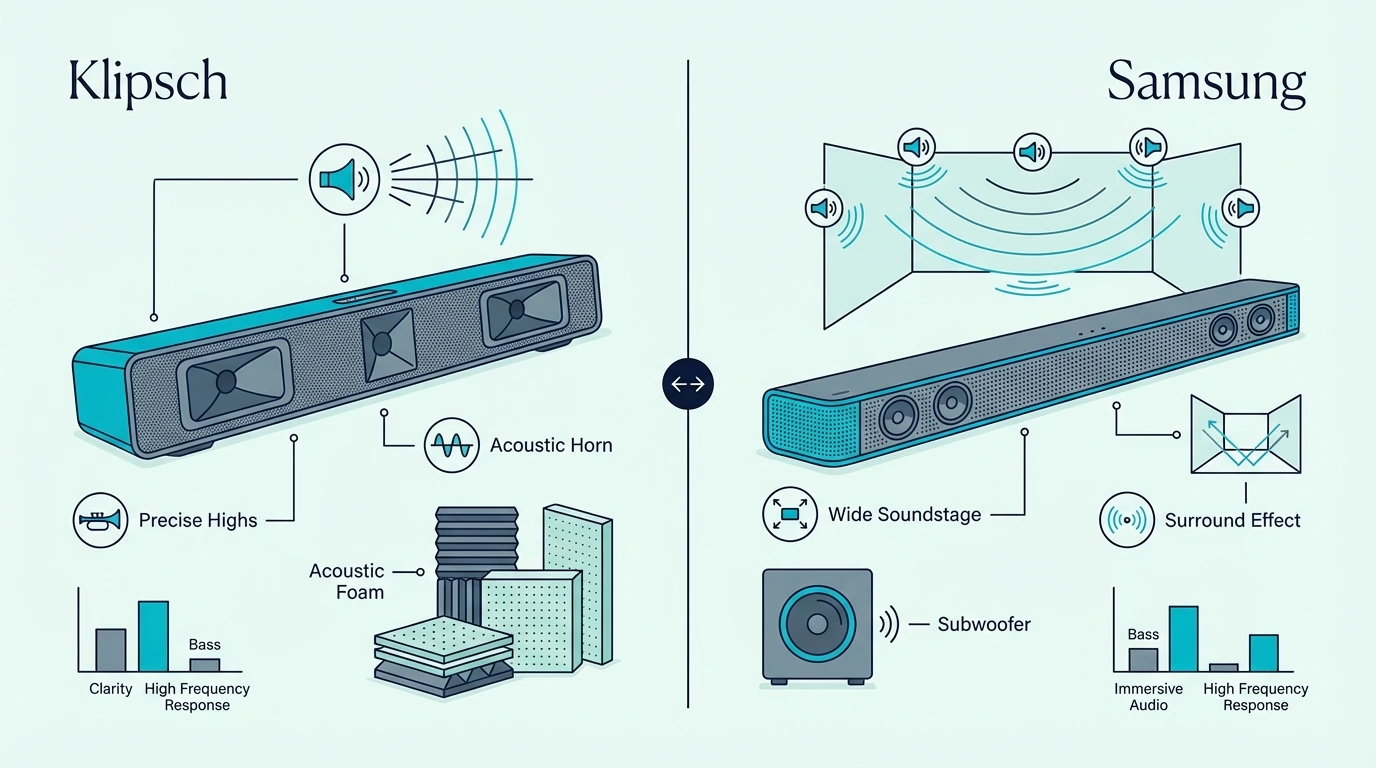
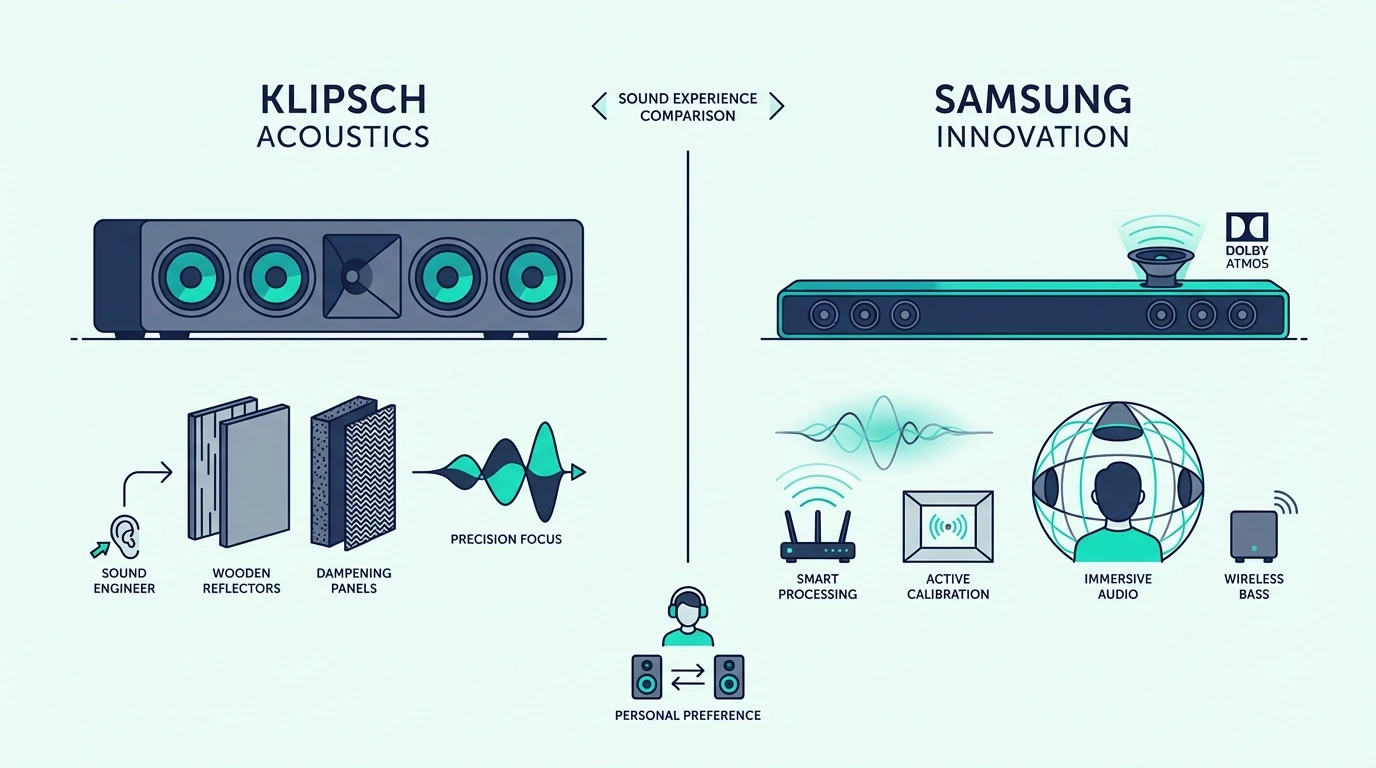
Klipsch builds soundbars around horn-loaded drivers and lively, speaker-like dynamics.

Samsung builds soundbars around seamless TV integration with features like Q-Symphony and SpaceFit Sound.

Most buyers assume Samsung’s mass-market positioning means weaker audio, but its flagship models compete with premium brands while adding TV-specific features Klipsch cannot match.

The problem is that Klipsch soundbars deliver the dynamic, forward sound that many buyers love. Punchy dialogue and crisp highs make movies feel exciting.

But they lack the smart TV integration features Samsung provides because Klipsch focuses on audio engineering rather than TV ecosystem connectivity.

Samsung TV owners get a more unified system because Q-Symphony uses the TV speakers alongside the bar, while SpaceFit Sound tunes playback to the room.

That difference matters most when you split your time between focused movie nights, background TV, and casual music listening.

Understanding whether your priority is Klipsch’s dynamic audio character and speaker-grade sound quality or Samsung’s TV integration and feature-rich ecosystem helps you make a confident purchase, so you can avoid paying a premium for Klipsch’s audiophile engineering when Samsung’s integration features deliver better daily convenience, or missing Klipsch’s superior dynamics by defaulting to Samsung based on brand familiarity alone.

Below, we’ll compare Klipsch and Samsung soundbars across sound quality, TV integration, feature sets, and value so you can pick the brand that matches your actual audio priorities and TV setup.

Quick Takeaway

Choose Klipsch if you prioritize dynamic, lively sound with horn-loaded clarity and do not need Samsung-specific TV integration features. Choose Samsung if you own a Samsung TV and want Q-Symphony, SpaceFit Sound, and a broader feature set that makes the soundbar and TV behave like one unified system.

Sound Quality and Audio Character

Klipsch and Samsung soundbars compared side by side

The most significant difference between Klipsch and Samsung soundbars is their sound character — each brand has a distinct audio personality that appeals to different listener preferences, and choosing the wrong one means daily dissatisfaction with how your entertainment sounds.

Klipsch: Horn-Loaded Dynamics

Klipsch’s signature sound comes from their horn-loaded tweeter technology — a design borrowed from their legendary floor-standing speakers that uses a horn-shaped waveguide to direct high-frequency audio with exceptional efficiency and precision.

The result is a bright, forward sound character where dialogue cuts through with razor-sharp clarity, high-frequency details sparkle, and dynamic swings between quiet dialogue and loud explosions feel genuinely impactful.

For large-room movie use, a current example is Klipsch Flexus CORE 210 Dolby Atmos 44″ SoundBar + 10″ Subwoofer, which is a strong fit for Atmos movies and TV with stronger bass.

For action movies, live concerts, and music genres that benefit from forward presentation, Klipsch’s sound character makes content feel more exciting and alive.

Music-first buyers often prefer that immediacy, while mixed-use households sometimes find it more demanding over long everyday sessions.

Our soundbar vs speakers comparison covers when dedicated speakers outperform soundbar configurations, and our soundbar fundamentals guide explains how all soundbar types work.

Samsung: Refined Processing and Wide Soundstage

Samsung soundbars deliver a more balanced, processed sound signature that prioritizes wide soundstage, smooth frequency response, and consistent performance across all content types rather than the forward dynamics that Klipsch emphasizes.

For this kind of small-room, dialogue-first setup, a current example is Samsung Q800F 5.1.2ch Q Series Soundbar + Subwoofer, which is a strong fit for Atmos movies and TV with stronger bass.

Samsung’s refined audio processing emphasizes intelligibility and listening comfort for extended viewing sessions — dialogue stays clear without sounding aggressive, bass stays present without overwhelming, and the overall tonal balance is designed to sound good with everything.

For casual viewers who watch a mix of TV shows, movies, news, and music, Samsung’s balanced approach provides consistently satisfying audio.

Samsung’s calmer presentation is usually easier to live with when different people in the house watch very different kinds of content.

It is also usually the safer choice in brighter, more reflective family rooms where Klipsch’s more forward treble can feel exciting with movies but occasionally too assertive for background viewing.

Our Bose vs Samsung soundbar comparison covers how Samsung competes with another mainstream premium brand, and our Samsung vs LG soundbar guide explains Samsung’s competitive position among TV manufacturers.

TV Integration and Feature Value

Choosing between Klipsch and Samsung soundbars for TV audio

Beyond sound quality, Samsung offers TV integration features that create a fundamentally different ownership experience for Samsung TV owners.

Understanding whether those features matter for your setup determines whether Samsung’s ecosystem advantage justifies choosing their soundbar over Klipsch’s superior dynamics.

Samsung TV Owners: Unmatched Integration

Samsung’s Q-Symphony technology is the single biggest differentiator in this comparison.

It uses your Samsung TV’s built-in speakers alongside the soundbar simultaneously, creating a wider and taller soundstage that neither device could produce alone.

SpaceFit Sound automatically analyzes your room’s acoustics and adjusts the soundbar’s output accordingly.

The TV remote also controls the soundbar seamlessly without needing a separate remote or app.

For Samsung TV owners, these features transform the soundbar from a separate audio device into an integrated extension of the TV itself.

That level of seamless integration is something Klipsch and every other non-Samsung soundbar brand cannot provide because Q-Symphony depends on proprietary communication between Samsung TV and Samsung soundbar hardware.

That convenience matters most in everyday family-room use, where simpler control and automatic room tuning often get noticed more than small differences in raw sound character. It also reduces setup friction for less technical households.

Our Sonos vs Samsung soundbar comparison covers how Samsung’s integration competes with Sonos’s ecosystem, and our best Samsung soundbar guide shows which models make the most of those ecosystem features.

Non-Samsung TV Owners: Level Playing Field

If you don’t own a Samsung TV, Samsung’s biggest advantages don’t apply.

The comparison then shifts to audio quality, price, and standard features, where Klipsch’s dynamic sound character becomes a more compelling differentiator.

Without Samsung TV integration, a Samsung soundbar is simply a well-featured bar with Dolby Atmos at competitive pricing.

If your TV will never support Samsung’s exclusive features, paying extra for them makes less sense than choosing the sound profile you actually prefer.

Klipsch, by contrast, offers genuinely distinctive audio character that stands out from the crowd.

For large-room movie use, a current example is JBL Bar 700MK2-7.1 Channel soundbar System with Detachable Speakers a…, which is a strong fit for Atmos movies and TV with stronger bass.

Our HDMI vs optical guide explains connection options for both brands, and our soundbar to TV connection guide covers setup for any TV-soundbar combination.

Product Range and Pricing

Samsung offers the widest soundbar lineup of any brand — from budget models under $200 through the flagship HW-Q990D with 11.1.4 channels and physical rear speakers.

That range gives buyers options at every price point with consistent feature quality.

That breadth also makes Samsung easier to shop by budget because there is usually a model tier built around your room size and TV habits.

Klipsch’s soundbar lineup is significantly smaller and newer, with the Flexus series positioned at the mid-to-premium price points where competition is fiercest.

Klipsch gives you fewer forks in the road, but the lineup feels more intentionally voiced for buyers chasing impact over feature menus.

Our soundbar vs surround sound guide covers when full surround systems outperform both brands, and our soundbar vs home theater comparison explains the broader home theater upgrade path.

The Bottom Line

Choose Klipsch for dynamic, lively sound with horn-loaded clarity that makes movies and music feel exciting.

It also gives you speaker-heritage audio engineering and a distinctive sound character that stands out from mainstream brands.

Choose Samsung if you want seamless TV integration with Q-Symphony and SpaceFit Sound, the widest product lineup at every price point, and balanced audio that sounds good with everything.

For Samsung TV owners, that feature-rich ecosystem is hard to beat.

Our guide to choosing a soundbar helps evaluate whether either brand upgrade makes sense, and our soundbar setup guide covers optimal placement for both soundbar brands.

Frequently Asked Questions

Is Klipsch considered high end?

Yes — Klipsch is a heritage American speaker brand founded in 1946 with a reputation for high-end audio engineering.

Their signature horn-loaded driver technology is known for exceptional dynamics and efficiency.

Their soundbars carry that premium audio heritage into a more accessible form factor.

That positioning puts them above mass-market brands in audio quality while remaining below ultra-premium brands like Bang & Olufsen.

Does Klipsch make good soundbars?

Yes — Klipsch’s Flexus series soundbars deliver the brand’s signature dynamic sound with horn-loaded tweeters and Dolby Atmos processing.

That audio character appeals to buyers who genuinely want more liveliness and dialogue clarity.

The main limitation compared to Samsung is the smaller product lineup and lack of TV-specific integration features.

What brand is best for soundbars?

No single brand is best for everyone.

Samsung leads in TV integration and product variety, while Klipsch leads in dynamic audio character.

Sonos leads in multi-room ecosystem, Bose excels at compact room-filling sound, and JBL remains strong on mid-range value.

The best brand depends on whether you prioritize TV integration, audio character, ecosystem, or value for your specific setup.

KEF LSX vs Soundbar: Which Is Better for Music and TV? [2026]

The KEF LSX vs soundbar debate seems like a clear win for KEF’s audiophile pedigree but it is actually a choice between two fundamentally different audio philosophies. Picking the wrong one leads to expensive buyer’s remorse.

The KEF LSX II ($1,400/pair) are premium powered bookshelf speakers built around KEF’s acclaimed Uni-Q coaxial driver technology. Two physically separated speakers deliver audiophile-grade stereo imaging and music reproduction.

A soundbar is a single compact bar that uses virtual processing to deliver dialogue clarity and surround effects. You get simple one-cable setup from a unit placed below your TV.

The problem is music lovers who buy a soundbar expecting rich detailed music reproduction get disappointed. Compressed stereo imaging and processed sound character show up even on premium soundbars.

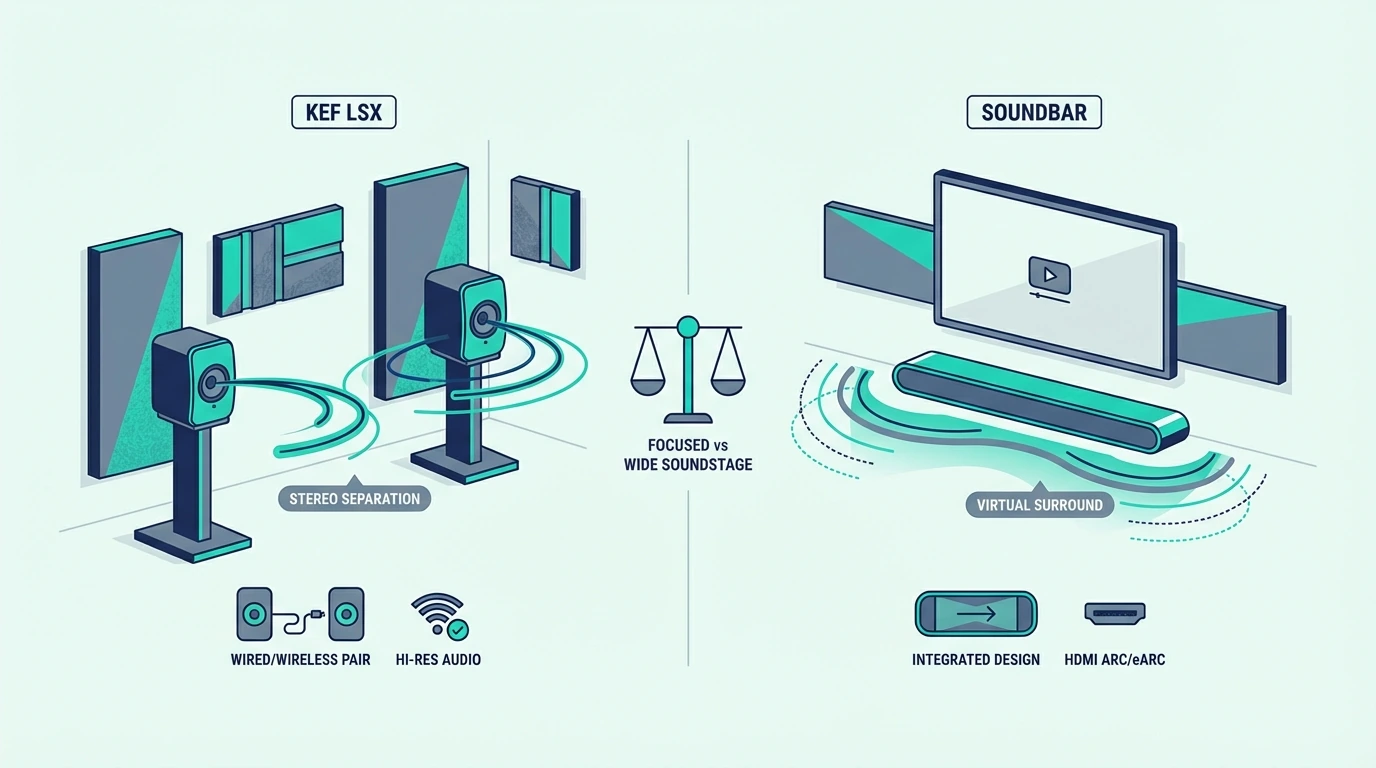
The cause is simple: a single bar physically cannot create the wide stereo separation that two properly positioned speakers produce. That limitation is baked into the form factor.

The KEF LSX II’s Uni-Q driver places the tweeter at the acoustic center of the midrange cone. Each speaker becomes a point source with exceptionally accurate stereo imaging.

The resulting three-dimensional soundstage is something no single-bar soundbar can replicate.

Knowing whether your primary use case is music listening (where the KEF LSX II genuinely excels) or TV viewing with dialogue clarity and surround effects (where soundbars genuinely excel) helps you make a confident purchase, so you can avoid spending $1,400 on audiophile speakers that underperform for TV dialogue and surround versus investing in a soundbar that delivers better TV audio at a fraction of the price while accepting its music limitations.

Below, we’ll compare the KEF LSX II and soundbars across music quality, TV performance, setup requirements, and value so you can pick the approach that matches whether music or TV is your primary listening priority.

Quick Takeaway

Choose the KEF LSX II if music listening is your primary use case and you want audiophile-grade stereo imaging, natural sound reproduction, and a wide three-dimensional soundstage that no soundbar can match. Choose a soundbar if TV viewing is your primary use case and you want clearer dialogue, virtual surround for movies, deeper bass from an included subwoofer, and simpler one-cable setup.

Music Quality vs TV Performance

KEF LSX speakers compared with a soundbar

The KEF LSX II and soundbars each dominate in their primary use case — and understanding where each excels (and where each falls short) prevents you from choosing the wrong product for your actual listening habits.

KEF LSX II: Audiophile Music Excellence

Place two LSX II speakers 4-8 feet apart at ear height for best imaging. The result is a wide three-dimensional stereo soundstage.

Instruments and vocals occupy precise positions in space with a depth and clarity that makes music feel present and alive in the room.

The stereo separation alone transforms music listening. Vocals sit firmly centered between the two speakers while instruments spread across a wide soundstage.

The soundstage extends beyond the physical positions of the speakers themselves. Even high-end soundbars cannot approach that kind of imaging.

For jazz and classical plus acoustic and well-produced recordings, the difference between KEF LSX II and any soundbar is immediately obvious.

The limitation for TV use is significant. The KEF LSX II are stereo speakers without a dedicated center channel for dialogue isolation.

They also lack virtual surround processing for movies and a built-in subwoofer for deep bass impact.

Dialogue can occasionally get lost in complex soundtracks because there is no center channel specifically handling voice frequencies.

Our soundbar vs speakers comparison covers the broader speaker-vs-soundbar decision, and our soundbar vs bookshelf speakers guide explains the general tradeoffs between these product categories.

Soundbars: TV Audio Dominance

Soundbars are purpose-built for TV audio — dedicated center channels isolate dialogue from background audio, virtual surround processing creates spatial immersion for movies and games, wireless subwoofers deliver deep bass impact, and the single-bar form factor means setup takes minutes rather than the careful positioning that bookshelf speakers require.

For large-room movie use, a current example is the JBL Bar 700 MK2. It is a strong fit for Atmos movies and TV with stronger bass.

For Atmos streaming and immersive TV audio, another premium option is the Sonos Arc Ultra. It pairs especially well with households that already use the Sonos ecosystem.

For dialogue-heavy TV viewing plus movie surround effects and gaming directional audio, soundbars outperform the KEF LSX II decisively. They are specifically engineered for these use cases with dedicated hardware that stereo speakers lack entirely.

Our soundbar fundamentals guide covers how all soundbar types work, and our guide to choosing a soundbar helps evaluate the overall soundbar investment.

Setup, Room Requirements, and Value

Music and TV audio differences between KEF LSX and soundbar setups

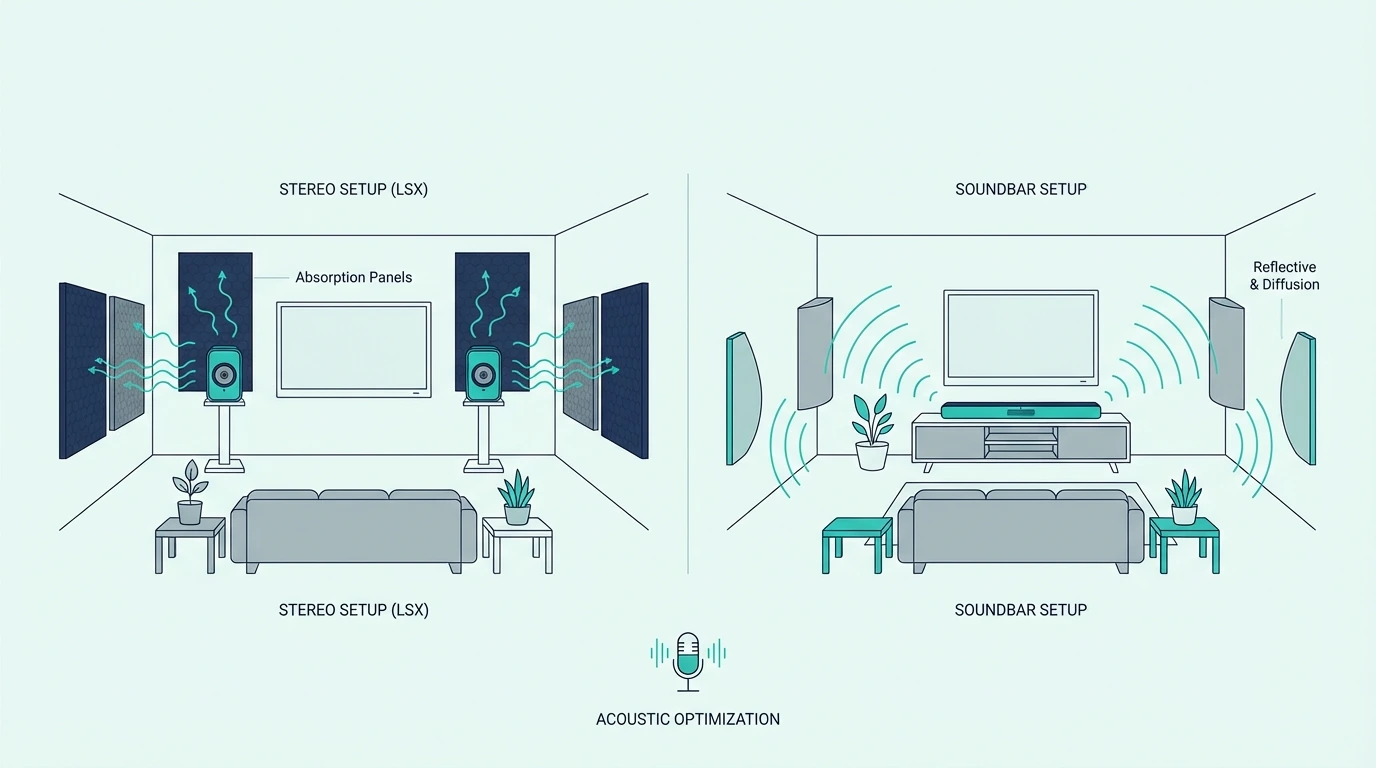
Beyond audio performance differences, the KEF LSX II and soundbars have dramatically different setup requirements, room commitments, and value propositions that often matter as much as sound quality for daily satisfaction.

KEF LSX II: Room Commitment Required

The KEF LSX II require proper placement for optimal performance. Position the two speakers 4-8 feet apart at ear height on stands or shelves.

Your listening position should form an equilateral triangle with the speakers. That means dedicated shelf or stand space on both sides of your TV.

You also run power cables to both speakers since each one needs AC power. Two visible speakers become part of your room’s aesthetic rather than a single discreet bar.

The $1,400 price point buys exceptional music reproduction. You still get no subwoofer and no surround processing or dialogue enhancement.

The optional KEF KC62 sub adds another $1,500 on top. That makes a complete TV audio system with the LSX II significantly more expensive than even premium soundbar packages.

Our soundbar vs home theater comparison covers when dedicated speakers justify their room commitment, and our soundbar vs receiver guide explains the broader decision between soundbar convenience and component audio quality.

Soundbars: Minimal Footprint, Maximum Convenience

A soundbar setup takes 5-15 minutes. Place the bar below your TV or mount it on the wall and connect a single HDMI ARC cable.

Wirelessly pair the subwoofer if one is included and start watching.

A current mid-tier example is the Samsung Q-Series Soundbar. It is a strong fit for TV and movies when you want fuller bass.

For shared living spaces, apartments, and rooms where visible speakers on both sides of the TV aren’t acceptable, the soundbar’s compact form factor delivers a dramatically better audio upgrade per square inch of room commitment than any bookshelf speaker setup.

Our HDMI vs optical guide explains connection options for both product types, and our soundbar to TV connection guide covers the simple setup process.

The Hybrid Approach: Both Can Coexist

Some audiophiles use KEF LSX II as their primary music speakers and a separate soundbar for TV audio. The KEF handles music while the soundbar handles TV content.

You switch inputs or use the TV’s audio output settings to route TV audio to the soundbar. Music still goes to the KEF speakers directly.

This hybrid approach delivers the best of both worlds. It does require two separate audio systems and the willingness to manage switching between them.

Our soundbar vs surround sound guide covers broader multi-speaker options, and our guide to choosing a soundbar helps evaluate whether a soundbar upgrade makes sense for your room and TV setup.

The Bottom Line

Choose the KEF LSX II if music listening is your primary passion. Investing $1,400 buys audiophile-grade stereo imaging and natural sound reproduction that no soundbar can match.

The Uni-Q drivers deliver a musical experience in a completely different league from any single-bar solution. You sacrifice TV dialogue clarity and surround processing without expensive add-ons.

Choose a soundbar if TV viewing and movies and gaming are your primary use cases. Soundbars deliver dramatically better dialogue clarity and surround immersion and deep bass at every price point from $100-900.

Simpler setup and a smaller room footprint round out the advantage over bookshelf speakers.

Our 2.1 vs 5.1 soundbar guide explains common soundbar configurations, and our soundbar setup guide covers optimal placement for soundbar systems.

Frequently Asked Questions

Are bookshelf speakers better than a soundbar?

For music listening, yes. Properly positioned bookshelf speakers like the KEF LSX II deliver stereo imaging plus soundstage width and natural sound reproduction that soundbars cannot match.

For TV viewing with dialogue clarity and surround effects plus simple setup, soundbars are significantly better. They are purpose-built for TV audio with dedicated center channels and integrated subwoofers.

What is the lifespan of KEF LSX speakers?

KEF LSX II speakers are built with premium materials and engineering that typically last 10-15+ years with normal use. Powered speakers have amplifiers built in that are matched to the drivers.

That matched pairing reduces the risk of damage from overpowering. KEF also provides firmware updates that add features and improve performance over time, extending the practical useful life of the speakers.

Is KEF LSX II good for movies?

The KEF LSX II can serve as TV speakers via HDMI eARC, but they lack a dedicated center channel for dialogue isolation, have no surround processing for spatial movie effects, and produce limited deep bass without an added subwoofer — making them significantly less optimal for movies than a comparably priced soundbar system specifically designed for TV and movie audio.

Denon Soundbar vs Sonos Arc: Which Premium Ecosystem Wins? [2026]

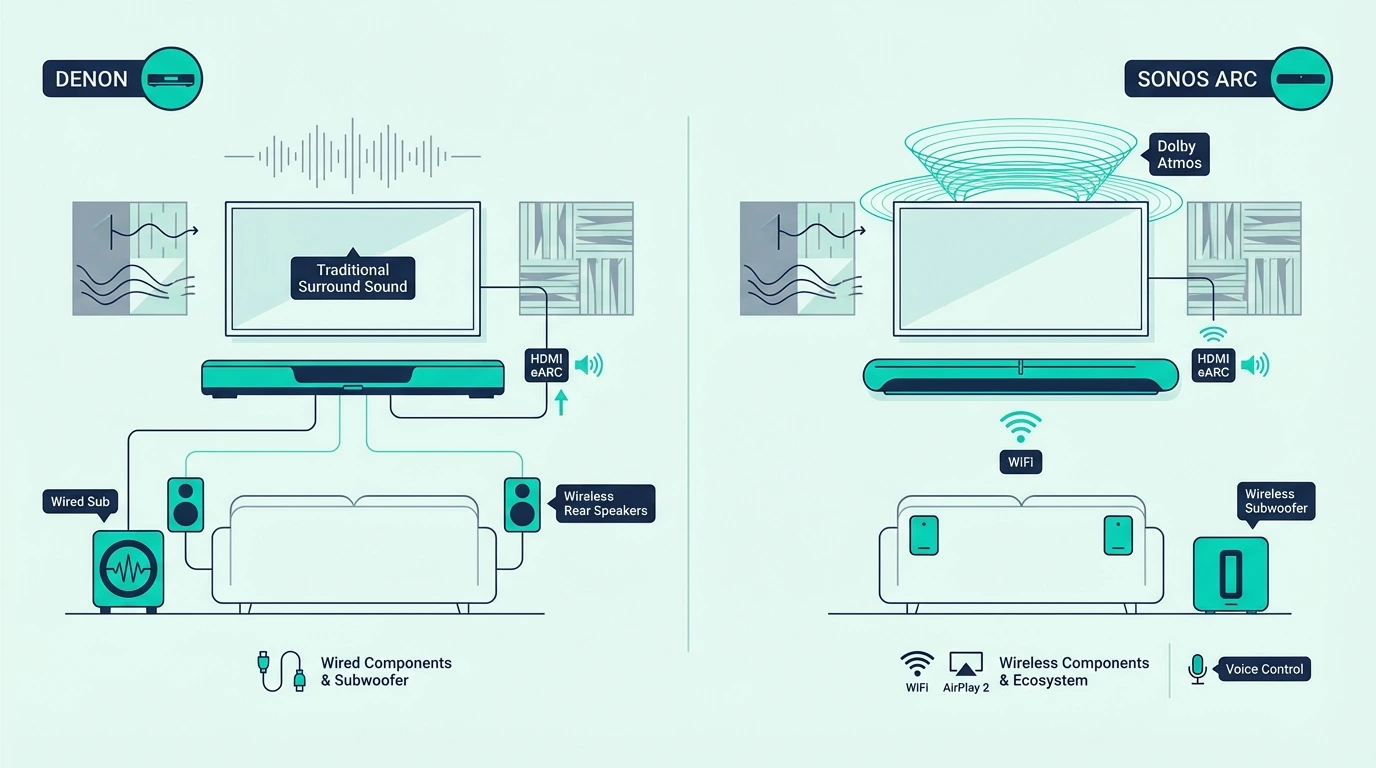
The Denon soundbar vs Sonos Arc comparison looks simple, but the wrong premium soundbar can waste money and lock you into an ecosystem that does not fit your room. Denon brings AV receiver heritage and HEOS integration, while Sonos brings room calibration, app polish, and a tighter whole-home ecosystem.

The tension is that the wrong choice can lead to a costly mismatch, with the soundbar feeling like a poor fit for your room, TV, and upgrade plans. This usually happens because buyers overlook the importance of calibration, software, and expansion path in favor of raw driver specs.

The pain of this mismatch is real: wasted money, frustration with daily use, and the hassle of upgrading or replacing the soundbar down the line. But what if you could avoid this pain and choose the perfect soundbar for your setup?

The promise is that by understanding the key differences between Denon and Sonos, you can make an informed decision that saves you money, simplifies future upgrades, and delivers a soundbar that truly fits your needs. The result is a decision based on ownership reality, not just brand reputation.

Start by separating sound quality from ecosystem fit, because this distinction explains why Sonos wins for some rooms while Denon makes more sense for others.

Below, we break down Denon and Sonos across audio performance, ecosystem value, and upgrade path so you can choose the better match with less guesswork.

That gives you a cleaner way to match the bar to your room, your current gear, and the upgrades you may want later.

Quick Takeaway

Choose the Denon Home Sound Bar 550 if you already own Denon AV equipment, want Dolby Atmos at a lower price point, or prefer HEOS multi-room that integrates with existing Denon gear. It also fits buyers who want a premium soundbar without committing to Sonos pricing for every future expansion.

Choose the Sonos Arc if you prioritize the most polished multi-room streaming ecosystem and want Trueplay room calibration. It is the better fit if you plan to build a whole-home Sonos system and want the smoothest app experience in the industry.

What Are the Key Differences in Audio Performance and Room Calibration?

Denon soundbar compared with Sonos Arc

Both Denon and Sonos deliver premium Dolby Atmos from their flagship soundbars. They approach audio quality and room optimization differently — and these differences matter more for daily satisfaction than raw specs suggest.

Sonos Arc: Eleven Speakers and Trueplay

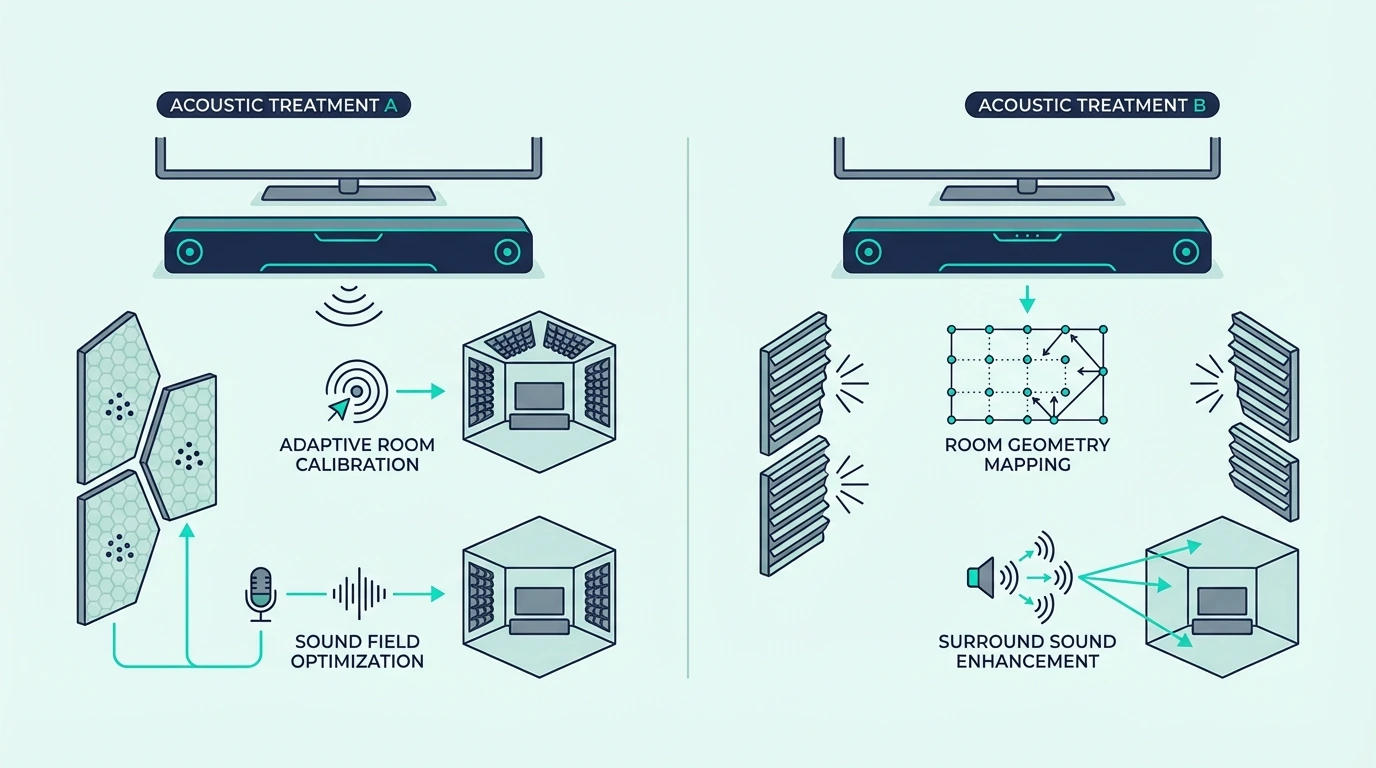
The Sonos Arc packs eleven custom-designed drivers (including upfiring Atmos channels) into a single premium bar with wide, immersive spatial audio. Sonos’s Trueplay room calibration uses your iPhone’s microphone to measure your room’s acoustics and automatically adjusts the Arc’s output for your exact space.

The result is consistently impressive audio that sounds good in virtually any room without manual tweaking. Trueplay handles acoustic optimization that most buyers would never configure themselves.

That convenience matters most in open living rooms where placement is imperfect and the bar needs help adapting to reflections. The main catch is that Trueplay still favors Apple-device households, so some buyers do not get the same easy calibration workflow.

For this kind of small-room, dialogue-first setup, a current example is Sonos Arc, which is a strong fit for Atmos streaming and immersive TV audio.

Our soundbar fundamentals guide explains how soundbar types work, and the broader soundbar hub is the safer next stop if you are still comparing premium categories before you buy.

Denon Home Sound Bar 550: AV Heritage Sound

The Denon Home Sound Bar 550 delivers Dolby Atmos and DTS:X processing with a sound signature tuned by the same engineers behind Denon’s acclaimed AV receivers. Denon’s approach favors accurate reproduction with detailed midrange and controlled bass rather than Sonos’s processed warmth.

The tradeoff: Denon relies on manual EQ adjustment rather than automatic room calibration. Experienced users get more control, but less experienced buyers miss the automatic optimization Trueplay provides.

That manual approach can be a strength if you already understand speaker placement, bass management, and source settings from receiver-based systems. It can also feel like extra work if you want a premium bar that sounds dialed-in the same day you unbox it.

The Denon Home 550 Wireless Smart Soundbar shows why that approach appeals to experienced home-theater buyers who want control rather than automatic processing.

If you are still deciding between a soundbar and a larger system, the soundbar fundamentals guide and broader soundbar hub are the best next stops.

Which Ecosystem Delivers Better Expansion and Value?

Choosing between Denon soundbar and Sonos Arc features

Beyond audio, the most consequential difference is their ecosystem approach. This determines what speakers you can add, what streaming services integrate natively, and how much expansion costs.

Sonos: The Best Multi-Room Ecosystem

Sonos’s multi-room ecosystem is widely regarded as the most polished in the industry. The Sonos app manages every speaker from a single interface, supports virtually every major streaming service natively, and provides seamless room-to-room audio grouping.

Expanding the Sonos Arc into full surround means adding Era 100 or Era 300 speakers and a Sonos Sub. Premium pricing adds up quickly, but it buys a cohesive system where every component works together cleanly.

That polish is what many buyers are really paying for when they choose Sonos over less expensive alternatives. The downside is that the same lock-in makes Sonos a weaker fit if you expect to mix brands or fold the bar into a receiver-based theater later.

The broader soundbar hub and soundbar fundamentals guide help if you still need to compare premium soundbar priorities before you commit.

Denon: AV Receiver Integration and HEOS

Denon’s HEOS multi-room platform supports wireless audio across Denon and Marantz products. The Home Sound Bar 550 integrates with Denon’s AV receivers, letting existing owners add it to a secondary TV while keeping their main receiver setup.

Sonos simply cannot offer this cross-product integration.

For buyers who already own Denon receivers or HEOS speakers, the Home Sound Bar 550 makes more sense because it extends the existing system instead of forcing a second ecosystem. If you want the lower-cost end of that Denon path, something like the Denon DHT-S316 TV Sound Bar with Subwoofer shows how Denon can undercut Sonos even harder on total system cost.

This matters most if the soundbar is not your forever living-room centerpiece. Denon gives you a cleaner path to move the bar to a second room later without abandoning the rest of your home-theater setup.

If you still need the connection basics before buying, the soundbar fundamentals guide and broader soundbar hub are safer starting points than over-reading brand claims.

How Much Does the Price Gap Matter Once You Expand?

The price gap between Denon and Sonos is still meaningful even though retailer pricing moves around over time. Sonos usually stays the more expensive ecosystem once you add surrounds or a sub, while Denon leaves more room in the budget for expansion.

Buyers often focus on the first purchase and underestimate the second and third. Once you price surrounds, a subwoofer, or a second-room speaker, the long-term cost difference becomes easier to feel.

That same overall spend can also overlap with packages like the JBL Bar 700MK2 7.1 Channel Soundbar System, which matters if your real priority is getting more physical surround hardware per dollar rather than buying into either brand ecosystem.

The broader soundbar hub and soundbar fundamentals guide help if you need to compare total-system value before you commit.

The Bottom Line

Choose the Denon Home Sound Bar 550 if AV receiver integration, HEOS compatibility, and lower expansion cost matter more than automated calibration. Choose the Sonos Arc if you want the most polished multi-room ecosystem and the easiest room-tuning experience.

In plain terms, Sonos is the better software-first choice and Denon is the better flexibility-and-value choice. If you already own one brand, staying inside that ecosystem usually matters more than trying to rank them on isolated sound quality alone.

If you want the smoothest daily streaming experience, Sonos usually earns the premium. If you want premium performance without locking every future upgrade into one brand, Denon is easier to justify.

The broader soundbar hub and soundbar fundamentals guide help if you still need to sanity-check whether either premium bar is the right category for your setup.

Frequently Asked Questions

Which is better, Denon or Sonos?

Neither is universally better. Denon delivers excellent Dolby Atmos at a lower price with AV receiver integration.

Sonos delivers the industry’s best multi-room ecosystem with automatic room calibration. Choose Denon for integration and value; choose Sonos for ecosystem polish.

Is the Sonos Arc outdated?

The Sonos Arc Ultra (released late 2024) is the latest flagship. The original Arc remains capable with Dolby Atmos, Trueplay, and full ecosystem integration.

Sonos continues firmware updates that keep it competitive, though the Arc Ultra adds improved bass and spatial processing.

What are the benefits of a Denon soundbar?

Denon soundbars leverage decades of AV receiver engineering for detailed audio with Dolby Atmos and DTS:X support. They integrate with existing Denon and Marantz equipment through HEOS multi-room.

Premium features at lower prices make them especially valuable for buyers already in Denon’s ecosystem.

What is the highest rated soundbar?

The Sonos Arc and Arc Ultra consistently rank among the highest-rated for audio quality, room calibration, and ecosystem polish. The Samsung HW-Q990D and JBL Bar 1300X lead in raw surround performance with physical rear speakers.

The “highest rated” depends on whether you prioritize ecosystem, performance, or value.

Bose vs Harman Kardon Soundbar: Two Premium Brands, Different Strengths [2026]

The Bose vs Harman Kardon soundbar comparison looks like a simple premium-brand decision, but these brands are not trying to impress you in the same way. Bose builds around dialogue clarity, compact practicality, and a cleaner upgrade path, while Harman Kardon leans harder into design-led living-room appeal and a warmer, smoother presentation that can feel more music-friendly.

That mismatch is why buyers end up disappointed. Choose Bose expecting the most natural, design-first soundbar for music and decor, and it can feel more processed than you wanted; choose Harman Kardon expecting Bose-level speech focus and lineup depth, and you may get fewer options and less obvious TV-first polish than you expected.

The upside is that the decision gets easier once you stop treating them as interchangeable luxury labels. You can match the brand to the room, the content you watch most, and the ownership experience you actually want instead of paying premium money for the wrong strength.

For most buyers, the real choice is not between two “premium” logos but between two different frustrations. Bose is usually the better fix when you are tired of muddy dialogue and want the safer all-around TV recommendation, while Harman Kardon makes more sense when you already know you care about warmer sound, visible design, and a more lifestyle-oriented living-room setup.

Start with the question that matters most: are you trying to fix unclear dialogue and get a more flexible long-term soundbar path, or are you trying to get a warmer, better-looking bar that feels more like part of the room? That frame makes the Bose-versus-Harman Kardon decision much clearer before you compare specs.

Quick Takeaway

Choose Bose if dialogue clarity, easier shopping, and a more practical ecosystem matter most. Bose gives you a clearer lineup from entry-level to flagship, plus a more obvious upgrade path if you later want better Atmos performance, app control, or add-on expansion.

Choose Harman Kardon if you care more about warm presentation, elegant industrial design, and a soundbar that feels like a visible premium object rather than a utility upgrade. Just expect a smaller lineup and less day-to-day clarity around which model fits which buyer compared with Bose.

How Do Bose and Harman Kardon Differ in Sound Character?

Bose and Harman Kardon soundbars compared side by side

The biggest difference between Bose and Harman Kardon is not the price tag — it is the type of premium experience each brand values. Bose tends to sound more controlled and TV-first, while Harman Kardon tends to feel more relaxed, smoother, and more obviously tuned for people who also care about music and visible design.

Bose: Dialogue-First Control

Bose soundbars are built around intelligibility, spaciousness, and compact practicality. Their processing pushes speech forward, widens the presentation from relatively small enclosures, and makes everyday TV easier to follow in rooms where bad mixes, background effects, and low-volume listening can otherwise bury voices.

That is why Bose is so often the safer recommendation for apartments, bedrooms, and mixed-use living rooms where TV dialogue is the real problem. A current premium example is the Bose Smart Ultra Soundbar, which shows the brand’s premium single-bar ceiling. Our Sonos vs Bose soundbar comparison covers how that same Bose voice-first tuning stacks up against another premium ecosystem brand.

Bose also benefits from being more consistent across the lineup. Even when the bars differ on Atmos performance, app depth, and expandability, the brand character is easy to understand: clearer speech, cleaner control, and fewer surprises if your use case is mostly TV and movies.

That consistency matters more than spec-sheet buyers sometimes realize. If several people in the house use the same TV, or if you often watch at moderate volume late at night, Bose’s more obvious dialogue focus tends to be easier to appreciate every day than a warmer but less TV-specific tuning.

Harman Kardon: Warmer and More Design-Led

Harman Kardon usually appeals to a different kind of buyer. The brand has long leaned into premium styling and a smoother, warmer sound that feels less aggressively processed than Bose, which can make music, acoustic instruments, and casual listening feel more relaxed and more naturally weighted.

That design-first pattern still shows up in current models like the Harman Kardon Enchant 900, which emphasizes Dolby Atmos, MultiBeam surround processing, Harman PureVoice dialogue enhancement, and 4K pass-through inside a more statement-piece chassis. That is a different sales pitch from Bose: less “fix your TV dialogue problem first” and more “make the room and the soundbar feel premium together.”

The tradeoff is that Harman Kardon is harder to shop confidently. The lineup is smaller, the upgrade path is less obvious, and the brand’s TV-first advantage is less immediate if your main frustration is simply understanding actors more clearly. Our what is a soundbar guide covers the basics behind those design tradeoffs, and our Bose vs Yamaha comparison shows another premium matchup where sound character matters more than logo prestige.

That does not make Harman Kardon weak — it just makes the brand more selective in who it fits best. If you want the bar to look and feel premium in an open living room, and you care almost as much about music playback and appearance as TV dialogue, Harman Kardon can feel more emotionally satisfying than a more utilitarian Bose setup.

How Do Bose and Harman Kardon Compare on Design, Features, and Value?

Sound profile differences between Bose and Harman Kardon soundbars

Once you move past sound character, the comparison becomes more practical. Bose tends to win on lineup clarity, expansion logic, and everyday ownership confidence, while Harman Kardon is more appealing when aesthetics, passthrough convenience, and premium living-room presence matter just as much as the audio itself.

Bose: Easier Lineup and Better Upgrade Path

Bose is easier to understand because the lineup is more clearly tiered. At the low end, the Bose TV Speaker is the simplest “make voices clearer and move on” option. In the middle, the Bose Smart Soundbar 600 is the cleaner midpoint for buyers who want Atmos, smarter features, and a more serious movie upgrade without jumping to the flagship tier.

That lineup clarity matters because it reduces buyer error. It is easier to know when you need the cheap dialogue fix, when you need the better all-around smart bar, and when you need Bose’s best single-bar performance. Our does a soundbar work with any TV guide and soundbar to TV connection guide also fit the Bose side well, because Bose’s appeal is partly that the ownership path feels straightforward regardless of TV brand.

It also makes Bose easier to recommend when you are not shopping only for yourself. If you are advising family members or buying for a shared room, Bose’s lineup is more transparent about who each model is for, which lowers the risk of overspending or buying the wrong kind of upgrade.

Harman Kardon: Better Fit for Visible Rooms and Lifestyle Buyers

Harman Kardon makes more sense when the soundbar is not just an audio upgrade but part of the room’s visual identity. Current HK bars put more emphasis on distinguished styling, Wi-Fi streaming support such as AirPlay and Google Cast, and useful practical touches like 4K pass-through with Dolby Vision, which can matter if you want the bar to sit more centrally in the signal chain instead of routing everything through the TV.

That does not automatically make Harman Kardon the better value. Bose usually gives buyers a more obvious ladder of choices, more surrounding ecosystem awareness, and a more clearly documented upgrade path, while Harman Kardon can feel more niche and more expensive for what you get on paper. Our is a soundbar worth it guide helps frame that premium-value question, and our HDMI vs optical guide explains why passthrough and connection flexibility can matter in practice.

In other words, Harman Kardon is easier to justify when the room itself is part of the purchase decision. If you want the soundbar to sit visibly under the TV, handle some source-switching duties, and feel like a premium object rather than a black utility bar, HK’s strengths become much easier to understand.

Which Brand Fits Which Buyer Better?

Choose Bose if your daily annoyance is unclear dialogue, inconsistent TV mixes, or not knowing which premium model is actually worth the step up. Bose is also the safer pick if you want a brand that feels more practical, more expandable, and easier to recommend across multiple room sizes and TV brands.

Choose Harman Kardon if you are more drawn to warm presentation, cleaner aesthetics, and the feeling of buying a lifestyle product rather than a purely functional AV tool. It makes the most sense in rooms where the soundbar stays visible every day and where music listening matters almost as much as the TV itself.

They also are not sister brands, which matters because some buyers assume there is shared engineering. Harman Kardon sits inside Harman International under Samsung ownership, while Bose remains independent, so the product philosophies and ecosystem priorities are genuinely separate rather than two badges on the same platform. Our soundbar vs speakers guide and soundbar vs home theater comparison are useful next reads if either brand still feels like a compromise against a fuller system.

Room type also shifts the answer. Bose usually makes more sense in smaller or more practical spaces where speech intelligibility and ease of use matter most, while Harman Kardon tends to make more sense in larger, design-conscious rooms where the soundbar stays on display and music playback has equal weight.

The Bottom Line

Bose is the better pick if you want clearer dialogue, simpler shopping, and a more obvious long-term path from a basic speech upgrade to a more capable Atmos bar. It is the more practical premium brand for TV-first buyers who want the soundbar to solve a problem, not become another lifestyle decision.

Harman Kardon is the better pick if warm presentation, premium industrial design, and a more design-conscious ownership experience matter just as much as raw TV convenience. That does not make it worse — it just makes it more niche, and for most buyers Bose remains the easier premium brand to shop with confidence.

Our do you need a soundbar for smart TV guide helps determine whether either brand is worth the upgrade at all, and our soundbar setup guide covers placement and configuration once you choose a direction.

Frequently Asked Questions

Is Harman Kardon better than Bose?

Neither is universally better. Harman Kardon makes more sense for buyers who prefer warmer presentation and design-led premium products, while Bose makes more sense for buyers who want clearer dialogue, easier model selection, and a more practical ownership path.

Is Harman Kardon owned by Bose?

No. Harman Kardon is part of Harman International under Samsung ownership, while Bose is an independent audio company, so there is no shared ownership or product platform between the two brands.

Which brand has the best soundbars?

There is no single best soundbar brand for everyone. Bose is one of the safest premium picks for dialogue and TV-first use, while Harman Kardon appeals more to buyers who care about warmer sound, cleaner styling, and niche premium design priorities.

Bose Soundbar vs Vizio Soundbar: Premium Polish or Better Value? [2026]

The Bose soundbar vs Vizio sound bar comparison seems like a straightforward premium-versus-value decision, but it actually reveals a deeper tradeoff that affects daily listening more than the price tag alone. Bose focuses on refined tuning, exceptional dialogue clarity, polished build quality, and cleaner long-term ownership, while Vizio packs more channels, wireless subwoofers, and Dolby Atmos into aggressively priced packages that deliver more hardware per dollar.

That does not automatically make Bose the better buy. Bose’s compact bars often sound cleaner for dialogue, music, and smaller rooms, but their lower-priced models can feel light on bass and surround hardware compared with what Vizio bundles at the same price. Vizio’s 5.1 systems can feel much more cinematic in medium and larger rooms where surround coverage and subwoofer output matter more than refinement.

Understanding which brand philosophy matches your room size, viewing habits, and priorities helps you make a confident decision. You can avoid overpaying for Bose polish when Vizio’s value approach better fits your space, or chasing Vizio’s spec sheet when what you really wanted was clearer voices, cleaner tuning, and better day-to-day reliability.

Below, we’ll compare Bose and Vizio across audio quality, feature value, room fit, and long-term ownership so you can pick the brand that matches your actual priorities and budget.

Quick Takeaway

Choose Bose if you prioritize refined dialogue clarity, balanced tuning, premium build quality, and better software support. Bose soundbars excel in small-to-medium rooms where dialogue-heavy content and music matter most.

Choose Vizio if you want maximum channels, Dolby Atmos, and a wireless subwoofer at the lowest possible price. Vizio-style multi-channel systems deliver stronger surround coverage and deeper bass for movies and gaming at prices that significantly undercut Bose.

How Do Bose and Vizio Differ in Audio Quality and Feature Value?

Bose and Vizio soundbars compared side by side

The core difference between Bose and Vizio is not just price. Bose tends to spend the budget on tuning, processing, and polish, while Vizio tends to spend it on more channels, bigger bundles, and stronger spec-sheet value. Knowing which approach matters more to you prevents the common mistake of buying the wrong kind of soundbar, not just the wrong model.

Bose: Premium Tuning, Compact Design

Bose soundbars are engineered for audio refinement above all else. Their signal processing delivers balanced frequency response, strong dialogue intelligibility, and room-filling sound from compact enclosures that often sound bigger than they look.

That polish extends beyond raw sound. Bose software support, app stability, and the general day-to-day feel of the product are usually more consistent than what you get from cheaper value brands, which matters more over a few years of ownership than a spec sheet suggests.

The tradeoff is that Bose’s lower-priced models ship as simpler front bars without the wireless subwoofer-and-rear package Vizio often includes at similar prices. Stepping up to Bose systems with more cinematic scale usually means paying a meaningful premium.

A current example is the Bose Smart Soundbar 600, which fits the brand’s cleaner, smarter, and more refined side of the comparison.

For dialogue-heavy viewing in small rooms, Bose’s compact bars punch well above their size. For movie immersion in larger rooms, the lack of included subwoofer and surrounds at lower price points limits the experience.

That is why Bose often feels like the “nicer” brand even when the hardware sheet looks less aggressive. You are paying for a smoother day-to-day experience, more polished dialogue tuning, and a product that usually feels more premium in a bedroom, apartment living room, or mixed TV-and-music setup where outright theater scale is not the priority.

Our Sonos vs Bose soundbar comparison covers how Bose stacks up against another premium brand, and our Bose vs Samsung soundbar guide compares Bose with Samsung’s mid-range approach.

Vizio: Maximum Features Per Dollar

Vizio takes the opposite approach: maximum features per dollar. The brand is far more willing to include a wireless subwoofer, surround channels, and Atmos branding at prices where Bose is still selling a cleaner but simpler front bar.

That makes Vizio especially compelling if your room is large enough to benefit from more hardware. A good 5.1 package can throw a wider, more enveloping field than a compact premium bar, even if the tonal balance and software polish are not as refined.

A current example is the VIZIO 5.1 Soundbar SE, which fits the exact more-hardware-for-the-money argument better than Vizio’s cheaper bar-only models.

The tradeoff is that Vizio’s tuning can sound less balanced than Bose’s processing. Dialogue is not always as clean in dense soundtracks, bass can feel looser, and the software ecosystem has historically been less consistent over time.

Vizio also asks you to be honest about setup tolerance. More channels, a separate subwoofer, and rear speakers can absolutely produce a bigger movie experience, but they also mean more pieces in the room, more placement variables, and a higher chance that the system feels cluttered if you really wanted a compact, low-fuss upgrade.

Our Samsung vs Vizio soundbar comparison covers how Vizio competes with Samsung’s value approach, and our what soundbar channels mean guide explains the channel configurations both brands offer.

Which Brand Fits Your Room and Long-Term Priorities Better?

Sound quality and value differences between Bose and Vizio soundbars

Beyond audio quality and feature differences, Bose and Vizio suit different room sizes, viewing habits, and ownership expectations. Those practical factors often matter more than raw audio performance once you live with the system every day.

Small Rooms and Dialogue: Bose Excels

For bedrooms, offices, and small living rooms under 200 square feet, Bose’s compact soundbars make a stronger case. The balanced tuning and dialogue focus can make TV audio feel fuller and clearer without needing a subwoofer to do all the work.

For this type of smaller, dialogue-first setup, a current example is the Bose Smart Ultra Soundbar, which shows what Bose does best at the premium end. Even without winning on raw hardware count, it demonstrates how Bose prioritizes clean vocal presence, polished processing, and easy daily use over spec-sheet bulk.

Bose also tends to age better as an ownership experience. More reliable firmware, better support, and sturdier materials matter if you want one soundbar to last for years instead of just looking good on day one.

That long-term angle matters more than many buyers expect. A soundbar is one of those purchases where you stop thinking about the spec sheet after the first week and start caring about whether the app stays stable, the remote behaves predictably, and the product still feels dependable after months of nightly use.

Our best Bose soundbar guide breaks down the lineup, and our soundbar vs speakers comparison explains when dedicated speakers outperform either brand.

Large Rooms and Movies: Vizio Delivers More Coverage

For medium-to-large living rooms where you want surround immersion for movies and gaming, Vizio’s bundled 5.1-style systems usually make more sense. A wireless subwoofer and rear channels do more to fill a 300-plus-square-foot room than a cleaner but simpler front bar.

That is where Vizio’s value thesis becomes real rather than theoretical. You are not just saving money — you are often getting the kind of hardware layout that better suits the room and the content you watch most.

If movie immersion and gaming surround are your primary use cases, Vizio’s approach means a more complete audio system for large-room entertainment at price tiers where Bose still expects you to pay extra for bass and expansion.

That does not mean Vizio wins every large room automatically, but it does mean the brand often starts closer to the hardware layout those rooms actually need. If your couch sits far from the TV or you want action scenes to feel broader and heavier without building a full receiver-based setup, Vizio’s bundle-first strategy is usually easier to justify.

Our best Vizio soundbar guide shows the brand’s strongest value options, and our soundbar vs home theater comparison covers the full surround-sound upgrade path.

Build Quality and Software: The Hidden Difference

One factor that rarely appears on spec sheets but often affects satisfaction is software polish. Bose soundbars use better materials, more stable wireless behavior, and generally cleaner app and firmware support, which makes the product feel more finished over time.

Vizio can still be the smarter value, but its software ecosystem has historically been less consistent. That does not erase the value proposition, yet it matters if you want a set-it-and-forget-it experience instead of the most hardware at the lowest price.

Our HDMI vs optical guide explains connection options for both brands, and our soundbar to TV connection guide covers setup for any soundbar system.

The Bottom Line

Choose Bose for small-to-medium rooms, dialogue-focused viewing, music listening, and long-term ownership where refinement and reliability matter most. Bose delivers premium audio polish from compact designs that reward buyers who care more about clean tuning than raw channel count.

Choose Vizio for larger rooms, movie-heavy viewing, gaming surround, and budget-conscious buyers who want maximum channels, a wireless subwoofer, and stronger immersion per dollar. Vizio delivers more cinematic hardware at the same price tiers where Bose often expects you to pay extra for bass and expansion.

Our do you need a soundbar for smart TV guide helps evaluate whether either brand upgrade makes sense, and our best soundbar guide shows where both brands fit in the broader market.

Frequently Asked Questions

Is Vizio better than Bose?

Vizio offers more features per dollar (more channels, included subwoofers, Dolby Atmos at lower prices), but Bose delivers superior audio tuning, dialogue clarity, build quality, and long-term software support. Vizio is “better” for budget-conscious buyers wanting maximum surround coverage; Bose is “better” for buyers prioritizing audio refinement and premium reliability.

Does Vizio have good soundbars?

Yes — Vizio makes some of the best value-oriented soundbars available, offering 5.1 surround systems with wireless subwoofers and Dolby Atmos at price points that significantly undercut premium brands like Bose and Sonos. For budget-conscious buyers who want maximum features per dollar, Vizio’s M-Series and V-Series represent excellent choices.

What brand has the best soundbars?

No single brand is “best” for everyone — Bose and Sonos lead in premium audio quality and build, Vizio and Samsung offer the best features-per-dollar value, and Sony and JBL bridge the gap with premium audio at competitive prices. The best brand for you depends on whether you prioritize audio refinement, feature count, price, or long-term ecosystem support.

5.1 vs 4.1 Soundbar: What Does the Fifth Channel Change?

The 5.1 vs 4.1 soundbar comparison looks like a tiny spec-sheet change, but the fifth channel often changes more than buyers expect.

In many systems, it is the difference between settling for a cheaper surround package and getting the standard layout that handles movies and dialogue the way most people think surround sound should work.

That is where many buyers get it wrong.

They expect 4.1 to feel basically the same as 5.1 for less money.

Then they discover the bigger issue was dialogue that never locks cleanly to the screen or a movie mix that keeps exposing the missing center channel.

Once you understand what the fifth channel actually does, the decision gets much easier.

You can judge whether 4.1 is a smart budget shortcut for your room or whether 5.1 is the version that will sound more correct from the first night you use it.

The first move is to stop treating this as “just one more speaker.”

Compare how each layout handles dialogue, surround placement, and day-to-day value.

That tells you when 4.1 is enough and when 5.1 is worth paying for.

Quick Takeaway

Choose a 4.1 soundbar if you are buying for a small room, a lower budget, and can live without a dedicated center channel. It can still add real rear-speaker immersion and a subwoofer, but dialogue usually is not as locked to the screen as it is on a proper 5.1 system.

Choose a 5.1 soundbar if you want the standard surround format for movies and gaming. The center channel handles speech more cleanly, and the separate surround channels make movement around the room sound more believable.

What Is the Real Difference Between a 5.1 and 4.1 Soundbar?

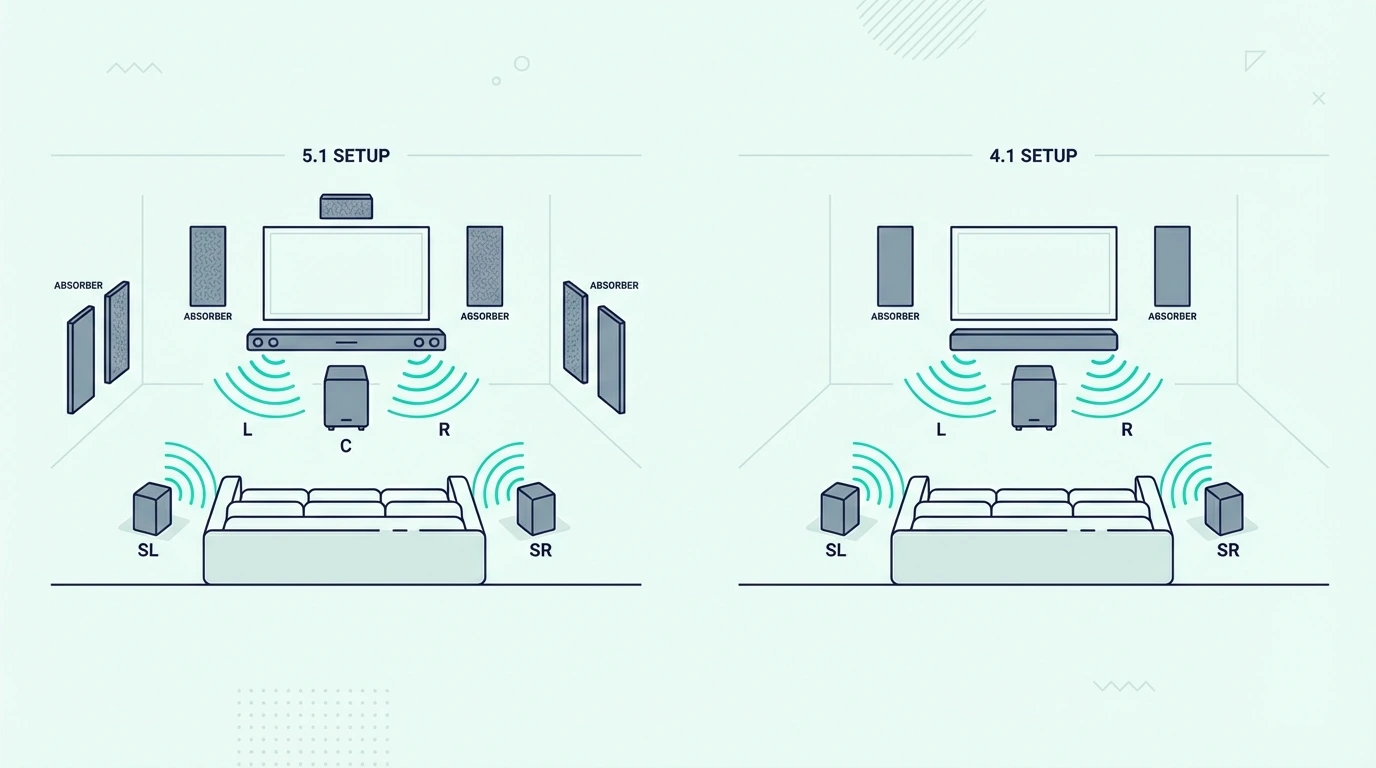
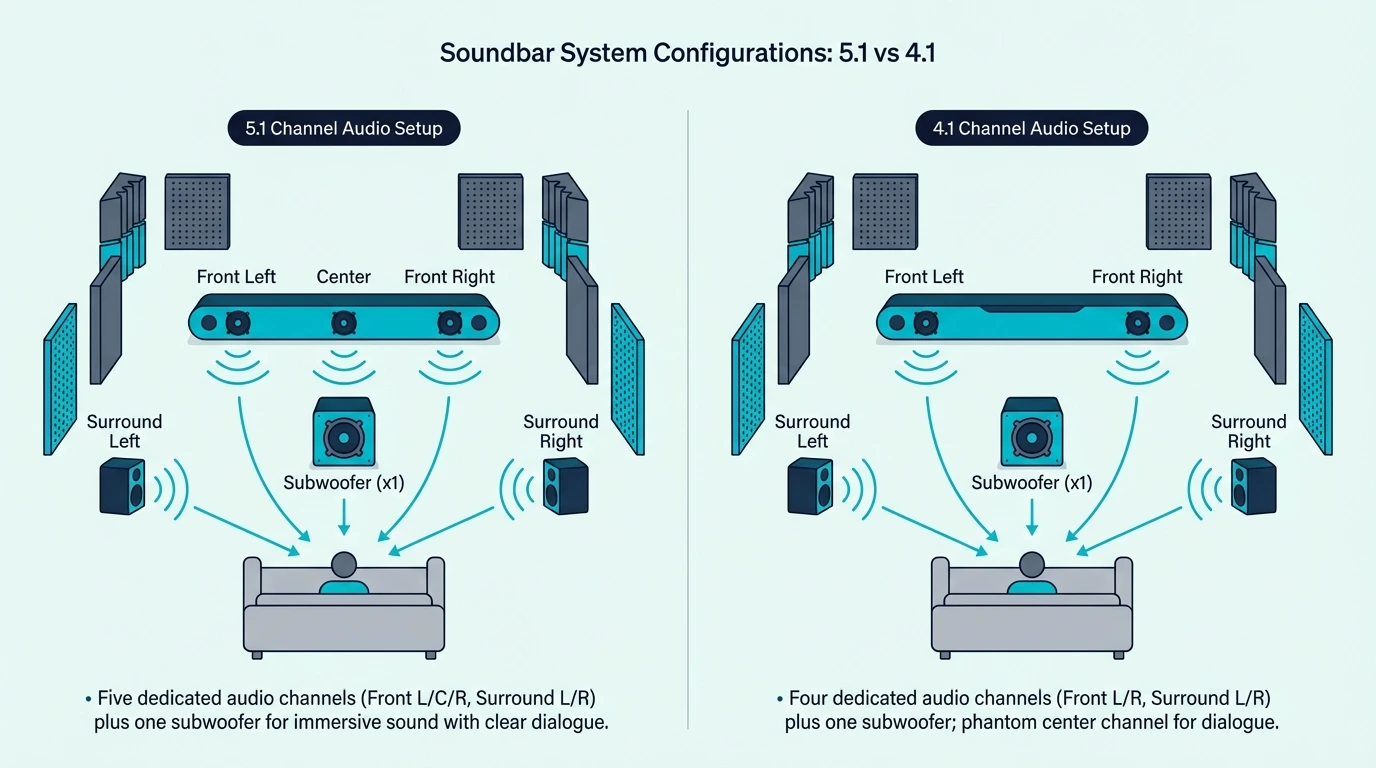
5.1 and 4.1 soundbar channel layouts compared

The spec difference is not just “one more effect channel.”

It usually changes how dialogue is handled at the front of the room.

It also changes how faithfully the soundbar matches the standard 5.1 mixes used by movies and games.

4.1 Soundbars: Rear Immersion Without a Discrete Center

A 4.1 soundbar gives you four main channels and a subwoofer.

On many soundbar packages, that means front left and right, two rear or surround channels, and no dedicated center speaker.

That missing center is the part many shoppers overlook. Voices can still sound clear, but they are usually being steered across the front speakers instead of coming from their own dedicated channel.

The LG S40TR 4.1ch Soundbar with Rear Surround Speakers is a good example of where 4.1 makes sense.

It gives you genuine rear-speaker presence and bass in a smaller room without forcing you into a more expensive full 5.1 package.

That does not make 4.1 the better format in general. It just means there are rooms and budgets where rear-speaker ambience matters more to the buyer than getting the cleanest possible dialogue channel.

If you want the broader primer on channel numbers, the soundbar fundamentals hub is the clean starting point. Buyers who already know they want a bass-included package can compare current bundles in the best soundbar with subwoofer guide.

5.1 Soundbars: The Standard Surround Layout

A 5.1 soundbar adds the missing piece: a discrete center channel alongside left, right, surround left, surround right, and the subwoofer.

That is why 5.1 is still the baseline surround format for movie tracks, streaming apps, and most games.

The center channel matters because it keeps speech anchored to the screen while the side or rear effects move around you.

The surround pair matters because left-rear and right-rear effects can stay separated instead of collapsing into a more generic wash of sound.

The Amazon Fire TV Soundbar Plus with Subwoofer and Surround Sound Speakers is a mainstream example of what the standard layout buys you.

If you want a cleaner step into real surround without jumping straight into premium pricing, it is a much better comparison point than pretending a 4.1 package is almost the same thing.

It is also easier to recommend because the tradeoff is clearer.

You are buying into the surround format most content already expects instead of relying on a more unusual 4.1 layout that varies a bit from brand to brand.

If you are already comparison-shopping specific buying options, the best Samsung soundbar roundup and the best budget soundbar guide are better next clicks than another high-level explainer.

Is 4.1 Good Enough, or Is 5.1 Worth It?

Center channel difference between 5.1 and 4.1 soundbars

The practical answer depends on your room, your viewing habits, and how much you care about dialogue precision.

The smaller the room and the lighter the movie use, the easier it is to live with 4.1.

Small Rooms and Casual Viewing

In a small bedroom or apartment setup, 4.1 can still be a meaningful step up from TV speakers. You get a subwoofer and real rear-speaker presence without paying for the full 5.1 layout.

The catch is that you are usually saving money by giving up the center channel, not by shaving off some invisible extra surround magic.

If most of your watching is casual streaming, sports, or background TV, that compromise can be perfectly reasonable.

Apartment buyers often notice the added bass and rear ambience before they notice the missing center.

If you rarely sit down for serious movie nights, 4.1 can still feel like a meaningful upgrade over a plain stereo or 2.1 bar.

That is where a 4.1 package like the LG S40TR fits best.

Before buying for a tricky room, the soundbar setup guide helps you think through rear-speaker placement.

The soundbar to TV connection guide covers the HDMI ARC side that can bottleneck surround formats.

Medium-Large Rooms, Movies, and Gaming

Once you move into a larger living room or start watching action movies and playing games regularly, 5.1 becomes much easier to justify.

The center channel improves speech intelligibility.

The two surround channels make pans, flyovers, and positional effects sound far more believable.

The center channel matters even more when the TV is farther away or the room already has some background noise. It keeps voices anchored and intelligible without forcing you to raise the whole mix just to hear dialogue.

A bundled 5.1 package like the Amazon Fire TV Soundbar Plus shows why 5.1 is still the standard when immersion matters more than shaving a little cost.

Why 4.1 Can Be Harder to Shop

Another practical issue is that 4.1 soundbars are relatively uncommon.

Because 5.1 is the standard surround format, brands often skip straight from simpler bars into 5.1 packages.

That can make the price gap smaller than you expect.

That also means most setup guides, buyer comparisons, and content mixes are built around 5.1 assumptions.

When a 4.1 package is only a little cheaper, the market itself is usually telling you where the mainstream value sits.

That is why a value-oriented 5.1 model like the Samsung HW-B750D/ZA 5.1ch Soundbar can be the smarter buy even for price-conscious shoppers.

If you are comparing deals more than specs, the best budget soundbar guide and the best soundbar with subwoofer guide are more useful than treating 4.1 as an automatic bargain.

The Bottom Line

Choose a 4.1 soundbar only if you are comfortable with the tradeoff that usually comes with it.

You get real surround presence, but no dedicated center channel.

In smaller rooms and lighter-use setups, that can still be a sensible way to get rear speakers and bass for less money.

Choose a 5.1 soundbar if you want the standard surround layout that movies and games are actually mixed for.

The center channel is the biggest quality-of-life improvement.

The balanced surround pair makes the whole presentation feel more complete.

If you want the category overview before buying, the soundbar hub is the clean entry point.

If you already know you want a bass-included package, the best soundbar with subwoofer guide is the more direct buying path.

Frequently Asked Questions

Is 4.1 good for home theater?

A 4.1 soundbar can still work for home theater, especially in a small room where you mainly want rear-speaker presence and deeper bass.

The catch is that many 4.1 packages do not include a discrete center channel, so dialogue is usually the compromise.

If movies are your priority and you care about cleaner speech plus more standard surround playback, 5.1 is the better fit.

Is 4.1 good for small rooms?

Yes, 4.1 can make sense in a small room because the shorter listening distance reduces how dramatic the gap feels between 4.1 and 5.1.

It is still worth remembering that the missing center channel may matter more than the room size if dialogue clarity is a constant complaint.

Is 4.1 usually missing the center channel?

In many soundbar packages, yes.

A 4.1 layout often means four main channels plus the subwoofer.

That usually translates to front left and right plus rear left and right, rather than a full front left, center, and right stage.

That is why the tradeoff feels bigger than just losing “one channel.” The missing center is usually what makes 4.1 less ideal for dialogue-heavy movie watching.

Is it worth getting a 5.1 soundbar?

Yes, if you watch movies regularly, stream surround-mixed content, or play games where positional audio matters.

5.1 is still the standard surround format.

The dedicated center channel plus separate surround pair make the upgrade easier to hear day to day.

It also helps that 5.1 models are usually easier to shop because the category has more choices than 4.1.

Can a good 4.1 soundbar beat a bad 5.1 soundbar?

Yes, especially if the 5.1 model cuts too many corners on tuning, build quality, or rear-speaker implementation.

A well-set-up 4.1 package can sound more satisfying than a sloppy 5.1 system that never places dialogue or surrounds convincingly.

That said, when the overall quality is similar, 5.1 still has the better ceiling. The dedicated center channel and standard surround layout give it more room to sound correct with real movie and game mixes.

Does Netflix support 5.1?

Yes, Netflix supports 5.1 on many titles when your TV, streaming device, and soundbar are connected in a way that preserves surround audio, usually through HDMI ARC or eARC.

Some titles also offer Dolby Atmos on compatible hardware.

But 5.1 support itself is common enough to make a true 5.1 soundbar more useful than a niche 4.1 package for regular streaming.

3.1 vs 5.1 Soundbar: Do You Actually Need Surround Channels?

The 3.1 vs 5.1 soundbar question sounds like a simple upgrade path, but the extra channels are not automatically the better buy for every room or viewing habit.

A 3.1 bar gives you left, center, and right channels plus a subwoofer.

A 5.1 bar adds two surround channels that are only worth paying for when they change what you actually hear.

That is where many buyers get it wrong.

They expect 5.1 to fix every TV-audio problem.

Then they discover the bigger issue was muddy dialogue, a weak front stage, or a room that never lets surround effects feel convincing.

Once you separate dialogue clarity from immersion, the decision gets much easier. You can choose the format that actually improves daily listening instead of paying for extra hardware that sits underused.

The first move is to understand what the two extra channels really add.

Then match that to your content, gaming habits, and room layout.

That tells you whether 3.1 is already enough or whether 5.1 is the upgrade that will finally feel different.

Quick Takeaway

Choose a 3.1 soundbar if you mostly watch dialogue-heavy TV, news, and dramas where surround effects are minimal. It gives you the center channel and subwoofer benefits people notice most without paying for surround channels you may barely use.

Choose a 5.1 soundbar if you watch action movies, play games, or want real spatial immersion from surround-mixed content. The two extra channels are only worth it when your room and habits actually let them work.

What Do Two Extra Surround Channels Actually Add?

3.1 and 5.1 soundbar channel layouts compared

Both 3.1 and 5.1 soundbars share the same core upgrade over basic TV audio.

You get a center channel for clearer dialogue and a subwoofer for deeper bass.

The real difference is whether the two extra surround channels in 5.1 materially change what you hear.

3.1 Soundbars: Front-Focused Excellence

A 3.1 soundbar delivers three front channels — left, center, and right — plus a wireless subwoofer for deep bass.

The dedicated center channel keeps dialogue clear and anchored to the screen.

That is why 3.1 feels like such a meaningful upgrade over 2.1 for everyday TV.

For front-focused content like news, talk shows, dramas, sitcoms, and most music, a 3.1 soundbar reproduces nearly everything the soundtrack is trying to do.

The limitation shows up with surround-mixed movies and games.

Audio meant to come from behind or beside you collapses back into the front soundstage.

The biggest practical advantage of 3.1 is that it already solves the complaint most people notice first.

Voices stop getting buried under background effects.

If clearer dialogue is your goal, 5.1 is not automatically better than 3.1.

It mainly adds immersion around you once the front stage is already doing its job.

Our soundbar fundamentals guide covers the numbering basics, and our how to choose a soundbar guide helps if you’re still narrowing down the right format.

5.1 Soundbars: Spatial Immersion Added

A 5.1 soundbar builds on the 3.1 foundation by adding two surround channels.

Those channels extend audio beyond the bar itself through virtual processing, beam-forming, or separate rear speakers, depending on the model.

For immersive movie nights, a current example is Amazon Fire TV Soundbar Plus with Subwoofer and Surround Sound Speakers, which fits buyers who want a more convincing surround presentation from a bundled living-room package.

The surround effect changes how action movies and games feel.

Explosions, weather, crowd noise, and directional game audio stop sounding flat.

They start wrapping around the listening position.

What matters is how the 5.1 system creates that immersion.

A bar with dedicated rear speakers usually sounds more convincing.

Virtual 5.1 from a single bar works best when the room gives those side-wall reflections somewhere useful to go.

You also need to manage expectations with virtual surround claims.

Some 5.1 bars create a wider, more spacious front stage rather than a precise behind-you bubble.

The best results still come from rooms and hardware that support real separation.

Our soundbar setup guide explains how placement affects surround performance, and our best Dolby Atmos soundbar guide shows which models are worth considering if immersion is the goal.

When Does 5.1 Actually Beat 3.1?

Surround speaker benefit in a 5.1 soundbar setup

Choosing between 3.1 and 5.1 depends less on spec-sheet bragging rights and more on what you watch, whether you game, and whether your room supports believable surround.

Those practical factors determine whether the two extra channels deliver daily value or just extra complexity.

Dialogue and Music: 3.1 Is Usually Enough

For households that mostly watch dramas, news, documentaries, sitcoms, and music content, a 3.1 soundbar already covers the important upgrade.

The center channel handles dialogue.

The left and right channels carry the rest of the mix.

The subwoofer adds bass without needing surround information that the content barely uses.

Sports, YouTube, podcasts, and casual streaming often land in the same bucket.

You may get a slightly bigger presentation from 5.1 processing.

But the difference is usually smaller than the jump from weak TV speakers to a strong 3.1 bar with a real center channel.

The important thing to remember is that 5.1 does not give you a better center channel by default.

If two bars have similar front-stage quality, the jump from 3.1 to 5.1 is mainly about immersion.

It is not usually about dramatically clearer voices or bigger bass.

For dialogue-first TV use, a current example is LG S70TY 3.1.1ch Soundbar with Wireless Subwoofer, which is a better fit when clear dialogue matters more than surround immersion.

Our how to choose a soundbar guide helps frame the broader purchase decision, and our best soundbars with subwoofers roundup is useful if dialogue clarity and bass are your top priorities.

Movies and Gaming: 5.1 Delivers Real Value

For households that regularly watch action movies, stream surround-mixed content, and play games, 5.1 delivers a genuinely noticeable improvement over 3.1.

Directional audio cues in competitive games and ambient rear effects in movies are exactly where the extra channels start earning their keep.

Movie soundtracks use those rear channels for rain, crowd noise, vehicles passing behind you, and environmental detail.

That is the difference between simply hearing the soundtrack and feeling pulled into it.

Gaming is where the 5.1 case becomes practical, not just cinematic.

Rear and side cues help you place footsteps, off-screen movement, and environmental hazards faster.

Single-player games also feel more believable because the world extends beyond the front wall.

Streaming habits matter too.

If most of your library is older sitcoms, sports, YouTube, and casual TV, 5.1 often sits underused for most of the week.

If your evenings revolve around action movies, prestige streaming shows with richer mixes, and story-driven games, the surround upgrade becomes much easier to justify.

That is the point where 5.1 starts feeling like a real improvement instead of a spec-sheet bonus.

Our HDMI ARC and eARC guide explains how to preserve multi-channel audio, and our soundbar to TV connection guide covers the setup basics.

What Kind of Room Supports 5.1 Best?

Virtual surround in single-bar 5.1 systems usually needs reflective side walls within a reasonable distance to bounce audio convincingly.

Open floor plans, heavy curtains, and irregular room shapes reduce the effect.

Rooms with cleaner wall symmetry let 5.1 sound more convincing.

If your room has supportive side walls or you plan to use a system with dedicated rear speakers, 5.1 makes more sense.

If the room fights surround or the seating is awkward, 3.1 often ends up being the smarter real-world buy.

Room layout is not just about wall reflections.

If the couch is against the back wall, the space opens into another room, or you do not want extra power near the seating area, 5.1 becomes harder to justify.

The surround channels never get the placement they need.

Household tolerance matters too.

If you do not want extra speaker stands, visible rear hardware, or the hassle of placement and calibration, 3.1 often stays the better long-term fit.

That can be true even when 5.1 sounds more exciting on paper.

Our soundbar setup guide covers placement, and how to choose a soundbar helps you weigh whether the extra hardware is worth it in your space.

The Bottom Line

Choose a 3.1 soundbar if you mostly care about clear dialogue, deep bass, and better everyday TV audio.

Choose a 5.1 soundbar if movies, gaming, and surround immersion are central to how you use your system.

If you want the simplest answer, 3.1 is the safer default for most households.

5.1 is the right step only when your room and viewing habits can actually reward the extra channels.

Our soundbar setup guide helps with placement.

Our how to choose a soundbar guide helps once you’re ready to buy.

If you are unsure, start by asking which problem you are actually trying to solve.

If the answer is muddy dialogue and weak bass, 3.1 is usually enough.

If the answer is flat movie sound and missing positional audio, 5.1 is the step that addresses it.

That framing prevents the most common mistake in this comparison.

People often pay for surround when what they really wanted was a cleaner center channel.

Others stay with 3.1 when what they actually wanted was immersion.

Frequently Asked Questions

Is a 5.1 soundbar worth it?

Yes, if you regularly watch action movies, stream surround-mixed content, or play games where positional audio matters.

In those cases, the extra channels create immersion that a 3.1 bar simply cannot reproduce.

For a budget-friendly 5.1 example, a current option is ULTIMEA 5.1 Sound Bar for Smart TV.

It makes more sense for buyers who specifically want a first step into surround without jumping straight to a pricier system.

For dialogue-heavy TV, though, the surround channels add much less value and 3.1 usually remains the smarter buy.

Is a 3.1 sound system worth it?

Yes.

A 3.1 soundbar gives you the two TV-audio upgrades people notice most.

You get a dedicated center channel for clearer speech and a subwoofer for fuller bass.

It does that without the extra room demands that come with surround.

Why does Netflix show 5.1 instead of Atmos?

Netflix shows 5.1 when the title does not have an Atmos mix available.

It can also happen when your soundbar or TV does not support Atmos properly, or when the connection path is not passing Atmos through.

5.1 is the more common fallback surround format and still delivers meaningful multi-channel audio.

You also need the app, TV, and connection chain to support Atmos negotiation end to end.

If any one part falls back to standard Dolby Digital or Dolby Digital Plus without height metadata, Netflix labels the stream as 5.1 instead.

2.0 vs 5.0 Soundbar: Basic Stereo or Virtual Surround From One Bar?

The 2.0 vs 5.0 soundbar comparison looks like a simple channel-count jump, but it changes the problem the bar is trying to solve.

A 2.0 bar is about cleaner TV audio at the lowest price.

A 5.0 bar tries to create surround-style immersion and stronger dialogue focus from one enclosure.

The catch is that virtual surround only pays off when your room and viewing habits give it something to work with.

In a small bedroom or a dialogue-first setup, extra processing can add cost without adding much real immersion.

That is where buyers often make the wrong call. They either overspend on surround features they barely notice or buy simple stereo and still feel underwhelmed every time a movie soundtrack is supposed to open up around them.

If you mostly watch movies and games in a medium-to-large living room, 5.0 can sound meaningfully bigger than stereo alone.

Below, we compare 2.0 and 5.0 soundbars across surround immersion, dialogue clarity, room fit, and bass trade-offs.

You can tell when the upgrade is worth paying for.

Quick Takeaway

Choose a 2.0 soundbar if you mostly watch dialogue-heavy TV or listen to music in a small room and want the simplest, lowest-cost upgrade. A 2.0 bar gives you clean stereo without paying extra for surround processing your room may never reveal.

Choose a 5.0 soundbar if you watch movies, play games, or want surround-style immersion from one bar in a medium-to-large living room. A 5.0 bar adds a center channel for clearer dialogue and virtual surround effects that make soundtracks feel wider than stereo alone.

What Does 5.0 Add Beyond Basic Stereo?

2.0 and 5.0 soundbar channel layouts compared

The jump from 2.0 to 5.0 is not just about more speakers inside the bar.

It adds two things a 2.0 bar cannot deliver.

First, you get a dedicated center channel for dialogue isolation.

Second, you get virtual surround channels that push sound beyond the bar’s physical width.

2.0 Soundbars: Clean Stereo, No Surround

A 2.0 soundbar delivers left and right stereo audio — the same basic configuration as headphones or desktop speakers. Sound comes from directly in front of you with clear left-right separation.

Phantom center imaging (blending both channels to simulate centered dialogue) works well for news, talk shows, and casual TV viewing in small rooms.

The Sony S100F 2.0ch Soundbar is a reliable example of a 2.0 bar. It noticeably upgrades small-room TV viewing without adding setup complexity.

When the soundtrack includes audio meant to come from beside or behind you, a 2.0 bar collapses everything into a flat stereo field.

Explosions that should rumble from behind feel like they come from the same two speakers delivering dialogue. Ambient environmental sounds lose their directional immersion.

Our best soundbar with subwoofer roundup shows when bass upgrades matter more than channel count.

Our how to choose a soundbar guide helps you decide whether simple stereo or more processing is the smarter next step.

5.0 Soundbars: Virtual Surround From One Bar

A 5.0 soundbar packs five virtual channels into a single bar — left, center, right, and two surround channels.

Beam-forming drivers bounce audio off your room’s side walls.

Psychoacoustic processing then tricks your brain into hearing sound from beside and behind you.

The Samsung HW-S60D 5.0ch All-in-One Soundbar shows what a true all-in-one 5.0 bar is aiming for: wider immersion and cleaner dialogue from a single enclosure.

The dedicated center channel is the most immediately noticeable upgrade from 2.0. Dialogue becomes clearer and stays anchored to the screen regardless of volume.

The virtual surround channels add spatial immersion that makes movie soundtracks feel wider and more enveloping. The effect varies depending on your room’s wall geometry and reflective surfaces.

That means room shape matters more here than it does with a basic stereo bar.

Open sides, heavy drapes, or asymmetrical furniture can make a 5.0 bar sound closer to a wide 3.0 bar than true wraparound surround.

Our what is a soundbar hub explains the broader channel language, and our how to choose a soundbar guide helps you judge whether your room can actually benefit from virtual surround.

Which Rooms Actually Benefit From 5.0?

When a 5.0 soundbar improves surround effects without a subwoofer

Beyond surround and dialogue improvements, 2.0 and 5.0 soundbars differ in pricing and room requirements. Where each fits in the upgrade path from basic stereo to full home theater matters for your long-term plans.

When 2.0 Makes Sense: Small Rooms and Budgets

A 2.0 soundbar is the right choice for bedrooms, offices, and small rooms under 150 square feet.

Virtual surround processing needs wall reflections to work.

Small rooms with soft furnishings usually do not provide enough reflective surfaces.

Budget 2.0 soundbars start under $50, making them the most affordable TV audio upgrade with an immediately noticeable improvement over built-in speakers.

For music listening, 2.0 stereo preserves the original recording’s spatial characteristics without virtual surround processing that can color the sound. Audiophiles who primarily use their soundbar for music may prefer the simpler stereo presentation.

That simplicity also makes 2.0 easier to place and easier to trust from room to room. You are not relying on wall reflections or DSP tricks that can change dramatically when furniture, curtains, or seating positions change.

Some buyers land in the middle and decide they want clearer dialogue without committing to full virtual surround. A Sonos Beam Gen 2 is the kind of middle-ground bar that makes sense in that situation.

It is not a 5.0 replacement, but it shows why some people stop at a strong 3.0-style bar instead of paying extra for surround effects they may not fully hear.

Our best budget soundbar roundup shows what strong entry-level bars look like today, and our how to choose a soundbar guide helps you match channel count to room size and habits.

When 5.0 Makes Sense: Movies and Medium-Large Rooms

A 5.0 soundbar delivers its best performance in medium-to-large living rooms with hard walls that reflect the beam-forming surround channels.

Rooms between 150 and 400 square feet with drywall or plaster side walls usually give virtual surround enough surface to create a convincing effect.

5.0 works best when you have clean side boundaries and sit far enough back for the effect to develop.

If one side of the room opens into another space, the surround illusion usually weakens before you hear what the processing was designed to do.

It also helps if your main use is movies, sports, or games where width and movement matter more than pure stereo accuracy.

If most of your screen time is news, podcasts, or casual sitcom watching, the extra processing may feel subtler than the price jump suggests.

Our soundbar to TV connection guide covers how more advanced bars connect cleanly, and our soundbar setup guide shows how placement affects width and clarity once you move beyond stereo.

The Shared Limitation: No Subwoofer

Both 2.0 and 5.0 soundbars lack a dedicated subwoofer. Neither produces deep bass below 80-100Hz — the low-frequency rumble that makes explosions and bass-heavy music feel physically impactful.

If bass matters, stepping up to a 2.1 or 5.1 configuration with a wireless subwoofer addresses this gap.

That is why a 5.0 bar can still sound bigger than 2.0 without sounding fuller. You get more width and clearer dialogue, yet action scenes may still miss the chest hit a subwoofer adds.

For some buyers, that trade-off is completely fine because they care more about simplicity than maximum impact. For others, it is the reason a 5.1 package ends up feeling like the more complete home-theater jump.

Our HDMI ARC setup guide explains the cleanest connection path for newer TVs, and our best soundbar with subwoofer roundup shows where the bass upgrade starts to justify the extra hardware.

The Bottom Line

Choose a 2.0 soundbar for small rooms, music listening, and budget-conscious upgrades. Basic stereo delivers a clear improvement at the lowest price.

Choose a 5.0 soundbar for medium-to-large living rooms where you watch movies and games often enough to notice the extra width and dialogue control.

The 5.0 center channel keeps dialogue clearer while virtual surround makes soundtracks feel bigger from one bar.

But if bass is part of the experience you care about, you still need to think beyond channel count.

You need a system with a real subwoofer.

Our guide to mounting a soundbar helps if you want a cleaner install, and our how to choose a soundbar guide walks through the trade-offs between clarity, surround effects, and simplicity.

Frequently Asked Questions

Is a 2.0 soundbar worth it?

Yes. A 2.0 soundbar is a major upgrade over your TV’s built-in speakers.

It gives you clearer dialogue, better stereo separation, and more usable volume starting under $50.

For small rooms and dialogue-focused viewing, 2.0 bars are often the best-value TV audio upgrade.

Do I need a 2.1 or 5.1 soundbar?

If deep bass matters for your viewing habits, you need at least a 2.1 configuration with a wireless subwoofer.

Neither 2.0 nor 5.0 bars produce deep bass on their own.

If you want both surround immersion and bass, a 5.1 configuration is the more complete upgrade.

Does the size of the soundbar matter?

Soundbar size affects both audio performance and practical fit. Longer bars generally produce wider stereo separation and more effective virtual surround because drivers are spaced farther apart.

However, the bar should roughly match your TV’s width for aesthetics and optimal sound coverage.