Best MIDI Keyboard for Logic Pro: Picks by How They Work With Logic
The Novation Launchkey 61 MK4 is the best MIDI keyboard for Logic Pro, because its Logic mode puts Smart Controls on its eight encoders.
How each pick works with Logic:
| Pick | Best for | Why |
|---|---|---|
| Novation Launchkey 61 MK4 | Most Logic players | Smart Controls on its 8 encoders |
| Arturia KeyLab Essential 49 mk3 | Arturia sounds | A DEEP script for Logic Pro |
| Akai MPK mini IV | A 25-key board | A Logic script with Auto Assign |
| Novation Launchkey Mini 37 MK4 | A 37-key board | The Launchkey’s Logic modes |
| M-Audio Keystation 88 MK3 | All 88 keys | Mackie Control transport |
| Nektar SE49 | Keys first | Nektar’s integration supports Logic |
- ✓ Arturia's DEEP script for Logic Pro
- ✓ MCU and HUI control for any other DAW
- ✓ Akai's Logic Pro control script with Auto Assign
- ✓ Knob modes for Smart Controls, mixer, sends and EQ
- ✓ The same Logic Smart Controls, mixer and Live Loops modes as the full-size Launchkey
- ✓ 16 pads with polyphonic aftertouch
- ✓ 88 full-size semi-weighted keys
- ✓ Transport and directional buttons in Mackie Control or HUI mode
- ✓ Nektar DAW Integration covers Logic
- ✓ Transport on secondary button functions with Nektar's integration
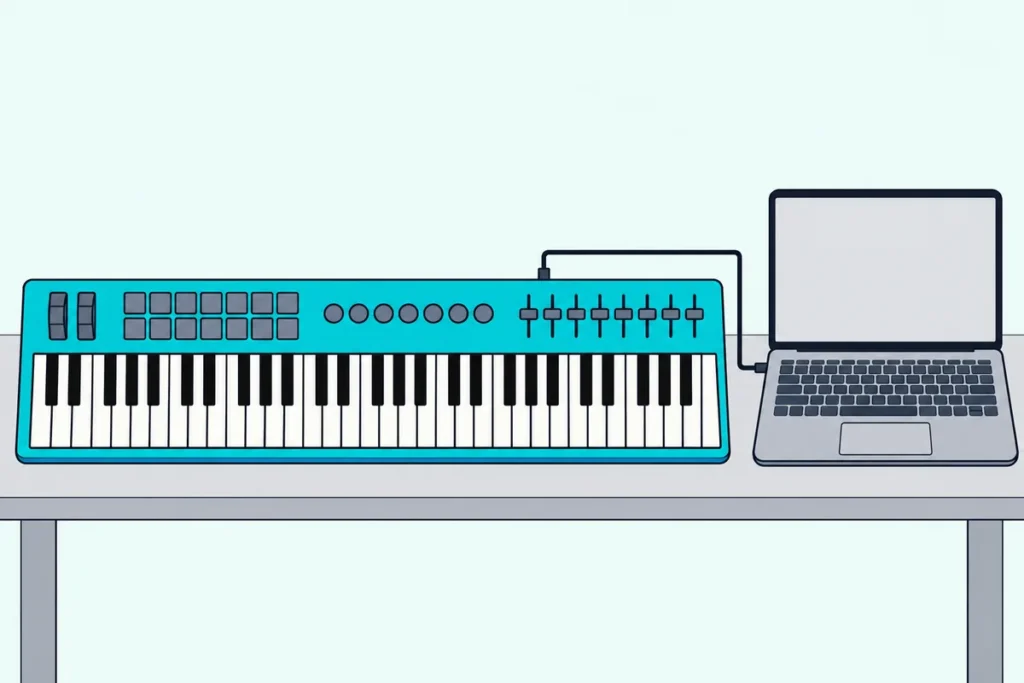
Choosing the best MIDI keyboard for Logic Pro starts with what Logic does the moment you plug it in, because Logic sets some keyboards up for you and treats the rest as plain note senders.
Buy one Logic doesn’t recognize and the keys still play, but its knobs and buttons have no Logic job until you assign each one yourself.
Choose one whose maker ships a Logic script, and its knobs, pads and transport buttons are working Logic controls from the first session.
The quick answer and six picks come first, then how Logic recognizes a keyboard, what Smart Controls, keys, pads and aftertouch add, where Logic Remote and MainStage fit, the checks before you buy and who should buy which.
The first pick suits most Logic players, so start there.
What Is the Best MIDI Keyboard for Logic Pro?
That plug-in moment is where the quick answer starts. The best MIDI keyboard for Logic Pro for most players is the Novation Launchkey 61 MK4, because Novation’s Launchkey 61 user guide gives it a Logic Pro mode in which its eight encoders control Logic’s Smart Controls and its pads run the mixer and Live Loops.
If you want the same kind of control on a 25-key board, the Akai MPK mini IV has its own Logic Pro control script. Akai’s MPK mini IV Logic Pro Setup Guide maps its knobs to Smart Controls, volume and pan, sends and EQ.
The descriptions come from the makers’ manuals and spec pages.
Every pick met Burton Acoustix’s rating, review and stock checks on 9 November 2026.
Which MIDI Keyboards Work Best With Logic Pro?
The quick answer gives the headline, and each pick below works with Logic through a script, a protocol or its maker’s own integration. Novation, Arturia and Akai publish Logic scripts that turn knobs and pads into Logic controls, M-Audio’s Keystation 88 MK3 speaks Mackie Control or HUI, and Nektar’s SE49 runs on Nektar’s own Logic integration.
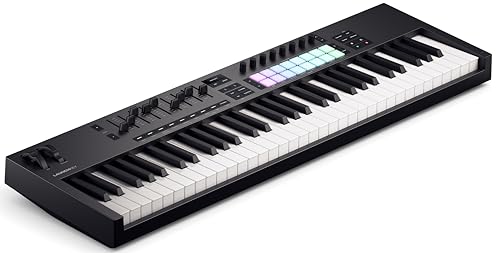
Novation Launchkey 61 MK4
If you want the deepest Logic control in a full-size keyboard, the Novation Launchkey 61 MK4 is the one to beat. Novation’s user guide describes a Plugin mode in which the encoders control Logic Pro’s Smart Controls for the selected instrument or plug-in, while the screen shows the track, the parameter and its value.
Novation Launchkey 61 MK4
Its pads split into two Logic modes: a Mixer mode for selecting, arming, soloing and muting tracks, and a Live Loops mode in which the top row plays the selected track’s loops and the bottom row fires scenes. In the encoders’ Mixer mode, the bank down button reaches a Mixer EQ page, which adds Logic’s EQ to the track if it doesn’t have one yet.
Novation lists 61 semi-weighted waterfall keys, 16 velocity-sensitive pads, nine faders, an OLED screen, a Scale Mode, three Chord Modes, a Chord Detector that names the chord you’re playing, an arpeggiator, a 5-pin MIDI out and USB-C bus power. It weighs 4.78 kg (10.54 lbs) and spans 895 mm (35.24 in), so measure the desk before you order.
The guide says it controls Logic Pro with no set-up required, and Novation’s downloads page also offers a Launchkey MK4 Logic Script Integration 1.1 for Mac. The Novation Launchkey MK4 series sends polyphonic aftertouch from its 16 pads, so each pad transmits its own pressure, but Novation lists no aftertouch on the keys.
Novation Components, the maker’s desktop and web app, handles firmware updates, custom MIDI mappings and backups. Novation says you’ll need a firmware update there when the keyboard first arrives, or some features may not work properly.
Arturia KeyLab Essential 49 mk3
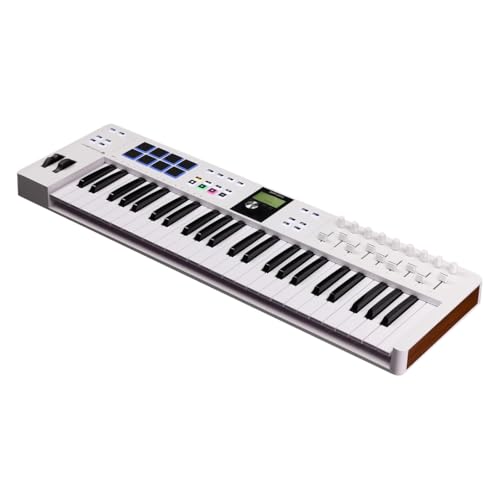
For a keyboard that also drives Arturia’s own instruments, the Arturia KeyLab Essential 49 mk3 pairs a Logic script with a fallback for every other program. Arturia’s KeyLab Essential mk3 manual lists DEEP scripts for five DAWs, Apple Logic Pro among them, and says the keyboard can control any other DAW through the MCU and HUI protocols.
Arturia KeyLab Essential 49 mk3
You switch it into Logic mode by pressing Prog until the display reads DAWs, and the manual warns that the scripts may have to be installed by hand. In that mode, the six transport buttons to the left of the screen run the transport, with loop, rewind, fast forward, metronome, stop and play.
Apple’s Logic Pro User Guide flags one Arturia detail worth knowing before you plug in. Apple says some controllers, such as those from Arturia, send MIDI Machine Control for their transport buttons, so it tells you to turn on Listen to MMC under File > Project Settings > Synchronization > MIDI.
Arturia lists 49 velocity-sensitive synth-action keys, eight pads that sense velocity and aftertouch, nine endless encoders, nine faders, Chord and Scale modes and an arpeggiator that can run together, a 5-pin MIDI output and USB-C power, and it bundles Analog Lab V. The same manual covers the 61 and 88-key versions, which keep the same controls with different spacing.
Akai MPK mini IV
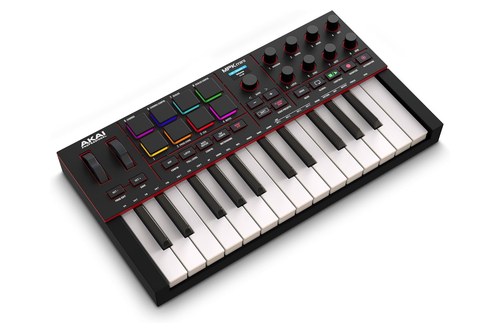
For the smallest board with real Logic control, the Akai MPK mini IV is the one to look at. Akai’s Logic Pro Setup Guide has you install its Logic Pro control script, press the PLUGIN/DAW button until it’s lit red, and then click Auto Assign when Logic asks.
Akai MPK mini IV
Its eight endless knobs then cycle through six Logic modes: Smart Controls in banks of 1-8 and 9-16, volume and pan, sends, EQ, navigation and an unmapped user mode. In EQ mode, Akai says Logic’s EQ is added to the track and its window opens, with the knobs on frequency and gain.
The pads have four Logic modes of their own: drums, track record, solo and mute, and Live Loops, in which one row launches the selected track’s clips and the other launches scenes. Akai also maps undo, cycle, play and stop, record and overdub to its buttons.
Akai’s MPK mini IV User Guide lists 25 velocity-sensitive keys with octave buttons, eight velocity- and pressure-sensitive pads, eight 360-degree knobs, pitch and modulation wheels and a 0.96-inch color screen. It weighs 1 kg (2.2 lbs), measures 34.7 cm (13.7 in) wide, and has a USB-C port, a 5-pin MIDI out and a sustain input.
Akai’s Logic guide asks for a USB 3.0 port on the computer, or a powered hub if you connect through one. That’s worth knowing on a laptop with few ports.
Novation Launchkey Mini 37 MK4
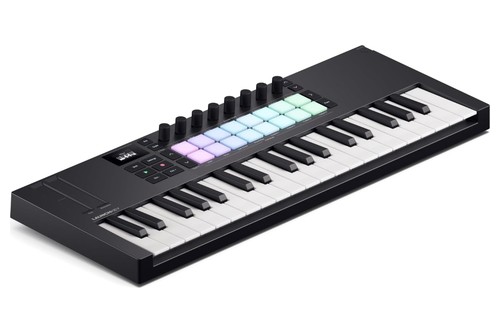
If 25 keys feel tight but a 49 won’t fit, the Novation Launchkey Mini 37 MK4 brings the Launchkey’s Logic mode to a smaller board. Novation’s Launchkey Mini 37 user guide describes the same Plugin mode for Smart Controls, the same Mixer EQ page and the same Mixer and Live Loops pad modes as the Launchkey 61, with no set-up required.
Novation Launchkey Mini 37 MK4
Novation lists 37 synth-action mini keys, eight encoders, 16 velocity-sensitive pads with polyphonic aftertouch and an OLED screen, with touch strips for pitch and modulation instead of wheels. It weighs 1.02 kg (2.25 lbs) and is 478 mm (18.81 in) wide, a little over half the width of the 61.
Its MIDI out is a 3.5 mm TRS type-A jack rather than a 5-pin socket, and it runs on USB-C bus power with a sustain input. Novation’s range table gives the Mini 37 Play, Record, Stop and Loop buttons but no faders, so mixing happens on the encoders.
M-Audio Keystation 88 MK3
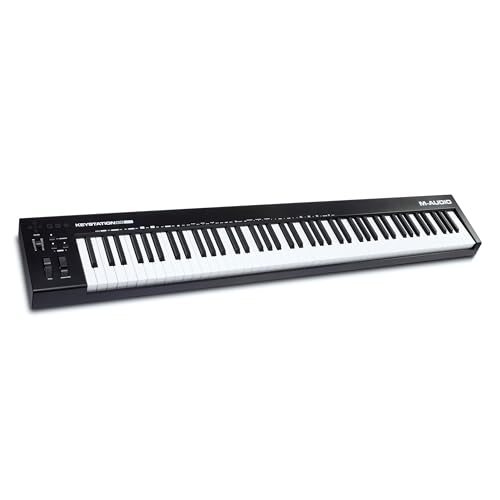
For all 88 keys and transport control without a panel full of knobs, the M-Audio Keystation 88 MK3 covers the range and the transport. M-Audio’s product page lists 88 full-size, velocity-sensitive semi-weighted keys, a volume fader, transport and directional buttons and a sustain pedal input.
M-Audio Keystation 88 MK3
Its Logic link is a protocol rather than a script. The Keystation 88 MK3 User Guide says the transport and directional buttons can use MIDI, Mackie Control or HUI, chosen with the Advanced button and the key labeled DAW, and that those controls go out on Virtual Port 2.
M-Audio gives the LEDs as the tell: green for Mackie Control, red for HUI and orange for plain MIDI. On the Logic side, Apple’s guide adds a control surface under Logic Pro > Control Surfaces > Setup with New > Install, and has you set the MIDI In and Out ports by hand when a device can’t be found by scanning.
The guide lists 13.88 lbs (6.3 kg) and a width of 54.2 in, with power from USB or an optional 9 V supply and a 5-pin MIDI out for hardware. M-Audio lists no knobs or pads, so Smart Controls stay on the mouse unless you add a small controller beside it.
Nektar SE49
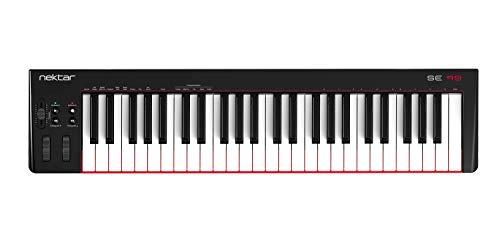
For a plain 49-key board with its maker’s Logic integration, the Nektar SE49 keeps things simple. Nektar’s SE49/SE61 page says its DAW Integration supports Logic among 11 programs, and with it active the buttons to the left of the keys take on transport control, track selection and patch browsing.
Nektar SE49
Nektar’s Logic files come from your Nektar account after you register the keyboard and pick Logic as your DAW.
Nektar lists 49 full-size synth-action keys with velocity, four velocity curves plus three fixed ones, pitch bend and modulation wheels, a foot switch socket, four buttons and one assignable fader. It’s USB class compliant, draws 100 mA and weighs 2.2 kg, about a third of the Keystation 88’s 6.3 kg.
Nektar lists no pads or knobs, so this is a keys-first keyboard controller that leaves Smart Controls to the mouse or to Logic’s Learn button. That trade suits players who mostly record parts and mix later.
How Does Logic Pro Recognize a MIDI Keyboard?
Those picks reach Logic in three different ways, and the difference decides how much of the keyboard works on day one. Logic Pro uses a Lua script that assigns a supported keyboard automatically, a control surface protocol such as Mackie Control, or assignments you teach it yourself, and Apple’s Logic Pro User Guide describes each one.
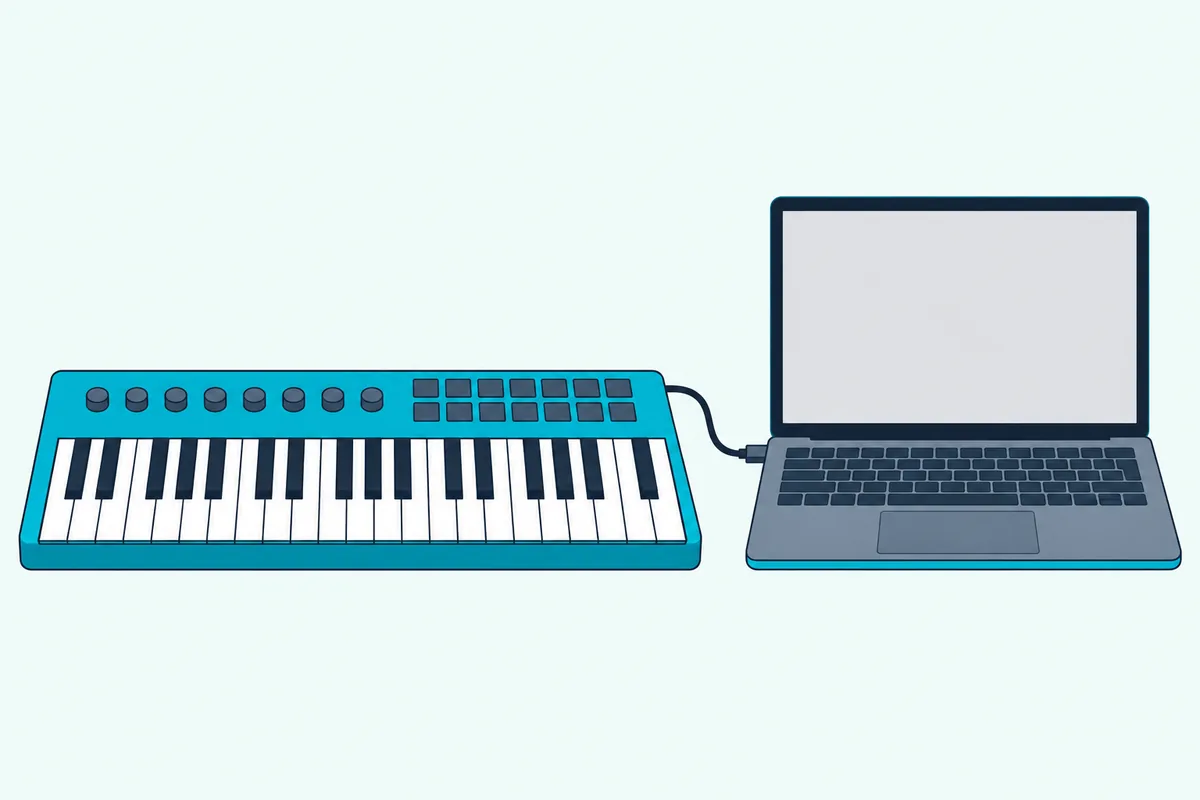
Knowing which route a keyboard takes tells you how much setup it needs. If a new keyboard stays silent or its knobs do nothing, Burton Acoustix’s Logic Pro controller setup guide traces each symptom to the window that fixes it.
Lua scripts and Auto Assign
Apple’s page on automatic assignment for USB MIDI controllers says Logic Pro supports a variety of USB MIDI controllers through Lua scripts. The first time you connect one, a dialog asks whether to use it as a control surface, and Auto Assign maps its controls to Smart Controls and other Logic functions.
Apple spells out what lands where. Buttons go to key commands such as Play, Stop, Pause, Record, Cycle and the marker commands, knobs go to knob screen controls, and faders go to fader screen controls, except that a lone fader labeled Volume runs the selected channel strip’s volume.
You can change your mind later under Logic Pro > Control Surfaces > Settings > MIDI Controllers, where an Auto checkbox matches the Auto Assign choice. Apple says any assignment you’ve made or edited yourself is kept when you turn it on.
Makers supply many of these scripts themselves, which is why the picks above mention downloads. Akai’s setup steps end in that Auto Assign dialog, and Arturia, Novation and Nektar offer Logic files for their keyboards too.
Mackie Control and HUI
A protocol keyboard works differently: its buttons speak the Mackie Control or HUI protocol, which Logic already supports for control surfaces. The Keystation 88 MK3’s Mackie Control mode and the KeyLab Essential’s MCU and HUI fallback both work like this.
Apple’s guide says some control surfaces, such as Mackie Control, are detected automatically when Logic opens, and others are added in the Control Surfaces Setup window. Logic also supports full mixing surfaces, and how a control surface connects to Logic Pro covers the Control Surfaces Setup steps.
Apple’s Controller Assignments overview shows how far that support goes: on a Mackie Control, the F1 to F7 buttons open screensets 1 to 7 by default, and you can reassign them alone or with modifier buttons. Apple’s notes for Logic Pro 12.3 add that Mackie Control support now gets feedback when Sends on Faders is toggled in the Mixer.
Assignments you teach Logic
Every other keyboard still works, but each knob waits for you. Apple’s Controller Assignments overview says you can assign any controller capable of generating a MIDI message, using a Learn process in an Easy view or the fuller Expert view.
Because that window accepts any controller that sends MIDI, a Stream Deck with a MIDI plugin can drive it too, and sending those messages from a Stream Deck shows the setup.
Apple’s notes on Macs with Apple silicon matter for controllers that rely on a plug-in. The guide says every Mac supports Logic’s built-in MIDI Device Plug-ins and MIDI Device Scripts, but only Macs with Intel processors also run control surface plug-ins from other makers, so on an Apple silicon Mac you check whether the maker offers a MIDI Device Script.
Why Do Smart Controls Matter When You Choose a Keyboard?
Smart Controls came up in nearly every route above, so they’re worth understanding before you count knobs. They matter because a keyboard mapped to Smart Controls puts the selected track’s screen controls under its knobs, so where the knobs land counts for more than how many there are.
Apple gives the examples itself: a synthesizer’s Smart Controls might cover waveform, resonance and filter cutoff, while a string instrument’s might change the articulation. You open the pane by clicking the Smart Controls button in the control bar or by pressing B, the same shortcut Novation’s guide points to, or choose Window > Open Smart Controls to give it its own window.
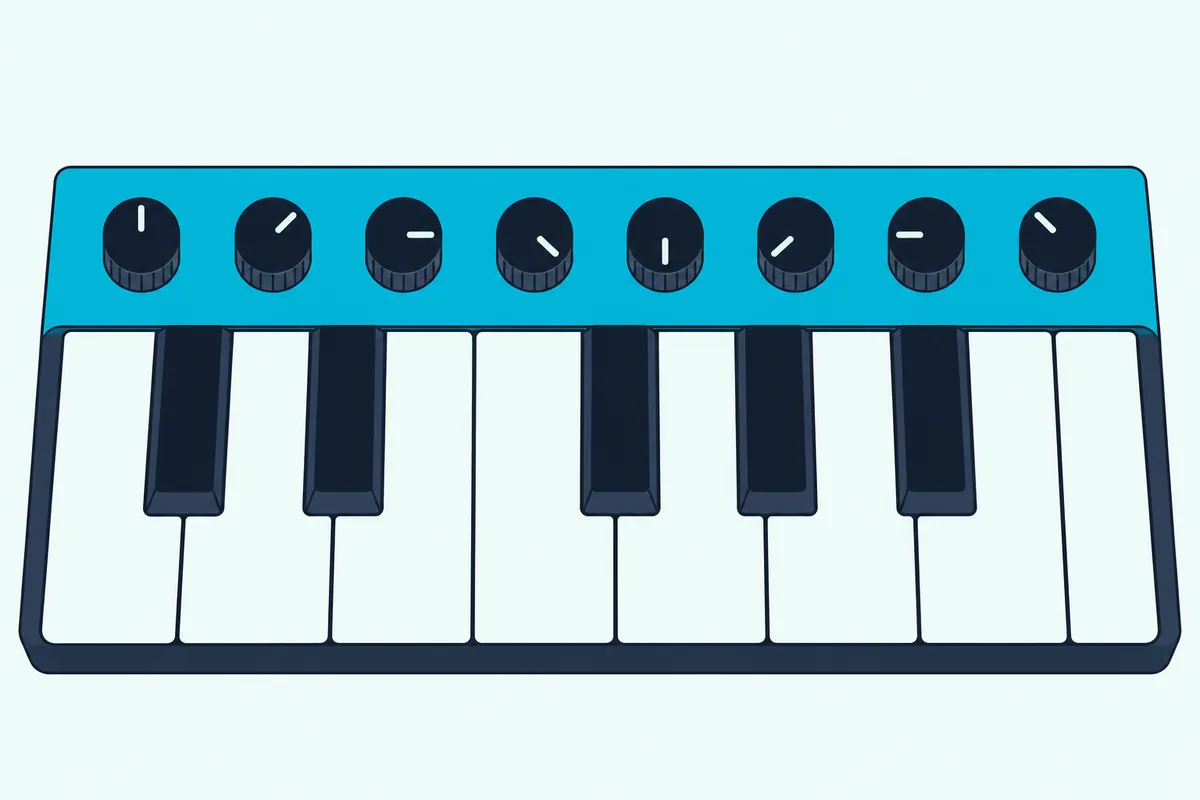
Smart Controls are the set of screen controls Logic shows for the selected track, and a single screen control can change one or more parameters across its channel strip, instrument and effect plug-ins. The Launchkey’s eight encoders and the MPK mini IV’s eight knobs both follow whatever track you select, and Akai splits Smart Controls into banks of 1-8 and 9-16 so the knobs can reach the second set.
Nektar’s Impact LX mk3 Owner’s Manual describes a similar switch: its Page button toggles between Nektar’s own LX mapping and the Macro, Quick or Smart controls that Live, Bitwig Studio, Cubase, Nuendo, Logic Pro and Studio One offer. Each maker gets to the same panel by a different button.
Without a script, Apple’s Learn process does the job one control at a time. In the Smart Controls pane you click the Inspector button, select a screen control, click External Assignment, click Learn and move the knob you want, then repeat for the next control before clicking Learn again to finish.
Faders change the picture for mixing. If you’d rather ride levels by hand than play, controllers built around faders give Logic’s mixer more to grab than a row of knobs.
How Many Keys Do You Need for Logic Pro?
Knobs are only half the choice, because the key count decides what you can play before reaching for the octave buttons. For most Logic producers 49 or 61 keys is the middle ground, while 25 or 37 keys suit a small desk and 88 keys suit piano parts that use the whole range.
A rough way to picture it is by octaves. A 25-key board gives you two octaves, 37 keys give three, 49 give four, 61 give five, and 88 keys run from A to C across seven octaves and a little more.
25 and 37 keys. The MPK mini IV and Launchkey Mini 37 MK4 cover this end, and Novation’s range table gives the Launchkey Mini 25 the same pads, encoders and transport as the Mini 37. A 25-key mini controller works for synth lines and beat making, but it limits two-handed piano and orchestral parts.
49 and 61 keys. The KeyLab Essential 49 mk3 and SE49 give four octaves, enough for a bass line in the left hand and chords in the right, and the Launchkey 61 MK4 adds a fifth. Width climbs fast: Nektar gives the SE49 as 80.5 cm and Novation gives the Launchkey 61 as 895 mm.
88 keys. The Keystation 88 MK3 is the only full-range pick here, and its semi-weighted keys suit players who want range more than piano action. If you play piano first, compare full-size 88-key controllers with weighted actions before you settle.
A quick desk test helps more than a spec sheet, so here are the widths and weights side by side:
| Keyboard | Width | Weight | MIDI out |
|---|---|---|---|
| Akai MPK mini IV | 34.7 cm | 1 kg | 5-pin DIN |
| Novation Launchkey Mini 37 MK4 | 47.8 cm | 1.02 kg | 3.5 mm TRS |
| Nektar SE49 | 80.5 cm | 2.2 kg | USB only |
| Arturia KeyLab Essential 49 mk3 | 5-pin DIN | ||
| Novation Launchkey 61 MK4 | 89.5 cm | 4.78 kg | 5-pin DIN |
| M-Audio Keystation 88 MK3 | 137.8 cm | 6.3 kg | 5-pin DIN |
Lay a tape measure along the space in front of your monitor before you choose. The two small boards fit almost anywhere, the 61 needs a real desk, and the 88 usually means a stand.
Are Pads Worth It for Live Loops and Drum Parts?
Key count settles the melody side, and the pads settle the rhythm side. Pads earn their place in Logic when you use Live Loops or play drums by hand, because Apple describes Live Loops as a grid of cells and scenes that a control surface or Logic Remote can control.
Apple’s Live Loops overview explains the grid: each cell holds a musical phrase or loop, cells start and stop in sync with the project tempo, and columns called scenes trigger together. A row of pads maps neatly onto that layout, one pad per cell.
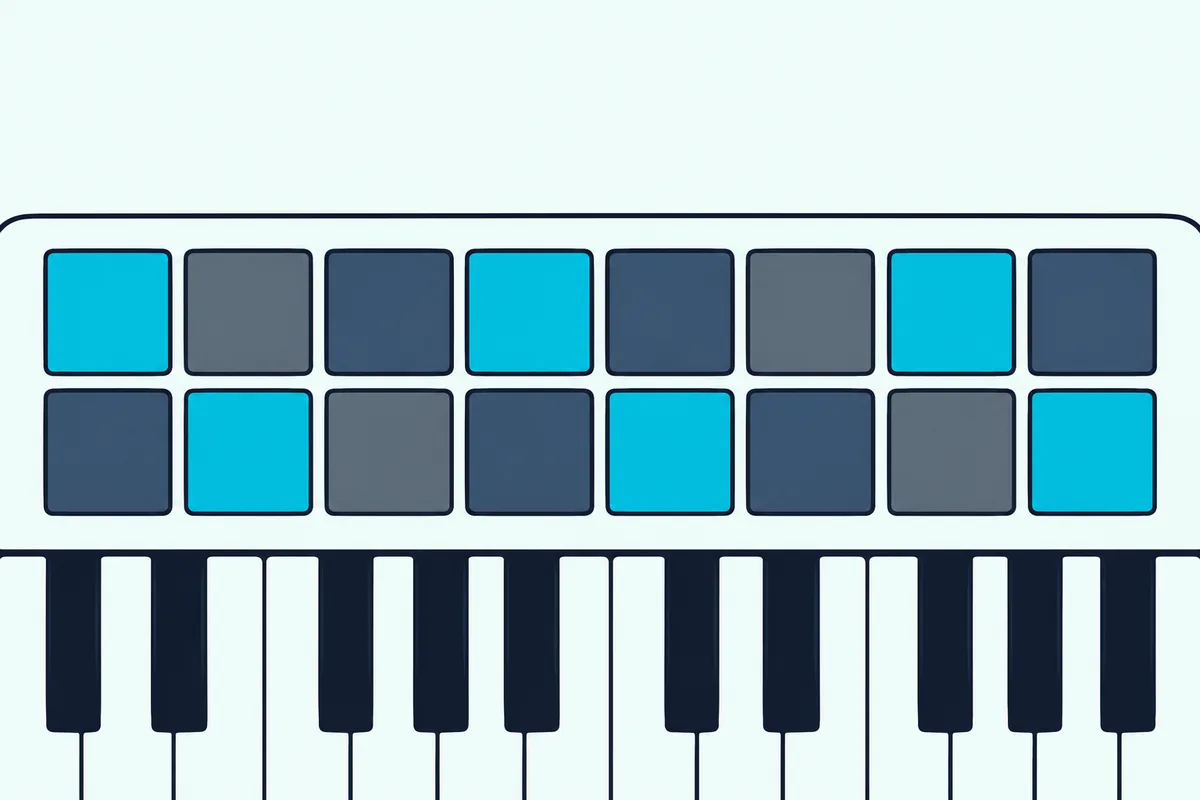
The Launchkeys do exactly that. Novation’s guides say the top row of pads shows the selected track’s loops in their Logic colors and the bottom row fires scenes, and that pressing an empty pad records a new loop while the pad flashes red.
Akai’s Live Loops mode splits the job the same way, with clips on the top row and scenes on the bottom, and its second pad bank turns all eight pads into scenes 1-8. For drums, Akai’s Drum Mode lays the pads out chromatically from C1 for MIDI instrument and Drum Machine tracks.
Velocity is where pads differ from keys. Akai’s user guide describes a Full Level mode that makes every pad hit send full velocity, 127, which helps when you want every hit at the same level.
If pads matter more to you than keys, our pad controller picks put more of them under your hands. Akai’s earlier keyboard also has eight backlit MPC pads, and the MPK Mini MK3’s 8 pads are covered in the general roundup.
Do You Need Aftertouch for Logic’s Instruments?
Pads also carry the pressure question, since that’s where these makers put their aftertouch. You need aftertouch only if you want pressure after the strike to keep shaping a note, and among these picks the makers list it on pads, not keys.
Novation lists polyphonic aftertouch on the Launchkey pads, which means each pad sends its own pressure, and Arturia’s manual says the KeyLab Essential’s pads sense velocity and aftertouch. Akai lists pressure-sensitive pads on the MPK mini IV, with an aftertouch setting of off, channel or poly, while M-Audio and Nektar list no aftertouch for the Keystation 88 MK3 or the SE49.
That split decides how you’d use it. Pad pressure suits drum rolls and swells triggered from the pads, while key pressure suits sustained synth and string parts you play from the keyboard.
For key pressure in Logic’s instruments, look for a keyboard whose maker lists aftertouch on the keys, such as the aftertouch keyboards we compare. Check that the maker says “aftertouch” on the keys themselves, because a pad spec can sit in the same line of a feature list.
Can Logic Remote Stand In for Knobs and Faders?
Pressure, pads and knobs all add to a keyboard, and Apple has its own controller app worth trying first. Apple says Logic Remote on an iPad or iPhone can control playback and navigation, recording, loading patches and plug-ins, mixing and automation in Logic Pro for Mac.
It also has Touch Instruments for playing Logic’s software instruments and custom layouts for the key commands you use most. Apple says the device connects to the Mac wirelessly or with a cable, and you can download it from the App Store or with Logic Pro > Download Logic Remote.
Its Smart Help feature shows help on the Logic interface, commands and menus as you point at them on the Mac. That’s a handy extra when you’re still learning where the mixer and Smart Controls live.
Apple names Logic Remote alongside control surfaces as a way to control Live Loops. That makes it a fair stand-in for the pad and mixer modes above if you already own an iPad.
Where it doesn’t replace a keyboard is the playing itself. A tablet on the desk handles the mixer and transport well, while the keys stay on the controller, so a plain keys-first board like the SE49 and Logic Remote make a workable pair.
Will the Same Keyboard Work in MainStage?
Logic Remote is one Apple companion, and MainStage is the other one Logic users ask about. Every keyboard here sends MIDI, so it can play MainStage, but Apple’s MainStage User Guide has you assign the controller’s faders, knobs, buttons, drum pads and pedals to screen controls in the MainStage workspace.
Apple describes two ways to do it: the Learn process, or the Assignments & Mappings table. Apple adds that you only need to make controller assignments once for a concert as long as you use it with the same hardware.
So for live use, the knob and pad counts in the picks above matter as much as the Logic modes. The makers’ Logic chapters describe Logic Pro, and MainStage keeps its own assignments, so plan on learning the controls once per concert.
What Should You Check Before You Buy?
MainStage aside, four checks decide whether a keyboard’s Logic support will work on your Mac. Check that the maker supports your Logic version, that its support installs on an Apple silicon Mac, which USB port it needs, and whether its transport needs a Logic setting.
- Your Logic version. Apple’s Logic Pro for Mac release notes list 12.4 as the newest version, and makers set their own floors: Nektar’s Impact LX mk3 manual asks for Logic Pro 10.8 and higher, and its Impact GXP and LX Mini page asks for 10.6 or higher.
- Your Mac. On Apple silicon, Logic runs Apple’s built-in device support and makers’ MIDI Device Scripts but not other makers’ control surface plug-ins, per Apple’s guide.
- Your ports. Novation packs a USB-C to A cable, so a Mac with only USB-C ports needs a different cable or an adapter, and Akai asks for a USB 3.0 port or a powered hub.
- Your transport. Arturia boards may need Listen to MMC turned on, per Apple.
The version line moves with Apple’s updates. Apple’s notes for 12.4 list control surface fixes, including Follow Focused View now working for Audio FX, MIDI FX and instruments on control surfaces, so keep Logic and the maker’s script current together.
Firmware belongs on the same list. Akai recommends checking for MPK mini IV firmware updates before first use, and Novation says a Launchkey needs its first firmware update in Novation Components.
Hubs deserve a second look if you run more than one controller. Akai’s powered-hub note is worth following for any bus-powered board, and Burton Acoustix’s powered USB hub picks for MIDI gear cover the power side.
Who Should Buy Which Keyboard for Logic Pro?
Those checks narrow the field, and how you work in Logic picks the winner. Beat-makers who live in Live Loops should start with a Launchkey or the MPK mini IV, pianists who need range should start with the Keystation 88 MK3, and Analog Lab users should start with the KeyLab Essential 49 mk3.
If you build tracks in Live Loops. The Launchkey 61 MK4 and Mini 37 MK4 show each loop’s color on the pads and fire scenes from the bottom row, and the MPK mini IV’s Live Loops mode does the same job on eight pads. That’s the pad layout from the Live Loops section, ready without any mapping.
If you write at the keyboard. The Keystation 88 MK3 gives you all 88 keys, and its Mackie Control transport lets you start and stop recording without reaching for the mouse. Add Logic Remote on an iPad if you want the mixer within reach too.
If you want Arturia’s sounds. The KeyLab Essential 49 mk3 comes with Analog Lab V and switches to its Logic script with the Prog button.
If you mix as much as you play. The Launchkey 61 MK4 adds nine faders to the Mixer EQ page that the Mini 37 also has, so levels and EQ both get hardware. The KeyLab Essential 49 mk3 has nine faders too, which Arturia says adjust track volumes and pans in your DAW.
If you carry a laptop. The MPK mini IV at 1 kg and the Launchkey Mini 37 MK4 at 1.02 kg both run on USB bus power. The Mini 37 gives you 12 more keys for almost the same weight.
If you mostly need keys. The Nektar SE49 covers four octaves with transport control through Nektar’s integration. Pair it with Logic Remote and the missing knobs matter less.
If you’re just starting out. Beginners get the most from a keyboard that maps itself, so the MPK mini IV or a Launchkey saves the Learn-button homework. Logic’s Musical Typing covers the first sessions if the keyboard hasn’t arrived yet.
If you play live in MainStage. The MPK mini IV and Launchkey Mini 37 MK4 weigh about a kilogram each, so count the knobs and pads you’ll need on stage before you choose.
The Bottom Line
The Novation Launchkey 61 MK4 is the best MIDI keyboard for Logic Pro for most players, because its Logic mode puts Smart Controls on the encoders and the mixer and Live Loops on the pads. The Launchkey Mini 37 MK4 brings the same modes to a smaller desk.
The Akai MPK mini IV is the compact pick with its own Logic script, the Arturia KeyLab Essential 49 mk3 suits Analog Lab users, and the M-Audio Keystation 88 MK3 gives you all 88 keys with Mackie Control transport. The Nektar SE49 is the simplest route to a 49-key board with its maker’s Logic integration.
Whichever you pick, check the maker’s script against your Logic version and your Mac, then let Auto Assign or the keyboard’s Mackie Control mode do the first round of mapping.
Frequently Asked Questions
Will any USB MIDI keyboard work with Logic Pro?
For playing notes, yes. Apple’s guide lets you connect a music keyboard to play software instruments, and its Controller Assignments overview says you can assign any controller capable of generating a MIDI message. M-Audio, Nektar and Korg all describe their keyboards as USB class compliant or USB-MIDI devices. The difference is how much works without setup: keyboards with a Lua script get the Auto Assign dialog, while the rest need Logic’s Learn process for their knobs and buttons.
Do I need a MIDI keyboard for Logic Pro?
No. Apple’s guide lets you play software instruments with Musical Typing (choose Window > Show Musical Typing, or press Command-K) or the onscreen keyboard, and pressing C or V lowers or raises the velocity. Clicking lower on the onscreen keys plays notes with higher velocity. A MIDI keyboard adds keys you can play with both hands and velocity that follows how hard you press each one.
Is the Akai MPK Mini good for Logic Pro?
The current MPK mini IV is well documented for it. Akai’s Logic Pro Setup Guide covers a control script with Auto Assign, knob modes for Smart Controls, volume and pan, sends, EQ and navigation, and pad modes that include Live Loops. Akai’s earlier MPK Mini MK3 also plays Logic’s instruments over USB, and its pads and knobs can be assigned with Logic’s Learn process.
What is the best 25-key MIDI controller for Logic Pro X?
The Akai MPK mini IV, for Akai’s Logic Pro script and its Smart Controls, mixer and Live Loops modes on a 25-key board. Novation’s Launchkey Mini 25 MK4 is the alternative, since Novation’s range table gives it the same pads, encoders and transport buttons as the Launchkey Mini 37, and the Mini 37 guide describes its Logic Pro modes.
What is the best 88-key MIDI controller for Logic Pro X?
The M-Audio Keystation 88 MK3 is the 88-key pick here, with semi-weighted keys and transport buttons that can run in Mackie Control or HUI mode. If you want Logic script support on 88 keys, Arturia’s KeyLab Essential mk3 manual covers an 88-key version with the same DEEP script for Logic Pro. Pianists who want weighted keys should compare dedicated 88-key controllers before buying.
Which MIDI keyboard works best with Logic’s Live Loops?
A keyboard whose maker documents a Live Loops mode. Novation’s Launchkey guides light the pads in each loop’s color, fire scenes from the bottom row and record into an empty slot when you press an unlit pad. Akai’s MPK mini IV has a Live Loops pad mode with clips on one row and scenes on the other, and Nektar’s Impact LX mk3 manual lists a clips mode for Live Loops. Apple also names Logic Remote as a way to control Live Loops, so an iPad can fill in for pads you don’t have.
Do these keyboards work with Logic Pro for iPad?
For playing, Apple’s Logic Pro for iPad guide says a Core MIDI compliant device appears automatically in MIDI Input Devices and Ports when you connect it to the iPad’s Lightning or USB-C port. Bluetooth MIDI devices are added by hand in the Bluetooth MIDI Devices dialog, and M-Audio says the Keystation 88 MK3 connects to iOS devices through Apple’s Lightning to USB Camera Adapter, sold separately. The makers’ Logic chapters above describe Logic Pro on the Mac, so check each maker’s notes before counting on the script features on an iPad.