Smart TV With the Best Sound Without a Soundbar: What to Buy

Shopping for a TV with the best sound without a soundbar starts with the speaker layout, because the best-sounding TV RTINGS has tested pairs 70W with a 4.2.2-channel system that includes up-firing Atmos speakers.
Most sets go the other way, since TVs have gotten thinner and their speakers have shrunk with them, leaving very little deep bass.
Pick well and dialogue stays clear at a normal volume, with sound that seems to come from the picture instead of the stand below it.
The first thing to check is the channel count, since a 2.1.2 or 4.2.2 layout adds a woofer or extra speakers that a plain two-channel set doesn’t have.
Below are the TVs whose own speakers do the most, what each maker builds in, how RTINGS rates the sound, and the point where a soundbar becomes the better buy.
What Is the TV With the Best Sound Without a Soundbar?
That 70W, 4.2.2-channel set is Samsung’s S95H OLED. RTINGS’ list of the best-sounding TVs calls it the best-sounding TV it has tested, with a well-balanced profile, clear dialogue and up-firing Atmos speakers, though it doesn’t deliver much deep bass.
The same 2026 list then works down the price range. The Sony BRAVIA 7 II is its mid-range pick, with 40W across 2.2 channels and no up-firing speakers, followed by the Hisense U7SG with a built-in subwoofer and the Samsung M70H on a budget.
RTINGS also singles out the Sony BRAVIA 9 II as an excellent TV that competes closely with the S95H. Its built-in surround sound speakers deliver a decent frequency response, though RTINGS rates the TV as less versatile than the Samsung.
Even at the top, RTINGS keeps expectations in check. Its view is that no TV can deliver the sound quality of a dedicated sound system or a soundbar.
Here’s how the TVs on this page compare, with each figure credited to the maker or to RTINGS:
| TV | Speakers | Maker’s sound system | RTINGS on the sound |
|---|---|---|---|
| Samsung S95H (2026 OLED) | 70W, 4.2.2 channels, up-firing Atmos speakers (RTINGS) | Object Tracking Sound+ (Samsung) | Best-sounding TV it has tested; little deep bass |
| Samsung S95F (2025 OLED) | 70W, 4.2.2 channels (RTINGS) | Dolby Atmos (Samsung) | Surprisingly decent; not very loud; lacks deep bass |
| Sony BRAVIA 7 II | 40W, 2.2 channels (RTINGS) | Acoustic Multi-Audio+ (Sony) | Balanced at moderate volume; effects drown voices as it gets louder |
| Sony BRAVIA 8 II | Actuators that vibrate the screen (Sony) | Acoustic Surface Audio+ (Sony) | Balanced at most volumes; bass not very impactful |
| Hisense U7SG | 50W on the 65-inch, 2.1.2 channels with a built-in subwoofer (Hisense) | Tuned by Devialet (Hisense) | Balanced at all volume levels; clear dialogue |
| Samsung S90H (2026 OLED) | Dolby Atmos, with a virtual top channel at 50 inches and under (Samsung) | Object Tracking Sound Lite (Samsung) | Decent; bass not very impactful; not very loud |
| Samsung M70H | Two 20W channel speakers (RTINGS) | Adaptive Sound (Samsung) | Very clear dialogue; very little low bass |
Read the speaker column first. RTINGS reads the S95H’s third number as up-firing Atmos speakers, while Hisense describes its 2.1.2 as two main speakers, two surround channels and a built-in subwoofer.
Which TVs Have the Best Built-In Speakers You Can Buy?
Those rankings set the bar for the TVs you can buy below. The Hisense U7SG, Samsung S95F, Sony BRAVIA 8 II and Samsung M70H each come with their maker’s own speaker details and a published RTINGS sound verdict.
Nothing here was played or measured by Burton Acoustix: the speaker details come from the makers’ documents and the sound verdicts from RTINGS’ reviews. Every pick met Burton Acoustix’s rating, review and stock checks on 28 Oct 2026.
Hisense U7SG
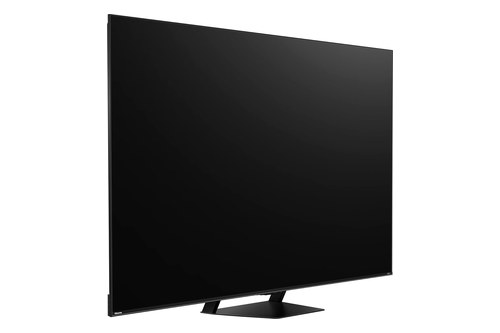
For built-in bass at a mid-range price, the Hisense U7SG is the set to look at. Hisense’s 65U7SG spec sheet lists 50W across a 2.1.2-channel system with two main speakers, two surround channels and a built-in subwoofer, plus Dolby Atmos and DTS Virtual:X.
the Hisense U7SG
RTINGS names it the best-sounding lower mid-range TV it has tested so far and says the built-in subwoofer delivers deeper bass than many similarly priced models. Its review adds that the sound stays fairly well balanced at all volume levels, so dialogue is clear, though RTINGS finds voices a bit more boxy than on the Sony BRAVIA 7 II.
Hisense says the U7’s multi-channel speakers are tuned by Devialet, the French audio company it announced a partnership with in May 2025, and that the Devialet certification is configured through over-the-air updates. RTINGS lists sizes from 55 to 116 inches, so it won’t fit a 43-inch space.
Samsung S95F
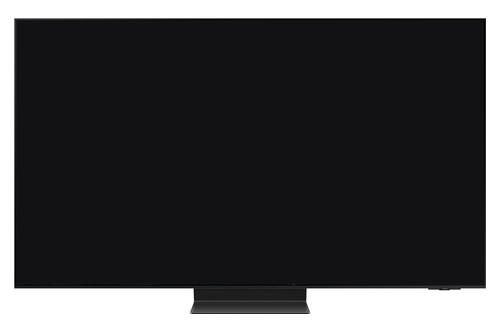
If you want the most speaker channels, the Samsung S95F carries the same figures as RTINGS’ top pick. RTINGS lists 70W across 4.2.2 channels with Dolby Atmos support, on a TV it says the S95H replaced in 2026.
the Samsung S95F
RTINGS says it sounds surprisingly decent given how small the speakers in its thin profile are, with a fairly well-balanced sound. It also notes that it doesn’t get very loud, lacks deep bass and has a slight dip in the mids that makes some dialogue sound a bit muted.
That makes it the older way into Samsung’s top OLED speaker layout. If a Samsung soundbar may join it later, Burton Acoustix’s Samsung TV soundbar picks cover the bars that work with Q-Symphony.
Sony BRAVIA 8 II
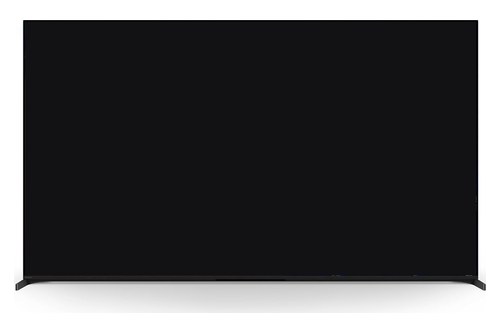
For sound that seems to come from the picture itself, the Sony BRAVIA 8 II takes a different route. Sony says its Acoustic Surface Audio+ uses actuators to vibrate the screen, matching the sound to where each subject sits and sending it straight from the screen.
the Sony BRAVIA 8 II
RTINGS rates its frequency response as okay and its sound as balanced at most volume levels, which makes dialogue easy to understand. It also says the bass isn’t very impactful, the speakers aren’t very loud, and you’re best off pairing it with a soundbar if you want deep bass.
Sony adds Voice Zoom 3, which uses AI to make voices stand out. Sizes are limited, though: RTINGS lists only 55- and 65-inch versions.
RTINGS notes that it uses the same QD-OLED panel as the Samsung S95F. That makes the two a direct comparison of speaker technology: actuators that vibrate the screen on the Sony against 4.2.2 channels on the Samsung.
Samsung M70H
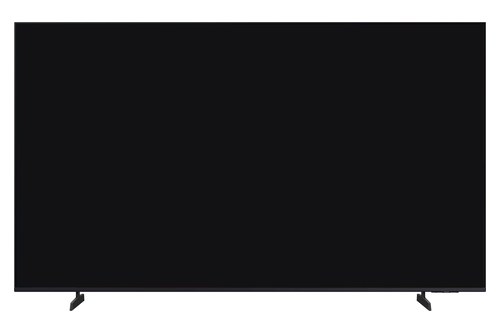
On a tight budget, or for a 43-inch space, the Samsung M70H is RTINGS’ best-sounding budget TV. RTINGS says its two 20W channel speakers won’t fill a room with booming sound, but they suit quieter spaces and late-night watching, with very clear dialogue.
the Samsung M70H
The trade-off is bass. RTINGS’ review finds very little true low bass, so explosions and deep rumble sound thin, and the speakers don’t get very loud.
RTINGS is also blunt that its picture quality is considerably worse than the other TVs on its best-sounding list. If the OLEDs above are too expensive and dialogue matters more than the picture, that’s the trade it asks you to make.
Samsung sells the M70H from 43 to 85 inches and lists Adaptive Sound, which it says keeps audio clearer and more balanced. RTINGS tested the 65-inch version, so check the 43-inch model’s spec sheet for its own speaker output.
What Makes a TV’s Built-In Speakers Sound Better?
Those four TVs reach good sound in different ways, but the same few things separate them from an ordinary set. Speakers placed higher on the TV, a built-in woofer and extra channels beyond the main pair give a TV more to work with than two small drivers along the bottom edge.
Sony explains the placement problem plainly: a typical TV puts its speakers below the screen, and the bigger the screen, the further the sound sits from the middle of the picture. Its Acoustic Multi-Audio+ answer on the BRAVIA 7 II places the full-range and bass speakers at the same height, while the BRAVIA 9 II places its high, mid and low speakers at the same height.
Think of a stage play heard through a radio on the floor. The words are all there, but they no longer come from the actor’s mouth, which is the gap these layouts try to close.
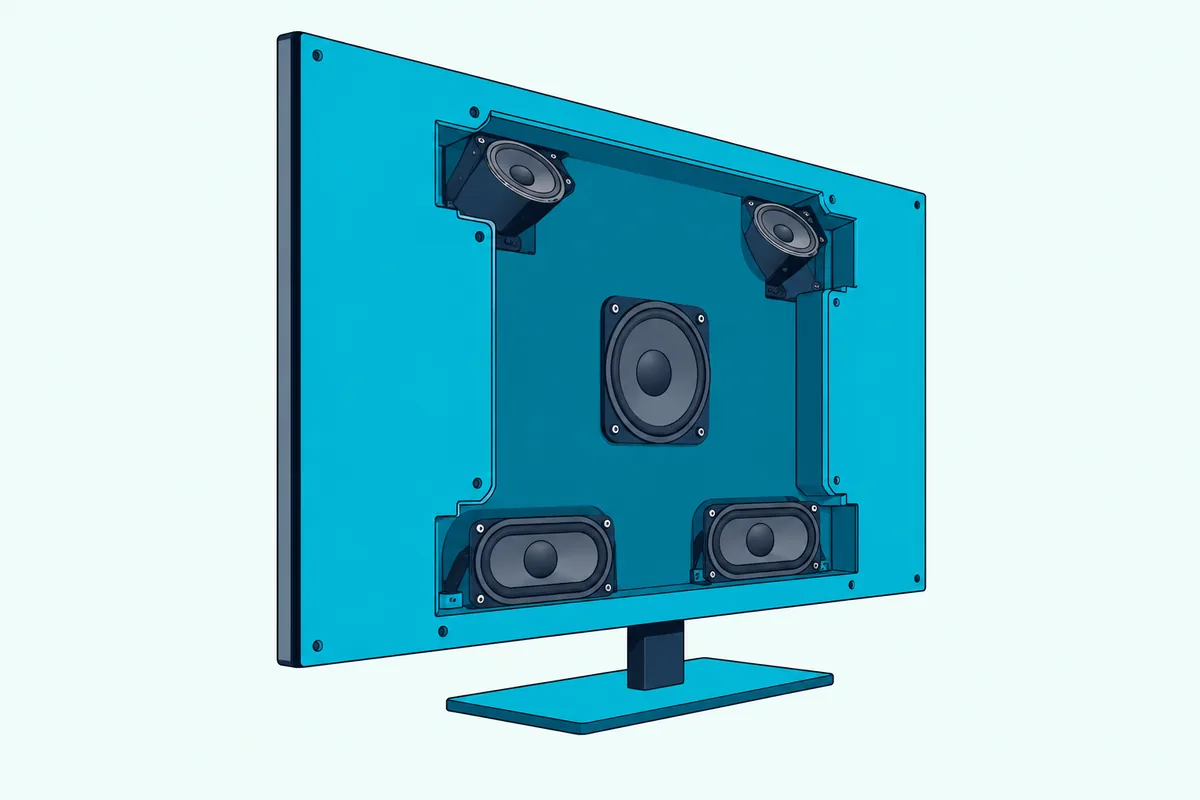
Samsung names its technology Object Tracking Sound, which its 2026 OLED announcement says syncs audio with the action on screen. Bass is the other half, and that’s where the Hisense U7SG’s built-in subwoofer earns RTINGS’ note about deeper bass than many similarly priced models.
Watts on a spec sheet tell you less than channels do. RTINGS says the BRAVIA 7 II’s 40W gets very loud, while the S95F’s 70W doesn’t get very loud, so a bigger number is no promise of a louder or fuller TV.
Dialogue is the other thing to listen for, and RTINGS’ reviews show three different ways it slips. On the S95F a slight dip in the mids mutes some voices, on the M70H a boost in the low mids makes them a bit boxy, and on the BRAVIA 7 II sound effects drown voices as the volume rises.
What Do Samsung, Sony, LG, Hisense and TCL Call Their Speaker Systems?
Those placement ideas reach the spec sheet under brand names. Samsung calls its system Object Tracking Sound, Sony uses Acoustic Surface Audio+ and Acoustic Multi-Audio+, LG has AI Sound Pro, Hisense says Tuned by Devialet, and TCL says Audio by Bang & Olufsen.
Here’s what each maker says its term does, and where it appears:
| Maker | Term | What the maker says it does | Where it appears |
|---|---|---|---|
| Samsung | Object Tracking Sound+ and Object Tracking Sound Lite | Syncs audio with the action on screen | OTS+ on the S95H; OTS Lite on the S90H and S85H |
| Samsung | Object Tracking Sound Pro | Audio that follows movement on screen, with dedicated top-channel speakers for Dolby Atmos | Neo QLED 8K QN990F (2025) |
| Sony | Acoustic Surface Audio+ | Actuators vibrate the screen so the sound comes from it | BRAVIA 8 II |
| Sony | Acoustic Multi-Audio+ | Speakers set at the same height so sound seems to come from the screen | BRAVIA 9 II and BRAVIA 7 II (Acoustic Multi-Audio on the 50- and 55-inch 7 II) |
| LG | AI Sound Pro | Optimized sound and virtual surround in real time, based on the content | webOS 25 TVs, depending on the model |
| Hisense | Tuned by Devialet | Multi-channel speakers tuned by Devialet, with the certification added by over-the-air update | U7 and U8 series |
| TCL | Audio by Bang & Olufsen | Comes with up-firing Dolby Atmos drivers on the QM8K | QM8K (2025) |
None of these names is a channel count or a wattage. So compare the terms within one brand, where the stronger versions sit on the pricier or larger sets, and compare the channel figures across brands.
LG’s webOS 25 user guide describes AI Sound Pro as optimized sound and virtual surround that adjust in real time to what you watch. That’s processing rather than extra speakers, the same distinction that matters for Dolby Atmos.
Is Dolby Atmos on TV Speakers Worth Paying For?
Both tables mention Dolby Atmos, and it pays off only with the right hardware. Atmos adds real height when the TV has speakers aimed upward, and RTINGS says the S95H’s up-firing Atmos speakers add an extra audio dimension to movies.
Without them, Atmos becomes processing. Samsung’s settings describe a Dolby Atmos switch that turns on a virtual surround effect for the TV’s built-in speakers, and Samsung’s 2026 OLED announcement says its screens of 50 inches and smaller have a virtual top channel.
RTINGS draws the same line on the Sony BRAVIA 7 II: its 2.2 layout has no up-firing Atmos speakers, so movies don’t sound as full. TCL lists up-firing Dolby Atmos drivers on its QM8K, and Hisense pairs Dolby Atmos with the U7SG’s 2.1.2 layout.
Sony leans on processing too. It says its XR processor turns any content into three-dimensional sound from the TV speakers alone, adding height to left and right even when a show isn’t mixed in Dolby Atmos.
So treat an Atmos badge as a format the TV can play. Then check the third channel number to see whether the TV adds speakers beyond its main pair.
What Should You Check on a TV Spec Sheet for Sound?
That Atmos check is one of four, and the order matters more than any single number. Read the channel figure first, then the sheet for your exact size, then the room and voice tools, and last the HDMI eARC input:
- Channel figure: a 2.1.2 or 4.2.2 layout adds a woofer or extra speakers to the main pair, as the Hisense U7SG and Samsung S95F do.
- Exact size: Samsung’s OLEDs at 50 inches and under use a virtual top channel, and Sony’s 50- and 55-inch BRAVIA 7 II use Acoustic Multi-Audio.
- Room and voice tools: a calibration feature that listens through a microphone, such as Samsung’s Adaptive Sound Pro, Sony’s Acoustic auto calibration or LG’s AI Acoustic Tuning.
- HDMI eARC input: the port a soundbar plugs into with one HDMI cable if you upgrade later; Hisense’s 65U7SG sheet lists eARC on HDMI 3.
Watts come last on purpose. As the BRAVIA 7 II and S95F show in RTINGS’ reviews, a higher figure doesn’t mean a louder TV, so treat it as a tiebreaker between sets with the same layout.
Which Samsung TV Sounds Best Without a Soundbar?
That checklist is easiest to see in Samsung’s range, where the same features come in tiers. The S95H is the best-sounding Samsung TV by RTINGS’ measure, and the best-sounding TV it has tested overall, with Object Tracking Sound+ and 70W across 4.2.2 channels.
Samsung’s 2026 OLED announcement gives the S95H Object Tracking Sound+ and the S90H and S85H Object Tracking Sound Lite, while all three get Dolby Atmos, Adaptive Sound Pro, Active Voice Amplifier Pro and Q-Symphony. RTINGS rates the S90H’s sound as decent and well balanced at most volume levels, but says the bass isn’t very impactful and the speakers don’t get very loud.
Two dialogue tools sit on top of that. Active Voice Amplifier Pro amplifies dialogue in noisy scenes, and AI Sound Controller Pro on the S95H and S90H lets you adjust voice, music and sound effects separately, while the S85H gets AI Sound Controller.
Below the OLEDs, the M70H is RTINGS’ best-sounding budget TV, and Samsung lists Adaptive Sound for it. Because the S95H’s 70W, 4.2.2-channel figures match the 2025 S95F’s, the older flagship is the other way into that layout.
A Samsung soundbar added later doesn’t sideline those speakers. Samsung says Q-Symphony links Samsung speakers with the TV’s own so they play at once, with up to five Samsung sound devices on its 2026 OLEDs, and RTINGS notes the S95H can keep its speakers working as a center channel with a compatible Samsung soundbar.
What Is the Best 43-Inch TV for Sound Without a Soundbar?
Even Samsung’s tiers shrink with the screen, which matters if you need a 43-inch TV. At that size, the TV to look at is the Samsung M70H, RTINGS’ best-sounding budget TV, which Samsung sells from 43 to 85 inches.
Smaller screens get less speaker hardware in the makers’ own fine print. Samsung’s 2026 OLED announcement gives screens of 50 inches and smaller a virtual top channel, and Sony says the 50- and 55-inch BRAVIA 7 II use Acoustic Multi-Audio instead of Acoustic Multi-Audio+.
RTINGS tested the 65-inch M70H, so the 43-inch set’s speaker output is worth checking on its own spec sheet. Expect the same character RTINGS describes: very clear dialogue, very little low bass and a modest maximum volume.
If you’d rather have an OLED, RTINGS lists the Samsung S90H in a 42-inch size. Samsung’s virtual top channel applies at that size, so its Atmos height comes from processing.
When Do Built-In TV Speakers Stop Being Enough?
Still, every set above has a ceiling, and RTINGS spells it out. Built-in speakers stop being enough when you want deep bass, a big-room volume or real surround, because RTINGS says no TV can deliver a true movie-like experience without an external surround system or a soundbar.
The reviews above point the same way. The S95F, S90H, BRAVIA 8 II and M70H all get RTINGS’ note that they don’t get very loud, and RTINGS tells BRAVIA 8 II owners to add a soundbar for deep bass.
A bedroom or kitchen TV at low volume is the opposite case, because you sit closer and listen less critically. That’s why our guide on whether a smart TV needs a soundbar treats it as the strongest reason to skip one.
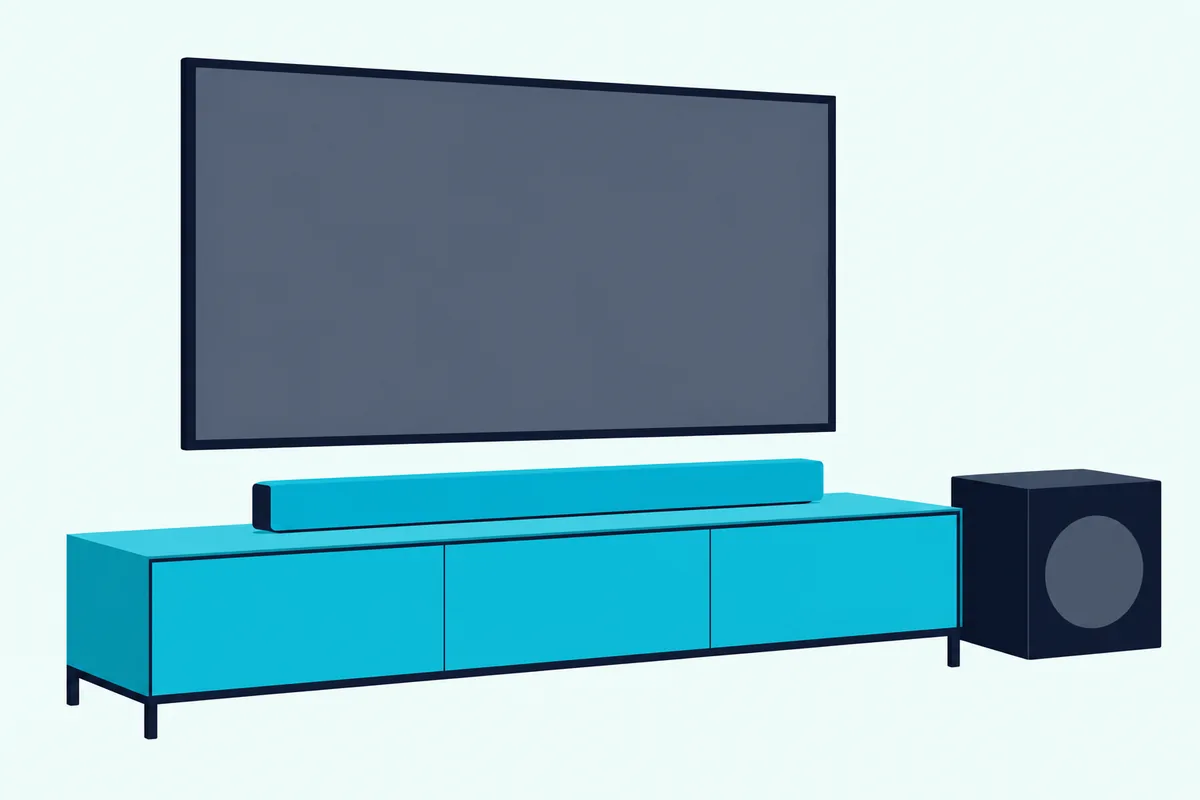
For a living room where bass matters, a soundbar with a subwoofer is the better buy, and our soundbar picks by room and budget start there. If money is tight, budget soundbars that beat TV speakers cover the cheaper end.
A TV with good speakers isn’t wasted money if a bar comes later. Samsung’s Q-Symphony, Sony’s Acoustic Center Sync, Hisense’s Hi-Concerto and TCL’s Dolby Atmos FlexConnect all keep the TV’s speakers playing alongside the added ones.
How Can You Make Your TV Sound Better Without a Soundbar?
If you aren’t adding a soundbar yet, the TV’s own settings are the next step. Start with room calibration and a voice mode, since Samsung, Sony and LG each build both into their TVs.
On a Samsung, Adaptive Sound Pro analyzes the viewing space and the content, but Samsung says it works only with the TV’s microphone switch on and the sound output set to TV Speaker. Active Voice Amplifier analyzes background noise and adjusts the sound to it, and the equalizer isn’t available while either feature is on.
On a Sony BRAVIA, Acoustic auto calibration plays a loud test sound and measures it through the Voice Remote’s microphone, so keep the room quiet and the remote still. Sony’s BRAVIA Help Guide adds that it can’t run while a soundbar is the output, and that Voice Zoom emphasizes voices.
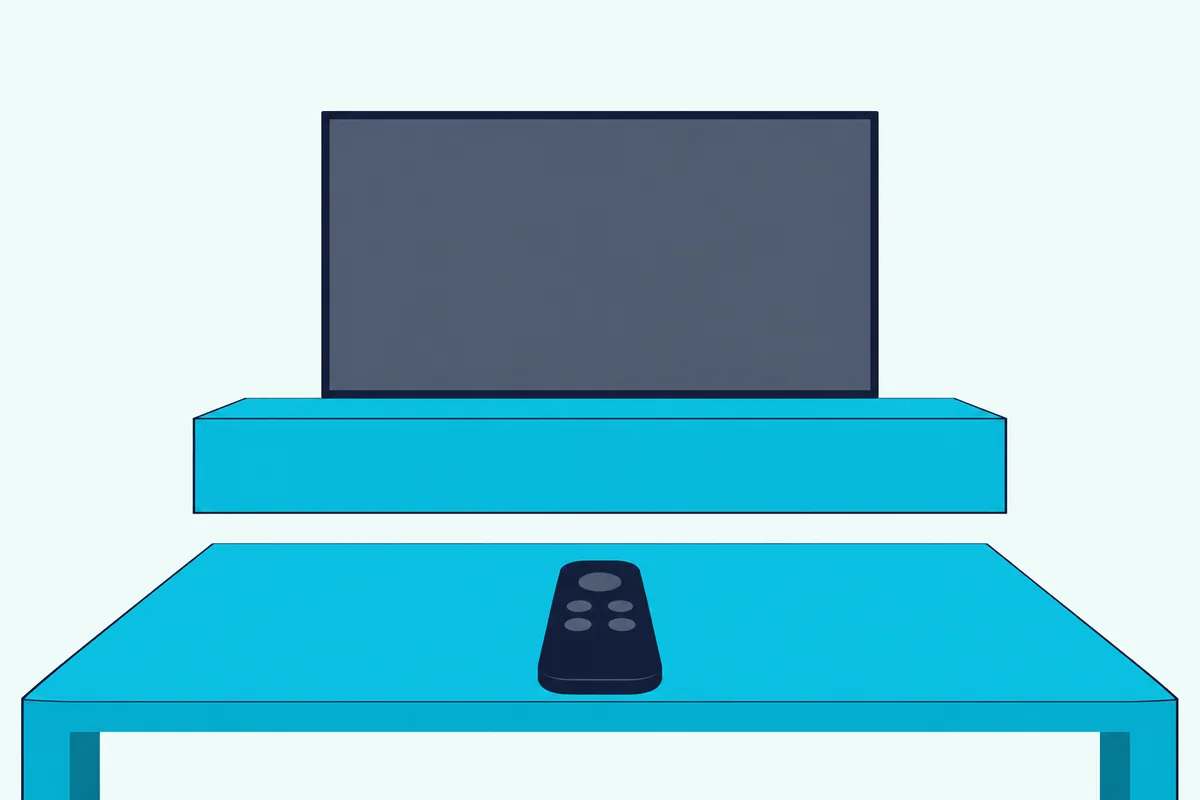
On an LG, AI Acoustic Tuning measures the room through the Magic Remote’s microphone, then offers Standard, Bass Boost and Treble Boost results. LG recommends staying within 3 meters (9.8 feet) of the TV when the room is louder than a library, about 30 to 40 dBA.
LG and Sony add voice and surround modes as well. LG’s Clear Voice Pro boosts voice clarity, and Sony’s Surround setting virtually reproduces surround sound.
Try this after calibrating: play a dialogue-heavy scene from a streaming app at your usual volume and switch the voice mode on and off. Keep whichever setting lets you lower the volume without losing words.
The Bottom Line
So look for a 2.1.2 or 4.2.2 speaker layout first and the maker’s sound feature name second. RTINGS rates Samsung’s S95H highest, the Hisense U7SG adds a built-in subwoofer for less, and the Samsung M70H covers 43-inch rooms with clear dialogue.
If you want deep bass or a big-room volume, no TV speaker replaces a soundbar, so plan for one.
Frequently Asked Questions
Do all smart TVs need a soundbar?
No. RTINGS rates the built-in speakers on sets like the Samsung S95H and Hisense U7SG as well balanced with clear dialogue, which covers everyday viewing in a smaller room.
For the deep bass of explosions and music, though, RTINGS’ view is that no TV matches a soundbar or a dedicated sound system.
Is there a TV with a built-in soundbar?
No TV on this page hides a soundbar inside, but some build soundbar-style hardware into the cabinet. Hisense’s U7SG has a 2.1.2-channel system with a built-in subwoofer, and the Samsung S95H and S95F carry 4.2.2 channels by RTINGS’ count.
TCL takes a similar route with up-firing Dolby Atmos drivers on its QM8K.
Which TV brand has the best audio quality?
No single brand wins every price range. RTINGS’ 2026 best-sounding list has two Samsung TVs, the S95H at the top and the M70H on a budget, with Sony’s BRAVIA 7 II and Hisense’s U7SG in between.
Does a Samsung TV need a soundbar?
Not for clear dialogue: RTINGS rates the S95H as the best-sounding TV it has tested and the M70H’s dialogue as very clear. For deep bass, RTINGS says even the S95H doesn’t deliver much, so a soundbar with a subwoofer is the fix, and Samsung’s Q-Symphony keeps the TV speakers playing alongside a Samsung bar.
Can you add speakers to a TV without buying a soundbar?
Some TVs allow it. TCL says up to four of its Z100 speakers can work alongside the TV speakers on its Dolby Atmos FlexConnect TVs, and Samsung’s Q-Symphony pairs up to five Samsung sound devices with its 2026 OLEDs, including its Music Studio speakers.