How to Block Sound Between Rooms (What Actually Works)
You can hear the neighbor’s TV through the wall, or a conversation in the next room that you’d rather not be following word for word.
So you search, and every result shows you a photo of a studio wall covered in gray foam wedges — which is the single most expensive wrong turn in this entire subject.
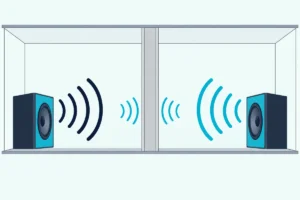
Foam won’t stop any of it, because blocking sound and absorbing sound are two different jobs done by two different materials.
How to block sound between rooms comes down to four things: mass, sealing, decoupling and damping.
Get them right and next door becomes an indistinct murmur instead of words you can follow — and the cheapest of the four costs about the price of a coffee, so that’s where we’ll start.
Does Acoustic Foam Block Sound Between Rooms?
Start with the wrong turn, because it’s the one that costs the most.
Acoustic foam and acoustic panels absorb sound inside a room. They make a room sound better to be in.
They don’t stop sound leaving it. Sticking foam on a shared wall is the most common mistake in this whole subject.
It costs people a weekend and a lot of money for no result. If you want the longer version of why, how soundproofing works covers the mechanism.
Blocking and absorbing are different jobs with different materials. Keep them separate in your head and most of the confusion disappears.
Where Is Sound Actually Getting Through?
With foam ruled out, the cheapest of the four principles comes first.
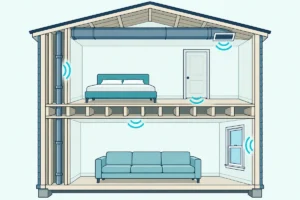
Sound travels through air. Any path air can take, sound takes with it.
It’ll happily bypass an expensive wall through a gap you can barely see.
Undercut doors are usually the worst offender. A typical interior door has a gap at the bottom big enough to see light through, and that gap alone can undo everything else you do to the wall around it.
Electrical outlets come next. They’re holes cut through the plasterboard, often back-to-back with an outlet in the next room, giving sound an almost unobstructed route.
Then the edges — where wall meets floor, where trim meets wall, where a pipe passes through. A tube of acoustical caulk closes most of these.
It stays flexible rather than cracking as the building moves. That matters more than it sounds, because a cracked seal is the same as no seal.
This is the cheapest work you’ll ever do here. Skip it and the expensive work that follows gets undermined by a two-millimeter gap.
Get Studio Tips Weekly
Join 5,000+ creators getting acoustic treatment advice every week.
No spam. Unsubscribe anytime.How Does Adding Mass Block Sound?
Sealed gaps stop the easy path, and the next question is what happens to sound going through the wall itself.
Sound passing through a wall is the wall itself vibrating and re-radiating into the next room. Heavy walls vibrate less.
That’s why solid masonry blocks sound so much better than a stud partition, and why the standard fix for a stud wall is another layer of drywall. The full approach to treating a shared wall runs through the build-up in order.
The effect is real but it isn’t linear. You get a meaningful improvement from the first added layer and progressively less from each one after.
Mass is also why curtains and rugs disappoint people who hoped for more. They aren’t heavy enough to matter to a wall.
A genuinely heavy curtain over a window is different, though. A window is the lightest part of most rooms, so mass there does more.
What Is Decoupling and Why Does It Matter?
Remember the wall vibrating and re-radiating? That vibration has a shortcut you haven’t closed yet.
Remember the wall vibrating and re-radiating? If both faces are screwed to the same studs, that vibration travels straight through the frame no matter how much mass you’ve added.
Decoupling breaks that path. In practice it means resilient channel, isolation clips, or a staggered or double stud frame.
The new surface is held so it doesn’t rigidly touch the structure carrying the sound. This is the step that turns a modest improvement into a real one.
It’s also the step that requires opening the wall up. That’s a construction job, not an afternoon.
Decoupling matters most for low frequencies — bass through a shared wall, footsteps from above. That’s exactly the noise mass alone struggles with.
What Does Damping Do for Bass?
Decoupling breaks the path; damping absorbs what still travels along it.
Damping converts vibration into a small amount of heat instead of letting it pass through.
In practice it’s a viscoelastic compound applied between two layers of board, so the sandwich flexes against itself rather than transmitting cleanly.
It’s the least intuitive of the four and the one most often skipped. Its value sits almost entirely in low frequencies.
If your problem is music or a home cinema rather than voices, damping earns its place. If it’s conversation through a wall, spend the money elsewhere first.
Does Cavity Insulation Help Block Sound?
That cavity you’d open up for decoupling raises an obvious question about filling it.
Filling a stud wall’s cavity with mineral wool helps, but not for the reason most people are told.
An empty cavity behaves like a drum. Sound entering one face excites the air in the void, and that air drives the far face.
Filling the void damps that resonance and removes the drum effect. What it doesn’t do is add meaningful mass, and it does nothing about the studs connecting both faces.
So insulation is worth doing whenever the wall is already open. It’s cheap at that point and it removes a real problem.
It isn’t worth opening a finished wall just to add it. Its value multiplies alongside decoupling, where the cavity is doing more work.
Density matters less than people expect. Standard acoustic mineral wool performs well, and specialist high-density products give diminishing returns for the price.
How Do You Soundproof an Interior Door?
All four principles applied to a wall can be undone by the one part of it that opens.
If two rooms are separated by a standard interior door, that door sets the ceiling on everything else you do. A hollow-core door weighs very little and usually sits in a frame with visible gaps on three sides.
Seal the perimeter first. Adhesive-backed acoustic seal around the frame, and a drop-down seal or well-fitted threshold at the bottom.
That alone is often the single most noticeable improvement anyone makes, and it costs less than a takeaway. The options for a noisy door run from a few dollars to replacing the leaf entirely.
Then consider replacing hollow with solid. A solid-core door of the same size typically weighs three or four times as much and blocks correspondingly more.
It hangs in the existing frame, though the hinges may need upgrading. That’s the mass principle from earlier, applied to the weakest element.
Accept the limit. Even a perfectly sealed solid door in a heavy wall is still the weak point, because it has to open.
Rooms needing genuine separation use two doors with a space between. That’s why studios have airlocks.
What About Windows, Vents and Ceiling Voids?
Doors are the obvious weak point, and three less obvious ones catch people out just as often.
Windows are usually the lightest element in an external wall. Secondary glazing — a second independent pane with a wide air gap — outperforms replacing a unit with thicker sealed glass.
The gap provides decoupling that a sealed unit can’t. Same principle as the wall, different location.
Vents and extractor ducts can’t simply be blocked, because the room needs the airflow. Acoustic vents make the air take a longer, lined path, so sound loses energy on the way through.
Ceiling voids defeat a great many office partitions. The wall stops at the suspended ceiling, the void continues over the top, and sound travels across it into the next room.
Any partition meant to provide privacy has to continue up to the structural slab. Stopping at the tile grid doesn’t work.
Where the wall can’t be extended, one lab test lifted a ceiling from CAC 22 to 46 with a sealed barrier above the wall, and what a drop ceiling really blocks walks through the numbers.
Back-to-back sockets on a shared wall are two holes with almost nothing between them. Offsetting them to different stud bays and sealing the boxes with acoustic putty pads closes a path no amount of added mass will fix.
How to Block Sound Between Rooms: Why Order Matters
Every path is now closed on paper, so it’s worth understanding why partial jobs underperform so badly.
Half-measures disappoint because these principles multiply rather than add.
A wall with excellent mass and no sealing performs like a wall with a hole in it, because it has one. A decoupled wall with no mass has little to stop.
Sealing alone helps speech noticeably and does nothing for bass. That’s the gap-versus-mass distinction showing up in practice.
Work in the order sealing, mass, decoupling, damping, and expect the returns to feel uneven. Sealing gives an immediate satisfying result for very little money.
Mass gives a solid but unspectacular improvement. Decoupling costs the most and delivers the change you were hoping for at the start.
What Do STC and NRC Ratings Mean?
Since the foam-versus-blocking confusion runs through this whole subject, the product labels are where it gets expensive.
Two ratings appear on soundproofing materials, and confusing them wastes money.
STC and its modern equivalents describe how well an assembly blocks sound passing through it. Higher is better, and it’s the number that matters here.
NRC describes how much sound a material absorbs from the room it faces. Acoustic foam and fabric panels score well on this and are irrelevant to blocking.
If the difference is still fuzzy, panels versus soundproofing sets them side by side.
A product marketed as “soundproofing” while quoting only an NRC figure is an absorber. It’ll make your room sound calmer and won’t stop your neighbor hearing you.
That mismatch between the marketing word and the measured number is where most wasted spending in this category happens.
How Quiet Can You Realistically Get?
One last thing, before you price any of it.
Full separation between two rooms in an existing building is rarely achievable without construction that costs more than most people expect.
What is achievable is a large reduction. Enough that a conversation next door becomes an indistinct murmur rather than words you can follow.
The gap between “quieter” and “silent” is where most of the money goes. Knowing that before you start is the difference between a project that satisfies you and one that doesn’t.