Are Concrete Apartments Soundproof? What Still Gets Through
Ask a leasing agent “are concrete apartments soundproof?” and you’ll usually hear a confident yes, which is only half the story.
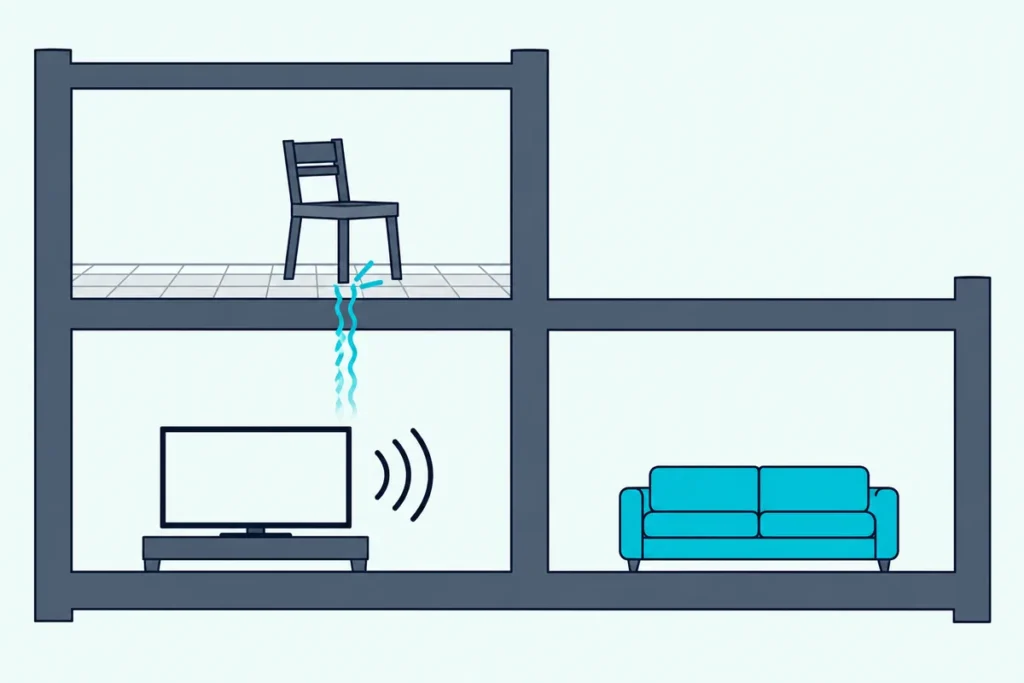
Concrete floors and walls typically stop a neighbor’s voices and TV far better than wood framing, yet footsteps, dropped keys and hallway chatter still find their way in.
Know which noises concrete blocks and which it carries, and you can pick a quiet unit, or fix a noisy one, without paying for the wrong cure.
The first thing to check is the floor above you, because a bare slab under tile rates far below the building code’s impact minimum.
Below are the lab numbers for concrete walls and floors, the weak spots that undo them, and a quick way to size up a unit before you sign.
Are Concrete Apartments Soundproof Against Every Kind of Noise?
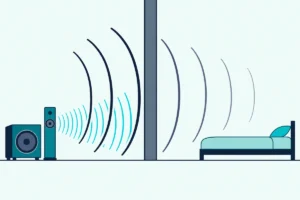
That half-right answer comes down to two kinds of noise. Concrete apartments aren’t soundproof: their mass blocks airborne noise such as voices and TV well, but does much less against impact noise such as footsteps.
The 2021 International Building Code sets a minimum for each: a sound transmission class (STC) of 50 for walls and floors between units, or NNIC 45 in the field, and an impact insulation class (IIC) of 50 for floor-ceilings, or NISR 45 in the field (ICC).
Solid concrete clears the airborne bar easily: PCI Midwest, a chapter of the Precast/Prestressed Concrete Institute, lists 6-inch and 8-inch solid slabs at STC 55 and 58 (PCI Midwest). Impact is the catch, and our explainer on what STC and IIC ratings actually measure shows how a single floor can pass one test and fail the other.
Why Does Concrete Stop Voices So Well?
Those STC figures come down to weight. Concrete stops voices because it’s dense, and HUD’s Noise Guidebook says denser walls block more noise, making concrete walls better insulators than wood walls of the same thickness (HUD).
HUD’s comparison puts a 7-inch concrete wall at STC 52 against STC 35 for a common stud wall, though doubling a partition’s thickness adds at most about 6 dB. PCI Midwest’s table climbs the same way, from STC 49 for a 4-inch panel at 54 pounds per square foot to STC 58 for an 8-inch one at 95 pounds.
Get Studio Tips Weekly
Join 5,000+ creators getting acoustic treatment advice every week.
No spam. Unsubscribe anytime.Why Can You Still Hear Footsteps Through a Concrete Floor?
That weight works on sound in the air, but a footstep strikes the slab itself. Impacts send vibration straight into the concrete, and a hard surface passes it on: NRC Canada’s Warnock writes that a marble or chair leg striking a tiled slab is heard below as a sharp click (NRC).
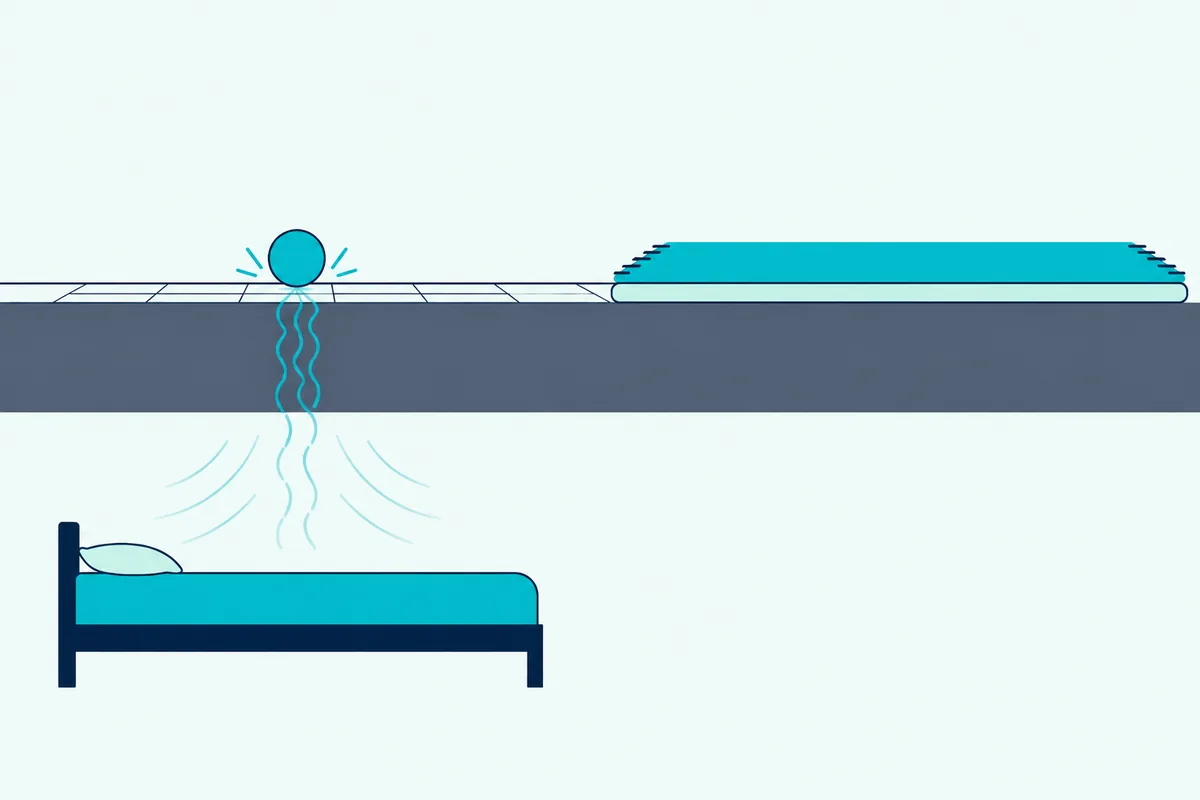
His table puts a 6-inch slab at about IIC 28 with ceramic tile, 33 with hardwood and 37 with vinyl, all under the IIC 50 he calls the minimum for occupant satisfaction. A 9-mm wood floor installed on a 6-mm resilient layer reaches about 47, and carpet with underlay 75 to 85.
More concrete barely moves those numbers: Warnock gives an 8-inch slab only about three points more, and hollow-core maker Nitterhouse Concrete says concrete’s thickness or unit weight doesn’t greatly affect impact sound (Nitterhouse). The Carpet and Rug Institute’s tests put a bare concrete floor-ceiling at IIC 34 and the same slab under carpet and cushion at 69 to 80 (CRI).
So the footsteps you hear depend mostly on the floor above, and floor soundproofing that lifts a slab’s IIC is the fix from that side.
What Lets Noise Around the Concrete?
Even a thick slab and wall cover only the direct path, and sound has others. It transfers around concrete through the connected structure, gaps and doors, and NRC’s calculation guide says the sound insulation between two rooms is always worse than that of the wall or floor between them (NRC RR-331).
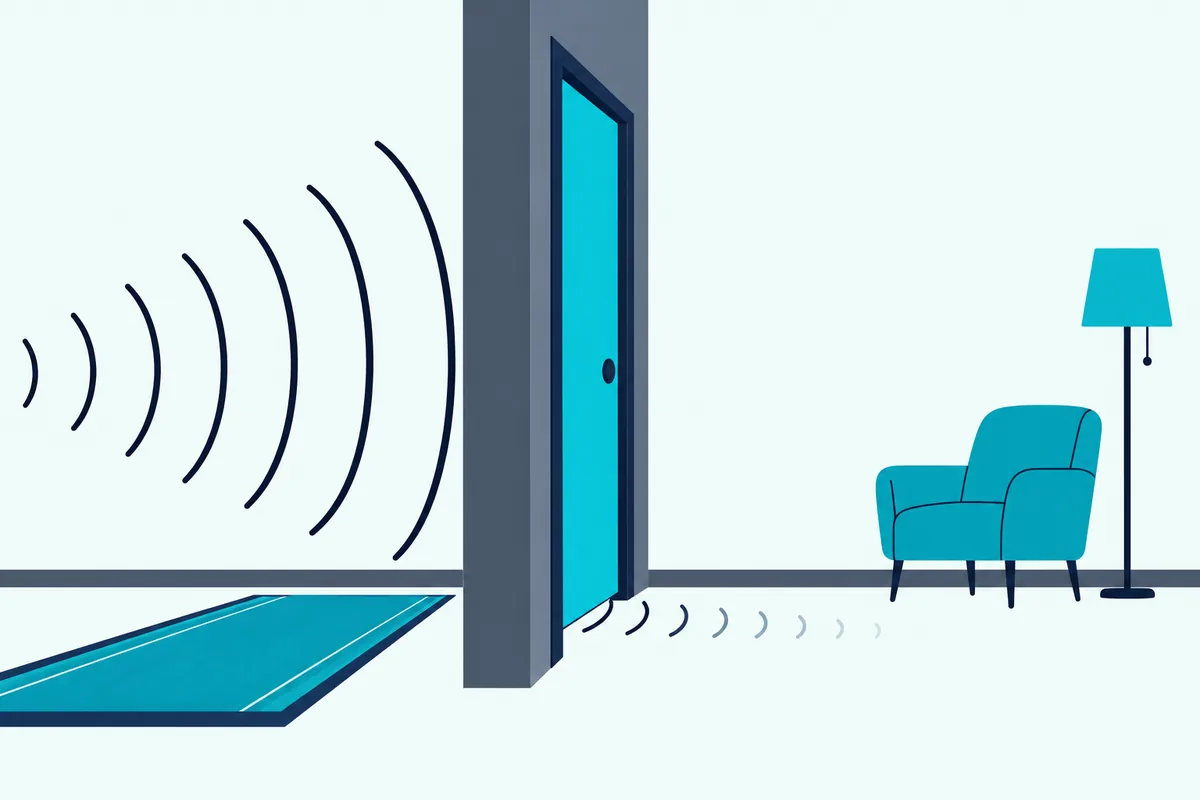
In the guide’s worked examples of bare concrete and block buildings, the room-to-room rating, ASTC, came out one to nine points below the wall’s or floor’s own STC. A 6-inch concrete wall rated STC 57 for the direct path dropped to ASTC 54 once flanking through the concrete floor, ceiling and side walls was counted.
Openings do more damage: HUD says a one-inch-square hole, or a 1/16-inch crack 16 inches long, takes an STC 50 wall down to 40. Doors are weaker still, and the code exempts apartment entry doors from its STC rule as long as they fit tightly.
In HUD’s example, a hollow-core door rated STC 17 drags a 48-STC wall down to 24, while a solid-core door with edge seals, over carpet, holds it at 33. Windows limit street noise the same way: an STC 45 wall falls to STC 35 once an STC 26 window covers 30 percent of it.
Is Every Concrete Building Concrete Between Units?
Those leaks assume concrete on every side, and some buildings mix materials. A concrete building can still have drywall walls between units, and NRC’s guide treats concrete floors with steel-stud walls as a case of their own.
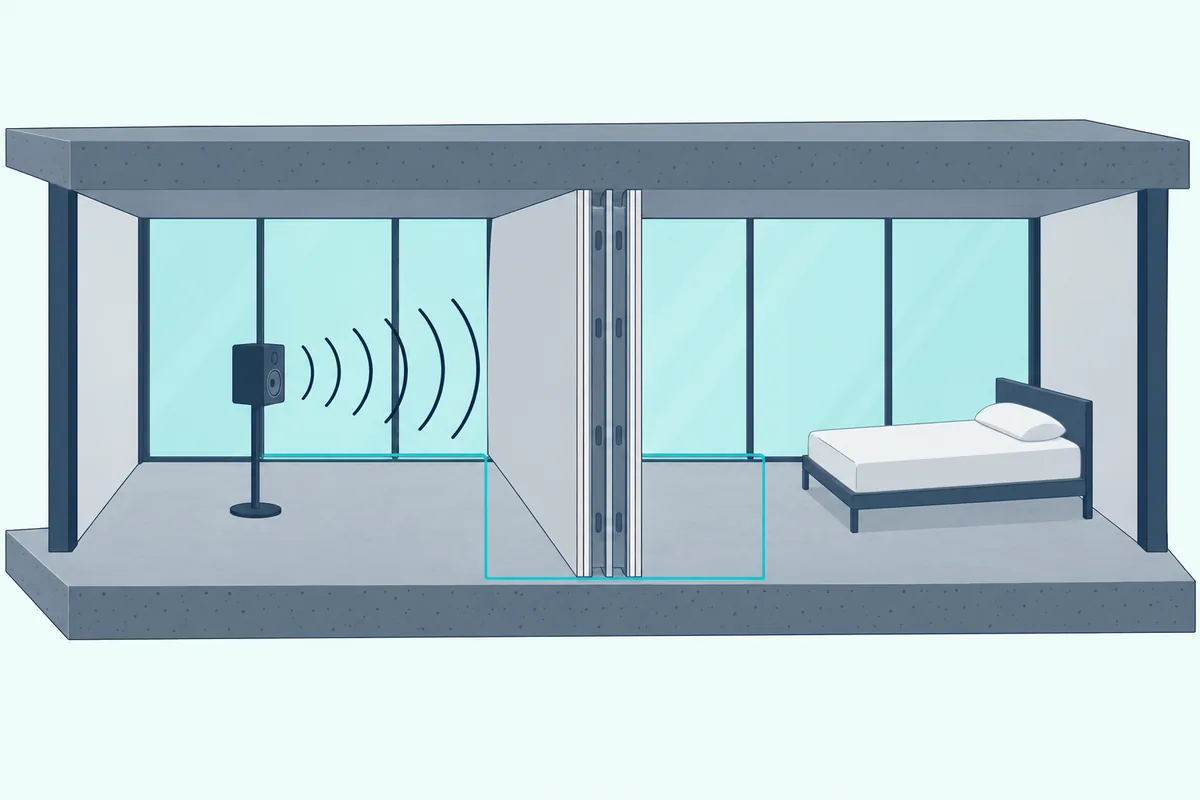
Its example is an insulated row of steel studs with two layers of fire-rated drywall on each side, between rooms with 8-inch concrete floors. With a concrete-block facade the side-by-side rooms reached ASTC 56, but with a glass curtain wall they fell to ASTC 50, and rooms one above the other dropped from 60 to 47.
Block walls vary too. The masonry group CMHA calculates an 8-inch wall of hollow blocks at a density of 105 pounds per cubic foot at STC 46, under the code’s 50, and the same wall with grout filling the cores at STC 56, though CMHA calls the calculation conservative (CMHA).
Floors differ as well: PCI Midwest lists an 8-inch hollow-core plank at STC 50, against 58 for a solid 8-inch slab.
Are Concrete Buildings Quieter Than Wood-Frame Apartments?
That mix of materials is why a building’s label tells you less than its details. Concrete has the edge on low thumps, but a carefully built wood floor can beat a bare concrete slab on most ratings.
NRC’s Zeitler and colleagues compared a bare 6-inch slab with a 12.6-inch-deep wood joist floor that had resilient channels and three layers of gypsum board (NRC). The slab did better up to 125 Hz, but the wood floor was about 10 dB better in the mid frequencies.
Warnock explains the low end: a heavier floor vibrates less when walked on, so it makes less low-frequency sound. That’s the boom lightweight wood floors can keep even under carpet and pad.
How Can You Tell If a Concrete Apartment Will Be Quiet?
Since the details decide it, check them before you sign. Ask the landlord or the builders for the STC and IIC of the wall and floor system, or a field result such as ASTC, then check four weak spots:
- Floor above: carpet or a hard floor, and whether hard floors need an acoustic underlayment. A top-floor unit has no footsteps above it.
- Shared wall: knock on it, because a hollow sound suggests drywall on studs or furring rather than bare concrete.
- Entry door: solid, with seals on the frame and no light showing underneath.
- Windows: on a busy street, ask for their STC or OITC rating.
A field number is worth more, because ASTM notes a partition tested in a building can rate lower than in the lab through flanking or construction errors (ASTM). Then visit on a weekday evening and listen in the bedroom with the windows shut.
The Bottom Line
That checklist is the practical answer: concrete apartments are quieter for voices and TV, not soundproof. Solid slabs rate STC 55 to 58, but a bare slab under tile rates around IIC 28 against a code minimum of 50.
If you already live with the noise, fix the path it takes. Footsteps are fixed upstairs, with carpet and cushion over the existing floor or a tested underlayment, as our guide to noise from upstairs neighbors explains.
For hallway and wall noise, door seals and outlet gaskets come first among Burton Acoustix’s renter-friendly fixes.
Frequently Asked Questions
Do concrete apartments have less noise?
Usually less airborne noise, yes. HUD rates a 7-inch concrete wall at STC 52 against STC 35 for a common stud wall, so a neighbor’s voices come through fainter, but a slab under a hard floor still carries footsteps.
Can sound travel through concrete floors?
Yes, mostly as impact noise. A 6-inch slab with ceramic tile rates about IIC 28 in NRC’s figures, under the code’s IIC 50, while carpet with underlay lifts it to 75 to 85. Airborne sound can also travel around it through the connected walls and facade, which NRC calls flanking.
What floor is the quietest in an apartment building?
The top floor usually is, because nobody walks above you and footsteps are the noise concrete handles worst. Beyond that, pick a unit away from the elevator, the stairs and the busiest street.
Are concrete condos soundproof?
No more than concrete apartments or flats are, since the structure is the same. What differs is that owners choose their floors, and Acousti-Tech, an acoustic membrane maker, notes condo boards often ask owners for an underlayment’s impact rating, though a rating belongs to a whole floor assembly (Acousti-Tech).