Acoustic Foam vs Cork: Which One Fixes Your Noise Problem?
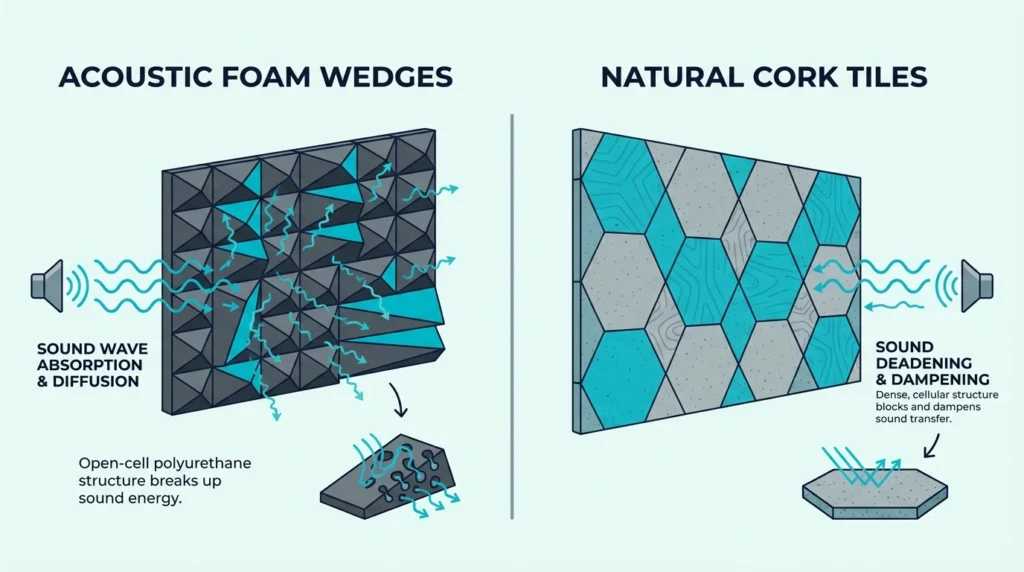
Acoustic foam vs cork looks like a simple materials choice, but it’s really a question of where the noise is traveling: echo in the room, or thumps through the building. Pick the wrong one and you can cover a wall (or a floor) and still be stuck asking, “why is this room still so loud?”
Foam is an airborne-reflection tool (echo/reverb), while cork is a vibration tool (footsteps, thumps, impact). Start with the quick takeaway, then each section breaks down how each material works, what the common numbers do (and don’t) tell you, and which rooms each one actually fixes.
Pick acoustic foam if your problem is echo, reverb, or that metallic flutter between hard walls in a studio, podcast setup, or home-theater room. Foam is built to absorb the mid/high reflections that make a space sound “ringy” on mics and speakers.
Pick cork if you’re dealing with impact noise (footsteps, dropped objects, treadmills) traveling through floors, or you want a durable, natural finish with some vibration damping. Neither material is soundproofing, so for “stop noise from getting in/out,” you’ll still need mass + sealing + decoupling.
How Does Acoustic Foam Actually Work?
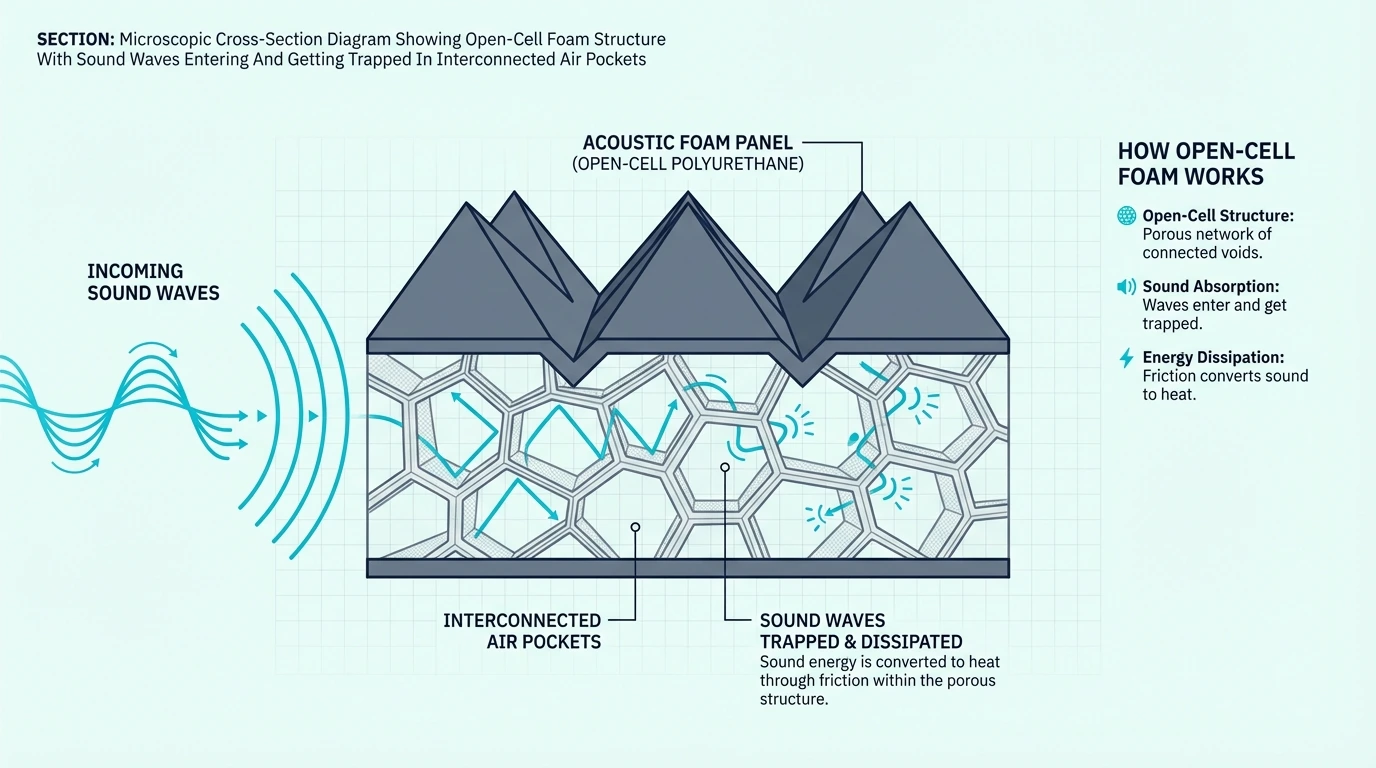
Echo and thump are two different problems, and foam’s job is the easier one to explain: it treats reflections inside the room. Hard surfaces throw sound back at you, and foam helps when it lets that reflected energy enter the material instead of pinging right back.
Once that reflected energy is inside the foam’s open-cell maze, air movement rubs against the cell walls and bleeds off energy as heat. That’s why good placement can shorten reverb and tame flutter, even though it won’t make the room “quieter” to your neighbors.
What Is Open-Cell Structure?
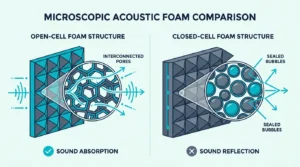
That absorption only happens when air can actually move inside the foam, which is why “open-cell” matters. Open-cell just means the tiny bubbles are connected, like a sponge you can blow air through.
That connectivity gives sound a way in, which is the whole point of absorption. Once sound gets in, the foam has a chance to steal energy from the reflection instead of bouncing it back.
Closed-cell foam is the opposite: the bubbles are sealed, so it behaves like a springy surface instead of a maze. That’s why things like packing foam and pool noodles are bad acoustic treatment — the normal foam vs acoustic foam comparison explains the difference.
If you’ve ever bought “soundproof foam” that felt rubbery, that’s usually the closed-cell problem in disguise. For real treatment, look for open-cell acoustic foam and focus on reflection points, not random coverage.
Which Frequencies Does Foam Absorb Best?
Open-cell foam lets sound in, but it doesn’t absorb every pitch equally. Standard 1–2 inch acoustic foam is a mid/high tool (roughly 500 Hz to 4 kHz), which is where speech harshness and slap reflections live.
The pyramid vs wedge comparison shows how shape changes the absorption profile at these frequencies.
That’s why it can clean up vocals and dialogue without fixing low-end boom. Foam can make the room sound less “splashy,” but it won’t stop the heavy, slow energy that builds up in the bass.
Bass lives lower, with wavelengths measured in feet, not inches. At 100 Hz the wave is around 11 feet long, so thin foam barely registers — bass traps are the only foam-based path to low-end control.
Quick test: clap and listen for a sharp ring or flutter between parallel walls—foam can tame that fast. If the problem is a low “whoom” that hangs around, that’s bass, and the fix lives in corners, not on the wall.
How Does Foam Thickness Affect Performance?
Once you understand that foam mainly lives in the mid/high range, thickness becomes the next question. Thickness mostly changes how much of the vocal range you catch, not whether you suddenly get bass control.
In practice, 1-inch foam mostly tames the “zing,” while 2-inch foam reaches lower into the vocal range and tends to sound more forgiving. If you’re treating speech or vocals, 2-inch is usually the safe default thickness.
Thicker foam can help a bit more in the lower mids, but it still isn’t a bass solution. For most home studios and podcast setups, 2-inch thick acoustic foam panels like the TroyStudio kit are the easy “good enough” starting point.
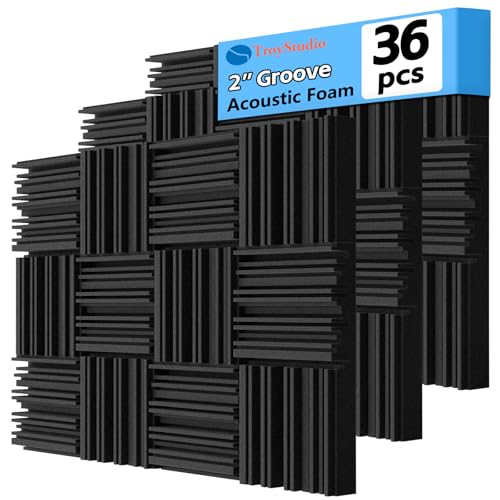
TroyStudio Thick Acoustic Foam Panels (36 pcs, 2-inch)
How Does Cork Work for Sound?
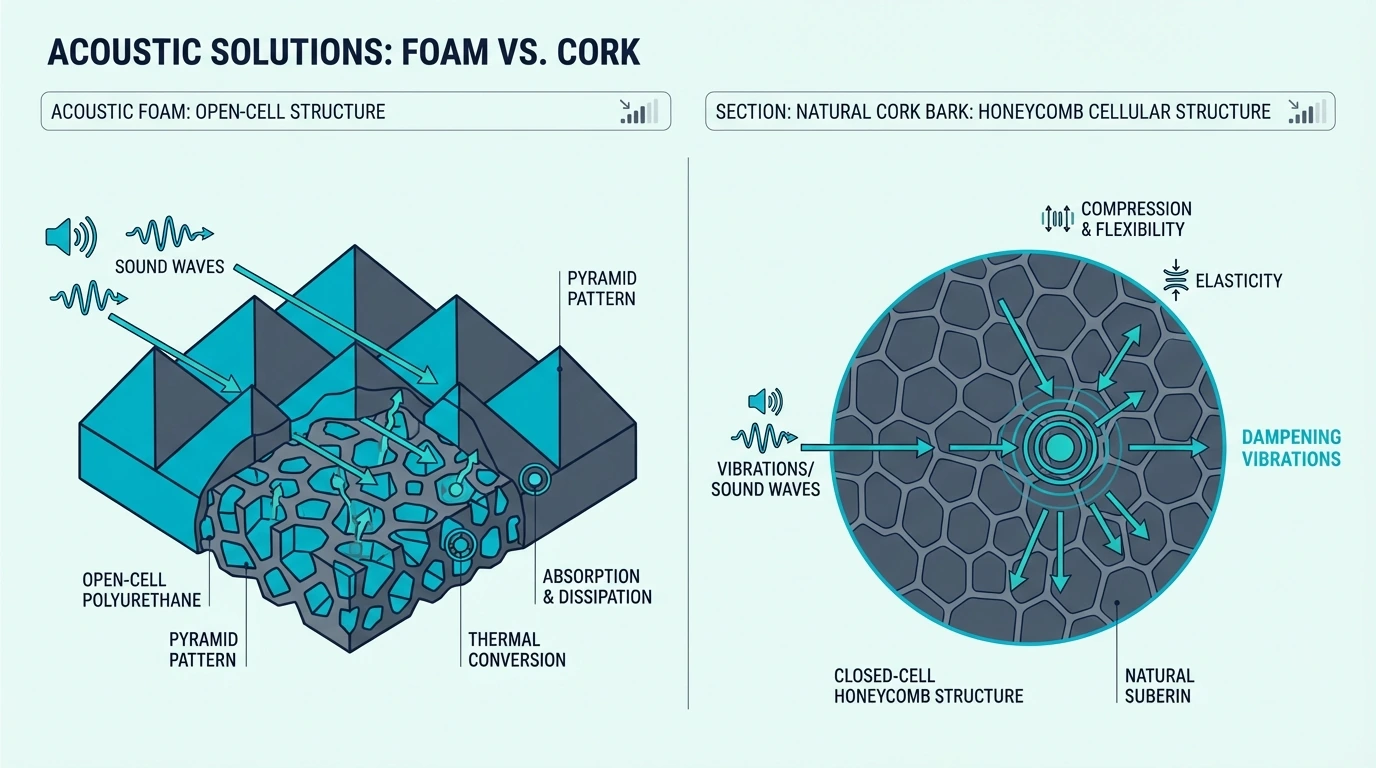
Foam can make a room sound tighter, but it won’t stop a thump traveling through a floor. Cork targets that problem because it damps vibration in the structure, which is why it shows up as underlayment and isolation layers far more often than as a wall “treatment panel.”
When a surface vibrates, cork compresses and turns some of that mechanical energy into heat instead of passing it along. This is a different path than airborne reflections, which is why cork can feel like it’s doing nothing in an echoey room—even though it’s doing its job under a floor.
The next three H3s cover what cork does, what the specs actually measure, and why impact noise is cork’s real strength.
Cork as a Sound Deadener
Sound absorption and sound deadening are two different jobs, which is the same air-vs-structure split from the intro. Absorption is about airborne reflections in the room, while deadening is about vibration traveling through the building.
Cork is strong at deadening because its tiny cells compress under impact, like a built-in cushion layer. Put it under flooring and it can take the edge off footstep thumps in a way wall foam simply can’t.
If this distinction still feels fuzzy, the sound deadening vs acoustic foam comparison spells out the difference. That deadening focus is why cork underlayment can help downstairs neighbors while wall foam can’t.
If you’ve got hardwood upstairs and someone below you, cork underlayment is one of the few upgrades that can actually reduce the “thump” without rebuilding the floor. On walls, cork can take the edge off brightness, but it won’t replace real absorption if echo is the problem.
Cork NRC: What the Numbers Really Mean
That deadening job is also why cork’s NRC can look underwhelming at first glance. NRC tests airborne absorption, so it’s judging cork by the job cork isn’t trying to do.
That’s why cork’s NRC (often around 0.15 to 0.35) looks “bad” next to foam (often 0.50 to 0.90). That comparison is unfair, because it’s measuring the wrong thing.
That’s like judging a shock absorber by how well it mops up a spill: wrong metric. For impact noise, underlayment/impact ratings (IIC) matter more than NRC.
So use NRC to estimate “will this wall surface make the room less reflective,” and use IIC to estimate “will this floor feel less thumpy downstairs.” Then the specs line up with what cork actually does.
Why Cork Works for Impact Noise
Instead of thinking “absorption,” think “impact path.” Your foot hits the floor, the floor vibrates, and the building carries that vibration to the room below.
That’s why the downstairs ceiling can “broadcast” your footsteps even when the air between rooms is quiet. Cork interrupts that path by adding a compressible layer that absorbs some of the impact before it becomes a traveling vibration.
Foam doesn’t touch this, because foam is treating air reflections—not the structure. For the biggest effect, cork belongs under a finished floor, not as a thin wall tile.
Add rugs or rubber mats where impacts happen, and you usually get a bigger win than any wall treatment. Once you picture the path, cork stops feeling like a “weak absorber” and starts feeling like the right tool.
Get Studio Tips Weekly
Join 5,000+ creators getting acoustic treatment advice every week.
No spam. Unsubscribe anytime.What’s the Difference Between Acoustic Foam and Cork?
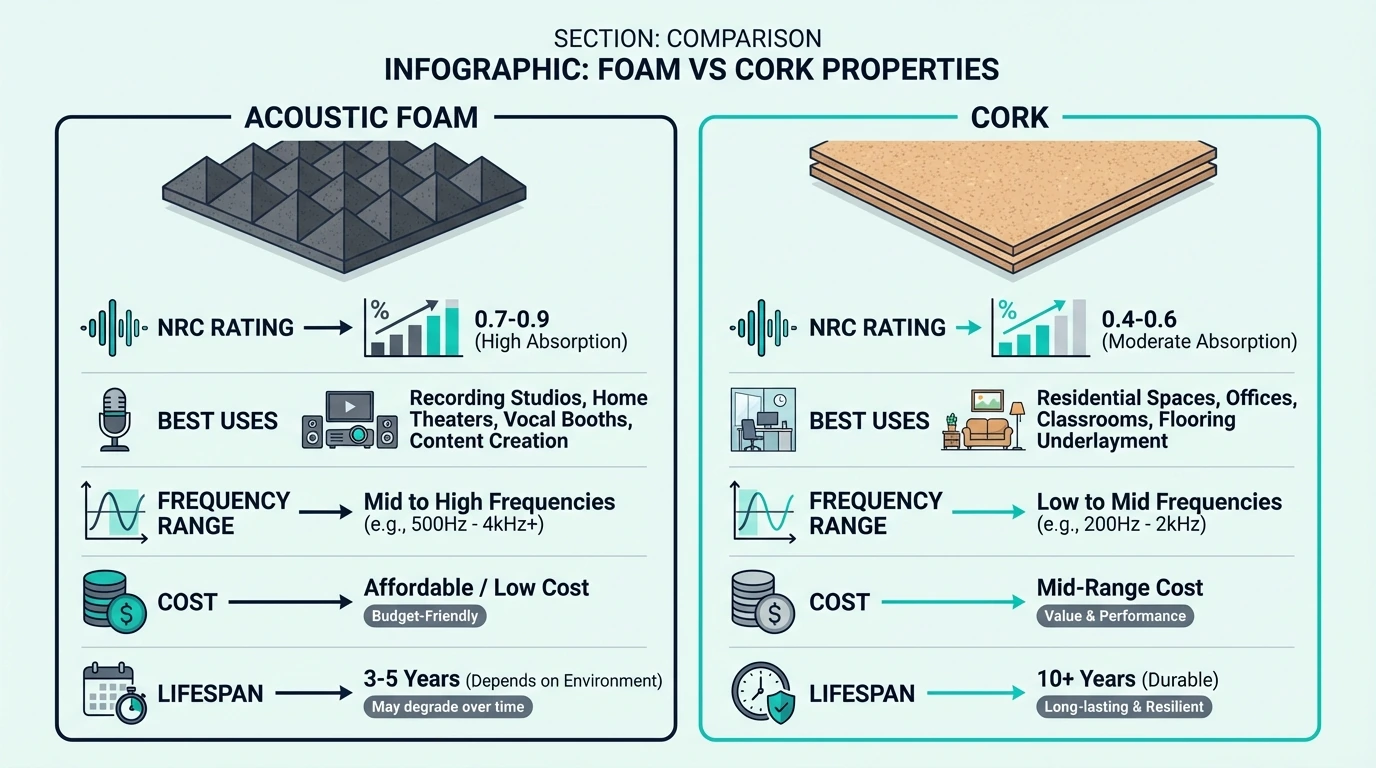
With foam handling reflections and cork handling vibration, the comparison gets simple. If you only read one section, make it this table.
| Factor | Acoustic Foam | Cork |
|---|---|---|
| NRC Rating | 0.50–0.90 | 0.15–0.35 |
| Best For | Echo/reverb reduction | Impact noise, underlayment |
| Frequency Range | Mid-high (500 Hz–4 kHz+) | Low-mid (vibration) |
| Sound Type | Airborne | Structure-borne |
| Installation | Wall/ceiling mount | Floor underlayment, wall tiles |
| Typical Upfront Cost | Usually lower | Usually higher |
| Durability | Shorter (varies) | Longer (varies) |
| Aesthetics | Studio look | Natural/eco look |
Use this table as a filter: if you’re fighting echo, you’ll lean foam, and if you’re fighting impact, you’ll lean cork. The wrong move is buying one to solve the other problem.
The next two H3s translate the table into the situations people actually ask about.
When Foam Beats Cork
Foam wins when your problem is inside-the-room acoustics: echo, flutter, long reverb, or recordings that sound like they were done in a bathroom. That’s the classic home studio/podcast/home theater situation, and it’s exactly what foam is built to treat.
In that scenario, cork on the wall is mostly a décor finish with modest acoustic benefit. The echo reduction guide shows how to get the most change per square foot from foam placed at reflection points.
Cork on studio walls usually disappoints because it doesn’t remove enough mid/high reflection energy to change the reverb you’re hearing. It can look great, but it’s not a substitute for targeted absorption.
If the room sounds fine on a mic but someone downstairs is complaining, the priority flips to impact control. That’s where cork earns its keep.
When Cork Beats Foam
Flip the complaint from echo to thump and cork takes over. This is the case the table labels as “structure-borne.”
Cork wins when the complaint is “I can feel/hear the thump,” not “the room is echoey.” Think footsteps, dropped weights, treadmills, chair scrapes, and anything that shakes the floor.
In those cases, cork underlayment is addressing the actual path the noise is traveling (through the structure). Foam panels on the wall won’t move the needle, because the air in the room isn’t the problem.
Cork also wins when you want a long-lasting, natural finish that doesn’t scream “studio.” If this is a living space, that matters.
How Much Does Acoustic Foam Cost vs Cork?
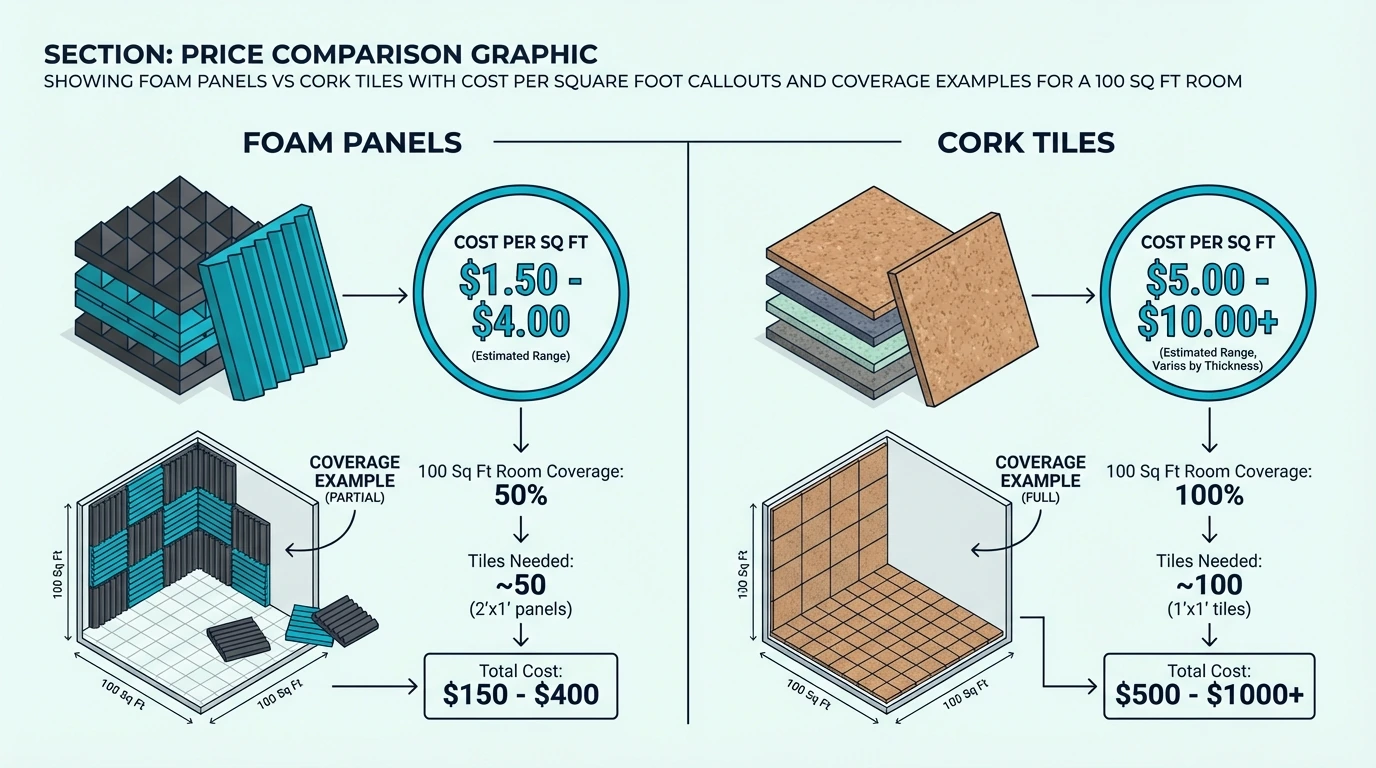
Once you know whether you’re treating echo or impact, the next decision is money and coverage. Foam is sold in packs and cork is sold like a building material, so cost comparisons can get weird fast.
Foam is usually cheaper for echo control because strategic placement works, while cork gets more expensive when you’re covering whole floors or walls. On the flip side, cork tends to outlast foam in permanent installs.
Start with foam, since it’s usually the first purchase when you’re chasing echo control.
Acoustic Foam Cost Breakdown
Foam is usually the budget-friendly way to reduce echo in a small room, especially if you place it at reflection points instead of covering every inch of wall. You can start with a few panels and add coverage if the room still feels too “live.”
Corner pieces like the JBER column wedge corner blocks can be a useful add-on when you’re targeting corners and edges, but they’re not a replacement for panels on reflection points. Think of corner wedges as a supplement—not the whole plan.
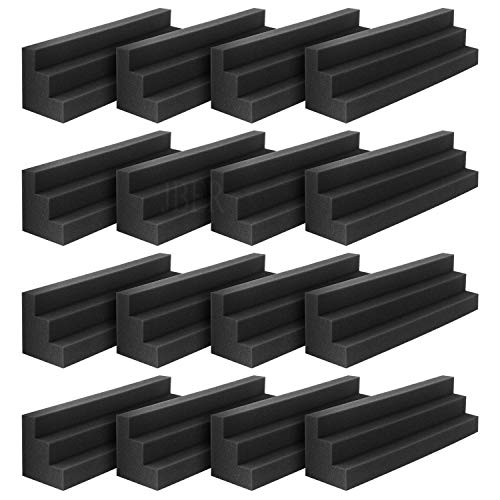
JBER Column Acoustic Wedge Corner Block
The two upgrades that usually raise the cost are better foam consistency/density and real fire ratings. If you’re treating a serious studio space (or mounting near gear and heat), that’s where “premium” can make sense.
For a curated shortlist, the best acoustic foam panels roundup covers picks by room and use case. Use this cost section to set expectations, then use that roundup when you’re ready to buy.
A coverage pack like 50-pack 2-inch panels is a common “treat a room fast” option when you want enough coverage to actually hear the change. Just don’t fall into the trap of random placement—reflection points still matter more than square feet.
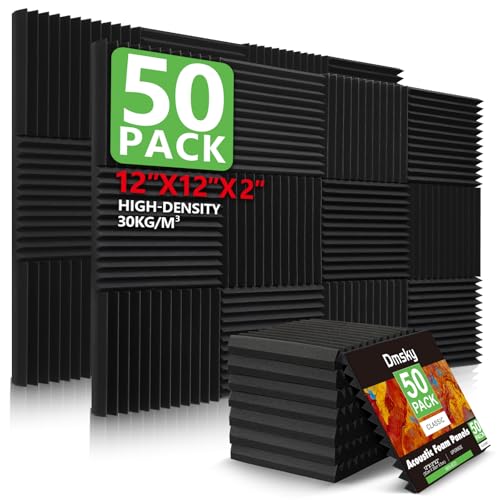
50 Pack High Density 2-inch Panels
Cork Cost Breakdown
Cork pricing looks different because you’re buying square footage, not a pack of panels. That’s why the numbers swing more with room size.
Cork underlayment is priced like flooring material because it’s meant to cover real square footage. Thickness and density matter, and better underlayment costs more for a reason.
Cork wall tiles are often closer to a finish product: you’re paying for look, durability, and ease of installation as much as acoustics. If this is a living room or office, that aesthetics advantage can be the whole reason you choose cork.
For floors, cork’s value is in impact/vibration control, not “NRC per dollar.” For walls, cork’s value is usually durability and aesthetics with a modest acoustic bump.
Total Cost Comparison
Put the two together and the cheaper material isn’t always the cheaper project. The goal is to match coverage to the problem so you’re not paying for area that doesn’t help.
For echo control, foam often wins on upfront cost because you don’t need to treat the entire room to hear a difference. For impact noise, cork can be the better value because underlayment is designed for whole-area coverage and tends to last longer.
If you’re renting or setting up something temporary, foam’s lower commitment is a benefit — the is acoustic foam worth it breakdown covers the cost-vs-benefit math. If you’re renovating a long-term space, cork’s lifespan starts to matter more than the upfront number.
Is Acoustic Foam or Cork Safer for Fire?
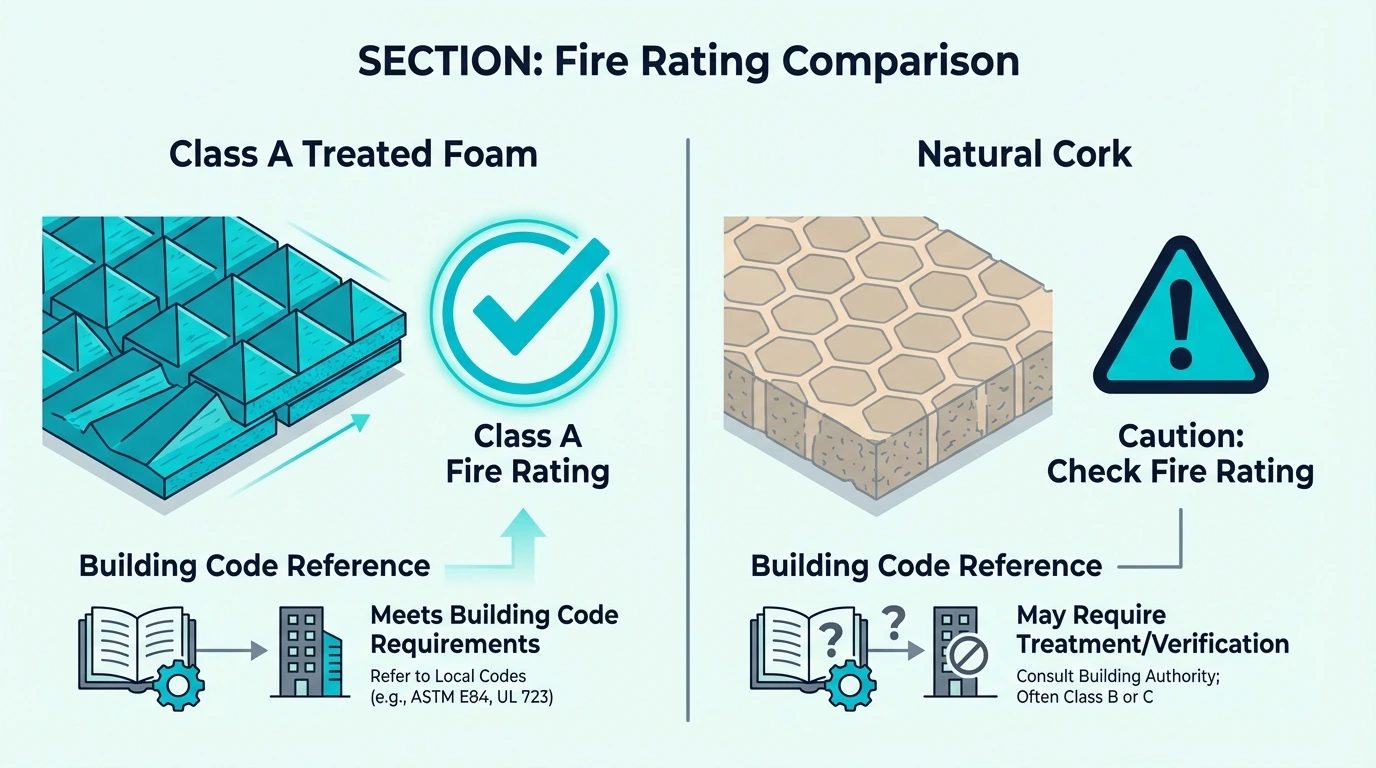
Cost and performance matter, but safety comes next when you’re covering surfaces. Foam is still plastic, and studios are full of power and heat.
The quick version: untreated foam is a bad idea, and “random cheap foam” is often the same material with a new label. If you’re buying foam, look for a real fire rating from the manufacturer.
Foam is where you want to be strict, because sellers vary widely on treatment and documentation.
Acoustic Foam Fire Ratings
Raw polyurethane foam can burn, and not every seller treats it properly. If you’re mounting foam near lights, heaters, or lots of cables, don’t guess — look for documentation like ASTM E84 / Class A claims from a reputable brand.
The wall installation guide covers safe mounting methods for every surface type.
Even in a home studio, that extra caution is cheap compared to replacing gear (or worse). For a deeper safety breakdown, the acoustic foam safety guide covers fire ratings and VOC concerns.
Cork Fire Properties
Cork starts in a better place than untreated foam, but it still isn’t a free pass.
Cork is generally more resistant to flame spread than untreated foam, and it tends to self-extinguish once the ignition source is removed. That said, cork products still have ratings and adhesives/finishes can change real-world behavior.
If you’re installing in a commercial space—or you just want peace of mind—check the specific product’s fire rating before you commit. Don’t assume “natural material” automatically equals “code compliant.”
Building Code Considerations
Even if a material behaves well in theory, code is what decides what you’re allowed to install. That’s the part people discover too late.
If you’re treating a business studio or any space that needs to pass inspection, fire rating stops being optional. Local codes and insurance requirements can dictate what you’re allowed to mount on walls and ceilings.
When in doubt, choose a rated foam product or a cork product that clearly lists a tested rating. Buying compliant materials now is easier than redoing an install later.
Should You Use Acoustic Foam or Cork in Each Room?
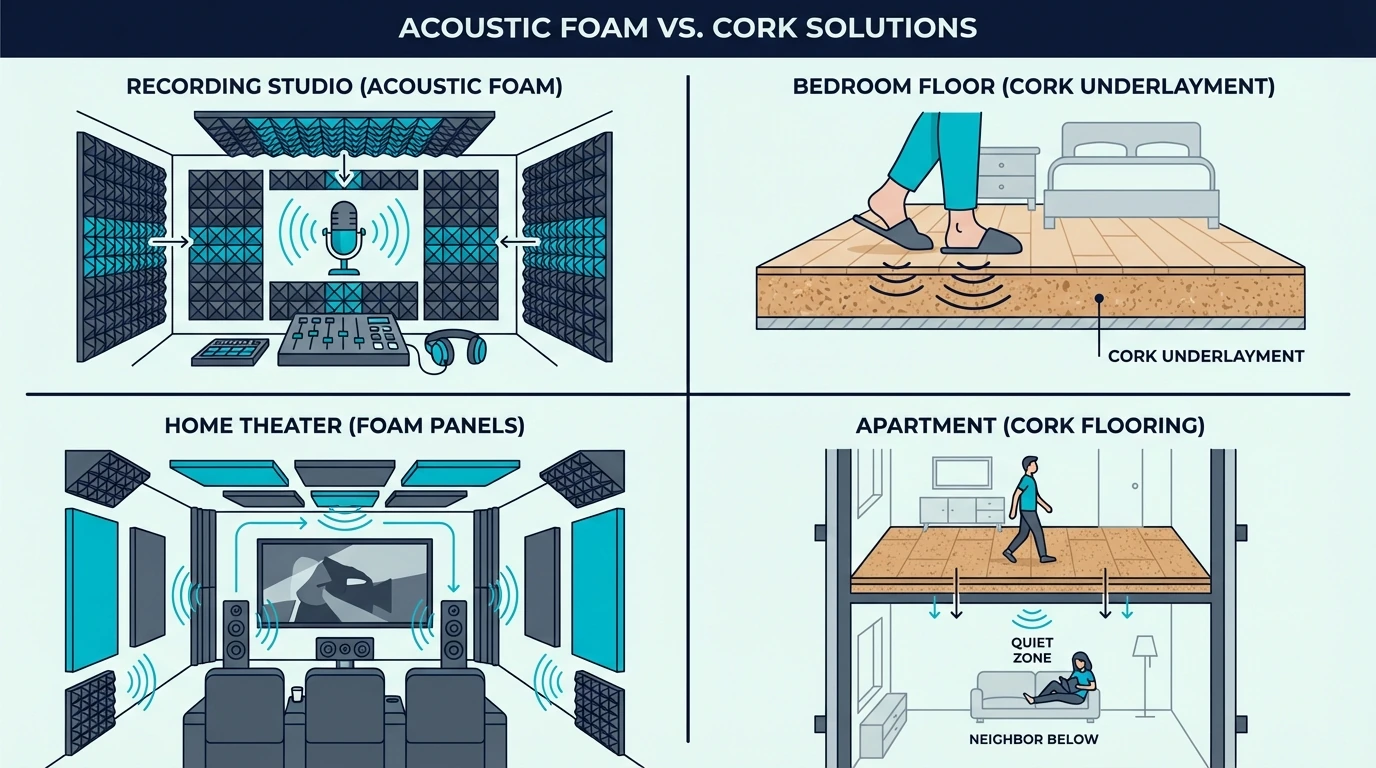
With the air-vs-structure split clear (and safety covered), picking between foam and cork becomes a room-by-room decision. These four scenarios match each material to the rooms people actually ask about.
Start with the space foam was built for: recording.
Recording Studio: Foam Wins
If you record vocals or instruments, you’ve heard the room in your takes—flutter, slap, that hollow “box” sound. Foam is a direct fix for that because it reduces the reflections your mic is capturing.
Start with reflection points (behind the mic, side walls, and the wall behind monitors) and add coverage until the room stops sounding splashy. The acoustic foam placement guide maps out every reflection point for a home studio.
If you need bulk coverage fast, a 50-pack 2-inch foam panels kit makes it easy to treat the key surfaces without overthinking it.
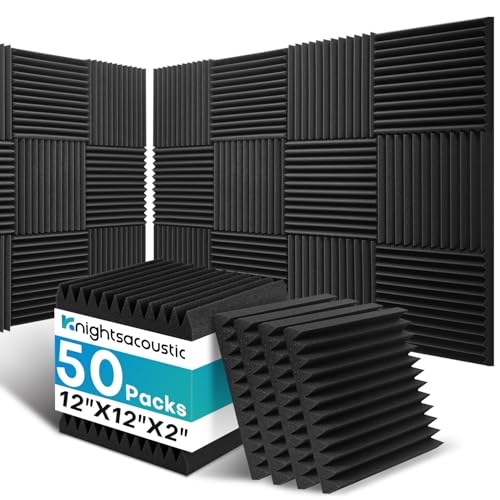
50-pack 2-inch foam panels
Cork on studio walls usually disappoints because it doesn’t remove enough mid/high reflection energy to change the reverb you’re hearing. It can look great, but it’s not a substitute for targeted absorption.
If the room sounds fine on a mic but someone downstairs is complaining, the priority flips to impact control. That’s where cork earns its keep.
Bedroom Above Living Space: Cork Wins
If the complaint is coming from downstairs, it’s almost always impact noise: footsteps, dropped items, chair movement. That’s structure-borne noise, so wall foam won’t help much even if the room itself sounds less echoey.
Cork underlayment works because it adds a cushion layer that absorbs some of the impact before it becomes a vibration in the building. Pair it with a thick rug and pad, and you usually get the biggest improvement for the least hassle.
If your goal is “less thump through the floor,” cork is the right tool. If your goal is “less echo in the room,” foam is the right tool.
Home theaters sit in the middle, because you’re solving for what you hear and what the building feels. That’s why foam and bass control usually come first, with cork only if vibration is part of the complaint.
Home Theater: Foam Plus Bass Traps
Home theaters are usually a two-problem room: you want clearer dialogue (mid/high reflections) and tighter bass (low-frequency buildup). Foam helps the first part, but it can’t “fix bass” on its own.
Treat first reflection points with foam, then use bass traps for the low end if explosions feel boomy. Cork only enters the picture if you’re trying to reduce subwoofer vibration traveling through the floor.
If you’re only treating for better sound inside the room, focus on foam placement plus bass control. If you’re treating for neighbor complaints, that’s when floor isolation matters.
Apartments add the neighbor constraint by default, so impact noise matters earlier than it would in a house. Cork underlayment and rugs usually deliver more peace than wall foam ever will.
Apartment Floor: Cork Wins
Apartments are where cork makes the most sense, because you’re trying to be a good neighbor as much as you’re trying to improve your own acoustics. Underlayment reduces footstep thumps leaving your unit, and cork adds a small amount of high-frequency absorption inside the room.
Foam can still be worth it if your room is echoey, but it’s not a neighbor-noise solution — a heavy moving blanket on the wall often does more for apartment noise than foam panels. If the problem is complaints about walking, cork (plus rugs) is the move.
If you need both, you can combine them: cork under the floor for thumps, foam on walls for reflections. Just keep the goal of each material clear so you don’t waste money.
Conclusion
Foam vs cork is easy once you name the path: air or structure. If you want to kill echo and clean up recordings, foam is the right tool.
If you’re dealing with impact noise traveling through floors, cork underlayment is the right tool. And if you have both problems, you can use both—foam on walls for reflections, cork under the floor for thumps.
Frequently Asked Questions
Is Cork Soundproof?
No. Cork can help with impact and a little bit of high-frequency absorption, but it won’t block sound like a properly built wall or ceiling.
If you need soundproofing, you’re looking at construction (mass, sealing, decoupling), not surface materials. Cork is treatment and underlayment, not isolation.
Can Cork Replace Acoustic Foam?
Not if your goal is echo control. Cork’s airborne absorption is modest compared to foam, so you’ll usually be disappointed if you use cork on walls expecting a “studio” change.
Use cork for impact/vibration and aesthetics, and use foam for airborne reflection control. They’re solving different problems.
Can You Use Both Cork and Foam Together?
Yes, and it’s often the best combo when you have both problems. Foam handles reflections in the air, and cork handles vibration through the structure.
Which Material Lasts Longer?
Cork generally lasts longer because it’s a dense natural material and doesn’t crumble the same way. Foam can degrade over time (UV, humidity, dust), so it’s more common to replace foam in a permanent setup.
Which Is More Environmentally Friendly?
Cork is usually the greener choice because it’s harvested from bark and is recyclable/biodegradable. Polyurethane foam is petroleum-based, so if sustainability is a priority, cork has the edge.