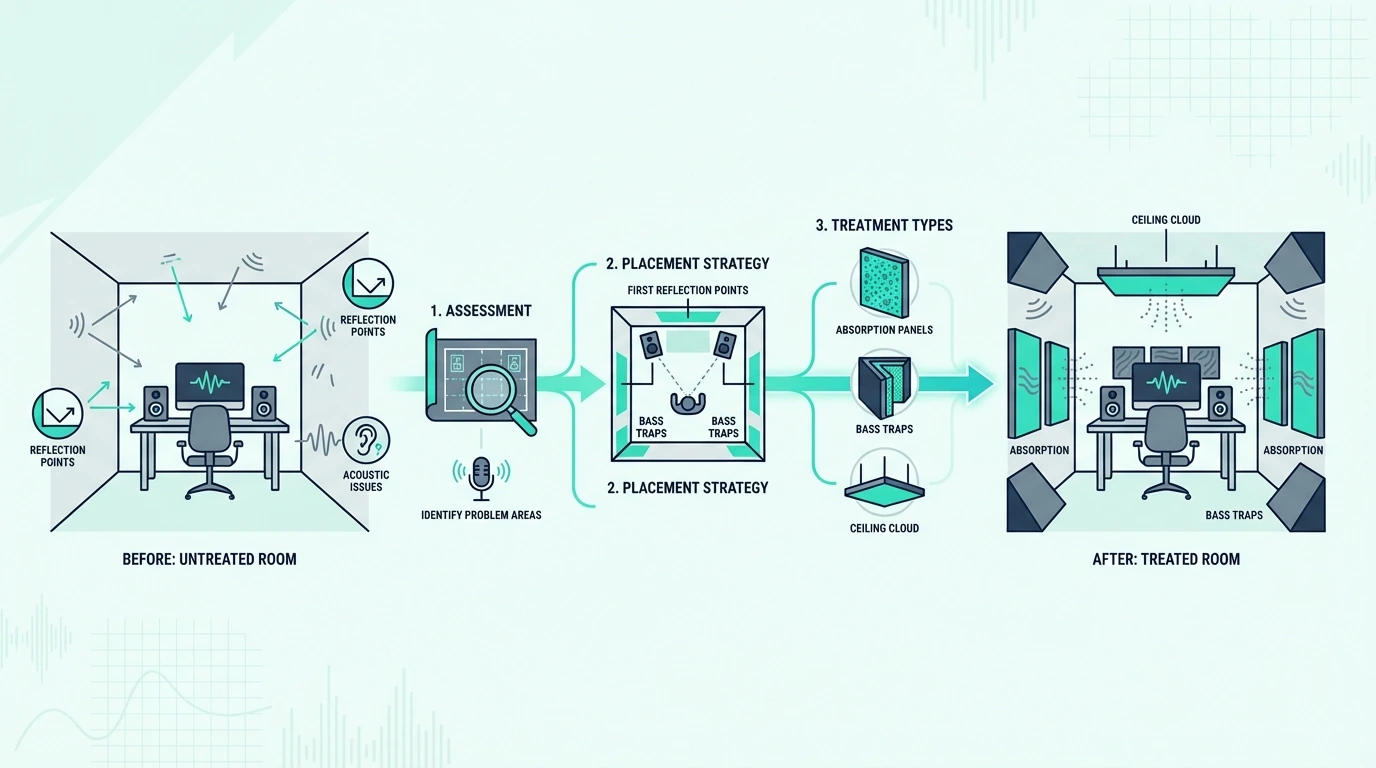
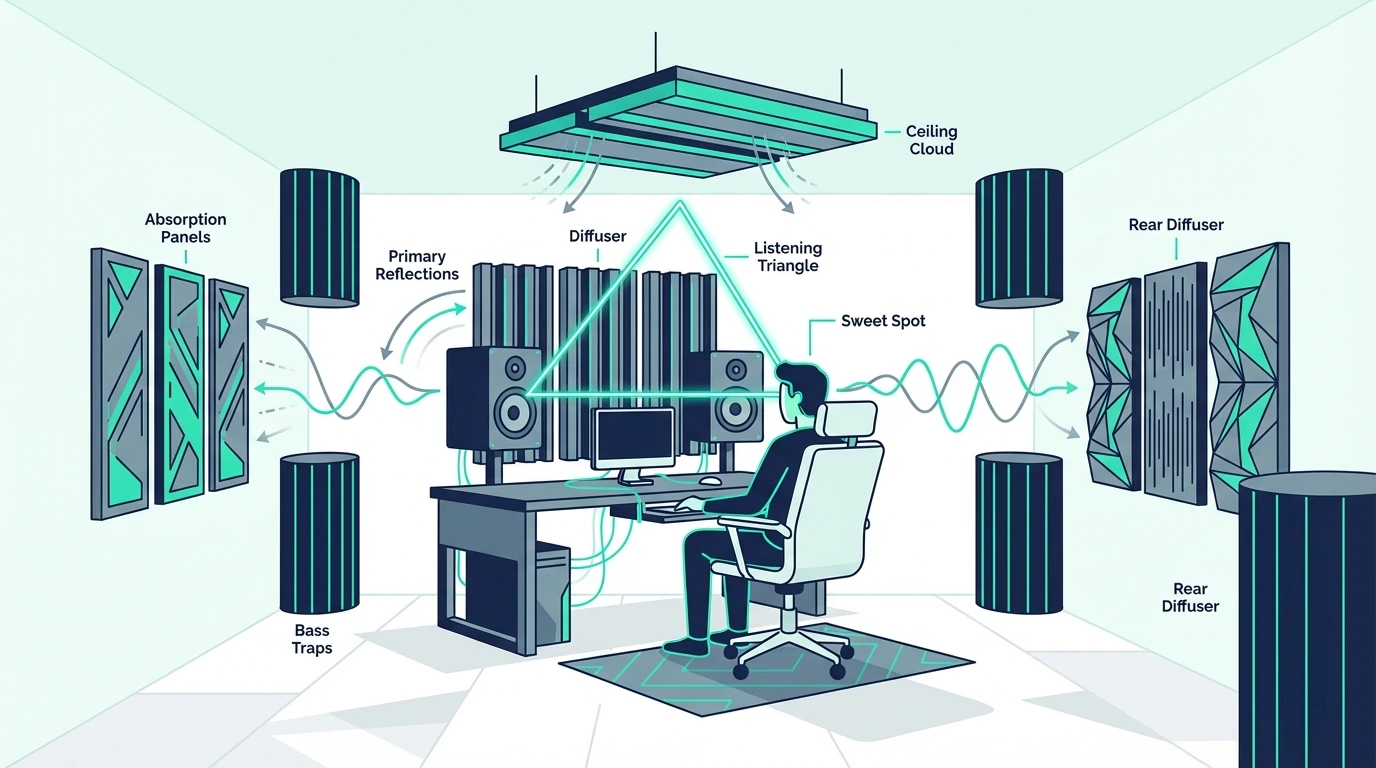
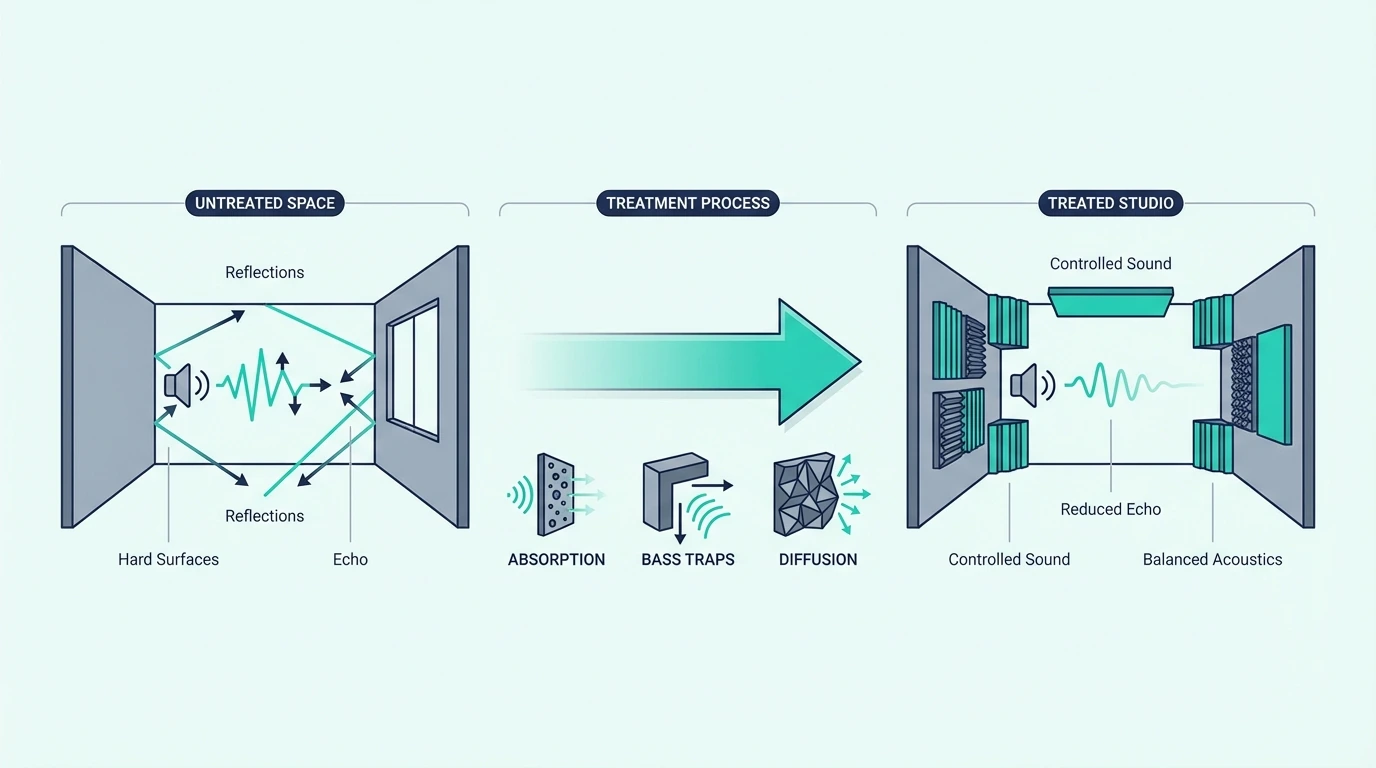
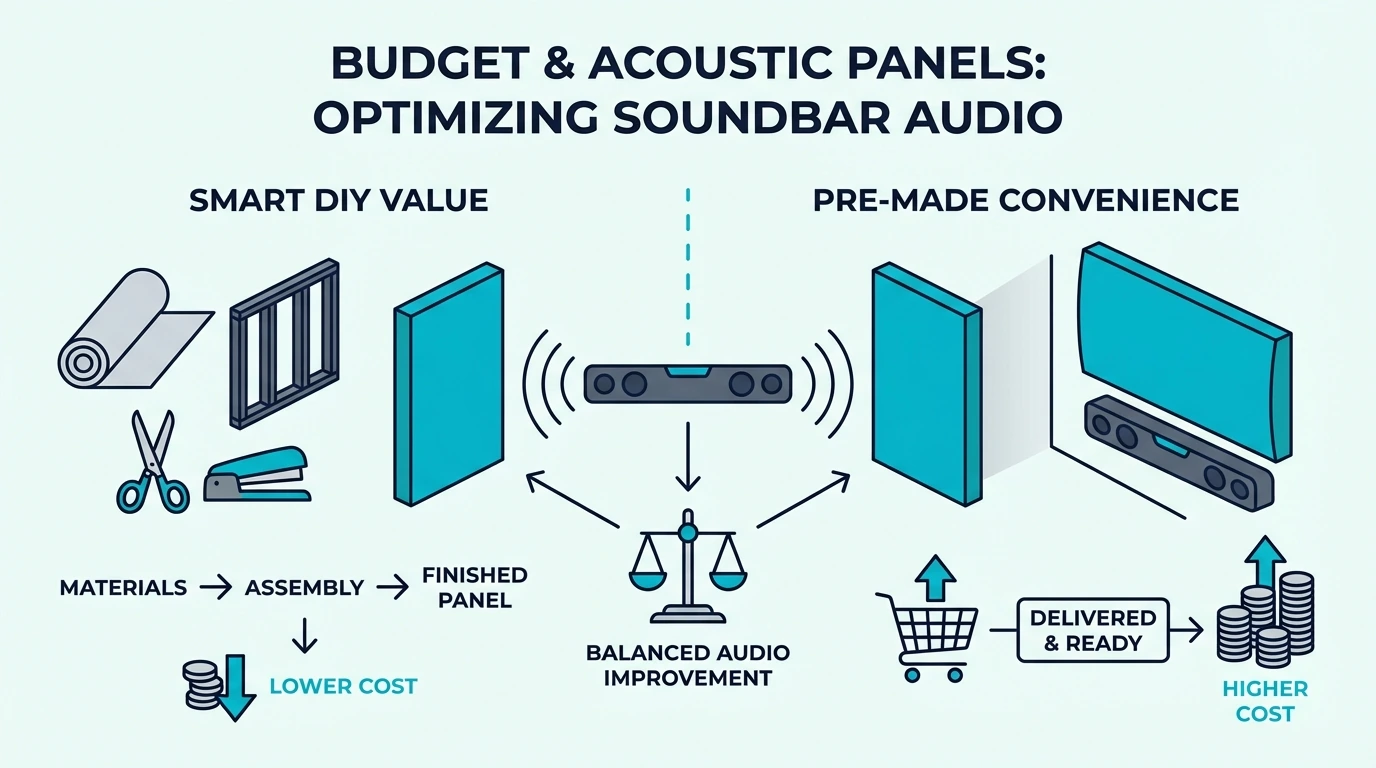
How Much Does Acoustic Treatment Cost (Real Numbers, Not Guesses)

How much does acoustic treatment cost depends on one decision that most people skip — whether you build the panels yourself or buy them ready-made, but that single choice changes the total by 50-70% in either direction.

A bedroom studio can sound dramatically better for a few hundred dollars if you source the right materials. The same coverage in commercial panels pushes the budget past a thousand without adding any acoustic advantage.

The problem is that most cost guides either lowball the number with foam-only setups that barely work or inflate it with professional installation quotes that assume you cannot hang a panel yourself.

Below, this guide gives you real price ranges for every approach — DIY, commercial, and professional — so you can match the treatment to your budget without overspending or undertreating.

Quick Takeaway

To treat a small home studio acoustically, expect to spend between 200 and 500 dollars for DIY panels built from fiberglass or rockwool, or between 500 and 1,500 dollars for equivalent coverage in commercial pre-made panels. The biggest cost variable is not the material — it is whether you build or buy.

How Much Does Acoustic Treatment Cost — A Realistic Breakdown
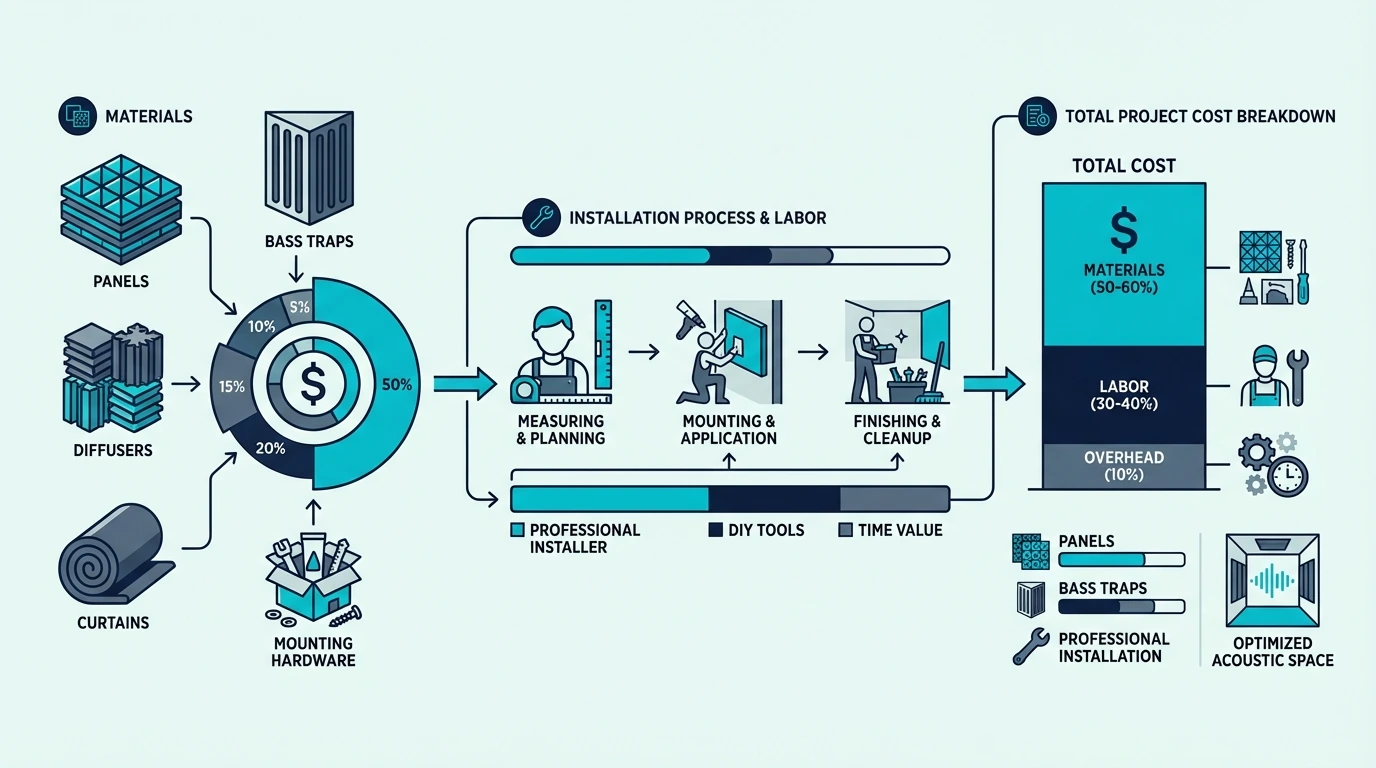
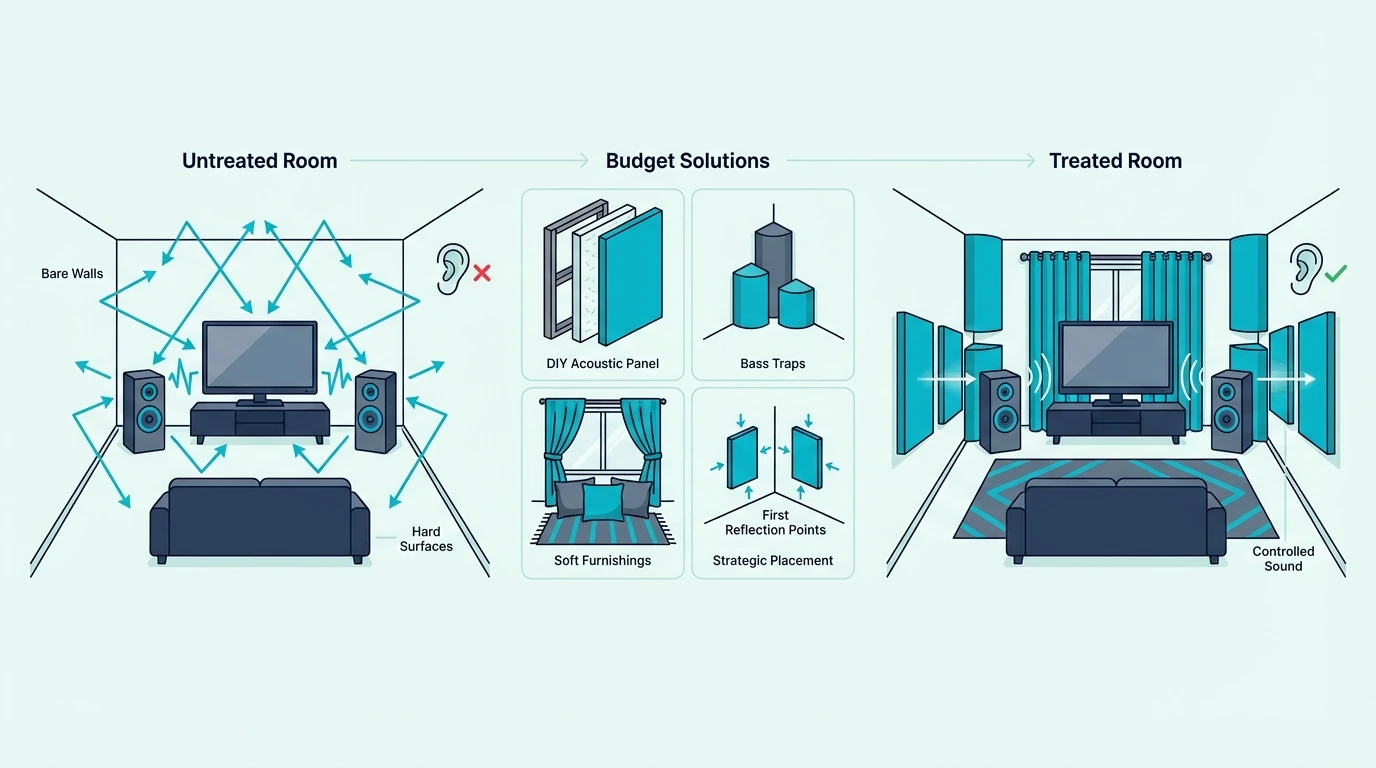
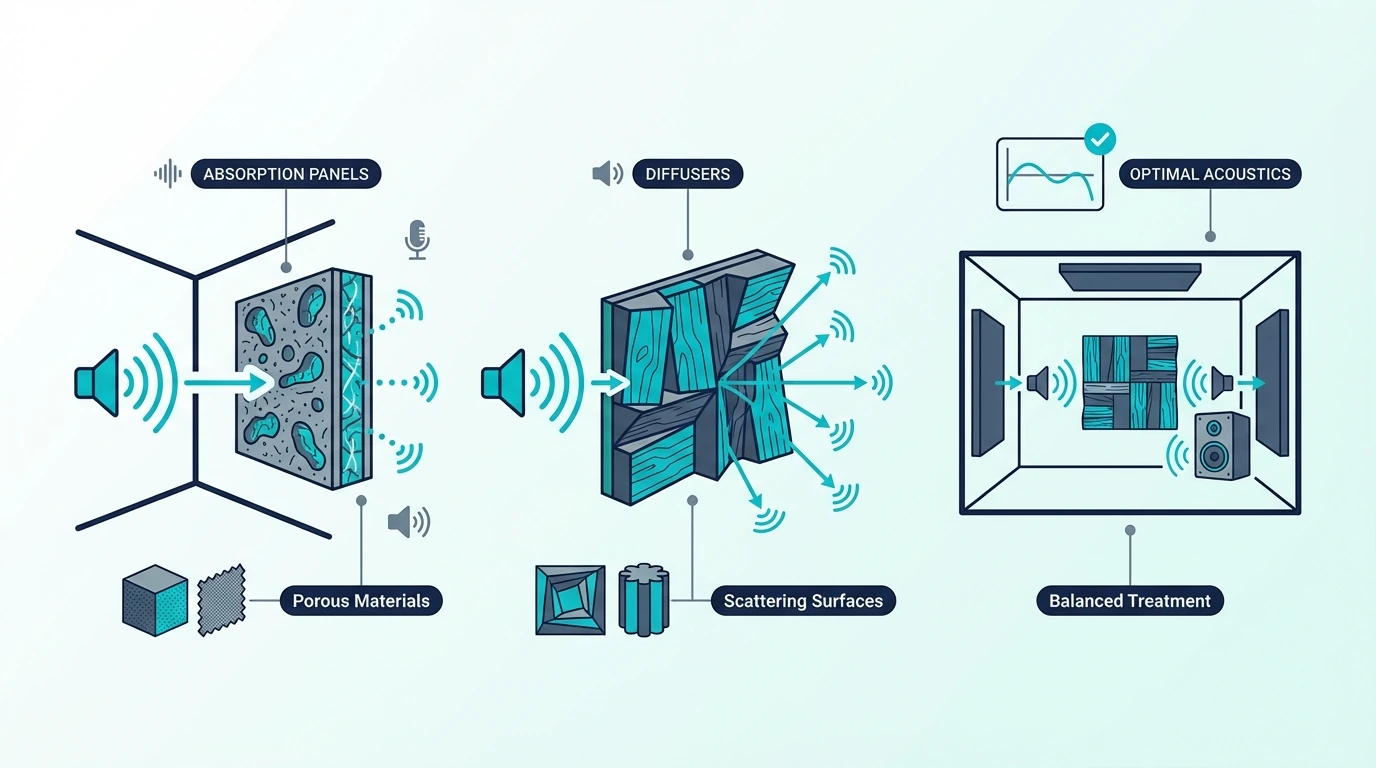
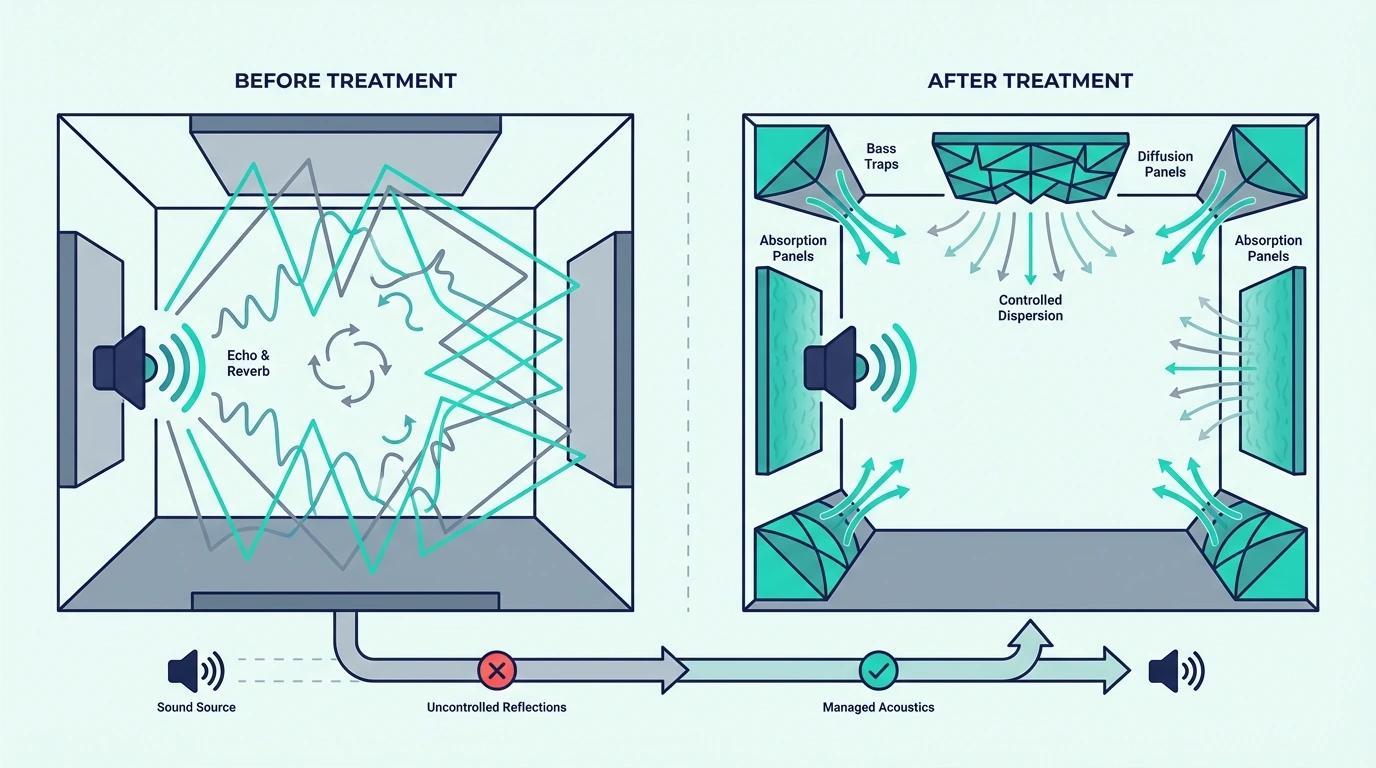
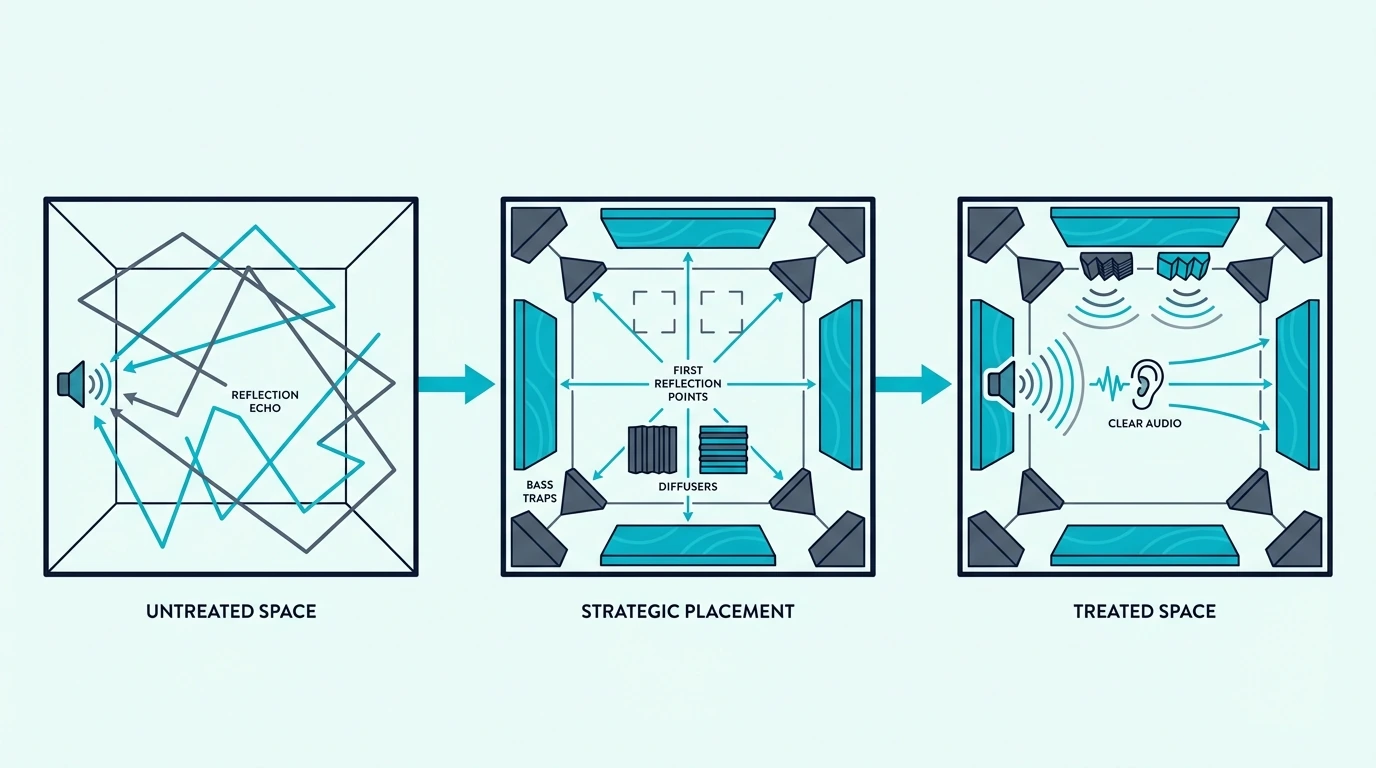
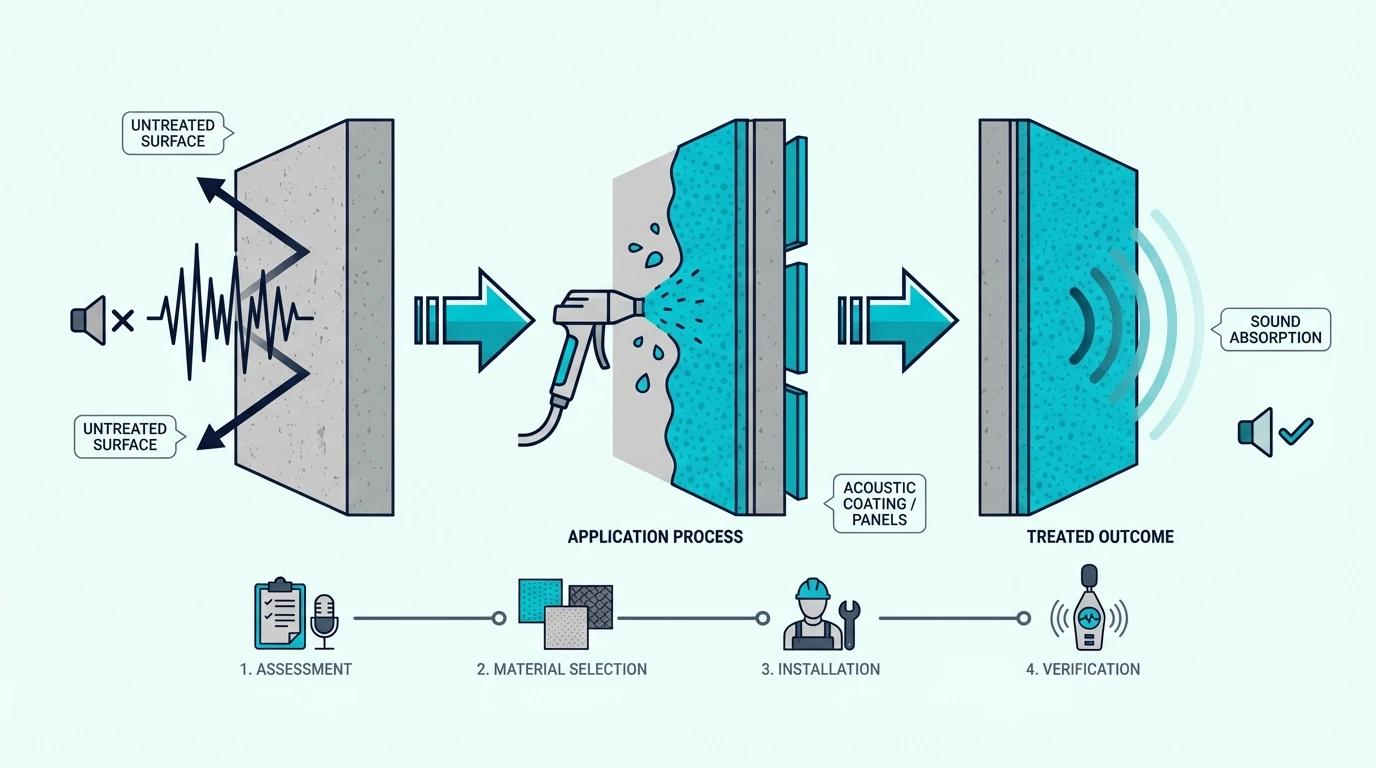
Cost breakdown for acoustic treatment projects

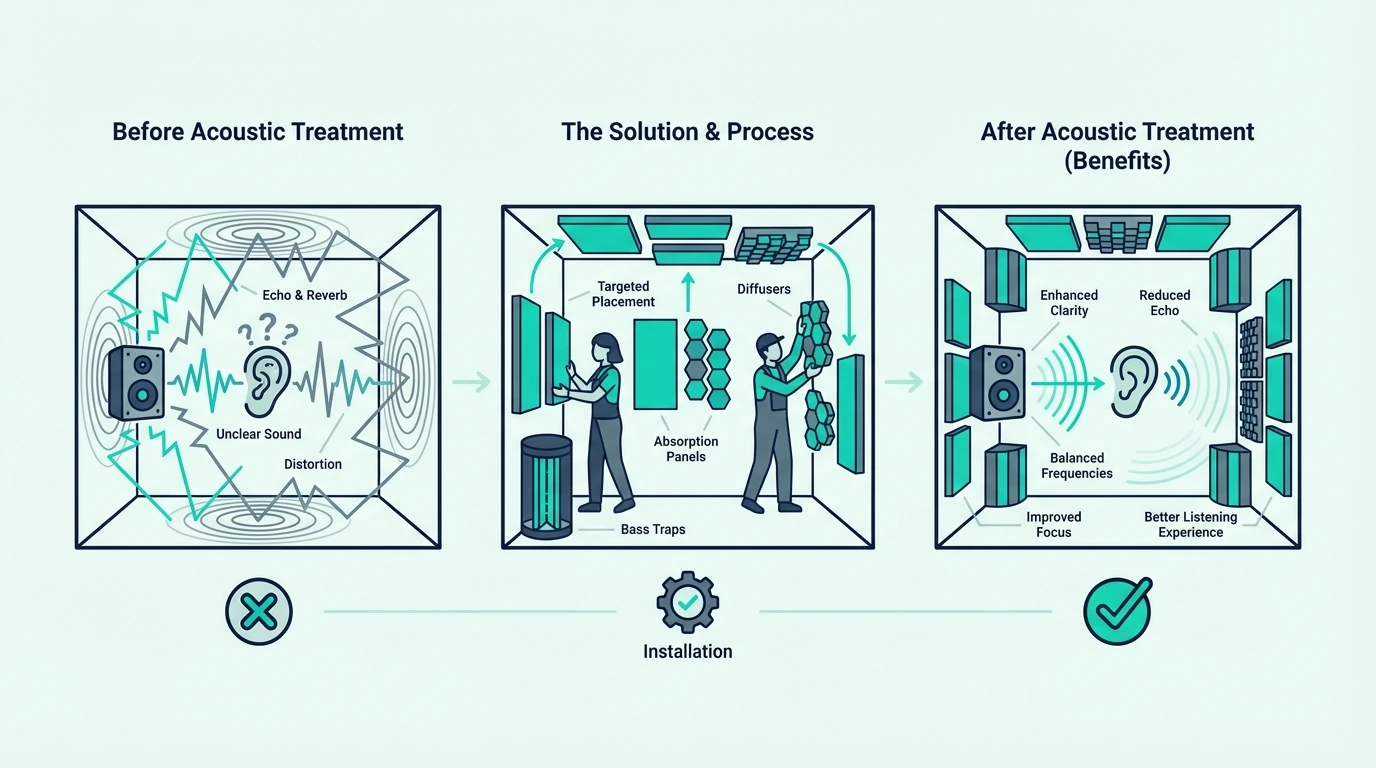
The total cost of acoustic treatment falls into three tiers depending on your approach, your room size, and how much of the work you do yourself. Each tier delivers real acoustic improvement — the difference is time, convenience, and finish quality.

The Three Cost Tiers

A DIY setup using fiberglass or mineral wool insulation, pine frames, and fabric wrap runs between 200 and 500 dollars for a typical bedroom-sized home studio. That covers 4-6 wall panels and 2-4 corner bass traps — enough to control the worst reflections and tighten the low end.

Commercial pre-made panels for the same coverage land between 500 and 1,500 dollars depending on brand, panel size, and whether you buy individual panels or a bundled room kit. A 4-pack of mid-range fiberglass panels typically runs 80-130 dollars, and most rooms need 2-3 packs plus separate bass traps.

Professional installation — where a contractor or acoustics company designs and installs a custom treatment plan — starts around 1,500 dollars and climbs past 5,000 for larger rooms or specialized spaces like home theaters. Most home studio owners skip this tier entirely because the acoustic benefit over a well-executed DIY job is marginal.

What Factors Affect Acoustic Treatment Cost?
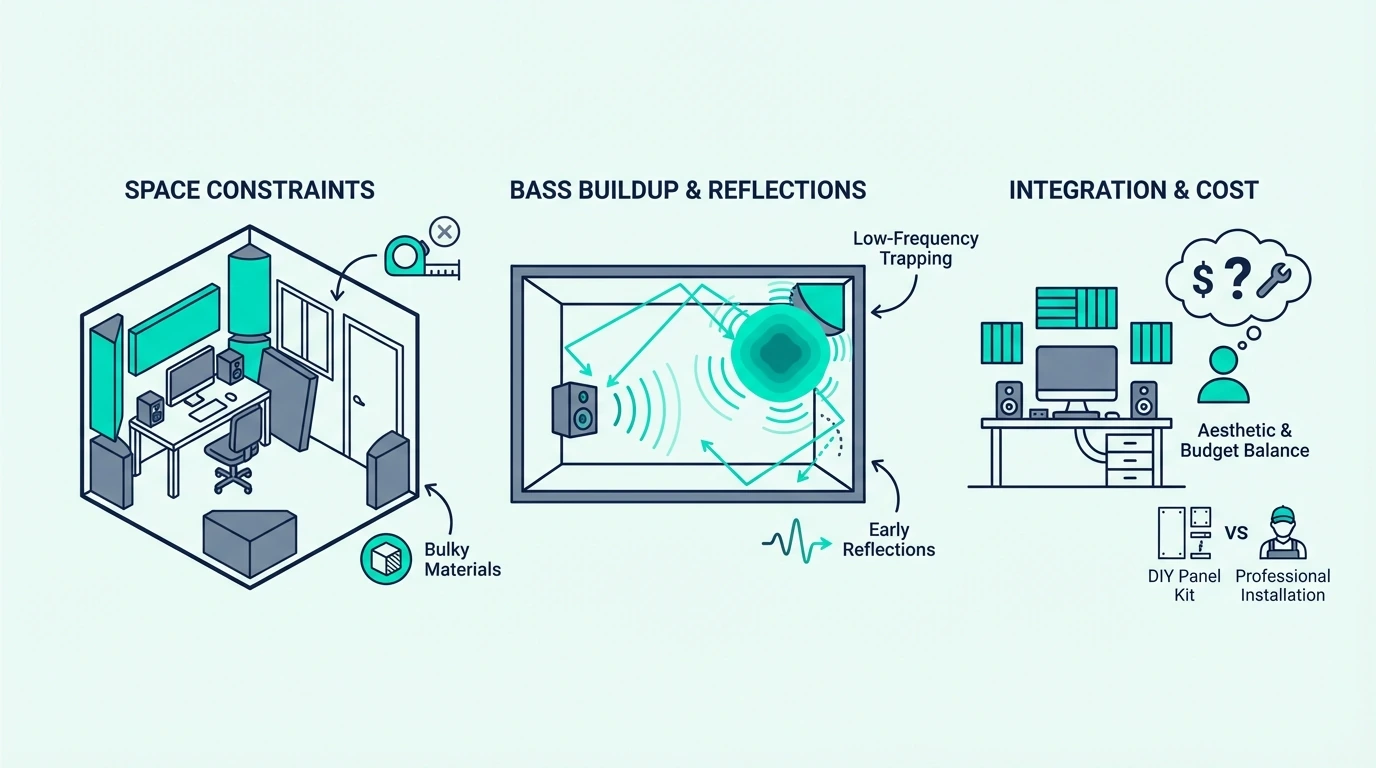
Factors that affect acoustic treatment cost

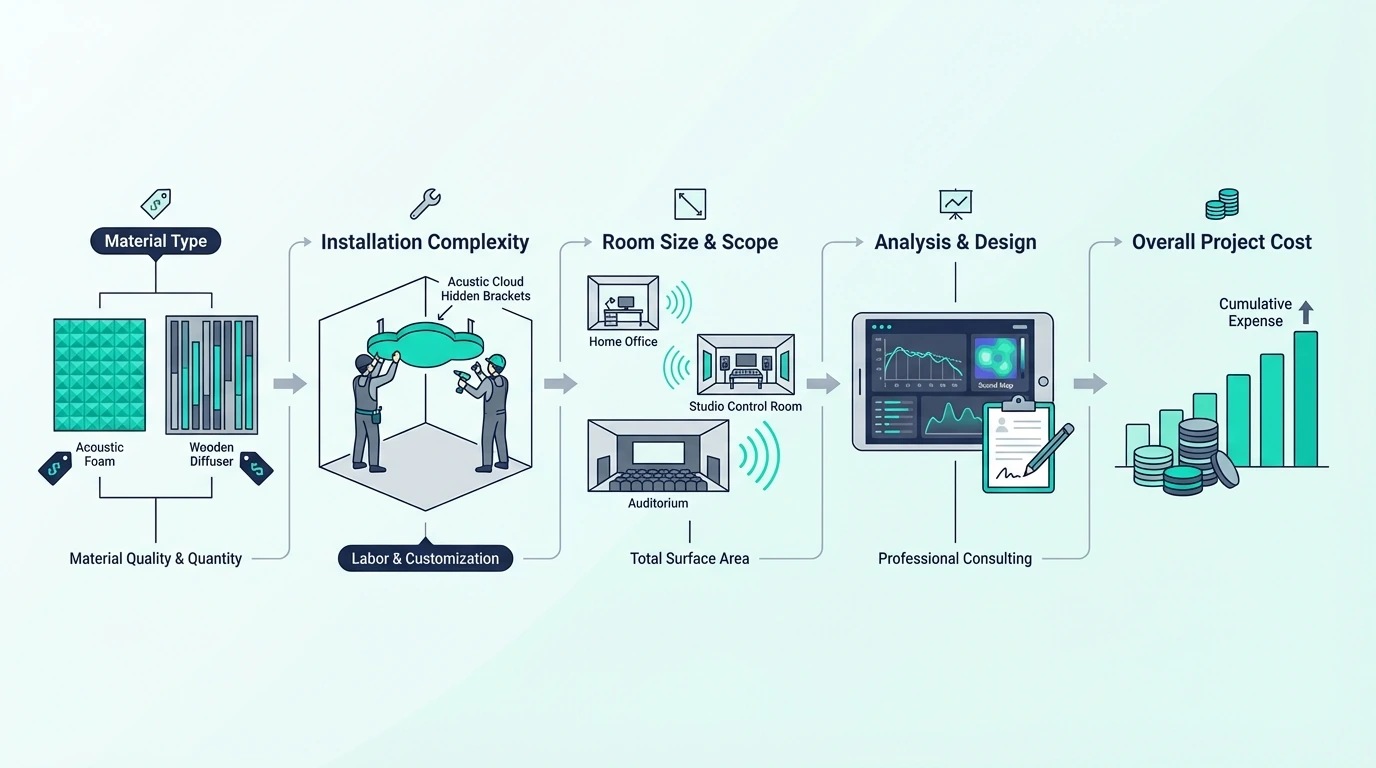
The sticker price on a single panel tells you almost nothing about what your room will actually cost to treat. Four variables stack on top of each other, and missing any one of them leads to either overspending or undertreating.

Room Size And Coverage Needs

A 10 x 10 foot bedroom studio needs 6-10 panels to control first reflections and corner bass buildup. A 15 x 20 foot dedicated recording space or home theater needs 12-20 panels because every additional square foot of wall and ceiling creates more reflective surface area.

The math is straightforward: figure out how many reflection points your room has (two side walls, the ceiling above the mix position, the wall behind the monitors, and two to four corners), then count the panels needed to cover them. Most rooms need fewer panels than people expect because treatment only goes at specific acoustic problem spots, not across every surface.

Material Quality And Type

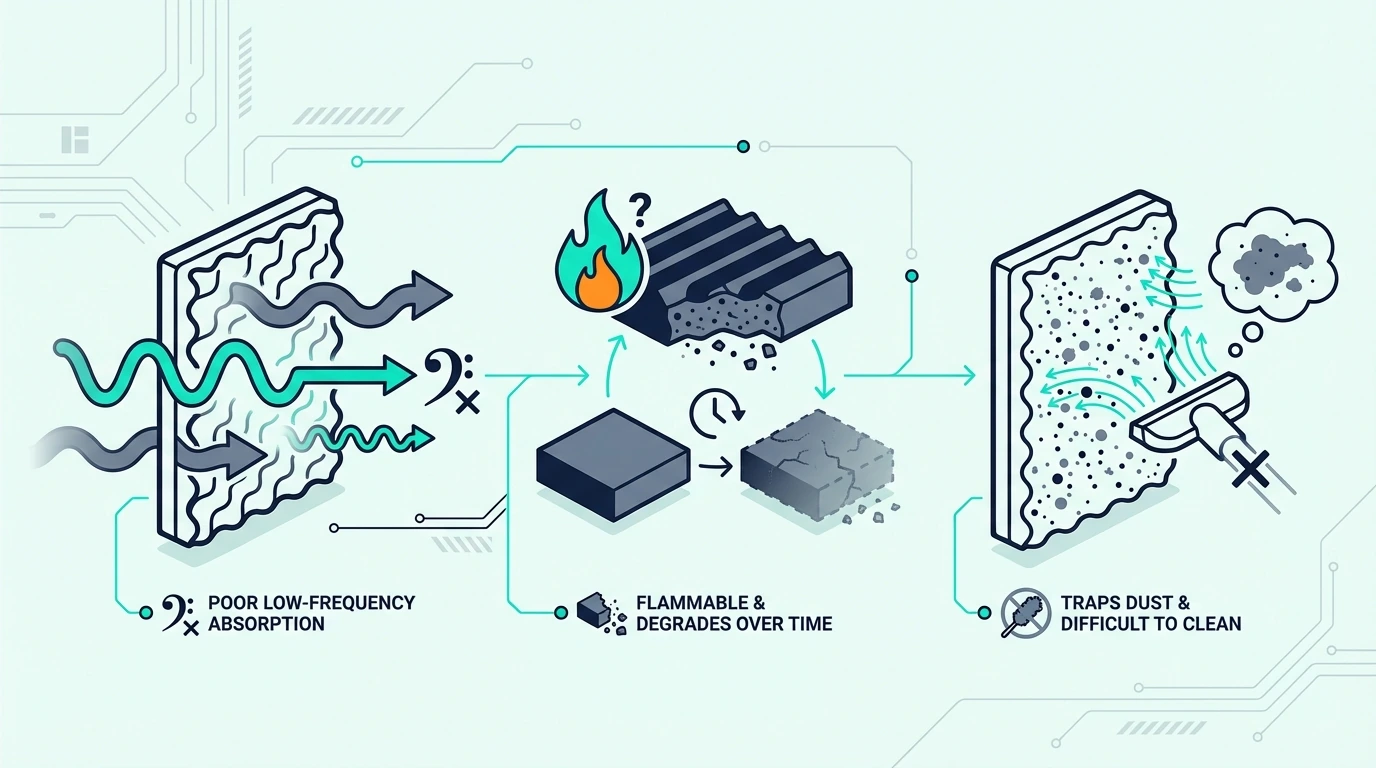
Acoustic foam is the cheapest entry point — thin polyurethane tiles that absorb some high-frequency energy. Foam panels help with flutter echo and basic room ring, but they do almost nothing below 500 Hz where bass buildup and room modes cause the real problems.

Rigid fiberglass panels (like Owens Corning 703) and mineral wool (like Rockwool Safe’n’Sound) absorb across a much wider frequency range — including the low-mids that foam misses entirely. The material cost per square foot is higher, but you need fewer panels to achieve the same acoustic result because each one works harder.

The cost difference between foam and fiberglass isn’t just per-panel pricing — it’s total coverage cost. A room treated with foam often needs twice the panel count to match the acoustic improvement of half as many fiberglass panels placed at the right spots.

DIY vs Commercial — What Does Each Approach Actually Cost?
DIY acoustic treatment compared with commercial products

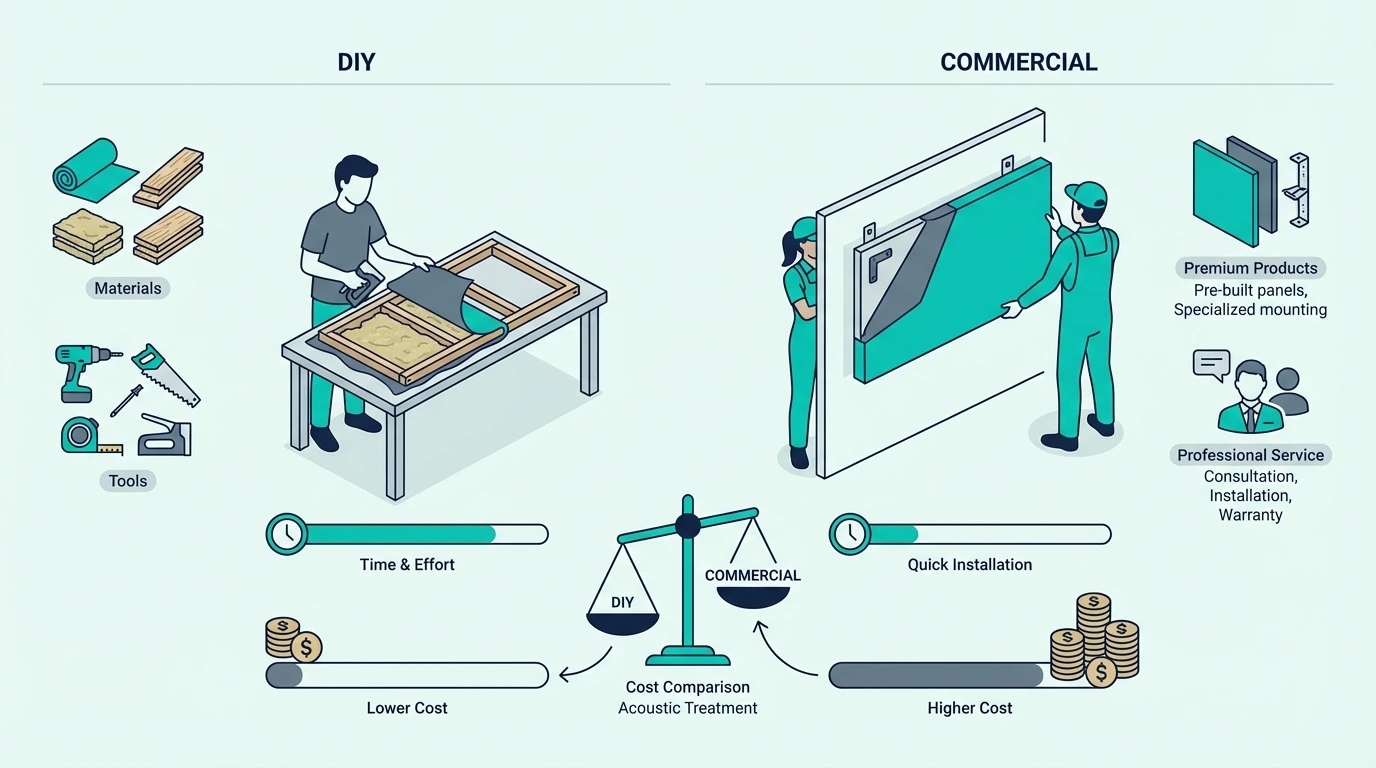
The DIY-versus-commercial decision is where most of the budget variation lives. Both approaches use the same core materials — the commercial version just adds labor, packaging, and a finished look to the price.

DIY Panel Cost Breakdown

A single 2 x 4 foot DIY panel built from a 1 x 4 pine frame, a 2-inch slab of Rockwool Safe’n’Sound, and acoustically transparent fabric costs roughly 15-25 dollars in materials. That includes the insulation (about 1 dollar per square foot), lumber for the frame (3-5 dollars), fabric (3-5 dollars per panel), and mounting hardware (2-3 dollars).

Eight panels — enough for a bedroom studio — runs 120-200 dollars in raw materials. Add another 40-80 dollars for corner bass traps built from the same materials at double thickness, and the full room lands between 160 and 280 dollars.

The tradeoff is time — plan a full weekend for measuring, cutting, assembling, and wrapping.

If you want a step-by-step walkthrough of the build process, the approach is simple enough for anyone comfortable with a saw and a staple gun.

Commercial Panel Pricing

Entry-level commercial panels run 30-50 dollars per panel for smaller sizes in basic fabric wraps. Mid-range panels like the Olanglab Fiberglass Panels land in the 80-90 dollar range for a 4-pack of fiberglass-core panels with fabric wrapping — a solid middle ground between foam and premium brands.

Panels that include mounting brackets save you the separate purchase of clips or hooks — a detail that matters when you’re trying to calculate the true total.

Premium room kits like the Acoustic Panels 4-Pack Room Kit bundle larger panels designed to cover a full room in one purchase. The per-panel cost is higher, but the cost per square foot of coverage often beats buying smaller panels individually.

When comparing options, always calculate cost per square foot of panel coverage — not cost per panel. A pack of four 12 x 12 inch panels covers 4 square feet, while a pack of four 46 x 23 inch panels covers roughly 29 square feet.

The larger panels almost always win on a per-square-foot basis even when the sticker price looks higher. That math matters more than any single panel price when you’re budgeting for a full room.

How To Get The Most Treatment For Your Budget
How to maximize an acoustic treatment budget

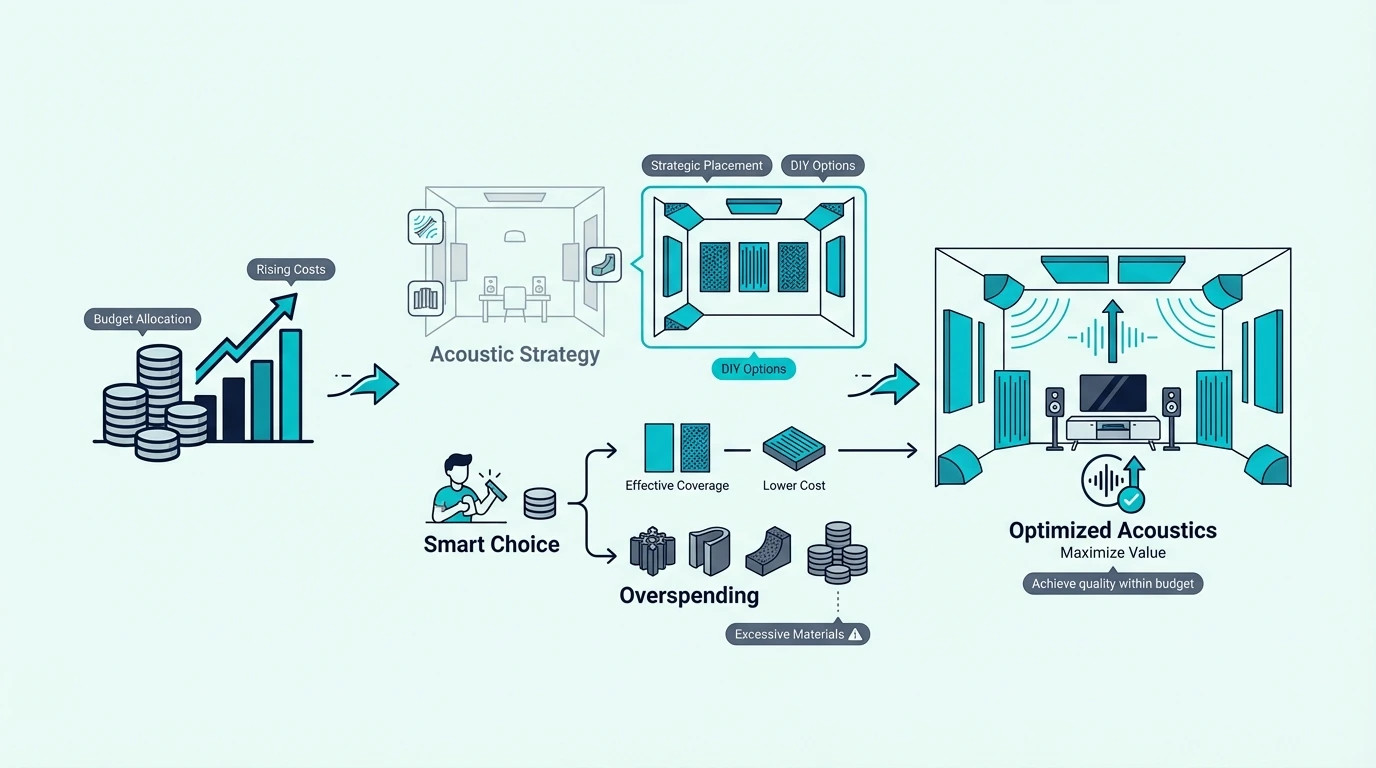
The order you treat your room matters more than how much you spend on each panel. Placing the right treatment at the highest-impact spots first means you hear improvement from day one — and every additional panel compounds the result.

Treatment Priority Order

Bass traps in corners deliver the single highest return per dollar because they address room modes — the low-frequency buildup that no amount of wall panels or EQ can fix. Four corner traps built from 4-inch thick fiberglass or mineral wool should be the first purchase regardless of budget.

Side wall panels at first reflection points come next. Two panels per side wall, placed at ear height between you and the monitors, restore clarity to everything you hear at the mix position.

A ceiling cloud above the listening position is the third priority. One overhead panel tightens stereo imaging and reduces the low-mid smear that an untreated ceiling creates.

Everything beyond those three priorities — rear wall diffusion, additional side panels, floor treatment — refines the sound rather than fixing fundamental problems. If you’re working on a tight budget, stop after corners, sides, and ceiling, and you’ll have a room that performs better than most untreated commercial spaces.

Where To Save And Where To Spend

Save on fabric and frames — these are cosmetic components that don’t affect acoustic performance. A plain muslin wrap absorbs the same frequencies as premium speaker cloth at a fraction of the cost.

Spend on insulation thickness. A 2-inch panel handles mid and high frequencies, but a 4-inch panel reaches meaningfully deeper into the low-mids.

The extra inch or two of material costs very little per panel but absorbs frequencies that thinner panels miss completely. That single upgrade delivers more acoustic improvement per dollar than any other change you can make. Panels like the UMIACOUSTICS 4-Pack with Hanging Brackets bundle the hardware with the panel, which keeps the true per-panel cost honest.

If you want a ready-made kit that handles the whole room in one purchase, the best acoustic treatment kits roundup compares options by coverage area and included components. For individual panel picks across every price point, the budget acoustic treatment guide breaks down what actually delivers results without overspending.

The Bottom Line

Acoustic treatment costs between 200 and 1,500 dollars for a home studio depending on whether you build or buy — and the acoustic result from a well-placed DIY setup is nearly identical to commercial panels costing three times as much.

Start with corner bass traps and side wall panels at reflection points, then add a ceiling cloud when the budget allows. That three-step sequence gives you 80-90% of the acoustic improvement for 30-40% of the cost of treating every surface.

The full guide to acoustic treatment covers every placement priority and surface type if you’re ready to plan the whole room.

Frequently Asked Questions

Is acoustic treatment expensive?

Not if you prioritize correctly. A bedroom studio needs 6-10 panels, and building them from fiberglass insulation and pine frames costs 200-400 dollars in materials.

Commercial panels for the same coverage run 500-1,000 dollars. The key is treating the right spots — corners and first reflection points — instead of covering every wall.

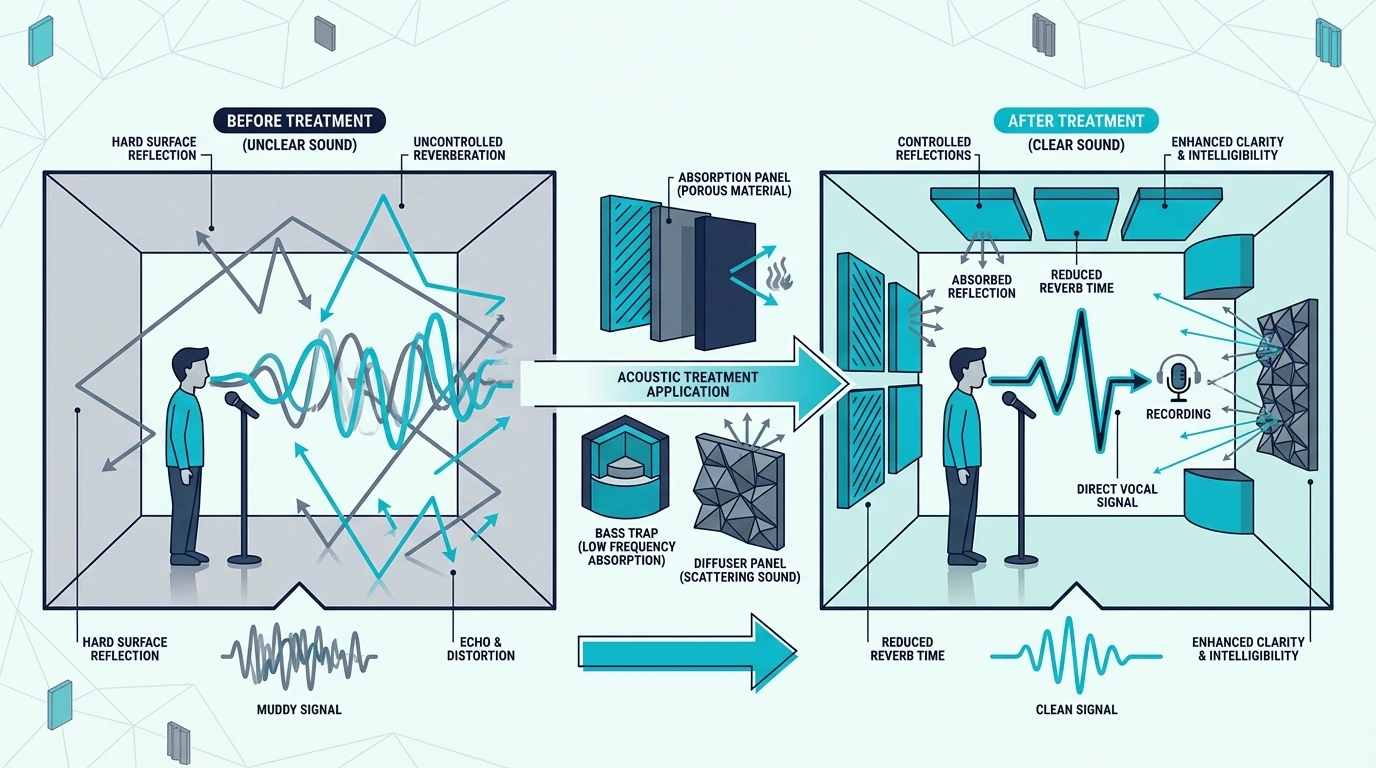
Will acoustic treatment give my vocal more clarity?

Reducing room reflections directly improves vocal recording clarity because the microphone captures less of the room and more of the voice. Two panels flanking the mic position and one behind the singer eliminate the early reflections that cause the biggest problems in untreated rooms.

Is a mattress good for acoustic treatment?

A mattress absorbs some mid and high frequency energy, but it’s impractical as a permanent solution. The absorption is uneven — thick in some frequency ranges and almost transparent in others.

A mattress does virtually nothing for bass frequencies, which is where most room problems live. A single 2-inch fiberglass panel at the right spot outperforms a mattress leaning against a wall. A 6-pack of Rockboard 60 mineral wool boards costs under 125 dollars for six panels worth of material — one of the lowest cost-per-panel options for serious broadband absorption.
Acoustic Treatment For Home Theater (Why Your Speakers Sound Wrong)

Figuring out how to do acoustic treatment for home theater comes down to one uncomfortable truth — the room matters more than your speakers, but most people spend thousands on gear and nothing on the surfaces that shape every sound those speakers produce.

That boomy bass during action scenes, the dialogue you keep cranking up because it sounds buried, the surround effects that feel harsh instead of immersive — none of those problems live inside your equipment.

They live in untreated walls, corners, and ceilings that reflect, amplify, and smear sound waves before they reach your ears.

Fix the room first, and you get tighter bass, clearer dialogue, and surround sound that wraps around you instead of bouncing off every hard surface.

Below, this guide walks through the specific acoustic problems in a home theater, what treatment each surface needs, and how to handle the whole project on a budget without gutting the room.

Quick Takeaway

To treat a home theater acoustically, start with bass traps in all four vertical corners, then add absorption panels at the first reflection points on both side walls and the ceiling above the primary seating position. That combination controls the three biggest audio problems in most theater rooms: boomy bass, smeared dialogue, and harsh surround reflections.

What Are The Acoustic Challenges In A Home Theater?

Common acoustic challenges in home theaters

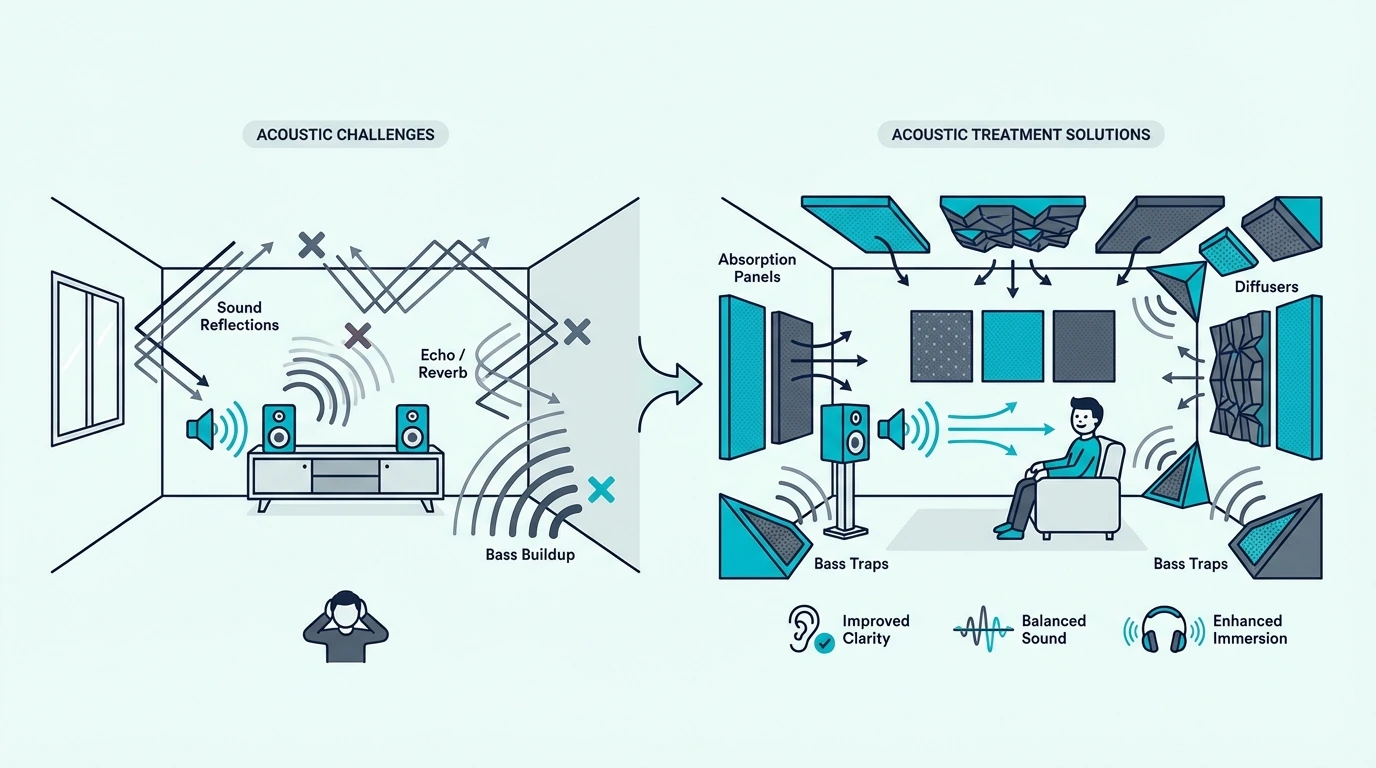
A home theater stuffs a multichannel surround system into a rectangular box — and that box fights the speakers at every turn. Understanding what goes wrong helps you spend treatment dollars where they actually matter instead of covering every wall with panels and hoping for the best.

Bass Problems And Room Modes

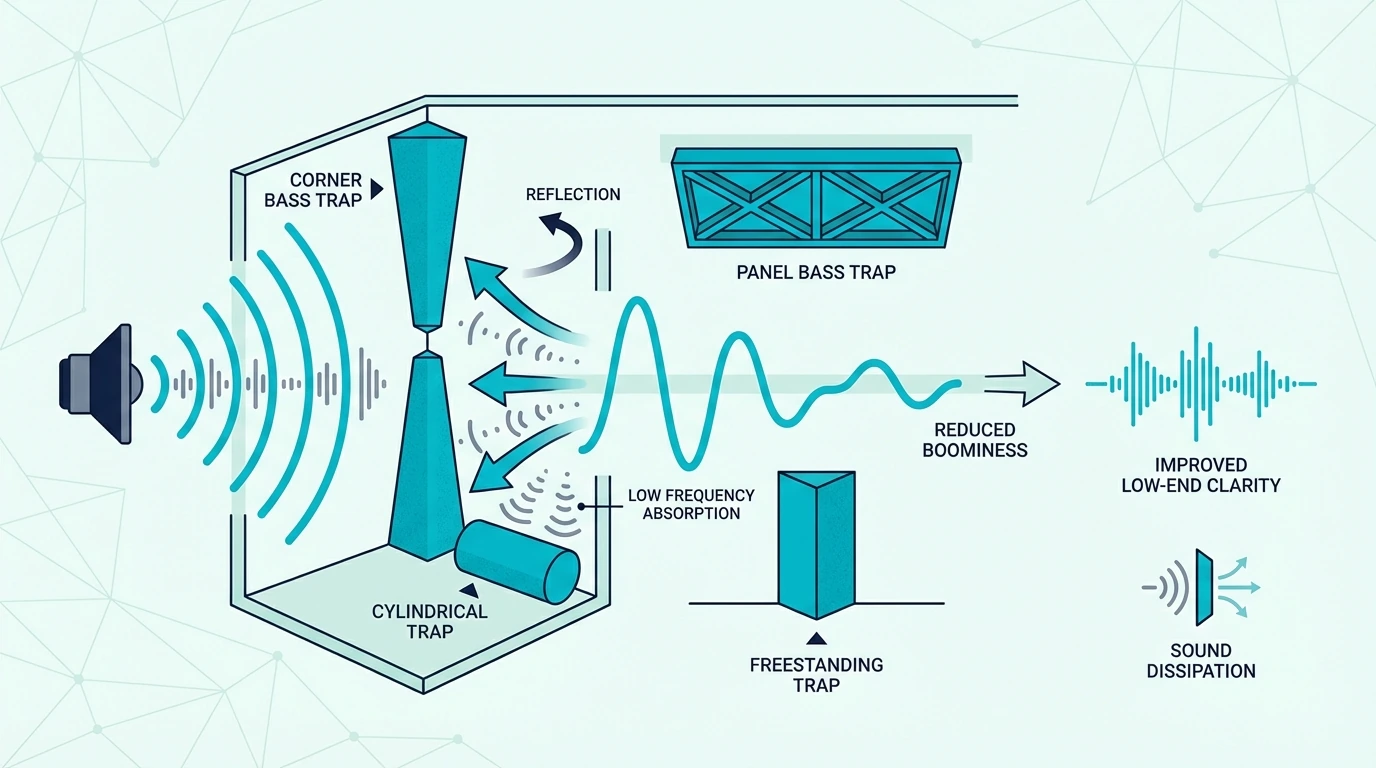
Low-frequency sound waves are long — a 60 Hz bass note has a wavelength over 18 feet. When that wave hits a wall and bounces back, it collides with the next wave coming from the subwoofer and creates pressure zones that stack energy in certain spots while canceling it in others.

Those pressure zones are called room modes, and they turn every action scene into a muddy, booming mess in some seats while the seat two feet over sounds thin. A 12 x 15 foot room with 8-foot ceilings has its first three axial modes between 37 Hz and 70 Hz — right in the heart of movie bass and soundtrack low end.

Corner placement amplifies the problem because low-frequency energy naturally piles up where three surfaces meet. Every vertical corner in your theater room is a bass accumulator, and without treatment, that accumulated energy bleeds into everything else.

The fix isn’t EQ or turning the subwoofer down — those approaches change what the sub sends out, but they cannot change how the room responds. Bass traps in the corners physically absorb that excess energy at the source. Budget foam corner traps like the TroyStudio foam bass traps cover all four vertical corners for under 35 dollars and tame the mid-bass buildup that makes action scenes sound muddy.

Dialogue Clarity And Early Reflections

Your center channel speaker handles most of the dialogue in a 5.1 or 7.1 system. The direct sound from that speaker reaches your ears first, but within 5-15 milliseconds, reflected copies arrive from the side walls, ceiling, and the wall behind the screen.

Those early reflections smear the consonants that make speech intelligible. The word “kick” starts sounding like “thick” because the reflected copy slightly shifts the timing and frequency balance of the original signal.

Panels at the first reflection points on the side walls — the spot where sound from the center channel bounces to the primary seating position — restore clarity without deadening the room. You only need treatment at the specific points where reflections arrive earliest, not across the entire wall.

A quick way to find those spots: have someone hold a mirror flat against the side wall at ear height while you sit in the main seat. Wherever you can see the center channel speaker in the mirror, that’s a first reflection point.

What Acoustic Treatment Does A Home Theater Need?

Acoustic treatment plan for a home theater

Now that you see where the problems come from, the treatment plan writes itself. Each surface in the room plays a different acoustic role, and the treatment for each one serves a different purpose.

Bass Traps In Front And Rear Corners

Every home theater needs a minimum of four corner bass traps — one in each vertical corner of the room. Thicker traps perform better: a 4-inch thick fiberglass or rockwool trap absorbs meaningfully at 80 Hz, while a 6-inch trap reaches down toward 50 Hz.

Floor-to-ceiling traps outperform short triangular wedges because low-frequency energy distributes along the entire vertical edge, not just at ear height. If full-height traps feel too imposing, stack two 4-foot panels per corner to cover the critical zone.

The front corners (behind or beside the screen) deserve the thickest traps because the front speakers and subwoofer drive the most low-frequency energy into those junctions. Rear corners handle the reflected bass that the front traps missed.

For a dedicated theater room, fiberglass or rockwool insulation in a simple wood frame is the most cost-effective bass trap you can build. The material cost per corner runs far less than a single pre-made broadband trap at the same thickness.

Side Wall Panels At Reflection Points

Side wall treatment targets early reflections from all five front-facing speakers (left, center, right, and the two surround channels in a 5.1 layout). Panels at ear height between the screen wall and the primary row of seats intercept the reflections that cause the most damage to dialogue and imaging.

Two panels per side wall — placed at the first and second reflection points — handle the worst offenders. Each panel should be at least 2 inches thick and made from fiberglass or mineral wool wrapped in acoustically transparent fabric.

Ready-made panels like the UMIACOUSTICS 4-Pack Fiberglass Panels come with brackets for fast wall mounting and cover the mid-to-high frequency range where dialogue clarity lives.

If aesthetics matter as much as performance — and in a home theater, they usually do — decorative fabric-wrapped panels with high NRC ratings blend with theater decor while still absorbing in the critical speech frequencies.

Rear Wall And Ceiling Treatment

The rear wall catches reflected bass from the subwoofer and reflected surround energy from the rear speakers. Two treatment strategies work here depending on how much space you have.

Absorption on the rear wall works the same way as side wall panels — it kills reflections that would otherwise arrive at the seating position with a delay long enough to cause audible coloring. This is the safer choice for rooms with rear surround speakers mounted close to the back wall.

Diffusion on the rear wall scatters reflected energy in many directions instead of absorbing it. Scattered reflections sound more spacious and keep the room from feeling dead.

If your rear speakers are at least 3-4 feet in front of the back wall, diffusion adds a sense of envelopment that pure absorption cannot provide. The scattered energy fills the space behind you without creating distinct echoes.

The ceiling needs one treatment panel — a ceiling cloud — centered above the primary seating row. That single panel intercepts the strongest overhead reflection that otherwise smears the center channel image and creates a sense of the sound “collapsing” toward the ceiling instead of staying locked to the screen.

Home Theater Treatment On A Budget

Budget acoustic treatment options for home theaters

Professional acoustic panels are not cheap, but the room doesn’t care whether the treatment cost hundreds or thousands — it only cares whether the right material sits in the right place at the right thickness.

DIY Panels With Rockwool Or Fiberglass

A 2 x 4 foot panel built from a simple 1 x 4 pine frame filled with 2-inch Rockwool Safe’n’Sound or Owens Corning 703 and wrapped in acoustically transparent fabric costs a fraction of a comparable commercial panel. The SoundAssured Acoustically Transparent Fabric lets sound pass through to the core instead of bouncing off a sealed surface — which is the whole point of wrapping.

Building four side-wall panels and four corner traps from raw materials typically runs 40-60% less than buying the same coverage in pre-made panels. The tradeoff is time: plan a full weekend for cutting, framing, stuffing, and wrapping.

If you want step-by-step instructions for building your own panels, the process is straightforward enough for anyone who can operate a saw and a staple gun.

Prioritizing Treatment On A Tight Budget

When the budget forces you to choose, this order gives the biggest return per dollar:

  1. Corner bass traps first — they fix the most damaging problem (room modes) and improve the entire frequency range, not just the bass
  2. Side wall panels at first reflection points — two panels per side restore dialogue clarity immediately
  3. Ceiling cloud above the main seat — one overhead panel tightens imaging across the front soundstage
  4. Rear wall treatment last — absorption or diffusion here refines the surround field but is not critical until the first three are covered

That order matters because each layer compounds the previous one. Bass traps clean up the low end so the side wall panels can work on a cleaner signal, and the ceiling cloud locks the front soundstage into place once the walls are handled.

Heavy curtains over windows and thick rugs on hard floors help absorb scattered reflections in the mid and high frequencies. Neither replaces proper panels at reflection points, but they reduce the overall reverb time enough to notice, especially in rooms with tile or hardwood.

A full home theater treatment setup doesn’t have to happen in one purchase. Start with corners and side walls, listen for the improvement, then add the ceiling and rear wall when the budget allows.

Each step compounds — the room gets noticeably better with every panel you add. Most people report the biggest jump after installing corner bass traps, with dialogue clarity following closely once the side wall panels go up.

If you want to estimate the total project cost for acoustic treatment, the biggest variable is whether you build panels yourself or buy them pre-made.

Choosing Pre-Made Panels For Speed

Not everyone wants a DIY weekend project, and pre-made panels close the gap between effort and results. Budget-friendly options like the Olanglab Fiberglass Panels ship ready to mount with fabric wrapping and fiberglass cores that perform at the frequencies where dialogue clarity matters most.

The advantage of pre-made panels is consistency. Every panel in the pack has the same density, the same NRC, and the same dimensions — no guessing whether your DIY cuts are even or whether the fabric tension is tight enough.

Mount them at the same reflection points you would use for DIY panels, and the acoustic result is nearly identical. The only real difference is cost versus time.

For a full list of budget acoustic treatment options, the roundup covers both DIY materials and pre-made panels with verified performance specs.

The Bottom Line

A home theater system is only as good as the room it plays in, and treating that room follows a clear priority order: corner bass traps first, side wall panels at reflection points second, ceiling cloud third, and rear wall treatment last.

Every step in that sequence fixes a specific problem — boomy bass, muddy dialogue, collapsed imaging, or harsh surround reflections. You don’t need to treat every surface to hear a dramatic improvement.

Start with the corners and reflection points, and the complete guide to acoustic treatment can help you plan the rest when you’re ready to expand. If you want a kit that bundles panels with mounting hardware, the best acoustic treatment kits roundup covers the options worth considering.

Frequently Asked Questions

How many acoustic panels does a home theater need?

A typical 5.1 home theater needs 8-14 panels: 4 corner bass traps (one per vertical corner), 4 side wall panels (2 per wall at first reflection points), 1-2 ceiling panels above the primary seating row, and 2-4 rear wall panels for absorption or diffusion.

Smaller rooms can get away with fewer panels because the reflection paths are shorter and fewer surfaces contribute overlapping problems. A 10 x 12 foot room often needs just 8-10 panels to sound dramatically better.

Do you need acoustic treatment in a home theater?

If you have ever turned up the center channel to hear dialogue during quiet scenes and then flinched when an explosion hit, that’s the room — not the receiver. Treatment controls bass buildup in corners and kills the early reflections that smear speech clarity.

Even a basic setup with four bass traps and four wall panels transforms a boomy, harsh room into one where every seat sounds balanced. For DIY builders, Rockboard 60 mineral wool boards produce enough material for four corner bass traps from a single 6-pack and deliver deeper bass absorption than any foam alternative.

What is the best acoustic treatment for a home theater?

Corner bass traps made from 4-6 inch thick fiberglass or rockwool deliver the single biggest improvement because they address room modes that no amount of EQ can fix. After corners, 2-inch thick fiberglass panels at the first reflection points on the side walls and a ceiling cloud above the listening position complete the essential treatment package.

Best Acoustic Treatment For Ceiling (The Surface Most People Ignore)

Best acoustic treatment for ceiling starts with one fact most home studio owners overlook — the ceiling creates some of the strongest early reflections in any room, but most people skip it entirely and wonder why their mixes still sound muddy.

That muddy low-mid buildup sitting on top of every vocal take and every guitar track isn’t a mic problem or a plugin problem — it’s an untreated ceiling bouncing energy straight back into your monitoring position before your ears can separate the direct sound from the reflection.

Treat that overhead surface with the right panel in the right position, and you get tighter stereo imaging, cleaner reverb tails, and a mix position you can actually trust across different playback systems.

Below, this guide breaks down why ceiling reflections hit harder than most wall reflections, what types of ceiling treatment exist, and how to install each one without ripping out drywall or hiring a contractor.

The first step is understanding what makes overhead reflections so damaging — and why one well-placed ceiling panel outperforms a half-dozen random wall panels.

Quick Takeaway

To treat your ceiling acoustically, hang a fiberglass or mineral wool panel (called a ceiling cloud) directly above your listening position with a 2-4 inch air gap. That single panel controls the strongest overhead early reflection in most rooms and improves stereo imaging more than any other single treatment placement.

Why Does The Ceiling Matter For Acoustic Treatment?

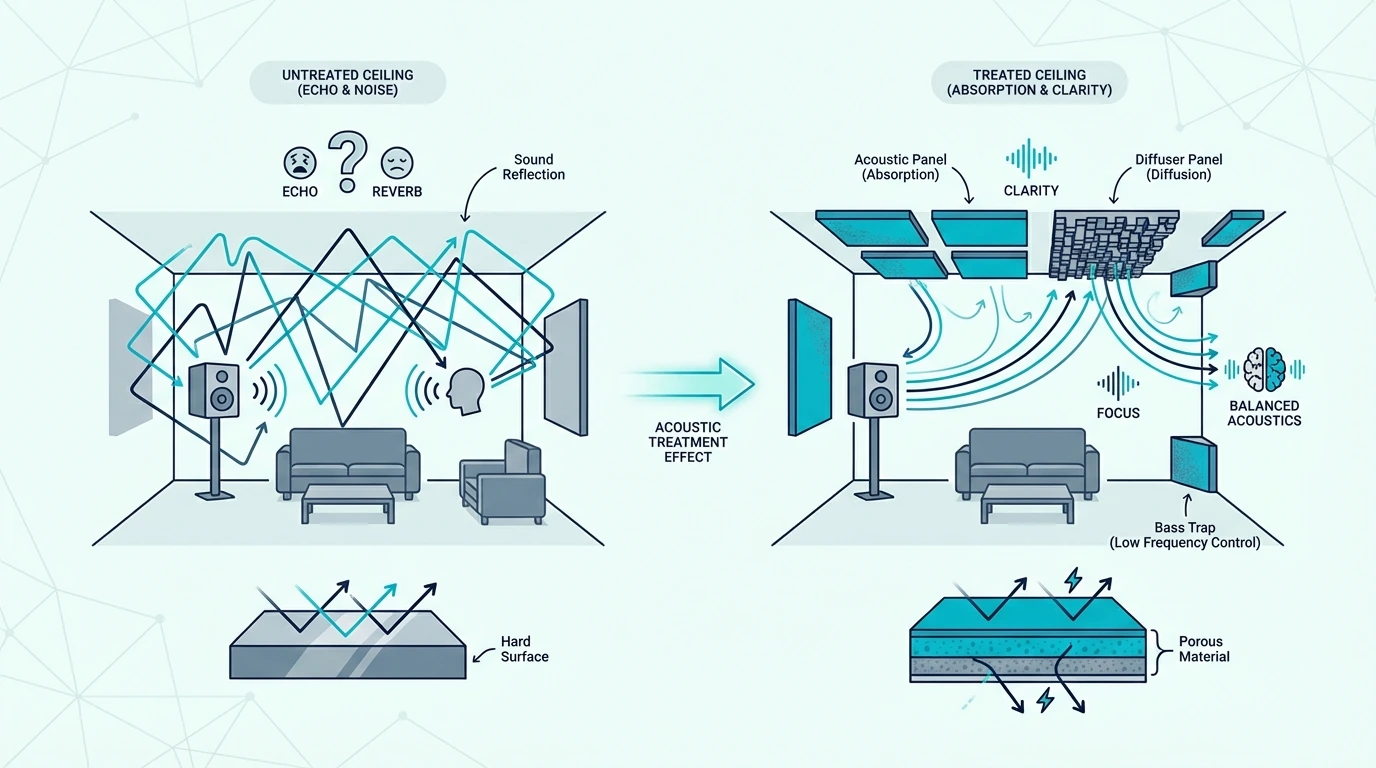
Why ceiling reflections matter in acoustic treatment

That flat surface sitting quietly above your mix position creates a shorter reflection path than most walls — and that shorter path is exactly why ceiling treatment deserves priority over almost everything else in a small room.

The Reflection Point You Cannot Dodge

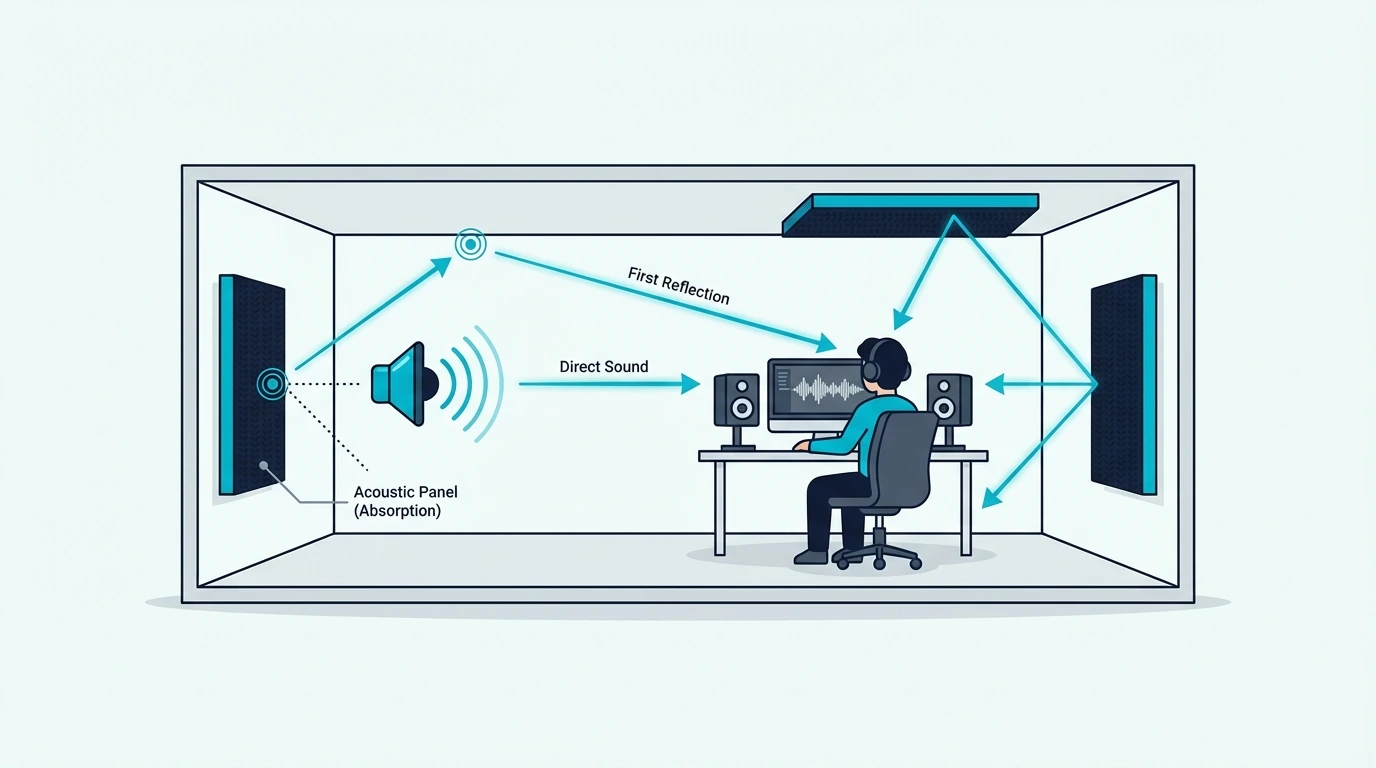
Sound from your monitors hits the ceiling and bounces straight back to your ears. The distance is shorter than the path to most side walls, which means the reflected sound arrives sooner and blends with the direct signal before your brain can separate the two.

A reflection arriving within the first 15-20 milliseconds of the direct sound doesn’t register as a separate echo — it colors the original tone. You hear it as thickness, smearing, or a vague sense that the low-mids are always piling up.

In a typical home studio with 8-foot ceilings, the ceiling reflection reaches you roughly 3-5 milliseconds after the direct sound. That’s fast enough to shift perceived frequency balance and smear the stereo image between your left and right monitors.

Clap your hands once while standing at your mix position and listen for a bright, metallic ring from above. If you hear it, that’s the ceiling reflection dominating your monitoring environment.

Ceiling Versus Walls — Where Your Treatment Budget Pays Off First

Side walls and rear walls matter, but the ceiling reflection often ranks as the second strongest reflection point in a room — right after the wall directly behind your monitors.

Most people tackle wall panels first because walls feel obvious and accessible. The ceiling gets skipped because it feels harder to reach, harder to mount, and less visible to anyone walking into the room.

That instinct is backwards in rooms where the ceiling height is shorter than the wall-to-wall distance. In a 10 x 12 foot room with 8-foot ceilings, the ceiling is the closest large reflective surface above the mix triangle — closer than either side wall.

Treating it first, even before side walls, gives you a cleaner home studio monitoring position with less effort. One well-placed ceiling cloud does the work that would take two or three wall panels to approximate from the sides.

What Types Of Ceiling Acoustic Treatment Exist?

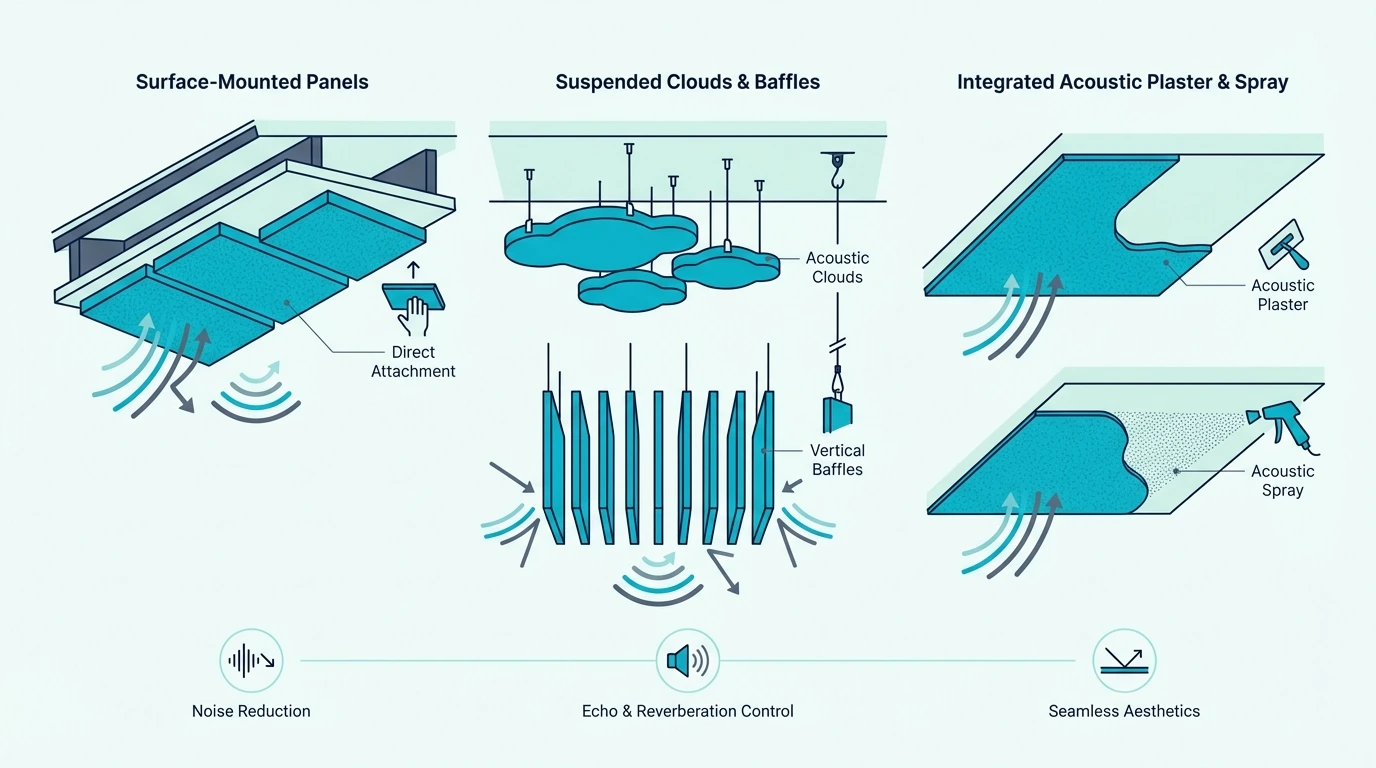
Types of ceiling acoustic treatment

Now that you see why overhead reflections cause so much damage, the next question is what to actually hang up there. Three main options cover virtually every scenario, and each suits a different ceiling height, budget, and mounting situation.

Ceiling Clouds

A ceiling cloud is a fabric-wrapped fiberglass or mineral wool panel suspended below the ceiling with an air gap between the panel and the surface. That air gap is what separates a cloud from a flat panel glued overhead — and it makes a measurable difference in low-frequency performance.

With a 2-4 inch air gap, a 2-inch thick fiberglass cloud absorbs effectively down to roughly 250 Hz. Without the gap, that same panel barely touches anything below 500 Hz, which means all of those muddy low-mid reflections pass right through.

Clouds work best in studios, home theaters, and any room where you sit in a fixed listening position below the panel. The sweet spot is directly above the mix position, centered between the left and right monitors.

A ready-made option like the UMIACOUSTICS 4-Pack Fiberglass Acoustic Panels with Hanging Brackets ships with the mounting hardware already included, which saves a separate trip for eye hooks and wire.

Direct-Mount Ceiling Panels

When suspension hardware isn’t an option — popcorn ceilings, concrete overhead, or a landlord who bans holes — direct-mount panels fill the gap with a simpler install.

These panels attach flush to the ceiling using construction adhesive or impaling clips. No air gap, no cables, and a lower profile that barely changes the visible ceiling height.

The tradeoff is predictable: without an air gap, absorption drops off sharply below 500 Hz. You still get solid mid and high frequency control, which helps noticeably with speech clarity, flutter echo, and vocal recording.

Direct mounting suits office ceilings, podcast rooms, and spaces where overhead treatment needs to be subtle. Lightweight panels like the Olanglab Fiberglass Acoustic Panels 4-Pack are thin and light enough for adhesive mounting without worrying about gravity pulling them off overnight.

Acoustic Ceiling Tiles And Baffles

Drop-ceiling tiles sit inside a suspended grid framework — the kind you see in commercial offices and conference rooms. They replace standard ceiling tiles with higher-NRC rated versions that absorb more energy across the grid.

Baffles take a different approach entirely. They hang vertically from the ceiling in large open spaces where the ceiling area alone cannot hold enough flat treatment to control the reverberation time.

Neither option targets a single reflection point the way a cloud does. Tiles spread absorption across the entire ceiling grid, and baffles scatter and absorb sound arriving from all directions rather than focusing on one listening position.

For home studios and home theaters, ceiling clouds outperform both options by a wide margin. Tiles and baffles make practical sense only in commercial or large-venue contexts where the ceiling is 12 feet or higher and no single listening position dominates.

How To Install Ceiling Acoustic Treatment

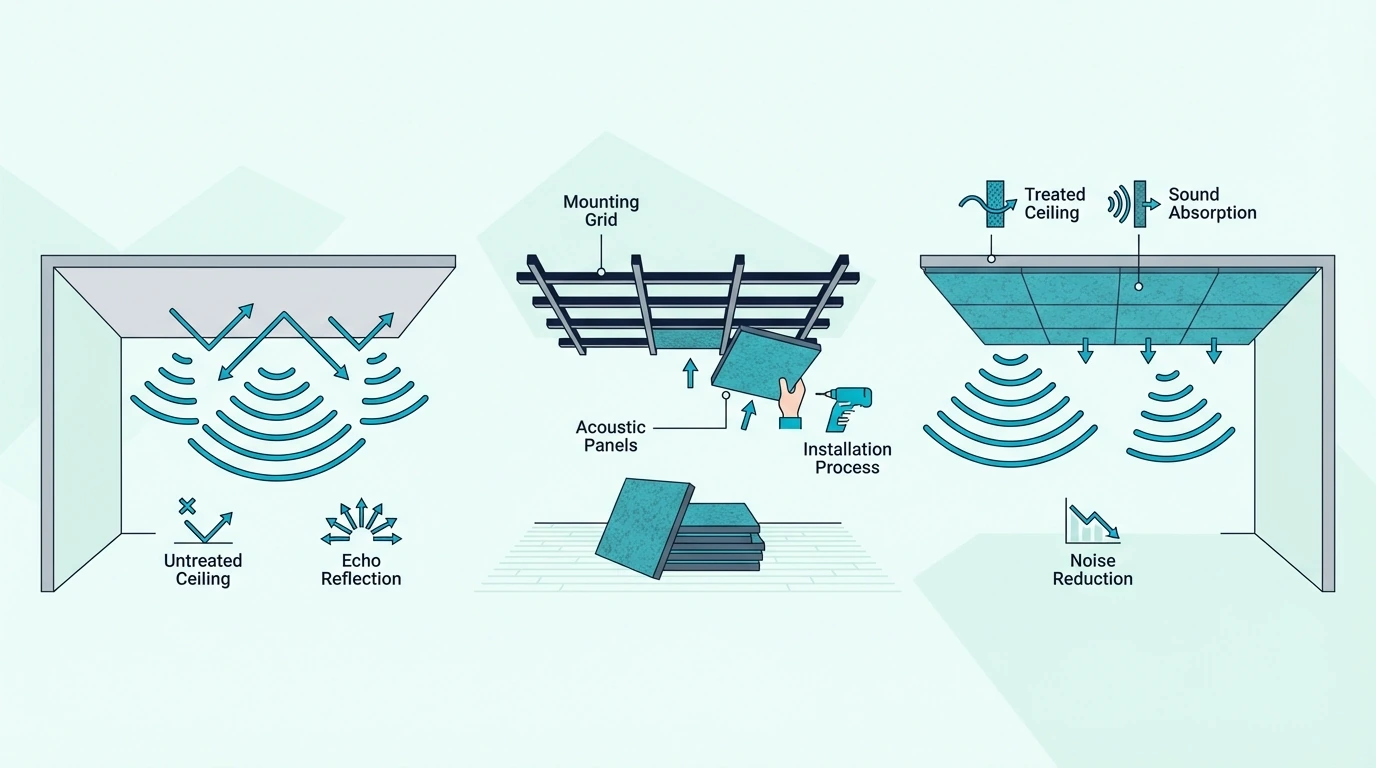
Ceiling acoustic treatment installation methods

Knowing what type of ceiling treatment works best only matters if you can actually get it mounted safely overhead. Two installation methods cover almost every ceiling situation, and the one you pick depends on whether an air gap is possible in your space.

Suspended Installation With Air Gap

The most effective ceiling treatment method uses eye hooks screwed into ceiling joists, with aircraft cable or picture wire holding the panel 2-4 inches below the surface.

Start by locating your ceiling joists with a stud finder. Eye hooks need to thread into solid wood — drywall anchors alone will not support a fiberglass panel overhead long-term, especially with any vibration from footsteps on the floor above.

Space four eye hooks in a rectangle matching the panel corners, then run wire from each hook to the panel frame. Adjust the wire length until the panel hangs level with a consistent gap behind it.

A standard 24 x 48 inch fiberglass panel weighs roughly 4-8 pounds. That’s well within the capacity of standard eye hooks in joists.

Heavier hybrid panels like the Jocavi WoodWaves Absorption-Diffusion Panels need structural screws or toggle bolts rather than basic hooks. Always check the hook or anchor rating against the panel weight before you mount anything.

If you want a complete acoustic treatment kit that bundles ceiling panels with wall panels and mounting hardware, that can simplify the shopping step — especially for a first room setup.

Direct Mount Installation

For ceilings where suspension is not feasible — concrete, rental restrictions, or no accessible joists — impaling clips or construction adhesive handle the job with fewer holes and less hardware.

Impaling clips are metal plates with sharp pins that push into the back of the panel. You screw the flat plate to the ceiling, then press the panel onto the pins until it holds flush against the surface.

Construction adhesive (like Loctite PL Premium) bonds the panel directly overhead. This approach is permanent — pulling the panel off later damages both the panel face and the ceiling finish underneath.

Between the two, impaling clips suit most situations better. They leave only small screw holes, hold the panel securely, and let you remove or reposition later without destroying anything.

That flexibility matters if you ever build your own panels and need to swap them out. The total cost for ceiling treatment stays lower when your mounting method doesn’t force you to replace panels every time you adjust the layout.

The Bottom Line

The ceiling is the most cost-effective surface to treat in a small room because one panel above the listening position controls the strongest overhead reflection — and that single reflection shapes stereo imaging more than most people expect.

Start with one ceiling cloud hung 2-4 inches below the surface, centered between your monitors. Everything else — side walls, rear walls, bass traps — performs better once that overhead reflection is under control.

If you’re still mapping out your full room treatment plan, the complete guide to acoustic treatment covers every surface and every placement priority. And if budget is tight, the best budget acoustic treatment roundup shows what delivers real results without spending more than you need to.

Frequently Asked Questions

How do you acoustically treat a ceiling?

Hang a fiberglass or mineral wool panel above your listening position using eye hooks screwed into ceiling joists, with wire holding the panel 2-4 inches below the surface. That air gap lets the panel absorb lower frequencies that a flush-mounted panel would miss entirely. For DIY ceiling clouds, Rockboard 60 mineral wool boards hold their shape when suspended overhead and absorb deeper into the low-mids than lighter insulation options.

Do acoustic ceiling baffles work?

Baffles are effective in large spaces with high ceilings — gymnasiums, warehouses, open-plan offices — where wall treatment alone cannot control the reverb time. For home theaters and home studios with standard 8-10 foot ceilings, a ceiling cloud directly above the seating position outperforms baffles because it targets the specific reflection that matters most.

Are acoustic ceiling tiles worth it?

For offices and conference rooms with drop-ceiling grids, acoustic tiles reduce overall reverberation and improve speech clarity across the room. For studios, they spread absorption too thinly — a focused ceiling cloud above the mix position gives you deeper absorption right where the strongest reflection hits.

Best Budget Acoustic Treatment

Best budget acoustic treatment can absolutely make a room sound better, but the cheapest option in the category is usually not the best value. If you spend money on the wrong material, you end up with a room that feels less echoey while the real bass and reflection problems stay right where they were.

That is why budget acoustic treatment frustrates so many people. You buy foam because it is inexpensive, easy to mount, and everywhere on Amazon, then you still hear muddy low end, a smeared stereo image, and recordings that sound boxy or papery.

The good news is that you do not need a luxury budget to get meaningful improvement. You just need to spend on the parts of treatment that actually change what you hear, and skip the products that only look acoustic.

Start with the reality check: cheap treatment only helps if it targets the right problem instead of the cheapest listing. Below, you will see what to buy first on a tight budget, which options are actually worth your money, and which DIY materials, pre-made panels, and bass traps make the strongest picks right now.

Quick Takeaway

The best budget acoustic treatment is usually DIY mineral wool or fiberglass before it is cheap foam. If you want the best value overall, start with rigid or semi-rigid insulation for DIY panels, then move to pre-made fiberglass panels if you need convenience. On a very tight budget, prioritize corners first, then side-wall reflection points, then the ceiling cloud above the listening position.

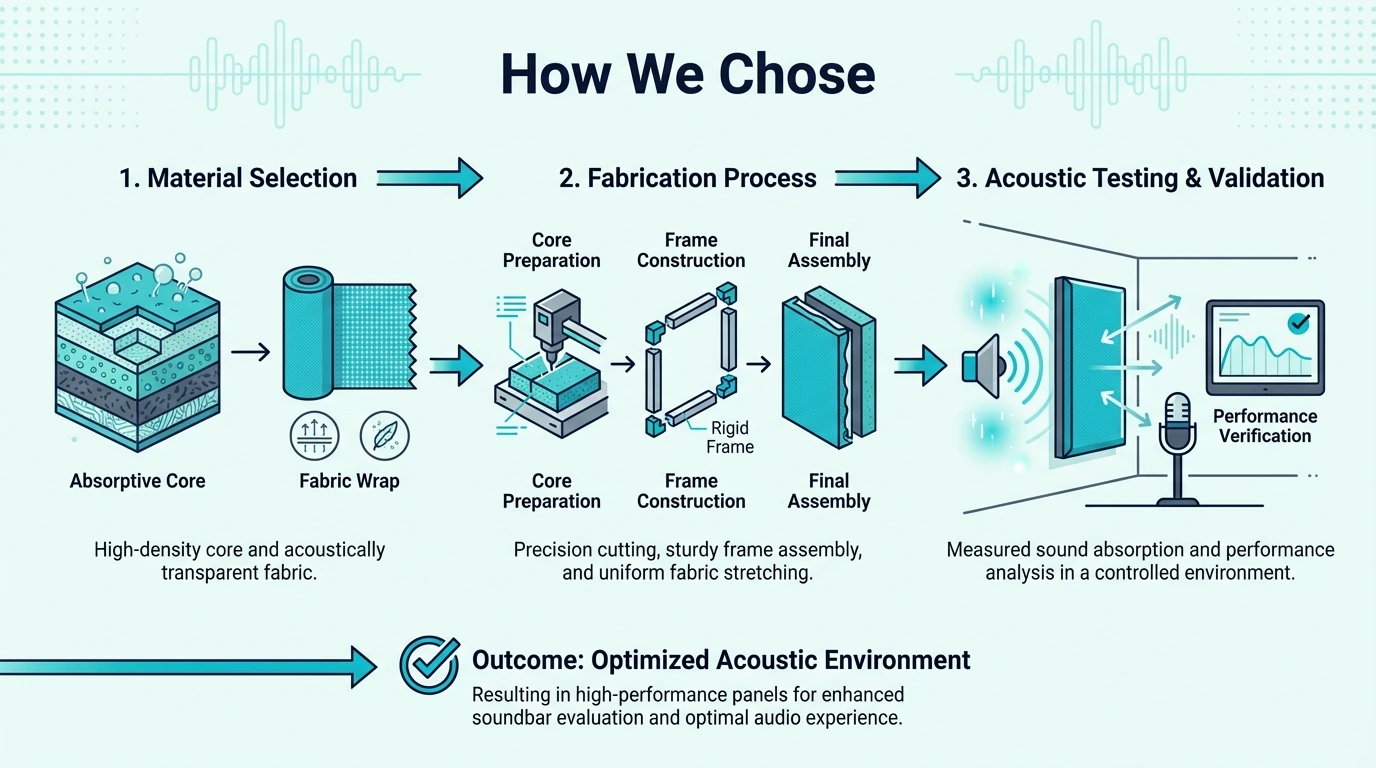
How We Chose The Best Budget Acoustic Treatment

How budget acoustic treatment options were chosen

Budget treatment is not just about the lowest price tag. It is about how much useful absorption you get for the money, how much problem-solving a product can do in a real room, and how many corners the manufacturer cuts to hit the price.

That means I did not treat all cheap products as equal. Thin decorative foam, vague “soundproof” mats, and generic room décor do not deserve the same weight as mineral wool, fiberglass, or purpose-built bass traps that actually address the problems most rooms have.

I used four filters for this list. First, the product needed a believable use case for acoustic treatment rather than noise blocking or heat insulation alone.

Second, it needed to offer real performance per dollar. A DIY material can outrank a pre-made panel if it delivers much more absorber area for the same money.

Third, the product needed a realistic budget story. Some options here are true starter buys, while others are “budget stretch” upgrades that still make sense when you compare them to premium boutique treatment.

Fourth, I weighed convenience against value. A product that is cheaper but requires woodworking, fabric wrapping, and extra hardware is not the same kind of buy as a panel you can mount the same day.

That last point matters because budget does not just mean dollars. It also means time, tools, space, and how much friction you can tolerate before the project stalls.

If you need the wider foundation first, what acoustic treatment is explains the basic absorber-versus-problem logic behind every pick on this list.

I also discounted products that hide the only details that really matter, like material type, thickness, or actual intended acoustic use. If a listing leans on vague words like soundproof, studio, or noise cancelling without showing believable absorber material, it is usually a bad budget buy no matter how low the price looks.

What Can You Actually Get On A Budget?

What acoustic treatment you can get on a budget

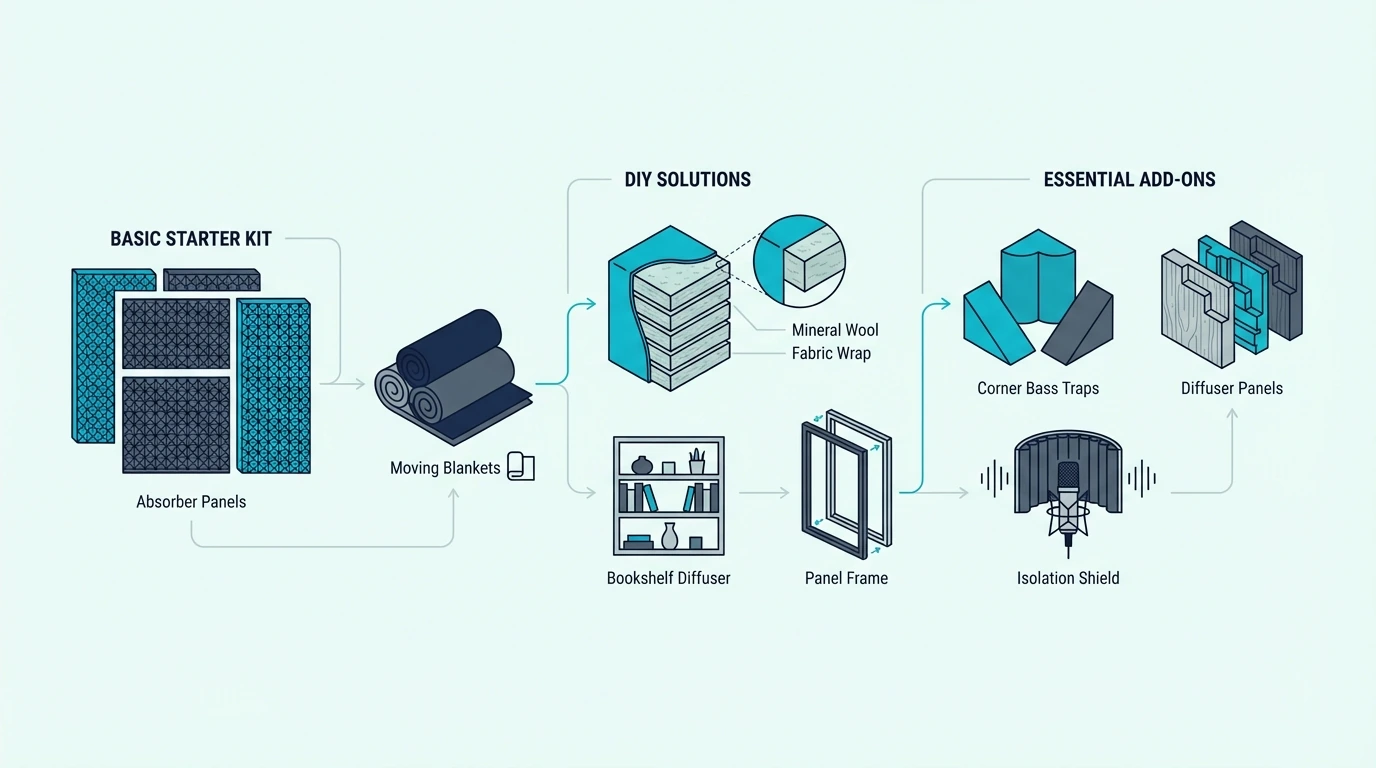
Budget acoustic treatment falls into two broad buckets. You can either build better-performing treatment yourself, or you can pay extra for the convenience of pre-made panels and traps.

DIY Panels — The Best Value

If your goal is maximum absorption per dollar, DIY panels usually win. A stack of mineral wool or fiberglass batts inside simple wood frames can outperform many cheap commercial products, especially when you build them thick enough and leave a small air gap behind them.

That is why the cheapest effective treatment often is not a finished panel at all. It is raw absorber material plus some labor.

The catch is that DIY is only a bargain if you are actually going to finish it. If the insulation sits in the garage for two months because you still need fabric, timber, and a free weekend, the “best value” argument gets weaker fast.

DIY also rewards better decisions. If you build 4-inch panels for first reflections or corners using the best acoustic treatment materials, you can solve real room problems for surprisingly little money compared with buying thin decorative products that do almost nothing below the midrange.

That is one reason fiberglass acoustic treatment keeps coming up in serious rooms even when the budget is tight.

Budget Commercial Options

Budget commercial treatment lives in a narrower lane. The good options usually cost more than first-time buyers hope, because real broadband absorption needs real material depth.

That means good budget pre-made panels are still often fiberglass or mineral-wool based. They just trade labor for convenience, cleaner finishing, and hardware that lets you get them on the wall quickly.

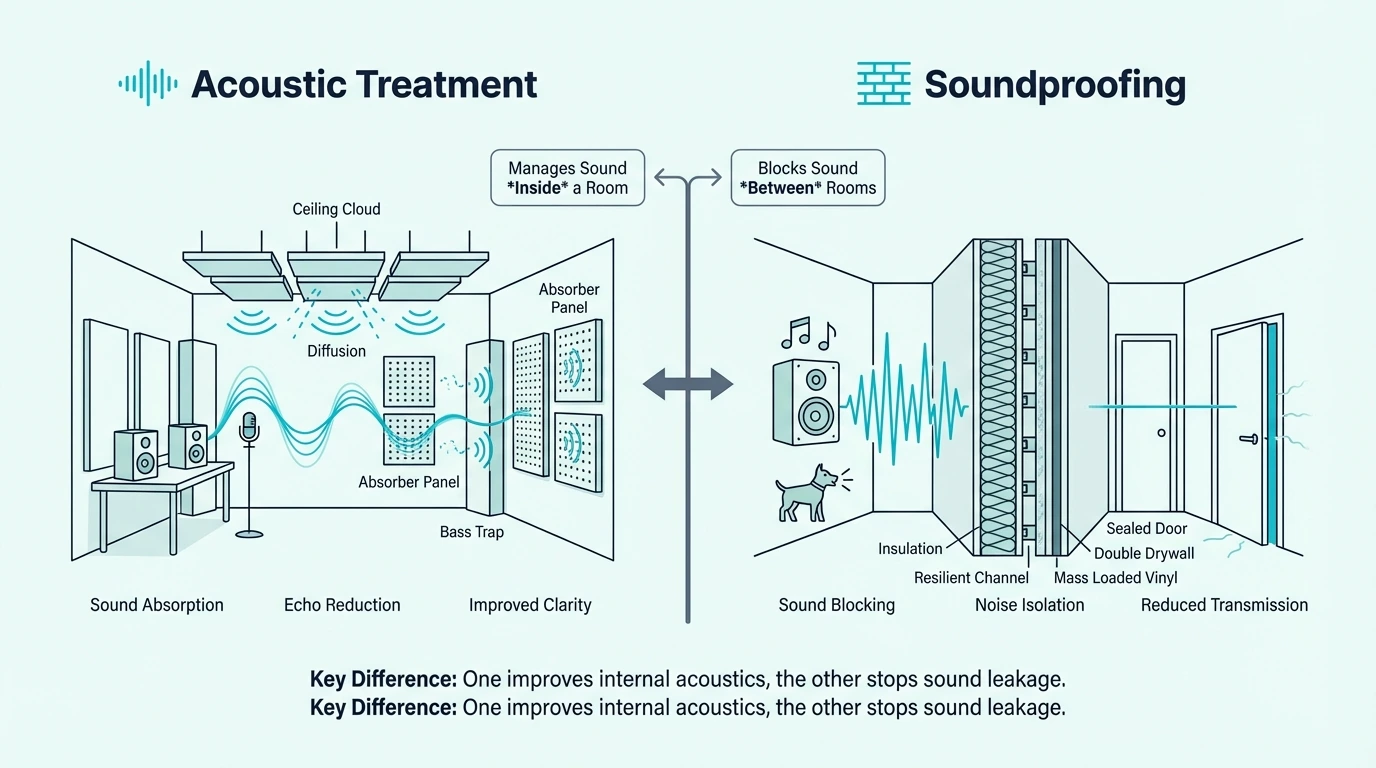
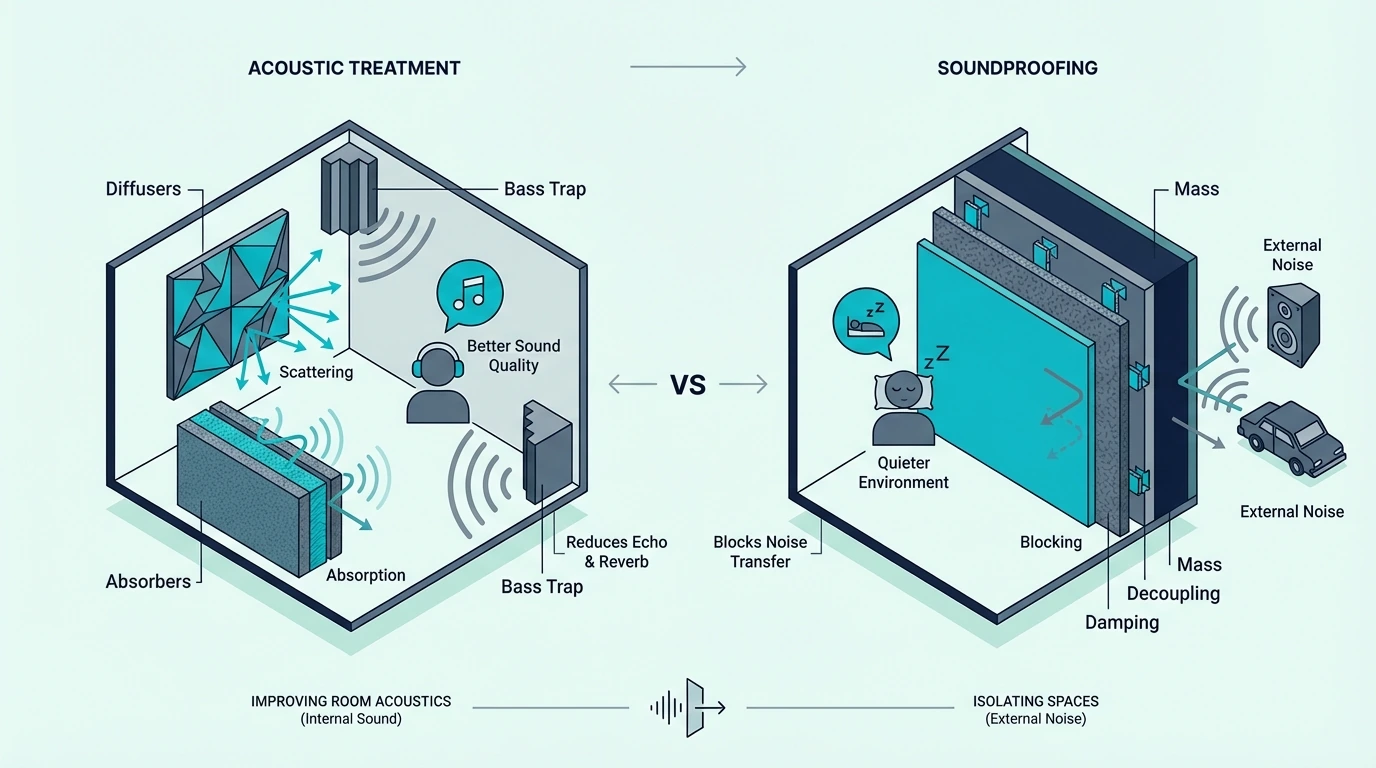
What you cannot realistically expect from the budget commercial tier is miracle performance from the cheapest foam pack on the page. Foam can help with flutter echo, but it is not the same thing as broadband panel treatment and it is definitely not the same thing as soundproofing.

So the budget question is not “what is cheapest?” It is “what gets me the most useful improvement for the least regrettable spend?”

That is why the budget commercial tier starts with credible fiberglass packs rather than novelty foam shapes. Once you frame the decision around cost per useful improvement instead of cost per listing, a lot of the cheapest options stop looking cheap at all.

For rooms where convenience matters as much as price, that same tradeoff shows up in a broader a home studio treatment plan too.

What Should You Buy First On A Tight Budget?

What to buy first for budget acoustic treatment

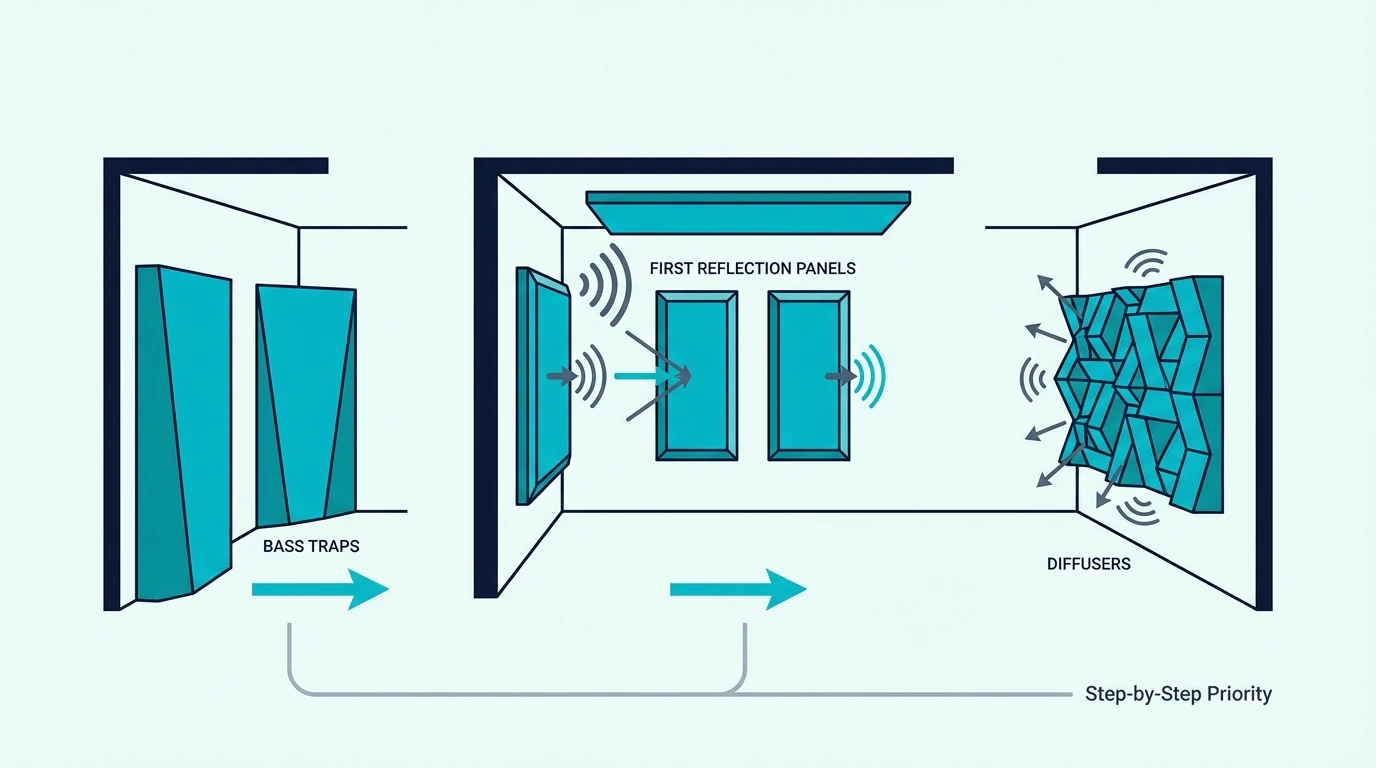
When money is tight, buying order matters more than brand. The best budget room is the room where you handled the biggest problem first instead of spreading a small budget thinly across six mediocre choices.

Start with corners if the room is for mixing, monitoring, or anything where low-end translation matters. Small rooms exaggerate bass buildup so badly that a little corner control often helps more than covering random wall patches with thin panels.

That is exactly why acoustic treatment for corners is such a common first upgrade.

After that, buy two panels for the first reflection points on the side walls. That gives you a more immediate improvement in clarity and stereo image than trying to decorate every open surface.

If your budget room is also compact, acoustic treatment for small rooms follows the same priority order for exactly this reason.

Then look at the ceiling cloud above the listening position. In rooms with normal residential ceiling height, that reflection comes back fast enough to matter, especially if you are mixing nearfield monitors in a small bedroom or office.

If low clearance is a special problem, ceiling acoustic treatment goes deeper on cloud placement and tradeoffs.

Diffusion, decorative slats, and “soundproof” accessories all come later. If the budget is under pressure, skip anything that does not directly help bass control, early reflections, or broadband absorption.
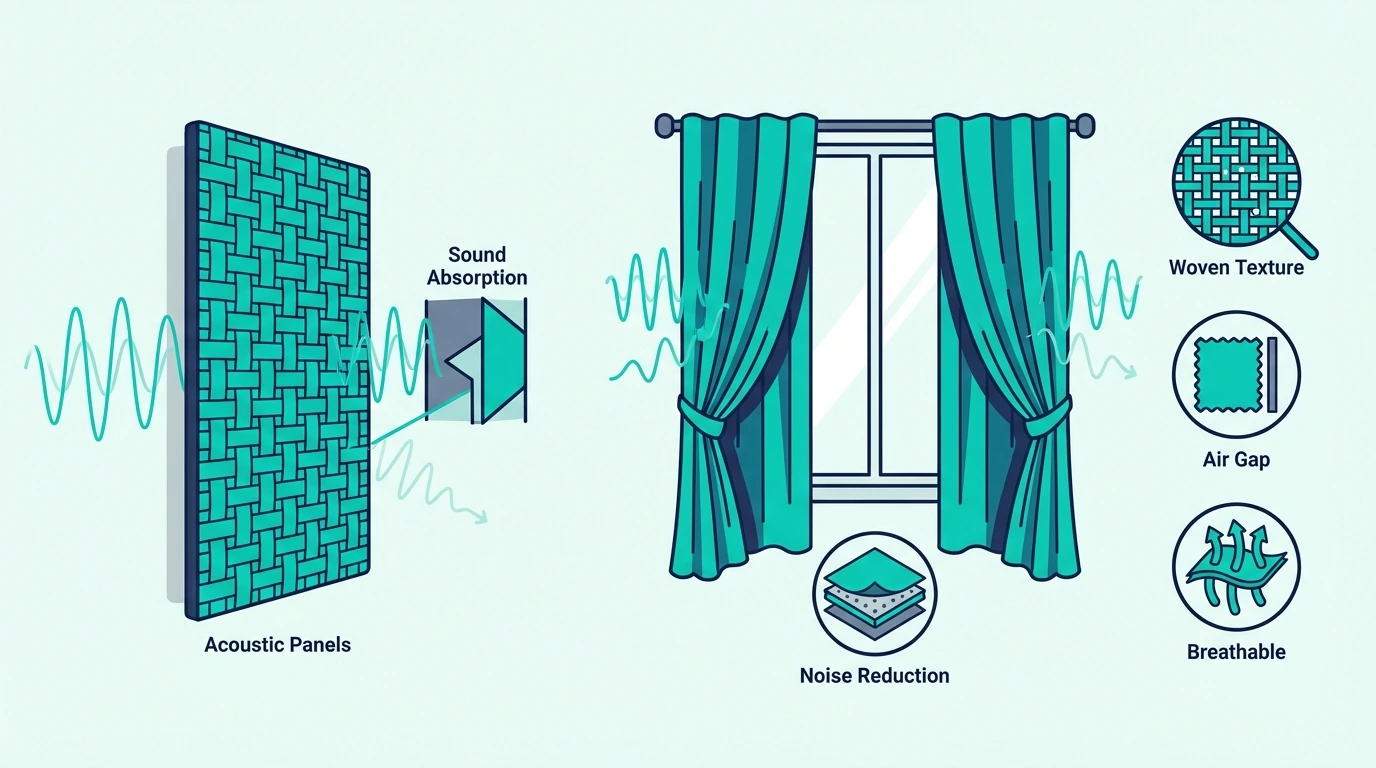
That is also why a budget plan should be honest about tradeoffs. Sometimes the smartest move is one DIY material purchase now, two side-wall panels next month, and a bass-trap upgrade after that instead of forcing a full-room buy in one order.

If you are trying to price that path honestly, acoustic treatment cost helps frame what a starter room versus a fuller setup usually adds up to.

If you are stuck choosing between more cheap foam and fewer real absorbers, buy fewer real absorbers. A smaller number of meaningful treatments usually does more for the room than a larger number of products that mostly change the look of the walls.

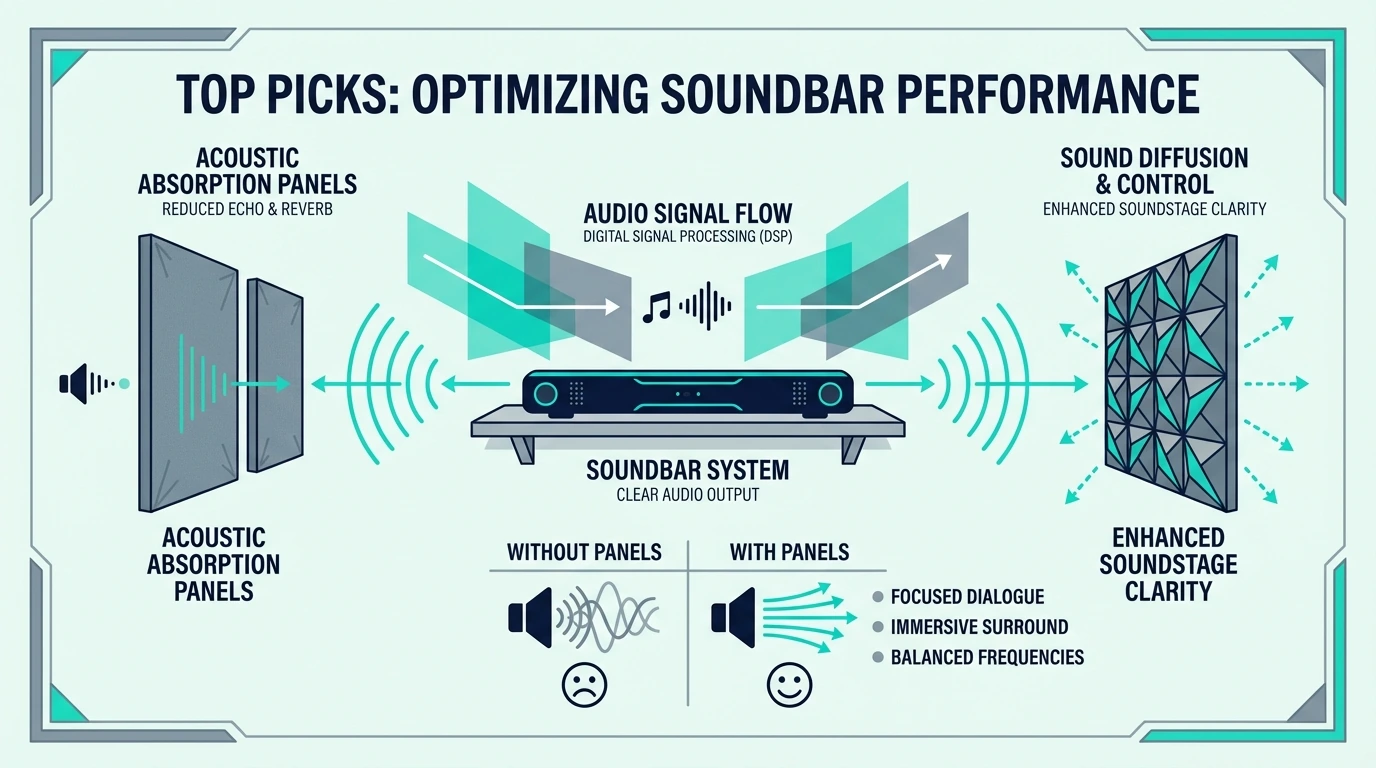
Our Top Picks For Best Budget Acoustic Treatment

Top budget acoustic treatment picks

The products below are not all the same type of buy. Some are for DIY value, some are for convenience, and some are there because the best budget setup usually mixes materials rather than relying on one cheap fix.

If you want a more bundled route, best acoustic treatment kits is the closest adjacent comparison.

Best Budget DIY Material

If you are willing to build your own panels, AFB Acoustical Fire Batts Mineral Wool Insulation is the strongest value buy in this roundup.

It is not glamorous, but that is exactly the point. You are paying for absorber material instead of a finished frame, branded packaging, and retail markup.

That makes it the right answer for buyers who want the most panel area for the least money. If you can handle a basic frame build and fabric wrap, this type of mineral wool usually beats cheap pre-made alternatives on pure performance per dollar.

The tradeoff is time and friction. If you know you will never build the frames, then the theoretical value is irrelevant and a pre-made panel becomes the smarter budget choice.

Best Budget Pre-Made Panels

For buyers who want a finished panel without jumping straight to premium pricing, UMIACOUSTICS 4 PCS Acoustic Panels with Hanging Bracket is the cleanest value play here.

The pack size makes sense for real rooms. You can cover the left and right first reflection points, still have two panels left for the front wall or a rear-wall problem area, and avoid the usual disappointment of under-buying with a tiny starter set.

That kind of practical fit matters even more if the room is used for speech or singing, which is why acoustic treatment for vocals often starts with the same reflection-point logic.

If your room is cramped or broken up by doors, windows, or furniture, Olanglab Fiberglass Acoustic Wall Panels 4 Pack is the better fit.

It gives you a more flexible footprint without sliding into novelty-sized décor. That matters when your “budget room” is also a bedroom, office, or shared space where oversized panels are harder to place.

If you want fewer, larger panels and you can stretch the budget without pretending it is the cheapest route, UMIACOUSTICS 2 PCS Large Fiberglass Acoustic Panels is the budget-stretch option that still earns its place.

I would not call it the cheapest solution, but I would call it a sensible upgrade if you care more about fewer large absorbers than maximizing panel count. For some rooms, that is the better spend.

This is the recurring pattern in budget treatment: starter products help you get moving, but the best-value purchase is often the one that prevents you from buying the same category twice. Spending a little more once can be cheaper than buying the wrong cheap product first and replacing it later.

That is also part of why buyers eventually compare best acoustic treatment brands instead of looking at price alone.

Best Budget Bass Traps

Budget bass control is where buyers are most likely to make bad compromises. The cheapest corner products are often foam, which can still help a little, but they should be treated as starter tools rather than a complete low-end solution.

If you need the lowest entry price, 8 Pack Bass Traps Acoustic Foam Corner Set is the one that makes the most sense.

It is affordable, it gives you enough pieces to start treating multiple corners, and it is honest about what a starter budget can buy. What it will not do is replace thicker rigid treatment when deeper bass control is the goal.

If you have a little more flexibility and want an option that behaves more like a real upgrade than a stopgap, 2 Pack Wooden Acoustic Bass Traps is the stronger buy.

It is not the first product I would recommend to someone with almost no budget. It is the product I would recommend to someone who tried the cheapest route, learned what the room actually needs, and wants the next purchase to matter more.

That is an important distinction for this whole category. Budget treatment should get you moving in the right direction, but it should also teach you which later upgrades are worth paying for and which ones are just marketing with a lower sticker price.

The Bottom Line

The best budget acoustic treatment is usually the product that solves the right problem first, not the one with the lowest sticker price. That is why DIY mineral wool stays the best pure-value answer, while pre-made fiberglass panels become the better call for buyers who need speed, finish quality, and less friction.

If your budget is tight, spend first on corners and first reflections. That gives you a room that becomes easier to trust before you worry about coverage everywhere else.

If you are buying for a media room rather than a desk setup, acoustic treatment for a home theater changes the placement priorities without changing the core budget logic.

If you can build, buy DIY material and put the savings into thickness. If you cannot build, buy the best-value pre-made fiberglass panel pack you can afford and avoid pretending foam alone will do the whole job.

Frequently Asked Questions

What is the cheapest effective acoustic treatment?

The cheapest effective acoustic treatment is usually DIY mineral wool or fiberglass inside simple absorber frames. That route takes more work, but it gives you much better performance per dollar than most ultra-cheap finished products.

Is acoustic foam worth buying on a budget?

Acoustic foam can be worth buying if you understand what it can and cannot do. It can help with flutter echo and some upper-bass issues, but it is not a substitute for thicker fiberglass or mineral wool when real broadband absorption is the goal.

How much does it cost to treat a small room?

A small room can often be treated in stages for a few hundred dollars if you start with corners and two side-wall reflection panels. DIY builds usually keep the budget lower, while pre-made panels and upgraded bass traps raise the cost faster but reduce the build time.

How To Do Acoustic Treatment For Home Studio (The Order That Fixes Your Room Fast)

How to do acoustic treatment for home studio is not about buying the most panels first — yes, acoustic treatment works, but small rooms improve only when you solve bass buildup and early reflections in the right order before you start covering random wall space.

Most people buy a few panels, place them wherever there is empty drywall, and then wonder why the room still sounds muddy, sharp, and inconsistent from one seat to the next.

The fix is to set the listening position first, treat the corners next, handle the early reflections after that, and only then decide how much extra absorption the room actually needs.

Below, this guide walks through that order step by step so you can build acoustic treatment in a home studio without wasting money or solving the wrong problem first.

Quick Takeaway

For most home studios, acoustic treatment should happen in this order: fix your listening position, add bass control in corners, place panels at first reflection points, hang a ceiling cloud, then decide whether the rear wall needs absorption or diffusion. If your budget is tight, do not spread treatment evenly across every wall. Put the first panels where the physics matters most and the room gets better much faster.

How To Do Acoustic Treatment For Home Studio — Where Do You Start?

Where to start with home studio acoustic treatment

The first move is choosing the right listening position, because every treatment decision depends on where your ears and monitors sit. Once the layout is centered, each panel solves a predictable problem instead of chasing a moving target.

If your desk faces the wrong wall or sits off-center, the room starts lying to you before any treatment goes up. One side reflects earlier, bass builds up differently behind each speaker, and the stereo image never feels fully locked in.

Facing the short wall is usually the safest starting point in a bedroom studio. That gives you more room depth behind you, which makes rear-wall reflections easier to control.

This is the same reason acoustic treatment placement matters more than raw panel count. A smaller number of well-placed panels beats a larger pile of treatment in random locations.

Center the desk between the side walls as closely as the room allows. Even a few inches of left-right imbalance can shift the image enough that you start making mix decisions that do not translate outside the room.

Avoid the exact middle of the room as well. That center spot often lands in a bass null, which makes the low end feel cleaner than it really is.

That is why how much acoustic treatment you need cannot be separated from layout. A bad layout demands more panels and still performs worse than a smarter setup with fewer of them.

If you are working in a 10×12 bedroom, try this simple test. Play a bass-heavy reference track, lean forward six inches, then lean back six inches.

If the low end changes dramatically, the room is showing you exactly why placement comes first. Treatment helps, but it cannot fully rescue a chair position that already sits inside a strong peak or null.

This is also why home studio plans should stay practical. You are not trying to build a perfect mastering room inside a spare bedroom.

You are trying to create a position that tells the truth often enough that your recording, editing, and balance decisions stop falling apart on headphones, in the car, and on other speakers.

How Should You Set Up Your Listening Position?

Listening position setup for home studio treatment

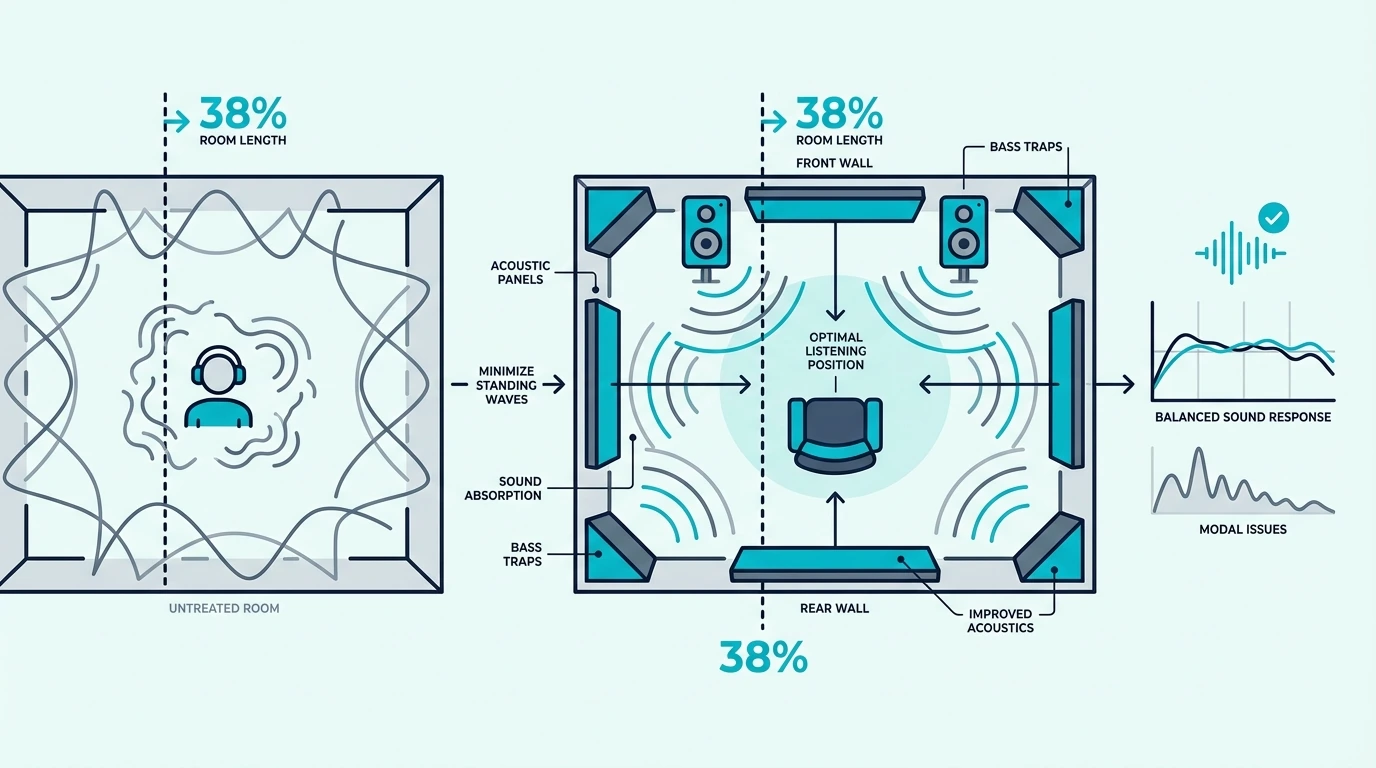
The listening position is the foundation for everything that follows. Start with the 38% rule, keep the monitors and your head in an equilateral triangle, and keep both speakers the same distance from the side walls.

This is where the room starts feeling intentional instead of improvised. Once the triangle is stable, your treatment plan becomes much easier to prioritize.

The 38% Rule For Speaker Placement

The 38% rule is the starting point for placing your chair far enough from the front wall to reduce the worst low-frequency peaks and nulls. Measure the room length and place your ears about 38% of that distance back from the front wall.

In a 12-foot room, that lands a little over 4.5 feet from the front wall.

It is not a perfect answer for every room, but it usually avoids the ugliest bass problems that happen when you sit too close to the center or too close to the wall.

Same principle applies in small rooms, where bass problems stack up faster because the boundaries are so close together. The tighter the room, the more every inch of chair position matters.

If you are building the room mainly for translation and editing, compare your choices against acoustic treatment for mixing. Home studio treatment and mixing-room treatment are almost the same conversation once monitors enter the picture.

Monitor Height And Angle

Tweeters should sit at ear height and the monitors should angle slightly toward your ears so the phantom center stays stable. If the tweeters fire above your head or into your chest, the tonal balance shifts before the room reflections even reach you.

Keep both speakers the same distance from the side walls. If one speaker hugs a wall while the other has breathing room, the stereo image leans to one side even when the mix itself is balanced.

Try to keep a little space between the speakers and the front wall too. A smarter layout with cleaner spacing often improves the room more than one extra panel purchase, which is why acoustic treatment cost should always be judged against setup quality first.

One more detail that helps more than people expect is monitor stand isolation. When the speakers couple directly into a desk, the desk itself starts acting like part of the room problem.

That does not replace treatment, but it explains why setup and treatment have to work together. The room only becomes trustworthy when the speaker position, desk position, and panel position all support the same goal.

What Acoustic Treatment Does A Home Studio Need?

Home studio acoustic treatment needs by room type

Home studios do not need every wall covered, but they do need the right problems solved in the right order: corners first, reflection points second, ceiling and rear wall after that.

That order matters because the room does not hurt every frequency equally. Bass buildup and early reflections usually do far more damage than a slightly lively rear wall or one untreated door.

Corner Bass Traps

Corners are the highest-value treatment positions in a home studio because low frequencies naturally pile up where boundaries meet. If the corners stay untreated, the room keeps sounding swollen and uneven even after the side walls look much cleaner.

This is where thickness matters more than appearance. A 100 Hz wave is roughly 11 feet long, which is why bass is so much harder to control than a bright slap off drywall.

The TroyStudio Bass Traps – 12 Pcs are a realistic starting point if you need to calm a bedroom studio without overspending immediately.

They are still a starter solution, not a full broadband answer. If you want the deeper why behind that, best acoustic treatment materials and rockwool acoustic treatment explain why denser fiberglass and mineral wool reach lower than foam.

Treat the front corners first if you cannot do every corner at once. Those positions interact most strongly with the monitors, so they usually tighten the low end faster than any other single move.

If you later want to refine the corner plan, acoustic treatment for corners is the natural next step because corner strategy changes with ceiling height, air gap, and whether you can straddle the boundary instead of mounting flat.

First Reflection Panels

First reflection panels on the side walls reduce the early reflections that smear the stereo image and make panning harder to trust. These reflections arrive just milliseconds after the direct sound, which is exactly how comb filtering sneaks into a small studio.

Use the mirror trick here. Sit at the mix position, have someone move a mirror along the wall, and mark the point where you can see the speaker in the reflection.

The UMIACOUSTICS 4 PCS Acoustic Panels with Hanging Bracket fit this job well because one pack usually covers the critical side-wall positions in a typical bedroom studio.

This is also where acoustic treatment for vocals starts getting noticeably better. Once the early reflections calm down, microphones pick up less room splash and more of the actual source.

If one reflection point lands on glass, do not ignore it. That is when acoustic treatment for windows or a movable panel becomes more useful than pretending the window is acoustically neutral.

Most home studios feel dramatically better after corners and first reflections are handled. The room gets less edgy, the phantom center stabilizes, and pan moves start making sense much faster.

Ceiling Cloud And Rear Wall

A ceiling cloud handles the overhead bounce, while rear-wall treatment depends on room size and how live or controlled you want the room to feel. In an 8-foot room, the ceiling reflection is close enough to do real damage to clarity.

Hang the cloud above the line between the monitors and your ears rather than above the middle of the room. That is where the overhead reflection actually matters.

Leave an air gap if you can. The same panel becomes more effective when it sits away from the ceiling instead of hugging it flat.

The UMIACOUSTICS 2 PCS Acoustic Panel makes sense when you want broad front-wall, rear-wall, or cloud coverage without piecing together several smaller panels.

The front wall behind the monitors can benefit from absorption too, especially when the speakers sit close to it. That front-wall bounce muddies the low mids and makes the room feel slower than it really is.

If you want broader front-wall coverage without building frames yourself, the Acoustic Panels 6 Pack are more useful on the front wall and larger dead zones than in the corners.

Rear-wall treatment depends on room depth. In shallow rooms, absorption usually wins because the reflection returns too quickly to feel helpful.

In deeper rooms, some diffusion can keep the studio from sounding over-damped. That tradeoff becomes easier to understand when you compare it with acoustic treatment for home theater, where spaciousness matters more than ruthless monitoring accuracy.

Can You Treat A Home Studio On A Budget?

Yes, but budget treatment only works if you stay ruthless about priorities. Cheap treatment in the right positions beats premium treatment in the wrong ones every time.

Budget rooms go wrong when people try to make them look treated instead of making them work better. A few smart panels in the corners and reflection points do more than a wall full of decorative foam squares.

DIY Panel Build Basics

DIY panels still give the best performance per dollar when you use dense fiberglass or mineral wool and breathable fabric. That is why serious budget builds still revolve around insulation cores instead of surface texture alone.

The material differences we covered earlier show up immediately here. Fiberglass acoustic treatment and mineral wool both work because they offer real depth and density instead of just a shaped face.

Fabric matters too. If the fabric does not breathe, the panel stops acting like an absorber and starts acting like a decorative board.

That is where acoustic treatment fabric becomes part of the build, not an afterthought. Breathable fabric lets the insulation core do its job while still making the room look finished.

If you want a ready-made alternative without building your own frames, the Olanglab Fiberglass Acoustic Wall Panels 4 Pack are a sensible middle ground between DIY logic and a fully polished commercial room.

They make more sense when you are renting, sharing the room, or still experimenting with layout. You can improve the room now without committing to a huge permanent build on day one.

That flexibility matters in apartments, spare bedrooms, and mixed-use rooms where the studio has to coexist with furniture, windows, and everyday life. A panel you can reposition is often more valuable than a larger panel stuck in the wrong place.

What To Skip When Money Is Tight

Skip decorative foam that looks impressive but tells you nothing about actual absorption. If the listing talks more about style than thickness, material, or use case, you are probably paying for appearance first.

Skip diffusion early too. Diffusion can help later, but it rarely fixes the first set of problems a bedroom studio actually has.

You can also skip the idea that every wall needs something on it. A room with good corners and good first reflections usually beats a room with thin treatment spread evenly across all four walls.

If you want product-led options after the fundamentals are in place, compare your next move with best budget acoustic treatment and best acoustic treatment kits. Those are useful only after you know which positions you are actually solving.

For modular expansion, the 4 Pack Fiberglass Wall Panels make more sense than buying a giant bundle you have not planned for properly.

The Bottom Line

Home studio acoustic treatment works best when you fix the room in order: listening position, corners, reflections, ceiling, then rear wall.

If you are asking how to do acoustic treatment for home studio without wasting money, that sequence is the answer because it gives you the biggest improvement per panel and keeps the room from sounding either muddy or dead.

It also keeps you from over-treating the easy surfaces while the real bass and reflection problems stay untouched.

The biggest mistake is trying to buy your way past setup errors. A smarter layout with focused treatment almost always beats a larger budget spent without a plan.

If you want the short version, start with the listening triangle, corner control, and first reflection points. After that, use panel-count guidance and placement strategy to decide whether the room still needs more.

Once those fundamentals are right, every later upgrade becomes more useful. That is when pages like best acoustic treatment materials and budget treatment options become genuinely helpful instead of distracting.

Frequently Asked Questions

How do I acoustically treat my home studio?

Start with corner bass control, add side-wall panels at first reflection points, then add a ceiling cloud above the listening position.

After those are in place, listen again before adding more treatment. A lot of home studios are already 70-80% improved once those priority positions are handled correctly.

What is the 38% rule room acoustics?

The 38% rule places your listening position about 38% of the room length away from the front wall so bass response is more even.

It is a starting point, not a permanent law. Use it to get out of the worst bass trouble, then fine-tune by moving the desk a few inches while listening to familiar material.

Where should acoustic treatments be placed in a studio?

Start in the corners, then move to side-wall reflection points, the ceiling between you and the monitors, and finally the rear wall.

That order gives you the fastest payoff because it targets the places where bass and early reflections do the most damage first.

Best Material For Acoustic Treatment (Fiberglass, Mineral Wool, Foam, And Fabric Compared)

Best material for acoustic treatment depends on which frequency range you need to control — yes, all panels absorb sound, but a 2-inch fiberglass panel absorbs frequencies down to 125 Hz while a 2-inch foam wedge barely touches anything below 500 Hz.

That gap matters because bass buildup and low-mid room modes cause the biggest problems in home studios and listening rooms. Choosing a material that only handles highs leaves the worst issues untouched, and your mixes still will not translate.

The right material at the right thickness gives you broadband absorption that covers lows, mids, and highs — turning an unreliable room into one that tells the truth about your audio.

Below, this guide compares rigid fiberglass, mineral wool, polyester, and foam on the metrics that matter — NRC ratings, density, cost per panel, and durability — so you can pick the right core material for your acoustic treatment panels.

Quick Takeaway

Rigid fiberglass (like Owens Corning 703) is the gold standard for acoustic panel cores — it offers the highest NRC ratings per inch of thickness and absorbs broadly across the frequency spectrum. Mineral wool (Rockwool Safe n Sound) is the best alternative: nearly identical performance at lower cost and wider availability. Acoustic foam only absorbs mid-high frequencies and degrades over time, making it a poor primary treatment material. Whatever core you choose, wrap it in acoustically transparent fabric — Guilford of Maine is the industry standard, but burlap and speaker cloth work as budget alternatives.

What Is The Best Material For Acoustic Treatment?

Best materials for acoustic treatment panels

The best material for acoustic treatment is rigid fiberglass board. It delivers the highest noise reduction coefficient (NRC) per inch of thickness, absorbs across the widest frequency range, and lasts indefinitely without degrading.

Mineral wool is the closest alternative — nearly matching fiberglass in absorption performance while costing less and being easier to source from local hardware stores.

Polyester fiber panels have gained popularity as a formaldehyde-free option. They perform well in the mid-high range but require greater thickness to match fiberglass or mineral wool at low frequencies.

Acoustic foam is the weakest performer. It absorbs mid and high frequencies adequately but offers almost no low-frequency absorption, degrades over time, and carries fire risk with cheap formulations.

The material you choose determines the frequency range your panels can absorb. Density and thickness are the two variables that matter most — higher density and greater thickness push the absorption curve deeper into the bass range.

This is why two panels with the same outer dimensions can perform completely differently once you mount them. A thin decorative felt tile may calm a bright, reflective room, but it will not control the 120-250 Hz buildup that causes muddy low mids and unreliable bass decisions.

Rigid Fiberglass vs Mineral Wool For Acoustic Panels

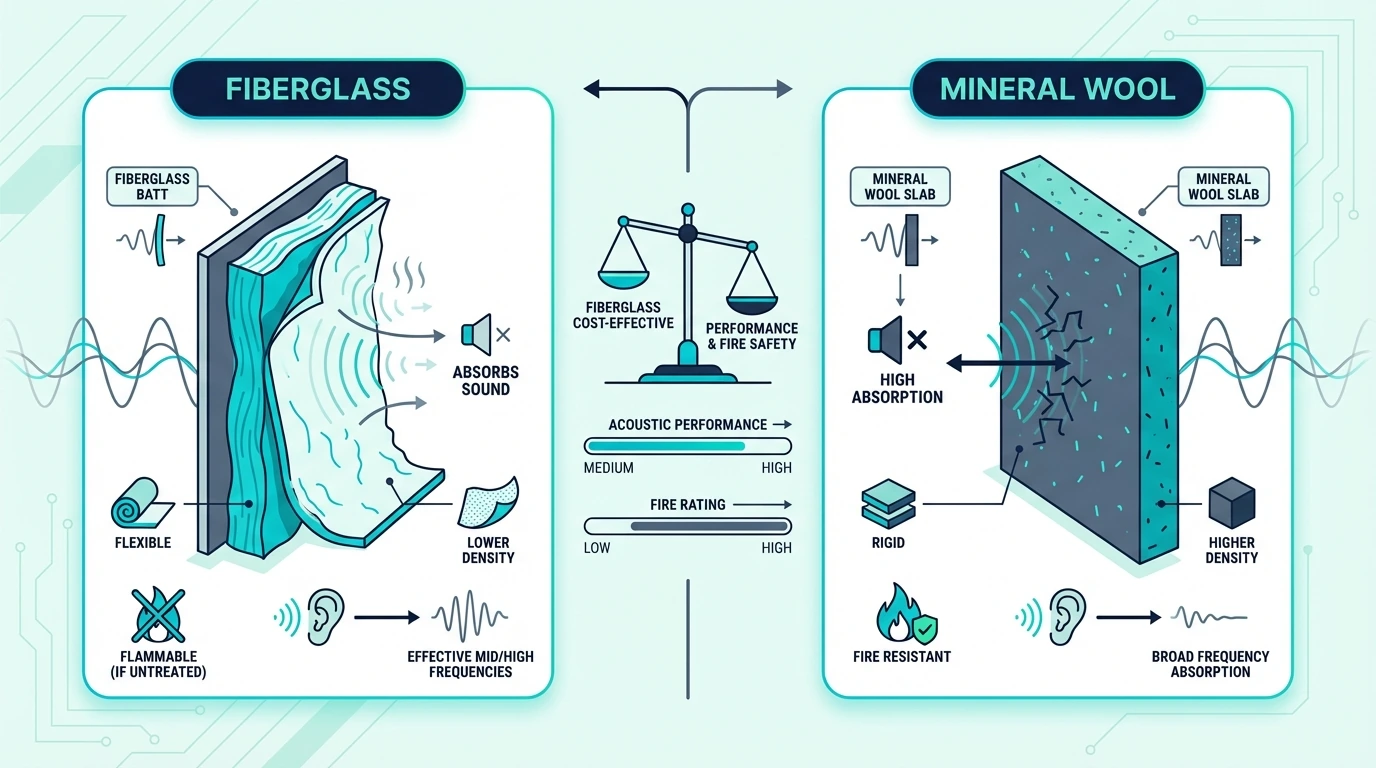
Fiberglass and mineral wool compared for acoustic treatment

These two materials dominate professional and DIY acoustic treatment because they both deliver broadband absorption at reasonable cost. The differences between them are smaller than most forum debates suggest.

Owens Corning 703 And 705

Owens Corning 703 is a 3 lb/ft³ density rigid fiberglass board that has been the standard DIY panel material for decades. At 2 inches thick, it achieves an NRC of approximately 0.86 — meaning it absorbs 86% of the sound energy that hits it across the mid-frequency range.

OC 705 is a denser version at 6 lb/ft³, designed for applications where maximum bass absorption matters. It reaches deeper into the low-frequency range than 703 at the same thickness, making it the preferred choice for bass traps.

Both products are available in standard 24×48 inch boards that fit common wooden frames. The downside is availability — OC 703 and 705 are specialty products that require ordering from acoustic supply dealers or insulation distributors rather than walking into a hardware store.

Fiberglass also has a consistency advantage for DIY builds because the boards hold their shape cleanly inside a frame. The tradeoff is handling safety — gloves, sleeves, and a mask are smart during cutting because loose fibers can irritate skin and lungs.

The UMIACOUSTICS 4-Pack Fiberglass Panels deliver that fiberglass performance in a pre-built, fabric-wrapped format.

Rockwool Safe n Sound

Rockwool Safe n Sound is a stone wool (mineral wool) product originally designed for sound insulation inside wall cavities. It has become the go-to alternative to OC 703 for DIY acoustic panels because it is available at Home Depot and Lowe’s for roughly half the price of specialty fiberglass boards.

Safe n Sound has a density of approximately 2.5 lb/ft³ — lower than OC 703. That density difference means it absorbs slightly less energy at the lowest frequencies per inch of thickness.

The practical difference is small. At 2 inches thick, Rockwool delivers NRC values in the 0.80-0.85 range — close enough to fiberglass that most users cannot hear the difference in a treated room.

Rockwool has one advantage over fiberglass: it is naturally moisture-resistant and does not absorb water. In humid environments or basement studios, that property matters for long-term durability.

Mineral wool is also easier for many DIY builders to source locally, which changes the real-world cost equation more than lab measurements do. If one material ships expensively from a specialty supplier and the other is available ten minutes away at a big-box store, the cheaper project is usually the one you can buy locally and finish this weekend.

The Rockboard 60 Mineral Wool Boards are a strong pick if you want the mineral wool route in a rigid board format.

If you want pre-built options rather than raw insulation boards, start with the best acoustic treatment brands instead of sourcing every material separately.

Acoustic Foam vs Rigid Panels — When Does Each Make Sense?

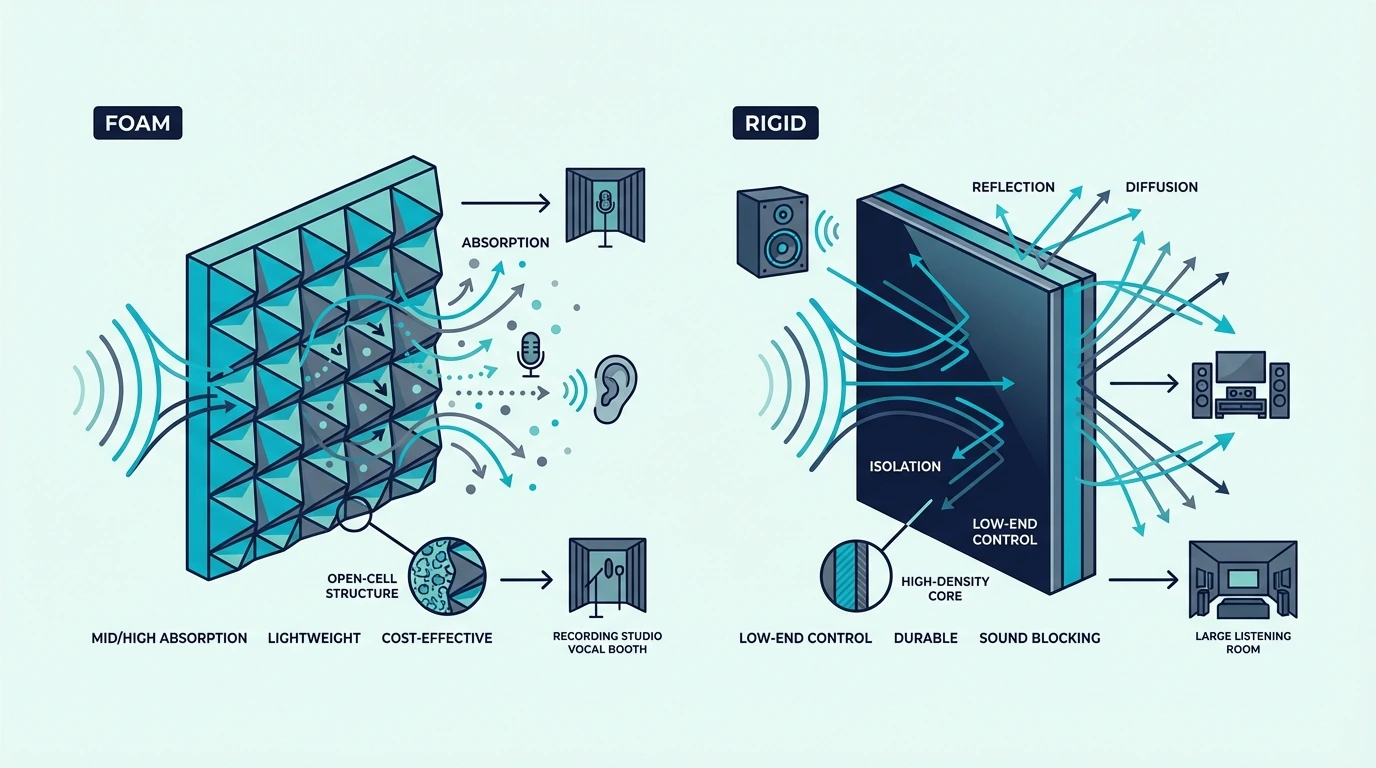
Foam compared with rigid acoustic panel materials

Foam and rigid panels serve different roles, and understanding when each makes sense prevents wasted money on the wrong material.

Where Foam Works Well

Foam excels at absorbing high frequencies in situations where bass control is not the primary goal. Flutter echo between parallel walls — that metallic ringing you hear when you clap — is a mid-high frequency problem that foam handles effectively.

Vocal booths and podcast recording spaces benefit from foam because the primary concern is reducing room reflections around the microphone, and those reflections are predominantly in the frequency range foam absorbs well.

Quick, temporary setups also favor foam. It is lightweight, inexpensive, and attaches to walls with adhesive strips.

For renters who cannot mount heavy panels, foam provides meaningful (if limited) improvement.

The UMIACOUSTICS 12-Pack Acoustic Panels provide an affordable entry point for basic room treatment.

Where Rigid Panels Win

Rigid fiberglass and mineral wool panels win every comparison where broadband absorption matters. Mixing rooms, mastering suites, dedicated theaters, and any space where accurate bass reproduction is important require rigid panel treatment.

A 2-inch fiberglass panel absorbs meaningfully down to 125 Hz. A 4-inch panel reaches below 80 Hz.

A 2-inch foam wedge barely absorbs anything below 500 Hz.

That frequency gap means foam-treated rooms still have boomy, uncontrolled bass. If you need to keep spending under control, the best budget acoustic treatment options are a smarter starting point than thin foam tiles that only tame the top end.

Rigid panels also last indefinitely. Fiberglass and mineral wool do not degrade, yellow, or crumble over time.

Foam loses its absorptive properties within a few years as the cellular structure breaks down.

The 6-Pack 72×48 Sound Absorbing Panels provide broad coverage with rigid panel performance. Full-size 24×48-inch fiberglass panels are a better fit when you want rigid coverage for reflection points or rear-wall treatment.

Cost per performance favors rigid panels in the long run. While the upfront price is higher, rigid panels never need replacement.

Foam that degrades in 3-5 years costs more over a decade than fiberglass panels you buy once.

Installation efficiency matters too. One full-size rigid panel at a first reflection point usually solves more of the problem than several small foam squares scattered around the same wall, because the rigid panel covers the actual reflection zone in one continuous absorptive surface.

What Fabric Should You Use For Acoustic Panels?

The fabric covering on an acoustic panel must be acoustically transparent — meaning sound passes through it freely to reach the absorptive core behind it. A fabric that reflects sound turns your carefully chosen core material into a decorative wall hanging that does nothing.

Guilford Of Maine And Alternatives

Guilford of Maine is the industry-standard acoustic fabric used by professional panel manufacturers. It is specifically engineered for high air permeability while maintaining durability and aesthetic quality.

The blow test is the simplest way to verify any fabric: hold it up to your mouth and blow. If air passes through easily with minimal resistance, the fabric is acoustically transparent enough.

If it blocks the airflow, it will reflect sound.

This matters most at the top end of the frequency spectrum, where dense weaves start reflecting energy before it ever reaches the core. A great fiberglass or mineral wool panel wrapped in the wrong fabric can underperform a cheaper build wrapped in proper speaker cloth.

Budget alternatives that pass the blow test include burlap, speaker grille cloth, and certain lightweight polyester blends. These fabrics cost a fraction of Guilford of Maine and perform identically in terms of acoustic transparency. The Olanglab 24×48 Fiberglass Panels come pre-wrapped in acoustically transparent fabric, which eliminates the sourcing step entirely.

If you would rather skip the fabric decision entirely, many best acoustic treatment kit options bundle finished panels and mounting hardware together.

The 8-Pack 48×32 Acoustic Panels come pre-wrapped, eliminating the fabric selection step entirely.

Fabrics To Avoid

Canvas, vinyl, leather, and heavy upholstery fabrics reflect sound. A panel covered in canvas absorbs dramatically less than the same panel covered in speaker cloth because the canvas acts as a barrier that prevents sound from reaching the core.

Printed fabrics with heavy ink coverage can also reduce transparency. The ink fills the gaps between the fabric fibers, reducing air permeability.

If aesthetics demand a specific fabric, test it with the blow test before committing. Some decorative fabrics look dense but pass air freely, while others that appear lightweight actually block airflow.

The Bottom Line

Rigid fiberglass (OC 703) is the best-performing acoustic treatment material. Rockwool mineral wool is the best value — nearly identical performance at lower cost and wider availability.

Foam is acceptable for flutter echo and high-frequency control in temporary or budget setups, but it is not a substitute for rigid panels in any room where bass accuracy matters. If you want finished products instead of raw materials, compare the best acoustic treatment brands and the best budget acoustic treatment picks first.

Wrap your panels in acoustically transparent fabric — test with the blow test if you are unsure. The core material does the acoustic work, and the fabric should stay out of its way.

If you prefer a simpler shopping path, a best acoustic treatment kit can reduce the guesswork around matching panels, hardware, and coverage.

Whether you are building a studio, improving a theater, or tightening up a voice space, the material choice is the foundation — get this right and the rest of your treatment decisions become straightforward. For voice-focused spaces, choosing the right core material matters even more because microphones pick up every deficiency a thin panel leaves behind.

Frequently Asked Questions

Is Rockwool Or Fiberglass Better For Sound?

Both perform within a few percentage points of each other. Fiberglass (OC 703 at 3 lb/ft³) has a slight edge in absorption per inch due to higher density.

Rockwool is cheaper, more widely available, and naturally moisture-resistant. For most home studio and home theater applications, the difference is inaudible.

What Is The Best Material For DIY Acoustic Panels?

Rigid fiberglass (OC 703) or Rockwool Safe n Sound in a 1×4 or 1×3 wooden frame, wrapped with acoustically transparent fabric. Build panels at 2 inches thick minimum — 4 inches for bass traps.

Mount with a 1-2 inch air gap behind the panel for improved low-frequency absorption.

Is MDF Or Plywood Better For Acoustic Panel Frames?

Either works. MDF provides smoother edges for fabric wrapping but is heavier.

Plywood is lighter and structurally stronger. Neither affects acoustic performance because the frame is not an absorptive element — it just holds the core material and fabric in shape.

Does Acoustic Treatment Make A Difference (Yes — Here Is Exactly What Changes)

Does acoustic treatment make a difference — yes, but the size of that difference depends entirely on what materials you use and where you put them. Foam wedges on random walls barely move the needle, while fiberglass panels at first reflection points transform the room.

The skepticism comes from people who tried the foam approach and heard the room get quieter but not more accurate. Their mixes still did not translate because the bass buildup and comb filtering — the real problems — stayed untreated.

The right panels at the right positions fix those specific problems, giving you recordings with less room coloration and mixes that sound consistent across playback systems.

Below, this guide breaks down what treatment actually does to sound, what it cannot fix, and why strategic placement makes the biggest audible difference in any listening environment.

Quick Takeaway

Acoustic treatment makes a measurable and audible difference. It reduces flutter echo, tames bass modes, eliminates comb filtering at first reflection points, and improves stereo imaging accuracy. The result is cleaner recordings, mixes that translate to other playback systems, and reduced listener fatigue. Treatment does not block outside noise (that is soundproofing) and cheap acoustic foam only addresses mid-high frequencies while ignoring bass problems. Fiberglass or mineral wool panels at 2-4 inches thick deliver the broadband absorption that actually matters.

Does Acoustic Treatment Make A Difference — And How Big Is That Difference?

The difference is large enough that professional studios consider treatment non-negotiable. No serious recording or mixing facility operates in an untreated room, and the reason is not aesthetics.

An untreated room adds its own signature to everything you hear. Sound waves bounce off walls, ceiling, and floor, creating reflections that arrive at your ears milliseconds after the direct sound.

Those reflections cause comb filtering — specific frequencies cancel or reinforce depending on the path length, making your monitoring inaccurate.

Bass modes compound the problem. In a typical bedroom-sized room, standing waves create spots where bass is 10-15 dB louder than it should be and other spots where it nearly disappears.

You cannot mix bass accurately when the room adds or subtracts that much energy at specific frequencies.

Treatment removes those distortions. After placing panels at first reflection points and bass traps in the corners, the room tells the truth about what your speakers are actually producing.

Mixes translate better because you made decisions based on the music, not on room artifacts.

What Does Acoustic Treatment Actually Do To Sound?

What acoustic treatment does inside a room

Acoustic treatment changes the behavior of sound inside your room by absorbing, diffusing, or trapping the energy that bounces off surfaces. Each type of treatment addresses a different problem.

Before And After — What You Hear

The simplest test is the clap test. Clap your hands in an untreated room and you hear a metallic ringing that sustains for a noticeable duration — that is flutter echo bouncing between parallel walls.

After placing even two panels on opposite walls, that ringing disappears. The sound of the clap dies quickly and cleanly because the reflection path is broken.

Vocal recordings show the difference even more clearly. Record a vocal in an untreated room, then record the same performance after adding panels at the first reflection points behind and beside the microphone.

The treated recording sounds tighter, more present, and more detailed because the room reflections that were smearing the vocal are gone.

The UMIACOUSTICS 4-Pack Acoustic Panels are a practical starting point for hearing that before-and-after difference in a home studio.

What Treatment Cannot Fix

Treatment does not block outside noise. If traffic, neighbors, or HVAC noise is entering your room, that is a soundproofing problem that requires mass, decoupling, and sealed construction — not absorption panels.

Treatment also cannot fix bad room dimensions. A perfectly square room creates overlapping modes at the same frequencies, and while bass traps reduce the severity, the fundamental geometry still works against you.

Choosing a rectangular room with non-integer dimension ratios gives treatment a better starting point.

Equipment problems — noisy preamps, bad cables, cheap microphones — remain after treatment. Treatment improves the room, not the signal chain.

What Are The Disadvantages Of Acoustic Foam?

Disadvantages of relying only on acoustic foam

Acoustic foam is the most common treatment material people buy first, and it is also the least effective option for serious acoustic work.

Foam only absorbs mid and high frequencies. Standard 2-inch polyurethane foam wedges have almost no absorption below 500 Hz.

Since bass buildup is the biggest acoustic problem in small rooms, foam leaves the worst issues untreated.

Cheap foam degrades over time. Low-quality polyurethane yellows, crumbles, and loses its absorptive properties within a few years.

Some budget foams also pose fire risks because they lack proper flame-retardant treatment.

Foam NRC ratings are lower than rigid panel alternatives. A typical 2-inch foam wedge has an NRC around 0.65, while a 2-inch fiberglass panel achieves 0.85 or higher.

That difference means you need significantly more foam to achieve the same absorption as fewer fiberglass panels.

The 8-Pack Art Acoustic Panels offer a middle ground — decorative panels with better absorption than basic foam at a budget-friendly price point.

Will Acoustic Treatment Give My Vocals More Clarity?

Improving vocal clarity with acoustic treatment

Yes — and vocal clarity is one of the most immediately audible improvements from treatment. The reason is straightforward.

When you record a vocal, the microphone picks up the direct sound from the singer and the reflected sound bouncing off nearby walls. Those reflections arrive milliseconds later, creating comb filtering that makes the vocal sound hollow, boxy, or distant.

Panels at the first reflection points behind, beside, and above the microphone absorb those early reflections before they reach the mic. The result is a vocal that sounds closer, more present, and more detailed — because you are hearing the singer, not the room.

The improvement is most dramatic in untreated bedrooms and home studios where bare drywall creates strong, focused reflections within a few feet of the microphone position.

Even podcasters and voice-over artists notice the difference. Speech intelligibility improves because the consonants and transients that carry meaning are no longer smeared by room reflections.

What Are The Benefits Of Acoustic Treatment?

The benefits extend beyond recording quality. Every listening activity improves when the room stops adding its own coloration to the sound.

Cleaner recordings are the most obvious benefit. Removing room reflections from microphone pickup gives you a drier, more controllable signal that responds better to processing and mixing.

More accurate mixing follows directly. When your monitoring position tells the truth about frequency balance, stereo imaging, and depth, your mix decisions translate to other playback systems — car speakers, earbuds, phone speakers — instead of only sounding right in your room.

Reduced listener fatigue is a benefit most people do not expect. Untreated rooms force your brain to work harder to separate direct sound from reflections.

After treatment, listening for extended periods feels less tiring because your brain processes a cleaner signal.

The UMIACOUSTICS 4-Pack Panels with Hardware deliver these benefits with a straightforward install at key room positions.

Better speech intelligibility matters for home theaters, conference rooms, and podcast spaces. Treatment reduces the reflections that smear dialogue, making speech easier to understand at lower volumes.

Improved music enjoyment applies even if you do not record or mix. Listening to music in a treated room reveals details — spatial cues, quiet reverb tails, subtle instrument textures — that reflections mask in an untreated space.

The Bottom Line

Acoustic treatment makes a real, measurable difference in any room used for recording, mixing, or critical listening. The improvement is not placebo — it is physics.

Start with panels at first reflection points and bass traps in corners. Those positions deliver the biggest audible improvement per panel.

Avoid cheap foam as your primary treatment — fiberglass or mineral wool panels absorb across a wider frequency range and last significantly longer.

Frequently Asked Questions

How Much Does Acoustic Treatment Cost?

DIY panels using rigid fiberglass and fabric cost roughly $30-50 each in materials. Commercial pre-built panels range from $50-200 per panel depending on size and quality.

A basic home studio treatment setup — four to six wall panels plus four corner bass traps — typically costs $300-800 total.

What Is The Cheapest Way To Reduce Noise Through Walls?

That is a soundproofing question, not an acoustic treatment question. The cheapest approaches are sealing air gaps around doors and outlets with acoustic caulk, adding heavy curtains over windows, and applying mass-loaded vinyl to walls.

None of these are acoustic treatment — they block sound transmission rather than controlling sound quality inside the room.

Is Acoustic Treatment Worth It For A Bedroom Studio?

A bedroom studio benefits more from treatment than a large room because small rooms have worse acoustic problems — stronger bass modes, more flutter echo, and closer reflection points. Even four panels at first reflection points and two corner bass traps transform a bedroom from an unreliable listening environment into one where your mix decisions actually translate.

Where To Put Acoustic Treatment (Strategic Placement That Actually Improves Your Room)

Where to put acoustic treatment matters more than how much you buy — yes, panels help, but four panels in the right spots outperform twelve scattered randomly because acoustic problems are location-specific.

Random placement treats symptoms you can hear (echo, brightness) while missing the real damage at first reflection points and in corners. Your room sounds different, but your mixes still do not translate because the comb filtering and bass buildup remain untouched.

The fix is targeting the exact wall and ceiling positions where early reflections and low-frequency modes do the most harm — positions you can find in minutes with the mirror trick.

Below, this guide covers those positions in priority order and breaks down how placement changes for acoustic treatment in home studios, home theaters, and offices.

Quick Takeaway

Place acoustic treatment at first reflection points on side walls first (use the mirror trick to find them), then add bass traps in corners where walls meet walls and ceiling. A ceiling cloud between your monitors and listening position handles overhead reflections. Rear wall treatment depends on room size — absorption for small rooms, diffusion for larger ones. Symmetrical placement is mandatory for mixing rooms. Mount panels at ear level (seated), and leave an air gap behind panels for better low-frequency absorption.

Where To Put Acoustic Treatment — And Why Placement Matters More Than Quantity

Why acoustic treatment placement matters

The most common mistake in acoustic treatment is buying a pack of foam wedges and sticking them evenly across every wall. That approach absorbs mid and high frequencies uniformly, making the room sound dead without solving the specific problems that ruin recordings and mixes.

Strategic placement works because acoustic problems are location-specific. Early reflections arrive from predictable angles.

Bass builds up in corners. Flutter echo happens between specific parallel surfaces.

When you place panels at these problem spots, each panel eliminates a measurable issue. When you spread them randomly, each panel makes a tiny dent in everything but solves nothing completely.

A room with four panels at first reflection points and four bass traps in the corners sounds dramatically better than a room with twenty foam squares glued to random wall sections. The difference is not subtle — it is the difference between a room that lies to you and one that tells the truth about what your mix actually sounds like.

How Do You Find First Reflection Points?

First reflection point placement for acoustic panels

First reflection points are the spots on your walls and ceiling where sound from your monitors bounces once and reaches your ears. These reflections arrive within 5-15 milliseconds of the direct sound, creating comb filtering that colors everything you hear.

The mirror trick is the standard method for finding them. Sit in your listening position (or your primary recording spot) and have someone slide a small mirror flat along the wall surface.

The moment you can see the face of your monitor speaker in the mirror, that wall position is a first reflection point.

Side Wall Reflection Points

Side wall reflections are the highest priority because they arrive earliest and cause the most stereo image damage. Place panels at ear level (seated position) on both side walls at the mirror-trick positions.

In most rooms, these points land roughly one-third of the way between your monitors and the rear wall. The panels should be large enough to cover the reflection zone — at minimum 2 feet wide and 4 feet tall.

The UMIACOUSTICS 4-Pack Acoustic Panels cover both side wall reflection points with two panels per side.

Symmetrical placement is mandatory for mixing and critical listening. If you place a panel on the left side wall, the right side wall needs a matching panel at the same position.

Asymmetrical treatment creates an unbalanced stereo image that pulls your mix decisions in the wrong direction.

Ceiling Reflection Points

The ceiling reflection point sits directly above the midpoint between your monitors and your listening position. Sound bouncing off the ceiling at this spot arrives within milliseconds of the direct sound, creating vertical comb filtering.

A ceiling cloud — a panel suspended horizontally 2-4 inches below the ceiling surface — eliminates this reflection. The air gap behind the panel improves low-frequency absorption by placing the absorptive material where particle velocity is higher.

In rooms with standard 8-foot ceilings, the ceiling reflection is especially strong because the short distance means the reflected path length is nearly identical to the direct path. That near-identical timing creates deep comb filtering notches.

Rear Wall Treatment

The rear wall is the last priority for a reason — rear wall reflections travel the longest path and arrive latest, so they cause less comb filtering damage than side and ceiling reflections.

In small rooms (under 12 feet deep), absorption on the rear wall prevents late reflections from muddying the sound. In larger rooms, diffusion on the rear wall scatters reflections to maintain a sense of liveness without creating focused echoes.

A pair of 24×48-inch fiberglass panels provides broad coverage for rear wall absorption.

A common mistake is over-treating the rear wall. Too much absorption behind you makes the room feel unnaturally dead.

One or two panels (or a diffuser) is usually enough.

Where Should You Place Bass Traps?

Bass trap placement in room corners

Bass traps belong in corners — specifically where two surfaces meet (dihedral corners) and where three surfaces meet (tri-corners). Low-frequency sound waves naturally accumulate maximum pressure at these boundaries.

The four vertical corners of your room are the primary bass trap positions. Panels mounted across these corners at 45 degrees, with an air gap behind them, absorb the most low-frequency energy per square foot of any placement in the room.

Tri-corners (where the ceiling meets two walls) are the single most effective bass trap positions because three surfaces converge. If you can only place four bass traps, the two front tri-corners and two rear tri-corners deliver the maximum bass control.

The thickness of your bass trap matters more than its position. Standard 2-inch panels absorb almost nothing below 250 Hz.

For meaningful bass absorption, you need 4-6 inches of dense fiberglass or mineral wool mounted with an air gap.

The UMIACOUSTICS 47×24 Panels work as corner bass traps when mounted diagonally across the corner.

Floor-to-ceiling coverage in each corner is ideal. Stack two or three panels vertically in each corner to treat the full height of the room.

Placement By Room Type

Acoustic treatment placement by room type

Different rooms serve different purposes, and the placement strategy shifts based on what you are optimizing for.

Home Studios And Mixing Rooms

Home studios demand symmetrical treatment around the listening triangle (the equilateral triangle formed by your two monitors and your head). Place panels at both side wall first reflection points, a ceiling cloud above the triangle, and bass traps in all four vertical corners.

The front wall behind your monitors benefits from absorption as well. Sound radiating from the back of your monitors reflects off the front wall and arrives at your ears with a short delay that muddies the low-mid range.

Keep your home studio setup oriented so you face the shorter wall. This positions you farther from the rear wall and reduces the strength of rear reflections at the mix position.

Home Theaters

Home theater placement differs from studio placement because the audience area is wider and surround channels add more reflection paths.

Place absorption panels at the side wall first reflection points between the screen and the primary seating position. Bass traps in the front corners tighten the low end from your subwoofer.

Absorption or diffusion on the rear wall prevents surround reflections from becoming distracting echoes.

Upholstered furniture — couches, chairs, curtains — already provides significant mid-high absorption. Factor existing room furnishings into your treatment plan before buying panels.

Offices And Bedrooms

Office and bedroom placement focuses on the area where you spend the most time. Panels on the wall directly facing your desk (or bed headboard) and on the wall behind you handle the strongest reflections in your immediate zone.

The Olanglab Compact 4-Pack Panels fit office and bedroom walls without overwhelming the space.

Ceiling panels above your desk reduce overhead reflections that cause fatigue during long calls or listening sessions. Even a single ceiling panel makes a noticeable difference in speech clarity.

The Bottom Line

Placement follows a clear priority: side wall first reflection points, then ceiling cloud, then corner bass traps, then rear wall. Every panel should target a specific acoustic problem — no random placement.

Symmetrical treatment is mandatory for any room used for mixing or critical listening. Mount panels at ear level with air gaps behind them for better low-frequency performance.

Start with the fewest panels that solve the biggest problems, then add more only if issues remain. A well-placed set of six to eight panels outperforms a room plastered with budget foam.

Frequently Asked Questions

Where Should Acoustic Treatments Be Placed?

Start with first reflection points on side walls and ceiling (use the mirror trick to find them). Add bass traps in all available corners, prioritizing tri-corners where ceiling meets two walls.

Treat the rear wall last with absorption or diffusion depending on room size.

Are Acoustic Panels Better On The Wall Or Ceiling?

Both positions serve different purposes. Side wall panels handle lateral reflections that damage stereo imaging.

Ceiling panels handle overhead reflections that cause vertical comb filtering. Prioritize side walls first, then add a ceiling cloud at the reflection point between your monitors and listening position.

Does Acoustic Treatment Need To Be Symmetrical?

For mixing and critical listening, yes. Asymmetrical treatment creates an unbalanced stereo image that shifts your perception of left-right balance.

Every panel on the left side wall needs a matching panel on the right. For general room improvement (offices, bedrooms), symmetry is helpful but not mandatory.

Should You Put Acoustic Panels Behind A TV?

Yes — the wall behind a TV or screen reflects sound from your speakers back into the room with a short delay. A panel behind the screen reduces that reflection, improving dialogue clarity and tightening the sound stage for movies and music. For a DIY panel behind the screen, a single Rockboard 60 board fits behind most screen setups and absorbs the low-mid reflections that cause the most dialogue smearing.

Best Acoustic Treatment For Small Rooms (Priority Order That Actually Works)

Best acoustic treatment for small rooms can make a cramped setup far more usable, but small spaces punish bad treatment choices faster than large ones. It is surprisingly easy to quiet the room down while still leaving the worst bass and reflection problems untouched.

That is why small rooms frustrate people so quickly. You spend money, cover walls, and still hear muddy low end, a blurry stereo image, and mixes that fall apart everywhere else because the room is still dictating what you hear.

The good news is that small rooms improve fast when you treat the highest-leverage surfaces first. Once the corners, first reflections, and ceiling are handled in the right order, the room starts giving you cleaner decisions instead of constant second-guessing.

The first move is almost never “more wall coverage” — it is treating the corners behind your speakers, then the first reflection points, then the ceiling cloud. Below, this guide walks through that order, explains the 38% rule, and shows which products actually make sense when wall space is tight.

Quick Takeaway

The best acoustic treatment for small rooms starts with bass control, not decorative wall coverage. Treat the corners first, add fiberglass panels at the first reflection points on the side walls, then hang a ceiling cloud above the listening position. In a small room, placement matters as much as the products themselves, so combine treatment with a sensible speaker/listening position before you judge the result.

Best Acoustic Treatment For Small Rooms — Where Do You Start?

Where to start with acoustic treatment in a small room

The best place to start is not with the walls you see first. It is with the problems you hear first.

In a small room, the biggest damage usually comes from bass buildup in the corners, followed by strong early reflections from the side walls and ceiling. That is why the treatment order matters so much more here than it does in a larger room.

A lot of people start with thin foam because it looks like acoustic treatment and feels affordable. In practice, that usually means solving flutter echo while leaving the low end just as unreliable as before.

That tradeoff is brutal in a bedroom studio. The room may sound less ringy after a weekend of sticking foam on the walls, but kick drums still read too loud in one spot and too weak in another.

For anyone building a bedroom setup, the same priorities show up in a broader home studio treatment plan too.

So start by asking one question: what is making your decisions wrong? In most small rooms, the answer is not “I need more wall coverage.” It is “my low end is lying to me, and the reflections are making it harder to tell.”

That is why the right starting order is so consistent. Corners first, reflection points second, ceiling third, and only then any extra coverage for edge cases like a close rear wall or a strong front-wall bounce.

That same decision tree makes more sense once you start from what acoustic treatment is instead of treating every surface like the same problem.

Why Are Small Rooms Acoustically Challenging?

Small rooms are harder to treat because all the bad acoustic behavior is packed into a shorter distance. Reflections return faster, bass modes are more obvious, and your listening position ends up much closer to every boundary.

Bass Buildup And Room Modes

Bass is the real reason small rooms feel impossible. Long low-frequency wavelengths do not care that your room is cramped, so they bunch up against the room boundaries and create exaggerated peaks and deep cancellations.

That is what room modes do. A note that sounds huge in one position can nearly disappear a foot away, which makes every EQ or balance decision feel less reliable than it should.

A 10×12 foot room is a perfect example. It is common to hear one-note bass in the corners, weak bass at the desk, and a completely different low-end balance if you stand up and walk toward the rear wall.

That is why broadband corner treatment matters so much more than random surface coverage. If the corners stay untreated, the room keeps exaggerating the exact part of the spectrum that causes the most mix translation problems.

That is also why acoustic treatment for corners does more in a small room than almost any cosmetic wall upgrade.

Flutter Echo Between Parallel Walls

The second problem is flutter echo. In a narrow room, the side walls are close enough together that reflections bounce back and forth quickly, creating that metallic clap you hear in an untreated bedroom or office.

Flutter echo is easier to fix than bass, but it still matters. It adds a sharp, papery character to vocals, acoustic instruments, and even the way speech sounds while you work.

The good news is that this problem responds fast to correctly placed absorption. A pair of fiberglass panels at the first reflection points can clean up the side-wall bounce almost immediately.
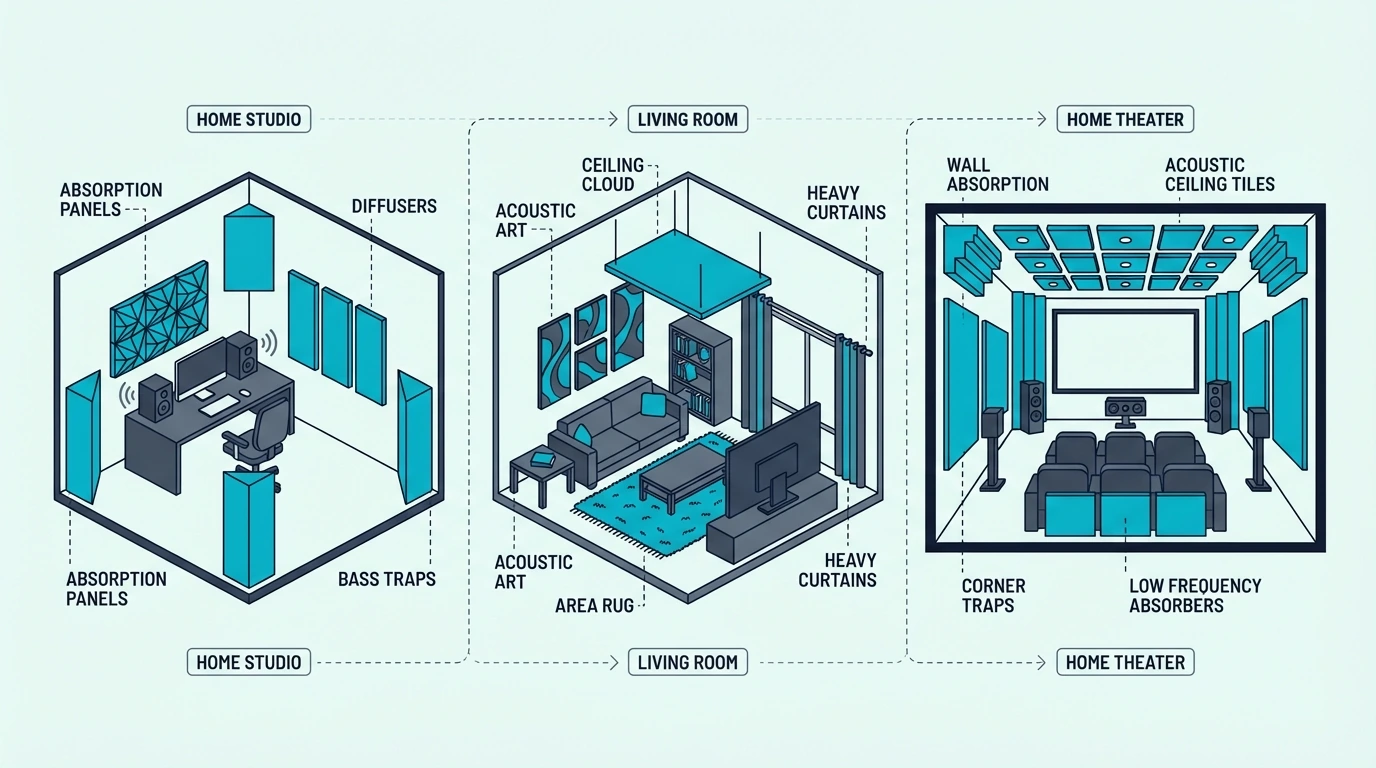
The bad news is that people often stop there. That makes the room sound less splashy, but it does not solve the modal low-end chaos underneath it.

If you record close-mic sources, this is one reason acoustic treatment for vocals usually starts with reflections and room tone before anything fancy.

What Acoustic Treatment Do Small Rooms Need?

Acoustic treatment plan for a small room

The best treatment plan for a small room is not complicated. It just needs discipline.

Each layer solves a different problem, and each layer works better when the previous one is already in place. If you reverse the order, you usually spend more and solve less.

Corner Bass Traps Are Priority One

If you can only buy one thing first, buy corner treatment. Corners are where low-frequency energy piles up, which makes them the highest-leverage position in a small room.

That does not mean any foam wedge in a corner counts as a full bass-trap strategy. Small foam pieces can help a little in the upper-bass range, but serious low-end control usually needs more depth, more density, or both.

For a stronger first step, something like the 2 Pack Wooden Acoustic Bass Traps makes more sense than scattering thin foam around the room and hoping for a miracle.

Start with the two front corners behind your speakers. If budget allows, add the rear corners next, because small rooms benefit quickly from getting all four vertical corners involved.

If you need a cheaper entry point before stepping up to thicker traps, best budget acoustic treatment helps sort the compromises.

First Reflection Points On Side Walls

Once the corners are under control, move to the first reflection points on the side walls. These are the spots where sound leaves the speakers, hits the wall, and reaches your ears just after the direct signal.

That tiny timing offset is enough to smear the stereo image and create comb filtering. You hear less focus, less center definition, and less confidence in panning or EQ decisions.

This is where a straightforward fiberglass pack earns its keep. The UMIACOUSTICS 4 PCS Acoustic Panels with Hanging Bracket is the kind of pack that fits this job well because it gives you enough panels for both side walls without turning the room into a full remodel project.

Use the mirror trick to find the exact spots. Sit in your listening position and have someone slide a mirror along the wall until you can see a speaker in it.

Where you see the speaker, place the panel. Do that on both walls and you have handled one of the biggest clarity upgrades available in a small room.

If you want a shorter buying path, acoustic treatment kits can cover this reflection-point stage faster than sourcing every part separately.

Ceiling Cloud Above Listening Position

After the side walls, look up. In a room with a normal residential ceiling height, the ceiling reflection is often close enough to matter almost as much as the side-wall reflections.

That is why a ceiling cloud is not some luxury add-on for pro studios. In a small room, it is often part of the basic treatment plan.

The actual panel matters less than the mounting and placement. You want the cloud centered between the speakers and your head, with a small air gap above it so it can work more efficiently.

Secure mounting hardware with a small air gap is the key detail, because small-room clouds only help when they are positioned correctly and suspended firmly.

If you have very limited wall space, a ceiling cloud can do more than people expect. It will not replace bass trapping, but it can make a short room feel much more controlled without eating up the last open wall you still need for a desk or storage.

If low clearance is the main obstacle, ceiling acoustic treatment goes deeper on cloud placement and clearance tradeoffs.

The 38% Rule And Speaker Placement In Small Rooms

38 percent rule for listening position in a small room

Treatment alone does not rescue a bad listening position. In a small room, where you sit changes the bass almost as much as what you hang on the walls.

The 38% rule is a practical starting point. Measure the room length from the front wall, then place your listening position about 38% of that distance into the room.

That position tends to avoid the worst modal hotspots and nulls. It is not magic, but it is a far better starting point than sitting exactly in the center of the room or pushed hard against the back wall.

Small rooms make this awkward because the furniture layout is usually already compromised. If the room is short, the 38% point can leave your chair closer to the speakers than you expected.

That is still better than building the whole setup around convenience and fighting the room forever. Get the speakers and listening position into the best workable geometry first, then treat around that reality.

Compact panels also help here because tight rooms do not always have space for large-format absorbers everywhere you want them. The Olanglab Fiberglass Acoustic Wall Panels 4 Pack is a sensible fit when full-size panels would crowd doors, windows, or furniture clearances.

If the room is extremely small, orient the desk along the longer dimension whenever possible. That gives the monitors more room to breathe and gives you a more practical version of the 38% position to work with.

That tradeoff between layout and budget is also why acoustic treatment cost climbs quickly once a small room needs traps, panels, and a ceiling cloud together.

The Bottom Line

The best acoustic treatment for small rooms is not “more panels.” It is the right treatment in the right order.

Treat the corners first so the room stops lying about the low end. Then handle the side-wall reflection points, then the ceiling cloud, and only after that decide whether the room needs more coverage anywhere else.

Combine that with a sensible 38% listening position and even a modest bedroom setup starts behaving more like a room you can trust. You will not make a tiny room perfect, but you can make it dramatically more honest.

Frequently Asked Questions

What is the 38% rule room acoustics?

The 38% rule places your listening position about 38% of the room length away from the front wall. It is a starting point that helps reduce the worst overlap of strong room modes at the mix position.

Do smaller rooms have better acoustics?

No. Smaller rooms usually have more obvious acoustic problems because reflections return faster, bass modes feel more extreme, and you are forced to work closer to every boundary.

How many acoustic panels do I need for a small room?

A practical small-room setup often starts with four corner treatments, two side-wall reflection panels, and one ceiling cloud. For DIY builders, a single 6-pack of Rockboard 60 mineral wool boards provides enough material for corner traps and wall panels in one purchase. From there, you add only what the room still proves it needs instead of covering surfaces blindly.

Acoustic Treatment Vs Soundproofing (They Solve Completely Different Problems)

Acoustic treatment vs soundproofing is one of the most misunderstood distinctions in the entire noise-control space, but the difference matters because buying the wrong one wastes money and leaves the original problem untouched.

That is why so many buyers feel disappointed. They buy acoustic foam panels expecting to block neighbor noise, or they add mass loaded vinyl to a wall expecting clearer audio in a recording setup.

Both products work, but they solve completely different problems, and using one where the other belongs is the single most common mistake in this category.

The clearer way to think about it is simple: acoustic treatment changes how a room sounds inside. Soundproofing changes how much sound travels in or out.

Once you understand which problem you actually have, the right product becomes obvious.

Below, you will learn what each approach actually does, which one is better for your specific situation, the most common misconceptions, and how to decide whether you need one or both.

Quick Takeaway

Acoustic treatment vs soundproofing comes down to direction. Treatment improves the sound inside a room by controlling reflections, echo, and clarity. Soundproofing reduces how much sound passes through walls, ceilings, floors, and openings. They solve different problems, and most rooms that need help need one or the other — not both — depending on whether the issue is internal sound quality or external noise transfer.

What Is The Difference Between Acoustic Treatment And Soundproofing?

Now that the core distinction is clear, the next step is understanding what each approach actually does in practice.

What Does Acoustic Treatment Actually Do?

Acoustic treatment controls how sound behaves inside a room. It reduces echo, flutter, harsh reflections, and the muddy or boomy quality that untreated rooms create when sound bounces off hard surfaces.

The main tools are absorbers (panels and foam that soak up mid and high frequencies), bass traps (thicker absorbers that target low frequencies), and diffusers (surfaces that scatter sound evenly instead of absorbing it). Together, they make the room sound clearer, tighter, and more controlled.

That family is broader than wall panels alone. Acoustic foam is the entry-level treatment option, fiberglass or mineral-wool panels built from cores like Owens Corning 703, Knauf, or Rockwool are the stronger broadband option, bass traps handle corners and low-end buildup, and diffusers keep a room from becoming too dead.

Acoustic panels like UMIACOUSTICS Acoustic Panels are a typical treatment product. They make the room sound better inside, but they do not stop noise from traveling through the wall to the neighbor.

Foam tiles like JBER Acoustic Foam Panels are the cheaper and weaker branch of treatment. They can help with flutter echo and upper-frequency splash, but they should not be mistaken for broadband panels, bass traps, or any kind of soundproofing.

When the room also has obvious low-frequency buildup, corner treatment matters just as much as flat wall absorption. A starter option like TroyStudio Bass Traps makes that clearer because treatment is not only about wall panels.
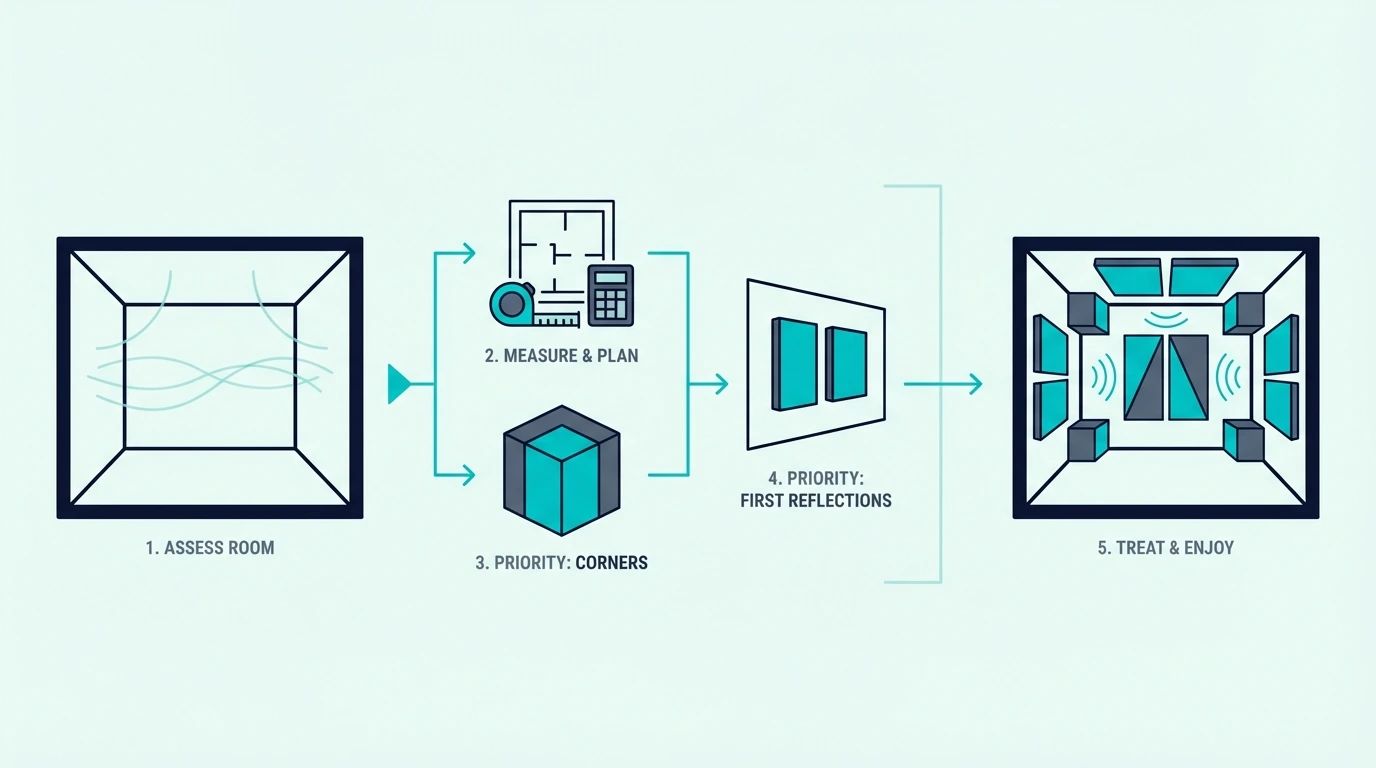
It is about controlling the reflections and buildup that happen inside the room. If the room already has enough absorption and starts feeling too dead, compare that next step with sound diffuser vs acoustic panel so the diffusion side of treatment is clear too.

What Does Soundproofing Actually Do?

Soundproofing reduces how much sound passes between spaces. It targets the walls, ceilings, floors, doors, and windows that separate the room from the outside world or from adjacent rooms.

The main tools are mass (heavier barriers like mass loaded vinyl and double drywall), decoupling (resilient channels and isolation clips that break the vibration path), damping (compounds that convert vibration to heat), and sealing (closing every air gap that sound can leak through).

That family is broader than one so-called soundproofing panel. MLV and extra drywall add mass, Green Glue adds damping between rigid layers, clips and channel add decoupling, solid-core doors and acoustical sealant close leak paths, and batt materials like AFB or Owens Corning-type fiberglass or mineral wool belong inside the wall assembly rather than on the room surface.

A barrier material like Trademark Soundproofing Mass Loaded Vinyl is a typical soundproofing product. It stops noise from traveling through the wall, but it does nothing to improve the clarity or quality of sound inside the room.

A damping product like Green Glue Noiseproofing Compound belongs between rigid layers, usually drywall, when the goal is to reduce panel vibration in a real build. It is not a decorative room-treatment product, and it only works when the wall or ceiling assembly is actually being built or rebuilt.

An insulation product like AFB Acoustical Fire Batts belong inside an open stud or joist cavity as the absorptive layer in the assembly. They help the system perform better, but by themselves they are not the same thing as hanging an acoustic panel on the finished wall.

Why Do People Confuse These Two So Often?

Because the marketing language overlaps. Products labeled “soundproof foam” are actually acoustic treatment.

Products sold as “acoustic panels” are sometimes foam absorbers and sometimes mass-based barriers. The word “acoustic” gets applied to both categories, and buyers who do not know the difference end up buying the wrong product for their problem.

There is not really a simple soundproofing equivalent to acoustic foam or acoustic panels. Real soundproofing is usually a layered wall, ceiling, floor, door, or window assembly rather than a decorative surface product you hang like treatment.

The simplest test is this: if the product is lightweight, porous, and designed to hang on the wall surface, it is probably treatment. If it is heavy, dense, and designed to go behind the wall or between layers, it is probably soundproofing.

Which Is Better: Acoustic Treatment Or Soundproofing?

Neither is better in general. The right choice depends entirely on the problem you are trying to solve.

Which One Helps More With Echo And Harsh Reflections?

Acoustic treatment. If the room sounds echoey, boomy, harsh, or muddy — especially during recording, video calls, or music listening — treatment is the fix.

Panels, bass traps, and diffusers change the internal acoustic character of the room without affecting how much noise travels through the walls.

This is the most common need in home studio acoustic treatment, podcast setups, conference rooms, and home theater acoustic treatment where the quality of sound inside the room matters more than blocking sound from outside.

Which One Helps More With Neighbors And Outside Noise?

Soundproofing. If the problem is hearing your neighbor’s TV, traffic through the window, or footsteps from upstairs, no amount of acoustic treatment will fix it because the noise is entering the room through the structure, not bouncing around inside.

For neighbor and outside noise problems, the fix is always mass, sealing, decoupling, or some combination of those — not foam panels or fabric absorbers. Soundproofing a wall, soundproofing a door, and soundproofing windows are the relevant starting points depending on where the noise enters.

When Do You Need Both?

You need both when you want to keep sound from leaving the room (soundproofing) and you also want the room to sound good inside (treatment). A home recording studio is the most common combined-use case because it needs isolation from outside noise and controlled internal acoustics for accurate monitoring.

In that scenario, the soundproofing goes first — mass, sealing, and decoupling in the walls, ceiling, and door. Then the treatment goes on the inside surfaces to control reflections and clarity.

Doing it in the opposite order (treatment first, soundproofing never) is the mistake that leads to a room that sounds great inside but still leaks noise in both directions.

What Are The Most Common Misconceptions?

Most acoustic product complaints come from misconceptions rather than product failures.

Why Don’t Acoustic Panels Soundproof A Room?

Because acoustic panels are porous and lightweight. They absorb sound energy inside the room, but they do not add enough mass to block sound from passing through the wall behind them.

Hanging foam on a shared wall will make the room sound less echoey inside, but the neighbor’s TV will be just as audible.

This is the most expensive mistake in the category because buyers often buy enough panels to cover an entire wall expecting isolation, then discover that the noise has not changed at all.

Why Doesn’t Soundproofing Automatically Improve Room Acoustics?

Because soundproofing adds mass and isolation to the structure, not absorption to the room surfaces. A room with double drywall, MLV, and resilient channels will be much quieter from outside noise, but it can still sound echoey and harsh inside if the interior surfaces are all hard and reflective.

That is why recording studios treat both problems separately. The soundproofing keeps noise out and sound in, and the treatment makes the internal sound accurate and comfortable.

Why Can A Room Feel Better Without Actually Blocking More Noise?

Because reducing echo and reflections inside the room lowers the perceived noise level even though the actual transmission has not changed. When a room has less reverberant buildup, sounds feel quieter and cleaner, which can make outside noise seem less intrusive even though the same amount of energy is still entering.

This is useful to understand because it means acoustic treatment can sometimes improve comfort enough that full soundproofing becomes unnecessary. If the room feels better after treatment and the remaining noise is tolerable, you may not need to spend on isolation at all.

How Should You Choose Between Acoustic Treatment And Soundproofing?

Decision for acoustic treatment vs soundproofing

The decision starts with the problem, not the product.

Are You Mixing, Recording, Sleeping, Or Blocking Neighbors?

If you are mixing or recording, you almost certainly need treatment and may also need soundproofing. If you are sleeping, working from home, or trying to block neighbor noise, you need soundproofing and probably do not need treatment.

For budget-conscious testing, a small MLV barrier like TroyStudio High Density Mass Loaded Vinyl over the weakest surface can confirm whether soundproofing is what you actually need before investing in a bigger project.

What Is The Budget Difference?

Treatment is usually cheaper. A set of panels or foam tiles for a small room can cost under two hundred dollars and be installed in an afternoon.

Soundproofing can cost from a few hundred for basic sealing and a solid door up to several thousand for wall and ceiling mass-and-decouple assemblies.

That budget difference often drives the decision in practice. Many buyers start with treatment because it is accessible and affordable, then add soundproofing later if the noise problem turns out to be the bigger issue.

What Is The Best Order To Tackle These Problems?

If you need both, do soundproofing first. Mass, sealing, and decoupling go into the structure before the finish surfaces are applied.

Treatment goes on the room surfaces after the structure is complete.

If you only need one, start with the one that matches your primary complaint. Echo and clarity issues point to treatment.

Noise transfer issues point to soundproofing. If you are not sure, compare the problem against does soundproof foam work, best soundproofing material, and acoustic treatment placement before you spend more money.

Treatment is cheaper and reversible, while soundproofing is slower and structural. That difference usually tells you whether the remaining problem is internal acoustics or external transmission.

Compare your situation with the broader soundproofing hub and how much acoustic treatment you need so you can match the right approach to your specific room and budget.

The Bottom Line

Acoustic treatment vs soundproofing is not a competition between two products. It is a distinction between two entirely different problems.

Treatment fixes how a room sounds inside. Soundproofing fixes how much noise travels in or out.

On the treatment side, think acoustic foam, fiberglass or mineral-wool panels, bass traps, ceiling clouds, and diffusers. On the soundproofing side, think drywall mass, MLV, Green Glue, AFB or Owens Corning-type cavity fill, clips, channels, doors, and seals working together as one assembly.

Buying the wrong one wastes money and leaves the original problem exactly where it was.

For most buyers, the decision is straightforward: if the complaint is echo, harshness, or poor audio quality, treatment is the answer. If the complaint is neighbor noise, traffic, or sound leaking between rooms, soundproofing is the answer.

And if you need both, do the soundproofing first so the treatment has a quiet, stable room to work with.

Frequently Asked Questions

What’s the difference between soundproofing and acoustic treatment?

Soundproofing reduces how much noise passes between spaces by adding mass, decoupling, and sealing to the barriers. Acoustic treatment improves how the room sounds inside by controlling reflections and echo with absorbers, bass traps, and diffusers.

Can acoustic treatment reduce neighbor noise?

Not in the way most buyers mean it. Acoustic treatment can make a room feel calmer by reducing reflections and reverberant buildup, but it does not meaningfully block sound transmission through walls, ceilings, doors, or windows.

If the real complaint is neighbor noise, you usually need soundproofing instead.

Do you need both acoustic treatment and soundproofing in a home studio?

Often, yes. Soundproofing helps keep outside noise out and prevents your own sound from leaking, while acoustic treatment helps the room sound more accurate and less echoey inside.

If you only choose one, pick the one that matches the main problem you are hearing right now.