Acoustic Panels vs Bass Traps: Which Do You Need? [2026]

Acoustic panels vs bass traps both absorb sound, yes, but they solve different problems in a room. Choose the wrong one and you can treat a space and still hear the same issues.

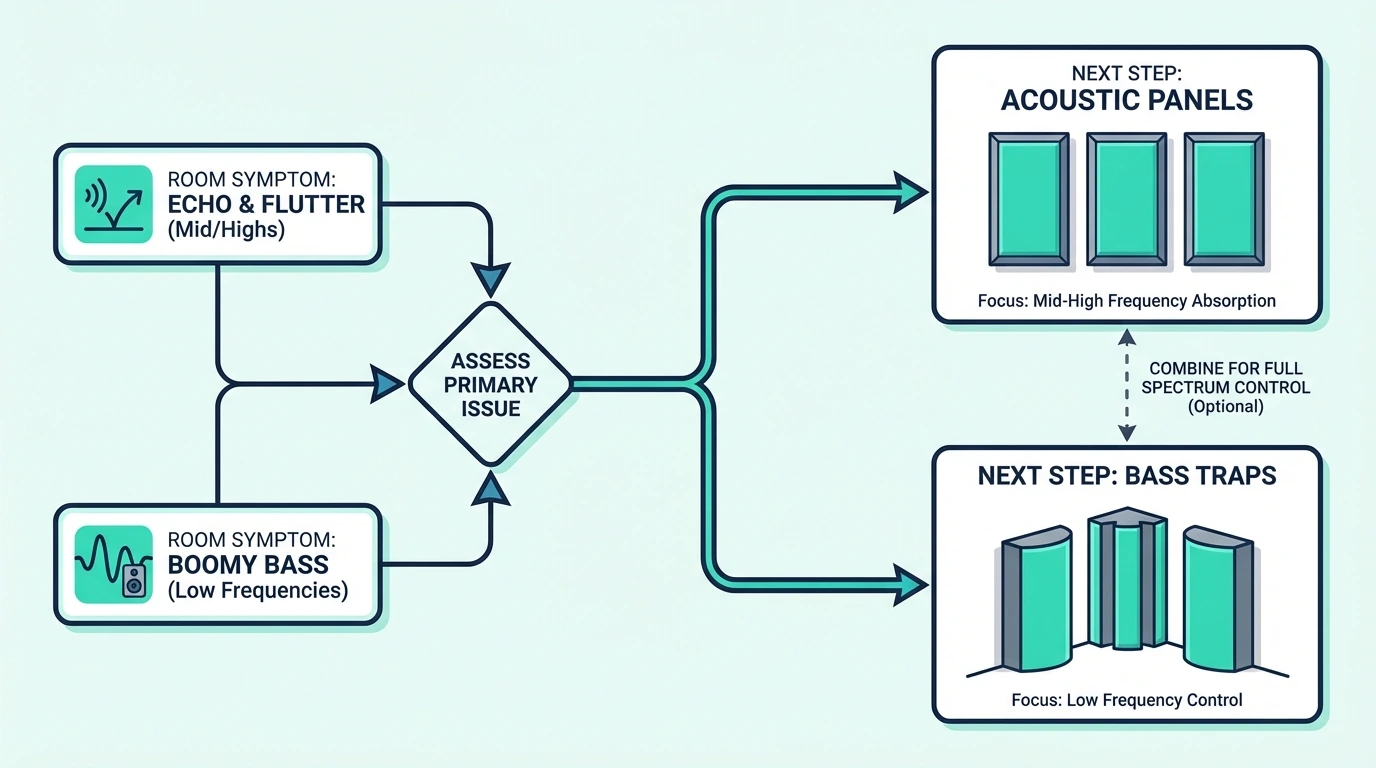
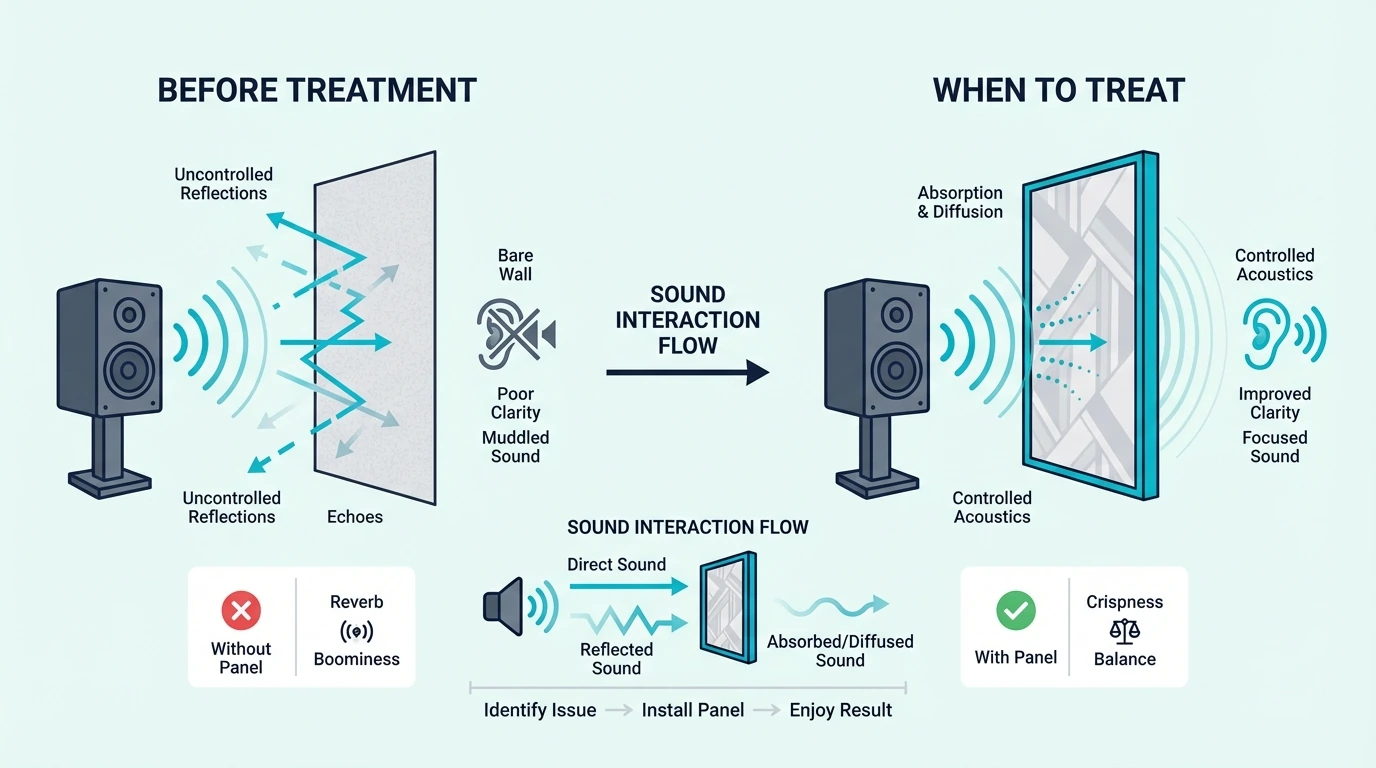
Harsh echo and smeared clarity happen when mid/high reflections bounce off bare walls and ceilings. Boomy, muddy low end usually comes from bass energy building up in corners and room modes.

Match the symptom to the right tool so you can reduce the problem fast and get cleaner, more direct sound. You will also avoid wasting money adding more panels when the real issue is bass (or vice versa).

Start with panels at first-reflection points if reflections are the issue, or start with traps in the front corners if bass is the issue. Below, the comparison table and next-steps checklist make the decision and placement order clear.

Quick Takeaway

Acoustic panels absorb mid-high frequencies (250 Hz and above) and mount on walls at reflection points. Bass traps absorb low frequencies (20–250 Hz) and install in corners where bass energy accumulates.

You typically need both for complete room treatment — start with panels if your main issues are echo and voice clarity, or bass traps if you are dealing with boomy, undefined low end. Neither replaces the other.

Acoustic Panels vs Bass Traps: What Is the Difference?
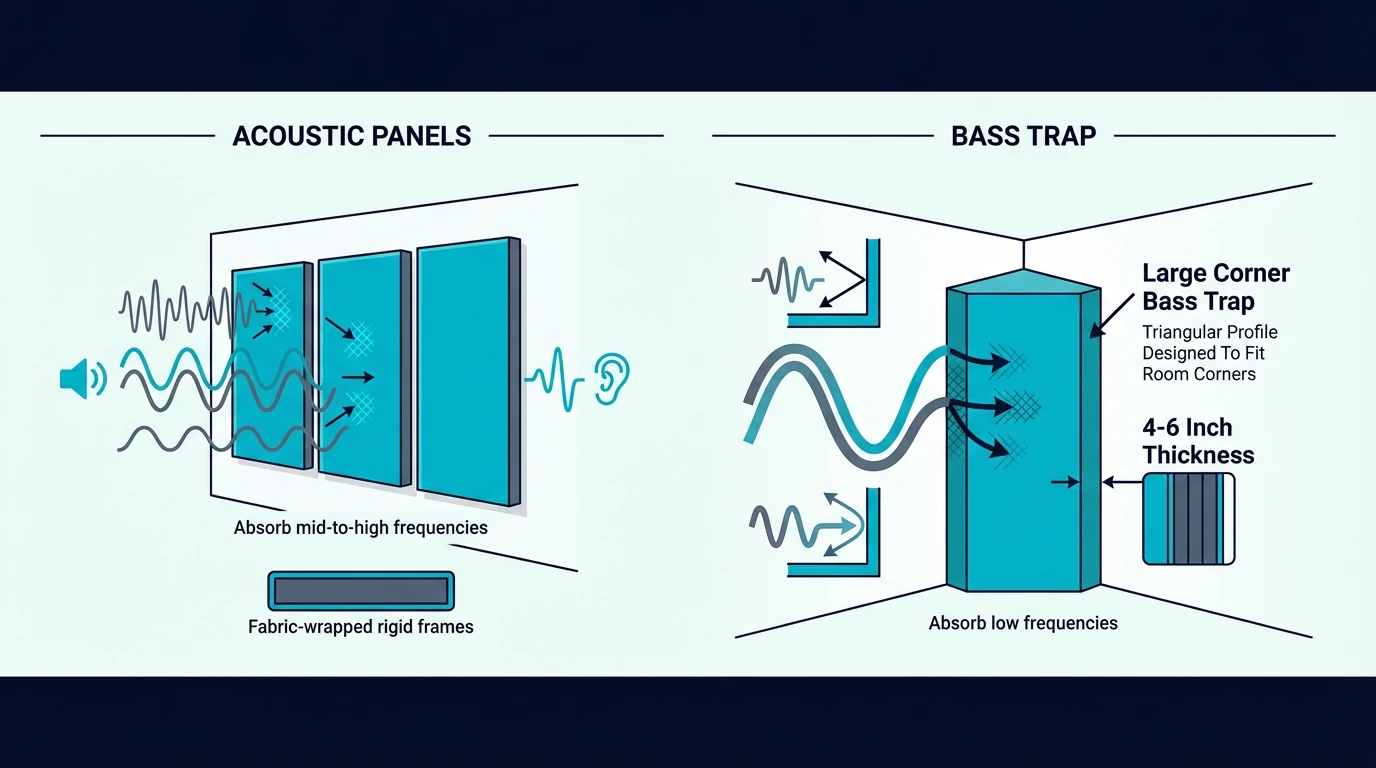
Acoustic Panels vs Bass Traps: What is the Difference?

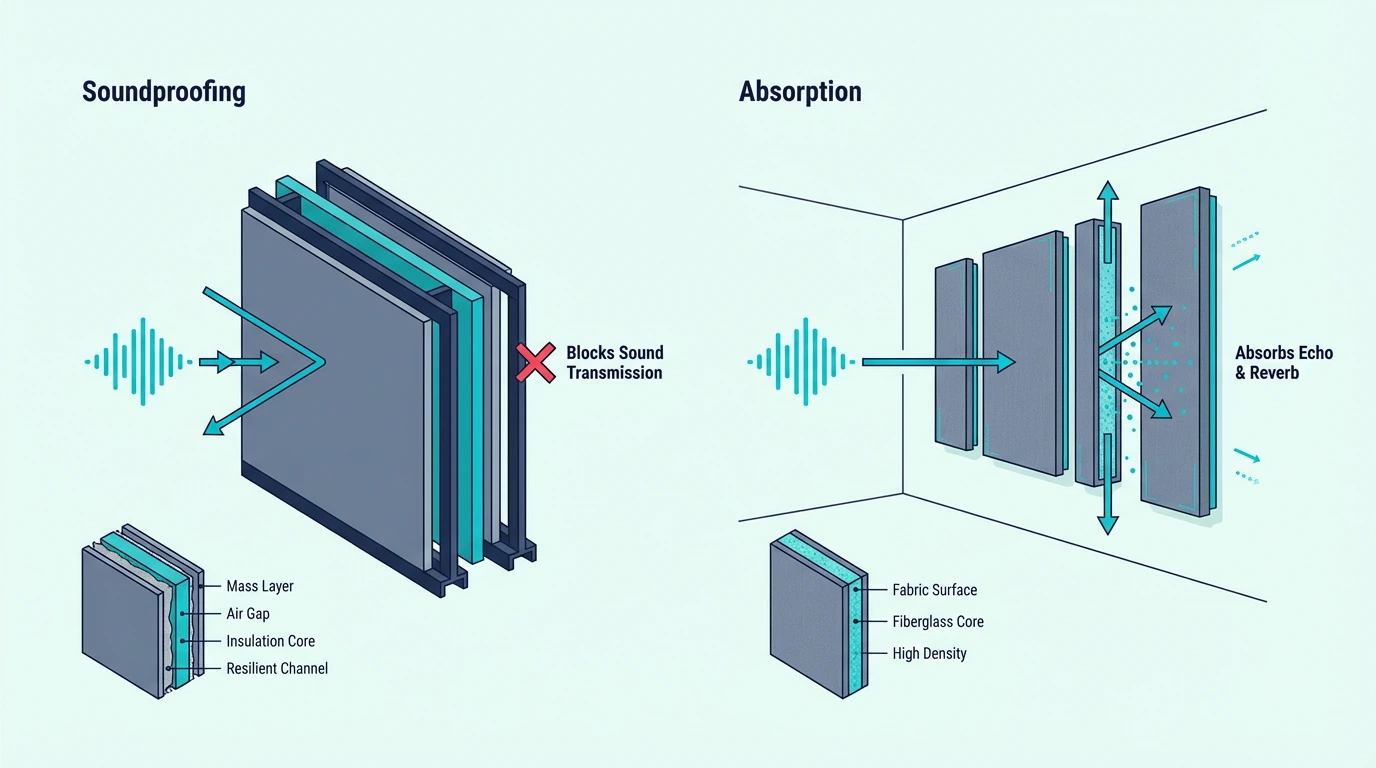
Acoustic panels and bass traps both absorb sound, but they target different parts of the frequency spectrum. The split is a hard line at roughly 250 Hz: panels handle everything above it, and traps handle everything below it.

Acoustic Panels Target Mid and High Frequencies

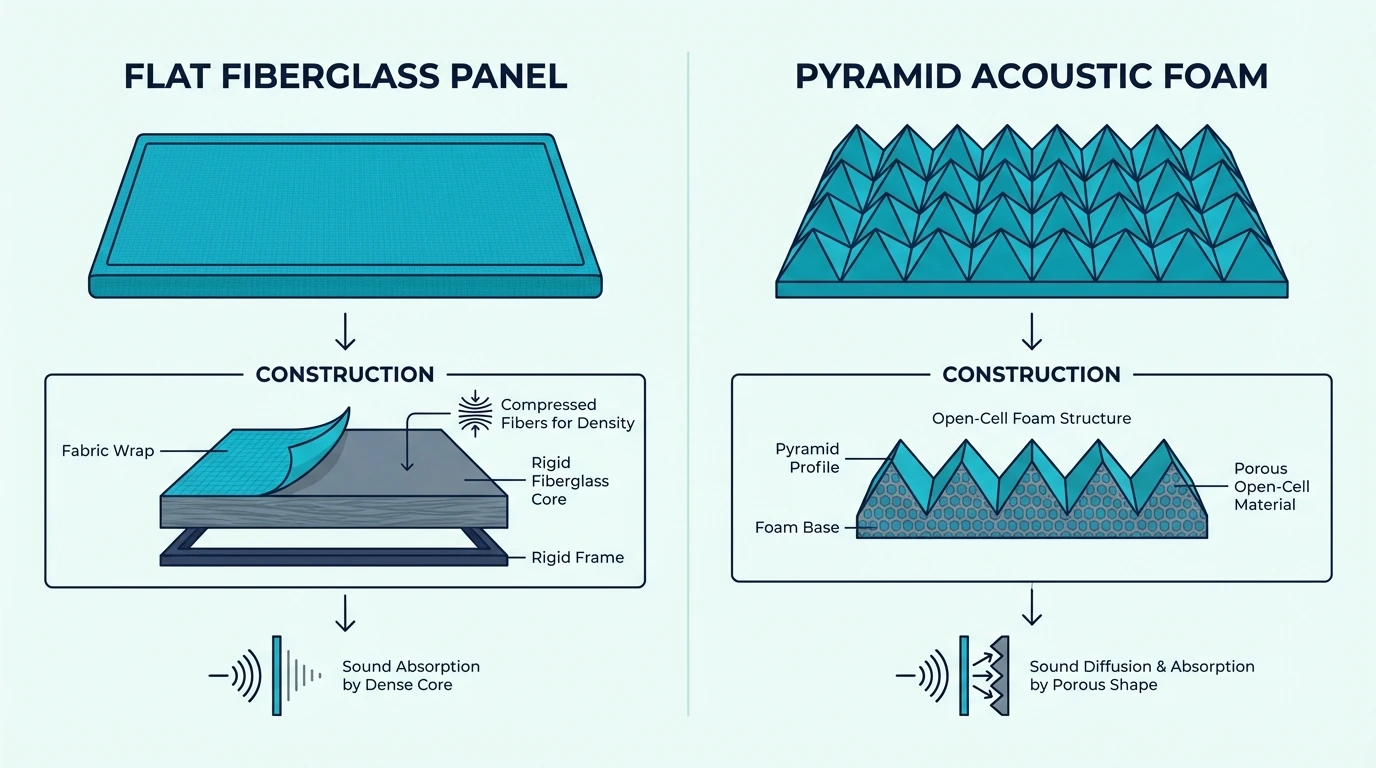
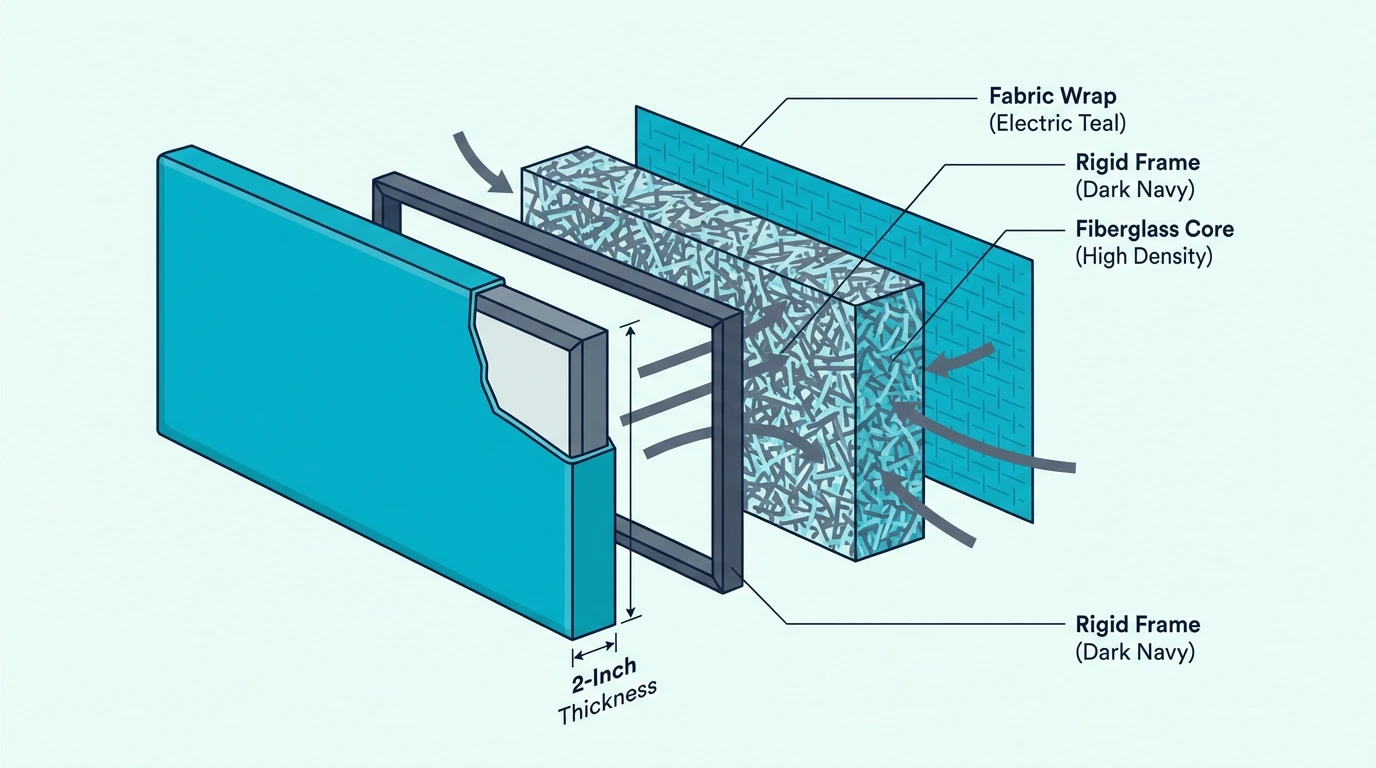
That upper range—from 250Hz through 20kHz—is the territory of standard acoustic panels. The 2-inch thick fabric-wrapped rectangles you see in professional studios exist specifically to absorb human voice fundamentals, guitar body resonance, cymbal shimmer, and the clarity range where most sonic detail lives.

A quality panel with an NRC rating of 0.85 or higher absorbs 85% of sound energy in this range. That is enough to transform a live, reflective room into a controlled acoustic environment.

Clap your hands in the room and listen for a ringing tail or flutter echo. If you hear it, those panels are the fastest fix.

What Are Acoustic Panels Good For?

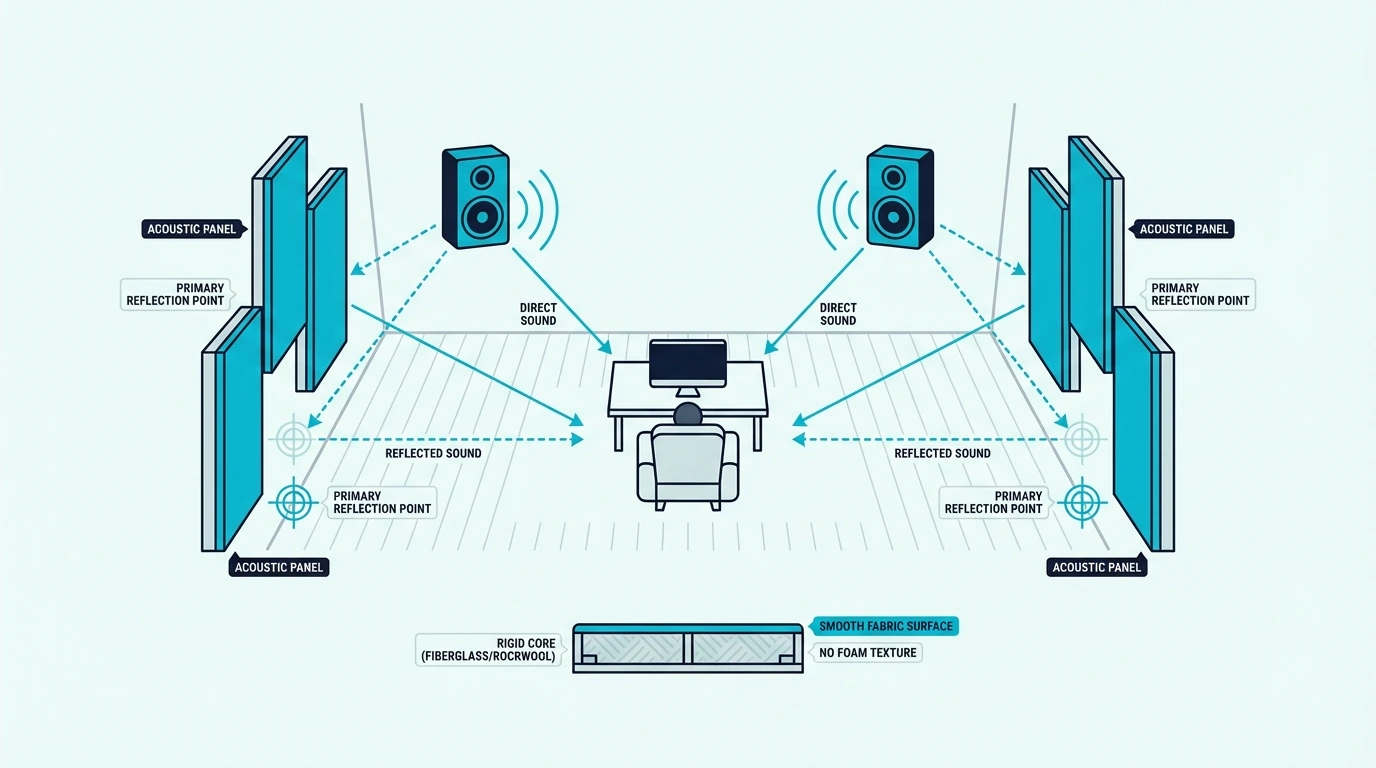
The best place to deploy that mid-high absorption is at your first reflection points—the spots on your walls where sound bounces directly from your speakers (or voice) to your ears. These early reflections cause comb filtering and smeared imaging that makes mixing difficult and recordings sound amateur.

For home studios focused on vocals and podcasting, treating these reflection points often provides 80% of the acoustic improvement you will ever need, simply because voice frequencies sit squarely in the panel’s effective range.

But for music production involving heavy kicks or synths, panels are necessary but insufficient. They will clean up the mids and highs beautifully, but your low end will remain a boomy, unpredictable mess without dedicated bass treatment.

Understanding how acoustic panels work helps explain why material thickness drives this frequency split so aggressively.

If you want a straightforward “standard” panel to start with, the UMIACOUSTICS 4 PCS Acoustic Panels are a typical 2-inch fiberglass option for mid/high reflection control.

What Are Bass Traps?
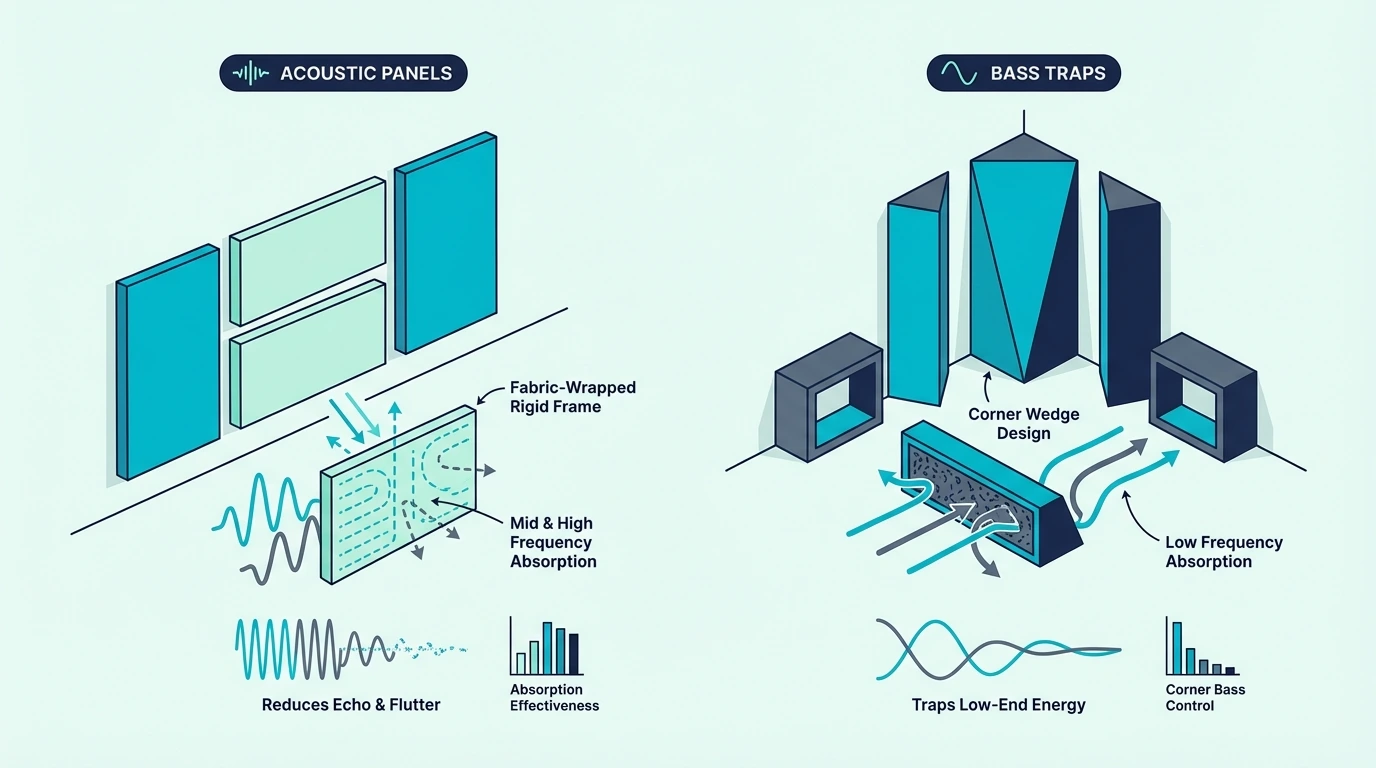
What Are Bass Traps?

Because panels cannot absorb deep energy, you need bass traps to handle everything below 250Hz. How deep they actually reach depends on two structural factors: material thickness and corner placement.

What Frequencies Do Bass Traps Absorb?

The thickest traps target the 20Hz to 250Hz range—everything from deep sub-bass rumble through the fundamental frequencies of a kick drum and male vocal chest resonance.

The most common bass problems in home studios occur between 60Hz and 200Hz, where room modes create massive standing waves. These modes cause certain bass frequencies to boom excessively while others virtually disappear from the listening position, making accurate mixing impossible.

A well-designed bass trap can provide strong absorption down to 80 Hz or lower. When you add an air gap behind a thick trap, that effective absorption extends even further into the sub-bass range.

The DIY bass trap guide explains the exact materials and thickness required for meaningful low-end absorption if you want to build your own.

For an entry-level corner option, the 8 Pack – Bass Traps Acoustic Foam Corner can help with mild issues.

Why Are Low Frequencies So Hard to Control?

Those deep frequencies require so much material because they behave fundamentally differently than mids and highs. At 100Hz the wavelength is over 11 feet, and at 50Hz it exceeds 22 feet — which is often longer than the physical dimensions of the room.

When wavelengths approach the size of your room, standing waves form as sound bounces between parallel surfaces, creating predictable zones of reinforcement (loud spots) and cancellation (dead spots). That is why the bass can sound overwhelmingly loud at your desk but completely disappear when you walk to the back of the room.

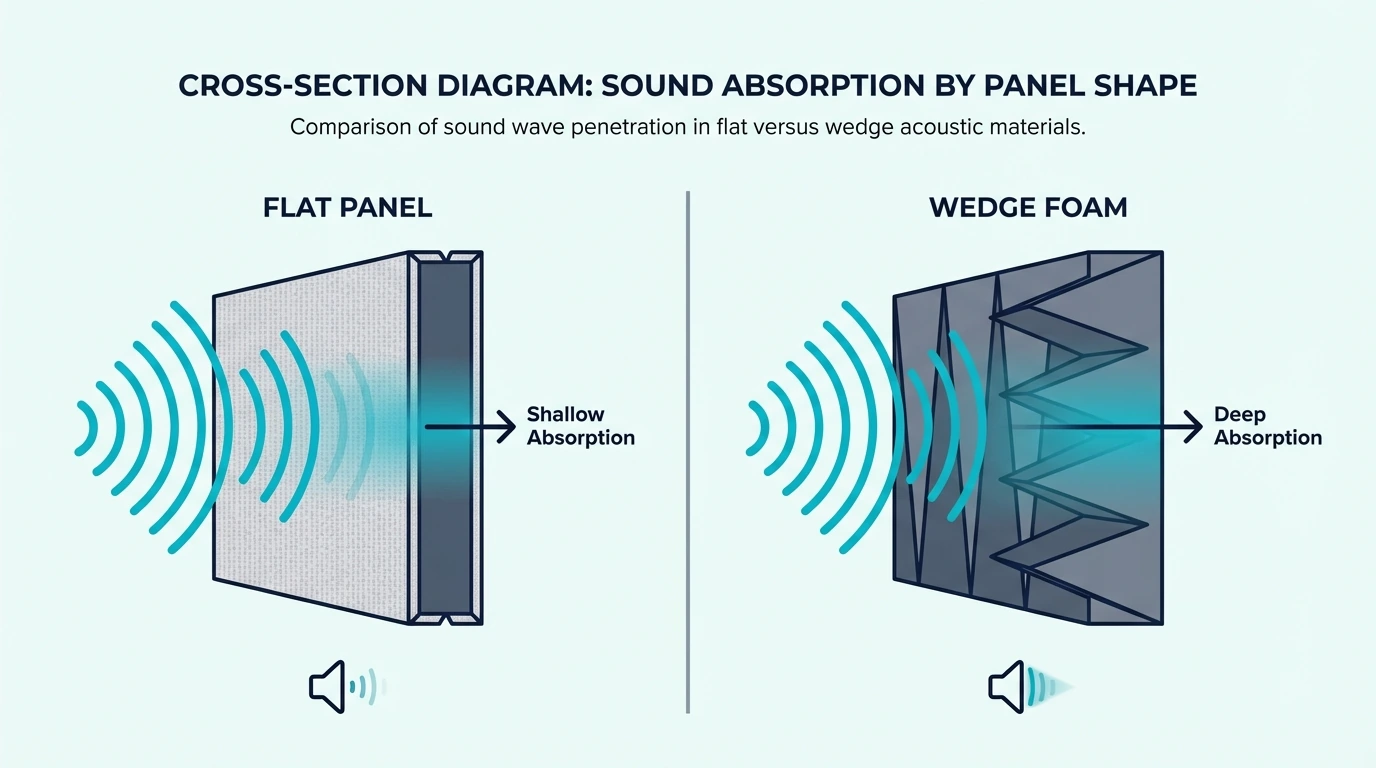
Standard panels cannot touch these massive waves because a 2-inch depth is tiny compared to an 11-foot wavelength. Bass traps solve this physics problem through sheer bulk—more material depth means more friction to convert that acoustic energy into heat.

Corner placement amplifies this effectiveness because room corners are pressure zones where bass energy naturally pools. Treating corners captures the bass where it is most concentrated.

For deeper low-end control in those corners, the ATS Acoustics Corner Bass Trap is a thick fiberglass option built for serious low-frequency problems.

Can Acoustic Panels Work as Bass Traps?
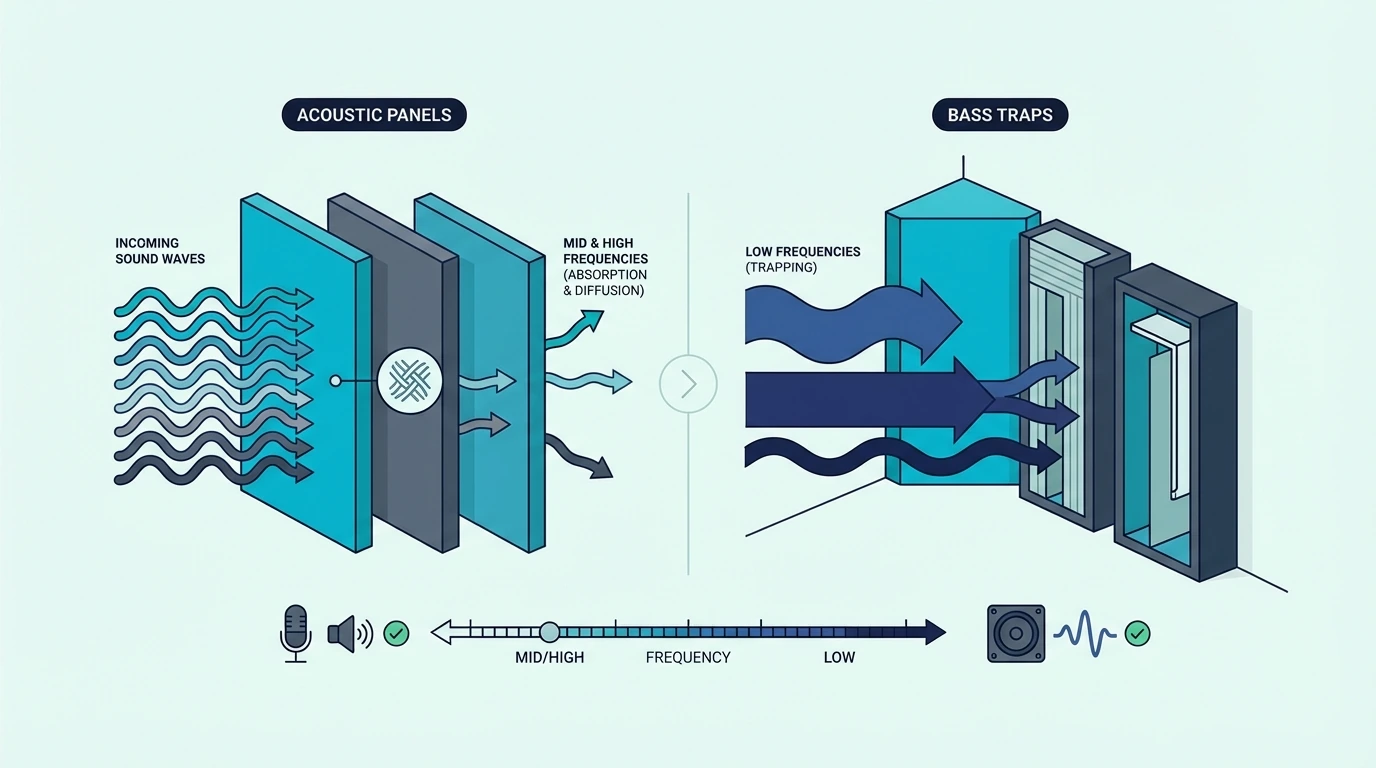
Can Acoustic Panels Work as Bass Traps?

Many people buy standard panels, cover their walls, and still hear a boomy room because they assume “acoustic treatment” means “treats all frequencies.” Two things explain why panels fail at this job — the physics of material depth, and the one mounting trick that partially bridges the gap.

Why Panels Cannot Handle Bass

The failure traces back to the wavelength math mentioned earlier: a 2-inch panel is simply too shallow to interact with an 11-foot 100Hz wave. The wave passes through the thin material with minimal friction and loses almost no energy.

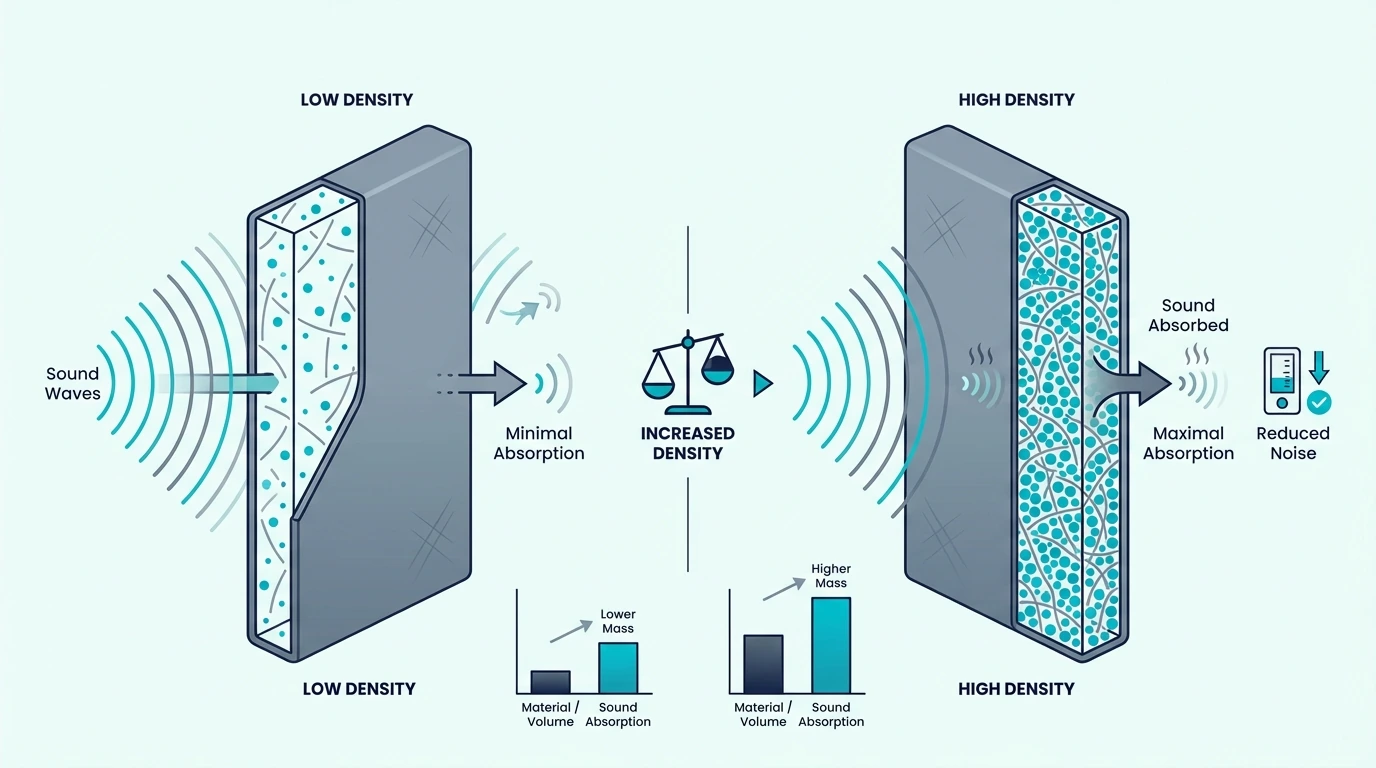
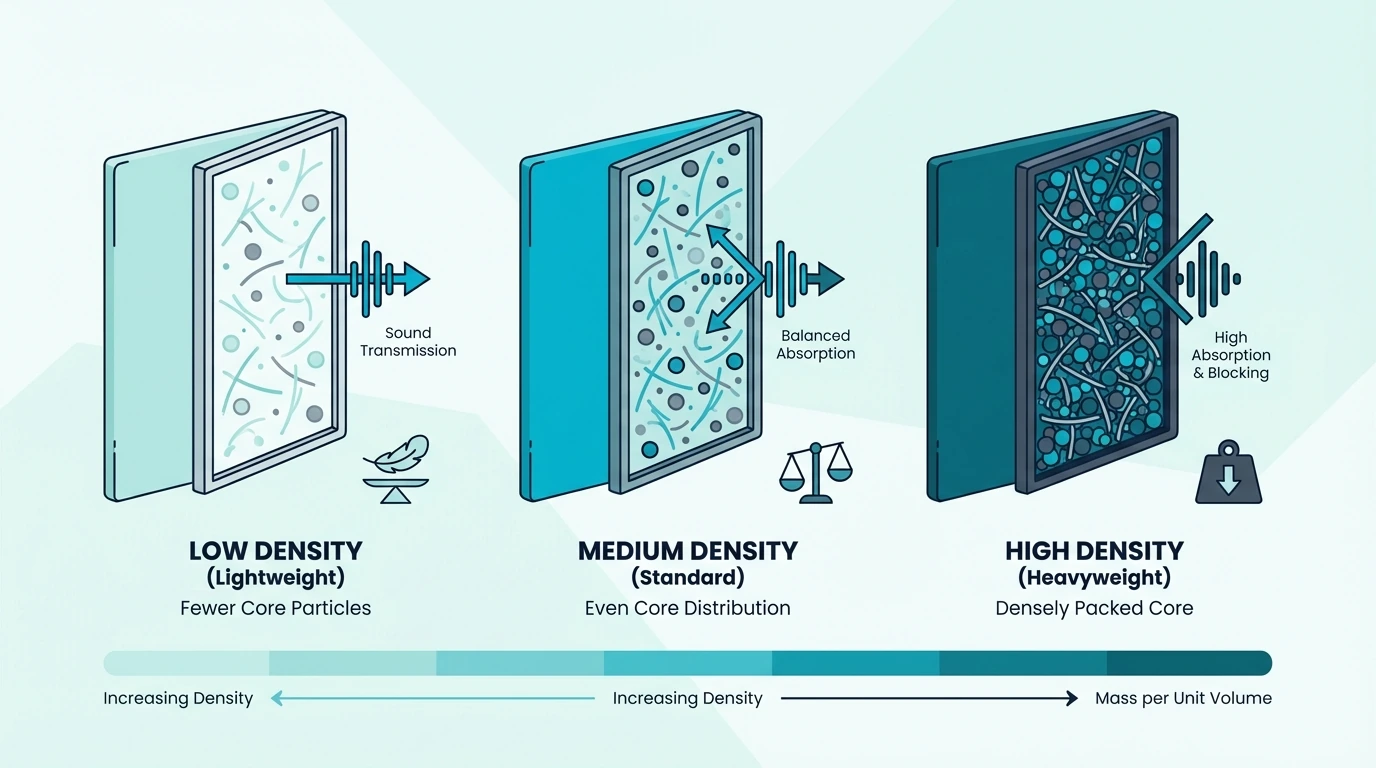
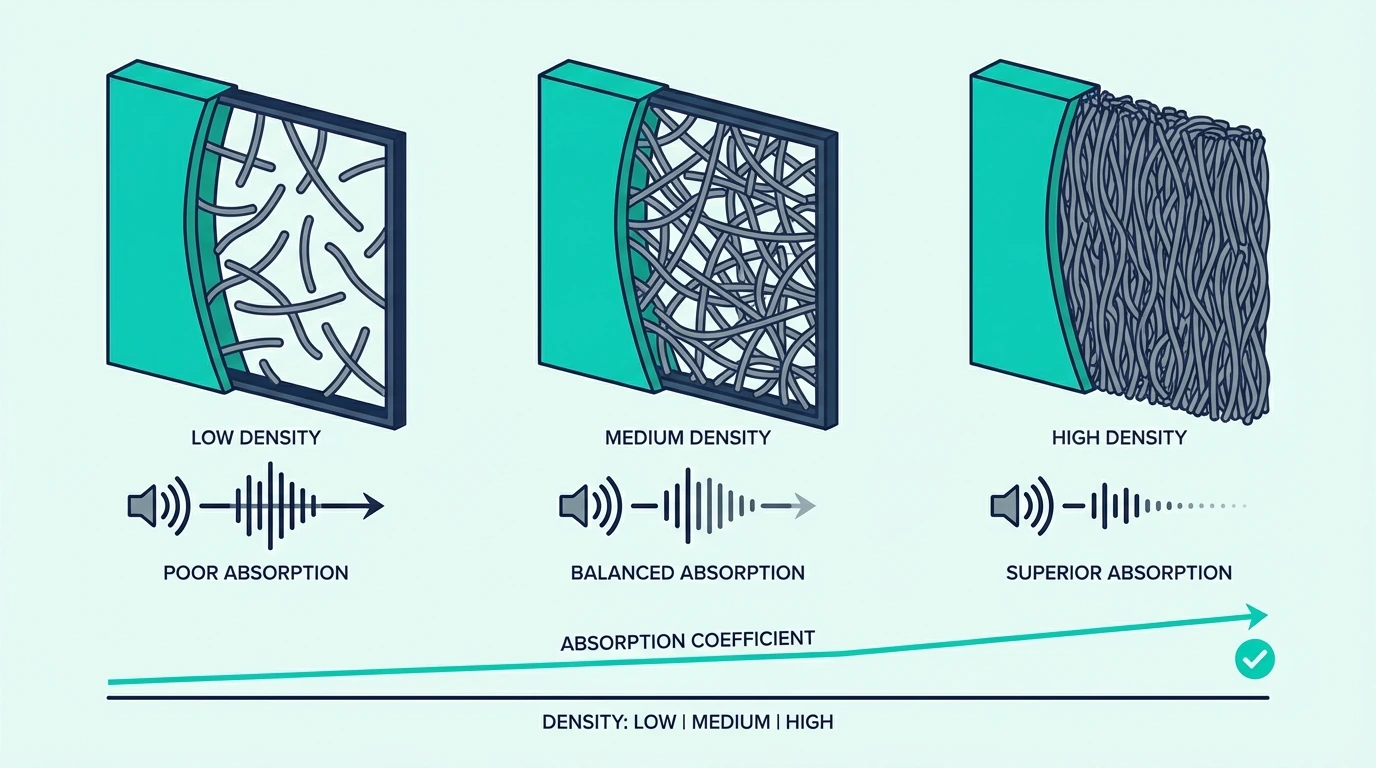
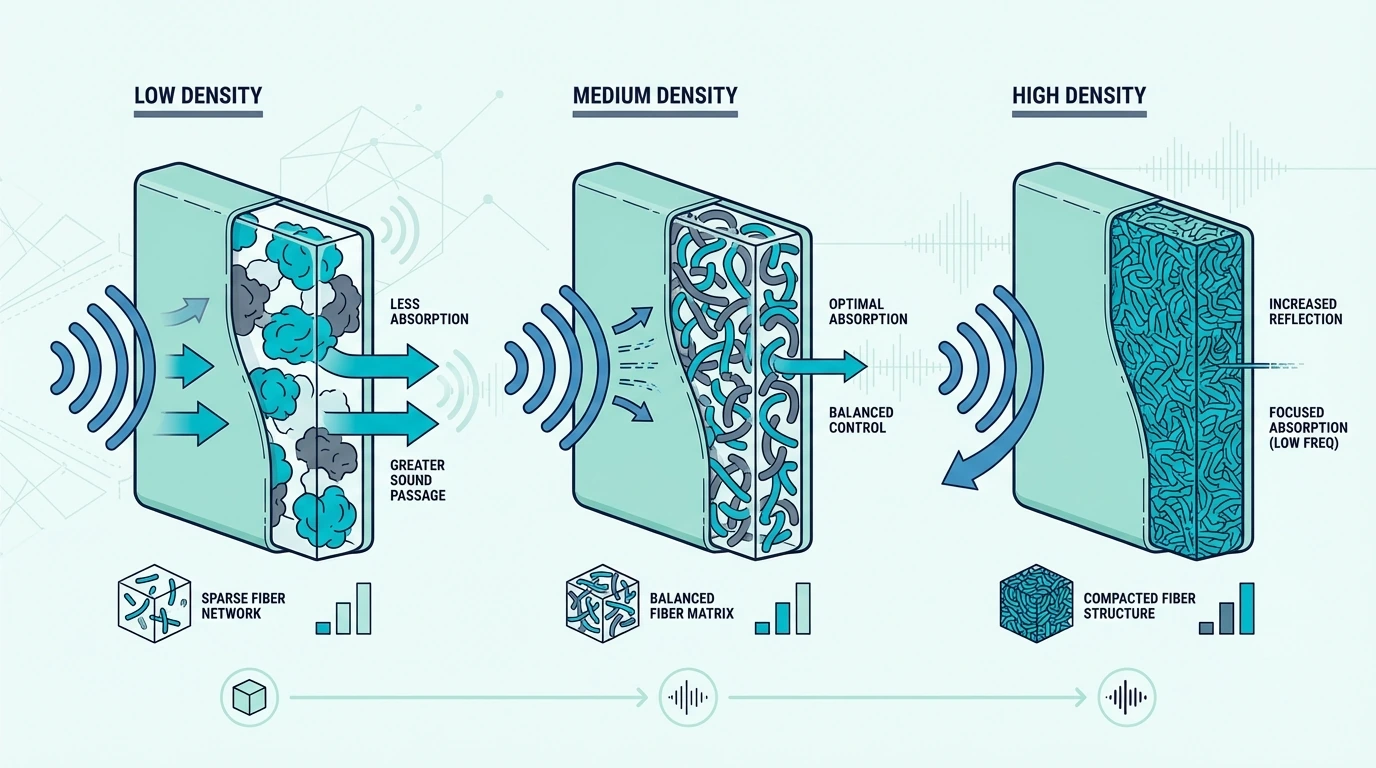
Increasing panel density does not help much—you can pack more fibers into those 2 inches, but the fundamental depth limitation remains. The wave needs distance to dissipate, and thin panels do not provide it.

You can demonstrate this yourself by playing a bass-heavy track and standing near a wall covered in standard panels, because you will still feel the bass vibrating through. Now stand in a corner with a dedicated bass trap and the difference in low-end control is immediately obvious.

Some manufacturers market “bass-absorbing panels” at 2-inch thickness, but the physics is the same. If you check absorption coefficient charts, you will typically see effective absorption starting at 250-500Hz, not the 80-125Hz range where most bass problems live.

The Only Panel Configuration That Helps Bass

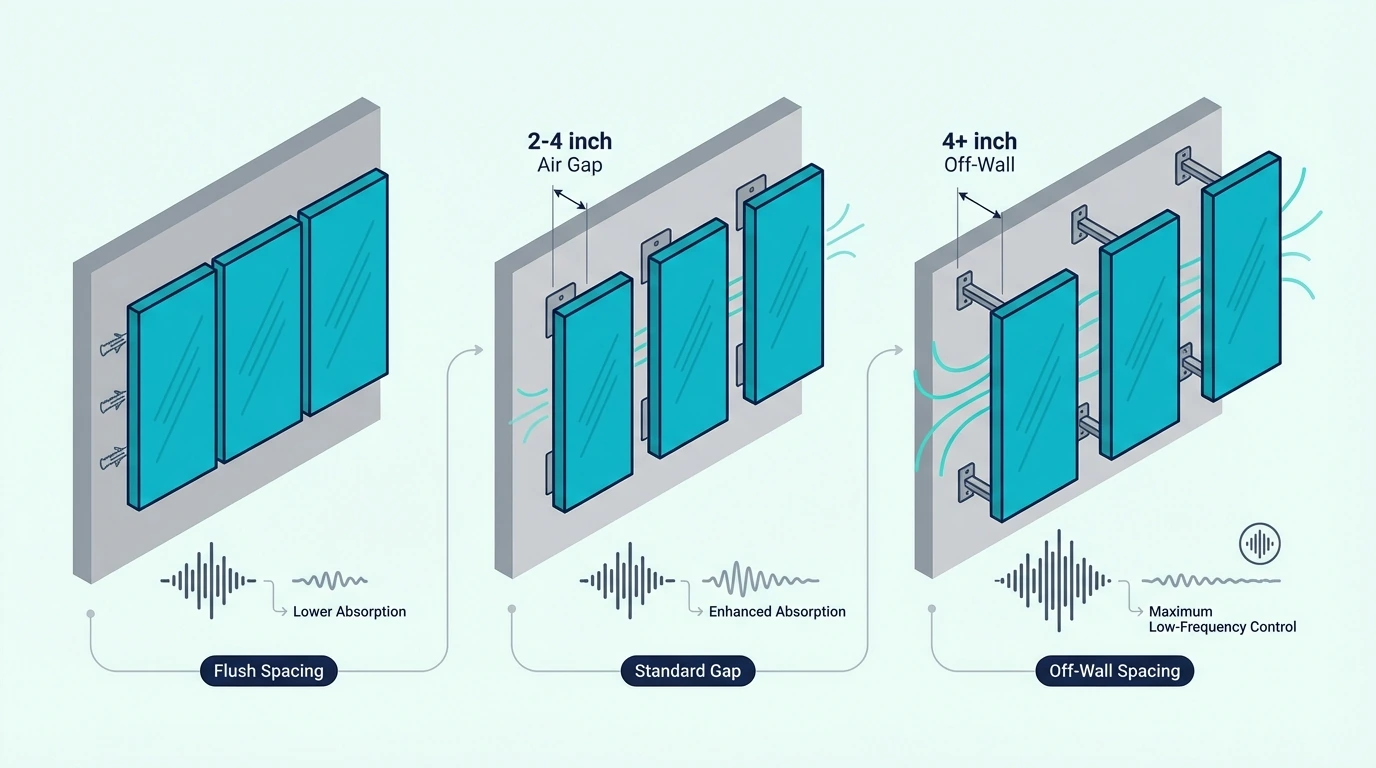
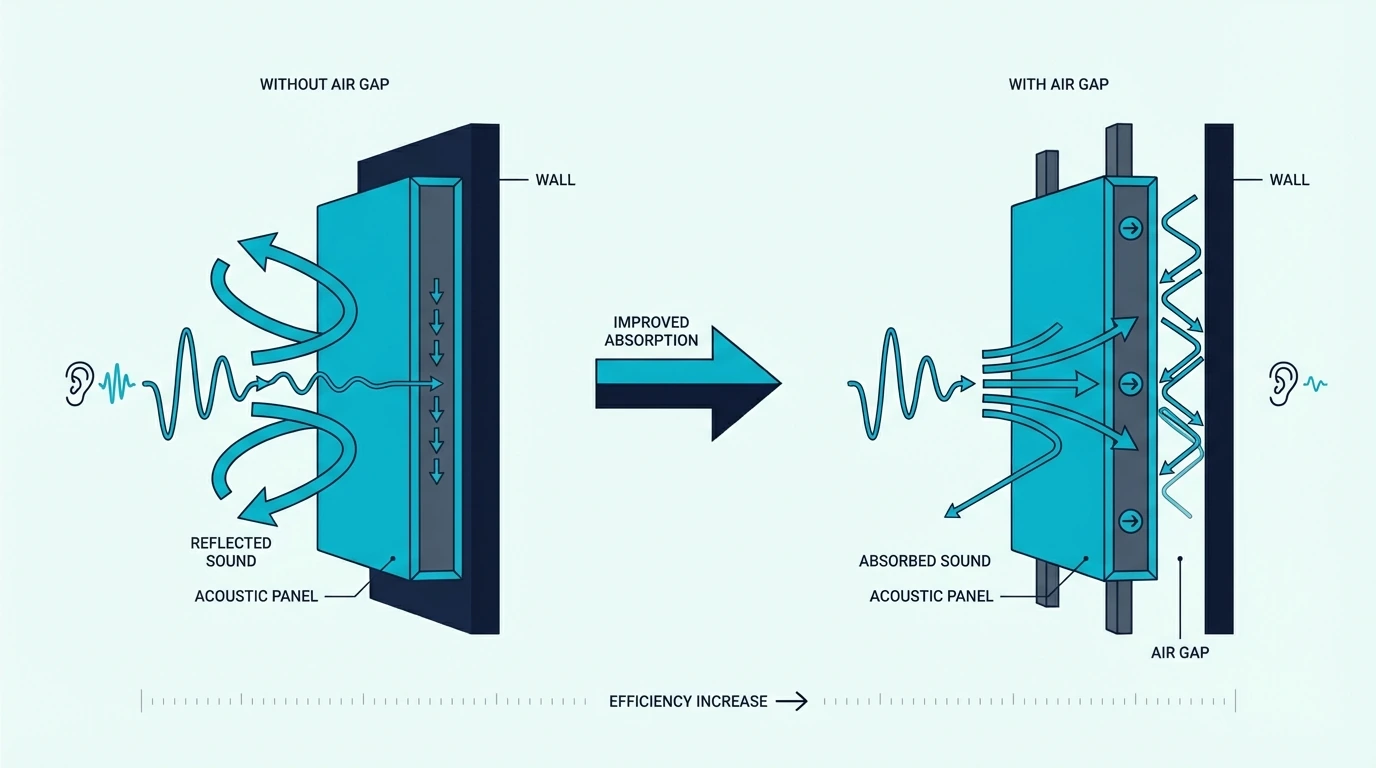
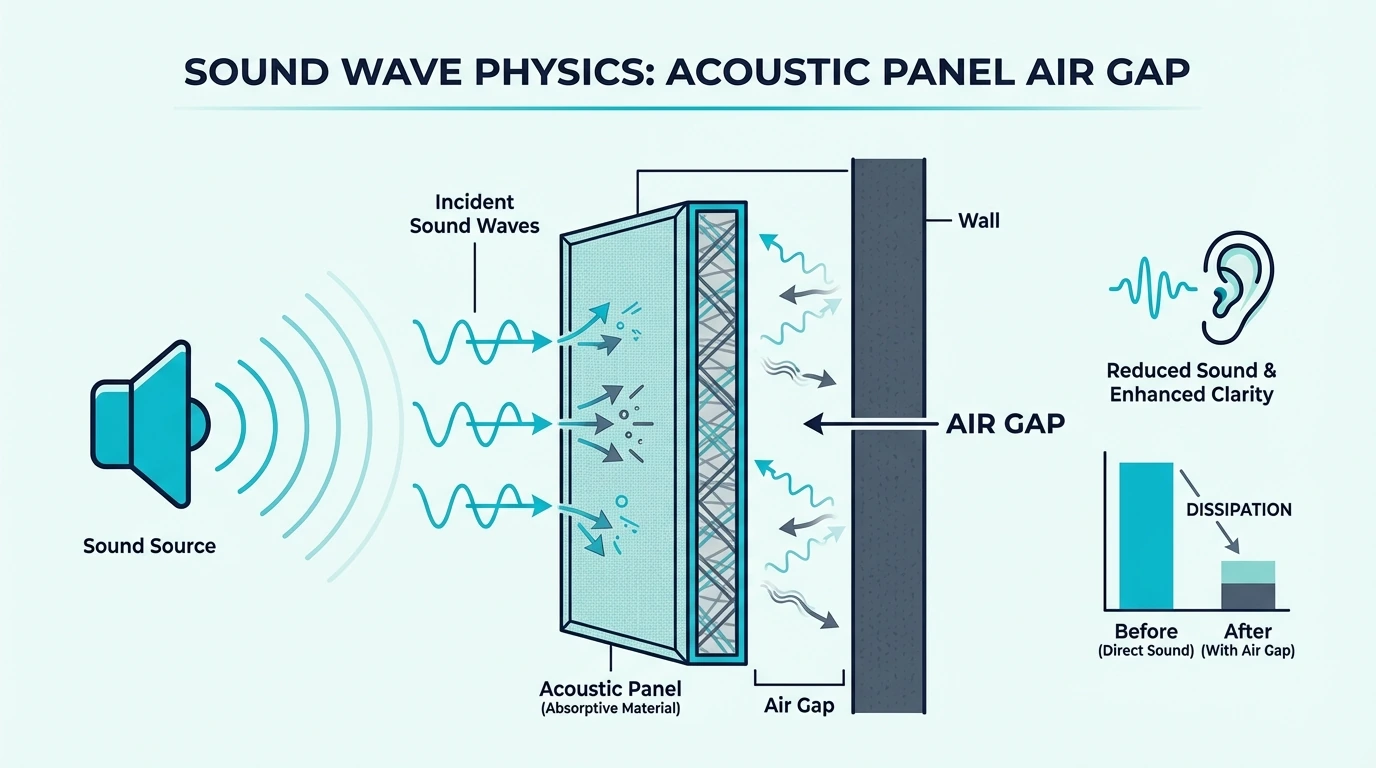
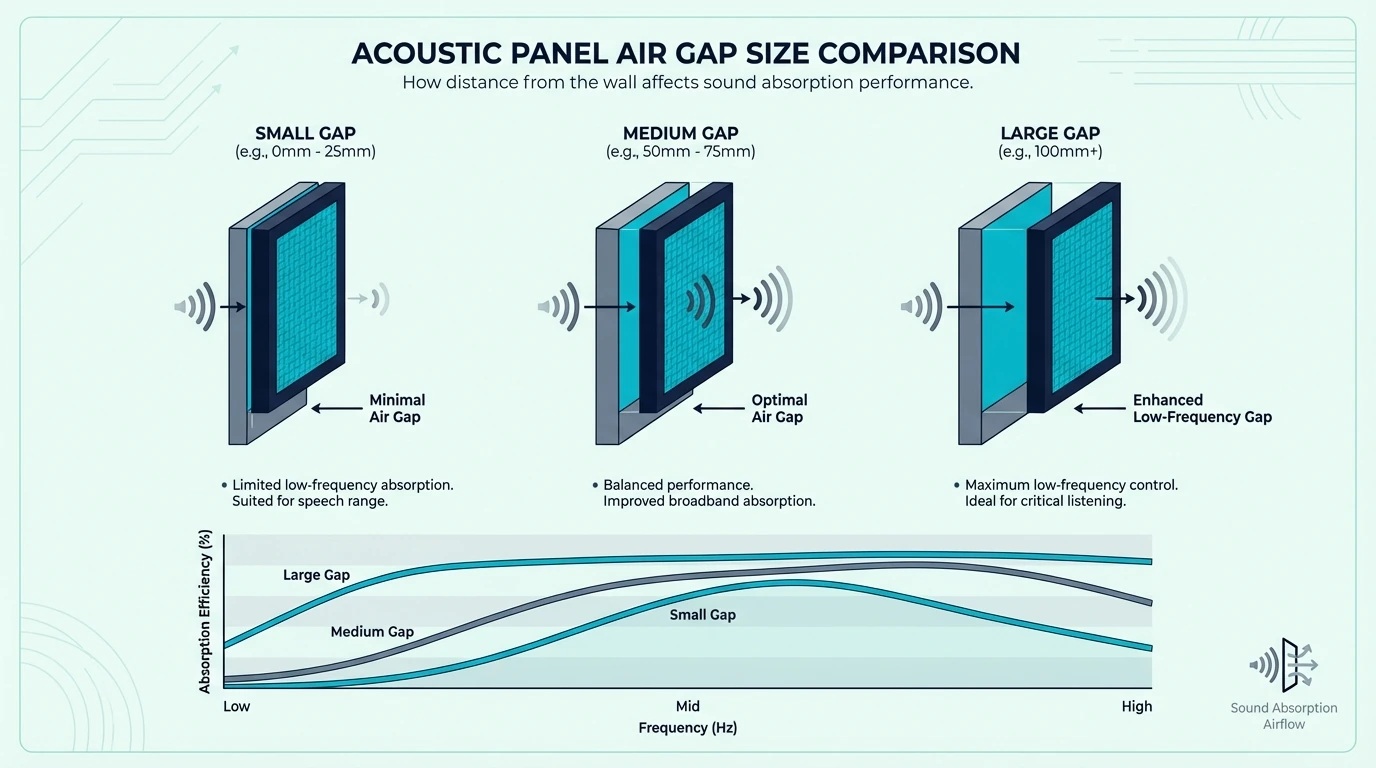
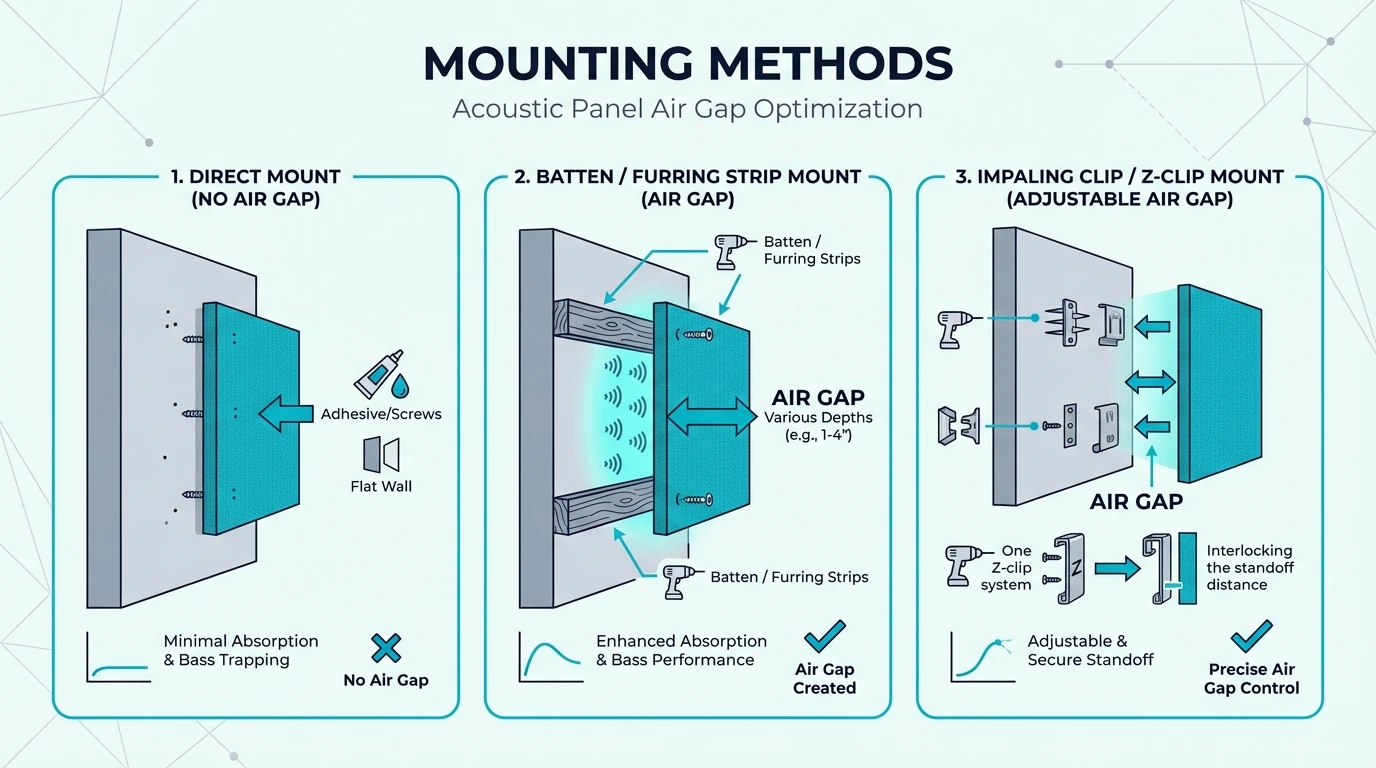
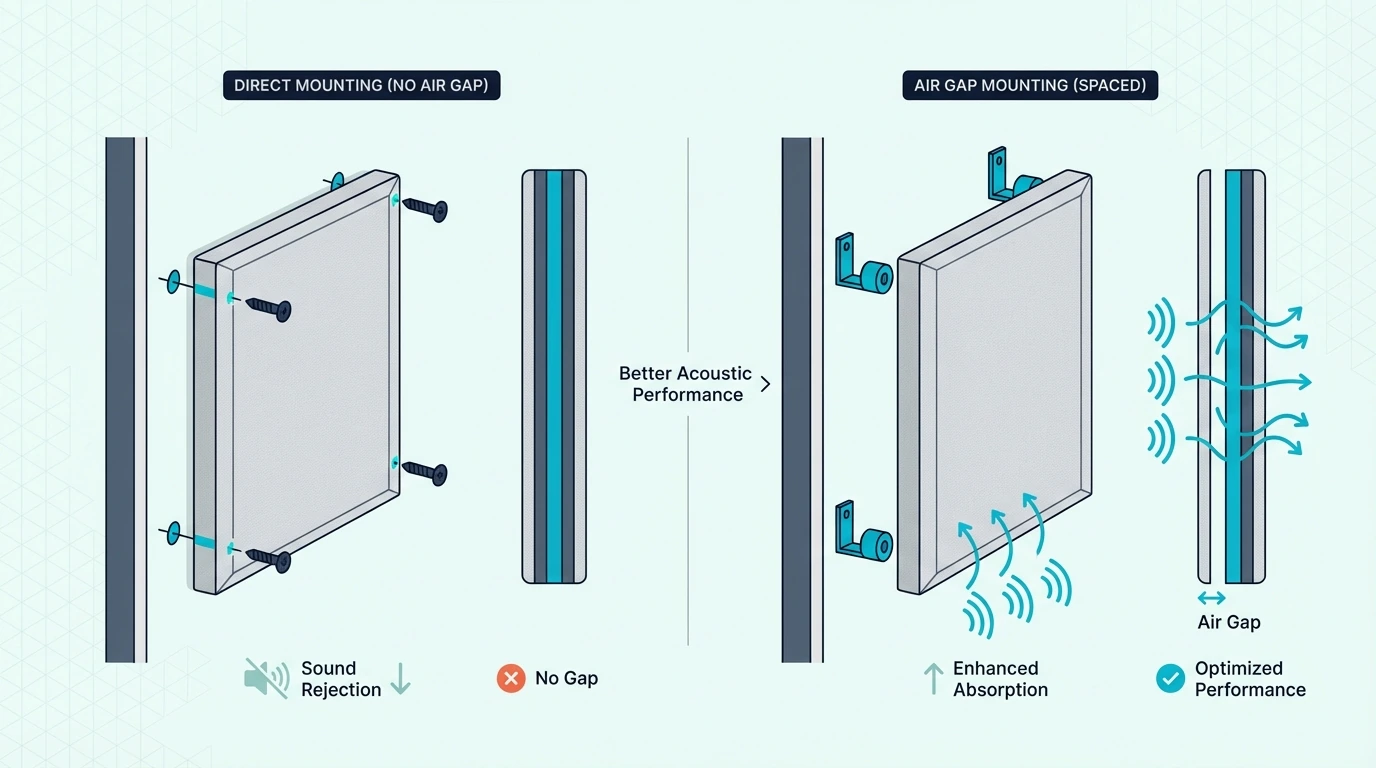
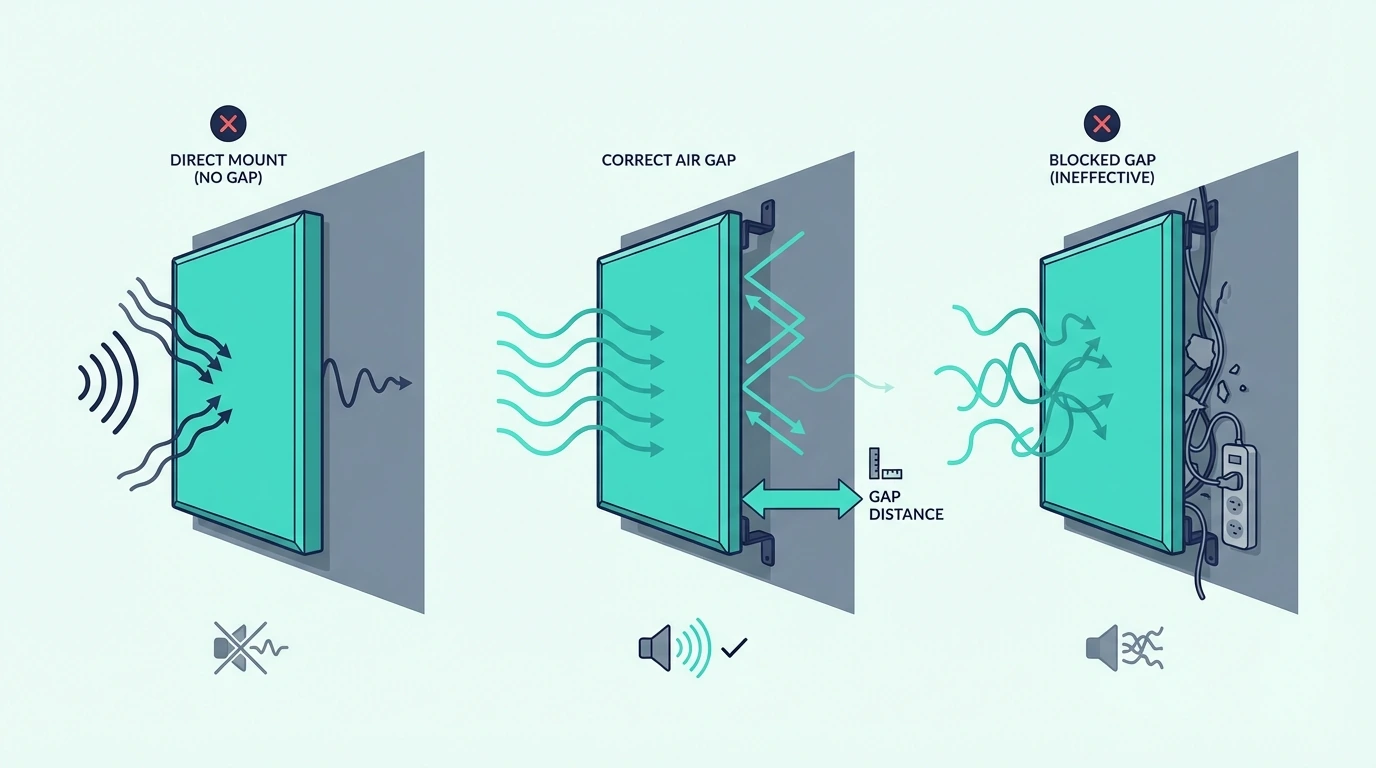
You can artificially deepen that material interaction by adding an air gap behind standard panels. A 2-inch panel mounted 4 inches off the wall performs closer to a 6-inch panel for certain frequencies. The air gap installation guide explains when this helps and how to mount panels safely.

But even with generous air gaps, standard panels will never match the raw performance of dedicated bass traps. If your primary acoustic problem is low-end room modes, treating with thicker purpose-built traps delivers far better results than trying to force thin panels to do a job they were not built for.

Do You Need Both Panels and Bass Traps?
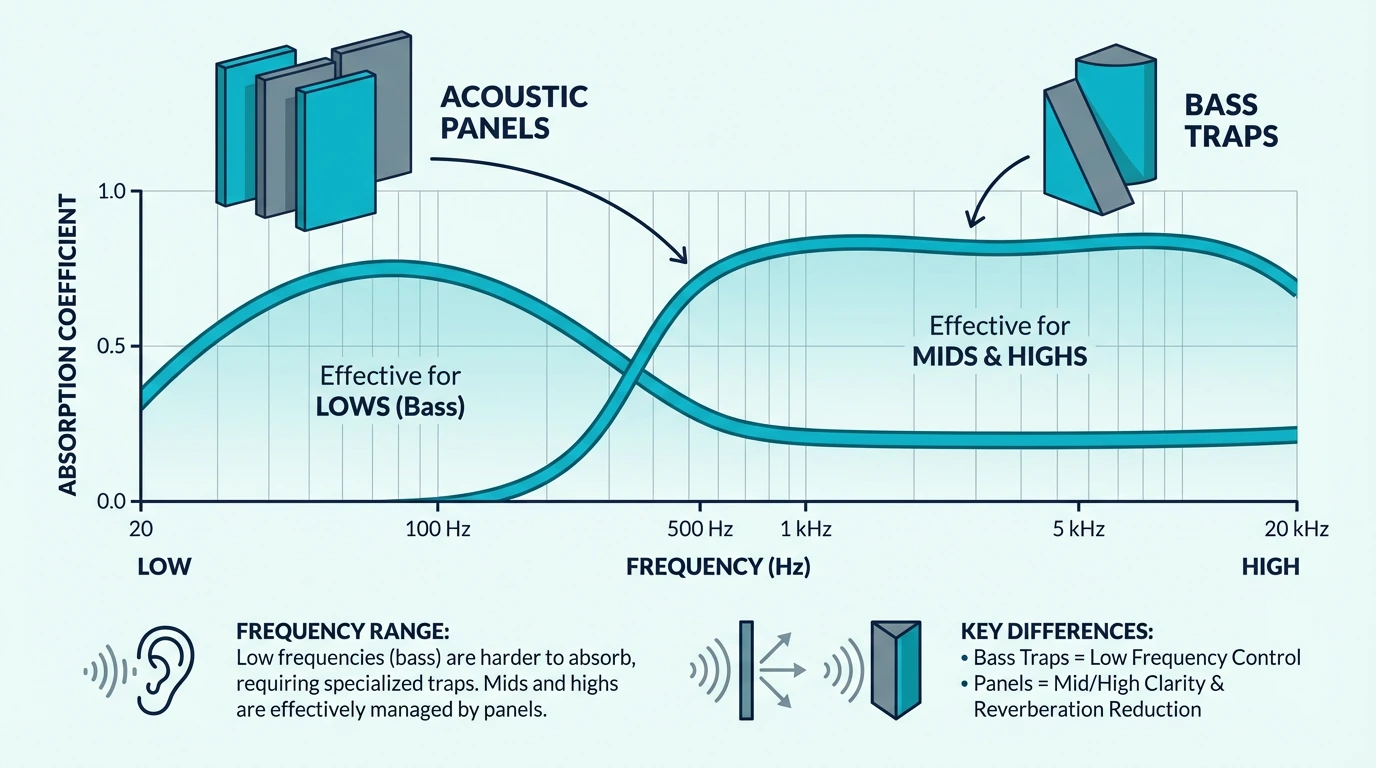
Do You Need Both Panels and Bass Traps?

Because they fix entirely different problems, most rooms eventually require both panels and traps. But the order in which you should buy them depends entirely on what the room is used for.

For Home Studios: Usually Yes

If you are producing, recording, or mixing music, both treatments are mandatory for a reliable room. You need panels to handle the flutter echo and comb filtering that smears your stereo imaging, while simultaneously needing bass traps to flatten out the room modes that make your low end unreliable.

Studios without bass treatment suffer from notoriously inconsistent mixes. What sounds huge and punchy at the mixing desk might sound completely hollow in your car — because you were EQing the mix to compensate for the room’s false bass boost.

The recording studio panel guide covers panel selection, but any serious setup must budget for corner treatment alongside wall absorption.

For Home Theaters: Depends on Content

Home theaters shift the priority slightly. If you watch explosive action movies or listen to bass-heavy soundtracks, traps are essential to keep the deep rumbles controlled and tight rather than booming chaotically around the room.

But if the theater is primarily used for dialogue-focused content like news, talk shows, or documentaries, panels alone might suffice. Speech frequencies sit perfectly within the standard panel absorption range. The home theater panel guide has specific recommendations for both scenarios.

Budget Approach: Panels First

When budget constraints force you to choose one or the other, standard panels almost always deliver a more obvious initial improvement. The reduction in room echo and the massive boost to voice clarity from treating first reflection points is immediately audible to anyone.

Bass traps, by contrast, address problems that are structurally critical but often less obvious to untrained ears until the mid-high clutter is cleared out. Many beginners do not even realize they have a bass problem until they have treated all the reflections and the underlying low-end boom finally becomes exposed.

Start with 4-6 panels at primary reflection points, such as the Olanglab Fiberglass Acoustic Wall Panels 4 Pack. Add bass traps when budget allows, prioritizing corners behind your listening position first.

Where Does Each Type Go?
Where Does Each Type Go?

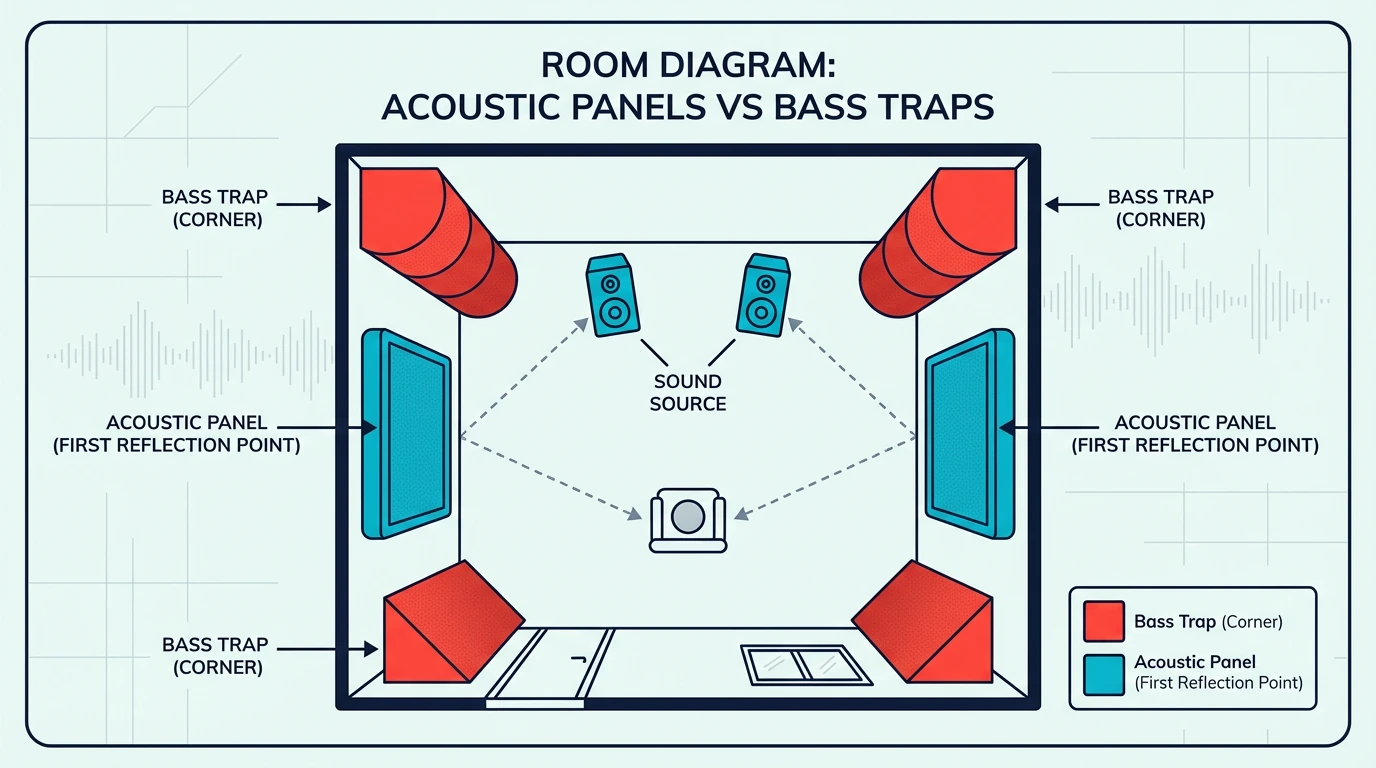
Because they target different physics, the placement rules for each treatment are completely separate. You are hunting pressure zones for traps and bounce paths for panels.

Bass Traps: Corners First

The highest pressure zones in any room are the corners where three surfaces meet (wall-wall-ceiling or wall-wall-floor). Bass energy naturally accumulates here, making these tri-corners the absolute most effective real estate for deep absorption.

You should prioritize the vertical wall-to-wall corners first, ideally running floor-to-ceiling treatment to capture the maximum amount of energy per square foot. If budget allows, extend the traps horizontally into the wall-ceiling junctions.

Putting a bass trap in the middle of a flat wall provides minimal benefit because you are missing the pressure zone entirely.

Acoustic Panels: First Reflection Points

Conversely, panels belong squarely on the flat wall surfaces, specifically at the spots where sound bounces from your monitors to your ears.

You find these bounce paths using the mirror trick: sit in your listening chair while someone slides a flat mirror along the side walls. Wherever you can see the speaker cone in the reflection is exactly where a panel needs to be mounted.

Treat the side walls at ear height first, then move to the front wall behind the speakers if they are positioned close to the drywall. A ceiling cloud above the desk is the next priority, leaving the rear wall for last if flutter echo still persists.

The panel placement guide includes detailed positioning strategies for every room shape.

How Do Acoustic Panels and Bass Traps Compare Side by Side?
Comparison Table

Acoustic panels focus on mid and high frequencies (roughly 250Hz and up) and are usually 2-4 inches thick in standard 24×48 sizes. Bass traps focus on low frequencies (roughly 20-250Hz) and are typically 4-6 inches thick or more, often in corner-friendly shapes.

Panels go on walls at first reflection points to reduce echo and improve clarity, while bass traps go in corners (pressure zones) to control room modes and tighten low end. Panels are usually cheaper per unit and take minimal wall space, while bass traps cost more and consume corner space but solve problems panels cannot.

What Should You Do Next?
What Should You Do Next?

Panels and traps solve different acoustic problems, and neither can replace the other.

Start with the symptom you hear most and add the second treatment as you expand coverage.

For most home studios and listening rooms, start with acoustic panels at first reflection points to clean up imaging and clarity. Then add bass traps to corners as budget allows, especially if you mix bass-heavy music or hear obvious room boom.

If you are building out a new space, plan for both from the start. The combined cost of complete treatment is lower than iteratively discovering you need additional products after initial installation.

The best acoustic panels guide covers panel recommendations, and the acoustic panels hub covers placement, installation, and room-specific treatment strategies.

Conclusion

The single biggest mistake in acoustic panels vs bass traps treatment is buying more of the same product when the problem is actually in a different frequency range. Four extra panels will not fix an 80 Hz room mode, and four corner traps will not clean up a slapback echo at 2 kHz.

Diagnose the frequency first, then match the tool. That one decision saves more money and delivers faster results than any product upgrade.

The panel count guide helps you calculate how many of each you need, and the hanging guide covers hardware for every wall and corner type.

Frequently Asked Questions

These quick answers cover the most common buying and placement questions when you are comparing panels and bass traps.

Use them as a final check before you order products or build your own treatment.

Which Should I Buy First — Panels or Bass Traps?

Panels first for most situations. The clarity improvement from treating first reflection points is immediately noticeable and panels cost less per unit.

Exception: if you hear obvious boominess or notes that disappear, prioritize bass traps — the low-end improvement will be more dramatic.

How Many of Each Do I Need?

For a typical 10×12 home studio: 4-6 panels at side wall and speaker reflection points, plus 2-4 bass traps prioritizing front corners. Larger rooms scale proportionally, but the ratio stays roughly equal between panels and traps.

Can I Use Thick Panels Instead of Bass Traps?

A 4-inch panel with an air gap approaches bass trap performance above 125 Hz. Below that — the 60–100 Hz range where most room modes live — purpose-built corner traps still win.

Corners concentrate bass energy where flat walls do not, so a thick panel on a flat wall still misses the highest-pressure zones that traps are designed to treat.

Do Bass Traps Replace Corner Panels?

Bass traps in corners replace the need for panels in those same corners — you would not install both in the same spot. But bass traps do not eliminate the need for panels at first reflection points on flat wall surfaces, so complete treatment still requires both types.
Acoustic Panels Behind Speakers: Should You Do It? [2026]

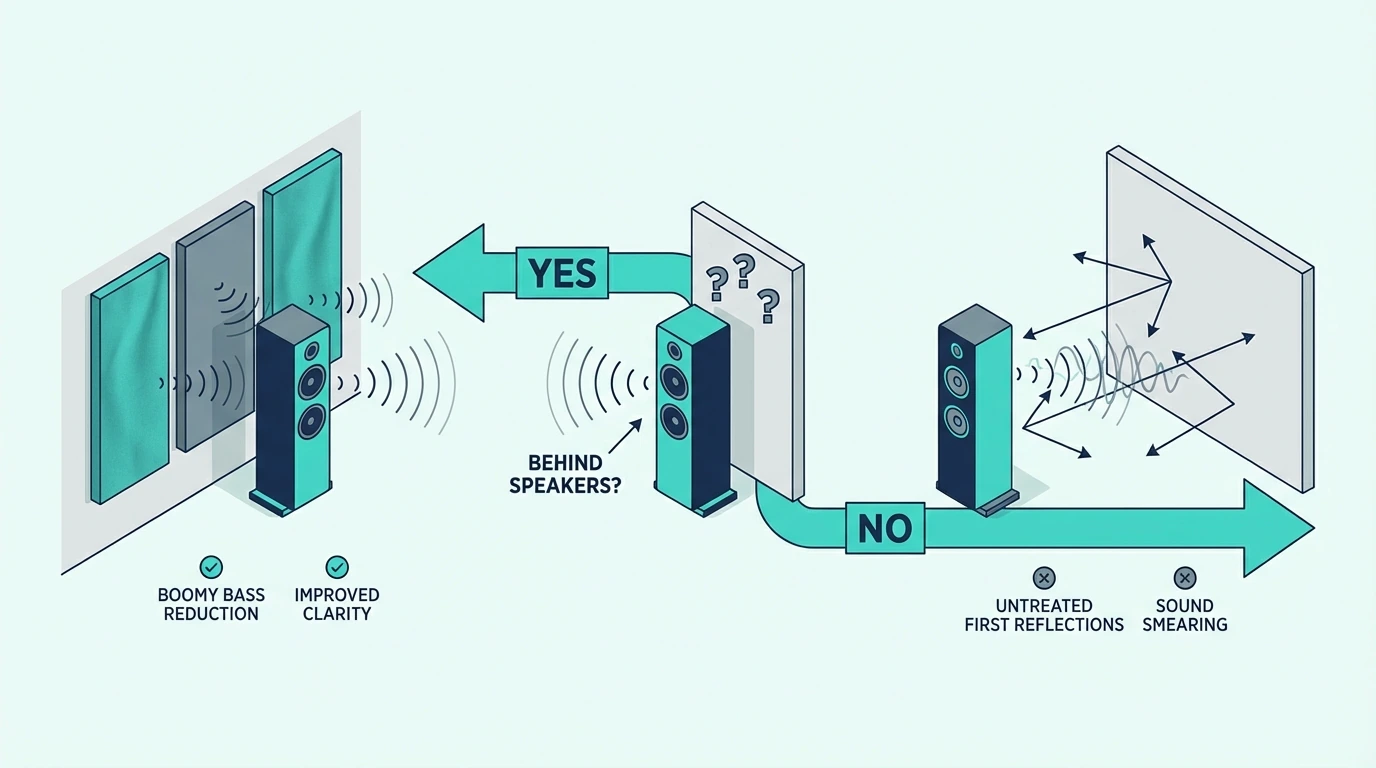
Should you put acoustic panels behind speakers? Yes, but only if you are solving the right problem.

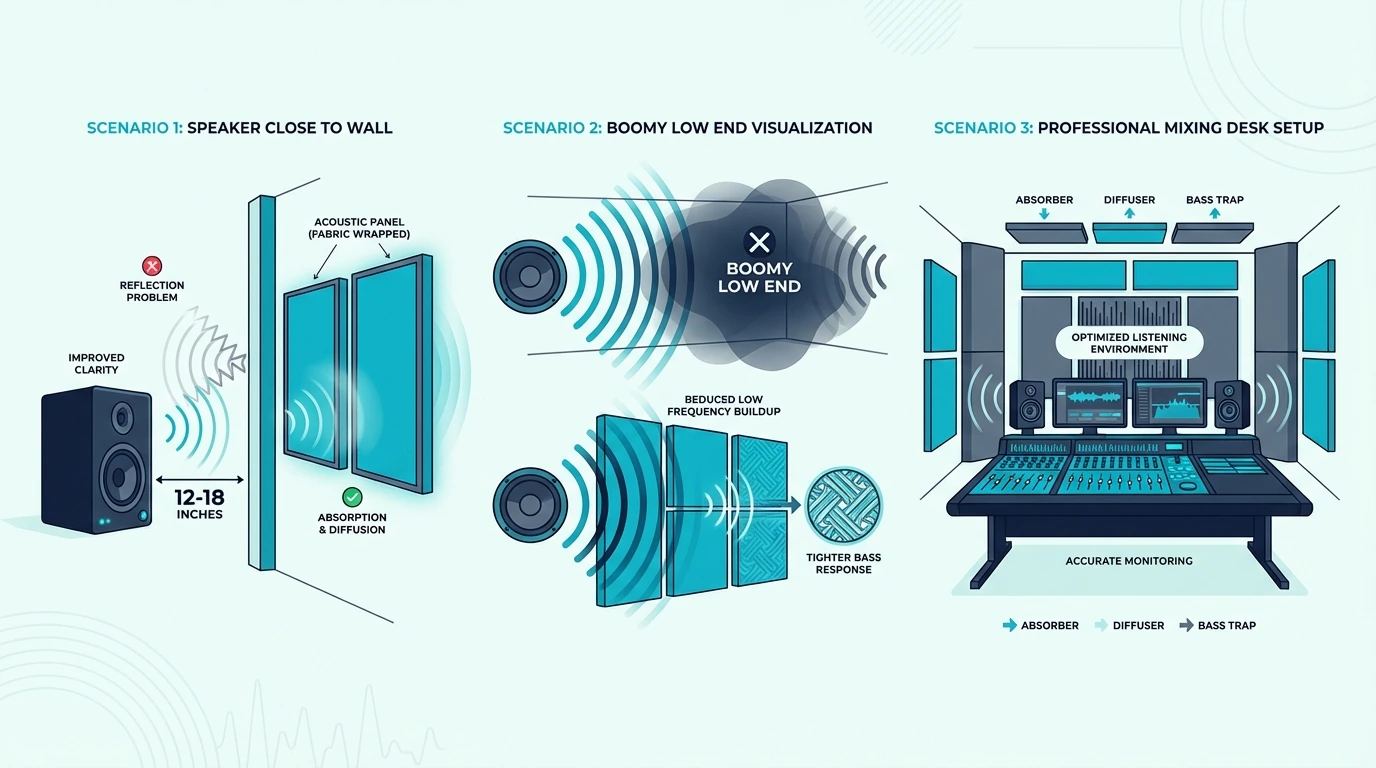
When speakers sit close to the wall behind them, SBIR can carve dips in the low mids and make bass feel boomy in one spot and thin in another. When the stereo image feels smeared, the usual culprit is early reflections from side walls and the ceiling.

Start with the quick rule below, then use the placement priorities to decide what to treat next so you can lock in imaging and smooth out the low end.

Quick Takeaway

Panels behind speakers can reduce SBIR (Speaker Boundary Interference Response) and low-mid buildup when speakers are close to the front wall. Treat first reflection points on side walls and the ceiling first, then use thick panels (4+ inches) behind the speakers if you still hear boomy or uneven bass.

Should You Put Acoustic Panels Behind Speakers?

Decision guide for treating the wall behind speakers

It depends on your setup. In most home studios and listening rooms, the fastest improvement comes from first reflection points, not the wall behind the speakers.

The wall behind the speakers mainly affects low-mid buildup and SBIR. Side walls and the ceiling shape clarity and imaging, so they tend to feel more obvious when you treat them.

If you are starting from zero, treat side walls and the ceiling first.

Rear wall treatment behind speakers becomes worth it when speakers are close to the wall, when bass feels uneven and hard to dial in, or when desk placement forces a short distance.

What Is SBIR and Why Does It Matter?

When to add acoustic panels behind speakers

Because acoustic physics are confusing, most people assume that putting panels directly behind the speakers will stop the sound before it reaches the rest of the room. SBIR—Speaker Boundary Interference Response—explains what actually happens when sound hits that front wall.

How SBIR Works

When your speaker pushes a sound wave forward toward your ears, it simultaneously radiates low-frequency energy backward toward the wall behind it. The NRC rating of a panel tells you how much mid-range energy it absorbs, but SBIR lives lower than the NRC test range. That backward-traveling wave hits the drywall, reverses direction, and bounces straight back at you, eventually colliding with the direct sound coming out of the front of the speaker.

Because the reflected wave traveled further, it arrives slightly late. At certain frequencies, that delay causes the two waves to collide perfectly out of phase, creating a massive cancellation that literally deletes that frequency from the room. At other frequencies, they arrive perfectly in phase, doubling the volume and creating a boomy, overwhelming peak.

The Distance Factor

The exact frequencies that get destroyed by this collision depend entirely on the physical distance between your speaker cone and the drywall.

When speakers sit just 12 inches from the wall, the cancellation notch sits high in the low-mids, right around 280 Hz, destroying the warmth of a guitar or snare drum. Pulling the speakers back to 24 inches drops that notch down to 140 Hz. Moving them a full 36 inches off the wall pushes the SBIR cancellation down below 95 Hz, dropping it into the sub-bass territory where room modes take over anyway.

How Panels Help

Thick acoustic panels mounted directly behind the speakers act as a buffer against this collision. By forcing that backward-traveling wave to pass through dense fiberglass before hitting the drywall, the panel strips away the energy of the reflection.

When that weakened reflection finally bounces back and collides with the direct sound, it lacks the energy to cause severe cancellation. The deep notches in your frequency response flatten out, and the low-mids suddenly sound tight and defined rather than hollow and unpredictable.

However, a standard 2-inch panel is completely physically incapable of absorbing these long low-mid wavelengths. To actually reduce SBIR, you must use panels that are at least 4 inches thick. If you are unsure what thickness is worth choosing for the rest of the room, the 2-inch vs 4-inch comparison shows what that extra depth changes in real rooms.

When Should You Put Panels Behind Speakers?

Best placement zones for panels behind speakers

Because you are fighting physics, simply slapping panels behind the monitors isn’t a universal fix. The treatment only works if your room actually suffers from the specific problems that front-wall absorption solves.

Speakers Close to Wall

If your desk forces your monitors to sit within 18 inches of the front wall—the unavoidable reality of most bedroom studios and apartments—treating that boundary becomes critical. At that tight distance, the SBIR cancellation notches sit exactly in the upper bass and low-mid frequencies that make mixes sound punchy.

If you are working in a rental, the apartment treatment guide explains how to mount thick panels safely without losing your security deposit. Hitting that front wall with dense fiberglass pulls the coloration out of the low-mids, leaving you with a tight, highly defined bass response.

Boomy or Muddy Low End

Even if your speakers sit further out into the room, you might still suffer from a persistently muddy low-end that makes kick drums sound like a blurry, sustained rumble. This boominess usually occurs because the energy bouncing off the front wall is lingering in the room and muddying the direct sound.

Placing thick absorption behind the speakers acts like an acoustic brake, shutting down that secondary wave before it has a chance to wander the room. This is especially true for desktop bookshelf speakers, where the combination of desk reflections and the immediate front wall creates a nightmare of low-frequency chaos.

Professional Mixing Environments

In a dedicated critical listening environment like a mastering suite or a commercial control room, leaving the front wall bare is almost unthinkable. The goal in these rooms is absolute, clinical control over every single boundary in the space.

For home producers attempting to hit that level of translation, treating the wall behind the monitors is the mandatory final step after the first reflection points and corner bass traps have been locked in.

When Should You Skip Rear Wall Treatment?

When to skip acoustic treatment behind speakers

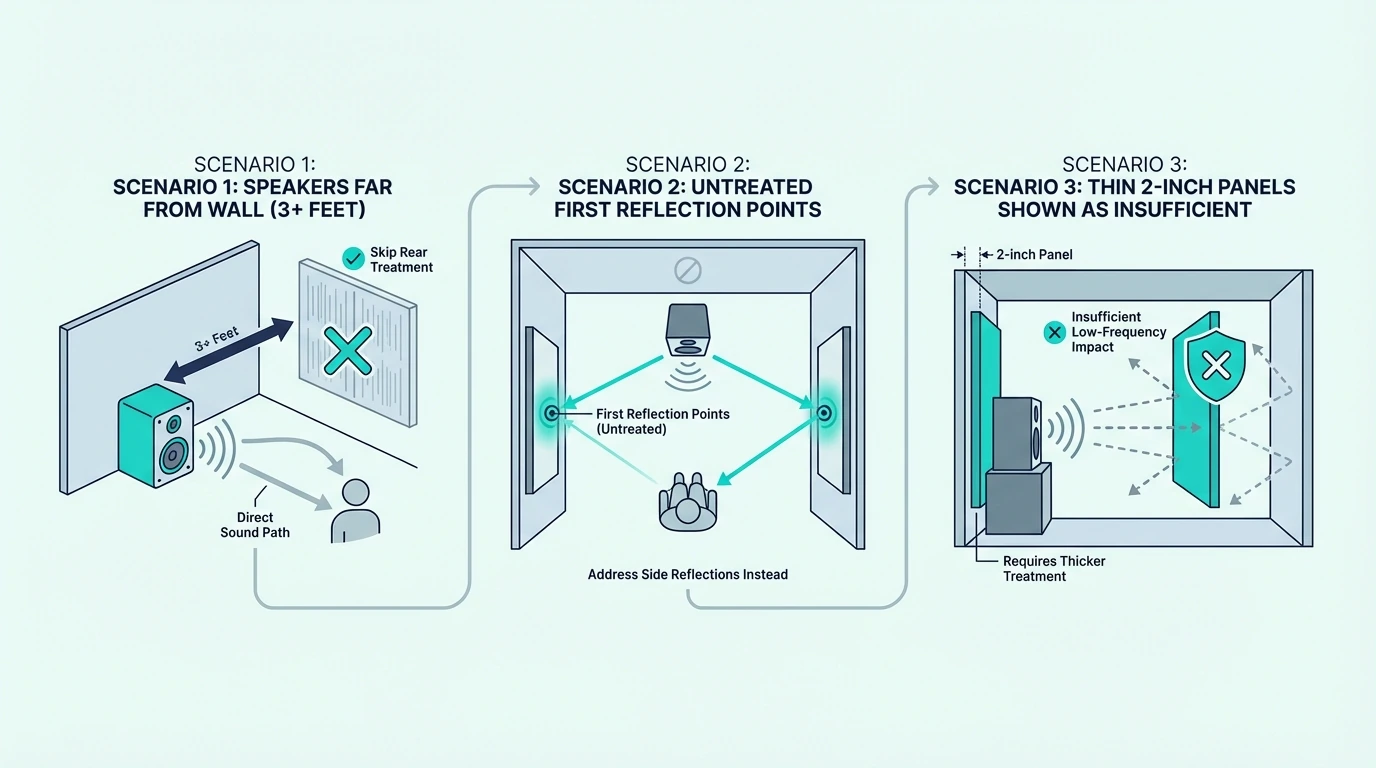
Many bedroom producers blow their budget buying massive 4-inch panels for the front wall when their room actually needs something else entirely. There are three scenarios where ignoring the front wall is the smarter move.

Speakers Far From Wall

If you have the luxury of pulling your speakers 3 or 4 feet away from the front wall, you move past the SBIR problem. At that physical distance, the cancellation notches drop so deep into the sub-bass frequencies that massive room modes take over the physics anyway.

Hanging panels behind speakers spaced that far out provides almost zero audible benefit to the mix position. Your budget is far better spent on floor-to-ceiling corner bass traps to control the deep room modes instead.

First Reflections Untreated

If the side walls beside your listening chair are still bare drywall, stop looking at the front wall. Hitting the first reflection points on your left and right is the single most critical step in acoustic treatment, and the placement guide maps those exact positions.

Those immediate side reflections destroy your stereo imaging, smear your high frequencies, and ruin vocal clarity. Treating the front wall before the side walls is like buying expensive racing tires for a car with a broken steering wheel—you are fixing a subtle refinement while ignoring a devastating flaw.

Thin Panels Only

If you only own standard 2-inch thick acoustic panels, putting them behind your speakers is a complete waste of material. While a 2-inch panel expertly absorbs high frequencies and flutter echo above 500 Hz, it is completely invisible to the 100-300 Hz low-mid waves where SBIR actually occurs.

Either invest in 4-inch or 6-inch panels specifically for the front wall, or save your 2-inch panels for the side walls where their mid-range absorption is needed most. If you do opt for the heavy panels, the hanging guide covers the heavy-duty mounting hardware required to keep them safely on the drywall.

What About Front-Ported vs Rear-Ported Speakers?

Rear speaker ports that can affect panel placement

Speaker design affects how the rear wall interacts with sound output. This matters for placement and treatment decisions.

Front-Ported Speakers

Front-ported (or sealed) speakers direct all sound output forward. They are less sensitive to rear wall proximity because there is no port interaction with the boundary.

Treatment behind front-ported speakers is purely about SBIR reduction—helpful but not critical unless speakers are very close to the wall.

Rear-Ported Speakers

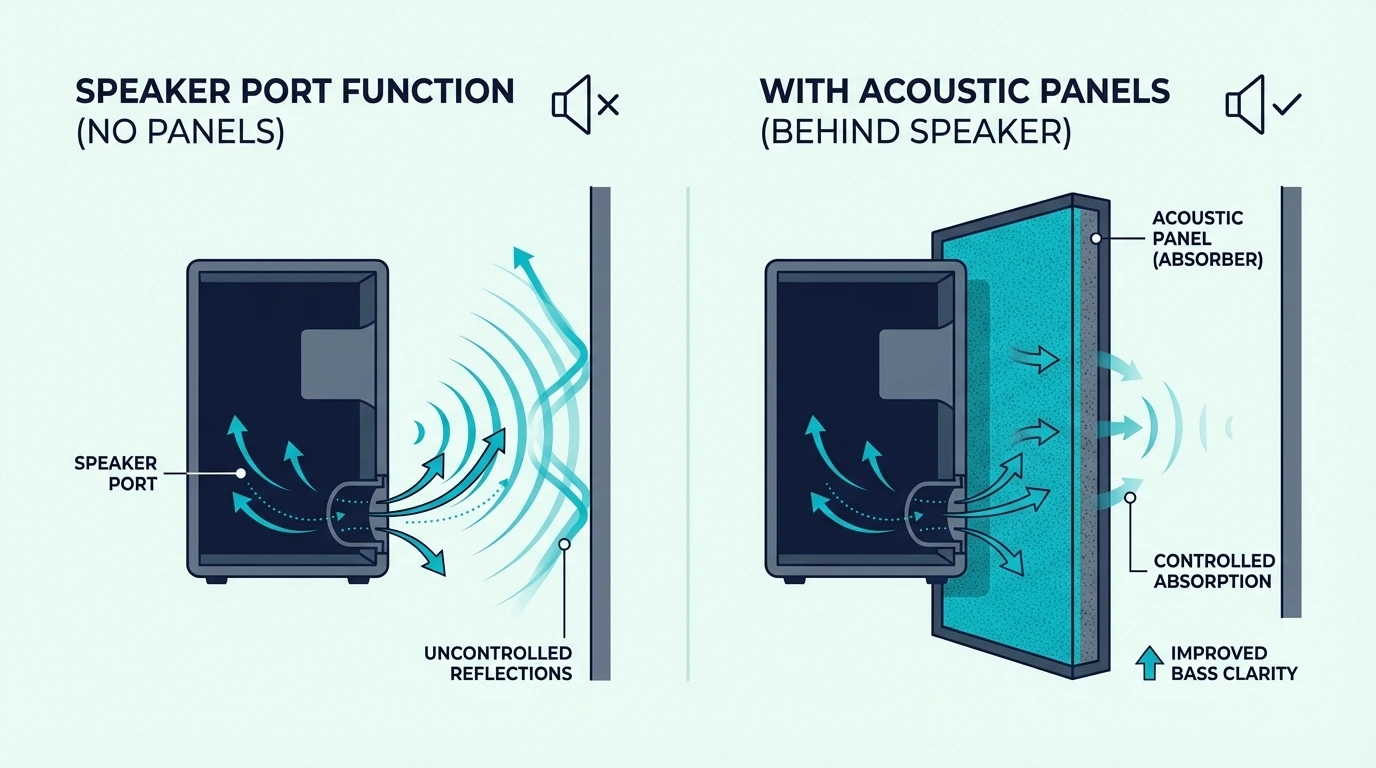
Rear-ported speakers have a bass reflex port on the back that directs low-frequency energy toward the rear wall. Placing these speakers too close to the wall causes port loading—boosted, undefined bass.

For rear-ported speakers, the first solution is distance: position them at least 12-18 inches from the wall. If space does not allow adequate distance, absorption on the rear wall can help control port reflections—but it is a compromise, not a fix.

The Distance Rule

Regardless of port type, more distance from the rear wall generally improves sound. Treatment cannot fully compensate for speakers crammed against walls.

If possible, move speakers forward first, then treat the remaining reflection.

Where Should You Actually Put Panels First?

Priority acoustic panel placement behind speakers

If your room is a blank slate, you must establish a strict hierarchy of treatment. Wasting your first panels on a subtle front-wall tweak while the rest of the room bounces out of control guarantees a terrible sounding mix.

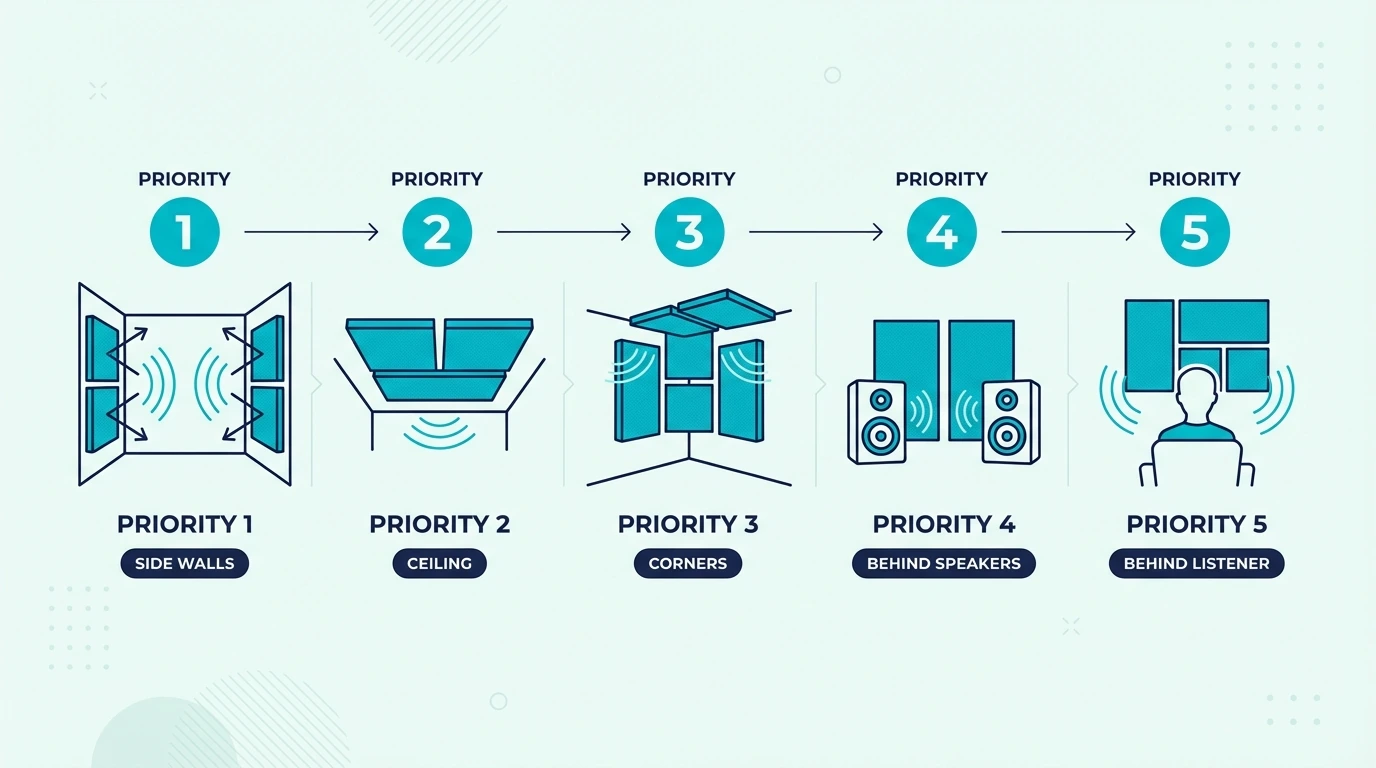
The True Treatment Hierarchy

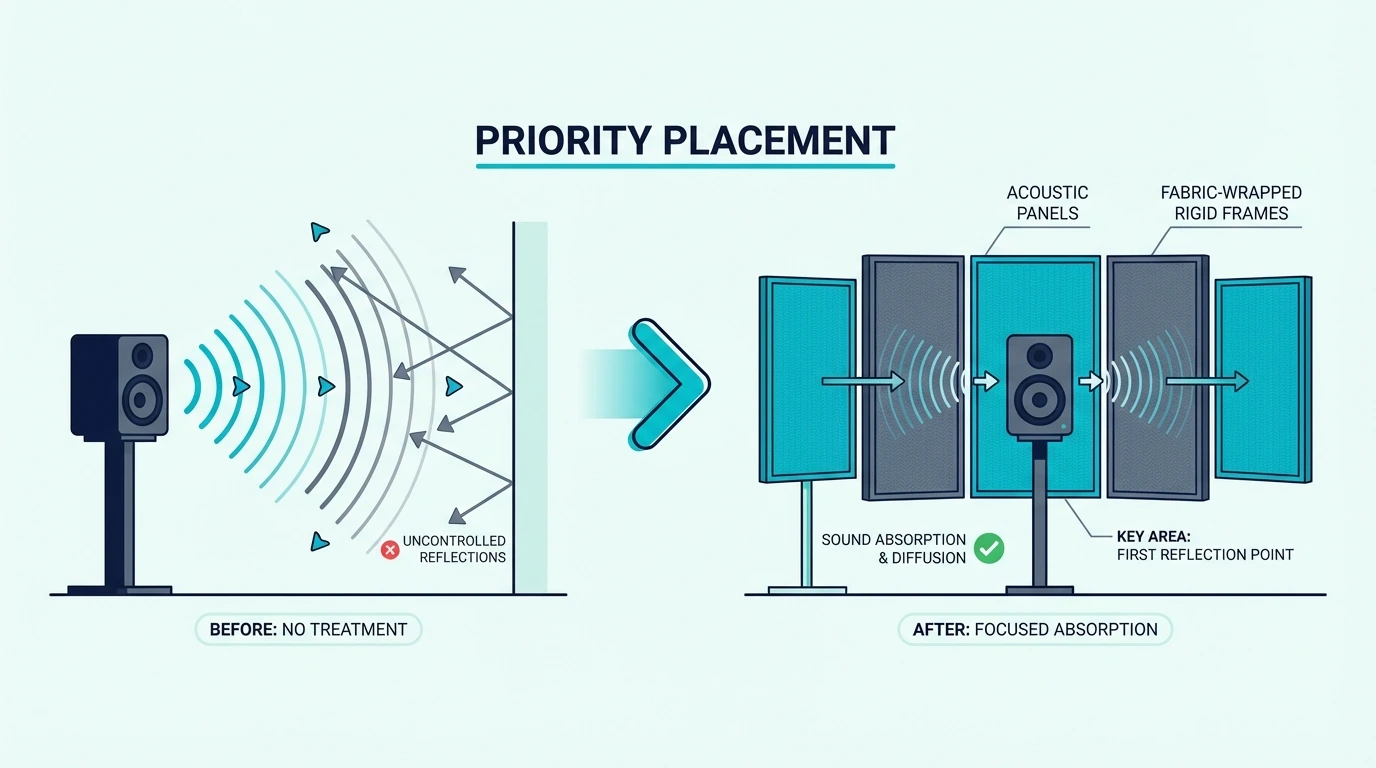
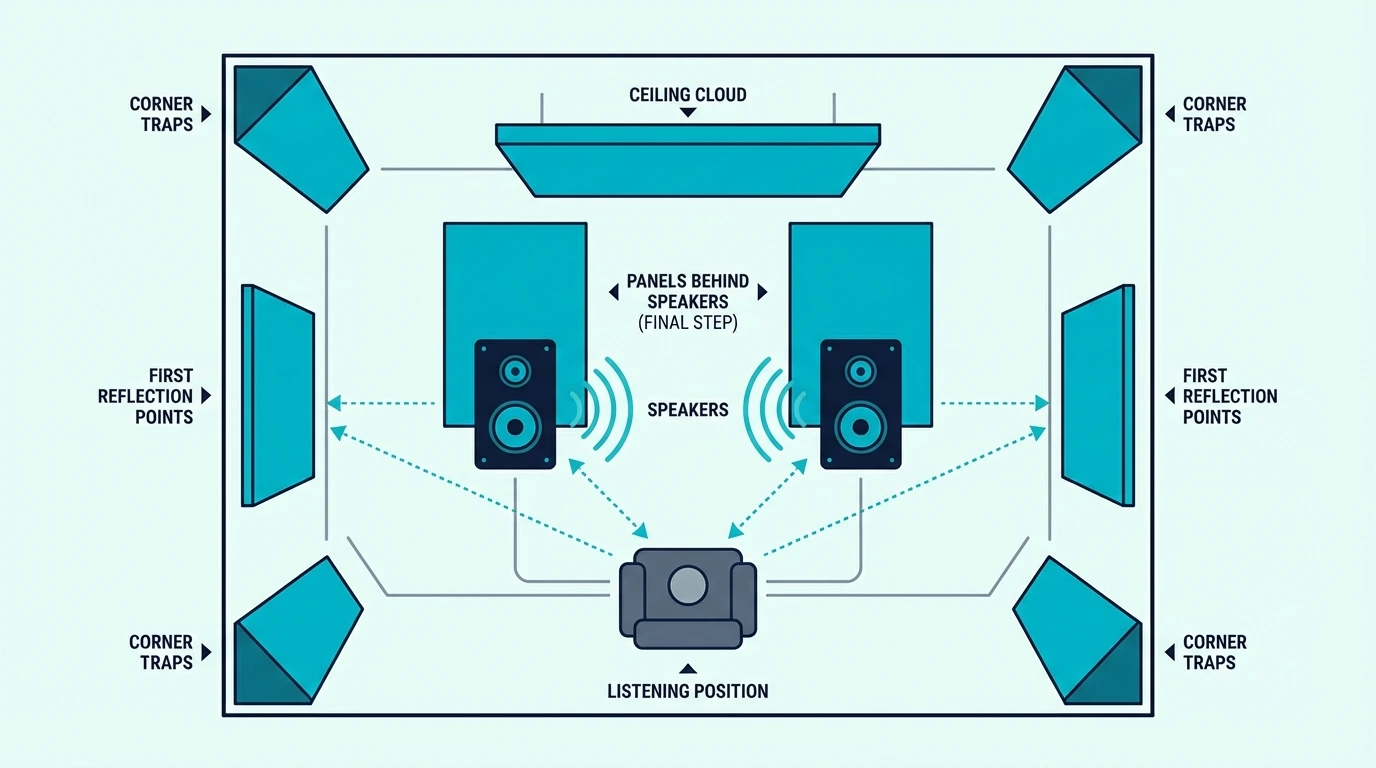
The absolute highest priority in any listening room is the side walls at the first reflection points. These are the exact spots where sound ricochets directly from the tweeter to your ear, creating the comb filtering that destroys your phantom center. By employing the simple mirror trick—having someone slide a mirror along the side wall until you see the speaker cone from your chair—you can locate the exact square foot where your first 2-inch panel belongs.

If you want a compact set that easily covers both side walls instantly, Olanglab 4-Pack Fiberglass Panels provide professional fiberglass absorption right at the source.

Once the side walls are locked down, priority two is the ceiling directly above the mix position. A suspended acoustic cloud eliminates the vertical bounce that causes harsh flutter echo between the ceiling and the desk surface.

Priority three shifts to the deep low end, demanding thick bass traps stacked in the vertical corners to soak up the room modes that make bass notes linger for seconds after the track stops.

Only after those three foundational pillars are secured does the wall behind the speakers become priority four. Once the rest of the room is tight, placing 4-inch panels directly behind the monitors provides the final level of surgical refinement needed to clean up the low-mid SBIR dips. Finally, the rear wall directly behind your chair represents priority five, where professional rooms often deploy diffusion rather than absorption to maintain a natural sense of acoustic space.

How to Treat the Wall Behind Speakers

Acoustic treatment method for the wall behind speakers

When you finally reach the point where front wall treatment is the logical next step, you have to execute it correctly. Hanging thin decorative panels where thick mass is required is a classic studio mistake.

Panel Thickness and Coverage Area

Because the goal is fighting SBIR in the low-mid frequencies, 4 inches of thickness is the absolute minimum requirement, while 6 inches of fiberglass or mineral wool provides ideal absorption. If you attempt to solve a 150 Hz null with a standard 2-inch panel, the wave will simply pass through it, bounce off the wall, and cancel out your monitors anyway.

If you prefer to buy a ready-to-hang solution rather than building a DIY box, the UMIACOUSTICS Large Panels deliver the necessary core depth and density to actually alter the front-wall reflections.

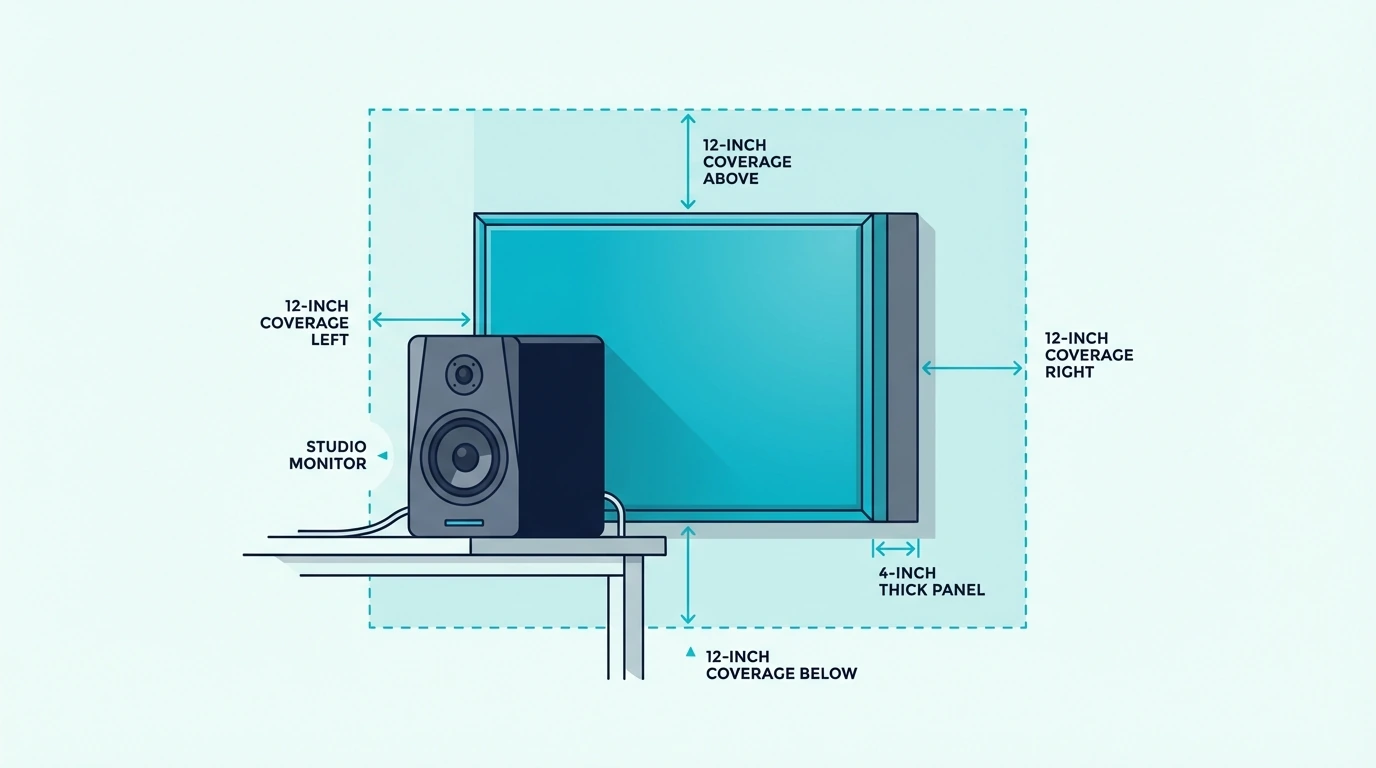
You must center these thick panels directly behind the speakers themselves, ensuring the material extends at least 12 inches past the outer edges of the speaker cabinet in every direction. A single massive 24×48-inch panel mounted horizontally behind each monitor is usually the perfect starting point. Panel spacing between those two panels matters less than centering each one directly behind its speaker. Hanging these heavy beasts requires rigid mounting; using French Cleat Z Hangers allows you to lock the frames securely to the drywall while keeping a flush, low-profile look.

To Gap or Not to Gap?

Interestingly, while adding an air gap behind a standard side-wall panel massively increases its bass absorption, an air gap behind the front speakers is usually unnecessary. Because you are already using 4-to-6 inch thick panels to combat SBIR, the physical mass of the material provides more than enough low-frequency performance when mounted flush to the drywall.

If your room feels uncomfortably suffocating after hanging these massive panels, you might have over-treated the space. Swapping the thick absorbers for deep wooden diffusers can scatter the front-wall reflections without sucking all the acoustic energy out of the room, reducing the SBIR notches while keeping the room feeling alive.

What Are Common Mistakes with Speaker Area Treatment?

Common mistakes when placing panels behind speakers

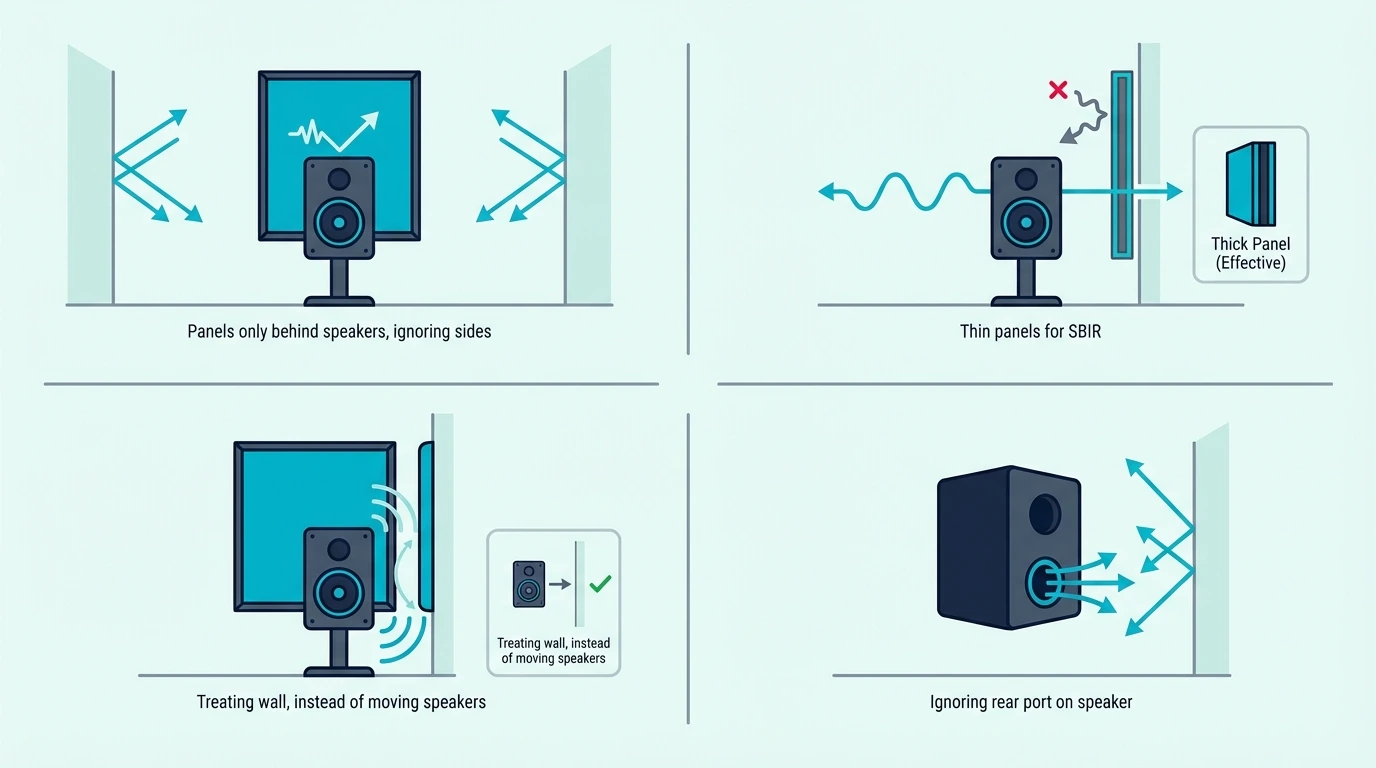
Even armed with the right panels, studio builders constantly make strategic errors regarding the front wall. Avoiding these four common pitfalls keeps your budget laser-focused on the problems you can actually hear.

The Danger of Ignoring Priorities

The most devastating mistake an amateur producer can make is buying six thick panels, mounting them all behind the desk, and leaving the side walls completely bare. Treating only the front wall fixes a subtle low-mid interference problem while completely ignoring the brutal flutter echo and stereo smearing caused by the untreated first reflection points. Side walls always take priority.

The second mistake is relying on 2-inch foam to fix SBIR. A thin foam wedge physically cannot absorb the low-mid frequencies bouncing off the front wall, meaning you have effectively spent money to change the way the wall looks without altering how it sounds in the low end at all.

Hardware Fixes vs Acoustic Fixes

Producers also frequently try to treat their way out of a bad layout. If your massive studio monitors are crammed exactly 6 inches away from the drywall, adding a panel will not solve the overwhelming bass buildup. Physically pulling the desk out to 18 or 24 inches from the wall fixes the physics of the room instantly, completely free of charge. Acoustic treatment should always act as a refinement to an optimized layout, not a band-aid for terrible speaker positioning. The 1-inch vs 2-inch comparison explains why thin panels miss the frequencies that matter most behind monitors.

Finally, failing to respect the port design of the speaker destroys the low end. If you own rear-ported monitors that vent bass directly out the back of the cabinet, shoving them flush against a thick absorption panel chokes the port. You must maintain adequate breathing room for the bass reflex port to function, or the speaker’s engineered low-end response collapses entirely.

How Does Each Treatment Zone Compare?

Comparison of treatment options behind speakers

Not every surface deserves the same panel. The table below ranks each treatment zone by how much it changes what you hear, along with the minimum thickness that actually moves the needle at that location.

Treatment Location Priority What It Addresses Panel Thickness
First Reflection (Side Walls) 1 Imaging, clarity, comb filtering 2-4 inches
Ceiling Cloud 2 Vertical reflections, flutter echo 2-4 inches
Corners (Bass Traps) 3 Room modes, bass buildup 4-6+ inches
Behind Speakers 4 SBIR, low-mid buildup 4-6 inches
Behind Listening Position 5 Late reflections, room liveliness Diffusion preferred

Side wall reflections arrive just milliseconds after the direct sound from your speakers, and your brain uses that timing gap to build a stereo image. Treating those first reflection points tightens the phantom center and widens the perceived soundstage more than any other single treatment.

Ceiling clouds handle vertical reflections that cause flutter echo between a flat ceiling and a hard floor. A single 2-inch panel suspended above the mix position usually removes the problem entirely.

Corner bass traps target the low-frequency room modes that stack up where walls meet. Thick panels wedged into corners smooth out the peaks and dips that make bass sound uneven from seat to seat.

Behind-speaker treatment addresses SBIR, which becomes audible when monitors sit within 18 inches of the front wall. Four-inch panels absorb enough low-mid energy to clean up the one-note boom that EQ alone cannot fix.

The rear wall behind the listening position is the only zone where diffusion often outperforms absorption. Scattering those late reflections preserves a sense of room size without letting them smear the mix.

Where Should You Place Panels Near Speakers?

Acoustic panel positioned near speakers

Treat first reflection points first because they provide the biggest improvement in clarity and imaging.

If you want a simple, practical order, start with side walls, then ceiling, then corners, then behind your speakers.

When you treat behind your speakers, use thick panels (4+ inches) and cover the area behind each speaker first rather than trying to blanket the entire front wall.

Conclusion

Acoustic panels behind speakers can reduce SBIR and low-mid buildup, but only after your main reflection points are under control. Treat side walls, ceiling, and corners first so you do not use your first panels on a subtle refinement. The installation guide has mounting options for every wall type and weight class.

If you still hear uneven bass with speakers close to the wall, add thick panels behind each speaker and re-check placement. Small changes in distance plus targeted absorption usually beat blanket “front wall coverage.”

Frequently Asked Questions

Should I Put Acoustic Panels Behind My Studio Monitors?

Only after treating first reflection points. Panels behind studio monitors help reduce SBIR and low-mid buildup, but this is refinement, not foundation.

Treat side walls and ceiling first for bigger improvements.

If your monitors are very close to the wall (under 18 inches), rear treatment becomes more valuable. Use thick panels (4+ inches) for meaningful absorption at the frequencies involved.

Will Panels Behind Speakers Reduce Bass?

Yes, but only if they are thick enough. Standard 2-inch panels have minimal effect on bass frequencies.

Thick panels (4+ inches) absorb low-mid frequencies where SBIR occurs, reducing problematic bass buildup rather than overall bass output.

The result should be tighter, more defined bass rather than less bass overall.

What Is the Best Placement for Acoustic Panels Near Speakers?

First reflection points on side walls are the priority. Find them using the mirror trick: where you see speakers reflected in a mirror on the side wall, that is where panels go.

After side walls, treat the ceiling above your listening position. Corners benefit from bass traps.

Behind speakers is fourth priority—helpful but not critical for most setups.

Can I Use Diffusers Instead of Absorbers Behind Speakers?

Yes, especially if your room already has heavy absorption. Diffusers scatter rear wall reflections without removing energy, which can address SBIR-related imaging issues while maintaining room liveliness.

This works best when first reflection points are already treated with absorption. Using diffusion behind speakers while first reflections are untreated will not provide the clarity benefits you are looking for.

The coverage calculator helps determine how many panels you need for full treatment.

Acoustic Panels vs Diffusers: Which Do You Need? [2026]

Acoustic panel vs diffuser is usually a “panels first” answer.

But if you keep adding absorption without a plan, you can overshoot and end up with a room that feels small and dead.

The symptom is familiar: smeared speech, harsh cymbals, or vague imaging.

The cause is usually early reflections bouncing off bare walls and ceilings and arriving a split-second after the direct sound.

Make the direct sound more dominant, and dialogue snaps into focus while mixes translate.

Start by treating first reflection points with acoustic panels, then consider diffusion on the rear wall only after echo is controlled.

Quick Takeaway

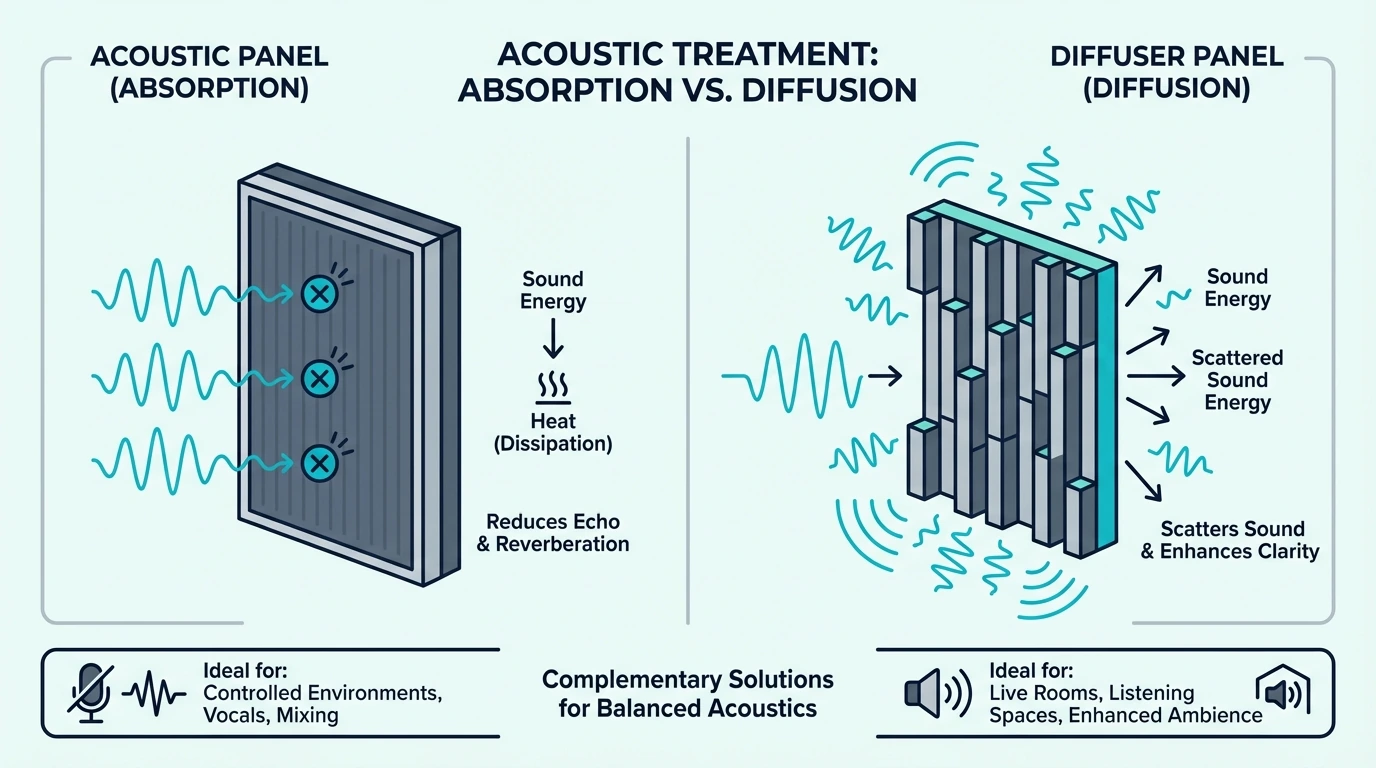
Acoustic panels absorb sound waves, reducing echo and reverb. Diffusers scatter sound waves, maintaining room liveliness while preventing focused reflections.

Most rooms need absorption panels first. Diffusers are advanced treatment for rooms that sound too dead after adding panels, or for rear wall placement in studios where you want spaciousness without flutter echo.

What’s the Difference Between Acoustic Panels and Diffusers?

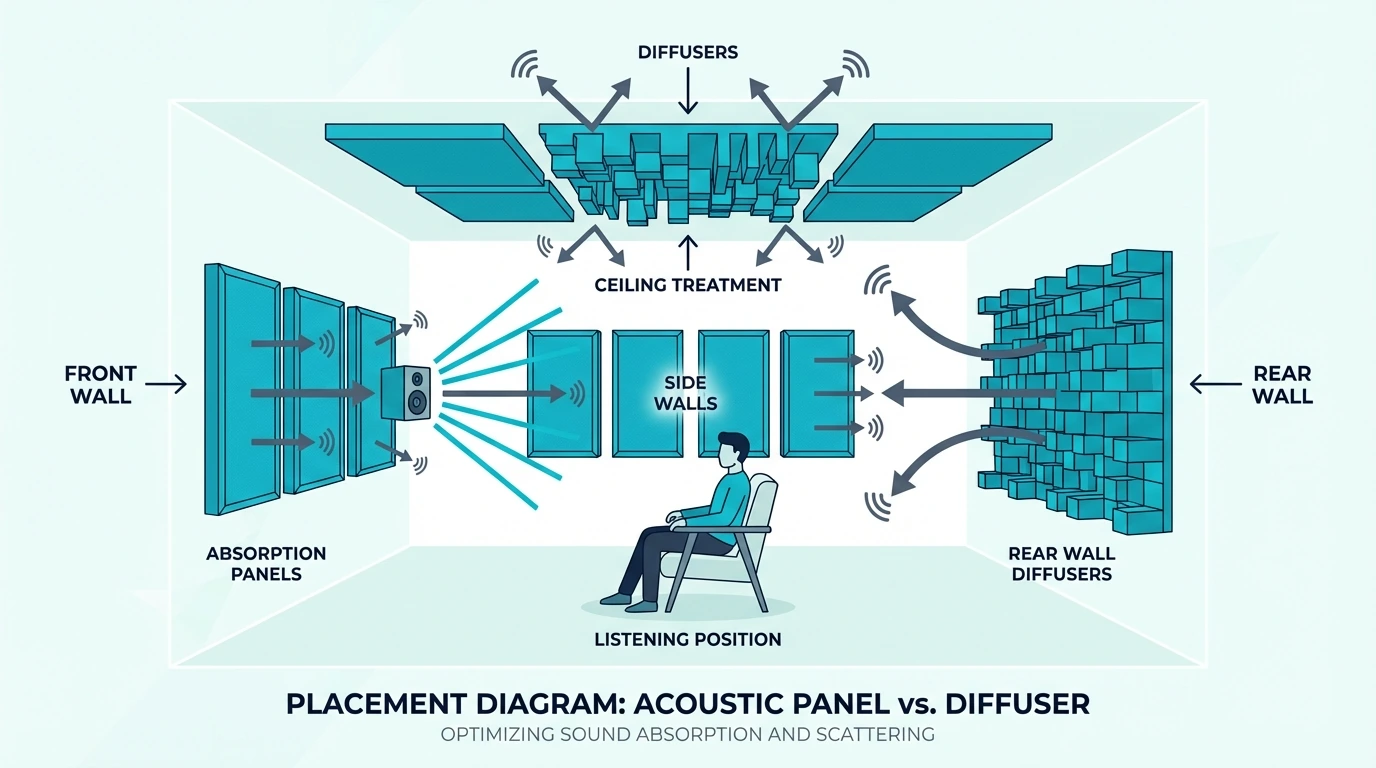
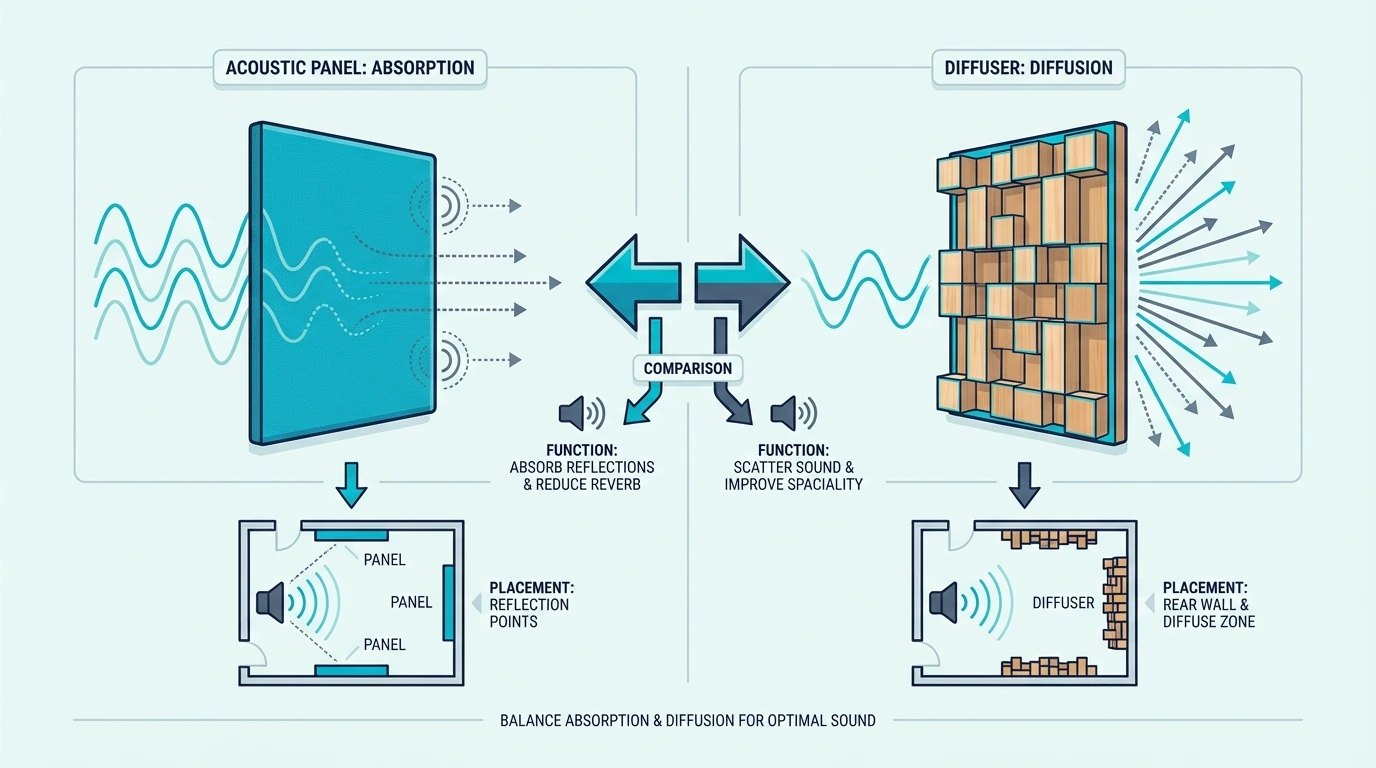
Placement Diagram for acoustic panel vs diffuser

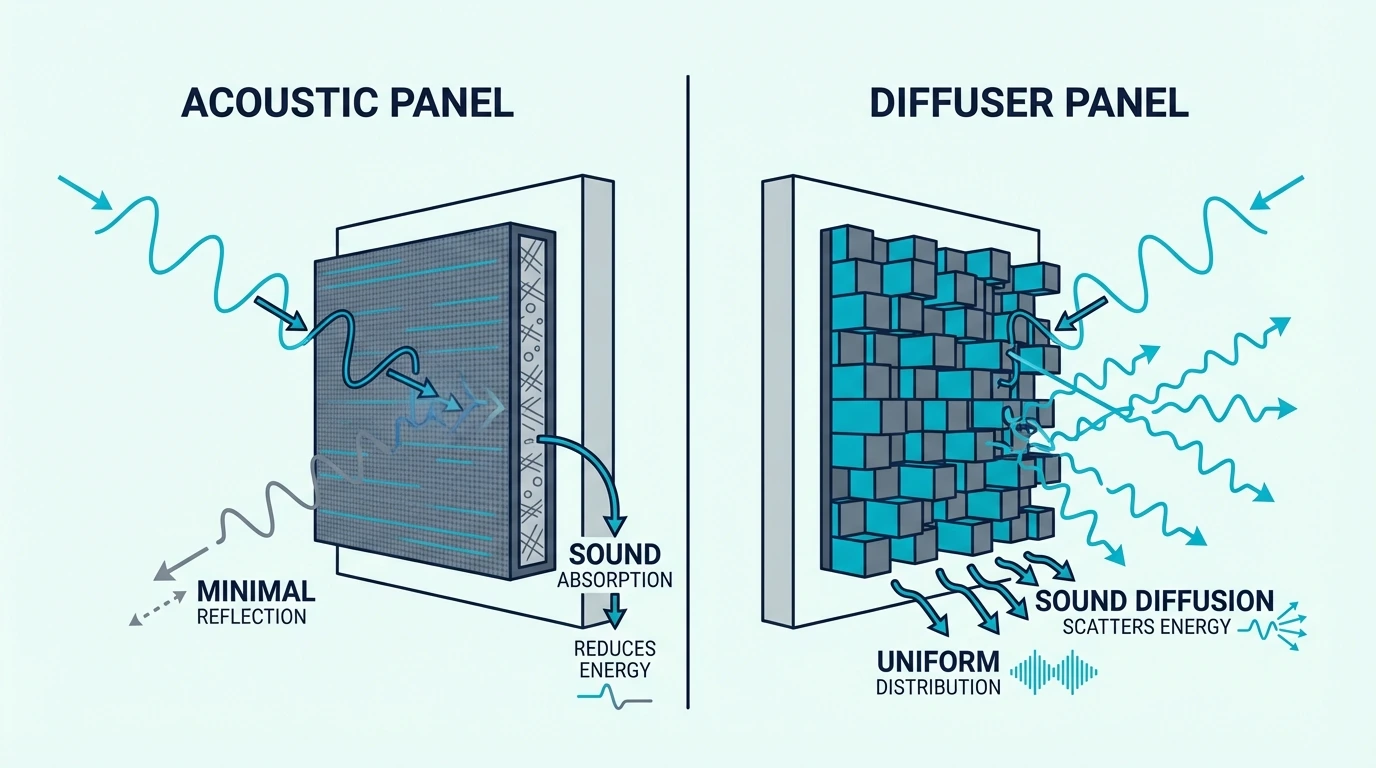
Panels absorb sound energy; diffusers redirect it. Understanding the physical mechanism behind each one makes it completely obvious where they belong in your room.

When acoustic energy hits a flat drywall surface, it bounces back as a clean, strong reflection—exactly like a laser beam hitting a mirror. A diffuser acts more like frosted glass, taking that single strong reflection and breaking it into dozens of weaker reflections scattered at different angles. An absorber acts like a black curtain, taking the energy in and letting almost nothing bounce back.

Acoustic Panels = Absorb Sound

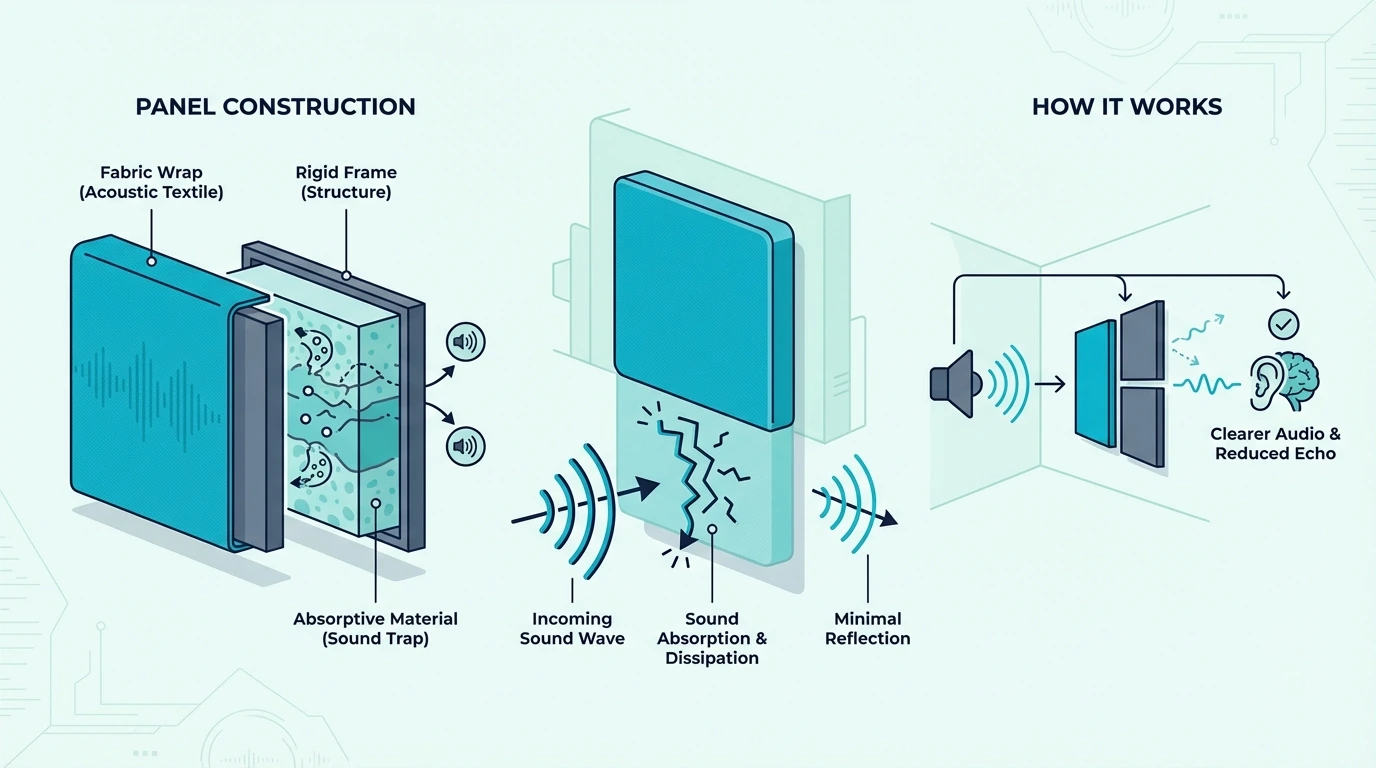
Absorption relies on friction. Acoustic panels use dense, porous materials—typically fiberglass, mineral wool, or heavy polyester fiber—wrapped tightly in fabric. When sound waves enter the material, they are forced to navigate the microscopic maze of fibers, converting their acoustic energy into tiny amounts of heat.

For a first absorber, a large 2-inch fiberglass board like the UMIACOUSTICS Large Panels pulls a massive amount of energy out of the room at the first reflection points.

The result of that friction is simply less sound energy bouncing around the room. By stripping that energy away, you eliminate the distinct repetitions of an echo, shorten the sustained wash of reverb, and kill the rapid metallic flutter that happens between two parallel walls. For most untreated rooms, pulling this chaotic energy out of the air is the only way to restore speech clarity and music fidelity.

Diffusers = Scatter Sound

Diffusion relies on complex geometry instead of friction. Diffusers are constructed from rigid surfaces—wood, hard plastic, or dense polystyrene—featuring mathematically calculated patterns of varying depths. Because the sound waves hit the different depths at slightly different times, the reflection breaks apart and scatters uniformly across the room.

For rear-wall diffusion, a QRD-style option like Sirius 2-Pack 2D QRD Diffusers shatters those reflections mathematically.

Because the energy is scattered rather than absorbed, the room retains its natural acoustic liveliness without suffering from focused, phase-canceling reflections. This maintains a sense of physical space and tonal balance, since you aren’t selectively sucking high frequencies out of the air.

Diffusion is far more complex to execute than absorption. A random bumpy surface does not scatter sound evenly—real diffusers like QRD (Quadratic Residue Diffuser) blocks use prime number sequences to guarantee uniform scattering. If you prefer a furniture-grade look, this wood acoustic diffuser panel provides the same mathematical scattering, though it still requires several feet of distance to allow the waves to disperse before reaching your ears.

What Are Acoustic Panels Good For?

Acoustic panel mounted on wall for sound absorption

Most real-world rooms simply have far too much acoustic energy bouncing around, meaning they require heavy absorption first. Acoustic panels are the direct solution to the problems you notice immediately: ringing echo, harsh highs, and blurry stereo imaging.

Controlling Echo and Reverb

When people complain that a room sounds “too echoey” or that voices are “muddy,” they are describing phase interference. This happens when the reflected sound bounces off the drywall and arrives at your ears just milliseconds after the direct sound from the speaker, tricking your brain into hearing a smeared, confusing signal.

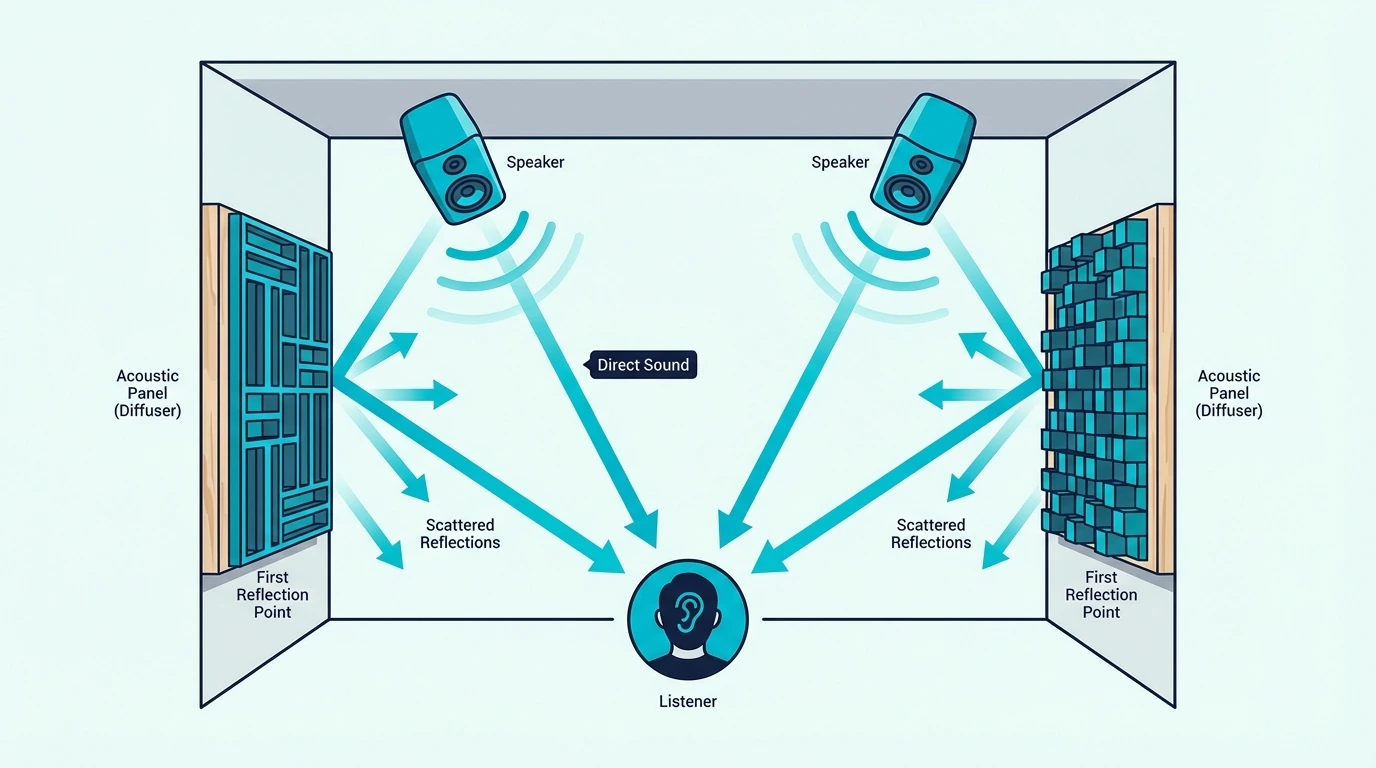
Acoustic panels solve this instantly when placed at the first reflection points—the exact spots where the sound takes its first bounce toward your chair. By killing that specific bounce path, the direct sound dominates, and clarity returns immediately. The panel placement guide covers the mirror trick for finding these critical positions.

Recording and Mixing Environments

In recording studios, that clarity is non-negotiable because you are trying to capture the source instrument, not the sound of your bedroom walls. Panels strip away the room coloration so that your vocal takes sound dry and professional, ensuring they will translate properly when played on other systems.

Mixing rooms require even tighter absorption control. If you are making critical decisions about EQ, panning, and adding digital reverb, you have to hear the actual mix coming out of the monitors, not the room’s physical contribution. The recording studio panels guide and a calculated panel spacing strategy matter so much for producers.

Speech Intelligibility

That exact same physics problem plagues conference rooms, classrooms, and home offices. Excessive reverb makes it exhausting to understand fast speech, a problem that gets multiplied when cheap laptop microphones pick up the room reflections and broadcast them over a Zoom call.

Strategic panel placement—typically on the wall behind the speaker and the wall directly facing them—massively improves speech intelligibility by killing the flutter echo. A compact fiberglass pack like the Olanglab 4-Pack Fiberglass Panels covers those specific speech zones without making the office look like a recording studio.

If your goal is clearer dialogue for movies rather than meetings, the exact same reflection logic applies. The home theater panels guide maps out which walls matter most for surround sound clarity.

What Are Diffusers Good For?

Diffuser Panel for acoustic panel vs diffuser

Diffusers are precision tools that solve the specific problems created when a room has too much absorption. They keep a room feeling lively and energetic without allowing hard, focused reflections to ruin the audio.

Preventing Over-Damped Rooms

The most common amateur mistake in acoustics is adding absorption to absolutely every bare surface. Plastering a room entirely in thick fiberglass kills the reverb, but it also creates a space that feels uncomfortably dead, claustrophobic, and strangely unnatural to sit in.

Diffusers solve this by maintaining the room’s natural liveliness while completely preventing focused slap-echoes. You get to keep the psychological sense of being in a real, breathing space without suffering from the comb filtering of an untreated room.

Rear Wall Treatment

The rear wall of a listening room or studio presents a unique acoustic trap. Hitting the back wall with heavy absorption can make the room feel artificially small and closed-in, but leaving it bare throws a massive, delayed reflection straight back at the back of your head, smearing the stereo image instantly.

Mounting deep diffusers on the rear wall shatters that returning reflection. The acoustic energy still makes it back to the listening position to maintain spaciousness, but it arrives as a scattered, diffuse wash rather than a focused slap, making it the default professional choice for high-end control rooms.

Live Recording Spaces

Rooms designed specifically for tracking drums, acoustic guitars, or ensemble performances actually require room ambience to sound good. Full absorption would completely choke the natural reverb that makes acoustic instruments sound massive and alive on a record.

Diffusion allows engineers to control that ambience rather than kill it. The room still contributes its natural character and decay tail to the microphones, but the diffusers ensure that the reverb is smooth and dense rather than chaotic and harsh.

When Should You Use Panels First?

Room diagram showing acoustic panels at first reflection points

For 95% of rooms and home studio owners, acoustic panels must come first. Untreated drywall and hardwood floors cause far more audible damage to a mix than a missing diffuser ever will.

Untreated rooms simply have too much raw reflection energy bouncing between parallel surfaces, creating the flutter and ringing that ruins recordings. Because a 2-inch fiberglass panel absorbs sound according to highly predictable, lab-tested coefficients, you know exactly what problem you are solving when you mount it. Diffuser performance, by contrast, relies heavily on complex design quality, the physical depth of the wells, and requiring enough physical distance from the listener to allow the waves to scatter.

If you are frustrated by echo, reverb tails, or vague panning, you have an absorption problem. You should immediately target the first reflection points on your side walls, the ceiling cloud directly above your chair, the front wall behind your speakers, and the corners with thick bass traps.

If you plan to tackle the ceiling reflection, the ceiling installation guide covers the exact mounting hardware needed to suspend a cloud safely. To figure out exactly how many panels it will take to cover those critical zones, the panel coverage calculator provides a room-specific target.

When Should You Consider Diffusers?

Diffuser panel with QRD pattern for rear wall treatment

You should only start shopping for diffusers after you have successfully locked down the room’s basic absorption needs and evaluated the resulting decay time.

If you’ve installed panels at all the first reflection points and the space suddenly feels uncomfortably dead—like talking inside a coat closet—swapping some of the rear-wall absorption for diffusion will restore the liveliness without bringing the harsh echoes back.

They are also the right choice when you explicitly want controlled ambience. Live tracking rooms, dedicated home theaters chasing an immersive surround field, and audiophile listening rooms all benefit from diffusion’s unique ability to maintain spatial cues and energy while preventing slapback.

If you are designing an advanced studio build from scratch, professional acousticians will often model a combination of absorption and diffusion from day one. But if you are treating a spare bedroom and aren’t even sure if absorption is the right first step, checking the NRC ratings of standard panels will show you exactly how much mid-range chaos they pull out of a small space.

Can You Use Both Together?

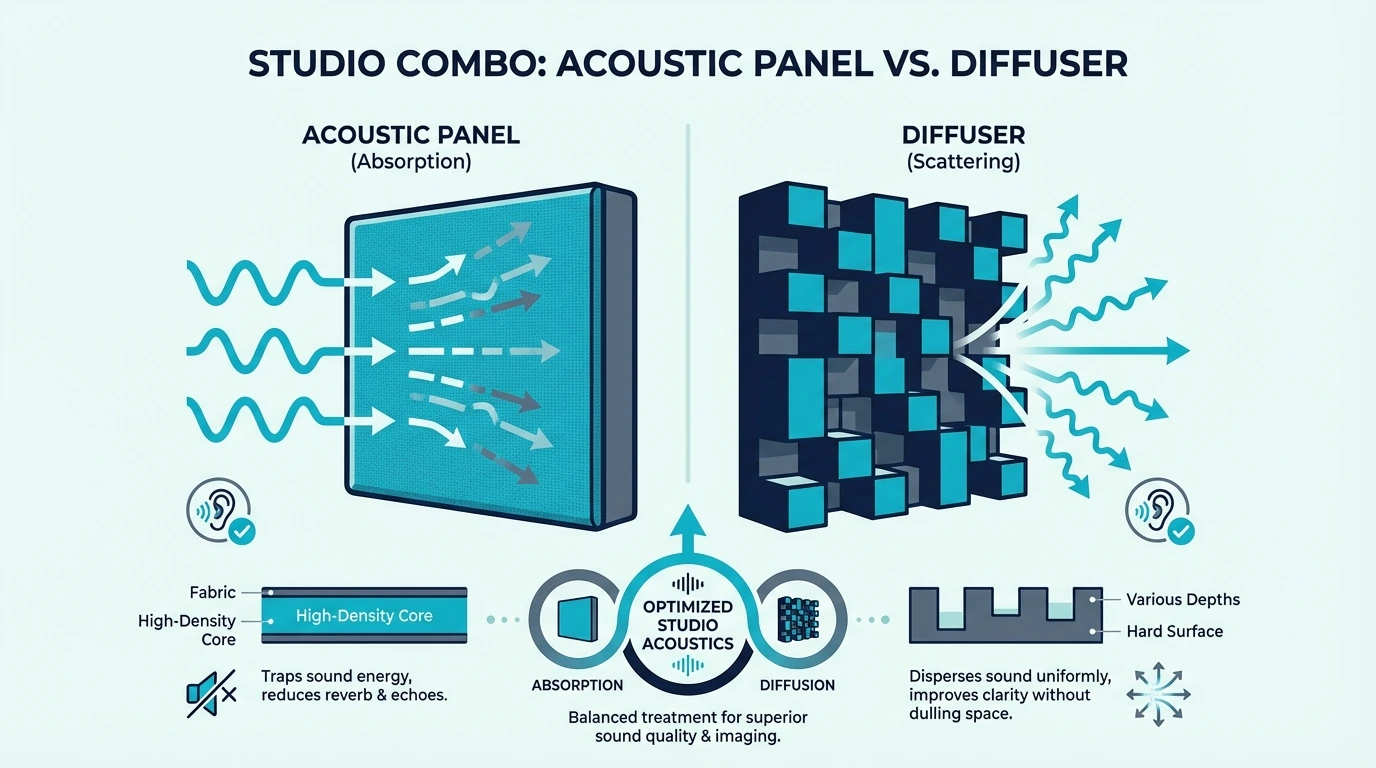
Studio Combo for acoustic panel vs diffuser

Most professional studios rely on a hybrid of both. They deploy dense absorption to kill the early reflections at the critical monitoring spots, while leaning on heavy diffusion to keep the rear of the room lively and energetic.

The Combination Approach

A standard professional layout treats the room in distinct zones. The front half of the room gets aggressive absorption at the side wall and ceiling first reflection points, backed by heavy absorption directly behind the monitors to control low-mid buildup. Thick bass traps are wedged into the vertical corners to tame the room modes.

The rear half of the room then switches entirely to diffusion. QRD blocks or 3D scattering panels coat the back wall, ensuring that any sound making it past the mix position is shattered and returned as a smooth ambient wash rather than a destructive echo.

This layout successfully treats the most critical monitoring zones—where early reflections cause devastating phase issues—while maintaining the room’s overall acoustic character through the rear diffusion.

The only critical limitation to this hybrid approach is physical distance. Diffusers require several feet of space between the wooden wells and the listener’s ears to function properly—typically at least 6 to 10 feet. Slapping a QRD diffuser on a wall 3 feet behind your mixing chair will not provide real diffusion; the scattered reflections will arrive too quickly and too focused, completely defeating the purpose of the block.

If you simply want to lock down all your first reflection points in one pass before worrying about the back wall, a 4-panel set like the UMIACOUSTICS 4-Pack with Hanging Brackets provides exactly enough fiberglass to hit both side walls and the ceiling cloud, with the specialized hardware included for the overhead mount.

How Do Acoustic Panels and Diffusers Compare?

Side-by-side comparison of acoustic panels and diffusers

Feature Acoustic Panels Diffusers
Function Absorb sound waves Scatter sound waves
Effect on Room Reduces reverb/echo Maintains liveliness
Problem Solved Too much reflection Dead-sounding rooms
Typical Materials Fiberglass, mineral wool, polyester Wood, polystyrene, plastic
Installation Distance Can mount directly on wall Needs 6-10+ feet from listener
Cost Budget to premium Mid-range to premium
When to Use First treatment for most rooms After absorption, if room is too dead
DIY Friendly Yes—fabric-wrapped panels Harder—requires precise geometry

How to Decide What You Need

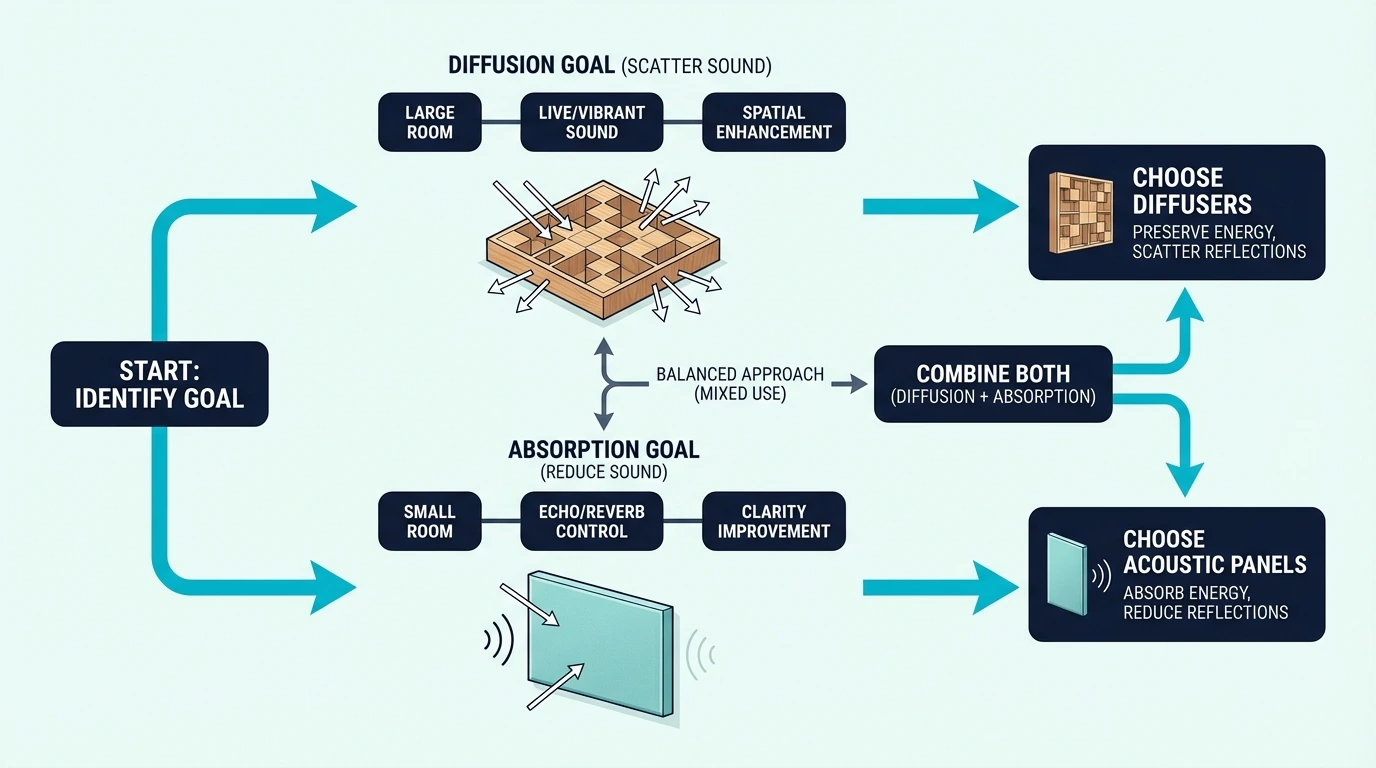
Decision flowchart for choosing between acoustic panels and diffusers

Instead of guessing whether you need absorption or diffusion, use your ears to diagnose the room and let the symptoms dictate the solution.

If you clap your hands in the center of the room and hear a harsh metallic ringing or a sustained reverb tail, you have an absorption problem. You must start by mounting acoustic panels at the first reflection points to pull that chaotic energy out of the air. For 80% of home studios and listening rooms, this single step completely solves the problem.

You only move to step two if the room suddenly feels uncomfortably dead or artificially dry after hanging those panels. That sense of claustrophobia means you have over-absorbed the high frequencies, and replacing some of your rear-wall absorption with diffusion will restore the room’s liveliness without bringing the harsh flutter echo back.

The golden 80/20 rule of acoustics applies here: 80% of your acoustic improvement comes purely from correct absorption placement at the reflection points. Diffusion handles the final 20% of refinement for rooms demanding advanced treatment.

Conclusion

Panels come first for nearly every room. They solve the reflection problems you actually hear—echo, reverb, and blurry imaging—while diffusers address a more subtle issue most rooms never reach.

If you treat first reflection points and the room still feels too dead, that is when diffusion earns its place on the rear wall.

Frequently Asked Questions

Should I Get Acoustic Panels or Diffusers for My Home Studio?

Start with acoustic panels—most home studios have untreated rooms with excessive echo and reverb. Add panels at first reflection points, then treat behind speakers and corners with bass traps before thinking about diffusion.

Diffusers become relevant only if the treated room sounds too dead. For most home studios, typical treatment levels do not over-absorb.

Can Diffusers Replace Acoustic Panels?

No—diffusers scatter sound but do not remove it from the room. If you have echo or reverb problems, diffusers will not fix them; they just spread the reflection energy around instead of eliminating it.

Do I Need Both for a Good Listening Room?

Not necessarily—many excellent listening rooms use only absorption. Diffusion adds refinement, but it is not required for great sound.

If absorption gives you clarity without making the room feel dead, you can stop there. Add diffusion only if you specifically want more room liveliness while controlling the rear wall.

Where Should I Put Diffusers in My Room?

The rear wall is the most common position—behind the listening position in a studio or theater—because diffusers need at least 6–10 feet of distance from the listener. Avoid first reflection points; those positions need absorption to control the early reflections that cause imaging and tonal problems.

Should Acoustic Panels Be Touching Each Other? A Spacing Guide [2026]

Should acoustic panels be touching each other? They can, but touching isn’t the “pro” default.

If your room still sounds echoey or boxy after you hang panels, spacing isn’t usually the culprit—it’s placement and coverage across the walls.

Get the panels in the right spots and you’ll hear cleaner speech, tighter imaging, and less slapback without covering every inch of drywall.

Start by marking your first reflection points, then decide whether a small gap helps you spread treatment across the wall. Below you’ll find spacing ranges, layout patterns, and a quick checklist for different room types.

Quick Takeaway

Acoustic panels don’t need to touch. Start with first reflection points, then use about 1–4 inches of spacing to spread coverage and keep the layout looking intentional.

How Far Apart Should Acoustic Panels Be?

Acoustic panel spacing options on a wall

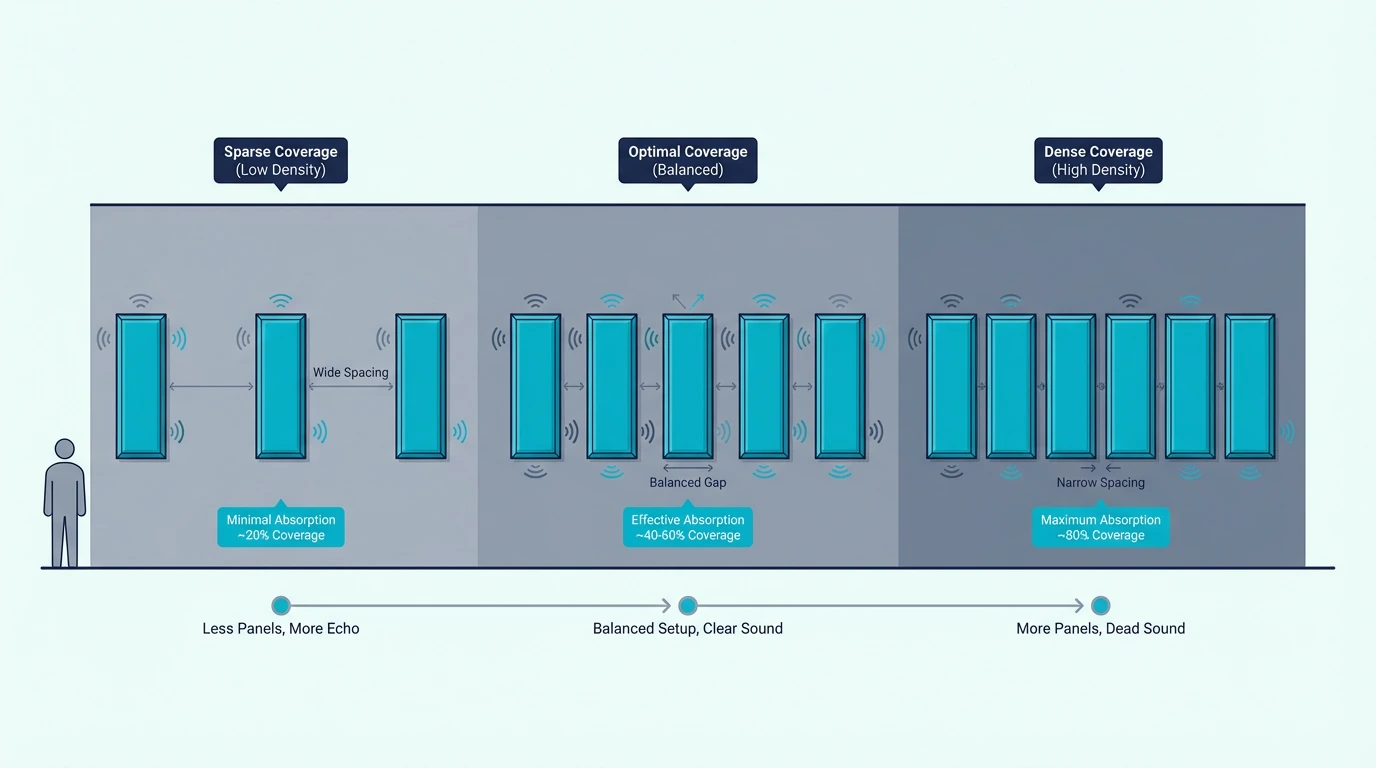
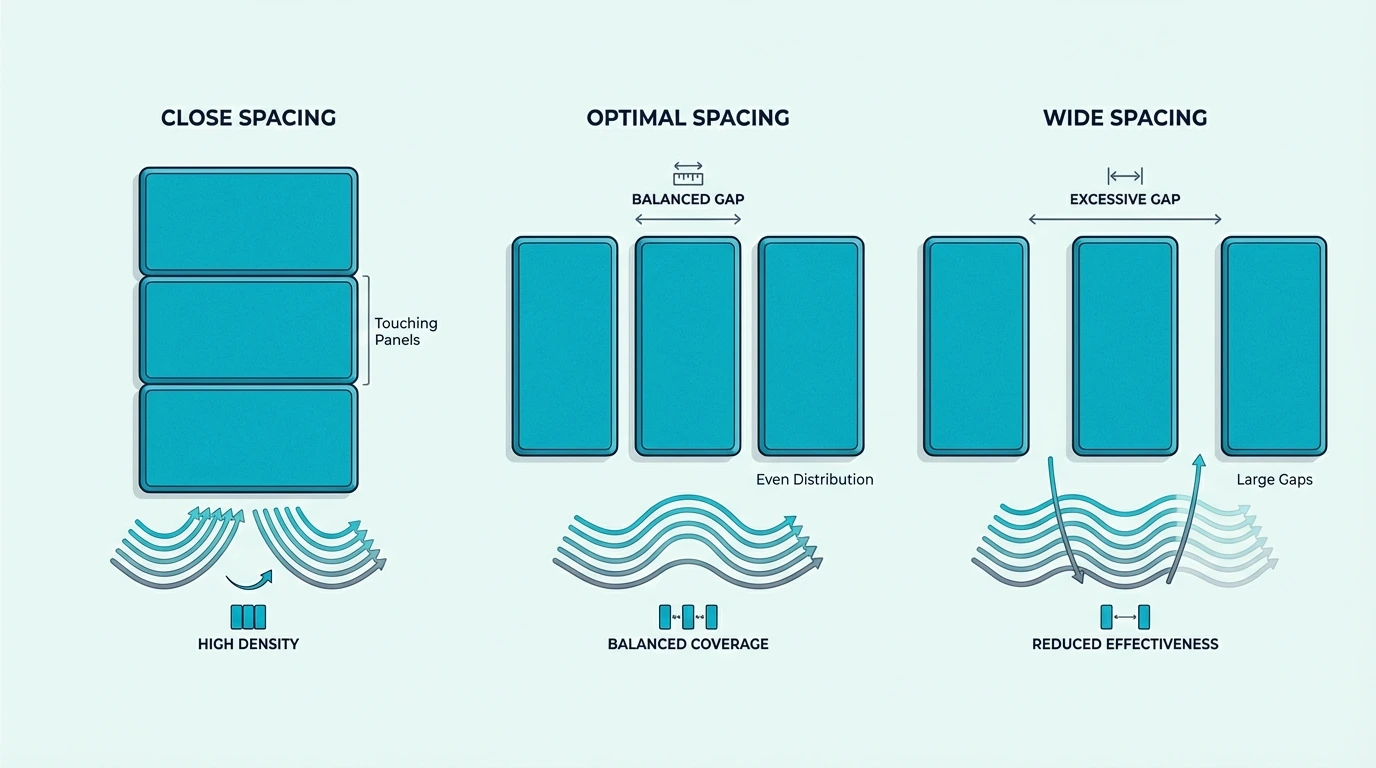
The ideal spacing between acoustic panels is 1-4 inches for most installations. This range gives visual separation, minor adjustment room, and more even coverage across the wall.

There is no magic number—the 2-inch vs 4-inch comparison confirms that 2 inches works as well as 4 inches acoustically. The best choice depends on wall dimensions, panel count, NRC rating, and how polished the layout should look.

Should Acoustic Panels Be Touching Each Other?

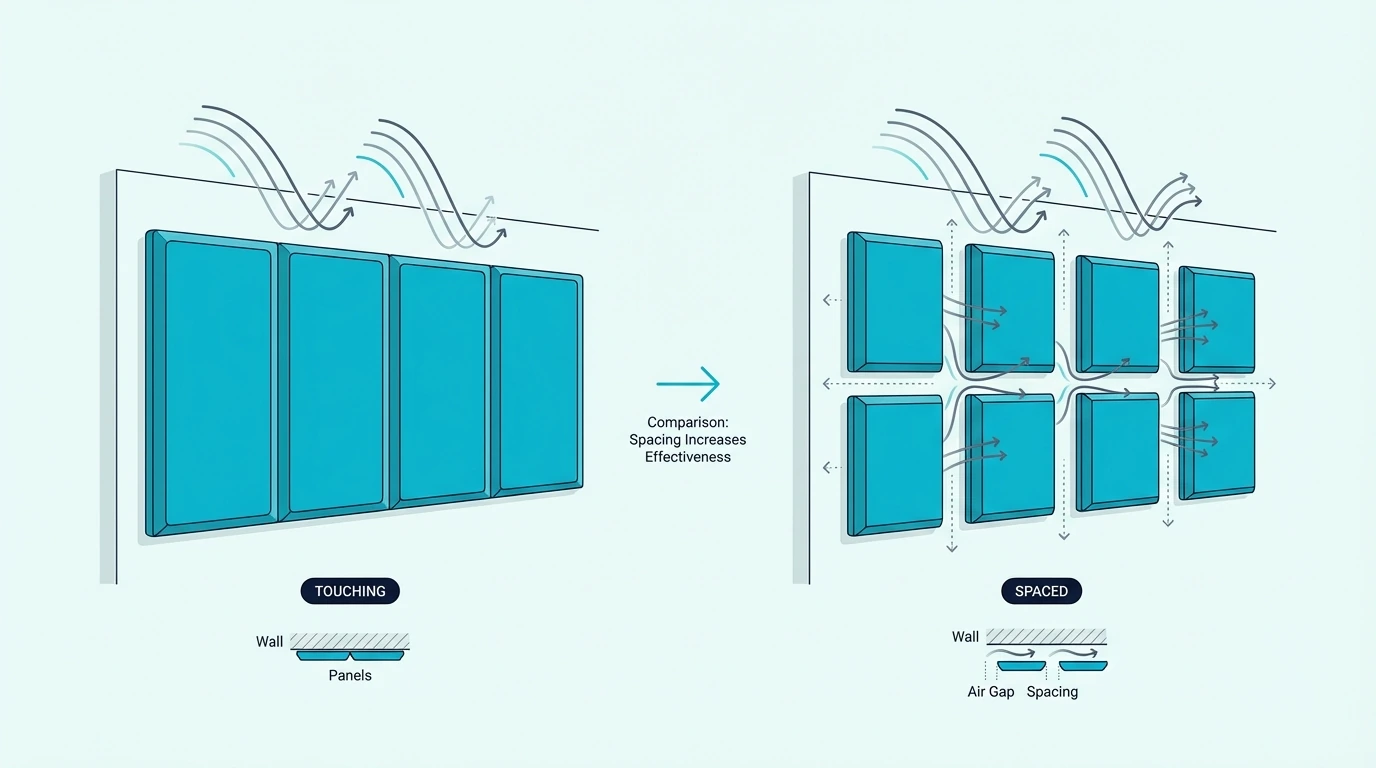
Comparison of touching versus spaced acoustic panels

Panels can physically touch without creating any negative acoustic side effects, but deciding whether to jam them together or space them apart depends on balancing visual design with coverage limits.

No Acoustic Problem with Touching

When panels touch edge-to-edge, they simply function exactly like one massive, single panel. Sound absorption depends on the density of the fibrous material, and the acoustic waves don’t care if there happens to be a seam in the fabric wrap where two panels meet.

If your room lacks low-end control and you’re worried your treatment isn’t powerful enough, touching panels won’t solve it. Total square footage and physical thickness dictate absorption far more than how tightly you pack the frames together.

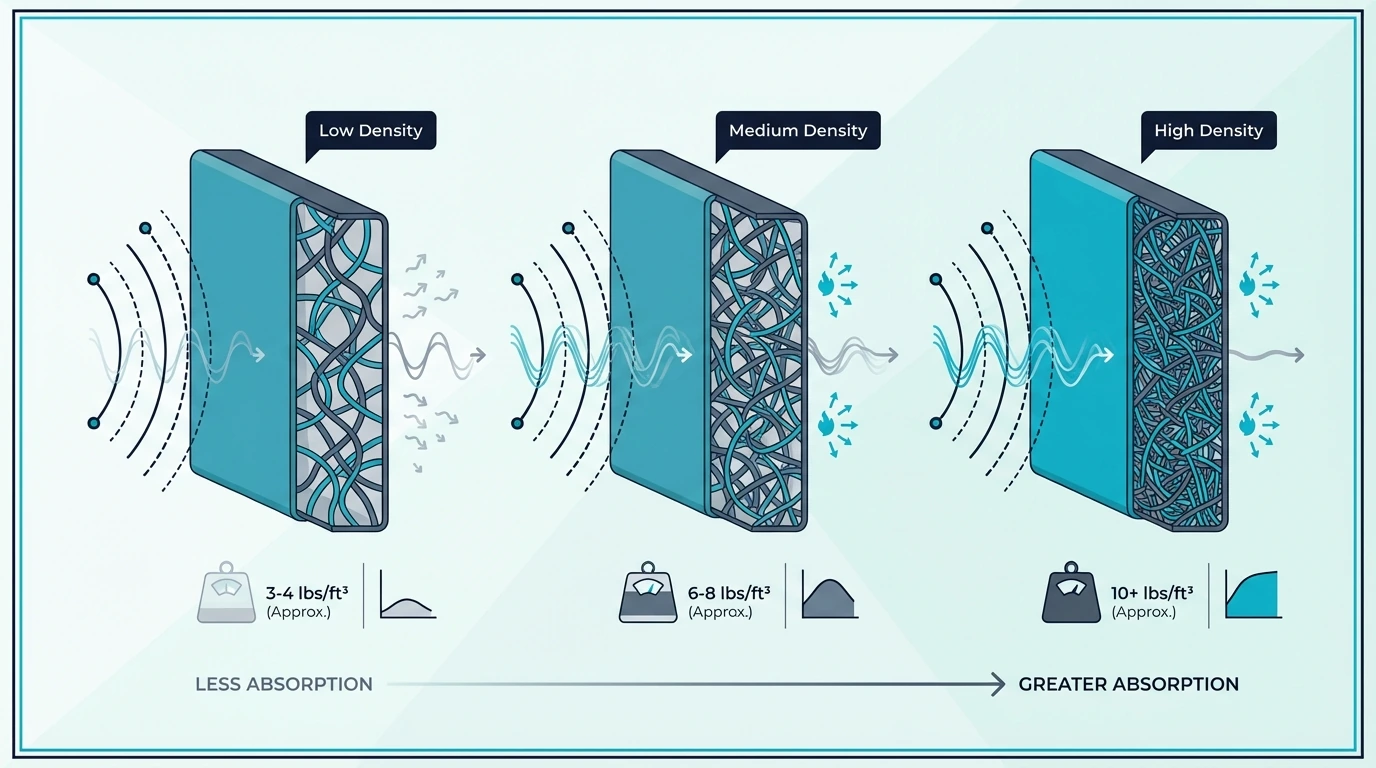
In those cases, density is usually the spec that explains why one wall absorbs better than another.

Why Spacing Often Works Better

While jamming panels together won’t hurt the acoustics, introducing intentional gaps between them provides several massive practical advantages.

The most obvious benefit is distributed coverage. If you only have six panels, spacing them 3 inches apart allows you to stretch that treatment across far more linear wall space than you could if they were all touching.

By spreading the coverage, you catch more secondary reflection paths across the entire wall rather than hyper-treating one small center spot.

Visually, evenly spaced gaps make the treatment look like a designed, professional installation rather than a desperate cluster. Those small gaps also provide installation flexibility—a 2-inch gap hides the minor misalignment that would be glaringly obvious if the frames were touching.

When Touching Makes Sense

Despite those spacing benefits, there are still specific scenarios where touching panels remains the smartest approach. If you are building floor-to-ceiling corner bass traps, you absolutely want those panels stacked tightly together to function as a single, massive low-frequency absorber.

Touching also makes sense on very narrow walls where intentional gaps would push the outer panels awkwardly close to a doorframe or window. In dedicated recording studios where maximum broadband treatment is required, seamless wall-to-wall paneling is often the goal.

If you plan to experiment with both tight clusters and spaced grids, the UMIACOUSTICS Large Panels are built with rigid enough edges to work cleanly in either configuration without sagging.

What’s the Best Spacing Pattern?

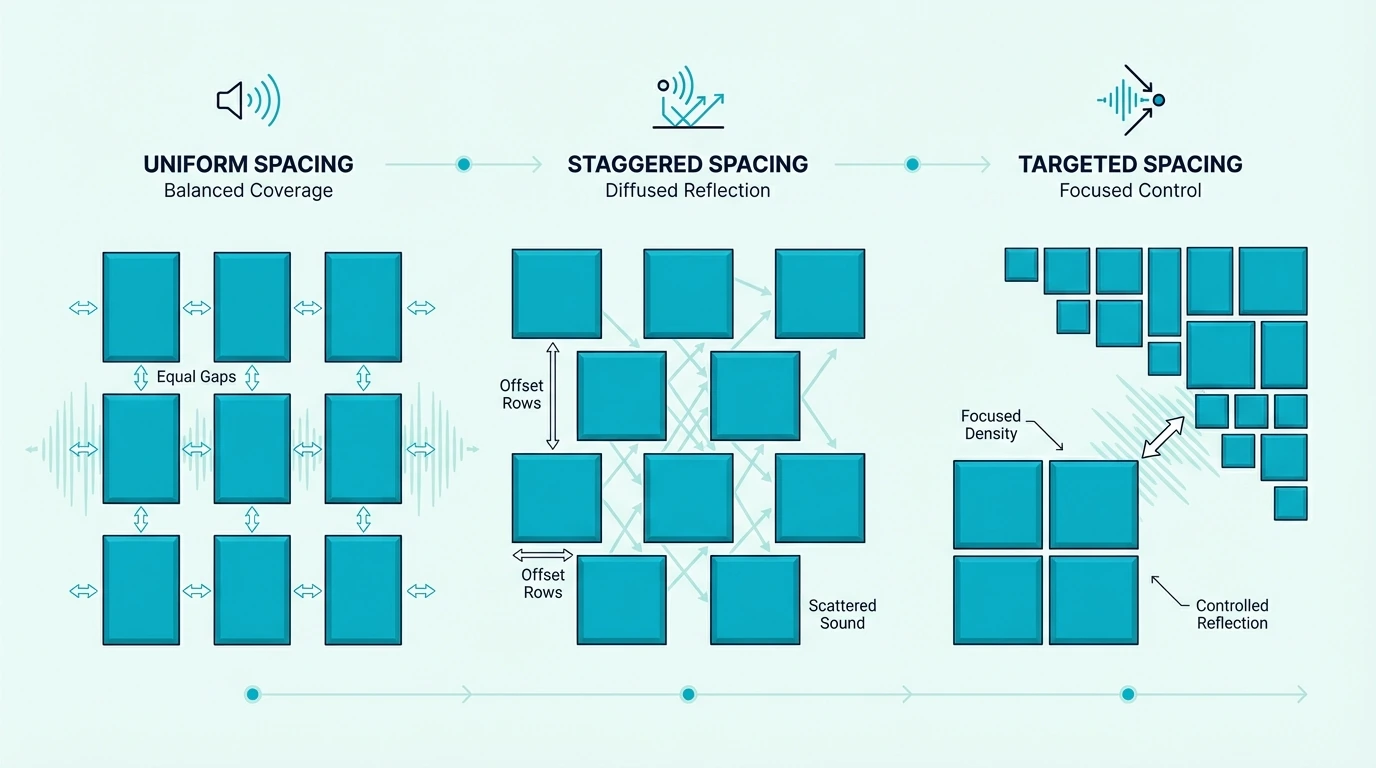
Common acoustic panel spacing patterns

Panel arrangement goes beyond just measuring gap widths. You can use the negative space between panels to create distinct visual patterns that actually complement the room.

Evenly Spaced Grid

The most common and foolproof approach is a simple grid: panels arranged in strict rows and columns with identical gaps on all sides. This creates a clean, organized appearance that guarantees even treatment distribution across the surface.

For example, taking six 24×48” panels and arranging them in a 2×3 grid with 3-inch gaps allows you to treat an 8-foot wide span of drywall. If those same six panels were touching, your treatment zone would shrink to just 6 feet.

Checkerboard Pattern

If you want to maximize the visual footprint of your treatment using the absolute fewest panels, alternating panels and empty wall space creates a checkerboard effect. The human eye perceives the pattern as cohesive wall treatment even though half the grid is empty.

This works exceptionally well in large living rooms or corporate spaces where you want to treat a massive wall area but don’t have the budget to buy thirty panels. The intentional gaps feel like a deliberate design choice rather than missing pieces.

Asymmetric Placement

You can also abandon grids entirely and place panels solely based on acoustic necessity. In this asymmetric approach, panels are mounted specifically at the known reflection points, behind the listening position, or wherever a flutter echo is loudest.

The spacing gaps happen completely naturally based on where the acoustic problems exist. This prioritizes pure audio function over visual symmetry, and the panel placement guide maps out exactly where those problem spots land in different rooms.

Staggered Rows

If a rigid grid feels too corporate, you can offset each horizontal row so the vertical seams don’t align—exactly like a brick wall pattern. This creates visual interest and makes the treatment feel much more dynamic on camera.

Staggered placement technically provides slightly more even sound diffusion across the wall because it breaks up the continuous vertical channels of reflective drywall, but that acoustic difference is negligible compared to standard aligned grids.

Does Panel Spacing Affect Acoustic Performance?

Performance comparison for different acoustic panel spacing

People obsess over exact gap measurements, but the physical spacing between the frames has almost zero direct impact on the sound.

The Short Answer: Minimal Impact

For typical room treatment, spacing versus touching makes no measurable acoustic difference to the panels themselves. A 2-inch gap does not magically boost absorption, nor does it create weird reflection channels.

The panels absorb the exact same amount of sound energy regardless of how close they sit to their neighbors.

What actually dictates your room’s sound is the total square footage of treatment across the entire room, the raw density of the core material, and whether you’ve implemented an air gap behind the panel (which actually does boost bass absorption by a wide margin).

Distributed vs Concentrated Treatment

The only real acoustic side effect of spacing is how it distributes your total absorption across the room geometry.

If you take six panels and jam them together in the exact center of a long wall, you create one intensely treated dead zone flanked by massive areas of untreated, reflective drywall. Taking those exact same six panels and spacing them evenly across the entire length of the wall provides a much more natural, distributed absorption pattern.

For most rooms, this distributed approach works better because sound waves reflect wildly off the entire wall surface, not just the dead center. Spreading your panels out catches far more random reflection paths.

First Reflections Matter Most

All of this debate about gap widths completely ignores the golden rule of acoustics: touching or spacing barely moves the needle compared to simply putting the panels at the correct first reflection points.

A perfectly spaced, mathematically beautiful grid mounted on the wrong wall will provide substantially less acoustic benefit than three ugly, touching panels slapped exactly where the speaker sound bounces to your ears. You must prioritize the reflection points first; you can worry about making the spacing look pretty with whatever panels you have left over.

How Much Wall Coverage Do You Need?

Wall coverage example for spaced acoustic panels

You cannot decide on a spacing pattern until you know exactly how many panels your room actually requires to function properly.

Coverage Percentages

The total number of panels you buy dictates how wide your gaps must be to cover the remaining wall. For critical spaces like home studios and listening rooms—which the panel quantity guide sizes by exact room dimensions—you generally want to hit 20-30% total wall coverage to tame harsh echoes.

If you are pushing for a strictly controlled mixing environment, that target jumps to 40-50% coverage. Anything past 60% coverage pushes you into an aggressively dead room, where you will likely be forced to mount panels so closely together that touching becomes unavoidable.

Spacing Calculation Example

The math of spacing proves why it is such a powerful tool for budget-conscious builders. If you own eight 24×24” panels and need to treat a massive 12-foot wall, your spacing choice determines the entire layout.

If you insist on the panels touching edge-to-edge, your eight panels only yield 8 feet of linear width, leaving the remaining 4 feet of the wall entirely bare and highly reflective. By simply adding a 6-inch gap between each column, those exact same eight panels stretch out to cover a massive 10.5-foot footprint.

Spacing allows you to fill vastly more visual and acoustic space with the exact same material—making it the easiest way to maximize the value of your existing panels without having to order another box.

What Spacing Works Best for Different Room Types?

Panel spacing recommendations by room type

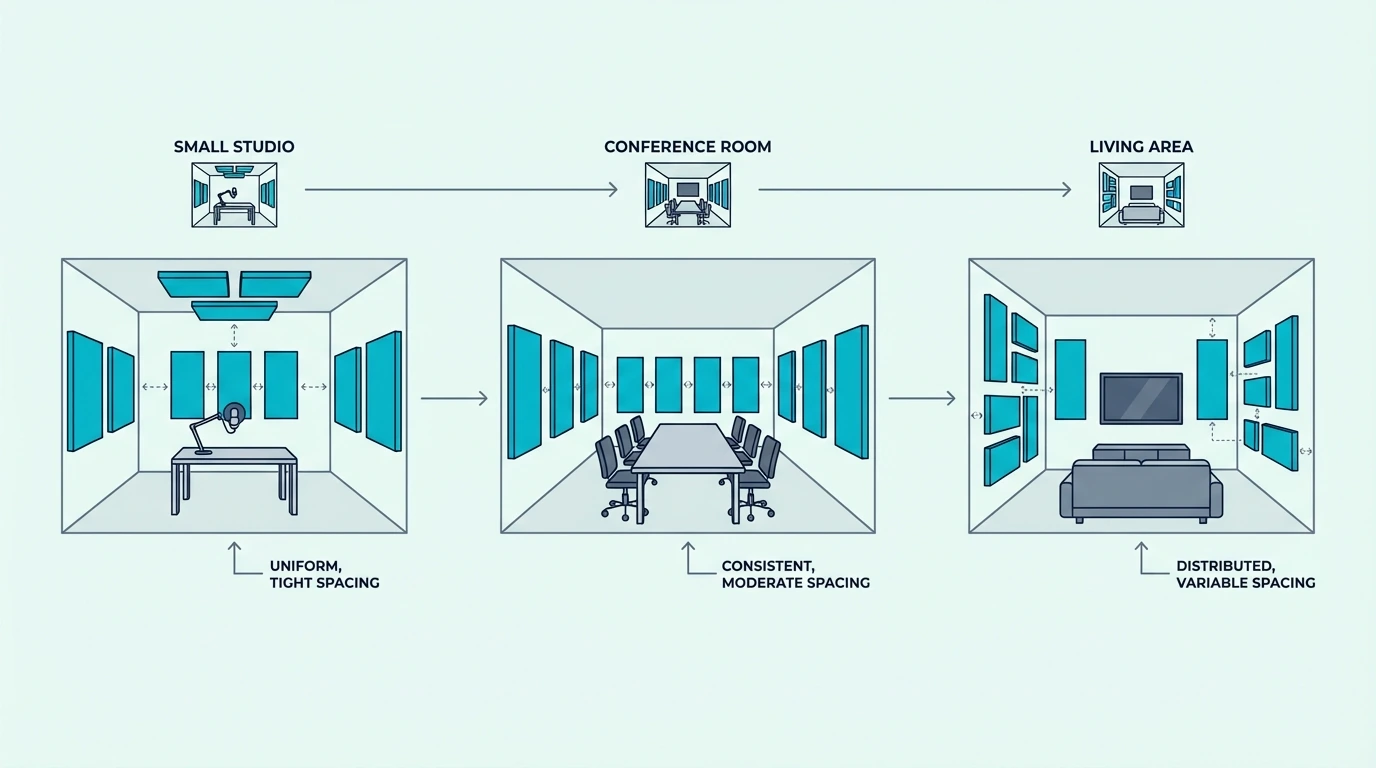
A recording studio attempting to hit strict decay times and a home theater trying to preserve surround sound dynamics call for completely different visual and acoustic spacing strategies.

Recording Studios

Professional mixing environments typically rely on extremely tight 1-to-2 inch spacing to create dense, focused zones of absorption exactly at the first reflection points. The goal is brutal efficiency: killing the early reflections completely so the mixing engineer only hears the direct sound from the studio monitors.

Because they demand so much treatment, studios often mix approaches—using tightly touching bass trap stacks crammed into the corners while transitioning to perfectly spaced, breathable grids for the broadband wall panels.

Home Theaters

Dedicated cinema rooms require a much more breathable approach, benefiting massively from distributed 4-to-6 inch spacing across the side and rear walls. You want to control the dialogue clarity without completely deadening the room.

Wide spacing maintains enough reflective drywall between the panels to preserve the immersive, ambient energy of the rear surround speakers, preventing the explosive action sequences from sounding choked or muffled.

Offices and Conference Rooms

Corporate spaces and home offices prioritize clean aesthetics right alongside the echo reduction. In these environments, evenly spaced grids are mandatory because they look like intentional, architectural design choices.

The smartest approach is to abandon standard measurements entirely and simply match your panel gaps to the room’s existing architecture. Aligning your panel edges with window frames, door trim, or existing artwork creates a visual harmony that makes the acoustic treatment feel built-in rather than tacked on.

Home Studios and Podcasting

In smaller 10×10 bedroom studios or podcast booths, wall real estate is at a severe premium. You are usually forced into tighter spacing or touching clusters simply to fit enough absorption into the room to handle the low-mid buildup.

The UMIACOUSTICS Compact Panels are highly effective in these cramped booths because their narrow width allows you to sneak them into tight gaps between desks and doors where massive 48-inch panels simply cannot fit.

How Do Spacing Approaches Compare?

Spacing comparison for acoustic panel layouts
Approach Coverage Appearance Best For
Touching (0”) Concentrated Seamless wall Bass traps, full coverage
Tight (1-2”) Slightly distributed Near-seamless Studios, tight spaces
Standard (2-4”) Distributed Professional grid Most applications
Wide (4-8”) Very distributed Design element Offices, theaters
Strategic Targeted Varies Acoustic priority

How Do You Install Evenly Spaced Panels?

Installation tips for spacing acoustic panels

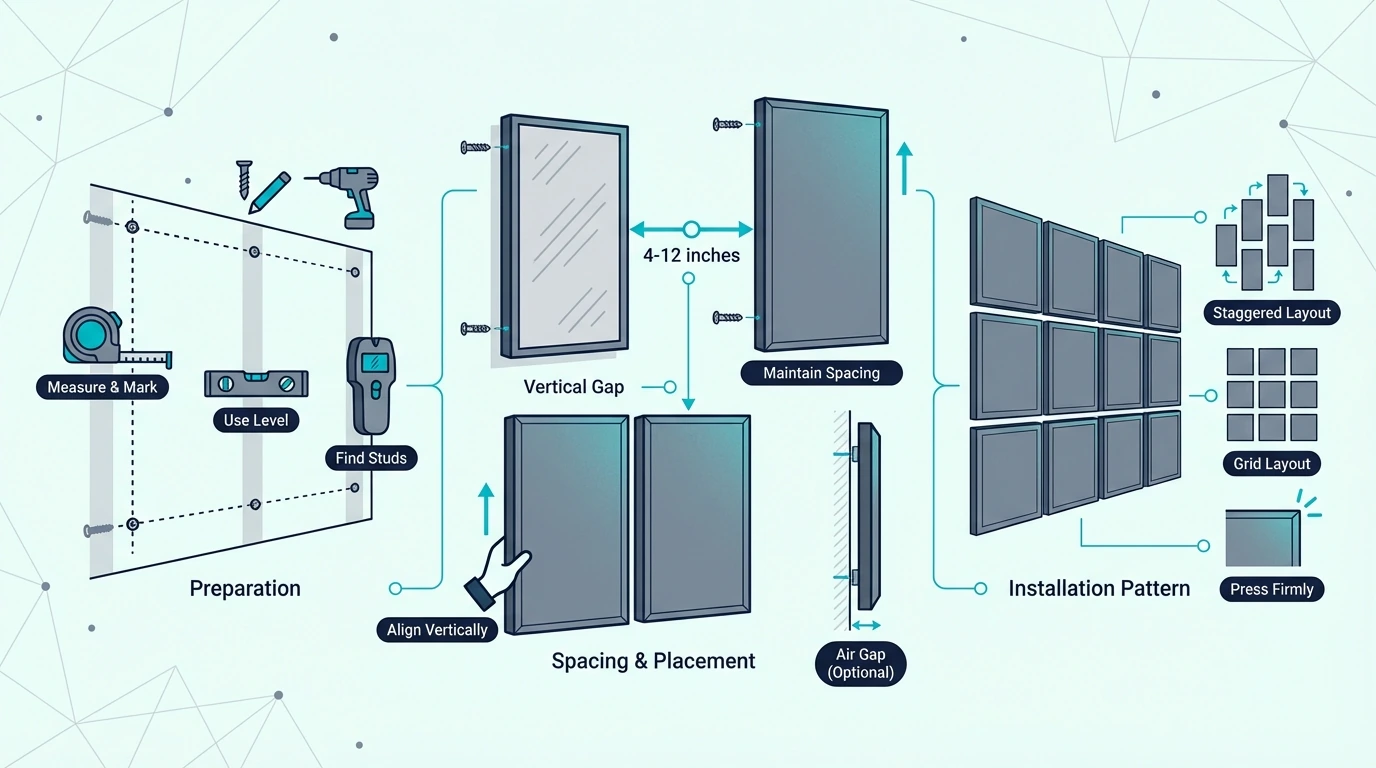
Achieving perfectly consistent gaps across a massive 12-foot wall requires careful prep work. If you try to eyeball the layout as you go, you will inevitably end up with crooked lines and uneven spacing by the time you reach the final panel.

Measure and Mark First

The golden rule of spaced grids is to calculate the total coverage width—including all the gaps—before drilling a single hole. Always find the exact center of the wall and mark your panel centers expanding outward from that point.

Starting at the left edge and working your way right without a plan usually leaves you with an awkward, glaringly uneven gap at the far corner.

Use Spacer Templates

You can eliminate the tedious process of measuring every single gap by creating a physical template. Cut a piece of rigid cardboard or scrap wood to match your exact desired gap width (like 3 inches), and hold it against the first panel while you position the second one.

This guarantees absolute consistency across the entire wall in half the time.

Level Each Panel

Because the human eye is very good at spotting parallel lines that aren’t quite parallel, spacing makes minor alignment errors hyper-visible. You must use a spirit level or laser level on every single panel, not just the anchor piece—even a quarter-inch tilt on the second panel will compound massively by the time you mount the fifth one in the row.

Consider Adjustable Mounting

The reality of drywall is that it is rarely perfectly flat, meaning fixed picture hooks can sometimes leave your spaced panels sitting at slightly different depths. Z-clips and French cleats allow you to slide the panels slightly left or right after installation to perfect the spacing—the installation guide and hanging methods guide compare these sliding hardware options.

If you want a low-profile mount that locks the frame flush to the wall while still allowing lateral adjustments, French Cleat Z Hangers are the standard professional choice. Once the metal track is leveled on the wall, the panels sit perfectly aligned every time.

Conclusion

Spacing is mostly a layout and coverage decision, not an acoustic “rule.” In most rooms, 1–4 inches of gap is an easy default that looks intentional and helps you spread treatment.

If you still have echo after you hang panels, revisit placement and coverage first, then thickness and density. Spacing is usually the last knob to turn.

Frequently Asked Questions

Should Acoustic Panels Be Touching Each Other?

No requirement exists for panels to touch. Spacing them 1-4 inches apart often works better by distributing coverage—touching isn’t wrong, it just concentrates treatment rather than spreading it.

The choice is primarily aesthetic and practical, not acoustic. Both approaches provide similar sound absorption for the same panel quantity.

How Far Apart Should Acoustic Panels Be?

For most applications, 2-4 inches between panels works well. This provides visual separation, allows installation flexibility, and distributes treatment across more wall surface.

There’s no acoustically “correct” spacing—choose based on your wall dimensions, panel quantity, and aesthetic preference.

Does Panel Spacing Affect Sound Absorption?

The total square footage matters far more than whether panels touch—six touching panels absorb the same sound as six spaced panels. Spacing just distributes that absorption across more wall area for more even treatment.

What Spacing Pattern Looks Best?

Evenly spaced grids with consistent gaps look most professional. 2-3 inch gaps between 24” panels creates clean visual rhythm without appearing sparse.

Staggered or asymmetric patterns can work for specific design goals, but consistent grids suit most rooms. Match spacing to room architecture when possible.

Acoustic Panel NRC Rating Explained: What It Means and Why It Matters [2026]

What does NRC mean in acoustic panels? NRC is a useful absorption score, but treating it like a “best panel” ranking leads to bad purchases.

That mistake shows up fast: you buy panels with a high NRC and the room still sounds splashy or boxy, because reflections depend on placement and frequency range, not just one averaged number.

Once you know what NRC actually measures and what it leaves out, you can compare panels realistically and get a room that sounds noticeably drier and clearer.

Below you’ll find how NRC is tested, what the numbers mean at each tier, and how to match ratings to your specific room. By the end, you’ll know exactly which specs to trust and which to ignore.

Quick Takeaway

NRC (Noise Reduction Coefficient) is an absorption score from 0.0 to ~1.0 that summarizes how much mid-range sound a panel absorbs in a lab test. For most rooms, look for 0.80+ NRC from real fiberglass or mineral wool panels, then prioritize first reflection points for the biggest audible improvement.

What Does NRC Mean in Acoustic Panels?

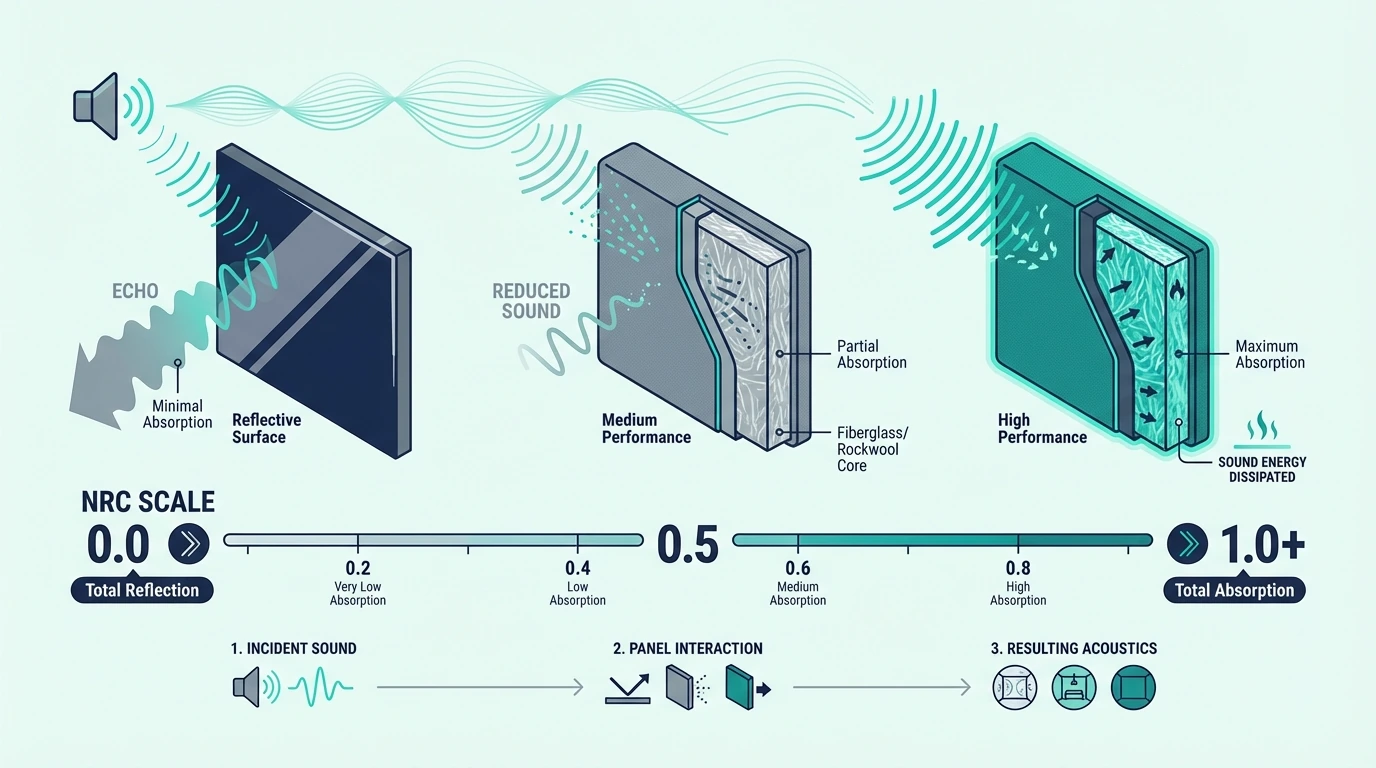
NRC scale for acoustic panel absorption ratings

NRC stands for Noise Reduction Coefficient — a standardized measurement of how effectively a material absorbs sound energy rather than bouncing it back into the room.

The rating runs from 0.0 (total reflection, like concrete) to 1.0 (near-total absorption), though you’ll sometimes see numbers above 1.0 because of how the test geometry works. But before comparing scores, you need to know exactly which frequencies are being graded.

The Four Frequencies Behind the Number

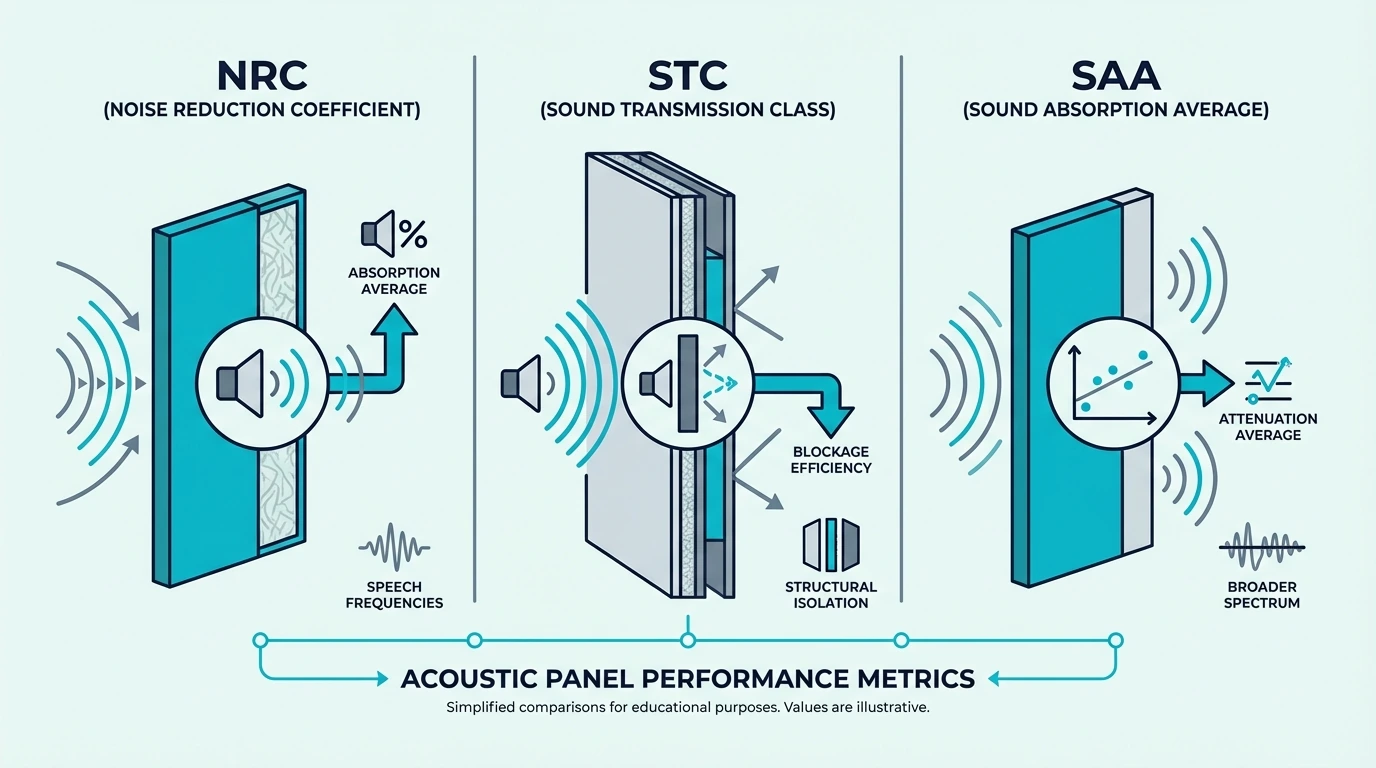
Rather than testing every possible pitch, NRC takes a snapshot by averaging absorption coefficients at four specific frequencies: 250Hz, 500Hz, 1000Hz, and 2000Hz. Each point on that spectrum represents a different slice of everyday sound that panels are expected to control.

The lowest test point, 250Hz, covers the low-mid range — male voice fundamentals, guitar body resonance, and the muddy warmth in music. Moving up, 500Hz sits squarely in the speech intelligibility zone where conversational energy peaks.

The top two points, 1000Hz and 2000Hz, capture upper-mid detail. This is where consonant clarity, cymbal attack, and the piercing “presence” range live. Together, these four frequencies span the exact band where flutter echo and room harshness are most obvious to human ears.

However, that targeted coverage is also the rating’s biggest blind spot. The formula completely ignores deep bass below 250Hz and high treble above 2000Hz, meaning a panel can score a near-perfect 0.95 NRC and still leave a room sounding overwhelmingly boomy. The 2-inch vs 4-inch comparison shows how much extra depth you need before low-frequency absorption becomes meaningful.

Why a Single Number Can Mislead

Because the final score collapses those four distinct data points into one flat average, two panels with identical NRC ratings can perform radically differently in the same room. A thin foam panel that absorbs heavily at 2000Hz but fails completely at 250Hz can easily generate the same mathematical average as a thicker fiberglass board that absorbs evenly across the entire spectrum.

That mathematical averaging makes the headline NRC useful as a quick first filter (“skip anything below 0.80”) but unreliable as a tiebreaker between two premium products. When you are doing serious room treatment, you must look past the average and demand the full frequency absorption curve from the manufacturer.

How Is NRC Measured?

NRC test chamber used to measure acoustic absorption

NRC comes from a highly standardized lab test designed to make competing materials directly comparable. But that heavily controlled environment also explains why a panel’s performance can feel underwhelming when you finally mount it in a real room.

Laboratory Testing Standards

The testing protocol follows ASTM C423, which requires engineers to place the panels inside massive reverberant chambers built specifically for acoustic measurement. To ensure accuracy, the standard requires a massive sample size of at least 72 square feet, which prevents the exposed edges of the panels from artificially inflating the absorption scores.

The lab measures the chamber’s baseline reverberation time, hauls the massive panel array inside, and measures the room’s decay time again. By controlling the temperature, humidity, and geometry perfectly, the resulting absorption coefficients remain entirely objective.

That objectivity is the entire point of the ASTM C423 standard. It guarantees that a 0.85 NRC rating from a premium fiberglass brand was tested under the exact same physics as a 0.90 NRC rating from a budget foam seller.

The fatal flaw in this system is that real rooms are not reverberant chambers. During testing, the panels are bombarded by sound waves arriving simultaneously from every possible angle in a highly reflective concrete box. When you mount that same panel flat against the drywall in your carpeted bedroom, it receives sound from a much narrower directional path, which inevitably alters its real-world performance.

What NRC Doesn’t Tell You

Beyond the geometry mismatch, the biggest secret of NRC is what it hides about mounting techniques. The lab test almost always assumes the panel is mounted completely flush to a hard surface.

If you take that exact same panel and mount it with a 2-inch air gap behind it, the absorption curve shifts noticeably toward the lower frequencies. The panel installation guide has air-gap mounting options that exploit this physics without special hardware.

For critical applications like music studios, the headline NRC is just marketing. You have to request the full “alpha curve” chart from the manufacturer to see the raw test data across every frequency band.

But for general acoustic treatment where you just want to reduce the echo in an office or tame the harshness in a living room, the basic NRC average provides enough data to keep you from buying useless decorative foam.

What Do NRC Numbers Mean?

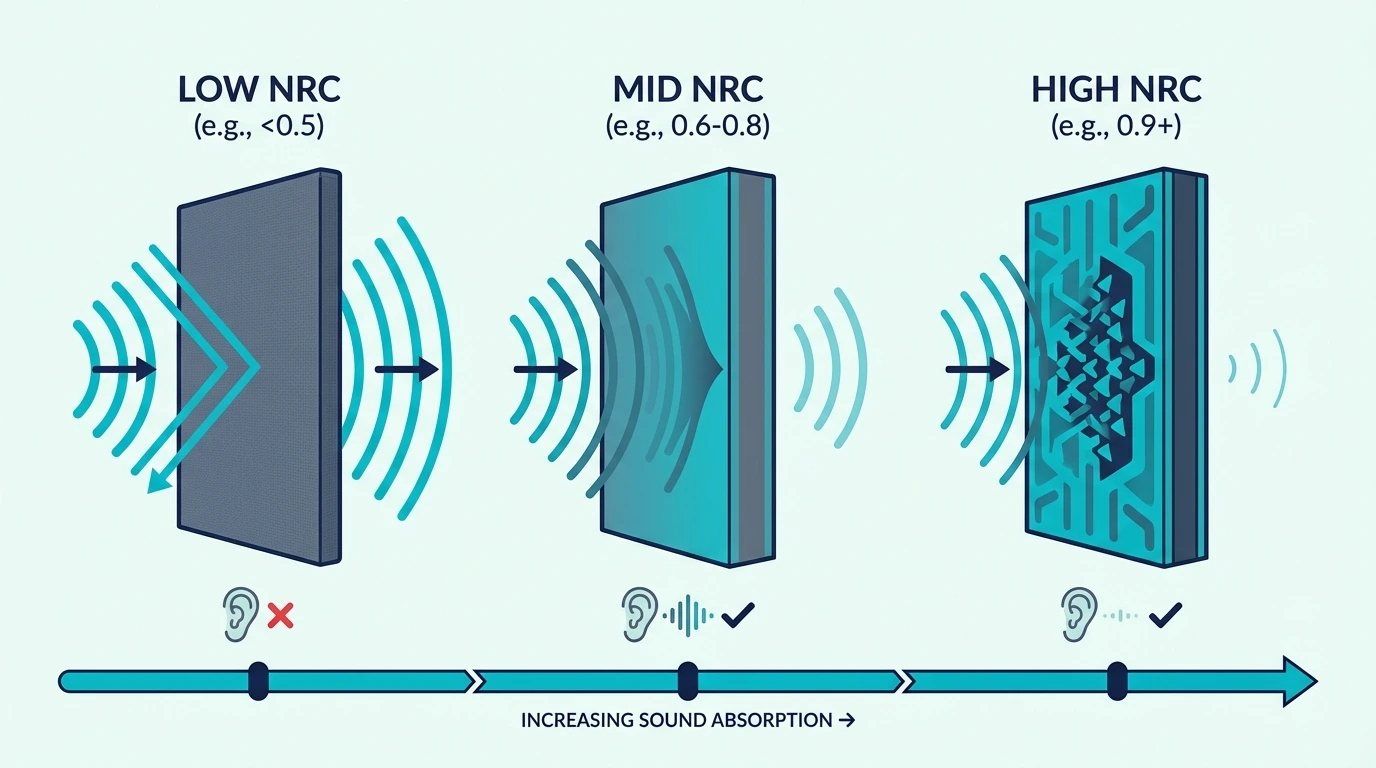
Examples of acoustic panel NRC ratings

The raw math of the 0.0 to 1.0 scale is abstract until you connect it to materials you already know.

The Scale Explained

At the absolute bottom of the scale sits pure reflection. A 0.0 rating means sound hits the surface and bounces back completely intact, which perfectly describes bare drywall, window glass, and concrete floors.

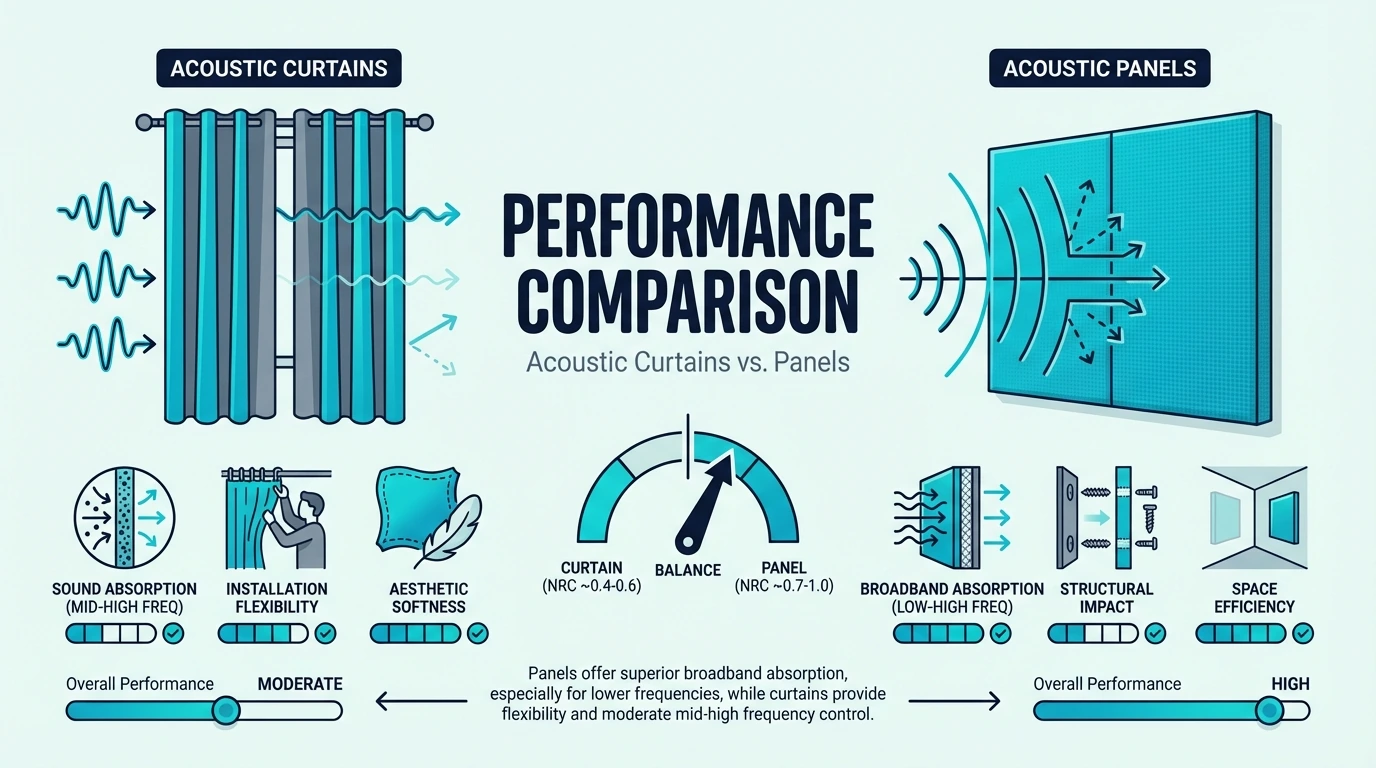
Moving to the middle, a 0.50 rating means the material acts like a toll booth, soaking up half the acoustic energy and reflecting the rest. Heavy carpet, thick curtains, and entry-level egg-crate foam usually land around this halfway point.

At the very top, a 1.0 rating represents total absorption within the tested frequencies. Thick fiberglass bass traps and heavy mineral wool boards are the few materials capable of killing reflections entirely.

The jump from an untreated drywall room (0.05) to a wall treated with professional panels (0.90) represents an 18x mathematical improvement in absorption. That massive multiple is exactly why hanging just a few panels in an empty room makes the space feel instantly “deadened.”

Why Higher Isn’t Always Necessary

Because that initial leap is so dramatic, a standard 0.85 NRC panel handles almost every common acoustic problem effectively. The perceptual difference to human ears between a 0.85 panel and a premium 0.95 panel is marginal compared to the difference between bare drywall and that 0.85 panel.

This law of diminishing returns means chasing a perfect 1.0 rating usually results in overspending for an upgrade you cannot hear. Once you cross the 0.80 threshold, the total square footage of your coverage matters vastly more than the decimal points on the spec sheet.

The one exception to this rule is professional mixing environments. In a recording studio where you are making EQ decisions based on what the room tells you, the accuracy of a higher-rated, linear-absorbing panel justifies the premium price tag.

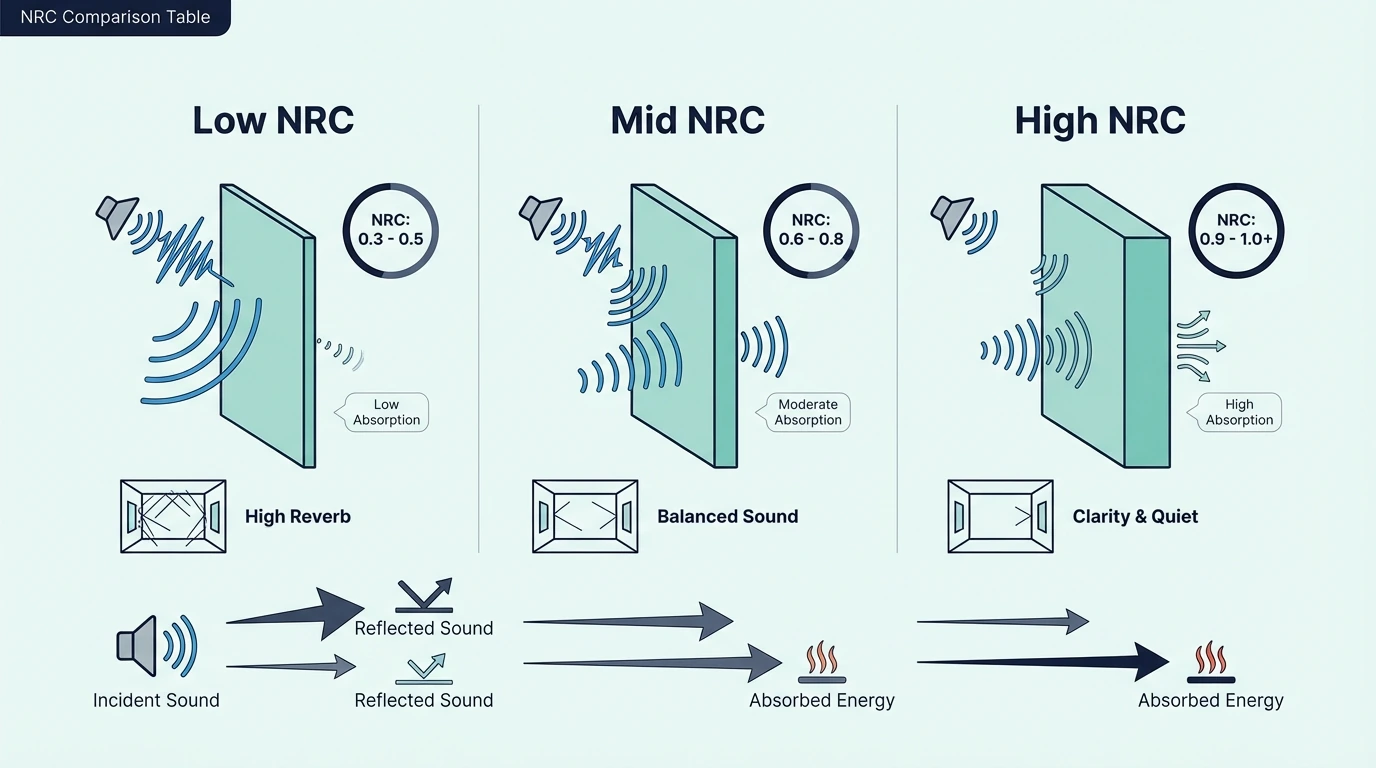
What’s a Good NRC Rating for Acoustic Panels?

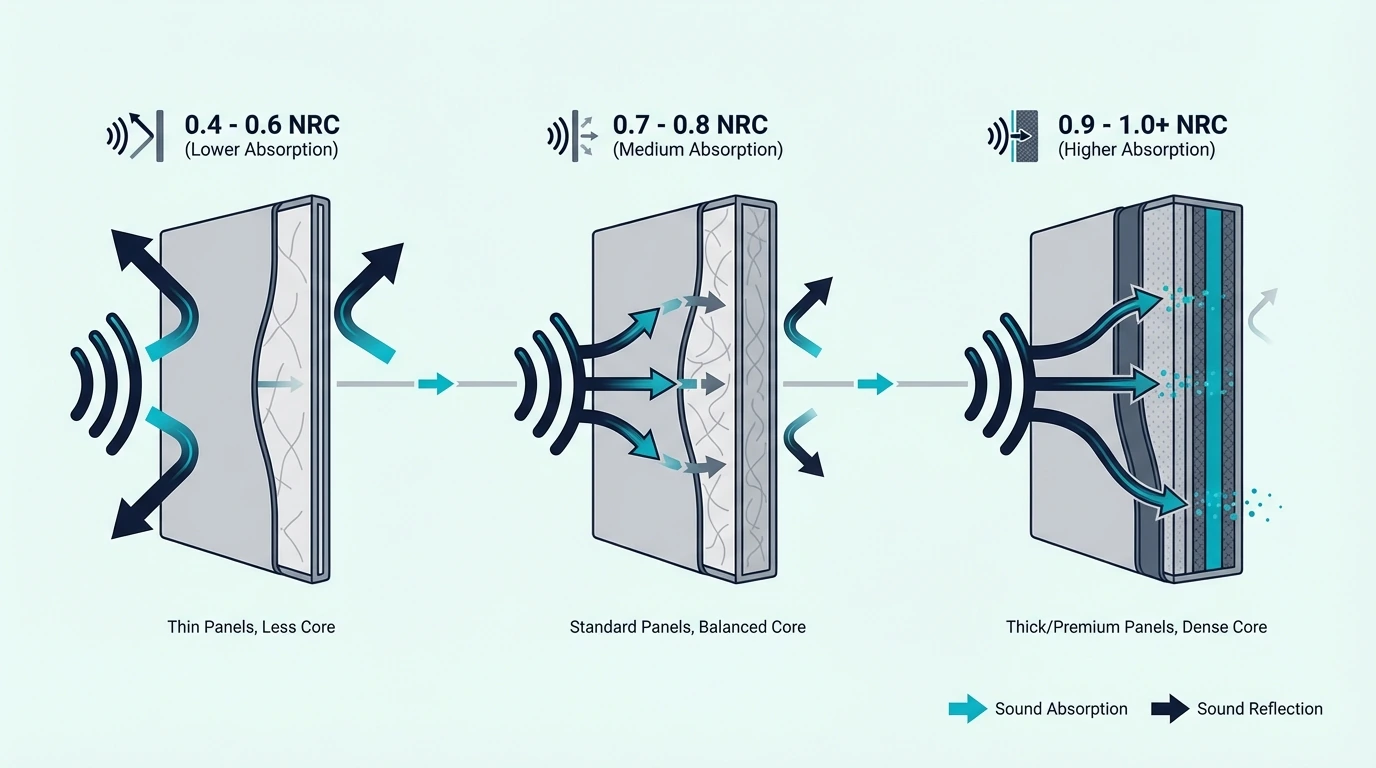
NRC rating tiers for acoustic panels

Because the market is flooded with products claiming to be “acoustic,” filtering by these three distinct NRC tiers is the fastest way to spot cheap decorative foam masquerading as serious treatment.

Low NRC (0.0-0.40)

If a product falls into this bottom tier, it is providing purely decorative value with almost zero acoustic benefit. You will find ultra-thin 1-inch foam wedges, rigid PET felt tiles, and unverified Amazon specials living in this bracket.

At 0.20 to 0.30 NRC, the material is only capturing a quarter of the mid-range energy that hits it. That might take the harsh edge off a small bathroom or a narrow hallway, but it will do absolutely nothing to fix the ringing slap-echo in a living room or a podcast studio. If a seller completely hides their NRC rating on the product page, it is because the foam belongs in this tier.

Medium NRC (0.50-0.70)

The middle tier provides legitimate, functional absorption for general residential spaces. Thicker 2-inch foam wedges, dense polyester panels, and lightweight acoustic baffles populate this bracket.

When you install 0.60 NRC panels, the room immediately feels less chaotic. Background chatter becomes clearer, and the “gymnasium” reverb drops out of video calls. For conference rooms, open offices, and gaming setups, this tier delivers exactly the improvement people expect without the hefty price tag of fiberglass.

If you want a “better than bare walls” baseline to tame flutter echo without spending a fortune, ATS Acoustics Sound Absorbing Acoustic Panel 24 × 48 × 2 is the standard entry point for this tier. For a deeper look at how quality foam stacks up against rigid panels in this range, the polyester vs foam acoustic panels comparison covers the trade-offs.

High NRC (0.80-1.0+)

This top tier represents professional-grade, uncompromising absorption. To hit these numbers, manufacturers must use dense fiberglass boards (like Owens Corning 703), heavy mineral wool, or specially engineered acoustic cores wrapped in transparent fabric. The fiberglass panel roundup ranks the top options in this tier by verified NRC data.

At 0.85 NRC and above, the treated space sounds surgically dry. Reverb tails vanish, dialogue becomes razor-sharp from across the room, and studio monitors finally reveal the true detail in a mix because the room is no longer fighting the speakers.

The Acoustic Panels 4 Pack ROOM KIT Large demonstrates how this tier is built — larger absorptive panels that prioritize serious wall coverage over decorative softness.

If you are treating a recording studio, a dedicated home theater, or a critical listening room, never buy a panel rated below 0.80 NRC. The performance gap between a 0.60 foam tile and a 0.85 fiberglass board is the single most dramatic acoustic upgrade you will ever hear.

NRC vs STC vs SAA: What’s the Difference?

Comparison of NRC, STC, and SAA acoustic ratings

Acoustic specs are full of acronyms that sound identical but measure completely different physics. Confusing them guarantees you will buy the wrong material for your room.

NRC (Noise Reduction Coefficient)

NRC only measures internal room absorption. It scores how effectively a material acts like an acoustic sponge, soaking up the reflections that bounce off the walls inside your room. When you want to kill the echo inside a podcast studio, you hunt for high NRC ratings.

STC (Sound Transmission Class)

STC measures barrier blocking. It scores how effectively a wall, door, or window stops sound from escaping your room and traveling into the hallway or the neighbor’s apartment.

Acoustic panels have high NRC ratings but very low STC ratings. They will make your drum kit sound perfectly dry and crisp inside the room, but they will do absolutely nothing to stop your neighbor from hearing the kick drum through the drywall. If you need to contain sound, you need mass and decoupling, which the acoustic panels vs bass traps comparison explains in the isolation section.

SAA (Sound Absorption Average)

SAA is simply a more granular version of NRC. Instead of averaging just four frequencies, the newer SAA standard averages the absorption across twelve distinct frequency bands to provide a slightly more accurate picture of the panel’s broadband performance.

Because the two metrics track the exact same physics, SAA and NRC scores on a spec sheet are almost always nearly identical.

Can NRC Exceed 1.0?

Edge effect diagram for acoustic panel NRC testing

You might see panels rated at 1.05 or 1.15 NRC, which seems impossible — how can something absorb more than 100% of sound? Two things explain it: the edge effect during testing, and what those above-1.0 numbers actually mean in practice.

The Edge Effect Explained

When panels are tested in a reverberant chamber, sound waves hit not just the front surface but wrap around the edges. This “edge effect” increases the effective absorption area beyond the panel’s physical dimensions.

A 24×48” panel absorbs sound across a larger area than its 8 square feet because edge diffraction brings additional sound energy into contact with the material. The thicker and more absorptive the panel, the stronger the edge effect — which is why thick fiberglass and rockwool panels are the products most likely to exceed 1.0.

Smaller test samples show larger edge effects relative to their face area, which is one reason the ASTM C423 standard requires a minimum 72 square foot sample. That minimum keeps edge effects from inflating the result beyond what you would see in a real installation.

What Ratings Above 1.0 Mean

An NRC above 1.0 indicates excellent absorption — the panel absorbs all direct sound plus additional energy from edge effects. In practical terms, treat anything above 0.95 as full absorption.

When comparing two products at 1.05 and 1.10 NRC, the difference is not meaningful in a real room. Both are absorbing effectively all the mid-range energy that reaches them, and the 0.05 gap reflects test geometry more than audible performance.

The Olanglab Sound Absorbing Acoustic Wall Panels 2 Pack sits in the kind of premium fiberglass category that regularly posts professional-grade absorption numbers.

If you see a product rated above 1.0, it is a good sign — but prioritize the full frequency data over the headline number. A panel at 1.05 NRC with weak 250Hz absorption is less useful in a boomy room than a 0.90 NRC panel with even absorption across all four bands.

What NRC Rating for Different Applications?

Application targets for different NRC ratings

The exact target NRC shifts depending on what you’re doing in the room. You can actually ruin a space by chasing maximum absorption when the room doesn’t call for it.

Recording Studios and Mixing Rooms

Mix rooms demand absolute maximum absorption (NRC 0.90+) at the primary treatment positions. If the walls reflect sound back to your chair, the room will color what you hear, tricking you into making EQ decisions that sound terrible on every other playback system.

The first reflection points on the side walls and the ceiling cloud are the absolute priority. The panel placement guide maps exactly where those bounce paths land in a typical room. However, the rear wall usually requires a hybrid approach — over-treating the entire room with 1.0 NRC panels makes it feel unnaturally suffocating, which throws off your perception of reverb tails.

Home Theaters

Dedicated cinema rooms thrive in the NRC 0.80 to 0.90 pocket. The theater requires heavy absorption to keep the dialogue perfectly clear and the surround-sound panning tight, but it still needs to breathe.

If you coat every single wall in 1.0 NRC fiberglass, the room loses the ambient acoustic energy that makes movie soundtracks feel massive and immersive. The sweet spot is usually 40–60% coverage on the front and side walls, leaving the rear surfaces slightly reflective. The home theater acoustic panels guide maps out exactly which speakers need which treatment.

Offices and Conference Rooms

Corporate spaces and home offices hit their sweet spot between NRC 0.70 and 0.85. The goal here isn’t surgical audio accuracy; the goal is killing the painful flutter echo so people can survive a two-hour Zoom call without fatigue.

Ceiling baffles are the most powerful weapon for offices because they catch the reflections from every single desk simultaneously. For conference rooms, flanking the ends of the table with medium-NRC wall panels instantly kills the “speaking into a tunnel” effect that ruins speakerphone audio.

General Rooms

Living rooms and bedrooms rarely need to exceed NRC 0.60 to 0.80. These spaces just need basic echo control to tame the harsh slap off hardwood floors and large glass windows.

Because couches, heavy curtains, and area rugs already absorb a massive amount of high-frequency energy naturally, you are just filling in the gaps. Two or three stylish polyester panels at the worst reflection points will drop the room’s reverb time into a perfectly comfortable range. The 1-inch vs 2-inch panel comparison helps you pick the right depth for casual spaces where slim profiles matter.

How Do Common Materials Compare by NRC?

NRC comparison table for acoustic panel materials
Material Type Typical NRC Best Application
Bare Drywall 0.05 — (baseline)
Carpet (heavy) 0.30-0.40 Floor absorption
Acoustic Foam (2”) 0.40-0.60 Voice recording
PET Felt Panels 0.50-0.70 Office aesthetics
Fiberglass Panels (2”) 0.85-0.95 Studios, theaters
Rockwool Panels (2”) 0.85-0.95 Studios, theaters
Bass Traps (4”+) 0.95-1.15 Corner treatment

Conclusion

NRC gives you one number to filter acoustic products, but the score alone won’t tell you how a panel performs at a specific frequency or in a specific position.

For any room where sound quality matters, set a floor of 0.80 NRC and skip products that don’t publish their rating. That single threshold cuts out most decorative panels and thin foam tiles.

Match NRC to the Room

A home office doesn’t need 1.0 NRC bass traps. Basic 0.80 NRC fiberglass panels solve speech echo in most setups.

A mixing studio benefits from maximum absorption at every critical listening position.

Placement Outweighs the Rating

A 0.85 NRC panel at the first reflection point outperforms a higher-rated panel mounted in a random spot.

Once you’ve settled on a target NRC, the panel count guide helps calculate total coverage, and the hanging guide matches hardware to your wall type. For product picks across every tier, the best acoustic panels guide ranks options by verified performance data.

Frequently Asked Questions

What Does NRC Mean in Simple Terms?

NRC is an absorption percentage — a panel rated 0.85 absorbs roughly 85% of mid-range sound and bounces back the rest. The rating only covers 250Hz to 2000Hz, so it says nothing about deep bass.

What’s a Good NRC Rating for Acoustic Panels?

Set 0.80 NRC as your floor. Fiberglass and rockwool panels typically rate 0.85 to 1.0, while budget acoustic foam sits around 0.40 to 0.60.

That gap is immediately audible once you treat even two or three first reflection points.

Is Higher NRC Always Better?

Diminishing returns kick in above 0.90 — the gap between 0.90 and 0.95 is barely audible. A well-positioned 0.85 NRC panel outperforms a poorly positioned 1.0 panel every time.

What’s the Difference Between NRC and STC?

NRC measures absorption (sound soaked up inside a room). STC measures blocking (sound stopped from traveling between rooms).

Acoustic panels have high NRC but low STC — they reduce echo but don’t soundproof. For sound blocking between spaces, you need mass, decoupling, and air sealing, not absorptive panels.

Acoustic Panel Density: How Thickness and Density Affect Absorption [2026]

Best density for acoustic panels sits in a sweet spot, but only if you match it to panel thickness and the problem you’re actually hearing.

Pick the wrong density and you’ll either under-treat the low-mids (boxy, muddy rooms) or pay for boards that feel “pro” but don’t absorb better.

Pick the right density and your panels soak up reflections efficiently without wasting money, space, or effort.

The rest of this guide covers what density means in practice, which ranges work for wall panels versus bass traps, and how to avoid overspending on density you don’t need. You’ll know exactly which lb/ft³ number to target for your room.

Quick Takeaway

For most wall panels, aim for about 3-6 lb/ft³ density with the right thickness. Step toward 6-8 lb/ft³ when you’re building bass traps or you need more low-frequency control in corners.

What Is Acoustic Panel Density?

Density comparison for common acoustic panel materials

Acoustic panel density measures how much material is packed into a given volume—expressed as pounds per cubic foot (lb/ft³ or pcf). A 3 lb/ft³ panel contains three pounds of material in every cubic foot of volume.

This measurement tells you more about acoustic performance than almost any other specification. Density determines how sound waves interact with the material, which frequencies get absorbed, and how well the panel converts sound energy into heat.

If you’re also weighing panel thickness, the 1-inch vs 2-inch acoustic panels guide shows how thickness and density work together.

Think of it like a coffee filter: a loose, thin filter lets liquid (and sound) pass through quickly with minimal absorption.

A dense, packed filter slows everything down and traps more particles. Acoustic materials work similarly—denser materials slow sound waves down and absorb more energy.

Why Does Density Matter for Sound Absorption?

Diagram explaining how acoustic panel density affects absorption

Density controls which frequencies your panels absorb — and by how much. Three factors shape the recommendation: how friction converts sound to heat, why bass needs more density than treble, and where diminishing returns set in.

How Density Affects Absorption

Sound absorption happens when air movement through fibrous material creates friction. Denser materials have more fibers per volume, creating more friction opportunities as sound waves pass through.

A practical way to understand this: blow air through a thin t-shirt versus a thick winter coat.

The coat provides more resistance because it has more material packed into each inch. Sound behaves the same way—more density equals more resistance equals more absorption.

Lower frequencies require more material interaction to absorb effectively. Bass waves have more energy and longer wavelengths, so they need denser materials (or thicker panels) to lose enough energy before passing through.

The Frequency Connection

Low frequencies are where density matters most. Bass waves need higher density to lose energy before passing through.

A 2 lb/ft³ panel might absorb 90% at 2000Hz but only 40% at 250Hz. Bump that to 6 lb/ft³, and the 250Hz absorption jumps to 70%.

High frequencies absorb easily regardless of density—even lightweight materials catch them. The density question primarily concerns mid and low frequency performance.

The air gap guide explains another way to improve low-frequency absorption without changing density.

Air gaps help lower density materials perform better at bass frequencies by positioning them optimally. But starting with 3–6 lb/ft³ material makes the whole system more predictable.

Diminishing Returns

One important caveat: density improvements aren’t linear.

Going from 2 lb/ft³ to 4 lb/ft³ provides a large improvement. Going from 6 lb/ft³ to 12 lb/ft³ provides modest improvement at two to three times the cost.

The sweet spot exists because of physics, not marketing. Most acoustic engineers target 3-6 lb/ft³ for standard panels because that range captures most of the benefit without excessive cost.

What Density for Fiberglass Panels?

Diminishing returns curve for acoustic panel density

Fiberglass is the most common acoustic panel core material. Two products cover nearly every application.

Owens Corning 703 (3 lb/ft³)

OC 703 is the industry standard for acoustic panels. At 3 lb/ft³, it provides excellent mid and high frequency absorption with decent performance down to 250-500Hz depending on thickness.

For most home studios, vocal booths, and general room treatment, 703 delivers the performance you need at reasonable cost. A 2-inch thick 703 panel achieves NRC ratings around 0.85-0.95.

The acoustic panel NRC rating guide explains what that number actually tells you and what it leaves out.

The Olanglab Fiberglass Panels demonstrate typical 703-equivalent performance in pre-made form.

If you’re buying pre-made panels and the seller doesn’t list density, that’s normal. Use thickness, core type (fiberglass/mineral wool/PET), and rigidity as your proxy instead of chasing an exact lb/ft³ number.

Owens Corning 705 (6 lb/ft³)

OC 705 doubles the density of 703, providing superior bass absorption. It’s the go-to material for bass traps, corner treatment, and studios where low-end accuracy matters.

At 6 lb/ft³, 705 absorbs down to 125Hz in 2-inch thickness — reaching well below what 703 manages at the same thickness. The trade-off is cost: 705 runs roughly 2-3x the price of 703.

Which Fiberglass Density to Choose?

For wall panels at first reflection points: 703 (3 lb/ft³) works perfectly. You’re targeting mid and high frequencies where flutter echo and voice reflections occur.

For bass traps and corner treatment: 705 (6 lb/ft³) justifies the extra cost. Bass problems require denser materials to control.

For ceiling clouds: 703 handles the job. Ceiling reflections are primarily mid-high frequency.

For a room kit that covers wall panels and first reflections in one order, the Acoustic Panels Room Kit (Large 4-Pack) bundles 703-equivalent fiberglass at a price that undercuts buying individual boards.

What Density for Rockwool Panels?

Fiberglass density options for acoustic panels

Rockwool offers different density options and is increasingly popular for DIY acoustic panel builds. Three products cover the range: Safe’n’Sound for budget builds, ComfortBoard for bass traps, and a direct comparison to fiberglass at equivalent densities.

Rockwool Safe’n’Sound

Safe’n’Sound runs approximately 3 lb/ft³, comparable to OC 703. It’s marketed for soundproofing (blocking sound between walls) but works acceptably for absorption panels too.

The advantage: widespread availability at home improvement stores. The disadvantage: inconsistent density compared to purpose-made acoustic products.

Rockwool ComfortBoard

ComfortBoard 80 runs 8 lb/ft³—denser than OC 705. It’s rigid enough to stand without frames and provides excellent bass absorption.

For DIY bass traps, ComfortBoard offers a convenient option that doesn’t require specialized sourcing. The DIY panel materials guide covers working with these materials.

Rockwool vs Fiberglass Density

At equivalent densities, rockwool and fiberglass perform similarly. The choice usually depends on availability, price, and personal preference for working with the material.

Rockwool is more rigid and easier to cut; fiberglass is lighter and more forgiving during installation. Both hit NRC 0.85+ when matched to the right thickness.

How Does Density Affect Panel Performance?

Foam density limits for sound absorption

Density translates directly to absorption numbers. Four subsections below cover bass absorption, mid-high performance, the trade-off list, and why thickness sometimes matters more than density.

Low-Frequency Absorption

At 125Hz (low bass), a 2-inch panel performs approximately:

  • 2 lb/ft³: 35% absorption
  • 4 lb/ft³: 55% absorption
  • 6 lb/ft³: 70% absorption
  • 8 lb/ft³: 75% absorption

Notice the diminishing returns above 6 lb/ft³. The jump from 2 to 4 pcf is large; the jump from 6 to 8 pcf is modest.

Mid and High Frequency Performance

At 1000Hz (mid frequency), density matters less:

  • 2 lb/ft³: 85% absorption
  • 4 lb/ft³: 92% absorption
  • 6 lb/ft³: 95% absorption

Even lightweight materials catch mid-high frequencies effectively. If your problem is speech clarity or flutter echo rather than boomy bass, density optimization provides marginal benefit.

The Trade-Offs

Higher density means:

  • Better bass absorption
  • Heavier panels (harder to mount)
  • Higher material cost
  • Stiffer, harder to cut

The right density balances these factors against the frequencies you need to control.

Density vs Thickness: Which Matters More?

If you’re stuck choosing between a denser 2-inch panel and a thicker 4-inch panel, thickness usually wins for low-frequency absorption.

Density helps, but it can’t replace depth. A thicker absorber gives the wave more material (and more distance) to lose energy.

That’s why a 4-inch panel at 3-4 lb/ft³ can outperform a 2-inch panel at 6 lb/ft³ in the low-mids where rooms sound boxy.

If you’re deciding between sizes, the 2-inch vs 4-inch acoustic panels guide covers the practical trade-offs.

Is Higher Density Always Better?

Material density comparison for acoustic panels

The intuitive answer — “more is better” — isn’t accurate. Two scenarios separate when extra density helps from when it wastes money.

When Higher Density Helps

Bass-heavy music production benefits from 6+ lb/ft³ panels. Kick drums, bass guitars, and synthesizers create problematic low frequencies that need dense treatment.

Home theaters with subwoofers need denser corner treatment. Movie soundtracks and music with powerful bass overwhelm lightweight panels.

When Standard Density Suffices

Podcasting and voice work stays above 200Hz—well within standard density effectiveness. Spending extra on high-density materials provides no audible benefit.

General echo reduction and reverb control target mid-high frequencies. Standard 3–4 lb/ft³ materials handle these problems without high-density boards.

The UMIACOUSTICS 2-Inch Panels show typical pre-made panels with 3–4 lb/ft³ density suited to general room treatment.

Cost Considerations

High-density materials cost 2-3x more than standard density. For a full room treatment requiring 8-12 panels plus bass traps, this difference adds hundreds of dollars.

Prioritize density where it matters — corner bass traps — and use standard density elsewhere. That split maximizes acoustic improvement per dollar spent.

What About Foam Density?

Performance chart for panel density and absorption

Acoustic foam operates on a different density scale than fiberglass or rockwool. Three aspects set it apart: why the material itself limits performance, where those limits show up, and the one use case where foam density is enough.

For real-world panel performance data, the best fiberglass acoustic panels guide reviews top-rated options with verified NRC ratings.

Why Foam Is Different

Acoustic foam typically runs 1-2 lb/ft³ — far lighter than even budget fiberglass. The open-cell structure provides some absorption, but the low density limits effectiveness to high frequencies only.

Foam Limitations

Even “high-density” foam at 2 lb/ft³ can’t match 3 lb/ft³ fiberglass for mid-frequency absorption. The material properties simply don’t allow equivalent performance regardless of density.

When Foam Works

For voice recording behind a microphone, foam’s high-frequency absorption reduces sibilance and air reflections acceptably. It’s a budget solution for targeted, limited treatment.

For full room treatment or any bass-related goals, foam — at any density — underperforms fiberglass or rockwool panels.

How Do Different Materials Compare on Density?

Rockwool density options for acoustic panels
Material Density (lb/ft³) NRC Rating Bass Absorption Best For
OC 703 Fiberglass 3.0 0.85-0.95 Moderate General panels
OC 705 Fiberglass 6.0 0.90-1.0 Good Bass traps
Rockwool Safe’n’Sound ~3.0 0.80-0.90 Moderate DIY panels
Rockwool ComfortBoard 80 8.0 0.95-1.0 Excellent Bass traps
Acoustic Foam 1-2 0.30-0.60 Poor Voice only
Polyester Fiber 2-4 0.70-0.85 Fair Budget panels

The biggest jump in the table sits between acoustic foam (1–2 lb/ft³) and OC 703 fiberglass (3 lb/ft³). That single step nearly doubles the NRC rating and opens up mid-frequency absorption that foam can’t reach at any thickness.

Above 6 lb/ft³, the gains shrink fast. ComfortBoard 80 at 8 lb/ft³ edges out OC 705 at 6 lb/ft³ on paper, but the audible difference in a treated room is minimal — while the price gap is not.

Polyester fiber lands in between: lighter than fiberglass, cheaper per panel, but weaker on bass. It’s a reasonable choice for wall panels in offices or bedrooms where low-frequency control isn’t the priority.

Conclusion

Most rooms need exactly two density tiers — and nothing else. Use 3–4 lb/ft³ fiberglass or rockwool for wall panels and ceiling clouds, then step up to 6–8 lb/ft³ for corner bass traps.

That two-tier split captures 90%+ of the absorption benefit at roughly half the cost of treating everything with high-density boards. Spending beyond 8 lb/ft³ buys marginal numbers on a test report but no audible difference in the room.

The one exception: if your only goal is taming voice reflections or flutter echo above 200 Hz, a single tier of 3–4 lb/ft³ handles it. You can skip dense corner treatment entirely.

Once you’ve locked in a density target, the panel placement guide covers positioning for maximum effect, and the panel count guide helps calculate total coverage before ordering. The best acoustic panels guide ranks pre-made options by verified performance data, and the hanging guide matches hardware to your wall type.

Frequently Asked Questions

What Density Is Optimal for Acoustic Panels?

The best-performing density range is 3–6 lb/ft³ for most applications. Use 3-4 lb/ft³ for general wall and ceiling treatment; use 6-8 lb/ft³ for bass traps and corner treatment.

There’s no single “correct” density—the right choice depends on which frequencies you’re targeting.

Voice frequencies (200Hz+) absorb well at 3 lb/ft³.

Bass frequencies (under 200Hz) benefit from 6+ lb/ft³.

Is Higher Density Always Better for Absorption?

No—higher density provides diminishing returns beyond 6-8 lb/ft³ for most applications. The improvement from 3 to 6 lb/ft³ is meaningful; the improvement from 8 to 12 lb/ft³ is marginal.

Higher density also means heavier panels, higher costs, and more difficult installation. Match density to your acoustic goals rather than assuming more is always better.

How Does Foam Density Compare to Fiberglass?

Foam density doesn’t compare directly—the materials work differently. High-density foam at 2 lb/ft³ performs worse than budget fiberglass at 3 lb/ft³ for mid and low frequencies.

Foam is effective only for high frequencies (2000Hz+). For full-range absorption, fiberglass or rockwool at 3+ lb/ft³ outperforms foam regardless of foam density specifications.

Where Can I Find Materials at Specific Densities?

Acoustic specialty suppliers stock OC 703, 705, and equivalent products with exact density specifications. Industrial insulation distributors often carry these materials at lower prices than acoustic retailers.

Home improvement stores carry Rockwool products, though density consistency may vary. For DIY projects, the DIY panel materials guide covers sourcing options and what specifications to request.

How Much Air Gap Do Acoustic Panels Need? [2026]

Best air gap for acoustic panels is usually 2–4 inches, but the ideal number depends on the frequency range causing problems in the room.

If your room still sounds boxy or boomy after hanging panels, the low-mids are likely still bouncing between parallel walls.

A small gap behind the panel can push absorption a full octave lower — if you are debating 1-inch vs 2-inch acoustic panels, an air gap matters just as much as panel thickness.

The rest of this guide covers gap sizing by frequency, mounting hardware options, and common mistakes — you’ll know exactly how much space to leave behind each panel by the end.

Quick Takeaway

Start with a 2–4 inch air gap for most rooms to calm boxy low-mids. Create the gap with Z-clips or French cleats plus spacer blocks, and skip the extra complexity if treating only voice and high-frequency echo.

What Is an Air Gap for Acoustic Panels?

Diagram showing an air gap behind an acoustic panel

An air gap is simply the space between your acoustic panel and the wall or ceiling behind it.

Instead of mounting panels flat against the surface, you use spacers or standoff hardware to create a gap of 1-6 inches.

This gap doesn’t just hang panels away from the wall—it changes how absorption works.

The physics of sound absorption (which dictates how sound absorption is measured) means that maximum absorption occurs where particle velocity is highest, which happens at a specific distance from the reflecting surface.

Think of it this way: when you throw a ball against a wall, it moves fastest just before impact.

Sound waves behave similarly—the air moves most vigorously a bit away from the wall, not right at the surface.

An air gap positions your absorber in that high-velocity zone.

Why Do Acoustic Panels Need an Air Gap?

Sound wave physics behind acoustic panel air gaps

Three aspects shape how much an air gap helps: how absorption changes with distance from the wall, which frequencies gain the most, and whether the use case even calls for a gap.

How Does an Air Gap Improve Sound Absorption?

Sound waves reflecting off a wall create what’s called a “velocity gradient.”

Right at the wall surface, air particles can’t move—they’re blocked by the solid boundary.

A quarter-wavelength away from the wall, particle velocity reaches maximum.

When you mount a panel with an air gap, you’re placing the absorber where air movement is greatest.

More air movement through the fibers means more friction, which means more absorption.

The panel converts more sound energy into heat.

A quick test proves the difference: clap your hands near a flush-mounted panel, then near one with a 4-inch air gap. The air-gapped panel creates noticeably more “dead” sound, especially on the lower frequencies of your clap.

What Frequencies Benefit Most from Air Gaps?

Low frequencies benefit the most.

A 2-inch panel mounted flush might be effective down to 250Hz.

Add a 4-inch air gap, and that same panel becomes effective down to 125Hz—a full octave lower.

The math works like this: absorption is most effective at a quarter-wavelength.

For 250Hz, a quarter-wavelength is about 13 inches.

For 125Hz, it’s about 27 inches.

The air gap moves the panel closer to that quarter-wavelength sweet spot for lower frequencies.

High frequencies already absorb well with flush mounting because their wavelengths are short.

A 2000Hz wave has a quarter-wavelength of only about 2 inches, which is why thin panels still help with harshness.

The air gap helps too, but the improvement is smaller.

Do All Acoustic Panels Require an Air Gap?

No—and this is important.

If you’re treating a room primarily for voice recording, podcasting, or speech clarity, flush-mounted panels work fine.

Those applications focus on frequencies above 500Hz, where air gaps provide smaller gains.

If you want a simpler install for that kind of general reverb control, BUBOS 4 Pack Thickened Acoustic Panels is more sensible than overengineering a gap for a voice-only room.

Air gaps matter most for: – Music studios (bass instruments, kick drums) – Home theaters (movie bass, subwoofer bleed) – Mixing rooms (accurate low-mid monitoring) – Rooms with boomy acoustics

The home theater panels guide has panel recommendations for cinema rooms where bass bleed is the main issue.

If your problem is high-frequency flutter echo or speech reverberation, save the installation complexity and mount flush.

What Is the Best Air Gap Size for Acoustic Panels?

Comparison of different acoustic panel air gap sizes

Three sizing questions come up in every install: the target gap for bass, the target for mids and highs, and the penalty for overshooting or undershooting.

What Is the Ideal Air Gap for Low-Frequency Absorption?

For maximum bass improvement, aim for 2-4 inches of air gap. This range provides the best balance between performance improvement and practical mounting.

A 4-inch gap is the target for 330Hz (quarter-wavelength = 10 inches total with a 2-inch panel). Combined with the panel thickness, you’re creating effective treatment for the 200-400Hz range where many room problems occur.

That is exactly why thicker fiberglass panels like the UMIACOUSTICS 4 PCS Acoustic Panels with Hanging Bracket benefit more from a proper gap than thin decorative panels do.

Going beyond 4 inches provides diminishing returns for most panels. The improvement continues but becomes marginal, and mounting complexity increases.

How Much Air Gap for Mid and High Frequencies?

Mid frequencies (500Hz-2000Hz) benefit from smaller gaps—1-2 inches is sufficient. High frequencies (2000Hz+) see minimal improvement from any gap size.

If your treatment goals focus on general reverb control rather than specific bass problems, 1-2 inch gaps provide a nice improvement without complicated mounting. Many Z-clips and French cleats naturally create this spacing.

What Happens If the Air Gap Is Too Large or Too Small?

Too small (less than 1 inch): You’re not reaching the high-velocity zone for any problematic frequencies. The panel performs almost identically to flush mounting.

Not harmful, just not helpful.

Too large (beyond 6 inches): The panel may start to “miss” some frequencies entirely.

There’s also a structural concern—panels mounted far from the wall can wobble or resonate. Practical mounting becomes difficult.

The sweet spot is 2-4 inches for rooms with bass issues, 1-2 inches for general improvement.

How Do You Create an Air Gap When Installing Acoustic Panels?

Mounting methods that create an air gap behind panels

Four hardware decisions shape the result: which bracket type to use, whether Z-clips suit the panel weight, how French cleats compare to impaling clips, and how to keep every gap uniform.

What Mounting Hardware Creates the Best Air Gap?

Several options work well, each with trade-offs between cost, complexity, and adjustability.

French cleats or Z-hangers combined with wooden spacer blocks create adjustable, secure mounting with any gap size you need.

Wood standoffs (1×2 or 2×2 lumber strips) provide the simplest DIY solution.

Mount strips to the wall, then mount panels to the strips. Gap size equals your lumber thickness.

If you want a ready-to-hang 2-inch set that still benefits from that spacing, UMIACOUSTICS 4 PCS Acoustic Panels with Hanging Brackets is the kind of panel pack that pairs well with a measured air-gap install.

Can You Use Z-Clips for Air Gap Installation?

Yes—Z-clips are excellent for air-gapped mounting.

Standard Z-clips provide approximately 0.5-1 inch of natural standoff. Add spacer blocks behind the wall-mounted clip for larger gaps.

The interlocking design makes leveling easy and allows panel removal for cleaning or repositioning. For studios where you might adjust treatment over time, Z-clips offer valuable flexibility.

What About French Cleats vs Impaling Clips?

French cleats create natural gaps through their angled profile—typically 0.5-1.5 inches depending on the cleat depth.

They’re ideal for heavy panels that need secure mounting.

That secure-mount point matters more with larger fiberglass units like Olanglab Sound Absorbing Acoustic Wall Panels (2-Pack), where the hardware has to carry more size and leverage than a compact foam tile.

Longer cleats spread the load across more wall area, which matters once you move beyond small panel sizes.

Impaling clips (spike-style mounts) typically create minimal gap—they’re designed for flush mounting foam, not air-gapped fiberglass panels. For air gap installation, choose Z-clips or cleats over impaling clips.

How Do You Maintain Consistent Air Gap Spacing?

Consistency matters for appearance and performance. Panels at different distances from the wall look unprofessional and may create uneven absorption.

If you’re also deciding how far apart to place panels from each other, the acoustic panel spacing guide covers that separately from air gaps.

It also helps to decide the panel size before you cut spacers. A compact pack like the Olanglab Fiberglass Acoustic Wall Panels (4-Pack) is easier to keep uniform across multiple positions than oversized panels if this is your first installation.

Cut spacer blocks to identical sizes using a stop block on your saw.

Pre-measure and mark wall positions before mounting any hardware.

Use a level across multiple mounting points to ensure uniform depth.

For large installations, create a jig—a piece of scrap at your target gap width that you hold against the wall while positioning each panel.

When mounting a full row, an interlocking cleat system helps keep every panel at the same standoff distance because the hardware self-levels across the row.

Hardware comparison for mounting acoustic panels with air gaps

What Are Common Air Gap Mistakes to Avoid?

Common acoustic panel air gap mistakes

Two questions trip up most first-time installers: whether flush mounting is ever acceptable, and whether too much gap can backfire. A comparison table at the end puts the hardware options side by side.

Is Mounting Panels Flush to the Wall Ever Acceptable?

Yes—flush mounting is fine when: – Treating primarily for voice frequencies (podcasting, speech) – Using thick panels (4+ inches) that already reach low frequencies – Space is limited and any gap would be impractical – Aesthetics require panels tight to the wall

Flush mounting isn’t wrong—it’s just leaving performance on the table for bass frequencies. If bass isn’t your problem, flush works fine.

Can Too Much Air Gap Hurt Performance?

Theoretically, extreme gaps (12+ inches) could create problems, but in practice, mounting limitations prevent this. At normal gap sizes (1-6 inches), more gap doesn’t hurt—it just stops helping beyond certain points.

The real risk with large gaps is structural: panels mounted far from walls can wobble, resonate, or even fall if hardware isn’t adequate. Stay under 6 inches and use mounting hardware rated for the panel weight.

Mounting Hardware Comparison

Hardware comparison for mounting acoustic panels with air gaps
Method Natural Gap Adjustability Cost Best For
Z-Clips 0.5-1 in Medium Low Light panels, easy removal
French Cleats 0.5-1.5 in Medium Medium Heavy panels, secure mount
Wood Standoffs Custom Low Low DIY, exact gap control
Furring Strips 0.75-1.5 in Low Low Multiple panels, consistent gaps
Metal Brackets 2-4 in High High Commercial installations

Z-clips and French cleats cover most residential installs because they balance cost, adjustability, and hold strength. Wood standoffs win on precision — cut them to the exact gap width and every panel sits at the same depth.

Metal brackets are overkill for a home studio, but commercial spaces with heavy 4-inch fiberglass panels need that load rating. Furring strips are the fastest option when treating an entire wall with uniform spacing.

Conclusion

Which air gap size to use depends on the frequency range causing problems. Music studios and mixing rooms benefit most from 3–4 inch gaps at first reflection points, where the extra distance pushes absorption down to 125–200 Hz and tightens low-mid clarity — the recording studio panels guide has specific product picks for that setup.

Home theaters need 2–4 inch gaps behind the main listening position, where bass buildup is worst. For general reverb control, 1–2 inch gaps from standard Z-clips or French cleats handle the job without extra spacers.

Voice-only recording rooms can skip the gap entirely and mount flush. The added complexity only pays off when bass frequencies are the problem.

The panel placement guide covers where to position panels, and the best acoustic panels guide reviews products with built-in air gap mounting systems.

Frequently Asked Questions

Do Foam Panels Need an Air Gap?

Foam panels benefit less from air gaps than fiberglass or rockwool panels. Foam’s lower density and effectiveness means the air gap improvement is proportionally smaller.

That said, foam with an air gap performs better than foam flush-mounted.

If you’re using foam and dealing with bass problems, a gap helps—but switching to fiberglass panels helps more.

Can You Adjust Air Gap After Installation?

With Z-clips or French cleats, yes—you can add or remove spacer blocks behind the wall-mounted hardware. With wood standoffs permanently mounted, adjustment requires reinstallation.

If you’re uncertain about ideal gap size, use adjustable mounting that allows experimentation. Test different gaps and listen to the difference in your specific room.

Does Air Gap Affect Panel Aesthetics?

Panels mounted with air gaps sit further from the wall, creating visible shadows and depth. Some people prefer this dimensional look; others want flush alignment.

The aesthetic impact is minor with 1-2 inch gaps, more noticeable at 4+ inches. If appearance is critical, consider the visual impact alongside acoustic benefits.

The 2-inch vs 4-inch comparison covers how panel depth interacts with air gap size.

Will Air Gap Cause Panels to Resonate or Rattle?

With secure mounting hardware, no. Panels should be securely attached with hardware rated for their weight.

Resonance problems typically indicate inadequate mounting—not air gap issues.

If panels vibrate audibly at certain frequencies, add more mounting points or switch to heavier-duty hardware — the installation guide covers techniques rated for any gap size.

Acoustic Curtains vs Panels: Which Is Better? [2026]

Acoustic curtains vs panels can both help with echo, but they aren’t interchangeable.

If your room still sounds harsh on calls or roomy on recordings, the usual culprit is hard, flat stuff near your mic: glass, drywall, and bare corners throwing early reflections right back at you.

Pick the right treatment and your voice (or instruments) stops sounding like it was recorded inside a bathroom. Start with the surface you can’t ignore – windows vs walls – then use the breakdown below to choose, or mix both in a simple hybrid setup.

Quick Takeaway

Acoustic panels absorb more (often NRC ~0.8-1.0) and are the go-to for first reflection points on walls and ceilings. Acoustic curtains absorb less (often ~0.4-0.6) but shine on windows, rentals, and temporary setups where mounting panels isn’t realistic.

What Are Acoustic Panels and Acoustic Curtains?

Overview comparing acoustic panels and acoustic curtains

Both can make a room less “ping-y,” but they do it in very different ways.

Three things separate them: what they’re made of, how they absorb sound, and why depth changes everything.

What Are Acoustic Panels?

Acoustic panels are rigid absorbers, usually built from fiberglass or mineral wool in a simple wood frame. That core is wrapped in breathable fabric so sound can get in, but fibers stay contained.

Most “real” panels are 2-4 inches thick, and that thickness is why they can absorb more than just the bright top end that makes rooms feel harsh.

If you want the fundamentals first, the acoustic panel NRC rating guide explains what the absorption numbers mean and how panel materials affect them.

What Are Acoustic Curtains?

Acoustic curtains are heavy, multi-layer drapes designed to add mass and texture over a reflective surface. You’ll also see them sold as “soundproof curtains,” but that label is mostly marketing.

In the real world, curtains mainly reduce reflections and soften high-frequency bleed through windows. They don’t replace actual soundproofing, and they won’t fix a boomy room by themselves.

The reason people still love them is simple: curtains can cover glass while still letting you use the window like a window.

How They Absorb Sound (and Why Depth Changes Everything)

Panels absorb sound by letting air move through a dense, porous core. That air movement turns into heat, which is why absorption goes up as thickness and density go up.

Curtains absorb by friction in the fabric and by putting a softer surface in front of glass. They can help a lot with bright reflections, but they don’t have the same depth as a 2-4 inch core.

That’s why curtains usually tame highs first, while panels do more in the mids and (when thick enough) the low-mids that make rooms sound boxy.

Do Curtains or Panels Soundproof a Room?

Comparison of soundproofing and sound absorption

No – acoustic curtains and panels are for absorption inside the room, not stopping sound between rooms. If you need real isolation from neighbors, you’re in the world of mass, sealing, and decoupling.

A fast way to sanity-check your goal: if sound is leaking through the wall, treatment on your side won’t magically block it.

The acoustic panels vs soundproofing guide explains the difference so you don’t waste money chasing the wrong fix.

How Do Acoustic Curtains vs Panels Compare in Real Rooms?

Performance comparison of acoustic curtains and panels

With the soundproofing myth out of the way, the comparison that actually matters is what you hear after you install each one.

Five factors separate curtains from panels in practice: absorption, coverage, installation, aesthetics, and cost.

Performance (Absorption)

Panels win on raw absorption because the core is doing most of the work. A good panel often tests around NRC ~0.8-1.0, while heavy curtains are commonly closer to ~0.4-0.6.

If you want a reference point for a dense panel core rather than decorative wall softening, the Rockboard 60 Mineral Wool Rigid Acoustic Insulation Board 2 Inch, 4 Pack is a better example of what “real panels” are built around.

That gap is obvious in a clap test. Clap in the middle of the room, then clap again right next to your window and listen for the “tail.”

Curtains shorten that tail near glass. Panels shorten it at the exact spots where reflections hit your mic or ears first.

The bigger difference shows up lower in frequency. Curtains mostly calm highs, while thicker panels (and panels with an air gap) reach further into the low-mids that make rooms feel boxy.

If you’re choosing thickness, the 1-inch vs 2-inch acoustic panels and 2-inch vs 4-inch acoustic panels comparisons explain what changes and what doesn’t.

Windows vs Walls (What Each Can Cover)

Curtains are unbeatable on glass because they can cover a window without turning it into a permanent wall.

If your room has a big sliding door or a wall of windows, the acoustic panels for windows guide explains why curtains usually do the heavy lifting there.

Panels win on walls and ceilings because you can place them exactly where reflections hit first. That’s why a handful of panels at first reflection points can beat “softening the room” with random fabrics.

Installation and Flexibility

Curtains install like normal drapes. You can move them, open them, close them, or take them down in minutes.

That flexibility is why curtains are popular in rentals and multipurpose rooms. Panels take more planning because placement matters.

If you’re trying to fix call audio or recordings, the acoustic panels placement guide helps you treat the right surfaces first instead of guessing.

If you’re renting and you want treatment without wall damage, the acoustic panel installation guide covers renter-safe mounting methods.

Aesthetics (And Being on Camera)

Curtains look like decor. Even when they’re heavy, most people just read them as “nice drapes.”

Panels look like acoustic treatment, which can be a vibe or a dealbreaker.

If you want panels that blend in, acoustic art panels are a good direction — the best acoustic art panels guide compares styles that double as decor.

Cost and Value (Without the Marketing Spin)

Curtains can cover a lot of square footage quickly when the main issue is a big window.

Panels usually deliver a higher “sound quality per square foot” return when the problem is reflections off nearby walls.

Panels also tend to be a longer-term investment because they don’t sag, wrinkle, or wear the way fabric can. Curtains win on convenience, especially if you need to set up and tear down.

When Should You Use Acoustic Curtains Instead of Panels?

Renter-friendly acoustic curtains over a window

Curtains are the right tool when the reflective surface is glass, or when you need a setup that disappears after the session.

Two things decide whether curtains actually help: where you hang them and how you hang them.

Best Use Cases for Curtains

Windows and sliding doors are the obvious use case. Glass reflects sound aggressively, and you can’t mount panels over windows you actually use.

Curtains also make sense as room dividers. A ceiling track can turn a corner of a room into a “soft booth” that you can open up later.

For a heavier divider-style curtain that can work on big windows and as a room separator, RYB HOME 3 in 1 Soundproof Blackout Insulation Linen Curtains is a solid baseline.

Curtains can also be the most realistic option in rentals. If you can’t drill, some treatment on glass is better than no treatment anywhere.

How to Hang Curtains for More Absorption

The “secret” isn’t a brand – it’s how you hang them. Try these moves before you decide curtains “don’t work.”

  1. Go floor-to-ceiling so you’re covering the reflection path, not just the middle of the wall.
  2. Use extra width (about 1.5-2x the window width) so the curtain has real folds instead of hanging flat.
  3. Leave an air gap of a few inches from the glass, because that gap increases effective absorption more than people expect.

A wider set like KOUFALL Extra Wide 70 Inch Linen Soundproof Blackout Curtains makes that second step easier because you get more fabric to work with before the curtain goes flat.

Those folds and that air gap are the same reason a thick jacket feels warmer than a tight t-shirt. More trapped air plus more fiber means more energy gets lost before it bounces back into the room.

When Are Acoustic Panels Better Than Curtains?

Professional acoustic panel setup on walls

If the goal is cleaner recordings, clearer dialogue, or better speaker imaging, panels are usually the main event.

Three factors explain why: where panels work best, how air gaps multiply their effect, and how renters can mount them without damage.

Best Use Cases for Panels

Panels make the biggest difference in dedicated home studios. They also matter in home theaters, where early reflections smear dialogue and surround imaging.

For offices and bedrooms, panels shine when the walls near you are bare and reflective. The fastest win is almost always first reflection points.

That’s the wall behind your mic, the side wall reflections, and (in some rooms) the ceiling.

If you want product direction after you understand placement, the best acoustic panels guide is a solid next step.

Air Gaps and Why One Panel Can Beat Two

A panel with a small air gap behind it often absorbs better than the same panel pressed flat to the wall.

The extra space increases effective depth, which is why a 2-inch panel with a 2-inch gap can outperform a 4-inch panel flat on drywall. The acoustic panel air gap guide covers simple mounting options.

Renter-Friendly Panel Mounting

If you can’t drill, you still have options. Freestanding panels and renter-safe hanging methods can get you most of the benefit without permanent holes.

If you want a smaller fiberglass set that’s easy to place at first reflection points, Olanglab Fiberglass Panels is a good example of that size category.

The how to hang acoustic panels guide covers practical ways to do this without turning it into a project.

Can You Use Curtains and Panels Together?

Hybrid setup with acoustic curtains on glass and panels on walls

If you’re stuck between curtains and panels, you usually don’t have to choose. The best real-world setup is often: curtains where the room is glass-heavy, panels where reflections hit first.

A simple three-step plan works in most bedrooms and home offices.

  1. Curtains first if the window is near your mic or desk, because glass is a reflection factory.
  2. Panels next at first reflection points, especially the wall behind the mic and the side walls near your head.
  3. Add depth (or an air gap) only if the room still feels boxy after steps 1 and 2.

If you want another comparison that fits the same “temporary vs permanent” idea, the rugs vs acoustic panels guide covers similar trade-offs.

How Do Curtains and Panels Compare Side by Side?

Comparison table for acoustic curtains versus panels

The table below puts every major factor in one place so you can compare without scrolling back through each section.

Pay attention to the NRC and frequency rows — that’s where the performance gap is widest and where most buying decisions should start.

Factor Acoustic Curtains Acoustic Panels
Typical NRC ~0.40-0.60 (varies by fabric + folds) ~0.85-1.0 (varies by core + thickness)
Frequency Range Mostly high + some mid Mid-high (more low-mid with thickness + air gap)
Installation Curtain rod / track (easy) Wall/ceiling mounting (moderate)
Portability Excellent Low (unless freestanding)
Wall Damage None to minimal Mounting holes (unless renter-safe)
Cost Range Budget-friendly to premium Budget-friendly to premium
Window Coverage Excellent Not ideal
Lifespan Good (fabric wear over time) Excellent (often 10-20+ years)
Best For Windows, rentals, temporary setups First reflection points, serious treatment

The biggest takeaway is the NRC gap: panels absorb roughly twice as much sound energy as curtains, and they reach further into the low-mids that make rooms feel boxy. If you only treat one surface, panels at first reflection points give you more return per square foot than curtains on glass.

Curtains pull ahead on portability and window coverage — two things panels simply can’t do well. If your room has large windows near your mic or desk, curtains handle that surface while panels handle the walls.

The Bottom Line

Acoustic curtains are the practical choice when the main reflection problem is glass, or when you need a setup you can take down without touching the walls. Acoustic panels are the performance choice when you’re chasing cleaner recordings, clearer dialogue, or better speaker imaging.

If you want the “best of both” without overthinking it, use curtains on windows and panels at first reflection points, then expand only if the room still sounds boxy.

Frequently Asked Questions

Are Acoustic Curtains as Good as Panels?

No – panels absorb more sound across a wider range, and the difference is obvious once you treat first reflection points. Curtains still win on windows, because they can cover glass without turning your room into a permanent build.

Do Blackout Curtains Help With Echo?

They can help, especially if they’re heavy and have deep folds.

Think “less slapback off the window,” not “studio-level absorption.”

How Many Panels Do I Need If I Already Have Curtains?

If your windows are handled, start with a small set for first reflection points.

A few well-placed panels can outperform a “cover everything” approach, which is why placement matters more than volume.

Can Curtains Reduce Noise From Neighbors?

They might soften a little high-frequency noise, but they won’t solve serious neighbor bleed.

For windows specifically, curtains reduce reflections inside the room — they don’t add meaningful mass to the glass itself.

If you need real isolation, the acoustic panels vs MLV guide covers mass-loaded barriers designed for that job.

Acoustic Foam vs Acoustic Panels: Which One Do You Actually Need?

Acoustic foam vs acoustic panels — these are not the same thing, and picking the wrong one wastes money without fixing your room.

Foam is a budget absorption tool for high-frequency reflections, while panels use denser fiberglass or rockwool cores that absorb a much broader range — but neither one soundproofs anything.

The real question is which one matches the problem you’re hearing right now, because a podcaster fighting echo has a completely different fix than a mixing engineer chasing translation issues.

Start with the comparison below, then use the decision checklist at the end to pick the right path for your room and budget.

Quick Takeaway

Acoustic foam absorbs mainly high frequencies (NRC 0.3–0.5) and lasts 3–5 years. Professional acoustic panels absorb the full frequency range (NRC 0.8–1.0) and last 15–20+ years. Choose foam for budget or temporary treatment; choose panels for serious acoustic work.

What Is the Real Difference Between Acoustic Foam and Panels?

Side-by-side comparison of acoustic foam tiles versus fabric-wrapped fiberglass acoustic panels

It starts with what’s inside — foam is open-cell polyurethane (the same family as mattress foam), while panels use rigid fiberglass or mineral wool cores wrapped in acoustically transparent fabric.

That single material difference ripples through everything: absorption range, NRC rating, lifespan, how the thing looks on your wall. Once you know which of those specs actually matters for your room, the decision practically makes itself.

How the materials affect absorption

Foam’s open cells are relatively large and soft, so they mainly catch shorter wavelengths — the high frequencies. The denser fiber matrix in panels catches longer wavelengths too, which means more balanced absorption across the full spectrum instead of just the top end.

If you’re choosing between foam profiles, best acoustic foam shape breaks down when shape actually matters and when it doesn’t.

When does each option make sense?

Foam earns its place when budget is the main constraint and you need basic treatment for voice recording, podcasting, or taming obvious echo. It also works for temporary setups where you can’t drill into walls.

Panels are the play when performance is the priority — recording studios, mixing rooms, home theaters, any space where accurate sound reproduction is the goal. The higher upfront cost pays back through better absorption and a lifespan measured in decades, not years.

Performance isn’t the only reason professionals choose panels, though.

How they look in your space

This one matters more than people admit. Foam’s pyramid and wedge textures have become visual shorthand for “studio,” which works when that’s the vibe you want but clashes with living spaces, client-facing rooms, or anywhere decor matters.

Fabric-wrapped panels come in virtually any color and can be customized with printed fabric or brand logos — many offices and restaurants use them as design elements without visitors realizing they serve an acoustic purpose. If anyone besides you sees the room, panels integrate where foam announces itself.

What Is Acoustic Foam?

Cross-section diagram showing sound waves entering open-cell acoustic foam structure

So what is this stuff, exactly? What foam is made of explains both why it works and where it hits a wall. Let’s start with the basic chemistry.

What is acoustic foam made of?

Acoustic foam is open-cell polyurethane — a petroleum-based plastic formed with a cellular structure. The open cells create air pockets that trap sound waves and convert acoustic energy into small amounts of heat.

The pyramid, wedge, and egg-crate patterns you see on foam tiles increase surface area, but in practice the material’s density and thickness matter more than the shape. Budget foam runs as light as 1 lb per cubic foot while better options reach 1.5–2 lbs, and that density difference shows up directly in how much sound the foam actually absorbs.

Foam fundamentally can’t match the 3–6 lb density of fiberglass or rockwool though, which is why even the best foam has a frequency ceiling that panels don’t. If you’re choosing between patterns, acoustic foam pyramid vs wedge covers when shape actually shifts performance.

What is acoustic foam good for?

Foam excels at the high end — sibilance in speech, cymbal crashes, and the “air” frequencies above 2000 Hz. For voice recording, foam behind a microphone reduces the obvious reflections that make recordings sound roomy.

The lightweight construction also makes installation painless: adhesive strips or mounting tape, no specialized tools, no permanent wall damage. The 24-Pack Pyramid Acoustic Foam Panels is a typical entry point — enough to experiment with placement before committing to a larger setup.

For an even cheaper trial, the JBER 12-Pack Foam Panels lets you hear what one treated wall sounds like before scaling up. If placement is the question, how to arrange acoustic foam covers reflection points without the guesswork.

The same lightweight structure that makes foam easy to install also limits its performance ceiling.

What are acoustic foam’s limitations?

That density ceiling shows up the moment you move past high frequencies. Anything below about 500 Hz passes through foam almost unaffected — voice fundamentals, guitar body, kick drums, and bass all get minimal treatment.

The result is unbalanced absorption: high frequencies disappear while mids and lows keep bouncing, which makes the room sound “dark” or “muddy” despite looking treated. You’ve removed sparkle but left the real problems untouched.

Foam also degrades — UV light, humidity, and air cause polyurethane to break down until it’s brittle, crumbly, and acoustically useless. Most foam lasts 3–5 years before you’re buying it again.

What Are Acoustic Panels?

Professional fabric-wrapped acoustic panel showing fiberglass core construction

Foam tops out at the high end — panels pick up everything it leaves behind. They cost more, weigh more, and absorb frequencies that foam physically cannot reach. Professional panels use fundamentally different materials to achieve their broader absorption range.

What are panels made of?

Professional acoustic panels use rigid fiberglass (like Owens Corning 703) or mineral wool (like Rockwool) as their core — materials developed specifically for acoustic absorption and thermal insulation.

The fibers pack tightly at 3–6 lbs per cubic foot, creating a dense matrix that absorbs a broad range of frequencies. A wood or metal frame holds the core, and acoustically transparent fabric wraps the whole assembly so no fibers escape into your room.

What are panels good for?

Two-inch panels absorb effectively from about 250 Hz upward, and 4-inch panels extend down to 125 Hz — covering voice fundamentals, most instruments, and the problematic mid frequencies that cause mix translation issues.

That proportional absorption is the whole point — the room sounds controlled rather than artificially dark (which is exactly what happens when foam eats the highs and leaves everything else bouncing around). Every professional studio uses panels for primary treatment because of that balance.

The UMIACOUSTICS 2-Inch 4-Pack shows the construction difference in practice — fiberglass core, fabric wrap, and you can hear why it costs more the second you A/B it against foam.

Why do panels cost more?

Fiberglass and rockwool cost more than polyurethane, and the construction adds frames, fabric, and assembly on top of that — so the price jump isn’t arbitrary.

But run the cost-per-year math and panels often come out ahead. A panel lasting 15 years costs less annually than foam replaced every 4 years — and sounds better for every one of those years.

How Does Absorption Performance Compare?

Chart comparing absorption performance of acoustic foam versus fiberglass acoustic panels

Materials explain why the gap exists. Numbers show how wide it actually is — and it’s wider than most people expect.

How does frequency absorption compare?

Foam absorbs effectively above 500–1000 Hz, with performance dropping off a cliff at lower frequencies. The thin, soft material simply can’t interact with longer wavelengths.

Two-inch fiberglass panels absorb down to about 250 Hz, and 4-inch panels reach 125 Hz. That extra depth and density give lower-frequency waves enough material to lose their energy in.

This gap matters enormously for music — a 100 Hz bass note has a wavelength of 11 feet that foam can’t touch. Even a 250 Hz note (lower male vocals) has a 4.5-foot wavelength that passes through foam largely unaffected.

How do NRC ratings compare?

NRC — Noise Reduction Coefficient — averages absorption across test frequencies. Higher means more absorption, and the spread between foam and panels is not subtle.

Product Type Typical NRC Effective Range
Budget Acoustic Foam 0.30–0.40 1000Hz+
Quality Acoustic Foam 0.40–0.55 500Hz+
2” Fiberglass Panels 0.85–0.95 250Hz+
4” Fiberglass Panels 0.95–1.0 125Hz+

A 0.50 NRC means half the sound bounces back; a 0.95 NRC means almost nothing returns. In a reverberant room, that difference hits your ears immediately.

How does lifespan compare?

Foam degrades — polyurethane breaks down through oxidation, UV exposure, and humidity until it’s brittle, crumbly, and acoustically useless. Most foam needs replacing within 3–5 years.

Fiberglass and rockwool are essentially inert — properly installed panels maintain full performance for 15–20+ years. The fabric might need replacing eventually, but the core that does the absorbing doesn’t degrade.

How Does Cost Compare?

Cost comparison diagram for acoustic foam versus acoustic panels

Foam wins on sticker price by a wide margin — but the long-term math flips once you factor in those NRC numbers and how often you’re replacing the stuff. Let’s look at the upfront numbers first.

What’s the price per square foot?

Budget foam runs a few dollars per square foot, while quality higher-density foam reaches the mid-single digits. Professional fiberglass panels typically cost three to five times more per square foot for pre-made options, though DIY panels using raw materials close that gap significantly.

For a room needing 50 square feet of treatment, the foam total lands in the low hundreds while panels push toward several hundred or more. You’ll feel that difference at checkout — but you’ll hear the performance difference every time you hit record.

Evaluating the actual cost means looking beyond the initial purchase price.

Which offers better long-term value?

Foam replaced every 4 years doesn’t actually save money over panels that last 15+. The cost-per-year ends up similar, except panels sound noticeably better for every one of those years.

The UMIACOUSTICS Large Panels are a good example — a decade from now you’re still getting full-spectrum absorption from the same set while someone on foam is shopping for their third replacement.

How Do Acoustic Foam and Panels Compare Overall?

Decision tree flowchart

One table, all the key numbers side by side.

Factor Acoustic Foam Acoustic Panels
Core Material Polyurethane Fiberglass/Rockwool
Typical NRC 0.30–0.55 0.85–1.0
Frequency Range 500Hz+ (high only) 125–250Hz+ (full range)
Lifespan 3–5 years 15–20+ years
Appearance Industrial/patterned Professional/decorative
Installation Adhesive/tape Mounting hardware
Fire Rating Varies (check specs) Usually Class A rated
Best For Budget, temporary, vocals Professional, permanent, full-range

Which Should You Choose?

Decision flowchart showing when to choose acoustic foam versus panels based on budget and goals

Specs tell you what each product does — your room and your budget tell you which one to buy.

When should you choose foam?

If budget is the hard constraint, foam still beats bare walls — and for voice recording, the high-frequency reflections it kills are the biggest offenders anyway.

It also works for temporary spaces or rentals where you can’t make permanent modifications — foam’s light weight and adhesive mounting mean zero wall damage. If you’re experimenting before committing to a bigger investment, how to choose acoustic foam helps you get the right thickness and density the first time so you don’t waste the experiment.

When should you choose panels?

Go with panels when audio quality is the priority — recording, mixing, content creation, home theater. That NRC gap from the comparison translates directly into audible quality you’ll notice on the first session.

They’re also the smarter pick for permanent spaces — better performance, longer lifespan, lower cost per year once you stop replacing degraded foam. And if anyone besides you sees the room, panels blend into decor where foam screams “studio.”

If you still want foam options regardless, the best acoustic foam panels roundup is the short list.

When using both makes the most sense

You don’t have to pick one exclusively — use panels at the positions that matter most (first reflection points, behind monitors, corners as bass traps) and fill secondary spots with foam. This puts broadband absorption where it counts while keeping the total closer to a foam-only budget.

A practical split is 30% panels at critical positions and 70% foam for supplemental coverage, which sounds closer to an all-panel room than an all-foam room at a fraction of the cost. If you want the deeper material-level breakdown of what’s inside those panels, acoustic foam vs rockwool covers the physics, real costs, and DIY details.

Conclusion

Foam and panels both absorb sound — but the level of performance, the lifespan, and the long-term cost tell very different stories.

If you’re starting out with voice recording and need quick improvement on a tight budget, foam is a legitimate first step — it will sound better than bare walls on day one. If you’re building a space where sound quality matters for years, panels pay for themselves through broader absorption and zero replacement cycles.

Pick the one that matches the problem you’re solving, not the price tag you prefer, and your room will sound better either way.

Frequently Asked Questions

Can acoustic foam replace panels?

Not for serious applications — they address different parts of the frequency spectrum, and the gap in effectiveness is enormous.

Foam can supplement panels (behind a microphone where high-frequency reflection is the main concern, for example), but foam alone leaves mids and lows completely untreated. If you’re treating a booth specifically, the acoustic foam vocal booth guide covers placement and thickness for that use case.

What do professional studios use?

Professional studios use fiberglass or rockwool panels almost exclusively. You’ll rarely find acoustic foam doing primary treatment in a commercial facility.

The exception is isolation booths or vocal positions where high-frequency treatment is the specific goal — and even there, foam typically supplements panels rather than replacing them. The does acoustic foam work guide covers the realistic expectations.

Can you mix foam and panels together?

Yes, and for many budgets it’s the smartest approach. Put panels at first reflection points where full-frequency absorption matters most, then use foam in secondary positions or behind microphones where high-frequency treatment is enough.

That mix outperforms a foam-only room by a wide margin while costing far less than panels everywhere. The trick is putting the expensive material where your ears will notice it most — the acoustic foam wall install guide covers mounting methods for both types.
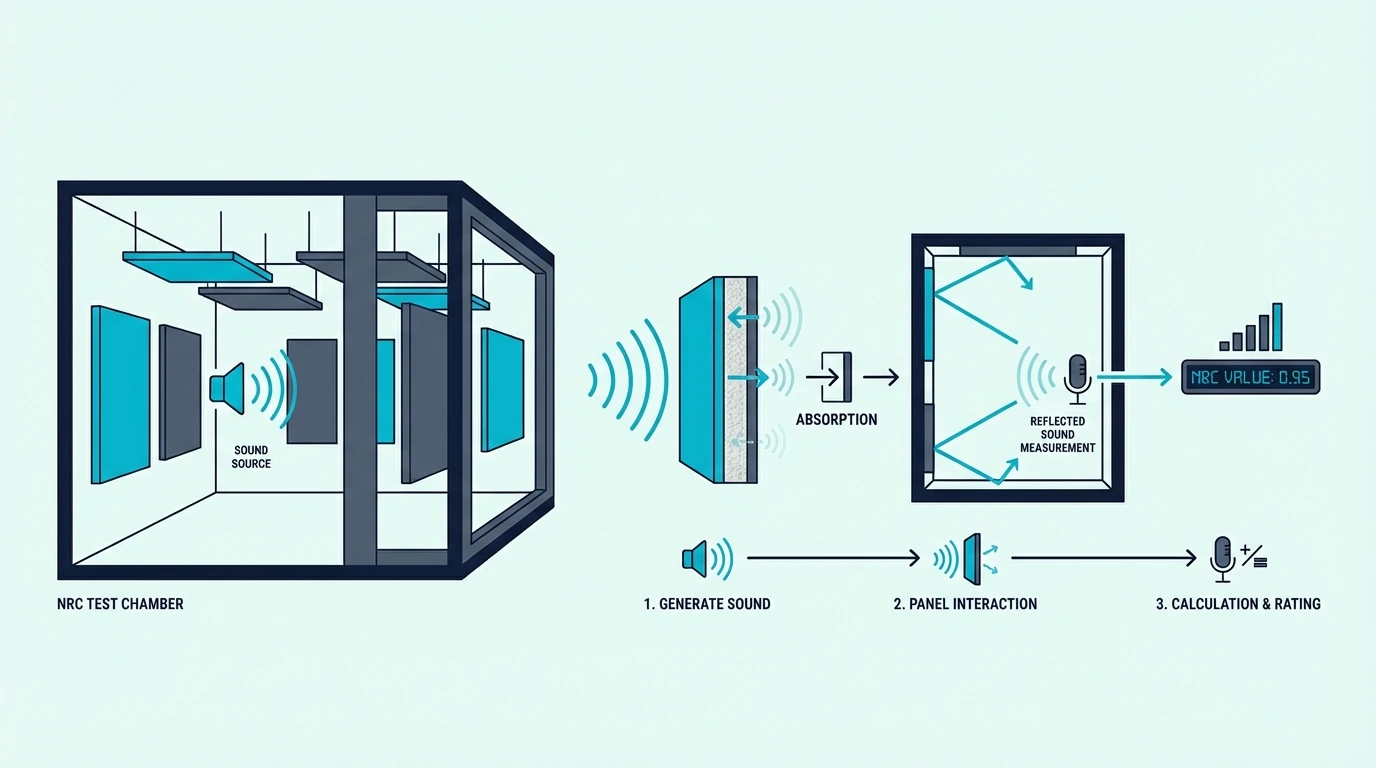
Does either one soundproof a room?

Neither one. Foam and panels absorb sound within a room — they reduce echo and reverb, not noise going through walls.

If your goal is blocking sound from neighbors or keeping sound inside, you need mass, sealing, and decoupling. The acoustic foam alternatives guide covers materials that actually work for isolation, and the is acoustic foam worth it breakdown helps you decide if foam fits your situation at all.

Acoustic Blankets vs Panels: Moving Blankets vs Acoustic Panels [2026]

Acoustic blankets vs panels sounds like a simple budget-vs-performance decision, but the real difference is portability vs permanence.

Pick the wrong one and you still end up with boxy, echo-y recordings because early reflections bounce off the walls around your mic.

Match the treatment to your space and you’ll get cleaner, more direct sound without making your room look like moving day. Start by deciding whether you need something you can take down after a session or something you can mount once and forget.

Quick Takeaway

Acoustic blankets (including moving blankets) are a portable, temporary way to cut high-frequency reflections, but they’re limited in the low end and aesthetics. Acoustic panels are the permanent, higher-performance choice for most dedicated rooms (studios, home theaters, offices).

Acoustic Blankets vs Panels: What’s the Difference?

Temporary acoustic blankets compared with permanent acoustic panels

The fundamental difference is purpose: blankets are temporary solutions, panels are permanent installations. How each camp handles portability and how it handles professional-grade performance explain every other trade-off in cost, appearance, and lifespan.

Quick reality check: neither blankets nor panels will soundproof a room; they mainly reduce echo and reverb inside it. If your goal is to keep sound from leaking to neighbors, the acoustic panels vs soundproofing guide explains the gap between absorption and isolation.

Blankets = Temporary/Portable

Acoustic blankets, including heavy-duty moving blankets, are designed to be hung, moved, and stored. They typically feature grommets for hanging on stands or hooks, and they fold flat when not in use.

A purpose-built option like US Cargo Control Sound Dampening Blanket hangs flatter than typical moving blankets, which helps when you’re trying to tame early reflections in a tight setup.

The portability makes them ideal for traveling musicians, temporary recording setups, or rental spaces where permanent installation isn’t allowed. Renter-friendly setups are covered in the acoustic panel spacing guide.

You can set up a functional vocal booth in minutes and pack it away just as quickly. The trade-off is appearance and performance.

Blankets look industrial — there is no getting around the quilted, utilitarian aesthetic. They also absorb less sound than purpose-built panels because they are thinner and less dense.

Panels = Permanent/Professional

Acoustic panels are designed for permanent wall mounting. They feature rigid frames, fabric wrapping, and professional finishes that integrate into room decor rather than fighting against it.

Once installed at first reflection points and problem areas, panels deliver reliable acoustic treatment every time you use the space. The consistent positioning is what separates panels from blankets that shift between sessions.

The rigid construction outperforms flexible blankets because fiberglass or mineral wool cores provide consistent density throughout, while fabric stretches tight over the frame.

What Are Acoustic Blankets?

Acoustic blanket setup for temporary sound absorption

Acoustic blankets range from purpose-built studio products to repurposed moving blankets — and the difference matters more than you might expect. Two things determine whether a blanket is worth buying: how the absorption mechanism works and how effective the end result actually is.

How They Work

Blankets absorb sound through dense, fibrous layers that convert air movement into heat. Sound waves enter the batting and lose energy as they rub against the fibers in the weave.

Moving blankets use quilted cotton or polyester batting — the same insulation principle as a winter jacket. Purpose-built sound blankets use heavier, denser fill and sometimes add a mass-loaded vinyl layer to reduce sound passing through.

The key limitation is thickness — most blankets measure well under an inch. That means they mainly tame high and mid frequencies (roughly 500 Hz and above), while bass and low-mids bounce around the room almost untouched.

Effectiveness

Acoustic blankets typically achieve NRC ratings between 0.4 and 0.6, which means they absorb 40–60% of the sound that hits them. That is decent for temporary treatment but noticeably less than what panels deliver.

A quick test shows the difference: hang a blanket on one wall and speak toward it, then speak toward a bare wall. You will hear less echo and a slightly “deader” sound in the blanket direction, but the effect is subtle compared to purpose-built treatment.

Moving blankets — the furniture-padding type — sit on the lower end of that 0.4–0.6 range because they are designed for physical protection, not acoustic performance. Purpose-built sound blankets use denser fill and tighter weave patterns, which pushes their NRC closer to 0.6, though they cost two to three times more than a basic moving blanket.

What Are Acoustic Panels?

Professional acoustic panel installed for room treatment

Purpose-built absorbers represent the professional standard for permanent acoustic treatment. Three construction details explain the performance gap over blankets: core material, thickness, and rigid framing.

How They Work

Acoustic panels use rigid fiberglass or mineral wool cores wrapped in acoustically transparent fabric. The core material provides consistent, high-density absorption, while the fabric contains the fibers and provides a finished appearance.

Most panels are 2 to 4 inches thick, which is why they absorb meaningfully lower than blankets.

As a rough rule, 2-inch panels start working down around 250Hz, while 4-inch panels can reach closer to 125Hz in many rooms. The 1-inch vs 2-inch panels and 2-inch vs 4-inch panels comparisons break down the trade-offs by frequency.

The rigid frame maintains consistent density and prevents sagging over time. Blankets can bunch up or develop thin spots; panels maintain uniform performance indefinitely.

Effectiveness

Quality acoustic panels achieve NRC ratings between 0.85 and 1.0. At the high end, they absorb virtually all sound that hits them—a stark improvement over blankets.

The Olanglab Fiberglass Acoustic Wall Panels 4 Pack demonstrates typical professional panel construction—fiberglass core with a finished panel form factor, achieving the kind of absorption people expect from permanent treatment.

The difference is immediately audible. Recording in a panel-treated room versus a blanket-treated room reveals noticeably cleaner sound, tighter frequency response, and more controlled reflections.

How Do Acoustic Blankets and Panels Compare on Performance?

NRC comparison chart for acoustic blankets and panels

Raw NRC numbers tell part of the story, but the real-world gap between blankets and panels shows up most at lower frequencies. Which absorbs better and how the NRC ratings compare are the two questions worth answering here.
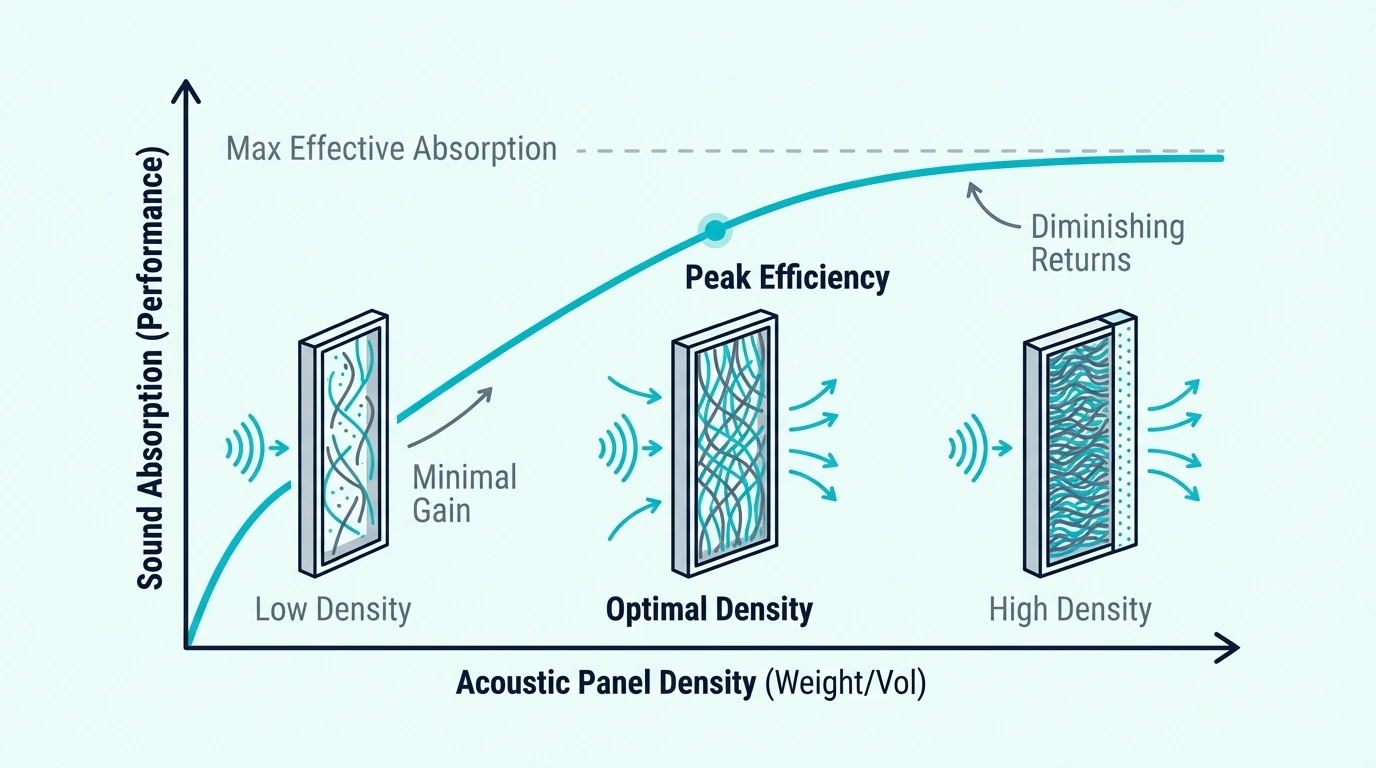
Which Absorbs Better?

Panels win decisively on raw absorption — the combination of greater thickness, higher density, and consistent construction creates superior performance at every frequency. Think of it this way: blankets are like wearing a sweater in winter (better than nothing, but not ideal), while panels are like proper wall insulation (engineered specifically for the job).

The gap is largest at lower frequencies, where blankets provide almost no absorption below ~500 Hz while 2-inch panels remain effective down to around 250 Hz. For speech-only recording (podcasts, voiceover), that low-end gap matters less because the human voice sits mostly above 300 Hz — but for music production, acoustic guitar, or drum bleed, untreated low-mids muddy the entire mix.

NRC Rating Comparison

Product Type Typical NRC Effective Range
Moving Blankets 0.35-0.50 500Hz+
Acoustic Blankets 0.50-0.65 400Hz+
2” Acoustic Panels 0.85-0.95 250Hz+
4” Acoustic Panels 0.95-1.0 125Hz+

The biggest jump in the table is between acoustic blankets (NRC 0.50–0.65) and 2-inch panels (NRC 0.85–0.95). That gap means panels absorb roughly 30–40% more of the sound energy hitting them, which translates to a noticeably shorter reverb tail and tighter stereo imaging in a treated room.

The effective-range column matters just as much as the NRC number. A moving blanket rated at NRC 0.50 sounds useful on paper, but nearly all of that absorption happens above 500 Hz — leaving the low-mids and bass completely untreated.

A 2-inch panel rated at NRC 0.85 absorbs energy a full octave lower, reaching down to around 250 Hz where room modes and boxy coloration live.

For the full breakdown of how NRC ratings work (including why some panels exceed 1.0), that guide covers the measurement method and what the numbers mean in practice.

When Should You Use Acoustic Blankets Instead of Panels?

Portable blanket booth for recording vocals

Despite the performance gap, blankets have legitimate use cases where portability and cost outweigh panel performance. Three scenarios favor blankets over panels.
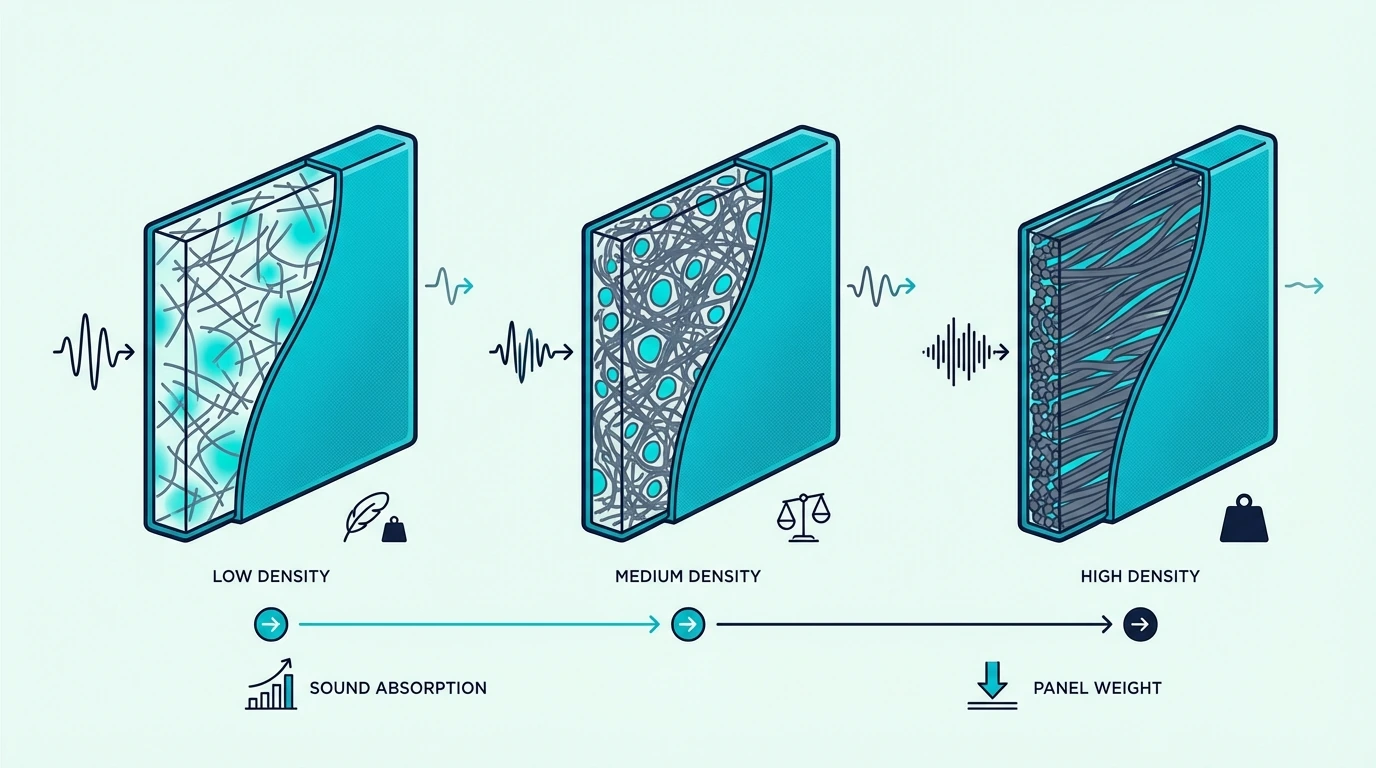
Temporary Setup

If you are recording in different locations — hotel rooms on tour, temporary office spaces, or rooms you don’t own — blankets provide treatment without permanent installation. Hang them before a session, record, then fold them into a duffel bag and move on.
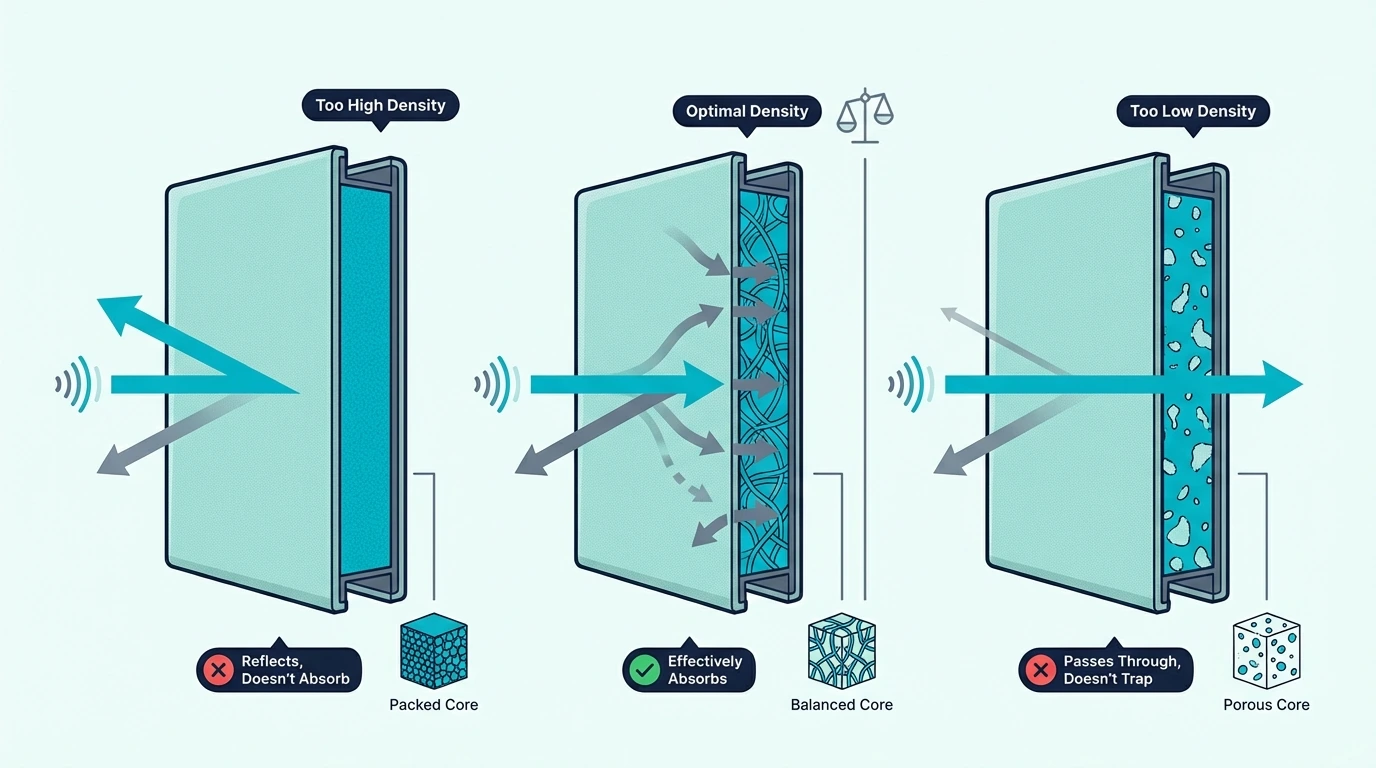
That flexibility is impossible with panels, which stay mounted wherever you install them. A touring musician or freelance voice actor who works in a new room every week gets zero benefit from permanent treatment — blankets are the only practical option.

Portable Recording

Vocal booths made from blankets hung on C-stands or PVC frames create functional recording environments that pack away between sessions. Many podcasters and voice actors use this approach in shared spaces.

The setup takes 10-15 minutes; teardown is faster. For occasional recording in non-dedicated spaces, this workflow makes sense despite the performance compromise.

Budget Treatment

Moving blankets run roughly one-fifth the cost per square foot of fabric-wrapped fiberglass panels. That price gap means you can cover three or four walls with blankets for the same money it takes to mount four panels at first reflection points.

The trade-off is performance per dollar spent over time. Blankets wear out in three to five years with regular hanging and folding, while panels maintain rated performance for a decade or longer — so the upfront savings can evaporate if you replace blankets repeatedly.

When Are Acoustic Panels the Better Choice?

Acoustic panels placed at first reflection points

If the room is yours (or it’s a long-term setup), panels are usually the smarter move. Two use cases tip the scale toward permanent treatment.

Permanent Treatment

If the room will be used for recording, mixing, or critical listening long-term, panels are worth the investment. The superior performance compounds over every session.

Professional studios use panels rather than blankets. The consistency, appearance, and performance justify the higher upfront cost through years of daily use—the recording studio panels guide covers specific product picks for that setup.

The Rockboard 60 Mineral Wool Rigid Acoustic Insulation Board 2 Inch, 4 Pack shows what a premium panel core looks like when long-term acoustic performance matters more than portability.

Professional Results

If audio quality is the priority — whether for commercial recording, content creation, or serious home theater — panels deliver results blankets cannot match. The frequency extension alone justifies the upgrade: blankets leave low-mids and bass almost untouched, while 2-inch panels absorb meaningfully down to 250 Hz.

In a mixing environment, that extra octave of absorption translates to tighter low-end in monitors, more accurate panning, and fewer EQ corrections in post. Home theater rooms benefit the same way — dialogue clarity improves when the 200–400 Hz range is controlled instead of ringing between hard walls.

The acoustic panel installation guide walks through mounting methods step by step, including adhesive, impaling clips, and French-cleat options for renters who want semi-permanent treatment.

How Do Blankets and Panels Compare Side by Side?

Decision matrix comparing acoustic blankets and panels

The table below puts the eight factors that matter most into a single view so you can weigh them against your own room, budget, and timeline.

Factor Acoustic Blankets Acoustic Panels
Setup Type Temporary/Portable Permanent
Typical NRC 0.40-0.60 0.85-1.0
Frequency Range 500Hz+ 125-250Hz+
Appearance Industrial/Utilitarian Professional/Decorative
Portability Excellent None
Cost per sqft Lower Higher
Lifespan 3-5 years 10+ years
Best For Portable, temporary, budget Permanent, professional, quality

The rows where blankets win — portability and upfront cost — matter most when the space is temporary or shared. If you are renting a room month-to-month or recording at different locations every week, those two factors outweigh everything else in the table.

The rows where panels dominate — NRC, frequency range, appearance, and lifespan — stack up fast once the room is permanent. A 10-year lifespan at NRC 0.95 means you install once and forget about acoustic treatment for a decade, while blankets need replacing two or three times over the same period.

Appearance is the sleeper factor most people underestimate. Blankets draped on C-stands look fine off-camera, but they can kill the visual credibility of a YouTube studio or client-facing podcast room where the backdrop matters as much as the audio.

The Bottom Line on Acoustic Blankets vs Panels

Neither option is universally “better”—acoustic blankets vs panels is a portability-vs-performance trade-off that depends on your room situation.

Choose blankets if you need portable treatment, you’re in a rental without mounting permission, you have severe budget constraints, or you only record occasionally in a non-dedicated space.

Choose panels if you’re treating a permanent space, appearance matters, you need professional-grade absorption, or you’re investing in a room you’ll use regularly for years.

For most home studios and content creators with dedicated spaces, panels are the better long-term investment. The performance gap is real, and the professional appearance integrates into your room rather than looking like a construction site.

The acoustic panels placement guide shows how to prioritize first reflection points for the biggest return. The best acoustic panels guide covers specific product recommendations across different budgets.

Frequently Asked Questions

Do Acoustic Blankets Actually Soundproof?

No—acoustic blankets and panels mainly reduce echo and reverb inside the room, not the sound that leaks out.

Real isolation requires mass, decoupling, and sealing — absorption alone won’t block sound from traveling through walls, floors, or ceilings.

Can Moving Blankets Work for Recording?

Yes, but with clear limitations. Moving blankets provide real absorption—better than bare walls—but they’re designed for furniture protection, not acoustic performance.

The quilted construction absorbs high frequencies reasonably well. Voice recording over moving blankets produces cleaner results than recording against hard walls, though bass and low-mid frequencies pass through almost untouched.

They also look distinctly unprofessional on camera, which can matter as much as the acoustics for video podcasts and streaming.

Which Lasts Longer?

Panels win decisively on longevity. Quality acoustic panels maintain performance for 10-15 years or longer because the rigid frame prevents sagging and the core doesn’t compress.

Blankets wear out faster through repeated hanging, folding, and transport. Expect 3-5 years of regular use before replacement becomes necessary.

The lifespan difference affects total cost of ownership—panels cost more upfront but may be cheaper over a decade when blanket replacements are factored in. The panel hanging guide covers mounting methods that preserve panel longevity.