Best USB MIDI Host: Play 5-Pin Synths From a USB Keyboard
You need a USB MIDI host when a keyboard with only a USB port has to play a hardware synth, and the right box comes down to power and ports more than brand.
The MIDI Association explains why: USB is a host-controlled bus, so a USB controller stays silent until a computer, smartphone or tablet starts every exchange.
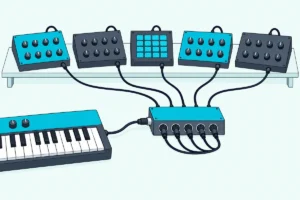
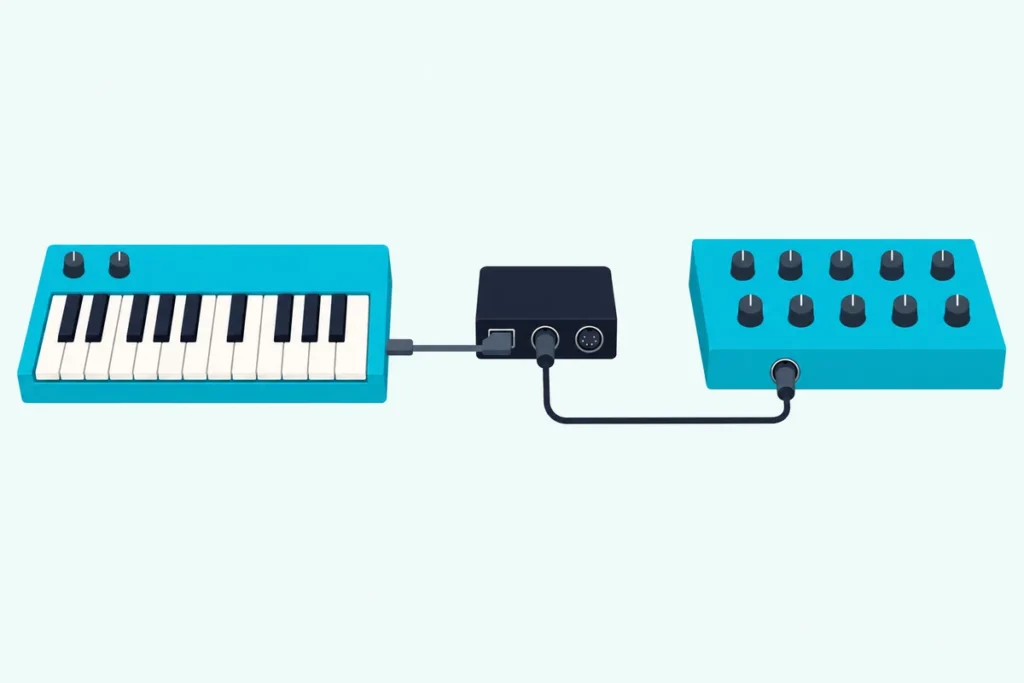
A host box takes the computer’s place, powering the controller and passing its notes out of a 5-pin MIDI OUT to the synth’s MIDI IN.
This guide compares host boxes by what their makers document: the power each USB port supplies, how many USB devices it takes and which 5-pin ports it has.
The picks come first, followed by what a host does, when you need one and why a controller can stay invisible to the box.
What Is the Best USB MIDI Host?
That depends on how much power your controller draws and how many USB devices you’ll connect, but one box covers the most setups. The best USB MIDI host for most rigs is the CME H2MIDI Pro, which CME’s manual describes as a USB host for plug-and-play USB MIDI devices with a 5-pin MIDI IN and OUT, up to 8 USB MIDI ports through a hub and settings it keeps for use without a computer (CME).
The other picks solve narrower problems:
| Pick | USB host port | 5-pin MIDI | Power to the controller, per the maker | Best for |
|---|---|---|---|---|
| CME H2MIDI Pro | 1 USB-A; up to 8 ports through a hub | 1 IN, 1 OUT | Up to 500 mA | Most setups |
| DigitalLife BridgeCore | 1 USB-A | 1 IN, 1 OUT | No figure from DigitalLife | One controller and one synth |
| CME WIDI Uhost | 1, through a USB OTG cable | None: it sends Bluetooth MIDI | Shared from one USB supply | Going wireless |
Every pick met Burton Acoustix’s rating, review and stock checks on 27 October 2026, and no prices appear because they change often. Nothing here was played or measured: the descriptions come from the makers’ manuals, product pages and listings.
| Product | Size | Link |
|---|---|---|
Best Overall 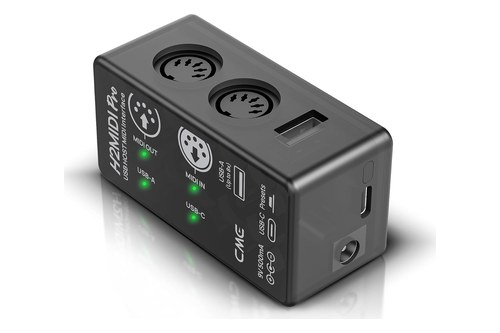 | 1 inch | See ratings |
Best Plug-and-Play 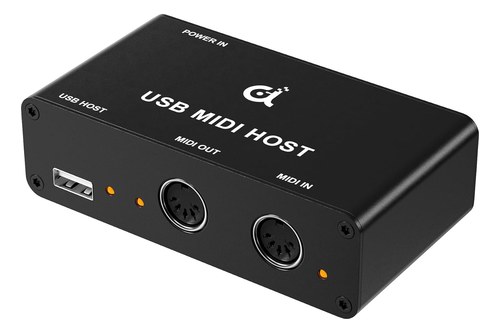 | 1 inch | See ratings |
Best Wireless 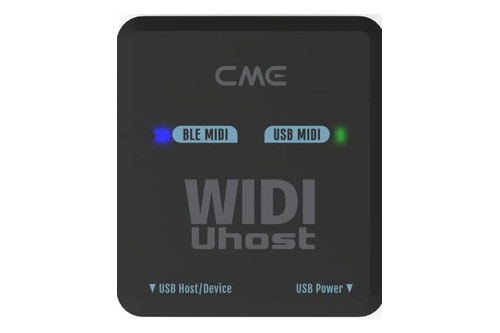 | — | See ratings |
Which USB MIDI Host Should You Buy?
Those picks split by what sits on the far side of the box. Buy the H2MIDI Pro for routing and a hub, the BridgeCore for one plain 5-pin link, and the WIDI Uhost for Bluetooth MIDI.
CME H2MIDI Pro
For most setups, the CME H2MIDI Pro is the pick.
the CME H2MIDI Pro
CME’s manual says it identifies a plug-and-play USB MIDI device when that device powers on and routes it to the 5-pin ports and its USB-C port automatically. Its free HxMIDI Tools app adds splitting, merging, mapping and filtering, and the box saves those settings in its own memory.
It’s also dual-role: plug its USB-C port into a Mac, a Windows PC, an iPad or an Android device and it becomes a USB MIDI interface with two virtual ports each way. That single MIDI OUT can still feed a rack of synths, and our MIDI thru box picks copy it to each one.
DigitalLife BridgeCore
For one controller and one synth, the DigitalLife BridgeCore keeps it simple.
the DigitalLife BridgeCore
DigitalLife’s manual lays out the whole setup: the controller goes into the USB-A port, the box’s MIDI IN and OUT go to the synth’s MIDI OUT and IN, and the included USB-A to USB-B cable, which carries power only, powers it.
DigitalLife’s product page lists the box as the UHOST-I-B and says it works with most class-compliant USB MIDI devices, but not with ones built around an internal USB hub (DigitalLife). Its test uses the free Windows program USB Tree Viewer: a controller that shows up as a new hub plus one or more devices won’t work.
CME WIDI Uhost
When the other end is Bluetooth MIDI, the CME WIDI Uhost cuts the cable.
the CME WIDI Uhost
CME calls it a Bluetooth MIDI interface plus USB host: a class-compliant controller plugs in through a USB OTG cable, and one Uhost pairs it with any Bluetooth MIDI device, an iPad or Mac included (CME). For two pieces of MIDI hardware, CME pairs two WIDI devices, so a 5-pin synth needs a WIDI unit on its own MIDI sockets.
CME quotes as low as 3 milliseconds between two WIDI devices and a range of 20 meters (65 feet) without obstacles. For the synth’s end of that link, Burton Acoustix’s Bluetooth MIDI guide covers CME’s WIDI Master and other adapters.
What Does a USB MIDI Host Actually Do?
Every pick does a job that a computer normally does unnoticed. A USB MIDI host starts and runs the USB connection that a controller can’t run itself, because the MIDI Association explains that the host initiates and controls all data transfers on USB, while devices only respond to its commands (MIDI Association).
Kenton puts the rule in one line: USB needs one, and only one, host, usually your PC, Mac or iPad, while keyboards and USB synths are devices. Its MIDI USB Host takes that role, so a controller and a synth can talk with no computer in the room (Kenton).
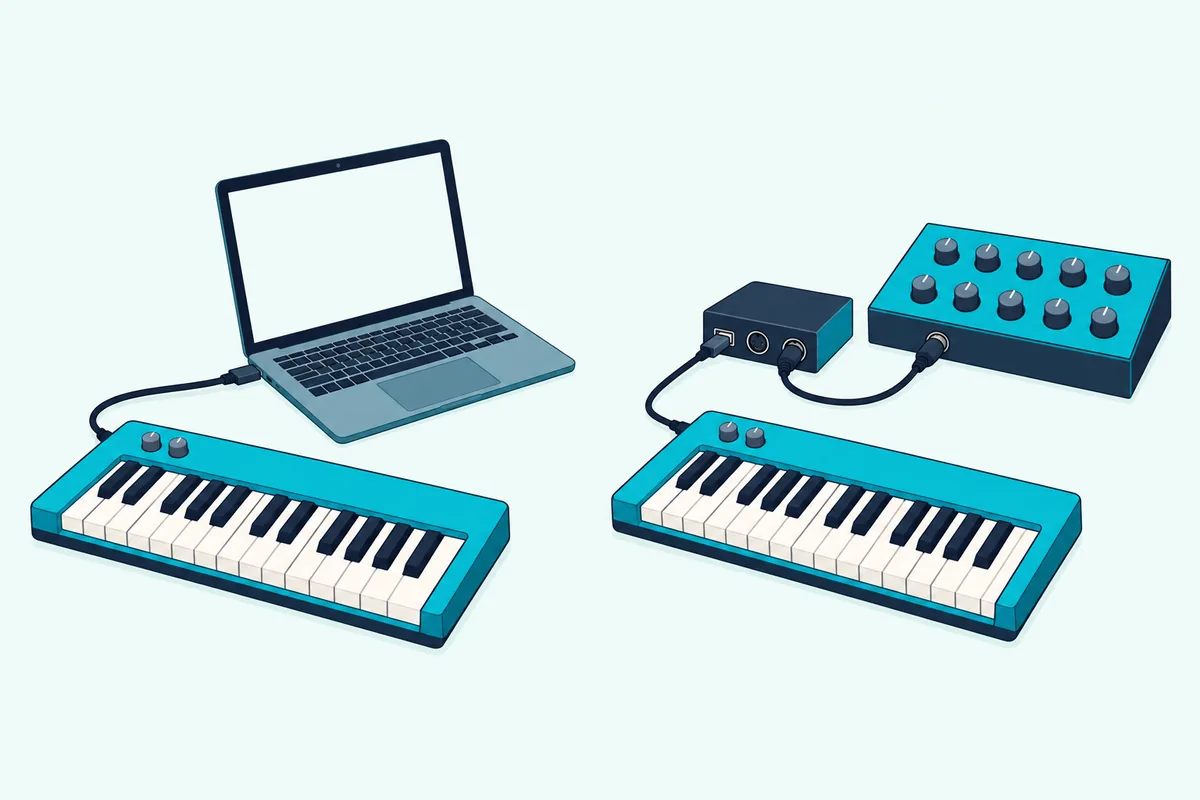
Each host here is built for class-compliant devices, the kind the MIDI Association says an operating system recognizes with a built-in driver. CME says the H2MIDI Pro can’t recognize USB MIDI devices that need drivers installed on a computer, and Kenton’s manual says its host works only with class-compliant ones.
When Do You Need a USB MIDI Host?
That driver rule matters only when no computer sits in the chain. You need a USB MIDI host when a controller with only a USB port has to play a hardware synth, drum machine or other 5-pin MIDI gear directly, or when two USB-only devices have to talk without a computer.
A controller with its own MIDI OUT skips the box. Arturia’s KeyStep 37 mk2 manual says standard MIDI cables carry its notes to external MIDI devices, and a phone charger supplying at least 5 volts and 100 mA powers it with no computer present.
If a computer stays in the rig, 5-pin gear needs the opposite box. Kenton says its host can’t plug into a PC, Mac or iPad, since those are hosts too, so 5-pin gear reaches a computer through a USB MIDI interface or an audio interface with 5-pin MIDI.
Other ways to use a MIDI keyboard without a computer, from sound modules to tablets, have their own guide.
Will the Host Power Your Controller?
Taking the computer’s place also means taking over its power job. A host powers your controller over USB only up to its maker’s limit: 500 mA from the H2MIDI Pro’s USB-A port and 910 mA from Kenton’s MIDI USB Host mk3, according to their manuals.
CME says a self-powered USB hub should power the devices once their total draw passes 500 mA, and Kenton recommends a powered hub when several devices share its port. Burton Acoustix’s powered USB hubs for MIDI controllers guide covers that power math.
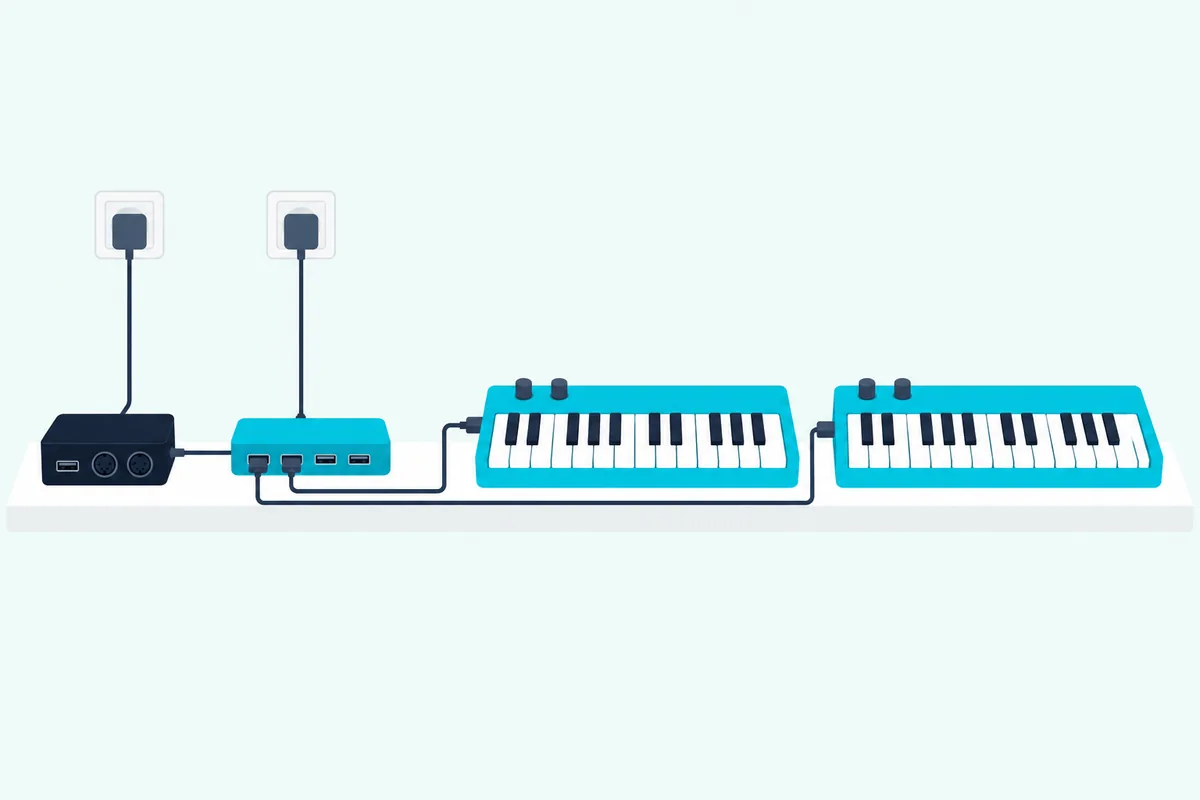
Each box needs its own supply too: the H2MIDI Pro runs from a USB charger, a power bank or an optional 9-volt adapter, and Kenton includes a 5-volt mains adapter. The WIDI Uhost splits one USB source between itself and a bus-powered controller.
How Many USB Devices Can One Host Handle?
A powered hub also answers the next question. One host port can serve several USB devices through a hub: up to 8 USB MIDI ports on the H2MIDI Pro and up to four USB devices on Kenton’s mk3.
CME counts ports, not boxes, so a device with several virtual MIDI ports uses several of the 8, and the manual says the box won’t recognize ports past that. Each port is a group of 16 MIDI channels, the MIDI Association explains.
Kenton adds a trick for all-USB rigs: put a controller and USB synths on a hub, then link the host’s MIDI IN to its MIDI OUT with a short MIDI cable, and they can see each other. It warns that some USB synths, such as Roland’s S-1, echo their incoming USB MIDI back out and create a loop.
Do You Need 5-Pin MIDI In as Well as Out?
That covers the USB side of the box, and the 5-pin side matters just as much. You need the host’s MIDI IN only when something 5-pin has to reach your USB gear, such as a drum machine’s clock or a 5-pin keyboard playing a USB synth.
Kenton says its host converts in both directions at once: MIDI from the USB device leaves through the MIDI OUT, and MIDI arriving at the MIDI IN goes to the USB device. CME describes the H2MIDI Pro the same way, as bidirectional between its USB devices and 5-pin devices.
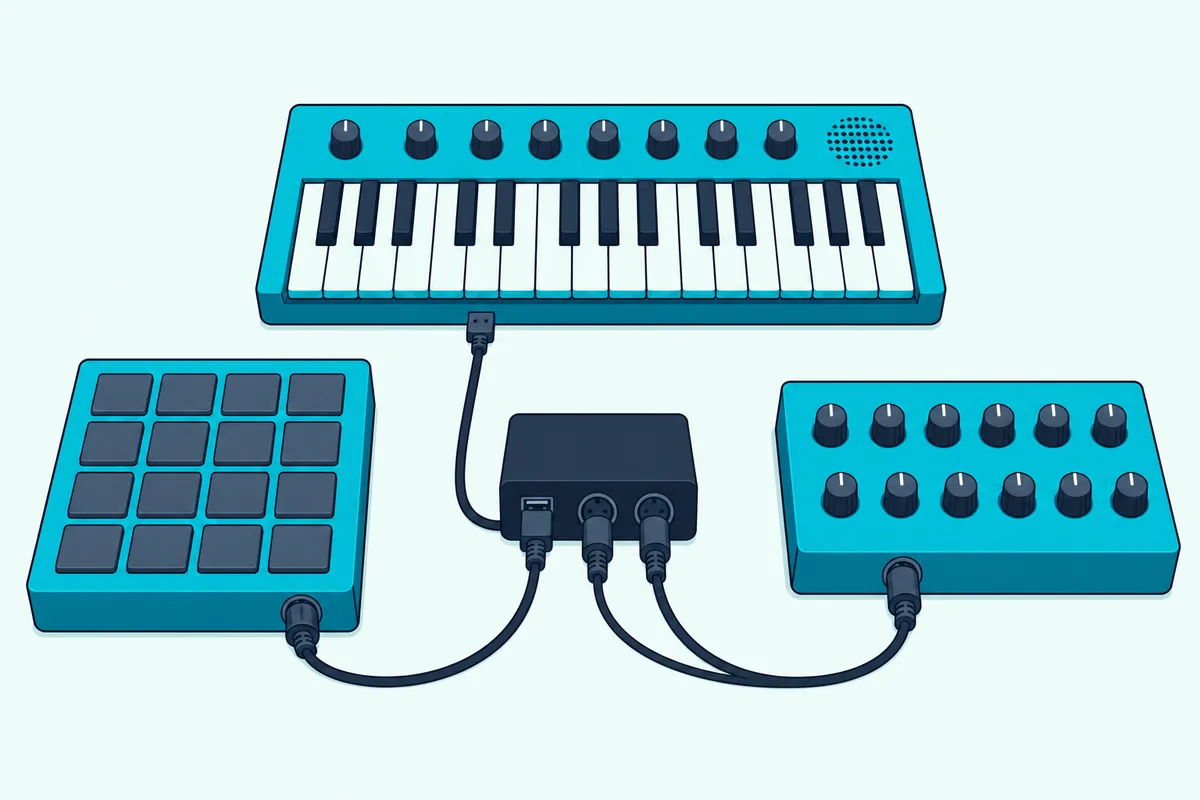
Kenton’s mk3 also merges. In Merge 1 the MIDI IN joins the USB device’s data on its way to the MIDI OUT, and Merge 2 also sends the MIDI IN to the USB device, which Kenton warns can double notes if that device echoes its USB input.
For more than one 5-pin synth, Kenton suggests adding a thru or merge box, and the guide to controlling multiple devices from one MIDI keyboard walks through the channels and wiring.
Why Won’t the Host See Your Controller?
Even with every cable right, a host can ignore a controller. A host won’t see a controller that isn’t class compliant, draws more power than its port supplies or adds too many ports, and DigitalLife’s box also rejects controllers with an internal USB hub.
| What you see | Likely cause | What to try |
|---|---|---|
| Kenton’s light keeps flashing with the controller plugged in | The device isn’t class compliant | Switch it to a class-compliant or “generic driver” mode if it has one, or power off and start again |
| A DigitalLife box ignores the controller | The controller contains a USB hub | Check it in USB Tree Viewer on a Windows PC |
| Some ports missing on the H2MIDI Pro | More than 8 ports connected | Unplug a device to stay within 8 |
Kenton’s list of known issues says many BOSS products and Roland’s Boutique range aren’t class compliant, and Novation’s Launchpad Mini mk3 and Launchkey Mini mk3 send MIDI through its host but can’t receive any. It also suggests attaching the USB device before powering the host.
Is a USB MIDI Host the Same as a USB MIDI Interface?
That driver talk points back to the computer, and the computer is what separates a host from an interface. No: a USB MIDI interface connects 5-pin gear to a computer that stays the host, while a USB MIDI host replaces the computer.
The H2MIDI Pro is the box that does both, with its USB-C port acting as the interface side. Whatever you use, don’t link two hosts with a USB-A to USB-A cable: the MIDI Association warns that the Type A connector supplies power and that the connection can seriously damage your gear.
Which USB MIDI Hosts Didn’t Make the List?
Kenton’s box has come up throughout, yet it’s missing from the cards. The cards stick to boxes with an Amazon offer, and Kenton sells its MIDI USB Host mk3 from its own site and through dealers.
Miditech’s USB MIDI Host had fewer Amazon reviews than the picks, and Behringer’s GO MIDI HOST had too few to judge. CME also sells the H4MIDI WC and H12MIDI Pro as USB host interfaces, so check their manuals for ports and power if you need more.
The Bottom Line
So buy the CME H2MIDI Pro for most setups, the DigitalLife BridgeCore for one controller and one synth, and the WIDI Uhost when the other end is Bluetooth MIDI. Whichever you choose, check that your controller is class compliant and within the host’s power limit before you plug it in.
Frequently Asked Questions
Can you plug a USB MIDI controller straight into a synth?
Only if the synth’s USB port can act as a host. The MIDI Association says a synth’s Type B port marked To Host connects to a computer, and a Type A port marked To Device usually takes flash drives, though it can do more depending on the instrument. Check the synth’s manual; if it lists no USB MIDI support for that port, a USB MIDI host or a controller with a 5-pin MIDI OUT does the job.
Can a USB hub replace a USB MIDI host?
No. The MIDI Association describes a hub as a way to expand one port into several for a host system, so it still needs a computer, smartphone, tablet or host box at the top. A host box can use one, though: CME’s H2MIDI Pro reaches up to 8 USB MIDI ports through a hub, and Kenton’s mk3 up to four USB devices.
Does a USB MIDI host add latency?
CME rates the H2MIDI Pro’s wired path as “close to zero latency and zero jitter” and says it achieves its accuracy at the sub-millisecond level. Kenton’s and DigitalLife’s documents give no latency figure. Over Bluetooth through the WIDI Uhost, CME quotes as low as 3 milliseconds between two WIDI devices.
Can a USB MIDI host run from a power bank?
Yes, with the right one. Kenton says its MIDI USB Host works from a power bank that can supply enough current for the host and your device, and CME recommends one with a low-current charging mode and no automatic power-saving for the H2MIDI Pro.