Are Barn Doors Soundproof? Why the Gaps Win and What to Fix
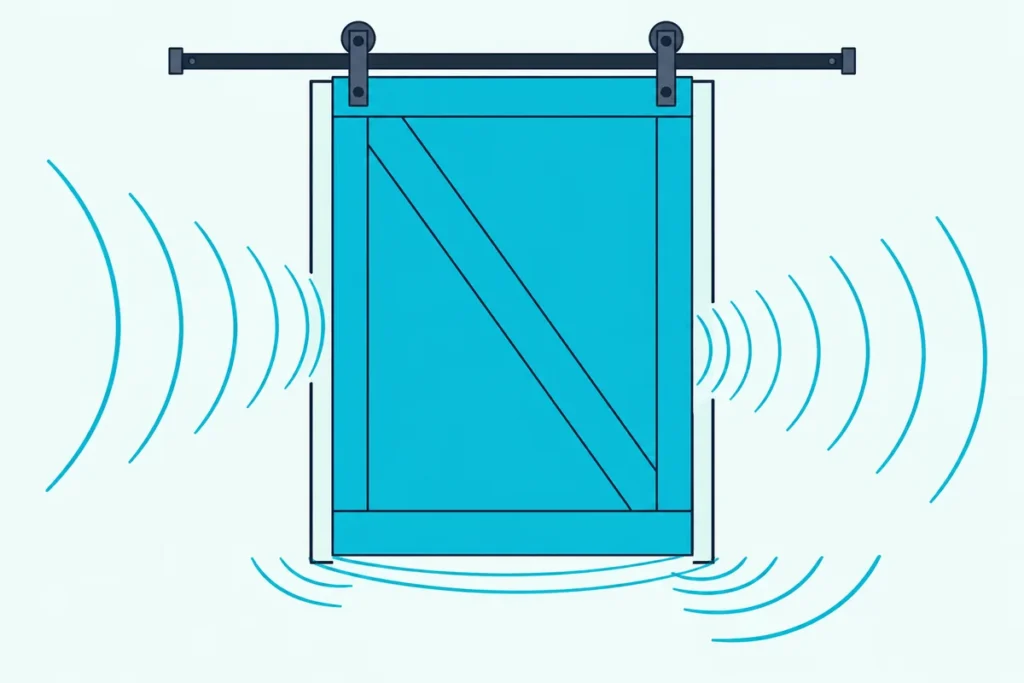
Are barn doors soundproof? No, because a barn door hangs on a track in front of the opening, and sound leaks around every edge before it ever reaches the slab.
Picture a bedroom barn door closed for the night, with every word from the kitchen still carrying through the gap at the floor.
Masonite’s hardware instructions, JELD-WEN’s door ratings and HUD’s noise guidebook show how big those gaps are and what a better slab and seals can add.
You’ll see how a barn door’s gaps compare with HUD’s one-inch hole, which slab to choose, the five fixes that close the edges, and when a hinged door is the better answer.
Start with the slab and the gaps, because they decide everything else.
Are Barn Doors Soundproof?
That depends on the gaps more than the slab, and neither looks promising. A barn door slab can be decent, but a track-hung door isn’t sealed on any side, and JELD-WEN’s ratings are for new doors in a test frame.
JELD-WEN says hollow core molded doors test at STC 25, and that a 25 means normal speech can be easily and distinctly understood through the closed door. It says a 36 means loud speech may be audible but unintelligible.
HUD defines STC as the number of decibels a sound is reduced as it passes through a material, so a higher number blocks more. Its older guidebook gives the common hollow core wood door an STC of 17, and says doors are acoustically even weaker than windows.
So a plain barn door starts at the bottom of the scale before a single gap is counted. Our guide to door seals and sweeps for hinged doors covers the swinging case, and the sections below cover what a better slab adds and what the gaps take away.
Which Barn Door Slab Blocks the Most Sound?
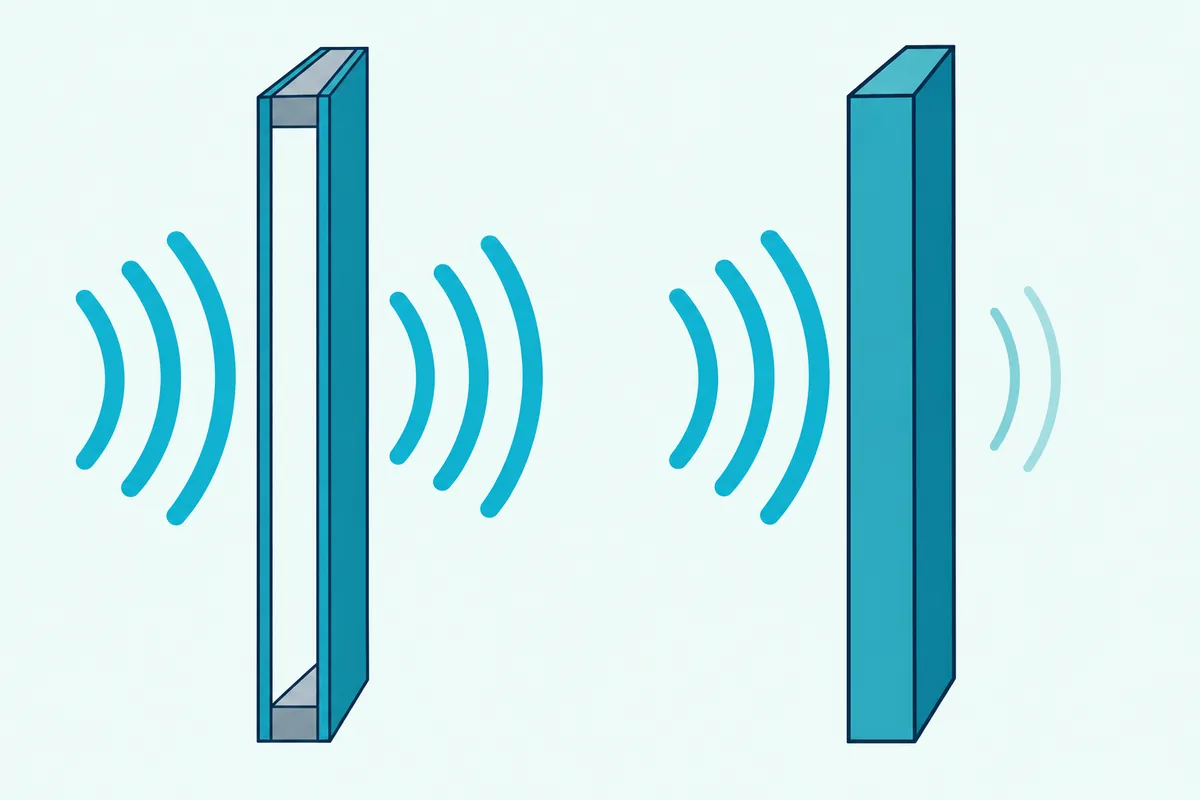
That’s the first choice, and JELD-WEN publishes ratings for its interior doors. This table gathers them, with HUD’s older figure for comparison:
| Door slab | STC | Source |
|---|---|---|
| Common hollow core wood door | 17 | HUD, from older government tests |
| Hollow core molded doors, across JELD-WEN’s listed series | 24 to 27 | JELD-WEN |
| Solid core molded doors, across JELD-WEN’s listed series | 29 to 32 | JELD-WEN |
| Flush solid core, 60-minute fire rated | 34 | JELD-WEN |
| TRIA C Series, 45-minute fire rated, with Seal Set D | 36 | JELD-WEN |
| TRIA L Series, 90-minute fire rated, with Seal Set E | 37 | JELD-WEN |
Solid core adds about five to seven points over hollow core in most of JELD-WEN’s series. JELD-WEN says a difference of 10 in the STC system means sound is reduced by 50 percent.
Why the extra mass helps, and why it still can’t stop sound slipping around the edges, is the subject of our solid core door explainer.
JELD-WEN’s guide carries a warning that applies here. Its numbers are for new products, are intended for reference only, and the actual rating could vary with the components, accessories and options chosen.
The two TRIA rows include seal sets, which a barn door doesn’t have. JELD-WEN also says a typical 2×4 interior wall carries STC 36, so it usually doesn’t make sense for an interior door to go beyond that.
Those fire-rated rows don’t make a fire label a sound rating, as what a fire rating says about a door’s STC explains with the rest of JELD-WEN’s fire door figures.
Get Studio Tips Weekly
Join 5,000+ creators getting acoustic treatment advice every week.
No spam. Unsubscribe anytime.Do Glass or Panel Barn Doors Block Less?
Not much less, though they don’t beat a solid slab either. JELD-WEN’s MODA line rates its panel doors at STC 29, its doors with glass at 30 and its doors with a mirror at 34.
Its stile-and-rail line rates a hemlock six-panel door at 27, a fir six-panel at 30 and a hemlock full-lite door at 31. A barn door with a glass panel therefore sits close to a solid core slab on paper.
The glass itself matters more as it grows. Our page on how full-height glass doors rate shows how a full-height pane compares with its frame.
How Big Are the Gaps Around a Barn Door?
That is where the slab’s rating gets lost. Masonite’s installation guide for its barn door hardware says to position the track so there’s a gap of 3/8 to 1/2 inch under the door.
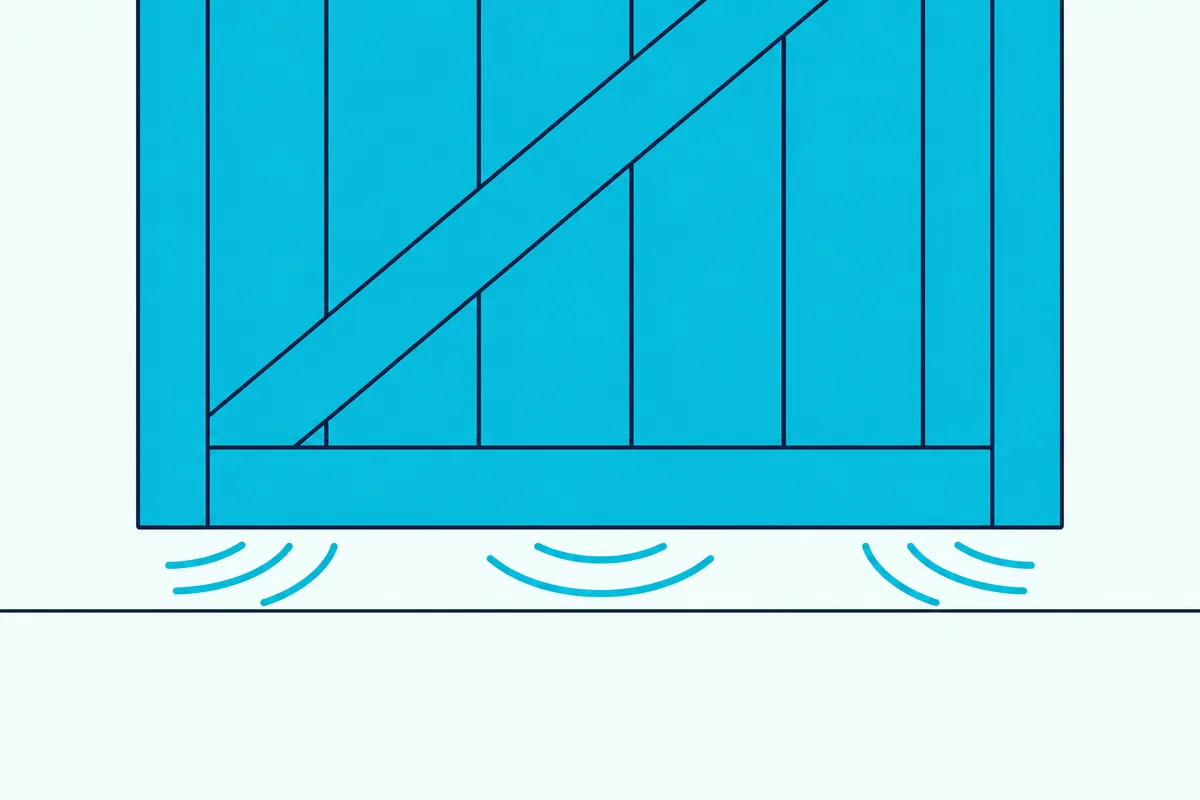
The kit hangs the door from rollers on a track that sits on wall spacers, so the door hangs in front of the wall instead of sitting in a frame. Its parts list names five wall spacers, and the guide gives no figure for the gap along the sides or top.
Take a 36-inch-wide door as an example. A 3/8 to 1/2 inch gap under it is 13.5 to 18 square inches of open area, which is roughly 13 to 18 times a one-inch square hole.
The table works the same sum for other common widths, using Masonite’s gap range:
| Door width | Open area at a 3/8-inch gap | Open area at a 1/2-inch gap |
|---|---|---|
| 30 inches | 11.25 square inches | 15 square inches |
| 32 inches | 12 square inches | 16 square inches |
| 36 inches | 13.5 square inches | 18 square inches |
| 42 inches | 15.75 square inches | 21 square inches |
The figures are my own arithmetic, door width times gap height. A double barn door has two doors’ worth of gap at the floor and a seam down the middle as well.
HUD says a one-inch square hole, or a 1/16-inch crack 16 inches long, will reduce a 50 STC wall to 40. HUD gives no number for an opening that large, but it calls small holes and cracks devastating to a wall’s insulation value.
The floor guide matters too. Masonite’s guide has a 1/4-inch groove in the bottom of the door for a floor-mounted guide, and says it will prevent the door from swinging in and out, which keeps the gap from growing.
Can You Shrink the Gap Under the Door?
That helps a little, if you hang the door at the low end of Masonite’s range. At 3/8 inch the open area under a 36-inch door is 13.5 square inches, against 18 at 1/2 inch, a cut of a quarter.
Check that the door still clears the floor everywhere along its travel, because a floor that isn’t level can catch the slab. A sweep then closes what’s left, and HUD’s example of a solid core door with carpeting on the floor shows how much the floor side can matter.
How Much Does a Door Pull Down a Wall?
That’s the real cost of a leaky door, because it sets the rating for the whole opening. HUD says any door reduces the insulation value of the surrounding wall.
Its example is a hollow core door with an STC of 17 taking about 20% of a wall, which reduces a 48 STC wall to 24 STC. A solid core wood door with a vinyl seal around the edges and carpeting on the floor leaves the same wall at 33.
A barn door in an interior wall is in the same position. A wall rated STC 36, which JELD-WEN calls typical for a 2×4 interior wall, is only as quiet as the opening in it.
Can You Add Mass to a Barn Door?
You can, but the track limits how much. Masonite’s guide says not to fasten the track to drywall alone, because that may not support the weight of the track and the mounted door, and it requires solid wood blocking behind the track.
A heavier slab or an added layer loads that blocking and the rollers more. Check the hardware’s weight rating before you add anything, since the instructions I read for Masonite’s kit don’t list one.
Mass is still the principle that works, because HUD says the denser the wall material the more noise it reduces. JELD-WEN says its ProCore doors use a dense medium density fiberboard core as a sound transmission buffer, and rates its top door at STC 36 against 25 for hollow core.
How to Soundproof a Barn Door in Five Fixes
Those numbers point to an order of work that runs from the cheapest fix to the most expensive:
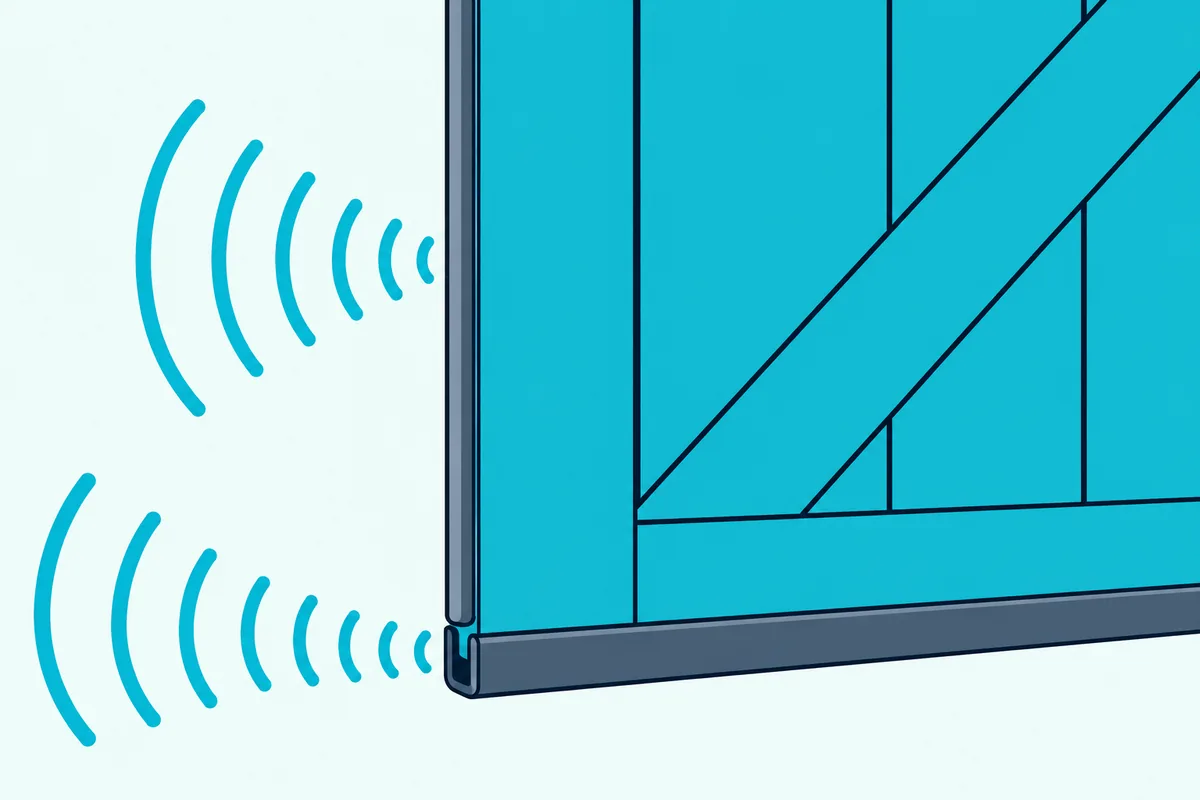
- Choose a solid core slab. JELD-WEN’s solid core doors rate STC 29 to 32 against 24 to 27 for hollow core.
- Close the bottom gap. Masonite’s 3/8 to 1/2 inch gap is the biggest opening, and a sweep fills it.
- Seal the sides and top. Add foam or rubber strips where the door meets the wall or frame, so it presses against them when closed.
- Keep the door from swinging. A floor guide, as in Masonite’s kit, holds the door a steady distance from the wall.
- Swap to a hinged door if you need privacy. Hinged doors press against seals, and JELD-WEN rates its sealed TRIA doors STC 36 to 37.
Start with the free fixes, then the bottom gap. It’s the largest opening, and a sweep costs less than a slab.
What Fills the Bottom Gap?
A sweep does, and the choice is mostly about reach. M-D’s Cinch slide-on under door seal is made for this range, because M-D says it adjusts to seal a 3/8 to 3/4 inch gap, which covers Masonite’s 3/8 to 1/2 inch, and slides on with no drilling.
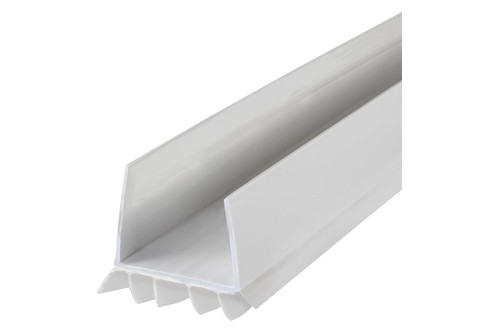
M-D’s Cinch slide-on under door seal
M-D lists it for a standard 1-3/4 inch thick door, and Masonite’s kit takes slabs 1-3/8 and 1-3/4 inch thick, so check yours before you buy. M-D says to cut the seal to length with a hacksaw.
Fit it with the door closed and test the slide, since a sweep that drags on the floor will fight the rollers. Our guide to sealing the bottom of a door compares sweeps in more detail.
What Seals the Sides and Top?
Those gaps need a seal that compresses, and a foam strip is the cheapest. Kikerike’s self-adhesive foam weatherstrip is a self-adhesive strip sold for door and window sound isolation, and its listing gives the size as 1/2 inch by 1/4 inch, with 42 feet in total.
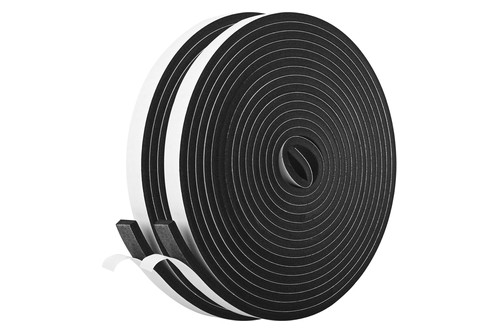
Kikerike’s self-adhesive foam weatherstrip
Foam only seals where something presses against it. On a barn door that means the edge that touches the wall when the door is closed, and any frame or trim it meets.
HUD says a high performance wall has to be well sealed at the perimeter, and the same holds for a door opening. Clean the surface before you stick any strip down, since the adhesive depends on it.
Can Renters Seal a Barn Door Without Drilling?
Yes, because adhesive strips and slide-on or stick-on sweeps need no tools. Test a hidden spot first, since adhesive can mark a finish.
Replacing the slab or the hardware needs your landlord’s approval, and so does cutting a groove for a floor guide. Seals and a sweep are the part you can do alone.
Neither will turn a barn door into a wall. They close the gaps, which is the part HUD says does the damage.
Do Sound-Rated Sliding Doors Exist?
They do, but they’re engineered systems rather than a barn door kit. Modernfold’s Soundmaster folding partitions are specified to a lab-tested STC of 39 for the Soundmaster 8 and 40 for the Soundmaster 12, tested to the ASTM E90 procedure and classified under ASTM E413.
Woodfold rates its H4100 accordion partition at STC 41 and NanaWall its acoustic folding glass wall at up to STC 45, and how folding doors with published ratings compare sets them beside ordinary bifolds.
Those ratings come from engineered partition systems, so they show roughly what a movable door can reach when the seals are part of the design. A track-hung barn door with a sweep and strips won’t reach them, and the same lab method is the one to ask a maker about.
Should You Swap a Barn Door for a Hinged Door?
That is a good idea if privacy matters more than the look, because Marvin’s test tables rate its swinging doors three points above its sliding doors with identical glass, 36 against 33.
That comparison is for glass doors, so treat it as a direction rather than a number for wood slabs. JELD-WEN’s TRIA doors with seal sets rate STC 36 to 37, which no unsealed slab in its table reaches.
HUD names gasketed door stops and drop bar threshold closers as ways to improve a hinged door. Our hinged-door guide covers them, and our page on the gap problem on a patio slider shows the same issue on glass.
Are Barn Doors Private Enough for a Bedroom or Bathroom?
Not by the numbers. JELD-WEN says STC 25 lets normal speech be easily and distinctly understood, and STC 36 makes loud speech audible but unintelligible.
An unsealed hollow barn door sits nearer 25 than 36, so a conversation in the next room stays clear. A solid slab with a sweep and edge seals moves toward the middle, and only a sealed hinged door in JELD-WEN’s table reaches 36 to 37.
If the room is a bathroom, a nursery or a home office, choose the hinged door.
Where Are the Leaks on a Barn Door?
That’s worth ten minutes before you buy any seal. Close the door and listen from the other side while someone talks at a normal volume, then move along the bottom, the sides and the top.
At night, switch off the room lights and shine a bright flashlight along the edges from the other side. Any gap shows as a line of light, and sound uses the same line.
Mark each gap with tape so you can seal them in one pass. HUD says a one-inch hole and a long hairline crack each cost a 50 STC wall ten points, so the thin gaps count as much as the big one.
What Should You Ask Before Buying a Barn Door Kit?
Those ratings are only as useful as the questions behind them, and four answers separate a tested door from a sales line:
- Is the STC for the slab alone or for the whole door and hardware? JELD-WEN says its numbers are for new products and the actual rating could vary with the components, accessories and options chosen.
- Was it tested to ASTM E90 and classified to ASTM E413? JELD-WEN’s key names E413, and Modernfold’s specification asks for E90 testing and a written test report on request.
- What seals were on the door in the test? JELD-WEN’s TRIA doors rate 36 and 37 with named seal sets, so a rating without seals says little about a barn door.
- What weight can the track carry? Masonite’s guide says the track needs solid wood blocking, because drywall alone may not support the door.
A seller who can’t answer the first three is quoting the slab, not the door.
How Do You Check the Result?
Measure it, because your ears adjust quickly. NIOSH’s free Sound Level Meter app runs on iOS devices and is accurate within 2 dBA, according to NIOSH.
Stand in the same spot with the door closed, measure the same sound before and after, and compare the A-weighted level. The FHWA’s noise primer says a 3 dBA drop is barely perceptible, 5 dBA is readily perceptible and 10 dBA is perceived as half as loud.
Seal the gaps first and measure again before you spend on a new slab. HUD’s examples show a single crack can cost a 50 STC wall 10 points.
A hollow slab at STC 25 changing to a solid one at 32 is a 7-point gain on paper, which falls between a readily perceptible change and a halving of loudness. The gaps would take part of that back, which is why the seals come first.
Which Fix Adds the Most?
Those fixes line up like this, from the cheapest to the most expensive, though the figures come from different tests, so treat them as a guide to the order rather than an exact ranking:
| Fix | Published figure | Source |
|---|---|---|
| Seal a 1/16-inch crack, 16 inches long | Restores up to 10 points on a 50 STC wall | HUD |
| A sweep under a 36-inch door | Closes 13.5 to 18 square inches of open area | Masonite’s gap, my arithmetic |
| Solid core instead of hollow core | 5 to 7 STC points | JELD-WEN |
| Hinged door with the same glass | 3 STC points over the sliding version | Marvin |
| Sealed hinged door | STC 36 to 37 | JELD-WEN |
The Bottom Line
Barn doors aren’t soundproof, because the slab starts at STC 24 to 32 in JELD-WEN’s table and the gaps pull the result lower. A solid core slab, a sweep, edge seals and a floor guide improve it, but they don’t close the track and spacers.
For a bedroom, bathroom or office, a sealed hinged door is the better choice, with JELD-WEN rating its TRIA doors with seal sets at STC 36 to 37. Even engineered sliding partitions reach only about STC 39 to 40 in Modernfold’s specification, so set your expectations for a barn door accordingly.
The same choice comes up when soundproofing an open loft, where a sealed hinged door in a full-height wall is the stronger choice than a barn door across the opening.
Frequently Asked Questions
Can you soundproof a barn door?
You can improve it. A solid core slab, a bottom sweep and edge seals close the biggest gaps, but a track-hung door still isn’t sealed like a hinged one.
How soundproof is a barn door?
Less than the slab alone. JELD-WEN rates hollow core doors at STC 24 to 27 and solid core at 29 to 32 in a test frame, and a barn door’s gaps lower the result.
How do you soundproof a bathroom barn door?
Use a solid core slab, a sweep and foam edge seals, and expect the result to stay below a hinged door. JELD-WEN says STC 36 keeps loud speech unintelligible, and only its sealed hinged doors reach that.
Do barn doors block noise from the next room?
Poorly. JELD-WEN says STC 25 lets normal speech be easily understood, and an unsealed hollow barn door sits near that.
What is the biggest gap on a barn door?
Usually the one at the floor. Masonite’s guide sets 3/8 to 1/2 inch under the door, which is 13.5 to 18 square inches on a 36-inch door.
Is a solid core barn door better?
Yes. JELD-WEN’s solid core doors mostly rate five to seven points above its hollow core doors, 29 to 32 against 24 to 27.