Does Spray Foam Sound Proof? What the Test Numbers Say
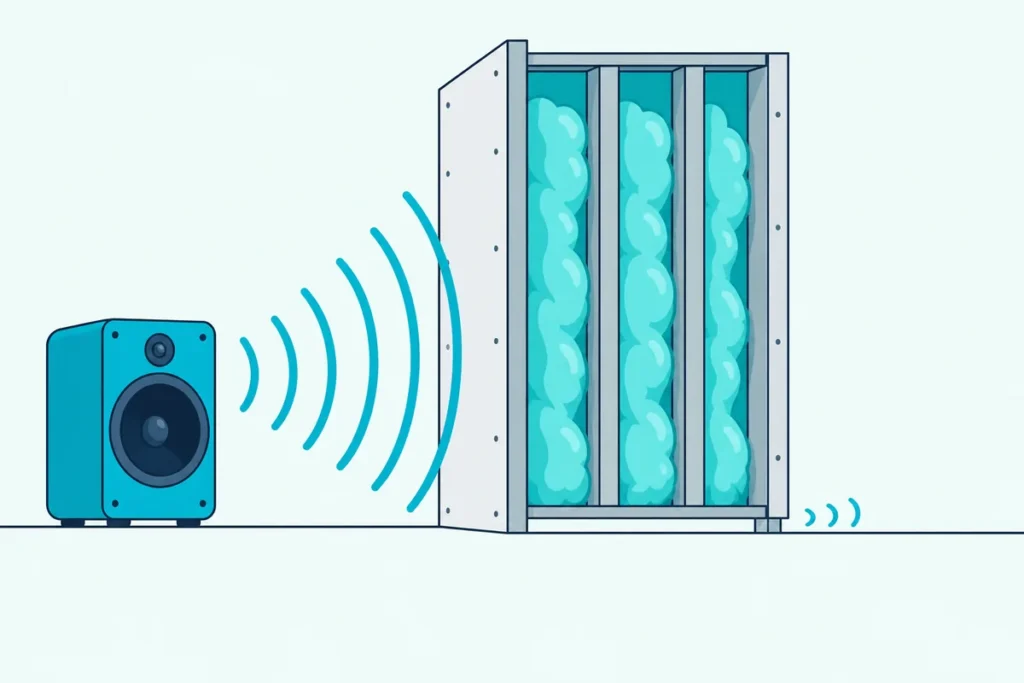
Does spray foam sound proof a room? Not on its own, but it does two useful things that are easy to mistake for soundproofing.
Hire it as a noise fix and you can end up with a full wall of foam that still lets the television through, while the real leaks stay open.
The makers’ own test numbers show where foam helps, where it doesn’t, and which changes move a wall’s rating by ten points or more.
Below, you’ll see how open-cell and closed-cell foam absorb sound, what walls filled with spray foam score, and which builds beat them.
Start with the answer for a single wall, then the scales behind the numbers.
Does Spray Foam Sound Proof a Wall?
Not by itself, and BASF’s own numbers show why. Its test data put walls with spray foam in the 30s on the STC scale, and the two useful things it does are sealing air gaps and, for open-cell foam, absorbing some sound inside the cavity.
Here are BASF’s reported results for walls filled with its foam, all with 5/8-inch gypsum board on the room side (BASF):
| Wall | Foam | STC |
|---|---|---|
| Exterior, 2×4 studs | 3.5 in open-cell | 33 |
| Exterior, 2×6 studs | 5.5 in open-cell | 34 |
| Exterior, 2×6 studs | 3.0 in closed-cell | 33 |
| Interior, 2×4 studs, one layer of gypsum each side | 3.5 in open-cell | 34 |
Those numbers sit far below what a noisy neighbor needs blocked, and our guide to how mass, damping and decoupling work explains what’s missing. The rest of this page shows what does better.
What Do STC and NRC Measure?
Those two abbreviations are the scales behind every number here. STC, or Sound Transmission Class, rates how well a wall blocks airborne sound on a scale where higher is better, and NRC, or Noise Reduction Coefficient, rates absorption from 0, which reflects everything, to 1, which absorbs everything (SprayFoam Magazine).
BASF also lists IIC, the Impact Insulation Class, for floors, where higher is better again. A material can score well on NRC and poorly on STC, because NRC describes what the foam soaks up and STC describes what gets through the wall.
Get Studio Tips Weekly
Join 5,000+ creators getting acoustic treatment advice every week.
No spam. Unsubscribe anytime.How Does Sound Get Through a Wall in the First Place?
That gap between absorbing and blocking comes from the two routes sound takes. BASF, citing the ASHRAE Handbook, names airborne transmission and structure-borne transmission as the two principal paths, and says room-to-room transmission occurs when surfaces vibrate (BASF).
The same source says lightweight structures with little damping radiate more sound than a massive structure with greater damping. That’s why weight and separation show up so strongly in the tests later on.
Foam sits in the middle of this picture. It seals the air path and adds some damping and absorption inside the cavity, but it adds little weight compared with an extra layer of drywall.
How Much Sound Do Open-Cell and Closed-Cell Foam Absorb?
The absorption side shows in BASF’s results, measured to ASTM C423. Its 3.5-inch open-cell foam has an NRC of 0.65, and its 2-inch closed-cell foam has an NRC of 0.10 (BASF).
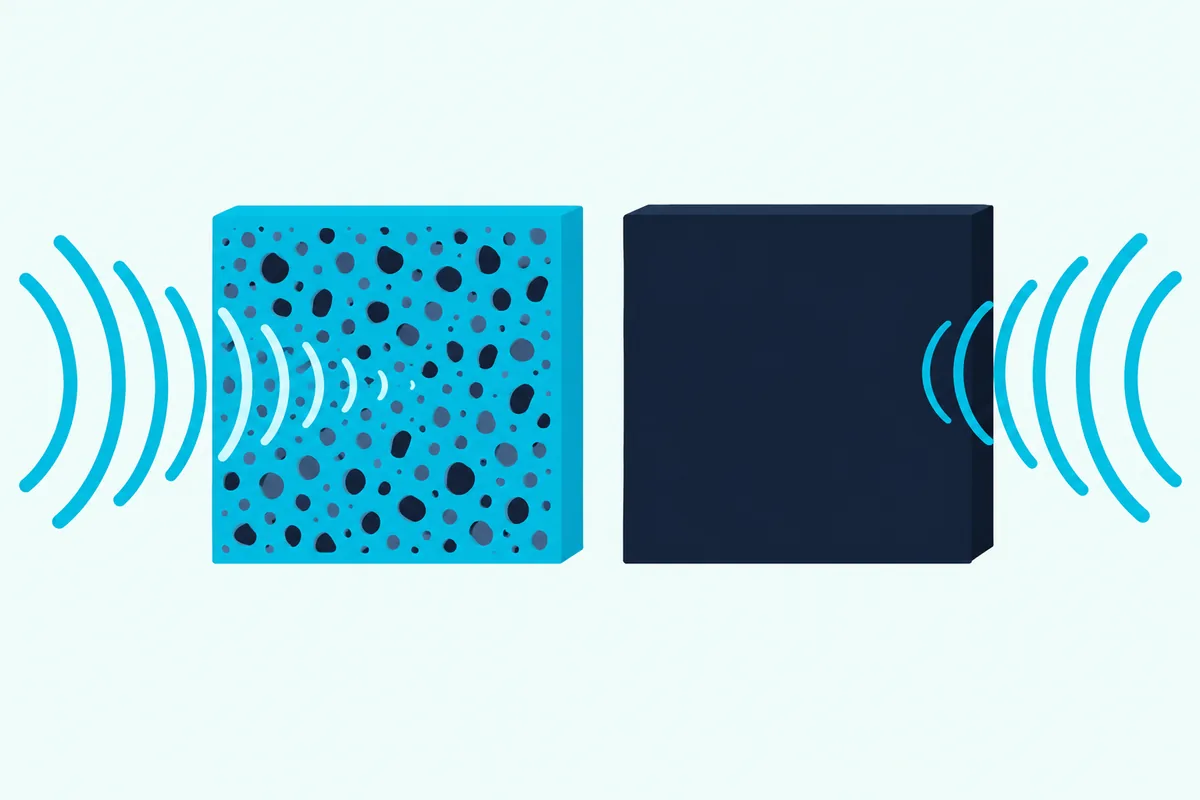
At 500 Hz the gap is wider, with open-cell absorbing 0.88 of the sound and closed-cell 0.15. The thicknesses differ, so the comparison is a guide rather than a like-for-like test.
Open-cell foam soaks up sound, then, and closed-cell foam mostly reflects it. That’s why closed-cell foam gets pitched for sealing and strength, and open-cell for noise.
Is Closed-Cell Foam Better for Soundproofing?
Those absorption numbers cut against a claim you’ll see in shop guides. SoundAssured’s guide to foam for soundproofing calls closed-cell foam the best kind and says it’s a misconception that open-cell foam is ideal (SoundAssured).
In BASF’s wall tests, the closed-cell and open-cell fills score within a point or two of each other, at STC 33 and 34. The wall numbers don’t show closed-cell foam blocking more sound.
What STC Does a Wall With Spray Foam Reach?
Here’s where the absorption numbers meet the wall scores. The BASF table above gives STC 33 to 36 for its exterior walls, with the 36 coming from a 2×6 wall that adds a 3.5-inch batt to 2.5 inches of closed-cell foam.
For a like-for-like idea of where foam sits, ROCKWOOL reports STC 38 for its 3-inch Safe’n’Sound mineral wool in a 2×4 single-stud wall with 5/8-inch gypsum (ROCKWOOL). That’s four points above BASF’s 34 for a similar open-cell wall, though the two come from different tests.
How Do You Read a Maker’s STC Claim?
That four-point gap is a good reason to read claims carefully. Check the assembly before the product, because stud size, stud spacing, drywall layers and insulation thickness all change the number.
The same logic applies to the wool itself, and does Rockwool work for soundproofing sets Rockwool’s listed walls beside Owens Corning’s and BASF’s.
ROCKWOOL lists each assembly with its components and a report number, such as RAL-TL96-265 for its 3-inch wall, and BASF names UL designs like U305. Look for footnotes too, since BASF marks its closed-cell values with an asterisk and calls them typical values in the defined assemblies.
Compare like with like, meaning a single stud row against a single stud row and the same number of drywall layers. A double-stud wall beating a single-stud wall says nothing about the insulation inside them.
Here’s how the two makers’ single-stud walls line up, which is why the gap between them is only a ballpark:
| Detail | BASF wall | ROCKWOOL wall |
|---|---|---|
| Studs | 2×4 | 2×4, 16 in on center |
| Drywall | 5/8 in Type X gypsum each side | 5/8 in gypsum |
| Insulation | 3.5 in open-cell spray foam | 3 in Safe’n’Sound |
| Test reference | UL Design U305 | Report RAL-TL96-265 |
| STC | 34 | 38 |
What Actually Raises a Wall’s STC?
The answer is decoupling and mass, and ROCKWOOL’s catalog shows the steps from one maker’s tests of wood-stud walls (ROCKWOOL):
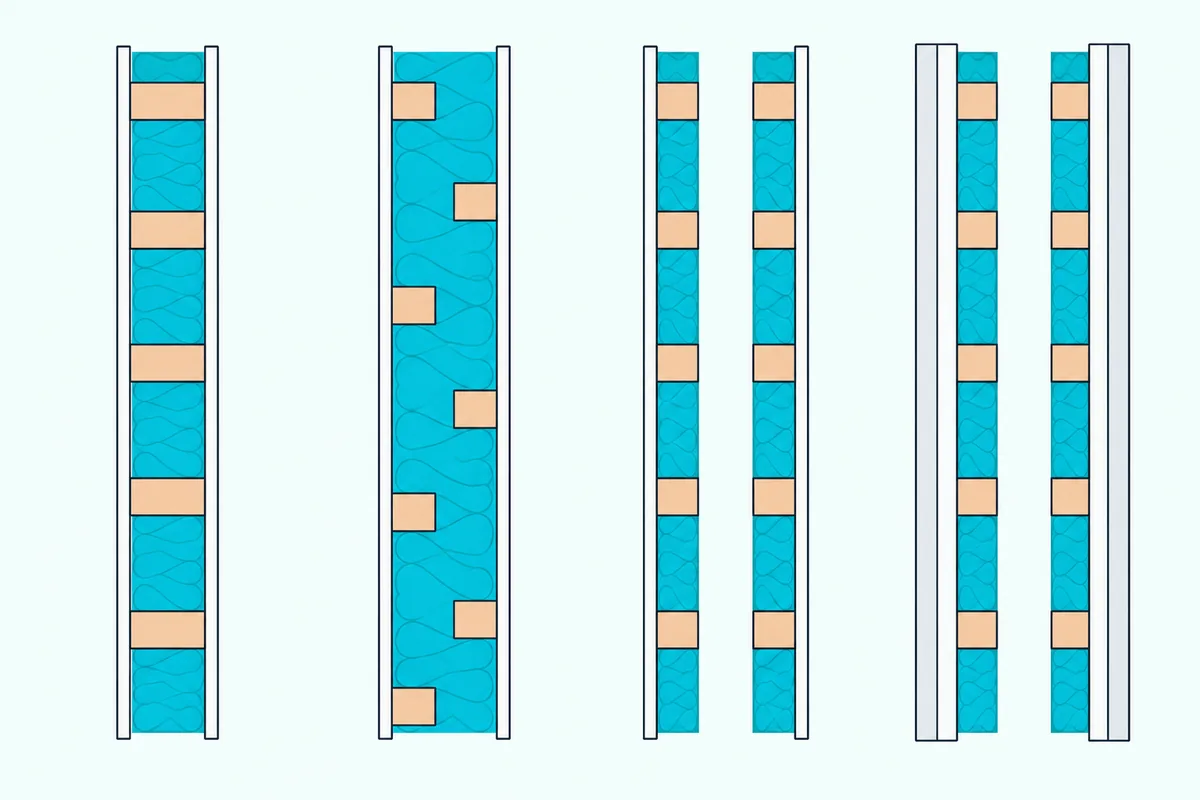
| Wall build (2×4 wood studs, 3 in Safe’n’Sound) | STC |
|---|---|
| One stud row, 5/8 in gypsum, no other change | 38 |
| Staggered studs, 5/8 in Type X gypsum | 50 |
| One stud row with resilient channels, 5/8 in gypsum | 51 |
| Double stud with a 1 in air gap, 5/8 in Type X gypsum | 56 |
| Double stud with a 1 in air gap, two layers of Type X gypsum each side | 66 |
Every row above the first changes how the two faces of the wall connect or how heavy they are. None of them changes the insulation.
Deeper studs don’t do it either. ROCKWOOL lists STC 36 for a 2×6 single-stud wall with 3 inches of Safe’n’Sound, two points below its 2×4 wall.
BASF’s own best example shows the same pattern. Its partition with two layers of Type X gypsum on each side, a double stud row and 3.5 inches of open-cell foam in one cavity reaches STC 57, against 34 for a single stud row with one layer on each side.
Does Spray Foam Help in Floors and Ceilings?
Impact noise adds a second scale, and BASF lists two floor and ceiling assemblies with open-cell foam. One reaches STC 57 and IIC 50, and the other STC 59 and IIC 55 (BASF).
Both stack several layers: an acoustical pad or mat under the flooring, an OSB subfloor, 18-inch open-web trusses with 3.5 inches of open-cell foam, resilient channel and 5/8-inch gypsum. The second adds 1 1/4 inches of gypsum concrete, so the pads, the weight and the channel likely do much of the work beside the foam.
Where Does Spray Foam Help Reduce Noise?
Those layered results leave foam two real jobs. BASF says that sealing air leaks is the same job as reducing airborne sound, and that its foams count as air barriers under ASTM E2178 and E283 (BASF).
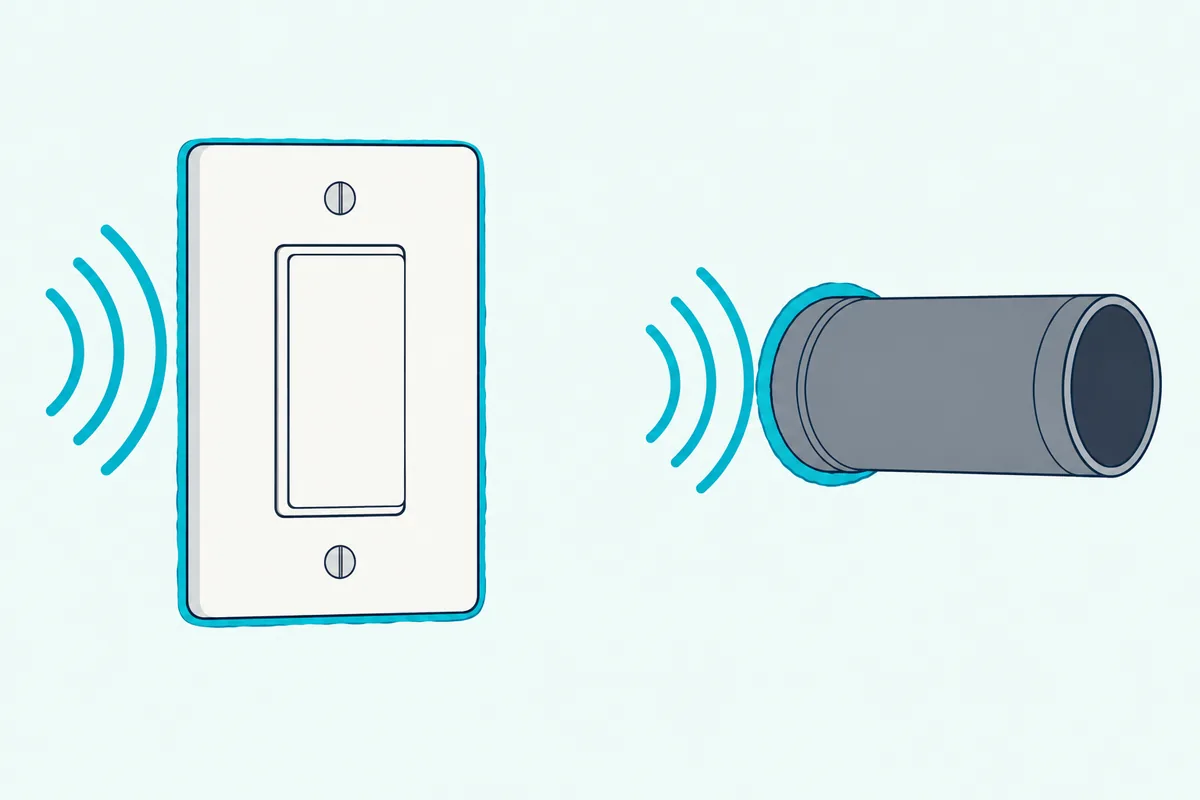
Gaps matter because sound follows air. A wall with open outlets, an unsealed top plate or a gap around a pipe leaks noise whatever it’s filled with, and foam is good at closing those.
BASF also claims that its closed-cell foam’s stiffness inhibits structure-borne sound and that its open-cell foam adds absorption while filling the cavity. Those are the maker’s claims, and the STC numbers above are the check on them.
Is Spray Foam the Same as Acoustic Foam?
Absorption is also where the confusion with acoustic foam starts, and mixing the two up is a common way to waste money. Spray foam is insulation that hardens inside a wall, while acoustic foam is a panel that reduces echo inside a room.
Our guide to what acoustic foam does and doesn’t do explains the difference between echo and soundproofing. Neither one blocks sound moving through a wall.
Rigid polystyrene foam, which many people call Styrofoam, is a third kind, and how little Styrofoam weighs next to drywall shows why it doesn’t block sound either.
What Should You Do Instead in a Finished Room?
The table above ranks the fixes, and the cheapest come first:
- Seal every gap you can find. Foam or sealant around outlets, pipes and the top plate stops the air path.
- Add mass. A second layer of drywall is the simplest way to make the wall heavier.
- Decouple. Resilient channels took ROCKWOOL’s single-stud wall from STC 38 to 51.
- Rebuild if you can. Staggered or double studs came next in the table, at STC 50 and 56.
Only the last step means rebuilding the wall. Our guide to fixes for a finished wall covers the ones you can add without that, and our comparison of insulation for soundproofing covers what goes in the cavity.
Use spray foam when you’re already insulating and want the gaps sealed, and skip it as the only fix for noise from next door.
The Bottom Line
The tests above lead to one answer: spray foam doesn’t soundproof a wall on its own, since BASF’s own tests put walls with it around STC 33 to 36 while decoupling and extra mass took ROCKWOOL’s walls from 38 to 66. It’s a sealing material first and an absorber second.
Choose it for air sealing and energy savings, and treat any noise reduction as a bonus. For real noise control, change the wall’s construction.
Frequently Asked Questions
Does closed-cell spray foam block more sound than open-cell?
Not in BASF’s data. Its closed-cell and open-cell walls score STC 33 to 34, and open-cell absorbs far more sound inside the cavity, with an NRC of 0.65 against 0.10 for closed-cell.
Can spray foam stop noise from neighbors?
It can seal gaps that let sound through, but it can’t add the mass or decoupling that stops voices and bass. Those come from changes like resilient channels, staggered studs or a second layer of drywall.
What is a good STC rating for a wall?
Higher is better, and ROCKWOOL’s tested wood-stud walls range from 36 to 66. A single stud row with one layer of gypsum scored 38 in its tests, while a double stud wall with two layers each side scored 66.
Is spray foam better than mineral wool for soundproofing?
In each maker’s own single-stud test, mineral wool scored higher: ROCKWOOL reports STC 38 and BASF reports 34 for open-cell foam. The tests differ, so the gap is a ballpark, and construction changes matter far more.
Does spray foam reduce impact noise from floors?
BASF lists IIC 50 and 55 for two floor-ceiling assemblies that combine open-cell foam with resilient channels and acoustic pads. The foam is one layer among several there, so the other layers likely account for much of the score.