Is Styrofoam Good for Soundproofing? Why Weight Decides
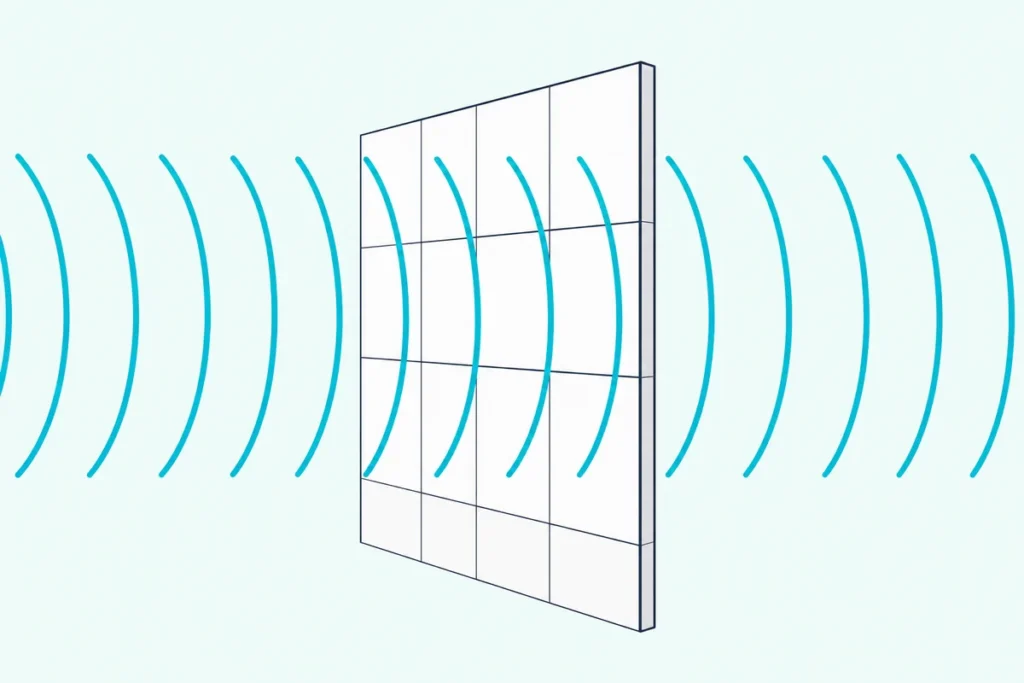
Is Styrofoam good for soundproofing? No, and the reason is weight: a foam board is so light that sound passes through it almost as if it weren’t there.
Picture a bedroom wall covered in white foam panels while the neighbor’s television still comes through as clearly as before.
Owens Corning’s data sheet, DuPont’s brand page, Rockwool’s data sheet and HUD’s noise guidebook explain why, and what works instead.
You’ll see how little a foam board weighs next to drywall, how much of it you’d need to match one sheet, why bare foam on a wall runs into fire code, and which fixes HUD says add real decibels.
Start with the weight, because that’s where the answer lives.
Is Styrofoam Good for Soundproofing?
That answer comes down to weight, because HUD’s Noise Guidebook says a material’s transmission loss typically improves with its surface weight. It adds that, in general, the denser the wall material, the more noise it reduces.

The table shows how little foam weighs next to drywall. DuPont’s chart lists the minimum densities the ASTM C578 standard sets for three kinds of EPS, the white beaded foam in coolers and packaging, and USG lists the nominal weight of a 5/8-inch drywall panel.
| Material | Density or weight | Weight per square foot |
|---|---|---|
| EPS foam board, Type I, 2 inches thick | At least 0.9 lb/ft³ | About 0.15 lb |
| EPS foam board, Type II, 2 inches thick | At least 1.35 lb/ft³ | About 0.23 lb |
| EPS foam board, Type IX, 2 inches thick | At least 1.8 lb/ft³ | About 0.3 lb |
| USG Sheetrock Firecode X, 5/8 inch | 2.2 lb/ft² | 2.2 lb |
The foam figures are my own arithmetic, density times thickness in feet, so 1.8 lb/ft³ times 2/12 ft comes to 0.3 lb per square foot. Even the densest foam in the table weighs about a seventh of one drywall layer, which means that by HUD’s weight rule it adds almost nothing.
To match one 5/8-inch drywall sheet by weight, you’d need about 29 inches of Type I foam or 15 inches of Type IX, because 2.2 lb divided by 0.9 lb/ft³ is 2.4 ft and divided by 1.8 lb/ft³ is 1.2 ft. That’s why a second layer of drywall does more than a thick foam panel, and HUD says doubling the thickness of a partition can lower the sound passing through it by as much as 6 dB.
What Is Styrofoam, and Does the Kind Matter?
It matters less than you’d think, because both kinds are light plastic foam. DuPont says Styrofoam Brand is an extruded polystyrene (XPS) board insulation, and that the white foam in cups, coolers and packaging is a type of expanded polystyrene (EPS) that isn’t made from Styrofoam Brand.
Neither is sold as a sound product. Owens Corning’s FOAMULAR 150 data sheet, for an XPS board, lists R-value, strength, moisture and fire properties and no sound rating, and DuPont’s Styrofoam data sheet I read doesn’t list one either.
Rockwool’s Safe’n’Sound data sheet shows what a sound rating looks like: a noise reduction coefficient of 1.10 for its 3-inch batt, tested to ASTM C423. That number measures absorption, which is a different job from the blocking HUD measures with Sound Transmission Class.
Does Styrofoam Absorb Sound Instead?
That’s the usual fallback, but HUD’s list of absorbers doesn’t include plastic foam. The blankets it recommends for a wall cavity are made from mineral or rock wool, fiberglass, hair felt or wood fibers.
Our page on foam board and sound absorption covers the absorption side in more detail, and our look at what spray foam does for sound covers the other foam people ask about.
Is Bare Styrofoam Safe on a Wall?
That’s the catch most foam guides skip, because foam plastic burns. Owens Corning’s data sheet says FOAMULAR 150 is combustible and that a protective or thermal barrier is required as specified in the building code, and DuPont’s Styrofoam data sheet carries a similar caution.

The International Residential Code spells that barrier out in section R316.4. Foam plastic has to be separated from the interior of a building by not less than 1/2-inch gypsum wallboard, 23/32-inch wood structural panel or a material that passes both NFPA 275 fire tests, in the 2021 edition.
That rule governs foam plastic installed in a house, so it doesn’t police a renter’s craft project. The logic still carries over, because foam panels on a bedroom wall are foam with no barrier over them.
How Do Real Walls Compare?
Those foam figures look small beside HUD’s own examples, and its Sound Transmission Class scale shows why. HUD defines STC as the number of decibels a sound is reduced as it passes through a material, so its example of an 85 dB noise outside and 45 dB wanted inside calls for a 40 STC partition.
Figure 16 of the guidebook rates eight wall types, none of them foam, and six are in this table:
| Wall | STC |
|---|---|
| Common stud wall | 35 |
| Staggered stud wall | 39 |
| 4-inch brick wall | 40 |
| Staggered stud wall with absorbent blanket | 43 |
| 7-inch concrete wall | 52 |
| Double brick wall | 53 |
The two stud walls show the gap that matters most. Staggering the studs lifts the rating from 35 to 39, and an absorbent blanket in the cavity lifts it to 43, and our guide to STC and IIC ratings explains the scale further.
Where Does Noise Really Get Into a Room?
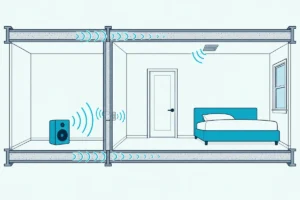
Those wall ratings assume the wall is the only path, but HUD says doors are acoustically even weaker than windows and that any door reduces the insulation value of the surrounding wall. Its guidebook gives a common hollow core wood door an STC of 17 and says that door, taking about 20% of a wall, would reduce a 48 STC wall to 24 STC.
A heavier solid core wood door that is well sealed does better. HUD says one with a vinyl seal around the edges and carpeting on the floor leaves that same 48 STC wall at 33, a 9-point gain from the door alone, and our page on how to seal and upgrade a door shows how.
What Blocks Noise Instead of Styrofoam?
That staggered-stud result points to HUD’s list, which is mostly about mass, air and sealing:
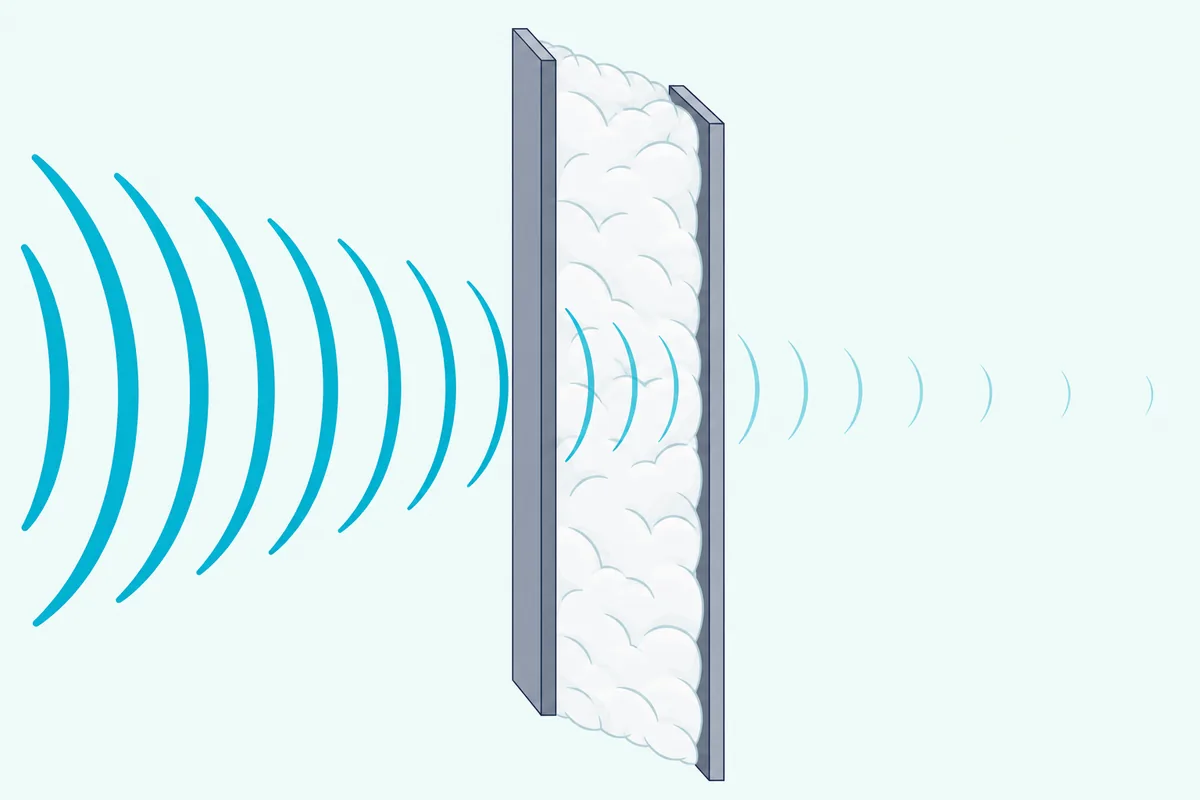
- Add mass. HUD says the denser the wall material, the more it reduces noise.
- Use an air space. HUD says a three-inch airspace provides significant noise reduction, and widening it to six inches can reduce noise by an additional 5 dBA.
- Space or stagger the studs. In a single stud wall, HUD says 24-inch stud spacing gives a 2 to 5 dB increase in STC over the common 16-inch spacing.
- Separate the layers. Resilient layers such as fiber board and glass fiber board, resilient clips and semi-resilient attachments can raise the rating by 2 to 5 dB, HUD says.
- Fill the cavity with a blanket. HUD says mineral or rock wool, fiberglass, hair felt or wood fibers can attenuate noise by as much as 10 dB.
- Seal the gaps. HUD says a one-inch square hole, or a 1/16-inch crack 16 inches long, will reduce a 50 STC wall to 40.
Rockwool’s Safe’n’Sound is one example of that blanket. Rockwool lists it as a stone wool batt with a nominal density of 2.5 lb/ft³, a flame spread index of 0 and a noncombustible rating.
Our guide to the mass, damping and decoupling basics covers the build side.
What Is Styrofoam Good For?
That’s heat, which is what it was built for. Owens Corning lists FOAMULAR 150 at a long-term thermal performance of R-5 per inch, with a minimum compressive strength of 15 psi.
So keep foam where its data sheet puts it, in a foundation or a masonry cavity wall, and spend the soundproofing money on weight, air gaps and seals.
The Bottom Line
Styrofoam isn’t good for soundproofing, because a foam board weighs a fraction of a drywall layer and the two foam data sheets I read list no sound rating. Bare foam on an interior wall also meets the fire-code logic head-on.
If a wall needs to be quieter, add weight, separate the layers, fill the cavity with a mineral wool or fiberglass blanket and seal every gap.
Frequently Asked Questions
Is polystyrene soundproof?
No. DuPont’s chart sets minimum densities of 0.9 to 1.8 lb/ft³ for EPS, which works out to 0.15 to 0.3 lb per square foot for a 2-inch board against 2.2 lb for a 5/8-inch drywall panel.
Can you use Styrofoam to soundproof a room?
You can hang it, but it won’t do much, and bare foam raises the fire-code problem above. HUD’s list of fixes is mass, an air space, separated layers, a mineral wool or fiberglass cavity blanket and sealed gaps.
How much Styrofoam would it take to match drywall?
About 29 inches of Type I EPS or 15 inches of Type IX to equal one 5/8-inch Sheetrock Firecode X panel by weight. That uses the minimum densities in DuPont’s chart and USG’s 2.2 lb/ft² panel weight.
Is EPS or XPS better for soundproofing?
Neither is sold as a sound product. Owens Corning’s XPS data sheet and DuPont’s Styrofoam data sheet list thermal, strength, moisture and fire properties and no sound rating.
Is Styrofoam better than nothing for noise?
Only by a hair, because it adds so little weight. HUD’s list of fixes doesn’t include it.
What is the cheapest way to cut noise through a wall?
Seal the gaps first. HUD says a one-inch square hole, or a 1/16-inch crack 16 inches long, will reduce a 50 STC wall to 40.
Is Styrofoam good for thermal insulation?
Yes, that’s its job. Owens Corning lists FOAMULAR 150 at R-5 per inch.