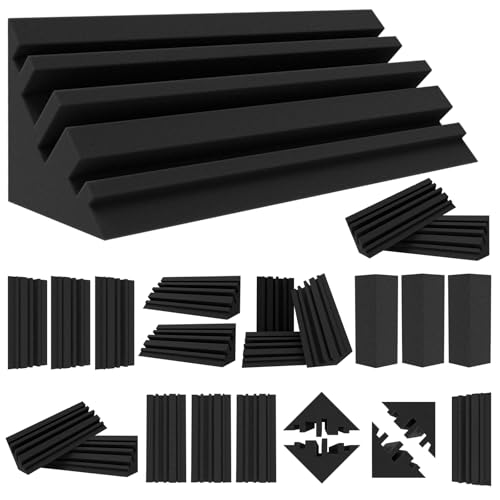
How Many Bass Traps Do I Need — Room Size Guide With Coverage Rules
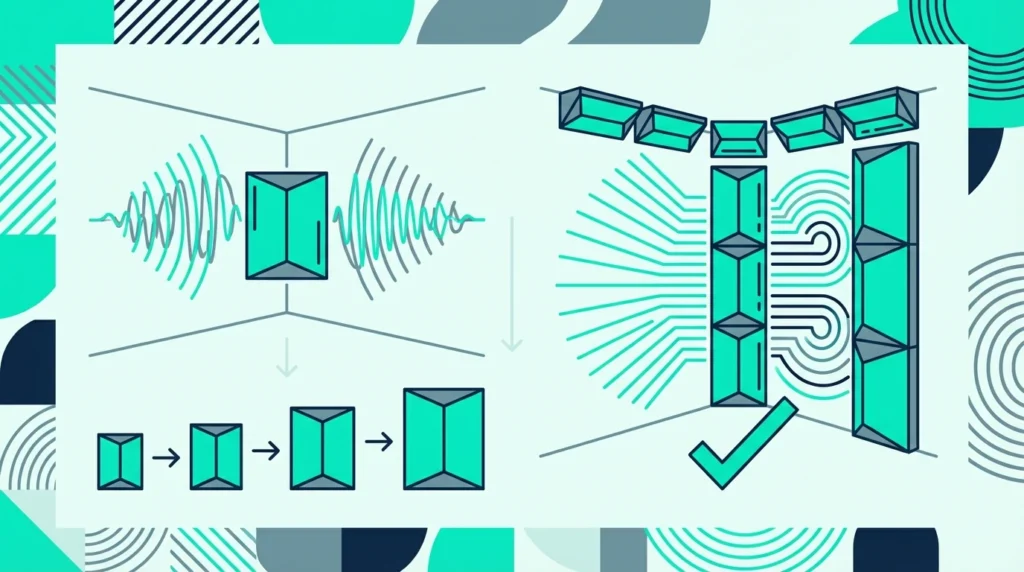
How many bass traps do i need depends on your room size, the severity of your bass problems, and how much of the room’s corner and edge surface area you can cover, but the short answer for most home studios is four to eight traps placed in the highest-priority corners.
The real question isn’t a fixed number — it’s how much corner and edge coverage you can achieve. A room with four thick traps filling the front wall corners floor-to-ceiling outperforms a room with twelve small foam wedges scattered randomly around the perimeter.
Bass problems are worse in smaller rooms because room modes are more densely packed and fall in the critical listening range. A 10×12 foot bedroom studio needs more treatment per cubic foot than a 20×30 foot live room, even though the live room has more total surface area.
Below, you’ll find specific trap counts by room size, whether you need traps in every corner, how to calculate coverage for your space, and when to stop adding traps before you over-treat the room.
Start with 4 bass traps in the front wall corners (floor-to-ceiling if possible), then add rear corners (8 total), then wall-ceiling edges (12+). Small rooms under 150 sq ft need 4–6 traps minimum. Measure your room’s frequency response with REW before and after each round of treatment to know when you’ve done enough. Stop adding traps when your bass response is within ±6 dB across the 40–200 Hz range.
How Many Bass Traps Do I Need?
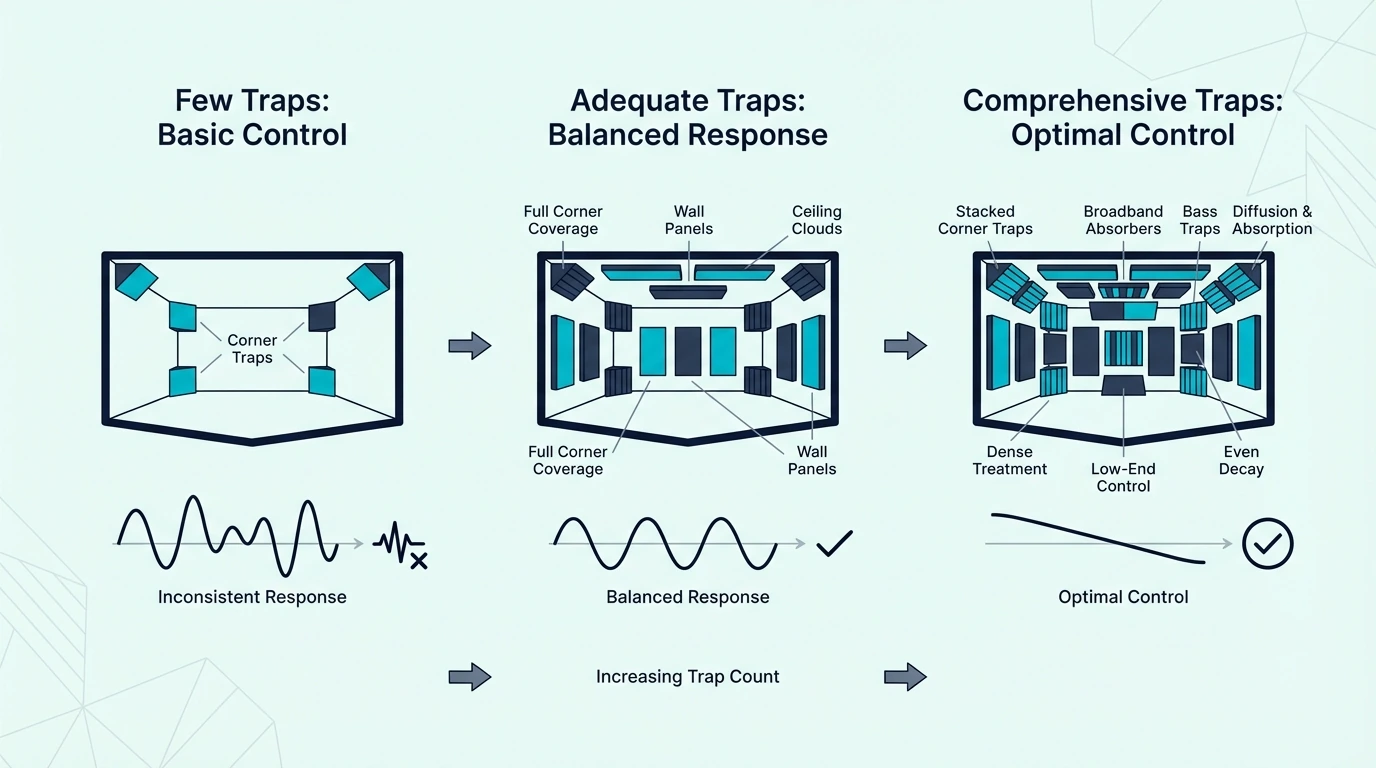
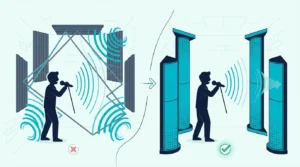
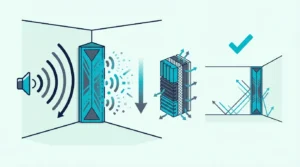
The number of bass traps you need follows a simple priority system based on your room’s corners and edges. Every room has the same physics — bass pressure is highest at boundaries, and corners where boundaries meet concentrate that pressure.
4 traps (minimum effective setup): Two floor-to-ceiling traps straddling the front wall corners — this addresses the most critical bass buildup for monitoring and recording accuracy. If budget is tight, start here.
8 traps (strong foundation): All four vertical wall-wall corners, floor to ceiling. This handles the primary axial modes in the length and width dimensions and gives you a balanced, symmetrical treatment.
12+ traps (comprehensive treatment): All vertical corners plus wall-ceiling edge traps along the front and sides. This adds vertical mode control that wall-only treatment misses.
The trap count assumes standard-sized traps (24×48 inches or similar). Smaller traps like 12-inch foam wedges count as partial coverage — you’d need two or three to cover the same junction length as one full-sized panel.
How Many Bass Traps For A Small Room?
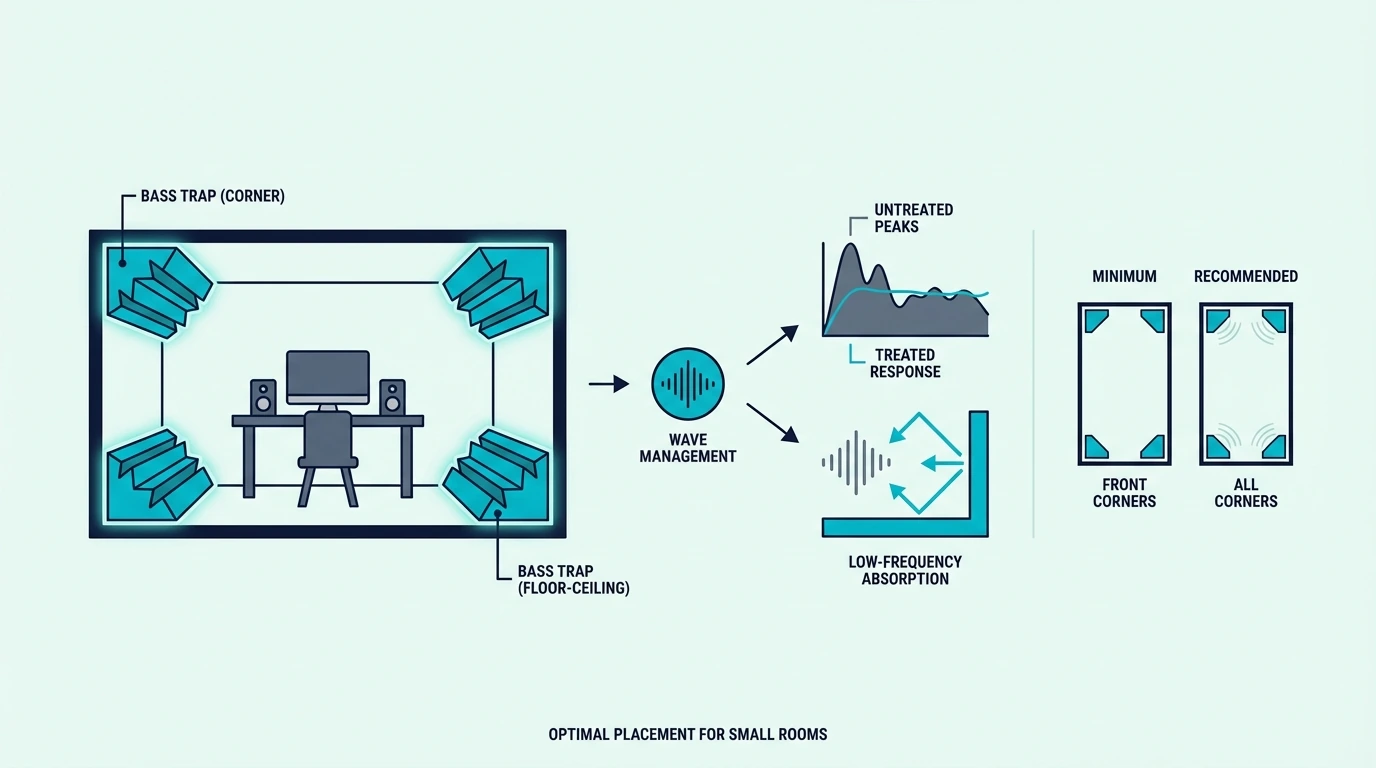
Small rooms need more bass treatment relative to their size because room modes are more densely packed and fall directly in the frequency range where music has the most energy. A room with an 8-foot ceiling has its fundamental height mode at 70 Hz — right where kick drums and bass guitars live.
The smaller the room, the fewer corners and edges you have, but each one matters more. In a small room, every untreated corner creates audible problems.
Bedroom Studios (Under 150 sq ft)
A bedroom-sized studio (10×12 to 10×15 feet) needs a minimum of 4–6 bass traps to achieve usable monitoring accuracy. The priority order:
- Two floor-to-ceiling traps in the front wall corners (behind/beside your monitors)
- Two floor-to-ceiling traps in the rear wall corners
- Two wall-ceiling edge traps along the front wall junction
In rooms this small, the front wall corners are so close to your listening position that untreated bass buildup directly colors what you hear. Treating just the front corners often produces a noticeable improvement in bass clarity within the first few minutes of listening.
Home Theaters And Listening Rooms
Home theaters and dedicated listening rooms benefit from 6–8+ traps because immersive audio relies on even bass response across a wider seating area — not just a single sweet spot. Multiple listeners at different positions in the room need consistent bass levels.
Cover all four vertical corners first (4 traps), then add ceiling-wall edge traps at the front and side junctions (2–4 more). For rooms with subwoofers, the front wall corners and the wall behind the sub deserve the thickest treatment because the sub excites those boundaries most intensely.
Rear surround speaker positions also benefit from corner treatment. Bass from rear channels reflects off the back wall and side walls, creating mode interactions that corner traps reduce.
Get Studio Tips Weekly
Join 5,000+ creators getting acoustic treatment advice every week.
No spam. Unsubscribe anytime.Do I Need Bass Traps In Every Corner?
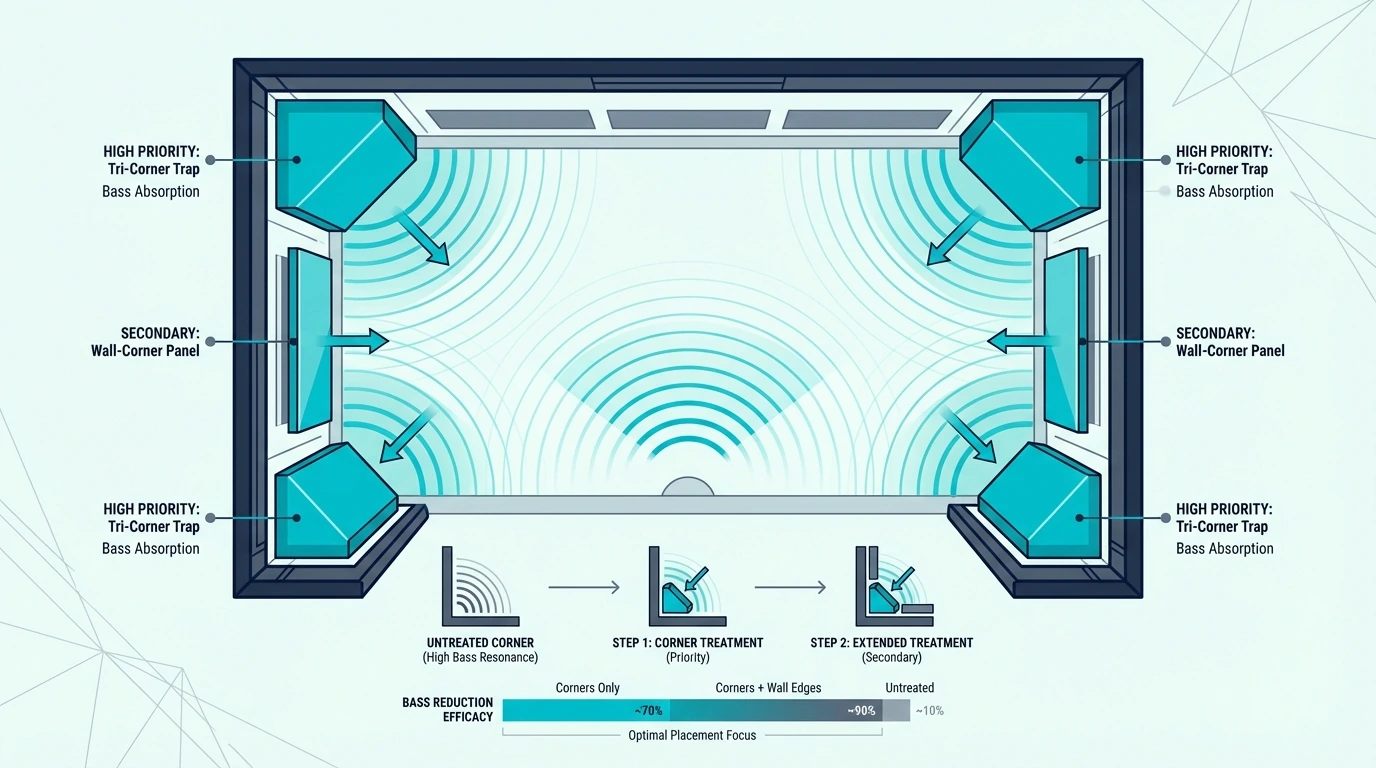
Every corner is ideal, but front corners give you roughly 60% of the total benefit for about 30% of the cost. The priority falloff between positions is steep — the first four traps do more than the next eight combined.
Here’s the diminishing returns curve:
- First 2 traps (front corners): Biggest single improvement — typically 4–8 dB reduction at the worst modal peaks
- Next 2 traps (rear corners): Adds another 2–4 dB reduction and improves bass consistency across the room
- Next 4 traps (ceiling edges): Adds 1–3 dB improvement and controls vertical modes
- Beyond 8 traps: Incremental improvements that require measurement to confirm
If you can only afford treatment for two corners, choose the front — if you can do four, do all wall-wall verticals, and if you can do eight, add ceiling edges. Each step adds real improvement, but the first step adds the most.
Bass traps are necessary in every serious listening room, but “every corner” isn’t required to achieve a dramatic improvement over an untreated room.
How To Calculate Bass Trap Coverage For Your Room
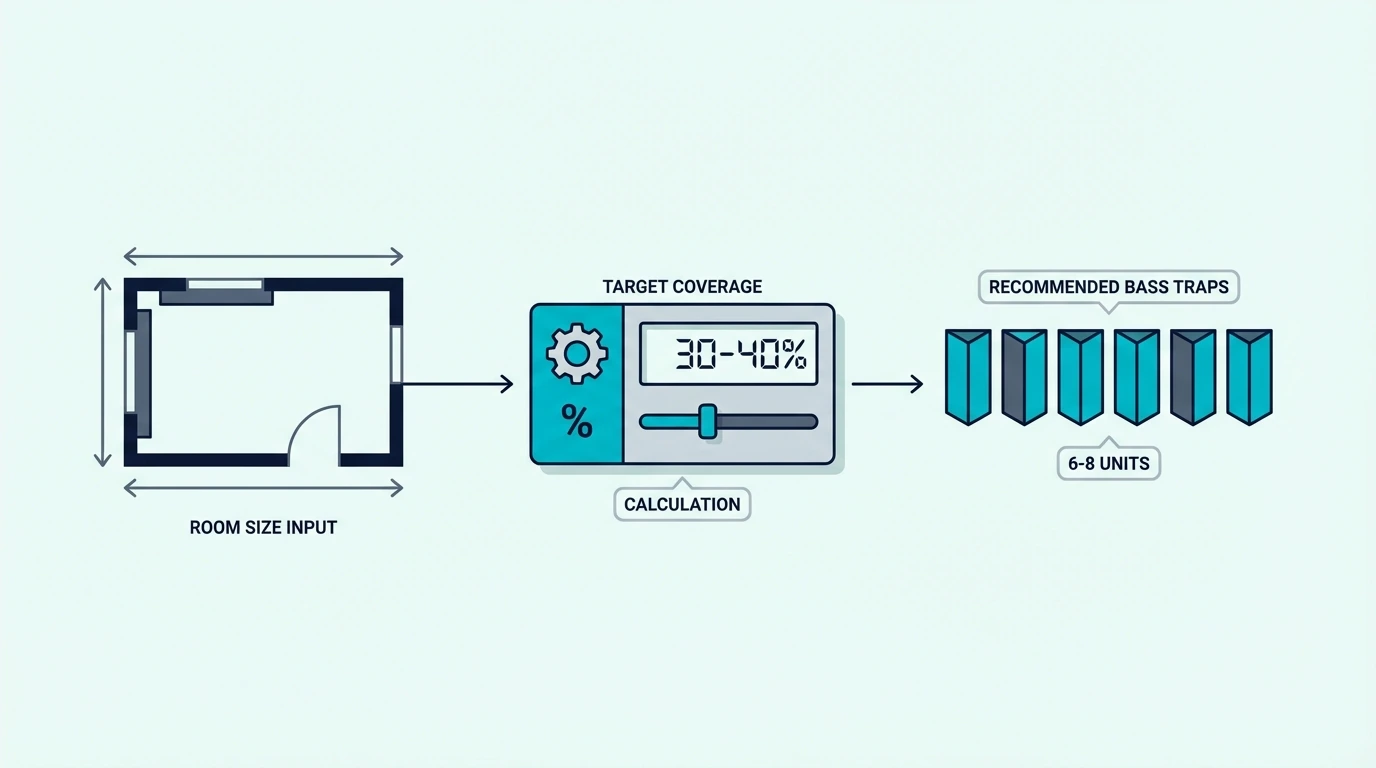
A practical coverage calculation uses the total length of corners and edges in your room as the baseline. Every rectangular room has 4 vertical wall-wall corners and 8 horizontal wall-ceiling/wall-floor edges — that’s your total treatable surface.
Step 1: Measure your vertical corners. Multiply your ceiling height by 4 (corners). An 8-foot ceiling gives you 32 linear feet of vertical corner to potentially treat.
Step 2: Measure your horizontal edges. Add the perimeter of your room twice (ceiling edges + floor edges). A 10×12 room has a 44-foot perimeter, so 88 linear feet of horizontal edges total.
Step 3: Calculate your current coverage. Add up the total linear feet of corners and edges your traps actually cover. Four floor-to-ceiling traps in a room with 8-foot ceilings covers 32 feet of the total 120 feet — about 27%.
Target: Covering 25–40% of your total corner and edge surface area delivers strong results for most rooms. Below 25%, you’re likely leaving significant modal energy untreated, and above 40%, you’re in the territory of diminishing returns.
Use room measurement software like REW (Room EQ Wizard) with a calibrated microphone to verify your results. The measurement tells you exactly which frequencies still need attention and whether more traps will help or whether you’ve reached the practical limit for porous absorption.
When To Stop Adding Bass Traps
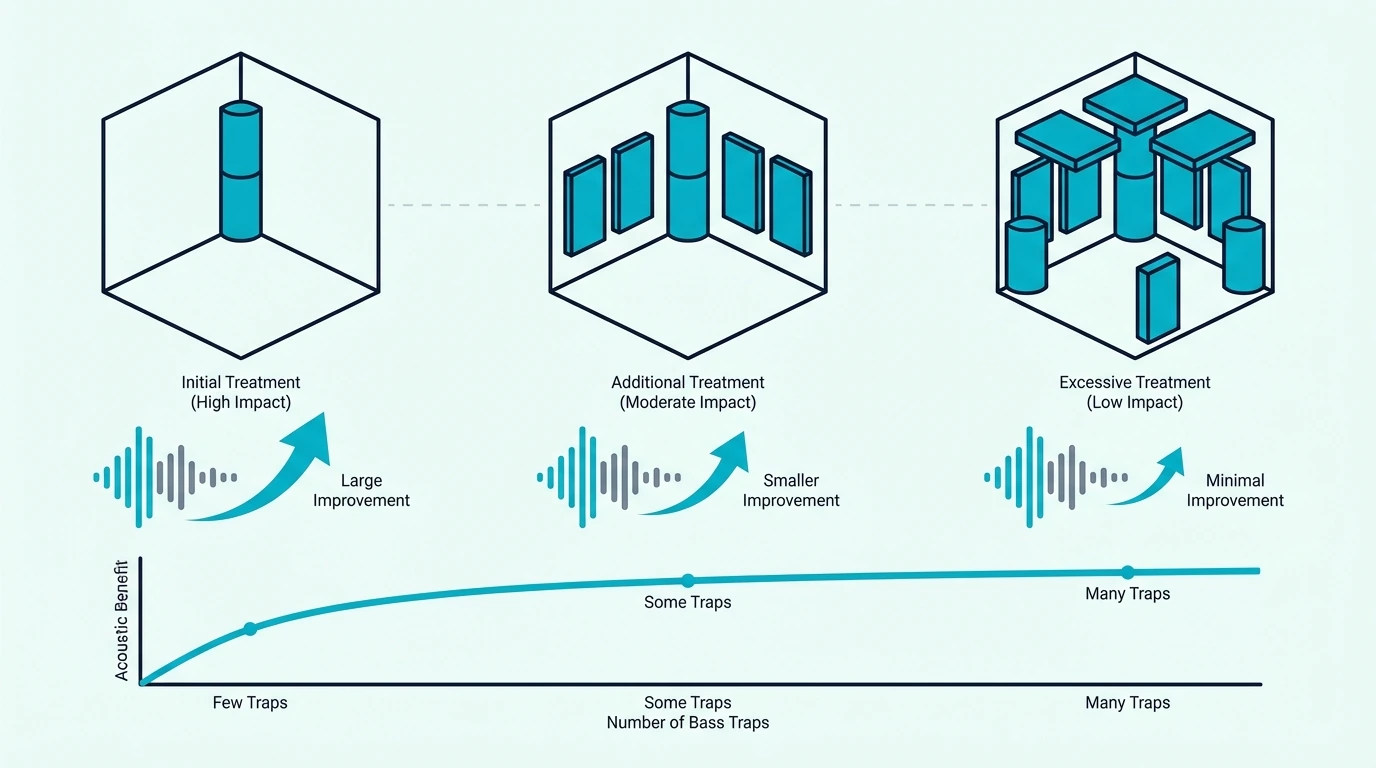
Over-treating a room with bass traps is a real risk that makes the space sound unnaturally dead and uncomfortable. The goal is controlled, even bass — not zero bass energy.
Measurement-based stopping point: Run a frequency sweep with REW at your listening position — if your bass response is within ±6 dB from 40–200 Hz, you’ve achieved excellent results. Getting to ±3 dB requires either perfect room dimensions or a combination of absorption and electronic room correction.
Listening-based signs you’ve gone too far: – Speech sounds thin and unnatural in the room – Clapping produces no audible decay at all (too dead) – Music sounds “small” and lacks body even at normal volumes
If your room feels over-treated, remove a trap or two from the rear corners or sides first. The front corner treatment should stay — it’s doing the most critical work for your monitoring accuracy.
The balance between absorption and diffusion matters once you’ve covered your corners — diffusers scatter sound energy rather than absorbing it, keeping the room lively while reducing flutter echo and comb filtering. A room with bass traps in the corners and diffusers on the rear wall often sounds better than a room with absorbers everywhere.
The Bottom Line
Start with 4 bass traps in the front wall corners and measure your room’s frequency response before and after. Add rear corners next (8 total), then ceiling edges (12+), measuring after each addition to confirm improvement.
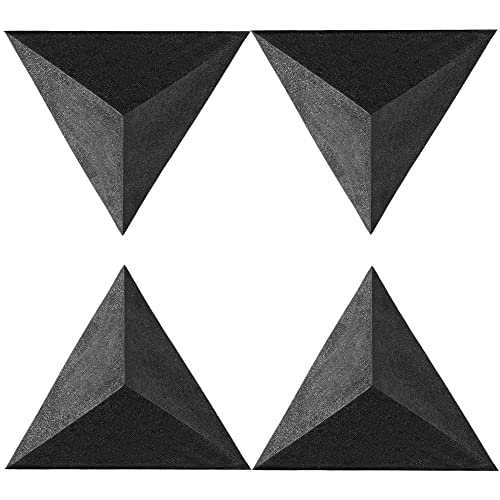
Small rooms under 150 sq ft need 4–6 traps minimum, while home theaters benefit from 8+. The 4 Pack Bass Traps for Ceiling Corner covers a pair of corners to get you started.
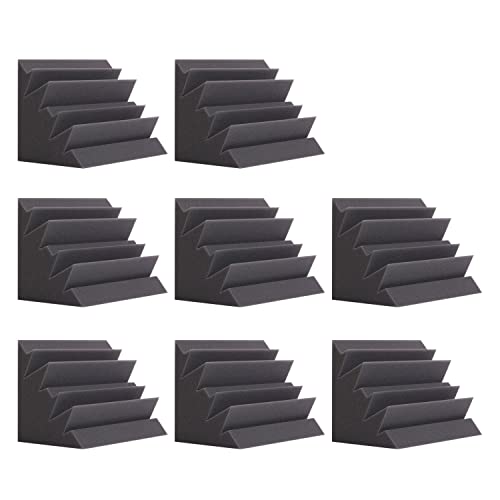
For rooms that need broader coverage across multiple corners, the 8 Pack Bass Traps Acoustic Foam Corner delivers enough pieces to treat all four vertical corners.
The TroyStudio Bass Traps 24 Pack is ideal for larger rooms or home theaters needing 8+ traps.
Stop adding traps when your measured bass response is within ±6 dB across the 40–200 Hz range — beyond that, you’re spending money for marginal gains.
Frequently Asked Questions
How much of a difference do bass traps make?
Bass traps typically reduce problem frequencies by 6–10 dB at modal peaks, which is a dramatic audible improvement. The first set of corner traps makes the biggest difference — going from untreated to four corner traps is far more noticeable than going from four to eight.
Can you have too many bass traps?
Yes — over-absorption makes a room sound dead, thin, and uncomfortable for both recording and listening. Balance bass traps with some reflective or diffusive surfaces to keep the room feeling natural.
If speech sounds thin or music lacks body, you’ve over-treated.
What is the best Rockwool for bass traps?
Rockwool Safe’n’Sound and Rockwool Comfortboard 80 are the two most popular options. Safe’n’Sound is cheaper and widely available at hardware stores — it works well for DIY bass trap builds when packed into frames at 2–4 inch thickness.
Comfortboard 80 is denser and performs slightly better per inch but costs more.