How to Soundproof a Bedroom, One Noise Path at a Time
If you’re trying to work out how to soundproof a bedroom, start by naming the noise that wakes you, because the street, the hallway, the neighbor’s wall and the floor above each come in by a different path.
You’ve hung heavy curtains and laid a rug, and the hallway TV or the 6 a.m. traffic still gets through.
Fix the path the sound actually takes, and the same bedroom can lose the noise that breaks your sleep.
This guide matches each noise to its path, then covers the door, the window, the shared wall and the ceiling in that order, with the federal and lab figures for each fix.
Start with the two-minute listening test below, then jump to the section for the path that’s loudest in your room.
Soundproof a bedroom by the path the noise takes. Household noise comes through the door, so seal its gaps and, if needed, fit a solid-core door; street noise comes through the window, so lock it and add an insert or storm window; a neighbor’s voices need the shared wall’s leaks caulked and then a heavier layer; footsteps need a rug upstairs or a resilient ceiling. Curtains, rugs and foam cut echo inside the room but block little coming in.
How to Soundproof a Bedroom, Path by Path
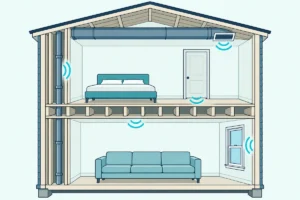
That takeaway rests on one idea: sound takes the weakest way in, so the fix has to match the path. Here’s each common bedroom noise, its path, its first fix and the figure behind it:
| What wakes you | Main path | First fix | The figure behind it |
|---|---|---|---|
| TV, voices, the kitchen | Bedroom door | Seal the gaps, then a solid-core door | A hollow-core door takes an STC 48 wall to STC 24 (HUD) |
| Traffic, sirens, dogs | Window | Lock it, then add an insert or storm window | A storm window lifts about 18 dB to about 24 dB (NBS) |
| A neighbor’s voices or TV | Shared wall | Seal outlets and baseboards, then add a layer | A 1/16-inch crack 16 inches long takes STC 50 to 40 (HUD) |
| Footsteps and thuds | Ceiling | A rug upstairs, or a resilient ceiling | Carpet and underlay take a slab from IIC 28 to 75-85 (NRC) |
STC rates how well a wall, door or window blocks airborne sound, and IIC how well a floor stops footsteps. Think of the bedroom as a bucket: a thicker side won’t help while the hole is in the door.
Which Noise Is Reaching Your Bedroom?
That bucket only leaks at its holes, so find the loudest path before buying anything. The noise usually tells you: household voices point to the door, traffic to the window, a neighbor’s TV beside the bed to the shared wall, and thumps from above to the ceiling.
Here’s a quick test. While the noise is on, look for hall light under and around the door, then put your ear to the door edges, the window frame, the outlets on the shared wall and the ceiling corner.
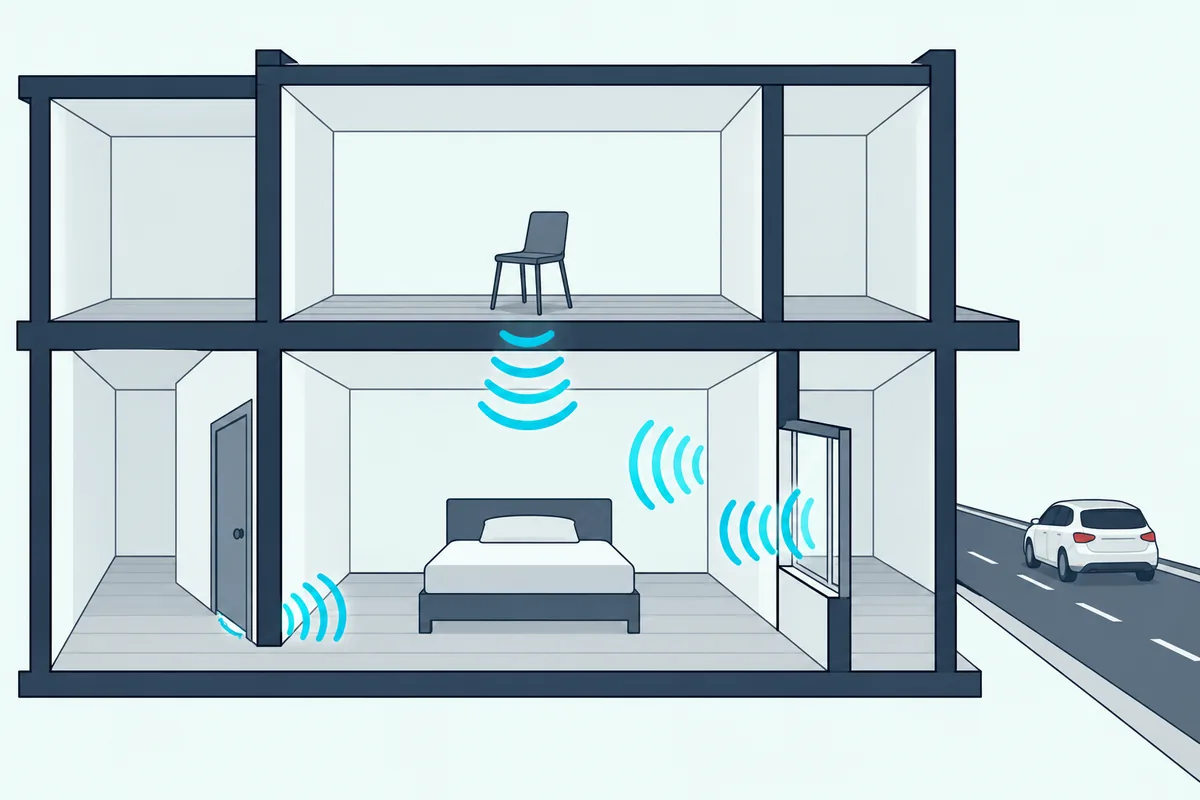
The loudest spot is the path to fix first. The National Bureau of Standards’ handbook on quieting a home blames poor bedroom privacy on three things: thin hollow-core doors, open gaps under doors that let return air through, and light interior walls.
Get Studio Tips Weekly
Join 5,000+ creators getting acoustic treatment advice every week.
No spam. Unsubscribe anytime.How Do You Soundproof a Bedroom Door?
The door comes first on that NBS list, and HUD’s Noise Guidebook explains why. A common hollow-core wood door rates only STC 17, so filling about 20% of a wall rated STC 48, it pulls the whole wall down to STC 24.
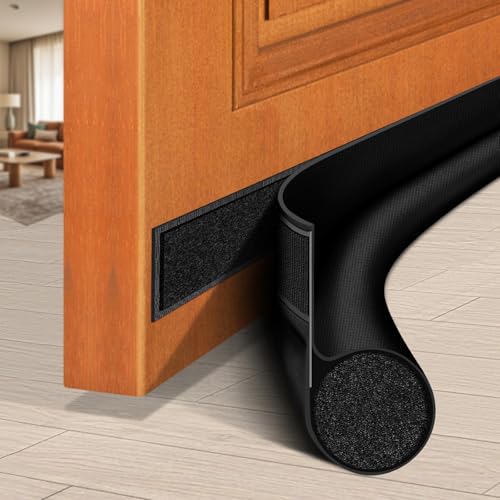
Seal the gaps before you replace anything. A self-adhesive strip on the door stop closes the sides and top, such as this 33 ft self-adhesive seal strip for door frames, and a bottom seal like the HomeProtect 36 inch door draft stopper closes the gap under it.
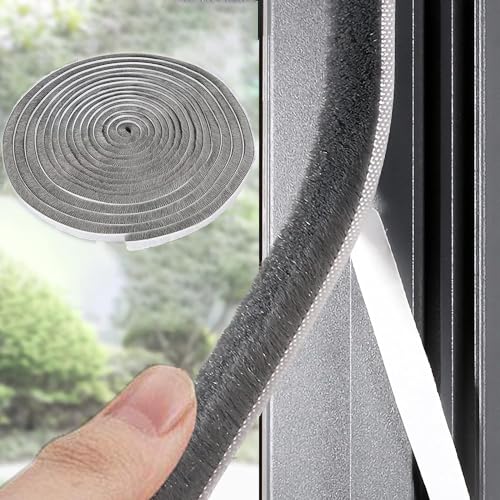
33 ft self-adhesive seal strip for door frames
Each product here had 4.0+ stars from 50+ Amazon reviews and was in stock on 20 October 2026; prices change, so none are shown. See the best door sweeps for soundproofing for heavier bottoms.
NBS also warns that many homes return heating and cooling air through the gap under bedroom doors, so if yours does, a tight seal needs a separate return or an acoustically lined transfer grille.

Mass is the next step. HUD says a solid-core wood door with a vinyl seal around its edges and carpet on the floor leaves that same wall at STC 33, and gasketed stops or a drop-bar threshold closer add more; NBS recommends solid-core doors with perimeter gaskets and a drop closure for bedrooms.
For a hollow door you’re keeping, see a light test and a seal list for a hollow bedroom door; for the slab itself, how to soundproof a door and whether a solid-core door is worth it. The same fixes apply in a baby’s room, where how to soundproof a nursery adds the safe-sleep rules.
What Works on a Bedroom Window?
That door test has a twin at the window, which NBS calls the weakest barrier in the outside walls of most homes. Its figures: ordinary locked double-hung windows cut outside noise by about 18 dB, adding a storm window raises that to about 24 dB, and caulking both improves the high frequencies about 3 dB more.
So close and lock what you have first, and caulk the frame. Andersen, the window maker, says no window is soundproof, rates a typical dual-pane window at STC 25 to 30, and says that at STC 30 you’d still understand a loud conversation outside.
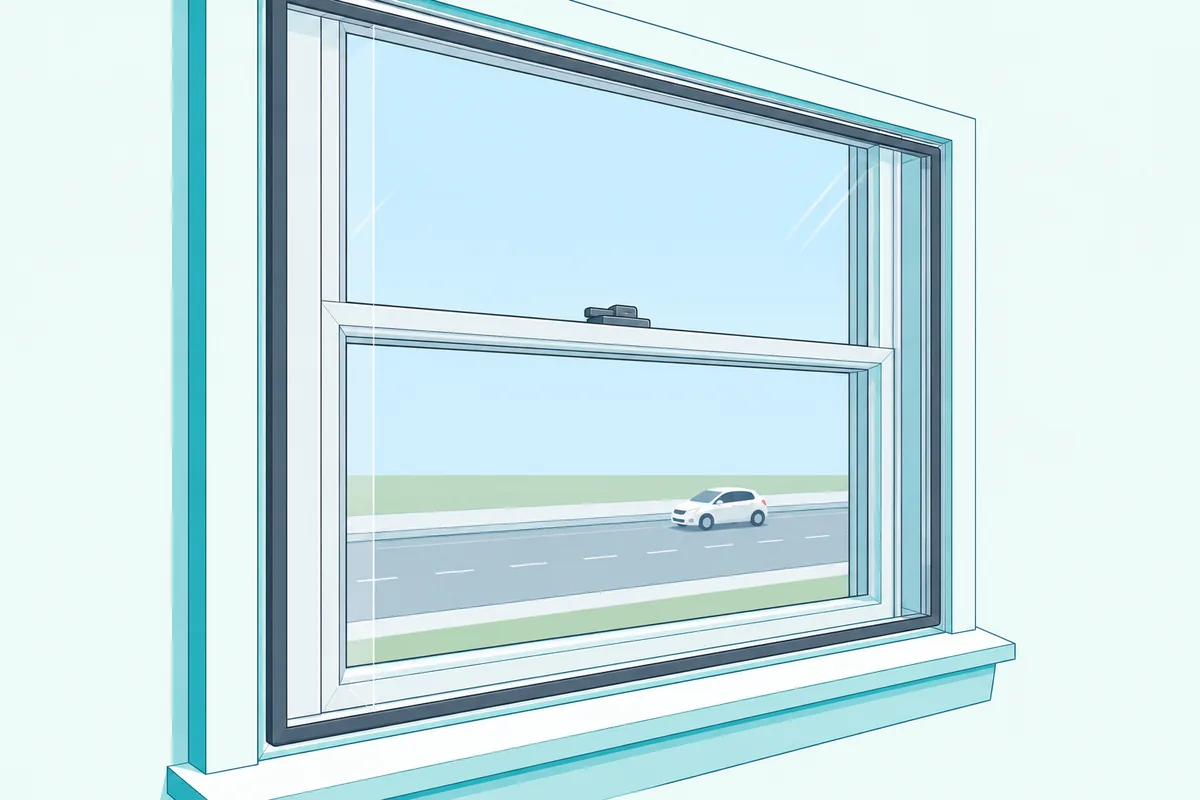
A second pane with an air gap moves the number. In Andersen’s 400 Series sound report, its dual-pane double-hung rates STC 29, 33 with a combination storm unit, 32 with laminated glass and 37 with both.
Renters can use window inserts that press into the frame instead. Indow, which makes them, reports a British Columbia Institute of Technology test that raised double-pane windows to STC 42 to 45 with its inserts.
For a full window plan, see how to soundproof windows, best soundproof windows for home and how to block outside noise. For an air conditioner in that window, see the window AC steps.
How Do You Block Noise Through a Shared Bedroom Wall?
That air gap in the window has a cousin in the wall: small holes. NBS says that if conversation or TV comes through a bedroom wall, look for leaks at the base of the wall and at electrical outlets first, and HUD shows a 1/16-inch crack 16 inches long can drop an STC 50 wall to STC 40.
Seal the baseboard joint and outlet edges with an acoustical sealant such as TMS Acoustical Soundproofing Caulk. Then move the bed off that wall; HUD calls closets and corridors buffer zones between rooms.
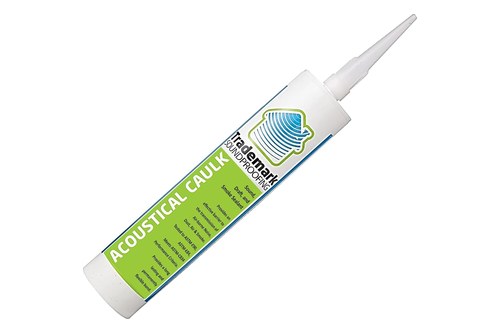
TMS Acoustical Soundproofing Caulk
If voices still come through, the wall needs mass. NBS suggests laminating another layer of wallboard, preferably on both sides, and the best soundproofing material page compares the options.
For the full build, see how to soundproof a wall, how to soundproof a wall from noisy neighbors and Burton Acoustix’s party wall guide.
What Stops Footsteps Coming Through the Ceiling?
That wall advice won’t help with footsteps, because impact travels through the structure. NRC Canada’s Construction Technology Update No. 35 calls IIC 50 the usual minimum for satisfied occupants, and lists a concrete slab at IIC 28 bare and 75 to 85 with carpet and underlay.
That’s why the fix sits upstairs, though NRC adds that soft coverings help much less on wood-joist floors. NBS says acoustic tile on your ceiling won’t reduce noise from the room above, while a soft, thick carpet on the floor above will cut footstep noise substantially.
If you can’t change the floor above, the ceiling has to be rebuilt. NBS describes 3 inches of glass fiber between the joists, metal resilient channels 2 feet apart, 5/8-inch gypsum board on them, and a 1/4-inch edge gap filled with non-setting caulk.
In an apartment, start with soundproofing against upstairs neighbors and how to soundproof a ceiling; for your own floor, see how to soundproof a floor.
How Quiet Should a Bedroom Be at Night?
Those fixes need a target, and two public bodies give one. The World Health Organization’s Night Noise Guidelines for Europe set 40 dB of night noise measured outside the home as the target to protect the public, with 55 dB as an interim step.
HUD sets a goal of 45 dB inside a home, and shows the arithmetic: with 85 dB outside and 45 dB wanted inside, the wall needs STC 40.
NBS adds that a bedroom on the side of the house away from a busy road can cut traffic noise by about 10 dB, and a partly shielded side by about 6 dB.
What Doesn’t Soundproof a Bedroom?
That 10 dB from swapping rooms beats most of what’s sold for bedrooms. Foam, acoustic panels, curtains and rugs absorb echo inside the room, but NBS warns that porous absorbers shouldn’t be used with the sole intention of stopping sound between rooms.
When the gaps are closed and the noise still wins, how to soundproof a room ranks the bigger builds and how much it costs to soundproof a room prices them.
The Bottom Line
To soundproof a bedroom, fix the path the noise takes: door gaps first for household noise, the window for traffic, the shared wall’s leaks for a neighbor, and the floor above for footsteps.
Seals come first, and after them a heavier door, a second window pane or a new wall layer does the blocking.
Frequently Asked Questions
Does rockwool soundproof a bedroom?
Rockwool and other mineral wool or fiberglass batts help inside a wall or ceiling cavity: HUD’s guidebook says such blankets in the airspace can cut noise by as much as 10 dB, mainly in lightweight construction. Pinned to a finished wall on its own, insulation is a porous absorber, which NBS says shouldn’t be used to stop sound between rooms.
Can you soundproof a bedroom cheaply?
Yes, for household and street noise, since the cheapest fixes close gaps. A seal strip on the door stop, a bottom seal, caulk at the baseboard and outlets, and locked windows cost little, and HUD’s figures show gaps can cost a wall 10 STC points. Footsteps and bass are the exceptions: they travel through the structure. The full budget list is in how to soundproof a room cheaply, and renters can start with how to soundproof an apartment.