A soundbar is the right buy for TV and dialogue, and a stereo pair for music when two speakers can sit about as far apart as you sit.
Products in this guide
Picking a soundbar vs speakers for your TV starts with a measurement most buyers never take: how far apart two speakers could sit, compared with how far back you sit.
Squeeze a stereo pair beside the screen and you’ve paid for separation you can’t use, while a bar in a room set up for music gives up the width a pair would deliver.

Get that match right and you get clear dialogue, a real stereo image or both, with no box you didn’t need.
This guide sets a soundbar against a stereo pair, passive bookshelf speakers with an amplifier or powered speakers, using the makers’ manuals and Dolby’s setup guides.
The short answer and a table come first, then what each setup is, the TV connection, stereo width and dialogue, bass, placement, music and the gear worth buying.
Soundbar vs Speakers, Which Is Better for Your TV?
Neither wins everywhere, because each solves a different problem. A soundbar is the simpler TV upgrade and the steadier one for dialogue, while a stereo pair gives the wider left-to-right image music is mixed for, if the room lets you spread the speakers out.
Sonos frames it the same way: a soundbar is the better choice for an easy TV upgrade, and separate speakers are the more flexible route that can be tailored to a room (Sonos). Bose adds that neither is inherently better, and that the room’s layout and furnishings should help decide.
| Soundbar | Powered pair | Passive pair | |
|---|---|---|---|
| Example | Sonos Arc Ultra | Klipsch The Fives (pair) | Polk T15 pair and Yamaha R-N800A |
| Boxes at the TV | One bar | Two speakers | Two speakers and one amplifier |
| TV connection | HDMI eARC/ARC; optical with an adapter | HDMI-ARC, optical or analog | Optical or coaxial |
| Center channel for dialogue | Yes, in the bar | No, left and right only | No, left and right only |
| Subwoofer | Brand’s own add-on | Sub out jack | Subwoofer out on the amplifier |
| Grows into | Rears and sub from the same brand | Stereo plus a subwoofer | Surround, through an AV receiver |
The descriptions come from the makers’ manuals and spec pages.
Every pick met Burton Acoustix’s rating, review and stock checks on 9 November 2026.
The rest of this page works down those rows, and a separate guide covers bookshelf speakers against a soundbar.
What Is a Soundbar, and What Is a Stereo Pair?
The table’s “Boxes at the TV” row holds the biggest difference, which is how many cabinets carry the sound. A soundbar is one long cabinet holding many drivers, and a stereo pair is two separate cabinets, one for the left channel and one for the right.
Sonos describes a soundbar as a single elongated speaker housing multiple drivers that work together; its Arc Ultra has 14, including seven tweeters and six midwoofers.
Dolby’s speaker guide names the jobs those drivers share: left and right speakers carry music and sound effects, and a center speaker is used mainly for dialogue (Dolby). A stereo pair covers only left and right, the 2.0 of Dolby’s numbering, or 2.1 once a subwoofer joins.
Passive Bookshelf Speakers and an Amplifier
Passive speakers have no amplifier inside, so they make no sound until speaker wire connects them to an amplifier or receiver. Polk’s T15 bookshelf speaker takes that wire through gold-plated binding posts and lists a recommended amplifier power of 20 to 100 watts per channel (Polk Audio).
The amplifier is a second box, but it’s also where the inputs live. Yamaha’s R-N800A stereo receiver, rated at 100 W + 100 W into 8 ohms, has two optical and two coaxial digital inputs, a phono input and a subwoofer output (Yamaha).
Powered Speakers
Powered speakers build the amplifier in, so the pair connects straight to the TV. Klipsch’s spec sheet for The Fives lists HDMI-ARC with CEC, optical, analog, USB and Bluetooth inputs and says no receiver is necessary (Klipsch).
The inputs sit on the primary speaker, and a supplied 4-meter speaker cable runs to the secondary one, per the Klipsch manual. So a powered pair still needs a cable between its cabinets, just no separate amplifier.
How Does Each Connect to Your TV?
That amplifier question decides the cable you’ll run from the TV. A soundbar and a powered pair with HDMI ARC both take one HDMI cable from the TV’s ARC or eARC port, while an amplifier without HDMI ARC, like the R-N800A, takes an optical or coaxial cable.
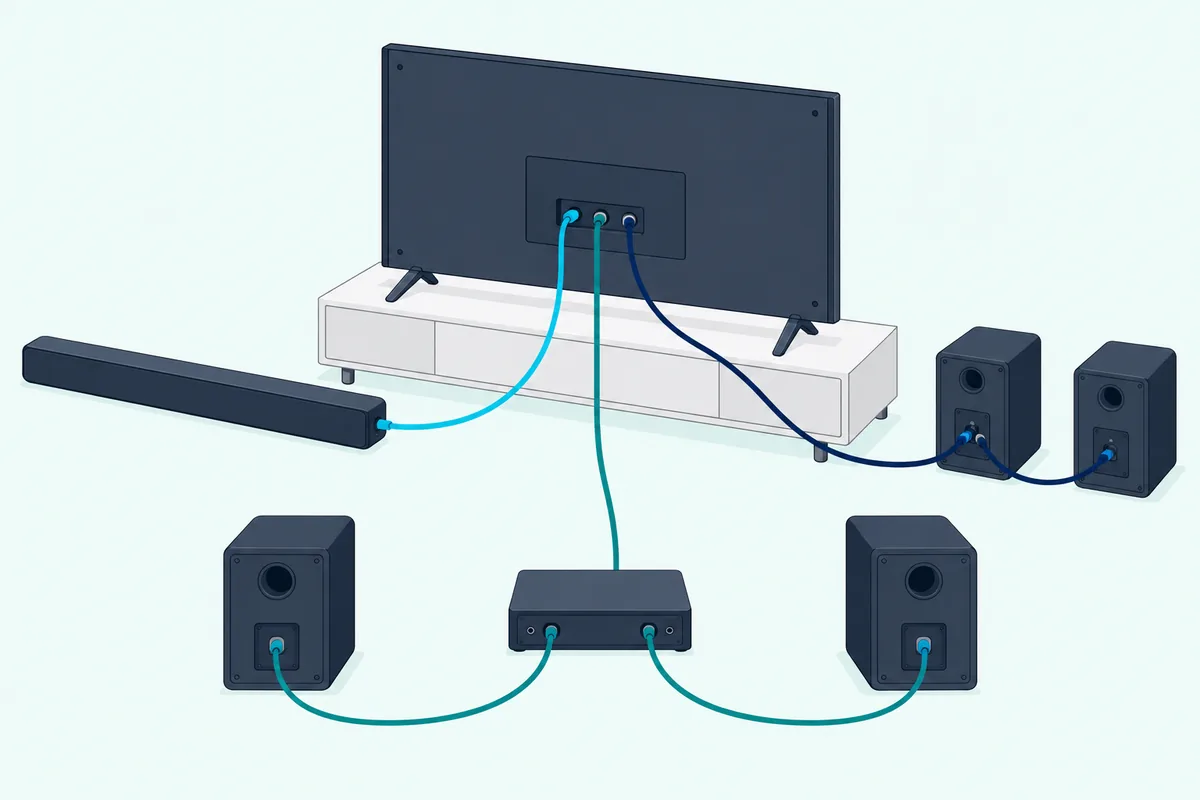
Dolby calls one HDMI cable between the TV’s ARC/eARC port and the soundbar the simplest option, and recommends eARC whenever both devices have it (Dolby). Sonos adds an optical route for the Arc Ultra on TVs without ARC, through an Optical Audio Adapter sold separately.
Powered speakers follow the same rule with one catch. Klipsch warns that a basic HDMI input won’t pass TV audio to The Fives; they take it only through HDMI-ARC with CEC on, optical or analog, with the TV set to PCM or stereo output.
Passive speakers connect through the amplifier, so its inputs are what matter. The R-N800A’s spec table lists HDMI (ARC) as “No,” so the TV goes into an optical or coaxial input, which Yamaha describes as its connection for TV sound.
Try this before buying: check the back of your TV for a port labeled ARC or eARC and for an optical output. That one look tells you which route needs no adapter.
A game console fits the same picture, since Dolby notes that with ARC the devices connected to your TV play through the soundbar. If a console is your main source, see the soundbar picks for a PS5.
Which Gives Wider Stereo and Clearer Dialogue?
With the cable sorted, the sound splits along the table’s center channel row. A stereo pair gives the wider image because its speakers can sit as far apart as you sit from them, and a soundbar gives steadier dialogue because it has a center channel aimed at you.
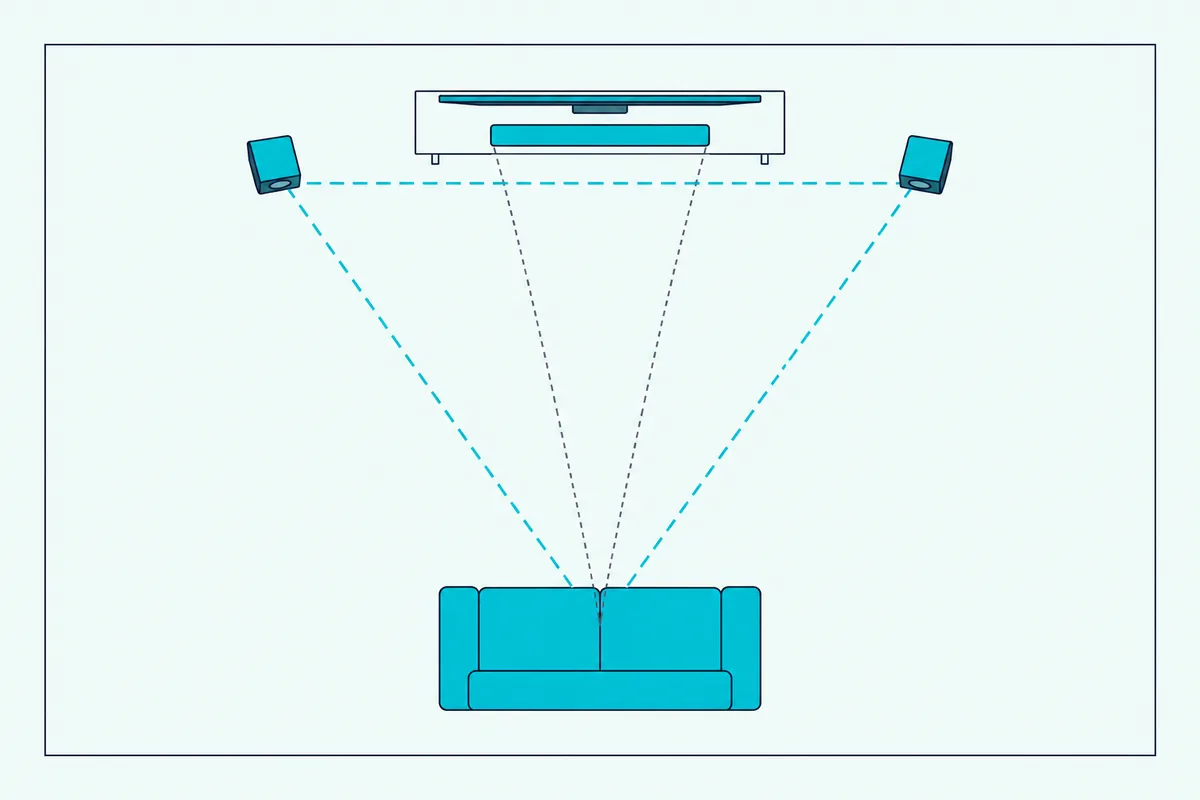
Polk’s T Series manual gives the rule: the most realistic stereo image comes from placing the speakers as far apart as the listeners are sitting from them (Polk Audio). Sit 8 feet back and that’s speakers 8 feet apart, while a bar like the Arc Ultra measures 46.38 inches end to end.
Dolby’s home theater guide calls the same idea its “golden rule”: each pair of speakers should form a triangle with the listener (Dolby). If the room forces the pair wider, Polk suggests angling them toward the middle for a more solid center image.
That center image is the pair’s weak spot for TV. With no center speaker, a voice in the middle of the screen is a blend of left and right, and Polk notes a pair wired with one cable reversed sounds thin, with little or no center image.
A soundbar doesn’t lean on that blend. Dolby places the center speaker just above or below the TV so dialogue comes straight at you, and Sonos says the Arc Ultra maximizes center channel performance and adds four levels of Speech Enhancement.
Think of it as two strengths: the pair paints a wide stage, and the bar pins voices to the screen, which suits a household that mostly watches TV.
Do You Need a Subwoofer With Either One?
Those voices sit in the midrange, and bass is where the two routes look most alike. A subwoofer is optional with both, and the connection your bar or amplifier offers decides how you add one.
Dolby explains why one subwoofer can go almost anywhere: bass isn’t directional, and a subwoofer lets the main speakers be smaller and easier to place. Its soundbar guide puts the most common spot near the bar, often to its left or right, and warns that a sub inside cabinetry can sound poor or rattle (Dolby).

A stereo pair adds bass through a jack. The Fives have a single RCA line-level output for a powered subwoofer, and the R-N800A lists a subwoofer out.
A soundbar usually adds its maker’s own sub. Sonos suggests building out from the bar with a subwoofer and two rear speakers, and Bose says its soundbars can connect other Bose speakers, including a subwoofer.
Check the pair’s own bass limit first. Polk lists the T15’s lower -3 dB limit at 65 Hz and The Fives’ frequency response starts at 50 Hz, so a subwoofer is what fills in the lowest notes of a film score.
How Much Room Does Each Take, and Where Does It Go?
That subwoofer is one more box, and box count is where the two routes differ most. A soundbar needs one spot below or in front of the TV, while a stereo pair needs two spots either side of it, ideally at ear height, plus a shelf for any amplifier.
Bose notes that a soundbar can sit on the TV’s stand or mount just above or below the screen, and that its largest bar is 41.14 inches long (Bose). The Arc Ultra is 2.95 inches tall and 4.35 inches deep.
Each Fives speaker measures 12 by 6.5 by 9.25 inches, each T15 is 6.5 inches wide, and the R-N800A adds a 17-1/8-inch-wide box. Dolby puts main speakers at about seated ear level, roughly 3.9 feet from the floor, with stands where furniture can’t reach it, and recommends toeing them in toward your seat.
The T15 has a keyhole slot for wall mounting, which helps where there’s no shelf beside the screen. Still, a wall-mounted TV with nothing either side is where a soundbar’s single box makes the clearest sense.
Room size points the same way. Bose warns that a full traditional system in a tight space may sound distorted from the many reflections, and Dolby’s home theater setup guide suggests 50 to 100 watts per channel for rooms under 200 square feet, which the R-N800A covers.
Is a Soundbar or Speakers Better for Music?
Those placement rules are exactly why music favors the pair. Speakers are the better choice for music when you can place them properly, and Sonos says so: for a hi-fi music setup with little use for a home theater, separate speakers get you further than a soundbar.
Music arrives as left and right channels, the two Dolby assigns to music and effects, so a pair placed by Polk’s rule plays it the way it was mixed. A bar fits those channels inside one cabinet, though Sonos still credits a premium bar with doing music justice.
The inputs back this up. The R-N800A has a phono input, a USB DAC and streaming, and The Fives have a phono pre-amp, so either pair can be the music system on its own.
A soundbar’s music strength is convenience: Bose’s bars play from phones and tablets over Bluetooth. For a desk rather than a living room, Burton weighs a soundbar or speakers for a desk separately.
Which Should You Buy?
The connection, dialogue, placement and music sections boil down to three checks: your TV’s audio ports, the spacing your wall allows, and whether music or TV fills most of your listening. Buy a soundbar if TV and dialogue come first or the wall has no room either side, and buy a stereo pair if music matters and you can space the speakers about as far apart as you sit.
For a passive pair, the Polk T15 is the pick.
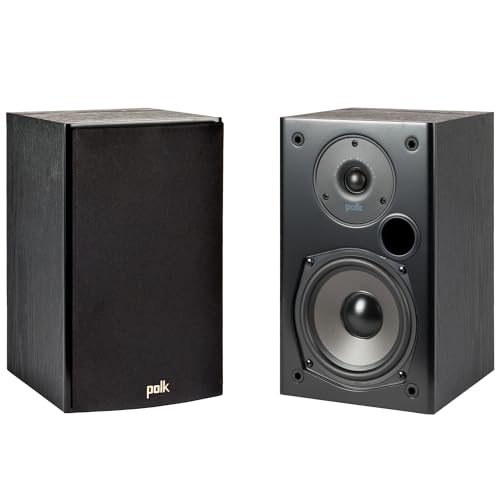
Polk T15
To drive that pair and feed it TV sound, the Yamaha R-N800A is the pick.
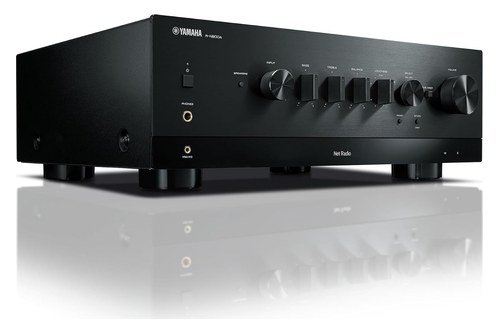
Yamaha R-N800A
To skip the amplifier, a powered pair with HDMI-ARC such as Klipsch’s The Fives connects the way a soundbar does. If you already own a soundbar and a receiver, Burton Acoustix’s receiver-and-soundbar setup guide compares the zone 2, ARC and passive-bar routes.
Rear speakers and height later point back to the bar or an AV receiver, covered in the surround sound comparison.
Still deciding whether to replace the TV’s own speakers at all? Start with a soundbar against the TV’s built-in speakers.
The Bottom Line
A soundbar is the right buy when TV and dialogue come first and the wall has room for one box, and a stereo pair is right when music matters and two speakers can sit about as far apart as you do. For that pair, the Polk T15 with the Yamaha R-N800A is the pick.
Frequently Asked Questions
Does a soundbar replace speakers?
A soundbar replaces the TV’s built-in speakers and can be the only sound system for TV and movies; Sonos calls it the simplest way to upgrade a TV’s sound. It doesn’t replace a stereo pair for someone who mainly listens to music, since Sonos also says separate speakers get further for a hi-fi music setup.
What are the disadvantages of a soundbar compared with speakers?
The main ones are a narrower stereo image and fewer upgrade paths. Bose notes that a soundbar can’t be upgraded on its own, and that if something fails the whole bar must be repaired or replaced, though Bose and Sonos let you add their own subwoofers and rears. A stereo pair lets you change the amplifier or speakers separately.
Should I get a soundbar or speakers for an apartment?
The wall decides it more than the apartment. If the TV hangs on a wall with nothing either side, a soundbar fits, and Bose notes its bars can mount just above or below the screen. If two speakers can sit about as far apart as you sit from them, a powered pair gives stereo without a separate amplifier.