4.1 Soundbar vs 5.1: What Does the Fifth Channel Change?
In a 4.1 soundbar vs 5.1 choice, the speaker you give up isn’t a rear one: Dolby’s 4.1 setup guide keeps both surround speakers and the subwoofer and leaves out the center speaker.
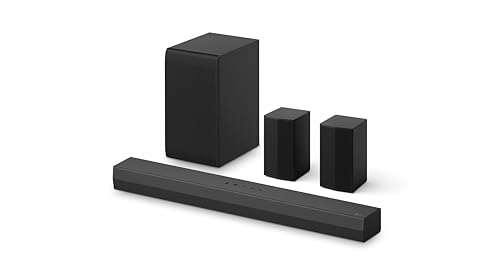
- ✓ A 4.1-channel set with rear surround speakers and a wireless subwoofer
- ✓ Dolby Digital and DTS Digital compatible
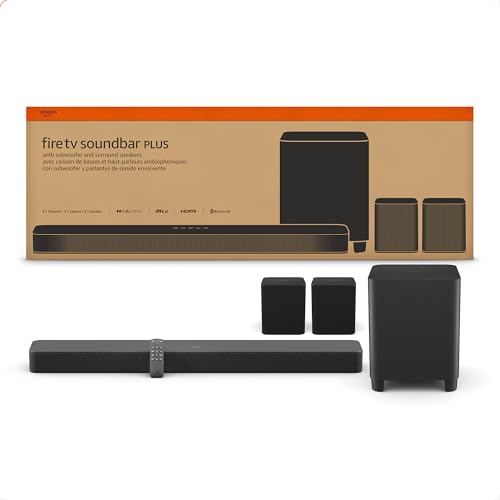
- ✓ 5.1 channels with a dedicated center dialogue channel
- ✓ A subwoofer and two surround speakers come with the bar

That’s the speaker Dolby says is primarily used to deliver dialog, and on a 4.1 set nothing sits between the left and right speakers to take that job.
Once you know which channel each layout carries, the labels on LG’s 4.1 sets and on Vizio’s, Sonos’s and Amazon’s 5.1 sets read like parts lists.
What follows lays Dolby’s two speaker maps side by side, then shows how makers count the boxes and what a 4.1 set does with a 5.1 movie or a stereo show.
The last sections turn that into a room check, so you can match a layout to where your couch sits and what you watch.
4.1 Soundbar vs 5.1: Which Speaker Does 4.1 Leave Out?
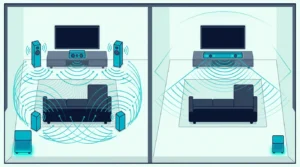
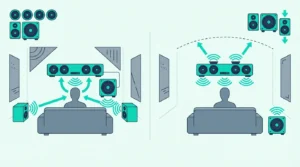
Dolby’s own home theater speaker guides make the answer easy to see side by side. A 4.1 layout leaves out the center speaker: Dolby’s 4.1 virtual speaker setup guide lists left and right speakers, a subwoofer and left and right surround speakers, and its 5.1 guide lists the same four plus a center speaker.
Both guides draw the same room, with the left and right speakers 22 to 30 degrees either side of the seat’s center line and the surrounds at 110 to 120 degrees. The 5.1 drawing adds one box at 0 degrees, the center speaker directly below the screen.
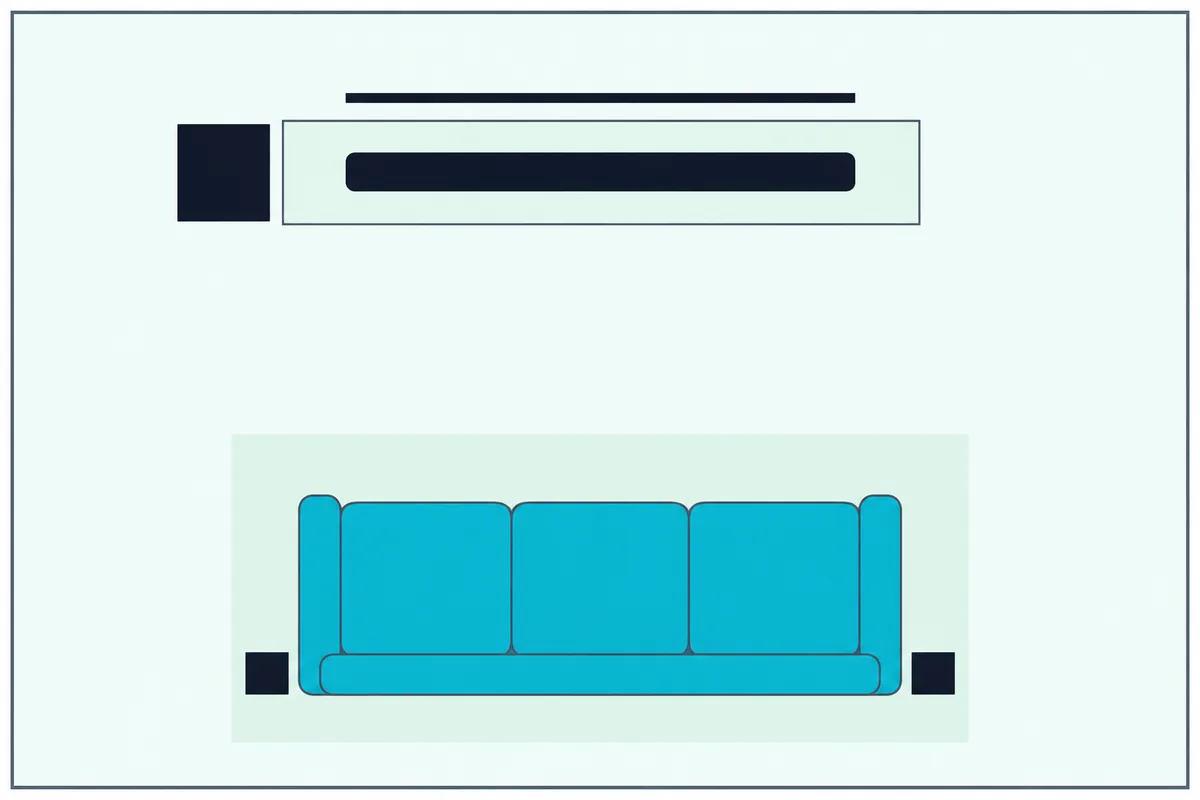
So a 4.1 layout isn’t a 5.1 with a rear speaker missing. It has every surround position 5.1 has and lacks only the front-middle one, as the table shows.
| Speaker | Dolby’s 4.1 guide | Dolby’s 5.1 guide | What Dolby says it’s for |
|---|---|---|---|
| Left and right | Yes, 22 to 30 degrees out | Yes, 22 to 30 degrees out | The main speakers for music and sound effects |
| Center | No | Yes, at 0 degrees | Primarily delivering dialog |
| Left and right surround | Yes, 110 to 120 degrees | Yes, 110 to 120 degrees | Sound effects and music around you |
| Subwoofer | Yes | Yes | Deep bass, placed almost anywhere |
The numbers on the box follow the same rule. Dolby’s guides say the first number counts the traditional surround speakers (front, center, surround) and the second counts powered subwoofers, so 4.1 means four ear-level speakers and one sub, and 5.1 means five and one.
Receiver makers count the same way. Onkyo’s TX-NR6100 manual offers a “4.1 ch” speaker setting and describes its Atmos 4.0/4.1 mode as the one for front and surround speakers, while its 5.0/5.1 mode adds the center speaker.
Flip the trade around and you get 3.1. Onkyo’s manual describes 3.1 as front speakers with a center speaker and a subwoofer, the center-without-rears case that Burton Acoustix’s 3.1 vs 5.1 comparison takes apart.
Why Does the Center Channel Matter for Dialogue?
That one box at 0 degrees has a specific job. Dolby’s speaker setup guide says center speakers are “primarily used to deliver dialog” and should sit just below or above the TV so the sound comes directly at you, while it calls the left and right speakers the main ones for music and sound effects.
Makers that build a center into a 5.1 bar treat it the same way. Vizio’s V51-H6 and M51a-H6 manuals give the center its own level control, which raises or lowers “the presence of dialog in the center channel.”

Think of the center as a lane of its own. Vizio’s Center Level moves that one lane, so voices mixed there rise or fall while the left, right and surround channels stay where they were.
The speaker test in Vizio’s M51a-H6 user manual calls out the positions in turn: left front, center, right front, right rear, left rear and the subwoofer. In Dolby’s 4.1 layout, the second name on that list has no speaker.
LG’s NS40TR owner’s manual shows what that looks like in practice. It labels the speaker positions front speakers, subwoofer and rear speakers, and its Sound Tuning list runs subwoofer, rear, treble, mid and bass, with no center level.
What Does 4.1 Ch Mean on a Soundbar?
That LG manual comes from a maker that sells sets under the 4.1 label. On a soundbar, 4.1 ch means four main channels and one subwoofer, the count in Dolby’s 4.1 guide, and on LG’s sets the four are the bar’s left and right plus two rear speakers.
LG’s S40TR, SQC4R and SNC4R are each listed on Amazon as 4.1-channel soundbars. The S40TR’s listing describes “4 channels” with a wireless subwoofer and wireless rear speakers, and adds that the rear speakers require a wired connection between them and that one rear speaker needs AC power.
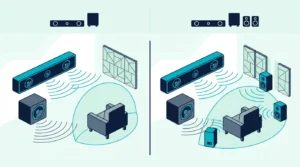
LG’s NS40TR owner’s manual covers the same kind of package: a soundbar, a wireless subwoofer and a pair of rear speakers joined by a speaker cable, with a power cable for the rear speaker. Its drawings show the bar’s sound coming from its two ends, left and right, with no middle position.
So the “4” isn’t four speakers in the bar. It’s the bar’s left and right plus the two rears, which is Dolby’s 4.1 map with the front pair moved into one cabinet.
For a set sold under the 4.1 label, the LG S40TR 4.1 ch soundbar with rear surround speakers and wireless subwoofer pairs its bar with that rear set and sub. Its listing gives the bar as 28.4 inches wide and the subwoofer as 6.7 by 12.6 by 9.9 inches.
LG S40TR 4.1 ch soundbar with rear surround speakers and wireless subwoofer
How Do Makers Count a 5.1 Set?
Where LG’s 4 counts the bar’s two channels and two rears, a 5.1 count adds the middle channel, and makers reach it with different boxes. Sonos and Vizio count the bar’s front channels first and then add the rears: Sonos lists its Ray as 3.0 on its soundbar comparison, and Sonos’s blog on 5.1 and 7.1 surround sound calls a Ray with two Era 100 speakers and a Sub Mini “our most compact 5.1 system.”
That blog spells out the rule. The first number is the ear-level channels and the second is the subwoofer, so a 5.1 system has left, right and center in front and left and right surrounds behind.
Vizio spreads the same five channels across a bar, a subwoofer and two surround speakers. Its V51-H6 and M51a-H6 manuals call each a “5.1 Sound Bar” and put two surround speakers and a wireless subwoofer in the box, with the surround speakers cabled to the subwoofer rather than to the bar.
Roku names its layouts by parts instead of numbers. Its support article on building a Roku surround sound system calls a Roku Wireless Soundbar with two rear Roku Wireless Speakers and a Roku Wireless Subwoofer “true surround sound,” on Roku Plus and Pro TVs only.
Amazon’s bundle follows the 5.1 pattern too. The Amazon Fire TV Soundbar Plus with subwoofer and surround speakers is listed as 5.1-channel, with a subwoofer, two surround speakers and “a dedicated center dialogue channel.”
Amazon Fire TV Soundbar Plus with subwoofer and surround speakers
Every pick met Burton Acoustix’s rating, review and stock checks on 3 November 2026. For more sets in this layout, 5.1 soundbars sorted by where their surrounds come from separates bars with rear speakers in the box from bars that keep the surrounds inside.
How Does a 4.1 Set Play a 5.1 Movie?
Those boxes only matter once a 5.1 soundtrack reaches them. In LG’s NS40TR manual, with the rear speakers connected, a 5.1-channel input plays from the bar, the subwoofer and the rears in every sound effect mode, and the drawing shows the bar’s sound coming from its left and right ends.
LG’s manual doesn’t say how the bar handles the center channel of that 5.1 input. If voices are the reason you’re shopping, check how your set’s manual describes it.
Onkyo’s receiver manual is explicit in one case: the TX-NR6100’s Mono mode plays mono audio from the center speaker and, if no center speaker is connected, from the front speakers instead.
On Vizio’s 5.1 sets, the M51a-H6 manual says Dolby and DTS surround content plays as full 5.1 sound when Surround is on. The center channel there has its own speaker and the Center Level control from earlier.
None of that happens unless the TV passes 5.1 along. Roku’s guide to connecting surround sound to a Roku TV says the optical (S/PDIF) connection is limited to two channels of uncompressed stereo (PCM) or 5.1 channels of compressed Dolby Digital or DTS, and that HDMI ARC adds Dolby Digital Plus and Dolby Atmos.
The menus for each TV brand are in the soundbar to TV connection guide, and the same limit applies to 4.1 and 5.1 sets alike. A 4.1 bar fed two-channel PCM gets no surround channels of its own, so anything its rears play comes from the bar’s surround mode.
Do Stereo Shows and Music Use the Fifth Channel?
A 5.1 movie is half the story, and stereo shows are the other half, since a two-channel show carries no center or surround channels of its own. Only a mode that spreads the sound puts them to work: Vizio’s M51a-H6 manual says that with stereo content, Direct EQ with Surround off gives 2.1 audio “without center or surround,” while EQ Music adds DTS Virtual:X and EQ Movie produces “realistic 5.1 effect sound.”
LG’s NS40TR table shows the same split on a set with no center. In its Standard mode, a 2.0-channel input plays from the bar and subwoofer with the rear speakers silent, while AI Sound Pro, Cinema and Game send it to the rears as well.
LG describes that surround function as letting you “hear immersive 3D sound produced by multiple audio channels from the speakers, regardless of the channels in the originally recorded content.” Vizio’s Dual setting does something similar, playing the same left and right channel content from both surround speakers as from the bar.
For music, Dolby calls the left and right speakers the main speakers for music, and both layouts have them. The fifth channel is the one a stereo track never fills, unless a mode like Vizio’s EQ Movie spreads the sound across it.
Where Do the Rear Speakers Go in a 4.1 or 5.1 Room?
Whether the rears play every show or only some, both layouts ask the same thing of the room behind you. Dolby’s 4.1 and 5.1 guides put the surround speakers at 110 to 120 degrees from the line between your seat and the screen, beside and slightly behind you, at your ear height when you’re seated.
Vizio’s M51a-H6 manual says to place the subwoofer and surround speakers in the rear of the room, with the bar centered below the TV and close to ear level. Its surround speakers take their cables from the subwoofer, and the sub goes to the back with them.

LG’s NS40TR manual asks for at least 30 cm, about 12 inches, between the rear speakers and the TV. It also wants at least 1 m, about 3.3 feet, between the bar or rears and devices such as wireless routers and microwave ovens.
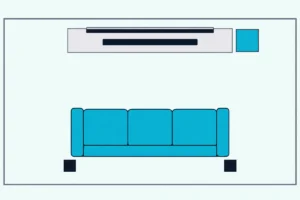
Its rears also need a speaker cable between them and an outlet for one of them. In a bedroom like the one pictured, that can mean one rear on each nightstand and a cable along the headboard wall.
Rooms with no spot behind the seat have a documented fallback on Vizio’s sets. Its Front Surround Mode is for rooms where ideal placement of the surround speakers isn’t practical, with the surrounds near the bar and DTS Virtual:X producing a virtual surround experience.
Dolby’s guides add three checks for either layout: a clear path from each speaker to you, small adjustments after a first listen, and fewer bare walls and floors. For the bar and subwoofer side, the soundbar setup guide walks the seven steps from the bar’s spot to the subwoofer.
Which Layout Suits Your Room and Viewing?
Put those pieces together and the choice turns on two questions: where voices should come from, and where the rears can sit. A 5.1 set gives dialogue a center channel, which Vizio’s sets let you level on its own, and a 4.1 set keeps the same rears and subwoofer with only left and right in front.
The documents point to four checks before you buy.
- If you want a separate control for voices, look for a center level like Vizio’s; LG’s NS40TR tuning list has none.
- If the room has spots at Dolby’s 110 to 120 degrees beside and behind the seat, both layouts use them the same way.
- If most of what you watch is stereo, LG’s Standard mode leaves its rears silent for 2.0 input and Vizio’s Direct EQ with Surround off plays 2.1.
- If you also want height, the third number counts overhead speakers, as the FAQ below explains.
Both layouts already include the .1, so the subwoofer doesn’t separate them. How big a subwoofer a room needs is covered in the best soundbar with subwoofer guide, and how 5.1 compares with no rears at all is in the comparison of a 2.1 bar against a full 5.1 set.
The Bottom Line
The difference between a 4.1 and 5.1 soundbar is one speaker, and it’s the center, not a rear. Dolby’s guides give both layouts the same left, right, surround and subwoofer positions and add the center only at 5.1, the speaker Dolby says is primarily used to deliver dialog.
Pick by the manual, not the number on the box: look for a center channel and a center level if voices come first, and check that the rears have a place at 110 to 120 degrees either way. The descriptions come from the makers’ manuals and spec pages.
Frequently Asked Questions
Is 4.1 good for home theater?
Dolby publishes 4.1 as one of its home theater speaker setups, with left and right speakers, a subwoofer and two surround speakers at 110 to 120 degrees. What it leaves out is the center speaker, which Dolby says is primarily used to deliver dialog. So a 4.1 set keeps the surround speakers of a 5.1 layout and gives up the speaker Dolby assigns to voices. Onkyo’s TX-NR6100 manual treats 4.1 the same way: its Atmos 4.0/4.1 mode is for front and surround speakers, with the center added at 5.0/5.1.
Is 4.1 good for small rooms?
Both layouts need the same two spots for rear speakers, 110 to 120 degrees around the seat in Dolby’s guides, so the question for a small room is whether those spots exist. LG’s NS40TR manual asks for at least 30 cm between the rear speakers and the TV, a speaker cable between the rears and power for one of them. Where rear placement isn’t practical, Vizio’s 5.1 sets have a Front Surround Mode that puts the surrounds near the bar and uses DTS Virtual:X instead.
Is 4.1 good for music?
Stereo music has two channels, and Dolby calls the left and right speakers the main speakers for music, which 4.1 and 5.1 both have. Whether the rears join in depends on the mode. LG’s NS40TR manual shows its Standard mode keeping the rear speakers silent for 2.0 input, while its AI Sound Pro, Cinema and Game modes use them.
What does 4.1.2 mean on a soundbar?
The third number counts height speakers. Dolby’s 4.1.2 overhead guide lists left and right speakers, a subwoofer, left and right surround speakers and two top middle overhead speakers, and it says the third number refers to how many overhead or Dolby Atmos enabled speakers the setup uses. Like 4.1, it has no center speaker. Onkyo’s TX-NR6100 lists “4.1.2 ch” next to “5.1.2 ch” among its speaker settings, and Dolby’s speaker setup guide describes 5.1.2 as left, center, right, two surrounds, a subwoofer and two overhead speakers.