Best LG Sound Bar: 9 Models Compared by LG’s Own Specs

The best LG sound bar for your TV depends less on wattage than on one letter at the end of the model number.
Amazon lists more than a dozen LG models with near-identical names, so it’s easy to buy rear speakers you didn’t want or miss the ones you did.
Match the model to your room and TV, and you get clear dialogue, real height effects from speakers aimed at the ceiling, and one remote.
Below are nine LG soundbars that passed a stock and ratings check on Amazon on 21 October 2026, each described from LG’s own owner’s manuals rather than from ads.
The quick answer and a table come first, then the systems with rear speakers, the bars without them, the budget models, and the LG features that decide the fit.
What Is the Best LG Sound Bar?
That letter matters most, and for most living rooms the LG S90TR is the best LG sound bar because it puts up-firing speakers, side speakers, wireless rear speakers and a wireless subwoofer in one box. LG’s manual places front, center, top, top center and side speakers in the bar itself, with the rear speakers and subwoofer around the room (LG S90TR manual).
If you want LG’s biggest system, the S95TR adds rear speakers that fire up and to the side as well. If you’d rather keep the room clear of rear speakers, the SC9S and S70TY keep their height channels in the bar, and the S60T, S40T and S20A cover smaller rooms and budgets.
| Pick | Channels (LG) | Up-firing speakers | Rear speakers | TV connection | Best for |
|---|---|---|---|---|---|
| LG S95TR | 9.1.5 | 5 (bar and rears) | Wireless, in the box | HDMI eARC plus HDMI in, optical | Biggest rooms |
| LG S90TR | 7.1.3 | 3 in the bar | Wireless, in the box | HDMI eARC plus HDMI in, optical | Best overall |
| LG S80TR | 5.1.3 | 3 in the bar | Wireless, in the box | HDMI eARC plus HDMI in, optical | Narrower TV stands |
| LG S40TR | 4.1 | None | Wired pair, in the box | Listing copy only | Budget surround |
| LG SC9S | 3.1.3 | 3 in the bar | Optional kit | HDMI eARC plus HDMI in, optical | LG OLED C series |
| LG S70TY | 3.1.1 | 1 in the bar | Optional kit | HDMI eARC plus HDMI in, optical | LG QNED TVs |
| LG S60T | 3.1 | None | None | HDMI ARC, optical | Clear dialogue |
| LG S40T | 2.1 | None | None | HDMI ARC, optical | Bass on a budget |
| LG S20A | 2.0 | None | None | HDMI ARC | Small TVs |
Every pick had at least 4.0 stars from 50 or more Amazon reviews and was in stock when checked on 21 October 2026. Prices, ratings and review counts change daily, so none are printed here, and several listings were down to their last one or two units.
None of these soundbars was played or measured for this guide, so each description rests on LG’s manuals and, where LG’s manual couldn’t be read, on LG’s own listing copy. If you’d also like to compare other brands, Burton’s guide to the best soundbar for an LG TV covers bars from Sonos, Polk and others.
| Product | Size | Link |
|---|---|---|
Best Overall 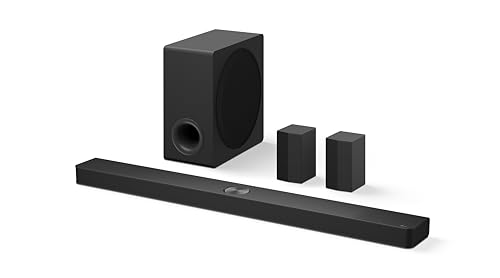 | 49.2 inch | See ratings |
Biggest Rooms 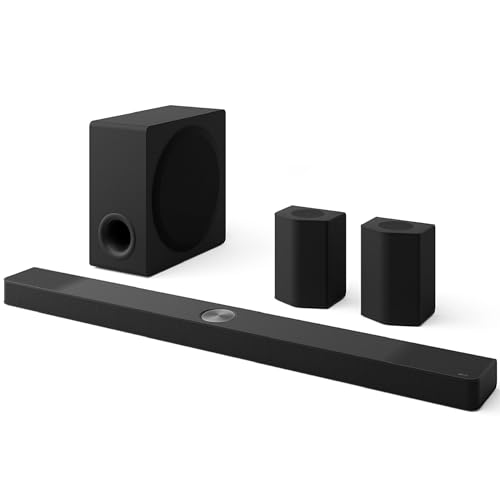 | 49.2 inch | See ratings |
Narrower TV Stands 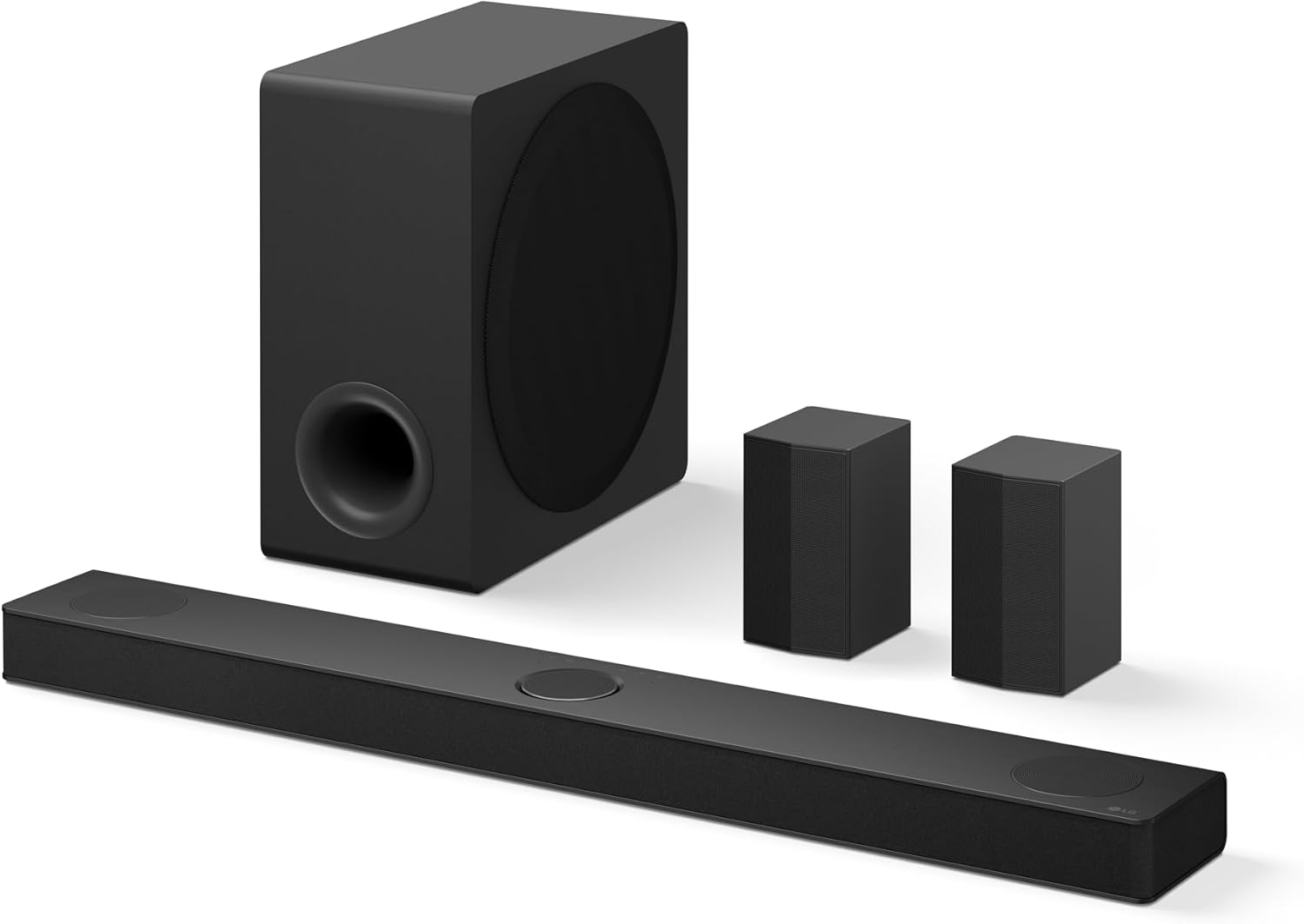 | 39.4 inch | See ratings |
Budget Surround 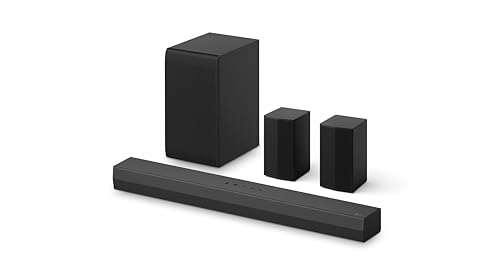 | 28.4 inch | See ratings |
LG OLED C Series 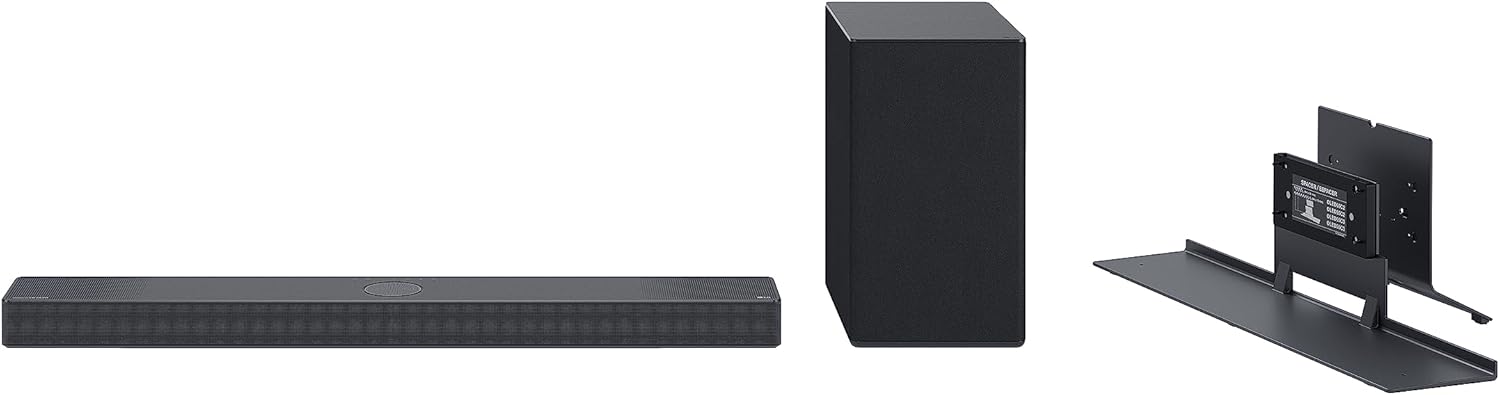 | 38.4 inch | See ratings |
LG QNED TVs 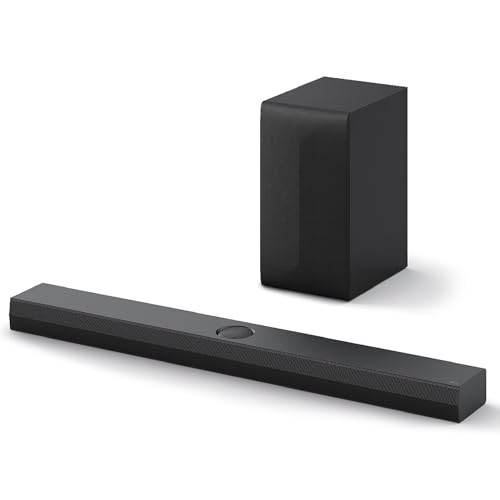 | 37.4 inch | See ratings |
Clear Dialogue 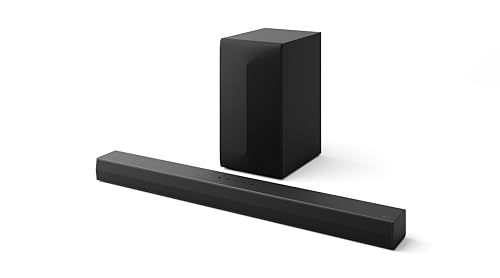 | 33.4 inch | See ratings |
Bass on a Budget 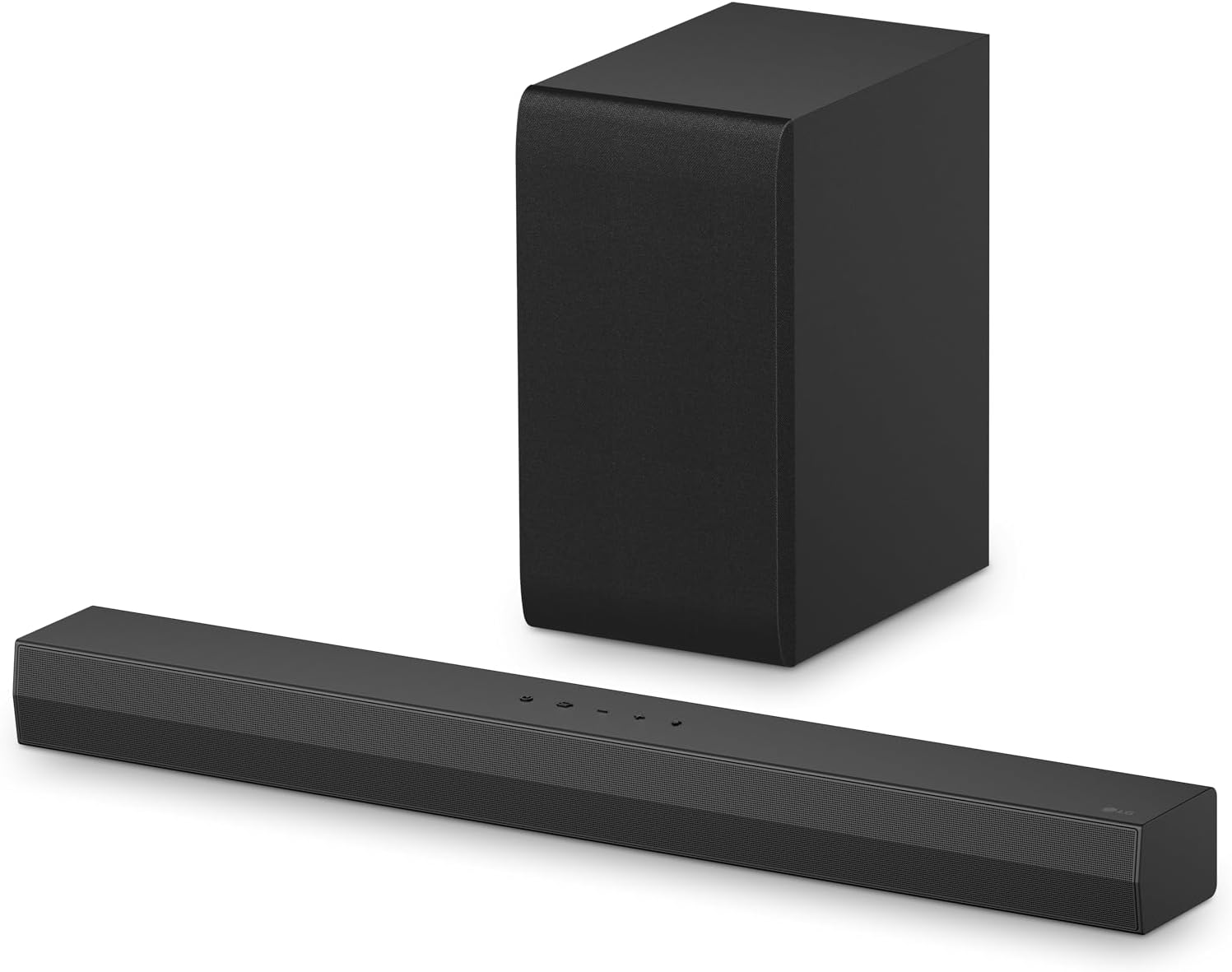 | 28.3 inch | See ratings |
Which LG Soundbars Come With Rear Speakers in the Box?
The table splits cleanly on that question, and four of the nine picks ship with rear speakers: the S95TR, S90TR, S80TR and S40TR. The first three use wireless rear speakers that pair with the bar on their own, while the budget S40TR uses a wired pair in which one speaker needs a power outlet.
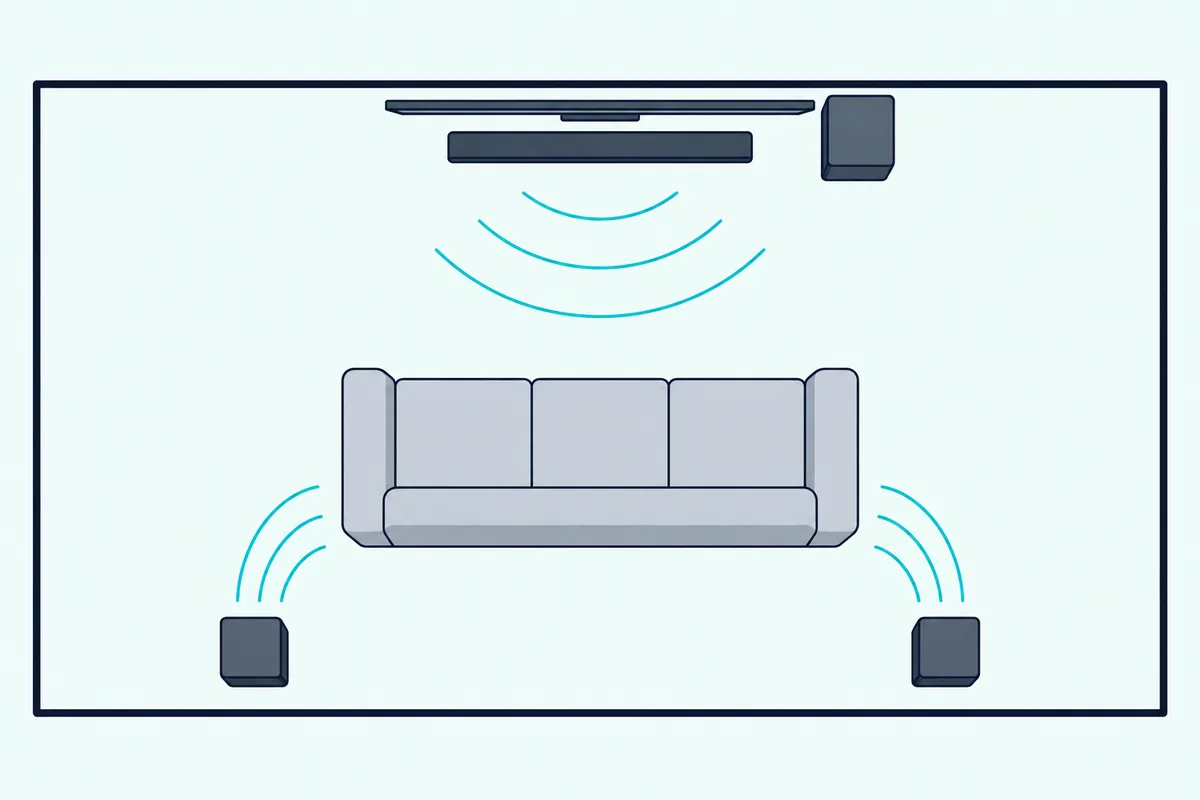
Rear speakers put surround effects behind you with real drivers. Dolby’s sound bar guide calls the alternative virtualization, which simulates surround sound without speakers behind or beside you.
LG S90TR
For most living rooms, the LG S90TR is the pick.
the LG S90TR
LG’s manual lists seven speaker positions for the S90TR system: front, center, top, top center and side speakers in the bar, then the subwoofer and the two rear speakers. That’s the 7.1.3 layout in LG’s listing, with three channels aimed at the ceiling.
The bar decodes Dolby Atmos and DTS:X, along with Dolby TrueHD and DTS-HD Master Audio, according to LG’s format list in its specifications. Its back panel has an HDMI input, an HDMI eARC connection to the TV and an optical input, and LG says the HDMI connection passes 4K at 120 Hz.
A built-in microphone runs AI room calibration from the LG ThinQ app, which LG’s front-panel page names as the microphone’s job. Wi-Fi comes standard, and the manual’s TV setup step lists LG WOWCAST among the sound outputs, so an LG TV that supports WOWCAST can send sound to it without a cable.
To save power, LG says the bar turns itself off after 15 minutes without an input signal from an external device, a note LG prints on the S90TR’s front-panel page.
The bar is 49.2 inches wide and 2.5 inches tall, the same footprint as the S95TR. Measure first, because a 49.2-inch bar is wider than a 55-inch screen, which is about 48 inches across.
LG S95TR
For the largest rooms, the LG S95TR is the pick.
the LG S95TR
LG’s specifications break the S95TR’s 810 W RMS into front, center, side, top and top-center channels in the bar, then rear, rear-side and rear-top channels in the two rear speakers and a 220 W subwoofer (LG S95TR specifications). Each rear speaker carries three drivers, listed as a rear, a side and a top speaker.
That’s how LG reaches 9.1.5, and its listing counts five up-firing speakers in all. The extra two sit in the rear speakers, so overhead sound can come from behind as well as from in front.
LG’s setup step powers the subwoofer first, then the rear speakers, then the bar, and their LEDs turn green once they connect.
The connections and formats match the S90TR: HDMI input, HDMI eARC, optical, Dolby Atmos, DTS:X and 4K 120 Hz pass-through. The subwoofer is the same 7.9 by 16 by 15.9-inch box, rated at 220 W RMS with a 440 W maximum.
In this guide’s view, the S95TR earns its place over the S90TR when the rear speakers can stand behind your seats rather than beside them. That’s where its rear-top drivers add overhead sound from behind, which the S90TR’s rears don’t have.
LG S80TR
For narrower stands, the LG S80TR is the pick.
the LG S80TR
The S80TR keeps the S90TR’s height layout in a shorter bar: LG’s amplifier table lists two front, one center, two top and one top-center channel, plus two 50 W rear speakers and a 220 W subwoofer. Its 580 W RMS total and 39.4-inch width make it the compact way into LG’s rear-speaker systems.
What it drops is the pair of side speakers, so the bar itself spreads sound less widely than the S90TR. The rear speakers carry the surround effects instead, so the S80TR leans on them more than the S90TR does.
It’s the only pick here whose manual describes a text display, and LG’s setup step says it shows “OPT”, “ARC” or “E-ARC” once the TV connection is made. That makes it easy to confirm that eARC is working, which matters for the lossless Atmos formats on the format list.
The formats, HDMI input and 4K 120 Hz pass-through match the S90TR’s specification. Wi-Fi and the [LG WOWCAST] output option are in the manual too.
LG S40TR
For surround sound on a budget, the LG S40TR is the pick.
the LG S40TR
LG’s Amazon listing describes four channels, a wireless subwoofer and rear speakers, with Dolby Digital and DTS Digital support. No LG-hosted manual for the S40TR could be read for this guide, so its card rests on that listing copy, and the connection list stays a gap.
The listing’s footnote matters for placement: the two rear speakers need a wired connection between them, and one of them needs AC power. Plan a cable run along the back wall, or behind the sofa, before you buy.
The bar measures 28.4 by 2.5 by 3.4 inches and the subwoofer 6.7 by 12.6 by 9.9 inches, both from the listing. That small bar is the point, because by this guide’s sizing it’s the only rear-speaker system here for a 43-inch or 50-inch TV.
Its listing’s bar and subwoofer sizes match the S40T’s manual to within a tenth of an inch, and the R adds the rear pair. Neither one has height speakers, so movies with Atmos soundtracks play without the overhead layer.
Get Studio Tips Weekly
Join 5,000+ creators getting acoustic treatment advice every week.
No spam. Unsubscribe anytime.What If You Want an LG Soundbar Without Rear Speakers?
Those rear-speaker systems all need floor or shelf space behind you, and the SC9S, S70TY and S60T are the picks for rooms without it. The SC9S and S70TY keep up-firing speakers in the bar and accept an optional rear kit later, while the S60T is a simpler 3.1 bar with a center channel for dialogue.
Dolby’s speaker setup guide says center speakers are primarily used to deliver dialog. A bar with its own center channel gives voices a speaker of their own rather than sharing the left and right ones.
LG SC9S
For an LG OLED evo C-series TV, the LG SC9S is the pick.
the LG SC9S
LG’s listing describes the SC9S as the first of its kind with triple up-firing height channels, and LG’s own channel count is 3.1.3. Its format list is the longest here, adding IMAX DTS and IMAX DTS:X to Dolby Atmos, Dolby TrueHD and DTS-HD Master Audio.
The bracket is the reason to choose it. LG’s listing says the synergy bracket fits 55, 65 and 77-inch OLED evo C2, C3 and C4 models, and the manual’s mounting chapter stands the bar and TV together with a rear bracket that LG says must be attached.
LG’s manual says WOW Orchestra on the SC9S works only over an HDMI cable or an LG WOWCAST connection, and it asks you to enable eARC on the TV (LG SC9S manual). The bar has an HDMI input, HDMI eARC, optical and Wi-Fi, and LG controls it through the LG Sound Bar app rather than ThinQ.
Rear speakers come later as the SPQ8-S kit, a wireless receiver that connects to two rear speakers by cable.
The bar is 38.4 inches wide, which leaves a little space on each side under a 55-inch C-series screen. LG’s specification also lists an external AC adapter for the SC9S, so leave room behind the TV for the power brick.
LG S70TY
For an LG QNED TV, the LG S70TY is the pick.
the LG S70TY
The S70TY’s surround page names its speakers as front, center, a top center speaker for overhead sound, the subwoofer and optional rear speakers. That one top speaker is the “.1” at the end of 3.1.1, so height effects come from the middle of the bar rather than from both sides.
It decodes the same Atmos and DTS:X formats as the S90TR, and its HDMI input passes 4K at 120 Hz to the TV. For a console owner who wants Atmos without rear speakers, that’s the useful combination at this size.
LG’s listing ties it to the QNED range: it names the BT5-2P QNED synergy bracket for 55, 65, 75 and 86-inch 2024 QNED 80, 85, 90 and 99 TVs. LG’s accessory page for that bracket couldn’t be read for this guide, because lg.com refuses Burton’s scripts, so check your TV’s model year before you count on it.
Its manual adds LG Sound Sync (Wireless), a cable-free link set up with the bar’s Bluetooth pair button that lets an LG TV remote set the volume, and WOW Orchestra over HDMI. Its specification page lists no Wi-Fi, and its TV setup step offers no LG WOWCAST output, so expect a cable or Bluetooth.
LG S60T
For clear dialogue without height speakers, the LG S60T is the pick.
the LG S60T
The S60T is the smallest bar here with a center channel, and LG’s listing calls it a 3.1-channel bar with a dedicated center channel. Its format list stops at Dolby Digital, DTS Digital Surround and PCM, so it plays Atmos soundtracks from their core 5.1 layer (LG S60T specifications).
Its TV connection is HDMI ARC rather than eARC, plus optical, and it has no HDMI input. ARC is enough here, since the bar’s format list holds nothing that needs eARC.
LG’s HDMI chapter for the S60T covers WOW Orchestra, which plays the TV’s speakers with the bar, and WOW Orchestra PSW mode, a personalized sound mode the TV sets up. LG’s note says WOW Orchestra needs the HDMI cable.
The bar is 33.4 inches wide and only 3.4 inches deep, so it sits on a shallow shelf. The wireless subwoofer is the same 7.9 by 14.8 by 11.2-inch box LG ships with the S70TY.
Is a Cheaper LG Soundbar Enough for a Small Room?
The S60T marks where LG’s center channel stops, and below it the S40T and S20A trade that center speaker for size and simplicity. In a bedroom or a small living room, either one is a clear step up from flat TV speakers, as long as you don’t expect surround effects.
Here’s a quick test before you choose between them. Play a scene with an explosion at your usual volume, and if your TV’s speakers rattle or go thin, the S40T’s subwoofer is the fix; if only voices are the problem, the S20A may be all you need.
LG S40T
For bass on a budget, the LG S40T is the pick.
the LG S40T
LG’s amplifier table for the S40T lists two 50 W front channels and a 200 W subwoofer, 300 W RMS in all. That’s a 2.1 layout, so most of the system’s power goes to bass.
One listing detail contradicts LG’s manual, and it’s worth knowing before you compare boxes. The Amazon listing’s title says 2.1, but its description says “4.1 ch.”, and the manual’s amplifier table settles it at two front channels and a subwoofer.
The S40T connects through HDMI ARC or optical and handles Dolby Digital, DTS Digital Surround and PCM. Its manual’s HDMI chapter doesn’t mention WOW Orchestra, so don’t count on the TV’s speakers joining in.
The bar is 28.3 inches wide, which suits 43-inch and 50-inch TVs, and LG’s specification lists an external AC adapter for it. The subwoofer is smaller than the S60T’s, at 6.7 by 12.6 by 9.9 inches.
LG S20A
For small TVs and simple setups, the LG S20A is the pick.
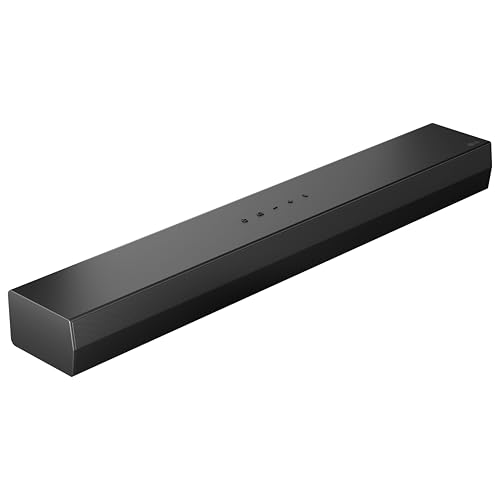
the LG S20A
The S20A is LG’s all-in-one bar: two 25 W front channels, no subwoofer, and one HDMI ARC connection to the TV. At 25.6 inches wide, it’s narrower than a 32-inch screen, which is about 28 inches across.
The manual LG’s manual host serves for it is the UK edition, where the model is called the US20A. That edition lists HDMI ARC as the only TV connection, with no optical input, so check the US box before you plan on an optical cable.
The same manual covers WOW Orchestra and WOW Orchestra PSW mode over HDMI, so an LG TV can play through its own speakers and the bar together. Formats are Dolby Digital, DTS Digital Surround and PCM.
Treat it as a dialogue and clarity upgrade rather than a home theater, and in this guide’s view the simplest bar to set up on this list. If your room is bigger than a bedroom, the S40T’s subwoofer or the S60T’s center channel will do more.
What Do LG’s Soundbar Model Numbers Mean?
Those nine names follow a pattern, and the number after the S tells you most of what you need: higher numbers bring more channels. Across these picks, the S20A is 2.0, the S40T is 2.1, the S60T is 3.1, the S70TY is 3.1.1, the S80TR is 5.1.3, the S90TR is 7.1.3 and the S95TR is 9.1.5, by LG’s own channel counts.
The letters after the number mark the model year and the extras. RTINGS’s LG lineup key dates names ending in TR to 2024 and AR to 2025, and it reads QR, as in the S95QR, as a model with rear speakers and Google Assistant (RTINGS).
LG’s own documents bear out the R. The S40TR, S80TR, S90TR and S95TR list rear speakers in the box, while the S40T, S60T and S70TY list none, and the S70TY’s manual calls its SPT8-S rear kit “sold separately”.
The Y in S70TY is less clear from LG’s documents. LG’s listing calls the S70TY “QNED TV Matching”, but no LG manual read for this guide defines the letter, so treat it as a model name rather than a feature.
Two other names break the pattern. LG’s listing introduces the SC9S as the “LG Sound Bar C” for its C-series OLEDs, which RTINGS’s key dates to 2023, and the 2026 Sound Suite system centers on the H7 bar with M5 and M7 speakers and a W7 subwoofer, according to RTINGS.
How Many Up-Firing Speakers Does Each LG Soundbar Have?
The last number in each channel count answers that, and five of the nine picks have speakers aimed at the ceiling for Dolby Atmos. The S95TR has five, the S90TR, S80TR and SC9S have three each, and the S70TY has one; the S60T, S40TR, S40T and S20A have none.
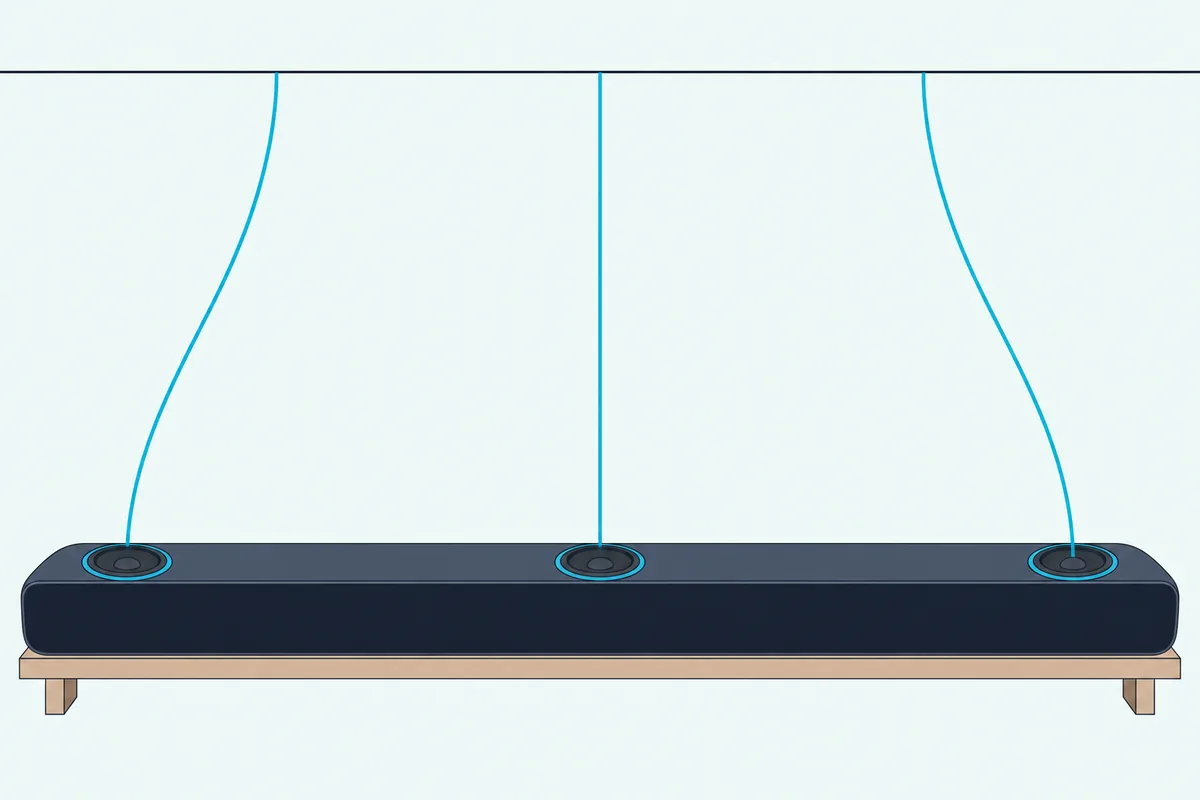
Dolby describes the up-firing approach in its sound bar setup guide. Up-firing speakers in the top of the bar use the ceiling’s reflection to place sound above you, and Dolby calls them one of the easiest ways to identify an Atmos sound bar (Dolby).
The same guide describes the other route, virtualization, which simulates overhead sound from speakers at ear level. None of LG’s bars without height speakers in this guide lists Dolby Atmos decoding at all, so the line is simple: no up-firing speaker, no Atmos on these picks.
DTS:X follows the same split. The S95TR, S90TR, S80TR, SC9S and S70TY list DTS:X with Dolby Atmos, while the S60T, S40T and S20A stop at DTS Digital Surround.
Dolby’s speaker setup guide explains the numbers: the first counts ear-level speakers, the second subwoofers, and the third height speakers. Think of the ceiling as a mirror for those height speakers, which is why the S70TY’s single one sits in the middle of the bar.
Does Your Ceiling Suit LG’s Up-Firing Speakers?
Those up-firing speakers only work as well as the surface above them, and Dolby’s guide puts the ideal ceiling between 7.5 and 12 feet high. It asks for a flat, acoustically reflective ceiling, and says a shallow vaulted ceiling still gives acceptable results.
Dolby also warns against acoustic ceiling tiles, which tend to absorb the overhead sound. Popcorn finishes, chandeliers and can lights don’t interfere, according to Dolby’s guide.
Placement matters as much as the ceiling. Dolby advises against putting an up-firing bar in a cabinet or under a soffit, because that blocks the path to the ceiling.
Mounting height matters too, because the up-firing speakers need open air above the bar. Burton Acoustix’s LG install guide covers LG’s spacing below the TV and the bracket steps model by model.
Try this before you choose a 5.1.3 or 3.1.3 system. Stand where the bar will sit and clap once while looking up, and if the ceiling is tiled or higher than 12 feet, a bar without height speakers, such as the S60T or S40TR, may suit the room as well.
What Do WOW Orchestra and WOWCAST Add With an LG TV?
Ceilings decide the height layer, and LG’s TV features decide how the bar and TV work together. WOW Orchestra plays sound through the LG TV’s speakers and the LG soundbar at the same time, and LG WOWCAST sends sound from the TV to a supporting soundbar without a cable.
LG’s soundbar manuals put the same conditions on WOW Orchestra: it works on some LG TV and soundbar models, it follows the audio codec the TV supports, and it needs an HDMI connection. On the S90TR and SC9S, LG adds that an LG WOWCAST connection also works and asks you to enable eARC on the TV.
LG’s webOS 2024 user guide describes WOWCAST as a way to “enjoy rich sound without degraded quality” from a wirelessly connected soundbar that supports it (LG webOS user guide). The same guide recommends a 5 GHz Wi-Fi network and warns that screen sharing or Wi-Fi Direct on a 2.4 GHz network will disconnect it.
Among the picks, LG’s manuals list the [LG WOWCAST] sound output for the S95TR, S90TR and S80TR, and LG’s listing says the SC9S is WOWCAST ready. The S70TY’s manual offers LG Sound Sync (Wireless) over Bluetooth instead, and the S60T, S40T and S20A manuals list no WOWCAST option.
On the S70TY, S60T and S20A, LG’s manuals also describe WOW Orchestra PSW mode, a Personalized Sound Wizard the LG TV provides. LG says it analyzes the sound you pick with AI deep learning and sets it as your preferred sound, and it points to the TV’s manual for the settings.
The guide also notes a catch for gamers. If Sound Out is set to a Bluetooth device while the TV is in Game Optimizer, the picture mode changes to Standard, and LG recommends a wired optical or HDMI connection if problems continue.
Do You Need HDMI eARC for an LG Soundbar?
WOW Orchestra already leans on HDMI, and eARC is the version of that connection you want for Atmos. HDMI LA says eARC carries uncompressed 5.1 and 7.1 audio and formats such as DTS-HD Master Audio, DTS:X, Dolby TrueHD and Dolby Atmos (HDMI LA).

The five Atmos picks all have an HDMI eARC connection, and LG’s manuals repeat the point. They say eARC supports DTS-HD Master Audio, DTS:X, Dolby TrueHD and Dolby Atmos, that your TV must support eARC before you turn it on, and that the cable should be a certified one with the HDMI logo.
The S60T, S40T and S20A use plain HDMI ARC, which matches what they decode: Dolby Digital, DTS Digital Surround and PCM. eARC wouldn’t add anything for those three, because their format lists stop there.
An HDMI input on the bar is the other difference. The S95TR, S90TR, S80TR, SC9S and S70TY have one, so a console or streaming box can plug into the bar, and LG lists 4K 120 Hz pass-through for all of them except the SC9S, whose US manual gives 4K with HDCP 2.3.
LG’s setup steps show an external device such as a console plugged into either the soundbar or the TV by HDMI. Burton’s guide to connecting an LG soundbar to an LG TV walks through the Sound Out menus for each connection.
Which LG Soundbar Fits Your Room and TV?
Those connections settle the TV side, and width settles the room side. LG’s bars run from 25.6 inches for the S20A to 49.2 inches for the S90TR and S95TR, all from LG’s manuals except the S40TR, whose width comes from its listing.
| Pick | Bar width | Bar height | Bar depth | Suits TVs around |
|---|---|---|---|---|
| LG S95TR | 49.2 in | 2.5 in | 5.3 in | 65 in and up |
| LG S90TR | 49.2 in | 2.5 in | 5.3 in | 65 in and up |
| LG S80TR | 39.4 in | 2.5 in | 5.3 in | 50 to 65 in |
| LG SC9S | 38.4 in | 2.5 in | 4.9 in | 55 to 77 in C-series OLED |
| LG S70TY | 37.4 in | 2.5 in | 4.5 in | 50 to 65 in |
| LG S60T | 33.4 in | 2.5 in | 3.4 in | 43 to 55 in |
| LG S40TR | 28.4 in | 2.5 in | 3.4 in | 43 to 50 in |
| LG S40T | 28.3 in | 2.5 in | 3.4 in | 43 to 50 in |
| LG S20A | 25.6 in | 2.5 in | 3.9 in | 32 to 43 in |
The “suits” column is this guide’s rule of thumb, not LG’s, based on the bar sitting no wider than the screen. A 55-inch TV is about 48 inches wide, so LG’s two longest bars run slightly wider than a 55-inch screen.
Every bar here is 2.5 inches tall in LG’s documents, 63 mm in the manuals. Measure the gap under your screen anyway, since a bar taller than the gap will block the bottom of the picture.
Room size points the other way. In this guide’s view, a 12 by 14-foot bedroom is well served by the S20A or S40T, while an open-plan living room with a sofa far from the TV is where the S90TR’s side speakers and rear speakers earn their space.
Can You Add Rear Speakers to an LG Soundbar Later?
The bars without rear speakers aren’t all locked that way, and two of the picks accept an LG rear kit later. The SC9S takes the SPQ8-S kit, which LG’s specification lists as a wireless receiver plus two rear speakers, and the S70TY takes the SPT8-S kit, which its manual calls sold separately.
The two kits wire differently, according to LG’s setup pages. The SC9S’s rear speakers connect by speaker cable to the wireless receiver, and the S70TY’s manual says to connect its rear speakers via a speaker cable, with the black-striped wire on the negative terminal.
The S60T, S40T and S20A manuals list no rear speakers in their setup diagrams. So if you think you’ll want surround sound later, choose the S40TR or S80TR now.
Same logic applies to the subwoofer. Every pick except the S20A ships with a wireless subwoofer, and the S20A’s manual shows no subwoofer connection at all.
Which Sound Modes Do LG Soundbars Share?
Rear speakers change what the bar can do with ordinary TV sound, and LG’s surround setting is where that shows. LG’s manuals for the S70TY, S80TR, S90TR and S95TR list the same eight sound modes: AI Sound Pro, Standard, Cinema, Clear Voice Pro, Sports, Music, Game and Bass Blast.
Clear Voice Pro is the one to try first if dialogue is your complaint, because LG describes it as improving the clarity of voices. AI Sound Pro is LG’s automatic choice, which the manuals describe as sound customized with artificial intelligence.
The surround setting is separate from the modes. LG’s manuals say it plays immersive 3D sound from all the speakers regardless of the channels in the original recording, so a 2.0 music track can spread to the rear speakers.
Each manual has a table showing which speakers play for 2.0, 5.1 and 7.1 sources in every mode, with and without the rear speakers connected. Turn the setting off if you’d rather hear a recording in its original channels, and on if you want 2.0 TV shows spread across every speaker.
Here’s a quick test after setup. Play a news channel in Standard, then switch to Clear Voice Pro and back, and keep whichever mode lets you lower the volume without losing words.
One remote can run all of this with an LG TV. LG’s manuals describe SIMPLINK, the HDMI-CEC link that lets a SIMPLINK-compatible LG TV remote turn the bar on and off, change the volume and mute it.
Why Didn’t Newer LG Soundbars Make the List?
Those modes appear in every LG surround manual read here, but LG’s newest models mostly failed this guide’s rules on the day. LG’s 2025 S95AR fell short of the review-count rule on both readings, and the 2026 Sound Suite H7 bar fell short of both the review-count and the rating rules.
The rest of the shortlist failed for similar reasons. The S77TY and S77S fell short of the review-count rule, the Eclair SE6S and the older SK1 fell short of the rating rule, the S70TR listing showed no ratings at all, and the S30A and S6FTR fell well short of the review-count rule.
The S95QR, an earlier LG flagship, passed every rule but was left out as an older generation. Its manual carries a 2023 copyright against the S95TR’s 2024, and the listing was sold by a third-party seller.
Renewed and refurbished listings were skipped too, including an SP7R system. A refurbished soundbar can be a fine buy, but it isn’t the model a new buyer gets.
If any of these passes both rules on a later check, it’ll be worth a look. RTINGS ranks two Sound Suite systems first in its LG list, so the H7 is the model to watch.
How Were These LG Soundbars Checked?
That shortlist came from one set of rules applied to every LG soundbar on Amazon. Each pick needed at least 4.0 stars, 50 or more reviews, stock on hand and a current price on 21 October 2026, and prices were checked but are never printed.
Each spec on this page comes from LG’s own online owner’s manuals, read as LG publishes them on its manual host: the specification, setup and HDMI pages for each model. The S40TR is the exception, because no LG manual for it could be read, so its card uses LG’s Amazon listing copy and says so.
One manual edition isn’t a US one: the S20A’s is the UK edition, where the model is called the US20A, so its card notes where a US box might differ.
Stock moved during the check itself: several listings read ‘cannot be shipped’ on one lookup and in stock on the next, so each card was confirmed on its listing’s own address.
Nothing here was listened to, measured or tested for this guide. The judgments, such as which bar is best for most rooms, are this guide’s reading of LG’s specs against common room sizes, and they’re labeled that way.
The Bottom Line
Everything above comes back to the model letters and the room. For most living rooms, the S90TR is the best LG sound bar, with three up-firing speakers, side speakers, wireless rear speakers and a wireless subwoofer in one box.
Pick the S95TR if its rear speakers can stand behind your seats and you want height effects from behind too. Pick the S80TR if your stand is narrower, or the S40TR if you want rear speakers without Atmos on a smaller budget.
Without rear speakers, the SC9S is the match for a C-series OLED, the S70TY for a QNED, and the S60T for clear dialogue. The S40T and S20A are the small-room picks.
Before you buy, check three things: your ceiling for up-firing speakers, your TV’s HDMI eARC port, and the gap under your screen. For sound mode choices after setup, Burton’s explainer on what LG’s sound modes change picks up where this guide ends.
Frequently Asked Questions
Which LG soundbar is best for an LG OLED TV?
The SC9S is built for LG’s OLED evo C series, with a synergy bracket that LG lists for 55, 65 and 77-inch C2, C3 and C4 models. It has three up-firing height channels, HDMI eARC and WOW Orchestra over HDMI or WOWCAST.
For a larger room, the S90TR, which LG’s listing calls “OLED evo TV Matching”, adds side speakers and wireless rear speakers. It also lists WOWCAST, so an LG TV that has the feature can send it sound without a cable.
Do LG soundbars support Dolby Atmos?
Five of the nine picks do: the S95TR, S90TR, S80TR, SC9S and S70TY list Dolby Atmos and DTS:X in their format tables. Each has at least one up-firing speaker, and each uses HDMI eARC for the lossless formats.
The S60T, S40TR, S40T and S20A don’t list Atmos. They decode Dolby Digital and DTS Digital Surround, so Atmos soundtracks play from their core layer.
Can an LG soundbar play through the TV’s speakers at the same time?
Yes, on supporting models, through WOW Orchestra. LG’s manuals say it plays sound through the LG TV’s speakers and the soundbar together, turns on automatically when the bar is connected, and needs an HDMI connection.
On the S90TR and SC9S, LG says an LG WOWCAST connection also works. The feature depends on both the TV and the soundbar model, so check your TV’s Sound Out menu.
Does an LG soundbar work with a non-LG TV?
Yes, through HDMI ARC or eARC, and on most picks optical or Bluetooth too. LG’s manuals list other brands’ HDMI-CEC names, such as Samsung Anynet+ and Sony BRAVIA Sync, beside LG’s own SIMPLINK.
What you lose is LG’s TV features. WOW Orchestra, WOWCAST and LG Sound Sync need an LG TV that supports them.
Is the LG S90TR or the S95TR better?
The S95TR adds two up-firing channels in its rear speakers, so overhead sound can come from behind as well as in front. LG’s manuals give both the same 49.2-inch bar, the same formats and the same HDMI eARC and HDMI input.
In this guide’s view, the S90TR is the better fit for most rooms, because its side speakers and three up-firing channels already cover the front of the room. The S95TR makes sense when the rear speakers can stand behind the seats.
Which LG soundbar is best for gaming?
The S95TR, S90TR, S80TR and S70TY list an HDMI input with 4K pass-through at 120 Hz, so a console can plug into the bar. Each also has a Game sound mode in LG’s manuals.
LG’s webOS guide warns that a Bluetooth sound output changes the TV’s Game Optimizer picture mode to Standard. Use HDMI for a console, and pick the S70TY if you want Atmos without rear speakers.
What’s the difference between the LG S40T and S40TR?
The R adds rear speakers. The S40TR is a 4.1 system with a wired pair of rear speakers and a wireless subwoofer, according to LG’s listing, while the S40T is a 2.1 bar with a wireless subwoofer, by LG’s manual.
Neither has Atmos, and both bars are about 28 inches wide. Choose the S40TR if you can run a cable between the rear speakers and reach a power outlet behind your seats.