Rockwool suits acoustic treatment: its dense mineral wool fiber structure absorbs sound across a wide frequency range, and its thicker batts reach further into the bass.
Is rockwool good for acoustic treatment — yes, for wall panels and bass traps alike, as long as the batt’s thickness matches the job.
Thin foam panels leave the low end largely untouched: Auralex’s published test of its 2-inch Studiofoam Wedges gives 0.21 at 125 Hz against 0.97 at 1,000 Hz.
Thicker mineral wool reaches further down: ROCKWOOL rates its 4-inch AFB batt at 0.73 at 125 Hz.
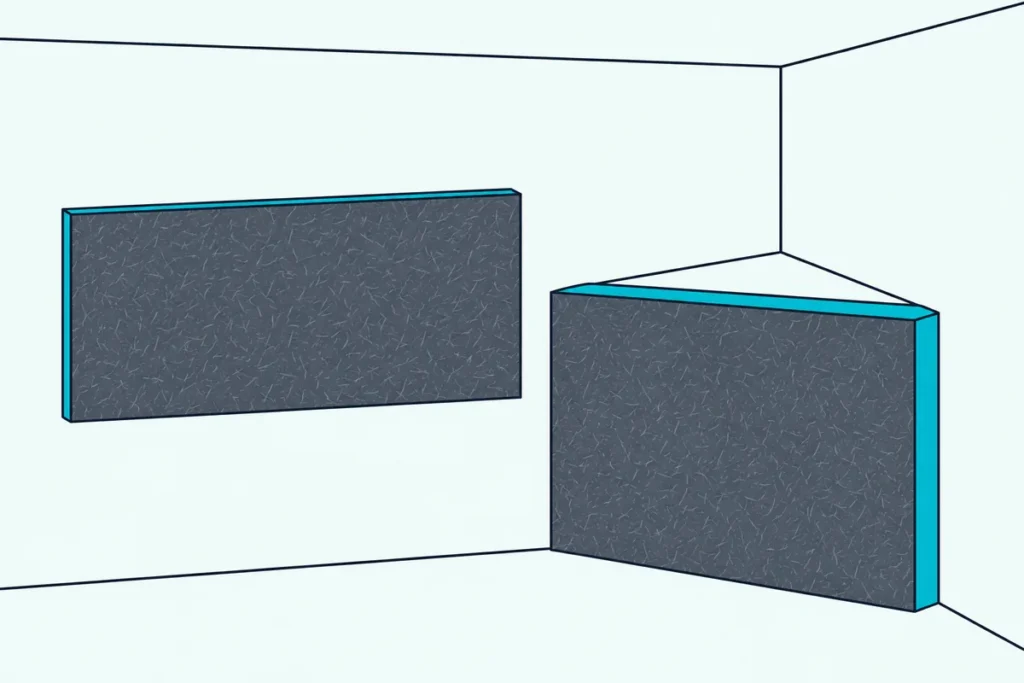
The first step is picking the right rockwool product for your panels and your bass traps, because they need different thicknesses.
Below, this guide covers which rockwool products work for acoustic treatment, how to build DIY panels from raw batts, and how rockwool compares to rigid fiberglass board such as Owens Corning 703.
Rockwool Safe n Sound comes 3 or 6 inches thick for DIY panels, while Rockwool AFB comes in more thicknesses, from 1 to 6 inches, for bass traps.
Is Rockwool Good For Acoustic Treatment?
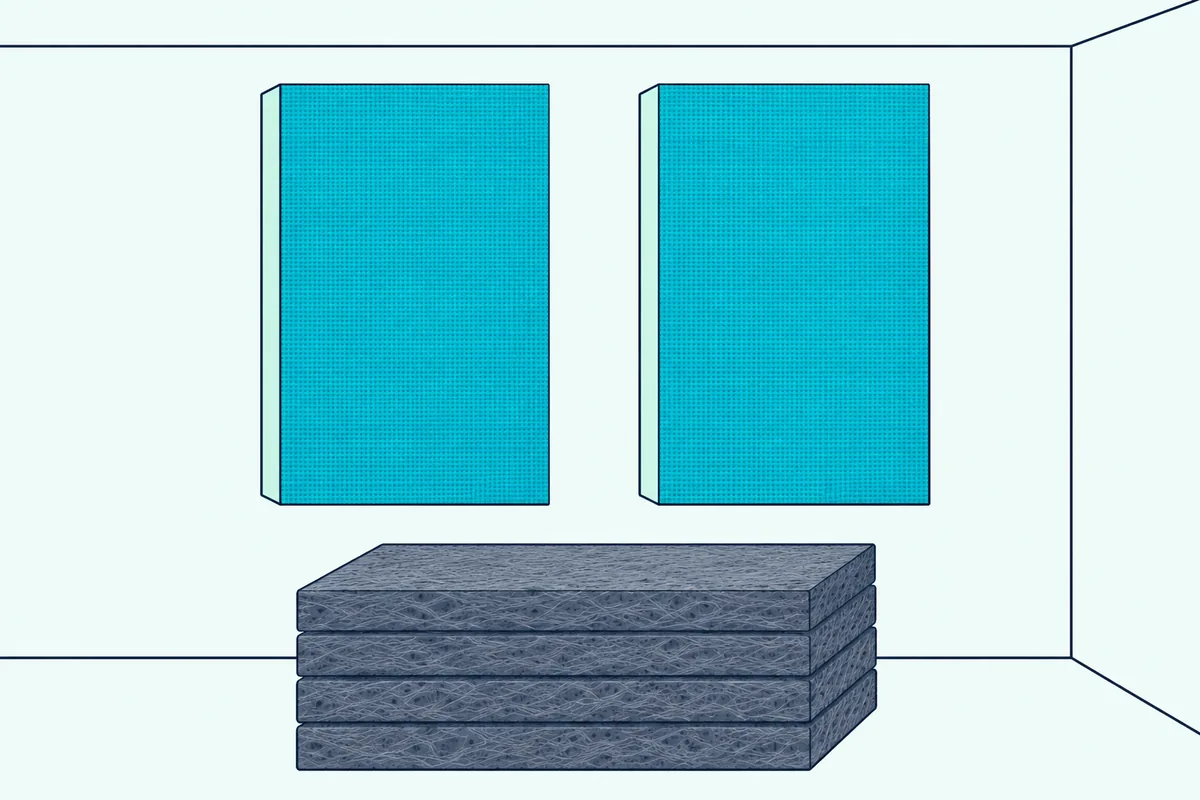
Yes — rockwool (also called mineral wool or stone wool) suits DIY acoustic treatment, as rigid fiberglass does.
The reason rockwool works so well comes down to its physical structure. The fibers are dense, randomly oriented, and create millions of tiny air pockets that convert sound energy into heat through friction as sound waves pass through the material.
ROCKWOOL rates its 2-inch AFB batt at an NRC (Noise Reduction Coefficient) of 0.95, an average of its absorption coefficients at 250, 500, 1,000 and 2,000 Hz that Auralex’s Acoustics 101 notes is not a percentage. At 4 inches thick, absorption extends further into the bass frequencies, as ROCKWOOL’s 125 Hz figures below show.
For a broader look at why material choice matters, see what is acoustic treatment and the role each material plays.
What Makes Rockwool Effective For Acoustic Treatment?
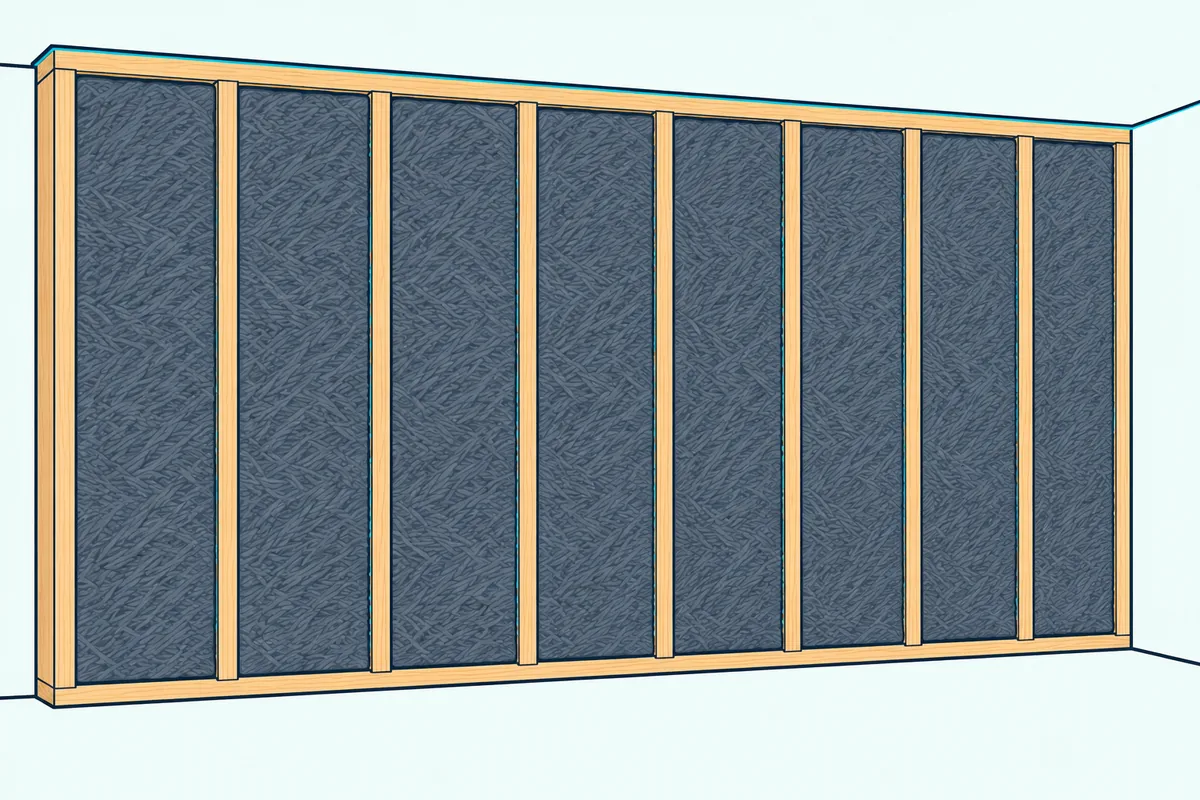
Three of rockwool’s properties bear on acoustic treatment: density, fire resistance, and moisture resistance.
ROCKWOOL lists its Safe n Sound and AFB batts at a nominal 2.5 pounds per cubic foot, and its rigid Rockboard 40, Rockboard 60 and Comfortboard 80 at 4, 6 and 8. Its data sheets add that density isn’t a performance criterion, even though it’s commonly used when specifying insulation.
At low frequencies, thickness matters more: ROCKWOOL rates 2-inch AFB at 0.22 at 125 Hz and 4-inch AFB at 0.73, at the same nominal density.
Fire resistance is a practical safety advantage. ROCKWOOL’s product guide says its stone wool insulation is made from natural stone and recycled material and will not burn, produce toxic smoke or contribute to the spread of flame.
The same guide says the noncombustible insulation can withstand temperatures up to 1000 °C (about 1,830°F). Polyurethane foam is different: Auralex’s safety data sheet for its Studiofoam says that, if ignited, the foam can produce rapid flame spread, intense heat, dense black smoke and toxic gases, and can melt into a burning liquid that can drip and flow.
Moisture resistance matters for basements, garages, and any space where humidity is a concern. ROCKWOOL’s product guide says its insulation repels water and is completely resistant to rot, mildew, mould and bacterial growth.
Rockwool Safe n Sound (Stone Wool Batts)
ROCKWOOL’s data sheet describes Safe n Sound as a stone wool insulation for interior partitions of residential wood and steel stud construction, and its product guide says its insulation is available at quality building supply retailers.
Safe n Sound comes 3 or 6 inches thick at a nominal density of 2.5 lb/ft³, per ROCKWOOL’s data sheet. For the 3-inch batt, ROCKWOOL gives absorption coefficients of 0.98 at 250 Hz and 0.44 at 125 Hz, with an NRC of 1.10.
For small room treatment, Safe n Sound panels go at the first reflection points.
The limitation is bass. For frequencies below 125 Hz, you need thicker material, which is where Rockwool AFB’s thicker cuts come in.
Rockwool AFB (Acoustic Fire Batts)
Rockwool AFB is an acoustical fire batt for interior walls and floors, at the same nominal 2.5 lb/ft³ as Safe n Sound. ROCKWOOL makes it from 1 to 4 inches thick in half-inch steps, plus 5 and 6 inches.
For DIY bass traps across a corner, the 4-inch AFB is the thickness to start from: ROCKWOOL rates it at 0.73 at 125 Hz, against 0.22 for its 2-inch batt.
How To Use Rockwool For DIY Acoustic Panels
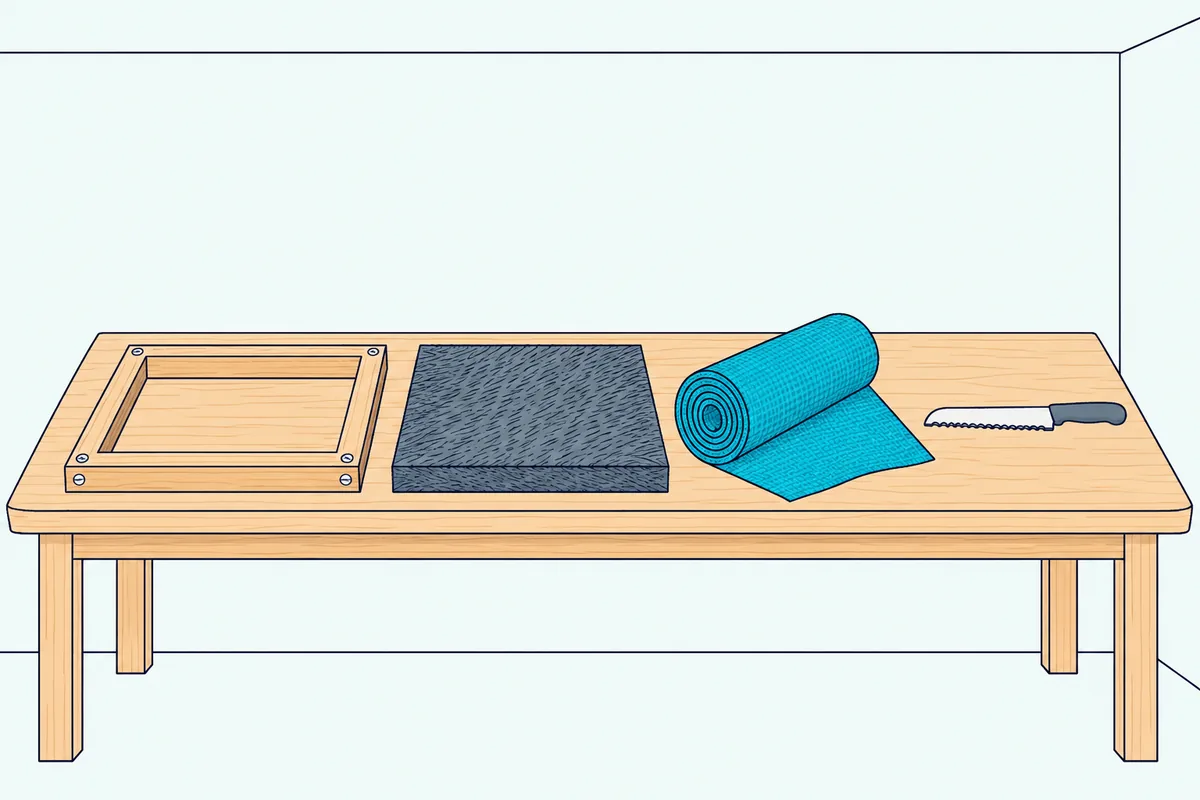
Building your own acoustic panels from rockwool for a home studio takes a frame, the batt and fabric, as the steps below show.
Building The Frame
The frame is simple: 1×4 lumber for 2-inch rockwool, or 2×4 lumber for thicker batts. Standard panel sizes are 24×48 inches (the most common) or 24×24 inches for smaller spaces.
Cut four pieces of lumber to size, join them with wood screws or pocket screws to form a rectangle, and optionally add a crossbar in the middle for rigidity on larger panels. The frame does not need to be furniture-grade — it sits behind fabric and nobody sees it.
Cutting And Handling Rockwool Safely
Rockwool mineral fibers irritate skin, eyes, and lungs. Always wear long sleeves, gloves, safety glasses, and a dust mask when cutting and handling the material.
Cut rockwool with a serrated knife: ROCKWOOL’s product guide says its insulation cuts quickly and accurately with one, such as a bread knife. Mark your cut line, compress the material slightly with a straightedge, and saw through with the serrated blade.
Once the rockwool is cut to size, press it into the frame and wrap the entire assembly in acoustically transparent fabric, such as Guilford of Maine FR701 or any loosely woven fabric that you can blow air through.
If you want to skip the DIY process entirely, pre-made fiberglass panels need no construction.
If you want the full breakdown of DIY panels and bass traps, see our DIY acoustic treatment guide.
Rockwool vs Fiberglass For Acoustic Treatment
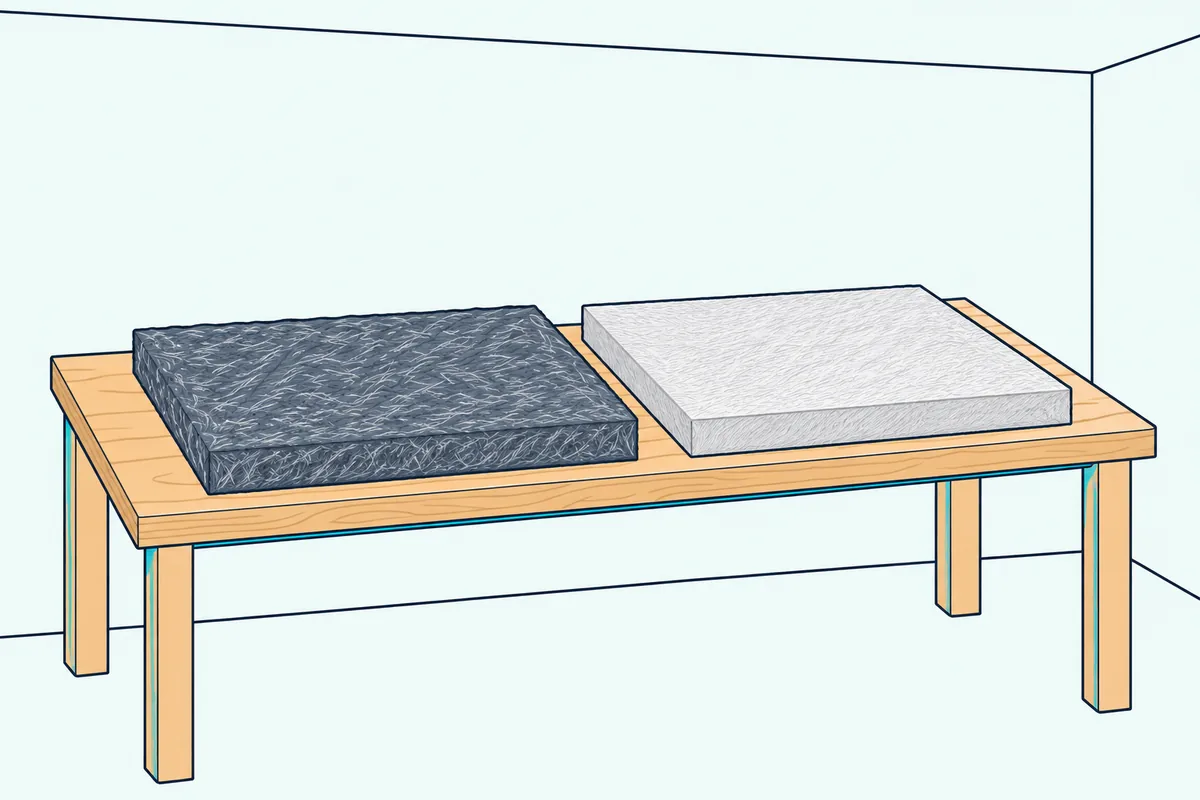
Rigid fiberglass (typically Owens Corning 703 or Knauf insulation) is the other material in this comparison, and the makers’ own figures below set the two side by side.
Fiberglass has a slight edge in absorption per inch at mid and high frequencies: Owens Corning gives its unfaced 2-inch 703 an NRC of 1.00, mounted against a solid backing, against ROCKWOOL’s 0.95 for its 2-inch AFB.
On heat, ROCKWOOL’s product guide says its noncombustible insulation can withstand temperatures up to 1000 °C (about 1,830°F), and Owens Corning’s data sheet gives 703 an operating temperature range of 0 to 450°F. On moisture, ROCKWOOL’s guide says its insulation repels water, and Owens Corning’s sheet gives 703 a water vapor sorption under 5% by weight at 120°F and 95% relative humidity.
For a detailed side-by-side comparison of these two materials with specific product recommendations, see our Owens Corning vs Knauf guide and our broader fiberglass acoustic treatment breakdown.
The Bottom Line
Rockwool suits acoustic treatment: it absorbs across a wide frequency range, ROCKWOOL rates it noncombustible, and ROCKWOOL’s product guide says its insulation is available at quality building supply retailers.
Start with Rockwool Safe n Sound for wall panels at first reflection points and Rockwool AFB at 4 inches for corner bass traps.
If the goal is blocking noise between rooms and not treating the room, Rockwool in a soundproofing wall covers what the wool adds there.
If you are still weighing whether you need treatment, see is acoustic treatment necessary. For DIY against ready-made panels, check the DIY vs ready-made panels guide.
And if you want to see how all the pieces fit together, start with how acoustic treatment works.
Frequently Asked Questions
What is the downside of rockwool?
The main downside is handling. Rockwool mineral fibers irritate skin, eyes, and lungs during cutting and installation, requiring gloves, long sleeves, safety glasses, and a dust mask.
On indoor air, ROCKWOOL’s product guide says its insulation has received GreenGuard’s most stringent certification for indoor air quality.
What is the best material for acoustic treatment?
Rockwool and rigid fiberglass (like Owens Corning 703) are close by their makers’ figures: ROCKWOOL gives its 2-inch AFB an NRC of 0.95 and Owens Corning its unfaced 2-inch 703 an NRC of 1.00. ROCKWOOL rates its batts noncombustible with a flame spread index of 0; Owens Corning gives unfaced 703 a flame spread index of 5.
Fiberglass absorbs slightly more sound per inch at mid frequencies.
Is rockwool better than spray foam for soundproofing?
For acoustic treatment (controlling sound inside a room), rockwool is the one with published absorption figures: ROCKWOOL rates its 2-inch AFB batt at an NRC of 0.95.
Spray foam is designed for thermal insulation and air sealing, not acoustic absorption.