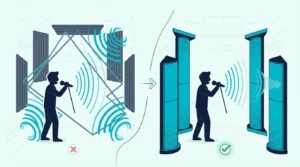
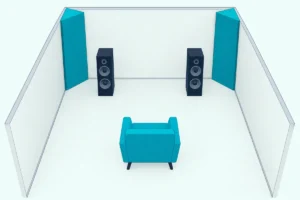
What is a bass trap? It’s a deep or tuned absorber that soaks up the low notes a room piles up, most of all in its corners, so the bass sounds more even from spot to spot.
That boom on one note and gap on the next comes from the room, not your speakers, and it’s why a mix balanced at your desk won’t sound the same in other rooms.
Put the right kind of trap in the right spots, and those peaks and dips shrink while bass notes die away sooner after they’re played.
The sections below cover what a bass trap is, what it does in a room, how porous and tuned traps work, where they go and what they’re made of.
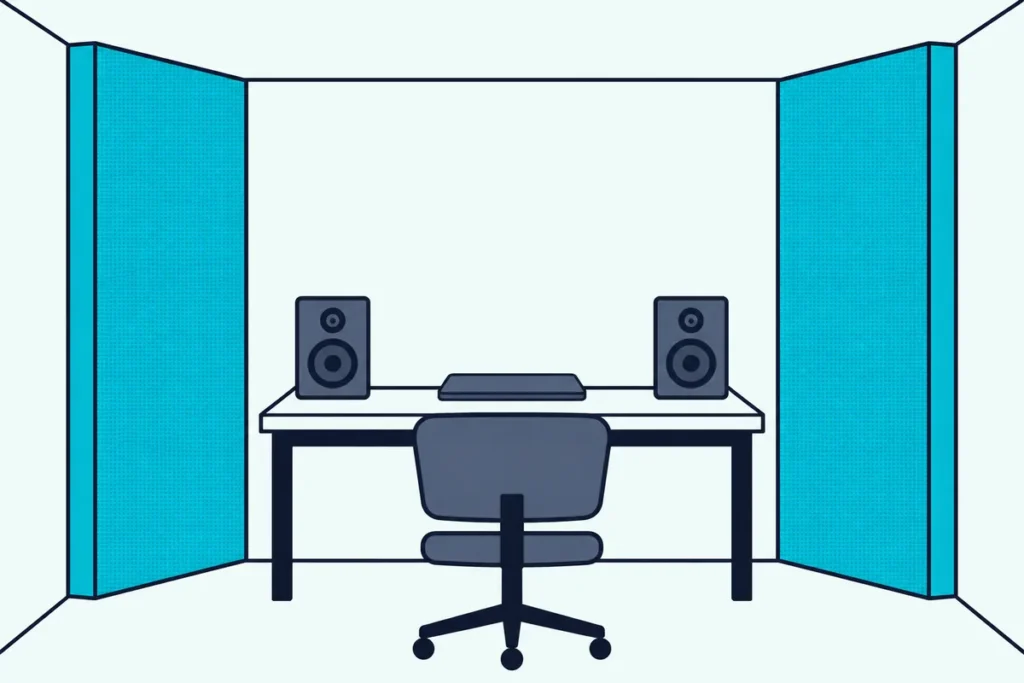
By the end, you’ll know which kind your room calls for and which corner gets the first one.
What Is a Bass Trap?
That deep, corner-filling absorber is the opposite of the thin foam tile it often gets mistaken for. A bass trap is a device that absorbs low frequencies, as RealTraps co-founder Ethan Winer defines it in his Acoustic Treatment and Design guide, and depth or tuning is what lets it reach them.
A thin panel can’t: on Owens Corning’s 700 Series data sheet, a 1-inch 703 board scores 0.88 at 1,000 Hz but 0.05 at 125 Hz, and GIK says its 2-inch panels roll off below about 300 Hz.
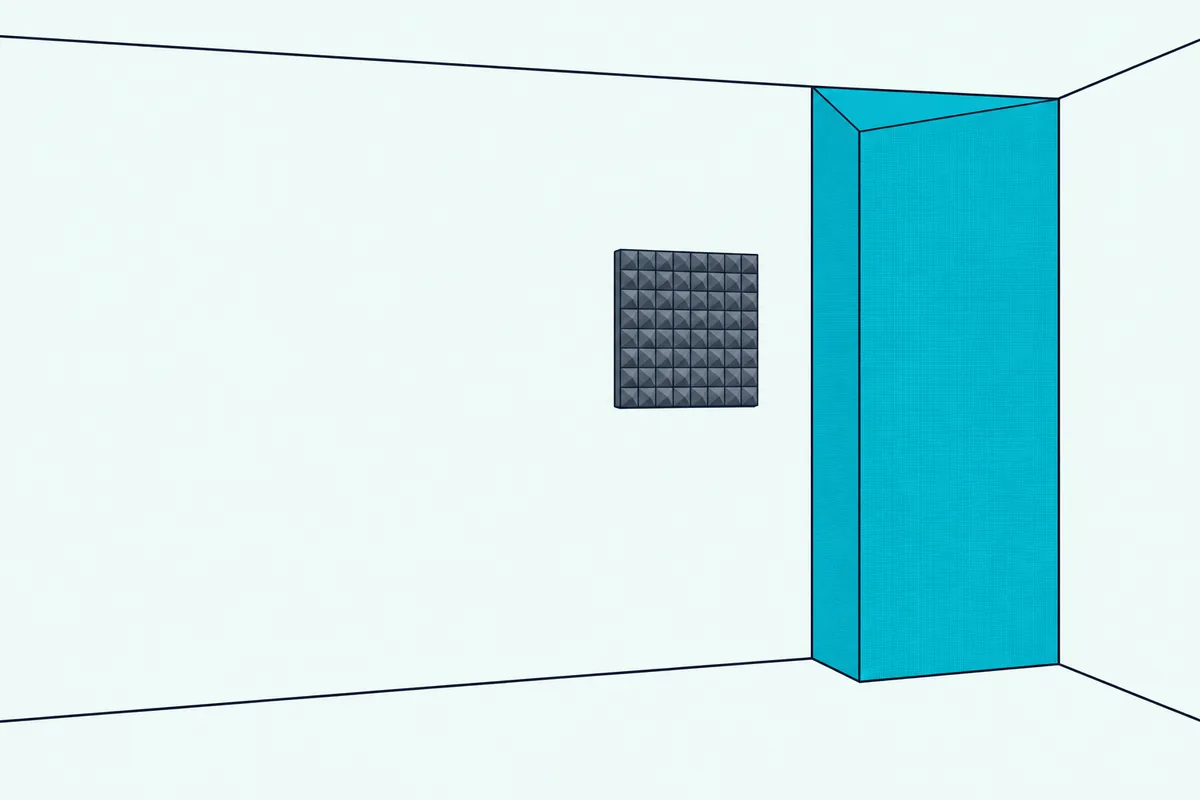
Winer’s guide says thin treatments such as acoustic foam tiles do nothing for low-frequency reflections, and a hand clap won’t reveal that.
Every bass trap is an absorber, so what sets bass traps apart from other absorbers is that depth or tuning. A bass trap also won’t block outside noise: GIK calls traps part of a treatment solution, not a sound isolation method.
What Do Bass Traps Do in a Room?
Those low notes misbehave because every room stores some of them. Bass traps flatten the peaks and dips that a room’s standing waves carve into the low end, and they cut how long the worst notes ring.
Auralex’s Acoustics 101 calls a room mode a low-frequency standing wave; the axial kind runs between two parallel walls. Winer’s guide puts the first one at 1,130, the speed of sound in feet per second, divided by twice the distance between them.
So a 15-foot room has its first mode near 38 Hz, with more at about 75 and 113 Hz, each loud in some spots and nearly gone in others. Winer puts those boosts at up to 6 dB and the dips at 25 dB or more in untreated rooms.
In the room his guide graphs, some notes also rang for a third of a second until traps cut that in half or more, except at the lowest mode.
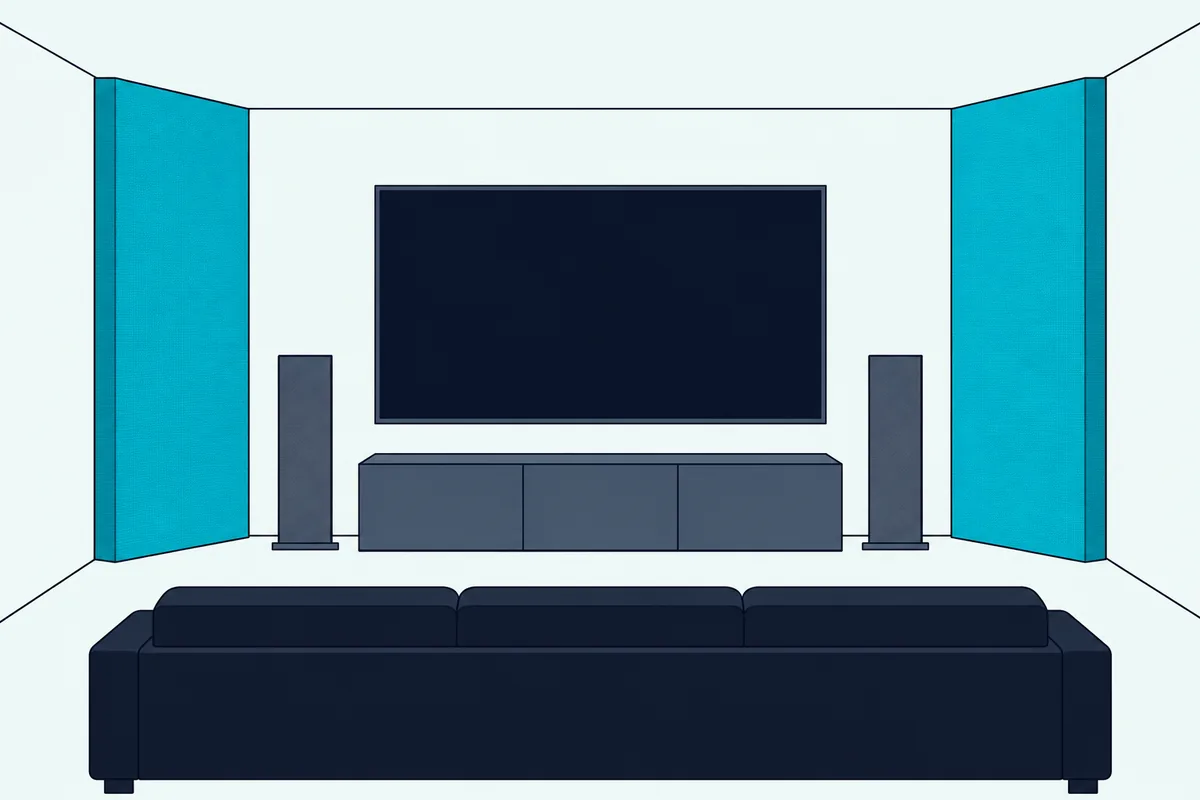
EQ can’t stand in for traps, since Winer points out that boosting a 25 dB dip costs 25 dB of headroom and no single curve fixes every seat. That’s why proper bass trapping is necessary in any room where you mix or judge bass.
How Do Bass Traps Work?
Those standing waves carry energy as air pressure and as air movement, and each kind of trap goes after one of them. A porous bass trap turns moving air into a tiny amount of heat as it pushes through fibers, while a tuned trap resonates with one band of bass and damps that energy inside.
Porous traps need depth, since air stops moving at a wall and moves fastest a quarter wavelength out: at 100 Hz, Winer’s 1,130 rule gives an 11.3-foot wavelength, putting that point about 2.8 feet out, though he notes there’s still plenty of movement at an eighth. That’s why, Acoustics Insider explains, a trap set across a corner reaches much lower notes than a panel flat on a wall.
Tuned traps work the other way round. GIK’s Understanding Different Bass Trapping guide calls them pressure-based, says most are tuned to 100 Hz and lower, and notes that every wall surface, corners included, has high pressure.
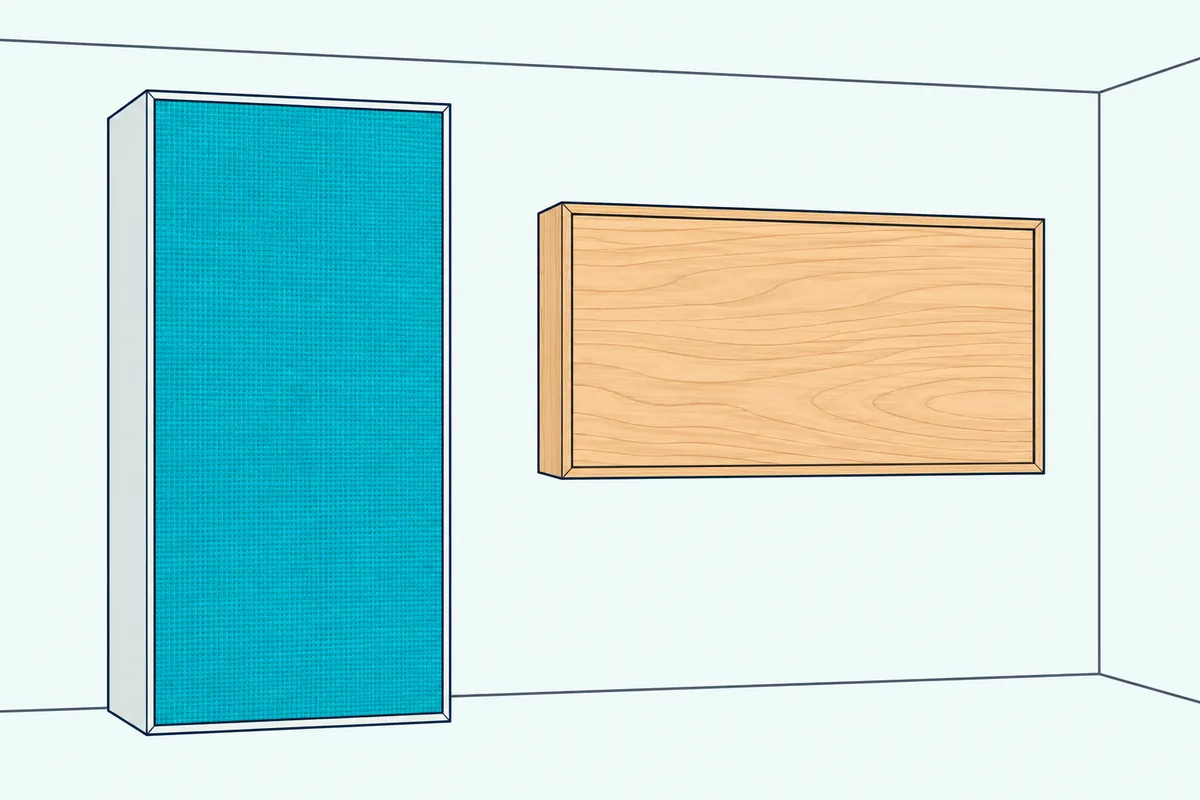
GIK’s guide, Winer’s guide and Primacoustic’s MaxTrap and FullTrap pages describe four common designs:
| Type | How it absorbs | Where it works | Range |
|---|---|---|---|
| Porous | Moving air loses energy in fibers or foam | Across a corner or off a wall | Broad, lower as it deepens |
| Membrane | A sealed panel vibrates and is damped | Walls and corners | Narrow, usually 100 Hz or lower |
| Helmholtz | Air in a tuned cavity resonates | Walls and corners | Narrow, set by the cavity |
| Hybrid | Porous front, limp diaphragm behind | Corners or walls | Broad, to about 100 Hz or lower |
The tuned rows carry a catch: GIK warns that a pressure trap built imprecisely can resonate at the wrong frequency, and Acoustics Insider says one placed off its pressure peak doesn’t work at all. So GIK and Sound On Sound’s technical editor Hugh Robjohns both put porous trapping first, and GIK saves a tuned trap for stubborn resonances that are left.
The full breakdown of trap types goes deeper on each design, and separate guides cover Helmholtz resonators and building a membrane bass trap.
Where Do Bass Traps Go?
That need for depth is why bass trap placement starts in the corners. Auralex’s home studio guide makes bass traps in all of the corners the first step for acoustic treatment in any small room.
A box-shaped room has 12 corners, as RealTraps counts them: four where walls meet, four at the ceiling and four at the floor. GIK says low frequencies collect in all of them, especially the trihedral corners where two walls meet the floor or ceiling.
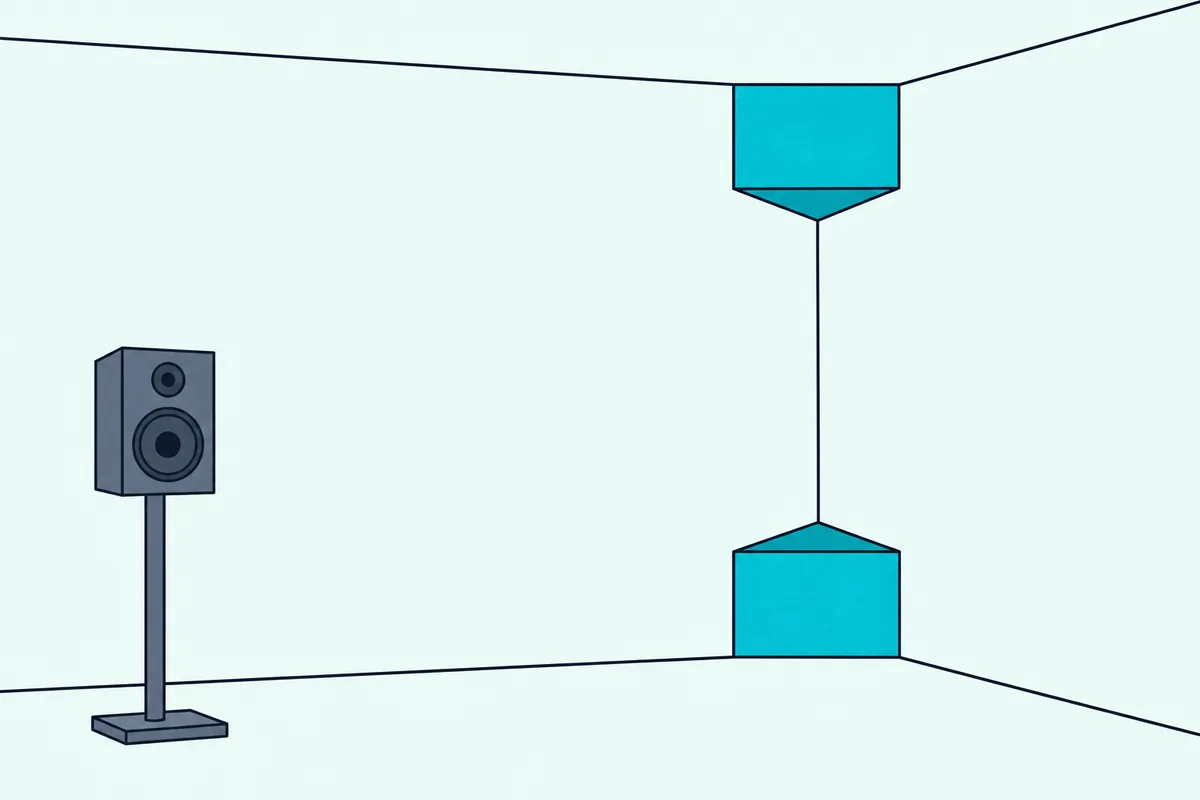
Robjohns suggests treating the four vertical corners first, then the wall-ceiling corners, which Winer finds equally effective; just avoid blocking ceiling-mounted fixtures such as lights and vents. On a tight budget, Auralex says to keep traps at ear level, 30 to 36 inches up.
Choosing between a corner trap and a flat panel matters less than coverage, because GIK calls the total area of bass trapping the biggest factor in performance. Winer advises as many traps as you can fit and afford, with every corner as the minimum.
The right number of traps depends on your room, and the guide to how to bass trap a whole room takes it in four steps. First-reflection panels mainly serve clarity, though GIK notes thicker ones there help the low end too.
What Are Bass Traps Made Of?
Those corner traps only work as well as what’s inside them. Porous traps are made of fiberglass, mineral wool or acoustic foam, GIK says, while Winer’s and Primacoustic’s tuned designs put a wood panel, a row of slats or a limp diaphragm over a closed box.
Picking the right material starts with density, but depth counts for more. Owens Corning lists its 703 board at 3.0 pcf and its 705 at 6.0, yet at 4 inches the denser 705 scores only 0.60 at 125 Hz against 0.56.
ROCKWOOL’s mineral wool runs from 2.5 pcf (Safe’n’Sound, nominal) to 8 pcf (Comfortboard 80). Foam sits under 2 pcf by Winer’s figure, and his table puts 2-inch sculpted foam at 0.11 at 125 Hz.
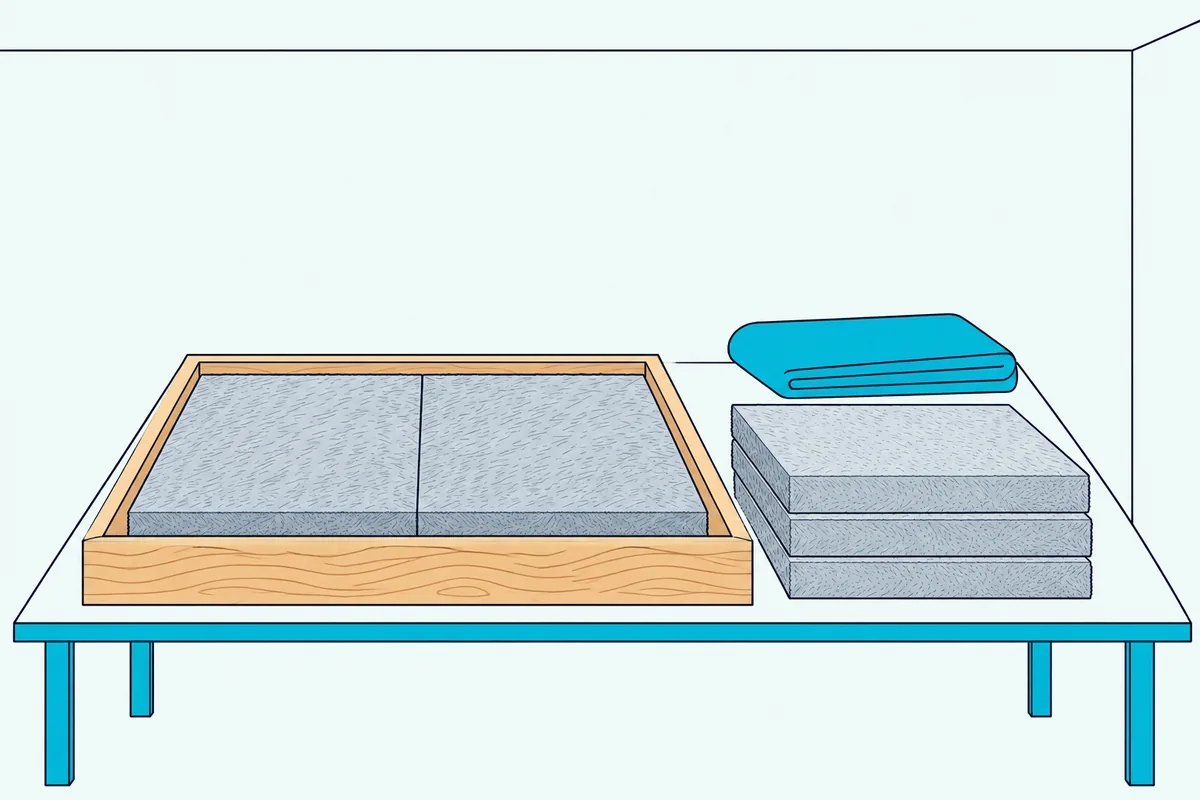
Depth is what moves the bass column, as ROCKWOOL’s AFB data sheet shows for one board tested to ASTM C423:
| Thickness | 125 Hz | 250 Hz | NRC |
|---|---|---|---|
| 1 in | 0.05 | 0.22 | 0.65 |
| 2 in | 0.22 | 0.69 | 0.95 |
| 3 in | 0.42 | 0.90 | 1.10 |
| 4 in | 0.73 | 1.24 | 1.10 |
| 6 in | 1.11 | 1.28 | 1.15 |
NRC barely moves after 3 inches because Acoustics 101 defines it as an average of 250 to 2,000 Hz, so read the 125 Hz column: 0.73 at 4 inches, and above 1 only with much thicker treatment. Acoustics 101 also notes that coefficients aren’t percentages, so a 1.11 isn’t an error.
For a DIY build, Robjohns suggests Rockwool slabs 2 to 4 inches thick in simple timber frames covered with fabric; Winer says nearly any porous fabric works, and Sona acoustical fabric is one sold by the yard.
The Bottom Line
A bass trap is a deep porous absorber or a tuned resonator that evens out a room’s low end and shortens its ringing. Start with porous traps at least 4 inches deep in as many corners as you can, then add a tuned trap only if one mode still rings.
The figures here come from the makers’ data sheets and the acoustics guides named above.
Frequently Asked Questions
Do Bass Traps Increase Bass?
Usually, yes. Winer’s guide says adding bass traps tends to raise the amount of bass you hear, because the reflections that cancel it shrink and the low-frequency response comes out more even.
How Do I Know If I Need Bass Traps?
Play low tones and listen as you move: GIK suggests pink noise filtered to 400 Hz and below, walking the room to find where the bass gets louder. Winer suggests single sine tones and says most rooms swing 15 dB or more between loud and quiet spots; a hand clap won’t tell you, since it excites mostly the midrange.
Where Should You Not Put Bass Traps?
Not a thin porous trap flat against a wall, where air barely moves, and not a tuned trap out in the room, since GIK and Acoustics Insider both put pressure traps on walls and in corners.