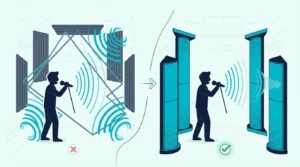
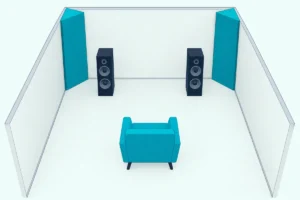
Bass traps should be at least 4 inches thick and ideally 6 inches or more, because thicker traps absorb far more at 125 Hz.
How thick should bass traps be? Four inches of fiberglass or mineral wool is the usual starting point, and 6 inches or more is where the makers’ 125 Hz figures pass 1.
The catch is that a thin panel looks like treatment, yet on Owens Corning’s 700 Series data sheet a 2-inch 703 board scores 1.14 at 500 Hz and only 0.15 at 125 Hz.
Match the depth to the lowest notes your system plays, and the corner space you give away works on the low end instead of only the mids.
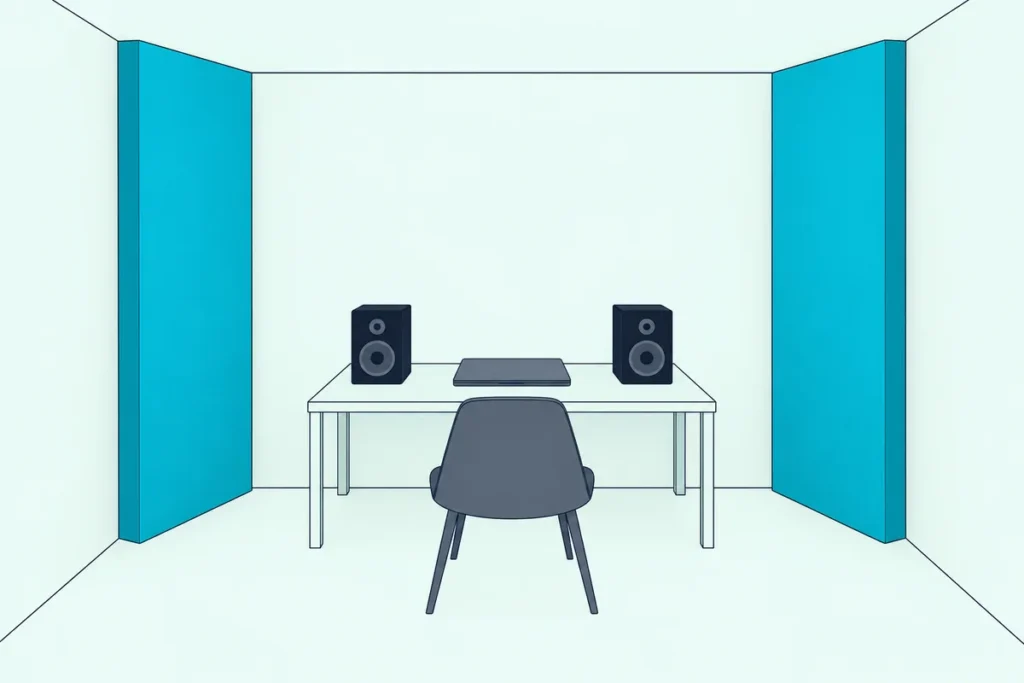
The first step takes a minute: divide 565 by your room’s length in feet to find the lowest note it stores.
From there, the tables below set thickness, density and air gap against the makers’ numbers, so you can pick a depth before you cut a board or order a panel.
How Thick Should Bass Traps Be?
That 4-inch starting point comes from the numbers, and Burton Acoustix’s explainer on how traps work covers why depth matters. Bass traps should be at least 4 inches thick and ideally 6 inches or more, because the 125 Hz coefficient on the makers’ sheets runs 0.15 to 0.37 at 2 inches, 0.56 to 0.93 at 4 inches and 1.11 to 1.38 at 6 inches.
| 125 Hz coefficient by material, density | 2 in | 3 in | 4 in | 6 in |
|---|---|---|---|---|
| Owens Corning 703, 3.0 pcf (48 kg/m3) | 0.15 | 0.34 | 0.56 | Not listed |
| Owens Corning 705, 6.0 pcf (96 kg/m3) | 0.18 | 0.45 | 0.60 | Not listed |
| ROCKWOOL AFB, 2.5 pcf nominal (40 kg/m3) | 0.22 | 0.42 | 0.73 | 1.11 |
| ROCKWOOL Safe’n’Sound, 2.5 pcf nominal (40 kg/m3) | Not listed | 0.44 | Not listed | 1.38 |
| ROCKWOOL Rockboard 40, 4 pcf (64 kg/m3) | 0.25 | 0.63 | 0.93 | Not listed |
| ROCKWOOL Rockboard 60, 6 pcf (96 kg/m3) | 0.28 | 0.85 | 0.88 | Not listed |
| ROCKWOOL Comfortboard 80, 8 pcf (128 kg/m3) | 0.37 | 0.84 | Not listed | Not listed |
Every row rises from left to right. Owens Corning tests against a solid backing, while ROCKWOOL’s AFB data sheet and its sister sheets name no mounting, so compare within one maker first.
Those figures are coefficients, not percentages, as Auralex’s Acoustics 101 points out. Scores above 1 happen because a tested panel’s edges absorb too, and RealTraps co-founder Ethan Winer’s treatment guide notes they aren’t counted in its stated area.
Makers and consultants are just as cautious about 4 inches. ATS’s panel FAQ says its 4-inch panels even out bass but aren’t true bass traps, GIK asks for at least 6 inches on a back wall, and Acoustics Insider’s porous trap guide calls 4 inches just short of a bass trap.
The descriptions come from the makers’ manuals and spec pages.
Why Does Bass Trap Thickness Matter?
All those rising numbers trace back to moving air. Bass trap thickness, or depth, matters because fiberglass and mineral wool absorb sound by slowing moving air, and Winer’s guide shows that air moves fastest a quarter wavelength away from a wall.
A wall stops the air dead, so material pressed against it sits where there’s little motion to work on. Low notes push the fast zone a long way out, as Winer’s formula of 1,130 divided by the frequency shows.
| Frequency | Wavelength | Quarter wavelength |
|---|---|---|
| 125 Hz | 9.0 ft | 27 in |
| 100 Hz | 11.3 ft | 34 in |
| 60 Hz | 18.8 ft | 57 in |
| 40 Hz | 28.3 ft | 85 in |
Treat that last column as the ideal, not a minimum. A 4-inch 703 board scores 0.56 at 125 Hz with a quarter wavelength of 27 inches, and Winer notes there’s still plenty of air movement at an eighth of a wavelength.
No flat panel comes close to 34 inches, so the goal is getting material as far from the wall as your room allows. Winer adds that bass builds up most in corners, which is why corner placement runs through the makers’ advice.
How Does Bass Trap Thickness Affect Frequency Absorption?
That quarter-wavelength idea shows up cleanly on one board. Each time you double the thickness, the lowest frequency a bass trap absorbs well drops by about an octave: 703 scores 0.63 at 500 Hz at 1 inch, 0.71 at 250 Hz at 2 inches and 0.56 at 125 Hz at 4 inches.
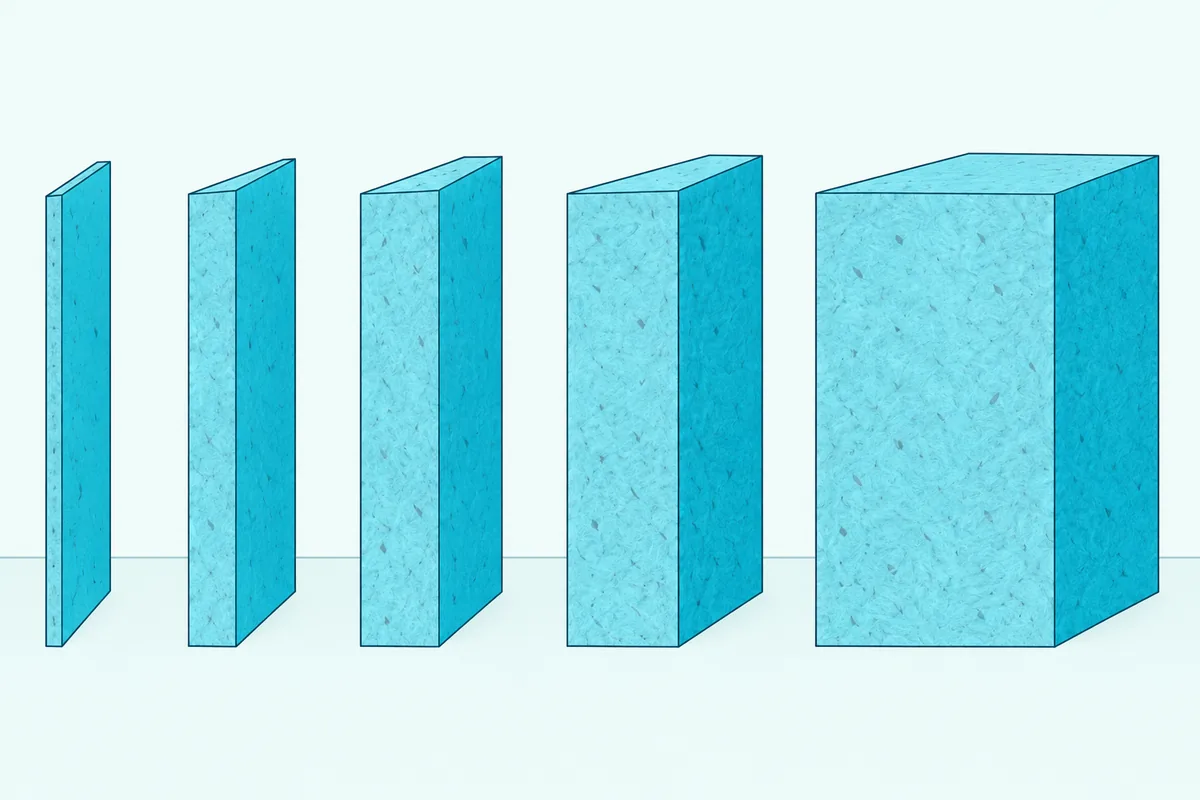
| Owens Corning 703, unfaced | 125 Hz | 250 Hz | 500 Hz | 1,000 Hz |
|---|---|---|---|---|
| 1 in | 0.05 | 0.26 | 0.63 | 0.88 |
| 2 in | 0.15 | 0.71 | 1.14 | 1.16 |
| 3 in | 0.34 | 1.09 | 1.25 | 1.15 |
| 4 in | 0.56 | 1.26 | 1.22 | 1.11 |
Follow that pattern and 8 inches lands near 63 Hz, a projection, since Owens Corning’s sheet stops at 4 inches. GIK’s names sit close to it: its 18 cm (7-inch) FlexRange trap is the 70 Hz version and its 23 cm (9-inch) one the 50 Hz version.
ATS’s lab figures go lower. Its 4-inch panel scores 0.68 at 100 Hz, then falls to 0.28 at 80 Hz and 0.22 at 50 Hz, which explains that not-a-true-bass-trap line.
Its 13-inch Corner Bass Trap scores 1.78 at 80 Hz and 0.58 at 50 Hz. Read that as direction only, since ATS tested it with a side exposed and works from the front’s 8 square feet.
Should You Choose 4-Inch or 6-Inch Bass Traps?
Those drop-offs turn 4-inch vs 6-inch into a question about how low your system plays. Choose 4 inches when your speakers stop around 75 Hz in a small room, and 6 inches or more when a subwoofer reaches lower, since ROCKWOOL’s AFB climbs from 0.73 to 1.11 at 125 Hz between those depths.
Try this: divide 565, half of Winer’s 1,130, by a room dimension in feet to find the first of its room modes, then double and triple the answer. A 16-foot length gives 35, 71 and 106 Hz, matching the 35 and 71 Hz modes Winer measured in a room about that long.
Auralex splits its own traps the same way, keeping its Venus trap, good to 40 Hz by its account, for rooms over about 12 x 12 x 8 feet with a subwoofer or speakers that play below 75 Hz.
When Is 4-Inch Enough?
Four inches fits a room where the speakers, not the modes, set the low limit, and Produce Like a Pro calls a 4- to 6-inch fabric panel the most common type for home studios. ATS rates its 4-inch panel at about four times its 2-inch panel at 125 Hz, and the two match from 500 Hz up.
When Should You Go 6-Inch or Thicker?
Six inches fits when that 565 sum lands on notes your system plays.
A DIY build gets there with a deeper frame, and Winer notes two adjacent 2-inch panels absorb the same as one 4-inch piece. For 50 to 125 Hz, ATS points buyers past its panels to its 13-inch corner trap, and Winer notes tuned membrane traps reach low with less depth, though each covers a narrow band.
Does an Air Gap Count as Extra Thickness?
A deeper frame isn’t the only way to reach those lower notes. An air gap counts as extra thickness only in part: Winer’s guide gives 2-inch 703 a score of 0.17 at 125 Hz flat on a wall, close to Owens Corning’s 0.15, and 0.40 with a 16-inch gap.
The first few inches of gap do the most good, Winer adds, and he calls a gap equal to the panel’s thickness the ideal.
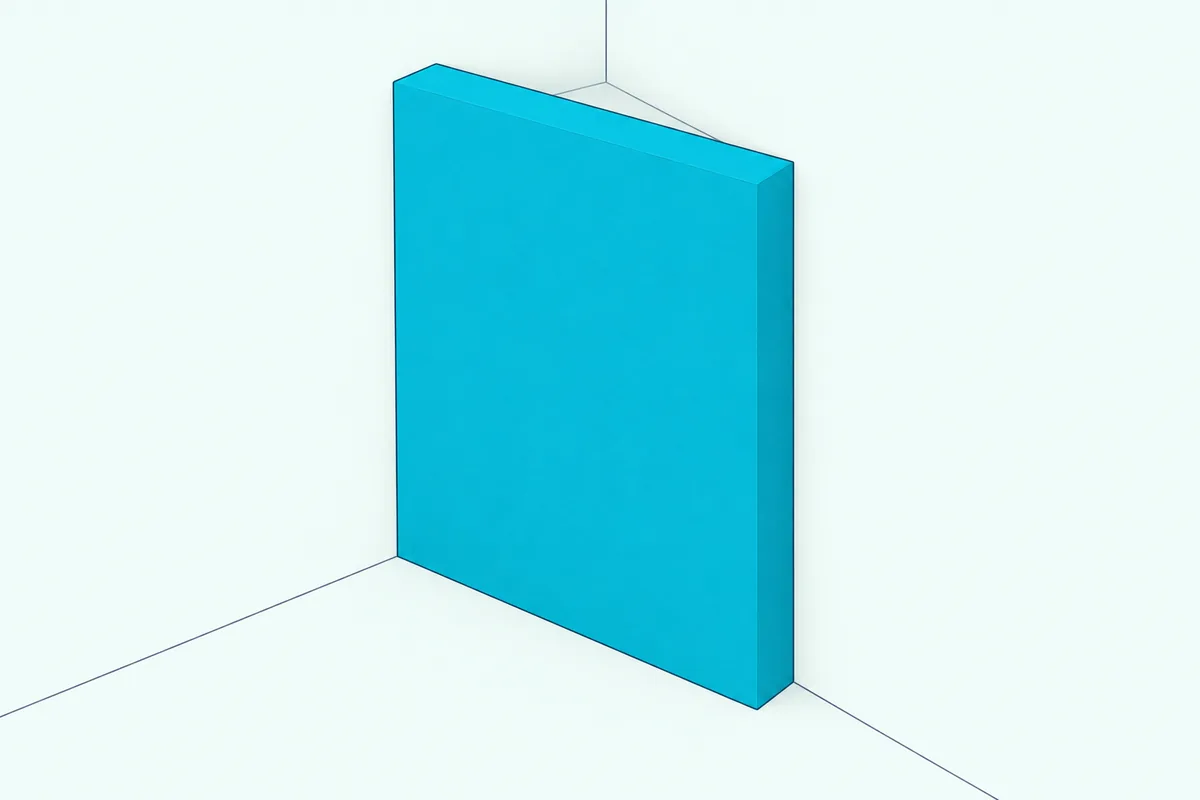
A corner builds that gap without extra material. A 24-inch-wide panel across a square corner touches each wall about 17 inches out and leaves 12 inches of air behind its center, close to the 30 cm Acoustics Insider estimates for a 2 x 4-foot panel.
| Setup | Absorber depth | Air behind it | Total depth |
|---|---|---|---|
| 4-inch panel flat on a wall | 4 in | None | 4 in |
| 6-inch panel flat on a wall | 6 in | None | 6 in |
| 24-inch-wide, 4-inch panel across a corner | 4 in | Up to 12 in | 16 in |
| 24-inch-wide, 6-inch panel across a corner | 6 in | Up to 12 in | 18 in |
| ATS Corner Bass Trap, backed into a corner | 13 in | None | 13 in |
That table measures distance, not results: neither Owens Corning’s nor ROCKWOOL’s sheets give a figure for a panel across a corner. ATS says a gap behind both sides of its corner trap raises its numbers, and backing it fully into the corner lowers them.
ATS sells open-back 4-inch panels, fabric in place of the wood back, so the gap can work in corner mounting, and Acoustics Insider lists sealed backs among the common mistakes.
Our guide to a straddled panel and a filled corner covers that choice, along with how big the gap behind a panel should be.
Is It Better to Have Thicker or Bigger Bass Traps?
Depth isn’t the only thing you can add: more square feet absorb more sound too. At 125 Hz a thicker panel beats a bigger one even at half the area, but when the amount of material is fixed, spreading it around the room did better in Ethan Winer’s tests.
Multiply a coefficient by the panel’s area for a rough count of sabins, the unit of total absorption. A 2 x 4-foot, 4-inch 703 panel gives 4.5 sabins at 125 Hz against 2.4 for a 4 x 4-foot, 2-inch panel, though the order flips at 250 Hz.
Those sums ignore the room, and Winer’s density tests didn’t. Twelve 3-inch panels spread around a room shortened ringing more than the same fiberglass doubled up into six 6-inch panels.
So if wall space is your limit, go thicker, and if material is your limit, spread it across multiple corners. GIK’s buying guide sums it up: more of both is always better.
What Is the Best Density for Bass Traps?
With depth and coverage settled, density is the last dial. The best density for bass traps depends on thickness: on ROCKWOOL’s sheets the 6 to 8 pcf (96 to 128 kg/m3) boards lead at 2 and 3 inches, the 4 pcf (64 kg/m3) board passes them at 4 inches, and the 2.5 pcf (40 kg/m3) mineral wool batts top their best figures by 6.
At 3 inches, Rockboard 60 scores 0.85 at 125 Hz against 0.42 for AFB, yet Rockboard 60 stalls at 0.88 at 4 inches and Comfortboard 80 at 0.89 at 5 inches, while Rockboard 40 reaches 1.09 at 5 inches and AFB 1.11 at 6.
Acoustics Insider’s rule fits those rows: shallow panels can take denser material, while deep traps need lower density so sound passes through the whole depth. Safe’n’Sound, the 2.5 pcf batt behind our simple DIY builds, shows it best, climbing from 0.44 at 3 inches to 1.38 at 6.
Density alone predicts little, though. Owens Corning’s 705 and Rockboard 60 are both 6 pcf (96 kg/m3), yet at 3 inches they score 0.45 and 0.85 at 125 Hz, and ROCKWOOL’s AFB sheet says density isn’t a performance criterion.
ATS says higher densities absorb only slightly better than its 2.5 pcf mineral wool, and Winer saw density matter less as panels got thicker.
The Bottom Line
Those tables point one way: settle depth first. Use 4 inches as the floor for a broadband trap, 6 inches or more if your system plays below 75 Hz, and a panel across the corner for more depth from the same material.
Then pick density by that thickness, and fill as many corners as your room allows.
Frequently Asked Questions
How Long Does a Bass Trap Need to Be?
As long as your corner allows. GIK’s buying guide says to stack corners floor to ceiling where possible, and Auralex’s LENRD placement guide starts at the ceiling, with at least two 2-foot LENRDs per corner under an 8-foot ceiling. Our ceiling treatment guide covers the ceiling-wall corners.
Can You Use Acoustic Panels as Bass Traps?
Only thick ones. ATS’s 2-inch panel scores 0.12 at 125 Hz against 0.65 for its 4-inch, and ATS recommends the open-back version across a corner for the most bass. See what separates an acoustic panel from a bass trap for the rest.
Do Foam Bass Traps Follow the Same Thickness Rule?
They do. Auralex’s Acoustics 101 says thicker acoustic foam is better at absorbing low frequencies, and Winer adds that, inch for inch, 703 is about twice as absorbent as acoustic foam down there.
Will a Thicker Bass Trap Block More Outside Noise?
No. Corner bass traps work on sound inside your room, and GIK says stopping it between rooms takes structural work such as decoupling walls and adding mass.