Auralex’s home-studio guide finds low frequencies building up especially in corners.
Best acoustic treatment for a corner is a thick bass trap straddled across the corner with an air gap behind it.
Products in this guide
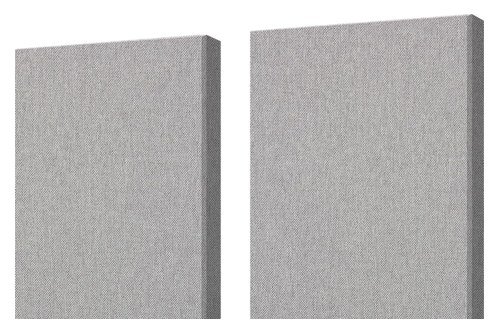
Olanglab 24x48 inch fiberglass panels
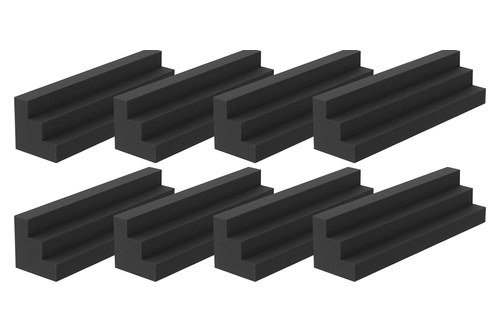
JBER foam corner columns
Corners are where low frequencies build up: Auralex’s home-studio guide calls the buildup of low frequencies, especially in corners, one of the most common problems in small rooms.
The physics is room modes, which Auralex’s Acoustics 101 defines as low frequency standing waves in a room, normally a small room phenomenon.
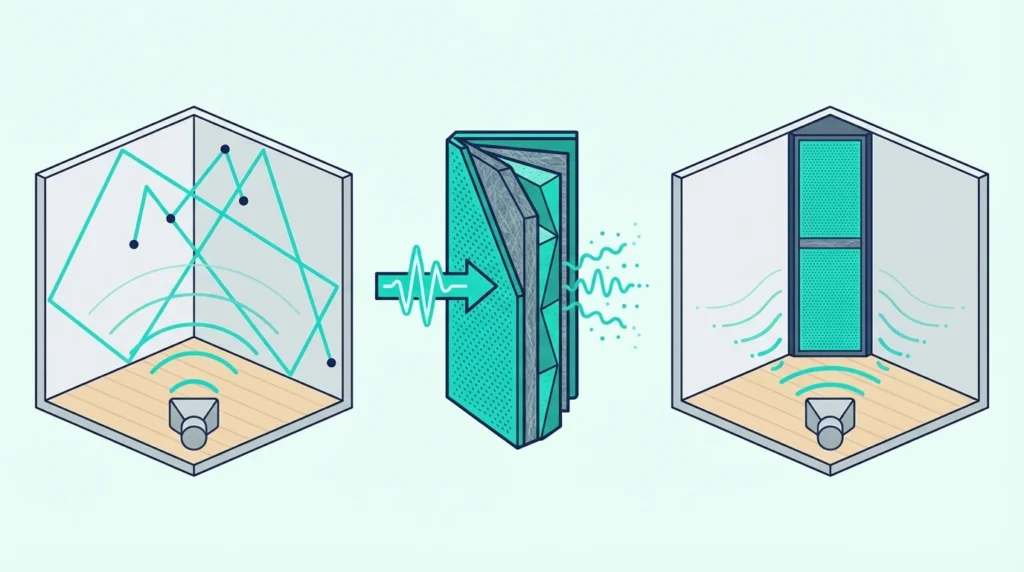
The sections below cover why bass builds up in corners, the types of corner treatment, how many corners to treat, and how thick corner traps should be. Start with the four vertical wall-wall corners.
Treat all four vertical wall-wall corners with bass traps at least 4 inches thick, straddled diagonally across the corner with an air gap behind. Add tri-corner treatment (where walls meet the ceiling and floor).
The descriptions come from the makers’ manuals and spec pages.
Every pick met Burton Acoustix’s rating, review and stock checks on 9 November 2026.
Why Do Corners Need Special Treatment?
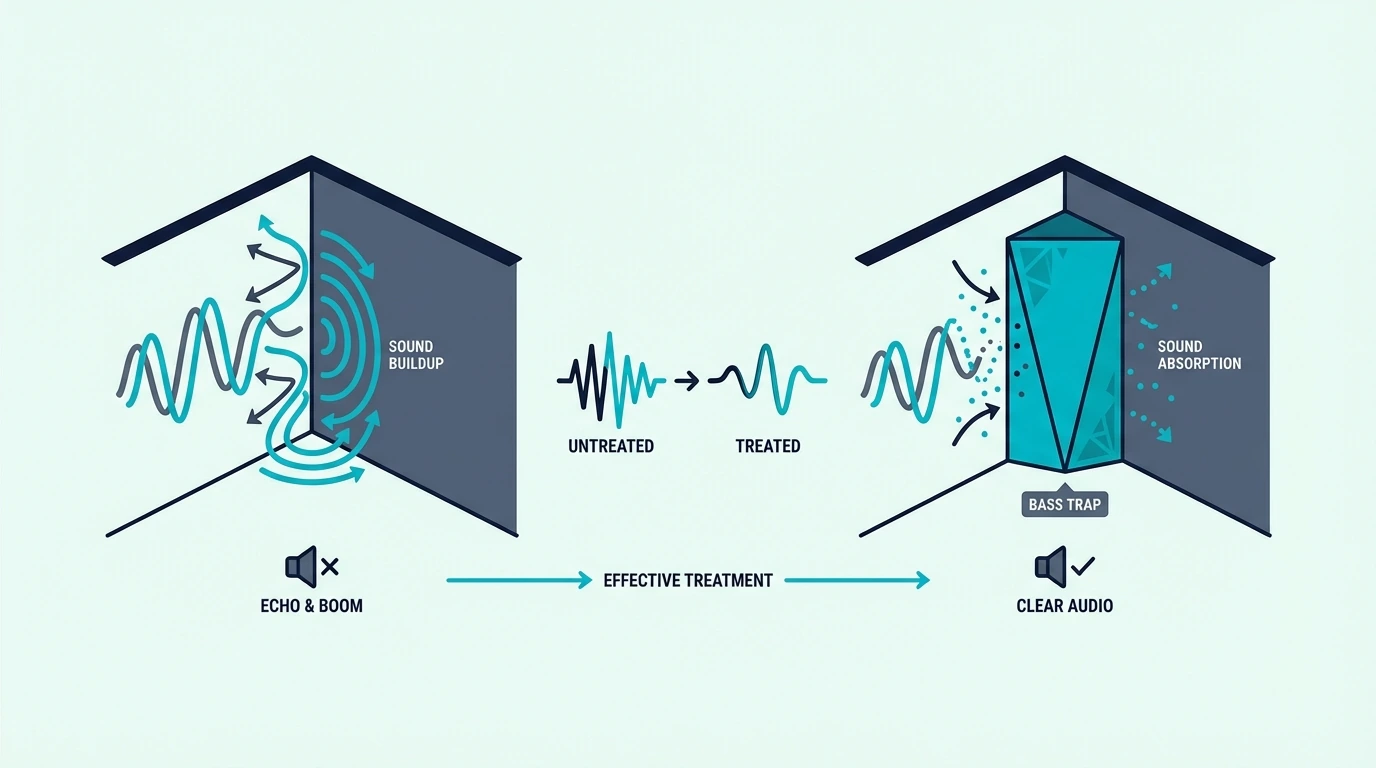
Auralex’s Acoustics 101 describes a room mode as a “bump” or “dip” in a room’s frequency response, set by the room’s dimensions and the way they make sound waves interact.
Auralex’s home-studio guide makes bass traps in all of the corners the first step for acoustic treatment in any small room.
How Bass Builds Up In Corners
Auralex’s Acoustics 101 sorts room modes by the surfaces they run between: two parallel surfaces for an axial mode, four for a tangential mode and six for an oblique one.
A vertical corner is where two of those surfaces meet.
The how treatment works guide explains the physics of standing waves.
Tri-Corners Vs Wall-Wall Corners
Tri-corners are where two walls meet the ceiling or floor, three boundaries at one point.
Wall-wall vertical corners run floor-to-ceiling at each of the four room corners, and Auralex’s guide treats them vertically where it can, horizontally where a corner doesn’t allow it.
In a rectangular room with 8- to 10-foot ceilings, the four vertical corners run 32 to 40 linear feet in all: four corners times the ceiling height.
Auralex’s home-studio guide calls bass trapping very important in small rooms.
What Types Of Corner Treatment Work Best?
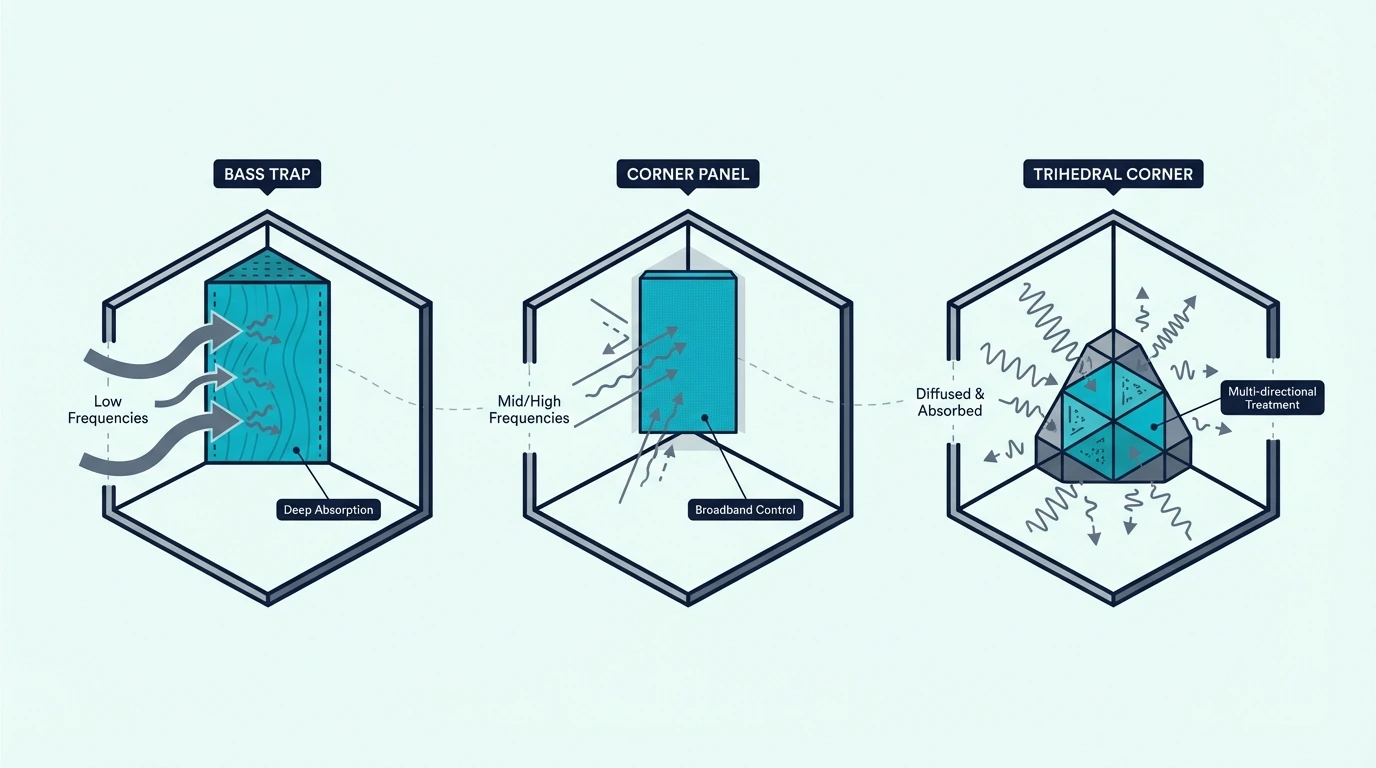
The key variables are panel thickness, mounting method, and the air gap behind the panel.
Straddled Broadband Absorbers
A flat panel mounted diagonally across a corner, straddled from wall to wall, sits at a 45-degree angle with a triangular air gap behind it. Auralex’s Acoustics 101 gives the same shape over a peak, a piece of Studiofoam spanning it over a small, triangular-shaped airspace, and calls that viable and perhaps even more effective than two separate pieces.
Owens Corning 703 fiberglass boards come 2 inches thick, so stack two to 4 inches for straddled corner bass traps. Mount them diagonally across each corner with L-brackets attached to the adjacent walls.
The DIY treatment guide covers step-by-step construction of straddled corner bass traps including frame dimensions and fabric wrapping techniques.
Triangular Corner Traps
Triangular traps are wedge-shaped panels that fit flush into the corner rather than straddling across it, so they use less room space and leave no air gap behind.
Use triangular traps in corners where a straddled panel would protrude too far into the room, such as behind a door or in a walkway.
Pre-Built Panel Options
For ready-to-hang treatment without DIY construction, fabric-wrapped fiberglass panels can be straddled across corners on brackets mounted to adjacent walls.
The fiberglass treatment guide compares panel thicknesses and their absorption coefficients at different frequencies.
How Many Corners Should You Treat?
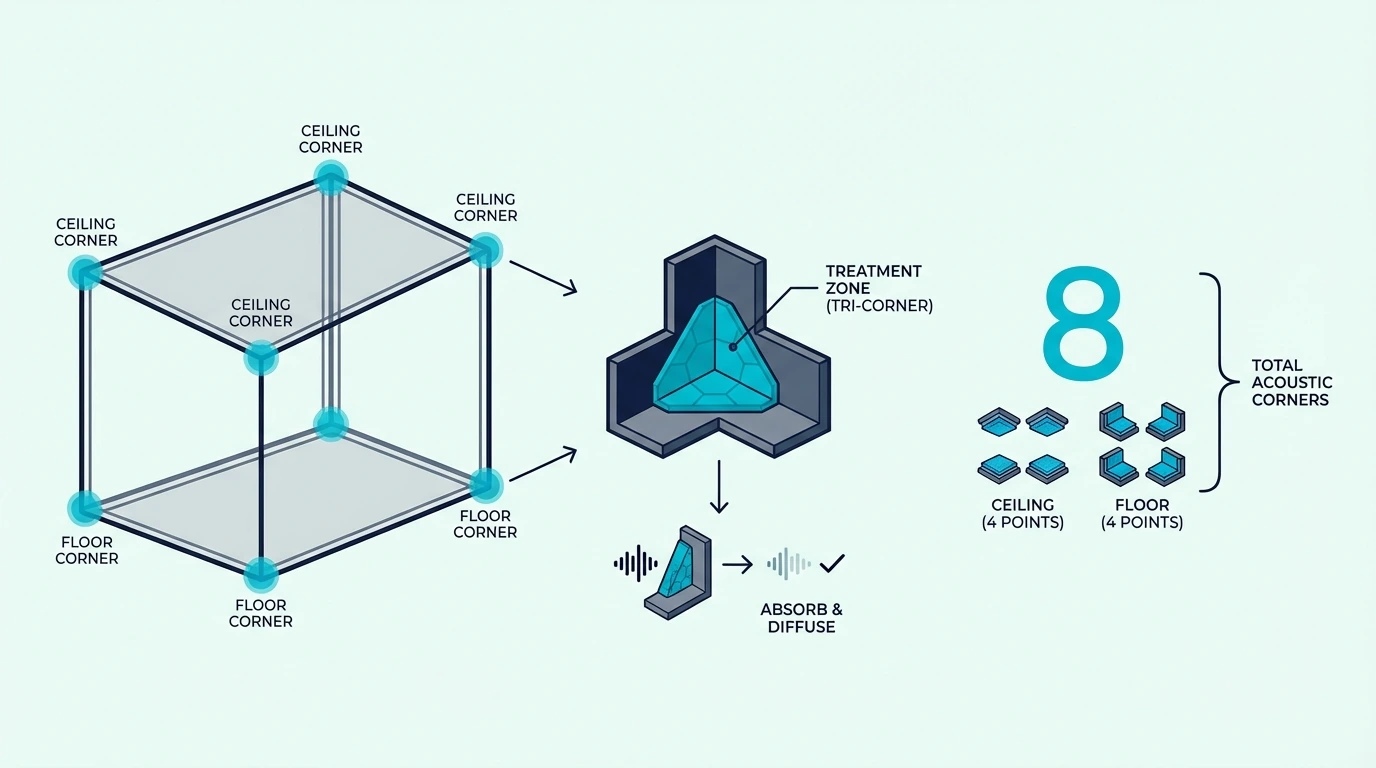
All of them, ideally. At minimum, treat the four vertical wall-wall corners from floor to ceiling.
After the four vertical corners, add treatment to the wall-ceiling tri-corners above the listening position.
Olanglab 24×48 inch fiberglass panels come two to a pack, each 24 x 48 inches and 2 inches thick, one for each of two corners when straddled diagonally.
Olanglab 24x48 inch fiberglass panels
For mixing rooms, treat corresponding corners alike: Auralex’s home-studio guide says symmetry is important to sound accuracy.
The cost breakdown guide covers corner treatment across different room sizes.
The Bottom Line
Corners come first: Auralex’s home-studio guide makes bass traps in all of the corners the first step in any small room.
Treat all four vertical corners with panels at least 4 inches thick, straddled diagonally with an air gap behind them. Add tri-corner treatment next.
Corner traps are one of the three kinds of treatment most rooms need, alongside absorption panels and diffusers. For home studio builders, corner treatment comes first.
Frequently Asked Questions
Does acoustic treatment need to be symmetrical?
For mixing and critical listening, yes. Auralex’s home-studio guide says symmetry is important to sound accuracy, so keep as much as possible.
Auralex’s guide adds that symmetry plays an important role in the effectiveness of the treatment as well as its look. Treat the corners and first reflection points that are accessible and practical for your room layout.
Can acoustic panels go around corners?
Yes: a panel can straddle a corner diagonally with an air gap behind it.
Mount the panel using L-brackets or wire attached to both adjacent walls. The panel should span from wall to wall at a 45-degree angle.
How thick should corner bass traps be?
Thicker reaches lower: Owens Corning gives unfaced 703 board 0.15 at 125 Hz at 2 inches and 0.56 at 4 inches, and ATS says its 4-inch panels are not true bass traps and will not absorb much below 100 Hz.
For serious bass absorption, 50 to 125 Hz, ATS points to its own corner bass traps.
While you plan thicker fiberglass builds, the 16-pack of JBER foam corner columns gives you four columns for each corner.