Best 37 Key MIDI Controller: Seven Picks by Key Size and Ports
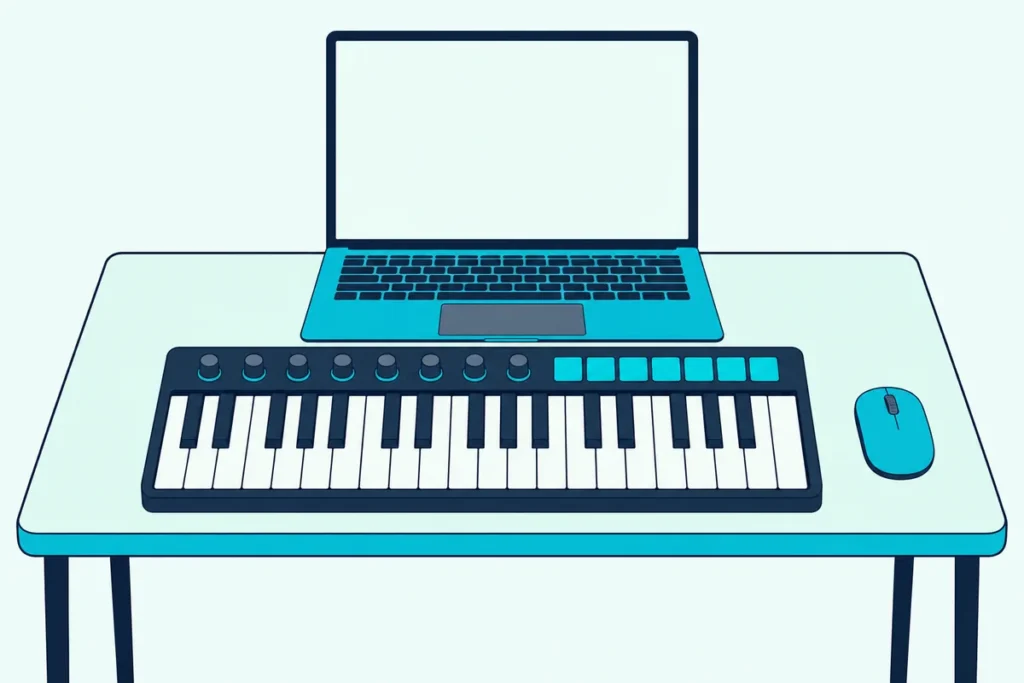
Your desk has room for a laptop and about two feet of keys, so the best 37 key MIDI controller has to earn that space on day one.
Spec sheets bury the three things that decide it: how wide the keys are, whether the wheels are real and what the board can plug into.
This guide compares seven 37-key controllers on those points, using the makers’ own pages and manuals as of 3 October 2026.
You’ll see key sizes, footprints, pads, ports, bundled software and which listings are strong enough to recommend, with a few setup traps along the way.
Start with the short list, because the right pick depends on whether you play, program beats or drive hardware.
What Is the Best 37 Key MIDI Controller?
That depends on what you want around the keys, but the Novation Launchkey 37 MK4 is the best all-round pick on the spec sheet. Novation lists 37 full-size synth-action keys, pitch and mod wheels, 16 pads, eight encoders and a 5-pin MIDI out on one 557 millimeter board (Novation).
The other six each win one narrower job, and this table sorts all seven by what they add to the keys:
| Controller | Keys | Pads | Pitch and mod | MIDI out | Best for |
|---|---|---|---|---|---|
| Novation Launchkey 37 MK4 | 37 full-size synth-action | 16, polyphonic aftertouch | Wheels | 5-pin DIN | DAW control with full-size keys |
| Novation Launchkey Mini 37 MK4 | 37 synth-action mini | 16, polyphonic aftertouch | Touch strips | 3.5 mm TRS | Compact DAW control |
| Akai MPK Mini Plus | 37 mini | 8 MPC pads | Wheels and joystick | 5-pin DIN, plus CV | Beats and hardware |
| Arturia KeyStep 37 mk2 | 37 Slimkey, aftertouch | None | Touch strips | 5-pin DIN, plus CV | Hardware synths |
| Arturia KeyStep Pro | 37 slim, aftertouch | None | Looper strip, no wheels listed | 2 x 5-pin DIN, plus CV | A full sequencer |
| Korg microKEY2-37 | 37 Natural Touch mini | None | Wheels | USB only | Keys alone |
| IK iRig Keys 2 | 37 mini | None | Wheels | 2.5 mm TRS | Phones and tablets |
Every pick met Burton Acoustix’s rating, review and stock checks on 3 October 2026, and no prices appear because they change often.
| Product | Size | Link |
|---|---|---|
Best Overall 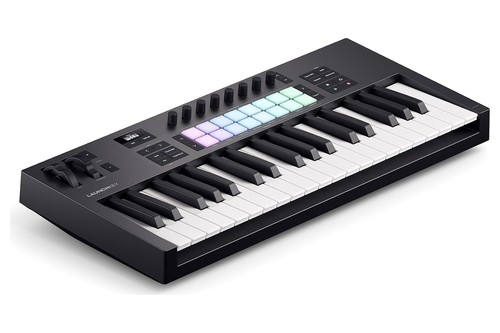 | 3.1 inch | See ratings |
Best Compact DAW Control 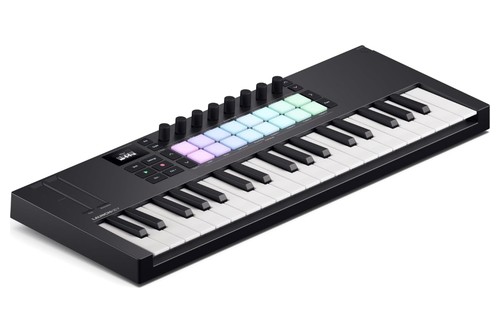 | 1.9 inch | See ratings |
Best for Beats and Hardware 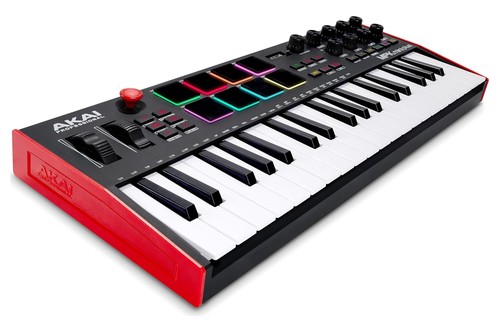 | — | See ratings |
Best for Hardware Synths 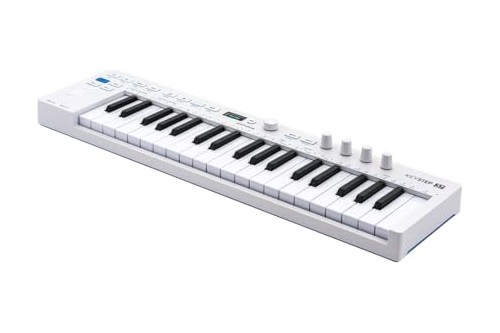 | 2.3 inch | See ratings |
Best Full Sequencer 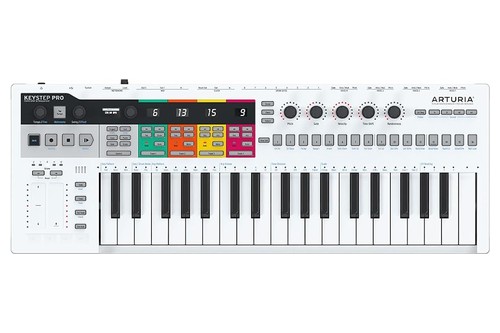 | 1 inch | See ratings |
Best Keys-Only 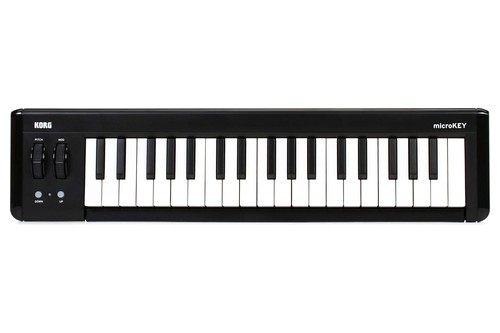 | 2.1 inch | See ratings |
Best for Phones and Tablets 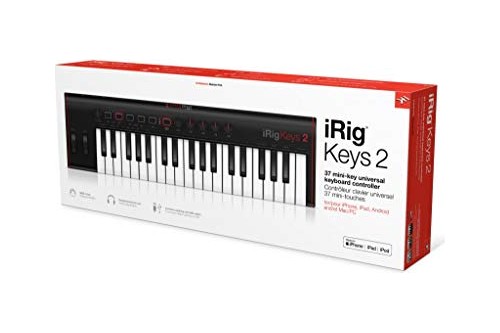 | 2.1 inch | See ratings |
Why Pick 37 Keys Instead of 25 or 49?
Those seven boards sit in the middle for a reason: 37 keys give three octaves plus one note, which covers most basslines, leads and single-hand chords without an octave button. Our guide to choosing between 25, 37 and 49 keys holds the full size table, so this page covers only what changes at 37.
The saving shows on the desk: Novation’s 37-key Launchkey is 557 millimeters wide and 2.18 kilograms, against 730 millimeters and 4.08 kilograms for its 49-key model (Novation). That’s 173 millimeters of width and about 1.9 kilograms you keep.
What you give up is reach, because a part more than three octaves wide needs a button press and both hands playing wide chords will feel tight. Octave buttons stretch it: Akai says its 37 keys and octave buttons cover a ten-octave range, and Korg’s shift runs four octaves either way.
Arturia’s own pair shows what five extra keys cost: the 37 mk2 is 63 millimeters wider than the 32-key mk2 and adds four encoders and a 39-LED key indicator, at about the same 1.1 kilograms (Arturia).
If that sounds too cramped, 49-key controllers worth stepping up to cover four octaves, and 25-key and mini boards go the other way.
Mini Keys, Slim Keys or Full-Size Keys?
That 173-millimeter saving comes partly from key size, and the seven boards use three kinds. Novation calls the Launchkey 37’s keys full-size and the Launchkey Mini 37’s mini-keys, Arturia calls its keybeds Slimkey, and Akai, Korg and IK Multimedia all say mini keys.
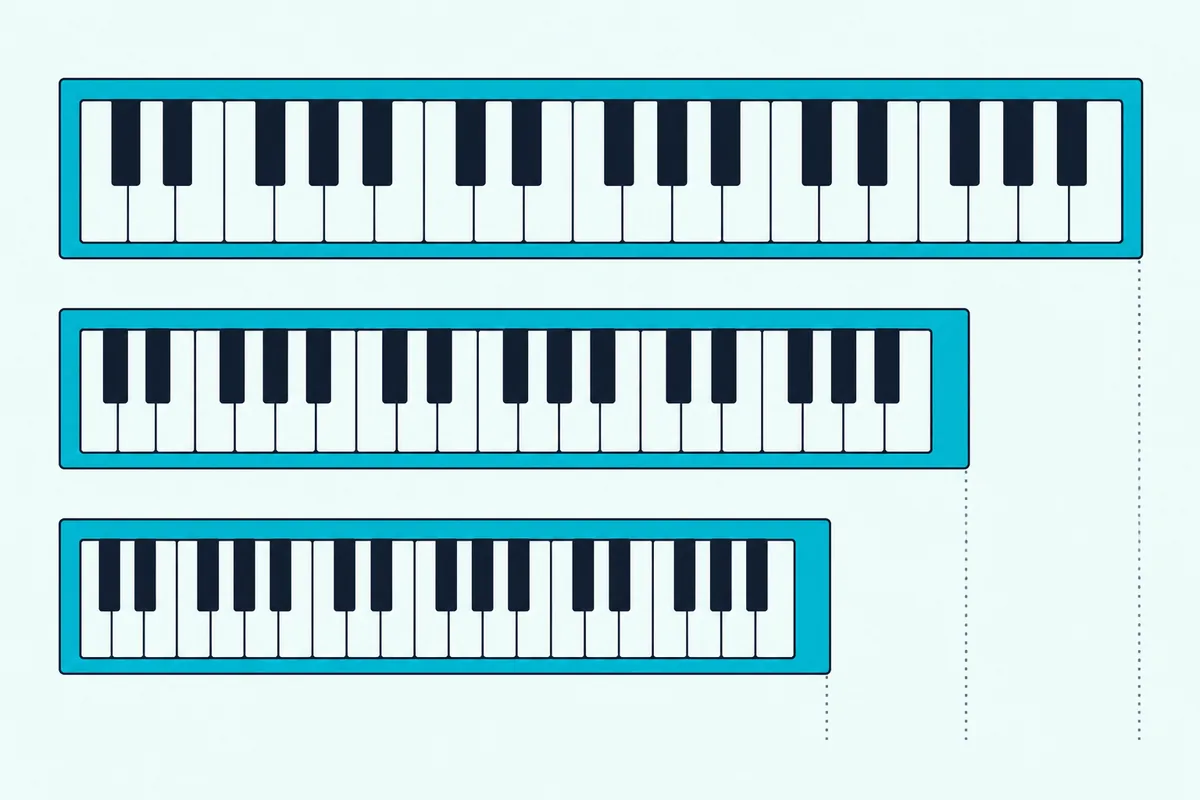
Novation’s own listing images mark the Launchkey 37’s keys at 22 millimeters wide and the Launchkey Mini 37’s at 19 millimeters. Across the 22 white keys of a 37-key board that 3 millimeter gap comes to about 66 millimeters of the 79-millimeter difference in overall width.
Arturia’s manual puts its Slimkey keys in words rather than numbers: smaller than standard piano keys but still large enough for maximum playability (Arturia).
| Controller | Key type (maker’s term) | Width x depth x height | Weight |
|---|---|---|---|
| Novation Launchkey 37 MK4 | Full-size synth-action | 21.9 x 9.9 x 3.1 in | 4.8 lb |
| Novation Launchkey Mini 37 MK4 | Synth-action mini | 18.8 x 7.0 x 1.9 in | 2.2 lb |
| Akai MPK Mini Plus | Mini, Gen 2 Dynamic Keybed | 17.8 x 7.1 x 2.0 in | 2.8 lb |
| Arturia KeyStep 37 mk2 | Slimkey | 21.5 x 5.8 x 2.3 in | 2.4 lb |
| Arturia KeyStep Pro | Slim | 23.2 x 8.2 x 2.2 in | 6.0 lb |
| Korg microKEY2-37 | Natural Touch mini | 22.2 x 5.5 x 2.1 in | 2.2 lb |
| IK iRig Keys 2 | Mini | 20.4 x 5.5 x 2.1 in | 1.9 lb |
Width alone can mislead, as Arturia’s KeyStep 37 mk2 shows: at 547 millimeters it is almost as wide as the full-size Launchkey 37 at 557, yet 103 millimeters shallower. Korg’s microKEY-37 measures 565 millimeters with mini keys, so footprint depends on the case as much as the keys.
Key feel is the one thing a spec sheet can’t tell you, and it was the first thing a VI-Control poster asked about in 2022 when shopping for a 37-key board with a decent action and no clang (VI-Control).
Do You Need Real Pitch and Mod Wheels?
That question about feel has a cousin at the keyboard’s left end: Novation’s Launchkey 37 has pitch and mod wheels, while its Launchkey Mini 37 has touch strips. Akai’s MPK Mini Plus adds wheels and an assignable joystick, Korg’s microKEY-37 and IK’s iRig Keys 2 have wheels, and Arturia’s KeyStep 37 mk2 uses two capacitive touch strips.
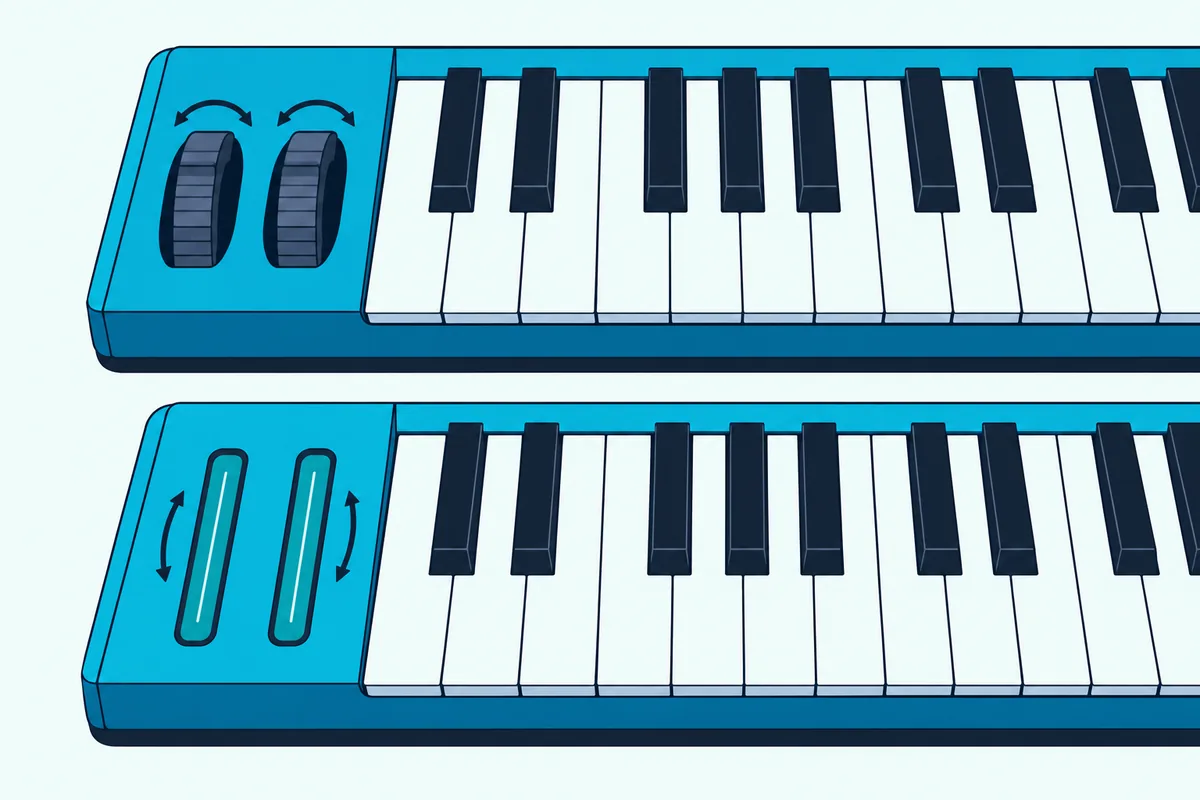
A November 2025 AudioSEX thread shows the stakes: the asker wanted a proper mod wheel for orchestral expression because a strip had disappointed on an earlier keyboard, and one reply noted that many 37 mini-key boards lack real wheels while the full-size ones have them (AudioSEX).
If you play expressive leads or orchestral parts, choose wheels, and if you mostly trigger pads and clips, strips cost you little.
Do 37-Key Controllers Come With Pads, Knobs or Faders?
Those wheels sit beside other controls, and here the field splits three ways. The two Launchkeys carry 16 pads and eight encoders, the MPK Mini Plus carries eight pads and eight knobs, and the KeyStep boards, the microKEY2-37 and the iRig Keys 2 have no drum pads.
Faders are the gap, because none of the seven lists mixer-style faders, though Arturia’s new MiniLab 37 has four and Novation’s 49-key and larger Launchkeys add nine (Arturia).
If faders matter more to you than the key count, our pick of the best MIDI controller with faders starts with that nine-fader Launchkey 49 and adds fader boxes that sit beside a 37-key board.
Aftertouch is just as uneven. Arturia lists it on the keys of the KeyStep 37 mk2 and the KeyStep Pro, while Novation and Akai list it on the pads, where both let you choose off, channel or polyphonic aftertouch in their manuals.
Bigger keyboards split the same way, and our pick of the best aftertouch MIDI keyboard sorts eight boards, from the KeyLab 61 mk3 to these two KeyStep models, by the kind of aftertouch each maker documents.
Controls you never touch are wasted money, so count only the ones you’ll use. A producer who maps everything with a mouse is paying for knobs that a keys-only board skips.
What Do Chord and Scale Modes Add at 37 Keys?
Those pads and knobs are not the only help on a short keyboard, because three of the makers build chord and scale tools into the board. Novation’s Scale Mode offers 30 scales in three behaviors: Snap rounds a stray note to the nearest scale note, Filter drops it, and Easy Scale maps the whole scale onto the white keys (Novation).
Its Chord Map and User Chord modes play chords from the pads, Fixed Chord stores a chord you play on the keys and replays it from single key presses elsewhere, and a chord detector names what you’re playing on the OLED display.
One trap: Novation’s manual says the chord modes send on MIDI channel 3 by default, apart from the keys, so a synth track listening on channel 1 won’t answer the pads until you change it in Settings.
Akai’s MPK Mini Plus has a Chords mode that plays several notes and inversions from one key and a Scales mode with 15 scale settings, and its Program Editor lets you silence off-scale notes or move them to the nearest scale note. Arturia lists chord and scale modes on the KeyStep 37 mk2 and a chord mode on the new MiniLab 37.
The Korg microKEY2-37 and the iRig Keys 2 have no such modes on their pages, so you supply the harmony yourself.
What Sequencers and Arpeggiators Are Built In?
Those chord tools often work alongside a sequencer, and three of the seven have a standalone one. Akai’s MPK Mini Plus has a two-track step and live sequencer with 8-note polyphony per step, Arturia’s KeyStep 37 mk2 records up to 64 steps with 8-voice polyphony, and the KeyStep Pro runs four sequencer tracks and a 24-part drum sequencer.
Both Launchkeys carry a generative arpeggiator with an 8-step editor instead, and Novation says Ableton Live users also get Sequencer, Drum Rack and Clip modes on the controller (Novation).
The Korg microKEY2-37 and the iRig Keys 2 list neither feature, so they send notes and leave the patterns to your software.
Which Ones Connect to Hardware Synths?
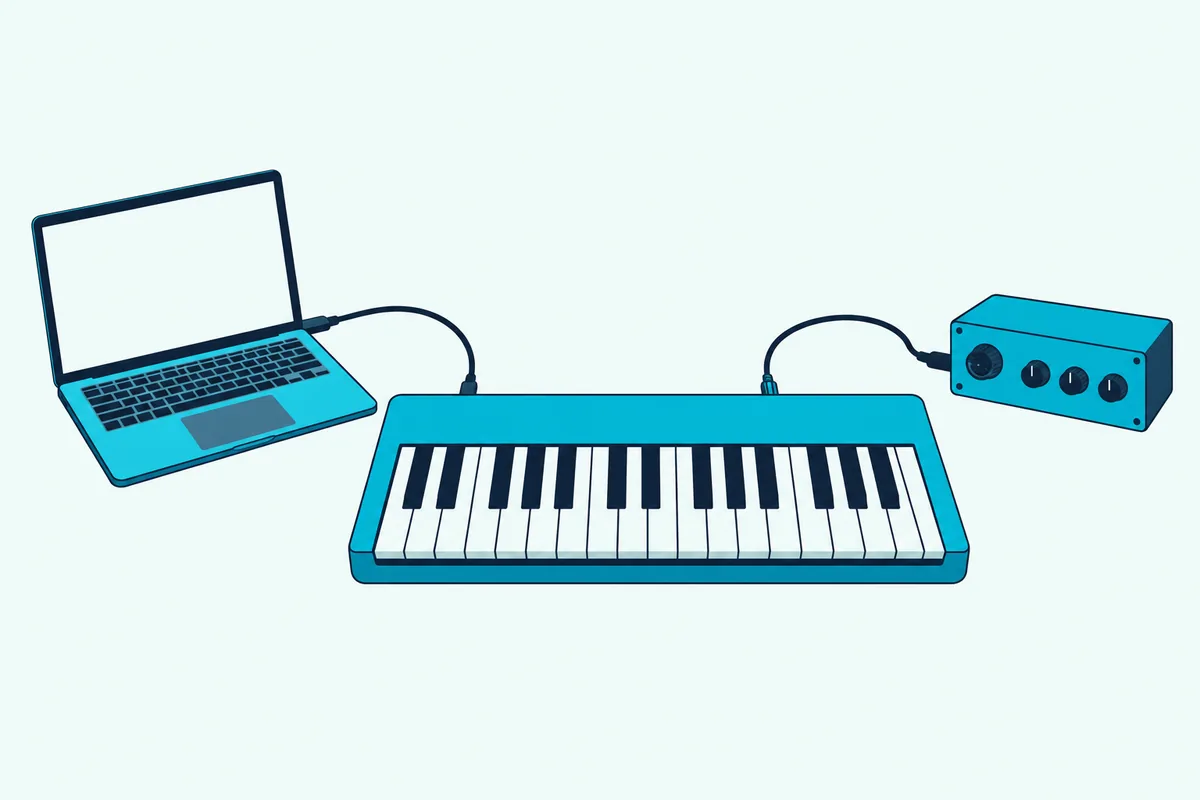
Those sequencers matter most when something outside the computer is listening, and the ports show how seriously each maker takes that.
| Controller | MIDI out | MIDI in | CV or gate | Pedal input |
|---|---|---|---|---|
| Launchkey 37 MK4 | 5-pin DIN | No | No | Sustain only |
| Launchkey Mini 37 MK4 | 3.5 mm TRS | No | No | Sustain only |
| MPK Mini Plus | 5-pin DIN | 5-pin DIN | 3 CV outputs and clock in and out | Sustain |
| KeyStep 37 mk2 | 5-pin DIN | 5-pin DIN | 4 CV and gate outputs, sync in and out | Sustain or expression |
| KeyStep Pro | 2 x 5-pin DIN | 1 x 5-pin DIN | 4 CV, gate and mod outputs, 8 drum gates | Sustain |
| microKEY2-37 | None | None | None | Assignable switch jack |
| iRig Keys 2 | 2.5 mm TRS | 2.5 mm TRS | None | External pedal |
The Launchkey Mini 37’s 3.5 millimeter jack needs a cable to reach a 5-pin synth, and Novation’s box holds only a USB cable. IK includes a 2.5 millimeter to 5-pin adapter for the iRig Keys 2.
Novation’s manual says the Launchkey’s sustain input doesn’t support expression, soft or sostenuto pedals, while Arturia lists a sustain and expression input on the KeyStep 37 mk2.
Akai’s guide adds that when a computer powers the MPK Mini Plus, its MIDI in and out ports act as a computer MIDI interface, which is handy for a desk with one synth and no spare interface.
Which Ones Run Without a Computer?
Those 5-pin ports are only useful away from the laptop if the board can get power, and the manuals answer that unevenly. Arturia’s manual says the KeyStep 37 mk2 can run from a phone, a tablet or a standard USB phone charger that supplies at least 5 volts and 100 milliamps, so it works without a computer present (Arturia).
Akai says the MPK Mini Plus can run from a wall adapter, in which case MIDI goes to its 5-pin out by default, and it pitches the onboard two-track sequencer for DAW-less jams. IK lists a stand-alone mode for the iRig Keys 2 that runs from a USB supply or battery pack, though some battery packs switch off at such a light load, and Arturia ships the KeyStep Pro with a power supply.
The Novation and Korg pages describe USB bus power and list no stand-alone mode, so treat those two as computer-first boards. Our page on running a MIDI keyboard with no laptop covers the wiring in more detail.
Can a 37-Key Controller Work With a Phone or Tablet?
Those power notes lead to the mobile question, and only three of the seven pages answer it. IK’s iRig Keys 2 ships with Lightning, USB-C and USB-A cables and lists iPhone, iPad, Android and Mac or PC support, Korg says the microKEY2 works with iPad and iPhone through Apple’s camera adapter, and Arturia lists the KeyStep 37 mk2 as iPad compatible with a camera connection kit.
Novation’s Launchkey 37 and Mini 37 user guides and Akai’s MPK Mini Plus user guide don’t mention iPad or iPhone, so treat phone use as unconfirmed for those boards.
IK’s board also has a headphone output, but its device connector is micro-USB, an older plug than the USB-C on the two Launchkeys and the KeyStep 37 mk2. Android use needs a micro-USB OTG cable, which is sold separately.
Our roundup of the best MIDI controllers for Android sets this board beside M-VAVE’s Bluetooth keyboard and two CME adapters that bring other keyboards to a phone.
Setup on Mac and Windows
That older plug is one of several setup differences, and the makers’ own pages list the rest. Novation’s Launchkey appears as a USB drive on both Windows and Mac, and a link on it opens Easy Start, a web guide that registers the board and unlocks the software bundle (Novation).
Novation Components handles firmware updates and custom mappings, and its web version needs a browser with Web MIDI support such as Chrome or Opera.
Akai’s guide says to connect the MPK Mini Plus with a standard USB cable first and, if you use a hub, to make it a powered one. Korg says the microKEY2 needs no driver, though its spec page warns of power problems with a USB-C to USB adapter on some Mac Thunderbolt 3 ports.
IK says Windows needs the iRig ASIO driver for low latency, and Arturia sends you to its site for firmware and the MIDI Control Center editor.
Which Ones Work Best With Your DAW?
Those setup steps end at your DAW, and Novation is the only maker here that lists custom DAW scripts by name. Its Launchkeys list scripts for Ableton Live 11 or later, Logic, Cubase 11 and 12, Reason Studios, FL Studio and Ardour, and the Mini adds Reaper (Novation).
Reason users don’t need a script download at all, because Novation says Reason 13.0.2 and later already contain the Launchkey MK4 and Mini MK4 scripts, and our best MIDI controller for Reason guide lists the other boards Reason detects on its own.
Anything else can use HUI, a MIDI protocol that handles mixer, transport and track selection without a custom script, and Novation’s manual walks through Pro Tools, Studio One and a partial HUI setup for Reaper.
Akai says the MPK Mini Plus can be mapped to DAWs such as FL Studio, Logic and Ableton Live for transport, macros and mixing. Arturia, Korg and IK list no DAW scripts, so their controls send standard MIDI messages that you map in the DAW.
Which Software Comes With Each One?
Those mappings lead into the software, and the bundles fill in the rest. Novation’s two Launchkeys include Ableton Live Lite, Cubase LE and Novation Play, plus instruments and effects from Klevgrand, GForce, Native Instruments and Orchestral Tools.
Akai bundles MPC Beats, a Komplete Select edition of your choice and two months of Splice, and Arturia’s KeyStep boards include Analog Lab Intro with Ableton Live Lite. IK’s iRig Keys 2 comes with SampleTank 4 SE plus one bonus title, and Korg lists iZotope Ozone Elements, Skoove and its own synths.
Bundles change often, so confirm what’s included on the maker’s page before you count one in your budget.
Are There Weighted or Semi-Weighted 37-Key Controllers?
Those bundles say nothing about how the keys feel, and a common request is weighted or semi-weighted keys in a 37-key body. None of the seven makers lists weighted or hammer action: Novation calls the Launchkey 37’s keys synth-action, and the step up to a heavier feel starts at its 49-key Launchkey, which it calls semi-weighted (Novation).
That means a heavier action costs you a bigger board. Our page on semi-weighted and hammer-action options covers the 49 to 88-key boards that offer it.
Can You Adjust the Key Feel in Software?
Those weighted options are physical, but the response can be tuned a little in software. Novation’s manual offers Soft, Normal, Hard and Fixed velocity curves for the keys, with the same choices for the pads, and Arturia’s manual offers Linear, Logarithmic, Exponential or a fixed velocity of 100 on the KeyStep 37 mk2.
Arturia adds an aftertouch curve and a Low, Medium or High aftertouch sensitivity. Akai’s Program Editor has a key curve editor with four data points and a black-key balance, and its guide suggests a heavier curve if you usually play weighted keys.
Korg’s KONTROL Editor adjusts the velocity curve of the microKEY2, and IK’s Edit mode lets you customize touch sensitivity on the iRig Keys 2. None of that changes key width or action, so it won’t make mini keys feel like full-size ones.
Travel Weights, Bags and Power
That tuning won’t help if the board stays in a bag, so here’s how the seven rank for carrying. The iRig Keys 2 is lightest at 0.87 kilograms, followed by the Launchkey Mini 37 at 0.98, the microKEY2-37 at 1.0, the KeyStep 37 mk2 at 1.09 and the MPK Mini Plus at 1.26.
The Launchkey 37 at 2.18 kilograms and the KeyStep Pro at 2.7 are studio boards that travel only in a case. IK sells fitted travel bags for its iRig Keys 2 range, and Novation’s Launchkey 37 and Arturia’s KeyStep 37 mk2 both have a Kensington lock slot for shared studios.
For depth, the KeyStep 37 mk2, microKEY2-37 and iRig Keys 2 are the shallowest at 5.8, 5.5 and 5.5 inches, while the Launchkey 37 is 9.9 inches deep and the KeyStep Pro 8.2.
Which Controllers Do Forum Members Name?
Those weights and sizes show up in how forum members sort the field. In the November 2025 AudioSEX thread, replies pointed to the MPK Mini Plus for pads and knobs, the KeyStep 37 for key feel and sequencing, the Launchkey 37 for full-size keys and Ableton integration, and the iRig Keys for a keys-only board.
One reply warned that 37 keys can leave you wishing for more and suggested 49 or more if the board won’t travel. The 2022 VI-Control question was narrower, asking for full-size keys with a good action, a few CC controls and wheels, and no spec sheet answers that.
Which 37-Key MIDI Controller Fits Your Setup?
Those forum answers line up with the picks below, which each pair one job with one board, so find the job that sounds like yours.
Novation Launchkey 37 MK4
For full-size keys, wheels and the deepest DAW control, the Novation Launchkey 37 MK4 is the pick.
the Novation Launchkey 37 MK4
Its arpeggiator has an 8-step editor with tie, accent and ratchet controls, a Capture MIDI button triggers your DAW’s retrospective record where it has one, and Novation Components can map any pad or encoder to a MIDI parameter. It is also NKS-ready, so Native Instruments plugins map to its controls.
Novation Launchkey Mini 37 MK4
For the same pads and DAW scripts in a lighter body, the Novation Launchkey Mini 37 MK4 trades wheels for strips.
the Novation Launchkey Mini 37 MK4
Novation lists Reaper among its custom DAW scripts, alongside Ableton Live, Logic, Cubase, FL Studio, Reason and Ardour, and the Mini is 79 millimeters narrower and 1.2 kilograms lighter than the full-size board.
Akai MPK Mini Plus
For beats plus hardware, the Akai MPK Mini Plus packs the most controls into the smallest footprint.
the Akai MPK Mini Plus
Its pads have two banks, a Note Repeat button retriggers them at the tempo you set, and a Full Level mode plays them at velocity 127 whatever your touch. Its CV outputs send pitch, gate and a mod signal taken from key velocity, the mod wheel or sequence velocity, and its guide counts eight program slots you can fill from the Program Editor.
Arturia KeyStep 37 mk2
For a desk full of synths, the Arturia KeyStep 37 mk2 is the pick for its sequencer and CV outputs.
the Arturia KeyStep 37 mk2
Its manual describes four banks of 16 patterns, each up to 64 steps with 8 notes per step, and its Mutate, Spice and Dice tools vary a phrase live. A MIDI CC button reaches 16 assignable controllers across four banks, and the four CV outputs can follow velocity, aftertouch or the mod strip.
Its Amazon listing covers both the 32-key and 37-key mk2, so the reviews that clear this guide’s bar describe the pair rather than the 37-key board alone.
Arturia KeyStep Pro
For a full sequencer rig, the Arturia KeyStep Pro goes furthest.
the Arturia KeyStep Pro
Arturia gives each track 16 patterns of up to 64 steps with 16 notes per step, lets you chain 16 patterns into a song, and adds a looper, seven arpeggiator modes over five octaves and scale quantization with user scales. A small speaker and a line output keep a metronome in time with other gear.
Korg microKEY2-37
For keys and wheels and nothing else, the Korg microKEY2-37 keeps it simple.
the Korg microKEY2-37
Korg’s octave buttons shift the range four octaves either way, and the 37-key model has an assignable switch jack for a damper pedal. Korg also sells a microKEY Air line that connects wirelessly to an iPad or iPhone, which is a separate model from the one listed here.
Our guide to the best Bluetooth MIDI controller compares wireless boards and the adapters that add Bluetooth to a wired keyboard.
IK Multimedia iRig Keys 2
For phones and tablets, the IK Multimedia iRig Keys 2 is the one built for them.
the IK Multimedia iRig Keys 2
It saves four setups with a Set button, adds program buttons, a data encoder and a volume control for the headphone jack, and converts audio at 16 or 24 bits up to 96 kilohertz. IK also lists an iRig Keys 2 Pro with 37 full-size keys, 605 x 212 x 77 millimeters and 1.87 kilograms, but it didn’t meet the stock check on 3 October 2026.
Which 37-Key Controller Suits a Beginner?
Those picks all work as a first controller, but a few help more with the learning. Novation’s Easy Start builds personalised tutorials around how you plan to use the Launchkey, and its bundle adds Melodics lessons in keys and finger drumming (Novation).
Korg bundles Skoove, a keyboard lesson app, with the microKEY2, Arturia pairs Analog Lab Intro with Ableton Live Lite, and Akai includes MPC Beats and a Komplete Select edition.
If you want the least to configure, the Korg microKEY2-37 and IK’s iRig Keys 2 are keys, wheels and little else, while lessons and a DAW in one box point to either Launchkey.
Why Aren’t Other 37-Key Controllers on the List?
Those seven passed the rating, review and stock checks on 3 October 2026, and several well-known boards didn’t. Arturia’s MiniLab 37 adds a 37-note slim-key keybed to the MiniLab line, with eight pads in two banks, eight encoders, four faders, touch strips, a mini display, USB-C and a 5-pin MIDI out (Arturia).
It stays out because its Amazon listing shows the same reviews as the older MiniLab 3 and still describes the MiniLab 3 in its bullets, so the 37-key model has no rating of its own yet. Revisit it once it has reviews of its own, especially if faders matter to you.
Novation’s FLkey 37 MK2, made for FL Studio, had too few reviews of its own, and the older FLkey 37 listing is the first-generation model, so its reviews don’t describe the MK2. CME’s Xkey 37 LE, Donner’s Starrykey 37 Play and Akai’s MPC Key 37 G2, a standalone production keyboard, fell short on stars or reviews, and several lesser-known 37-key boards had a dozen reviews or none.
What Should You Check Before You Buy?
Those extras matter less than a few basic checks that take a minute each. Compare the width and depth in the table with the desk space left after your laptop and mouse, and check that the pedal input matches the pedal you own.
Then confirm the connector, which is USB-C on the Launchkeys and KeyStep 37 mk2, USB Type-B on the MPK Mini Plus and micro-USB on the iRig Keys 2.
Look at what’s in the box too, because Novation’s Launchkeys ship with only a USB cable, and at the software, because bundles are part of the value.
Key feel is the part to test, so keep the packaging until you’ve played it, since Amazon’s return text covers many items for 30 days after delivery.
The Bottom Line
Buy the Launchkey 37 MK4 if you want full-size keys, wheels and the deepest DAW control, and the Launchkey Mini 37 or MPK Mini Plus if desk space matters more.
Buy an Arturia KeyStep if hardware synths share the room, a Korg or IK board if you only need keys, and try the keys first, because no spec sheet can.
Frequently Asked Questions
Is a 37-key MIDI controller enough?
Yes for leads, basslines and single-hand chords, since 37 keys give three octaves plus one note and the octave buttons shift the range. Both hands playing wide chords will feel tight, and Novation’s 49-key Launchkey adds a fourth octave.
How wide is a 37-key MIDI controller?
Across the seven picks it runs from 17.8 inches for the Akai MPK Mini Plus to 23.2 inches for the Arturia KeyStep Pro. The full-size Launchkey 37 is 21.9 inches wide and the Launchkey Mini 37 is 18.8.
Which 37-key MIDI controller has aftertouch?
Arturia lists aftertouch on the keys of the KeyStep 37 mk2 and the KeyStep Pro. Novation’s Launchkeys and Akai’s MPK Mini Plus list it on the pads, with off, channel and polyphonic settings.
Does a 37-key MIDI controller need a power supply?
The Launchkeys, the microKEY2-37 and the KeyStep 37 mk2 run on USB bus power, and the iRig Keys 2 also runs from a USB charger or battery pack. Akai’s MPK Mini Plus can use a wall adapter, and the KeyStep Pro ships with a power supply.
What’s the difference between the Launchkey 37 and the Launchkey Mini 37?
Novation’s images mark the keys at 22 millimeters against 19, the Launchkey 37 has pitch and mod wheels where the Mini has touch strips, and the full-size board weighs 2.18 kilograms against 0.98. The Mini’s MIDI out is a 3.5 millimeter jack and the full-size board’s is a 5-pin DIN.
Which 37-key MIDI controller is best for Ableton Live?
Novation’s Launchkeys, since the Mini and the full-size board both ship with Ableton Live Lite and custom Live scripts. Novation says its Live mode adds sequencer, Drum Rack and Clip modes on the controller.
Which 37-key MIDI controller is best for FL Studio?
Novation’s FLkey 37 MK2 is made for FL Studio, but its Amazon listing had too few reviews for a card on 3 October 2026. The Launchkey 37 MK4 has an FL Studio script and Akai’s MPK Mini Plus maps to FL Studio.
What is the smallest 37-key MIDI controller?
Akai’s MPK Mini Plus is the narrowest at 17.8 inches, ahead of Novation’s Launchkey Mini 37 at 18.8. IK’s iRig Keys 2 is the lightest at 0.87 kilograms and the shallowest, with Korg’s microKEY2-37, at 5.5 inches.
Do 37-key MIDI controllers have pitch and mod wheels?
Some do. The Launchkey 37, MPK Mini Plus, microKEY2-37 and iRig Keys 2 have wheels, while the Launchkey Mini 37 and the KeyStep 37 mk2 use touch strips and the KeyStep Pro lists no pitch or mod controls.
Is a 37-key MIDI controller good for beginners?
Yes, since every pick runs on USB power from a computer and three octaves are enough to start. Novation’s Launchkeys add tutorials and Melodics lessons, and Korg’s microKEY2 adds Skoove.
Can a 37-key MIDI controller work with an iPad?
The iRig Keys 2, the microKEY2-37 and the KeyStep 37 mk2 list iPad support, the first with included cables and the other two with Apple’s camera adapter or connection kit. Novation’s Launchkey 37 and Mini 37 user guides and Akai’s MPK Mini Plus user guide don’t mention iPad.