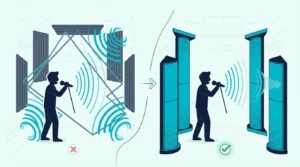
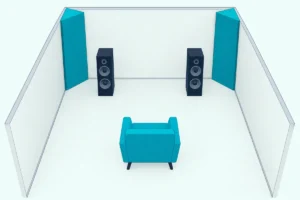
Add an air gap behind your bass traps and move them into the corners, where Auralex’s home-studio guide notes low frequencies build up.
Asking how to improve bass traps usually assumes you need new ones, but placement and thickness also set how much bass the traps you own absorb.
At 2 inches, Owens Corning lists its 703 board at 0.15 at 125 Hz against 1.14 at 500 Hz, so a thin trap can leave the bass largely untreated.
Moving a panel from a flat wall into a corner, adding an air gap behind it, or stacking a second layer of insulation needs little or no new material.

The sections below cover each upgrade, the physics behind why it works, whether bass traps increase bass (they do not), and common questions about improving bass trap performance.
Neither change needs new panels.
How To Improve Bass Trap Performance

Improving bass trap performance comes down to five variables you can control: air gap depth, panel thickness, material density, placement position, and coverage area. Each variable affects how much bass energy your traps absorb.
Two of the upgrades below, air gaps and placement, need no new material; thicker or denser insulation means adding or swapping batts.
Identify your worst bass problems before making any changes. Use a measurement microphone and Room EQ Wizard (measurement software) to see which frequencies have the biggest peaks and nulls in your room; this tells you exactly which frequencies your bass traps need to absorb and helps you prioritize upgrades that target those specific problems.
Add An Air Gap Behind Your Bass Traps
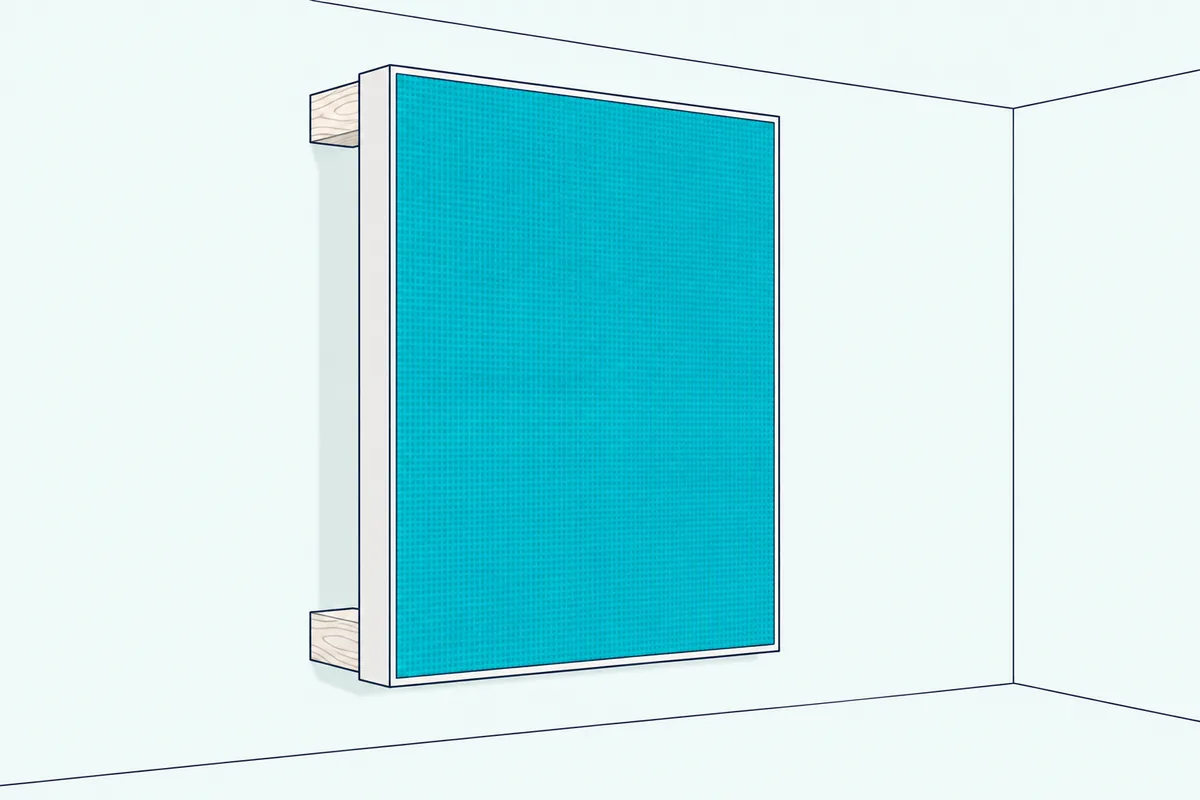
Adding an air gap behind your bass traps works because sound absorption happens where air particle velocity is highest, and for low frequencies, the velocity peak occurs at a distance from the wall boundary, not at the wall itself.
A bass trap mounted flush against a wall sits in a pressure maximum (high pressure, low velocity) for bass frequencies. The absorber needs particle velocity to convert sound energy into heat, so flush mounting wastes the trap’s potential at the frequencies where you need it most.
Pulling the trap off the wall moves part of the absorber into a higher-velocity zone. Owens Corning’s coefficients are for board placed against a solid backing (its Type A mounting), so its sheet gives no figure for what an air gap adds.
How Much Air Gap Is Enough?
A deeper gap takes more floor space, so for home studios and listening rooms the practical depth is the one the room can spare.
If you need absorption lower than a porous panel reaches, consider a Helmholtz resonator or membrane bass trap instead of piling on more air gap.
The simplest way to add an air gap is to mount your panels on Z-clips, French cleats, or simple wooden spacer blocks attached to the wall. For corner-straddled panels, angling the panel at 45 degrees across the corner leaves a triangular air space behind it.
Increase Bass Trap Thickness
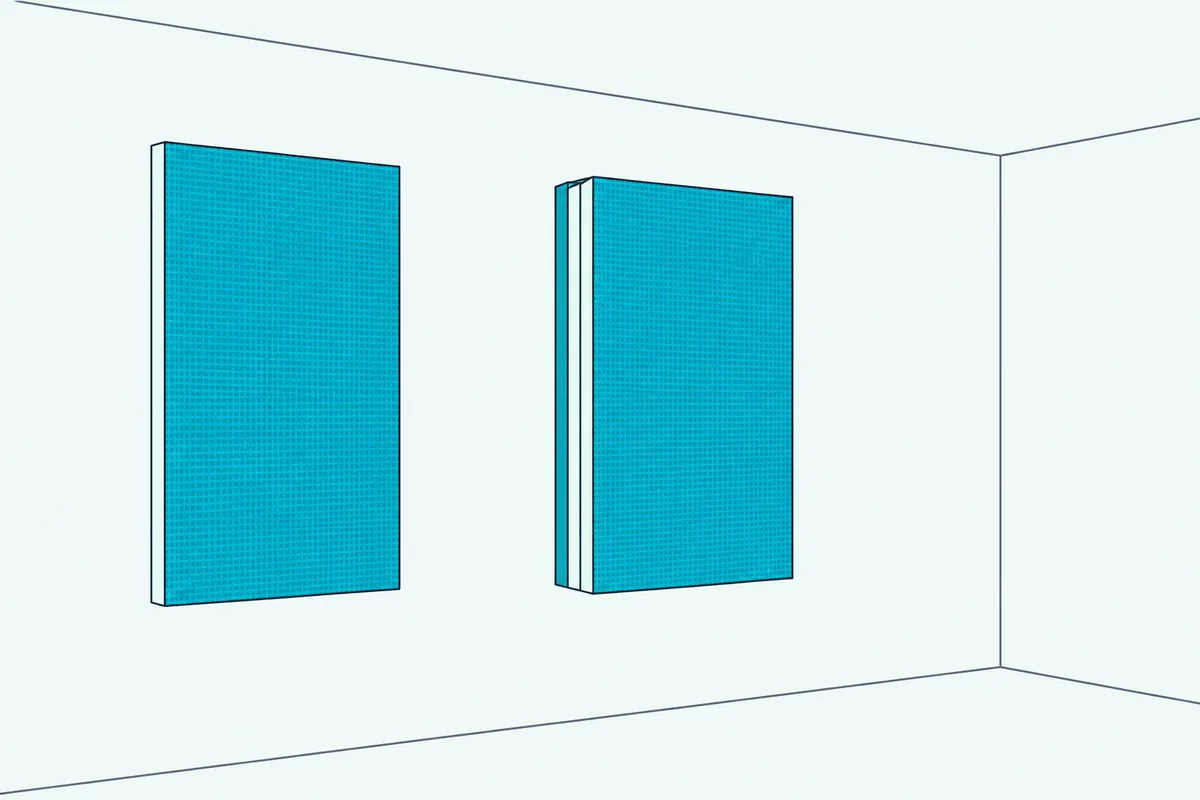
After optimizing air gaps, the next step is increasing the thickness of your bass traps. At 125 Hz, Owens Corning lists its 703 board at 0.15 at 2 inches and 0.56 at 4 inches, and ROCKWOOL lists 6-inch AFB at 1.11.
The easiest way to increase thickness is to stack panels — if you currently have 2-inch panels, adding a second 2-inch batt directly behind the first one gives you a 4-inch panel without any new framing or construction. Use the same insulation material for the added layer.
For DIY builders, switching from 2-inch to 4-inch batts in existing frames is often possible by simply removing the back panel, inserting the thicker material, and reattaching. If the frame depth does not accommodate the thicker batt, add a 2-inch batt behind the existing 2-inch batt and let it extend beyond the frame.
Compare Insulation By Its Coefficients, Not Its Density

Material density alone does not set absorption: ROCKWOOL’s sheets say density is not a performance criterion, though it is commonly referred to when specifying insulation. Compare the makers’ own coefficients at the frequencies you need.
At 2 inches and 125 Hz, ROCKWOOL lists AFB (2.5 pounds per cubic foot nominal) at 0.22 and Comfortboard 80 (8 pounds per cubic foot actual) at 0.37, against 0.15 for Owens Corning’s 703 (3.0 pcf).
Common upgrade paths:
Acoustic foam to Rockwool Safe’n’Sound: ROCKWOOL lists 3-inch Safe’n’Sound at 0.44 at 125 Hz and an NRC of 1.10, at a nominal density of 2.5 pounds per cubic foot.
Owens Corning 703 (3.0 pcf) to Rockwool Comfortboard 80 (8 pounds per cubic foot): at 2 inches and 125 Hz, Owens Corning lists 703 at 0.15 and ROCKWOOL lists Comfortboard 80 at 0.37.
Optimize Bass Trap Placement
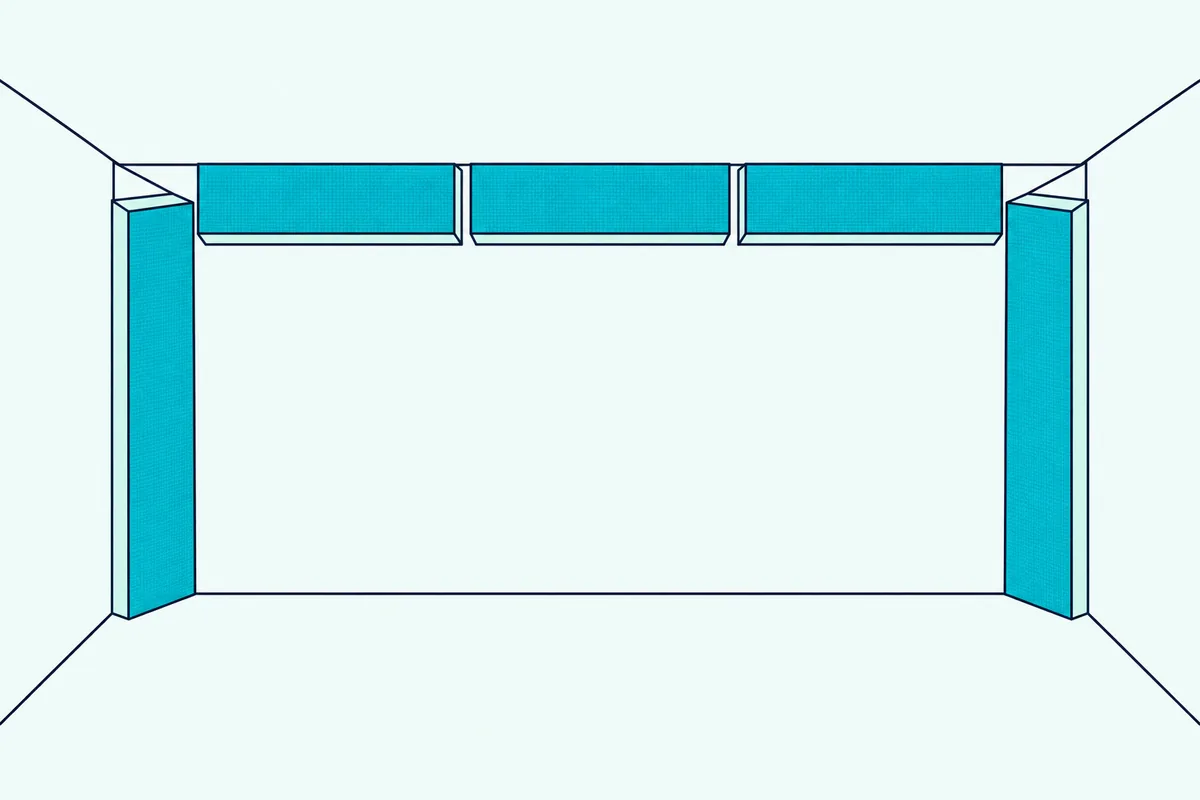
Where your bass traps sit in the room changes how much bass they catch, and moving traps from flat walls to corners needs no new material. Auralex’s home-studio guide makes bass traps in all of the corners the first step in any small room.
The priority sequence for placement optimization:
Move traps from flat wall centers to vertical wall-wall corners first — every room has four vertical corners, each where two walls meet. Auralex’s home-studio guide names the buildup of low frequencies, especially in corners, as one of the most common problems in small rooms.
Next, add treatment to ceiling-wall edges — these are horizontal “corners” where the ceiling meets each wall. Panels mounted along these edges treat the ceiling-wall junctions, which wall-only treatment leaves bare.
Finally, treat tri-corners (where two walls and the ceiling or floor meet) if your bass trap count allows it. Every rectangular room has eight of these points, where three boundaries converge.
Straddling vs flush corner mounting: A panel straddled at 45 degrees across a corner leaves a triangular air space behind it, while flush mounting places the absorber directly against the wall boundary in the low-velocity pressure zone.
For bass trapping in small rooms, placement deserves as much care as material: Auralex’s home-studio guide names the buildup of low frequencies, especially in corners, as one of the most common problems in small rooms.
Do Bass Traps Increase Bass?
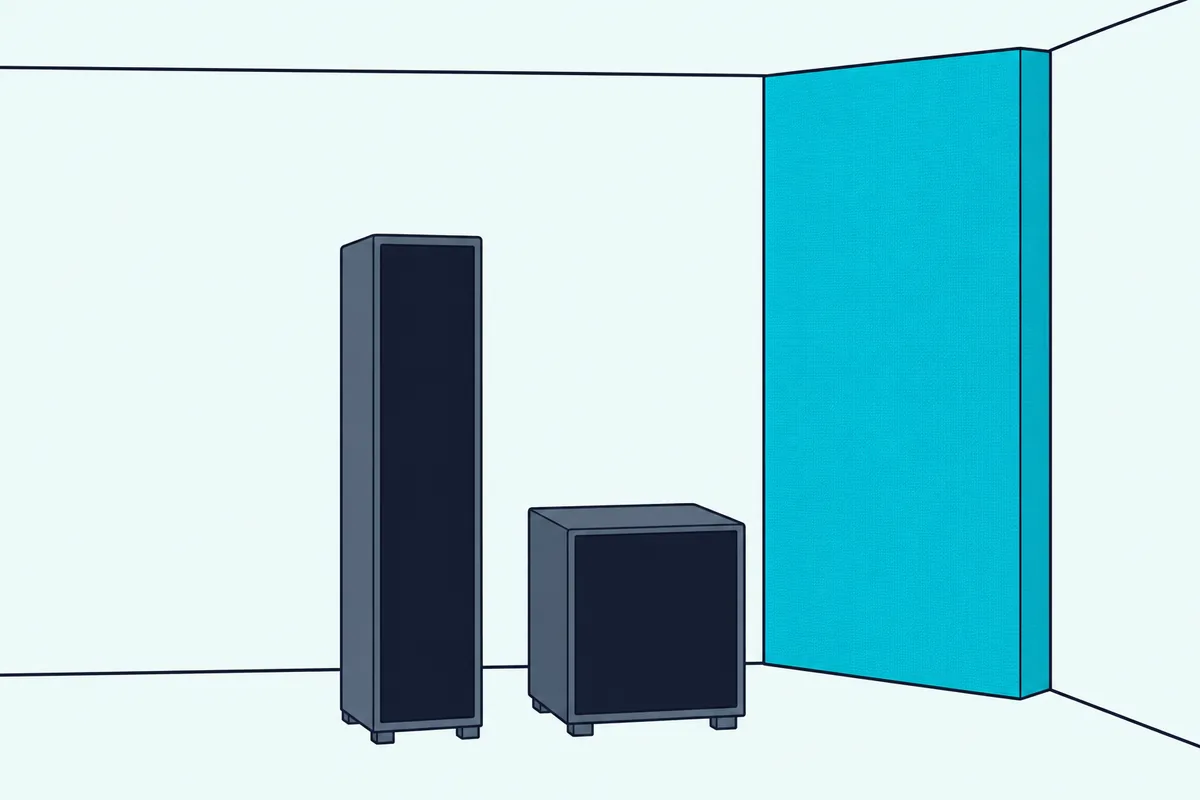
Bass traps do not increase bass — they reduce excess bass energy at specific frequencies where room modes create peaks. So what changes after installing them is those peaks coming down, not bass being added.
In an untreated room, standing waves (room modes) boost certain bass frequencies and cancel others at the same listening position. Auralex calls a mode a bump or dip in a room’s frequency response, so some notes come out louder and others nearly disappear.
Bass traps work by reducing those peaks — they absorb the excess energy that causes the boost, bringing the response closer to flat.
So bass traps are necessary for what they take away, the room’s peaks, not for any bass they add.
The Bottom Line
Improving bass traps starts with the two upgrades that need no new material: add air gaps behind your panels and move them into corners, where Auralex’s home-studio guide notes low frequencies build up.
For the next level of improvement, increase bass trap thickness by stacking, and compare the makers’ coefficients when you swap insulation material.
For stacking additional coverage, foam corner pieces extend treatment across all four vertical corners and the edges where walls meet the ceiling.
Frequently Asked Questions
Can you stack bass traps for better performance?
Stacking bass traps doubles the effective thickness. At 125 Hz, Owens Corning lists its 703 board at 0.15 at 2 inches and 0.56 at 4 inches, and stacking reaches the greater thickness without replacing the thin panels.
Does adding fabric over bass traps reduce performance?
Acoustically transparent fabric (like standard speaker grille cloth or muslin) lets sound pass through to the absorber behind it. Thick, dense fabrics like vinyl, leather, or heavy canvas will reduce high-frequency absorption, but standard coverings pass sound through without meaningful resistance.
Should I replace foam bass traps with mineral wool?
Swapping foam for Rockwool or rigid fiberglass in your existing trap frames is the material change described above. The makers give absorption by thickness: ROCKWOOL lists 3-inch Safe’n’Sound at 0.44 at 125 Hz, and Owens Corning lists 4-inch 703 fiberglass board at 0.56.