A soundbar brings its own speakers and needs one HDMI cable, while a receiver brings amplifiers and inputs for speakers you add yourself.
Products in this guide

- Subwoofer and two surround speakers in the box, for up to 11.1.4 channels
- Two HDMI inputs, plus the HDMI link to the TV
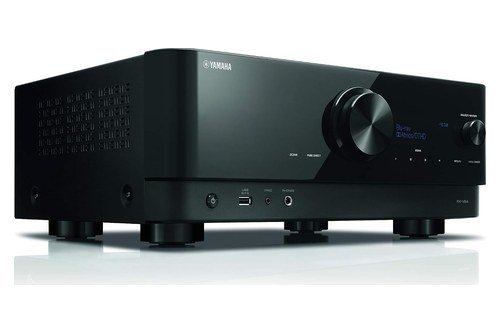
- Seven amplifiers for 2 to 9 speakers and up to 2 subwoofers
- Seven HDMI inputs and a phono input for a turntable
In a soundbar vs receiver decision, the makers’ own documents draw the line for you: a soundbar holds its amplifiers and speakers in one box, while an AV receiver holds the amplifiers and inputs for speakers you add yourself.
Miss that line and the trouble shows up at home, with a receiver that stays silent until speakers are wired in, or a bar with nowhere to connect the speakers you already own.

Match the box to your room and the things you plug in, and the rest of the choice gets a lot simpler.
The sections below cover what each one does, with named models, what each asks of your room, what each can’t do and how the two connect.
From there, the choice sorts itself by room, starting with the speakers and sources you have today.
What Is the Difference Between a Soundbar and a Receiver?
That one line decides almost everything else here. The difference between a soundbar and a receiver is that a soundbar is a finished set of amplifiers and speakers, while a receiver is a set of amplifiers, inputs and processing with no speakers at all.
Dolby’s home theater guide describes a receiver as the component that takes in your sources, amplifies the audio, routes the video to the TV and powers the speakers around the room.
The descriptions come from the makers’ manuals and spec pages. Here’s how the two line up, with named models as the examples:
| What you’re comparing | Soundbar | AV receiver |
|---|---|---|
| Speakers | Inside the bar; some sets add a subwoofer and rears | None in the box; Yamaha’s RX-V6A takes 2 to 9 |
| Amplifiers | Built in, for its own speakers | Seven on Denon’s AVR-X1800H and Yamaha’s RX-V6A |
| Link to the TV | One HDMI cable to the eARC or ARC port | One HDMI cable to the eARC or ARC port |
| HDMI inputs for sources | None on the Sonos Arc Ultra and Bose Smart Ultra, two on the Samsung HW-Q990D | Six on the AVR-X1800H, seven on the RX-V6A |
| Adding speakers | The bar maker’s own add-ons | Speakers within the receiver’s impedance range |
| A second room | Wireless multi-room on Sonos and Bose bars | A wired Zone 2, plus HEOS or MusicCast |
The bar’s list is short and set by its maker, while the receiver’s is longer and depends on what you connect. Denon sells both, and its guide to sound bars and AV receivers draws the same line, with a bar as the room-saving choice and a receiver as a hub you can customize to your room.
What Does an AV Receiver Do?
Start with that longer column. An AV receiver amplifies each speaker, switches your HDMI sources, takes TV sound back over eARC, tunes the system to your room and can feed a second zone.

Power comes first, because the receiver’s speaker terminals drive every passive speaker. Yamaha’s RX-V6A manual lists 7 internal amplifiers and room for 2 to 9 speakers plus up to 2 subwoofers, each subwoofer with its own built-in amplifier.
For scale, Dolby suggests 50 to 100 watts per channel for a room under 200 square feet and 80 to 150 for a room of 200 to 500 square feet. These four models show the range, each with eARC on its main HDMI output and a second zone:
| Receiver | Channels | Power per channel | HDMI inputs | Room calibration |
|---|---|---|---|---|
| Denon AVR-X1800H | 7.2 | 80 W | 6 | Audyssey MultEQ XT |
| Yamaha RX-V6A | 7.2 | 100 W | 7 | YPAO |
| Onkyo TX-NR6100 | 7.2 | 100 W | 6 | AccuEQ |
| Marantz Cinema 70s Series 2 | 7.2 | 50 W | 6 | Audyssey MultEQ XT |
Power is each maker’s rating into 8 ohms with two channels driven.
Sources are the second job, since every box can plug into the receiver instead of the TV. Yamaha calls inputs and outputs the first question to ask, and a phono input on the RX-V6A or AVR-X1800H matters if you’re wondering whether a turntable needs a receiver.
TV sound comes back over the same cable a bar would use. HDMI.org’s eARC page says the link sends audio from the TV to “an AVR or sound bar” through a single HDMI cable.
Room calibration starts with a microphone at your seat. Denon’s supplied microphone lets MultEQ XT analyze each speaker and build filters for each channel, and Yamaha’s YPAO works from a supplied microphone at your listening position.
Zones and streaming round out the list. Denon says Zone 2 plays the same or different audio in another room and HEOS streams to up to 64 zones.
What Does a Soundbar Do Without a Receiver?
All of those jobs get folded into one box on the other side of the comparison. A soundbar does its own amplifying, decoding and speaker work, so Bose and Sonos both describe the setup as a power cable plus one HDMI cable to the TV.

If you want the deeper foundation first, the what is a soundbar guide breaks down how that all-in-one design works.
What changes from bar to bar is what’s in the box and what you can add later:
| Soundbar | In the box | HDMI inputs for sources | Add-ons | Room tuning |
|---|---|---|---|---|
| Samsung HW-Q990D | Bar, subwoofer, two surround speakers | Two | Rears already included | SpaceFit Sound |
| Sonos Arc Ultra | Bar | None | Sonos Sub, two Sonos speakers as surrounds | Trueplay |
| Bose Smart Ultra | Bar | None | Bass Module 500 or 700, surround speakers | ADAPTiQ |
| Sony BRAVIA Theatre Bar 9 and Bar 8 | Bar | One | Optional rear speakers and subwoofers | Sound Field Optimization |
Samsung’s HW-Q990D guide lists up to 11.1.4 channels, and Sonos says the Arc Ultra does the work of nine ear-level speakers, one subwoofer and four overhead speakers.
Every bar in that table leans on the TV’s eARC or ARC port, and our guide to how ARC and eARC differ from plain HDMI explains what that port carries.
How Much Room and Wiring Does Each Setup Need?
That list of parts turns into furniture and cable as soon as you look at your room. A soundbar needs a spot by the TV and an outlet, while a receiver needs a shelf about 15 inches deep plus a place and a wire run for every speaker.
Measure your shelf first. Yamaha’s RX-V6A is 17-1/8 inches wide, 6-3/4 tall and 14-7/8 deep, and Marantz’s slimline Cinema 70s Series 2 cuts the height to 4.3 inches.
Sonos’s Arc Ultra is 46.38 inches wide, 2.95 tall and 4.35 deep, and Sonos asks for at least 4 inches between its top and the bottom of the TV. So a bar is a question of width under the screen, and a receiver is a question of depth on the shelf.
Speaker placement is what grows the receiver’s footprint. Denon’s AVR-X1800H manual puts the front pair at 22 to 30 degrees from the seat and the surrounds at 90 to 110 degrees, or 120 with no surround backs, while adding that you don’t have to match them exactly.
Each of those speakers needs its own cable back to the receiver, and the subwoofer needs a subwoofer cable. Bose says traditional speakers need more intensive installation, “power tools included,” and the soundbar vs home theater comparison walks through those layouts.
Wireless rears on a bar cut the speaker wire but not the power cords. Samsung’s HW-Q990D guide has you plug in the subwoofer, both surround speakers and the bar.
Small rooms are where Bose argues for the bar, warning that a full speaker system in a tight space may sound distorted from reflections. Bose sells bars, though, and Denon says its AVR-X1800H fills small to medium-size rooms.
What Can’t a Soundbar Do?
Those short wiring lists come with limits on the bar’s side. The bars above can’t power speakers you choose yourself, can’t take more sources than their few inputs allow and can’t be upgraded one part at a time.
Speaker choice is the hard stop. Sonos’s speakers vs soundbars post says it doesn’t currently support speakers as front channels for TVs, and its support pages limit surrounds to two Sonos speakers of the same model.
Our guide sets out which Samsung bars take add-on speakers, and the Sonos vs Bose comparison shows how those two wireless systems handle expansion.
Bose adds that a bar can’t be upgraded on its own, and that if something stops working, the entire bar must be repaired or replaced.
Inputs are the next limit. Bose says source devices can’t connect directly to its Smart Ultra, and Sonos’s Arc Ultra guide also sends streaming boxes and DVD players straight to the TV.
So count the HDMI cables going into your TV today, then count its HDMI ports and take away the one the bar needs. If the cables outnumber what’s left, a bar with no inputs won’t solve it.
Music is where Sonos itself draws a line, saying a pure hi-fi setup does better with separate speaker components, and the soundbar vs bookshelf speakers guide and soundbar vs speakers comparison cover that version of the question.
What Can’t a Receiver Do?
The receiver’s limits run the other way. A receiver can’t fill a room until speakers are connected, and it can’t fold a multi-speaker layout into one box under the TV.
Yamaha’s manual says to connect the front left and right speakers at a minimum, and Yamaha’s receiver guide counts five speakers and a subwoofer for 5.1.
It also can’t drive just any speaker. Denon and Onkyo call for 4 to 16 ohms, and Yamaha’s RX-V6A wants at least 4 ohms on the fronts and 6 ohms elsewhere, so check the rating of any speaker you plan to reuse.
A receiver brings no center speaker either, so voices come from whichever speakers you add. Our comparison of a center speaker and a soundbar for dialogue covers that setup on a receiver.
An older receiver can fall short on video as well. Dolby says to pick one with HDMI 2.1 or higher so it can pass 4K UHD video and Dolby Atmos.
Does a Soundbar Need a Receiver?
Put those two lists together and the short answer follows. No, you don’t need a receiver if you have a soundbar, because a powered bar already has the amplifiers and processing a receiver would supply, the point Consumer Reports makes too.
Passive bars are the exception, and they’re easy to miss because they share the name. Monitor Audio’s Passive Soundbar Series, ELAC’s Muro SB41L and Definitive Technology’s Mythos 3C-75 are passive models, and Monitor Audio’s manual runs left, center and right speaker cables from the AV amplifier to the bar.
ELAC’s spec sheet shows the giveaway, a nominal impedance of 6 ohms, the same rating those receiver manuals ask about. Those are the bars that do belong on a receiver’s speaker terminals.
Can a Soundbar and a Receiver Work Together?
That leaves the powered bar you may already own. They can work together, but only through a two-channel feed or through the TV, since both boxes are built to do the amplifying.

The manuals give no straight line from one box to the other. Denon lists its speaker terminals for speakers and its pre-outs for a subwoofer with a built-in amplifier or a zone 2 amplifier, while Sonos’s Arc Ultra guide tells you to disconnect existing home theater or surround sound equipment from the TV.
If you do end up owning both, a bar with an analog input can still play from the receiver’s zone 2 output, and the steps on how to connect a soundbar to an AV receiver show which receiver outputs it can use. That route hands the bar two channels, since Denon lists zone 2 as a 2-channel pre-out, and Yamaha’s RX-V6A sends no HDMI audio to its zone output.
The TV route puts the bar on the eARC or ARC port and the receiver on another TV input. The receiver becomes a switch at that point, because Denon says its HDMI Audio Out setting sends 2-channel audio to the TV while the receiver is on.
Is a Receiver Better Than a Soundbar?
With the two kept apart, this becomes a fair question. A receiver isn’t better than a soundbar in every room, and Bose says outright that neither is inherently better than the other.
Sonos calls a soundbar the better choice if you want one device and speakers the more flexible one. Denon goes further for its own range, saying true surround sound takes an AV receiver and speaker system.
Each of these companies sells what it’s describing, and none of this measures your room. A scene you know, played at your usual volume, tells you how either one sounds to you.
Soundbar vs Receiver, Which Suits Your Room?
That listening test helps, but your room and your sources settle most of this first. A soundbar suits a room where the TV is the hub and speaker wire has nowhere to go, while a receiver suits a room with space for speakers and more sources than the TV can take.
Every pick met Burton Acoustix’s rating, review and stock checks on 6 November 2026.
If Your TV Already Runs Everything
A bar is the direct fit here, since Sonos says a soundbar’s efficiency counts most when you’re mostly watching TV, and the eARC link carries sound from the TV’s own apps.
If you’re still deciding whether to add any external audio, the soundbar vs no soundbar guide is the first checkpoint. Once you’ve settled on a bar, the best soundbar roundup sorts them by TV and room, and the best budget soundbar guide covers the simpler models.
If You Can’t Run Wire to the Back of the Room
Surround with no speaker wire across the floor is the case for a bar with wireless rears, and the Samsung HW-Q990D, with its subwoofer and two rear speakers in the box is the pick.
Samsung HW-Q990D
Receivers can go wireless too: Yamaha says its MusicCast receivers can connect optional wireless surround speakers, and Sony’s STR-AN1000 guide covers Sony wireless rear speakers and subwoofers.
To weigh how many channels you want, the 2.1 vs 5.1 soundbar guide, the 3.1 vs 5.1 soundbar guide and the Atmos soundbar vs 5.1 comparison cover those layouts.
If You Already Own Speakers or a Turntable
Passive speakers have nowhere to go on a powered bar, so a receiver is the natural match. For that job the Yamaha RX-V6A, with seven HDMI inputs and a phono input is the pick.
Yamaha RX-V6A
A turntable points the same way, since the RX-V6A and Denon’s AVR-X1800H both take one at their phono inputs.
If You Plug In More Than Your TV Can Take
Consoles, a player and a streaming box add up fast. The receivers here take six or seven HDMI sources, against two at most on these bars, so your cable count from earlier is the number to compare.
If You’re Building a Dedicated Room
This is where Dolby’s guide lands on the receiver, saying an AV receiver with individual speakers for each channel lets you tailor the sound to your room if you have the space.
Our page on how a 5.1 system compares with a soundbar goes further on that layout.
The Bottom Line
The soundbar vs receiver choice comes down to who supplies the speakers. A soundbar brings its own and asks for one HDMI cable and an outlet, while a receiver brings the amplifiers, inputs and room calibration and asks for speakers, wire and space.
Both use the same eARC link to the TV, so that port doesn’t decide it. Your shelf, your walls and the cables behind your TV do.
If you are still mostly shopping on the soundbar side, the best soundbar guide and soundbar vs home theater guide are the next reads.
Frequently Asked Questions
What is an AVR in home audio?
AVR is short for audio/video receiver, the component Dolby places at the heart of many home theater systems. It takes in your sources, amplifies the audio, routes the video and powers the speakers.
Is a soundbar as good as a home theater system?
Bose says neither is inherently better than the other. Sonos says a multi-speaker system’s extra speakers around the listener suit larger rooms, while a bar does the work of several speakers in one cabinet.
Can a soundbar replace a receiver?
For TV sound, yes: it amplifies, decodes and plays from one box. It can’t replace a receiver’s speaker terminals, and the bars here have fewer HDMI inputs, so a bar won’t stand in if your speakers or sources are why you want a receiver.
Can I use a soundbar just for music?
Yes. Denon lists Bluetooth, AirPlay and HEOS on its bars, and Sonos says a premium bar can do justice to your songs. Sonos also says a pure hi-fi setup does better with separate speaker components.
Is a soundbar an amplifier?
Not in the usual sense. A powered bar has built-in amplifiers, but they drive its own speakers, while a stereo amplifier or receiver drives separate passive speakers. If you’re comparing a soundbar vs amplifier for speakers you already own, the amplifier or receiver is the one with terminals for them.