The best soundproof interior door is a 1-3/4-inch slab with a mineral core, led by Masonite’s Flush Series at STC 35.
To find the best soundproof doors for the rooms in your home, compare tested STC ratings rather than the words solid core, because Masonite’s lab sheet, every door sealed shut, runs from STC 24 for a hollow flush door to STC 35 for a mineral core.
Go by the label alone and you could hang a solid core door rated 28, a band where the Steel Door Institute says normal conversation can still be understood quite easily.
Choose by the published number and you can see what a denser core or a thicker slab adds before you carry one up the stairs.
The table below sets Masonite’s named doors by core and thickness, and acoustic assemblies from Ambico, IAC Acoustics and Acoustical Surfaces mark the far end.
After that come seals, prehung against slab, hanging, and where each maker sells.
What Are the Best Soundproof Doors for Interior Rooms?
That table comes first because the answer is a number. The best soundproof interior doors on Masonite’s sheet are its Flush Series with a mineral core at STC 35 and, with panels, its raised Molded Panel and Heritage 1 Panel Lincoln Park with particleboard cores at STC 33, all 1-3/4 inches thick.
| Pick | Best for | Why |
|---|---|---|
| Masonite Flush Series, mineral core | The quietest slab | STC 35 at 1-3/4 in, sealed shut |
| Masonite Heritage 2 Panel Logan | A home office | STC 32 with particleboard, 1-3/4 in |
| Masonite Flush Series, particleboard | A 1-3/8-inch frame | STC 31, tied highest at 1-3/8 in |
| Pemko S88D18 SiliconSeal Gasketing | The head and jambs | Silicone gasket tested for sound |
| Pemko 411APKL36 Automatic Door Bottom | The gap under the door | Its seal drops as the door closes |
| IAC Noise-Lock assembly | Ratings above STC 35 | STC 51 to 64 with frame and seals |
The descriptions come from the makers’ manuals and spec pages.
Best here means the highest STC a maker publishes at a stated thickness and core, nothing more. Masonite’s Acoustical Performance sheet for interior doors gives every value below for door panels “tested as inoperable with the perimeter sealed,” under ASTM E90.
| Masonite door | Core | Thickness | STC |
|---|---|---|---|
| Flush Series | Mineral | 1-3/4 in | 35 |
| Molded Panel (Raised) | Particleboard | 1-3/4 in | 33 |
| Heritage 1 Panel Lincoln Park | Particleboard | 1-3/4 in | 33 |
| Flush Series | Particleboard | 1-3/8 in | 31 |
| Molded Panel (Raised) | Engineered | 1-3/8 in | 31 |
| Heritage 1 Panel Lincoln Park | DorCor (18#) | 1-3/8 in | 29 |
| Heritage 2 Panel Logan | DorCor (18#) | 1-3/8 in | 29 |
Read the row that matches your frame, because a frame built for 1-3/8-inch doors stops at 31 on this sheet. Masonite’s largest tested size is 3’0″ x 7’0″ for each door here, except the mineral Flush door at 3’0″ x 6’8″ and the 1-3/8-inch raised Molded Panel at 2’6″ x 6’8″.
STC, or Sound Transmission Class, is one number for how well a door or wall blocks airborne sound, and our explainer on what an STC number tells you about a door has more. On the Steel Door Institute’s scale, normal conversation is understood quite easily at 25 to 29, normal speech may be audible but difficult to understand at 30 to 34, and loud speech is audible but not intelligible at 35 to 39.
What Can a Door Slab Do Without Seals?
Those sealed-shut figures are the ceiling, and a door you open every day sits below it. On its own a slab falls well short: Acoustical Surfaces’ door seal page lists a standard 1-3/4-inch solid-core door at STC 22 with no seals and 33 with its seals, an 11-point swing.
The Steel Door Institute’s Specifying Acoustic Doors says the inoperable test seals the perimeter with putty and tape, and that the result is “not indicative” of an operable door, which typically loses 1 to 5 points depending on the seal and threshold. Masonite’s sheet gives no operable figure, so treat its numbers as the best case.
National Guard Products, a seal maker, puts solid core wood doors at about 28 to 30 with gasketing, mineral core wood doors at about 32 to 36, and those doors without gasketing at 15 to 20.

So seal all four edges. Our guide to a bottom seal matched to your gap and floor handles the bottom edge, and the order for sealing a door you’ve just hung covers the rest.
If you’re keeping the slab for now, see a seal-first plan for a hollow-core door you’re keeping.
Pemko S88D18 SiliconSeal Gasketing
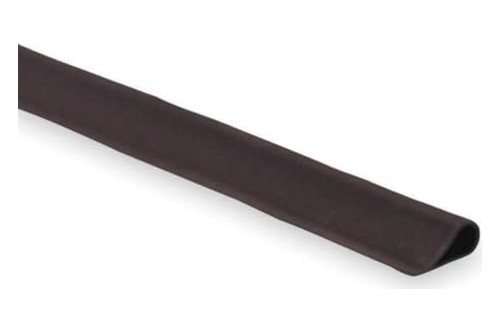
For the head and jambs, the Pemko S88D18 SiliconSeal Gasketing is an adhesive-backed silicone strip, 1/2 inch wide and 1/4 inch high, in an 18-foot length. Pemko says its gasketing is tested for sound resistance as well as smoke and draft control.
Pemko S88D18 SiliconSeal Gasketing
Pemko 411APKL36 Automatic Door Bottom
For the bottom edge, the Pemko 411APKL36 Automatic Door Bottom holds a movable drop bar seal in a 36-inch aluminum case. As the door closes, a plunger meets the jamb and pushes the seal down against the floor or threshold.
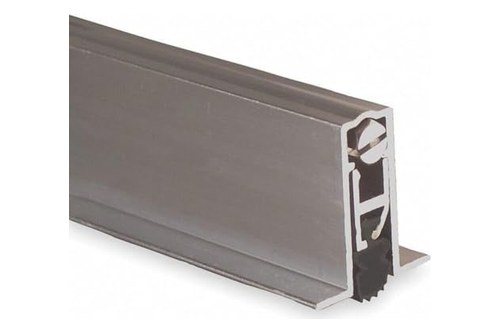
Pemko 411APKL36 Automatic Door Bottom
Which Door Material Is Best for Soundproofing?
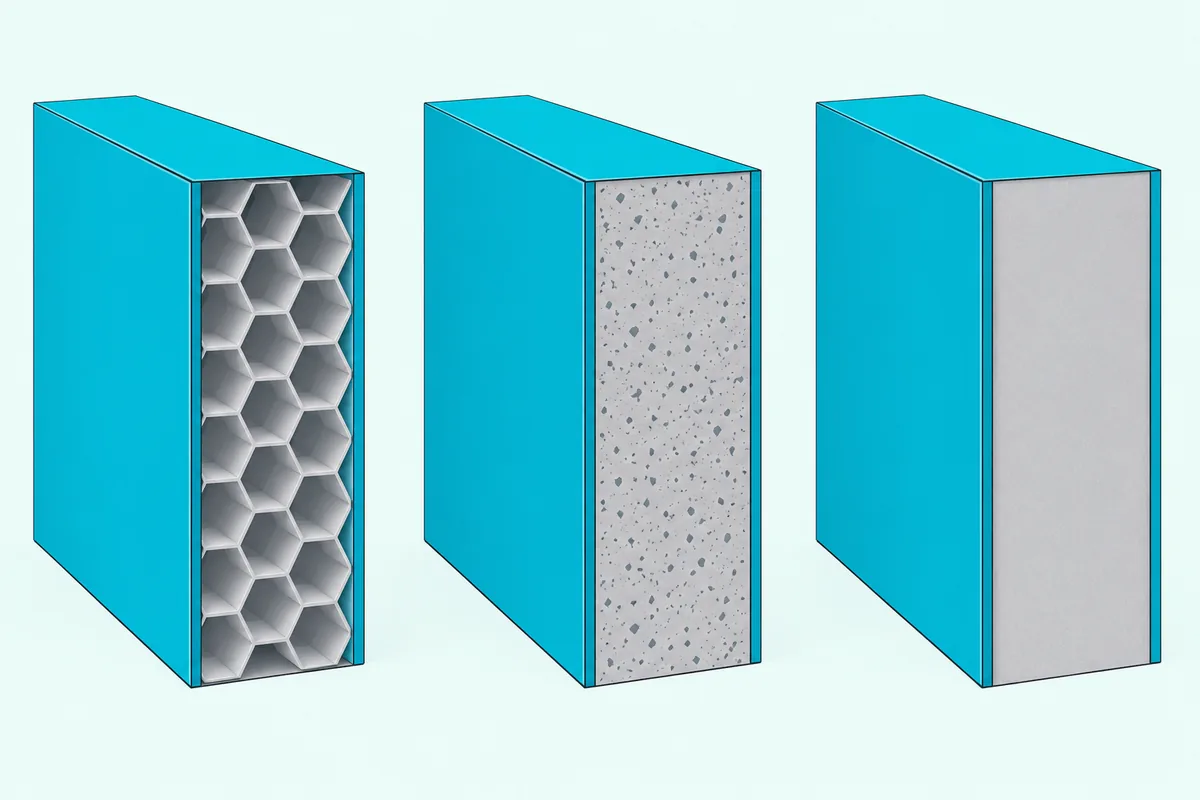
Seals handle the edges, so the slab’s own construction decides that ceiling. On Masonite’s sheet a mineral core rates highest at STC 35, then particleboard at 30 to 33, engineered cores at 31 to 32, DorCor at 28 to 31 and hollow cores at 24 to 27.
| Core | Flush, 1-3/8 in | Flush, 1-3/4 in | Molded, 1-3/8 in |
|---|---|---|---|
| Hollow | 24 | 27 | |
| DorCor | 29 | 31 | 28 |
| Particleboard | 31 | 32 | 30 |
| Mineral | 35 |
Core moves the number more than thickness does. On 1-3/8-inch flush doors the core alone spans 7 points, while the extra 3/8 inch adds 1 point to flush particleboard and nothing to molded particleboard, which rates 30 at both thicknesses.
Molded doors narrow the gap, since the hollow one starts at 27, but its OITC, the outdoor-indoor rating, is 21 against 28 for its DorCor twin. The Steel Door Institute says OITC reaches lower frequencies to mimic road and rail noise.
DorCor is Masonite’s wheat straw fiber core, and its data sheets say its 1-3/8-inch Flush and Molded Solid Core doors are made with it, so read those rows unless a dealer confirms another core. The sheet doesn’t say what 18# and 26# measure, so don’t take them for door weights.
Solid wood has no row here, and our page on whether solid core doors are soundproof sets another maker’s hollow, solid core and stile-and-rail ratings side by side. The Steel Door Institute’s advice holds either way: select by the STC value rather than the core material.
Do All Door Makers Publish STC Ratings?
That advice only works when a maker publishes the number, and not all do. Steves & Sons, Lynden Door, Trudoor and Woodgrain state their construction on these pages but give no STC figure there, so don’t carry Masonite’s numbers over.
| Door line | Construction | Sound claim |
|---|---|---|
| Steves & Sons Ultra MDF | LVL core and high density fiberboard | Sound reduction, no figure |
| Steves & Sons Stile & Rail | True stile and rail, multiple species | Excellent sound reduction, no figure |
| Lynden Door CD Series | Bonded sanded core, softwood edge stile | Acoustic options, no figure |
| Trudoor commercial wood | 1-3/4 in, particleboard or mineral core | None |
| Woodgrain Design Collection | MDF, 1-3/8 and 1-3/4 in | None |
Ask these makers for a test report on the exact door. Trudoor lists its mineral core as a 45, 60 or 90-minute fire door, and a fire listing isn’t a sound rating, as our page on why a fire label won’t give you the STC explains.
What’s the Best Door for a Bedroom, Office or Laundry Room?
Those lines sort by construction, and the room is the other half of the choice. For a soundproof bedroom door, NBS Handbook 119 recommends a solid core door with proper gaskets at the entrance of the hall leading to the bedrooms, and for a home office Masonite names its Logan and Livingston solid core doors.
Logan has a row on the sheet, 29 with DorCor at 1-3/8 inches and 32 with particleboard at 1-3/4, both sealed shut, while Livingston has none, so ask for its figure. For a laundry room, our guide to soundproofing a laundry room from the machines out adds the ventilation rule that limits how tightly a dryer’s closet door can be sealed.
Keep the door hinged if you can: Masonite says barn doors aren’t as sound dampening as hinged solid core doors, and our guide to how soundproof a barn door really is weighs slab ratings against the gap under the door.
When an opening has to keep its bifold, our comparison of the best soundproof bifold doors shows which folding doors carry tested ratings.
Should You Buy a Prehung Door or a Slab?
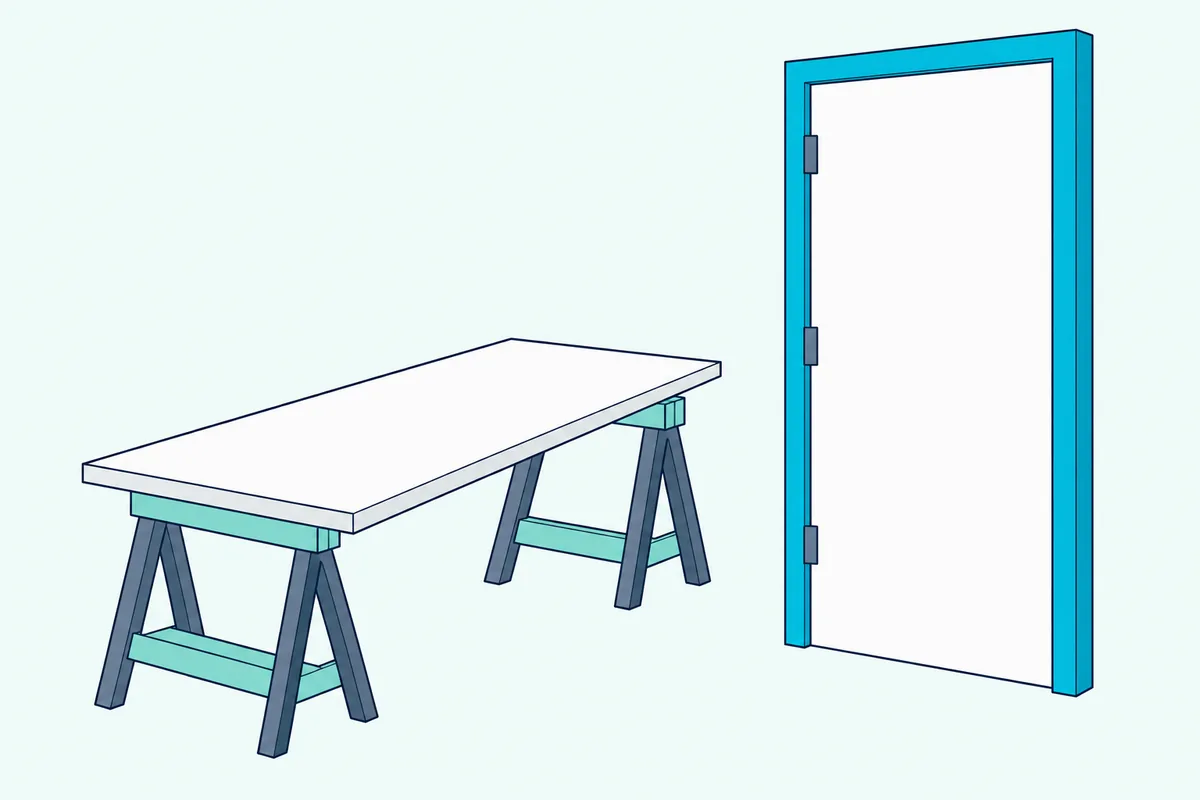
Whichever door suits the room, it arrives one of two ways. Buy a prehung solid core interior door if your old frame is out of true or you’re moving up to 1-3/4 inches, and buy a slab if the frame is plumb and already fits that thickness.
Masonite says prehung doors come hinged to their jambs, so you replace the frame along with the door. A slab keeps your frame, and Masonite warns that a frame that isn’t true and plumb makes a door look warped.
Thickness is the catch: every door rated 32 or higher on Masonite’s sheet is 1-3/4 inches, 3/8 inch thicker than a 1-3/8-inch door, so check your stops and hinge pockets first.
Trim limits are tight too: Masonite’s handling sheet allows 1/8 inch off each side, nothing off the top and 1/4 inch off the bottom without extra blocking, while Steves & Sons advises 1/2 inch at most on most flush and molded doors, split between top and bottom.
How Do You Measure and Hang a Soundproof Door?
That prehung route starts with the opening, not the door. Measure the rough opening first: Masonite’s prehung install guide wants it 1/2 inch wider and 1/2 inch higher than the unit, so a unit up to 31-1/2 by 81-1/2 inches needs a 32 by 82 inch opening.
Let the door settle first: Masonite’s handling sheet asks for 72 hours in the finished building’s heat and humidity, and three hinges on doors up to 90 inches tall. Its frame steps come down to this:
- Check that the threshold is level, the hinge side plumb and the head square, then center the unit.
- Nail the hinge side through jamb and shim with 8d finish nails at the top, middle and bottom.
- Shim and nail the lock side, with one at the strike, then fix the header through shims with 16d nails.
- Check that the gap between door and frame is equal all the way down, tapping the frame over if it isn’t.
Some gap is built in, too: Trudoor’s doors run 3/4 inch under nominal height for clearances and undercut, and that undercut is what a bottom seal has to close.
When Do You Need an Acoustic Door Assembly?
A well-hung slab still tops out at that STC 35. You need an acoustic door assembly when your target sits above that line, and the Steel Door Institute says doors above it should be specified as special assemblies, with closer attention to hardware, seals and installation.
| Assembly | Published STC | Door | Comes with |
|---|---|---|---|
| Ambico acoustic wood | 33 to 50 at 1-3/4 in | Wood, steel frame | Perimeter and bottom seals |
| Ambico acoustic steel | 33 to 53 at 1-3/4 in | Steel | Frame, perimeter and bottom seals |
| Acoustical Surfaces Studio 3D | Up to 56 | Wood composite, 2-3/4 in | Frame, seals, door bottom, 3-point latch |
| IAC Noise-Lock | 51 to 64 | Steel | Split-frame, seals, hinges, hardware |
Ambico’s thicker custom wood doors reach STC 51 to 56, and its steel doors rate higher when they’re thicker.
The Steel Door Institute says openings up to STC 54 can generally stay 1-3/4 inches thick and STC 55 or more takes 2-1/4 inches or thicker. It calls a rating in the 40s adequate in most situations, and its scale reserves 50 to 54 for reducing instruments and high-volume stereos to tolerable background sound.
Weight comes with the jump: Acoustical Surfaces gives about 300 pounds in all for Studio 3D, and SDI 128 says walls should be designed to carry acoustical doors, because a wall that flexes can’t keep the gaskets aligned.
SDI 128 also wants a full enclosure equal to or better than the door, so compare it with best soundproofing material and best sheetrock for soundproofing, and check the surrounding wall assembly.
Where Can You Buy Soundproof Interior Doors?
Those assemblies come from reps or the maker and the slabs from dealers. Buy Masonite doors through the retailers on its where to buy page, Woodgrain’s through its dealer locator, and Trudoor’s from its own store.
For the far end, use Ambico’s rep finder, IAC’s rep finder or Acoustical Surfaces’ page above. Steves & Sons says it sells through distributors supplying lumberyards, retailers and builders, with many doors online at Home Depot, and Lynden Door is best asked directly.
Whatever a shop calls them, sound reducing, sound deadening or noise reduction doors, ask for four things:
- The STC for the exact door, core and thickness, from the maker’s sheet.
- Whether the test was operable or inoperable, and the size tested.
- The slab weight, which Masonite’s sheet doesn’t give.
- The test report, because SDI 128 says a higher-rated door may do worse at certain frequencies.
The Bottom Line
Those four answers settle the choice better than any label. The best soundproof door for your frame is the highest rated row at its thickness, which on Masonite’s sheet is STC 31 at 1-3/8 inches and 35 at 1-3/4, both tested sealed shut.
Seal the head, jambs and bottom, since those figures come from a sealed door. If noise still gets in past a sealed door, look at best soundproof windows for home and best soundproof curtains, or start from the soundproofing hub.
Frequently Asked Questions
What are the best interior doors for sound proofing?
On Masonite’s sheet, the mineral core Flush Series at STC 35, then the raised Molded Panel and Heritage Lincoln Park with particleboard cores at 33, all 1-3/4 inches thick and all tested inoperable with the perimeter sealed.
What is the best door to block out noise?
If the room needs more than a slab, an acoustic assembly sold with its frame and seals. IAC’s Noise-Lock doors list STC 51 to 64 and Acoustical Surfaces’ Studio 3D up to 56.
What type of door is best for soundproofing?
A hinged door with a published STC and seals all around, since Masonite says barn doors aren’t as sound dampening as hinged solid core doors. Steel acoustic assemblies top these makers’ figures, at up to STC 64 from IAC.
Do sound deadening doors work?
Yes, with their seals. Masonite’s 1-3/8-inch flush doors test at STC 24 hollow and 31 with particleboard, sealed shut, and Acoustical Surfaces lists a standard solid-core door at 22 with no seals and 33 with them.