2.0 vs 3.0 Soundbar: Does a Center Channel Really Improve Dialogue?

The 2.0 vs 3.0 soundbar comparison looks like a minor channel-count upgrade, but it solves a real living-room problem: dialogue that sounds clear in the store and muddy at home.

A 2.0 soundbar uses left and right stereo channels to fake a center voice image. That can sound perfectly fine when you sit centered in a small room.

A 3.0 soundbar adds a dedicated center channel. Speech stays anchored to the screen instead of smearing across the front soundstage.

The pain shows up in wider rooms, busier soundtracks, and off-axis seating. That is when the phantom center starts to blur.

You end up riding the volume or turning subtitles on just to follow the conversation.

If your goal is cleaner dialogue without jumping to a full surround setup, this is the upgrade path worth understanding.

Below, we compare 2.0 and 3.0 soundbars across dialogue clarity, room size, and bass trade-offs.

You can quickly tell when a center channel is worth paying for.

Quick Takeaway

Choose a 2.0 soundbar if you mostly watch TV in a small room, sit centered, and care more about simplicity and music-friendly stereo than maximum dialogue control. A 2.0 bar keeps cost and clutter down while still sounding much better than built-in TV speakers.

Choose a 3.0 soundbar if dialogue clarity is your top priority, your couch seating is wider, or you regularly watch shows and movies with dense soundtracks. The dedicated center channel keeps voices anchored and intelligible in situations where phantom imaging starts to fall apart.

Does a 3.0 Soundbar Really Improve Dialogue?
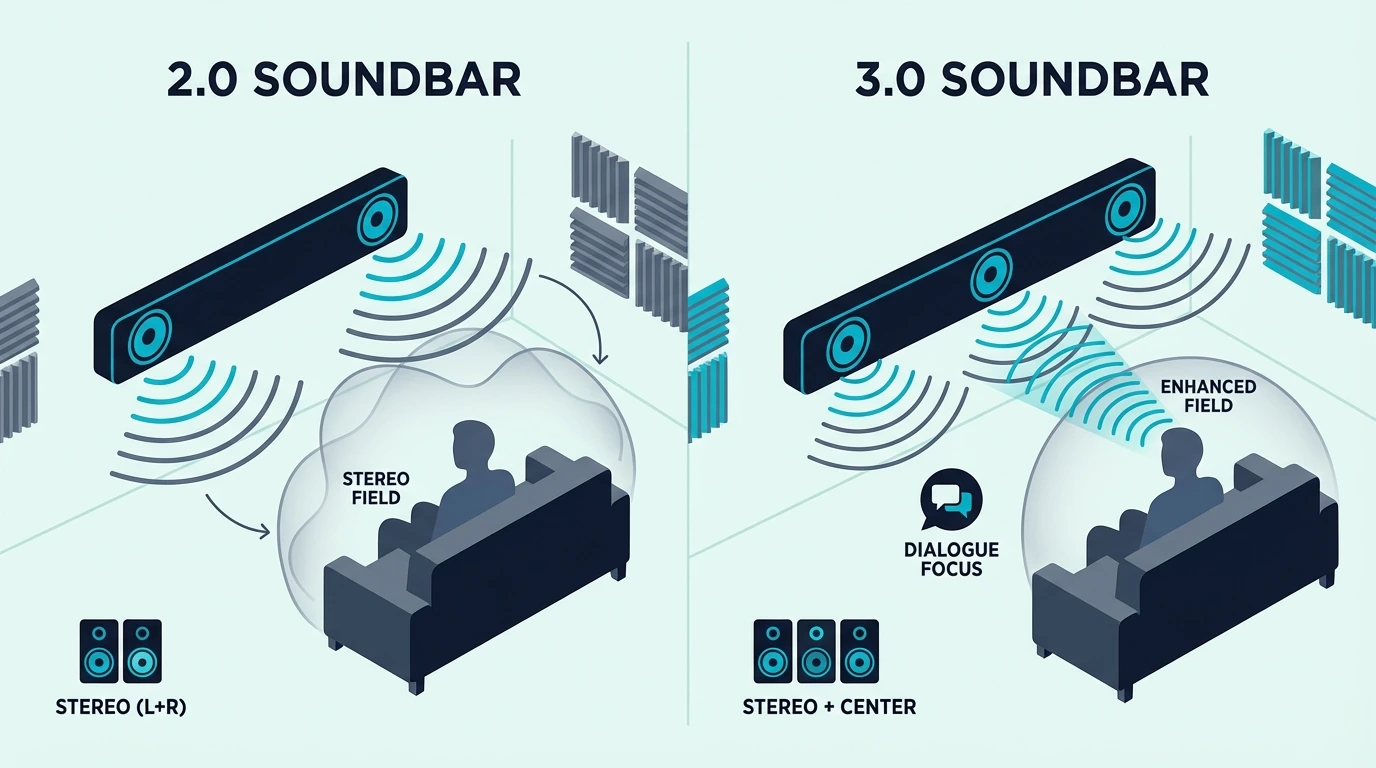
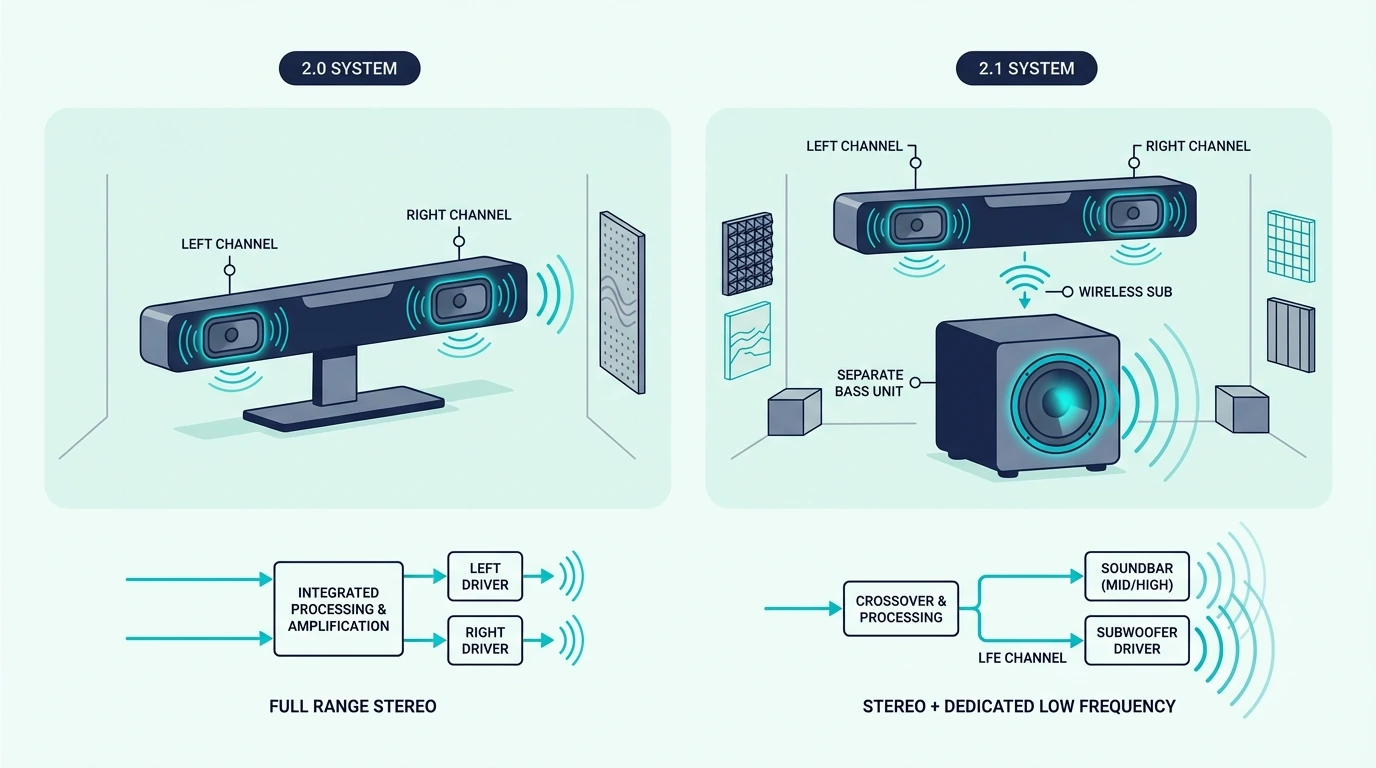
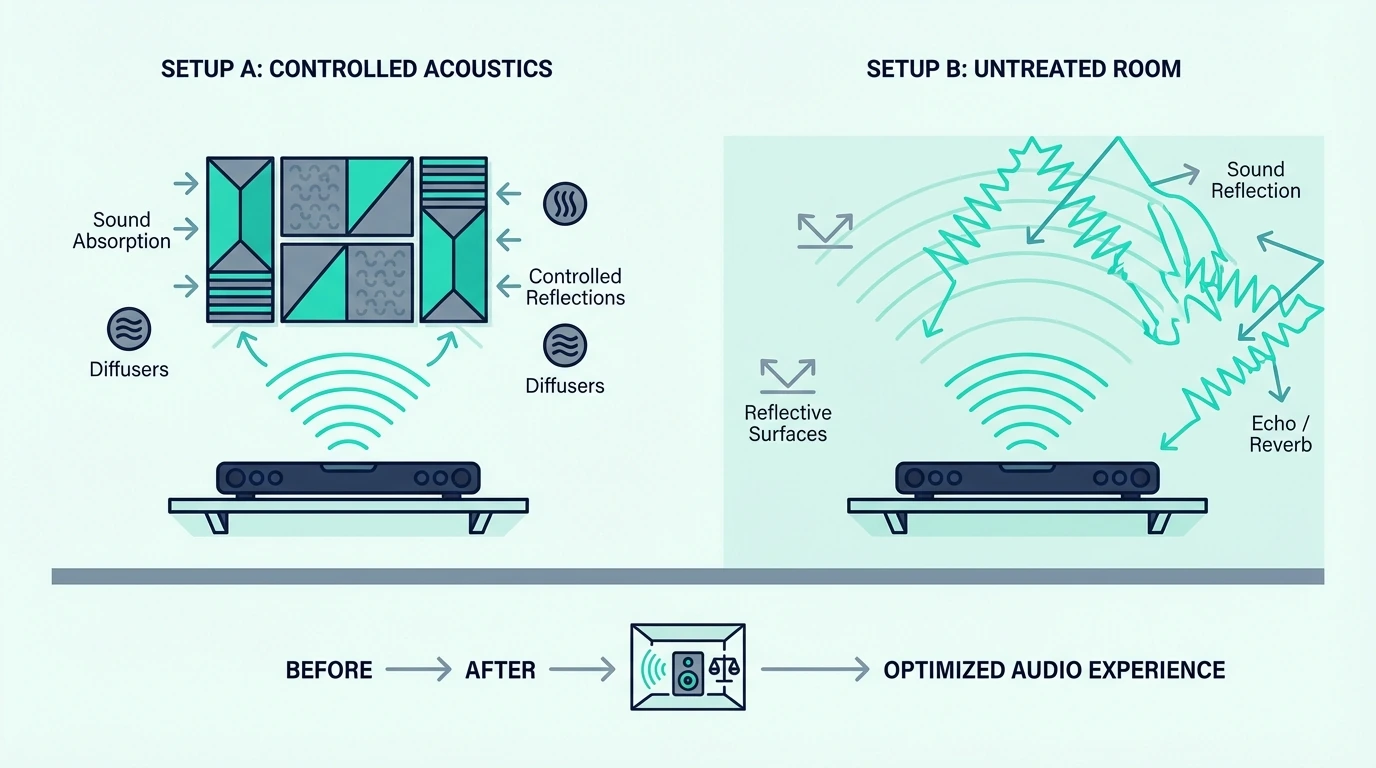
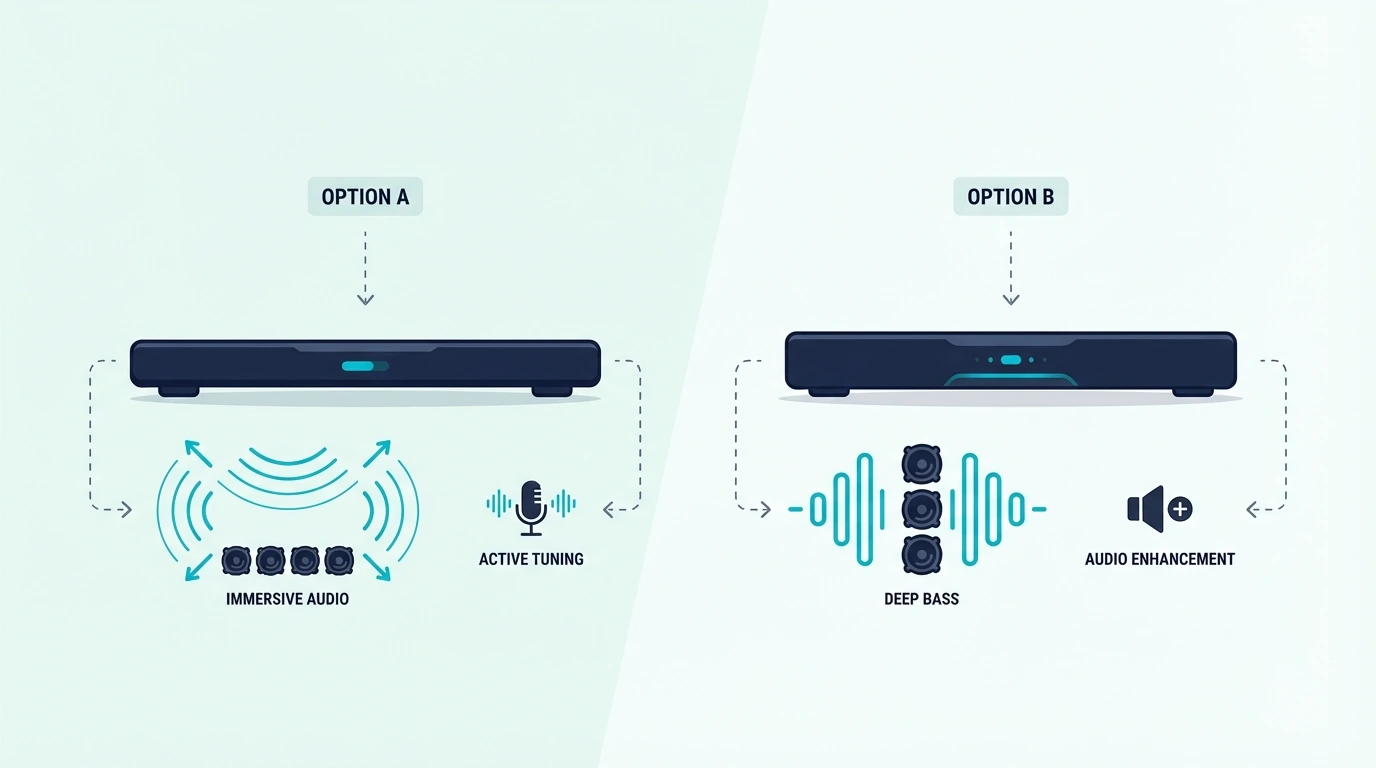
2.0 and 3.0 soundbar channel layouts compared

The dedicated center channel in a 3.0 soundbar isn’t just an extra speaker. It fundamentally changes how your soundbar separates human speech from background audio.

This difference explains why some buyers hear a dramatic dialogue improvement while others notice almost nothing after upgrading from 2.0.

2.0 Soundbars: Phantom Center Imaging

A 2.0 soundbar creates the illusion of centered dialogue by playing voice frequencies through both the left and right channels.

Your brain reads that phantom center as coming from the middle of the screen when you sit in the sweet spot.

In small rooms where you sit relatively close and centered, this phantom imaging works remarkably well for both dialogue and music.

The limitation appears in larger rooms and off-center seating. It also shows up during loud scenes.

The left and right drivers have to handle dialogue, music, and effects at the same time.

Voices get masked when competing audio demands overwhelm the same drivers. The Sony S100F 2.0ch Soundbar is a good example of what a 2.0 bar delivers well.

It offers clean stereo with bass reflex technology for respectable low-end, and its phantom center imaging sounds convincing in a small room.

Our what is a soundbar hub explains the basic channel language, and our how to choose a soundbar guide helps you match channel count to room size and listening habits.

3.0 Soundbars: Dedicated Dialogue Driver

A 3.0 soundbar physically separates dialogue from stereo effects by routing voice frequencies to a dedicated center channel driver.

That center driver handles the range where human speech lives.

The left and right channels no longer have to fight voices and effects at the same time.

The result is dialogue that stays clear and anchored to the screen even as volume rises. It also stays more consistent when you sit off to the left or right.

Family members across the couch hear dialogue more clearly than they would with a phantom center.

The center channel driver projects voice frequencies independently of the stereo field. The Sonos Beam Gen 2 shows what a well-tuned 3.0-style bar can do when dialogue is the main priority.

If you mostly watch talk-heavy TV, dramas, or late-night streaming, that extra center control is often more valuable than chasing slightly wider effects.

Our best soundbar with subwoofer roundup shows where a 2.1 or 3.1 upgrade starts to make more sense.

Our how to choose a soundbar guide helps you weigh dialogue needs against room size and budget.

Which Room and Use Case Fit 2.0 vs 3.0?
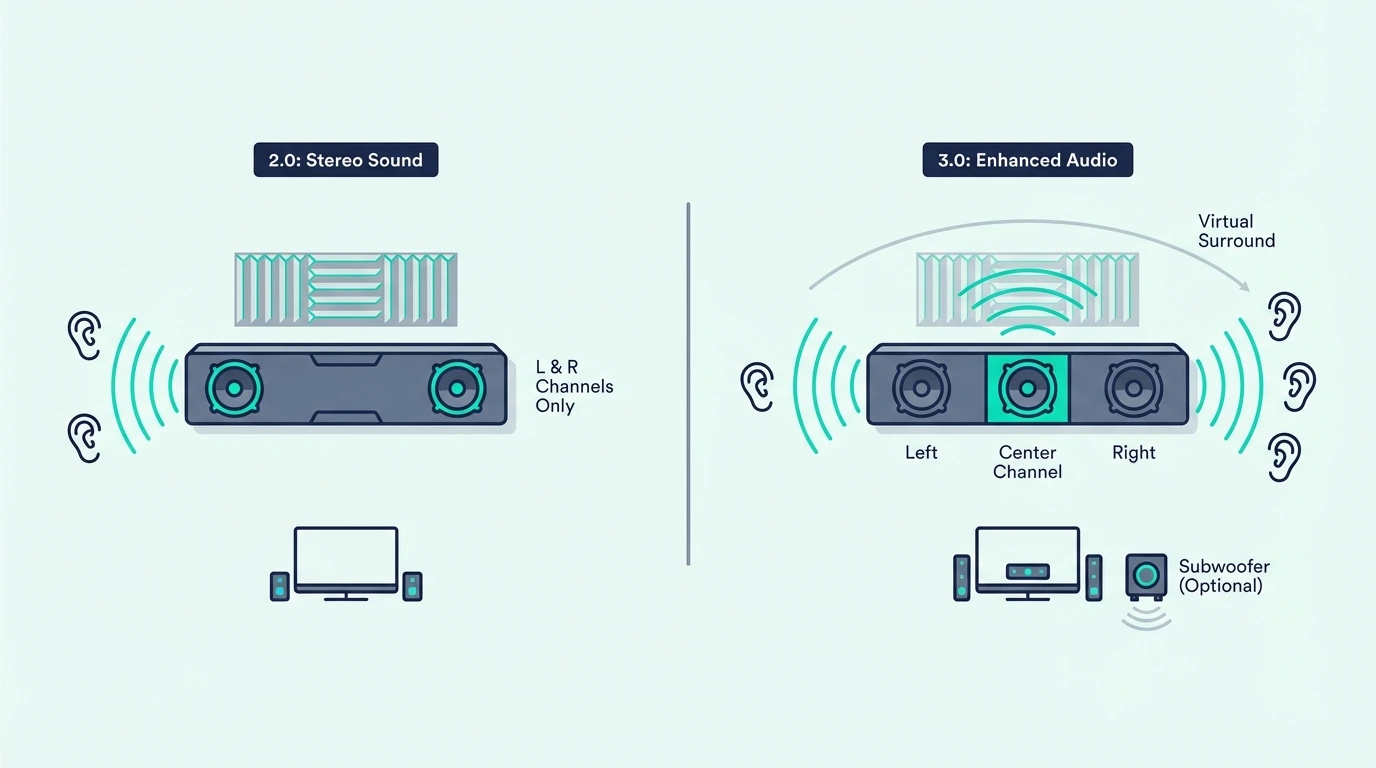
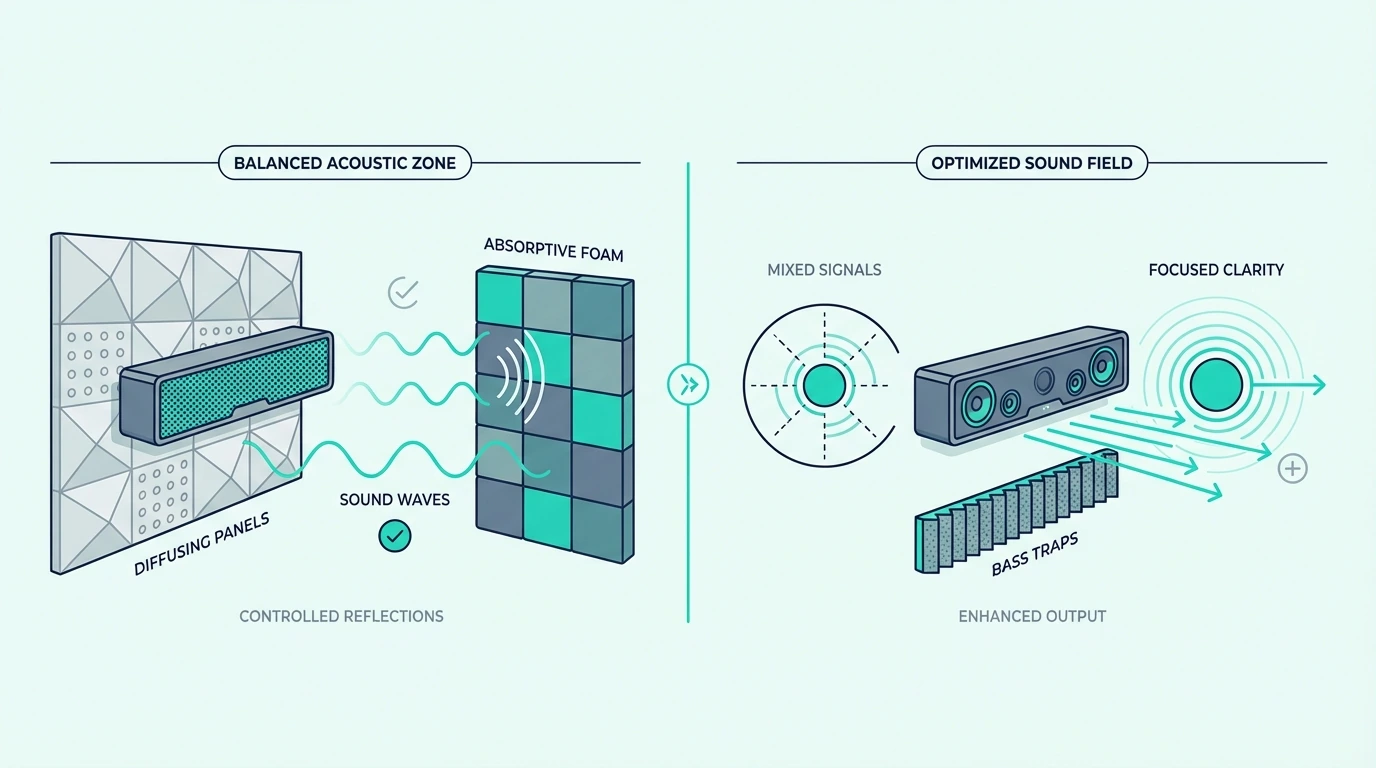
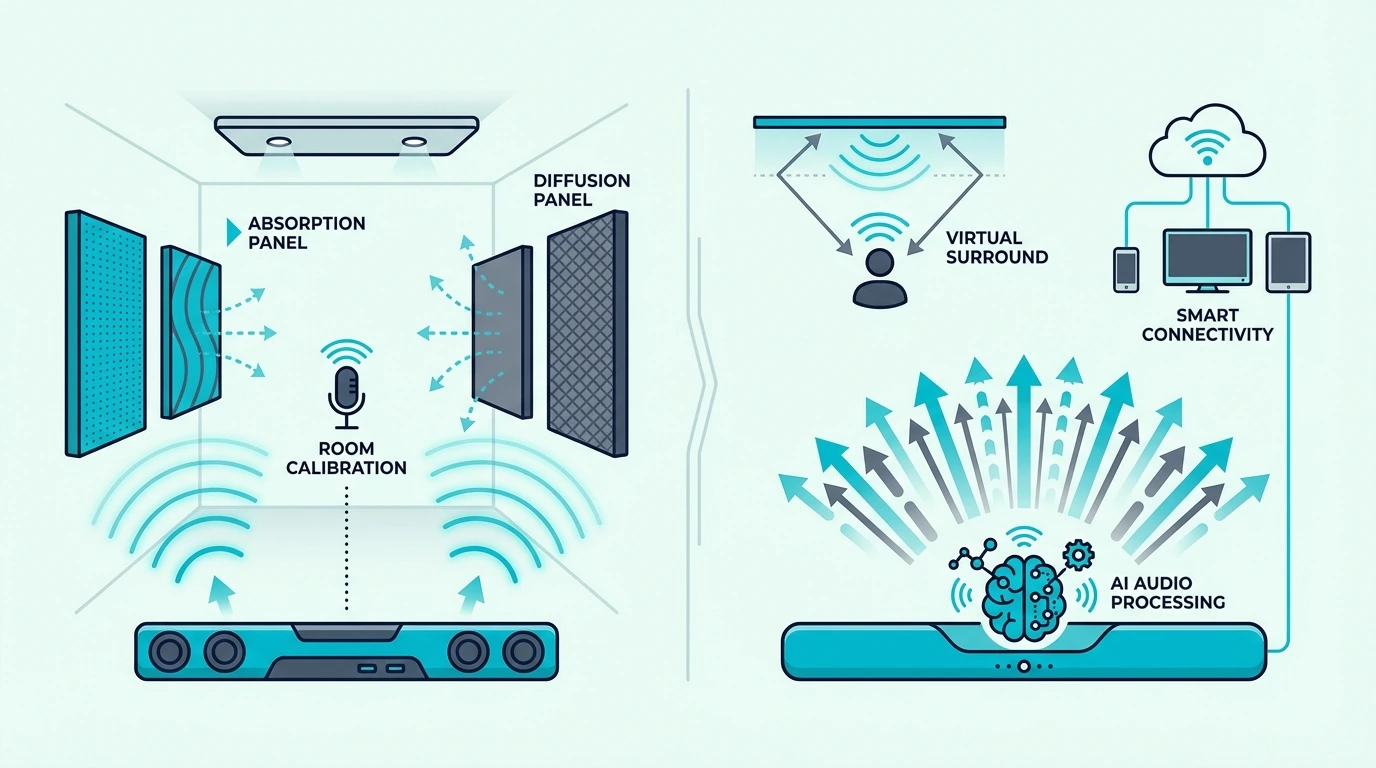
Center channel benefit in a 3.0 soundbar

Beyond dialogue clarity, 2.0 and 3.0 soundbars fit different room sizes and content types. That is what determines whether the center channel premium feels useful every day.

Small Rooms and Music: 2.0 Excels

A 2.0 soundbar often works well enough in a small room.

That includes bedrooms, offices, and compact living rooms.

Most listeners within 6 to 8 feet of the TV will not hear a big difference.

The smaller room helps the phantom center hold together because the sound reaches your ears with less spread.

For music listening, some audiophiles prefer 2.0 stereo because it avoids center-channel crossover processing. Pure left-right stereo preserves the recording’s spatial image more naturally.

That appeals to listeners who want the mix to stay closer to the original stereo presentation.

In nearfield listening, the screen is physically closer to your ears. That makes the phantom center hold together more consistently than it does across a wide couch.

That is why a simple 2.0 bar can feel perfectly fine in a bedroom but thin in a larger family room.

Our best budget soundbar roundup shows what simple entry-level bars look like today, and our how to choose a soundbar guide helps you match channel count to your room and listening habits.

Large Rooms and Dialogue-Heavy Viewing: 3.0 Wins

In medium-to-large living rooms, the 3.0 center channel becomes noticeably more valuable. Dialogue stays locked to the screen and more audible for everyone on the couch.

If you frequently turn on subtitles during action movies or rewind because you missed dialogue, a dedicated center channel addresses that frustration more effectively than turning up the volume.

A center channel matters most with compressed streaming dialogue, busy sports broadcasts, and mixed-volume TV shows. Those are the situations where voices constantly compete with effects.

It does not make the soundtrack more cinematic by itself. It makes everyday viewing less frustrating.

A bar with a true center driver keeps speech stable for everyone on the couch. That is why 3.0 makes more sense once the room gets wider or the soundtrack gets busier.

If you also want stronger bass, look at 3.1-style options in our best soundbar with subwoofer roundup.

Our soundbar to TV connection guide covers how both 2.0 and 3.0 configurations connect, and our soundbar setup guide shows how placement affects clarity once you move beyond a tiny room.

Neither Has a Subwoofer: The Bass Gap

One important limitation both 2.0 and 3.0 soundbars share — neither includes a dedicated subwoofer. Neither configuration produces deep bass below 80-100Hz.

If bass impact matters for movies, gaming, or music, you need to step up to a 2.1 or 3.1 configuration with a wireless subwoofer.

If you already know you want clearer speech and more low-end punch, a Samsung HW-B630F 3.1ch Soundbar is the kind of adjacent upgrade worth considering.

It is not a pure 3.0 bar.

But it shows why some buyers skip straight to 3.1 when both dialogue and bass matter.

A center channel solves clarity, not impact.

If your biggest complaint is thin explosions or weak kick drums, moving from 2.0 to 3.0 will not fix the low-end gap.

You still need a subwoofer for that.

Our HDMI ARC setup guide explains the cleanest connection path for newer TVs, and our best soundbar with subwoofer roundup shows where the bass upgrade starts to justify the extra hardware.

The Bottom Line

Choose a 2.0 soundbar for small rooms, music-focused listening, and centered seating where phantom imaging works well. These bars deliver clean stereo that significantly improves your TV’s built-in speakers at the lowest price.

Choose a 3.0 soundbar for medium-to-large living rooms and dialogue-heavy viewing. It also makes sense when multiple people sit in different positions.

The dedicated center channel keeps voices consistently clear across the couch.

Our guide to mounting a soundbar helps if you want a cleaner install, and a good buying checklist helps you decide whether clarity, bass, or simplicity matters most.

Frequently Asked Questions

What is the difference between 2.0 and 3.0 soundbars?

A 2.0 soundbar has left and right channels that use phantom imaging to simulate centered dialogue. A 3.0 soundbar adds a dedicated center channel that handles dialogue independently.

That keeps voices clearer and more anchored to the screen.

Neither includes a subwoofer for deep bass.

What does 3.0 mean on a soundbar?

The “3.0” means three audio channels — left, center, and right — with zero subwoofers. The first number indicates speaker channels and the second indicates subwoofer units.

A 3.0 adds a dedicated center channel for dialogue clarity compared to a 2.0 (left and right only) but doesn’t include a separate subwoofer.

Is a 2.0 soundbar worth it?

Yes. A 2.0 soundbar is a major upgrade over your TV’s built-in speakers.

It gives you clearer stereo, better volume range, and better dialogue for less money than most 3.0 options.

For small rooms, music listening, and budget-conscious buyers, it is often the smartest value.
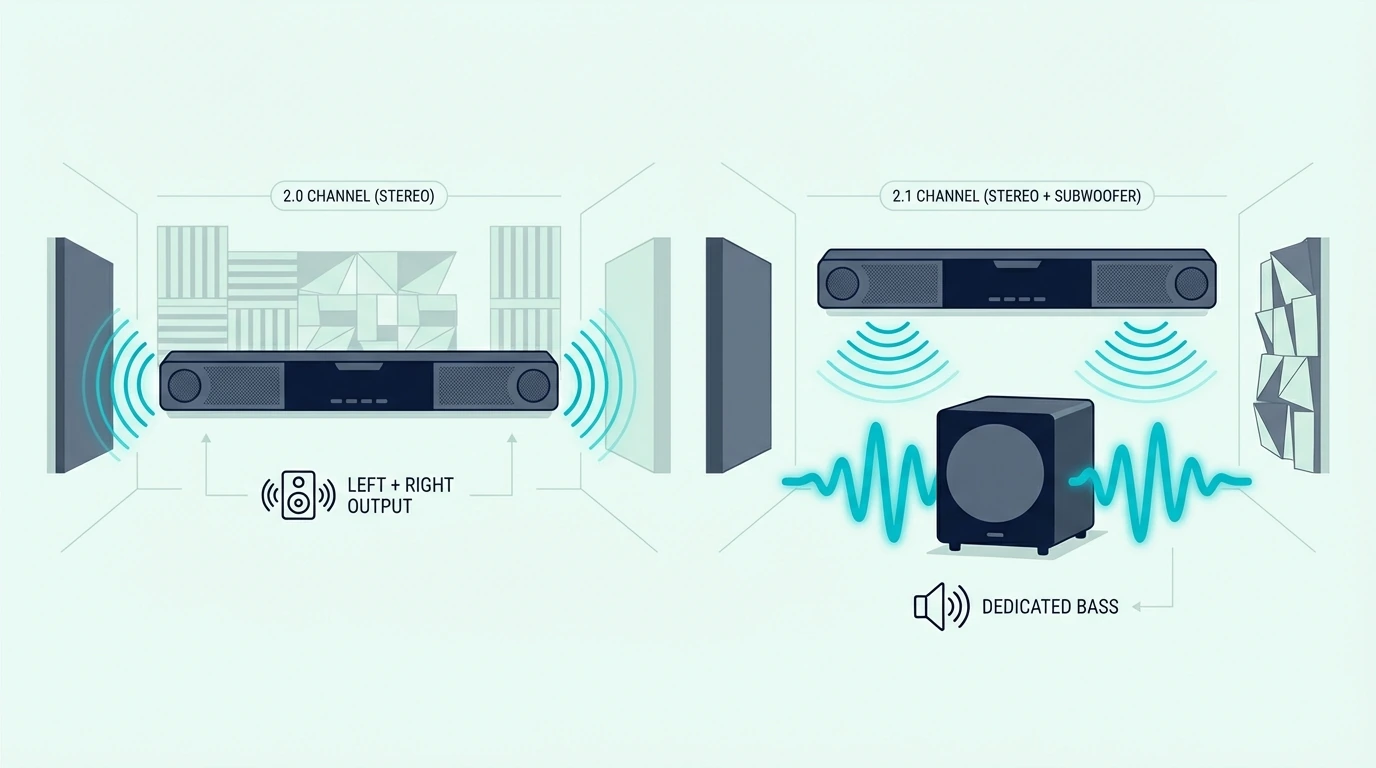
2.0 vs 2.1 Soundbar: Is a Subwoofer Worth the Extra Cost?

The 2.0 vs 2.1 soundbar difference comes down to one component, but that single change can reshape how movies, music, and games feel in your room.

A 2.0 soundbar packs two stereo channels into one bar with no external hardware. A 2.1 adds a wireless subwoofer that handles bass independently.

Without a subwoofer, compact bar drivers cannot reproduce frequencies below 80–100 Hz. You hear the boom, but you do not feel it.

The 2.1 subwoofer fills that gap. It also cleans up dialogue and mids because the bar drivers no longer strain to handle bass.

But if you mostly watch TV in a bedroom, the extra hardware may feel unnecessary. In that case, a simple 2.0 bar often makes more sense.

Below, we compare 2.0 and 2.1 soundbars across bass performance, audio clarity, setup complexity, room size, and price so you can choose the right setup for how you actually use your TV.

Quick Takeaway

Choose a 2.0 soundbar if you mostly watch dialogue-heavy TV, news, and podcasts in a bedroom or small room and want the simplest setup with no extra hardware. A 2.0 bar gives you clear stereo audio at the lowest price and avoids subwoofer placement concerns.

Choose a 2.1 soundbar if you watch movies, play games, or want fuller low-end in a medium-to-large room. The dedicated wireless subwoofer adds bass impact a 2.0 bar cannot physically reproduce and usually makes the main bar sound cleaner too.

How Do 2.0 and 2.1 Soundbars Compare for Sound Quality?

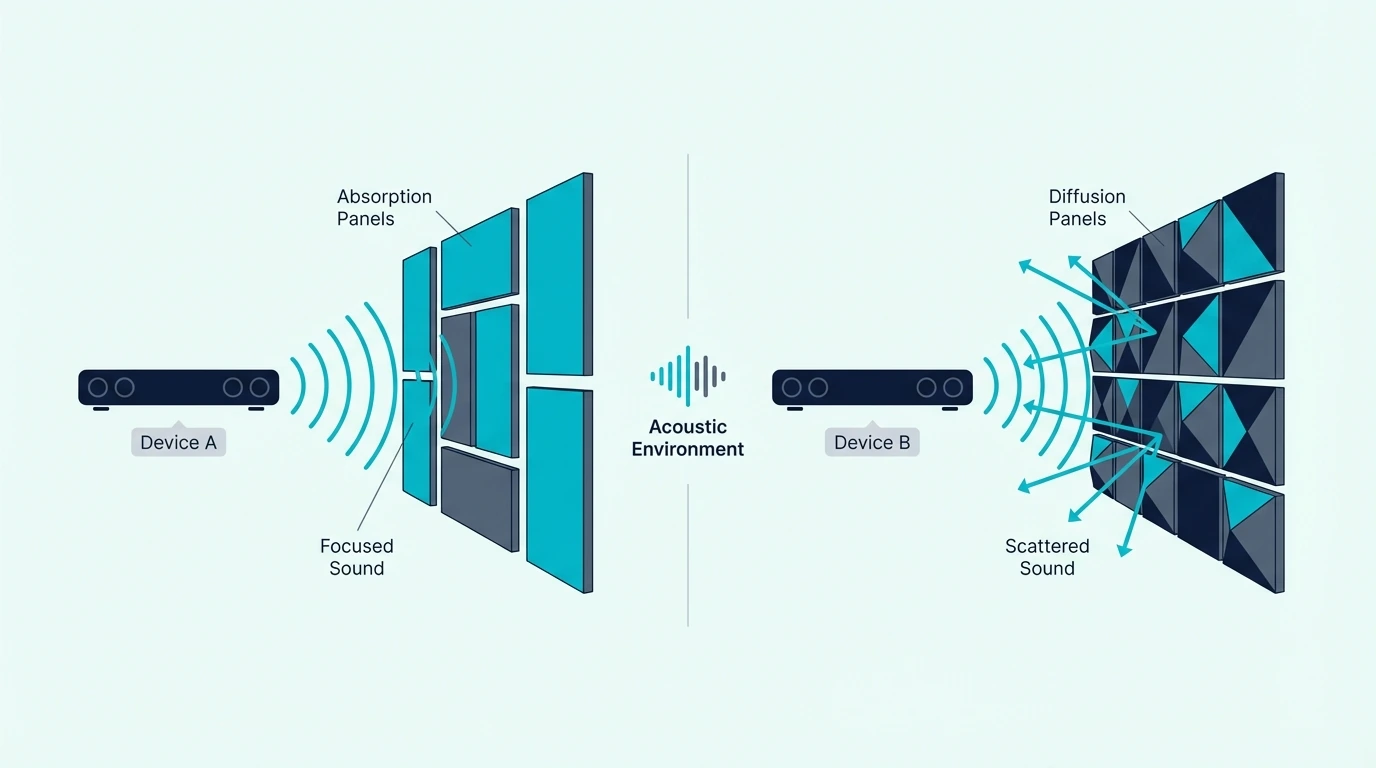
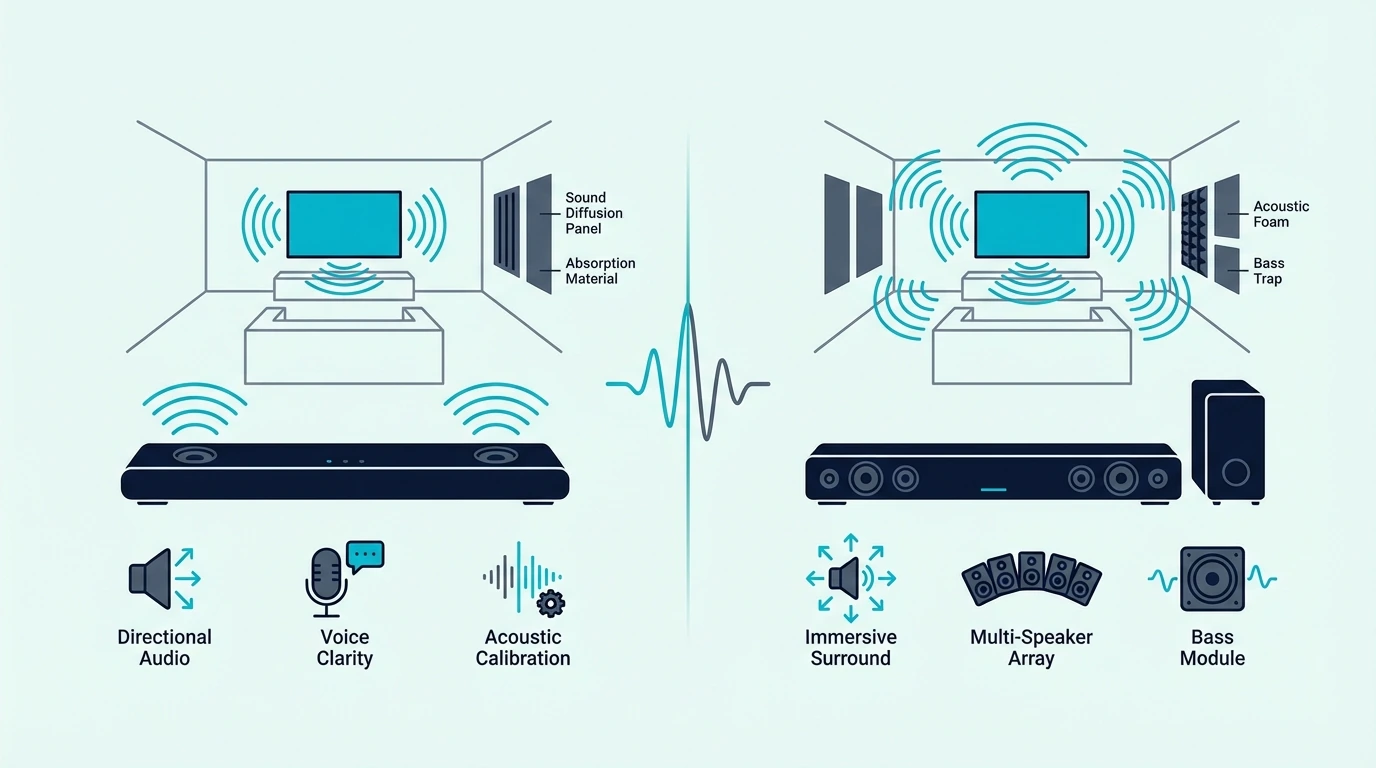
2.0 soundbar setup compared with 2.1 soundbar setup

The difference goes beyond having a subwoofer. Offloading bass to a dedicated unit changes how the entire system sounds — not just the low end but the mids and highs too.

2.0 Soundbars: Clean Stereo Without Deep Bass

A 2.0 soundbar delivers left and right stereo from two channels in a single bar. Voices sound clearer than they do on TV speakers, and the stereo image feels wider.

It also offers enough volume to fill a bedroom without straining.

Most 2.0 bars include Bluetooth for wireless music streaming from your phone, and many offer HDMI ARC or optical connections for TV audio.

That simplicity matters if you rent, move rooms often, or hate cable clutter. A single-bar setup is easier to live with day to day.

The Sony S100F 2.0ch Soundbar is a solid example of what a 2.0 bar delivers — clean stereo audio with bass reflex tuning that squeezes respectable low-end from compact drivers at an affordable price.

The trade-off is limited bass extension. Even with bass reflex engineering, compact drivers physically can’t reproduce frequencies below 80–100 Hz.

At moderate volumes, this barely matters. Dialogue stays clear, and music still sounds balanced.

Push the volume higher or switch to bass-heavy content, and the limitation becomes obvious.

In a bedroom watching The Office, you won’t miss the deep bass. In a living room watching Top Gun: Maverick, you absolutely will.

Our what is a soundbar hub explains how channel layouts fit into the broader soundbar landscape and gives you the baseline terminology behind 2.0, 2.1, and bigger setups.

2.1 Soundbars: Deep Bass Plus Clearer Mids

A 2.1 soundbar adds a wireless subwoofer that handles everything below roughly 80–120 Hz. This produces two distinct improvements you notice immediately.

The Samsung HW-C450 2.1ch Soundbar is a textbook example of the 2.1 upgrade. Its wireless subwoofer delivers bass impact that no standalone bar can match, and the main bar can focus on cleaner dialogue.

First, the subwoofer reaches down to 40–50 Hz. That is the range you feel in your body.

Hans Zimmer scores gain weight. EDM drops hit harder, and gaming explosions shake the couch.

Once bass is offloaded, the bar handles mids and highs with less strain. Dialogue sounds crisper, and the whole system stays cleaner as volume rises.

The difference is obvious the first time you switch between 2.0 and 2.1 in an action scene. You stop just hearing the explosion and start feeling it.

That extra bass is not only about louder explosions. It also makes music sound fuller and gives bigger rooms a sense of scale that a standalone bar struggles to create.

Our best soundbar with subwoofer roundup shows what current 2.1-style options look like, and our guide to pairing a subwoofer with a soundbar explains the setup trade-offs that come with adding separate bass hardware.

Which Room and Setup Needs Favor 2.0 vs 2.1?

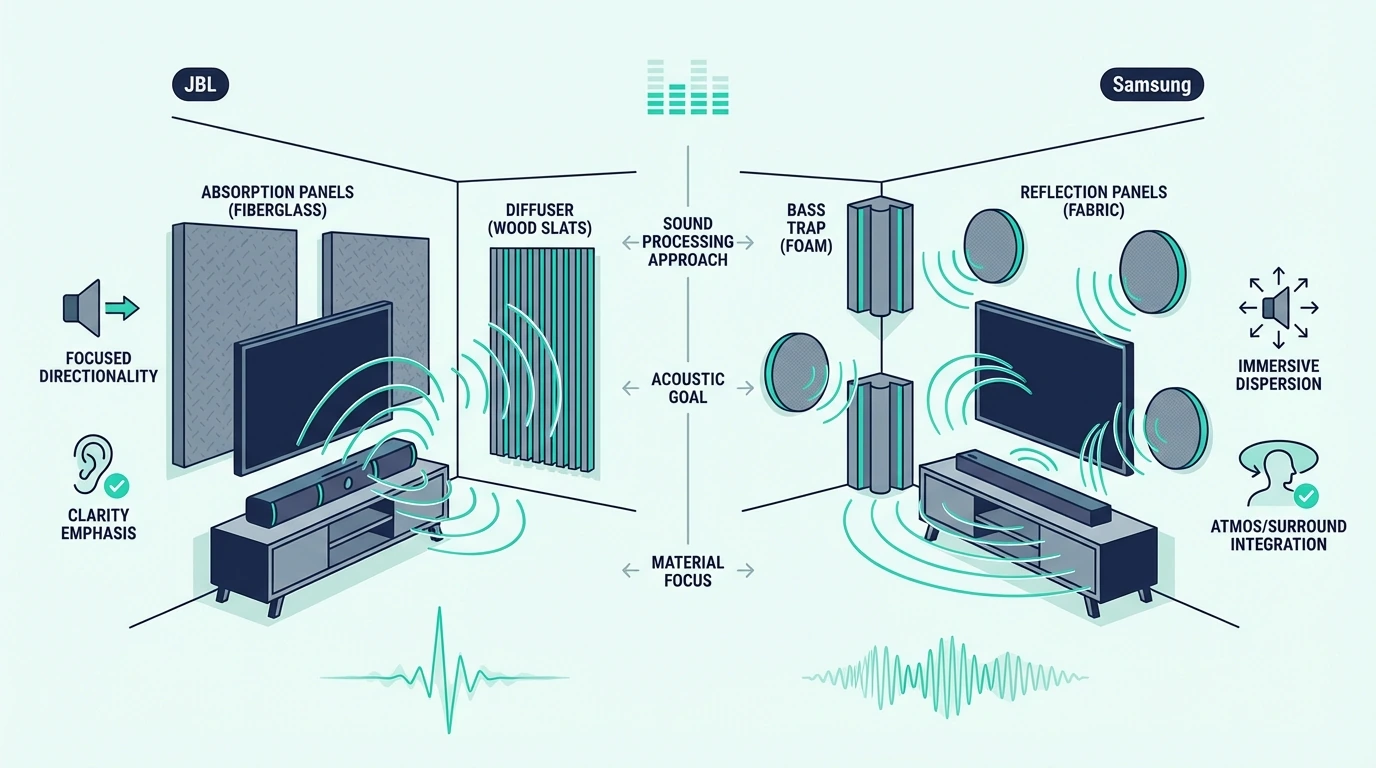
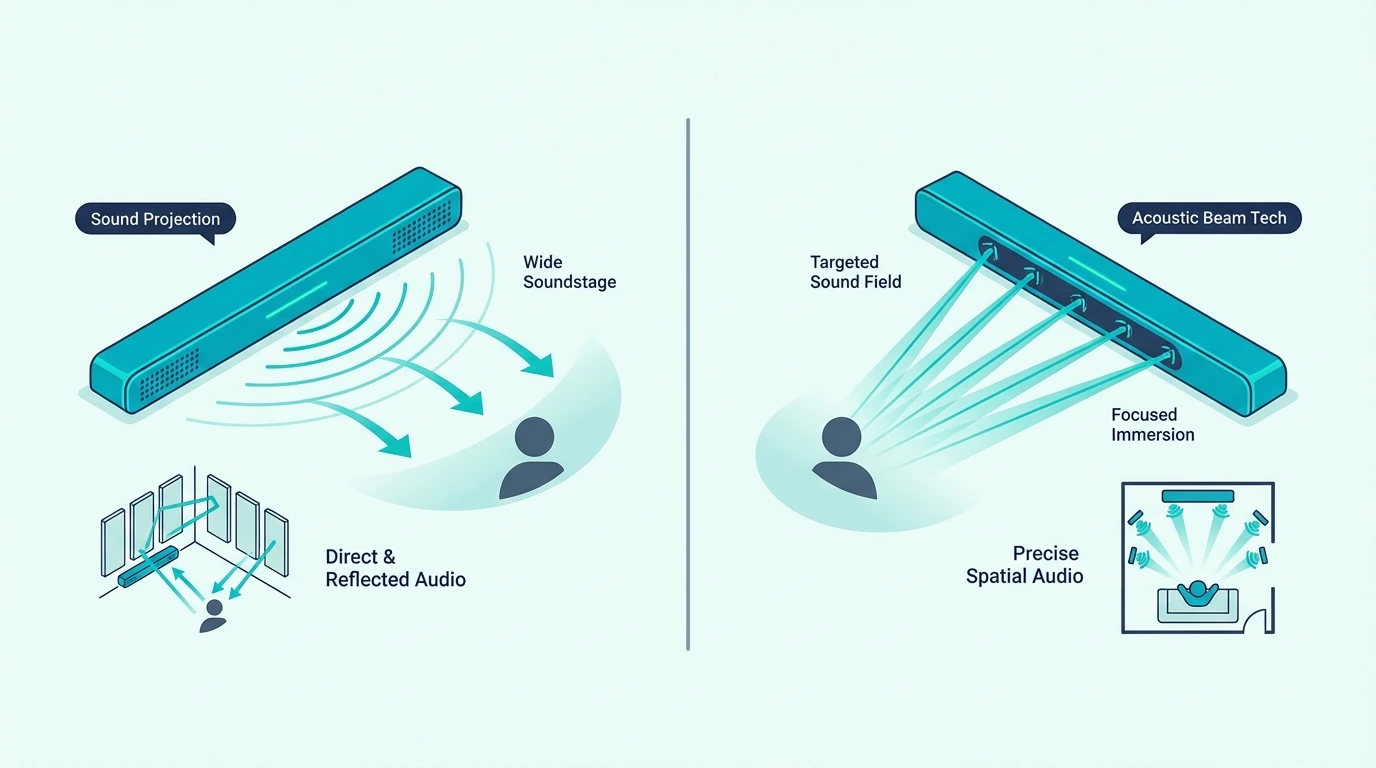
When a 2.1 soundbar with subwoofer is worth it

Beyond sound quality, these two setups differ in space needs and day-to-day hassle. Those practical factors often matter more than spec sheets.

When a 2.0 Soundbar Is the Right Choice

A 2.0 bar works well in a bedroom, office, or guest room where deep bass is not a priority. Setup is simple because you place one bar and connect one cable.

No extra hardware on the floor, no wireless pairing, and no subwoofer placement decisions. Budget 2.0 bars start under $50 — the most affordable meaningful TV audio upgrade available.

For apartment dwellers, 2.0 bars are particularly practical. Thin shared walls mean a subwoofer’s low frequencies travel directly into your neighbor’s living space, regardless of how low you set the volume.

Also ideal for late-night viewing. Without a subwoofer producing room-shaking frequencies, you get clear dialogue without bass energy traveling through walls and disturbing others in adjacent rooms.

A 2.0 setup also gives you predictable results with zero tuning. Since there is no separate sub to position, you avoid the trial and error that often comes with chasing smoother bass.

Our best budget soundbar roundup shows what entry-level bars look like today, and our soundbar to TV connection guide walks through the setup process that applies to both 2.0 and 2.1 configurations.

When a 2.1 Soundbar Is Worth the Premium

A 2.1 soundbar is worth the extra cost for a primary living-room TV if you watch movies, game, or listen to music regularly. The subwoofer moves the experience from “better than TV speakers” to genuinely immersive.

Medium and large rooms benefit most because bass has more space to fill. In a small bedroom, a 2.0 bar can cover the basics.

In a bigger living room, you will feel the gap every time an action scene hits.

The wireless subwoofer sits on the floor and auto-pairs with the soundbar during initial setup — zero cables running between the bar and sub. Place it near your entertainment center or in a corner for naturally reinforced bass output.

Avoid putting it inside a closed cabinet (muffles output) or directly behind large furniture (blocks the driver). Most people find the sweet spot within 15 minutes of sliding it around while playing a bass-heavy movie scene.

The subwoofer connects wirelessly to the bar during initial setup — press the pairing button once, and it stays connected permanently. No Bluetooth re-pairing each time you turn the system on.

That matters even more if your TV sits in an open-plan room. The farther sound has to travel, the more a dedicated sub helps the system feel substantial instead of thin.

A better living-room value example is JBL Bar 2.1 Deep Bass (MK2), which makes more sense when you want a dedicated subwoofer without stepping into a pricier surround package.

Our HDMI ARC setup guide explains the cleanest connection path for newer TVs, and our soundbar setup guide shows how placement changes bass performance in real rooms.

The Bottom Line

Choose 2.0 for bedrooms, small rooms, and secondary TVs. It gives you clear stereo with the simplest setup.

Choose 2.1 for your primary living room where you watch movies, game, or listen to music. The subwoofer produces dramatically deeper bass and simultaneously improves vocal clarity by offloading low frequencies from the bar’s drivers.

If you’re unsure, 2.1 is the safer bet for a primary TV. You can always turn the subwoofer down for late-night viewing.

You cannot add deep bass later to a 2.0 bar with no subwoofer output.

Our guide to mounting a soundbar helps if you want a cleaner install under or above the TV, and our how to choose a soundbar guide helps you weigh room size, bass goals, and budget before you buy.

Frequently Asked Questions

What does 2.0 mean on a soundbar?

The first number is speaker channels, the second is subwoofer count. “2.0” means two stereo channels and no subwoofer.

All audio — including whatever bass the small drivers can manage — comes from the bar itself. It’s the simplest setup: one bar, one cable, no extra hardware on the floor.

What is the difference between 2.0 and 2.1 speakers?

The subwoofer. A 2.1 system adds a separate wireless unit (the “.1”) that handles bass below ~100 Hz.

That offloading produces deeper low-end you can physically feel and simultaneously cleans up dialogue and mids from the main bar. The difference is obvious the first time you watch an action scene or play a bass-heavy song.

Are 2.0 soundbars worth it?

Yes, especially for bedrooms or secondary TVs. A 2.0 bar gives you clearer dialogue and real stereo separation in a small room.

It is one of the cheapest meaningful audio upgrades you can make for any TV. But if you are a movie buff or gamer building a main living room setup, you will notice the missing bass fast.

For many buyers, that is exactly enough. The goal is clearer TV audio and better stereo, not theater-level rumble.

Sonos vs Samsung Soundbar: Which Brand Fits Your Setup? [2026]

The sonos vs samsung soundbar comparison is really a choice between two completely different product philosophies, but most buyers frame it as a simple sound quality contest and miss the actual deciding factor.

Sonos builds premium streaming-first soundbars that work identically with any TV brand and excel at multi-room music, while Samsung builds ecosystem-first soundbars designed to unlock their best features exclusively with Samsung TVs.

Choosing between them without understanding this fundamental difference means either paying Sonos premium prices for features you won’t use or missing Samsung ecosystem advantages that genuinely improve your daily TV audio experience.

The problem is that music-focused households who choose Samsung lose Sonos’s seamless AirPlay 2 multi-room streaming, native Spotify and Apple Music integration. The ability to group soundbar audio with speakers throughout your entire home.

TV-focused Samsung households who choose Sonos lose Q-Symphony (where Samsung TV speakers and soundbar play simultaneously for wider sound) and SmartThings integration.

Because each brand’s core strengths serve completely different primary use cases, choosing based on specs or reviews alone means optimizing for the wrong listening scenario.

Understanding whether your main use case is TV audio or whole-home music streaming is the real first move.

How each brand’s ecosystem serves that priority helps you avoid the wrong pick. That way you can stop comparing channel counts and focus on the features that will actually change your daily listening.

Below, we’ll compare Sonos and Samsung soundbars across streaming capabilities, TV ecosystem features, model range, and price positioning so you can pick the brand that delivers the best real-world value for how you actually listen at home.

Quick Takeaway

Choose Samsung if you own a Samsung TV and care most about TV-first features like Q-Symphony.

Choose Sonos if music streaming, multi-room audio, and platform flexibility matter more.

Samsung is the better TV-first play. Sonos is the better music-first platform.

Streaming and Ecosystem: The Core Difference

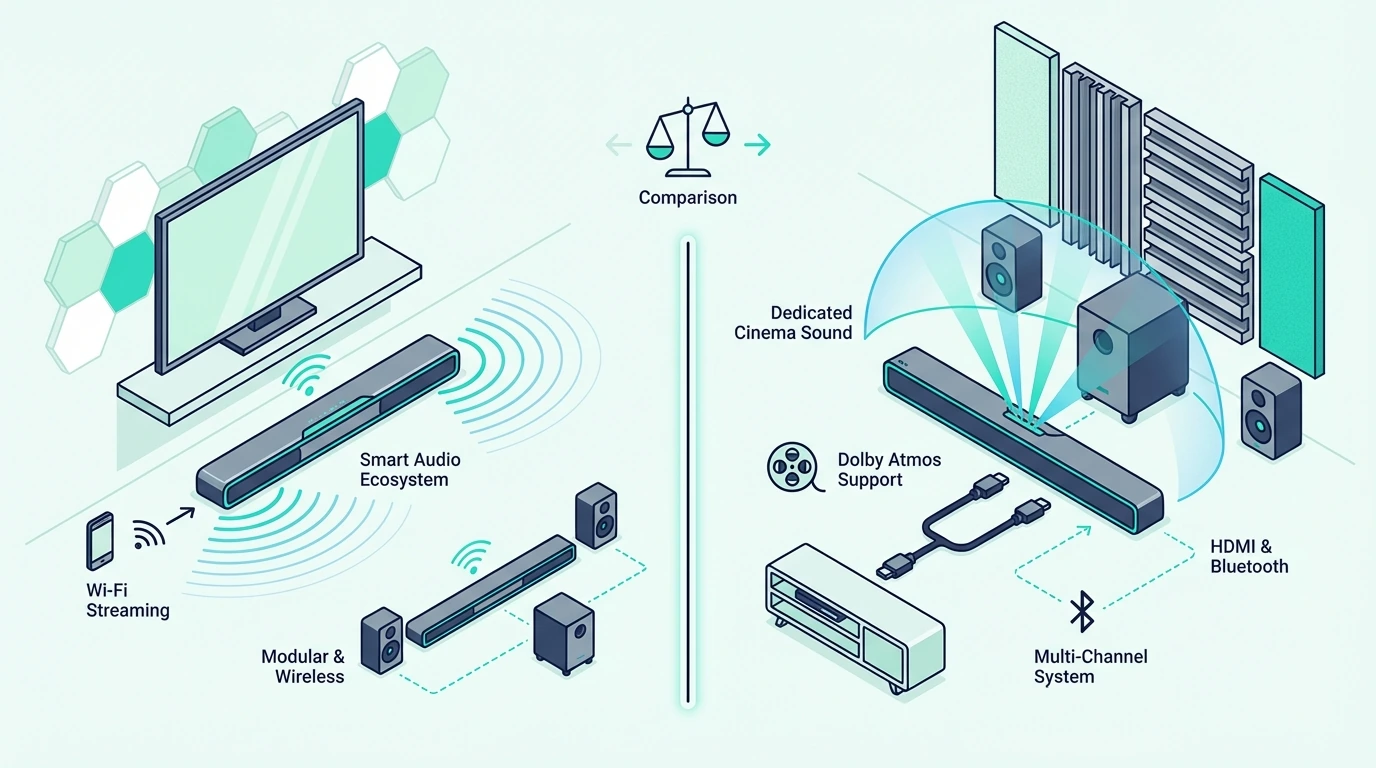
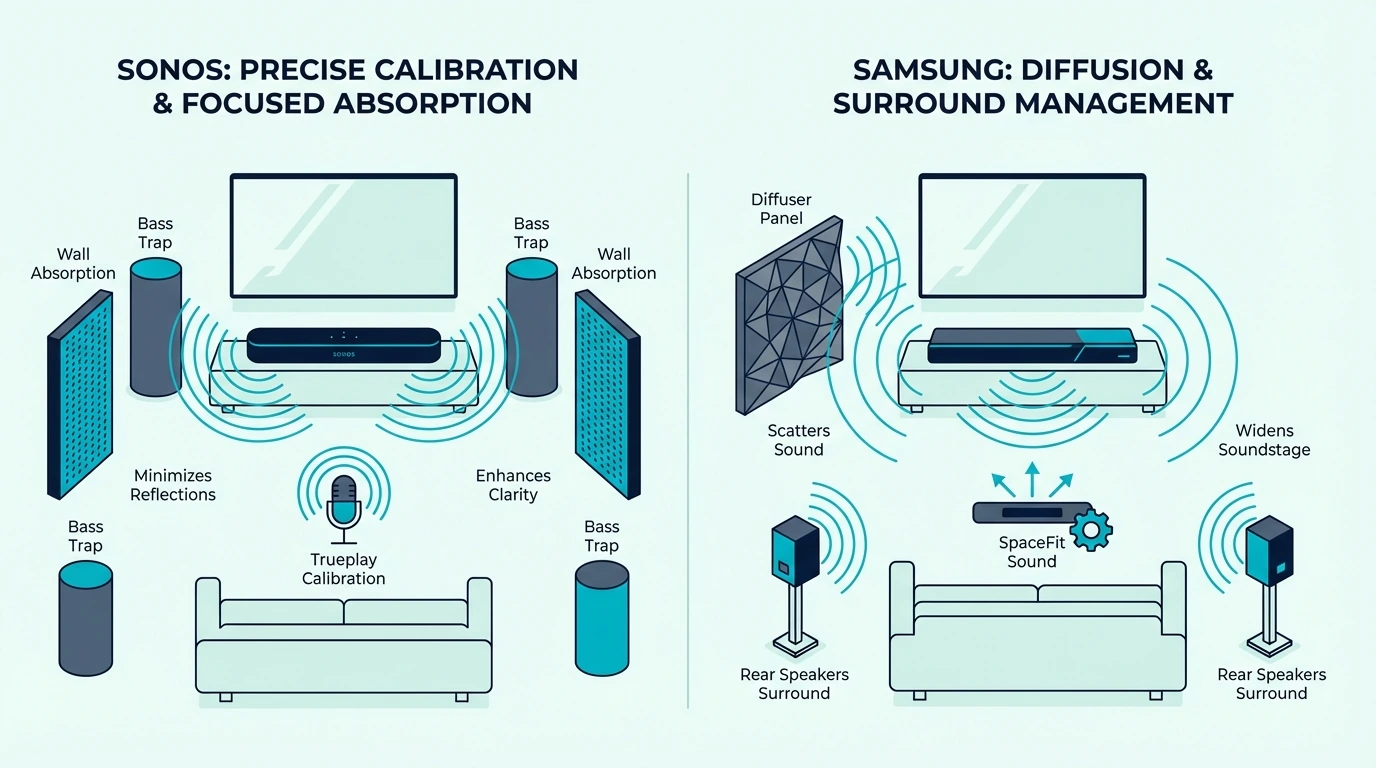
Sonos and Samsung soundbars compared side by side

The fundamental difference between Sonos and Samsung soundbars isn’t sound quality or channel count.

Sonos prioritizes being the best music streaming platform in your home. Samsung prioritizes being the best audio extension of your Samsung TV.

Understanding which priority matches your household determines which brand delivers significantly more daily value.

Most shoppers default to specs and reviews. That shortcut tends to bury the feature you will actually use most nights.

Sonos: Music-First, Platform-Agnostic Design

Sonos’s flagship Arc Ultra ($999) uses proprietary Sound Motion woofer technology. It produces remarkably deep bass from a single bar without a separate wireless subwoofer.

That is an engineering achievement that lets you get powerful bass in a cleaner single-unit setup.

Every Sonos soundbar works identically with Samsung, LG, Sony, or any other TV brand because Sonos deliberately avoids ecosystem lock-in, treating your TV as just one of many audio sources rather than the primary design focus.

That flexibility is especially valuable for households that change TVs over time, because the soundbar keeps the same streaming workflow even if the screen brand changes later. That continuity matters.

Our Sonos vs Bose soundbar comparison covers how Sonos competes against Bose’s dialogue-first approach, and our soundbar vs speakers guide explains when dedicated speakers outperform soundbar solutions for music listening.

Samsung: TV-First, Ecosystem-Integrated Design

Samsung soundbars are engineered as dedicated TV audio enhancement devices. They unlock their most impressive features exclusively when paired with Samsung televisions.

A current value example is Samsung Q-Symphony 5.1 Soundbar, which is a strong fit for Atmos movies and TV with stronger bass.

Samsung’s flagship HW-Q990D ($1800) delivers true 11.1.4-channel Dolby Atmos. It adds discrete rear speakers, a wireless subwoofer, and SpaceFit Sound room calibration.

That is more physical surround channels than any Sonos system can match. It is the superior choice for dedicated home theater audio where surround immersion matters most.

Our Bose vs Samsung guide covers Samsung’s strengths against another major brand, and our Samsung vs LG guide explores the ecosystem integration comparison with LG.

Model Range, Price, and Long-Term Value

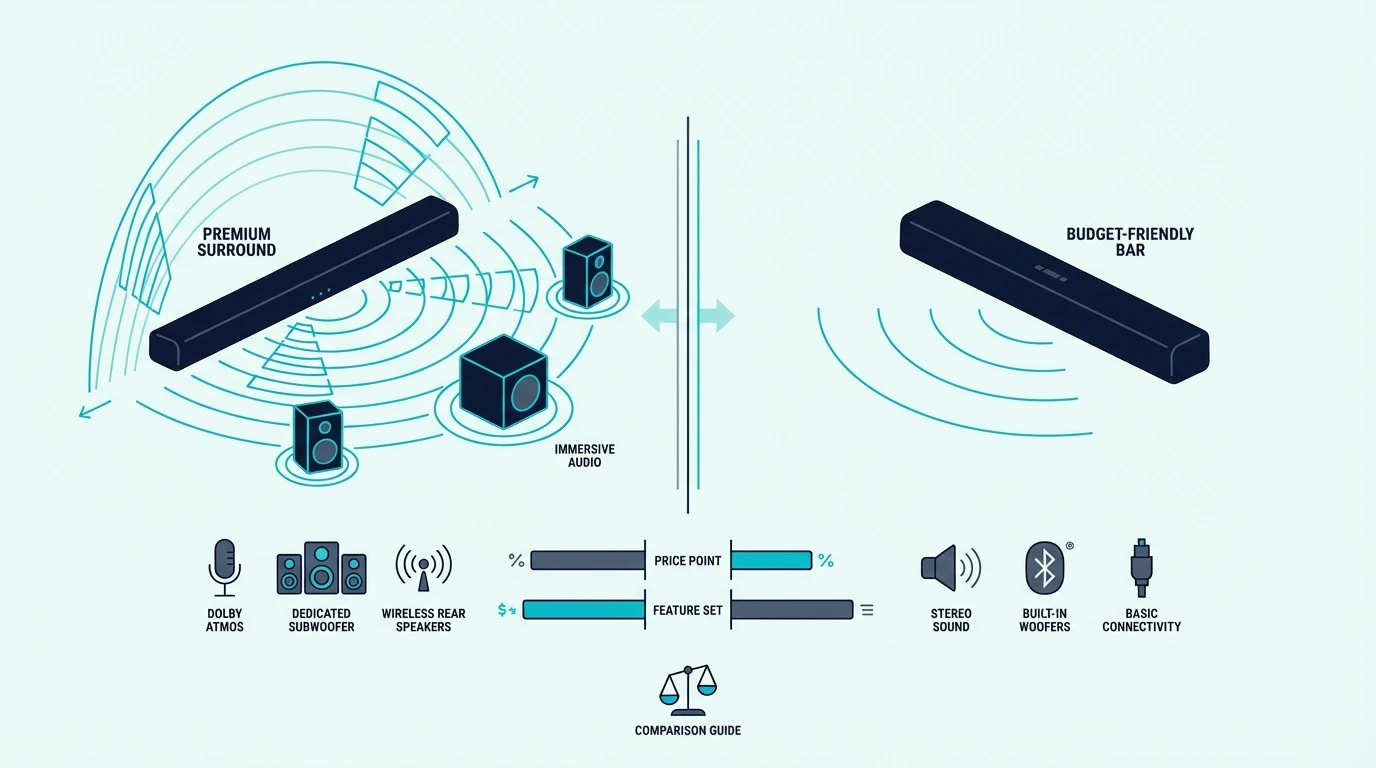
Choosing between Sonos and Samsung soundbars for TV audio

Beyond the streaming-versus-ecosystem divide, Sonos and Samsung also differ in pricing strategy and model range.

Long-term ownership value also matters. These are practical factors that affect which brand delivers more value over years of daily use.

Pricing: Premium-Only vs Every Budget

Sonos offers exactly three soundbar models: Beam Gen 2 at $449, Arc at $799, and Arc Ultra at $999. There are zero options under $400 and no budget tier at all.

Samsung offers the widest soundbar lineup in the industry. It spans from basic 2.0-channel bars at $100 to the flagship 11.1.4-channel HW-Q990D at $1800.

With models at virtually every $50 price increment in between covering every possible budget tier.

For budget-conscious buyers under $300, Samsung is the only realistic option since Sonos doesn’t compete at this price tier at all. That gap is real.

If you are willing to step outside both brands, a value alternative is the Amazon Fire TV Soundbar Plus at $190. It delivers Atmos and a built-in sub at a fraction of the Sonos Beam’s price.

For premium buyers willing to spend $450+, Sonos delivers superior music streaming features and longer software support.

Buyers sitting between $300 and $450 often end up with a mid-tier Samsung bar plus a cheap sub. That package tends to beat an entry-level Sonos bar on pure TV-audio impact.

Our is a soundbar worth it guide helps evaluate whether premium Sonos pricing is justified.

Our 2.1 vs 5.1 soundbar comparison covers when extra channels improve listening over single-bar solutions.

Long-Term Software Support and Resale Value

Sonos soundbars receive software updates for years longer than Samsung models. Sonos regularly adds features and maintains support for products 5-7+ years after purchase, while Samsung soundbars typically receive firmware updates for 2-3 years before support ends.

Sonos products also maintain significantly stronger resale value on the secondary market, making the higher upfront cost more palatable when you factor in the total cost of ownership over the product lifespan.

For households that upgrade room by room over several years, that longer platform life can matter as much as the initial sound quality.

A Samsung bar that loses firmware support after three years still plays sound. It just stops gaining features, which is a real cost only some households will feel.

Our soundbar fundamentals guide covers what to expect from soundbar technology in general, and our soundbar to TV connection guide explains how both brands connect via standard HDMI eARC for TV audio.

Surround Sound Expandability

Both brands offer surround expansion, but the approaches differ in cost and capability.

Samsung includes wireless subwoofers and rear speakers with many mid-range and premium models out of the box. Sonos requires a separate Sonos Sub at $799 and Era 100 surrounds at $249 each to build a comparable system.

Pushing the total Sonos system cost well above Samsung’s bundled alternatives.

Our soundbar vs surround sound guide explains when surround expansion genuinely improves your listening experience, and our what soundbar channels mean guide covers channel configurations for both brands.

The Bottom Line

Choose Samsung if you own a Samsung TV and primarily want better TV audio.

Q-Symphony ecosystem integration, the widest model range from $100 to $1800, and bundled surround packages make Samsung the practical choice for TV-focused households.

Our best Samsung soundbar guide covers the top picks at every budget.

Choose Sonos if music streaming is your primary use case and you’re willing to pay premium prices starting at $449.

AirPlay 2, native music service integration, multi-room whole-home grouping, and longer software support make Sonos the superior music-first platform.

Our best Sonos soundbar guide ranks every current Sonos bar by room size and use case.

Our do you need a soundbar for smart TV guide covers whether your TV genuinely benefits from either brand’s upgrade, and our soundbar setup guide walks through optimal placement and configuration for both Sonos and Samsung soundbar models.

Frequently Asked Questions

Is Sonos one of the best soundbars?

Sonos makes some of the highest-rated soundbars available.

The Arc Ultra consistently ranks among the best premium soundbars. It stands out for Dolby Atmos processing and deep bass from the proprietary Sound Motion woofer.

It also offers unmatched multi-room music streaming that no Samsung or traditional TV-focused soundbar brand can match.

Is Samsung Q990D better than Sonos Arc Ultra?

The Samsung HW-Q990D at $1800 delivers more surround channels than the Sonos Arc Ultra, at 11.1.4 versus virtual processing. It includes discrete rear speakers and a wireless subwoofer.

That makes it superior for dedicated home theater surround immersion.

The Sonos Arc Ultra at $999 costs significantly less. It produces impressive bass from a single bar without a separate subwoofer.

It also offers dramatically better music streaming with AirPlay 2 and multi-room grouping that Samsung cannot match.

What brand is best for soundbars?

No single brand dominates every soundbar use case.

Samsung leads in TV ecosystem integration. Sonos leads in music streaming and multi-room audio.

Bose leads in dialogue clarity, Sony in cinematic Atmos, LG in Meridian-tuned refinement, and JBL in bass per dollar.

The right brand for your specific situation depends on matching your primary use case, TV manufacturer, and budget to each brand’s core engineering strengths and ecosystem advantages.

For a bass-forward pick that skips the Sonos premium, a current JBL example is the JBL Bar 500 MK2. It leans into the bass-per-dollar advantage the FAQ above calls out for JBL.

Samsung vs Vizio Soundbar: Which One Gives Better Value? [2026]

Samsung vs Vizio soundbar looks like a clean premium-versus-budget choice, but the real tradeoff only shows up after months of nightly use.

The wrong brand can quietly waste money on ecosystem features your TV cannot unlock, or leave you with a cheaper package that never feels as tidy as you hoped.

That happens because spec sheets do not show which tradeoff will matter once the bar is actually under your screen.

Knowing where Samsung’s polish earns its premium and where Vizio’s bundled hardware wins on value helps you avoid both mistakes.

The first move is to weigh how much your TV brand shapes the answer, because Samsung tightens up with a Samsung TV while Vizio stays more brand-agnostic out of the box.

Below, we’ll compare where Samsung earns its premium, where Vizio’s lower pricing creates the better deal, and when a mixed-brand buyer can safely ignore both ecosystem perks.

Quick Takeaway

Choose Samsung if you own a Samsung TV and want the cleanest setup plus the smoothest control. Choose Vizio if you want more bass and more surround hardware for less money.

Does Samsung or Vizio Fit Your TV Better?

Samsung and Vizio soundbars compared side by side

Samsung and Vizio can look close when you compare channel counts and sale prices.

Price alone rarely tells the whole story, because two bars with identical channel counts can behave very differently depending on which TV they pair with.

TV fit changes the comparison quickly.

Samsung gets stronger inside a Samsung setup. Vizio stays more brand-agnostic and usually wins by including more hardware at the same spend.

Samsung makes more sense with a Samsung TV

Samsung’s biggest advantage is not raw channel count. It is how neatly the bar and TV behave together when both devices are Samsung.

Q-Symphony can keep the TV speakers active with the soundbar. Newer models can also add TV-aware tuning and easier control through SmartThings.

Older Samsung TVs may only get a subset of those extras, so checking model year before you buy keeps expectations realistic.

Those extras do not show up as bigger numbers on the box. They can make the system feel easier and more cohesive every day.

Samsung also tends to smooth over smaller annoyances that become obvious after the honeymoon period. HDMI handshakes, remote behavior, and preset switching usually feel more predictable than they do on cheaper systems that focus first on the parts list.

A midrange example is the Samsung 5.1 Channel Sound Bar with Wireless Subwoofer.

It fits Samsung TV owners who want Dolby Atmos and a bundled subwoofer without paying flagship prices.

If you are still planning the hookup, our soundbar to TV connection guide and soundbar setup guide cover the placement and port choices that affect the result.

Vizio makes more sense when your TV brand is mixed

Vizio becomes much more compelling as soon as Samsung-only perks drop out of the calculation.

If your TV is not a newer Samsung model, Vizio’s lower pricing usually does more of the work.

At the entry and middle tiers, Vizio often gives you the more dramatic jump from thin TV speakers. The box usually includes the subwoofer and the fuller surround package sooner.

That matters most in apartments, bedrooms, and family rooms where people want obvious improvement without learning a new ecosystem.

Vizio also rarely forces you into a specific remote-app workflow, which is a small quality-of-life win in households that mix streaming sticks and game consoles.

Vizio’s advantage is especially clear when you judge the system as a whole instead of just the soundbar itself.

A cheaper Vizio package with a subwoofer and surrounds can feel more cinematic in a medium room than a cleaner but simpler Samsung bar at a similar price.

For room-size tradeoffs, our 2.1 vs 5.1 soundbar guide and does a soundbar work with any TV guide help set expectations before you spend more.

Decide whether polish or included hardware matters more

Most buyers notice convenience before they notice tiny differences in tuning. Samsung usually feels cleaner to live with, while Vizio usually looks more generous the minute you open the box.

That does not automatically make Vizio the better sounding brand. It means Vizio often wins the first-impression test, while Samsung more often wins the long-term ownership test.

That is why the VIZIO 5.1 Soundbar SE is easy to recommend for mixed-brand households.

It gives you a bigger movie-night upgrade without paying for Samsung-exclusive extras.

If you are comparing connection options more than brands, our HDMI vs optical guide and soundbar to TV connection guide cover the practical setup details.

When Is Samsung Worth More Than Vizio?

Choosing between Samsung and Vizio soundbars for value and features

Once TV fit is clear, the next question is whether Samsung’s higher price buys something you will hear or feel every week. In some rooms it does, but in plenty of rooms Vizio still delivers the smarter spend.

Samsung earns the premium in daily use

Samsung’s cabinet finish, app behavior, and firmware cadence are usually more consistent than Vizio’s.

That matters if you hate input glitches, flaky wireless behavior, or menus that feel unfinished after the first week.

Support is part of the premium too.

Samsung’s larger lineup and retail footprint usually make it easier to find compatible rear kits, replacement remotes, and setup help that matches your exact model year.

Spare parts and accessories also stay on shelves longer because Samsung keeps its audio lineup tied to its TV cycles, which helps if you need to replace a remote or a rear kit a couple of years later.

A stronger step-up option is the Samsung Q-Series Soundbar HW-Q600F 3.1.2 ch Subwoofer.

It makes sense for shoppers who want SpaceFit tuning, cleaner everyday behavior, and a more refined Atmos presentation than bare-budget bars usually deliver.

If placement is part of the problem, our mount a soundbar guide and pair a soundbar and subwoofer guide can improve the result before you spend more.

Vizio still wins on hardware per dollar

Vizio does not usually win because its app is prettier or its cabinet feels richer.

It wins because the box often includes the subwoofer, rear speakers, or extra channels that Samsung keeps for higher price brackets.

That is especially attractive if you want a large, obvious jump from TV speakers and do not need your soundbar to double as a polished smart-home extension.

In those rooms, value beats refinement.

For many buyers, that is exactly the right priority. If the budget ceiling is firm, more speakers in the room usually create a bigger improvement than paying extra for nicer software.

Premium Vizio can undercut mid-premium Samsung

Vizio’s upper tier is where the comparison gets most interesting. Samsung still tends to feel more refined, but Vizio can get you closer to big-room surround spectacle for less money.

It is not a perfect win. Vizio’s larger systems take more space, more wires, and a little more patience to place well.

The VIZIO 5.1.2 Elevate Sound Bar shows that clearly.

Its rotating upfiring speakers, wireless subwoofer, and included rears create a more cinematic package than many similarly priced Samsung bars.

If you are still deciding whether a premium bar is enough, our soundbar vs home theater guide and soundbar vs receiver guide show when it makes sense to step beyond a single-bar system.

The Bottom Line

Samsung is the better pick when you own a Samsung TV and you care about cleaner integration, better long-term polish, and a setup that feels more seamless every time you turn it on.

Our best Samsung soundbar guide covers the current top picks at every budget.

Vizio is the better pick when you want the biggest audible upgrade per dollar.

It is usually the smarter value in mixed-brand homes, even if Samsung still feels more refined.

Our best Vizio soundbar guide ranks every current Vizio model by room size and use case.

If you watch casually in a mixed-brand living room, start with Vizio. If you already bought into Samsung’s TV ecosystem and want the cleaner ownership experience, Samsung is the safer long-term call.

Frequently Asked Questions

Is Samsung better quality than Vizio?

Samsung usually feels better built and more polished in software and firmware. Vizio can still deliver excellent performance for the money, but Samsung is more consistent if build finish and long-term refinement matter most.

Is Vizio or Samsung soundbar better for value?

Vizio is usually the better value because it includes more surround hardware at lower prices.

Samsung becomes the better value only when you own a Samsung TV and can actually use Q-Symphony, SmartThings control, and the tighter ecosystem fit.

Does Vizio have good sound bars?

Yes. Vizio is strong if you want bass, bundled subwoofers, and real surround hardware without premium-brand pricing.

The tradeoff is less polish in firmware, app behavior, and overall finish.

Which brand is better for Samsung TV owners?

Samsung is usually the better match for Samsung TV owners because it unlocks ecosystem features that Vizio cannot copy.

That tighter fit can make the system easier to control, easier to tune, and more satisfying over time.

What brand is best for soundbars overall?

No single brand wins every use case. Samsung is strongest for Samsung TV owners who want polish and tight integration.

Vizio is strongest for shoppers who care most about hardware per dollar. Brands like Bose or Sony can still make more sense for dialogue-first or cinema-first rooms.

Samsung vs LG Soundbar: Which Brand Matches Your TV and Listening Style? [2026]

Samsung vs LG soundbar sounds like a normal brand showdown, but the real decision usually starts with the TV already sitting under your screen.

The problem is that both brands lock some of their most useful daily features to matching TVs.

That means buyers who shop by spec sheet alone can pay for ecosystem perks they will never actually use.

Understanding that helps you avoid the wrong ecosystem and spend on the bar that will feel better in your real room.

Below, we’ll compare where TV matching matters, where sound style and value matter more, and when cross-brand buying still makes sense.

Then we’ll narrow it down by budget, room size, and the kind of listening experience each brand usually fits best.

Quick Takeaway

Choose Samsung if you already own a Samsung TV and want the broadest lineup plus a punchier movie-first presentation.

Choose LG if you already own an LG TV and want a simpler native fit with a slightly smoother sound on many models.

If you own neither TV brand, compare the exact bar and price in front of you because both brands still work well over HDMI ARC or eARC.

Which TV Brand Makes the Biggest Difference?

Samsung and LG soundbars compared side by side

TV matching matters here because both brands hide their most convenient features behind same-brand televisions.

When that feature match matters in your room, it can outweigh a small gap in raw sound quality.

Samsung TV Owners: Samsung Usually Makes the Cleaner Case

Samsung’s strongest argument is not that every Samsung bar beats every LG bar.

It is that Samsung gives Samsung TV owners the clearest reason to stay inside one ecosystem.

Q-Symphony keeps the TV speakers working with the soundbar instead of handing off everything to the bar alone.

In real rooms, that can make voices feel more connected to the screen.

Samsung also gives buyers more stops between basic bars and serious surround packages.

That makes it easier to stay with the brand as your budget changes.

If you want a mainstream example, the Samsung HW-B750D 5.1ch soundbar is a strong middle-ground pick for buyers who want a fuller package without premium pricing.

It makes more sense in medium rooms than a very basic bar-only model.

If you are still sorting out hookup priorities, our guide to connecting a soundbar to a TV and our HDMI vs HDMI ARC explainer show where Samsung’s ecosystem extras sit on top of the core connection.

LG TV Owners: LG Makes the Most Sense When You Want a Native Fit

LG’s pitch is similar even if the marketing language is different.

WOW Orchestra matters because it makes the LG TV and LG bar feel like one coordinated system.

That does not automatically make every LG bar better than every Samsung bar.

It does make the matching LG bar easier to justify when convenience is a big part of the purchase.

LG bars also tend to feel a little less aggressive in everyday TV use.

For buyers who want a calmer sound, that can be the better fit.

At the simpler end of the lineup, the LG S20A 2.0 ch. soundbar shows the low-friction side of LG’s appeal.

It is the kind of bar that makes sense in bedrooms, apartments, and dialogue-first living rooms.

If you are weighing wireless convenience against wired reliability, our TV-to-soundbar Bluetooth guide and our HDMI vs optical guide help before the logo starts to dominate the decision.

Daily Use Friction Matters More Than Most Buyers Expect

Most people do not spend every night testing Atmos demos.

They spend every night changing volume and trying to get sound from the TV with no drama.

That is where matching brands often feels better than it looks on a spec sheet.

Power behavior, menu integration, and remote control handoff tend to feel cleaner.

That advantage is boring, but boring is valuable in a family room.

It matters less in enthusiast setups where you already expect to tweak settings.

What Buyers Usually Regret In This Comparison

Most regret in this matchup comes from buying around the badge instead of the setup.

It rarely comes from a tiny objective quality gap.

Samsung TV owners usually regret losing Samsung-only integration when they jump to LG for a deal that was only slightly better.

LG TV owners usually regret the same thing in reverse.

That regret is strongest in everyday TV households where convenience matters every night.

It is much weaker in mixed-brand rooms where the bar is being judged like a normal speaker upgrade.

If You Own Neither Brand, the Logo Matters Less

A Samsung bar will still work with an LG, Sony, TCL, Roku, or Hisense TV.

An LG bar will still work with those TVs too.

What disappears is the ecosystem advantage that made the brand premium feel worthwhile.

Once that is gone, setup, room size, and speaker package matter more than the name on the front.

In that situation, placement usually matters more than another hour of spec-sheet comparison.

Our soundbar setup guide and our soundbar mounting guide usually improve daily results more than brand-switching does.

How Do Samsung and LG Compare on Sound, Value, and Room Fit?

Choosing between Samsung and LG soundbars for TV audio

Once you strip away TV matching, Samsung and LG separate themselves more by tuning style and lineup strategy than by raw competence.

Both brands can sound good, but they do not push buyers in exactly the same direction.

Samsung Usually Wins on Range, Punch, and Easier Deal Shopping

Samsung is often the easier brand to shop when you want lots of options at every price step.

You can usually find a Samsung bar that maps cleanly to a budget, a room, and a feature level.

That matters because most people are not choosing between two perfect flagships.

They are choosing between whatever is discounted and easy to set up this week.

Samsung also tends to make a stronger first impression in store demos.

Its bars usually lean into impact, bass presence, and a bigger-feeling front stage.

At the top end, the Samsung HW-Q990D shows the brand at its most convincing.

It is built for buyers who want a big cinematic package without moving into a receiver-based system.

If you are unsure whether you need more hardware or just better setup discipline, our guide to choosing a soundbar and our guide to pairing a soundbar with a subwoofer make that decision clearer.

LG Usually Wins on Restraint, Cohesion, and OLED-Friendly Fit

LG is often strongest when the goal is not maximum shock value.

It is strongest when the goal is a clean movie-first system that does not feel overbuilt for the room.

That can make LG easier to live with for buyers who dislike exaggerated bass or overly sharp tuning.

It can also make LG feel like the better brand for people who want the soundbar to disappear into daily use.

At the premium end, the LG S80TR 5.1.3 ch. soundbar is a good example of that approach.

It makes the most sense when you actually have the room and TV to benefit from the fuller package.

LG is not always the best blind value across all brands.

It is often the best fit when the room, TV, and listening habits already align with LG’s design choices.

Which Brand Fits Small Rooms and Big Rooms Better?

In small rooms, the better brand is usually the one that solves your problem without overbuying.

That can make a simple LG bar attractive for calmer TV listening and apartment-friendly use.

Samsung still has good small-room options, but the brand often shines more clearly once you move into fuller packages.

That is where the broader lineup starts to matter.

In bigger rooms, both brands improve once you add a subwoofer or rear speakers.

That is why channel layout matters more as distance from the screen grows.

Our 2.1 vs 5.1 soundbar guide helps you decide when extra speakers are actually worth paying for.

Room size changes the answer faster than most review scores do.

Price Tiers Matter More Than Marketing Claims

Under about $200, Samsung usually gives buyers more options and more frequent discounts.

LG still has worthwhile simple bars, but the range is narrower.

Between roughly $250 and $500, the comparison gets more interesting because both brands start offering fuller packages.

That is the range where included hardware matters more than a slogan on the box.

At premium prices, buyers are paying for added speakers, more drivers, and a bigger sense of scale.

That is also where matching the TV brand starts to matter more again.

If the price gap is small, buying the brand that matches the TV is usually the safer call.

If the discount gap is huge, the better overall package can outweigh the ecosystem edge.

When Cross-Brand Buying Still Makes Sense

Cross-brand buying is reasonable when the ecosystem extras are irrelevant from the start.

That happens with guest rooms, secondary TVs, and basic TV-audio upgrades where convenience is simple either way.

In those rooms, treat each bar like a normal product rather than a platform decision.

That is where included speakers, connection options, and price matter most.

If you are deciding whether to keep things simple or move into a bigger audio path, our soundbar vs receiver guide and our soundbar basics guide help frame the tradeoff.

The Bottom Line

Buy Samsung first when you already own a Samsung TV and want more lineup depth, stronger perceived impact, and the clearest Q-Symphony case.

Our best Samsung soundbar guide covers the current top Samsung picks by room size.

Buy LG first when you already own an LG TV and want the cleaner WOW Orchestra fit with a slightly calmer tuning style.

Our best LG soundbar guide ranks the LG lineup by use case.

If you own neither TV brand, buy the better package at the better price.

At that point, room size, included speakers, and setup needs matter more than the logo.

Frequently Asked Questions

Is Samsung or LG better for movies?

Samsung often feels more forceful with bass and surround impact.

LG often feels smoother and more relaxed, so the better movie brand depends on whether you want punch or balance.

Should I match my soundbar brand to my TV?

Usually yes when the price and feature level are close.

That is the easiest way to keep the ecosystem features and avoid paying for tools you cannot use.

Are LG soundbars more balanced than Samsung?

Many buyers describe LG that way, especially in long TV sessions.

Samsung often sounds more energetic, which can be great for action content but less subtle in smaller rooms.

Can I use a Samsung soundbar with an LG TV or an LG soundbar with a Samsung TV?

Yes.

You will still get normal ARC or eARC audio, but you lose the brand-specific ecosystem extras that make matching setups attractive.

JBL vs Samsung Soundbar: Which Makes More Sense for Your Setup? [2026]

The JBL vs Samsung soundbar comparison seems like a straightforward brand-vs-brand decision but it has a twist most buyers miss. JBL is actually owned by Samsung Electronics through their 2017 Harman International acquisition.

That means you are technically comparing two brands under the same corporate umbrella. They still operate with completely separate engineering teams and different sound philosophies.

JBL engineers soundbars around bass impact and detachable surround speakers plus concert-quality audio heritage. Samsung engineers soundbars around TV ecosystem integration and one of the widest model ranges in the industry.

Features like Q-Symphony sit squarely on the Samsung side of that split.

The Harman buyout did not merge the JBL engineering team into Samsung’s. JBL still designs and tunes bars out of Northridge California with its own priorities.

The problem is Samsung TV owners who buy a JBL soundbar miss out on Q-Symphony. They also lose seamless SmartThings integration that Samsung soundbars unlock.

Non-Samsung TV owners who buy a Samsung soundbar pay for ecosystem features they can never use.

Each brand’s biggest advantages depend on your specific TV brand because ecosystem features are exclusive by design. Choosing without understanding these differences leaves significant value on the table.

Understanding where each brand genuinely outperforms the other based on your TV brand, audio preferences, and budget helps you make a confident decision, so you can stop comparing spec sheets and focus on the features that will actually improve your daily listening experience at home.

Below, we’ll compare JBL and Samsung soundbars across sound quality, ecosystem features, price range, and TV compatibility so you can pick the brand that delivers the most real-world value for your specific setup and viewing habits.

Quick Takeaway

Choose Samsung if you own a Samsung TV — Q-Symphony and SmartThings integration are exclusive advantages that JBL cannot match, and Samsung offers one of the broadest soundbar ranges in the industry. Choose JBL if you want deeper bass impact, more brand-agnostic value, detachable wireless surround options on premium models, and a soundbar that does not depend on Samsung-TV-only features to feel worthwhile.

Sound Quality: Bass Impact vs Ecosystem Audio

JBL and Samsung soundbars compared side by side

Despite sharing a parent company, JBL and Samsung soundbars sound noticeably different because each brand’s engineering team optimizes for completely different audio priorities and use cases — and understanding this difference is the key to choosing correctly between them.

JBL: Concert-Grade Bass and Physical Surround

JBL’s decades of experience building professional concert speakers, studio monitors, and portable Bluetooth speakers gives their soundbars a distinctly bass-forward, energetic sound signature that makes action movies, gaming, and music feel more physically impactful than Samsung’s comparable models.

For large-room movie use, a current example is JBL Bar 5.0, which is a strong fit for Atmos streaming and immersive TV audio.

JBL’s flagship Bar 1000 includes detachable battery-powered rear speakers that physically separate from the main soundbar. You get true wireless 7.1.4-channel surround when the rears are detached.

The design lets you use the bar as a single unit for casual viewing and detach the rears for immersive movie nights. No Samsung soundbar currently offers this kind of flexibility.

JBL also supports both Dolby Atmos and DTS:X surround formats across its entire lineup. Samsung’s entry-level and mid-range models often support only Dolby Atmos without DTS:X decoding.

Our JBL vs Bose soundbar comparison covers how JBL’s bass-forward approach compares to Bose’s dialogue-first tuning, and our soundbar vs surround sound guide explains when physical rear speakers genuinely improve your listening experience versus virtual surround processing.

Samsung: Ecosystem Integration and Model Range

Samsung approaches soundbar design from an ecosystem perspective — their soundbars are engineered to work best when paired with Samsung TVs, unlocking exclusive features that create a more integrated and seamless audio-visual experience than any standalone soundbar brand.

A current value example is Samsung Q-Symphony 5.1 Soundbar, which is a strong fit for Atmos movies and TV with stronger bass.

Samsung’s flagship HW-Q990D pushes surround immersion to true 11.1.4-channel Dolby Atmos. It ships with discrete rear speakers plus a wireless subwoofer and dedicated upfiring drivers for overhead height effects.

That gives it more physical channels than JBL’s 7.1.4 Bar 1000. The Q990D sits in a different budget category entirely at its price point.

Our Bose vs Samsung guide covers Samsung’s strengths against another major competitor. Our soundbar fundamentals guide explains the numbering system behind these configurations.

Features, Price Range, and TV Compatibility

Surround sound and feature differences between JBL and Samsung soundbars

Beyond sound quality, JBL and Samsung differ significantly in pricing breadth, ecosystem features, and how much value you extract based on which TV brand you own — and this practical consideration often matters more than raw audio differences for everyday listening.

Samsung TV Owners Should Choose Samsung

If you own a Samsung TV, the decision is straightforward. Samsung soundbars unlock Q-Symphony where TV speakers and the soundbar play simultaneously for a wider soundstage.

SpaceFit Sound adds automatic room calibration through your Samsung TV. SmartThings integration puts soundbar controls in the same app managing your entire Samsung smart home ecosystem.

These features represent genuine and measurable audio and usability improvements. JBL and every other third-party soundbar brand physically cannot replicate them.

Our soundbar to TV connection guide covers how Samsung’s ecosystem integration works compared to standard HDMI ARC connections, and our guide to choosing a soundbar explains the overall audio upgrade experience.

Non-Samsung TV Owners Should Consider JBL

If you own a non-Samsung brand like LG or Sony or Vizio or TCL or Hisense, Samsung’s ecosystem advantages disappear entirely. You are paying for features you cannot access.

JBL’s brand-agnostic approach delivers better value in that scenario. You get deeper bass tuning plus detachable rear speakers and DTS:X support on top.

JBL soundbars connect via standard HDMI ARC/eARC and Bluetooth with zero brand-specific dependencies. You get the full feature set regardless of your TV manufacturer.

Our HDMI vs optical guide explains connection options for both brands, and our soundbar setup guide covers universal compatibility across all major TV manufacturers.

Pricing and Model Range

Samsung offers the widest soundbar lineup in the industry. Options run from basic 2.0 bars at $100 up to the flagship 11.1.4-channel HW-Q990D at $1800.

There are Samsung models at virtually every $50 price increment in between. JBL’s range spans $130 to $900 with fewer models but more focused feature differentiation at each tier.

The detachable rear speaker design on premium JBL models is unique to that brand. Samsung only offers separate rear speakers as part of its top-end Q-Series bundle and never as a detachable option.

For budget buyers under $200, Samsung has more options since JBL’s lineup starts higher. There are fewer sub-$200 JBL models available.

A current Samsung example for large-room movie use is the Samsung S60D. It is a strong fit for Atmos streaming and immersive TV audio.

For mid-range buyers ($300-500), both brands compete aggressively. JBL typically includes better bass hardware while Samsung includes better ecosystem integration.

That matters especially if you plan to keep the soundbar through future TV upgrades.

Our guide to choosing a soundbar helps evaluate value at every price tier. Our 2.1 vs 5.1 soundbar comparison covers when additional channels justify the investment.

The Bottom Line

Choose Samsung if you own a Samsung TV. Q-Symphony and SpaceFit Sound and SmartThings integration genuinely improve your audio experience in ways no other brand can match.

Samsung also covers the widest model range with price points from $100 to $1800.

Choose JBL if you want deeper bass impact from their concert audio heritage. Innovative detachable wireless rear speakers sit on the premium models.

DTS:X support runs alongside Dolby Atmos. The JBL feature set works with any TV brand without ecosystem lock-in.

JBL also tends to hold price better on Amazon since Samsung often runs deeper discounts on older inventory. Keep an eye on seasonal promos for either brand.

Our guide to choosing a soundbar covers whether your TV genuinely benefits from either brand’s audio upgrade, and our soundbar setup guide walks through optimal placement and configuration for both JBL and Samsung soundbar models.

Frequently Asked Questions

Is JBL now owned by Samsung?

Yes. Samsung Electronics acquired Harman International (JBL’s parent company) in 2017 for $8 billion, making JBL technically a Samsung subsidiary.

JBL and Samsung still operate as completely separate audio brands with independent engineering teams. Their sound tuning philosophies and product lineups compete directly against each other in the soundbar market.

Is Samsung Q990D better than JBL Bar 1000?

The Samsung HW-Q990D ($1800) offers more surround channels (11.1.4 vs 7.1.4) plus Samsung TV ecosystem integration.

The JBL Bar 1000 ($900) costs half as much and includes innovative detachable battery-powered rear speakers that no Samsung model offers.

The Q990D is technically superior for surround channel count. The JBL Bar 1000 still delivers exceptional surround immersion at a dramatically lower price point with more versatile physical design.

What brand is best for soundbars?

No single brand is universally best for every buyer. Samsung excels at TV ecosystem integration and broad model variety.

JBL excels at bass impact and innovative hardware design. Bose leads in dialogue clarity while Sony dominates cinematic Dolby Atmos immersion.

Sonos wins at multi-room streaming.

The right brand for your setup depends on matching your TV manufacturer plus primary listening content and room size to each brand’s core engineering strengths.

JBL vs Bose Soundbar: Bass and Value or Dialogue Clarity? [2026]

The JBL vs Bose soundbar comparison looks simple at first: JBL feels like the bass-and-value brand, while Bose feels like the dialogue-and-premium brand. That split is directionally true, but it still hides the decision that actually matters once the sound hits your room.

Buy the wrong brand and the mismatch shows up fast, because JBL can feel too bass-forward when your real problem is muddy speech. Bose can feel too restrained when you want bigger low-end punch and more hardware for the money.

The good news is that this choice gets much easier once you match each brand to the problem you are trying to solve. Below, we’ll compare JBL and Bose soundbars across sound quality, features, price tiers, and real-world use cases so you can pick the brand that fits how you actually watch TV.

Quick Takeaway

Choose JBL if you want more bass, more surround channels, and more hardware per dollar. It usually makes the stronger case when you want impact, scale, and extra features before you care about the cleanest dialogue tuning.

Choose Bose if dialogue clarity is your top priority above everything else. It is usually the safer pick when you want a cleaner single-bar setup and easier-to-follow speech rather than the biggest bass hit.

Which Brand Sounds Better: JBL or Bose?

JBL and Bose soundbars compared side by side

The most important difference between JBL and Bose is what each brand treats as the first job of a soundbar. Once you hear that priority clearly, the rest of the comparison starts to feel much less confusing.

What Does JBL Sound Like in Real Rooms?

JBL’s heritage in professional audio and concert speakers gives their soundbars a bass-forward, energetic signature. Action movies, gaming, and music feel more impactful than most competitors at the same price, which is why JBL usually feels bigger right away.

That tuning makes JBL especially good for sports fans, action-movie households, and anyone who wants a soundbar to double as a music speaker. It is usually less appealing if your main frustration is constantly missing dialogue during busy scenes.

For large-room movie use, a current example is JBL Bar 700MK2, which is a strong fit for Atmos movies and TV with stronger bass. It is the kind of JBL option that immediately shows why the brand leans harder into excitement and scale.

JBL is a weaker fit if you mostly watch talk-heavy dramas, news, or late-night TV at modest volume. In that use case, the extra bass and wider presentation can matter less than having dialogue locked dead center.

JBL’s flagship Bar 1000 takes this further with detachable rear speakers for true wireless 7.1.4-channel surround, while Bose’s Smart Ultra Soundbar aims for a similar immersive effect through virtual processing from a single bar. That hardware gap matters most for movie fans who want sound coming from behind and above instead of feeling widened only through processing.

Our JBL vs Polk soundbar comparison covers how JBL stacks up against another mid-range brand. The best Dolby Atmos soundbar guide explains when physical rear speakers and height channels are worth chasing.

What Does Bose Sound Like in Real Rooms?

Bose takes the opposite engineering approach — every soundbar in the lineup is tuned first to keep speech intelligible no matter what else is happening in the mix. For large-room movie use, a current example is Bose Smart Ultra Soundbar, which is a strong fit for Atmos streaming and immersive TV audio.

Bose tends to make more sense in smaller rooms where you sit closer to the screen and care more about hearing every word than feeling extra bass weight. It also suits buyers who want a cleaner single-bar setup before they think about adding more speakers later.

Bose’s proprietary ADAPTiQ room calibration uses a headset microphone to measure your room’s acoustics and optimize voice frequencies for your specific space. That tradeoff makes Bose especially appealing in apartments and bedrooms where clear speech matters more than shaking the room with deep bass.

Bose is a weaker fit if you expect one compact bar to replace the feel of a subwoofer-and-rear-speaker package. The best soundbars for dialogue guide shows where Bose-like tuning matters most, and our Bose vs Sony guide explores a similar premium-tier matchup.

Which Brand Gives You Better Features and Value?

Choosing between JBL and Bose soundbar features

Beyond sound quality, JBL and Bose differ dramatically in pricing strategy and included features. This is where JBL’s value edge becomes easiest to see if you care about getting more hardware inside the same budget.

Why Does JBL Usually Win on Hardware Value?

JBL’s soundbar lineup spans from simple entry-level bars to premium Atmos packages with meaningful upgrades at each step. Wireless subwoofers, Dolby Atmos, DTS:X, and detachable rear speakers show up in parts of the lineup where Bose still offers simpler configurations.

That is why JBL usually looks stronger on a side-by-side spec sheet. You reach bigger hardware, more surround channels, and broader format support faster without jumping straight to the top of the range.

JBL also supports both Dolby Atmos and DTS:X across more of its lineup, while Bose supports only Dolby Atmos. The soundbar buying guide explains how channel counts and format support change what you actually hear, and the best overall soundbar guide helps frame when those upgrades justify the money.

Why Do Some Buyers Still Prefer Bose?

Bose keeps the lineup tighter, with a smaller number of bars positioned around simplicity, dialogue performance, and app polish. Every model leans into refined speech processing and a cleaner user experience instead of chasing the longest spec sheet.

The trade-off is fewer hardware features per dollar compared to JBL, but the experience stays consistently polished. Bose SimpleSync also lets you pair Bose headphones with the soundbar for private listening, which is a genuinely useful late-night feature JBL does not match the same way.

The soundbar-to-TV connection guide explains the setup basics both brands still need. The dialogue-focused roundup helps you judge whether Bose’s speech-first tuning is the real reason to pay more.

How Do the Key JBL and Bose Price Tiers Compare?

For large-room movie use, a current example is JBL Bar 500MK2, which is a strong fit for Atmos streaming and immersive TV audio. In the mid-range tier, JBL usually gives you a wireless subwoofer and more surround ambition, while Bose usually gives you a simpler bar with stronger dialogue focus.

In practice, that choice is pretty straightforward. JBL wins if you want theater feel and bass per dollar, while Bose wins if you want clearer speech from a simpler bar that asks less of the room.

Room size changes the value math more than most spec sheets admit. In a larger living room, JBL’s bundled subwoofers and rear-speaker options can save you from needing upgrades later, while Bose makes more sense when the listening distance is short and speech clarity matters more than scale.

At the flagship end, the JBL Bar 1000 includes detachable rear speakers, a wireless subwoofer, and true 7.1.4-channel Atmos with physical height channels while the Bose Smart Ultra relies on virtual Atmos from a single bar. That leaves JBL ahead on raw hardware and Bose ahead on dialogue-first simplicity.

The flagship choice follows the same pattern, just with more money on the line. JBL gives you more physical hardware to justify the spend, while Bose bets that cleaner dialogue and a sleeker setup are the real premium features.

Our Bose vs Samsung guide covers another common premium-brand comparison. The soundbar-to-TV connection guide walks through setup for both JBL and Bose.

The Bottom Line

Choose JBL if you want more bass impact, more surround channels, and more hardware per dollar. Choose Bose if dialogue clarity is your top priority and you value a cleaner single-bar experience more than raw hardware.

The best soundbars for TV guide helps narrow the field if you want to compare these brands against the rest of the market. Our soundbar setup guide walks through placement and configuration once you pick a direction.

If you mostly watch action movies in a larger room, JBL usually makes the easier case. If you mostly watch dialogue-heavy TV in a bedroom or apartment, Bose usually ends up feeling like the safer buy.

It also helps to think about your upgrade path before you buy. If you want the box to include most of the theater feel on day one, JBL is easier to justify, while Bose fits better when you want to start with a compact bar and keep the system visually simple.

Music habits matter too. JBL usually sounds more immediately lively for playlists and casual parties, while Bose feels more controlled and less fatiguing for low-volume nightly TV.

Frequently Asked Questions

Which is the best, Bose or JBL?

Bose is the better pick if your daily frustration is understanding actors during loud scenes, because its tuning pushes speech clarity to the front. JBL is the better pick if you care more about bass impact, surround immersion, and overall hardware value for the money.

Which is better, JBL or Bose or Sony?

Each brand excels at a different listening priority. JBL wins on bass impact and value, Bose wins on dialogue clarity and polish, and Sony usually makes the strongest case for cinematic Atmos with deeper TV ecosystem integration.

If you are deciding between brands and a new TV at the same time, the soundbar hub is the best place to map the next step.

Bose vs Sony Soundbar: Which Brand Delivers Better Audio for Your Setup? [2026]

The Bose vs Sony soundbar comparison looks like a premium-versus-premium choice, but these brands are chasing different kinds of wins. Bose builds around cleaner dialogue, easier everyday use, and a tighter product ladder, while Sony leans harder into cinematic immersion, physical surround hardware, and features that become more compelling if you already own a Bravia TV.

That difference matters because the wrong match is easy to hear. Choose Bose when what you really wanted was a bigger, more theater-like bubble of sound, and it can feel restrained; choose Sony when what you really wanted was maximum speech intelligibility and low-friction TV use, and the wider presentation can feel less focused than you expected.

The better question is not which brand sounds “best” in the abstract, but which brand fits your room, your TV, and the kind of content you watch most. Once you compare them that way, Bose and Sony stop looking like interchangeable luxury badges and start looking like two genuinely different answers to TV audio.

Start with the choice that actually shapes satisfaction: do you want clearer voices and simpler ownership with any TV, or do you want stronger cinematic immersion and deeper Sony-TV integration? Below, we’ll break down the sound, features, value, and TV fit so you can choose the brand that matches your setup instead of the one with the flashier marketing.

Quick Takeaway

Choose Bose if dialogue clarity, cleaner day-to-day usability, and TV-brand flexibility matter most. Bose is the safer fit for buyers who want speech to stay forward in the mix and who do not want their soundbar choice tied to one TV ecosystem.

Choose Sony if you want more cinematic scale, more emphasis on physical surround hardware, and meaningful Bravia-specific advantages. Sony also makes more sense if you are willing to trade some Bose-style vocal focus for a bigger, more theater-like presentation.

How Do Bose and Sony Differ in Sound Character?

Bose and Sony soundbars compared side by side

The biggest difference between Bose and Sony is what each brand treats as the priority when TV audio gets complicated. Bose tends to push speech and control to the front, while Sony tends to chase width, height, and a more obviously cinematic sense of space.

Bose: Better for Dialogue-First Rooms

Bose soundbars are built to make everyday TV easier to follow. Dialogue stays more forward, low-volume listening usually stays clearer, and the overall sound feels more controlled in rooms where reflections, messy mixes, and constant volume-riding make TV frustrating.

That is why Bose often lands better in apartments, bedrooms, and shared living rooms where the real complaint is not “I need more Atmos” but “I can’t hear people talking.” A good flagship example is the Bose Smart Ultra Soundbar, which shows how far Bose pushes a single-bar, voice-first design before asking you to add more speakers around the room. Our Sonos vs Bose soundbar comparison is a useful next read if you want to compare Bose’s speech-focused tuning against another premium ecosystem brand.

Bose also tends to feel more predictable from model to model. The bars differ on immersion and features, but the house sound is usually easy to understand: voices first, tidy presentation second, and fewer surprises if your use case is still streaming, cable TV, sports, and everyday movies rather than demo-scene home theater.

That consistency matters if multiple people use the same TV or if you often watch at modest volume late at night. In those rooms, Bose’s cleaner center focus can be more valuable than a technically bigger soundstage that does not keep dialogue as locked in.

It also makes Bose easier to recommend to households that are not trying to build a system over time. If the goal is a premium bar that solves a clear problem without pushing you toward matching add-ons, rear speakers, or brand-specific TV features, Bose usually feels simpler and more immediately satisfying.

Sony: Better for Physical Immersion and Bigger Presentation

Sony comes at the category from a more cinematic angle. Instead of centering the entire experience on voice focus, Sony puts more emphasis on hardware-assisted immersion, physical driver layouts, and a broader sense of space that feels more like an intentional home-theater step up.

That shows up clearly in flagship products like the Sony Bravia Theater Bar 9, which makes Sony’s priorities obvious: scale, spatial effects, and deeper Bravia-aware feature integration instead of a pure dialogue-first pitch.

Sony also gives buyers more reason to care about room size. In larger rooms, and especially in setups where you want the soundbar to feel more expansive than the TV speakers from the first movie night, Sony’s physical approach usually makes more sense than Bose’s more polished virtual-surround presentation. Our soundbar vs surround sound guide helps frame when that extra hardware genuinely changes the experience, and our what soundbar channels mean guide explains why Sony’s specs can matter more in wider rooms.

That does not automatically make Sony better. It makes Sony easier to recommend when you care more about cinematic scale, action movies, and a bigger sense of wraparound sound than about squeezing the cleanest possible dialogue out of every scene.

Sony also makes more emotional sense for movie-first buyers who want the soundbar to feel like a step toward a real theater setup. Even before you add optional speakers, Sony’s product language and hardware choices are more clearly aimed at immersion, expansion, and system-building than Bose’s tidier one-bar proposition.

How Do Bose and Sony Compare on TV Integration, Features, and Value?

Choosing between Bose and Sony soundbars for TV audio

Once you get past raw sound character, the decision becomes more practical. TV brand, ecosystem fit, room goals, and lineup shape often matter just as much as pure sound quality because those are the things that keep affecting you after the first week of ownership.

Sony Has the Better Fit for Bravia TVs

If you already own a compatible Sony Bravia TV, Sony soundbars start with an advantage Bose cannot fully replicate. Features like Acoustic Center Sync let the TV participate as part of the center-channel presentation, and Sony’s broader Bravia integration makes the soundbar feel more like an extension of the display rather than a separate accessory.

Sony also leans harder into room-aware surround systems such as 360 Spatial Sound Mapping, which can make the soundbar feel more personalized and more theater-like when the room and TV are both aligned with Sony’s ecosystem. That is why Sony often makes the most sense for buyers who want the soundbar and TV to behave like parts of one system instead of two brands connected by HDMI. Our soundbar to TV connection guide and soundbar fundamentals guide are both useful here because the Sony advantage is easiest to understand when you care about how integration changes the experience, not just how the bar sounds in isolation.

Sony also gives you more routes into expansion. A strong mid-range example is the Sony HT-A3000, which is useful because it shows Sony’s real range advantage: you can start mid-tier and still build upward later instead of committing immediately to the most expensive bar.

Bose Is Easier If You Want TV-Agnostic Simplicity

Bose wins a different kind of feature battle: fewer dependencies. Bose bars work cleanly with practically any modern TV over ARC or eARC, and the ownership pitch does not change much depending on whether the display is Sony, Samsung, LG, TCL, or Hisense.

That makes Bose easier to recommend for buyers who change TVs more often than speakers, who do not want to think about ecosystem lock-in, or who simply want a premium bar that behaves consistently regardless of what display sits under it. Bose also benefits from a smaller, easier-to-shop lineup, which lowers the chance of buying the wrong model or paying for a level of immersion you do not really need.

The practical tradeoff is simple: Sony usually gives you more hardware ambition, deeper Bravia-specific features, and a more dramatic theater-first pitch, while Bose usually gives you cleaner everyday usability and clearer expectations across a smaller lineup. Our HDMI vs optical guide, does a soundbar work with any TV guide, and Bose vs Samsung comparison all help clarify where Bose’s TV-agnostic simplicity can matter more than raw feature count.

Room type is also a useful tiebreaker. Bose usually makes more sense in smaller or more practical spaces where speech clarity and ease of use matter most, while Sony usually makes more sense in larger rooms where you can actually benefit from the wider, more cinematic presentation the brand is chasing.

Which Brand Is the Better Value?

This is where the answer depends heavily on what you mean by value. If value means more cinematic ambition, more system-building potential, and stronger ecosystem upside for Sony TV owners, Sony often wins. If value means cleaner dialogue, easier model choice, and a more reliable “this will fix my TV frustration” purchase, Bose can still be the better deal even when the sticker price feels higher for less hardware.

That is the real reason this comparison is so easy to get wrong. A soundbar with more drivers or deeper ecosystem features is not automatically a better value if the problem you wanted to solve was simply hearing dialogue more clearly every night. Our is a soundbar worth it guide and Bose vs Yamaha comparison are useful follow-ups if you are still deciding whether you want the cleaner Bose path or a more hardware-driven alternative.

In practice, the better value brand is usually the one that matches your frustration most closely. If you keep missing dialogue, Bose’s focus can be worth more than extra hardware. If you keep wishing movies felt bigger and more enveloping, Sony’s theater-first direction is often the smarter buy.

The Bottom Line

Bose is the better fit if you want cleaner dialogue, simpler ownership, and a premium soundbar that behaves predictably with any TV brand. It is the safer answer for buyers who want the soundbar to fix everyday TV listening without turning the purchase into a wider ecosystem decision.

Sony is the better fit if you want a more cinematic, hardware-driven presentation, especially if you already own a Bravia TV and can benefit from Sony’s deeper integration features. It is the stronger answer when the goal is to make movies feel bigger, not just clearer.

Our do you need a soundbar for smart TV guide helps determine whether either brand is worth the upgrade at all, and our soundbar setup guide covers placement and setup once you choose a direction.

Frequently Asked Questions

Which is better, Bose or Sony soundbar?

Neither is universally better. Bose is usually better for dialogue clarity and simpler TV-agnostic ownership, while Sony is usually better for cinematic immersion, Bravia integration, and buyers who want the soundbar to feel more like a home-theater upgrade.

Is Bose owned by Sony?

No. Bose and Sony are completely separate companies with no ownership relationship, shared ecosystem, or shared product platform.

Which brand has the best soundbars?

There is no single best soundbar brand for everyone. Bose is one of the safest picks for dialogue-focused premium use, while Sony is one of the strongest picks for cinematic immersion and Bravia-specific integration. Your TV brand, room size, and listening habits matter more than the logo alone.

Bose vs Samsung Soundbar: Which Brand Matches Your TV and Budget? [2026]

The Bose vs Samsung soundbar comparison looks straightforward, but the two brands are solving different problems and that is where buyers get tripped up. Bose sells a tighter, more premium lineup built around dialogue clarity and simple ownership, while Samsung covers far more price tiers, more room sizes, and more surround-heavy setups — especially if you already own a Samsung TV.

That difference matters more than spec-sheet bragging rights. Choose Bose when what you really wanted was maximum immersion per dollar, and the lineup can feel expensive and narrow; choose Samsung when what you really wanted was easy dialogue improvement and TV-agnostic simplicity, and the extra feature density can feel less valuable than it looked on paper.

The better comparison is not “which brand is best?” but “which brand matches your TV, room, and listening habits?” Once you frame it that way, Bose and Samsung stop competing as generic premium brands and start looking like two different answers to two different problems.

Start with the most useful question: do you want clearer speech and a more predictable premium experience no matter what TV you own, or do you want more range, more channels, and better ecosystem advantages if you are already inside Samsung’s world? That is the decision that actually shapes satisfaction after the first week of ownership.

Quick Takeaway

Choose Bose if dialogue clarity, cleaner everyday usability, and TV-brand flexibility matter most. Bose is easier to shop if you want a premium bar that works the same way across Samsung, Sony, LG, TCL, or Hisense TVs and you do not want to decode a huge lineup.

Choose Samsung if you own a compatible Samsung TV, want more channel-count options, or care about getting more immersion and bass per dollar. Samsung is also the stronger fit when you want a brand that stretches from budget bars to flagship surround-heavy packages instead of only a few premium choices.

How Do Bose and Samsung Soundbars Differ in Sound Quality?

Bose and Samsung soundbars compared side by side

The biggest difference between Bose and Samsung is tuning philosophy. Bose tends to sound more controlled, speech-focused, and deliberately polished, while Samsung tends to push harder on scale, bass, and cinematic impact — especially once you move above the entry tier.

Bose: Better for Dialogue-First Listening

Bose soundbars are usually easier to appreciate in everyday TV use because the brand prioritizes intelligibility. Voices stay more forward in the mix, low-volume listening stays easier to follow, and the overall presentation feels designed around the question most people actually ask after buying a TV: “Can I hear what people are saying now?”

That is why Bose often works especially well in apartments, bedrooms, and shared living rooms where dialogue clarity matters more than maximum theater effects. A current flagship example is the Bose Smart Ultra Soundbar, which shows how far Bose pushes a single-bar, voice-first approach before adding more speakers around the room. Our Sonos vs Bose soundbar comparison shows how that same speech-focused tuning stacks up against another premium ecosystem brand.

Bose also tends to feel more predictable from model to model. The bars differ in immersion, app depth, and expandability, but the brand character is usually obvious: cleaner speech, more controlled sound, and fewer surprises if your main use case is still TV, streaming, and everyday movie watching rather than demo-scene home theater.

That consistency matters in real rooms. If several people use the TV, if you often watch at modest volume at night, or if you are tired of constantly rewinding dialogue, Bose’s sound signature often solves the daily annoyance faster than a more feature-heavy alternative.

Samsung: Better for Scale, Bass, and Channel Value

Samsung approaches the category from the opposite direction. Instead of centering the entire lineup on dialogue refinement, Samsung tends to give buyers more hardware, more channel count, and more cinematic weight at each tier, which makes the brand easier to justify when you want the soundbar to feel bigger than the TV speakers from day one.

That is easy to see in mid-range packages like the Samsung Q-Series Soundbar, which is the kind of product Samsung uses to win the “more home theater feel for the money” argument. Step up to bars like the HW-Q990D and Samsung moves even further toward full-surround immersion with discrete rear speakers and more obvious Atmos hardware than Bose offers in its cleaner single-bar path.

That does not automatically make Samsung “better sounding.” It makes Samsung easier to recommend when your priorities are action movies, fuller bass, and a bigger sense of space instead of the cleanest speech-first tuning. Our soundbar vs surround sound guide explains when more channels actually translate into a better room experience, and our what soundbar channels mean guide breaks down why Samsung’s lineup can look so much more aggressive on paper.

In short, Bose usually wins the “I want clearer dialogue and less friction” case, while Samsung usually wins the “I want bigger, bassier, more cinematic results for the money” case.

How Do Bose and Samsung Compare on Features, Pricing, and TV Fit?

Feature and surround sound differences between Bose and Samsung soundbars

Once you get past raw sound character, the Bose-versus-Samsung decision becomes much more practical. TV brand, ecosystem fit, lineup clarity, and price range matter just as much as sound quality because those are the things you keep living with after the novelty wears off.

Samsung Has the Better Native Fit for Samsung TVs

If you already own a compatible Samsung TV, Samsung soundbars start with an advantage Bose cannot duplicate. Features like Q-Symphony let the TV speakers and soundbar work together instead of forcing the TV speakers to shut off, which can create a wider and taller presentation than the soundbar alone.

That kind of native integration matters because it is not just a marketing extra. It changes the ownership experience. Samsung also folds the soundbar more cleanly into SmartThings and the broader Samsung ecosystem, which makes the bar feel like part of the TV platform rather than just an external box connected over HDMI. Our soundbar to TV connection guide is useful here because the Samsung advantage shows up most clearly when you already want tighter TV-side integration instead of simple universal compatibility.

Samsung also wins on range. The brand covers budget bars, mid-range subwoofer packages, and flagship surround-heavy systems in a way Bose simply does not. That means Samsung gives buyers more ways to scale up or down without leaving the brand, and it makes Samsung easier to fit to strict budgets, larger rooms, and buyers who want rear speakers sooner rather than later.

Bose Is Easier to Buy If You Want TV-Agnostic Simplicity

Bose wins a different kind of feature argument: less ecosystem dependence. Bose bars connect over standard HDMI ARC or eARC, work cleanly with almost any mainstream TV brand, and do not require you to care about whether your display and soundbar come from the same manufacturer to get the best day-to-day experience.

That makes Bose easier to recommend for buyers who change TVs more often than speakers, who own non-Samsung displays, or who simply do not want their soundbar choice tied to one TV ecosystem. A good mid-line example is the Bose Smart Soundbar 600, which captures the Bose appeal well: cleaner model positioning, solid everyday usability, and less ecosystem homework before you buy. Our HDMI vs optical guide and does a soundbar work with any TV guide both support the Bose side of the argument because the brand’s simplicity matters most when compatibility confidence is part of the buying decision.

Bose also benefits from being easier to shop. Instead of sorting through a huge ladder of models, you are usually deciding between “basic dialogue upgrade,” “better smart mid-tier bar,” and “best single-bar Bose option.” That reduces buying error, which is genuinely valuable if you are choosing for family members or for a room where simplicity matters more than squeezing every last feature out of the budget.

Which Brand Is the Better Value?

This is where the comparison usually flips depending on what you mean by value. If value means more hardware, more channels, and more feature density at the same spend, Samsung usually wins. Samsung is the easier brand to recommend when you want a subwoofer sooner, care about surround impact, or need a viable option below Bose’s starting tier.

If value means cleaner dialogue, easier daily use, and less risk of buying the wrong model, Bose can still be the better deal even when it costs more. A product that solves the exact problem you have is often more valuable than a product with more features you barely use. Our is a soundbar worth it guide frames that tradeoff well, and our 2.1 vs 5.1 soundbar comparison helps explain why Samsung’s extra hardware matters more for some rooms than others.

The most practical rule is simple: choose Samsung when room scale, immersion, or Samsung-TV integration drive the purchase; choose Bose when speech clarity, simplicity, and brand-agnostic ownership matter more than maximum channel count.

The Bottom Line

Bose is the better fit if you want clearer dialogue, easier model selection, and a premium soundbar that works predictably with whatever TV you own now or later. It is the safer answer for buyers who want the soundbar to solve everyday TV frustration without turning the decision into a mini home-theater project.

Samsung is the better fit if you own a Samsung TV, want more range from budget to flagship, or care more about immersion, bass, and hardware value per dollar than Bose-style simplicity. It is the stronger answer when you want the soundbar to feel like a bigger entertainment upgrade rather than just a cleaner one.

Our do you need a soundbar for smart TV guide helps you decide whether either brand is worth the step up at all, and our soundbar setup guide covers what to do once you choose a direction.

Frequently Asked Questions

Are Bose soundbars better than Samsung?

Bose is usually better for dialogue clarity, simpler shopping, and TV-agnostic ownership, while Samsung is usually better for immersion, bass, and getting more channels and features for the same money.

Is Samsung better than Bose for Samsung TVs?

Usually, yes, if you care about native ecosystem advantages. Compatible Samsung soundbars can tap features like Q-Symphony and tighter SmartThings integration in ways Bose cannot match, which gives Samsung a real practical edge for Samsung-TV owners.

Which brand has the best soundbars overall?

There is no single best soundbar brand for everyone. Bose is one of the safest picks for speech-first premium use, while Samsung is one of the strongest picks for lineup breadth, Samsung-TV synergy, and surround-heavy value. Your TV brand, room size, and listening priorities matter more than the badge alone.

Bose Soundbar vs Yamaha: Which Premium Brand Fits You Better? [2026]

The Bose soundbar vs Yamaha comparison sounds like a simple premium-brand decision, but it usually goes wrong when buyers assume both brands are chasing the same result. They are not: Bose is built around speech clarity and polish, while Yamaha chases fuller balance, bass weight, and better music playback.

That mismatch creates a very specific frustration after purchase. Buy Bose hoping for the biggest, warmest sound in a medium room and it can feel lighter than expected; buy Yamaha hoping for Bose-level dialogue separation and busy TV mixes can still leave voices softer than you wanted.

The upside is that once you understand that tradeoff, the right choice gets much easier. You can match the brand to your room, habits, and daily annoyances instead of paying premium money for the wrong kind of soundbar.

Start with the question that matters most: are you trying to fix unclear dialogue, or are you trying to get a fuller, more musical soundbar for both TV and playlists? That frame makes the Bose-versus-Yamaha decision much clearer before you ever compare specs.

Quick Takeaway

Choose Bose if dialogue clarity is your top priority and you want a more polished day-to-day app experience. Bose generally sounds cleaner with speech, but you often pay more for fewer hardware extras at the same price.

Choose Yamaha if you want warmer, fuller sound for both TV and music, plus stronger value on bass and connectivity. Yamaha usually delivers better feature value per dollar, especially if bass impact and music playback matter as much as TV dialogue.

How Do Bose and Yamaha Differ in Sound Quality?

Bose and Yamaha soundbars compared side by side

The biggest difference between Bose and Yamaha isn’t the spec sheet — it’s the tuning philosophy each brand brings to the room. Bose prioritizes making voices easy to follow, while Yamaha tends to chase fuller tonal balance that feels stronger with music and bass-heavy content.

Bose: Dialogue-First Engineering

Bose soundbars are engineered with voice clarity as the primary design goal. Their proprietary ADAPTiQ room calibration and dialogue-focused processing help speech stay intelligible even during dense action scenes and imperfect room acoustics.

That makes Bose especially appealing in apartments, bedrooms, and mixed-use living rooms where TV dialogue is the frustration you’re trying to solve first. A current premium example is the Bose Smart Ultra Soundbar, which fits the brand’s cleaner, more voice-first side of the comparison, and our Sonos vs Bose soundbar comparison shows how that same Bose tuning stacks up against another premium rival.

Bose’s PhaseGuide processing also creates a wider soundstage from a compact bar, but it still relies on virtual surround rather than the more physical multi-speaker approach some competitors favor. If your priority is clear voices and polished TV performance more than maximum bass output, that tradeoff often works in Bose’s favor.

That cleaner approach also suits buyers who want a single-bar setup without extra boxes around the room. Bose often feels easier to recommend when the room is small, the layout is shared, or the goal is solving everyday TV frustration rather than building a pseudo-home-theater statement piece.

Yamaha: Music-First Balance

Yamaha brings a different background to soundbar design. Decades of work in musical instruments, AV receivers, and hi-fi gear show up in a sound signature that usually feels warmer, fuller, and less dialogue-forward than Bose.

That tuning can make Yamaha the more satisfying choice if your soundbar doubles as a music system instead of existing only for TV dialogue. The Yamaha Audio YAS-209BL Sound Bar with Wireless Subwoofer is a useful current example because the included subwoofer gives Yamaha a more immediately weighty presentation than many similarly priced bar-only alternatives.

Yamaha soundbars tend to sound more substantial across the full frequency range, especially with music, gaming, and movie effects. Our what is a soundbar guide explains the basics behind that soundbar design tradeoff, and the practical takeaway is simple: Yamaha often sounds fuller, while Bose more consistently sounds clearer.

The tradeoff is that Yamaha’s extra warmth can make speech sound less surgically separated than Bose in rough TV mixes. For many listeners that is a fair trade because the overall presentation feels richer and less thin, especially when music and movie effects matter as much as the center channel.

Yamaha also tends to make more sense when you want bass presence without immediately planning a separate upgrade path. A bundled subwoofer changes the experience faster than another layer of virtual processing, which is why Yamaha can feel like the more satisfying choice in medium-size living rooms.

How Do Bose and Yamaha Compare on Features and Value?

Choosing between Bose and Yamaha soundbars for TV audio

Beyond sound quality, Bose and Yamaha differ in pricing strategy, connectivity, and ecosystem fit. Those practical differences often matter more than subtle tonal changes once the soundbar becomes part of your daily routine.

Pricing and Value

Bose keeps a tight three-model lineup built around premium positioning. In practical terms, that means a basic Bose TV Speaker at the low end, the mid-tier Bose Smart Soundbar 600 for Atmos and smarter features, and the Smart Ultra at the top — a curated range that is easy to understand but rarely the cheapest on raw hardware.

Yamaha is usually more aggressive on value. At comparable price points, Yamaha more often includes fuller bass, extra inputs, or a bundled subwoofer, which is why the brand tends to look better on a feature-per-dollar spreadsheet even when Bose still wins on voice-first polish.

This is where Bose and Yamaha can feel like completely different categories even when both are called premium brands. Bose sells a curated experience with fewer choices and clearer positioning, while Yamaha more often asks you to compare features, inputs, and bass hardware at each step up the lineup.

Our is a soundbar worth it guide helps evaluate whether either premium brand makes sense for your budget, and our 2.1 vs 5.1 soundbar comparison explains when more channels and bass hardware actually change the experience.

Connectivity and Compatibility

Yamaha soundbars typically offer more connection flexibility at lower price points, including extra HDMI inputs or legacy inputs on models where Bose expects you to route everything through the TV. That can make Yamaha easier to live with if you run multiple consoles, streaming boxes, or older devices.

Bose takes the cleaner approach: HDMI ARC/eARC, Bluetooth, and straightforward setup that works the same across TV brands. Our HDMI vs optical guide explains why ARC matters, and our does a soundbar work with any TV guide confirms the universal-compatibility side of the decision.

That difference matters most if your TV has limited ports or if you swap sources often. Buyers with a console, disc player, and streaming box tend to appreciate Yamaha’s flexibility, while buyers who just want ARC from the TV usually prefer Bose’s cleaner setup path.

Ecosystem and Smart Features

Bose has the advantage if you already own Bose speakers or headphones. The Bose Music app, SimpleSync pairing, and the generally polished software layer make Bose feel more complete for buyers who care about multi-room audio and private listening.

Yamaha’s MusicCast ecosystem is broader if you already live in Yamaha’s receiver-and-speaker world, and it makes more sense for buyers who may eventually expand into a bigger home audio setup. Our soundbar vs home theater comparison shows when Yamaha’s wider AV heritage becomes a real advantage, while our soundbar vs speakers guide covers when either brand stops being the best tool for the job.

If you already know you may expand into a receiver, separate speakers, or a wider Yamaha-based setup later, MusicCast gives Yamaha a more natural runway. If you just want the soundbar to behave consistently every day and tie neatly into other Bose devices, Bose feels less fiddly.

Which Brand for Which Listener

Choose Bose if your daily frustration is missing dialogue, you want a more polished software experience, or you prefer a simpler premium lineup that works predictably with any TV. Choose Yamaha if you want one soundbar to handle music and TV equally well, or if stronger bass and hardware value matter more than having the cleanest speech processing.

For budget-conscious buyers comparing feature sheets, Yamaha usually wins. For buyers who care more about refinement, speech intelligibility, and low-fuss usability, Bose still makes the stronger case.

Room size also shifts the answer. Bose tends to make more sense in smaller spaces where clean dialogue and compact simplicity matter most, while Yamaha often makes more sense in medium rooms where a little extra bass weight and hardware value are easier to appreciate.

Our soundbar vs surround sound guide covers when either brand’s surround processing is enough versus a discrete speaker system, and our soundbar setup guide walks through configuration for both brands.

The Bottom Line

Bose soundbars excel at dialogue clarity, premium build quality, and ecosystem polish — choose Bose if understanding voices clearly during TV and movies is your top priority and you want the most refined day-to-day experience.

Yamaha soundbars excel at balanced audio, bass depth, music performance, and feature-per-dollar value — choose Yamaha if you want one soundbar to handle both TV and music well without paying Bose pricing for a more curated lineup.

Our do you need a soundbar for smart TV guide helps determine whether either brand is worth the upgrade, and our Bose vs Samsung soundbar comparison covers another common premium-brand decision.

Frequently Asked Questions

How good are Yamaha soundbars?

Yamaha soundbars are excellent — particularly for listeners who value balanced audio that handles both TV and music well. Yamaha’s background in musical instruments and hi-fi audio equipment gives their soundbars a warm, natural sound signature with strong bass that many listeners prefer over the more processed sound of premium competitors.

What brand is best for soundbars?

No single brand is “best” for everyone — Bose leads in dialogue clarity and voice processing, Yamaha excels at balanced audio and features-per-dollar value, Sonos dominates multi-room integration and streaming, and Samsung offers the widest model range at every price point. The best brand depends on whether you prioritize voice clarity (Bose), music quality (Yamaha), smart home integration (Sonos), or budget flexibility (Samsung).

Which speaker is better than Bose?

For music listening and bass depth, Yamaha and Sonos soundbars outperform Bose at comparable price points because they prioritize tonal balance over Bose’s dialogue-first tuning. For dialogue clarity specifically, Bose remains the leader — no other brand matches their voice separation processing technology for making TV speech intelligible during complex audio scenes.