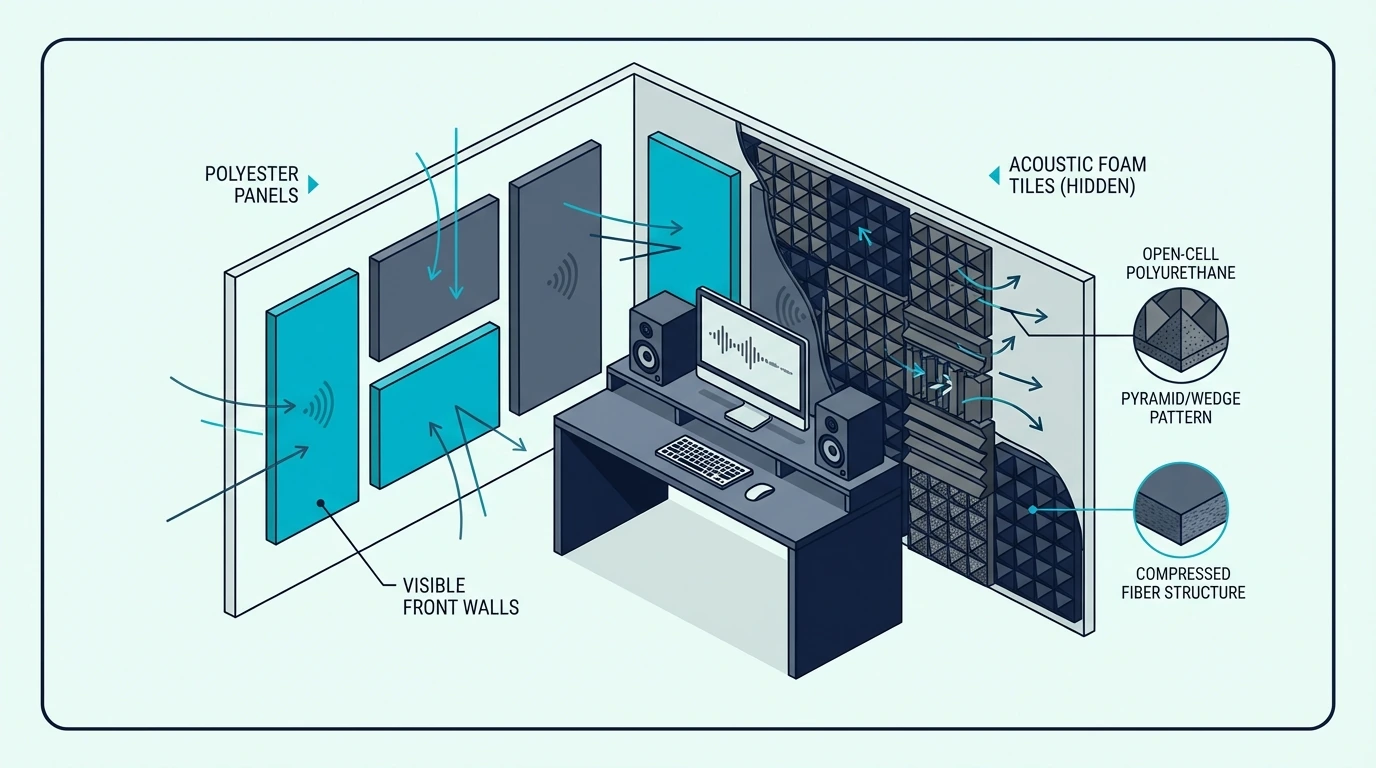
Acoustic Foam vs Insulation: What’s the Difference and Which Do You Need?

Acoustic foam and building insulation both affect sound, but they serve different purposes and work in different ways. Using the wrong one wastes money and leaves your actual problem unsolved.

The confusion is understandable—both materials absorb sound to some degree. But acoustic foam treats sound within a room while insulation primarily provides thermal control with secondary acoustic benefits.

Start with the quick takeaway below, then we’ll compare how each material works, what the performance numbers actually mean, and which rooms call for which solution.

Quick Takeaway

Use acoustic foam when you want to improve how your room sounds inside — it treats reflections on walls and ceilings to reduce echo, reverb, and harsh recordings.

Use building insulation when you need to reduce sound traveling through walls, ceilings, or floors as part of a soundproofing project. Neither one does the other’s job, so matching the material to the problem is the whole game.

Understanding the Core Difference
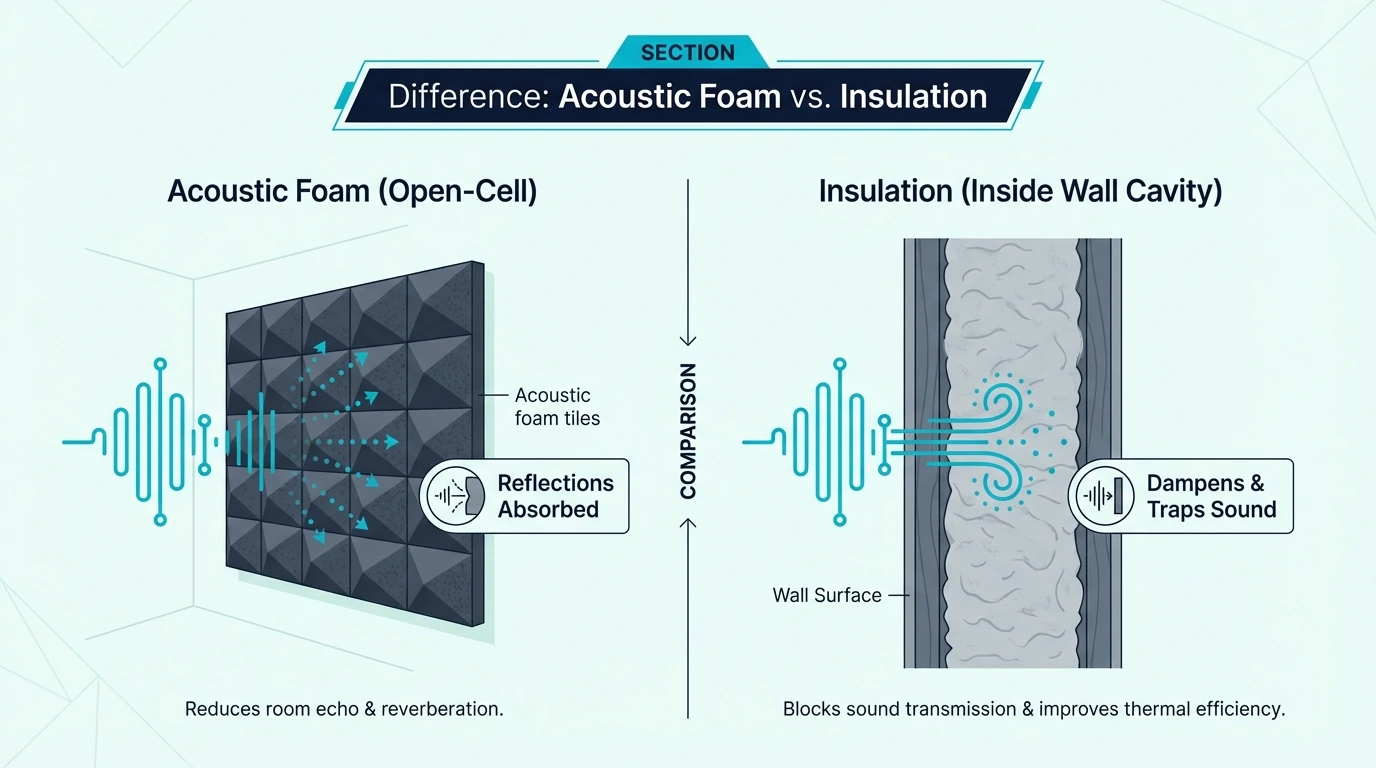
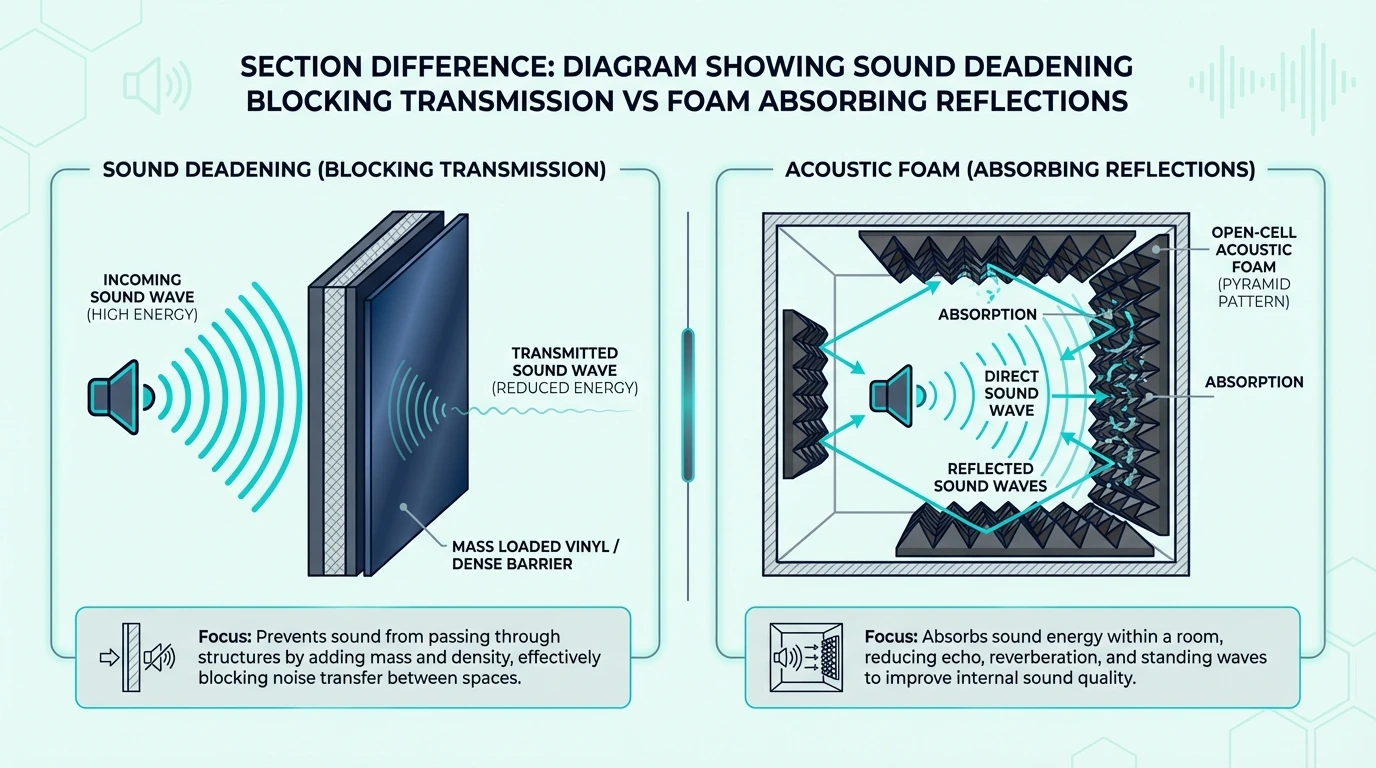
Difference diagram showing acoustic foam absorbing reflections vs insulation inside wall cavity

The fundamental difference is purpose and placement.

Acoustic Foam: Surface Treatment

Acoustic foam mounts on the surfaces of your room—walls, ceiling, sometimes floor. It absorbs sound waves that would otherwise reflect off hard surfaces and bounce around the room.

This absorption reduces: – Echo and reverberation – Flutter (rapid repeated reflections) – Harsh, “roomy” sound quality – Comb filtering from delayed reflections

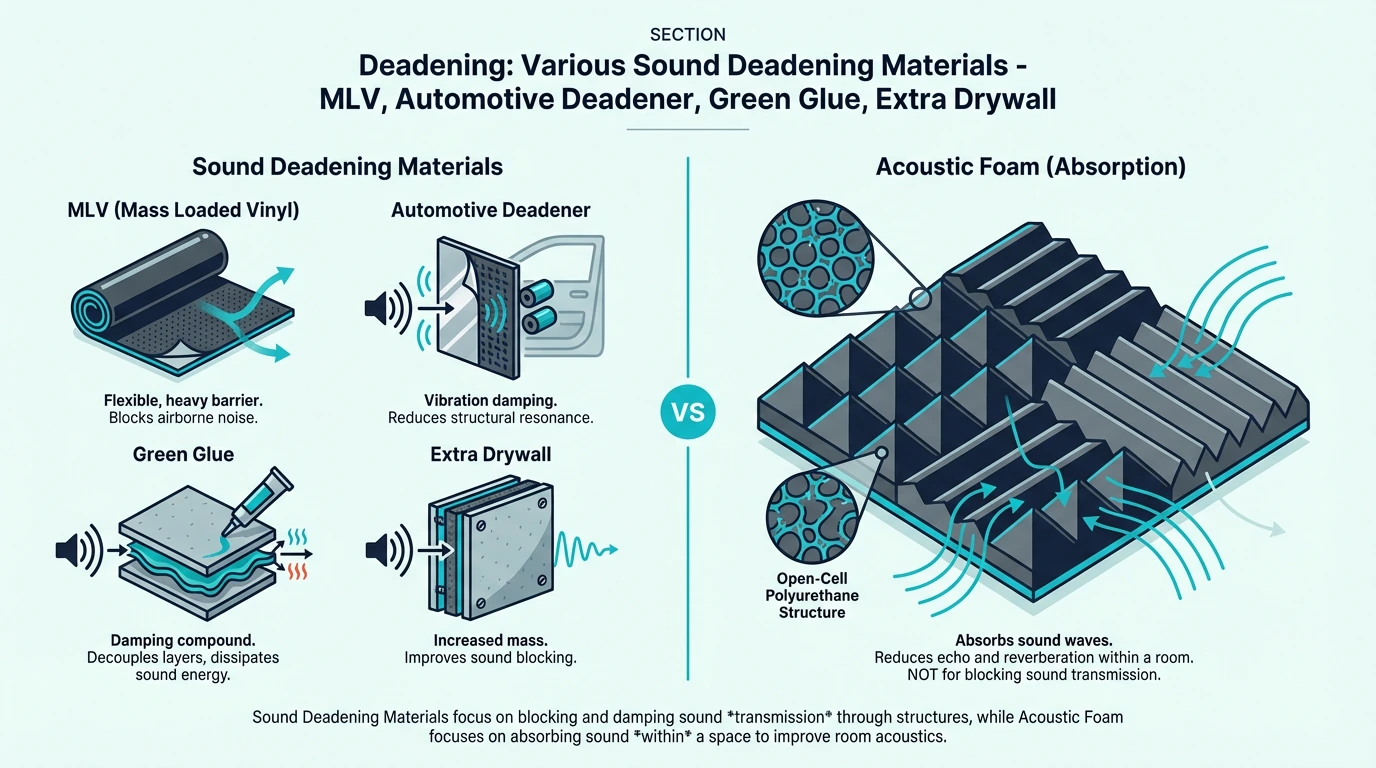
Acoustic foam does NOT stop sound from passing through walls. Sound transmission requires mass and decoupling to block — foam provides neither.

The does acoustic foam work guide covers what foam can realistically achieve.

The frequency absorption guide covers what foam can and can’t handle at each pitch.

Building Insulation: Cavity Fill

Building insulation fills cavities inside walls, ceilings, and floors. Its primary purpose is thermal control — keeping heat in or out.

Sound absorption is a secondary benefit.

When used for acoustic purposes, insulation: – Absorbs sound within wall cavities – Reduces resonance in hollow walls – Contributes to sound transmission reduction (with other measures) – Provides broadband absorption when exposed

Insulation alone doesn’t soundproof either. Effective soundproofing requires mass (drywall layers), decoupling (isolated wall structures), and sealing (no air gaps)—insulation is just one component.

Material Comparison
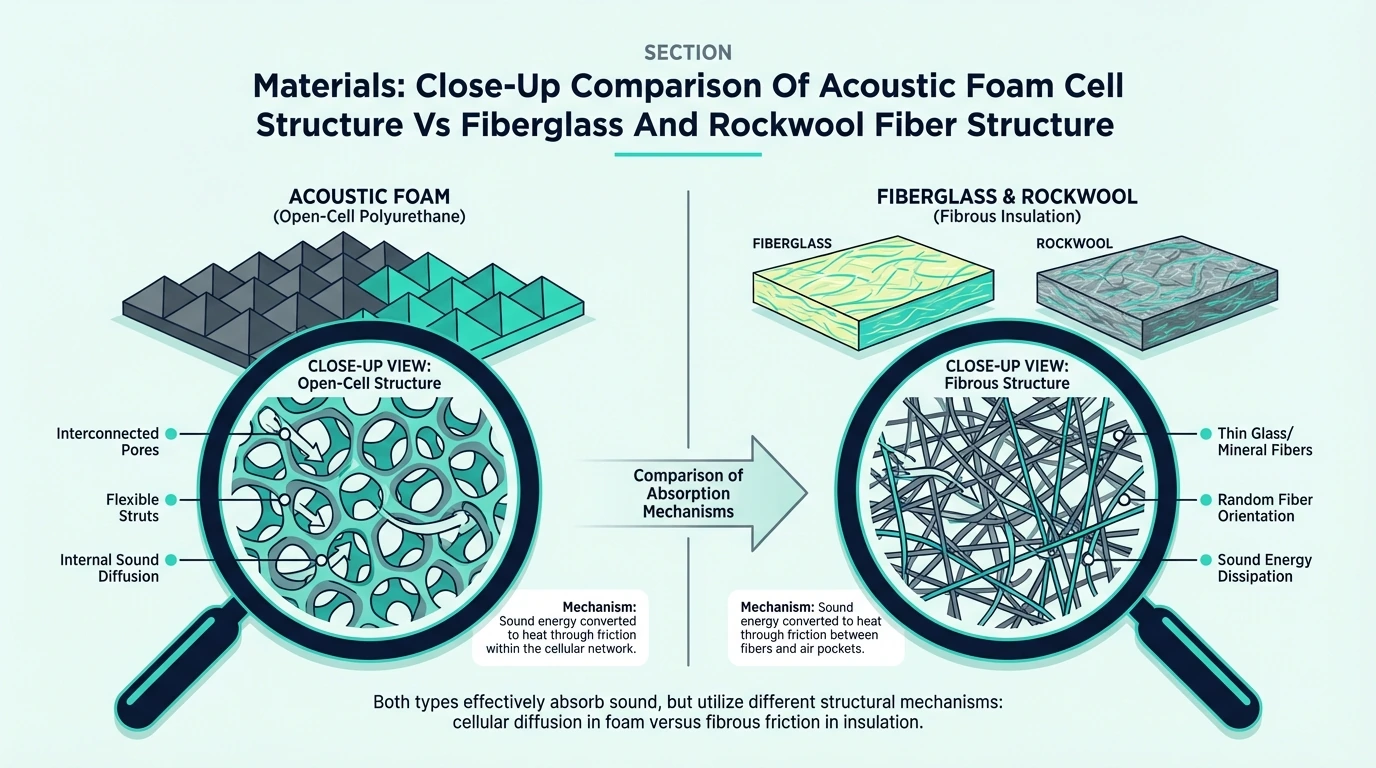
Materials close up comparison of acoustic foam cell structure vs fiberglass and rockwool fiber structure

Different materials, different properties, different applications.

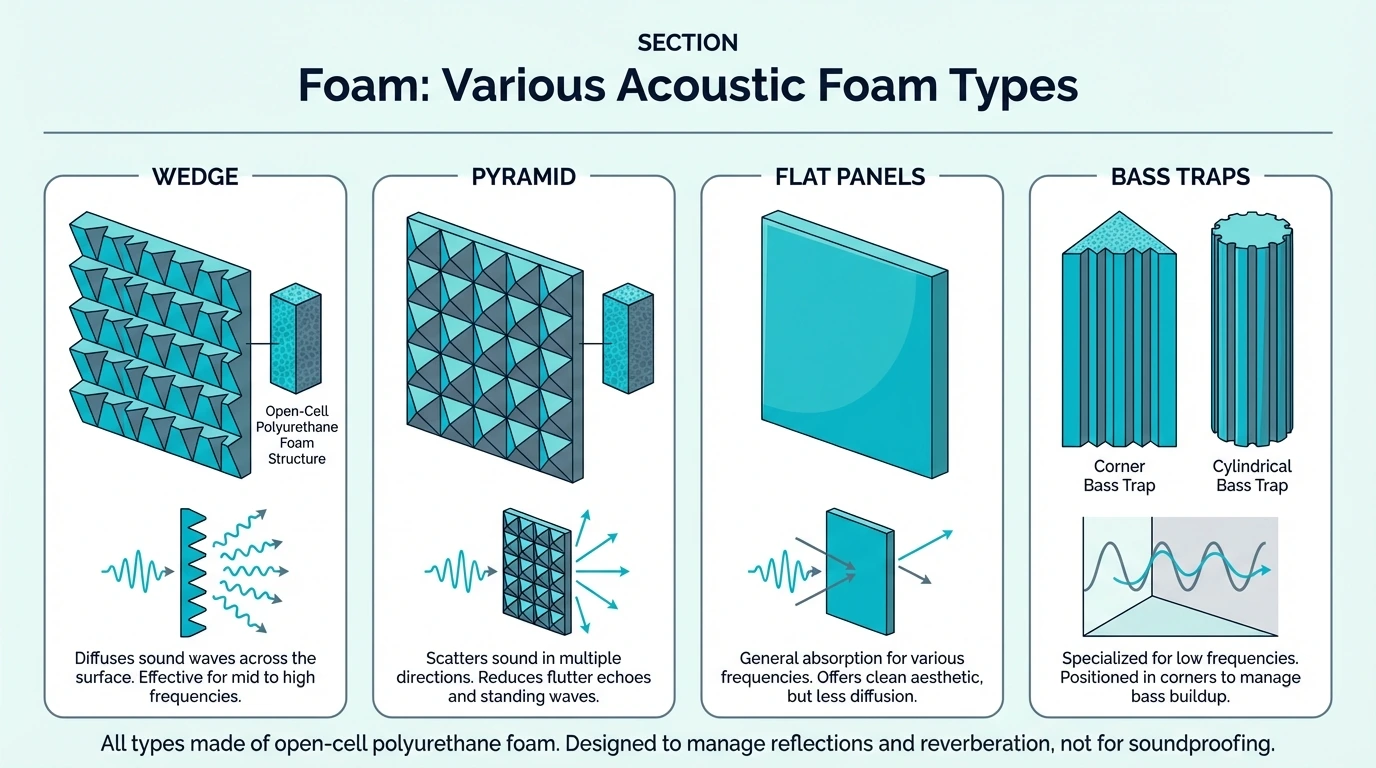
Acoustic Foam Types

Polyurethane foam: – Most common acoustic foam material – Open-cell structure allows sound penetration – Lightweight, easy to cut and mount – Available in various densities (1.5-2.5 lb/ft³) – Degrades over time with UV exposure

Melamine foam: – Higher performance than polyurethane – Better fire resistance – More expensive – Used in professional installations

The foam materials guide covers how composition affects performance.

Building Insulation Types

Fiberglass batts: – Pink or yellow fluffy material – Inexpensive, widely available – Good thermal properties – Moderate acoustic absorption – Irritating fibers require protection during handling

Mineral wool (rockwool): – Denser than fiberglass – Better acoustic properties – Superior fire resistance – More expensive than fiberglass – Preferred for acoustic applications

Rigid fiberglass boards (703, 705): – Dense, rigid panels – Excellent acoustic absorption – Used in professional acoustic panels – Higher cost than batts

Spray foam: – Expands to fill cavities – Excellent thermal properties – Closed-cell types reflect sound (poor for acoustics) – Open-cell types provide some absorption

Performance Comparison
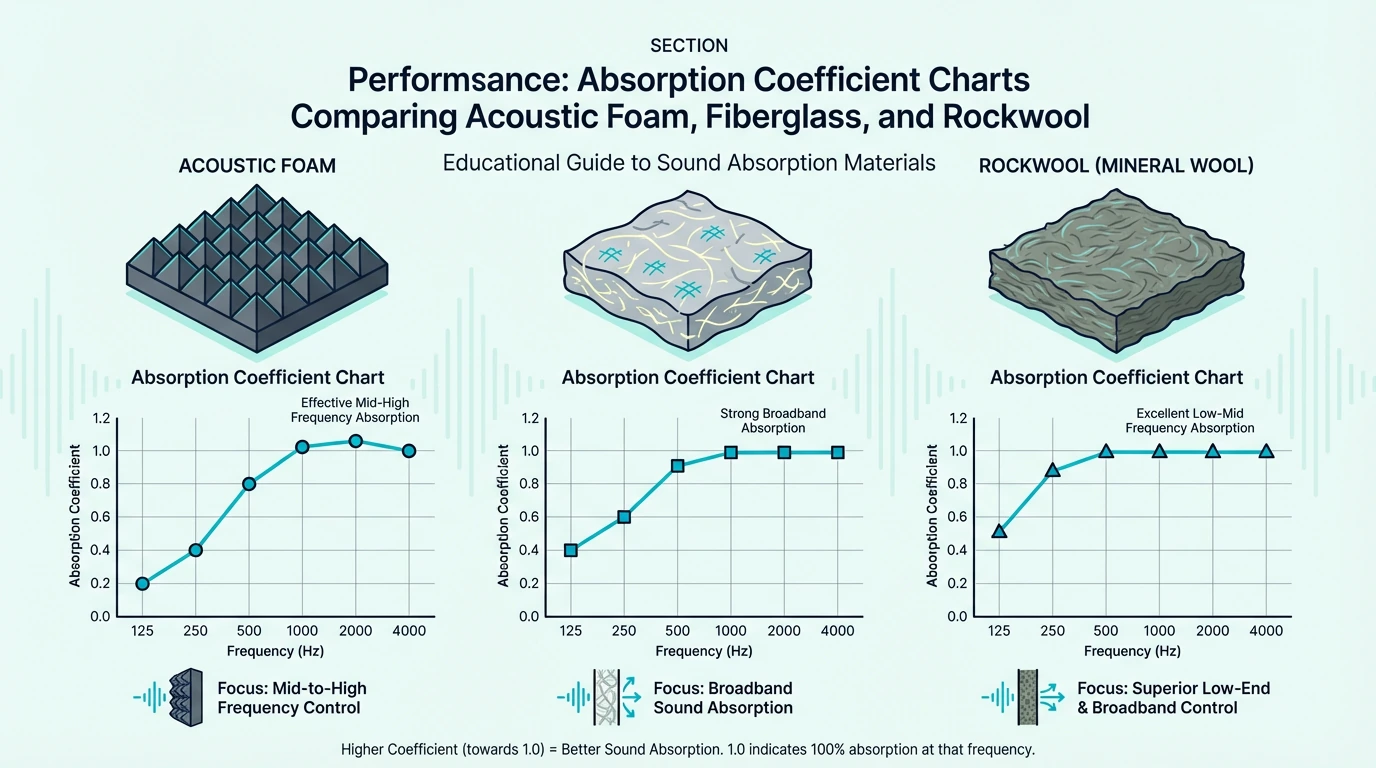
Performance absorption coefficient charts comparing acoustic foam fiberglass and rockwool

How do these materials actually perform acoustically?

Absorption Coefficients

Frequency 2” Acoustic Foam 3.5” Fiberglass Batt 3” Rockwool
125 Hz 0.11 0.34 0.52
250 Hz 0.30 0.73 0.93
500 Hz 0.60 0.99 1.00+
1000 Hz 0.85 0.99 1.00+
2000 Hz 0.90 0.94 0.98
NRC 0.65 0.90 0.95

Values are representative; specific products vary.

What This Means

Building insulation (especially rockwool) actually absorbs sound better than acoustic foam across most frequencies. The denser fiber structure and greater typical thickness provide superior absorption.

So why use acoustic foam at all? Because: 1. Foam is designed for surface mounting 2. Insulation requires containment (fabric wrap, wall cavity) 3. Foam comes in convenient panel sizes 4. Insulation fibers are irritating without covering

When insulation is properly contained in fabric-wrapped panels, it outperforms foam. But for simple surface treatment, foam’s convenience often wins.

When to Use Acoustic Foam
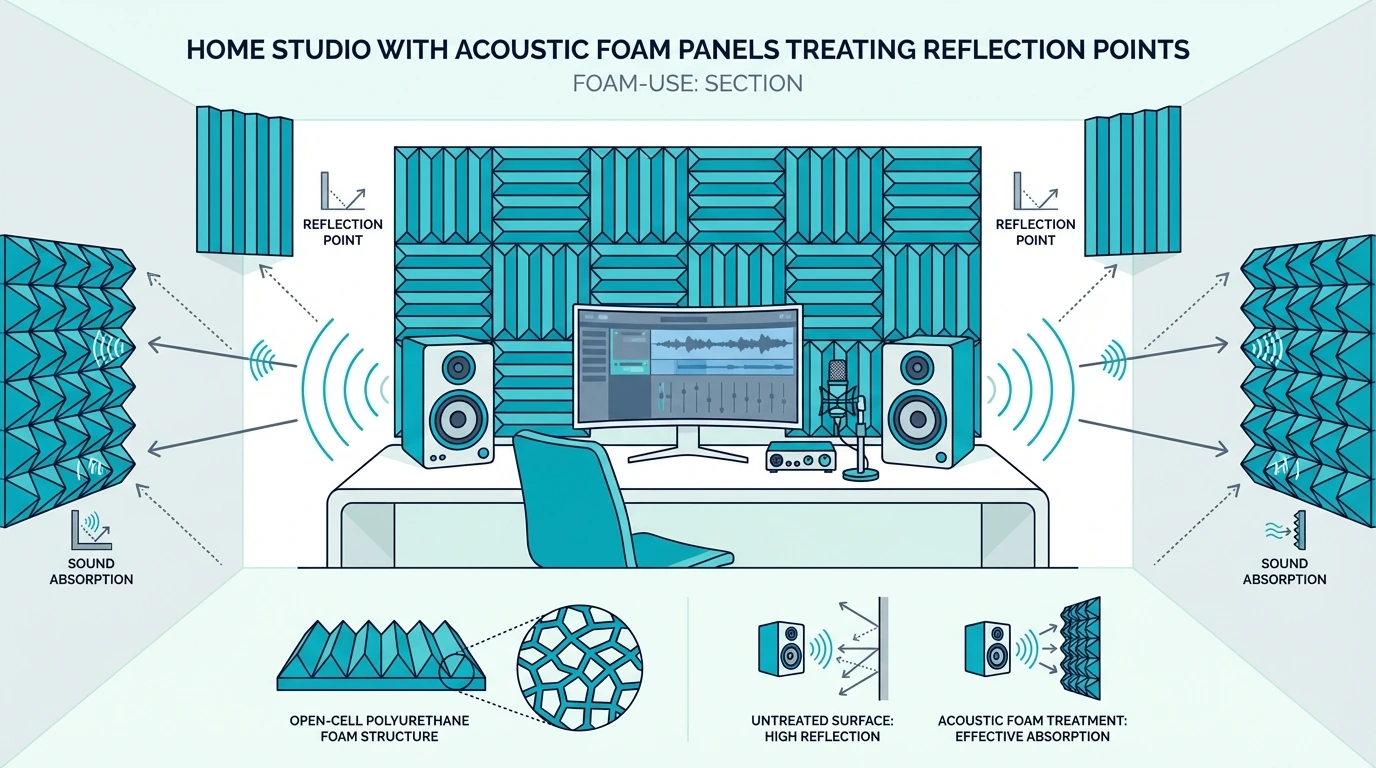
Foam use home studio with acoustic foam panels treating reflection points

Acoustic foam is the right choice for specific situations.

Treating Room Reflections

If your problem is echo, reverb, or harsh sound within your room, acoustic foam addresses it directly. Mount panels at reflection points to absorb sound before it bounces back to your ears or microphone.

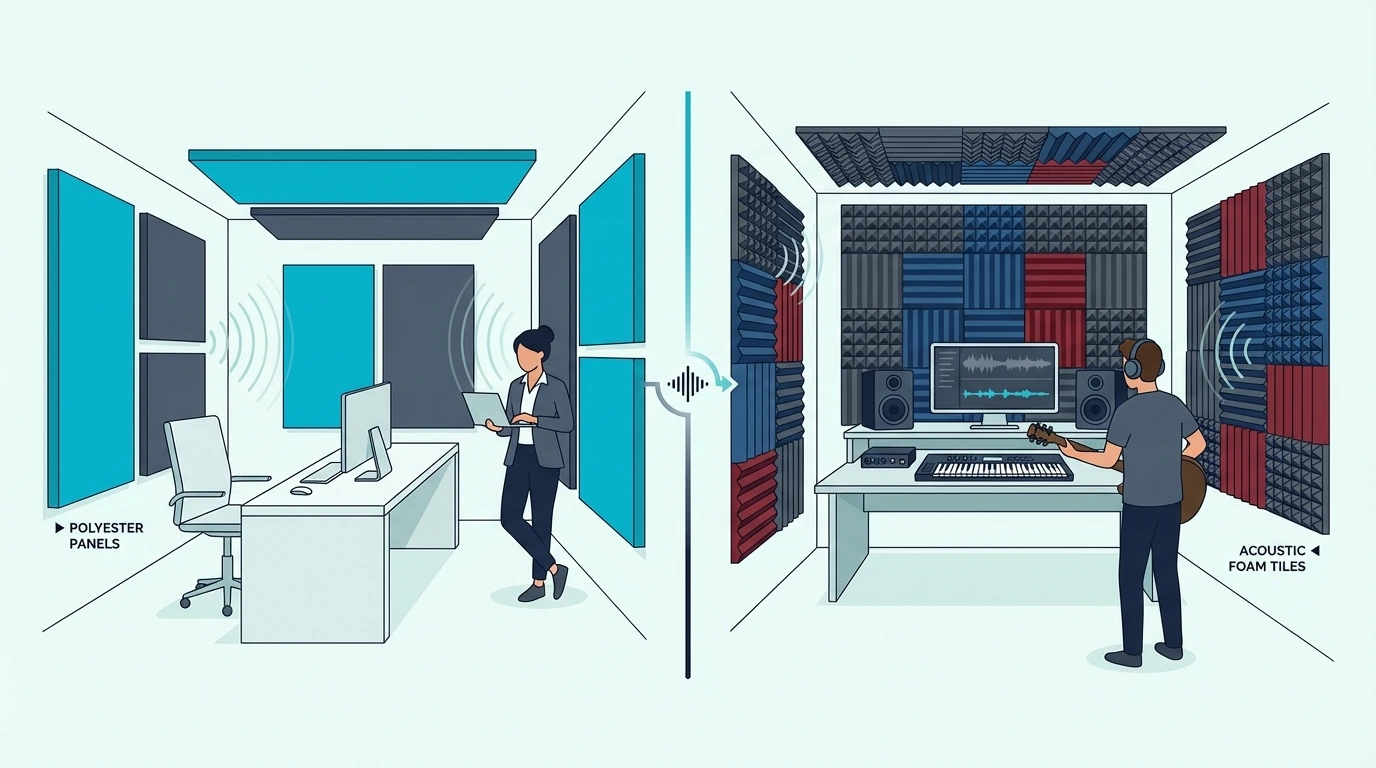
Common applications: – Home recording studios – Podcast recording spaces – Video conferencing rooms – Gaming and streaming setups – Practice rooms

Quick, Easy Installation

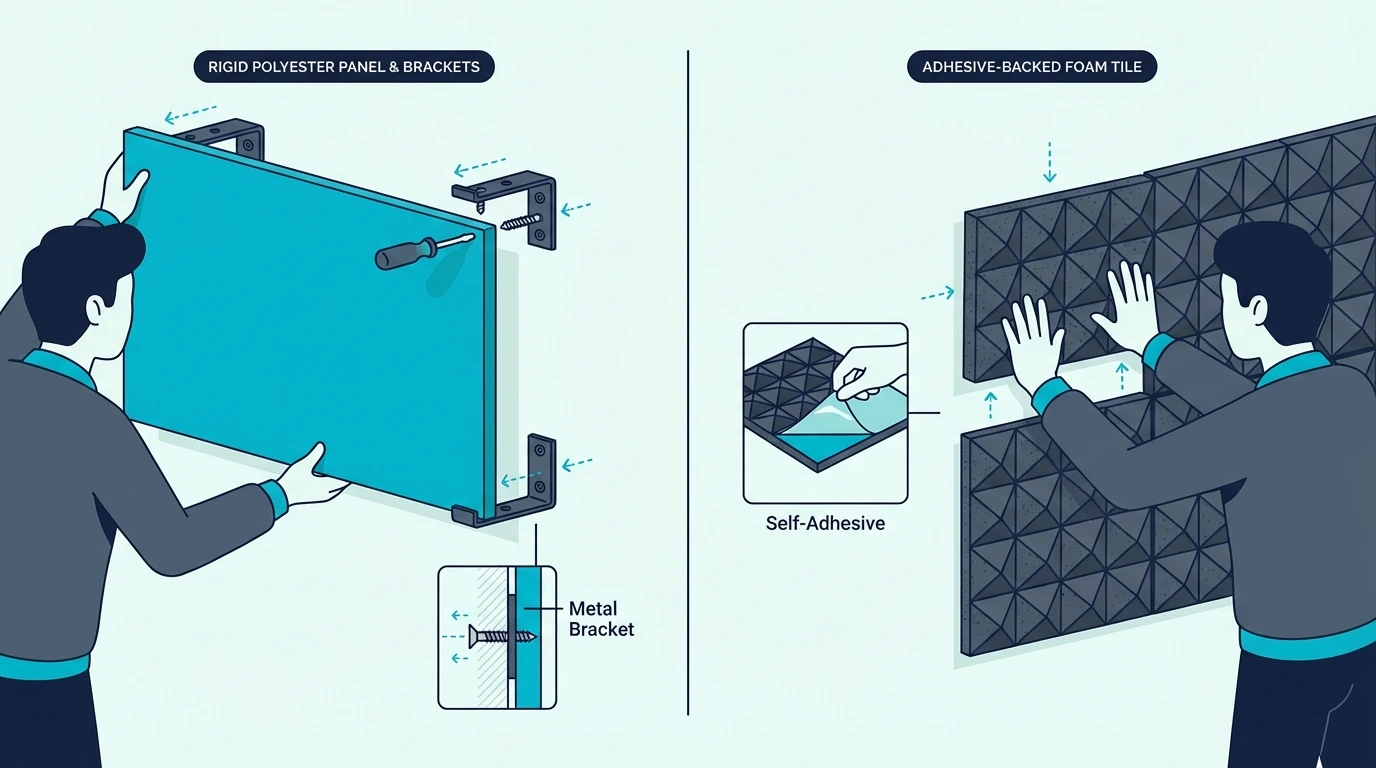
Foam panels mount with adhesive, command strips, or clips — no construction required. Mounting tape like WINDIR double-sided adhesive squares makes it a one-person afternoon job.

For renters or temporary setups, foam’s easy installation and removal is a practical advantage. The wall installation guide covers every mounting method.

Budget-Conscious Treatment

Foam panels cost less than equivalent fabric-wrapped insulation panels. When budget is limited and you need surface treatment, a starter pack like TroyStudio 2-inch foam panels provides meaningful improvement at accessible prices.

The best foam for recording roundup covers top picks by use case.

Limitations to Accept

Foam won’t: – Soundproof your room – Stop sound from entering or leaving – Effectively absorb bass frequencies – Last as long as other treatments

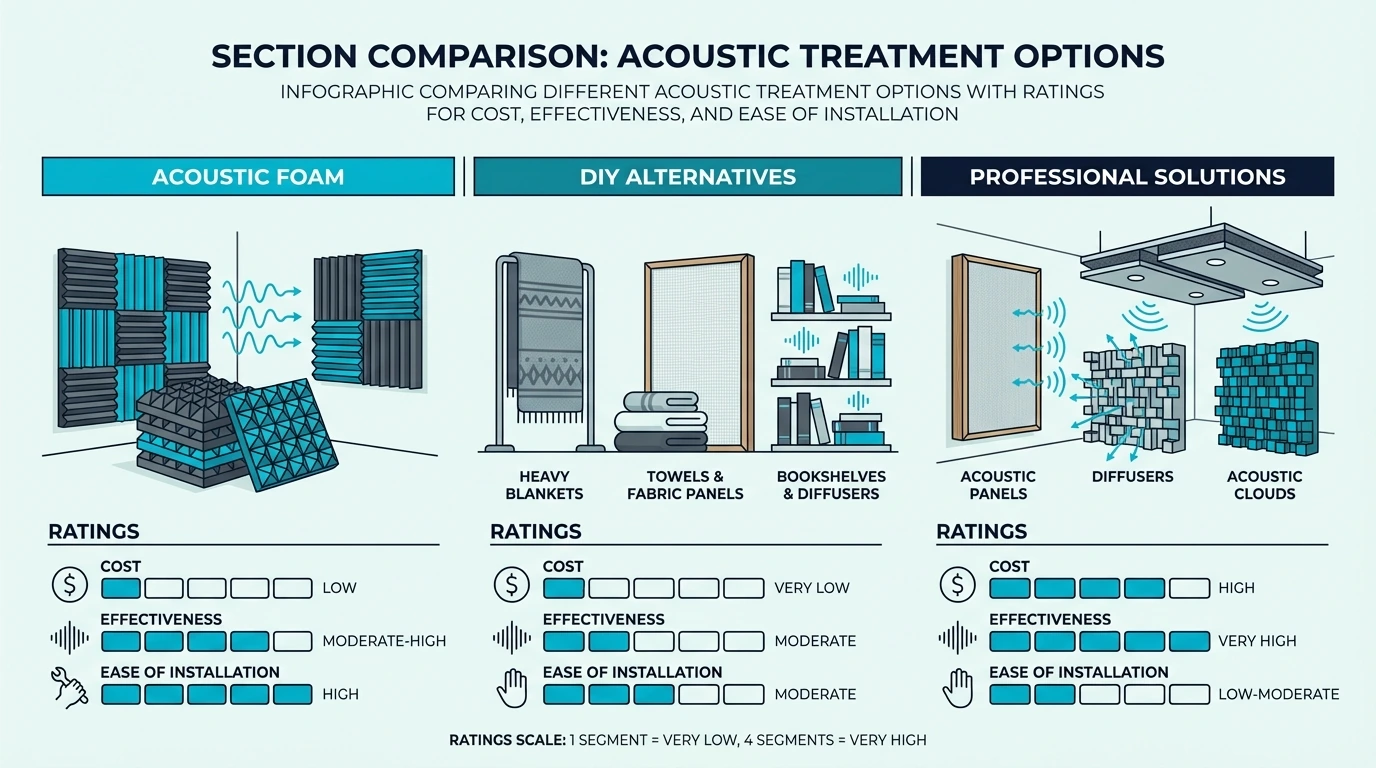
If these limitations matter for your application, consider whether insulation-based DIY panels or commercial fabric-wrapped panels would better fit your needs.

When to Use Building Insulation
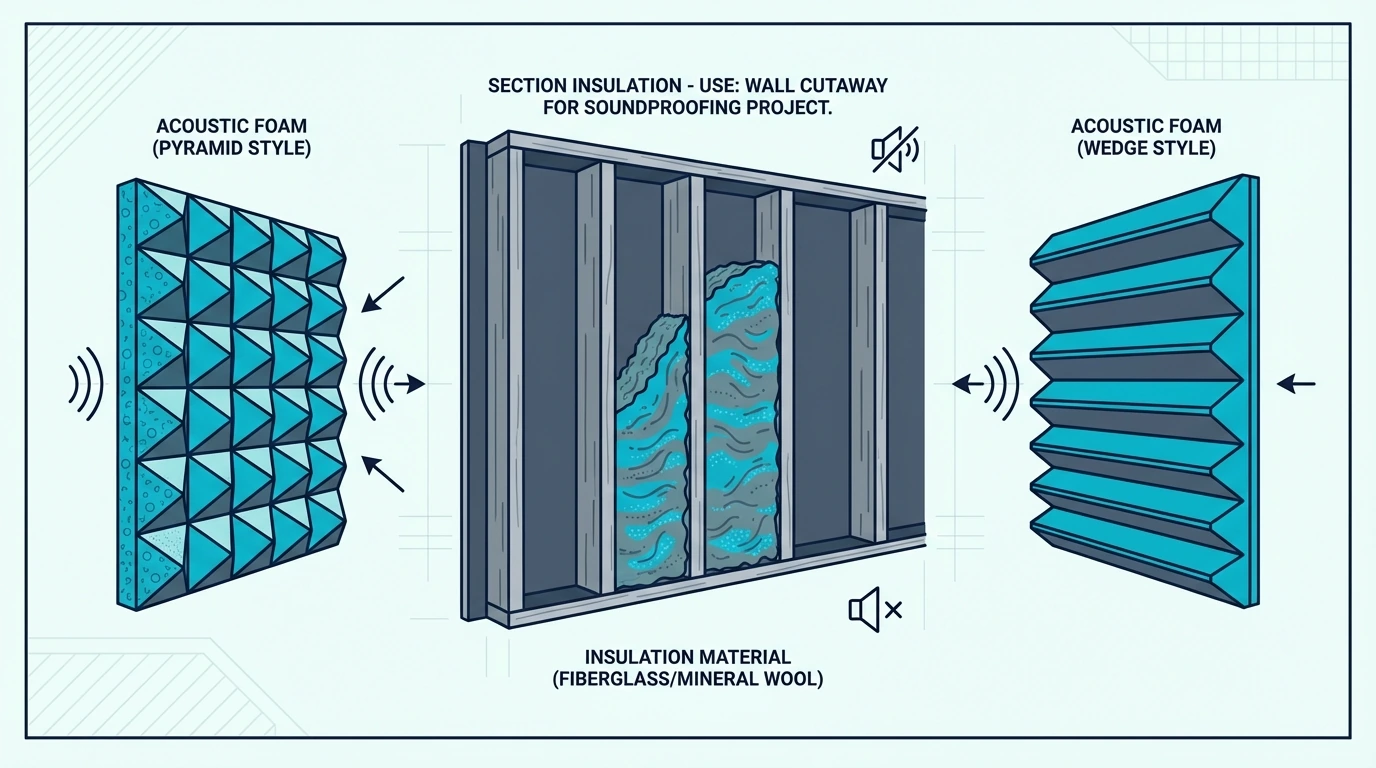
Insulation use wall cutaway showing insulation in cavity for soundproofing project

Building insulation serves different purposes than surface-mounted foam.

Soundproofing Projects

If you need to reduce sound transmission between spaces—stopping noise from entering your room or preventing your sound from disturbing others—insulation is part of the solution.

Effective soundproofing combines: – Mass (multiple drywall layers) – Insulation (cavity absorption) – Decoupling (isolated wall structures) – Sealing (no air gaps)

Insulation alone provides modest improvement. Combined with other measures, it contributes meaningfully — and sealing air gaps with acoustical caulk is one of the most overlooked steps.

New Construction or Renovation

When walls are open during construction or renovation, adding acoustic insulation is easy and cost-effective. Rockwool or fiberglass batts in wall cavities reduce sound transmission and resonance.

This is the ideal time to address acoustics—retrofitting insulation into existing walls is much more difficult and expensive.

DIY Acoustic Panels

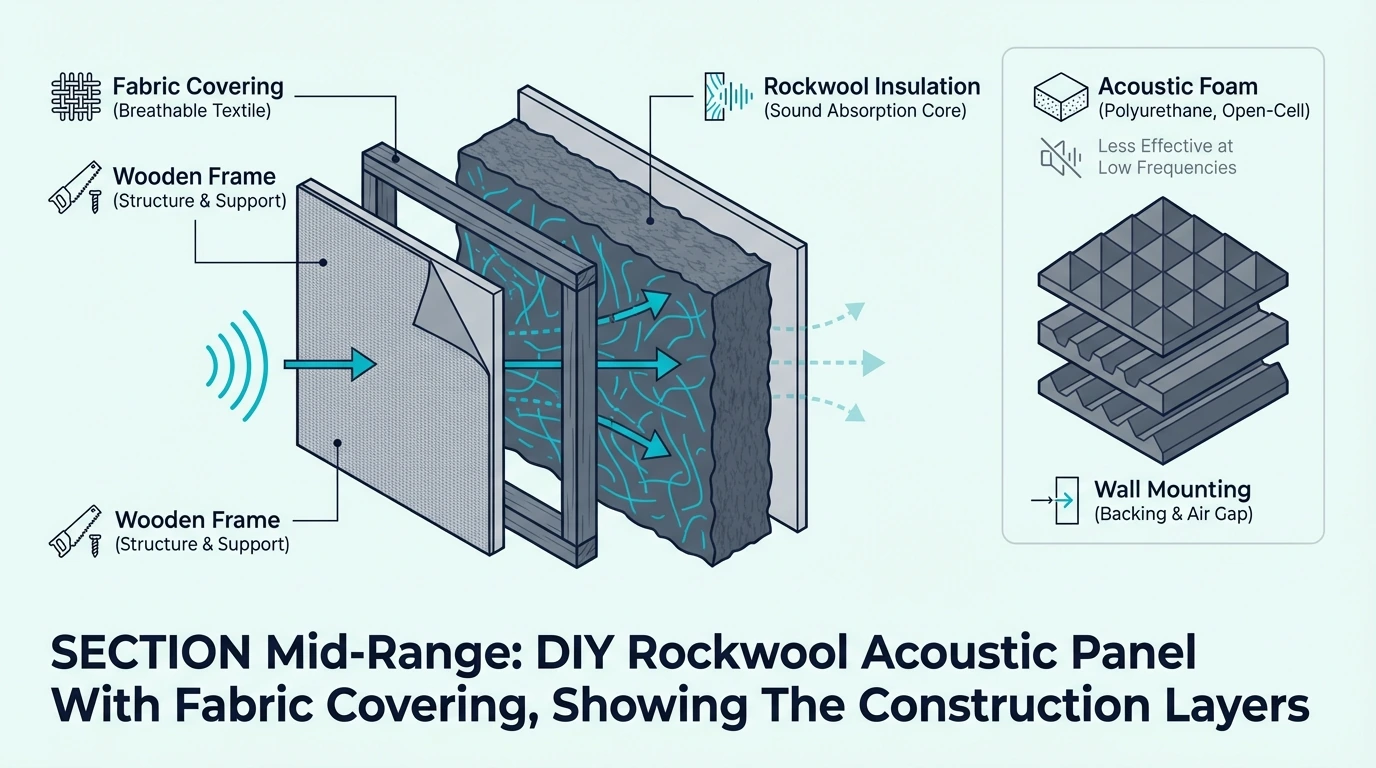
Building your own acoustic panels from rockwool or rigid fiberglass provides professional-grade absorption at lower cost than commercial panels.

The process: 1. Build simple wooden frames 2. Insert rockwool or fiberglass 3. Wrap with acoustically transparent fabric 4. Mount on walls

These DIY panels outperform foam while costing less than commercial fabric panels. The DIY acoustic panels guide walks through the build step by step.

Bass Traps

Low-frequency absorption requires thick, dense material. Rockwool bass traps (4-6 inches thick) absorb bass frequencies that foam can’t touch.

For corner treatment and bass control, insulation-based traps clearly outperform foam alternatives. The bass traps vs foam comparison covers when each makes sense.

Common Misconceptions
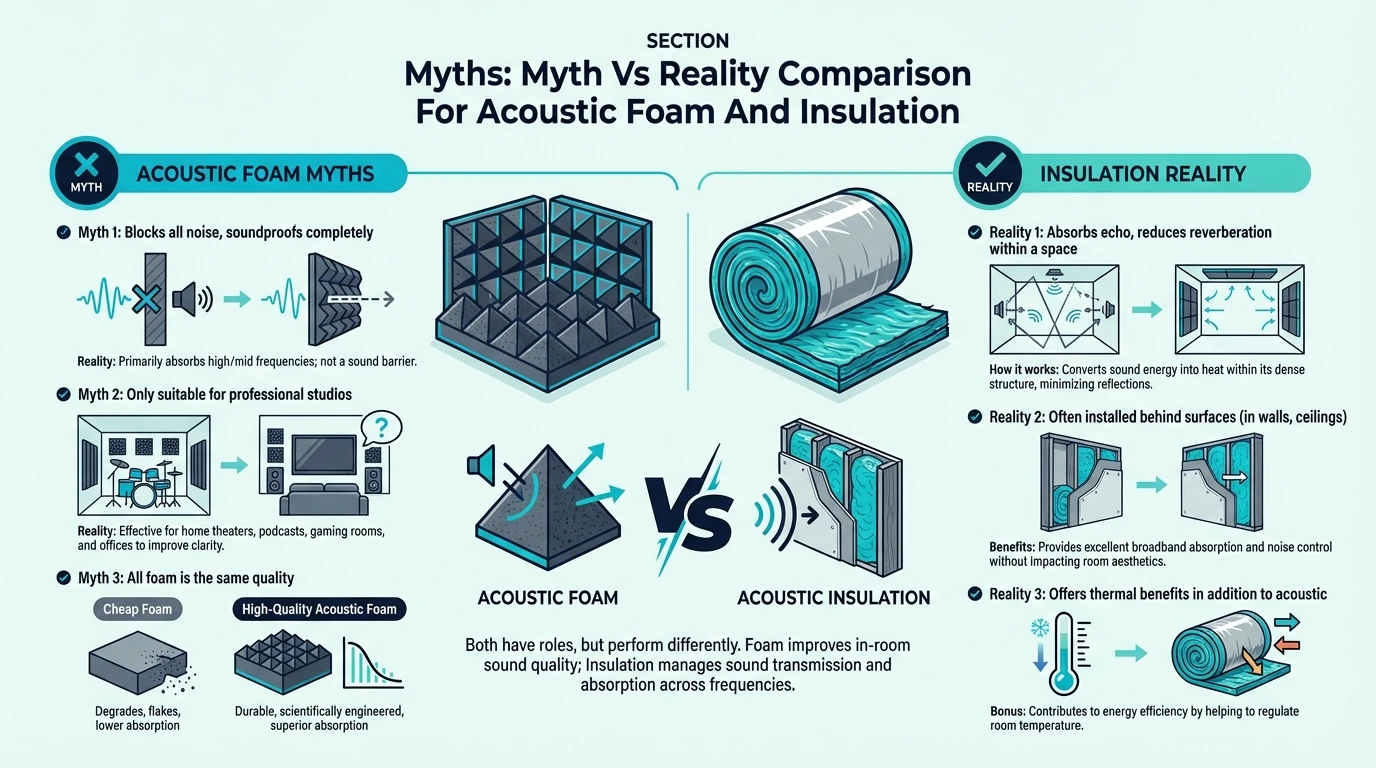
Myths myth vs reality comparison for acoustic foam and insulation

Several misunderstandings lead to wrong product choices.

“Acoustic Foam Soundproofs Rooms”

This is the most common misconception. Acoustic foam absorbs sound within a room—it doesn’t block sound transmission through walls.

If you cover your walls with foam and expect neighbors to stop hearing you (or vice versa), you’ll be disappointed. Soundproofing requires mass and construction, not surface treatment.

“Any Insulation Works for Acoustics”

Not all insulation is equal acoustically: – Closed-cell spray foam: Reflects sound, poor for acoustics – Polystyrene/styrofoam: Minimal absorption – Thin fiberglass: Limited effectiveness

For acoustic applications, use rockwool, mineral wool, or dense fiberglass (703/705). Standard pink fiberglass batts work but aren’t ideal.

“More Insulation = Better Soundproofing”

Insulation in wall cavities helps, but adding more beyond filling the cavity provides diminishing returns. Soundproofing improvements come from adding mass (more drywall) and decoupling (resilient channels, double walls), not just more insulation.

“Foam and Insulation Are Interchangeable”

They’re not. Foam is designed for surface mounting and convenient installation, while insulation is designed for cavity fill and requires containment.

Using insulation like foam (exposed on walls) creates fiber hazards and looks unprofessional. Using foam like insulation (stuffed in walls) wastes money on an expensive product where cheap insulation works better.

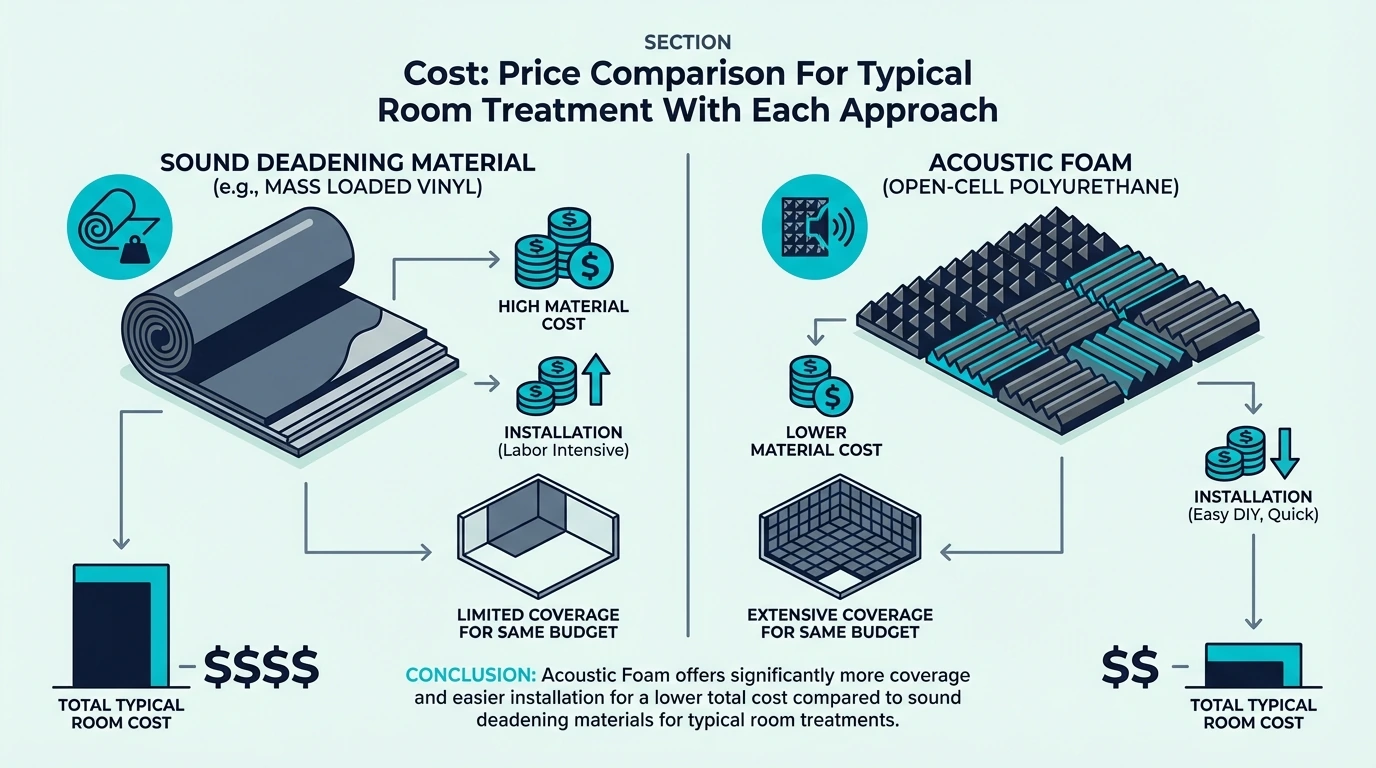
Cost Comparison
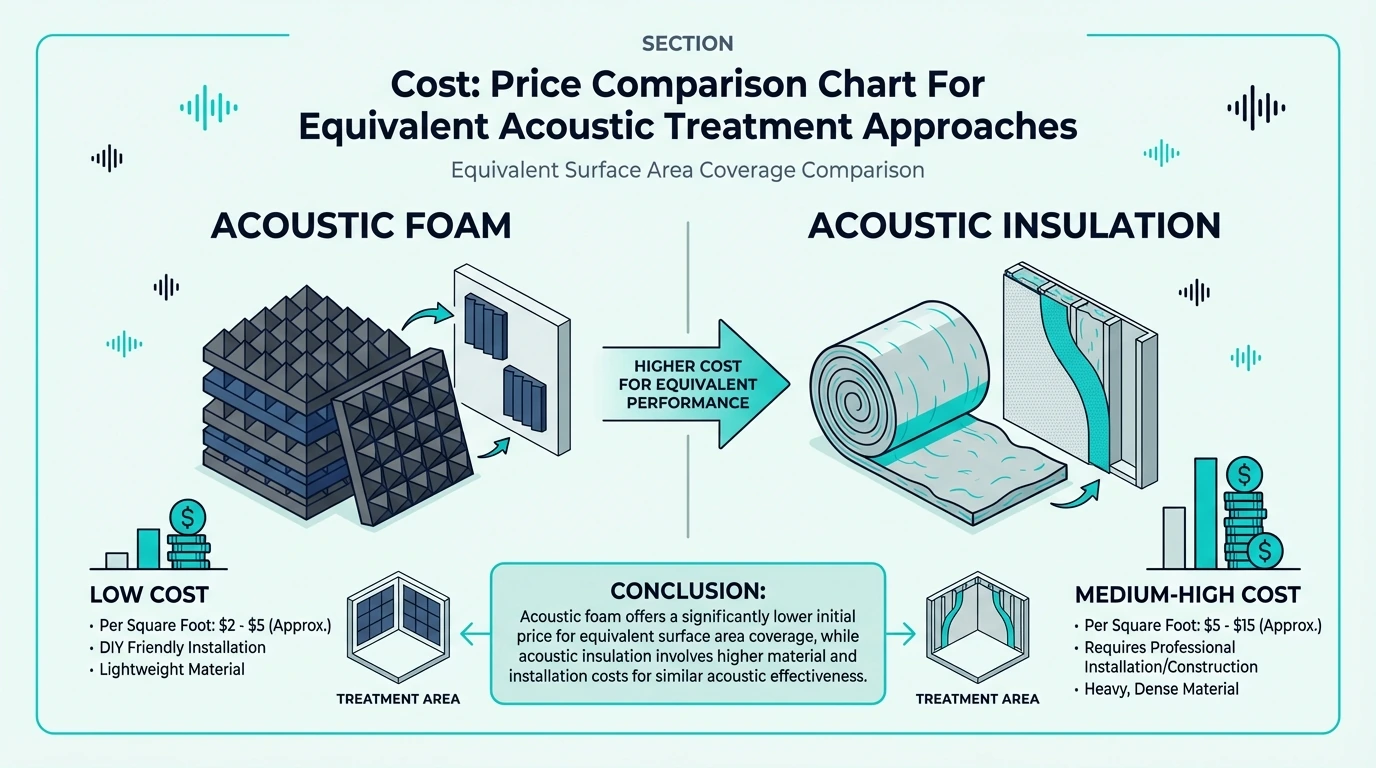
Cost price comparison chart for equivalent acoustic treatment approaches

Budget often drives decisions. Here’s how costs compare.

Surface Treatment Costs

Acoustic foam panels: – Budget: Lower cost per square foot – Quality (Auralex): Moderate cost per square foot

DIY rockwool panels: – Materials: Lower cost per square foot – Plus labor time

Commercial fabric panels: – Budget brands: Moderate cost per square foot – Premium (GIK, ATS): Higher cost per square foot

Soundproofing Costs

Basic insulation upgrade: – Rockwool batts: Lower cost per square foot of wall – Installation: DIY possible for open walls

Full soundproofing: – Additional drywall layers – Resilient channels or clips – Acoustic sealant – Professional installation often needed – Total: Much higher per square foot of wall

Value Analysis

For surface treatment (reducing reflections), acoustic foam provides the best value for simple applications. DIY rockwool panels provide better performance per dollar if you’re willing to build them.

For soundproofing, there’s no cheap solution. Effective sound blocking requires serious investment in materials and often professional installation.

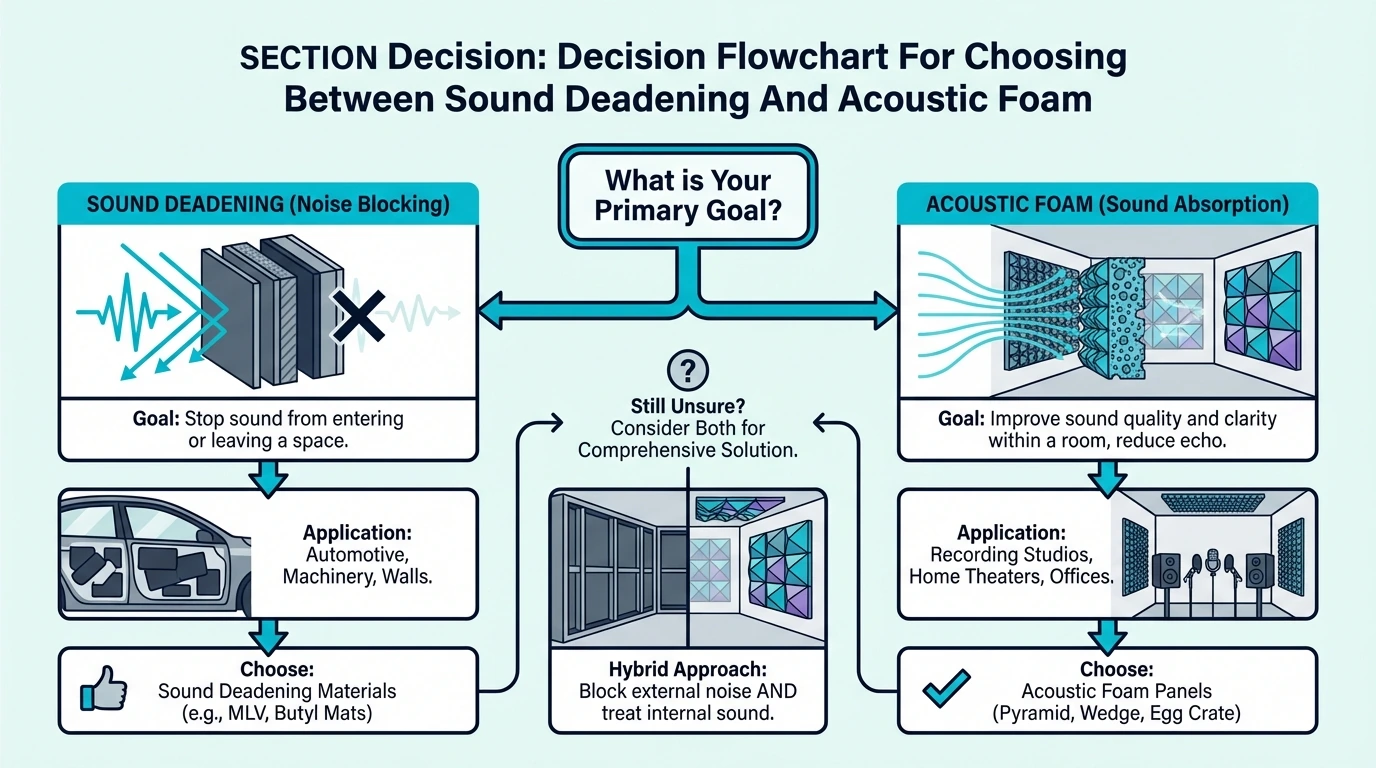
Making Your Decision
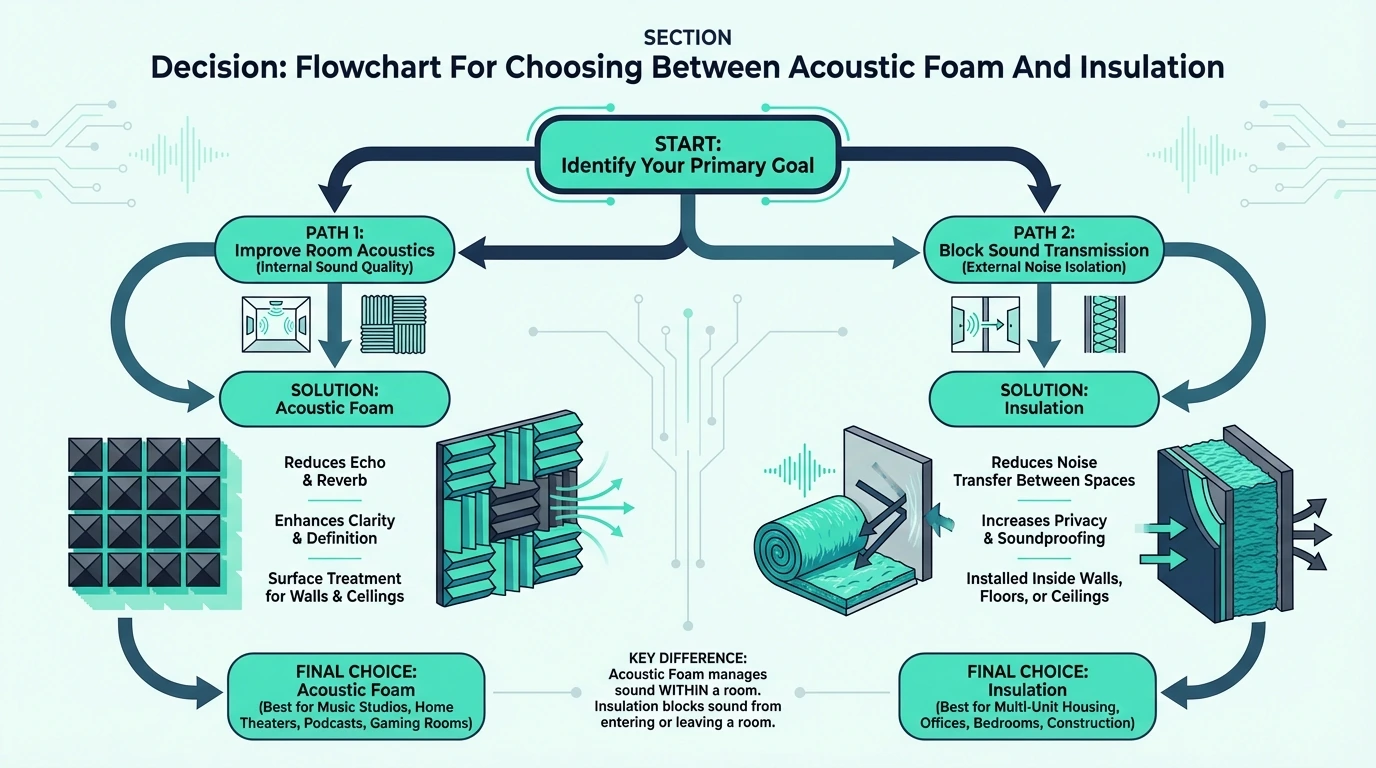
Decision flowchart for choosing between acoustic foam and insulation

Answer these questions to determine what you need.

What’s Your Actual Problem?

“My recordings sound echoey/roomy” → You need surface absorption → Acoustic foam or panels

“I hear my neighbors / neighbors hear me” → You need soundproofing → Insulation + mass + sealing

“My room sounds boomy (too much bass)” → You need bass traps → Thick rockwool traps

“I want better sound quality for mixing” → You need full-spectrum treatment → Combination approach

The does foam improve recording guide covers what to expect from treatment.

What’s Your Budget?

Limited budget, need quick improvement: → Acoustic foam for key reflection points

Moderate budget, want good results: → DIY rockwool panels or quality foam

Larger budget, want professional results: → Commercial fabric panels + bass traps

Serious soundproofing needed: → Construction project with insulation, mass, decoupling

What’s Your Situation?

Renter, can’t modify walls: → Acoustic foam (removable mounting)

Homeowner, walls already finished: → Surface treatment (foam or panels)

New construction or renovation: → Insulation in cavities + surface treatment

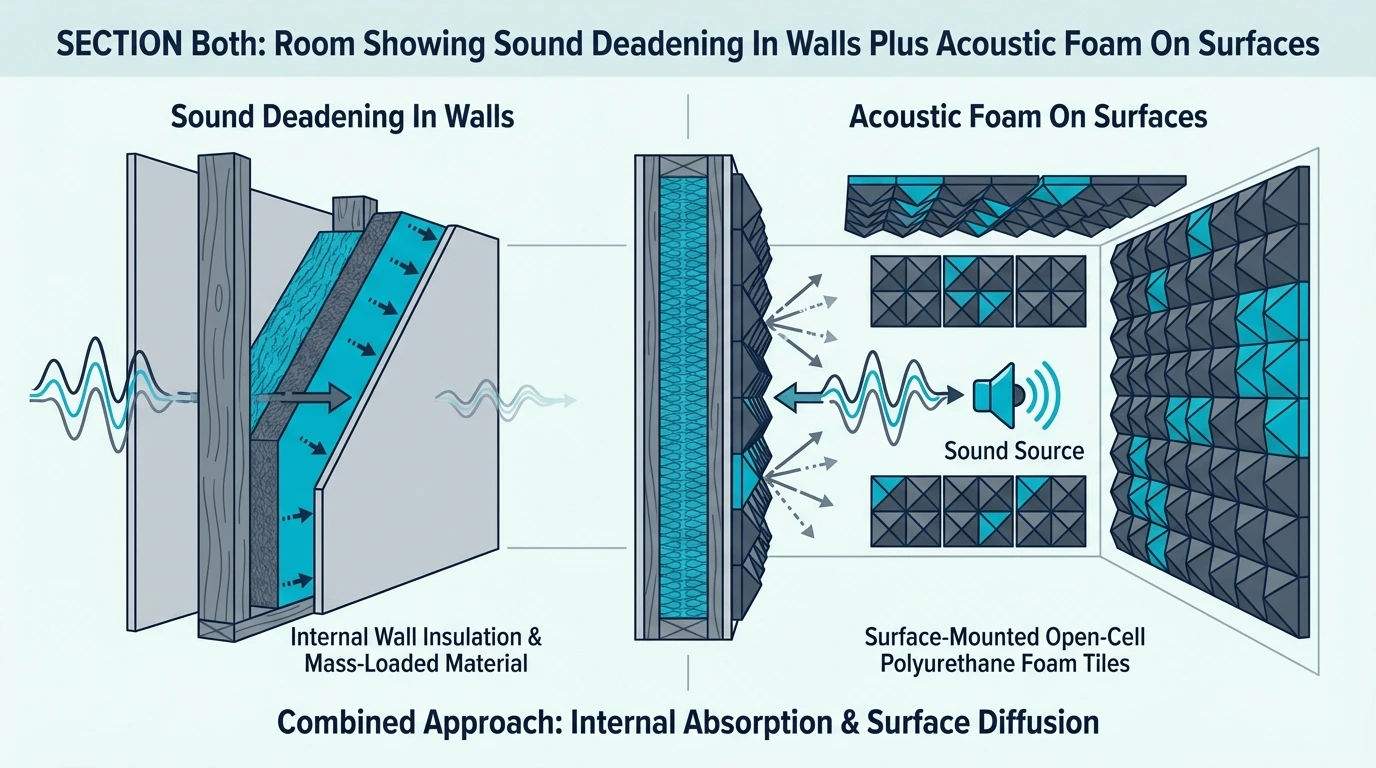
Hybrid Approaches
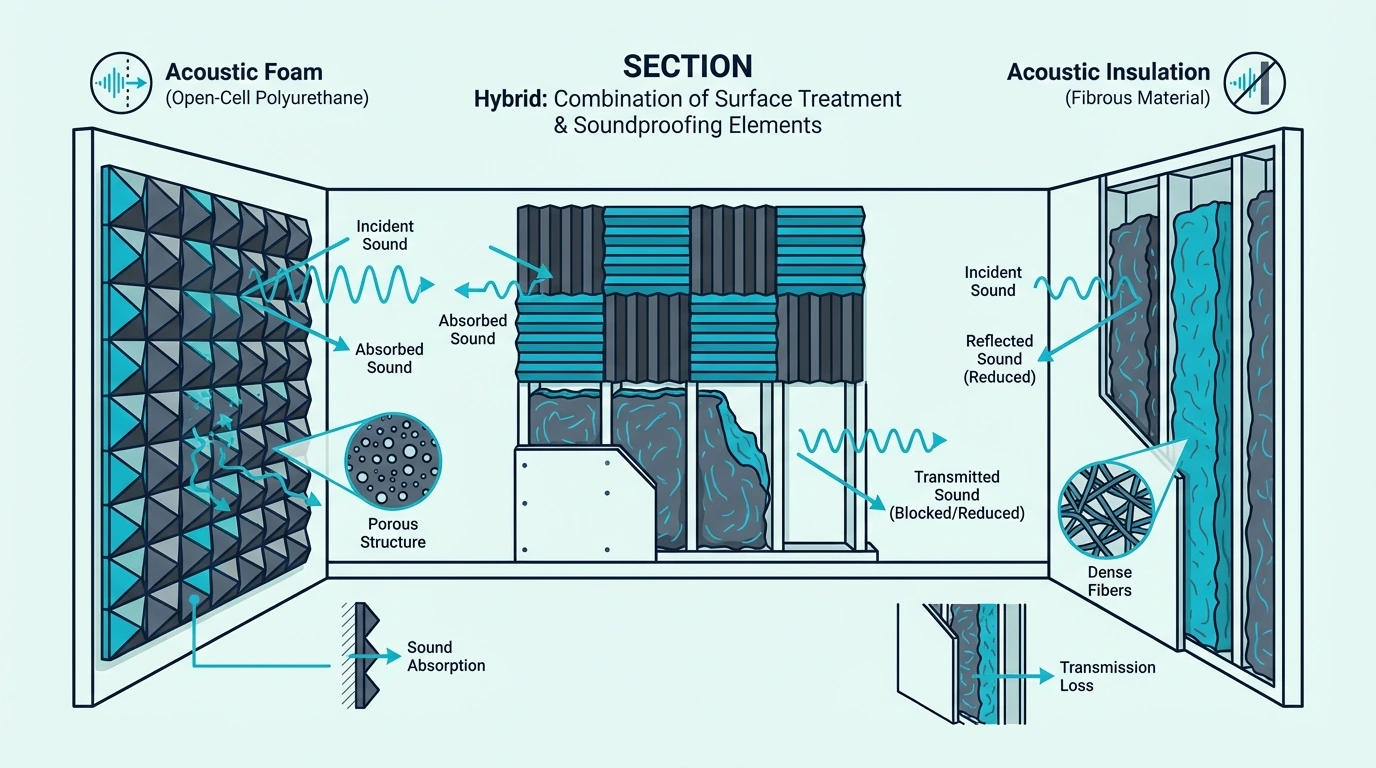
Hybrid room showing combination of surface treatment and soundproofing elements

Often the best solution combines approaches.

Surface Treatment + Bass Traps

Use acoustic foam for mid/high frequency absorption on walls, combined with rockwool bass traps in corners. This addresses the full frequency range more effectively than either alone.

Partial Soundproofing + Absorption

If complete soundproofing isn’t feasible, partial measures (adding mass to one wall, sealing gaps) combined with absorption treatment can meaningfully improve your situation.

Insulation Panels + Foam Supplements

Build or buy fabric-wrapped insulation panels for primary treatment, supplement with foam for additional coverage where needed. This balances performance and cost.

The acoustic foam arrangement guide covers layout strategies for every room shape.

Conclusion

Acoustic foam and building insulation serve different purposes despite both affecting sound. Foam treats reflections within your room—reducing echo and improving recording quality.

Insulation fills wall cavities, providing thermal control with secondary acoustic benefits. It contributes to soundproofing when combined with mass and sealing.

Choose acoustic foam when you need to improve how your room sounds inside: cleaner recordings, reduced echo, better monitoring. It’s designed for surface mounting, easy to install, and effective for mid/high frequencies.

Choose insulation when you’re building acoustic panels, creating bass traps, or undertaking soundproofing projects. Rockwool and dense fiberglass provide superior absorption and contribute to sound blocking when properly implemented.

Don’t expect foam to soundproof or insulation to work as surface treatment. Understanding what each material actually does—and doesn’t do—ensures you invest in the right solution for your specific problem.

Frequently Asked Questions

Can I use building insulation instead of acoustic foam?

Yes, if you contain it properly. Rockwool or fiberglass wrapped in acoustically transparent fabric creates panels that outperform foam.

You can’t just stick exposed insulation on walls—the fibers are irritating and it looks terrible. But DIY fabric-wrapped panels using insulation provide excellent, cost-effective treatment.

Does acoustic foam provide any soundproofing?

Minimal. Foam absorbs some sound energy, slightly reducing what passes through walls, but the effect is negligible.

Effective soundproofing requires mass (heavy materials that block sound) and sealing (no air gaps). Foam provides neither, so foam alone won’t achieve it.

Which is better for a home studio—foam or insulation panels?

Depends on your priorities. Foam is easier to install and more affordable for basic treatment.

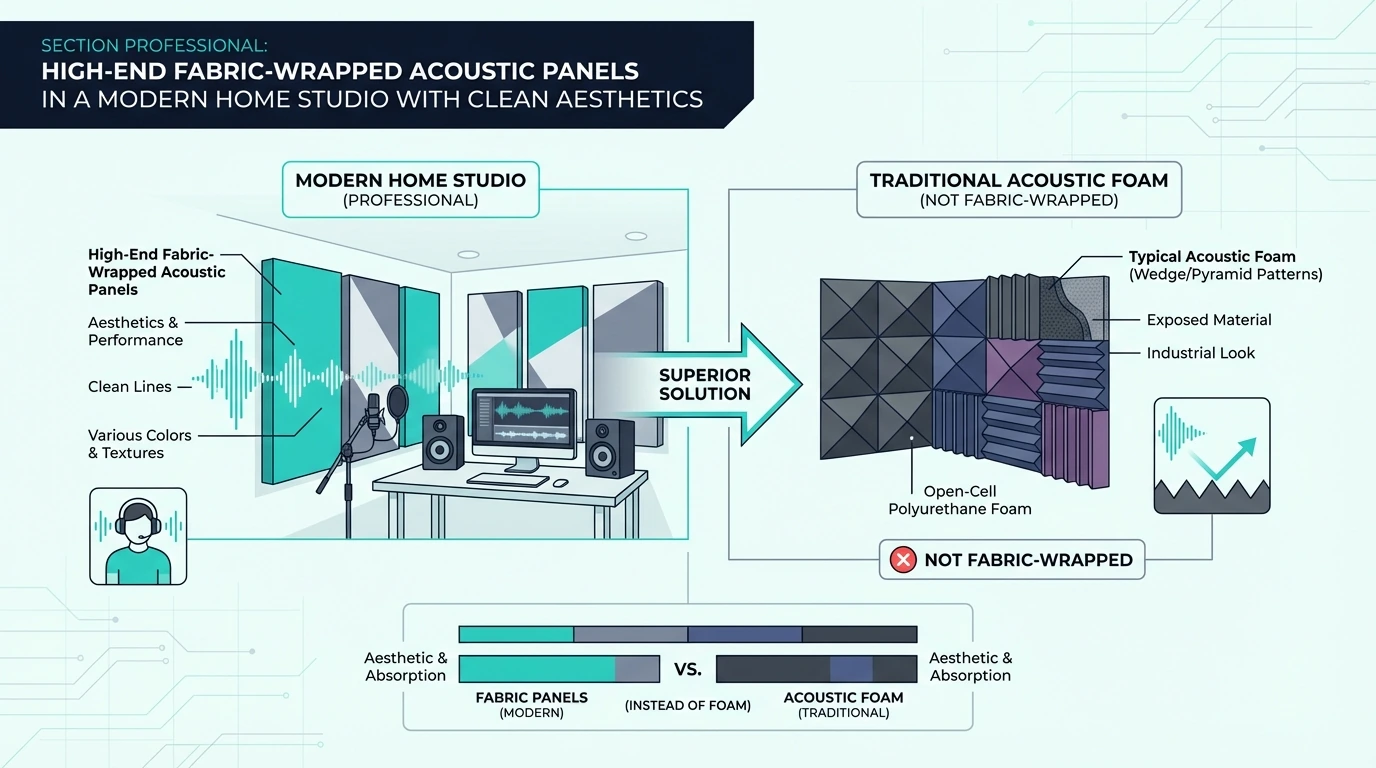
Insulation-based panels (DIY or commercial) provide better absorption, especially at lower frequencies, and look more professional. For voice recording, foam is often sufficient; for music production requiring accurate bass response, insulation panels are worth the extra effort or cost.

Is rockwool better than acoustic foam?

For absorption performance, yes. Rockwool absorbs more sound across a broader frequency range than equivalent thickness foam, and it’s more durable and fire-resistant.

The tradeoff is that rockwool requires containment (fabric wrapping) while foam can mount directly. For maximum performance, rockwool wins; for convenience, foam wins.

Can I soundproof a room with just insulation?

No. Insulation in wall cavities helps reduce sound transmission but isn’t sufficient alone.

Effective soundproofing requires mass (multiple drywall layers), decoupling (resilient channels or double-wall construction), and sealing (acoustic caulk at all gaps). Insulation is one component of a system, not a complete solution.

What’s the cheapest way to improve room acoustics?

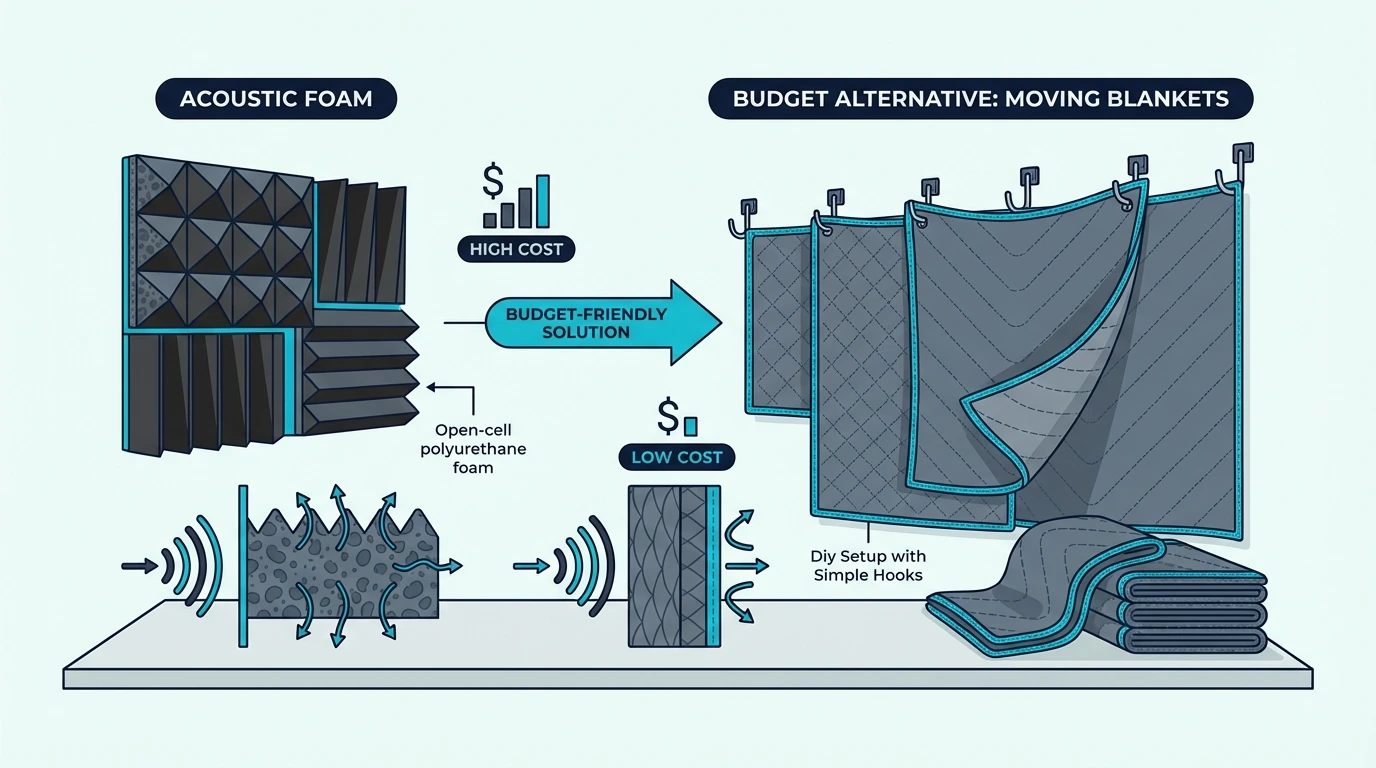
For echo reduction, DIY rockwool panels cost less than commercial options while performing better than foam. Heavy moving blankets are a fallback for very tight budgets.

For soundproofing, there’s no cheap shortcut — effective sound blocking requires serious investment in materials and construction.

Will Acoustic Foam Improve Recording? The Honest Answer

Will acoustic foam improve recording? Yes—in most untreated rooms. Foam absorbs room reflections that contaminate your recordings, producing cleaner audio that requires less post-processing.

But the improvement depends on your current situation. A room with hard walls and no treatment sees massive gains from foam.

A carpeted bedroom with curtains and furniture might only see modest improvement. Understanding what foam actually does helps you avoid wasting money on panels that won’t fix your problem.

Below you’ll find how foam improves recordings, when it helps most, and when to start with a different solution. For a deeper understanding of the science, see how acoustic foam works.

Quick Takeaway

Acoustic foam improves recording by reducing room reflections that reach your microphone, shortening reverb decay for tighter captures, eliminating flutter echo, and improving clarity so your voice sounds more present. The biggest improvements come from treating the wall behind your microphone and first reflection points on side walls. Foam won’t help with neighbor noise, outside traffic, or sound through walls—those require soundproofing, not acoustic treatment.

How Acoustic Foam Improves Recordings

Diagram Showing Sound Waves From Voice Hitting Microphone Directly Vs Bouncing Off Walls, With Foam Absorbing The Reflections

Understanding the mechanics helps you use foam effectively. The improvement isn’t magic—it’s physics.

The Reflection Problem

When you speak or play an instrument, sound radiates in all directions. Some travels directly to your microphone—this is the sound you want to capture.

But most of it hits walls, ceiling, and floor first.

These surfaces reflect sound back into the room. The reflections eventually reach your microphone too, arriving milliseconds after the direct sound.

Your recording captures both: the clean direct sound plus all the messy reflections.

The result sounds “roomy”—like you recorded in a bathroom or empty warehouse. The reflections add reverb, reduce clarity, and make your voice sound distant and unprofessional.

How Foam Solves This

Acoustic foam absorbs sound energy instead of reflecting it. When sound waves hit the foam’s porous surface, they enter the material and convert to tiny amounts of heat through friction.

With foam on your walls, reflections that would have bounced back to your microphone get absorbed instead. Your mic captures more direct sound and less room sound.

The recording sounds tighter, cleaner, and more professional.

The effect is immediate and obvious. Record yourself speaking in an untreated room, add foam, then record again.

The difference is stark—even to untrained ears. A starter pack like the Foamily 12-Pack Acoustic Wedge Panels is enough to test the difference at first reflection points. For product recommendations, see best acoustic foam for recording.

What Frequencies Foam Affects

Standard acoustic foam (1-2 inches thick) primarily absorbs mid and high frequencies—roughly 500 Hz and above. This range includes most vocal frequencies (85-255 Hz fundamental, but 1-4 kHz for clarity and presence) and the “presence” range that makes recordings sound clear.

Lower frequencies pass through thin foam largely unaffected. A 2-inch foam panel might absorb 80% of sound at 2000 Hz but only 15-25% at 250 Hz.

If your room has bass problems (boomy, muddy low end), standard foam won’t fix them. You’d need thicker bass traps (4+ inches) for low-frequency issues.

For vocal recording, podcasting, and most instrument recording, mid/high frequency absorption is exactly what you need. The frequencies foam handles are the ones that cause the most audible problems in recordings.

Before and After: Real Recording Differences

Split Waveform Comparison Showing Recording In Untreated Room (With Visible Reverb Tail) Vs Treated Room (Clean Cutoff)

The improvement from foam isn’t subtle. Here’s what actually changes in your recordings.

Reverb Reduction

Untreated rooms have long reverb tails—sound continues ringing for 500-800 milliseconds after you stop speaking in a typical bedroom with hard walls. This reverb overlaps with subsequent words, reducing intelligibility.

Foam shortens the reverb tail noticeably—often to 200-300 milliseconds or less. Sound dies quickly instead of bouncing around.

Each word or note stands distinct rather than blurring into the next.

In practical terms, this means your recordings sound “tighter.” There’s space between words.

Transients (the attack of sounds) come through clearly. The recording sounds controlled rather than chaotic.

Clarity Improvement

Room reflections create comb filtering—certain frequencies cancel out while others reinforce. This colors your recording unpredictably, making some frequencies 3-6 dB too loud and others 3-6 dB too quiet.

Foam reduces comb filtering by eliminating the reflections that cause it. Your recording captures a more accurate representation of your voice or instrument.

What you hear in the recording matches what you heard in the room.

For mixing and post-production, this clarity matters. Clean recordings are easier to process.

You spend less time fixing problems and more time enhancing what’s already good.

Presence and Proximity

Untreated recordings often sound distant—like the performer is far from the microphone even when they’re close. This happens because reflections dilute the direct sound.

Foam increases the ratio of direct sound to reflected sound. Your voice sounds closer, more present, more intimate.

This “in your face” quality is what separates professional recordings from amateur ones.

The improvement is especially noticeable for vocals and spoken word. Podcasts, voice-overs, and singing all benefit from the increased presence that foam provides.

When Foam Helps Most

Room Comparison Showing Hard-Surfaced Room (Maximum Benefit) Vs Already-Soft Room (Moderate Benefit)

Foam doesn’t help every situation equally. Some rooms see clear improvement; others see modest gains.

Hard-Surfaced Rooms

Rooms with hard walls, hard floors, and minimal soft furnishings benefit most from foam. These spaces have nothing absorbing sound—every surface reflects.

A spare bedroom with hardwood floors and bare drywall is a prime candidate. Add foam and the transformation is clear.

The room goes from echoey nightmare to usable recording space.

If your room sounds like a gymnasium when you clap, foam will help enormously.

Small Rooms

Small rooms accumulate reflections quickly because the walls are close together. Sound bounces back and forth rapidly, creating dense reverb and flutter echo.

Foam in small rooms provides outsized improvement because you’re treating a higher percentage of the reflective surface area. A few panels in a small room cover more of the problem than the same panels in a large room.

Bedroom studios, closet vocal booths, and small home offices all see clear improvement from modest foam treatment.

Untreated Spaces

If your room has zero acoustic treatment currently, foam provides the biggest improvement. Going from nothing to something is the largest jump in recording quality.

Rooms that already have carpet, curtains, upholstered furniture, and bookshelves have built-in absorption. Adding foam helps, but the improvement is incremental rather than transformative.

Do the clap test: if your room rings when you clap, foam will help. If the clap sounds relatively dead already, you may not need much additional treatment.

When Foam Helps Less

Room Showing Existing Soft Furnishings And Carpet That Already Provide Absorption

Foam isn’t always the answer. Some situations call for different solutions.

Already-Soft Rooms

Bedrooms with carpet, heavy curtains, upholstered furniture, and closets full of clothes already have plenty of absorption. The soft materials do what foam does—absorb reflections.

Adding foam to these rooms helps, but the improvement may be subtle. You might not notice much difference because the existing materials already handle most reflections.

Test before buying: record in your room as-is. If the recording sounds reasonably clean, you may not need foam.

Or you may need only minimal treatment at first reflection points. The guide on whether acoustic foam works can help you assess your situation.

Bass Problems

If your recordings sound boomy or muddy in the low frequencies, standard foam won’t help. Thin foam panels don’t absorb bass—the wavelengths are too long.

Bass problems require bass traps: thick, dense absorbers placed in corners where low frequencies accumulate. These are different products from standard wall panels.

Don’t keep adding foam hoping to fix bass issues. It won’t work.

Identify whether your problem is mid/high frequency reflections (foam helps) or low frequency buildup (bass traps help).

For more on this distinction, see bass traps vs acoustic foam.

Noise From Outside

Foam absorbs sound inside your room. It doesn’t block sound from entering or leaving.

If your problem is traffic noise, neighbor noise, or HVAC rumble, foam won’t help.

Blocking external noise requires soundproofing: adding mass to walls, sealing gaps, and sometimes construction work. This is completely different from acoustic treatment.

Many people buy foam hoping to block outside noise, then feel disappointed when it doesn’t work. Understand the distinction: foam treats acoustics inside; soundproofing blocks transmission between spaces.

For more on this common confusion, see whether acoustic foam works.

How Much Improvement to Expect

Chart Showing Improvement Levels From No Treatment To Full Treatment With Diminishing Returns Illustrated

Setting realistic expectations prevents disappointment. Here’s what different levels of treatment typically achieve.

Minimal Treatment (4-6 Panels)

Treating just first reflection points—two panels on each side wall at ear height—provides surprising improvement. This minimal setup (roughly 4-6 square feet of coverage) addresses the most problematic reflections.

Expect: noticeably cleaner recordings with 20-30% reduction in audible room sound, reduced flutter echo, improved clarity. The room still has some reverb, but the worst problems are solved.

This level works well for: podcasting, video calls, casual music recording, voice-overs for personal projects.

Moderate Treatment (12-20 Panels)

Adding treatment behind your microphone, on the ceiling above you, and expanding side wall coverage creates a more controlled recording environment. This typically covers 15-25 square feet—about 20-30% of a small room’s wall area.

Expect: noticeably cleaner recordings approaching semi-professional quality. Reverb time drops by 40-50%.

Clarity is good. Post-processing requirements are minimal.

This level works well for: serious home recording, YouTube content creation, podcast production, demo recordings.

Full Treatment (30+ Panels)

Full room treatment with panels on all walls, ceiling clouds, and corner bass traps creates a professional-grade recording environment. Coverage reaches 40-60% of available wall and ceiling space.

Expect: very clean, dry recordings with minimal room sound. RT60 (reverb time) under 0.3 seconds.

Professional quality achievable with good technique and equipment.

This level works well for: professional voice-over, commercial music production, broadcast-quality content.

Diminishing Returns

Each additional panel provides less improvement than the previous one. The jump from 0 to 6 panels is huge.

The jump from 20 to 30 panels is modest. The jump from 50 to 60 panels is barely noticeable.

Don’t over-treat. Find the level that solves your problems and stop there.

More foam beyond that point wastes money and can make your room sound unnaturally dead. For guidance on the right coverage level, see whether you can put too much acoustic foam.

Best Foam Placement for Recording

Room Diagram Showing Optimal Foam Placement For Recording With Numbered Priority Positions

Where you put foam matters more than how much you buy. Strategic placement maximizes improvement.

Priority 1: Behind the Microphone

The wall your microphone faces (behind you when recording) is the highest priority. Sound from your voice travels past the mic, hits this wall, and reflects back into the mic.

Treat this wall with 50-70% coverage at head height. This single treatment often provides more improvement than panels anywhere else.

Priority 2: First Reflection Points

Side walls at ear/mic height create first reflections that arrive at your microphone milliseconds after direct sound. These cause comb filtering and reduce clarity.

Use the mirror trick to find exact positions, then place 1-2 panels at each first reflection point. This targeted treatment is highly effective.

For thicker coverage at these spots, the TroyStudio 2-inch Self-Adhesive Panels handle the voice range better than 1-inch alternatives. For arrangement strategies, see how to arrange acoustic foam.

Priority 3: Ceiling Above Recording Position

If your ceiling is hard (drywall, plaster), it reflects sound down to your microphone. A ceiling “cloud” of 2-4 panels above your recording position addresses this.

Ceiling treatment is often overlooked but provides real improvement, especially in rooms with low, hard ceilings.

Priority 4: Corners (If Bass Is Problematic)

If your recordings sound boomy, add bass traps to corners—especially the corners behind your recording position. Standard foam won’t help here; you need thick corner absorbers.

A set like the Dekiru 8 Pack Acoustic Bass Traps can handle the corners at a low cost. For detailed placement guidance, see how to arrange acoustic foam.

Foam vs Other Recording Improvements

Comparison Showing Foam Treatment Vs Microphone Upgrade Vs Room Change, With Relative Improvement Indicators

Foam is one of several ways to improve recording quality. How does it compare?

Foam vs Better Microphone

A common question: should I buy foam or upgrade my microphone? The answer depends on your current situation.

If your room is untreated and echoey, foam provides more improvement than a microphone upgrade. Even an expensive mic sounds bad in a bad room—it just captures the room problems more accurately.

If your room is already reasonably controlled, a better microphone might be the next step. But for most home recordists, room treatment should come before microphone upgrades.

Foam vs Recording Technique

Microphone technique—distance, angle, position—affects recording quality more than most people expect. Good technique in an untreated room beats bad technique in a treated room.

But technique and treatment work together. Foam gives you more flexibility with technique because the room is more forgiving.

You can move around without noticeable changes in sound quality.

Learn good technique AND treat your room. They’re complementary, not competing improvements.

Foam vs Post-Processing

Modern software can reduce reverb and room sound in post-production. Why not just fix it later instead of treating the room?

Post-processing has limits. Heavy de-reverb processing creates artifacts and degrades audio quality.

It’s better to capture clean audio than to fix dirty audio later.

Foam reduces the need for post-processing, saving time and preserving audio quality. The cleaner your capture, the better your final product.

The Bottom Line

Acoustic foam improves recording quality by absorbing reflections that contaminate your microphone captures. The improvement ranges from dramatic (in hard, untreated rooms) to modest (in already-soft spaces), but some improvement is almost guaranteed.

Start with minimal treatment at high-impact positions: behind your microphone and at first reflection points. This strategic approach provides maximum improvement with minimum investment.

Add more treatment only if problems persist after testing.

Foam won’t fix everything. Bass problems need bass traps. External noise needs soundproofing.

But for the mid and high frequency reflections that cause most recording problems, acoustic foam is effective and affordable.

The difference between amateur and professional-sounding recordings often comes down to room acoustics. Foam is the most accessible way to improve yours.

For recording-specific product picks, see best acoustic foam for recording.

For more guides on foam types, placement, and mounting, start at the acoustic foam hub.

Frequently Asked Questions

How much does acoustic foam improve recording quality?

The improvement depends on your starting point. Untreated rooms with hard surfaces see the biggest gains—recordings go from obviously amateur to reasonably professional.

Rooms with existing soft furnishings see more modest improvement. In most cases, properly placed foam makes recordings noticeably cleaner and more professional-sounding.

Where should I put acoustic foam for recording?

Prioritize the wall behind your microphone (the wall you face while recording), then first reflection points on side walls at ear height. A ceiling panel above your recording position helps too.

Start with these locations before adding general wall coverage.

Will cheap acoustic foam work for recording?

Budget foam provides real improvement over no treatment. The absorption may be less consistent than premium options, and durability is typically lower, but cheap foam still absorbs reflections.

For beginners testing whether treatment helps, budget foam is a reasonable starting point.

How many acoustic foam panels do I need for recording?

Most home recording setups need 8-16 panels for effective treatment. Start with 4-6 panels at priority positions (behind mic, first reflections) and add more based on results.

Strategic placement of fewer panels outperforms random placement of many panels.

Does acoustic foam help with vocal recording specifically?

Yes—vocals benefit heavily from foam treatment. Human voice frequencies fall squarely in the range that standard foam absorbs effectively.

Foam reduces the “roomy” quality that makes vocal recordings sound amateur, increases presence and clarity, and produces tighter results.

Can acoustic foam make recordings sound too dead?

Yes, over-treatment is possible. Too much foam creates an unnaturally dead sound that feels uncomfortable and makes recordings sound lifeless.

Aim for 20-30% wall coverage at strategic positions rather than covering everything. If your room sounds muffled after treatment, remove some panels.

Why Is Acoustic Foam Shaped? Wedges, Pyramids & What Actually Matters

Why is acoustic foam shaped into wedges, pyramids, and “egg crate” bumps? The angles help reduce reflections, but shape alone won’t fix a bad room.

If your room still sounds echoey or harsh after installing foam, the problem usually isn’t the wrong shape — it’s the wrong thickness or density. Shape is only about 10–15% of the equation, yet it’s the first thing most sellers pitch.

Once you understand what shape actually changes, you can stop overpaying for patterns and start treating the wall behind your mic where it counts. Below you’ll find what each shape does, when it matters, and when thickness wins instead.

Quick Takeaway

Shape helps a bit by adding surface area and breaking up the straight “bounce-back” path, but the audible gains are small compared to open-cell structure and thickness. Surface area gives a minor efficiency boost, angles help reduce flutter echo between parallel walls, and tapered tips let high frequencies enter more easily. Pick the shape you like after the specs check out (open-cell + enough thickness for your use). If you’re trying to stop noise through walls, foam isn’t the tool—start with acoustic foam alternatives instead.

Why is acoustic foam shaped (what the shapes actually do)?

Diagram of sound waves interacting with shaped vs flat acoustic foam

There are three real effects to know, and none of them are magic. Once you understand them, you’ll stop paying extra for a pattern name.

Does shape increase surface area (and does that matter)?

Yes—wedges and pyramids expose more foam surface than a flat tile of the same footprint. That gives sound a little more material to rub against on each pass, so absorption can improve slightly at the top end.

The catch is that surface area can’t compensate for bad foam. A denser flat panel can outperform a flimsy pyramid because the sound has to enter the foam to be absorbed in the first place.

Do wedges and pyramids scatter reflections?

Angles break up the most annoying reflection: the one that shoots straight back from a flat wall into your mic or ears. In rooms with parallel hard walls, that scattering can reduce the “ping” you hear when you clap.

That’s why shaped foam can feel like it helps flutter echo with modest coverage. Placement still matters more than pattern—start with this acoustic foam placement guide and treat the reflection path, not the whole room.

Does the shape help sound enter the foam?

Thin tips (the points of pyramids or the edge of a wedge) are a gentler transition from air to foam than a blunt flat face. That can let a bit more high-frequency energy enter the foam instead of reflecting off the surface.

Don’t overthink the term “impedance matching”—it’s just “less bounce at the surface.” If you want the bigger wins, match thickness to the problem frequencies (start here: acoustic foam frequency absorption).

What are the common acoustic foam shapes (and what should you use each for)?

Wedge, pyramid, egg crate, and flat foam shapes side by side

Most shapes are variations on the same idea: change the surface a little, then let the foam do the absorbing. Here’s how each one tends to behave in real rooms.

Wedge foam

Wedge foam is the classic “studio look” for a reason: it’s widely available, affordable, and it breaks up reflections in one dominant direction. It’s a solid choice when you’re treating a wall behind a mic or behind speakers and you want predictable coverage.

If you want to cover a full wall without playing panel Tetris, a big pack like Allxinlog 96-pack wedge foam tiles can be a practical starter. Just measure first—foam works best when you treat the right zone, not when you cover everything randomly.

Pyramid foam

Pyramids add more surface area and scatter in more directions than wedges, so on paper they can test a bit better. In real rooms, the audible difference is usually subtle unless you’re comparing two panels with identical material and thickness.

If you like the pyramid look, buy it for aesthetics and minor efficiency gains—not because you expect it to “fix” a room on its own.

Egg crate foam

The egg-crate pattern can work, but this category has a quality problem: a lot of “egg crate” foam is low-density junk marketed as soundproofing. If it feels rubbery or closed-cell, it will reflect sound no matter how cool the bumps look.

If you do find open-cell egg-crate foam with real thickness, treat it like any other foam. The material quality matters more than the pattern.

Flat / smooth foam panels

Flat foam doesn’t scatter much, but it can still absorb reflections when the foam is open-cell and thick enough. Flat panels also look cleaner on camera, which matters if you’re building a podcast or YouTube background.

If your room is already echoey, don’t pick flat just for looks—pair it with good placement so it’s doing real work.

How much does foam shape actually matter?

Comparison chart of absorption between foam shapes

Here’s the honest answer: shape is the last 10–15% of the decision. Material quality and thickness are the first 85–90%.

Does material quality beat shape?

Two-inch open-cell foam usually beats one-inch foam, regardless of wedges vs pyramids, because there’s simply more depth for sound to lose energy inside the material. Density and open-cell structure determine whether sound can enter the foam and get “spent” as heat.

This is why a cheap pyramid tile can disappoint: it looks aggressive, but it doesn’t have the material properties to do the job. If you want a baseline reality check, read the honest guide on whether acoustic foam works.

What do measurements say about shape differences?

When labs compare shapes made from the same foam, pyramids usually test a little better than flat, and wedges land somewhere in between. Think single-digit to low-teens percentage differences, not a night-and-day jump.

That’s real, but it’s not worth paying a premium if you could instead buy thicker foam or treat a larger reflection zone. Coverage and placement scale better than chasing a pattern.

When does shape help (and when doesn’t it)?

Shape helps most when your room is hard and parallel and you’re hearing flutter echo. Shape matters least when you’re already using thick treatment, or when foam quality varies wildly between products.

If you’re on the fence, buy the better foam first and treat the right spots, then decide if you want the pyramid look. You’ll get more predictable results that way.

Is acoustic foam shape mostly marketing?

Different foam shapes marketed as acoustic treatment

This is where people get burned: the most “professional looking” foam isn’t always the most effective. Shape is easy to sell because you can see it, even when you can’t see density or cell structure.

Why do companies push wedges and pyramids so hard?

Shaped foam signals “studio” at a glance, which is why it shows up in thumbnails and product photos. Flat foam can look like packaging material, even if it performs similarly when thickness and quality are the same.

That “looks like treatment” effect is real marketing value, which is why shapes get emphasized. Your job is to separate the look from the performance.

What specs should you check instead?

If you only check three things, check these: open-cell structure, thickness, and a real absorption rating (NRC) from a reputable brand. Shape comes after that, not before.

If NRC is new to you, start with this foam buying guide and treat it like a sanity filter. It won’t tell you everything, but it prevents the worst “soundproof foam” mistakes.

Does foam shape affect bass, or only high frequencies?

Frequency absorption curves comparing foam shapes

Shape interacts with sound only when the wave is short enough to “notice” the surface contours. That’s why shapes show up mostly in the highs, not the lows.

High frequencies (where rooms sound harsh)

High frequencies have short wavelengths, so angles and extra surface area can change how they bounce and get absorbed. That’s why shaped foam can help with the sharp “ping” in a bare room faster than you’d expect.

If your main complaint is harshness or flutter, this is where wedge and pyramid patterns tend to earn their keep. It’s not magic, but it’s a real improvement when placed correctly.

Mid frequencies (where most voices live)

In the mids, thickness and coverage dominate. A solid 2-inch panel usually does more for vocal clarity than swapping wedge for pyramid.

A 2-inch pack like JBER 24-pack 2-inch foam panels is a good example of the thickness that starts to feel “forgiving” on voice recordings. Don’t buy it for bass—buy it to tame early reflections.

If you want the deeper breakdown, use the acoustic foam frequency absorption guide. It’ll help you match thickness to the problem you’re actually hearing.

Low frequencies (bass)

Bass waves are long—at 100 Hz, the wavelength is around 11 feet—so inch-sized surface patterns don’t change much. To affect bass, you need depth (4 inches+) and corner placement, which is why dedicated traps beat “cooler foam shapes” every time.

That’s also why the 1-inch vs 2-inch question matters, and why foam is not soundproofing. For the full “foam vs real bass control” distinction, read bass traps vs acoustic foam.

Which foam shape should you choose for your room?

Room setup showing where different foam shapes are typically used

If you’re still stuck, pick based on your room constraint, not the pattern name. These are the choices that tend to work in real setups.

If you’re recording vocals or podcasting

Start with the wall behind the mic (or behind you, depending on the reflection path) and treat first reflection points. Wedge or pyramid foam both work here as long as the foam is open-cell and thick enough.

If you want a practical starting map, follow this placement guide and treat in stages. It keeps you from buying a second box of foam when the real issue is the wrong wall.

If you care about how it looks on camera

Flat panels usually look cleaner and light more evenly, which matters for YouTube and streaming backgrounds. You’ll get similar absorption to shaped foam if thickness and material are comparable.

If the room still sounds harsh, mix in wedge or pyramid foam off-camera at the main reflection points. You can keep the “clean look” and still control the reflections that matter.

If you’re treating corners and edges (but don’t expect miracles)

Corner blocks can help tidy up reflections in awkward spots and smooth out flutter where two walls meet. A set like these wedge corner blocks is a reasonable add-on after you’ve treated the main reflection zones.

Just keep expectations realistic: small foam corner pieces aren’t the same as a thick bass trap. If bass is your problem, put your budget into real corner traps, not more shapes.

If you’re on a tight budget

Buy fewer, better panels and place them well before you buy a mountain of cheap foam. Coverage in the right zone beats blanket coverage in the wrong zone.

If you’re new and want a curated starting point, use the beginner foam guide and treat one wall first. You can always add more once you hear what changed.

The Bottom Line

Acoustic foam is shaped because angles add surface area and break up the straight reflection path that makes rooms sound harsh. But shape is not the main performance driver—material quality and thickness are.

Pick the foam that meets the spec basics, then choose the shape you like and place it where reflections actually hit. And if you’re trying to solve bass or neighbor noise, you’ll get more progress from the right kind of treatment than from any surface pattern.

If you want to understand the material side of the equation, read the acoustic foam materials guide. It’s the fastest way to avoid buying foam that looks right but behaves like packaging.

For more guides on foam types, placement, and mounting, start at the acoustic foam hub.

Frequently Asked Questions

Do wedges or pyramids work better?

Pyramids usually test slightly better than wedges when the foam is identical, because they add more surface area and scatter in more directions. In real rooms, the difference is subtle—choose based on looks and price once the material quality is comparable.

Is egg crate foam effective?

It can be, but the pattern has a quality problem: many egg-crate products are low-density foam marketed as “soundproofing.” If the foam is open-cell and thick enough, the pattern can work, but don’t assume bumps equal performance.

Why do some studios use flat panels?

Flat foam can absorb reflections when it’s the same material and thickness as shaped foam. Many studios also use fabric-wrapped fiberglass or mineral wool panels, which outperform foam regardless of shape.

Does shape affect bass absorption?

Not much—bass waves are too long for inch-sized surface contours to matter. Bass control comes from thickness and corner placement, which is why dedicated bass traps beat more foam.

Can I mix different foam shapes in one room?

Yes, and mixing shapes won’t hurt acoustically. Treat reflection points first, then fill in secondary spots if you still hear flutter.

Why is shaped foam more expensive than flat?

Molds and manufacturing are more complex for shaped foam, and the pattern uses a bit more material. The performance gain is usually modest, so only pay extra if you prefer the look or you’re optimizing a small treated area.

What Is Acoustic Foam Made Of? Materials, Chemistry & Manufacturing

Acoustic foam looks simple, but its effectiveness depends on specific materials and how they’re manufactured—because the open-cell structure that absorbs reflections in a room is the direct result of chemistry, not just shape.

That’s usually the cause of confusion when comparing products: two panels can look identical yet perform very differently based on density, cell structure, and fire treatment.

You’ll find the materials, chemistry, and manufacturing behind acoustic foam below. Start with polyurethane (the most common base), then see how melamine and polyester compare.

Quick Takeaway

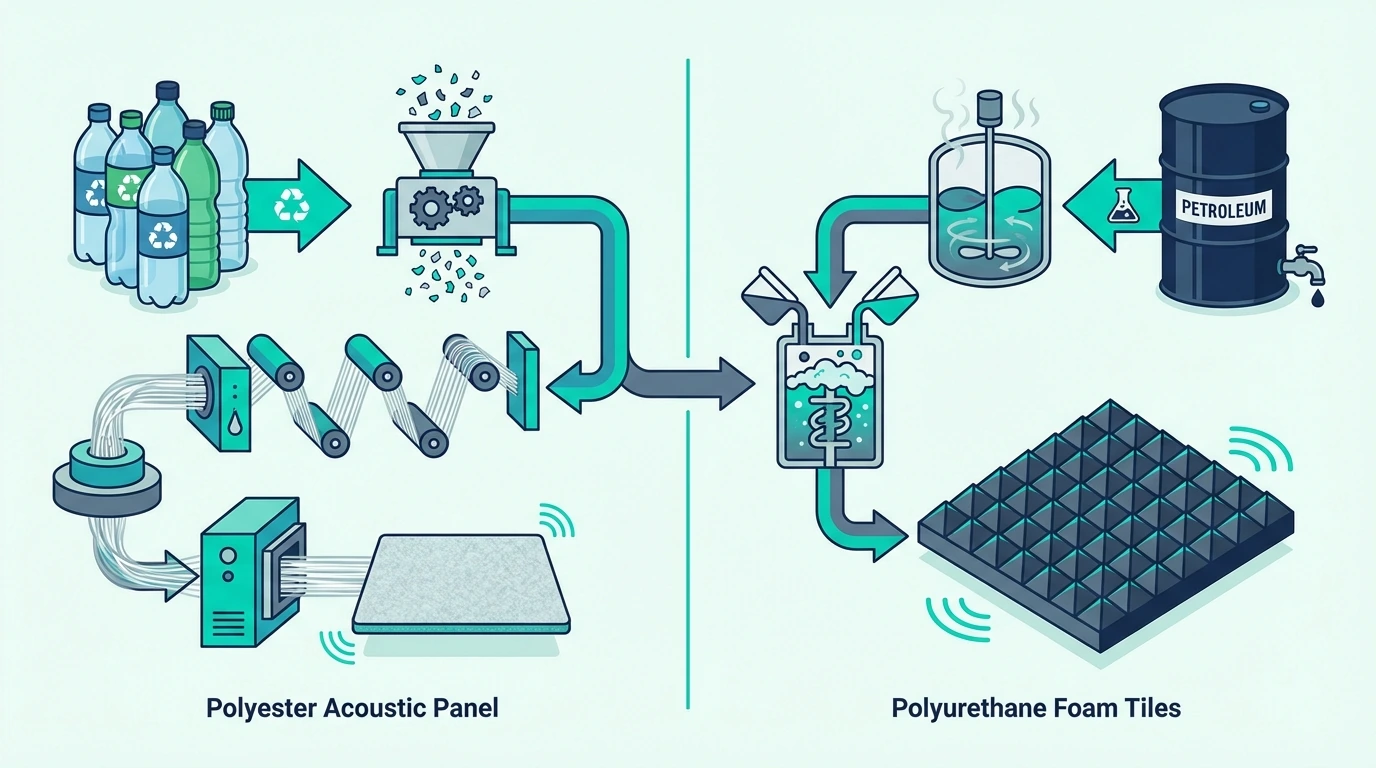
Primary materials:Polyurethane foam (most common) – Polymer created from polyols and diisocyanates – Melamine foam (premium) – Melamine-formaldehyde resin – Polyester fiber (alternative) – PET plastic fibers, often recycled

Key properties that make foam “acoustic”: – Open-cell structure (allows sound penetration) – Specific density (1.5-2.5 lb/ft³) – Fire retardant treatment – Consistent cell size and distribution

What Is Polyurethane Foam and Why Is It the Standard?

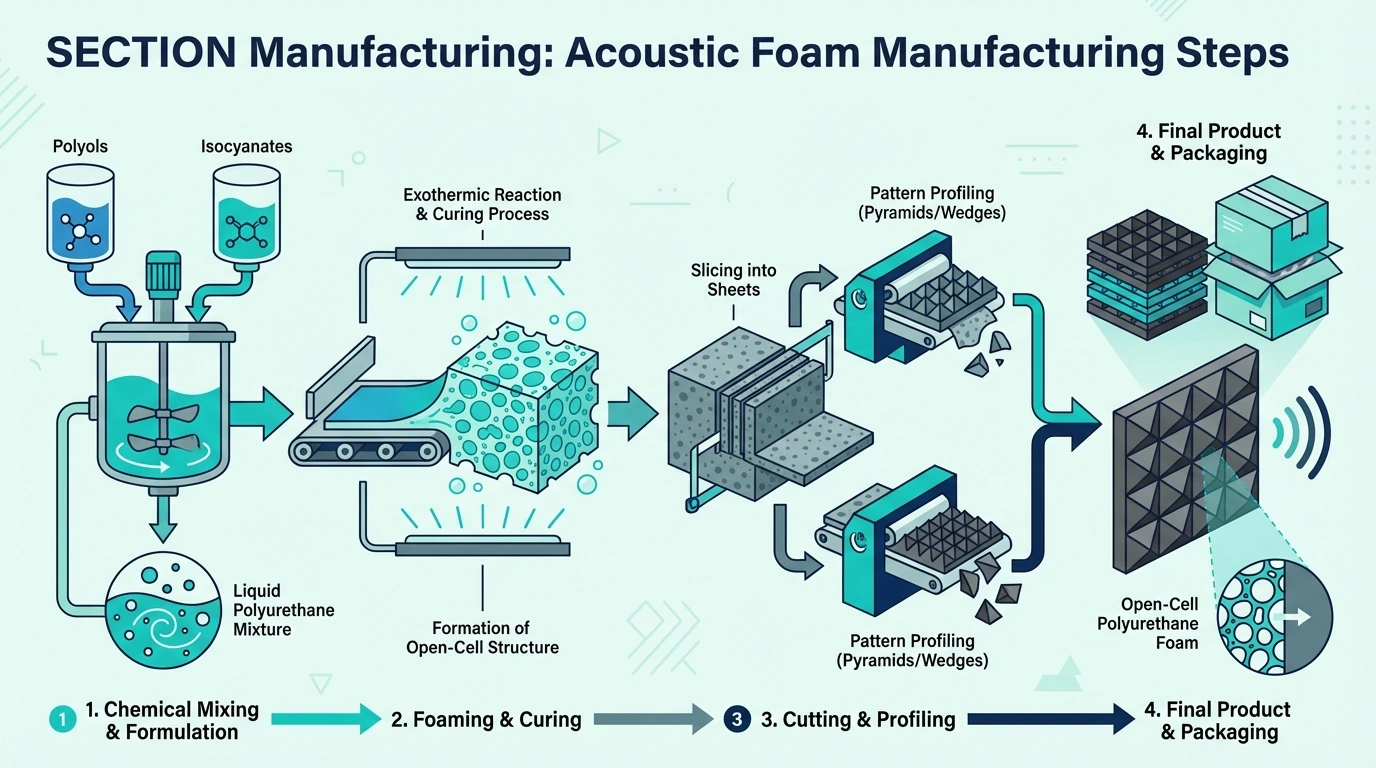
Polyurethane foam structure and manufacturing process

Most acoustic foam is polyurethane-based.

Chemical Composition

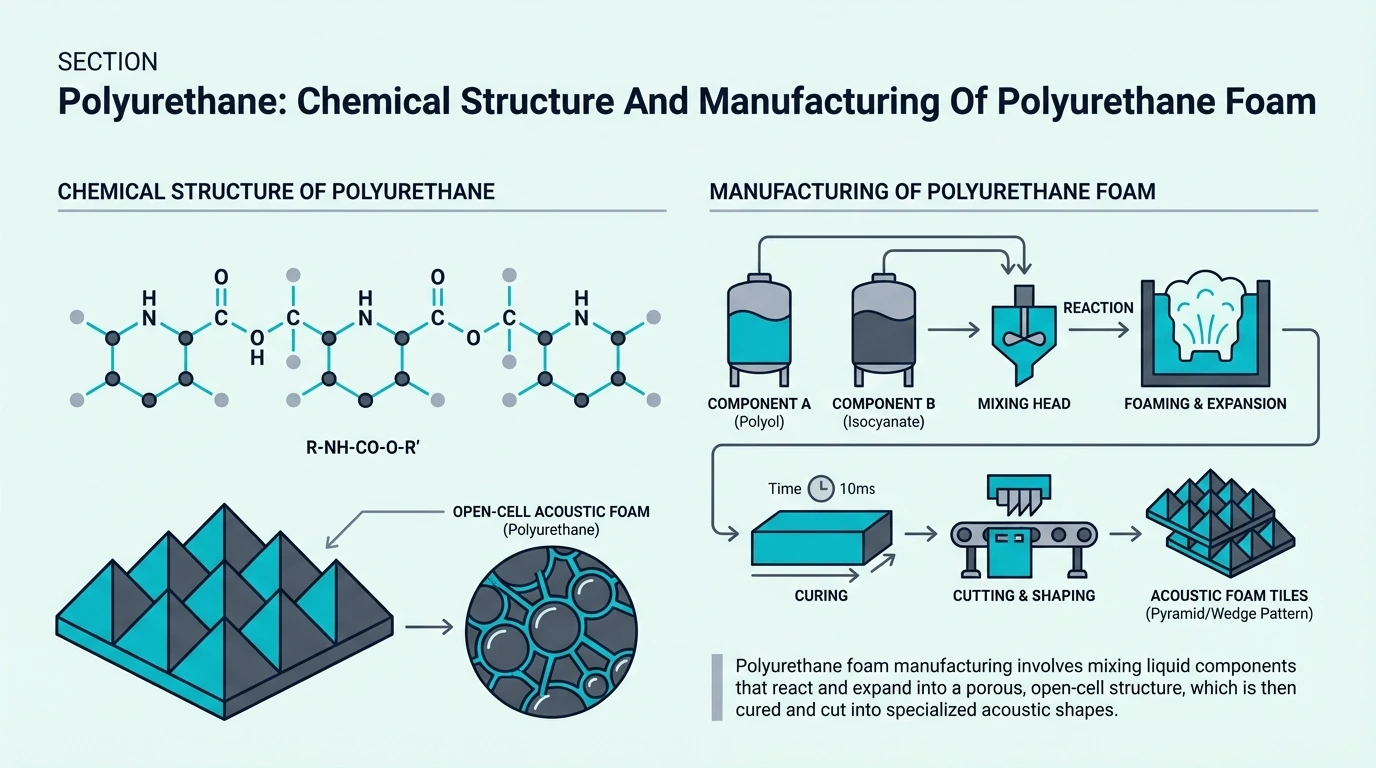
Polyurethane foam is created through a chemical reaction: – Polyols (alcohols with multiple hydroxyl groups) – Diisocyanates (reactive compounds) – Catalysts (control reaction speed) – Surfactants (control cell formation) – Blowing agents (create cellular structure)

When mixed, these components react exothermically, creating a polymer matrix with gas bubbles trapped inside—the cellular structure that defines foam.

Creating Open-Cell Structure

For acoustic foam, the manufacturing process is controlled to create open cells: – Cell walls partially rupture during foaming – Cells interconnect, allowing air passage – Controlled reaction speed affects cell size – Surfactants influence cell wall thickness

This open-cell structure is what allows sound to penetrate and be absorbed.

For more on cell structure importance, see acoustic foam open cell vs closed cell.

Density Control

Foam density is controlled by: – Ratio of components – Amount of blowing agent – Reaction conditions – Post-processing

Acoustic foam targets 1.5-2.5 lb/ft³—dense enough for effective absorption, light enough for practical use.

Fire Retardant Addition

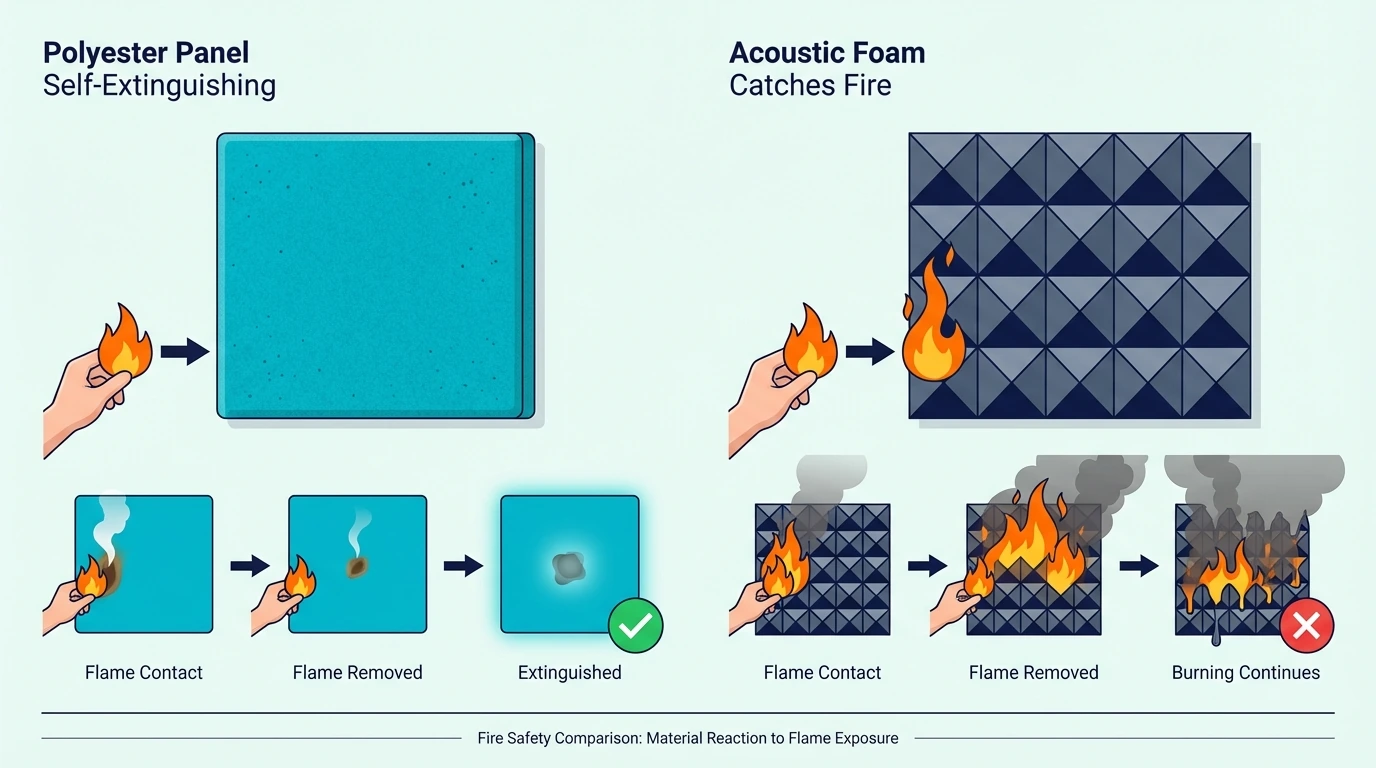
Polyurethane is inherently flammable. Fire retardants are added: – During manufacturing (mixed into formula) – After manufacturing (surface treatment) – Common retardants: phosphorus compounds, halogenated compounds, mineral fillers

Quality acoustic foam achieves Class A or B fire rating through these treatments.

For safety information, see whether acoustic foam is dangerous.

What Is Melamine Foam and Why Is It Premium?

Melamine acoustic foam structure and material properties

Melamine foam offers superior performance.

What Is Melamine?

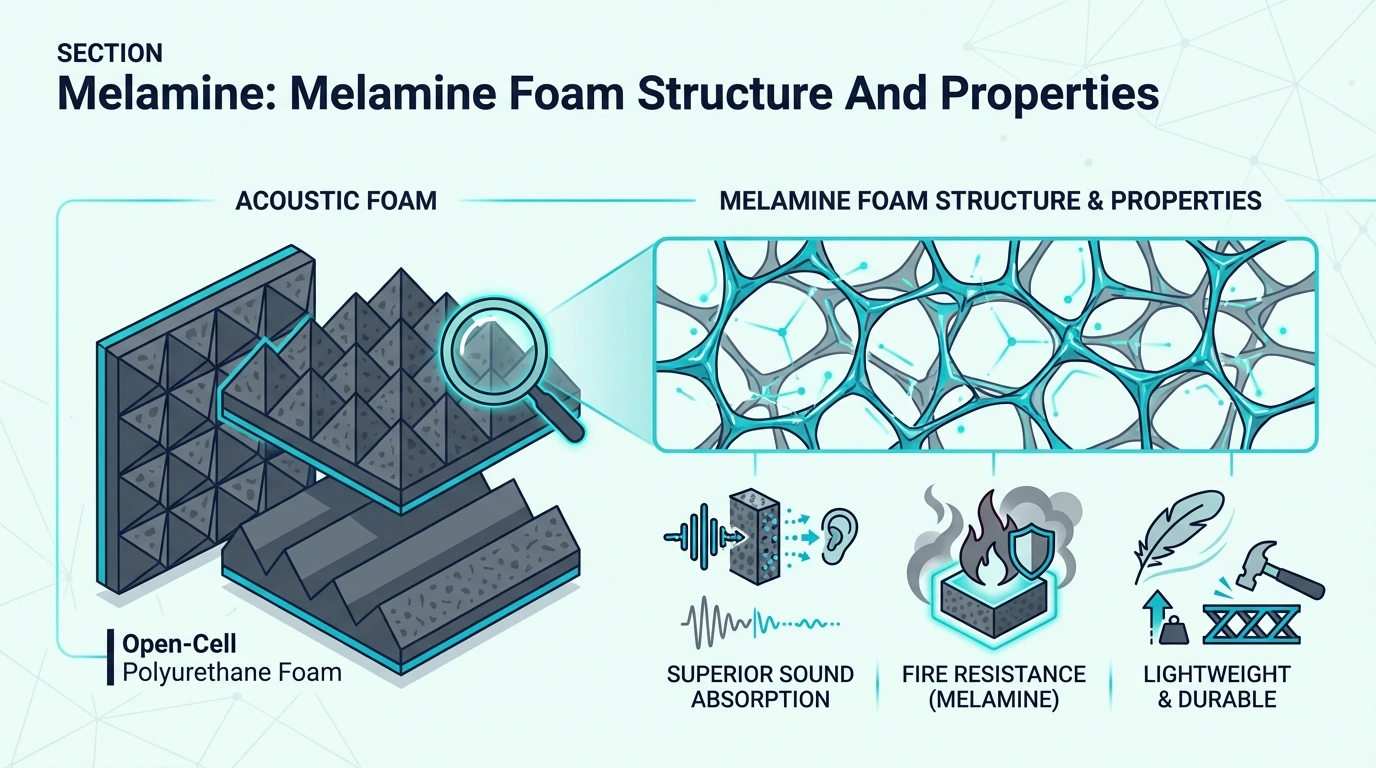
Melamine foam is made from melamine-formaldehyde resin: – Melamine: organic compound (C₃H₆N₆) – Formaldehyde: reactive aldehyde – Combined to form thermoset polymer

The resulting foam has extremely fine, open cells—finer than polyurethane.

Manufacturing Process

Melamine foam production: 1. Melamine and formaldehyde react to form resin 2. Resin is foamed using gas injection 3. Foam is cured at high temperature 4. Result: rigid, fine-celled foam structure

Why Melamine Performs Better

Melamine’s advantages come from its structure: – Finer cells: More surface area for absorption – Inherent fire resistance: No chemical treatment needed – Rigidity: Maintains shape better than polyurethane – Durability: Longer lifespan

Trade-offs

Melamine costs more due to: – More expensive raw materials – More complex manufacturing – Lower production volumes – Premium market positioning

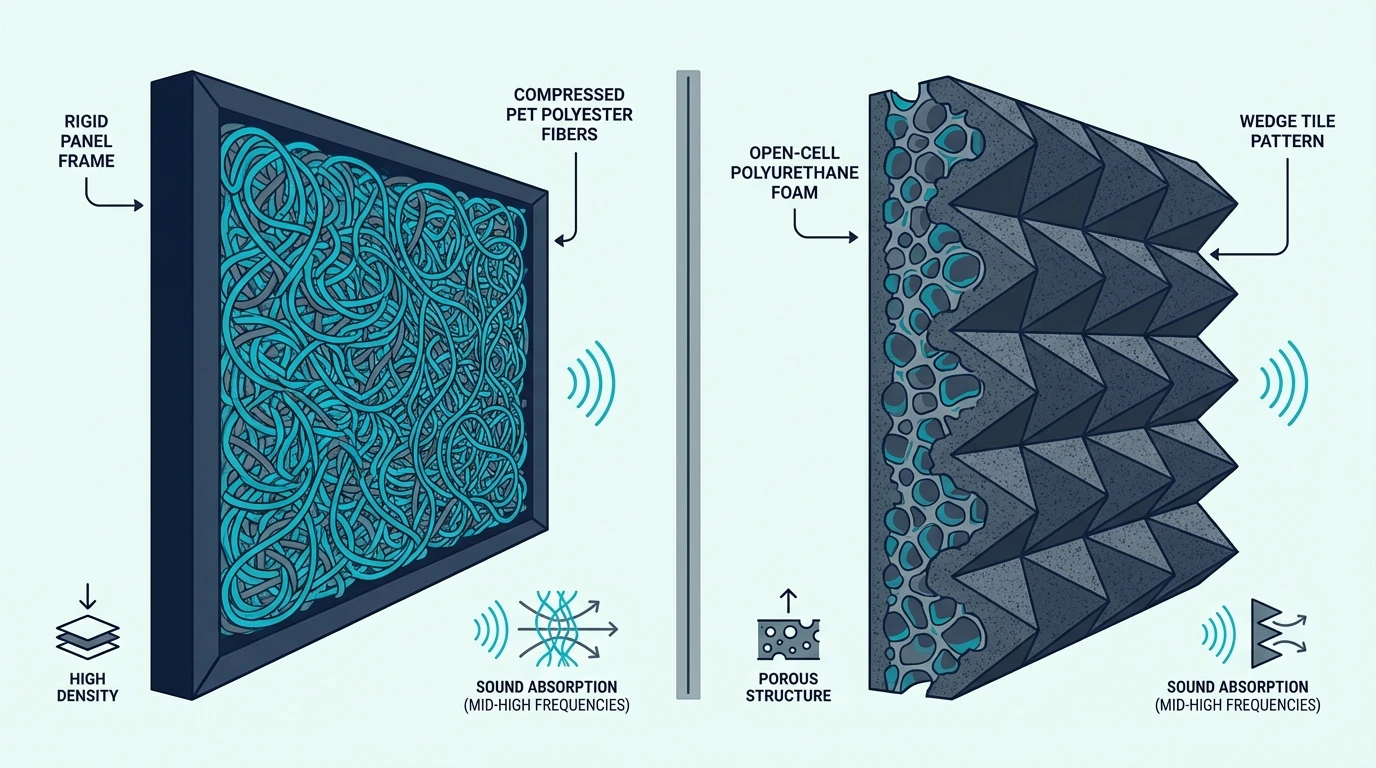
Can Polyester Be Used as Acoustic Material?

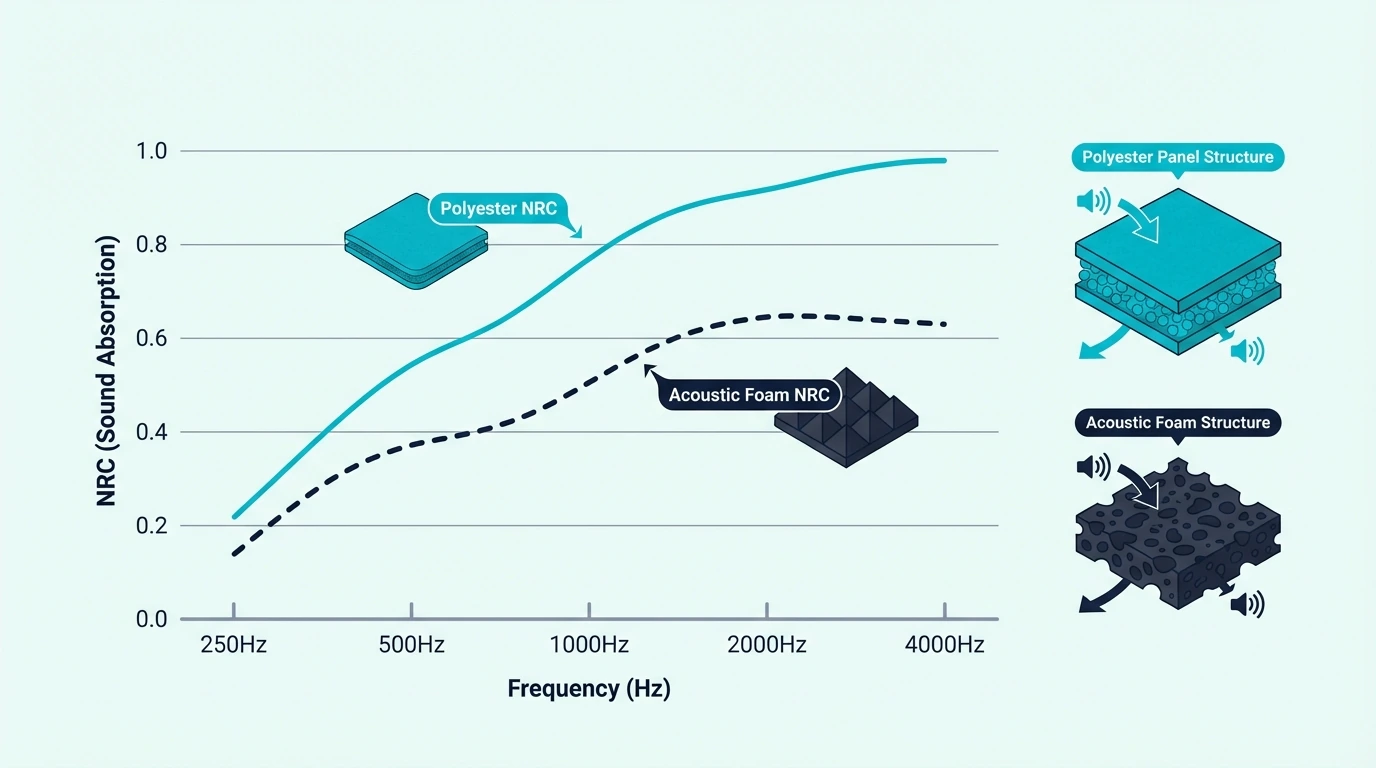
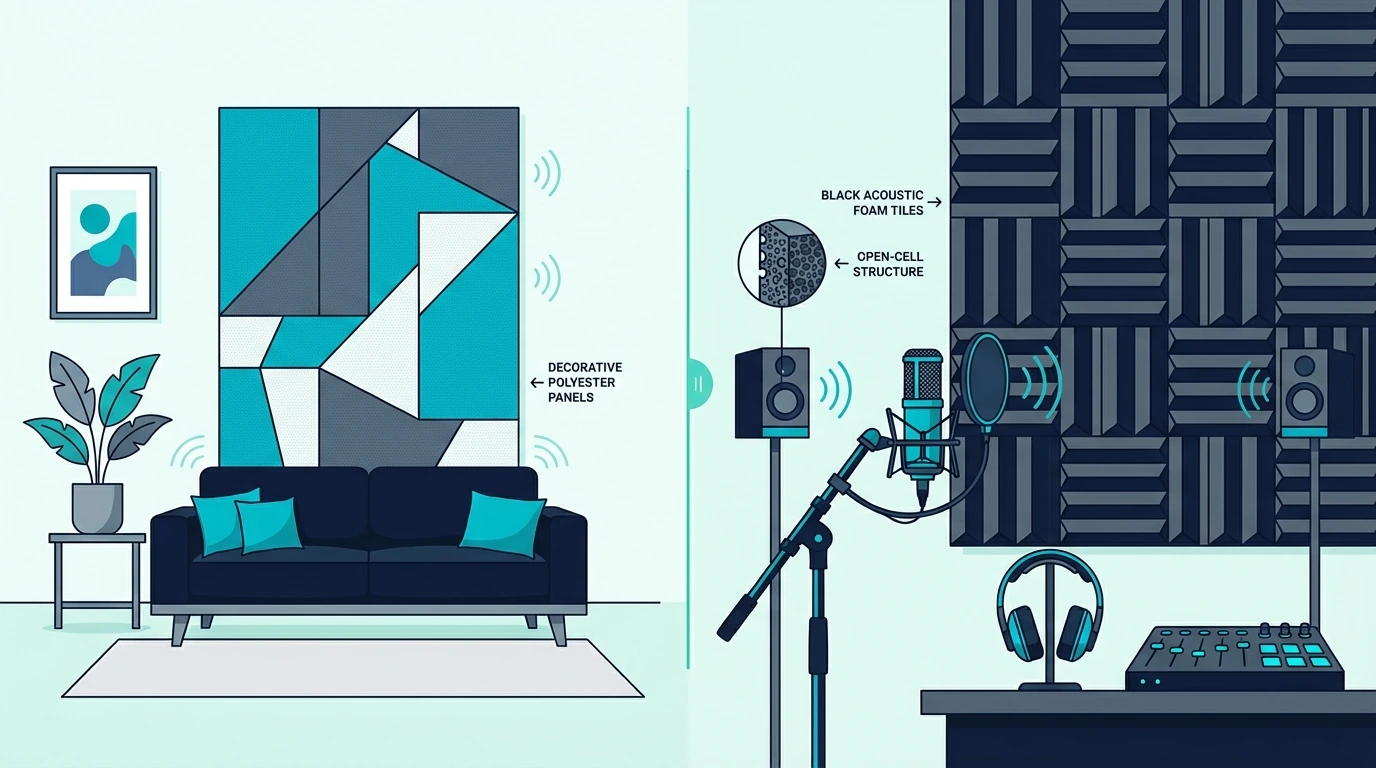
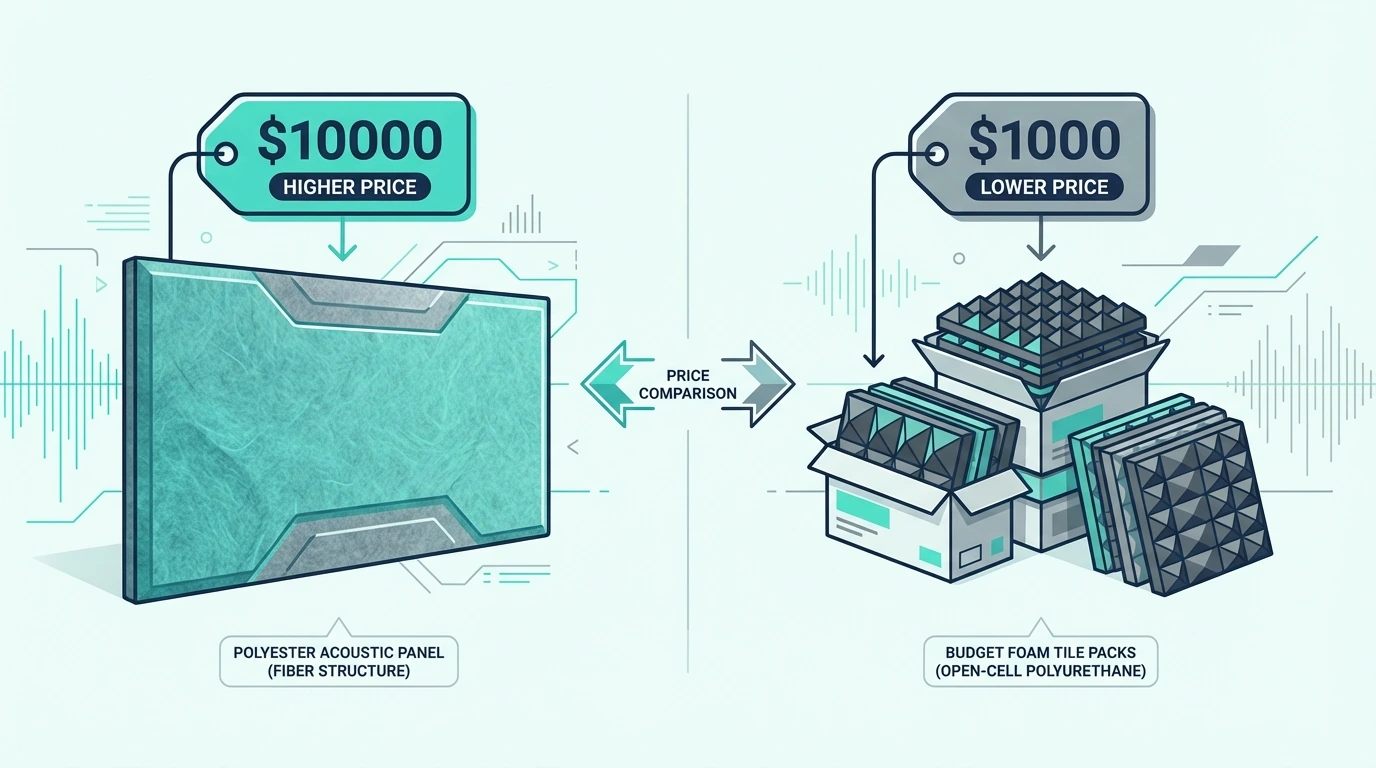
Polyester fiber acoustic panels as a foam alternative

Polyester panels are an alternative to foam.

Material Composition

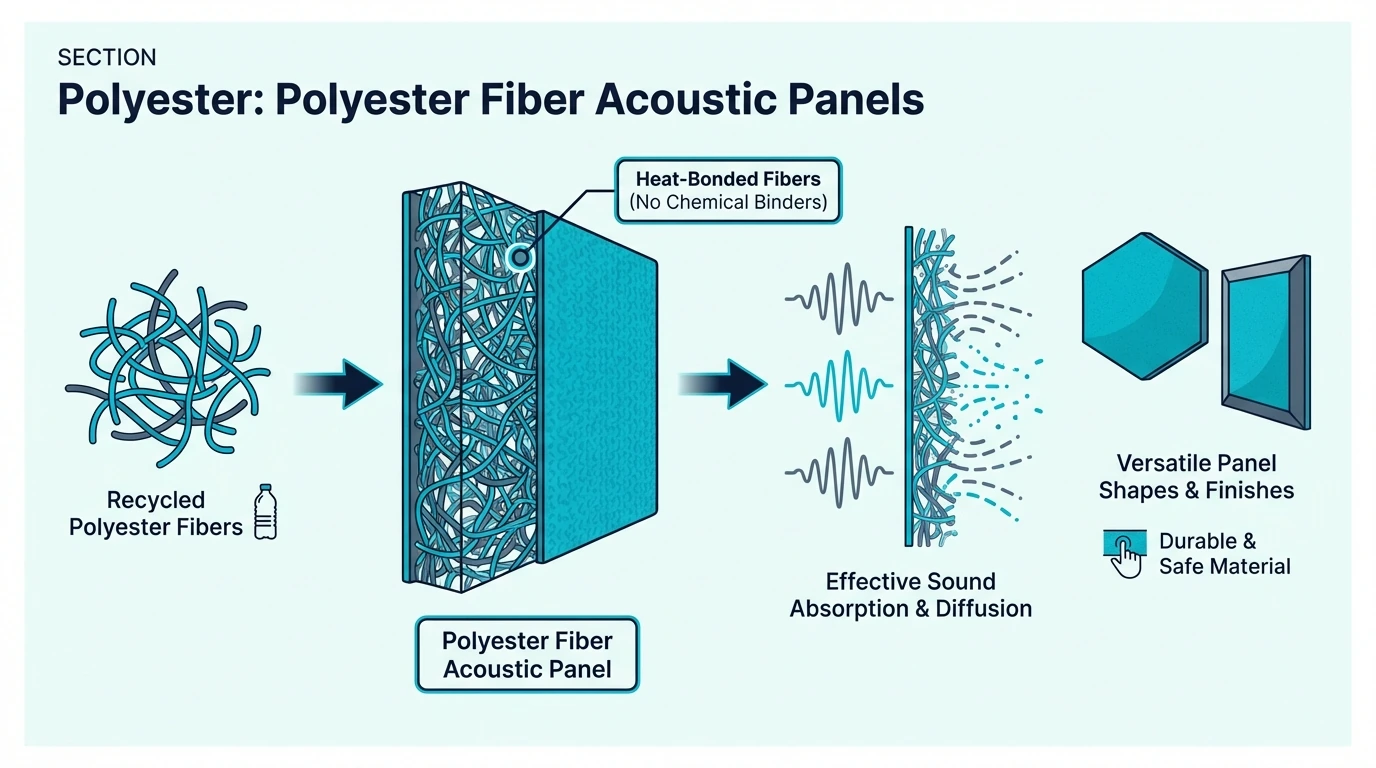
Polyester acoustic panels use PET fibers: – PET: Polyethylene terephthalate – Often from recycled bottles – Fibers compressed into boards or felt

How It Differs from Foam

Polyester isn’t foam—it’s compressed fibers: – No cellular structure – Sound absorbed through fiber friction – Different manufacturing process – Different properties and appearance

Environmental Advantage

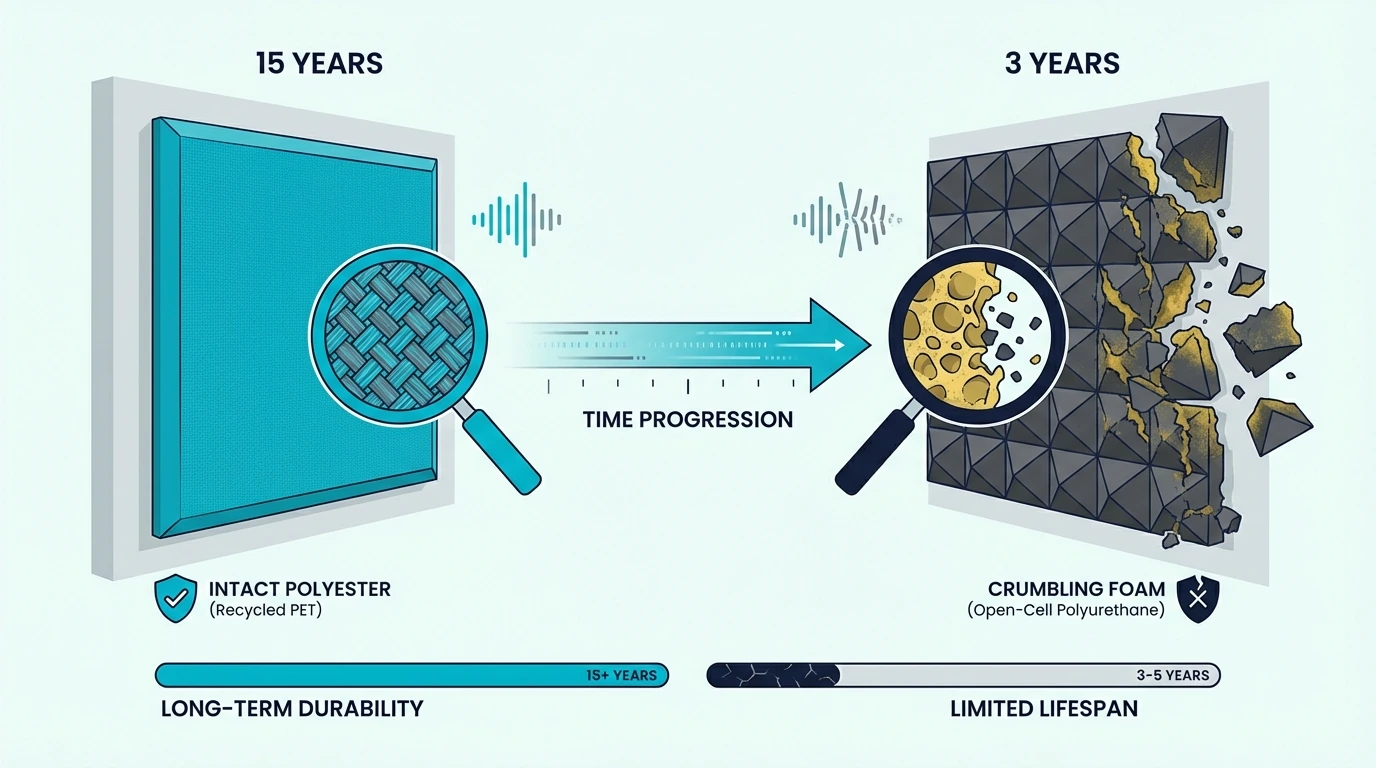
Polyester panels often use recycled content: – Diverts plastic from landfills – Lower environmental impact – Recyclable at end of life – Appeals to eco-conscious buyers

For comparison, see polyester vs foam acoustic panels. If you’re weighing foam against other materials entirely, a JBER 12-pack is a low-cost way to test polyurethane foam before committing to a full treatment.

What Additives and Treatments Go Into Acoustic Foam?

Additives used in acoustic foam manufacturing

Beyond base materials, additives affect foam properties.

Fire Retardants

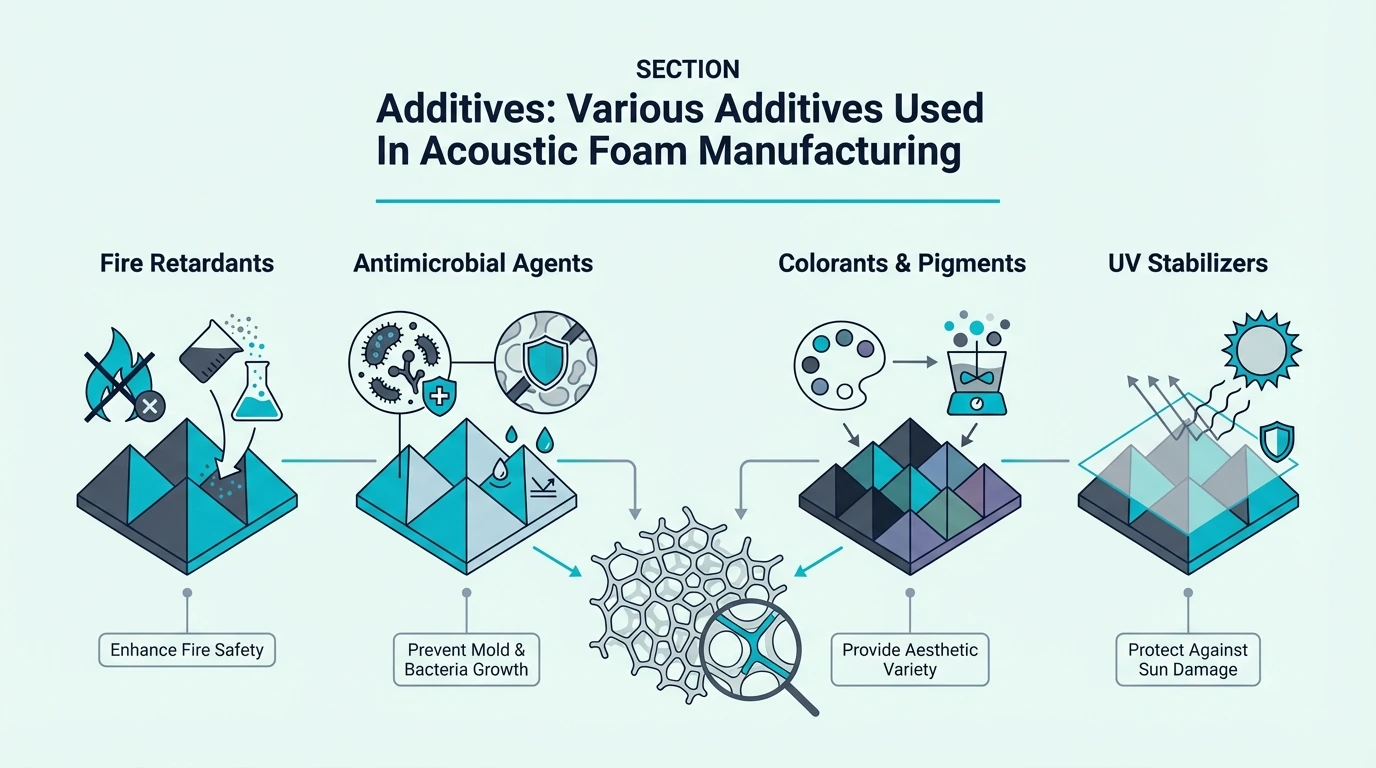
Common fire retardant types: – Phosphorus-based: Effective, lower toxicity concerns – Halogenated: Very effective, some environmental concerns – Mineral fillers: Aluminum hydroxide, magnesium hydroxide – Intumescent: Expand when heated, creating protective char

Colorants

Foam color comes from: – Pigments added during manufacturing – Dyes applied after foaming – Most acoustic foam is charcoal/gray (carbon black pigment) – Colors available but may cost more

UV Stabilizers

To reduce sun damage: – UV absorbers added to formula – Extend lifespan in sunny environments – Not all foam includes UV protection – Important for window-adjacent installations

Antimicrobial Treatments

Some foam includes: – Antimicrobial agents to resist mold/mildew – Particularly useful in humid environments – Not standard in all products – May add cost

How Is Acoustic Foam Manufactured?

Main steps in acoustic foam manufacturing

How acoustic foam goes from chemicals to panels.

Polyurethane Foam Production

  1. Mixing: Components combined in precise ratios
  2. Pouring: Mixture poured onto conveyor or into molds
  3. Rising: Chemical reaction causes foam to expand
  4. Curing: Foam solidifies as reaction completes
  5. Cutting: Large foam blocks cut to panel sizes
  6. Shaping: Convoluted (egg crate), wedge, or pyramid patterns cut
  7. Treatment: Fire retardant applied if not in formula
  8. Quality control: Density, cell structure, fire rating verified
  9. Packaging: Panels compressed for shipping

Quality Variations

Manufacturing quality affects performance: – Consistent mixing: Uniform cell structure – Controlled conditions: Predictable density – Proper curing: Complete reaction, stable foam – Accurate cutting: Consistent panel dimensions

Budget foam may have: – Inconsistent density – Variable cell structure – Incomplete fire treatment – Dimensional variations

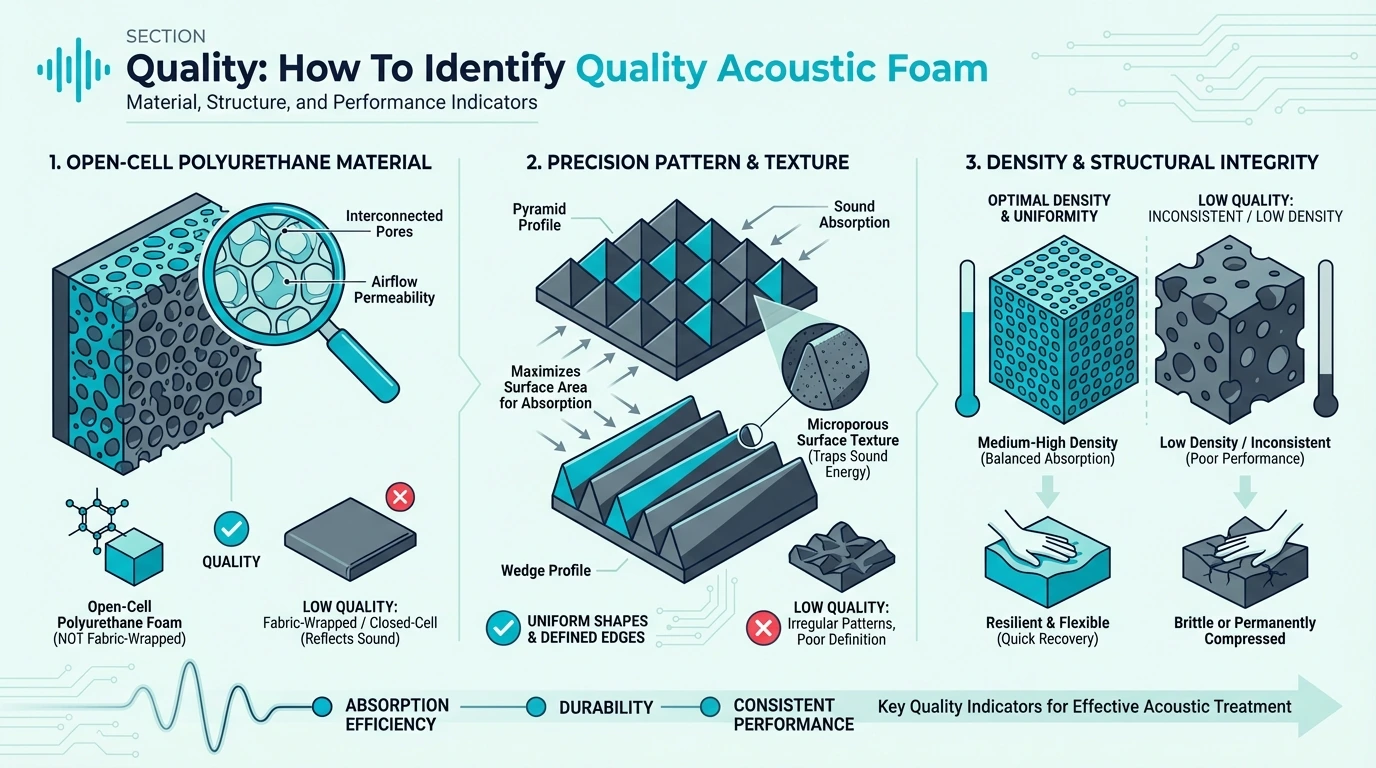
How Do You Identify Quality Acoustic Foam?

How to identify higher-quality acoustic foam

How to evaluate foam material quality.

Physical Indicators

Good quality foam: – Consistent color throughout – Uniform cell structure visible – Springs back when compressed – Feels substantial, not flimsy – No chemical odor after airing

Poor quality foam: – Color variations or streaks – Visible density variations – Slow recovery from compression – Very lightweight feel – Strong persistent odor

Specifications to Check

Look for: – Density: 1.5-2.5 lb/ft³ – NRC rating: 0.5+ (higher is better) – Fire rating: Class A or B – Cell type: Open-cell (must be specified)

For selection guidance, see how to choose acoustic foam.

Brand Reputation

Established brands (Auralex, Primacoustic) maintain quality control, while unknown brands may have inconsistent quality. Price often (but not always) correlates with material quality.

A reliable mid-range option is a 24-pack of 2-inch pyramid panels—consistent cell structure and fire-rated at a reasonable price.

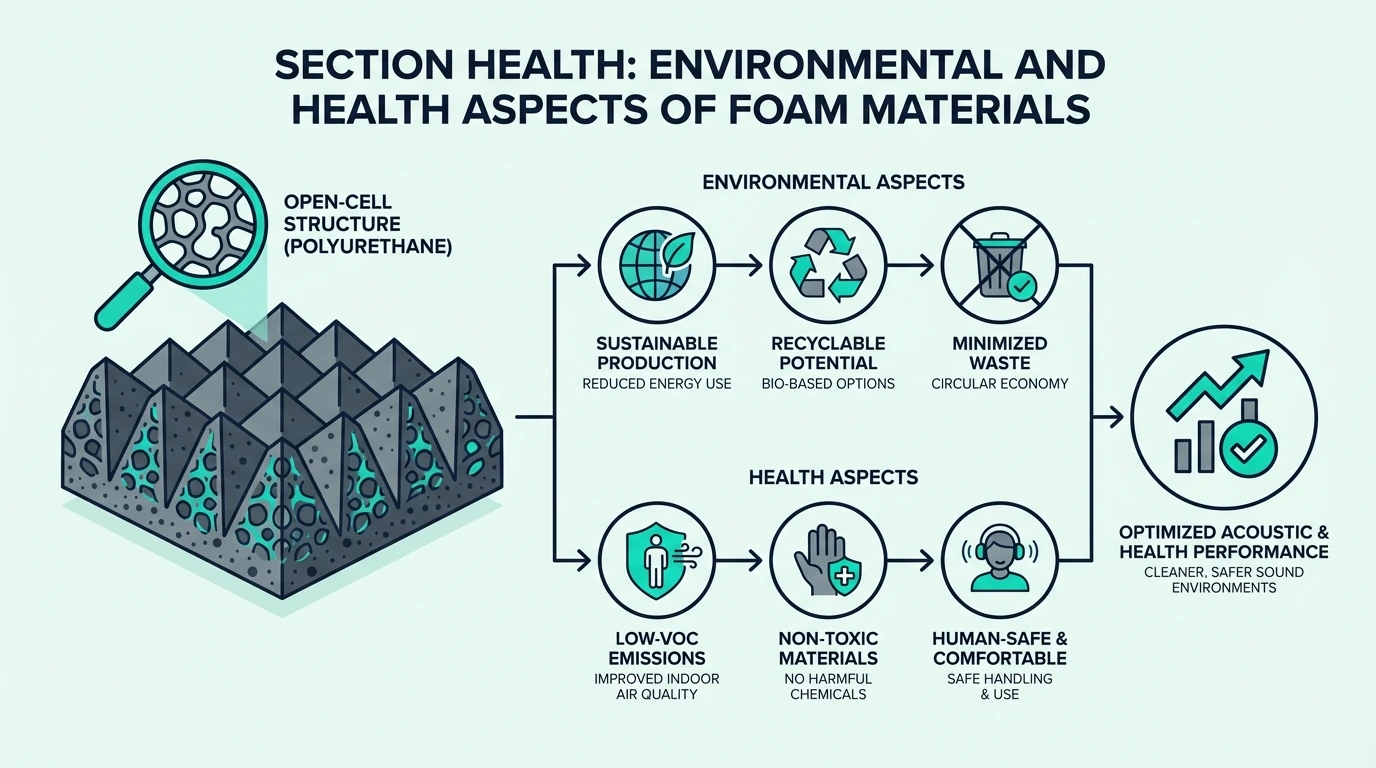
Are There Environmental or Health Concerns With Acoustic Foam?

Environmental and health aspects of acoustic foam materials

Material composition affects health and environmental impact.

Off-Gassing

New polyurethane foam may release VOCs: – Strongest when new – Dissipates over days to weeks – Ventilate during initial period – Quality foam has less off-gassing

Fire Retardant Concerns

Some fire retardants raise health questions: – Halogenated compounds most controversial – Newer formulations address concerns – Melamine avoids chemical retardants entirely – Check manufacturer information if concerned

End-of-Life Disposal

Foam disposal considerations: – Polyurethane: Not easily recyclable – Melamine: Not easily recyclable – Polyester: Recyclable in some programs – Landfill is common disposal method

Sustainable Alternatives

For environmental priority: – Recycled polyester panels – Natural fiber panels (wool, cotton) – Recycled content foam (limited availability)

For alternatives, see what to use instead of acoustic foam.

For understanding how material affects absorption, see what frequencies acoustic foam absorbs. If you want to know whether foam is worth your investment overall, see whether acoustic foam is worth it.

The Bottom Line

Acoustic foam is primarily made from polyurethane—a polymer created from polyols and diisocyanates, manufactured to create an open-cell structure that absorbs sound. Melamine foam offers premium performance through finer cell structure and inherent fire resistance.

Polyester panels provide an eco-friendly alternative using recycled PET fibers.

The key to acoustic effectiveness isn’t just the base material but how it’s manufactured: open-cell structure allows sound penetration, appropriate density (1.5-2.5 lb/ft³) provides absorption capacity, and fire retardant treatment ensures safety.

Quality varies widely between manufacturers—look for specified density, NRC ratings, and fire ratings. The material composition directly affects performance, durability, safety, and environmental impact.

For more guides on foam types, placement, and mounting, start at the acoustic foam hub.

Frequently Asked Questions

Is acoustic foam toxic?

Quality acoustic foam from reputable manufacturers is safe for normal use. New foam may off-gas VOCs initially—ventilate the area for a few days after installation.

Melamine foam avoids chemical retardants entirely. Once aired out, properly manufactured acoustic foam poses no notable health risk.

What’s the difference between acoustic foam and regular foam?

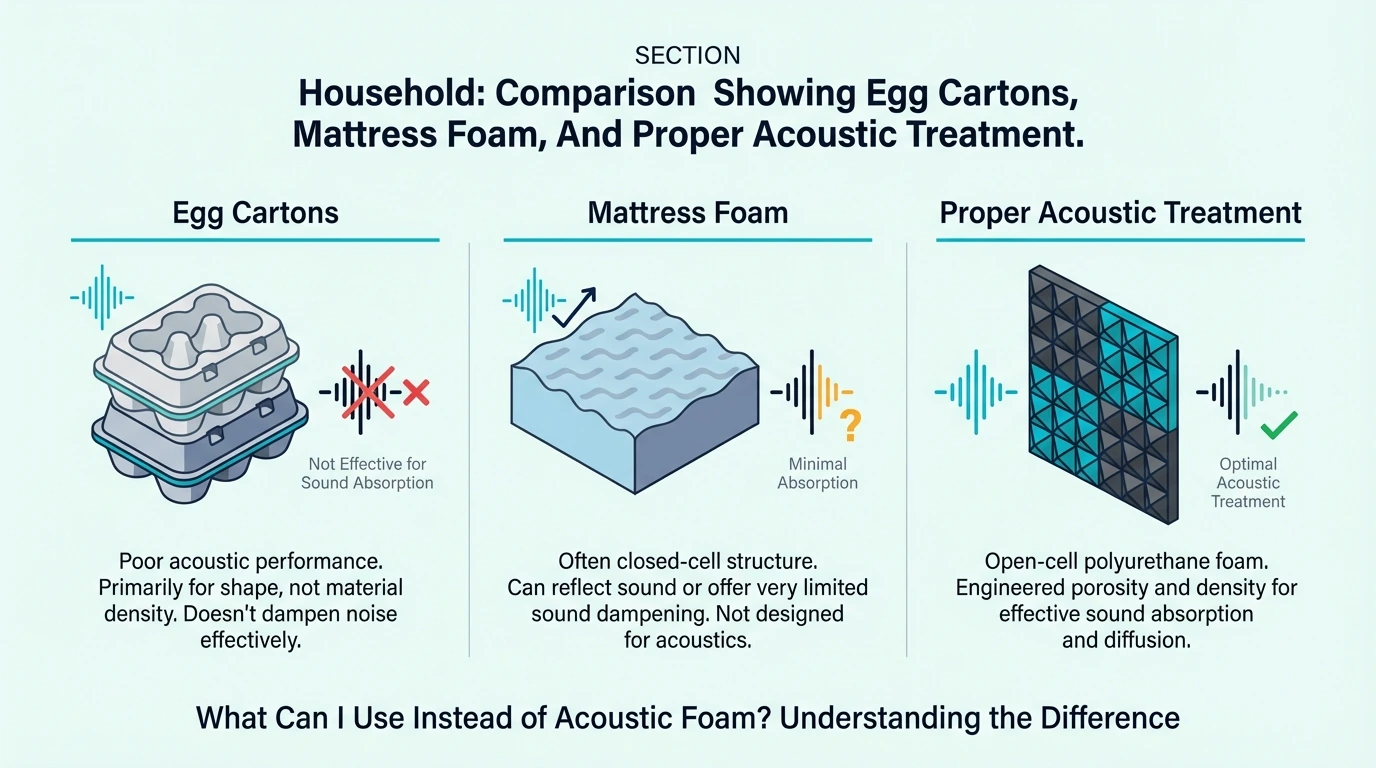
Acoustic foam is specifically manufactured with open-cell structure and appropriate density for sound absorption. Regular foam (mattress foam, packing foam) may have closed cells, wrong density, or other properties that make it ineffective for acoustics.

The base chemistry may be similar, but manufacturing differences create very different performance. For a deeper comparison, see acoustic foam vs normal foam.

Is melamine foam the same as Magic Eraser?

They’re related—both are melamine foam. However, acoustic-grade melamine is formulated and manufactured differently than cleaning products.

Acoustic melamine is optimized for sound absorption with specific density and cell structure—don’t use cleaning erasers as acoustic treatment.

Why is some acoustic foam more expensive?

Price differences reflect material quality (density, consistency), fire retardant quality, manufacturing precision, and brand reputation. Premium foam (melamine, high-density polyurethane) costs more due to materials and processing.

Budget foam cuts costs through lower density, less consistent manufacturing, or inferior fire treatment. If budget is a concern, a JBER 48-pack offers fire-tested polyurethane at an entry-level price.

Can I tell what foam is made of by looking at it?

Not definitively—polyurethane and melamine look similar, though you can feel differences (melamine is typically lighter and more rigid). Polyester panels look distinctly different: fibrous rather than cellular.

For certainty, check manufacturer specifications or product documentation.

Is recycled foam as effective as new foam?

Recycled content foam can perform equally well if properly manufactured—the recycling process doesn’t inherently reduce acoustic performance. However, quality control matters.

Ensure recycled foam meets the same specifications (density, NRC, fire rating) as virgin material. Recycled polyester panels are well-established and perform excellently.

What Frequencies Does Acoustic Foam Absorb? Complete Technical Guide

What frequencies does acoustic foam absorb? Standard 2-inch acoustic foam absorbs mid and high frequencies most effectively—roughly 500Hz to 8000Hz—but it provides minimal absorption below 250Hz because the wavelengths in a room are simply too long for thin panels to catch. Thicker foam extends absorption lower, but even 4-inch panels struggle with true bass.

That’s usually the cause of frustration after treating a room: the echo and harshness improve, but the boomy low end bouncing off walls stays untouched.

You’ll find the science behind foam absorption below, plus how thickness affects frequency response and when you need different solutions. Start with the quarter-wavelength rule, then match foam to your specific problems.

For a broader overview, see our guide on how acoustic foam works.

Quick Takeaway

Acoustic foam absorption by thickness:

  • 1-inch foam: Absorbs 1000Hz-8000Hz+ (best for high frequency flutter echo)
  • 2-inch foam: Absorbs 500Hz-8000Hz+ (best for vocals, speech, general treatment)
  • 3-inch foam: Absorbs 350Hz-8000Hz+ (best for music recording, fuller absorption)
  • 4-inch foam: Absorbs 250Hz-8000Hz+ (best for extended range, low-mid control)

Key insight: Foam thickness must be approximately 1/4 wavelength of the lowest frequency you want to absorb. Bass frequencies (under 250Hz) have wavelengths too long for practical foam thickness—you need bass traps for low frequencies.

The Science of Foam Absorption

Cross-section diagram of acoustic foam showing sound waves entering porous structure and converting to heat energy

Acoustic foam absorbs sound through a specific physical mechanism. Understanding this explains why foam works well for some frequencies and poorly for others.

How Foam Converts Sound to Heat

Sound waves are pressure variations traveling through air. When these waves enter acoustic foam’s open-cell structure, air molecules move back and forth within the tiny pores and channels.

This movement creates friction between the air and the foam’s cell walls. Friction converts kinetic energy (sound) into thermal energy (heat)—though the temperature increase is far too small to notice.

The more the air moves within the foam, the more friction occurs, and the more sound gets absorbed. This is why porous, open-cell materials absorb sound while solid, closed-cell materials reflect it.

Why Thickness Matters

Here’s the critical physics: sound absorption is most effective when the absorber is approximately 1/4 the wavelength of the sound being absorbed.

A 1000Hz tone has a wavelength of about 1.1 feet. One-quarter of that is about 3.3 inches—so 3-4 inch foam absorbs 1000Hz very effectively.

A 100Hz tone has a wavelength of about 11.3 feet. One-quarter of that is nearly 3 feet. No practical foam panel is 3 feet thick, which is why standard foam can’t absorb bass frequencies.

This relationship between thickness and wavelength is fundamental. It’s not a limitation of cheap foam versus expensive foam—it’s physics that applies to all porous absorbers.

The Quarter-Wavelength Rule

The quarter-wavelength rule provides a simple way to estimate foam effectiveness:

Minimum effective frequency ≈ 1130 / (4 × thickness in feet)

For 2-inch foam (0.167 feet): – 1130 / (4 × 0.167) = 1130 / 0.668 ≈ 1692Hz

This means 2-inch foam reaches peak absorption around 1700Hz and above, with decreasing effectiveness at lower frequencies. It still provides some absorption down to about 500Hz, but performance drops significantly below that.

For 4-inch foam (0.333 feet): – 1130 / (4 × 0.333) = 1130 / 1.332 ≈ 848Hz

Thicker foam extends the effective range lower, but even 4-inch panels don’t reach true bass frequencies.

Frequency Absorption by Foam Thickness

Graph showing absorption coefficients for 1-inch, 2-inch, 3-inch, and 4-inch foam across frequency spectrum

Different thicknesses serve different purposes. Here’s what each provides.

1-Inch Foam: High Frequency Only

One-inch foam absorbs effectively above 1000Hz. It handles high-frequency flutter echo, sibilance reflections, and the “brightness” that makes untreated rooms sound harsh.

This thickness is insufficient for comprehensive room treatment. It misses the mid frequencies where most vocal and instrument energy lives.

Use 1-inch foam only when you specifically need high-frequency absorption without affecting mids.

Common applications: reducing harshness in already-treated rooms, spot treatment for specific high-frequency problems, budget treatment where any absorption helps.

2-Inch Foam: The Standard Choice

Two-inch foam is the most common thickness for good reason. It absorbs effectively from about 500Hz up, covering the critical vocal range (300Hz-3000Hz) and most instrument frequencies.

For speech, podcasting, and vocal recording, 2-inch foam handles the frequencies that matter most. The human voice’s fundamental frequencies and harmonics fall squarely in this range.

This thickness balances effectiveness with practicality. Panels are manageable to handle and mount, don’t protrude excessively from walls, and cost less than thicker options. For product recommendations, see our guide to the best acoustic foam panels.

3-Inch Foam: Extended Range

Three-inch foam extends effective absorption down to roughly 350Hz. This captures more of the low-mid range where muddiness often occurs in recordings.

For music recording and mixing, the extended range is valuable. Instruments like acoustic guitar, piano, and male vocals have significant energy in the 250-500Hz range that 2-inch foam partially misses.

The tradeoff is cost and bulk. Three-inch panels cost more, weigh more, and protrude further from walls. The improvement over 2-inch foam is real but incremental.

4-Inch Foam: Maximum Practical Thickness

Four-inch foam reaches down to approximately 250Hz—the upper edge of the bass range. This is about as low as practical foam panels can effectively absorb.

For comprehensive treatment where budget allows, 4-inch foam provides the fullest absorption. It handles everything from low-mids through highs, leaving only true bass frequencies untreated.

Beyond 4 inches, foam becomes impractical for wall mounting. The panels are heavy, expensive, and protrude significantly into the room. For frequencies below 250Hz, different solutions (bass traps) work better.

For guidance on choosing thickness, see our comparison of 1-inch vs 2-inch acoustic foam. A solid starting point for most rooms is a 24-pack of 2-inch pyramid panels—enough to treat the first reflection points in a small room.

What Foam Can’t Absorb: Bass Frequencies

Diagram showing long bass wavelengths passing through thin foam panels unaffected

Understanding foam’s bass limitation prevents frustration and wasted money.

Why Bass Passes Through

Bass frequencies have wavelengths measured in feet, not inches. A 60Hz tone (low bass) has a wavelength of nearly 19 feet. A 125Hz tone (upper bass) has a wavelength of about 9 feet.

For foam to absorb these frequencies effectively, it would need to be several feet thick. That’s not practical for wall-mounted panels.

When bass waves encounter thin foam, they essentially don’t “see” it. The foam is so thin relative to the wavelength that the wave passes through with minimal interaction—like ocean waves passing a small buoy.

The Bass Trap Solution

Bass frequencies require different treatment: bass traps. These are thick, dense absorbers—typically 4-6 inches minimum, often thicker—placed in corners where bass energy accumulates.

Corner placement is key because room corners create pressure zones where bass builds up. Treating corners with thick absorbers addresses bass problems that wall-mounted foam can’t touch.

Bass traps and foam panels serve complementary purposes. Foam handles mid/high frequencies on walls; bass traps handle low frequencies in corners. Most well-treated rooms use both.

For more on this topic, see our guide on bass traps vs acoustic foam.

Recognizing Bass Problems

How do you know if your room has bass problems that foam can’t fix?

Signs of bass issues: – Boomy, muddy sound in certain spots – Bass that seems louder in corners – Low-frequency “ringing” after bass notes – Recordings that sound bass-heavy regardless of EQ

Signs of mid/high issues (foam can help): – Flutter echo (metallic ringing when you clap) – Harsh, bright sound – Excessive reverb on vocals – “Roomy” quality in recordings

If your problems are primarily bass-related, foam won’t solve them. If they’re mid/high frequency issues, foam is exactly what you need. Our guide on whether acoustic foam works can help you assess your specific situation.

NRC Ratings and What They Mean

Comparison chart showing NRC ratings of different acoustic materials from foam to fiberglass panels

NRC (Noise Reduction Coefficient) ratings help compare absorption effectiveness, but they have limitations.

Understanding NRC

NRC is a single number representing average absorption across four frequencies: 250Hz, 500Hz, 1000Hz, and 2000Hz. A rating of 0.85 means the material absorbs 85% of sound energy on average across these frequencies.

Higher NRC generally means better absorption. Quality acoustic foam typically rates 0.6-0.85 NRC, while professional fiberglass panels often exceed 0.95 NRC.

NRC Limitations

NRC averages hide important details. A material might absorb 95% at 2000Hz but only 30% at 250Hz—the NRC would show a decent number while masking poor low-frequency performance.

For foam specifically, NRC ratings can be misleading because they include 250Hz, where foam performs poorly. A foam panel might show NRC 0.70, but most of that absorption happens above 500Hz.

When comparing products, look for full absorption coefficient charts showing performance at each frequency, not just NRC. This reveals where the material actually works.

Typical Foam NRC Values

Here are typical NRC ranges you’ll see for common foam shapes and thicknesses: – 1-inch wedge: 0.35–0.50 (high frequency only) – 2-inch wedge: 0.60–0.75 (standard treatment) – 2-inch pyramid: 0.55–0.70 (similar to wedge) – 3-inch wedge: 0.70–0.85 (extended range) – 4-inch wedge: 0.80–0.95 (maximum practical foam absorption)

These are typical ranges—specific products vary. Premium foam with higher density generally outperforms budget options at the same thickness.

Matching Foam to Your Frequency Problems

Room scenarios showing different frequency problems and appropriate foam solutions

Different acoustic problems require different solutions. Here’s how to match foam to your needs.

Voice and Speech (Podcasting, Voice-Over)

Human speech fundamentals range from about 85Hz (deep male voice) to 300Hz (high female voice), with harmonics extending to 8000Hz and beyond. The critical intelligibility range is 300Hz-3000Hz.

Recommended: 2-inch foam handles speech frequencies effectively. The fundamental frequencies of most voices fall within 2-inch foam’s absorption range, and all the harmonics that create clarity are well-covered.

For deep male voices, 3-inch foam provides slightly better low-mid absorption, but 2-inch is adequate for most applications.

Vocal Music Recording

Singing extends the frequency range compared to speech. Vocal fundamentals can reach lower (bass singers) and harmonics extend higher (soprano overtones).

Recommended: 2-inch foam minimum, 3-inch preferred. The extended range of thicker foam captures more of the low-mid warmth that makes vocal recordings sound full and natural.

Acoustic Instruments

Acoustic guitars, pianos, and similar instruments have significant energy in the 100-500Hz range—lower than vocals. This is where foam starts to struggle.

Recommended: 3-4 inch foam for primary treatment, plus bass traps in corners. The thicker foam handles low-mids while bass traps address the true low frequencies these instruments produce.

Drums and Percussion

Drums produce energy across the entire frequency spectrum, from deep kick drum fundamentals (60-100Hz) to cymbal shimmer (10,000Hz+).

Recommended: Comprehensive treatment with 4-inch foam on walls and substantial bass traps in corners. Drums require more treatment than most sources because of their wide frequency range and high energy output. For a practical starting set, a large quantity pack like JBER 48-pack studio foam covers a lot of wall area on a budget.

Home Theater / Music Listening

Home theater and music playback benefit from balanced absorption that doesn’t over-deaden the room. You want controlled reflections, not elimination of all ambience.

Recommended: 2-inch foam at first reflection points, bass traps in corners, and possibly diffusion on rear walls. This combination controls problems while maintaining the liveliness that makes music and movies engaging. For placement guidance, see our guide on how to arrange acoustic foam.

Improving Low-Frequency Absorption

Corner bass trap installation showing proper placement for low-frequency control

If you need better low-frequency absorption than standard foam provides, several approaches help.

Air Gap Mounting

Mounting foam panels with an air gap behind them improves low-frequency absorption. The gap acts as additional absorptive space, effectively increasing the treatment’s thickness.

A 2-inch panel mounted with a 2-inch air gap performs similarly to a 4-inch panel mounted flush. This technique extracts more low-frequency absorption from thinner, less expensive panels.

Use furring strips or standoff brackets to create consistent gaps. Even 1-2 inches of air space provides meaningful improvement.

For mounting techniques, see our guide on how to put acoustic foam on walls. If you want an affordable tile to experiment with air-gap mounting, a JBER 12-pack keeps costs low while you test placement.

Corner Placement

Corners naturally have higher sound pressure at low frequencies. Placing absorbers in corners—even standard foam—provides better low-frequency absorption than the same panels on flat walls.

This doesn’t make thin foam effective for bass, but it does improve low-mid performance. Combining corner placement with air gaps maximizes what foam can achieve.

Dedicated Bass Traps

For true bass control, dedicated bass traps are necessary. These are typically:

  • Thick foam traps: 4-6 inch triangular corner units
  • Fiberglass/rockwool traps: Dense panels 4+ inches thick
  • Membrane traps: Tuned absorbers for specific frequencies
  • DIY traps: Rigid fiberglass in corner-mounted frames

Bass traps belong in corners, especially the corners behind your speakers or listening position. They complement wall-mounted foam rather than replacing it.

Common Misconceptions

Visual debunking common myths about foam absorption with correct information

Several myths persist about foam absorption. Here’s the truth.

“More Foam = Better Bass Absorption”

Adding more thin foam panels doesn’t improve bass absorption. Twenty 2-inch panels absorb the same frequencies as two 2-inch panels—just more of them.

Bass absorption requires thickness, not quantity. If you have bass problems, adding more wall foam won’t help. You need thicker treatment or bass traps.

“Expensive Foam Absorbs Bass Better”

Premium foam absorbs mid/high frequencies more consistently than budget foam, but it doesn’t magically absorb bass. The physics of wavelength versus thickness applies regardless of price.

Expensive foam is denser and more durable, which improves performance within its effective frequency range. But no foam product, regardless of cost, effectively absorbs frequencies below about 250Hz at practical thicknesses.

“Foam Absorbs All Sound Equally”

Foam absorption varies dramatically with frequency. A panel might absorb 95% of energy at 2000Hz but only 20% at 250Hz. The absorption curve is not flat.

This is why understanding frequency response matters. Foam is excellent for what it does—mid/high absorption—but it’s not a universal solution for all acoustic problems.

“Thicker Is Always Better”

Thicker foam absorbs a wider frequency range, but “better” depends on your needs. If your problems are purely high-frequency flutter echo, 1-inch foam solves them—thicker foam costs more without additional benefit.

Match thickness to your actual problems—don’t buy 4-inch foam for a room that only needs high-frequency treatment. If you’re unsure what your room needs, our guide on how to stop echo with acoustic foam helps identify specific issues.

The Bottom Line

Acoustic foam absorbs mid and high frequencies effectively—roughly 500Hz and above for standard 2-inch panels. Thicker foam extends absorption lower, but even 4-inch panels don’t reach true bass frequencies—that’s physics, not a product limitation.

For vocals, speech, and most recording applications, 2-inch foam handles the critical frequencies. Music production and situations requiring fuller absorption benefit from 3-4 inch thickness.

Bass problems require dedicated bass traps, not more wall foam.

Understanding these frequency limitations helps you choose appropriate treatment. Foam excels at what it does—controlling mid/high reflections that cause flutter echo, harshness, and “roomy” recordings.

For bass control, combine foam with corner-mounted bass traps for comprehensive treatment. If you want a broader look at foam limitations beyond frequency range, see our cons of acoustic foam guide.

The goal isn’t finding foam that absorbs everything—it’s using the right tools for each frequency range. Foam for mids and highs, bass traps for lows, and your room will sound dramatically better.

For a complete overview of foam’s real-world performance, see how many decibels acoustic foam reduces.

Frequently Asked Questions

Does acoustic foam absorb bass?

Standard acoustic foam (1-4 inches) does not effectively absorb bass frequencies below about 250Hz. Bass wavelengths are too long relative to foam thickness for significant absorption to occur.

For bass control, you need dedicated bass traps—thick absorbers (4-6+ inches) placed in corners where low frequencies accumulate.

What thickness acoustic foam do I need?

For speech and vocals, 2-inch foam is sufficient—it absorbs the critical 500Hz-8000Hz range effectively. For music recording with instruments, 3-4 inch foam provides better low-mid absorption.

Match thickness to your frequency problems: high-frequency flutter echo needs only 1-2 inches, while fuller absorption needs 3-4 inches.

Why doesn’t my foam help with boomy bass?

Foam panels are too thin to absorb bass frequencies. A 100Hz tone has an 11-foot wavelength—foam would need to be nearly 3 feet thick to absorb it effectively.

Your boomy bass requires corner-mounted bass traps, not additional wall foam. Bass traps use thickness and corner placement to address frequencies foam can’t touch.

What’s the difference between NRC 0.5 and NRC 0.8 foam?

NRC 0.8 foam absorbs approximately 80% of sound energy (averaged across test frequencies) versus 50% for NRC 0.5. The difference is audible—higher NRC foam creates tighter, more controlled acoustics.

However, NRC doesn’t indicate which frequencies are absorbed, so check full absorption charts when possible.

Can I improve foam’s bass absorption?

Mounting foam with an air gap behind it improves low-frequency absorption somewhat. A 2-inch panel with a 2-inch air gap performs similarly to a 4-inch panel flush-mounted.

Corner placement also helps because corners have higher bass pressure. However, these techniques only extend absorption modestly—for true bass control, you still need dedicated bass traps.

Is thicker foam always better?

Thicker foam absorbs a wider frequency range, but “better” depends on your needs. If your only problem is high-frequency flutter echo, 2-inch foam solves it—4-inch foam costs more without additional benefit for that specific issue.

Choose thickness based on the frequencies causing your problems, not the assumption that thicker is universally superior. For help deciding what your room needs, see our guide on how to choose acoustic foam.

What Can You Use Instead of Acoustic Foam? 12 Alternatives That Actually Work

What can you use instead of acoustic foam? Moving blankets, DIY rockwool panels, and heavy curtains all absorb sound, but most other “alternatives” people recommend online are myths that waste your money just as fast as cheap foam.

The real problem is echo and flutter bouncing off bare walls and hard floors, making recordings sound boxy and mixes unreliable. Egg cartons won’t fix that, and neither will mattress foam or thin curtains.

Match the right material to your room, though, and you get cleaner sound for less money than generic pyramid panels ever delivered.

Start with your budget tier—free, under $50, or under $150—then treat the first reflection point near your mic or monitors.

Quick Takeaway

To decide on the best acoustic foam alternative, consider your budget and goals:

  • Free options: Rearrange furniture, hang clothes in closets, use existing blankets
  • Budget tier ($0-50): Moving blankets, heavy curtains, thick rugs
  • Mid-range ($50-150): DIY rockwool panels, cork boards, fabric-wrapped frames
  • Professional ($150+): Commercial fabric panels, polyester acoustic panels

The best alternative depends on whether you need temporary treatment, rental-friendly solutions, or permanent upgrades. DIY rockwool panels offer the best performance-to-cost ratio, while moving blankets provide the quickest budget fix.

Why Look for Acoustic Foam Alternatives?

Why alternatives person looking frustrated at cheap acoustic foam thats yellowing and deteriorating on their wall

Not everyone needs—or wants—acoustic foam. Understanding your motivation helps narrow down which alternative makes sense for your situation.

Budget Constraints Hit Hard

Acoustic foam adds up fast. Covering even a small room requires dozens of panels, and quality foam isn’t cheap.

A 10×10 room needs roughly 40-60 square feet of treatment for basic echo control. At typical foam prices, you’re looking at a significant investment before you’ve even bought a microphone or interface.

Aesthetics Matter More Than You Think

Let’s be honest—most acoustic foam looks terrible. Those black or gray pyramids scream “budget YouTube setup” regardless of how much you spent.

Some people want their space to look like a living room, not a recording booth. Alternatives like fabric panels, curtains, or strategically placed furniture achieve the same acoustic goals without the visual compromise.

Rental Restrictions Are Real

Landlords don’t appreciate tenants gluing foam to their walls. Even “removable” adhesives can damage paint or leave residue that costs you your deposit.

If you’re renting, you need solutions that come down cleanly when you move. That rules out most permanent mounting methods and pushes you toward freestanding or temporary options.

Budget DIY Alternatives ($0-50)

Budget alternatives moving blankets hung on a wall with simple hooks showing a budget friendly acoustic treatment setup

You don’t need to spend much—or anything—to improve your room’s acoustics. These options work surprisingly well for the price.

Moving Blankets: The Budget Champion

Moving blankets are the go-to recommendation in audio forums for good reason. They’re thick, dense, and designed to absorb impact—which translates to decent sound absorption.

A single moving blanket hung behind your recording position reduces flutter echo noticeably. The dense padding absorbs mid and high frequencies similar to budget foam, though bass frequencies pass right through.

For comparison, see how acoustic foam stacks up against blankets in our detailed breakdown.

You can find moving blankets for a few dollars each at hardware stores. For a purpose-built option, VEVOR sound dampening blankets include grommets and hang from simple hooks—no wall damage required.

The downside is they look exactly like what they are: blankets hanging on your wall. For temporary setups or spaces where aesthetics don’t matter, though, they’re hard to beat.

Heavy Curtains Work Better Than Expected

Thick, floor-to-ceiling curtains do double duty. They treat your windows (a major source of reflections) while adding absorption to the room.

Velvet or heavy blackout curtains perform best because denser material absorbs more sound energy. Thin, decorative curtains do almost nothing—you need weight and thickness.

Position curtains so they hang with some space behind them, not flat against the wall. That air gap improves low-frequency absorption significantly—even a 2-4 inch gap makes a measurable difference.

Thick Rugs and Carpets

Hard floors reflect sound like mirrors reflect light—every clap, footstep, and spoken word bounces back and creates flutter echo. Understanding how sound absorption actually works helps explain why soft materials make such a difference.

A thick area rug breaks up floor reflections immediately. You’ll hear the difference the moment you lay it down—the room sounds less “live” and more controlled.

Rugs work best when placed between you and your monitors or microphone. The reflection point on the floor matters just as much as the walls, and most people ignore it completely.

Furniture Placement Costs Nothing

Before buying anything, try rearranging what you already own. Bookshelves scatter sound, couches absorb mid frequencies, and even a messy closet full of clothes acts as a bass trap.

The goal is breaking up parallel surfaces—two bare walls facing each other create flutter echo, that metallic ringing when you clap. Put a bookshelf against one wall, and the problem often disappears.

This isn’t a complete solution, but it’s free and immediate. Start here before spending money on alternatives.

Mid-Range Alternatives ($50-150)

Mid range diy rockwool acoustic panel with fabric covering showing the construction layers

When budget options aren’t enough, these mid-range solutions offer serious performance without professional prices.

DIY Rockwool Panels: Best Bang for Your Buck

If you’re willing to build something, DIY rockwool panels outperform acoustic foam in every measurable way. They absorb more sound across a wider frequency range, last longer, and cost less per square foot than quality foam.

Rockwool (mineral wool insulation) has an NRC rating around 0.95-1.0, meaning it absorbs 95-100% of sound energy hitting it. Compare that to budget foam at 0.3-0.5, and the difference is dramatic.

Building panels requires basic materials: 2-inch rockwool batts, simple wooden frames, and breathable fabric to wrap them. Total cost per panel runs less than half what commercial panels cost.

The tradeoff is time—each panel takes 30-60 minutes to build, and you’ll need basic tools. For anyone comfortable with simple DIY projects, this is the clear winner for performance versus cost.

For a complete guide on building your own, check out our DIY acoustic panel guide.

Fiberglass Panels (DIY)

Fiberglass insulation works similarly to rockwool but requires more careful handling. The fibers irritate skin and lungs, so you’ll need gloves, long sleeves, and a respirator during construction.

Owens Corning 703 is the standard recommendation—it’s rigid, easy to cut, and has excellent absorption characteristics. The 2-inch thickness handles frequencies down to about 500Hz effectively, while 4-inch panels reach into the 250Hz range. If you’re comparing thicknesses, our guide on 1-inch vs 2-inch acoustic foam explains why thickness matters so much.

Fiberglass panels need fabric wrapping to contain the fibers—Guilford of Maine is the industry standard, but any acoustically transparent fabric works. Test by holding it to your mouth and blowing; if air passes through easily, sound will too.

Cork Boards and Tiles

Cork offers a middle ground between aesthetics and function. It absorbs some sound, looks decent on walls, and installs easily with adhesive or pins.

The absorption isn’t as effective as rockwool or fiberglass—cork’s NRC rating hovers around 0.3-0.4. But for light treatment in spaces where appearance matters, it’s a reasonable compromise.

Cork works best for high-frequency absorption. It won’t help with bass buildup or low-mid muddiness, but it takes the edge off harsh reflections and reduces flutter echo in smaller rooms.

Fabric-Wrapped Frames

Stretching fabric over a wooden frame with batting inside creates a decorative panel that actually absorbs sound. It’s essentially a simplified version of commercial acoustic panels.

Use polyester batting, cotton batting, or even old towels as the absorptive material. Thicker is better—aim for at least 2 inches of compressed material inside the frame.

These panels look like art when done well. Choose fabric that matches your room, and nobody will know they’re acoustic treatment. The absorption won’t match rockwool panels, but it’s significantly better than bare walls. For ideas on improving foam aesthetics, check out how to make acoustic foam look good.

Professional Alternatives ($150+)

Professional high end fabric wrapped acoustic panels in a modern home studio with clean aesthetics

When budget isn’t the primary concern, these options deliver professional performance with professional appearance.

Commercial Fabric-Wrapped Panels

Companies like GIK Acoustics, Acoustimac, and ATS Acoustics sell pre-made panels that look like they belong in a professional studio. They use high-density fiberglass or mineral wool cores wrapped in acoustically transparent fabric.

These panels typically achieve NRC ratings of 0.85-1.0, absorbing nearly all sound energy across the frequency spectrum. They’re what professional studios use, and the performance reflects that.

The premium price buys you consistency, appearance, and convenience—every panel performs identically, the fabric options are extensive, and installation is straightforward. For anyone who values their time over DIY savings, commercial panels make sense.

Polyester Acoustic Panels

PET felt panels (made from recycled plastic bottles) have gained popularity for their combination of performance and aesthetics. They come in various colors, can be cut into custom shapes, and don’t require fabric wrapping.

Absorption varies by thickness and density, but quality polyester panels achieve NRC ratings around 0.7-0.85. That’s better than foam and approaching fiberglass performance.

The material is safe to handle, doesn’t irritate skin, and won’t degrade over time like foam. It’s become the go-to choice for offices and modern studios where appearance matters as much as acoustics.

If you’re curious about foam safety concerns, read our guide on whether acoustic foam is dangerous.

Wood Slat Acoustic Panels

Wood slat panels combine absorption with diffusion. The slats scatter high frequencies while the backing material (usually felt or foam) absorbs mid frequencies.

These panels look stunning—they’re as much a design element as an acoustic treatment. The wood adds warmth to room aesthetics while actually improving sound quality.

Performance varies widely depending on construction—some wood slat panels are purely decorative with minimal acoustic benefit. Others use engineered backing materials that provide genuine absorption, so check the NRC rating before buying.

What About Common Household Items?

Household comparison showing egg cartons mattress foam and proper acoustic treatment side by side

The internet is full of suggestions for household acoustic treatments. Some work, most don’t. Here’s the truth.

Do Egg Cartons Work? (No, Not Really)

Egg cartons are the most persistent myth in home acoustics. They look vaguely like acoustic foam, so people assume they work similarly.

They don’t. Egg cartons are thin cardboard—they have almost zero mass and absorb virtually no sound energy. The shape might scatter some high frequencies slightly, but the effect is negligible.

Worse, cardboard egg cartons are a fire hazard. They’re not treated with flame retardants like proper acoustic materials. Covering your walls with them is genuinely dangerous.

If someone recommends egg cartons, they don’t understand acoustics. Our full egg cartons vs acoustic foam comparison breaks down exactly why. Move on to solutions that actually work.

Can I Use Mattress Foam? (Not Ideal)

Mattress foam and acoustic foam are different products. Mattress foam is designed for comfort and support, not sound absorption.

Some mattress foam does absorb sound—particularly open-cell varieties. But the density and cell structure aren’t optimized for acoustics, so performance is inconsistent and generally poor.

The bigger issue is fire safety. Acoustic foam is treated with flame retardants; mattress foam often isn’t. Using untreated foam on your walls creates a fire risk that’s not worth the minimal acoustic benefit.

If you have old mattress foam lying around, it’s better than nothing for temporary use. Our acoustic foam vs mattress foam guide covers the differences in detail. But don’t buy mattress foam expecting acoustic performance—spend that money on proper materials instead.

Do Carpets and Rugs Help? (Yes, Somewhat)

Unlike egg cartons, carpets and rugs genuinely improve room acoustics. They absorb high and mid frequencies, reduce floor reflections, and add mass to the room.

A thick carpet won’t solve all your acoustic problems, but it addresses one of the most common issues: hard floor reflections. The improvement is immediate and noticeable.

Rugs work best when combined with wall treatment. They handle floor reflections while panels or curtains handle wall reflections. Together, they create a balanced acoustic environment.

For more on how different materials compare, see our guide on acoustic foam vs carpet.

Comparison Table: Alternatives vs Acoustic Foam

Comparison infographic comparing different acoustic treatment options with ratings for cost effectiveness and ease of…

Here’s how the alternatives stack up against standard acoustic foam:

Alternative Cost NRC Rating Ease of Install Appearance Best For
Moving Blankets $5-15 each 0.4-0.6 Very Easy Poor Temporary setups
Heavy Curtains $30-100 0.3-0.5 Easy Good Windows, rentals
DIY Rockwool Panels $15-25/panel 0.95-1.0 Moderate Good Best performance/cost
Cork Tiles $2-5/sqft 0.3-0.4 Easy Good Light treatment
Commercial Panels $50-150/panel 0.85-1.0 Easy Excellent Professional results
Polyester (PET) Panels $40-100/panel 0.7-0.85 Easy Excellent Modern aesthetics
Budget Acoustic Foam $1-3/sqft 0.3-0.5 Easy Poor Basic echo reduction

The numbers tell the story. DIY rockwool panels deliver professional-grade absorption at budget prices—if you’re willing to build them. Commercial panels cost more but save time and look better. Budget foam sits at the bottom for performance but remains the easiest option.

When Should You Just Buy Foam?

When foam small bedroom studio setup with strategically placed acoustic foam panels

Sometimes acoustic foam is actually the right choice. Here’s when alternatives don’t make sense.

When Budget Alternatives Fall Short

Moving blankets and curtains work for basic treatment, but they have limits. If you’re recording vocals professionally or mixing music, you need more absorption than household items provide.

The gap between “good enough” and “actually good” matters when audio quality is your goal. Budget alternatives get you partway there; proper treatment gets you all the way.

When Foam Is Actually Cheaper

DIY panels cost less per square foot than commercial panels, but they require time and tools. If your time is valuable and you only need a few panels, buying foam might cost less overall.

Calculate the true cost: materials plus your hourly rate times build time. For small projects pre-made foam often wins, but for larger rooms DIY savings add up quickly.

The Time vs Money Tradeoff

Building eight DIY panels takes a full weekend. Ordering foam takes five minutes.

Some people enjoy building things. Others want to start recording immediately. Neither approach is wrong—it depends on your priorities and how you value your time.

If you’re leaning toward foam, a 52-pack foam bundle covers a small room for under $35. Check our guide to the best acoustic foam panels to compare options.

Rental-Friendly Solutions That Actually Work

Rental freestanding acoustic panel divider in an apartment setting showing no wall damage

Renters face unique challenges. You need treatment that works but leaves no trace when you move out.

Freestanding Panel Dividers

Acoustic panel dividers stand on their own—no wall mounting required. They’re essentially acoustic panels on legs or frames that you position around your recording space.

These work particularly well for vocal recording. Place a divider behind you and another to the side, and you’ve created a semi-isolated recording environment without touching the walls.

The downside is floor space. Freestanding panels take up room that wall-mounted panels don’t. In small apartments, this tradeoff might not work.

Tension Rod Curtains

Heavy curtains hung from tension rods require zero wall damage. The rods press against the walls or window frames without screws or adhesive.

This approach works for windows, doorways, and even creating temporary room dividers. The curtains absorb sound while the tension rods leave no marks when removed.

For maximum effect, use the thickest curtains you can find and hang them with space behind. The air gap improves absorption significantly.

Portable Vocal Booths

Reflection filters and portable vocal booths mount to mic stands, not walls. They surround your microphone with absorptive material, reducing room reflections at the source.

These don’t treat the room—they treat the recording. The room still sounds echoey if you’re listening to playback, but your recorded vocals come out cleaner.

For podcasters and voice-over artists, portable booths often provide enough improvement without any room treatment at all—they’re the ultimate rental-friendly solution. Learn more about optimal foam placement in home studios if you decide to add room treatment later.

How to Choose the Right Alternative

Choose decision flowchart showing how to pick the right acoustic treatment based on budget and needs

With so many options, picking the right one comes down to answering a few questions.

What’s Your Primary Goal?

Recording vocals requires different treatment than mixing music or reducing echo for video calls. Vocal recording benefits most from absorption behind and around the microphone.

Mixing requires balanced treatment across the entire room. Video calls just need basic echo reduction.

Match your treatment to your goal—over-treating a room for video calls wastes money. Under-treating for professional mixing wastes time fixing problems in post.

How Much Can You Spend?

Be honest about your budget before researching options. It’s easy to convince yourself you need commercial panels when moving blankets would solve your actual problem.

Start with the cheapest solution that might work, and upgrade if it’s not enough. This approach costs less than buying expensive treatment you might not need.

How Long Will You Stay?

Temporary living situations call for temporary solutions. Don’t invest in permanent acoustic treatment for an apartment you’ll leave in a year.

Conversely, if you own your space and plan to stay, investing in quality treatment pays dividends for years. The cost-per-use drops dramatically over time.

Do You Enjoy DIY Projects?

Building panels is satisfying if you like working with your hands, but frustrating if you don’t. Be honest about which category you fall into.

There’s no shame in buying pre-made solutions. Your time has value, and spending it on projects you don’t enjoy isn’t a good trade.

The Bottom Line

Acoustic foam isn’t your only option—and often isn’t your best option. Moving blankets provide cheap immediate improvement, DIY rockwool panels deliver professional performance at budget prices, and commercial fabric panels offer the best combination of looks and function.

The right choice depends on your budget, your space, and how much effort you’re willing to invest. Start with the simplest solution that might work, then upgrade if needed.

For most home studios, a combination of approaches works best: rugs on the floor, curtains on windows, and panels at first reflection points. You don’t need to cover every surface—strategic placement of the right materials beats random coverage with the wrong ones.

Whatever you choose, remember that any treatment beats no treatment. Even imperfect solutions improve your recordings and make your space more pleasant to work in.

Frequently Asked Questions

What is the cheapest acoustic treatment?

Rearranging furniture costs nothing—bookshelves, couches, and closets all absorb and scatter sound. After that, moving blankets at a few dollars each offer the best budget absorption, and heavy curtains you already own also help.

Can I use blankets instead of acoustic foam?

Yes, thick blankets absorb sound effectively—sometimes better than cheap foam, and moving blankets work best because they’re dense and heavy. The main tradeoff is appearance: blankets look like blankets, not professional treatment.

Are DIY panels as good as commercial acoustic foam?

DIY rockwool or fiberglass panels actually outperform most acoustic foam, achieving NRC ratings of 0.95-1.0 compared to foam’s 0.3-0.5. The materials cost less per square foot than quality foam, though you invest time in building them.

What absorbs sound in a room naturally?

Soft, porous materials absorb sound—upholstered furniture, thick curtains, carpets, and bookshelves—while hard, flat surfaces like bare walls and glass windows reflect it. Adding soft materials and breaking up flat surfaces improves any room’s acoustics.

Is rockwool better than acoustic foam?

Rockwool significantly outperforms acoustic foam in absorption tests—it handles a wider frequency range, absorbs more energy at each frequency, and lasts longer without degrading. The only advantages foam has are easier installation and lower skill requirements.

Do acoustic panels work for blocking neighbor noise?

No—acoustic panels and foam absorb sound inside a room, but they don’t block sound from entering or leaving. Blocking neighbor noise requires mass (thick walls, solid doors, sealed gaps), which is soundproofing, not acoustic treatment—completely different solutions.

What Are Some Cons About Acoustic Foam? Honest Disadvantages Explained

What are some cons about acoustic foam? It tames reflections in a room, but it won’t absorb bass, it won’t soundproof anything, and it degrades faster than most people expect. Those are the big three, but there are six more that catch buyers off guard.

The frustration usually hits after installation: you’ve covered half a wall, the echo is better, but the boomy low end bouncing off walls and ceiling is untouched and your neighbor’s music still bleeds through.

Know the limitations upfront and you can use foam where it actually helps while avoiding the problems that waste money.

This guide walks through all nine cons. Start with the biggest performance gap — bass absorption — then work through the practical concerns that affect every foam install.

Quick Takeaway

Main disadvantages of acoustic foam:Limited frequency range – Doesn’t absorb bass effectively – No soundproofing – Won’t block noise transmission – Durability issues – Degrades over time, especially with UV exposure – Aesthetic limitations – Distinctive “studio” look may not suit all spaces – Fire concerns – Requires proper fire rating – Dust collection – Textured surfaces trap dust – Potential off-gassing – Some foams emit VOCs initially

Bottom line: Foam is a good solution for many situations, but understanding its limitations prevents disappointment.

Con #1: Limited Frequency Absorption

Graph showing acoustic foam limited bass absorption across frequencies

The biggest performance limitation of acoustic foam.

The Problem

Standard acoustic foam (2-4 inches) primarily absorbs mid and high frequencies. Low frequencies pass through largely unaffected:

Frequency2” Foam Absorption
125 Hz~10%
250 Hz~25%
500 Hz~55%
1000 Hz~80%

Bass frequencies (below 250 Hz) require much thicker, denser materials to absorb effectively.

Why It Matters

If your room has bass problems—boomy sound, standing waves, muddy low end—foam panels won’t solve them. You’ll treat the highs and mids while bass issues persist.

The Solution

For bass control, you need dedicated bass traps made from thick fiberglass or rockwool, placed in corners where low frequencies build up. Standard foam thickness won’t cut it.

See our guide on bass traps vs acoustic foam for low-frequency solutions.

Con #2: No Soundproofing Capability

Illustration showing sound passing through acoustic foam

The most common misconception leads to the biggest disappointment.

The Problem

Acoustic foam does NOT block sound transmission. It won’t: – Stop noise from neighbors – Prevent your sound from disturbing others – Block traffic or outside noise – Reduce sound between rooms

Foam is lightweight and porous—the opposite of what blocks sound.

Why People Get Confused

Marketing sometimes implies foam provides “sound reduction” without clarifying the difference between absorption (reducing reflections) and blocking (stopping transmission).

The Solution

Soundproofing requires: – Mass (heavy materials like drywall) – Decoupling (isolated wall structures) – Sealing (no air gaps)

These are construction projects, not surface treatments.

For more information, see our guide on does acoustic foam work.

Con #3: Durability and Degradation

Comparison of new acoustic foam vs degraded foam

Foam doesn’t last forever.

UV Damage

Sunlight degrades polyurethane foam: – Yellowing and discoloration – Brittleness and crumbling – Reduced acoustic performance – Shortened lifespan

Foam near windows or in sunny rooms degrades faster.

Physical Wear

Foam is delicate: – Easily torn or damaged – Compresses with pressure – Doesn’t recover from crushing – Shows wear from touching

Typical Lifespan

  • Budget foam: 2-5 years
  • Quality foam: 5-10 years
  • Premium foam (melamine): 10-15 years

Compare this to fabric-wrapped fiberglass panels that last 20+ years. If you opt for foam anyway, a denser panel like these 2-inch pyramid foam panels holds up longer than thinner budget tiles.

For more on foam longevity, see our guide on whether acoustic foam gets old.

Con #4: Aesthetic Limitations

Foam panels in various settings showing aesthetic challenges

Foam has a distinctive look that doesn’t suit every space.

The “Studio Look”

Wedge and pyramid patterns immediately signal “recording studio.” This may be: – Inappropriate for living spaces – Unprofessional for client-facing rooms – Dated or amateur-looking in some contexts – Visually overwhelming with extensive coverage

Limited Options

Compared to fabric panels: – Fewer color choices – No custom prints or patterns – Can’t match specific décor – Difficult to make look elegant

Alternatives for Better Aesthetics

  • Fabric-wrapped panels (fiberglass/rockwool core)
  • Flat foam panels (less distinctive)
  • Fabric-covered foam
  • Decorative acoustic panels

For improving foam appearance, see our guide on how to cover acoustic foam with fabric.

Con #5: Fire Safety Concerns

Fire rating labels and safety considerations for acoustic foam

Foam and fire require careful consideration.

The Risk

Polyurethane foam is inherently flammable. Without proper fire retardant treatment, foam can: – Ignite easily – Burn rapidly – Produce toxic smoke – Spread fire quickly

Fire Ratings

Quality acoustic foam carries fire ratings: – Class A: Most fire-resistant – Class B: Good fire resistance – Unrated: Unknown/potentially hazardous

The Problem

Budget foam may: – Lack proper fire rating – Have inadequate treatment – Not meet building codes – Create liability issues

The Solution

Always buy foam with a Class A or B rating and avoid unrated products. Check local fire codes for commercial spaces and keep foam away from heat sources.

For safety information, see our guide on whether acoustic foam is dangerous. Products from established brands like JBER 48-pack studio foam carry proper fire certifications.

Con #6: Dust and Cleaning Challenges

Foam panels showing dust accumulation in textured surfaces

Textured foam surfaces trap dust.

The Problem

Wedge and pyramid patterns create surfaces that: – Collect dust in grooves – Are difficult to clean thoroughly – May trigger allergies – Look dirty over time

Cleaning Limitations

You can’t wash foam like fabric: – Water damages foam – Aggressive cleaning tears material – Dust embeds in cell structure – Vacuuming helps but doesn’t fully clean

The Solution

Vacuum regularly with a brush attachment and use flat panels in dusty environments. If cleaning matters, a small pack like JBER 12-pack foam tiles is cheap enough to swap out every few years rather than deep-cleaning.

Con #7: Off-Gassing and VOCs

New foam packaging with ventilation recommendations

New foam may emit chemicals.

The Problem

Polyurethane foam can off-gas volatile organic compounds (VOCs): – Chemical smell when new – Potential respiratory irritation – Concerns for sensitive individuals – May take weeks to fully dissipate

Factors Affecting Off-Gassing

  • Foam quality (cheaper = more off-gassing typically)
  • Fire retardant chemicals used
  • Room ventilation
  • Temperature and humidity

The Solution

  • Buy from reputable manufacturers
  • Unpack and air out foam before installation
  • Ensure good ventilation during initial period
  • Consider melamine or polyester alternatives for sensitive situations

Con #8: Installation and Removal Issues

Wall damage from acoustic foam removal

Getting foam up—and down—has challenges.

Adhesive Problems

Permanent adhesives: – Damage walls on removal – May fail over time – Can’t be repositioned – Leave residue

Removal Damage

When removing foam: – Foam often tears – Wall paint/surface damaged – Adhesive residue remains – Panels rarely reusable after removal

Renter Concerns

For renters: – Permanent mounting risks deposit – Removable options less secure – May need landlord permission – Damage liability

For mounting options, see our guide on how to put acoustic foam on walls.

Con #9: Over-Treatment Risk

Room with excessive foam coverage looking dead

Too much foam creates problems.

The Problem

Excessive foam coverage makes rooms: – Sound unnaturally dead – Feel uncomfortable – Lack natural ambience – Fatiguing for extended periods

Why It Happens

People assume more is better and cover every surface. But rooms need some reflection to sound natural.

The Solution

  • Aim for 30-50% coverage maximum
  • Treat strategically, not comprehensively
  • Leave some reflective surfaces
  • Test and adjust rather than over-treating

For coverage guidance, see our guide on how to arrange acoustic foam.

If you’re weighing whether foam is worth the investment despite these cons, our is acoustic foam worth it guide gives the full picture.

Conclusion

Acoustic foam has real limitations: it doesn’t absorb bass, doesn’t soundproof, degrades over time, has aesthetic constraints, requires fire safety attention, collects dust, may off-gas, creates installation challenges, and can over-treat rooms if overused.

None of these cons make foam a bad product—they make it a product with specific strengths and weaknesses. It’s not the solution for bass control, soundproofing, or high-end aesthetics.

Foam excels at affordable, easy-to-install treatment for mid and high frequency reflections.

Understanding these limitations helps you use foam appropriately: for what it does well, in situations where its drawbacks don’t matter. For applications where foam’s cons are deal-breakers, alternatives like fabric-wrapped panels, DIY rockwool panels, or professional acoustic treatment may be better choices.

Frequently Asked Questions

Is acoustic foam worth it despite the cons?

For many applications, yes. Foam provides meaningful improvement in echo and reverb at affordable prices with easy installation.

The cons matter most when you need bass control, soundproofing, or premium aesthetics — foam can’t deliver any of those. For basic room treatment, foam’s benefits often outweigh its limitations.

What’s better than acoustic foam?

Fabric-wrapped panels with fiberglass or rockwool cores outperform foam acoustically (especially for bass), last longer, and look more professional. They cost more and require more installation effort.

DIY panels using rockwool provide similar benefits at lower cost if you’re willing to build them.

How do I avoid the cons of acoustic foam?

Buy quality foam with proper fire rating and install away from sunlight. Use appropriate coverage (not too much) and accept aesthetic limitations or cover with fabric.

Combine with bass traps for low-frequency control and use removable mounting if you might need to remove it later.

Does expensive foam have fewer cons?

Premium foam (melamine, high-density polyurethane) addresses some cons: better durability, less off-gassing, better fire resistance, and longer lifespan.

It doesn’t address fundamental limitations: still no bass absorption, still no soundproofing, still the same aesthetic.

Should I use something else instead of foam?

Depends on your priorities. For bass control, use bass traps. For soundproofing, use mass and construction. For aesthetics, consider fabric panels.

For budget treatment of mid/high frequencies, foam is often the practical choice. Match the solution to your specific needs and constraints.

Sound Deadening Material vs Acoustic Foam: Understanding the Difference

Sound deadening material and acoustic foam look like two versions of the same fix, but they solve opposite problems. Pick the wrong one and you’ll waste money while the noise stays exactly the same.

Sound deadening blocks transmission through walls and barriers. Acoustic foam absorbs reflections bouncing around inside a room.

Mixing them up is the most common mistake people make when treating a space.

Below you’ll find what each material does, when to use each, and how to tell which problem you’re actually dealing with.

Quick Takeaway

Sound deadening material blocks sound transmission between spaces using mass (MLV, extra drywall, automotive deadener). Acoustic foam absorbs reflections within a room using porous structure (wedge foam, pyramid foam, studio panels). If sound is coming through walls, you need deadening. If sound is bouncing inside your room, you need foam.

What’s the Real Difference Between Sound Deadening and Acoustic Foam?

Diagram comparing sound deadening that blocks noise with foam that absorbs reflections

Understanding this core distinction prevents costly mistakes.

Sound Deadening: Blocking Transmission

Sound deadening materials stop sound from traveling through barriers—walls, floors, ceilings, vehicle panels. They work through mass: heavy, dense materials that sound waves can’t easily pass through.

The physics: Sound waves carry energy. When they hit a massive barrier, most energy reflects back rather than passing through. The heavier and denser the barrier, the more sound it blocks.

Common applications: – Reducing noise between rooms – Soundproofing home theaters – Quieting vehicle interiors – Blocking external noise (traffic, neighbors)

Acoustic Foam: Absorbing Reflections

Acoustic foam absorbs sound waves within a room. It doesn’t stop sound from passing through walls—it reduces the sound bouncing around inside.

The physics: Sound waves enter the foam’s porous structure. Friction between air molecules and cell walls converts acoustic energy to heat. The sound dissipates rather than reflecting.

Common applications: – Recording studios – Podcast rooms – Home theaters (for clarity, not soundproofing) – Reducing echo in any space

For more on how foam works, see what frequencies acoustic foam absorbs.

Sound Deadening Materials Explained

Sound deadening materials including MLV, automotive deadener, Green Glue, and drywall

Several materials serve sound deadening purposes. Each has specific properties measured by Sound Transmission Class (STC) ratings—higher numbers mean better sound blocking.

Mass Loaded Vinyl (MLV)

MLV is a thin, heavy, flexible material specifically designed for soundproofing. It adds mass to walls, floors, and ceilings without adding much thickness.

Properties: – Very dense (1-2 lb per square foot) – Flexible, can conform to surfaces – Adds 25-32 STC points when properly installed – Only 1/8” thick but weighs 1 lb/sq ft – Installs behind drywall or under flooring

Best for: Adding mass to existing walls, wrapping pipes and ducts, soundproofing without major construction. A single layer of MLV can reduce sound transmission by 50-70% at mid frequencies.

Automotive Sound Deadener

Products like Dynamat, Noico, and Kilmat are designed for vehicle applications. They’re self-adhesive mats that add mass and damping to metal panels.

Properties: – Adhesive backing for easy application – Combines mass with vibration damping – Typically 80 mil (2mm) thick – Reduces road noise by 3-8 dB when covering 25-50% of panel area – Heat resistant up to 300°F and moisture resistant

Best for: Car audio installations, reducing road noise, quieting vehicle interiors.

Additional Drywall

Simply adding more drywall layers increases wall mass, improving sound blocking. This is often the most cost-effective soundproofing approach.

Properties: – Readily available at $10-15 per 4×8 sheet – Each 5/8” layer adds 2.5 lbs per square foot – Single layer adds 3-5 STC points; double layer adds 8-10 STC – Can combine with damping compounds for 12-15 STC improvement – Requires finishing work (tape, mud, paint)

Best for: New construction, renovations where walls are accessible.

Green Glue and Damping Compounds

These viscoelastic compounds apply between drywall layers, converting sound energy to heat through damping.

Properties: – Costs $15-20 per tube (covers 16-32 sq ft) – Enhances performance of drywall layers by 5-9 STC points – Easy to apply with standard caulk gun – Most effective at 125-400 Hz (bass frequencies) – Requires sandwich construction (drywall-glue-drywall)

Best for: Maximizing performance of multi-layer drywall assemblies. Two layers of 5/8” drywall with Green Glue achieves STC 50-55, compared to STC 33-38 for standard single-layer walls.

Acoustic Foam Explained

Acoustic foam types including wedge foam, pyramid foam, flat panels, and bass traps

Acoustic foam comes in various forms for different applications.

Standard Panels (Wedge, Pyramid)

The most common acoustic foam. Wedge and pyramid patterns increase surface area for better absorption.

Properties: – Typically 2-4 inches thick – Absorbs mid and high frequencies – Easy to mount on walls – Various colors available

Best for: General room treatment, recording spaces, reducing echo. A starter pack like Foamily 12-Pack Acoustic Wedge Panels is a common way to test placement before committing to full coverage.

For help with panel selection, see how to choose acoustic foam. For product recommendations, see best acoustic foam for recording.

Bass Traps

Thicker foam or specialized shapes designed for corner placement and low-frequency absorption.

Properties: – Thicker than standard panels (4+ inches) – Designed for corner mounting – Better low-frequency performance than flat panels – Still limited compared to fiberglass traps

Best for: Corner treatment, addressing mid-bass issues. The 8 Pack Corner Bass Trap Foam Blocks are a budget option for corner placement.

For more on bass treatment, see bass traps vs acoustic foam.

Flat Panels

Smooth-surface foam without wedge or pyramid patterns.

Properties: – Clean, professional appearance – Similar absorption to patterned foam – Better for video backgrounds – Easier to clean

Best for: Visible installations, video recording spaces.

When You Need Sound Deadening

Scenarios where sound deadening is needed for neighbors, theaters, and vehicles

Identify these situations to know if sound deadening is your solution.

Noise From Outside

If external sounds disturb you—traffic, neighbors, aircraft—you need to block sound transmission. Acoustic foam won’t help because the sound is coming through your walls, not bouncing inside your room.

Solutions: – Add mass to walls (MLV, extra drywall) – Seal air gaps (acoustic caulk) – Upgrade windows – Address the weakest points first

Noise Escaping Your Space

If your sound disturbs others—home theater bass, music practice, recording—you need to contain it. Again, this is a transmission problem, not a reflection problem.

Solutions: – Same as above: mass, sealing, isolation – Focus on shared walls/floors/ceilings – Address bass frequencies specifically (they transmit most easily)

Vehicle Applications

Reducing road noise, improving car audio, or quieting engine sound requires sound deadening. Vehicles have thin metal panels that transmit sound easily.

Solutions: – Automotive deadening mats on doors, floor, trunk – MLV for additional mass – Combine with absorption for best results

When You Need Acoustic Foam

Scenarios where acoustic foam helps with recording, echo, and home office noise

These situations call for absorption, not blocking.

Recording and Podcasting

If your recordings sound echoey, roomy, or harsh, you need to absorb reflections. The sound quality problem is inside your room, not coming through walls.

Solutions: – Foam panels at reflection points – Treatment behind microphone – Ceiling treatment – Corner treatment for bass

If you want thicker panels for voice work, JBER 12 Pack Acoustic Foam covers first reflection points without a big commitment. For effective panel placement, see how to arrange acoustic foam.

For recording improvement, see whether acoustic foam improves recording.

Echo and Reverb Reduction

If your room sounds echoey during calls, conversations, or playback, reflections are the problem. Hard surfaces bounce sound around, creating that hollow, reverberant quality.

Solutions: – Foam panels on walls – Soft furnishings (rugs, curtains) – Strategic placement at first reflection points

Home Theater Clarity

If dialogue is hard to understand or sound seems muddy, room reflections may be interfering. Note: this is different from soundproofing the theater to contain bass.

Solutions: – Absorption at first reflection points – Rear wall treatment – Combination with diffusion for natural sound

What Mistakes Do People Make with These Materials?

Common mistake of using foam for soundproofing and deadener for echo control

These errors waste money and leave problems unsolved.

Using Foam for Soundproofing

The most common mistake. People cover walls with acoustic foam expecting it to block sound from neighbors or contain their music.

It doesn’t work.

Foam is lightweight and porous—the opposite of what blocks sound. Sound passes right through it.

You might slightly reduce high-frequency transmission, but bass and mid-range pass through essentially unchanged.

The fix: If you need soundproofing, use mass (MLV, drywall) and sealing. Foam is for absorption only.

Using Sound Deadening for Echo

Less common but still happens. Adding MLV or automotive deadener to walls won’t reduce echo—these materials reflect sound rather than absorbing it.

The fix: If you need absorption, use acoustic foam or fabric-wrapped panels. Sound deadening materials don’t absorb.

For alternatives to foam that do absorb see what to use instead of acoustic foam.

Expecting Either to Solve Everything

Neither material solves all acoustic problems. A room might need both: sound deadening to block external noise AND acoustic foam to control internal reflections.

The fix: Identify your specific problems and address each appropriately.

Using Both Together

Room using sound deadening inside walls and acoustic foam on surfaces

Many situations benefit from combining approaches.

Home Studio Example

Sound deadening needs: – Block noise from outside (traffic, HVAC) – Contain sound to avoid disturbing others

Acoustic foam needs: – Reduce reflections for clean recordings – Control room sound for accurate monitoring

Combined approach: – MLV or extra drywall in walls for isolation – Seal all gaps with acoustic caulk – Acoustic foam on interior surfaces for absorption – Bass traps in corners

Home Theater Example

Sound deadening needs: – Contain bass to avoid disturbing neighbors – Block external noise for immersive experience

Acoustic foam needs: – Control reflections for clear dialogue – Reduce flutter echo

Combined approach: – Soundproofing on shared walls (mass + damping) – Absorption at first reflection points – Bass traps for low-frequency control – Diffusion on rear wall (optional)

How Do Costs Compare Between Sound Deadening and Acoustic Foam?

Price comparison for treating a room with sound deadening versus acoustic foam

Budget implications are worth understanding before you commit.

Sound Deadening Costs

Sound deadening typically costs more because it often involves construction:

MLV: Moderate cost per square foot Extra drywall + Green Glue: Lower material cost, plus labor Professional soundproofing: Much higher for full-room treatment

Effective soundproofing often requires treating entire walls, floors, or ceilings—large surface areas add up quickly.

Acoustic Foam Costs

Acoustic foam is generally more affordable:

Budget foam: Lower cost per square foot Quality foam (Auralex): Moderate cost per square foot Typical room treatment: Moderate total for 30-50% coverage

Foam only needs to cover a portion of surfaces, reducing total material needs. Be careful not to over-treat—see whether you can put too much acoustic foam.

Value Consideration

Don’t choose based on cost alone. The cheaper option that doesn’t solve your problem wastes money entirely.

Identify your actual need first, then budget accordingly.

How Do You Decide Which Material You Need?

Decision flowchart for choosing between sound deadening and acoustic foam

Answer these questions to identify your solution.

What’s Your Problem?

“I hear my neighbors / traffic / outside noise” → Sound deadening (blocking transmission)

“My neighbors hear me / I disturb others” → Sound deadening (containing transmission)

“My room sounds echoey / reverberant” → Acoustic foam (absorbing reflections)

“My recordings sound roomy / harsh” → Acoustic foam (absorbing reflections)

“Both external noise AND room echo” → Both solutions needed

Where Is the Sound?

Coming through walls/ceiling/floor: → Sound deadening

Bouncing around inside the room: → Acoustic foam

What’s Your Budget Reality?

Limited budget, need absorption: → Acoustic foam provides affordable improvement

Limited budget, need soundproofing: → Focus on sealing gaps first (cheapest), then add mass strategically

Adequate budget: → Address your actual problem properly

The Bottom Line

Sound deadening material and acoustic foam solve different problems. Sound deadening blocks transmission—stopping sound from passing through walls, floors, and ceilings.

Acoustic foam absorbs reflections—improving how sound behaves inside a room.

Using foam for soundproofing doesn’t work; it’s too light and porous to block sound. Using sound deadening for echo reduction doesn’t work; dense materials reflect rather than absorb.

Identify your actual problem first. If sound is coming through barriers, you need mass and sealing.

If sound is bouncing inside your room, you need absorption. Many situations require both approaches working together.

The right solution depends entirely on what you’re trying to achieve. Match the material to the problem, and you’ll get results.

Mismatch them, and you’ll waste money while the problem persists.

For more guides on foam types, placement, and mounting, start at the acoustic foam hub.

Frequently Asked Questions

Will acoustic foam soundproof my room?

No. Acoustic foam absorbs sound reflections inside your room but doesn’t block sound transmission through walls. Foam is lightweight and porous—sound passes through it easily.

For soundproofing, you need mass (heavy materials like MLV or extra drywall) and sealing (no air gaps).

Can I use automotive sound deadener for room acoustics?

For blocking sound transmission, yes—automotive deadener adds mass and damping. For absorbing reflections (reducing echo), no—deadener reflects sound rather than absorbing it.

If you want to soundproof a room, automotive deadener can help. If you want to reduce echo, you need acoustic foam or similar absorptive material.

What’s more important—sound deadening or acoustic foam?

Depends entirely on your problem. If external noise bothers you or your sound bothers others, sound deadening is the priority.

If your room sounds echoey or your recordings sound roomy, acoustic foam is what you need. Neither is universally “more important”—they solve different problems.

Do I need both sound deadening and acoustic foam?

Many situations benefit from both. A recording studio might need sound deadening to block external noise AND acoustic foam to control internal reflections.

A home theater might need soundproofing to contain bass AND absorption for dialogue clarity. Assess your specific needs—you may need one, the other, or both.

Why doesn’t acoustic foam block sound?

Sound blocking requires mass—heavy, dense materials that sound waves can’t easily penetrate. Acoustic foam is lightweight and porous by design, allowing sound waves to enter and be absorbed.

The same properties that make foam good at absorption (porosity, low density) make it ineffective at blocking.

What’s the cheapest way to reduce noise from neighbors?

Sealing air gaps is the cheapest first step—sound travels easily through gaps around doors, windows, outlets, and pipes. Use acoustic caulk and weatherstripping.

After sealing, adding mass (extra drywall layer) provides the most cost-effective improvement. Acoustic foam won’t help with neighbor noise—that’s a transmission problem requiring mass and sealing.

Should You Put Acoustic Foam in Bedroom? Pros, Cons & Considerations

Bedrooms often double as recording spaces, gaming rooms, or home offices. Adding acoustic foam seems logical, but bedrooms have unique considerations because reflections in a room this personal affect both audio quality and comfort.

That’s usually the cause of confusion: foam helps with echo and reverb inside the room, but it won’t block noise coming through walls.

You’ll find when bedroom foam makes sense below, plus potential concerns and how to implement it effectively. Start with the scenarios where foam helps, then move into placement and safety.

Quick Takeaway

Should you put foam in your bedroom?Yes, if: You record audio, game/stream, or have echo problems affecting calls – Maybe not, if: You only want to block outside noise (foam won’t help) or prioritize bedroom aesthetics

Key considerations: – Foam won’t soundproof against neighbors or traffic – Bedrooms often have soft furnishings that already absorb sound – Partial treatment around your desk/recording area often suffices – Consider aesthetics—you’ll see it every day

When Bedroom Foam Makes Sense

Bedroom recording or streaming setup with targeted acoustic foam

Several scenarios justify acoustic foam in bedrooms.

Recording and Content Creation

If you record in your bedroom: – Podcasts – YouTube videos – Music/vocals – Voiceover work

Foam reduces the room sound that makes recordings sound amateur. Even basic treatment (6-8 panels covering 4-6 square feet) around your microphone position significantly improves audio quality—often reducing audible room reflections by 40-60%.

For recording recommendations, see our guide on best acoustic foam for recording.

Gaming and Streaming

Streamers and gamers benefit from foam: – Clearer voice chat (teammates hear you, not your room) – Better stream audio quality – Reduced echo in headset mic (3-5 dB improvement typical) – More professional sound that keeps viewers engaged

Video Calls and Remote Work

If you work from home in your bedroom: – Clearer call audio – More professional sound – Reduced room echo that makes you sound like you’re in a bathroom – Better impression on colleagues/clients

A 2021 survey found that 67% of remote workers reported audio quality issues during video calls—most caused by room acoustics, not equipment.

Actual Echo Problems

Some bedrooms have echo issues: – Minimal furniture (reverb time can exceed 0.8 seconds) – Hard floors (hardwood reflects 85-90% of sound) – Large windows (glass reflects nearly as much as concrete) – Parallel walls creating flutter echo

If your bedroom sounds echoey when you clap, foam helps regardless of other uses.

When Bedroom Foam Doesn’t Make Sense

Bedroom with curtains, rug, and furniture where foam may be unnecessary

Foam isn’t always the answer.

Blocking Outside Noise

If your problem is: – Traffic noise – Neighbor noise – Street sounds – Airplane noise

Foam won’t help. These are sound transmission problems requiring soundproofing (mass, sealing, better windows), not absorption.

Already Soft Room

Bedrooms with: – Thick carpet – Heavy curtains – Upholstered furniture – Lots of bedding

…may already have adequate absorption. Adding foam provides diminishing returns.

Purely Aesthetic Concerns

If you don’t have functional needs and just want your bedroom to look like a studio—consider whether you’ll enjoy that aesthetic long-term. Bedrooms are personal spaces where comfort matters.

Sleep Quality Concerns

Some people worry about: – Off-gassing affecting sleep – Dust accumulation – Fire safety near bed

These concerns are manageable but worth considering.

Health and Safety Considerations

Bedroom acoustic foam installed safely away from bed and heat sources

Bedrooms have unique safety considerations.

Off-Gassing

New foam can emit VOCs: – Air out foam before installing in bedroom – Ensure good ventilation initially – Consider low-VOC or melamine foam – Don’t install directly above bed

Fire Safety

Bedrooms require extra fire caution: – Only use Class A or B rated foam – Keep foam away from heat sources – Don’t cover electrical outlets – Maintain clear path to exits

For safety information, see our guide on whether acoustic foam is dangerous.

Dust and Allergies

Foam collects dust: – Vacuum regularly – Consider flat panels (less dust trapping) – Keep foam away from bed if allergies are concern – May not suit severe allergy sufferers

Sleep Environment

Consider impact on sleep: – Very dead rooms can feel uncomfortable – Don’t over-treat the sleeping area – Focus treatment on work/recording area – Maintain some natural room ambience

Strategic Placement for Bedrooms

Bedroom layout showing where to place acoustic foam around a desk area

Bedrooms benefit from targeted treatment rather than comprehensive coverage.

Zone-Based Approach

Divide your bedroom into zones: – Work/recording zone: Treat thoroughly – Sleeping zone: Minimal or no treatment – Transition areas: Light treatment if needed

Desk/Recording Area Focus

Concentrate foam around your desk: – Wall behind your monitor/microphone – Side walls at first reflection points – Ceiling above desk (if practical)

This treats where you need it without affecting the whole room. A budget-friendly starting set like a 24-pack of 2-inch pyramid panels covers the key reflection points around a desk.

Avoiding the Bed Area

Generally avoid foam: – Directly above the bed – On walls the bed touches – Where you’ll see it while trying to sleep

Keep the sleeping area feeling like a bedroom, not a studio.

For placement strategies, see our guide on how to arrange acoustic foam.

Aesthetic Approaches for Bedrooms

Neat, decorative acoustic foam arrangement in a bedroom workspace

Making foam work visually in a bedroom.

Color Coordination

Choose foam colors that complement your bedroom: – Match wall color for subtle look – Coordinate with bedding/décor – Avoid jarring contrasts – Consider charcoal or gray for versatility

Contained Installations

Keep foam visually contained: – Behind desk area only – One accent wall – Defined geometric arrangement – Not scattered randomly

Alternative Products

Consider more bedroom-appropriate options: – Fabric-wrapped panels – Decorative acoustic panels – Acoustic art panels – Flat panels instead of wedges

For decorating ideas, see our guide on how to decorate with acoustic foam.

Removable Solutions

For flexibility: – Command strip mounting – Freestanding panels – Portable vocal shields – Treatment you can remove if needed

How Much Foam for a Bedroom

Partial acoustic foam coverage focused on a bedroom desk and recording zone

Bedrooms typically need less foam than dedicated studios.

Minimal Treatment (8-12 panels)

For basic improvement: – 4-6 panels (12”x12” each) behind desk/mic – 2-4 panels on side walls at ear level – Total coverage: 8-12 square feet – Noticeable improvement for calls/recording

If you want to keep costs low while testing placement, a JBER 12-pack is enough for the wall behind your mic.

Moderate Treatment (16-24 panels)

For better results: – Comprehensive desk area coverage (8-12 panels) – First reflection points treated (4-6 panels) – Some ceiling treatment (2-4 panels) – Total coverage: 16-24 square feet – Good recording quality achievable

For larger coverage, a JBER 48-pack gives you enough panels to cover the desk zone plus first reflection points.

What to Avoid

Don’t over-treat bedrooms: – Wall-to-wall coverage unnecessary (and costs $300+) – Creates uncomfortable dead sound – Wastes money on areas that don’t affect your recording position – Looks overwhelming—you’ll feel like you’re sleeping in a studio

For coverage guidance, see our guide on whether you can put too much acoustic foam.

Alternatives to Consider

Bedroom acoustic alternatives like curtains, rug, and portable panels

Foam isn’t the only option for bedroom acoustics.

Soft Furnishings

Leverage what bedrooms naturally have: – Heavy curtains (significant absorption) – Thick rugs (floor reflection control) – Upholstered headboard – Bookshelves with books

Portable Solutions

Non-permanent options: – Portable vocal shields – Freestanding acoustic panels – Acoustic room dividers – Moveable bass traps

Fabric Panels

More bedroom-appropriate aesthetics: – Custom colors and prints – Professional appearance – Better absorption than foam – Can look like art

For alternatives, see our guide on what to use instead of acoustic foam. If you want a deeper look at foam’s limitations, our cons of acoustic foam guide covers all nine.

For help choosing foam that balances budget and quality, see how to choose acoustic foam.

Conclusion

Acoustic foam in bedrooms makes sense for recording, streaming, gaming, or video calls—situations where room acoustics affect audio quality. It doesn’t make sense for blocking outside noise (that requires soundproofing) or in bedrooms that already have adequate soft furnishings.

If you do add foam, focus treatment on your work/recording area rather than the whole room. Keep foam away from the sleeping area for comfort and safety.

Choose colors and arrangements that complement your bedroom aesthetic, or consider fabric panels for a more refined look.

Bedrooms need less treatment than dedicated studios. Start with 8-16 panels around your desk area and add more only if needed—over-treatment makes the room feel dead and uncomfortable.

Consider safety factors unique to bedrooms: use properly fire-rated foam, air out new foam before installation, and maintain the room as a comfortable sleeping environment first, recording space second.

Frequently Asked Questions

Will acoustic foam help me sleep better?

Not directly. Foam absorbs reflections inside your room but doesn’t block outside noise—if traffic or neighbors disturb your sleep, you need soundproofing, not foam.

If your room has excessive echo that bothers you, foam might help marginally. Most people don’t notice room reflections while sleeping.

Is acoustic foam safe to have in a bedroom?

Yes, with precautions. Use foam with Class A or B fire rating, and air out new foam before installing to reduce off-gassing.

Keep foam away from heat sources and don’t install directly above your bed. Vacuum regularly to control dust—quality foam from reputable manufacturers is safe for bedroom use.

How much foam do I need for a bedroom studio?

For a bedroom recording setup, 8-16 panels (12”x12”) around your desk/recording area provides meaningful improvement. Focus on the wall behind your microphone and side walls at first reflection points—you don’t need to treat the entire bedroom.

Should I put foam behind my bed?

Generally no. Foam behind your bed doesn’t serve acoustic purposes for most bedroom uses—recording happens at your desk, not in bed.

It may collect dust near where you sleep and affects the bedroom aesthetic. Focus foam on your work area instead.

Can I use foam in a bedroom I rent?

Yes, with removable mounting. Use Command strips or other damage-free mounting methods—avoid permanent adhesives that will damage walls.

Check your lease for any restrictions on wall modifications. Removable mounting lets you take the foam when you move.

Will foam make my bedroom too quiet?

Only if you over-treat. Moderate foam coverage (20-30% of wall area) in your work zone won’t make the room uncomfortably dead.

Keep the sleeping area untreated and avoid covering every wall. Some room reflection is natural and comfortable—you’re reducing echo, not eliminating all sound.

Polyester vs Foam Acoustic Panels: Which Actually Works? [2026]

Polyester vs foam acoustic panels — polyester wins on almost every measure, but only if you need mid-to-high frequency absorption, because foam still has a cost edge for ultra-budget setups.

Most people end up regretting acoustic foam within 18 months: it yellows, crumbles, and loses absorption as the open-cell structure degrades. The frustration is real — you paid for treatment, the room still sounds off, and now the foam looks bad too.

It happens because foam’s NRC drops over time while polyester PET maintains performance for 10+ years.

Choosing the right material up front saves money over the lifetime of your setup and keeps performance consistent.

The rest of this guide compares both materials below across absorption, durability, safety, cost, and aesthetics — starting with what each panel is made of and ending with a decision framework for your room.

Quick Takeaway

Polyester panels (usually PET) are the easiest win when you care about fire ratings, longevity, and a clean “finished room” look. Acoustic foam is still the cheapest way to tame flutter echo and bright reflections fast, but quality and safety ratings vary a lot between brands.

Acoustically, at the same thickness, they’re closer than most people expect. Neither one is a real bass absorber on its own.

Quick Picks: Polyester Panels vs Acoustic Foam

Side-By-Side Product Comparison Showing A Rigid Polyester PET Acoustic Panel On The Left And Pyramid-Shaped Acoustic Foam Tiles On The Right for polyester vs foam acoustic panels

For polyester, a 48×24 polyester fiber panel set (5-pack) is a strong starting point. Each panel is large enough to cover a first-reflection point on its own, and the clean finish works in living rooms, offices, and on-camera setups.

Polyester panels win on fire safety, durability (15-20+ year lifespan), and aesthetics. You pay more upfront, but the per-year cost ends up lower than foam in most rooms because you are not replacing them every few years.

The trade-off is heavier mounting hardware and a longer install process.

Acoustic foam flips those priorities: fast setup, low upfront cost, and easy removal if you are renting. The downside is weaker absorption at the thickness most people buy (1 inch), faster degradation from UV and humidity, and a “studio” look that clashes with normal rooms.

For a dedicated recording space or practice room where looks are secondary, foam gets the job done.

On the foam side, 2-inch pyramid foam tiles (12-pack) are the better foam pick because the extra thickness reaches into the mid frequencies where 1-inch tiles fall off. The pyramid texture also looks more intentional than flat foam.

What Are Polyester Panels and Acoustic Foam Made Of?

Cross-Section Diagram Showing Compressed PET Polyester Fibers In A Rigid Panel Frame On The Left And Open-Cell Polyurethane Foam Wedge Tile On The Right for polyester vs foam acoustic panels

Before diving into absorption numbers, it helps to know what you’re actually comparing because polyester panels and acoustic foam are entirely different product categories.

Polyester Acoustic Panels

The core of a polyester panel is PET (polyethylene terephthalate) fiber, the same material used in plastic bottles. Manufacturers compress these fibers into dense boards or felt-like sheets that turn acoustic reflections into friction as sound waves pass through the matrix.

You’ll see this material sold as rigid boards, felt tiles, decorative shapes, and ceiling baffles, but the underlying mechanics are identical. That density gives them the “looks like decor” vibe, which is why large sets like 48×24 polyester panels work in living rooms and on-camera backgrounds.

Acoustic Foam

Foam takes the opposite approach: lightweight polyurethane or melamine shaped into wedge, pyramid, or egg-crate tiles. The open-cell structure lets sound waves penetrate and lose energy as friction between air molecules and cell walls converts acoustic energy to heat.

Because it isn’t a rigid “panel” in the traditional sense, you stick it directly to the wall. Most budget foam is only 1 inch thick, which limits its reach to upper-mid and high frequencies. Thicker options like 12-pack pyramid foam tiles dig deeper into the midrange, but neither thickness functions as a true bass absorber.

If you want the bigger picture on what counts as a real acoustic panel (and what doesn’t), start with what acoustic panels are.

How Do Polyester Panels and Acoustic Foam Compare on Absorption?

Sound Absorption Frequency Chart Comparing Polyester Panel NRC Curve Versus Acoustic Foam NRC Curve Across 250Hz To 4000Hz for polyester vs foam acoustic panels

Most people assume polyester panels and acoustic foam perform about the same since both “absorb sound,” but the gap is real — especially at the 1-inch thickness most people buy.

Absorption Coefficients

Frequency 1” Polyester Panel 1” Acoustic Foam 2” Polyester Panel
250 Hz 0.20 0.08 0.45
500 Hz 0.55 0.25 0.80
1000 Hz 0.85 0.55 0.95
2000 Hz 0.95 0.70 1.00
4000 Hz 0.90 0.60 0.95
NRC0.600.350.80

Values are representative; specific products vary widely.

At 1-inch thickness (the most common purchase), polyester panels absorb roughly twice as much sound energy as acoustic foam across the board. The gap narrows if you compare 2-inch foam to 1-inch polyester, but most budget foam sold online is 1 inch.

Foam concentrates its absorption in the upper frequencies (2 kHz+) and drops off fast below 500 Hz. Polyester panels maintain better absorption across a wider range, especially in the voice-critical 500–2000 Hz band.

Neither material is a true bass absorber. If the room booms below about 250 Hz, you still need dedicated bass treatment regardless of which material you choose.

For a deeper look at what panels actually absorb (and what they don’t), see do acoustic panels work.

For dedicated studios where you can cover a lot of wall area, foam can still get the job done through sheer coverage. But in spaces where you want fewer, better-performing panels (offices, living rooms, podcasting setups), polyester delivers more absorption per square foot.

Acoustic foam also does not block sound from leaving or entering a room. It absorbs reflections inside the room — if your goal is actual soundproofing, neither product will do that.

If you’re building a recording space, the best acoustic panels for a recording studio roundup helps match panel type to use case.

Are Polyester Panels Safer Than Acoustic Foam?

Fire Safety Comparison Showing Polyester Panel Self-Extinguishing When Flame Removed Versus Acoustic Foam Catching Fire for polyester vs foam acoustic panels

Fire safety is where the gap between these materials becomes a liability for commercial spaces.

Polyester Fire Properties

PET polyester is inherently flame-retardant, so it doesn’t need chemical treatment to meet Class A fire ratings. When exposed to a flame, the fibers tend to melt and self-extinguish rather than sustain a burn or drip flaming blobs.

That predictable, chemical-free fire resistance makes polyester the default choice when treating public buildings, offices, or anywhere a fire inspector might walk through.

Acoustic Foam Fire Properties

Polyurethane foam, by contrast, is inherently flammable and relies entirely on sprayed-in chemical retardants to meet safety codes. The issue is consistency — while name-brand foam (like Auralex) passes strict standards, budget acoustic foam from unknown sellers often ships with questionable or entirely fake fire ratings.

Even when treated, those chemicals can off-gas over time and their effectiveness can degrade. If you’re leaning toward classic studio panels but need verified safety, the best fiberglass acoustic panels guide covers alternative core materials that pass strict codes.

The acoustic panels for apartments guide covers fire code requirements for shared buildings in more detail.

Which Looks Better: Polyester Panels or Acoustic Foam?

Split View Of Modern Living Room With Decorative Polyester Panels On Left And Recording Studio With Black Acoustic Foam Wedge Tiles On Right for polyester vs foam acoustic panels

If these panels will be in a living room, office, or on camera, the aesthetic difference matters more than the acoustic one.

Polyester Aesthetics

Polyester’s density allows manufacturers to cut it into geometric shapes, print custom artwork across the surface, or press it into slatted wall panels. In a visible space, that flexibility means the treatment reads as intentional interior design rather than a desperate attempt to fix an echo problem.

Acoustic Foam Aesthetics

Foam only ever looks like one thing: a recording studio. The black or gray wedges scream “acoustic treatment,” which is perfectly fine for a dedicated tracking room or vocal booth where appearance takes a back seat to function.
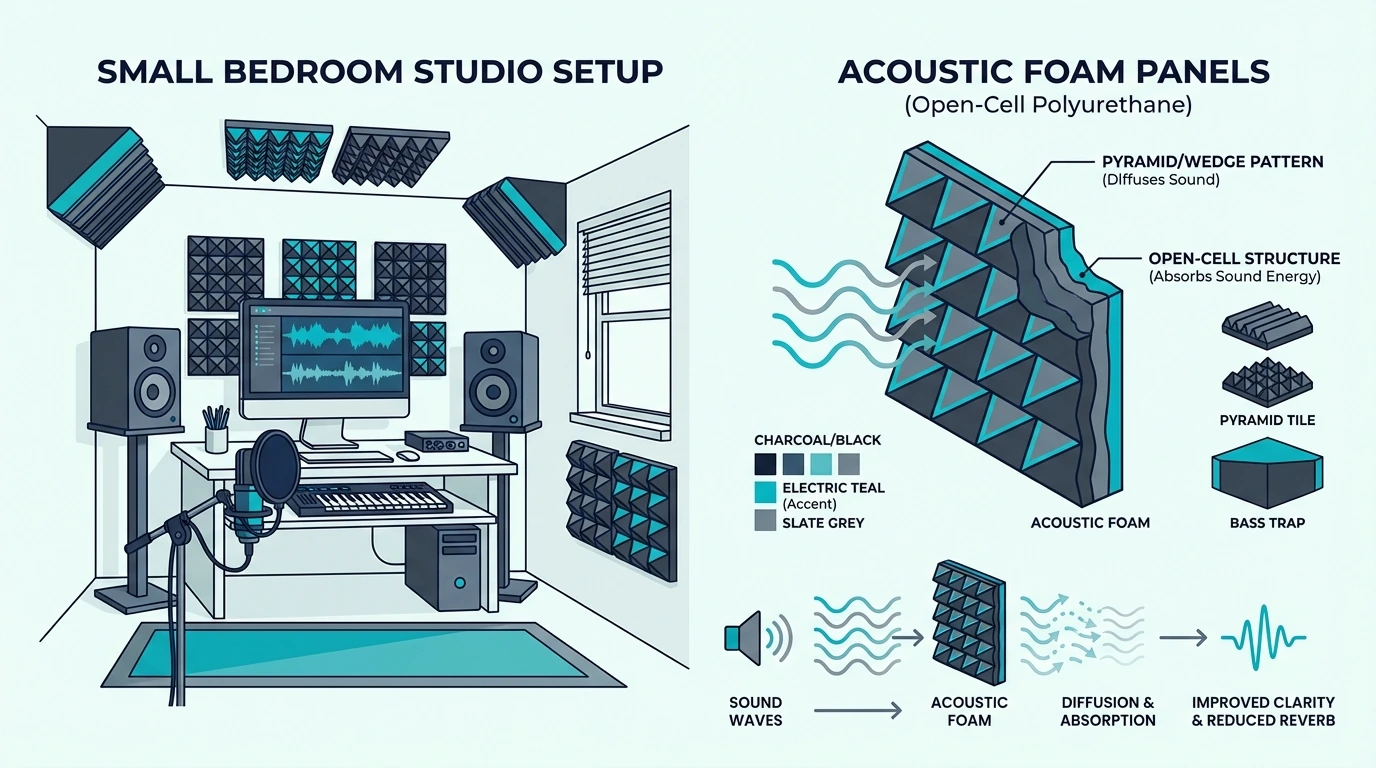
But in a hybrid space — like a home office that doubles as a podcast studio — foam tiles look immediately out of place against normal furniture.

Do Polyester Panels Last Longer Than Acoustic Foam?

Timeline Infographic Showing Polyester Panel Intact After 15 Years On Left Versus Crumbling Yellowed Acoustic Foam After 3 Years On Right for polyester vs foam acoustic panels

The lifespan gap between these materials is massive, driving the real cost difference over time.

Polyester Durability

Because PET fibers don’t crumble or compress easily, a polyester panel installed today will likely look identical a decade from now. They resist humidity, survive getting bumped or brushed against, and clean up with a basic vacuum attachment. It’s common to get 15 to 20 years of use from a permanent polyester installation without it ever turning into a maintenance chore.

Acoustic Foam Durability

Acoustic foam ages faster than almost any other treatment material on the market. Direct sunlight yellows it, high humidity covers the cell structure, and physical contact tears the delicate wedges.

Budget foam often looks tired and dusty within 18 months, and even premium foam eventually requires replacement as the polyurethane degrades. If you want a “mount it and forget it” solution, foam rarely survives the test of time. For a deeper look at long-term sizing strategies, the 1-inch vs 2-inch panel thickness guide covers how depth affects absorption longevity.

How Much Do Polyester Panels and Acoustic Foam Cost?

Price Comparison Showing Polyester Panel With Higher Price Tag On Left And Stack Of Budget Acoustic Foam Tile Packs With Lower Price On Right for polyester vs foam acoustic panels

Upfront, foam is cheaper — but the full picture requires looking at the total cost of ownership over the life of the treatment.

Price Ranges

Foam’s lowest-in-class entry cost remains its biggest selling point for budget studios. A 24-pack of 1-inch wedge tiles can run under $30, allowing you to cover a real chunk of wall space immediately.

Polyester panels demand a higher initial investment, particularly for large decorative boards or custom cuts. If you want to test placement before committing to full-size rigid panels, thinner felt tiles like TroyStudio felt panels keep the entry cost low while maintaining the cleaner PET aesthetic.

Total Cost of Ownership

The true cost calculation flips when you factor in replacement cycles. Acoustic foam often forces you to buy twice: once now, and again in three years when it begins to crumble or look dingy. Because polyester is a “buy once and leave it” material, its higher upfront premium frequently translates to a lower per-year cost over a decade of use.

Which Is More Eco-Friendly: Polyester or Foam?

Recycled PET Bottles Transforming Into Polyester Acoustic Panel On Left Versus Petroleum Barrel Producing Polyurethane Foam Tiles On Right for polyester vs foam acoustic panels

If you already prioritize safety and longevity, the environmental angle points in the same direction.
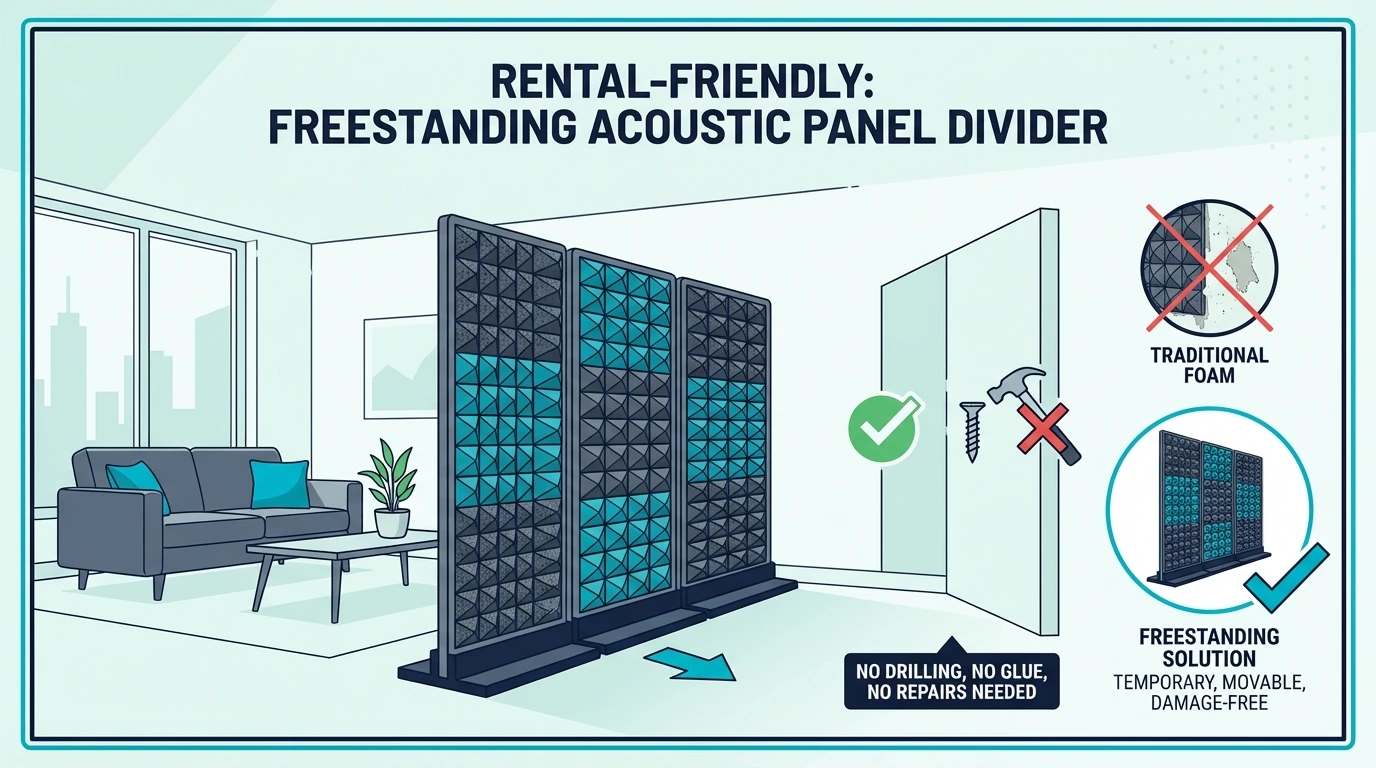
Polyester Environmental Profile

Many acoustic PET panels are manufactured directly from recycled plastic water bottles, keeping existing plastic out of landfills. Combined with their 15+ year lifespan and lack of added chemical fire retardants, they represent a highly sustainable treatment path.

Acoustic Foam Environmental Profile

Acoustic foam, conversely, is a petroleum-based polyurethane product that is difficult to recycle at the end of its life. Because the material degrades much faster, it generates much more waste over time as you cycle through replacements. Add in the chemical fire treatments required to make it safe, and foam’s environmental footprint is considerably heavier.

Which Is Easier to Install: Polyester Panels or Foam?

Person Mounting Rigid Polyester Panel With Brackets On Left Versus Person Pressing Adhesive-Backed Foam Tile Onto Wall On Right for polyester vs foam acoustic panels

Foam takes the win for pure speed, but that convenience comes with long-term compromises.

Polyester Panel Installation

Rigid polyester boards mount exactly like traditional acoustic panels: you map out your reflection points, measure twice, and use dedicated hardware like Z-clips or impaling clips. It takes longer and often requires drywall anchors, but the result is a clean, permanent fixture that will never sag or peel away from the wall. If you’re not sure where to start with hardware, see how to hang acoustic panels.

Acoustic Foam Installation

Foam’s ultra-lightweight nature makes it very forgiving to hang. You can stick it up solo using double-sided adhesive tabs, 3M Command strips, or spray adhesive in an afternoon.

That speed appeals to renters and DIYers who want immediate results without drilling holes. The catch is that adhesives frequently fail on textured or dusty walls, and budget packs like the Focusound 24-pack wedge foam often leave sticky residue behind that requires patching and painting when you eventually move out.

For detailed mounting techniques that minimize damage, see how to install acoustic panels.

When Should You Choose Polyester Panels Over Foam?

Split Scene Showing Office With Polyester Panels On Visible Walls On Left And Home Studio With Acoustic Foam Tiles Covering Back Wall On Right for polyester vs foam acoustic panels

It all depends on the room’s constraints and who else has to look at the walls.

When to Choose Polyester

Invest in rigid PET boards for commercial spaces, living rooms, and on-camera podcast setups where aesthetics are non-negotiable. They are also the mandatory choice for schools, hotels, or public buildings where strict fire codes require inherently flame-retardant materials.

Polyester panels are ideal for long-term installations where you want to minimize replacement costs and hassle. They’re also the better choice for eco-conscious projects where environmental impact is a priority.

When to Choose Acoustic Foam

Stick to foam for dedicated tracking rooms and vocal booths where appearance is secondary to rapid, budget-friendly coverage. It’s also the pragmatic choice for temporary rental spaces where you plan to take everything down in a year and don’t want to drill holes.

Foam is the better option for quick DIY projects where you need immediate results without planning a mounting layout. It’s also the cheapest way to tame flutter echo and bright reflections fast, but be aware that quality and safety ratings vary widely between brands.

If you want to skip the debate and just see the top performers, the best acoustic panels roundup covers the exact models to buy. To estimate how much surface area you actually need to cover, use how many acoustic panels you need as a starting formula.

Can You Use Polyester Panels and Acoustic Foam Together?

Room Diagram Showing Polyester Panels On Visible Front Walls And Acoustic Foam Tiles Hidden Behind Desk And Equipment for polyester vs foam acoustic panels

You don’t have to pick one product for every wall.

Strategic Combination

A practical hybrid is to use polyester panels in visible areas for the finished look, and stick foam tiles in hidden areas (behind monitors, closet walls, ceiling corners) where you just want cheaper absorption. Then handle corners separately, because neither polyester nor foam is a bass solution on its own.
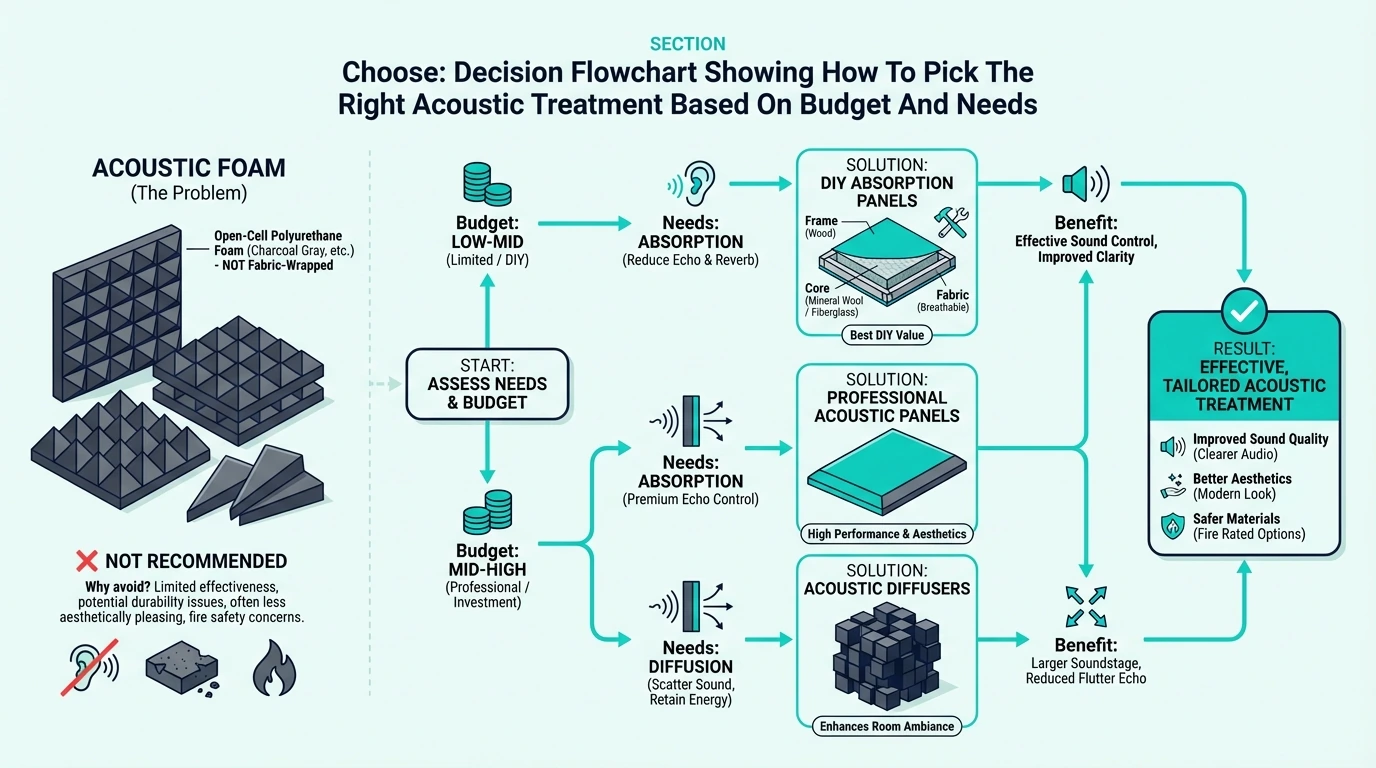
Polyester handles the visible walls, foam fills the hidden gaps, and you save money without sacrificing the look.

Supplementing with Bass Traps

Neither polyester panels nor acoustic foam effectively absorbs bass. For complete treatment, add bass traps regardless of which material you choose.

The mounting bass traps guide covers low-frequency treatment options.

The Bottom Line

Polyester panels outperform acoustic foam on absorption (at the same thickness), fire safety, durability, aesthetics, and environmental impact. If you are treating a space you plan to keep for years, polyester is the stronger investment.

Acoustic foam still wins on two fronts: upfront cost and installation speed. If you are renting, experimenting, or treating a dedicated studio where looks do not matter, foam tiles are a practical entry point.

The key distinction most buyers miss: these are different product categories, not just different materials. Polyester panels are rigid, mountable, and designed to last.

Acoustic foam is lightweight, adhesive-backed, and built for speed and budget.

For help deciding how much coverage your room needs, the panel placement guide covers first reflection points and coverage ratios. If you are weighing polyester against other rigid options, the fabric for acoustic panels breakdown covers wrapping materials that pair well with PET cores.

And if fire safety is a dealbreaker in your space, the acoustic panels vs soundproofing comparison clarifies what panels can and cannot do for noise control.

Frequently Asked Questions

Are polyester acoustic panels better than acoustic foam?

At the same thickness, polyester panels absorb more sound energy across a wider frequency range. The gap is largest at 1-inch thickness, where most budget foam performs much worse than polyester.

Neither material handles bass below about 250 Hz, so treat low frequencies separately.

Are polyester panels safer than foam?

Usually, yes. Polyester is typically naturally flame-retardant, while foam depends on treatments and quality can vary by brand.

If fire safety and code compliance are a concern, polyester is the safer default choice.

Do polyester panels last longer than foam?

Yes, by a lot in most real rooms — quality polyester panels can last 15-20+ years with minimal degradation. Foam often covers faster (UV, humidity, handling), especially budget foam, so plan on replacing foam sooner in rooms with direct sunlight.

Which is better for a home studio: polyester panels or acoustic foam?

If it is a dedicated studio where looks do not matter, acoustic foam can be the most cost-effective way to cover enough surface area quickly. If the studio shares space with living areas (or clients visit), polyester panels usually look more professional and last longer.

Acoustically, polyester delivers better absorption per square foot, but foam can compensate through sheer coverage if budget allows enough tiles. Placement matters more than material once you have enough coverage.

Can I mix polyester panels and acoustic foam in the same room?

Yes — using polyester panels in visible areas and foam tiles behind monitors, in closets, or on ceiling corners is a practical way to balance aesthetics and budget. The room can still sound consistent as long as total coverage is adequate.

Are polyester panels worth the extra cost over foam?

For permanent installations in visible spaces, often yes. Better absorption per square foot, longer lifespan (15–20+ years vs 2–5 years for foam), stronger fire safety ratings, and more design options can justify the premium.

For temporary setups, rental spaces, or extremely tight budgets, acoustic foam tiles make more practical sense.