Acoustic Foam vs Diffusers: Which One Does Your Room Actually Need?

If you’re deciding between acoustic foam and diffusers, start by naming the problem. Is it too much echo/reverb, or a room that already feels controlled but still sounds harsh?

Foam absorbs sound energy (it removes reflections), while diffusers scatter it (they keep the room lively while breaking up focused reflections). Start with the quick takeaway, then we’ll walk through placement, room-size rules, and the “use both” setup that most rooms actually need.

Quick Takeaway

Use acoustic foam when you need to reduce echo/reverb (absorption), and use diffusers when you want to control reflections without making the room feel dead (diffusion). In small rooms, start with foam at first reflection points and only add diffusion later if you have enough distance and the room feels too dry.

What Acoustic Foam Actually Does
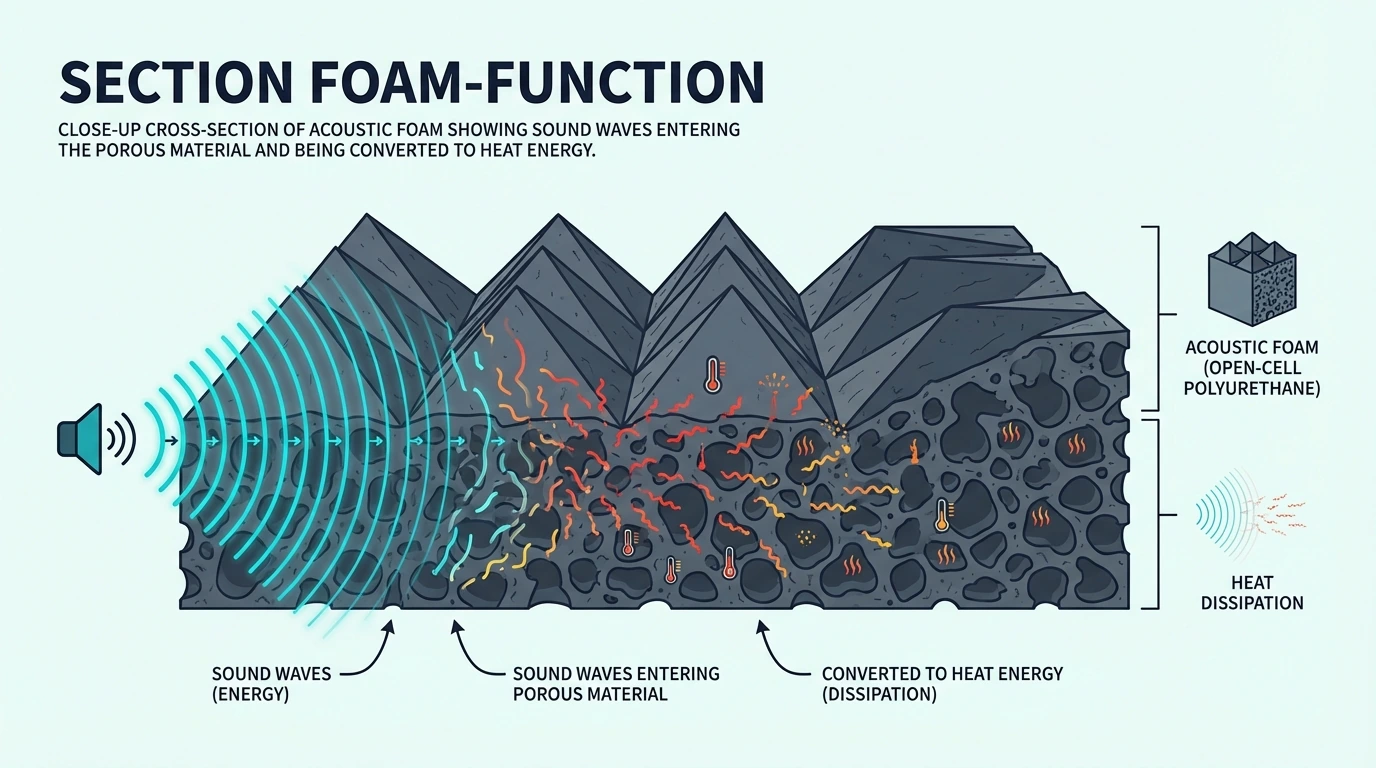
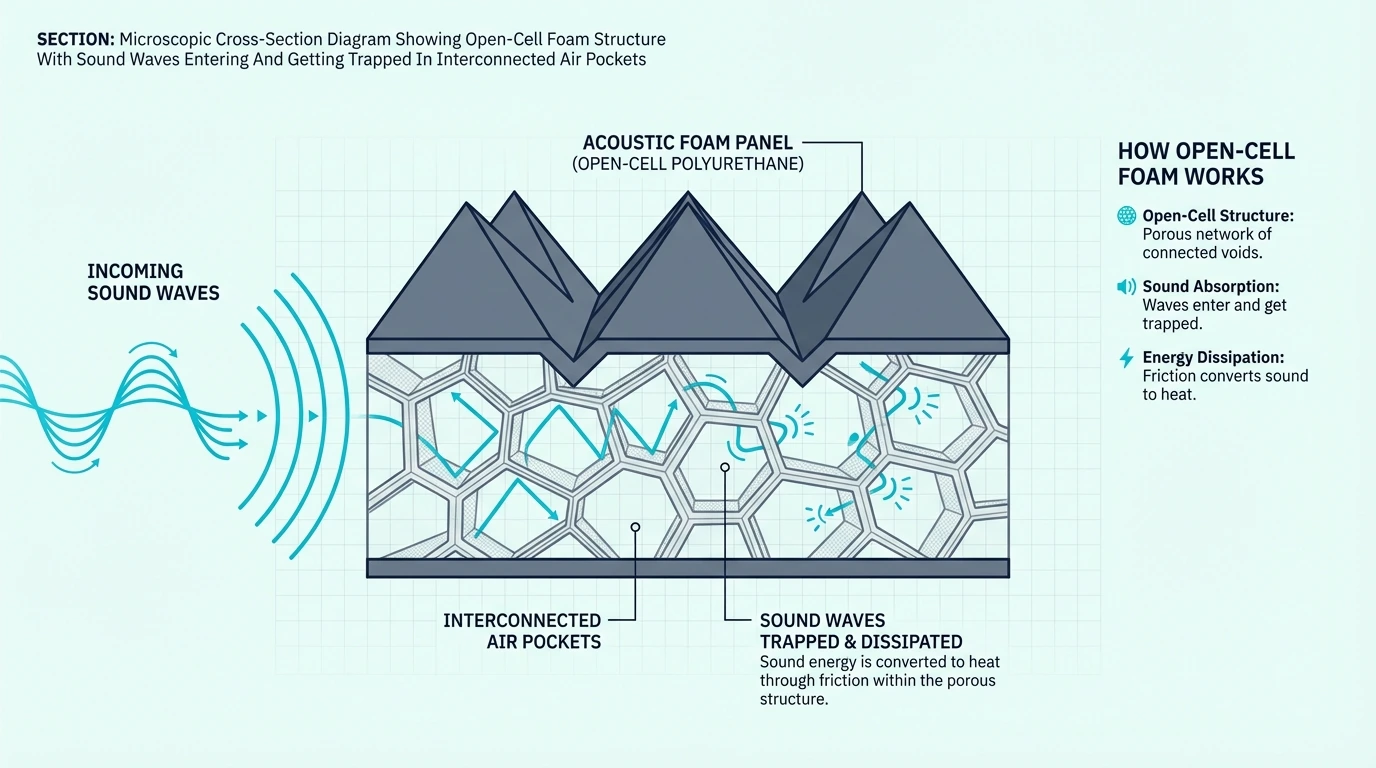
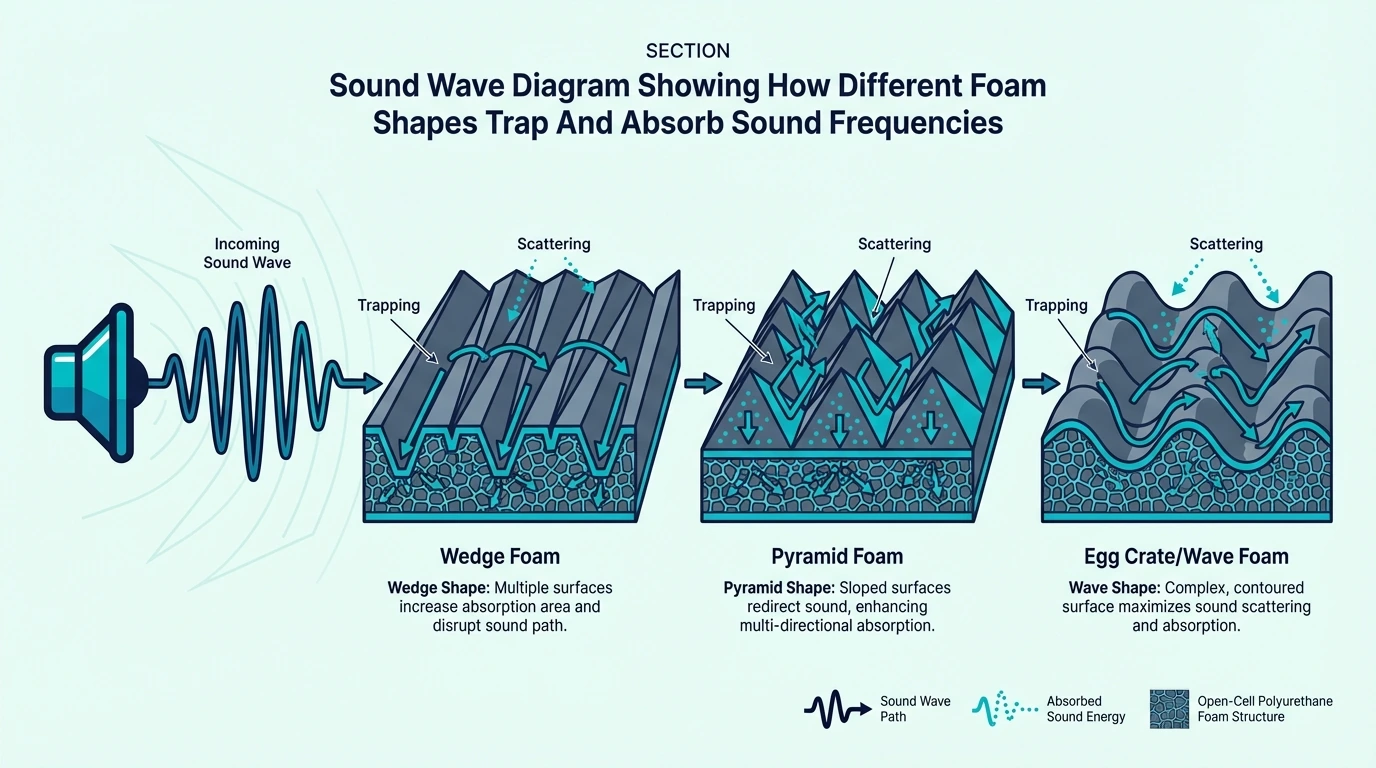
Cross-section of acoustic foam absorbing sound waves

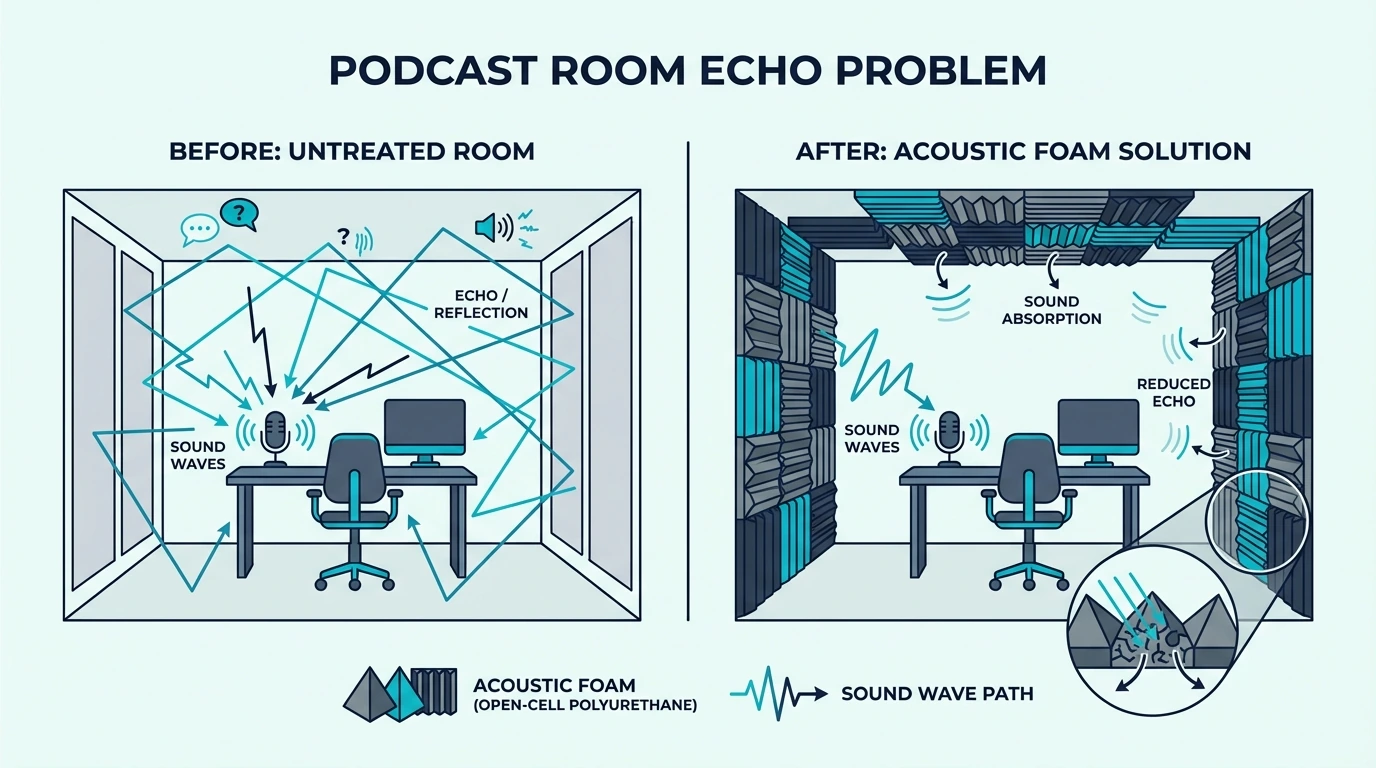
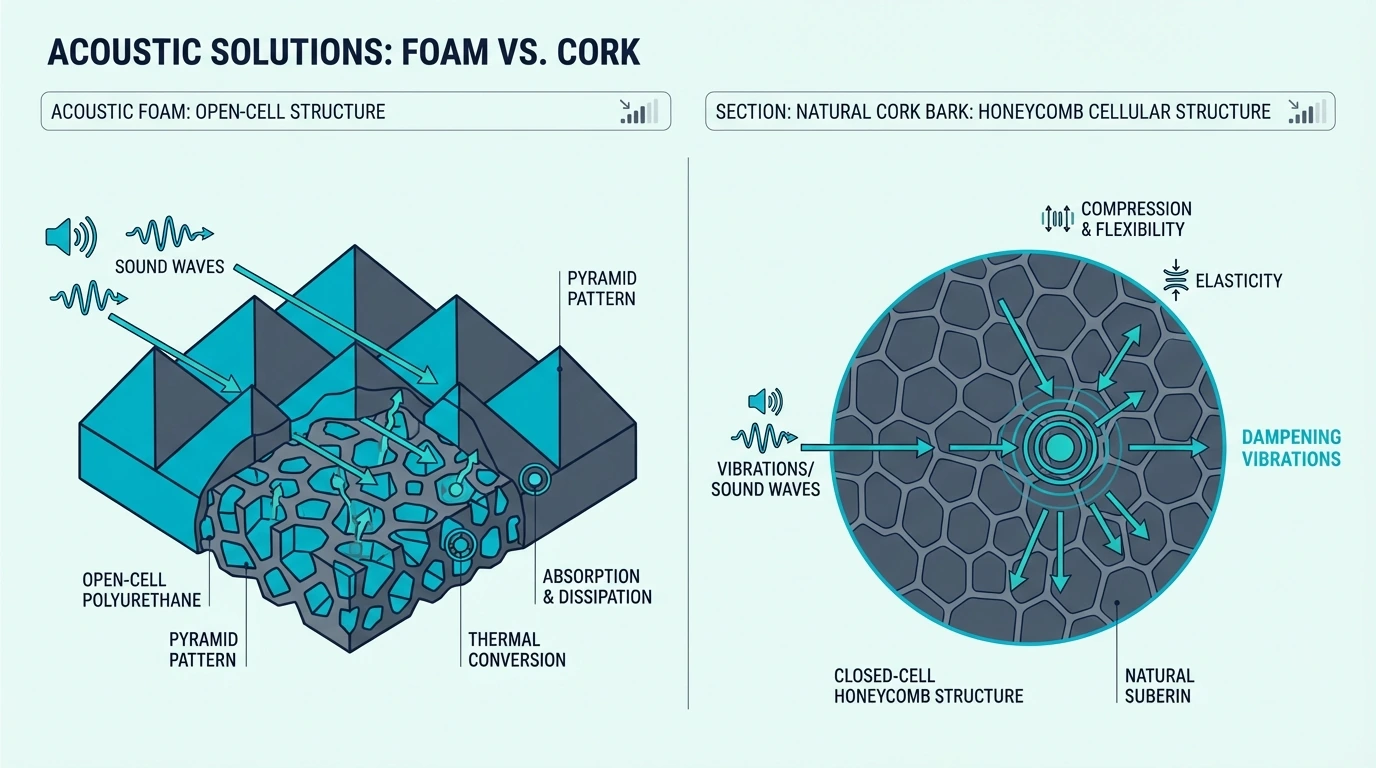
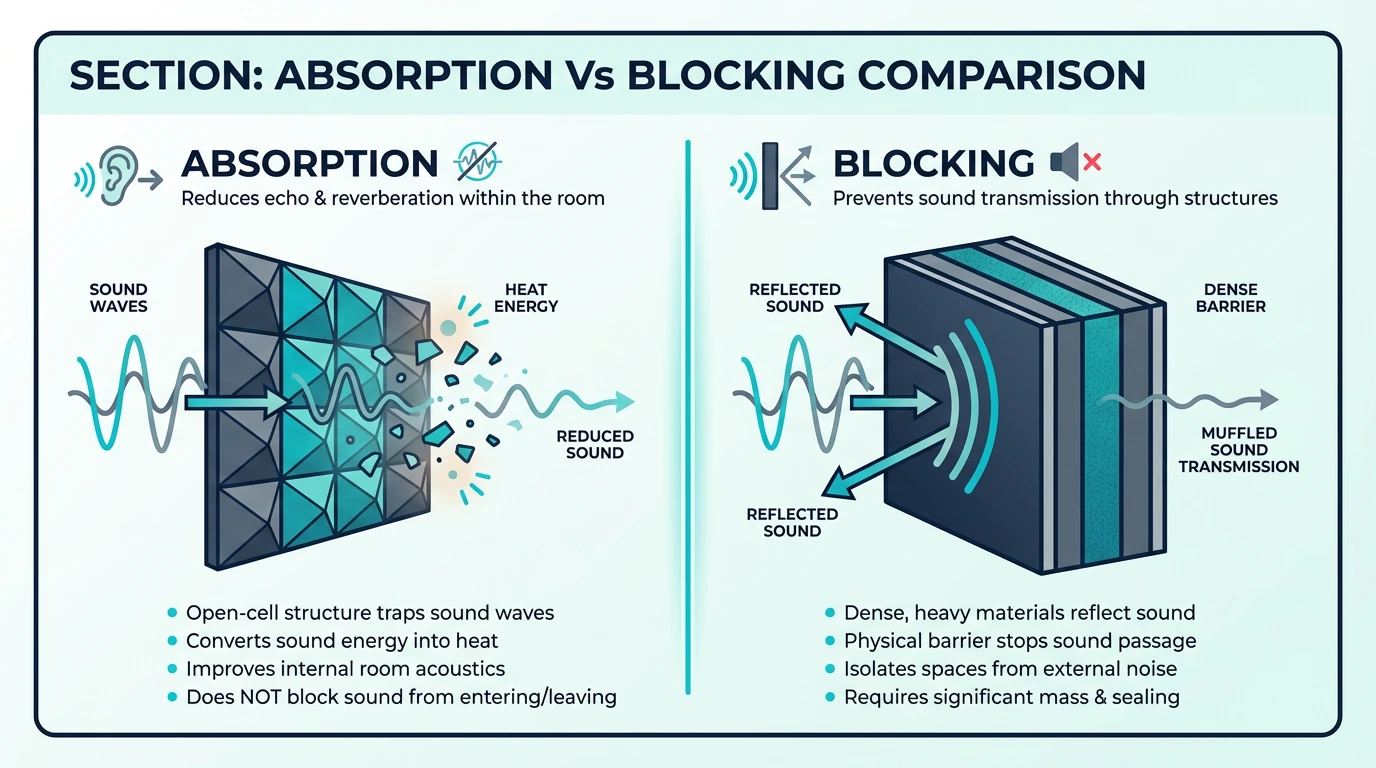
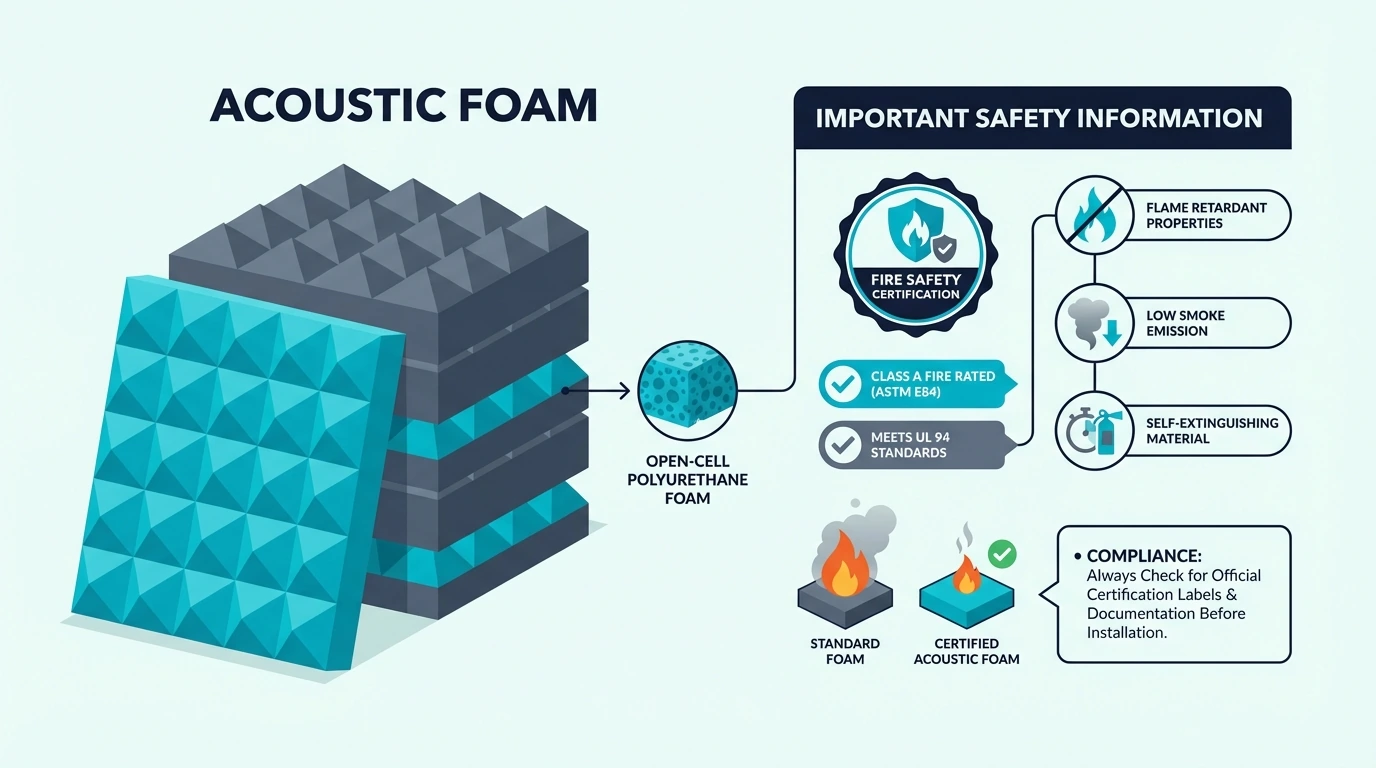
Acoustic foam absorbs sound energy by pulling reflections into its open-cell structure, where friction turns that motion into heat. Instead of bouncing back into the room, part of the reflection gets dissipated inside the foam.

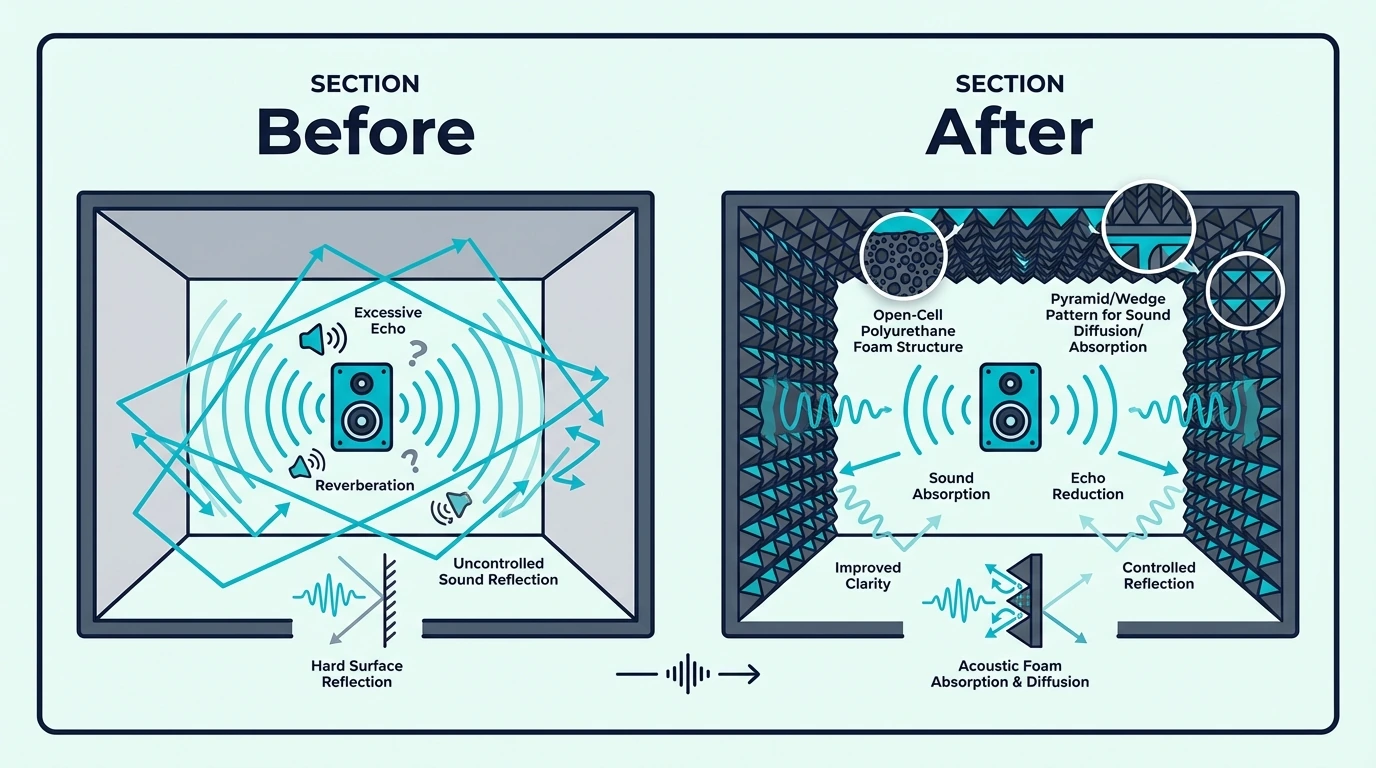
That absorption reduces reflections inside your room, which shortens reverb. In an untreated space, sound bounces off hard surfaces again and again; foam catches some of those reflections before they can build up.

How Absorption Changes Your Room

You can hear the difference immediately—clap in an untreated room, then clap again after adding foam. The ringing tail gets shorter, and the room feels tighter and more controlled.

For recording, this matters because microphones capture room reflections just as easily as the source. Foam at the right spots reduces that splashy “bathroom” sound and gives you a cleaner, more direct take.

The tradeoff is that absorption removes acoustic energy permanently. Overdo it and the room can feel unnaturally dead—so placement and coverage matter.

What Foam Does Well

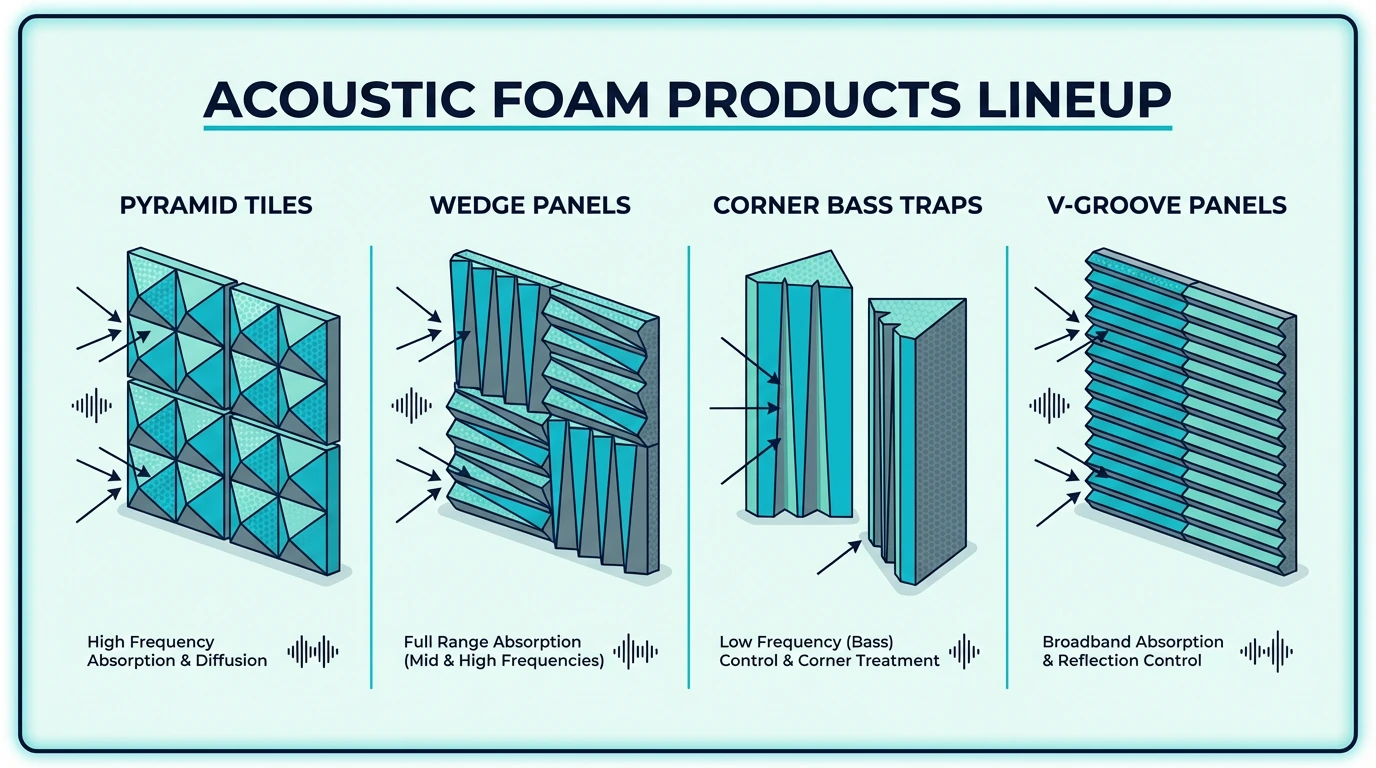
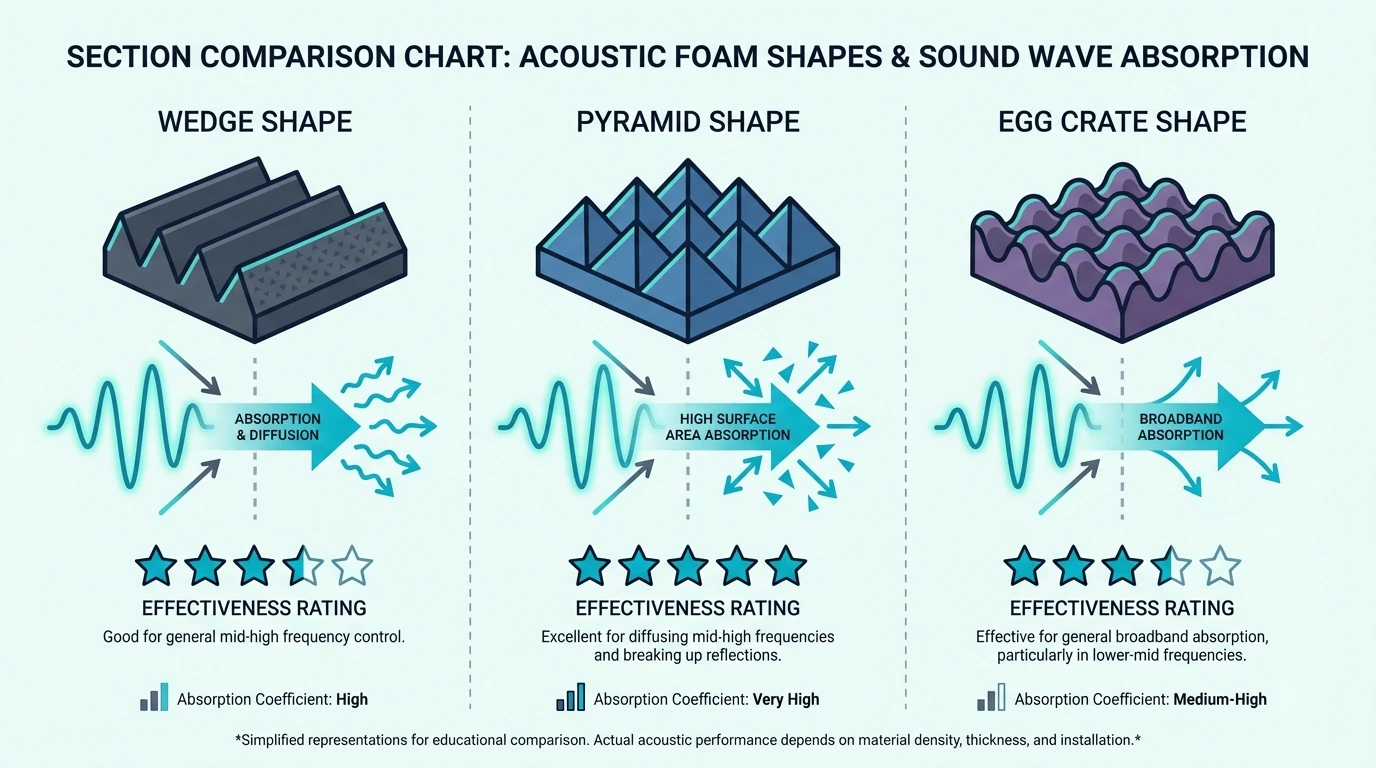
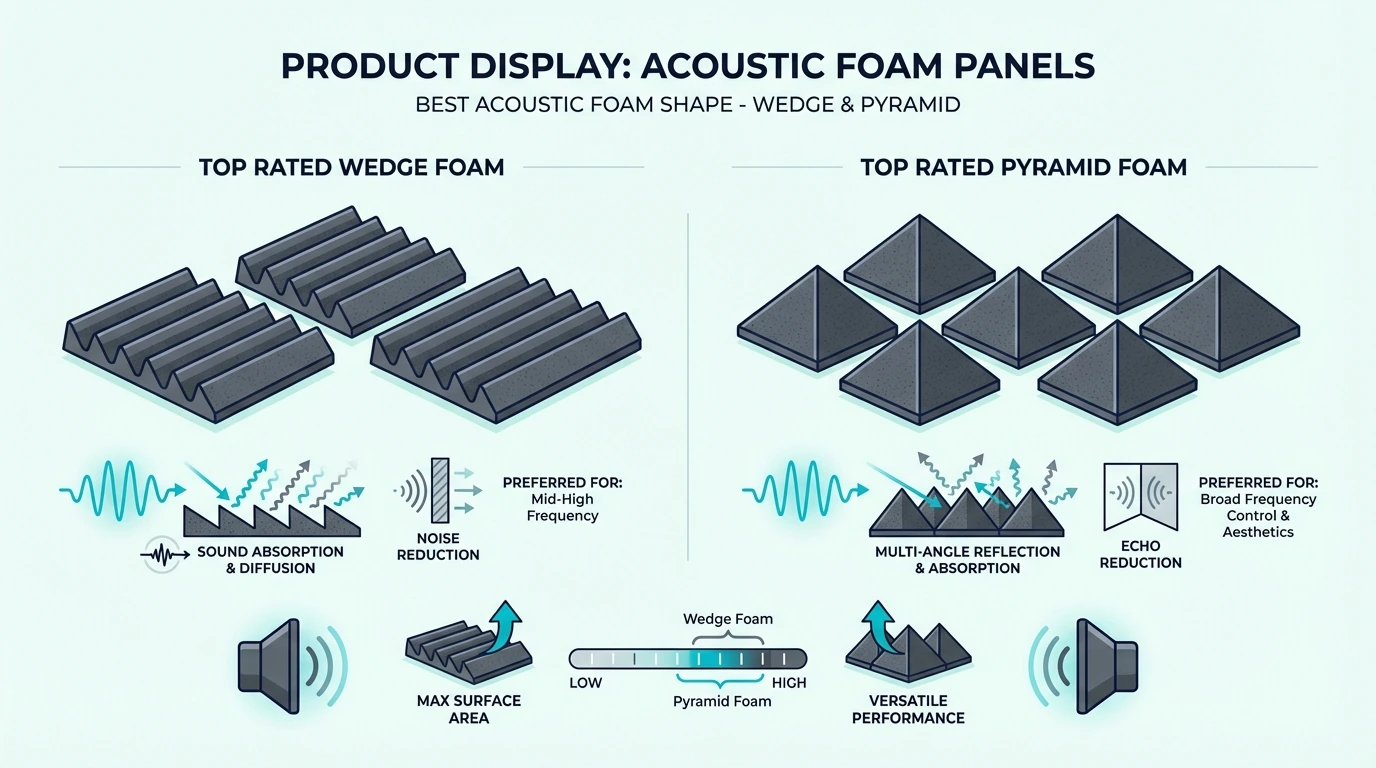
Foam excels at controlling mid and high frequencies. The pyramid and wedge shapes you see on studio walls target roughly 500Hz to 8kHz, where speech clarity and most musical detail lives.

Flutter echo—that metallic ringing between parallel walls—disappears with foam treatment. Even a few panels can break up the reflection pattern that causes it.

For home studios, podcasters, and content creators, foam often delivers the biggest improvement per dollar because it’s affordable, easy to install, and built for small-room reflections. The does acoustic foam work guide covers real-world results if you want a reality check before buying.

What Foam Does Poorly

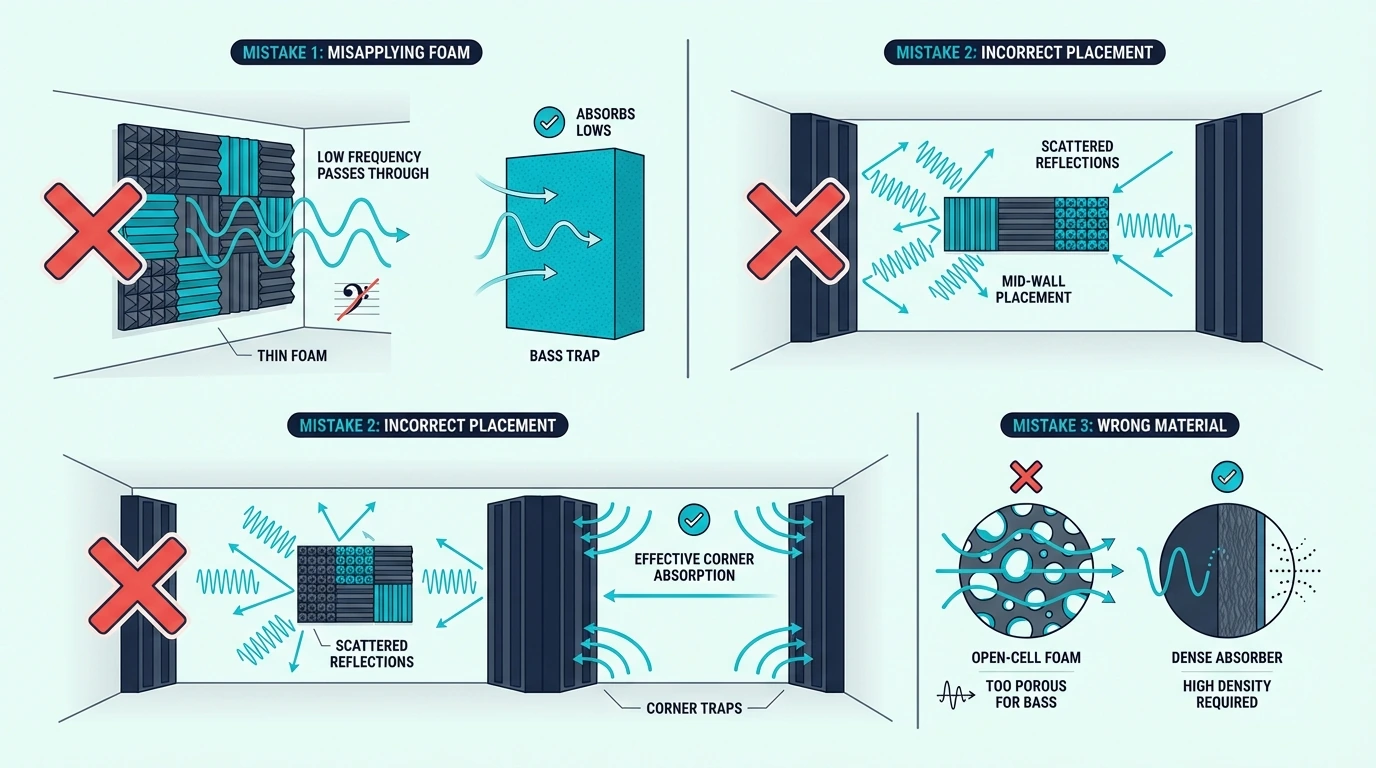
Bass frequencies pass right through standard foam because the wavelengths are too long for thin panels to absorb. If you’re hearing boomy bass or muddy low-mids, skip more foam and go straight to bass traps.

Foam can’t add anything to your room — it only subtracts reflections. The normal foam vs acoustic foam comparison explains why material type matters for that subtraction. If the space already sounds lifeless, more absorption will make that worse, not better.

What Diffusers Actually Do
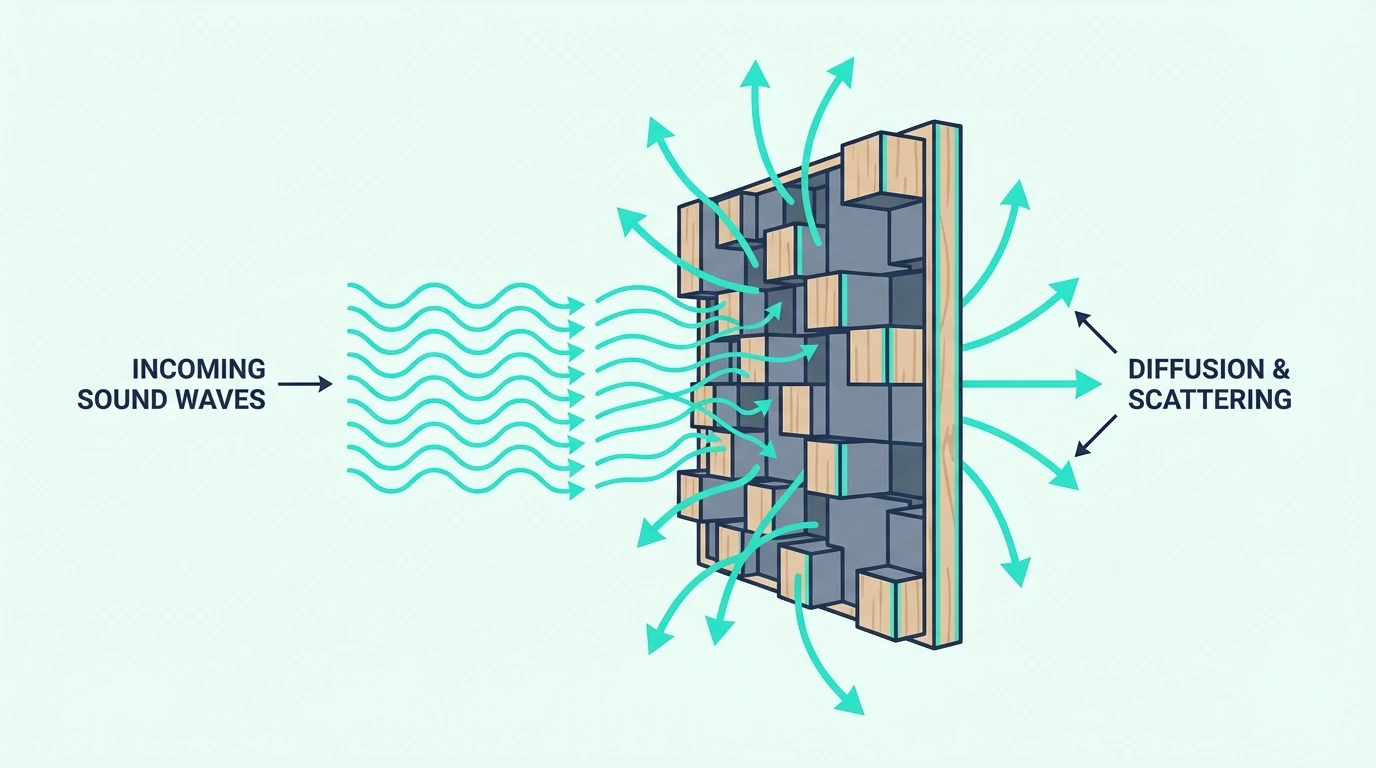
QRD diffuser scattering sound waves in multiple directions

Diffusers scatter sound waves instead of absorbing them, so reflections get redirected rather than removed. The energy stays in the room, but it spreads out instead of firing back as a single harsh reflection.

This scattering eliminates harsh reflections without removing acoustic energy. Your room maintains its natural liveliness while losing the problematic focused reflections that cause flutter echo and comb filtering.

How Diffusion Changes Your Room

Diffusion is subtler than absorption, but it changes how a room feels. Instead of hearing reflections ping between specific surfaces, the space feels wider and more natural.

Professional studios use diffusion extensively, especially in control rooms and live rooms. It creates that “expensive studio sound” where the room enhances recordings rather than fighting them.

For critical listening—mixing, mastering, or high-end audio playback—diffusion provides accuracy that pure absorption can’t match. You hear the recording, not an artificially dead room.

What Diffusers Do Well

Diffusers excel at maintaining room ambience while controlling reflections. They’re the solution when absorption would make your space too dead but you still need to address flutter echo or harsh reflections.

Behind the listening position in a studio, diffusers scatter rear-wall reflections without creating the “anechoic chamber” effect that too much absorption causes. You get controlled sound without unnatural deadness. The foam vs rockwool comparison covers which absorber delivers that accuracy best.

For larger rooms—home theaters, music rooms, live performance spaces—diffusion often works better than absorption. These spaces need some reverb to sound natural; diffusers control it without eliminating it.

What Diffusers Do Poorly

Diffusers don’t reduce overall sound levels, so they won’t fix a room that’s obviously echoey on their own. If you need the reverb time to drop, you need absorption somewhere in the plan.

They’re also ineffective in very small rooms because diffusion needs distance to develop. In a tiny bedroom studio, you’re often too close for a diffuser to do meaningful work.

Quality diffusers also cost more than foam because the shapes have to be built precisely. It’s common for one well-designed QRD diffuser to cost more than treating a whole wall with foam.

The Fundamental Difference Explained
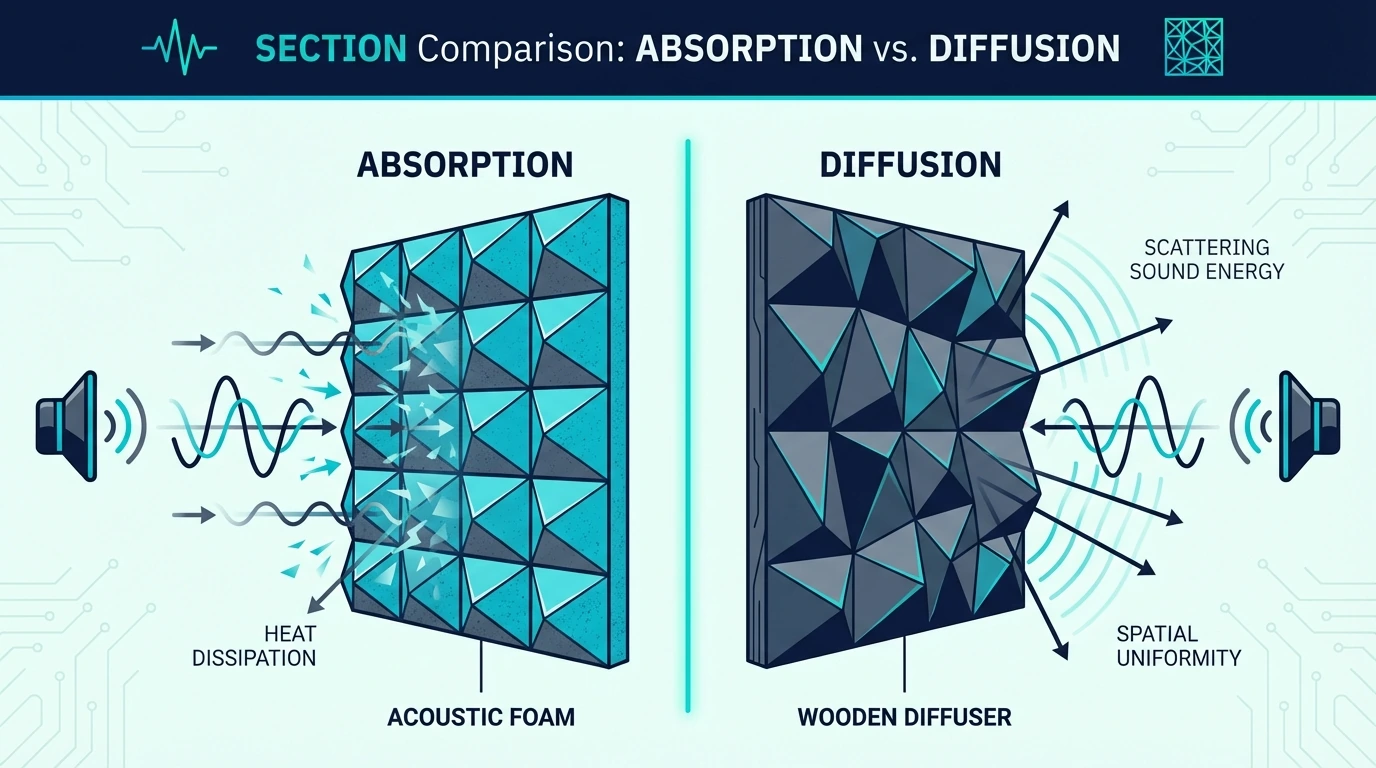
Absorption vs diffusion: foam absorbs while a diffuser scatters reflections

Think of it this way: foam is a sponge, diffusers are a prism.

A sponge soaks up water and it’s gone; foam does the same with sound energy. It pulls reflections in, turns that motion into heat, and removes energy from the room.

A prism takes light and spreads it into a rainbow—the light isn’t absorbed, just redirected. Diffusers take sound and spread it across the room—the energy stays but distributes evenly instead of focusing into problematic reflections.

When Energy Removal Helps

Absorption helps when you simply have too much sound energy bouncing around. In small rooms, each reflection stacks on the next until speech feels muddy and recordings pick up that amateur “room” sound.

Absorption brings order by lowering the total reflection energy, which shortens reverb and cleans up clarity. For most home studios, that’s the first win you need.

Recording spaces benefit from absorption because you want the mic to capture the source, not the room. Foam helps reduce the space’s fingerprint so your voice or instrument sounds more direct.

When Energy Preservation Helps

Preserving acoustic energy helps when your room sounds too dead or when you want natural ambience. Some reverb is desirable—it makes spaces feel alive and music feel connected to a physical environment.

Mixing and mastering rooms need accuracy, but they don’t need to feel anechoic. Too much absorption can push your decisions in the wrong direction, while diffusion helps keep the room natural without adding harsh reflections.

Live performance spaces, home theaters, and listening rooms benefit from controlled reverb. Diffusers let you shape the room’s sound without killing it entirely.

Room Size Matters More Than You Think
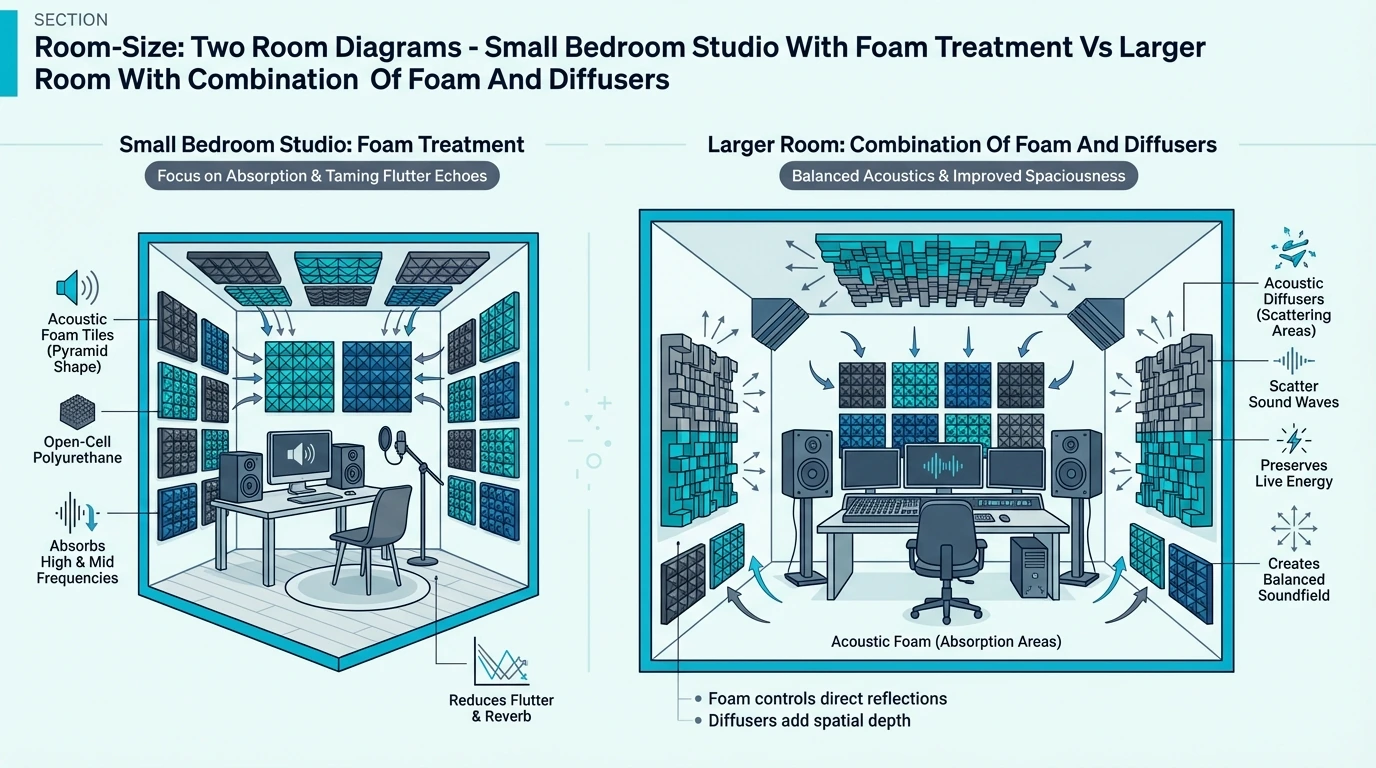
Small vs large room treatment: foam-only vs foam plus diffusers

The size of your room largely determines whether foam, diffusers, or both make sense. This isn’t arbitrary—it’s physics.

Small Rooms (Under 150 sq ft)

Small rooms need absorption more than diffusion. The walls are too close for diffusion to work effectively, and sound builds up quickly in confined spaces.

Most bedroom studios should start with absorption, not diffusion, because you’re usually too close to the walls for a diffuser to develop properly. The acoustic foam placement guide covers the key positions for small rooms.

Focus your budget on quality foam panels at key positions: behind your monitors, at side-wall reflection points, and behind your recording position. Skip diffusers unless you have specific problems that absorption can’t solve.

Medium Rooms (150-400 sq ft)

Medium rooms benefit from both treatments. You have enough space for diffusion to work, but the room is still small enough that absorption remains important.

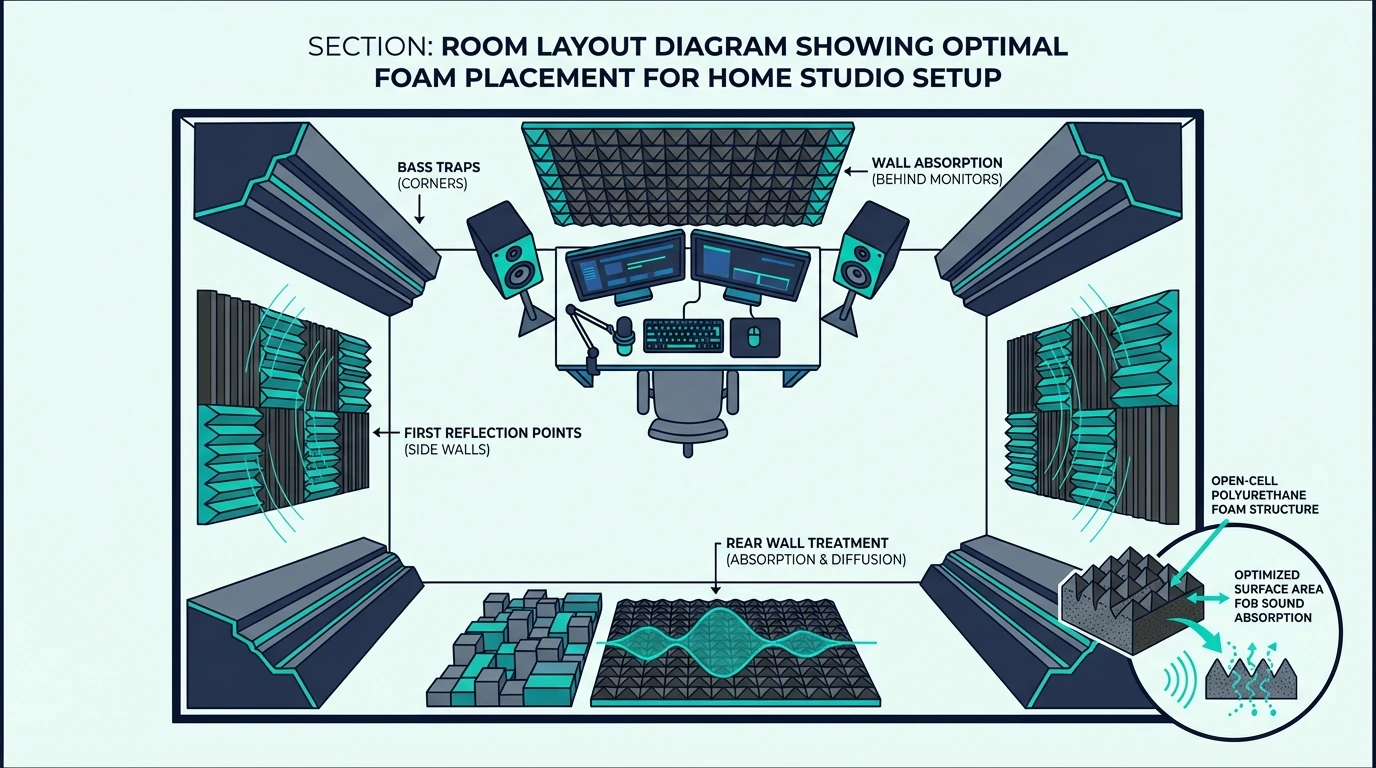
The classic approach: foam at first reflection points (sides and ceiling), diffuser on the rear wall. This controls early reflections while maintaining some natural ambience from the back of the room.

For recording in medium rooms, you might use foam around the recording position and diffusers elsewhere. This creates a controlled recording environment without making the entire room feel dead.

Large Rooms (400+ sq ft)

Large rooms often need more diffusion than absorption. These spaces have natural reverb that sounds good—you don’t want to kill it entirely.

Home theaters, dedicated listening rooms, and music studios in larger spaces use diffusion extensively. The goal is controlling reflections while preserving the room’s natural acoustic character.

Absorption still has a role—bass traps in corners, foam at specific reflection points—but diffusion becomes the primary treatment for managing the room’s overall sound.

Practical Applications: Which to Use Where
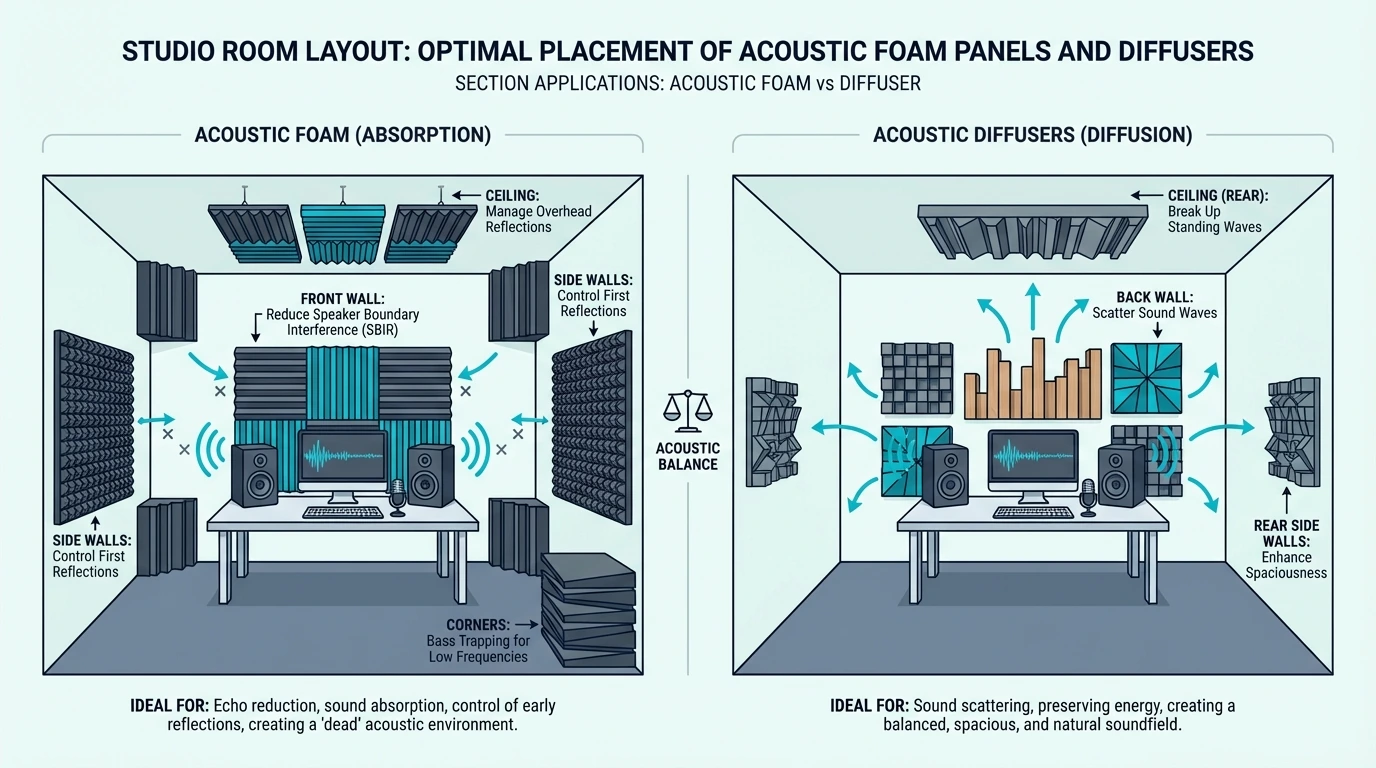
Studio layout showing where to place foam panels and diffusers

Here’s where each treatment works best, position by position.

Behind Your Monitors/Speakers

Use: Absorption (foam or panels)

The wall behind your speakers creates strong early reflections that interfere with direct sound. These reflections cause comb filtering—frequency cancellations that color what you hear.

Foam or absorptive panels behind monitors eliminate this problem. You hear the speakers more accurately without the wall’s contribution muddying the sound.

Diffusers don’t work well here. You’re too close, and scattering the reflection doesn’t help—you need to eliminate it entirely.

Side Walls (First Reflection Points)

Use: Absorption (foam or panels)

First reflection points are where sound bounces from your speakers to your ears via the side walls. These reflections arrive milliseconds after the direct sound and confuse your perception of stereo imaging.

Find these points with the mirror trick: sit in your listening position and have someone slide a mirror along the wall. Where you see your speaker in the mirror, that’s a first reflection point.

Foam panels at these positions can clean up your stereo image noticeably, and it’s one of the highest-impact treatments you can make in any room. The wall installation guide covers step-by-step mounting for every surface type.

Rear Wall (Behind Listening Position)

Use: Diffusion (preferred) or Absorption

The rear wall is where diffusion shines. Reflections from behind you arrive late enough that scattering them works better than absorbing them entirely.

A diffuser on the rear wall maintains room ambience while preventing focused reflections from coloring your perception. The sound stays lively without being problematic.

If your room is very small or very reverberant, absorption might work better here. But for most medium-to-large rooms, diffusion is the superior choice for the rear wall.

Ceiling (Above Listening Position)

Use: Absorption or Diffusion (depends on height)

Ceiling reflections matter, especially if you have hard ceilings. The treatment choice depends on ceiling height.

Low ceilings (under 9 feet) benefit from absorption. You’re close enough that reflections are problematic, and there’s not enough distance for diffusion to work.

With higher ceilings, you can use either treatment depending on how you want the room to feel. Diffusion keeps the sense of vertical space, while absorption gives you maximum control.

Corners

Use: Bass Traps (specialized absorption)

Corners are where bass builds up. Neither standard foam nor diffusers address this—you need bass traps specifically designed for low-frequency absorption.

This is a separate topic from the foam vs diffuser debate, but it’s worth mentioning: if you have bass problems, neither foam panels nor diffusers will help. You need dedicated corner bass traps.

Cost Comparison: What You’ll Actually Spend
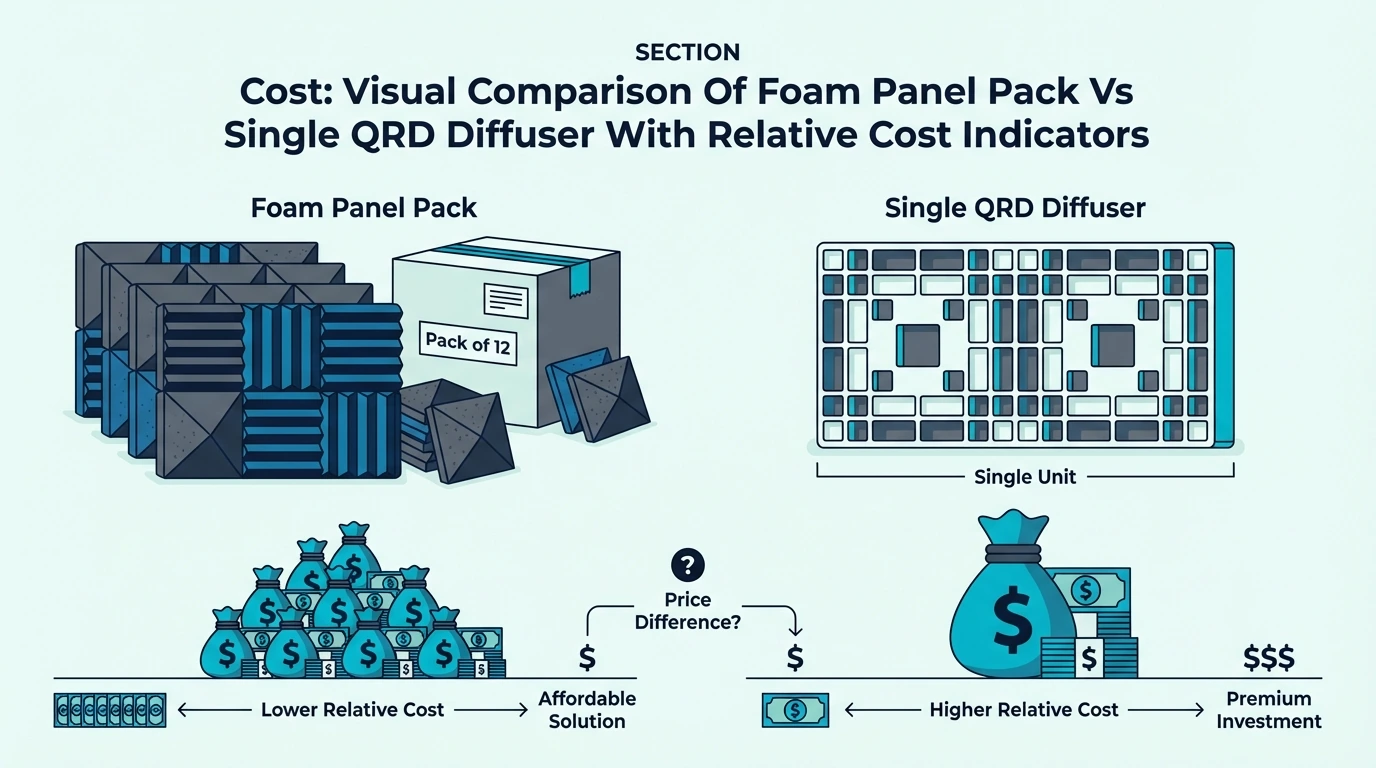
Cost comparison: foam panel pack vs a QRD diffuser

Budget often determines treatment choices as much as acoustics do. Here’s the reality.

Acoustic Foam Costs

Budget foam panels run cheap—you can treat a small room for relatively little. Quality varies enormously, but even budget foam provides meaningful absorption.

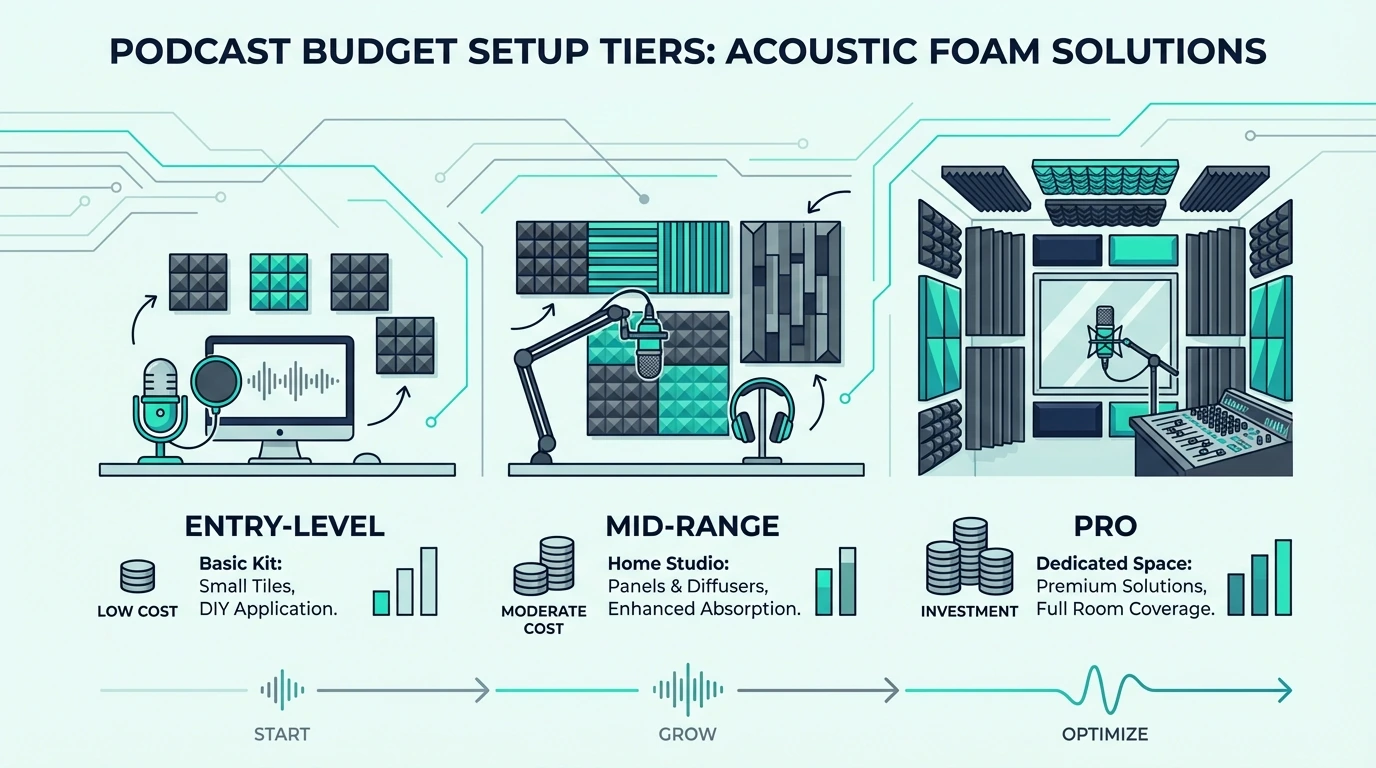
A budget 2-inch starter pack like FONESO 12-pack 2-inch foam panels is a simple way to get absorption on the wall without blowing the budget. Just remember placement matters more than blanket coverage.

Mid-range foam from brands like Auralex or Foamily costs more, but you usually get better consistency and durability. The best acoustic foam panels roundup compares options across price ranges.

If you want more predictable build quality, Auralex Studiofoam DST-114 (24-pack) is a premium option that trades dollars for consistency. It’s still mid/high-focused treatment, so pair it with bass traps if your room’s low end is messy.

Professional-grade absorption panels (fabric-wrapped fiberglass) cost more but outperform foam acoustically. For a deeper look at foam vs fabric-wrapped panels, that comparison covers when each makes financial sense. They’re the choice for dedicated studios where performance matters most.

Diffuser Costs

Diffusers are inherently more expensive. The complex shapes require precision manufacturing, and quality materials (hardwood, high-density foam) add cost.

A single 2×2 foot QRD diffuser often costs more than a 12-pack of foam panels. Treating a rear wall with diffusion can cost several times what full-room foam treatment would cost.

On the diffuser side, a true 2D QRD set like Sirius 2-pack QRD diffusers gives you enough surface area to matter on a rear wall. If you prefer wood, this wood acoustic diffuser panel is another option—just make sure your listening position isn’t right on top of it.

DIY diffusers can save money if you’re handy, because the designs are well-documented and building one from wood is doable. But it takes tools, time, and decent woodworking accuracy.

Value Calculation

For most home studios, foam provides better value. The acoustic improvement per dollar is higher, and the problems foam solves are more common in small spaces.

Diffusers become worthwhile when you’ve already addressed absorption needs and want to refine your room’s sound further. They’re a second-stage treatment for most people, not a starting point.

If budget is tight, spend it on foam first. Add diffusion later when you can afford quality units that actually work.

Common Mistakes to Avoid
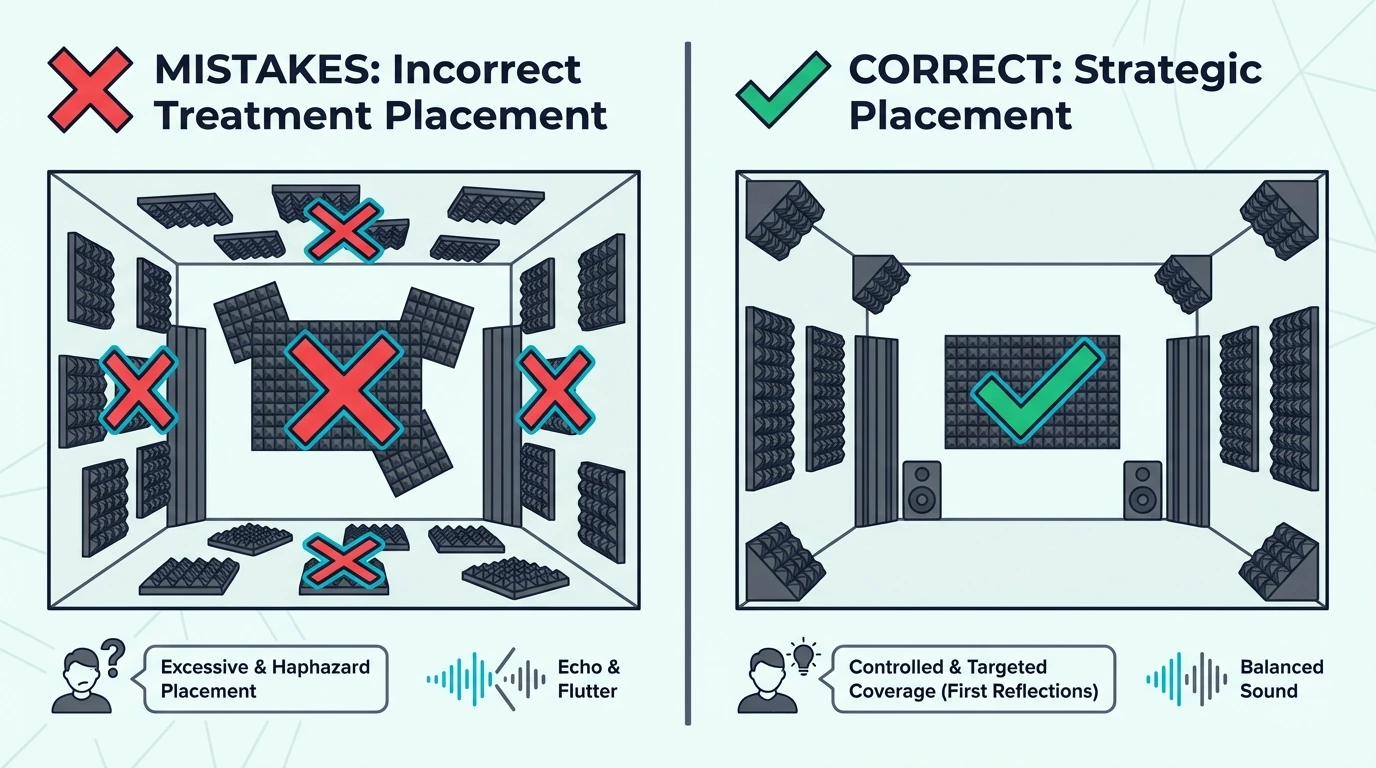
Common mistakes placing foam and diffusers in a room

People make predictable errors when choosing between foam and diffusers. Here’s what to avoid.

Using Diffusers in Tiny Rooms

Diffusion needs distance to develop. In a small bedroom studio you might be only 3–4 feet from the rear wall, which puts you in the near-field where a diffuser can’t do much.

Save diffusers for rooms where you can sit at least 6-8 feet from the diffuser surface. In smaller spaces, absorption works better even on the rear wall.

Over-Absorbing the Room

Too much foam creates an unpleasant, dead-sounding space. Speech sounds muffled, music loses life, and the room feels oppressive.

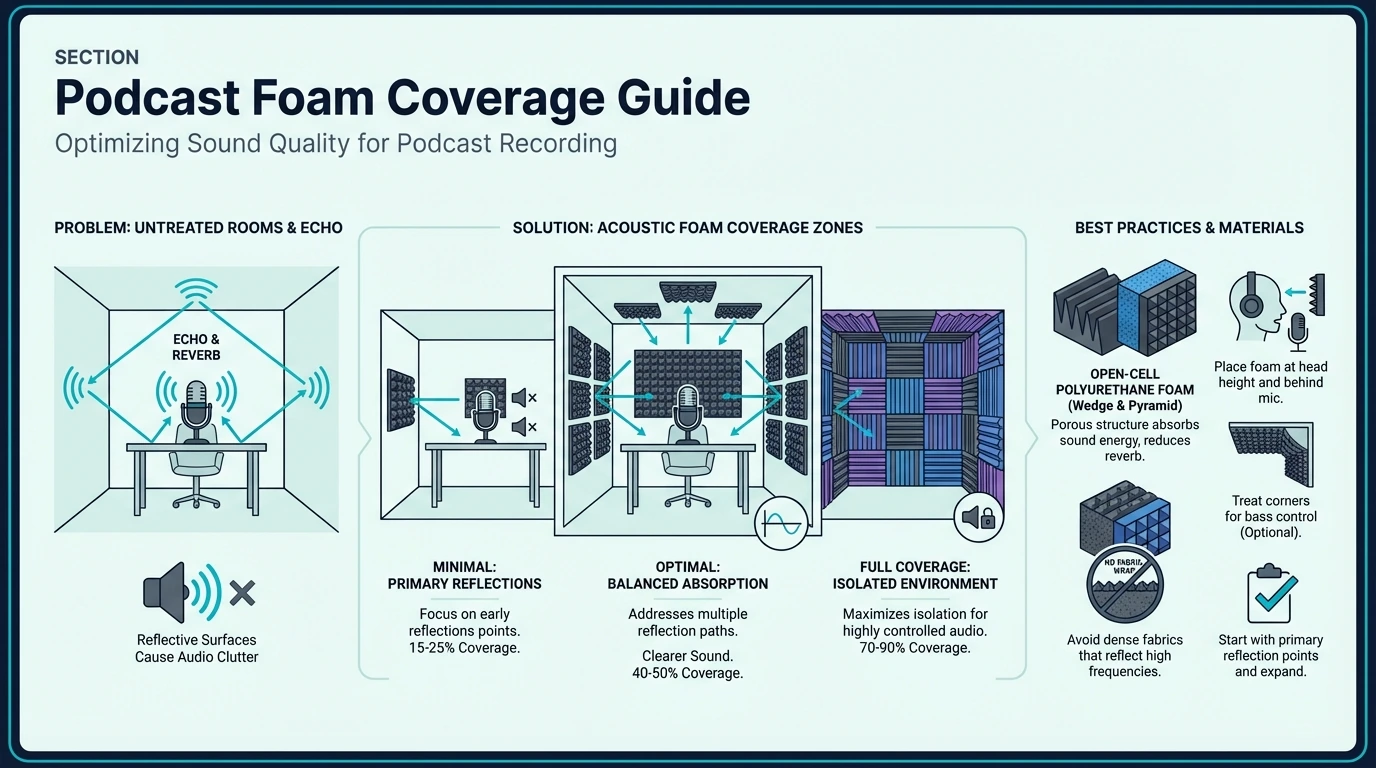
The goal isn’t eliminating all reflections—it’s controlling the problematic ones. Aim for 20–30% absorption coverage (not floor-to-ceiling foam), and the too much acoustic foam guide sets a practical coverage target.

If your room already sounds dead, adding more foam makes it worse. The is acoustic foam worth it breakdown helps calculate how much treatment a room actually needs before you over-commit.

Ignoring Bass Problems

Neither foam nor diffusers address bass buildup. If your room has boomy low end or muddy bass response, you need bass traps—thick, dense absorbers designed for low frequencies.

People often keep adding foam trying to fix bass problems, but it doesn’t work. The wavelengths are too long for thin panels to absorb, so low-end issues need different treatment.

Buying Cheap Diffusers

Budget “diffusers” often don’t diffuse effectively. The wells aren’t deep enough, the materials aren’t rigid enough, or the design isn’t acoustically valid.

A poorly designed diffuser is just an expensive decoration. If you can’t afford quality diffusion, you’re better off with foam—at least it definitely works.

Before you buy, stick to diffuser designs with proven performance like QRD and skyline patterns. Random patterns and shallow wells often look cool, but they don’t diffuse much.

The Hybrid Approach: Using Both
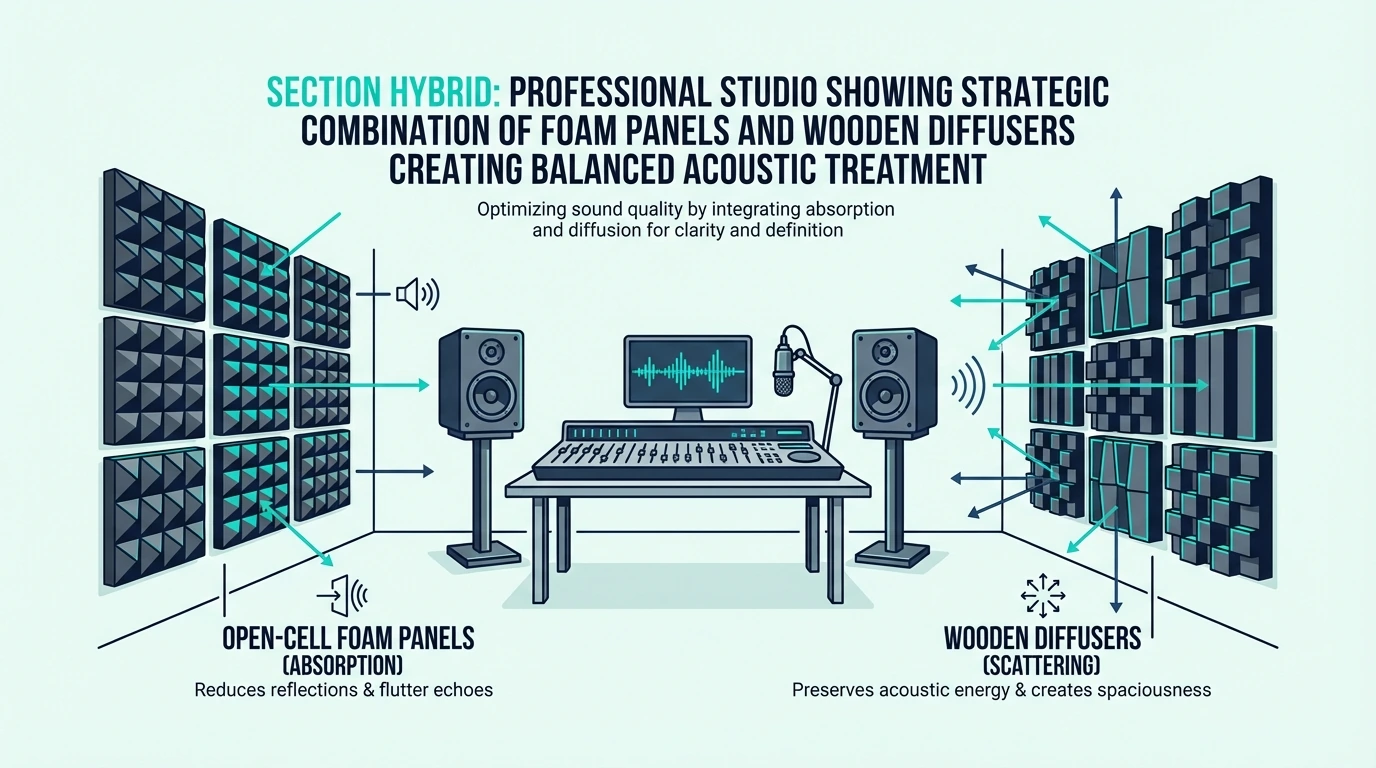
Hybrid studio setup using both foam panels and diffusers

Most well-designed rooms use both absorption and diffusion. The question isn’t which one to use—it’s where to use each.

The Classic Studio Setup

Professional studios typically follow this pattern:

  • Front wall (behind monitors): Absorption
  • Side walls (first reflections): Absorption
  • Rear wall: Diffusion

Then handle vertical reflections and bass separately:

  • Ceiling (reflection point): Absorption or diffusion
  • Corners: Bass traps

This combination controls early reflections with absorption while maintaining room ambience with rear-wall diffusion. It’s the standard approach because it works.

Adapting for Home Studios

Home studios can follow the same principles at smaller scale:

  • Foam panels at first reflection points (sides)
  • Foam behind monitors if wall is close
  • Diffuser or absorption on rear wall (depending on room size)
  • Bass traps in corners if bass is problematic

You don’t need to treat every surface—strategic placement of a few panels (and maybe one rear-wall diffuser) handles most problems in typical rooms. The acoustic foam arrangement guide covers layout strategies for every room shape.

When to Add Diffusion

Start with absorption because it solves the most common problems and costs less. Once your room sounds controlled but a bit too dead, that’s when diffusion starts making sense.

Signs you might benefit from diffusion:

  • Room sounds unnaturally dead after foam treatment
  • You want more “air” or ambience in recordings
  • Mixes made in your room sound too dry elsewhere
  • The space feels oppressive or uncomfortable

Diffusion restores liveliness without bringing back the problems absorption solved. It’s the refinement step after basic treatment is complete.

Making Your Decision
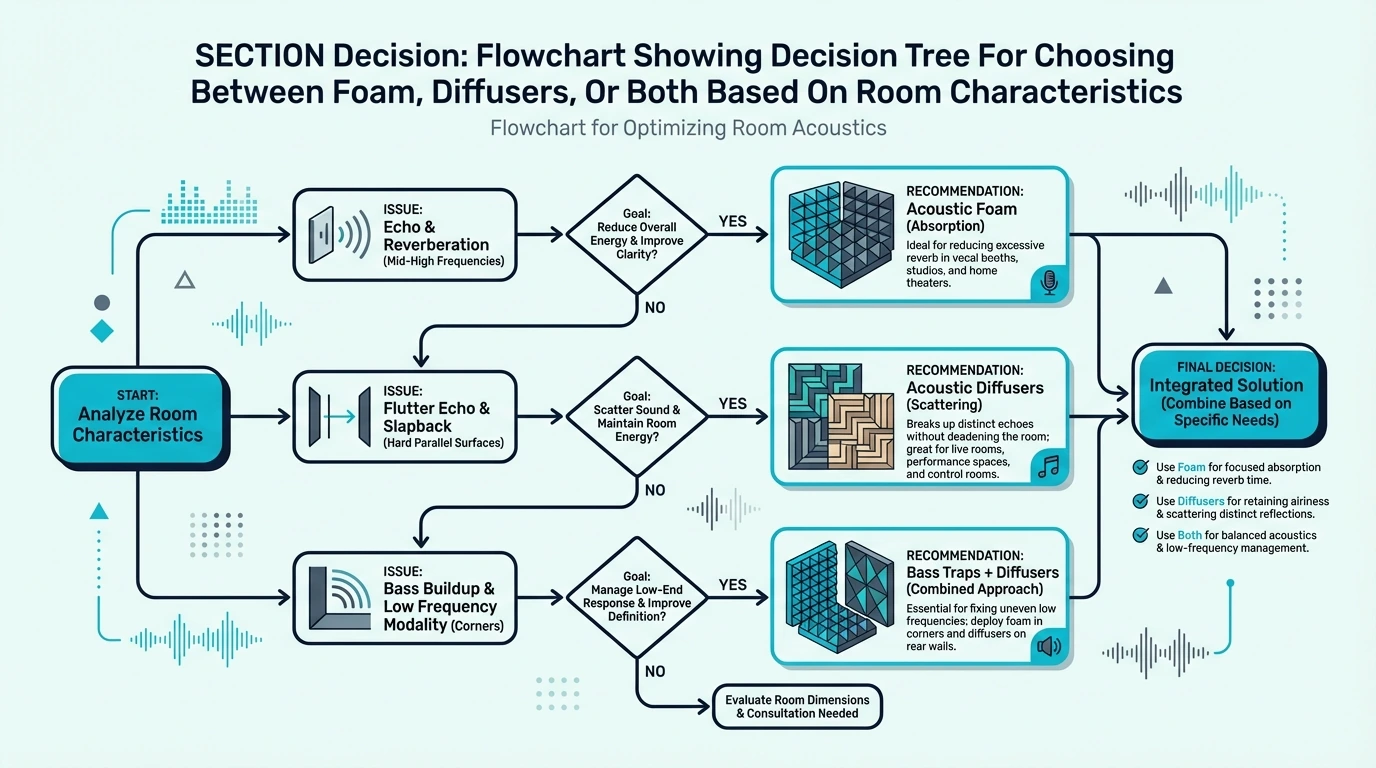
Decision flowchart for choosing foam, diffusers, or both

Here’s a simple framework for deciding what your room needs.

Start With These Questions

How big is your room?

  • Under 150 sq ft: Focus on foam, skip diffusers
  • 150-400 sq ft: Foam first, consider diffusers for rear wall
  • Over 400 sq ft: Both treatments, more emphasis on diffusion

What’s your primary use?

  • Recording: Absorption priority (clean, dry recordings)
  • Mixing/mastering: Balanced approach (accuracy matters)
  • Listening/home theater: Diffusion priority (natural ambience)

What’s your budget?

  • Limited: Foam only (better value per dollar)
  • Moderate: Foam plus one quality diffuser
  • Generous: Full treatment with both

The Minimum Effective Treatment

If you can only do one thing, put foam panels at your first reflection points. This single treatment provides more improvement than any other placement.

Two foam panels on the side walls at first reflection points can transform how your room sounds, and it’s one of the cheapest upgrades you can make. Understanding how acoustic foam works helps you maximize those spots, and the pyramid vs wedge comparison narrows the shape choice.

Everything else—rear wall treatment, ceiling clouds, bass traps, diffusers—builds on this foundation. Start here regardless of your ultimate plans.

The Bottom Line

Foam absorbs sound and reduces reverb, which is why it’s usually the foundation for small rooms and recording setups. Diffusers scatter reflections to keep a room lively, which makes them more useful in larger spaces and critical listening rooms.

Most rooms benefit from both, but foam comes first for most home studios. It’s more affordable, solves more common problems, and works in spaces where diffusion can’t function effectively.

Start with absorption at first reflection points, add bass traps if the low end is still messy, and consider a rear-wall diffuser once the room is controlled. That progression fixes problems in the order you’ll actually notice them (and usually in the order that costs the least).

The goal isn’t a perfectly dead room or a perfectly diffuse one—it’s a controlled space where you can work accurately and comfortably. Foam and diffusers are just tools toward that goal, and each works best in a specific spot.

Frequently Asked Questions

Can I use both foam and diffusers in the same room?

Yes—most professional rooms use both: absorption at first reflection points and behind monitors, with diffusion on the rear wall. That combination controls the early reflections that cause problems while keeping the room from feeling unnaturally dead.

Which is better for a home recording studio?

For most home studios, start with foam because small rooms need absorption more than diffusion and it costs less. Add diffusion later only if the room feels too dry after basic foam placement (and in many bedroom studios, you won’t need it).

Do diffusers reduce echo like foam does?

Diffusers can reduce the perception of echo by scattering reflections, but they don’t remove energy from the room like foam does. If the room is obviously reverberant, absorption is the faster fix; diffusion is best when you want control without killing the room’s liveliness.

Why are diffusers so much more expensive than foam?

Effective diffusers need precise well depths and rigid materials to scatter sound correctly, so manufacturing costs more than cutting foam panels. Cheap diffusers often don’t work, while even budget foam still provides real absorption.

How do I know if my room needs more absorption or diffusion?

Clap and listen: if you hear a long tail or metallic ringing, you need more absorption. If the room feels muffled and lifeless, you might need less absorption or a bit of diffusion to bring back natural ambience.

Can I make DIY diffusers?

Yes—QRD designs are well-documented and DIY-friendly if you can cut wood accurately and follow the sequence for well depths. A QRD calculator will give you the dimensions for your target frequencies, and DIY can save money if you have the tools and patience.
Egg Cartons vs Acoustic Foam: Why the Myth Refuses to Die

Egg cartons look like acoustic foam, but they don’t work like acoustic foam. Cardboard absorbs roughly 5% of sound energy — acoustically meaningless — while even budget foam absorbs 6-16× more.

The real cost of egg cartons isn’t money — it’s the echo that stays, the fire hazard you’ve mounted on a wall full of electronics, and the time wasted collecting material that does nothing for your recordings.

Even a single pack of budget acoustic foam absorbs 6-16× more sound than egg cartons, and it costs about the same as a few coffees. Below, you’ll see exactly why egg cartons fail the physics test, which affordable alternatives actually work, and how to treat a room on a tight budget without cutting corners on safety.

For a broader look at foam options, start with the acoustic foam hub.

Quick Takeaway

Egg cartons don’t absorb real sound and won’t fix echo. They’re also a fire hazard in a room with electronics and lighting. If budget is the worry, skip the myth and use real acoustic foam (or a heavy moving blanket as a temporary stopgap). You’ll get real absorption immediately without turning your wall into tinder.

Do Egg Cartons Absorb Sound?

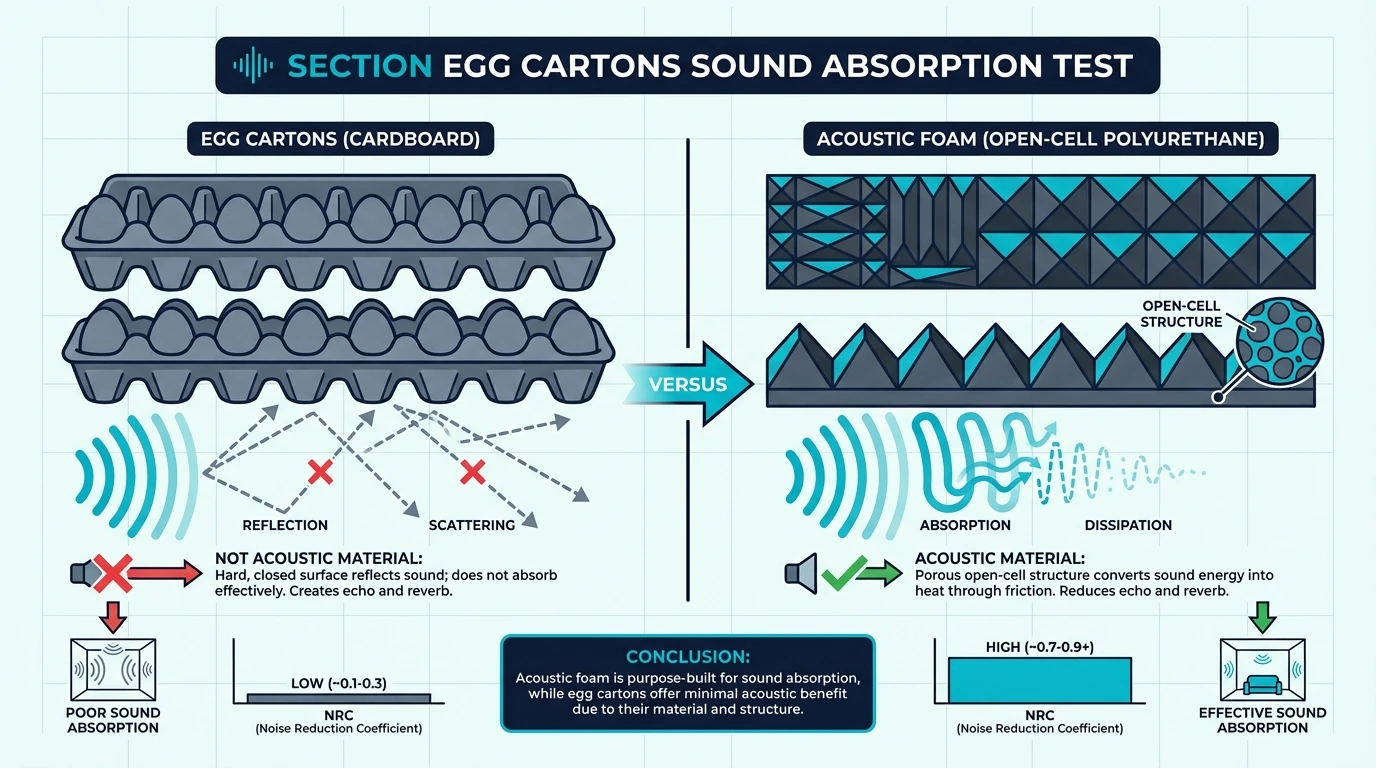
Sound absorption test comparing egg cartons and acoustic foam

Here’s the short version: egg cartons do not absorb sound in any real way. People spend hours collecting cartons, carefully mounting them, and end up with a room that sounds exactly the same — just uglier.

The Science: Why Cardboard Fails

Sound absorption requires porous materials that allow sound waves to enter and lose energy through friction. Think of it like a sponge absorbing water — the liquid enters the material and gets trapped in the structure.

Open-cell foam works because sound penetrates the material and bounces between thousands of tiny cell walls, converting acoustic energy to heat with each bounce. The what is acoustic foam guide covers the full science. By the time the wave tries to exit, most of its energy is gone.

Cardboard is dense and non-porous. Sound waves hit the surface and bounce right back, like throwing a ball at a wall.

The thin material provides no depth for absorption to occur. It’s the acoustic equivalent of putting up a poster and expecting it to stop echoes.

The Numbers Don’t Lie

NRC (Noise Reduction Coefficient) measures absorption on a 0-1 scale. Here’s the reality check:

Egg cartons: ~0.05 NRC — They absorb roughly 5% of sound energy. That’s not “some absorption.” That’s statistical noise. Your t-shirt absorbs more sound than egg cartons.

1-inch acoustic foam: 0.30-0.50 NRC — Six to ten times more absorption than egg cartons. That’s actual treatment.

2-inch acoustic foam: 0.50-0.80 NRC — Ten to sixteen times more absorption. This is where real improvement happens.

Professional panels: 0.80-1.0 NRC — The gold standard, but honestly overkill for most home setups.

The difference isn’t subtle. It’s the difference between treatment that works and treatment that decorates your wall while doing nothing.

What Egg Cartons Actually Do (Almost Nothing)

To be completely fair, egg cartons provide minimal sound scattering. The bumpy surface breaks up reflections slightly, creating minor diffusion.

But here’s the thing: this diffusion effect is so small it’s acoustically irrelevant. You’d need to cover every square inch of every surface in egg cartons to notice any change.

And even then, the room would still have the same echo problems. You’d just have a fire hazard that smells like breakfast.

Why the Egg Carton Myth Persists

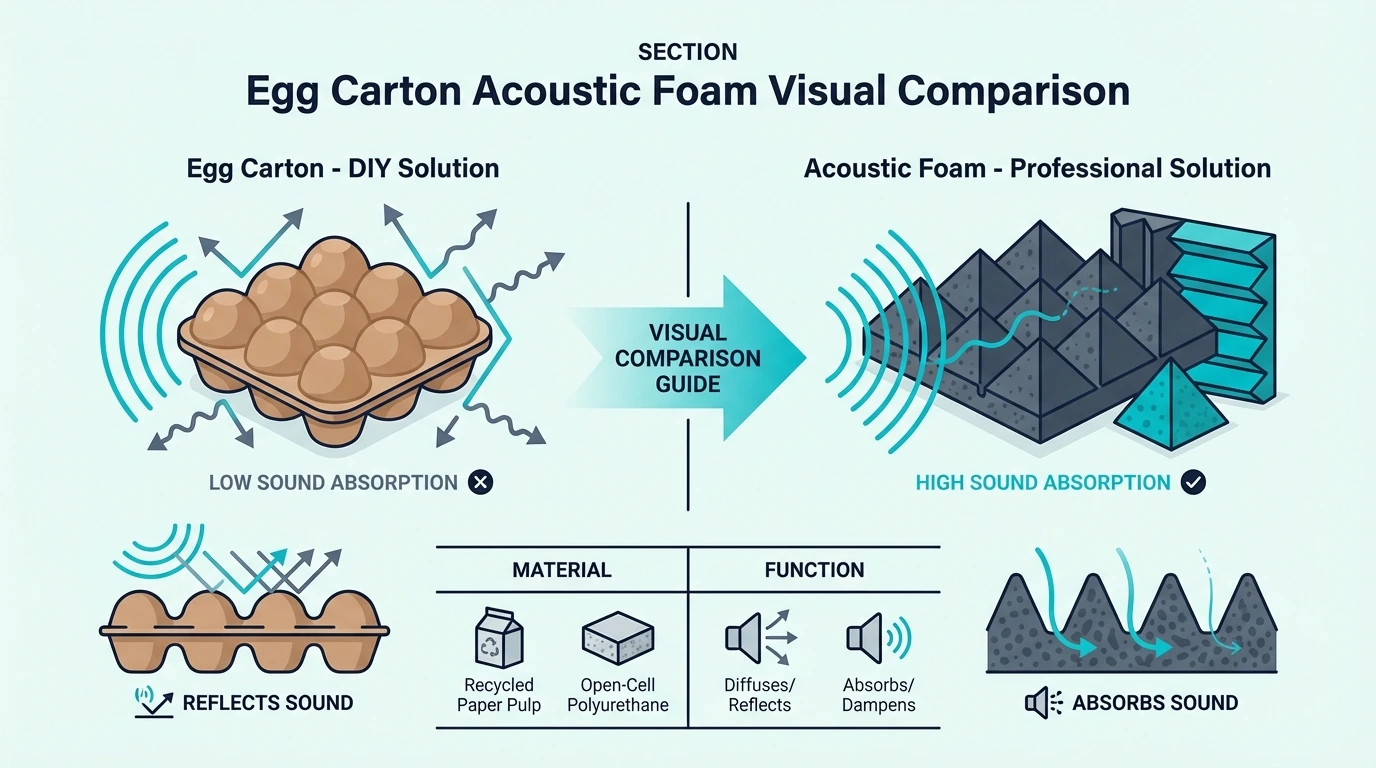
Visual comparison of egg cartons and acoustic foam panels

This myth has survived for decades despite being completely wrong. It’s the acoustic equivalent of “you only use 10% of your brain” — sounds plausible, gets repeated constantly, and falls apart under any scrutiny.

The Visual Similarity Trap

Look at an egg carton. Look at acoustic foam.

They both have bumpy, textured surfaces with peaks and valleys. Your brain sees the similarity and makes a logical leap: similar shape must mean similar function.

This is like assuming a cardboard cutout of a car can drive because it looks like a car. Shape doesn’t determine acoustic properties—material composition does.

Foam absorbs sound because of its porous cellular structure, not because it has bumps. You could make foam completely flat and it would still absorb sound.

You could make egg cartons into perfect pyramids and they’d still reflect everything.

The “Free” Delusion

Egg cartons cost nothing. Acoustic foam costs money.

People desperately want to believe the free option works.

That’s understandable. When you’re starting out, every dollar matters.

The idea that you could solve your acoustic problems with something you’d otherwise throw away is incredibly appealing.

Unfortunately, physics doesn’t care about your budget. Egg cartons fail regardless of how much you want them to succeed.

And here’s the kicker: the time you spend collecting, cleaning, and mounting egg cartons has value too. By the time you’ve gathered enough cartons to cover a wall, you could have bought real foam that actually works.

The Echo Chamber of Bad Advice

Many people confuse sound absorption with soundproofing, and both with “doing something about sound.” Egg cartons do none of these effectively.

The myth spreads because people who don’t understand acoustics share advice with other people who don’t understand acoustics. Someone tries egg cartons, doesn’t know what good treatment sounds like, assumes it helped, and tells their friends.

It’s the blind leading the blind, generation after generation.

Forums and comment sections are full of people defending egg cartons because they’ve already invested time in the approach and don’t want to admit it was wasted. Sunk cost fallacy meets acoustic ignorance.

The Fire Hazard Problem

Fire hazard warning for using egg cartons as acoustic treatment

Beyond being acoustically useless, egg cartons present a serious safety risk that most DIY enthusiasts don’t consider until it’s too late.

Cardboard + Electronics = Bad Combination

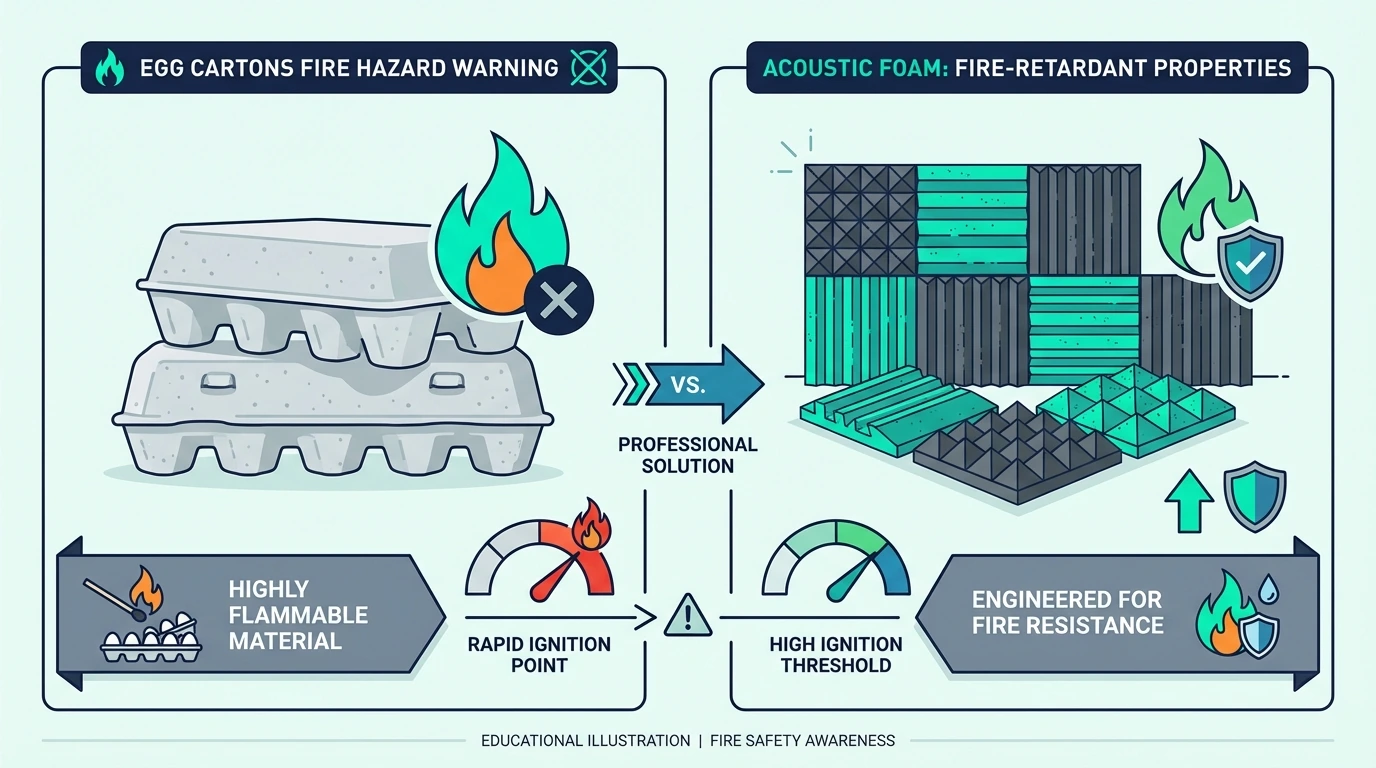
Egg cartons are made of recycled paper and cardboard—materials designed to be lightweight and biodegradable. They’re also highly flammable.

A room covered in egg cartons is kindling waiting for a spark.

Now think about what’s in a typical recording space: computers generating heat, audio interfaces with power supplies, studio lights that get hot, cables that can short circuit, maybe a space heater in winter. You’re surrounding all of this with flammable material mounted on walls where heat rises and accumulates.

Recording studios have burned down. This isn’t theoretical fear-mongering—it’s documented reality.

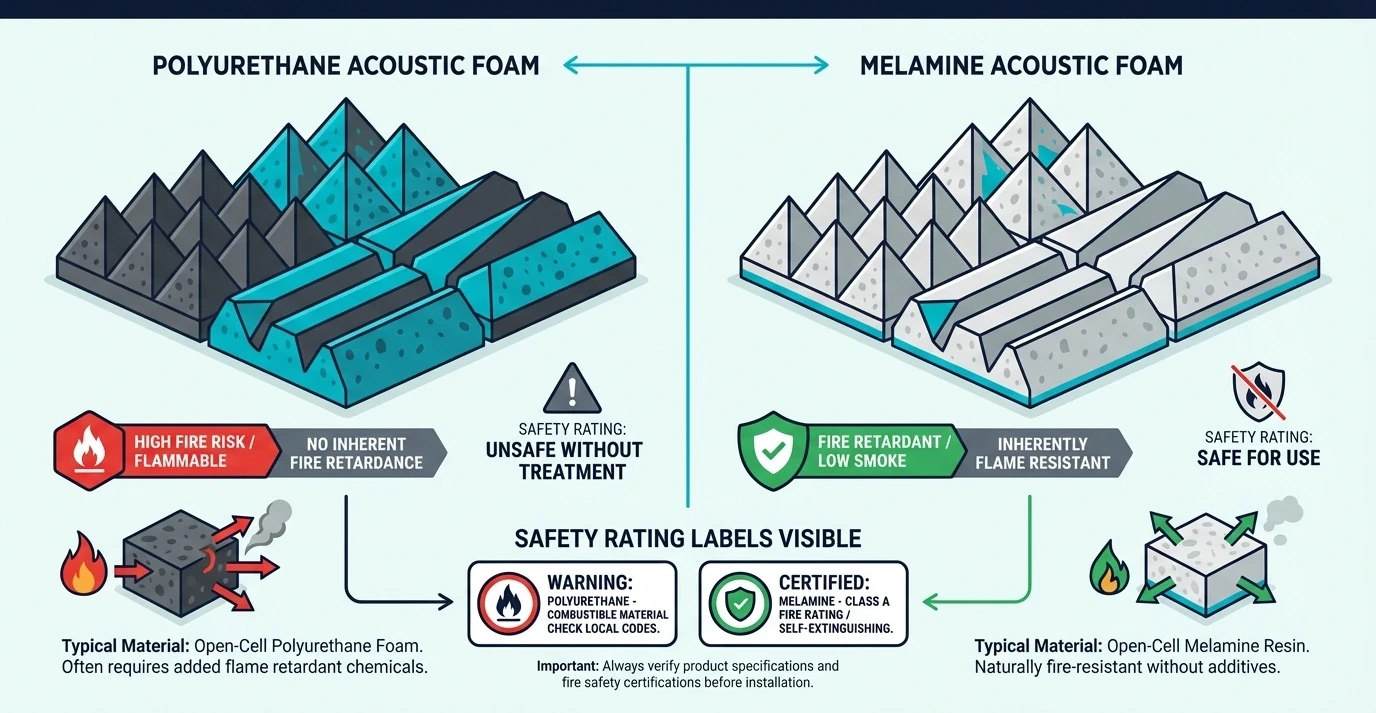
And while foam can also burn under extreme conditions, reputable manufacturers include fire-retardant treatment that slows ignition and spread. Learn more about acoustic foam safety.

The Certification Difference

The Sonic Acoustics 24 Pack Fire Retardant Panels specifically includes fire-rated material. This isn’t marketing fluff — it’s tested, documented protection.

Egg cartons have no fire rating because they’re not designed for wall mounting. They’re designed to protect eggs during transport and then be recycled.

Using them as permanent wall covering ignores their intended purpose and basic safety considerations.

The Insurance Nightmare

Here’s something nobody thinks about until there’s a problem: if a fire starts in a room you’ve intentionally covered with flammable material not designed for that purpose, your insurance claim gets complicated fast.

Insurance adjusters look for reasons to deny claims. “Homeowner covered walls with cardboard egg cartons” is exactly the kind of negligence that voids coverage.

The small amount you “saved” could turn into a much bigger problem fast—financially and for safety.

Is that risk worth avoiding a small foam purchase? The math doesn’t work.

What Actually Works: Affordable Alternatives

Budget alternatives to acoustic foam panels

Here’s the good news: if budget is your concern, real acoustic treatment costs far less than you probably think. The “egg cartons are free” argument falls apart when you realize actual foam costs about the same as a fast food meal.

The Budget Reality Check

The 12-pack self-adhesive wedge foam panels provides 12 square feet of real acoustic treatment. That’s enough to cover the wall behind your microphone — the single most impactful placement for voice recording.

Think about that. For roughly the cost of a few coffees, you can treat your primary reflection point with material that actually absorbs sound.

Compare that to spending hours collecting egg cartons that do nothing.

Spoiler: acoustic foam is not expensive.

Stepping Up: The Sweet Spot

If you want better performance without breaking the bank, 2-inch foam reaches frequencies that 1-inch panels can’t touch. The 2-inch self-adhesive pyramid foam panels (12-pack) delivers noticeably better absorption, especially for the low-mid frequencies that give voice recordings warmth.

The price gap between 1-inch and 2-inch foam is usually small. The performance difference is much more noticeable.

If you’re only buying once, buy the thicker option.

The DIY Route: Maximum Value

For the truly budget-conscious who don’t mind some work, building your own panels from rigid mineral wool delivers professional-grade absorption at DIY prices.

A single sheet of mineral wool can make multiple panels that outperform most foam options. Add a simple wood frame and fabric wrap, and you have treatment that rivals far more expensive commercial panels.

The tradeoff is time and effort—expect a few hours for your first batch. But if you’re considering egg cartons, you were already willing to invest time in a DIY approach.

This one actually works. Compare the options in the acoustic foam vs rockwool guide.

The “I Need Something Today” Option

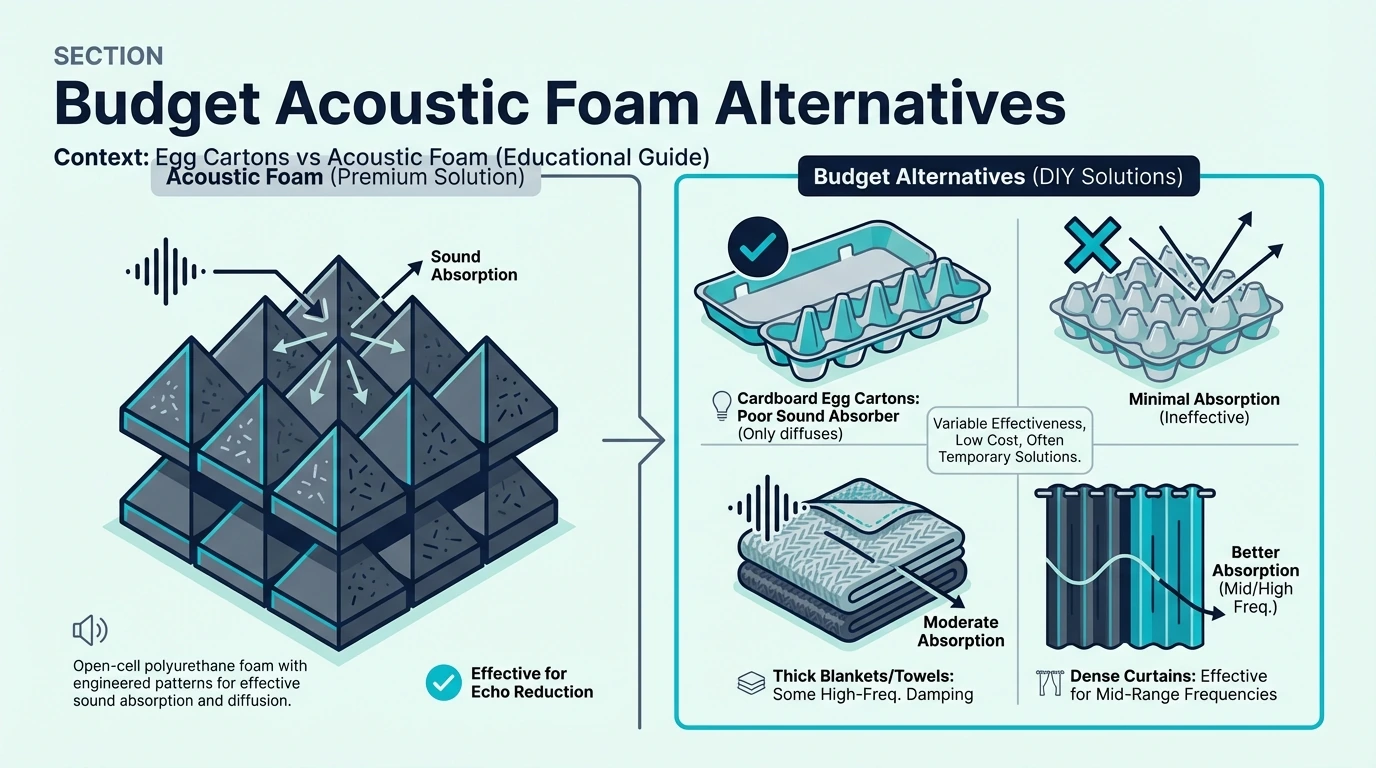
Heavy moving blankets provide moderate absorption and are inexpensive in bulk packs. They’re not as effective as foam, but they’re easy to buy locally and work for temporary setups.

Hang one behind your microphone or drape it over a mic stand. It’s not pretty—your recording space will look like you’re about to move furniture.

But it’s functional. And unlike egg cartons, it actually absorbs sound.

This is the legitimate “cheap and fast” option. Use it while you save up for proper foam, or keep it as your portable recording solution.

Egg Cartons vs Acoustic Foam: The Honest Comparison

Comparison table for egg cartons versus acoustic foam

Here’s the honest breakdown so there’s no ambiguity about which option makes sense:

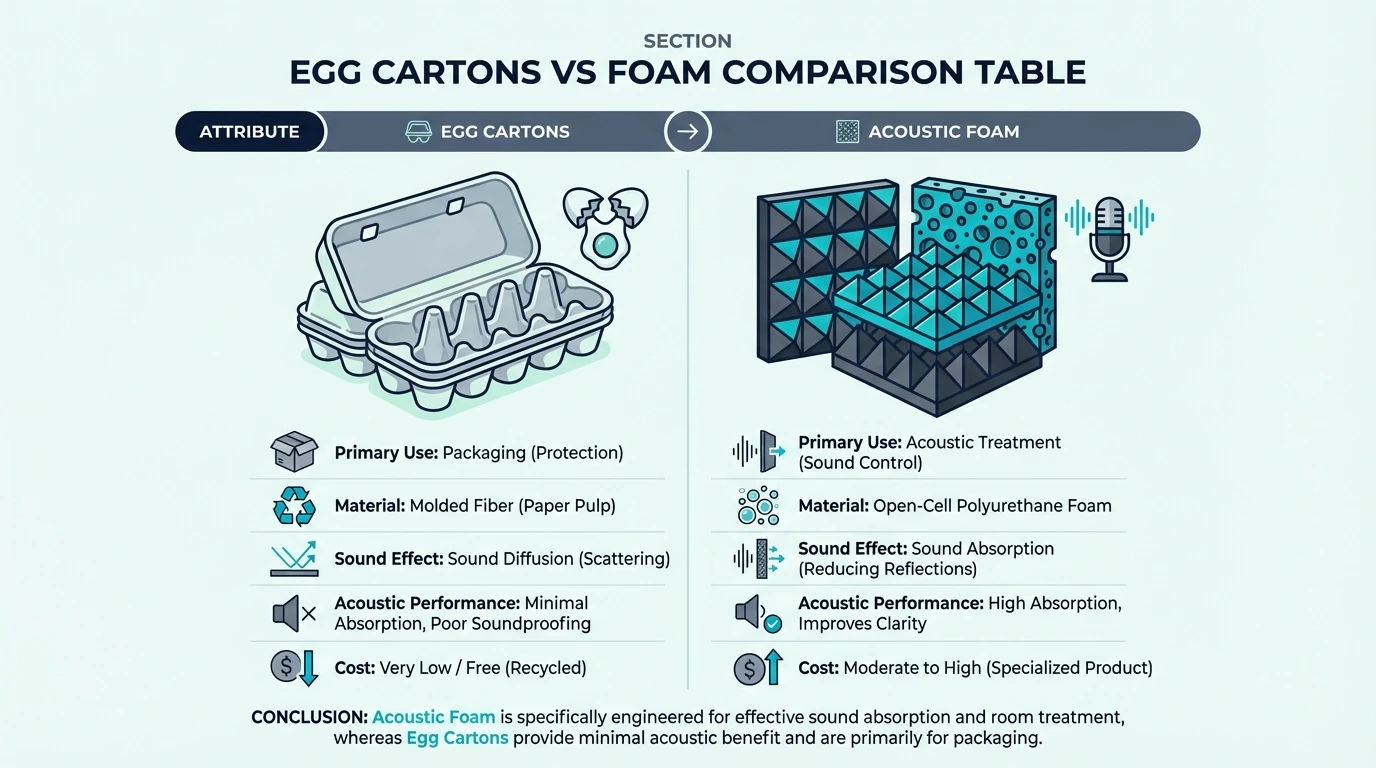
Factor Egg Cartons Acoustic Foam The Verdict
Sound Absorption ~5% (essentially zero) 30-80% Foam wins by 6-16x
Fire Safety Highly flammable hazard Fire-rated options available Foam is actually safe
Real Cost “Free” + wasted time Budget-friendly starter kit Foam costs less than you think
Appearance Looks like garbage (because it is) Clean, professional studio look Foam looks intentional
Durability Degrades, attracts pests 3-5+ years Foam lasts
Installation Won’t stick properly, falls off Easy with adhesive strips Foam actually stays up
Does It Work? No Yes This is the only row that matters

The comparison isn’t close. Egg cartons fail on every single metric except initial cost — and even that advantage disappears when you factor in the time spent collecting them and the fact that they don’t solve your problem.

Here’s the brutal truth: if you cover your walls in egg cartons, you’ll still have echo problems. You’ll just also have ugly walls and a fire hazard.

Then you’ll buy foam anyway, after wasting time and creating a mess to clean up.

Skip the intermediate step. Check the how to choose acoustic foam guide and buy real panels from the start.

The Bottom Line

Egg cartons don’t work for acoustic treatment. The myth persists because of visual similarity to foam and wishful thinking about free solutions.

Real acoustic foam is surprisingly affordable. Even a small starter pack can make a noticeable difference behind your microphone.

Don’t waste time on solutions that don’t work. Invest in proper treatment and hear the difference immediately. If you want help picking, the best acoustic foam shape guide breaks down wedge vs pyramid vs flat.

For more guidance on acoustic treatment, visit the acoustic foam hub, explore best budget acoustic foam picks, or learn how to choose acoustic foam. Check if acoustic foam is worth it for your setup.

Frequently Asked Questions

Can egg cartons reduce echo at all?

Technically, any textured surface provides minimal diffusion. But the effect is so small it’s acoustically irrelevant.

You’d notice more improvement from hanging a blanket on one wall than covering every wall in egg cartons.

What about egg crate foam mattress toppers?

Egg crate foam (the mattress material) is different from cardboard egg cartons. Foam mattress toppers provide some absorption, though less than purpose-built acoustic foam.

If you have an old mattress topper, it’s worth trying.

But buying one specifically for acoustic treatment makes less sense than buying actual acoustic foam. Learn acoustic foam vs normal foam differences.

Why do some studios have egg cartons on walls?

Old photos of budget studios sometimes show egg cartons. These studios had bad acoustics — the egg cartons were decoration, not treatment.

The myth spread because people saw the photos without understanding the context. Those studios would have sounded better with proper treatment.

Are there any legitimate uses for egg cartons in acoustics?

No. Egg cartons belong in recycling bins or compost, not on studio walls.

If you’re determined to use free materials, heavy blankets, thick curtains, or bookshelves full of books provide more absorption than egg cartons.

How much does real acoustic foam cost?

Budget acoustic foam is very affordable. A 12-pack of quality foam costs roughly the same as a few coffees and provides real sound absorption.

For full room coverage, bulk packs offer even better per-panel value. The investment is minimal compared to the improvement in recording quality.

Is acoustic foam safe compared to egg cartons?

Yes—quality acoustic foam from reputable manufacturers includes fire-retardant treatment. Egg cartons are highly flammable and present a serious fire hazard in recording spaces with electronics and lighting.

How to Choose Acoustic Foam: The Only Specs That Matter

How to choose acoustic foam is easier once you stop thinking “foam = soundproofing” and start thinking “foam = echo control.” If your room sounds ringy, boxy, or harsh on a mic, foam can help — fast.

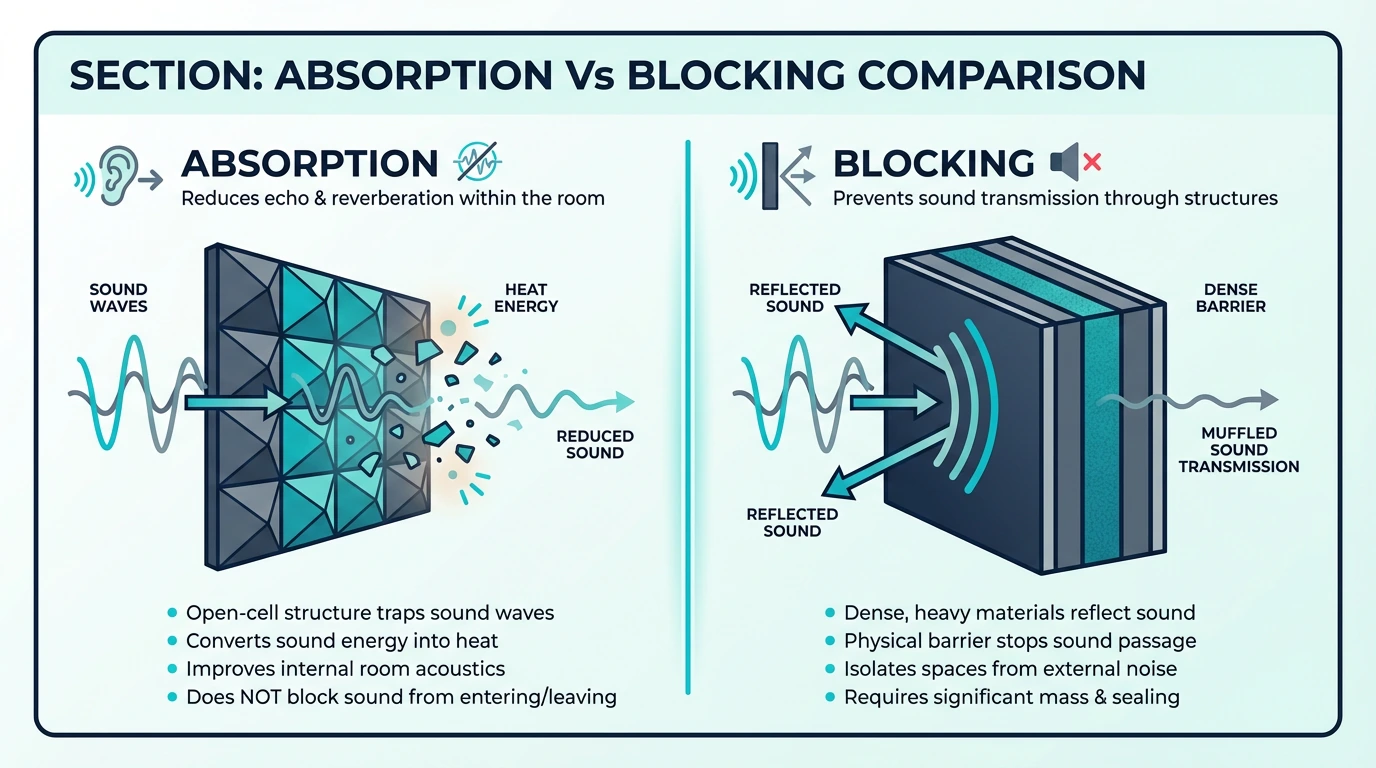
But if your problem is noise traveling through walls or keeping neighbors from hearing you, foam won’t move the needle. That’s construction (mass + sealing + decoupling), not something you fix with panels.

The real buying decision is matching foam specs to what you record and what your room is doing to the sound. Below is the quick takeaway, then a breakdown of what foam can and can’t do, which specs matter, and how to avoid the common “looks good, does nothing” traps.

Quick Takeaway

Start with 2-inch acoustic foam and place it at first reflection points, not randomly. Plan on 12–24 panels for a first pass, then add only if the room still sounds splashy. Avoid ultra-cheap foam that feels weightless, because low density usually means weak absorption and faster collapse over time. If foam will live near outlets, lights, or hot gear, prioritize a product with a published fire rating.

What Does Acoustic Foam Actually Do?

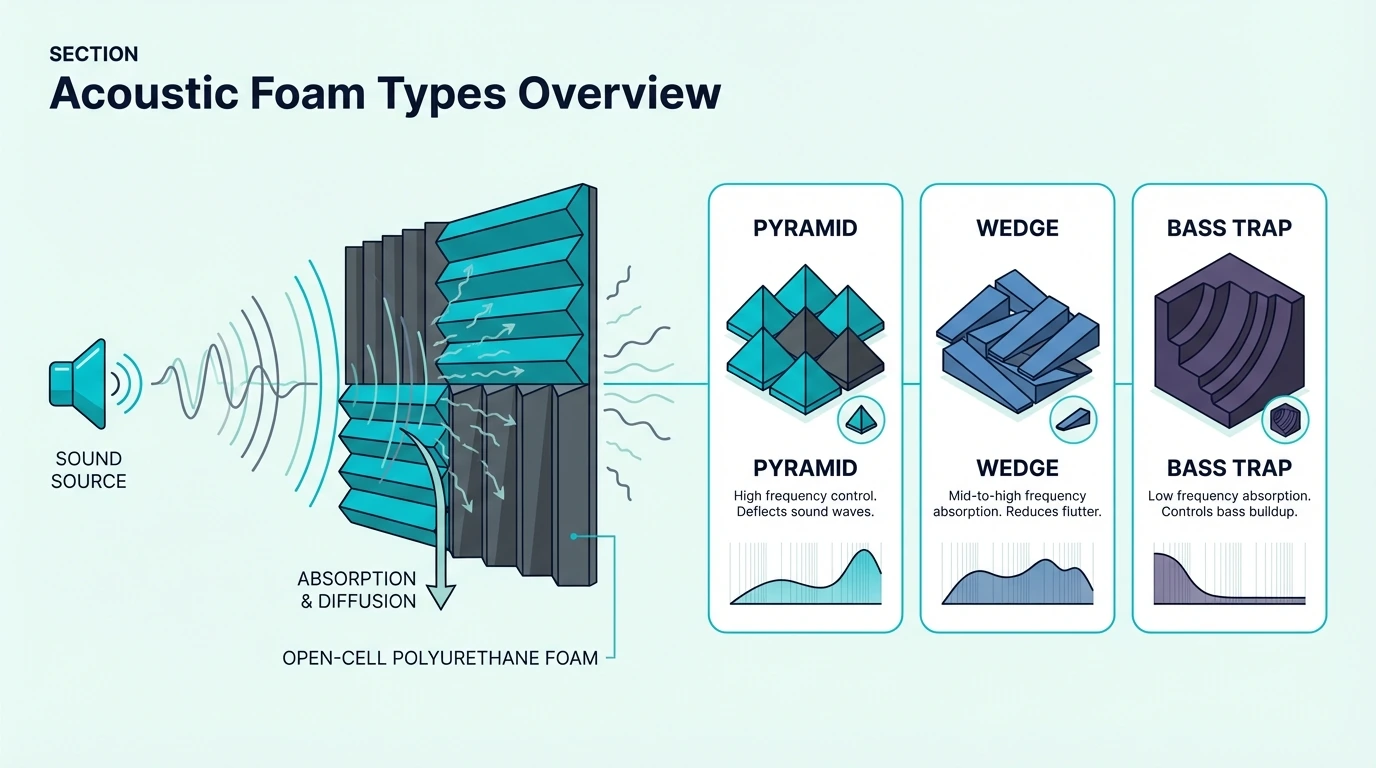
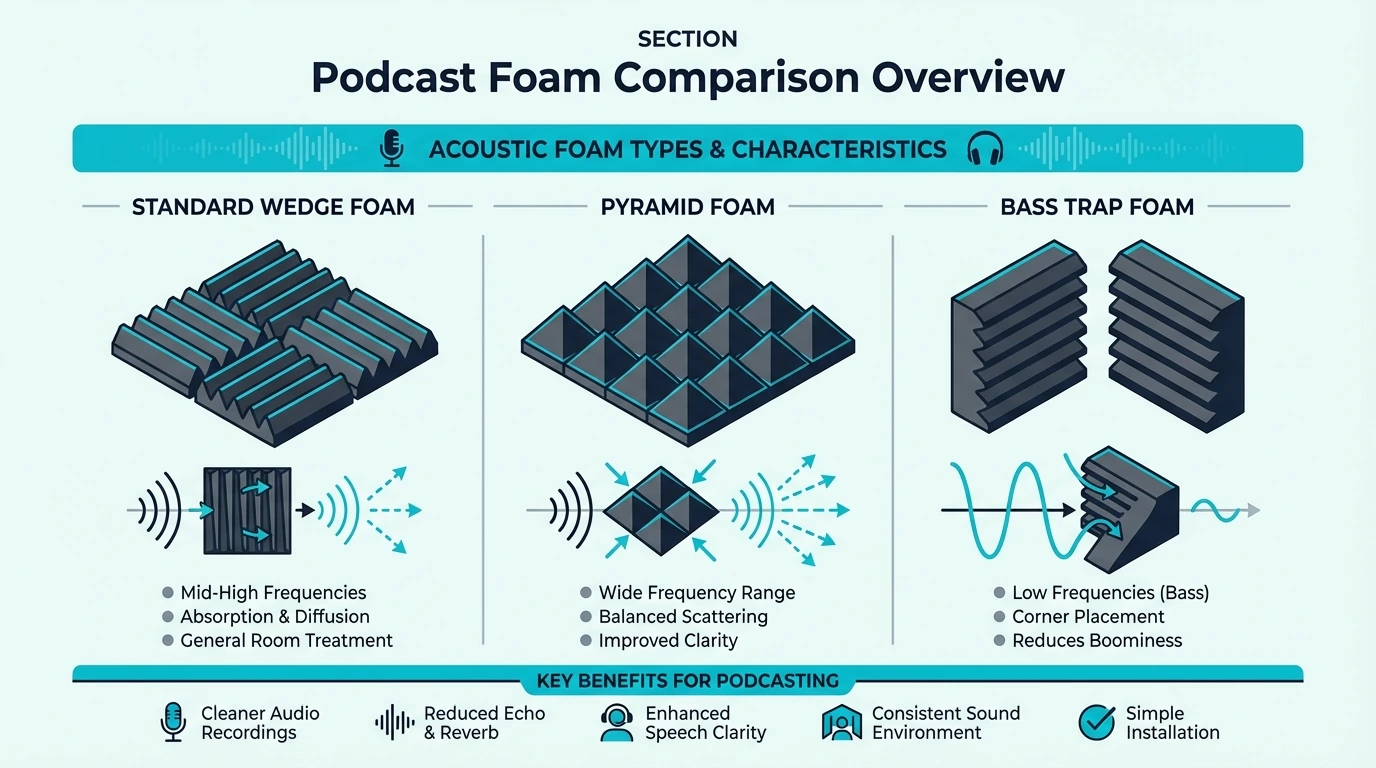
Overview of common acoustic foam types

Before you compare thickness or shape, you need a clean mental model of what foam can and can’t fix. Otherwise you’ll buy the right product for the wrong job.

What Foam Actually Does

Acoustic foam reduces reflections inside the room. That means less flutter echo, less “ring,” and cleaner recordings when your mic is picking up the room.

Foam works because sound can enter the open-cell structure. Once it’s inside, air movement rubs against the cell walls and bleeds off energy as heat.

This effect is strongest in the mid and high frequencies, where speech harshness and slap reflections live. The what is acoustic foam guide covers the science in more detail. That’s why foam can improve clarity without changing how “quiet” your room is to your neighbors.

If your main issue is boomy bass, thin foam won’t do much. For low-end control, bass traps are the right tool.

What Foam Cannot Do

Foam will not soundproof a room. It doesn’t add mass, it doesn’t seal gaps, and it doesn’t stop vibration traveling through walls.

So if your neighbor’s music bleeds through, foam won’t fix it. If your podcast is audible in the next room, foam won’t fix that either.

Soundproofing is a different system: mass, decoupling, and sealing. Foam is treatment for echo inside the room, not isolation between rooms.

If you want the full myth-busting breakdown, start here: does acoustic foam soundproof?. That one distinction will save you the most money.

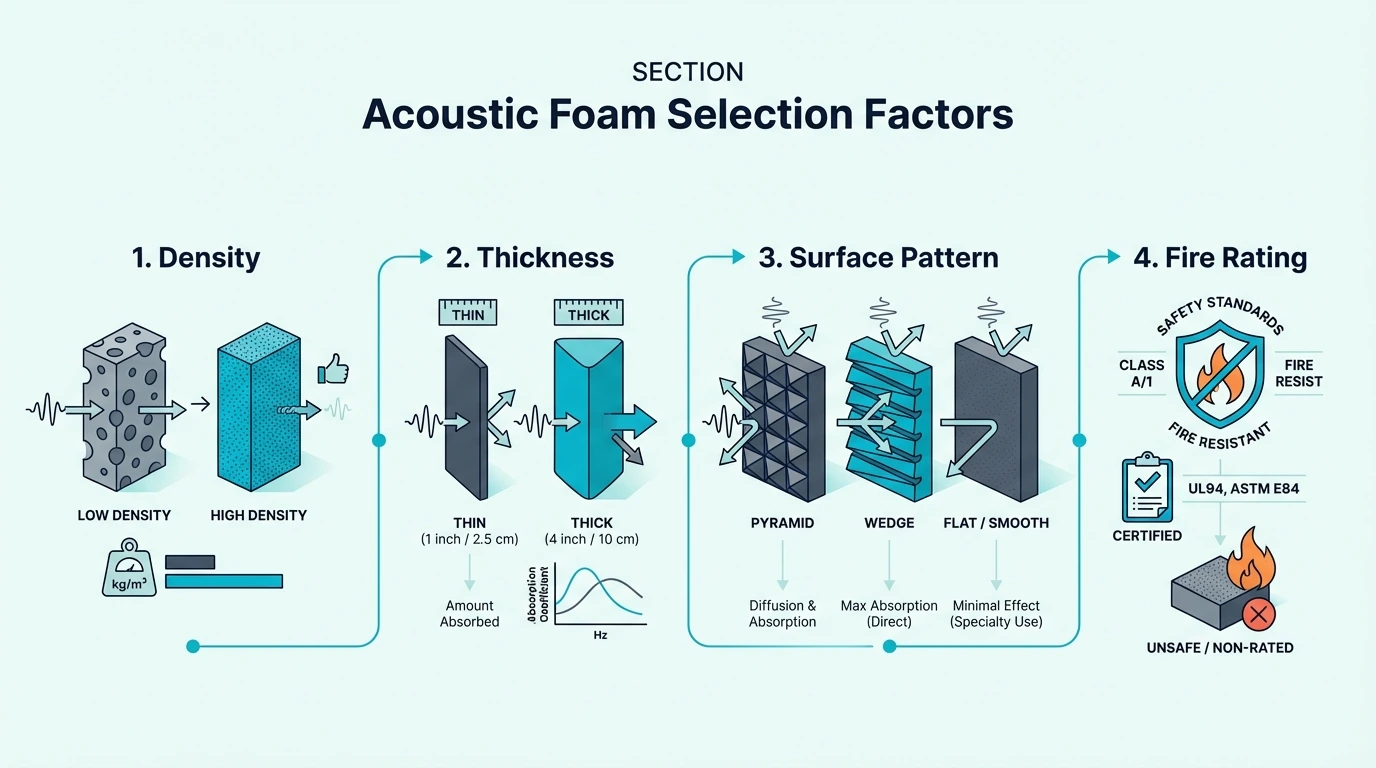
What Specs Matter When Buying Acoustic Foam?

Selection factors for choosing acoustic foam

Once you’re choosing foam for the right job, the next mistake is buying based on looks or price. The foam that works and the foam that decorates can look identical in photos.

Here are the five specs that actually change what you hear, and how each one connects to a real problem like “hollow vocals” or “harsh reflections.”

Factor 1: Thickness (Which Frequencies You Can Absorb)

Thickness controls how low the foam can absorb. That’s why 1-inch, 2-inch, and 4-inch foam can feel like totally different products.

Sound waves have physical length, so foam needs depth to slow the air down. A useful rule of thumb is quarter-wavelength: lower frequencies need thicker absorbers.

A 1-inch panel is mostly a high-frequency tool. It can tame “sizzle” and flutter, but it won’t touch the hollow 300–800Hz range that makes voices sound boxy.

2-inch foam reaches lower into the vocal range. For podcasts, voiceovers, and streaming, it’s usually the safest default thickness.

If you record instruments and you care about warmth, 3–4 inches at key reflection points can help the lower mids. The tradeoff is cost and bulk, so don’t buy it unless you actually need it.

The classic trap is buying 1-inch foam because it’s cheaper, then trying to fix a lower-mid problem it physically can’t absorb. If you hear “hollow” or “cardboard,” that’s usually not treble.

Factor 2: Density (Whether the Foam “Has Meat”)

If thickness decides which frequencies are in play, density decides whether the foam performs or just looks the part. Two panels can be the same shape and size and still absorb very differently.

Denser foam creates more friction as air moves through it. That friction is what steals energy from reflections instead of letting them bounce back.

The annoying part is that many listings don’t publish density. The practical workaround is weight—good foam feels surprisingly heavy for its size.

As a rough floor, under about 1.2 lbs/ft³ tends to compress and underperform quickly. Around 1.2–1.8 lbs/ft³ is a safer zone for most home setups.

Factor 3: NRC Rating (A Quick Reality Check)

NRC (Noise Reduction Coefficient) is one of the few objective specs you’ll see. Higher numbers generally mean less reflection energy gets bounced back into the room.

Budget foam often lands around 0.25–0.40. Mid-range foam is often closer to 0.50–0.70, which is where you start hearing obvious improvement.

Don’t obsess over one perfect number, because NRC is an average. Use it as a filter to avoid “mystery foam” that refuses to publish any data.

If a listing won’t show any test info at all, assume the numbers are not great. Good manufacturers publish their ratings because it’s a selling point, not a secret.

Factor 4: Shape (Usually Not the Decision-Maker)

Shape is the spec people argue about the most, but it’s rarely what makes or breaks results. At the same thickness and density, wedge vs pyramid vs egg crate is usually a small difference.

Pick shape based on what fits your room and what you can mount cleanly. If you want the nerdy breakdown, the pyramid vs wedge comparison covers it.

Factor 5: Fire Rating (Don’t Guess)

If you’re mounting foam near outlets, lights, or gear that runs hot, fire rating matters. Untreated foam can ignite and spread flame faster than most people expect.

For permanent installs, look for a published fire rating (often referenced as Class A / ASTM E84). Even in a home setup, documented material beats “random cheap foam” every time.

If a listing doesn’t show a fire rating, treat that as missing information—not as a green light. Use the manufacturer’s documentation first, then narrow your options by thickness and coverage.

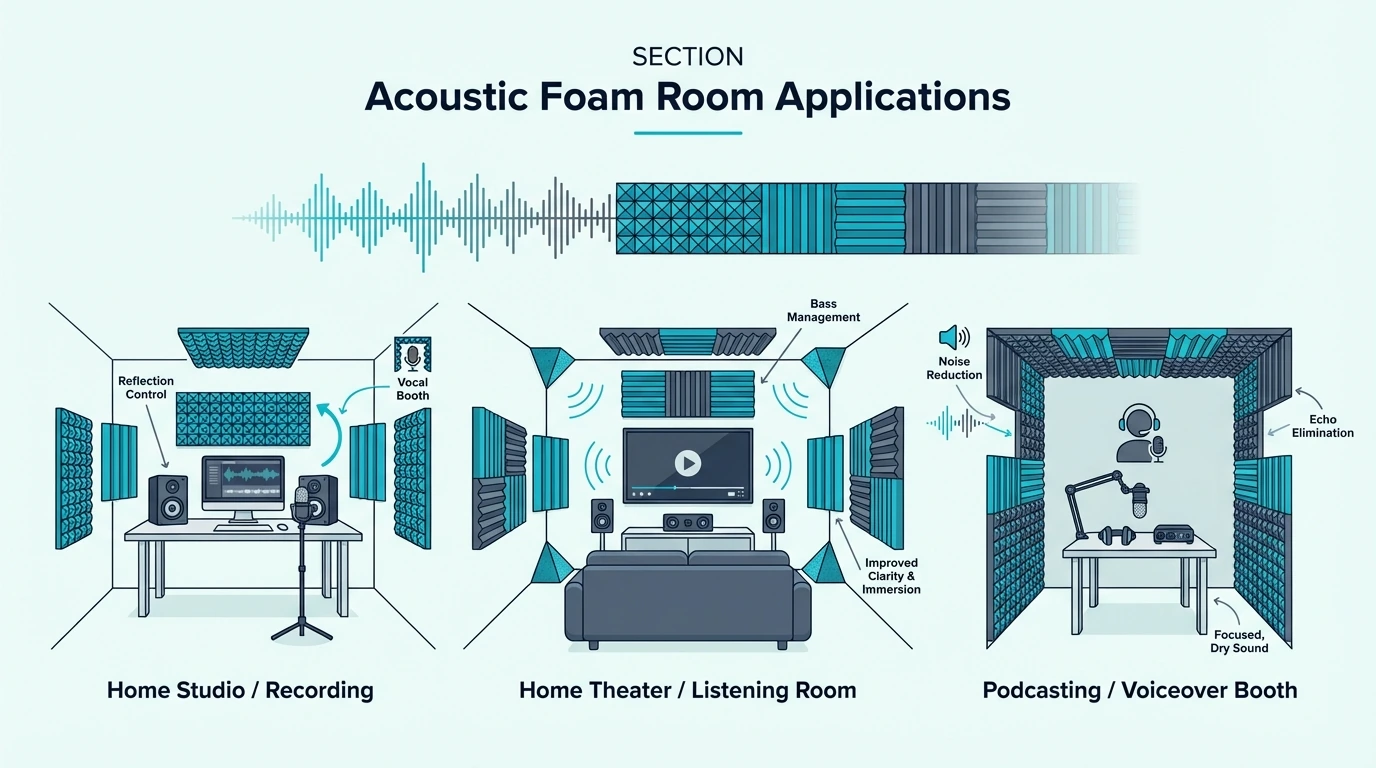
What Acoustic Foam Should You Use for Each Room?

Room applications for different acoustic foam types

Now that the specs make sense, here is how the decision plays out in real rooms. The right foam choice depends less on “best product” and more on what your mic and speakers are picking up in your space.

Home Recording Studios

Studios ask the most from acoustic treatment because you’re capturing everything. If you can hear the room in your takes, the room is part of the recording.

For most home studios, 2-inch foam is the minimum baseline. If you’re chasing warmth and reducing boxiness, 3–4 inches at key reflection points can help the lower mids feel less messy.

Don’t ignore corners if bass is part of your sound. Foam is not a bass solution, so pair it with bass traps if low end is boomy. If you want a foam-based corner add-on for early reflections, JBER Column Acoustic Wedge Corner Blocks can help in corners without pretending to solve bass on their own.

If you want a simple, solid 2-inch starting kit, Blue Pyramid Sound Proof Foam Panels (24-Pack) hits the thickness sweet spot without overthinking it. Start with reflection points, then decide if you need more coverage.

Podcast and Voiceover Rooms

Voice work is more forgiving than music because you’re dealing with a narrower range. If your room is small and hard-surfaced, you mostly need to tame mid/high reflections that make speech sound splashy.

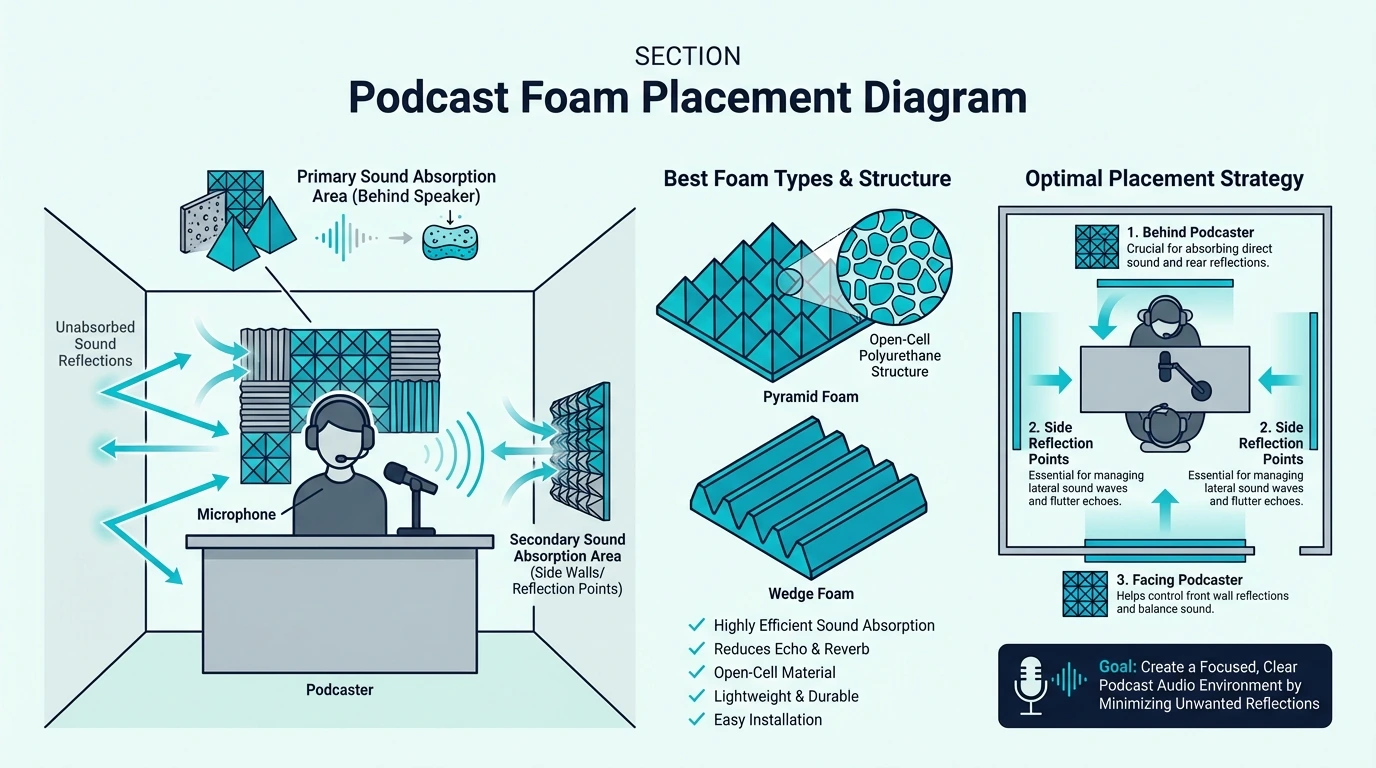
That usually means treating behind the mic and the first reflection points to the sides. You don’t need full-room coverage to hear a big improvement.

If you’re starting on a tight budget, a small pack like Sonicism 12 Pack Pyramid Sound Proof Foam Panels is a quick “test the concept” option. If your voice still sounds hollow or your room is stubbornly reflective, move up to 2-inch foam next.

For a deeper podcaster-specific setup, see best acoustic foam for podcasts. It’ll help you avoid overbuying and placing panels where they don’t matter.

Streaming and Gaming Rooms

Streaming is an audio problem and a camera problem. Foam everywhere can fix echo but make your background look cheap.

Treat the area around your mic first, especially the wall behind it. If foam will be visible, choose shapes and colors that look intentional, not like an afterthought. The how to decorate with acoustic foam guide covers layout and color tips.

Home Offices

For Zoom and video calls, the goal is simple: stop the room from sounding like a hallway. A few panels behind your desk and on the wall you face can remove that “untreated room” signature fast.

Start small and listen to a recording of your own voice on a call. The best budget acoustic foam guide has affordable picks for office setups. If the room still feels reflective, add a little more near the spots where sound bounces back at you.

Home Theaters

Home theaters are a two-problem room: dialogue clarity and bass control. Foam helps the first part, but it won’t fix low-frequency buildup on its own.

Treat first reflection points on walls and ceiling, then handle bass with corners and placement. If you’re dealing with vibration through the floor, that’s a different problem than echo.

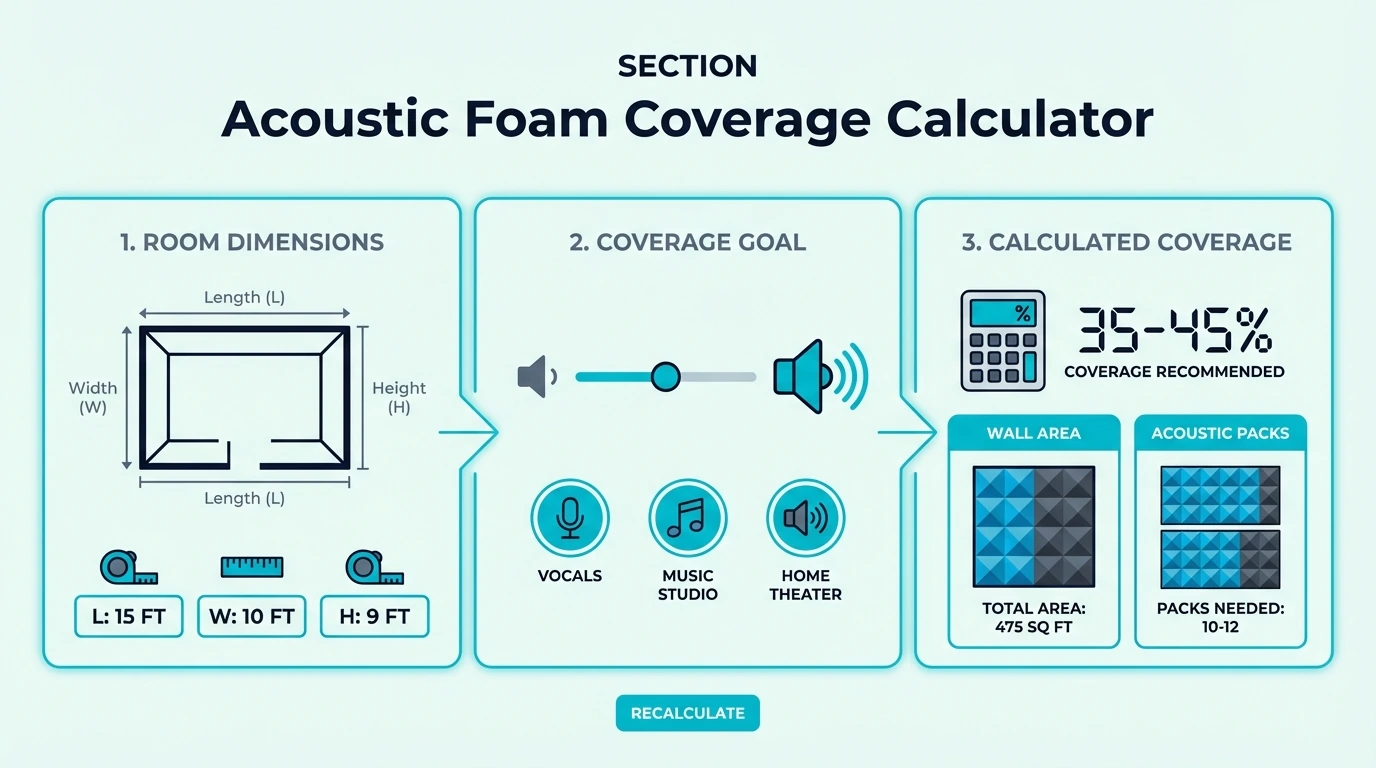
How Much Acoustic Foam Do You Need?

Coverage calculator for acoustic foam treatment

Here’s the shortcut: start with 12–24 panels and see what changes. Strategic placement of 12 panels can beat random placement of 50.

The “calculate your wall area and pick a percentage” method sounds scientific, but it often leads to overbuying. Foam works best when you treat reflection points first, then expand only if the room still sounds live.

The Real-World Approach

Most home recording problems come from a few spots. Treat the wall behind your mic, then the side walls at ear level.

Record something after each change and listen. If the room still rings, add ceiling treatment above your position.

This iterative approach costs less and usually sounds better than covering every surface. Over-treated rooms can feel unnaturally dead, especially for spoken word.

Room Size Guidelines (A Practical Starting Point)

For a typical bedroom or small office (roughly 8×10 to 10×12 feet), here’s a sane starting range. Treat reflection points first, then add coverage only if you still hear echo.

Minimal treatment is often 12–18 panels. This is usually enough for podcasting and streaming when you place them correctly.

Standard treatment is often 24–36 panels. This is where most home studios land once they start listening critically.

Full treatment can be 48–80 panels depending on room size and how “dead” you want it. It’s often overkill for voice-only recording. If you already know the room needs broad coverage, a bulk pack like Knightsacoustic 96 Pack Sound Proof Foam Panels is easier to plan around than stitching together random small packs.

Remember the thickness and density discussion from earlier. Twenty-four quality 2-inch panels can outperform forty-eight flimsy 1-inch panels.

The Formula (If You Want to Estimate Coverage)

If you prefer calculating, start with total wall area: (length × height × 2) + (width × height × 2). Then treat 25–35% of that for moderate control, or 40–60% for heavier treatment.

For example, a 10×12 room with 8-foot ceilings has about 352 square feet of wall area. At 30% coverage, that’s about 105 square feet (roughly 105 standard 12×12 panels).

Use that number as an upper bound, not your first purchase. Most people should start with 24 panels at reflection points and grow from there.

Where to Start (Priority Order)

The specs tell you what to buy. Placement decides whether it works.

Start with the wall behind your microphone or monitors. Then treat the side walls where reflections hit your ears, followed by the ceiling above your position.

After each addition, test a recording or clap test and listen for the tail. You might find that 18 well-placed panels solve your problem without needing more.

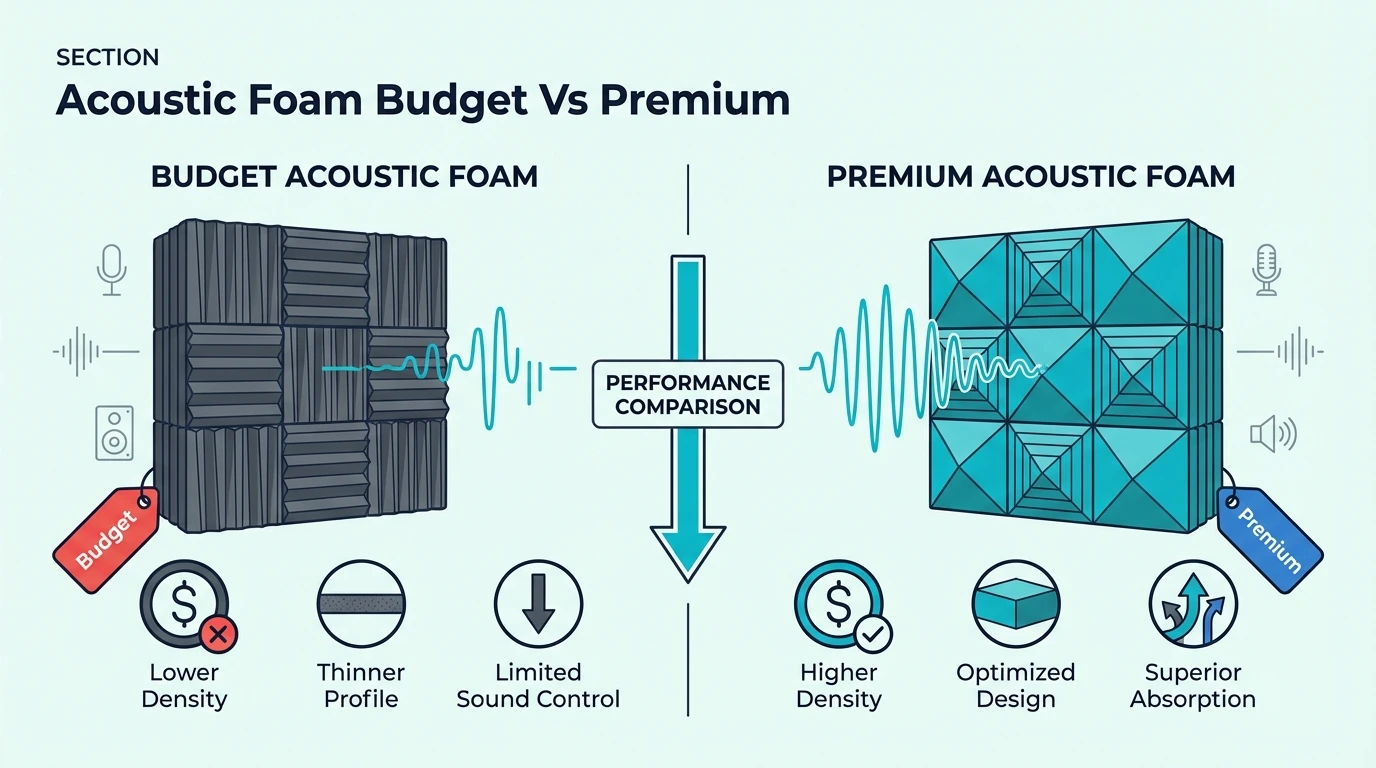
Is Cheap Acoustic Foam Worth It?

Budget versus premium acoustic foam comparison

Now that you can read thickness, density, and fire rating like a grown-up, price tiers make more sense. Cheap foam usually cuts density and documentation, and that shows up as weaker absorption and faster collapse.

The goal isn’t “buy expensive.” The goal is “buy foam that actually behaves like absorption instead of decoration.”

Budget Foam (Useful, With Limits)

Budget foam can be a good way to test whether treatment helps your room. It can also be fine for small improvements when expectations are realistic.

The downside is that very low-density foam can underperform from day one. It also tends to compress and lose effectiveness faster over time. If you want a budget listing with lots of review history, 52 Pack Acoustic Panels High Density Sound Foam is the kind of option worth comparing before you fall for mystery foam with no specs at all.

Mid-Range Foam (The Best Value Tier)

Mid-range foam is where most people should aim if they care about results. This is where density and absorption start to feel consistent instead of “hit or miss.”

It’s also where you’re more likely to see published specs and basic safety documentation. That’s a big deal if foam will stay mounted long-term.

Premium Foam (When Consistency Matters)

Premium brands usually sell consistency, documentation, and fire certification. That matters in commercial installs and pro studios where you can’t afford surprises.

For most home setups, the audible jump from good mid-range to premium is smaller than the price jump. If you’re building a business studio, premium makes more sense.

The Bottom Line on Quality

If you’re serious about recording, aim for mid-range as a minimum and buy enough thickness to match your use case. If you’re unsure, start small to test placement and upgrade once you know what changes your room.

What Mistakes Should You Avoid When Buying Acoustic Foam?

Final recommendation for choosing acoustic foam

Once you understand the specs, the biggest failures come from execution. These are the mistakes that make people say “foam doesn’t work,” even when foam wasn’t the problem.

Mistake 1: Buying Based on Price Alone

The cheapest foam often costs more long-term. Low-density foam compresses, degrades, and delivers weak absorption from the start.

Spending a little more for real density usually delivers a bigger improvement than buying more cheap panels. If you want value guidance, see is acoustic foam worth it?.

Mistake 2: Ignoring Thickness Requirements

This is the big one: people buy 1-inch foam because it’s cheap, then wonder why vocals still sound hollow. Hollow lives in the lower mids, and 1-inch foam isn’t built for that.

Match thickness to what you’re recording, not to your budget. If you want a deeper breakdown, the acoustic foam thickness guide explains the tradeoffs clearly.

Mistake 3: Over-Treating the Room

More foam isn’t always better. Rooms that are heavily covered can feel unnaturally dead and uncomfortable.

Start with reflection points and build slowly. It’s much easier to add panels than to remove them after you’ve mounted everything.

Mistake 4: Expecting Soundproofing

No amount of foam blocks sound transmission. If noise isolation is the goal, foam is the wrong product entirely.

The quickest fix here is mindset: foam is absorption, not blocking. Re-read does acoustic foam soundproof? if you’re on the fence.

Mistake 5: Random Placement

Foam scattered randomly across walls wastes material. Strategic placement at reflection points gives you more improvement with fewer panels.

Use the mirror trick to find first reflection points, then treat those. For a full map, see the acoustic foam arrangement guide.

The Bottom Line

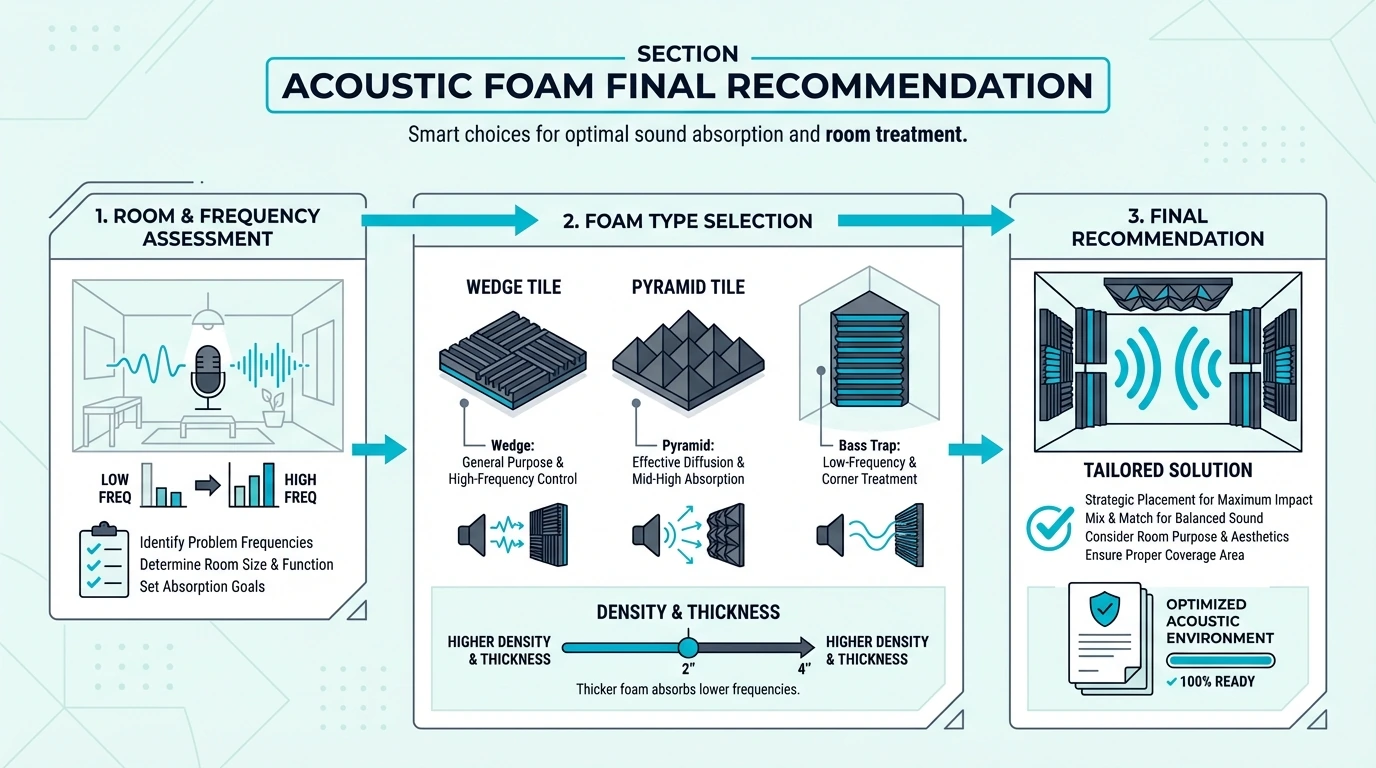
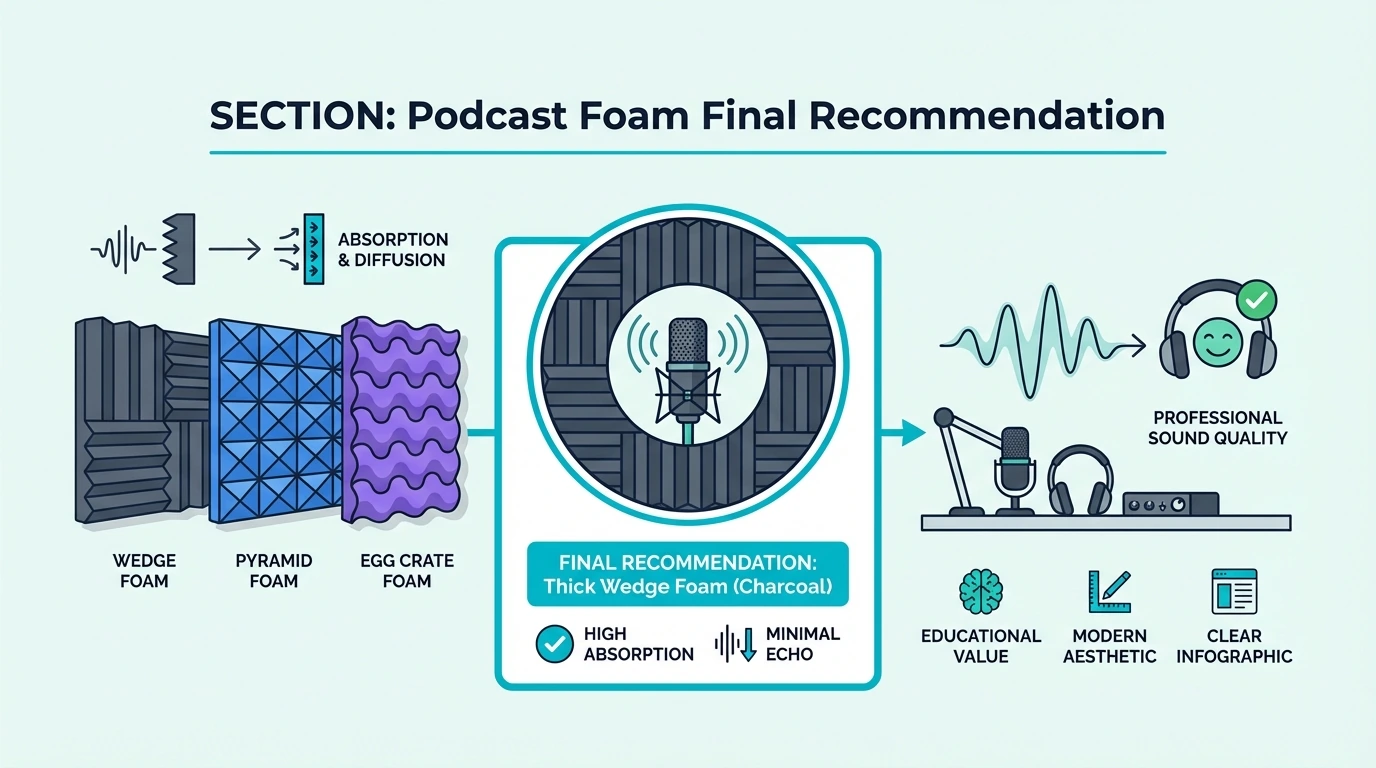
Choose acoustic foam based on what you record and what the room is doing to the sound. For most voice-focused setups, 2-inch foam placed at reflection points is the safe “start here” move.

Use thickness and density to avoid buying decoration, and treat fire rating as a real spec if foam will live near gear. If you want curated picks, start with best acoustic foam panels, and if you want placement maps, start with the acoustic foam arrangement guide.

Frequently Asked Questions

What thickness acoustic foam do I need?

For voice (podcasts, streaming, voiceovers), 2-inch foam is usually the safe default because it reaches into the core vocal range. For music, 3–4 inch at first reflection points can help the lower mids feel less boxy.

1-inch foam is mostly a high-frequency tool, so it won’t fix hollow lower mids. If you’re buying only one thickness, skip 1-inch.

How do I know if foam is good quality?

Look for real thickness, real weight, and real documentation. If you can find density, aim for roughly 1.2–1.8 lbs/ft³ for most home setups.

If a listing won’t publish any useful specs, assume it’s decoration foam. A decent NRC number and a clear fire rating are both good signs.

Is expensive foam worth it?

Good mid-range foam usually gives you most of the audible improvement. Premium foam makes more sense when you need consistency and fire documentation for a permanent install.

How many panels do I need?

Start with 12–24 panels and place them at reflection points (behind the mic, side walls, and ceiling above you). Add more only if the room still sounds live after you test recordings.

Does foam shape matter?

At the same thickness and density, wedge, pyramid, and egg crate foam are usually close enough that you won’t hear a notable difference. Choose shape based on aesthetics and what installs cleanly.

Can I use foam for soundproofing?

No. Foam absorbs reflections inside a room, but it doesn’t block sound between rooms.

If you need soundproofing, you’re looking at construction (mass, sealing, decoupling), not surface foam. Start with does acoustic foam soundproof? to see what works and what doesn’t.

Bass Traps vs Acoustic Foam: Why You Usually Need Both

Bass traps vs acoustic foam sounds like a choice between two competing products, but picking one over the other leaves half your room’s problems completely untreated.

If your mixes still sound muddy even after covering walls in foam, it’s because foam physically cannot absorb the low frequencies causing that muddiness — you’ve been treating the wrong part of the spectrum.

Getting the right absorber into the right part of your room finally stops that bass buildup and clears the reflections, so your mixes translate correctly on every system.

Start with the quick takeaway below, then we’ll break down exactly why these two products handle completely different frequency ranges and where each one belongs.

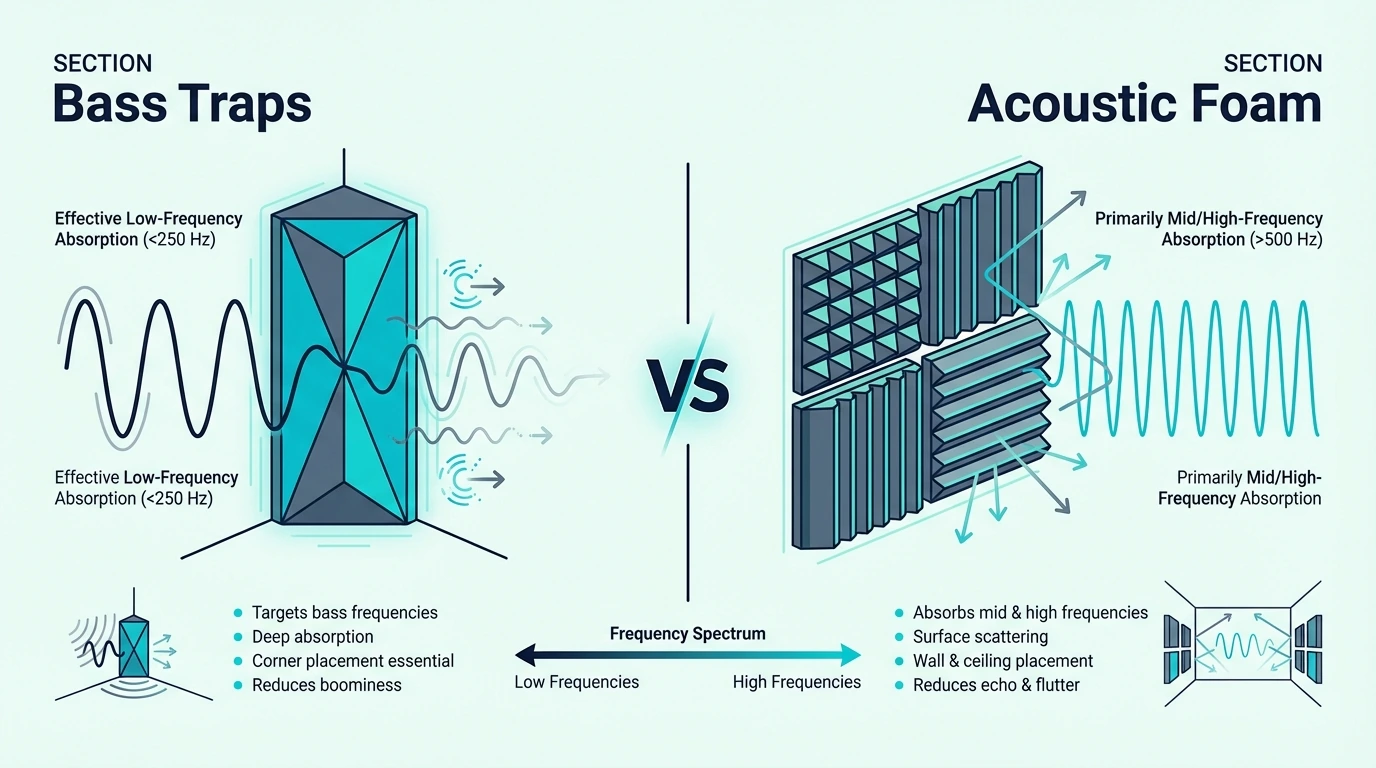
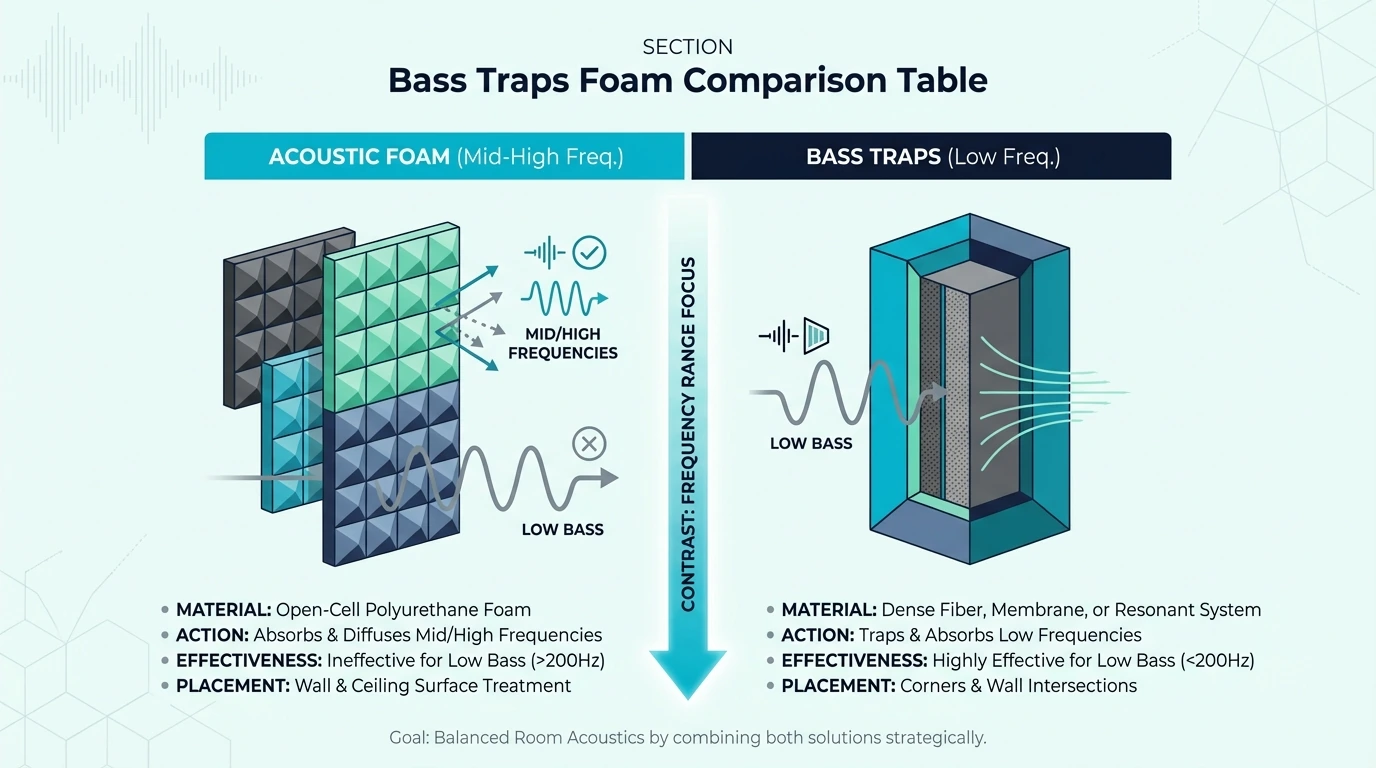
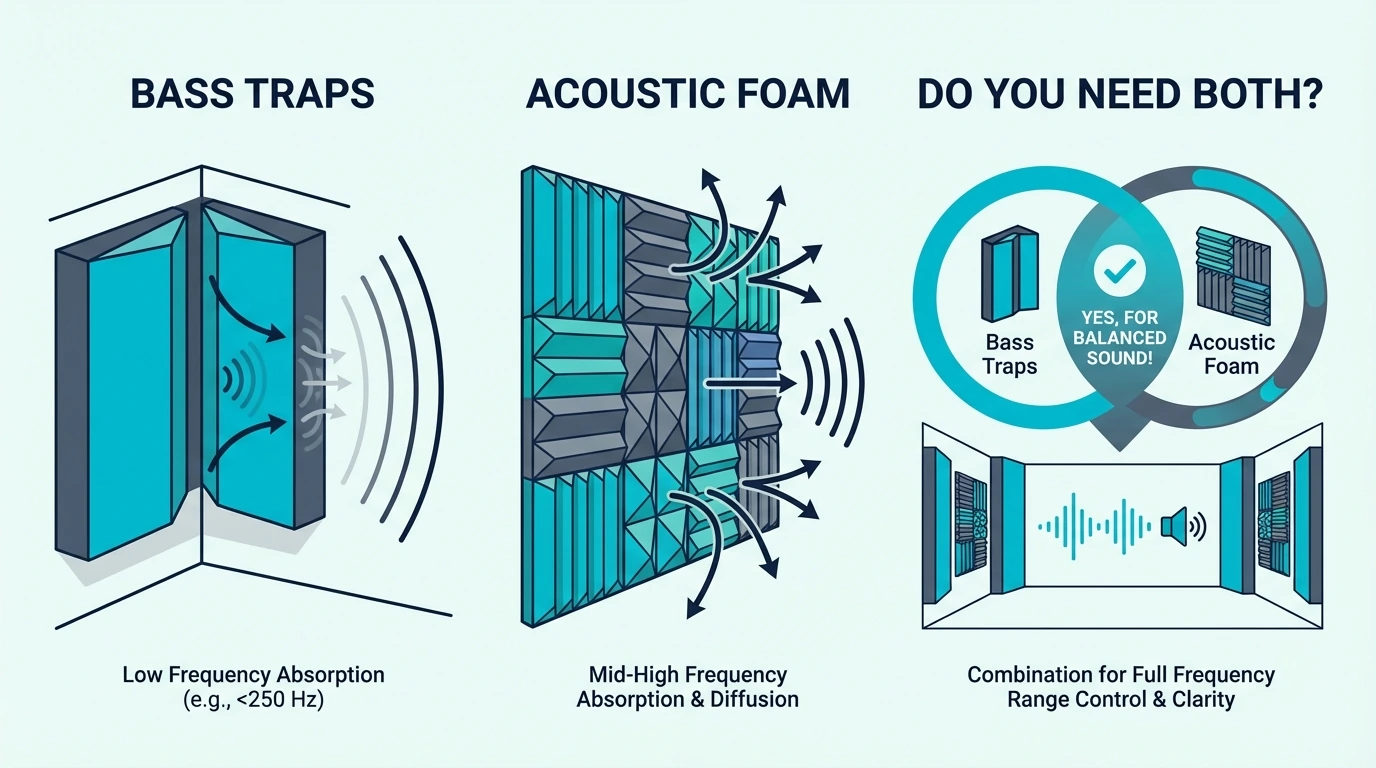
The Short Answer: Bass traps and acoustic foam aren’t competing products — they handle completely different frequency ranges. Bass traps go in corners for frequencies below 300Hz. Foam goes on walls for frequencies above 500Hz. For complete treatment, you need both. If budget forces a choice, start with bass traps — low-frequency problems cause more recording issues than high-frequency reflections.

Bass Traps vs Foam: The Quick Answer

Frequency comparison between bass traps and acoustic foam

The confusion between bass traps and acoustic foam comes from marketing that lumps all “acoustic treatment” together. In reality, these products work on opposite ends of the frequency spectrum. Here is how that spectrum is divided.

Different Products for Different Frequencies

Sound frequencies behave differently based on their wavelength. Low frequencies (bass) have wavelengths measured in feet — a 100Hz wave is about 11 feet long.

High frequencies have wavelengths measured in inches.

This wavelength difference determines what absorbs each frequency. Thin materials like foam can absorb short wavelengths (high frequencies).

Long wavelengths (low frequencies) pass right through thin materials without losing energy. That means you need something built specifically to stop them.

Bass Traps: Low Frequencies in Corners

Bass traps are thick, dense absorbers designed for frequencies below 300Hz. They’re typically 4-12 inches thick and made from rigid fiberglass or mineral wool.

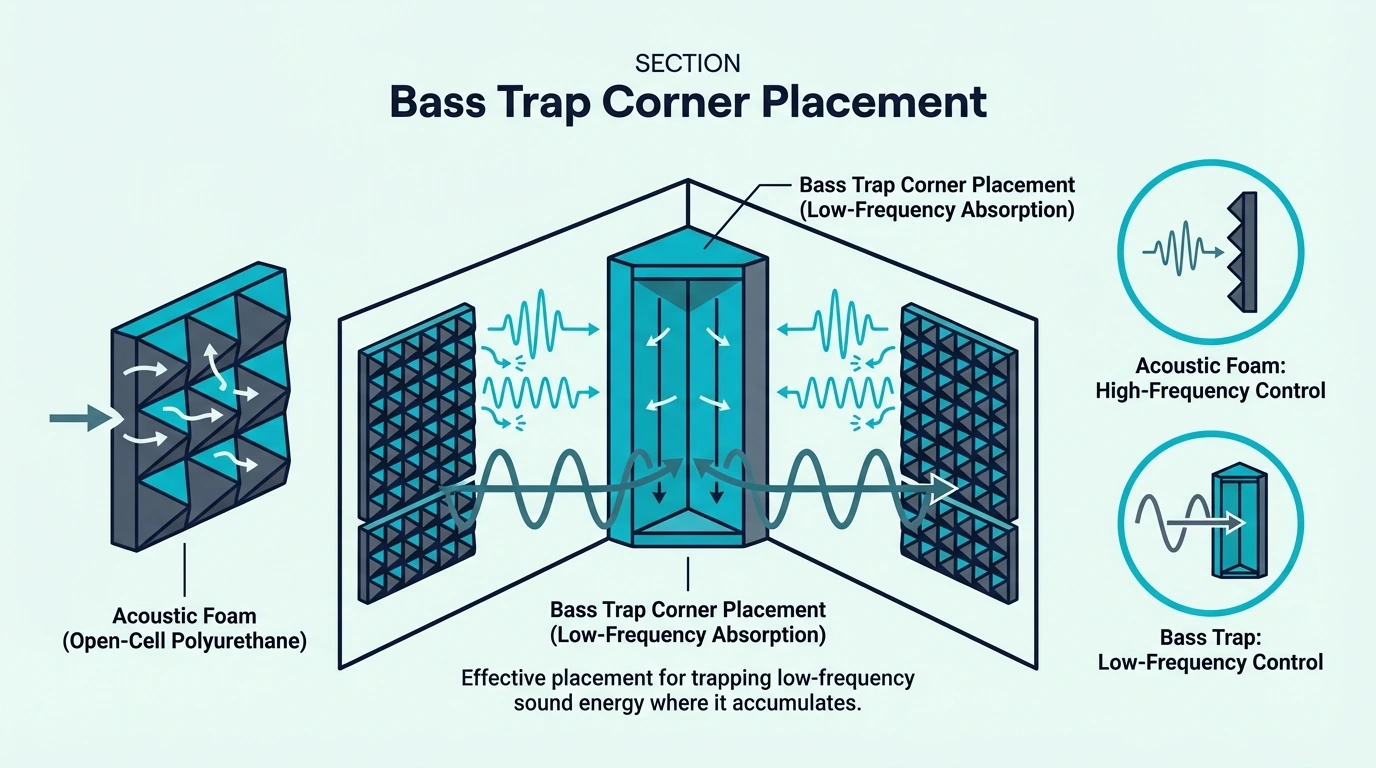
Corners are where bass traps belong because low frequencies accumulate there.

Understanding proper placement is essential. Sound waves bounce between walls and pile up in corners, creating “bass buildup” that muddies recordings and makes mixing impossible. Once those lows are controlled, you can handle the rest of the spectrum.

Acoustic Foam: Mid/High Frequencies on Walls

Acoustic foam handles frequencies above 500Hz — the range where voice clarity, cymbal shimmer, and guitar presence live.

Standard 1-2 inch foam absorbs these shorter wavelengths effectively. Learn more about acoustic foam thickness and how it affects absorption.

Foam belongs on walls at first reflection points, not in corners. Placing foam in corners wastes material on a job it can’t do.

What Are Bass Traps?

Bass traps installed in room corners from floor to ceiling for bass traps vs acoustic foam

If you’ve ever wondered why your mixes sound great in your studio but muddy everywhere else, bass traps are probably the missing piece. They’re specialized absorbers built to handle the low frequencies that standard foam literally cannot touch.

The Problem Bass Traps Solve

Here’s what’s happening in your room right now: low frequencies are bouncing between your walls like a ping-pong ball in slow motion.

A 60Hz bass note has a wavelength of nearly 19 feet. In a 12-foot room, that wave doesn’t fit — it bounces back and forth, reinforcing itself in some spots and canceling in others. Stand in one corner and the bass sounds boomy. Move two feet and it nearly disappears.

These “standing waves” make accurate mixing impossible. You think you’ve got the bass right, but you’re actually hearing your room’s distortion, not your mix. Bass traps break this cycle by absorbing that energy before it can bounce. But they have to be built correctly to do it.

The Physics: Why Thickness Matters

Bass traps work through friction — sound waves pass through dense material and lose energy. But here’s the catch: the absorber needs to be a significant fraction of the wavelength to work.

That 60Hz wave at 19 feet long? A 2-inch panel is laughably thin by comparison. It’s like trying to stop a truck with a speed bump.

This is why real bass traps are thick. A 4-inch trap reaches down to around 250Hz. Professional 12-inch traps can absorb below 80Hz — the frequencies that actually cause problems.

The 8 Pack Corner Bass Traps provides an affordable starting point, though serious bass control requires thicker fiberglass or mineral wool traps. Once you have the right thickness, you have to put them in the right spot.

Why Corners? The Pressure Zone Effect

Bass doesn’t accumulate randomly — it piles up where surfaces meet. Physics calls these “pressure zones,” and corners are the worst offenders.

Tri-corners (where two walls meet the ceiling) collect the most bass energy. Wall-wall vertical corners are second. Floor-wall junctions matter too, though they’re harder to treat without blocking floor space.

This is actually good news: you don’t need to treat your entire room. Target the corners with floor-to-ceiling traps and you’ve addressed the biggest bass problems with minimal material.

What Is Acoustic Foam?

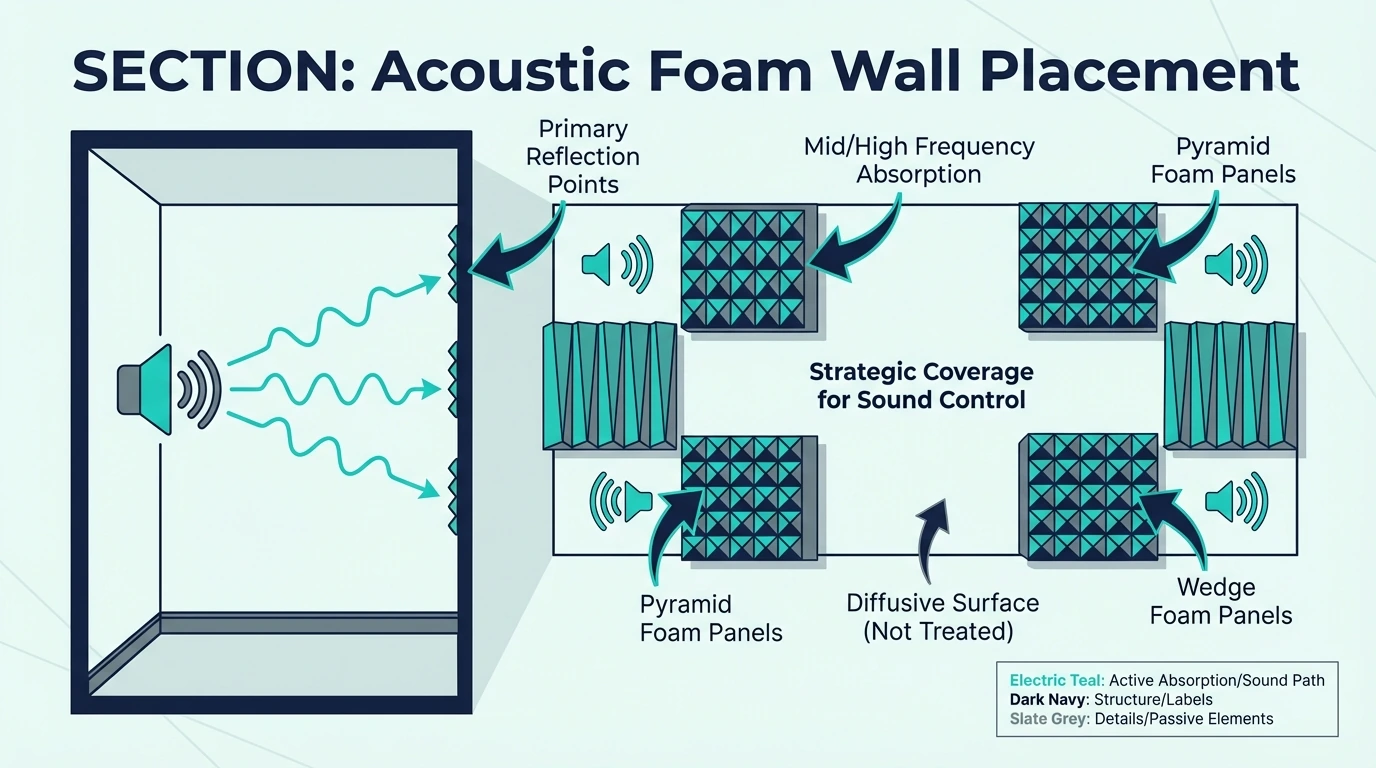
Acoustic foam panels mounted at first reflection points on studio walls for bass traps vs acoustic foam

Now let’s talk about the product you probably came here asking about — those pyramid or wedge-shaped panels you see in every YouTube studio and Twitch stream. Acoustic foam handles a completely different job than bass traps, and understanding the distinction saves you from expensive mistakes.

The Problem Foam Actually Solves

Record a voice in an untreated room and you’ll hear it: that hollow, echoey quality that screams “amateur.” That’s not bass — it’s mid and high-frequency reflections bouncing off your walls and arriving at your microphone milliseconds after your direct voice.

Your brain interprets these delayed reflections as “room sound.” In a cathedral, that’s beautiful reverb. In your bedroom, it’s mud that obscures detail and makes editing a nightmare.

Foam absorbs these reflections before they reach your mic. The result is cleaner, more direct sound that’s easier to process and more professional to listeners. This targeted absorption is a feature, not a bug.

Why Foam Works for Highs But Not Lows

Remember that wavelength discussion from the bass traps section? It works in reverse here.

A 4kHz frequency (the “presence” range that makes voices cut through) has a wavelength of about 3 inches. A 2-inch foam panel is a significant obstacle for that wave — plenty of material to create friction and absorb energy.

This is why foam excels at the 500Hz-8kHz range where speech intelligibility and musical detail live. The wavelengths are short enough that thin material actually works. It’s also why acoustic foam is worth it for voice recording specifically.

The TroyStudio 36 Pack 2-Inch Panels offers the thickness needed for effective mid-frequency absorption — thick enough to reach down to 500Hz where voice warmth lives. To get the most out of them, placement is everything.

Placement: The Mirror Trick

Unlike bass traps (which go in corners because that’s where bass accumulates), foam placement requires a bit more thought. You’re targeting “first reflection points” — the spots where sound bounces directly from source to listener.

Here’s the trick professionals use: sit in your recording or listening position and have someone slide a mirror along each wall. Where you see your speakers (or microphone) reflected, that’s a first reflection point. Mark it. Put foam there.

Side walls at ear level, the wall behind your monitors, and the ceiling above your position are typical foam locations. Our acoustic foam placement guide covers this technique in detail.

Bass Traps vs Foam: Side-by-Side Comparison

Side-by-side comparison table of bass traps versus acoustic foam specifications for bass traps vs acoustic foam

Feature Bass Traps Acoustic Foam
Frequency Range Below 300Hz Above 500Hz
Typical Thickness 4-12 inches 1-2 inches
Placement Corners Walls
Material Fiberglass, mineral wool, dense foam Open-cell polyurethane
Cost per Unit Higher Lower
Coverage Needed 4-8 corners 20-40% of wall space
Primary Benefit Tightens bass, reduces muddiness Reduces echo, improves clarity

The comparison makes clear why you can’t substitute one for the other. A room full of foam still has bass problems.

A room with only bass traps still has flutter echo.

Do You Need Both?

Diagram showing a room treated with both bass traps in corners and foam on walls for bass traps vs acoustic foam

The short answer: yes, if you want complete acoustic treatment. But budget constraints are real, so let’s prioritize.

Yes — Complete Treatment Requires Both

Professional studios treat both frequency ranges because problems in either range compromise recordings and mixes.

Untreated bass creates a muddy low end where kick drums and bass guitars blur together. Untreated reflections create harsh, echoey vocals and guitars.

Treating only one range improves that range while leaving the other problematic. Half-measures produce half-results. If you can’t buy everything at once, you have to prioritize.

Which to Buy First: Bass Traps

If budget forces a choice, start with bass traps. Low-frequency problems cause more severe issues than high-frequency reflections.

Bass buildup affects your entire mix. If you can’t hear bass accurately, you’ll make bad mixing decisions that translate poorly to other playback systems.

High-frequency reflections are annoying but less destructive. You can partially compensate with microphone positioning and post-processing. Here is the most efficient way to spend your budget.

Budget Priority Order

Here’s the optimal order for building acoustic treatment on a budget:

Step 1: Corner bass traps (4 minimum, 8 ideal). The 8 Pack Corner Bass Traps covers all four vertical corners.

Step 2: First reflection point foam (12-24 panels). The JBER 6 Pack 2-Inch Panels provides a starting point.

Step 3: Additional wall coverage (24-48 panels). The 50 Pack 2-Inch Foam Panels handles comprehensive wall treatment.

Step 4: Ceiling treatment and additional bass traps as budget allows.

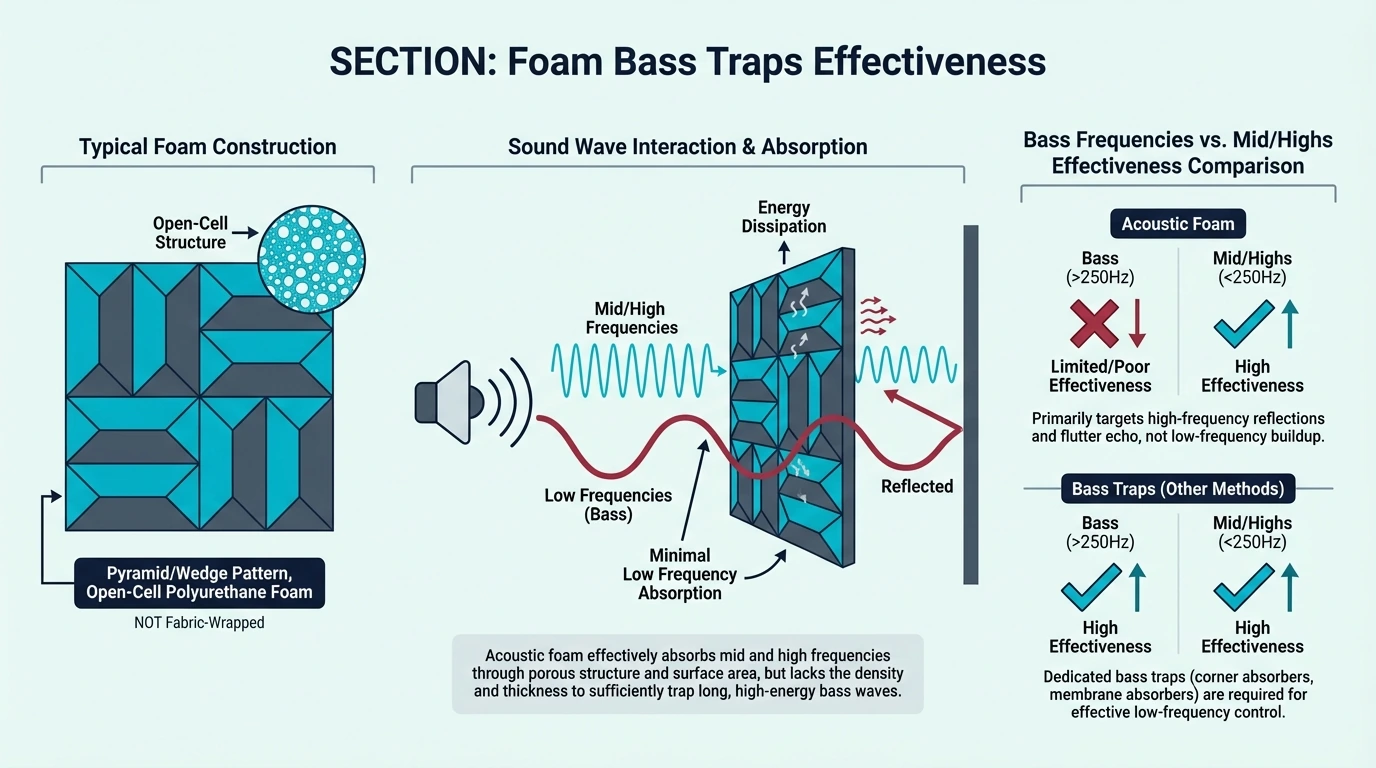
Do Foam Bass Traps Work?

Effectiveness of foam compared with real bass traps

This question comes up constantly because many products marketed as “bass traps” are actually just foam corner pieces. Let’s clarify what works and what doesn’t.

Foam Corner Pieces: Limited Effectiveness

Triangular foam pieces designed for corners provide some benefit, but they’re not true bass traps. Their thin profile (typically 2-4 inches) can’t absorb frequencies below 250-300Hz effectively.

These products reduce upper-bass and low-mid buildup in corners. That’s useful, but it’s not the same as controlling the 60-150Hz range where serious bass problems live. For that, you need heavier materials.

Real Bass Traps: Thick Fiberglass or Mineral Wool

Effective bass traps use dense, rigid materials at least 4 inches thick. Professional options use 6-12 inches of fiberglass or mineral wool.

The physics are non-negotiable. Low frequencies require thick absorbers.

No marketing claim changes the relationship between wavelength and absorption depth. Here is what you should actually look for.

What Actually Works for Low Frequencies

For true low-frequency control, you need:

Thickness: Minimum 4 inches, ideally 6-12 inches for frequencies below 100Hz.

Density: Rigid fiberglass (3-6 lbs/ft³) or mineral wool outperforms foam.

Placement: Floor-to-ceiling corner mounting maximizes effectiveness.

Quantity: More is better for bass. Unlike foam, you can’t really over-treat corners.

Budget foam corner pieces like the 8 Pack Corner Bass Traps provide entry-level corner treatment. For serious bass control, consider DIY fiberglass traps or professional options.

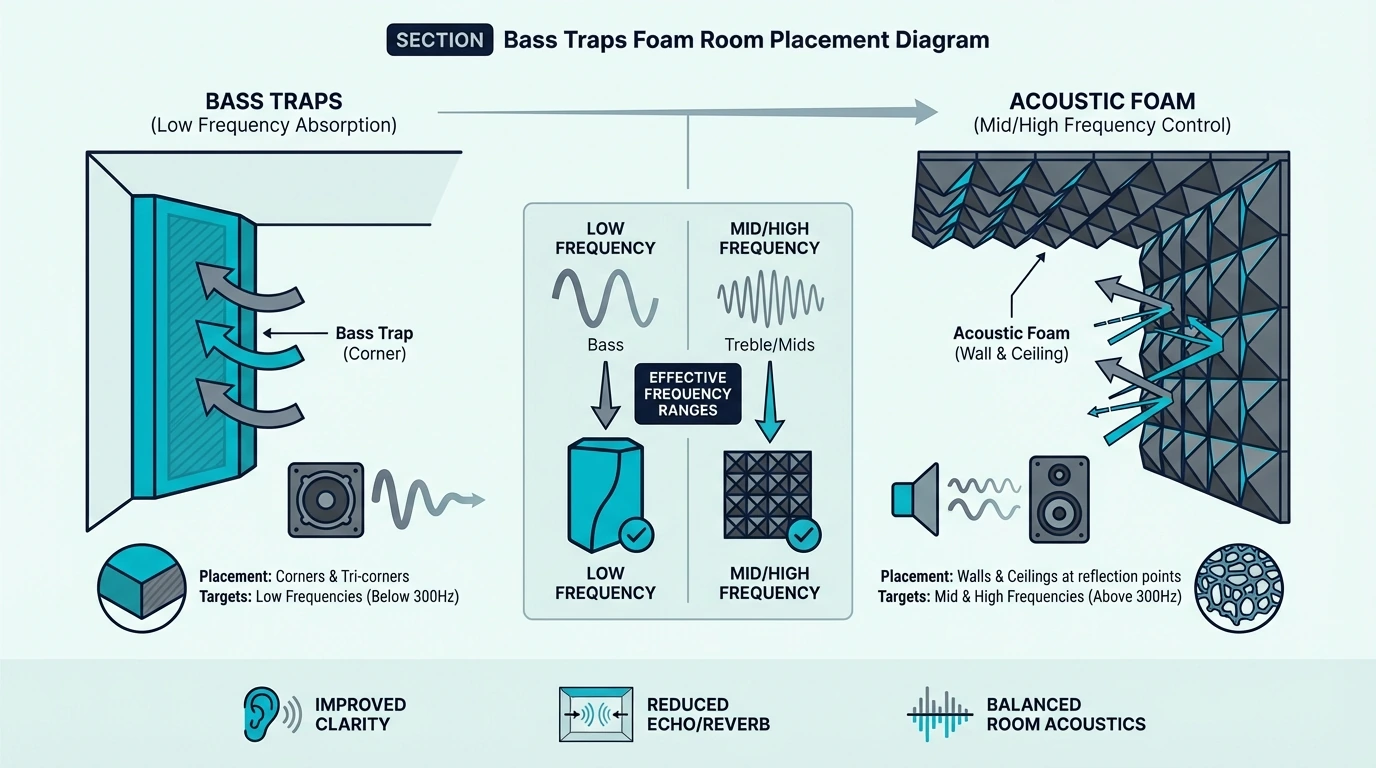
Placement Guide: Using Both Together

Room placement diagram for bass traps and acoustic foam

Now that you understand what each product does, let’s talk about how they work together in a real room. Think of this as a recipe — bass traps and foam are different ingredients that combine to create a balanced acoustic environment.

Start With Corners: Your Bass Trap Foundation

Before you stick a single foam panel on your wall, address your corners. This feels counterintuitive because foam is more visible and satisfying to install, but bass problems undermine everything else you do.

Vertical corners first. All four wall-wall corners from floor to ceiling. These collect the most bass energy and provide the biggest improvement per trap. If you can only afford four bass traps, put them here.

Tri-corners second. Where walls meet the ceiling — those eight corner points where three surfaces intersect. These are bass accumulation hotspots that vertical traps alone don’t fully address.

Wall-ceiling junctions third. The horizontal lines where walls meet the ceiling, between the tri-corners. These matter more in rooms with low ceilings where bass has less vertical space to dissipate.

Behind your listening position fourth. If your chair sits within a few feet of the rear wall, bass traps behind you prevent that wall’s bass buildup from coloring what you hear. Once the low end is under control, you can move to the higher frequencies.

Then Add Foam: Targeting Reflections

With corners treated, now you can address the mid/high frequency reflections that foam handles. The key word here is “targeted” — random foam placement wastes material.

First reflection points are priority one. Use the mirror trick: side walls at ear level where you see your speakers or mic reflected. These create the strongest high-frequency reflections that smear your sound. Our acoustic foam placement guide walks through this technique step by step.

The wall behind your monitors is priority two. Sound from your speakers hits this wall first and bounces straight back at you. Foam here tightens your stereo image and reduces that “wall of sound” blur.

Ceiling above your position is priority three. Ceiling reflections get overlooked because we don’t naturally look up, but they contribute significantly to room echo. A cloud of foam panels directly above your listening/recording spot makes a noticeable difference.

Rear wall is priority four. If you sit far from the rear wall (6+ feet), foam there reduces late reflections that smear transients and muddy detail. If you sit close to the rear wall, bass traps matter more than foam there. When you combine both treatments correctly, the difference is immediate.

The Balanced Room: What to Aim For

Here’s what a well-treated home studio typically looks like:

  • 8 corner bass traps (all vertical corners, floor to ceiling)
  • 24-36 foam panels (first reflection points + ceiling cloud + partial rear wall)
  • 40-50% of total wall surface treated
  • Some surfaces intentionally left bare

That last point matters. Over-treatment creates an unnaturally dead sound — your voice loses warmth when all reflections disappear. Leave some wall space reflective, especially surfaces far from your primary position. You want controlled acoustics, not an anechoic chamber.

The goal is balance: tight bass from corner treatment, clear mids/highs from wall foam, and enough natural ambience to sound like a real room rather than a padded cell.

Common Mistakes to Avoid

Common mistakes when choosing bass traps or acoustic foam

I see the same errors repeatedly in home studio setups. Most stem from misunderstanding what each product does — which is exactly why I spent so much time explaining the physics above. Here’s what to watch for:

Mistake 1: Foam in Corners (The Classic Blunder)

This is the most common waste of money I see. Someone buys 50 foam panels and sticks them everywhere, including corners.

Foam in corners does almost nothing. Those low frequencies pass right through thin foam like it’s not there. You’ve spent money on material that’s working at maybe 10% effectiveness in that location.

Save your foam for walls where it actually absorbs the frequencies it’s designed for. Use proper bass traps in corners — even budget foam corner pieces outperform flat foam panels in corner positions. This leads directly to the next issue.

Mistake 2: Expecting Foam to Fix Bass Problems

“I covered my walls in foam but my mixes still sound muddy.” I hear this constantly.

No amount of wall foam fixes bass problems. If your low end sounds boomy, undefined, or different in every spot you stand, that’s a bass issue. Adding more foam addresses frequencies that aren’t causing your problem.

Understanding what acoustic foam actually does prevents this frustration. Bass problems require bass traps. The physics are non-negotiable. Which makes the next mistake so incredibly common.

Mistake 3: All Foam, No Bass Treatment

Walk into most home studios and you’ll see walls covered in foam with zero corner treatment. It looks impressive on camera. Acoustically, it’s backwards.

The result: controlled highs but muddy, undefined bass. Vocals sound clean but the low end is a mess. Mixes translate poorly to other systems because the producer couldn’t hear bass accurately.

This happens because foam is cheaper, more visible, and more satisfying to install. But bass traps provide more acoustic improvement per dollar in most untreated rooms. See budget foam options that let you afford both. But going too far in the other direction is also an issue.

Mistake 4: Treating Only One Frequency Range

The opposite mistake exists too: studios that go all-in on bass traps while ignoring wall reflections. Tight bass, but harsh and echoey mids/highs.

Both approaches leave problems unsolved. Your room has issues across the frequency spectrum — treating only one range is like fixing half a leaky roof.

Complete treatment addresses both. Start with bass traps (they provide more bang for buck), then add foam at reflection points. The combination creates a balanced acoustic environment where you can actually trust what you hear.

The Bottom Line

Bass traps and acoustic foam aren’t competing products — they’re complementary tools for different frequency ranges.

Bass traps handle low frequencies and belong in corners. The 8 Pack Corner Bass Traps provides budget-friendly corner treatment.

Acoustic foam handles mid/high frequencies and belongs on walls. The TroyStudio 36 Pack 2-Inch Panels offers effective wall coverage.

For complete acoustic treatment, you need both. Start with bass traps if budget is limited — they provide more improvement per dollar in most untreated rooms.

For more guidance on acoustic treatment, visit our acoustic foam guide or explore our best acoustic foam panels recommendations. If you’re setting up a home studio, check out best budget acoustic foam options or learn how many panels you need for your space.

Frequently Asked Questions

Should I get bass traps or panels first?

Bass traps first. Low-frequency problems affect your entire frequency perception and cause more mixing errors than high-frequency reflections.

Start with corner treatment, then add wall foam as budget allows. The 8 Pack Corner Bass Traps provides affordable corner coverage.

Can foam absorb bass?

Standard 1-2 inch foam cannot absorb bass effectively. The frequencies are too low and wavelengths too long for thin materials to absorb.

See our foam thickness guide for details on frequency absorption by thickness.

Thick foam (4+ inches) provides some bass absorption, but dedicated bass traps using fiberglass or mineral wool perform significantly better.

How many bass traps do I need?

Minimum: 4 (one per vertical corner). Ideal: 8-12 (vertical corners plus tri-corners).

More bass traps generally means better bass control. Unlike foam, you can’t really over-treat corners for bass.

Are corner bass traps worth it?

Yes — corner treatment provides the highest return on investment for acoustic treatment. Bass problems affect your entire mix, and corners are where bass accumulates most.

Even budget foam corner pieces improve bass response. Professional fiberglass traps provide even better results.

What’s the difference between bass traps and acoustic panels?

Bass traps are thick absorbers (4-12 inches) designed for low frequencies below 300Hz. They mount in corners.

Acoustic panels (including foam) are thinner absorbers (1-2 inches) designed for mid/high frequencies above 500Hz. They mount on walls.

The terms sometimes overlap in marketing, but the physics are distinct.

Best Acoustic Foam for Podcasts: Top 7 Picks for Clear Voice Recording

Best acoustic foam for podcasts can make your recordings sound cleaner — but it won’t fix the wrong problem.

If your voice sounds hollow or far away, quick reflections are hitting the mic milliseconds after you speak.

Here’s the good news: you don’t need to cover every wall.

Start by treating the wall behind the microphone, then add panels at your closest reflection points.

In many bedrooms, 6-12 panels is enough to make your voice sound more direct and consistent.

Below are seven acoustic foam picks that work for typical podcast setups, from a simple “behind the mic” wall to full room treatment.

If you want the fast answer, check the Quick Takeaway, then use the rest of the guide to match a pack to your room and placement.

Quick Takeaway

For most podcast rooms, 6-12 panels behind the microphone eliminate the worst reflections. Treat the wall you face first, then add side-wall panels if echo remains. One-inch foam handles the 500Hz-4kHz speech range where clarity lives. If budget forces a choice, start small and expand only where recordings still sound hollow.

Quick Picks: Best Acoustic Foam for Podcasts

Final recommendation for acoustic foam in podcast rooms

If you just want the buying list, start here.

These picks cover the most common podcaster setups, from a basic “behind the mic” wall to full room treatment.

What’s the Best Acoustic Foam for Podcasts?

Comparison overview of acoustic foam options for podcasts

With the shortlist out of the way, here is how to choose the right pack for your room.

Podcasters need foam that tames voice reflections without breaking the bank. The goal isn’t studio perfection — it’s eliminating the echo that makes recordings sound like you’re in a bare room.

After reviewing a range of popular packs and sizes, these seven picks cover the most common podcast setups. The best choice depends on how much wall area you can realistically treat.

Best Overall: JBER 48 Pack Acoustic Foam Wedges

The JBER 48 Pack dominates the podcast foam market for good reason. You get enough foam to treat a small room without turning it into a major expense.

But what matters for many home studios is the fire rating. Foam near lights, PCs, and chargers can get warm.

Lower-quality foam can discolor or soften over time near heat sources. Fire-retardant panels reduce that risk and make the setup easier to forget about once it’s on the wall.

The 1-inch thickness handles the 500Hz-4kHz range where voice clarity lives. That’s exactly what podcasters need.

You’re not recording bass-heavy EDM tracks — you’re capturing speech. One inch is sufficient for that job.

The honest take: These won’t win awards for density or premium feel. They’re workhorses, not show ponies.

But for podcasters who need coverage without complexity, this is the pack to beat.

Best Budget Starter: JBER 12 Pack

If you’re new to treatment, the JBER 12 Pack is often enough to hear a clear difference. Twelve panels behind your microphone can remove a big chunk of room echo in many setups.

That’s not marketing fluff — it’s physics. Your mic’s cardioid pattern rejects sound from behind, making the wall you face the primary problem.

Treat that wall, and you’ve solved most of your acoustic issues.

At this price point, you can test whether foam actually helps your specific room before committing to full treatment. The best budget acoustic foam roundup compares more entry-level options if you want alternatives.

Some rooms surprise you — maybe yours has enough soft furniture and carpet that minimal treatment is enough.

When to upgrade: If you record video and your background needs to look treated, or if side-wall reflections remain audible after treating the front wall. If that solves it, you can stop there.

Best Large Room Coverage: 100 Pack Premium Acoustic Foam

The 100 Pack Premium Acoustic Foam exists for a specific situation: you have a dedicated podcast studio, it’s larger than a bedroom, and you want to treat it properly the first time.

Bulk packs like this can be a solid value when you actually need the coverage. The “premium density” claim actually holds up — these feel noticeably more substantial than budget alternatives.

The reality check: This is overkill for 90% of home podcasters.

A 10×10 bedroom needs maybe 36-48 panels for thorough treatment.

Buying 100 panels for that space means you’ll have 50+ panels sitting in a closet.

Measure your room and calculate your actual needs. Then decide if bulk buying makes sense.

Best for Tight Spaces: FONESO 24 Pack

Closet podcasters, this one’s for you.

The FONESO 24 Pack hits the sweet spot for small, dedicated recording spaces.

Twenty-four panels treat approximately 24 square feet — enough for the wall behind you plus partial side coverage in a walk-in closet or small bedroom corner.

The pyramid shape is worth discussing. The best foam shape guide breaks down when wedge, pyramid, and egg-crate profiles make a difference.

Unlike wedge foam that directs sound in predictable angles, pyramids scatter reflections in multiple directions.

Most listeners can’t tell the difference, but your ears might disagree.

Installation note: Pyramid foam is harder to cut cleanly than wedge foam. If your layout requires trimming panels around outlets or windows, plan carefully or choose wedge-shaped alternatives.

Best Bulk Value: 96 Pack Sound Proof Foam

The 96 Pack Sound Proof Foam plays the comparison game.

Amazon prices fluctuate constantly, so compare the 96-pack and the 100-pack on the day you buy.

Pick whichever is cheaper; the four-panel difference won’t matter on your wall.

The product itself: Solid, consistent, unremarkable in the best way. It does exactly what foam should do without surprises.

Best 2-Inch Thickness: JBER 6 Pack Thick Panels

This is where strategic upgrades come in.

The JBER 6 Pack 2-Inch Panels absorbs frequencies that 1-inch foam physically cannot touch.

That extra inch extends absorption down to around 250Hz. The best foam for recording guide covers thicker options in more detail, capturing the lower end of male voices and reducing room resonance that thin foam misses entirely.

Six panels won’t cover much area, and that’s intentional. Use these at your primary reflection point (directly behind your mic), then fill the rest with cheaper 1-inch panels.

This hybrid strategy — thick foam where it matters most, thin foam elsewhere — delivers better results than uniform 1-inch coverage throughout. You’re optimizing absorption at the critical spot while staying budget-conscious everywhere else.

Who needs this: Podcasters with deeper voices, rooms with noticeable low-mid “boominess,” or anyone who’s treated their room with 1-inch foam and still hears problems.

Best for Corners: Bass Traps Acoustic Foam Corner Pieces

If your recordings have that low-mid “boxy” buildup, corners are usually the culprit. Thin wall foam helps voice clarity, but corners are where bass energy stacks up.

The Bass Traps Corner Foam (8 Pack) is a practical corner upgrade for podcast rooms.

Use these where two walls meet (and especially where wall meets ceiling) near your recording position. You don’t need to treat every corner in the room to hear a difference.

Who it’s for: Podcasters who already have basic wall foam but still hear boominess, mud, or “room resonance” in the low end.

Why Podcasters Need Acoustic Foam

Podcast room echo problem before acoustic treatment

Those product picks only make sense if you’re solving the right problem.

Most podcasters have had this moment: you record an episode that felt great, then play it back and hear that hollow, echoey room sound.

Your voice can feel distant, like it’s bouncing around bare walls. For a deeper look at this problem, the acoustic treatment hub explains the full range of solutions.

That’s not your microphone’s fault. It’s your room.

What’s Actually Happening (The Physics in Plain English)

Your microphone doesn’t just capture your voice. It picks up every reflection bouncing off walls, ceiling, and floor — arriving milliseconds after your direct voice signal.

Sound travels at roughly 1,130 feet per second. In a 10×10 room, reflections return to your microphone in under 20 milliseconds.

Your brain can’t separate these reflections from your direct voice. The result sounds muddy, distant, and unprofessional.

Hard surfaces make this exponentially worse. Drywall reflects about 95% of sound energy.

Hardwood floors, windows, and bare walls turn your room into an echo chamber. Every word you speak bounces around multiple times before dying out.

This is why podcasters get outsized results from even basic treatment. For more context on how foam works (and what it can and can’t do), start with the acoustic foam hub.

How Foam Solves the Problem

Acoustic foam converts sound energy into tiny amounts of heat through friction. Sound waves enter the foam’s open-cell structure and lose energy as they bounce between cell walls.

The reflection that would have returned to your microphone simply doesn’t.

The result is cleaner, more direct sound—your voice arrives without the room’s acoustic signature layered on top.

Listeners hear your voice, not your room.

Foam works best on mid and high frequencies — exactly where voice clarity lives.

The 500Hz-8kHz range that makes speech intelligible is foam’s sweet spot, which is why even thin, affordable foam can noticeably improve podcast audio.

The Critical Distinction: What Foam Cannot Do

Here’s where expectations need managing: foam absorbs sound inside a room but doesn’t block sound from entering or leaving.

If your problem is noise coming through walls (neighbors, traffic) or noise leaving the room, foam won’t help.

That’s soundproofing territory.

If you’re trying to solve noise coming through walls, start with the acoustic foam hub so you don’t buy foam expecting it to act like soundproofing. Soundproofing requires mass, decoupling, and sealing — construction-level interventions that foam simply cannot provide.

Foam fixes echo, not noise.

Know which problem you’re solving before you buy.

How Much Foam Do Podcasters Need?

Coverage guide for podcast room acoustic foam

Once you’re clear that foam fixes echo (not outside noise), the next question is how much you actually need.

More foam isn’t always better. Over-treatment creates an unnaturally dead sound that listeners find uncomfortable.

Minimal Setup: Behind the Microphone

Start with 6-12 panels on the wall directly behind your microphone. This single treatment point eliminates the strongest reflections in most setups.

If you want a simple starting point for planning coverage, the acoustic foam hub walks through common room sizes and how much treatment typically works.

Your mic’s pickup pattern determines which reflections matter most. Cardioid mics (the most common type) reject sound from behind, making the wall you face the primary problem.

This minimal approach is very affordable with the JBER 12 Pack and delivers 60-70% of the improvement you’d get from full room treatment.

Standard Setup: Three-Wall Treatment

Treating the wall behind your mic plus both side walls handles first reflection points comprehensively. This requires 24-36 panels depending on room size.

First reflection points are where sound bounces off walls and returns to your mic most directly. Use the mirror trick: sit in your recording position and have someone slide a mirror along each wall.

Where you see your mic reflected, place foam.

The FONESO 24 Pack or JBER 48 Pack provides enough material for this level of treatment.

Full Treatment: Complete Room Coverage

Covering 40-60% of wall surfaces creates a controlled acoustic environment suitable for professional podcast production.

This doesn’t mean foam on every inch of wall. Strategic placement with gaps between panels often sounds better than solid coverage.

The best acoustic foam panels guide ranks products suited for larger installations.

The 100 Pack Premium Foam or 96 Pack handles full room treatment for spaces up to 12×12.

The Over-Treatment Trap

Rooms with too much absorption sound dead and unnatural. Your voice loses warmth and presence when all reflections disappear.

Aim for controlled acoustics, not anechoic chamber silence. Some room sound actually helps — it’s the excessive echo you’re eliminating, not all ambience.

If your recordings sound lifeless after treatment, remove some panels. Finding the right balance takes experimentation.

The best foam for recording guide covers how studios dial in the right amount.

Where to Place Foam for Podcast Recording

Placement diagram for acoustic foam in a podcast room

The coverage numbers only work if the panels go on the right surfaces.

Placement matters more than quantity. Twelve panels in the right spots outperform fifty panels scattered randomly.

Behind Your Microphone (Priority 1)

The wall you face while recording is your first treatment priority. Sound from your mouth bounces off this wall and returns directly into your mic.

For a bigger-picture overview of placement strategies, visit the acoustic foam hub.

Cover a 4×4 foot area minimum, centered at mouth height. This catches the strongest reflections from your voice.

If you only treat one surface, make it this one. The improvement is immediately audible.

The best foam for recording guide covers mic-position priorities for music and voice.

First Reflection Points (Priority 2)

Side walls create the next strongest reflections. Sound bounces off these surfaces at angles that direct it straight back to your recording position.

The mirror trick identifies exact placement: where you see your mic in a mirror held against the wall, that’s where foam belongs.

Treat both side walls equally. Asymmetric treatment creates an unbalanced sound that’s harder to fix in post-production.

The bass traps hub explains when corner treatment should come before additional wall panels.

Ceiling (Priority 3)

Ceiling reflections get overlooked, but they’re brutal because the path is short.

If you’re hearing a “slap” or hollow ring on spoken words, that ceiling bounce is often part of it.

Try this: record 10 seconds in your normal spot, then hold a thick blanket above your head (or tape a moving blanket temporarily) and record again.

If the second take sounds tighter, treat the ceiling area above the mic and your mouth.

If your ceiling is drywall or plaster, a 3×3 foot section makes a noticeable difference. Fabric-wrapped acoustic panels are another ceiling option if you want a cleaner look.

Drop ceilings with acoustic tiles may not need extra treatment. Your recordings will tell you faster than any guess.

Corners (Priority 4)

Corners are where rooms “store” low-end energy.

Foam won’t turn a corner into a true bass trap, but it can reduce the boxy low-mids that make voices sound like they’re stuck in a closet.

If you’re dealing with boomy low-end, visit the bass traps hub to understand when foam is enough and when corner treatment matters.

Triangular corner pieces or standard panels mounted diagonally across corners provide some low-frequency control.

For serious bass problems, dedicated bass traps work better than foam. The best corner acoustic foam guide covers dedicated corner solutions.

Podcast Foam Setups by Budget

Budget setup tiers for podcast room acoustic foam

If you want a practical plan (instead of theory), budget is the easiest way to map this out.

Your budget determines how comprehensively you can treat your space. Here’s what each price tier delivers.

Budget Tier: Starter Treatment

The JBER 12 Pack treats the wall behind your microphone. Add Command strips for damage-free mounting.

This minimal setup eliminates the worst reflections. Your recordings will sound noticeably cleaner than untreated rooms.

The best beginner foam guide has more starter picks if you want to compare.

Expect 60-70% of the improvement you’d get from full treatment. For many podcasters, that’s enough.

Mid-Range: Standard Treatment

The JBER 48 Pack covers three walls comprehensively. This handles first reflection points and provides professional-level room control.

Add the JBER 6 Pack 2-Inch Panels for strategic thick-foam placement at primary reflection points.

Total investment in this range delivers results comparable to studios spending hundreds on treatment. The best budget foam roundup has more mid-range picks worth comparing.

Premium Tier: Complete Treatment

Combine the 100 Pack Premium Foam with corner treatment and ceiling panels for full room control.

This budget allows full wall coverage plus strategic 2-inch panels at key positions. The result rivals professional podcast studios.

You’ll have panels left over for future expansion or treating a second recording space. The best corner foam guide covers what to add after wall coverage is handled.

Common Podcast Foam Mistakes

Podcast acoustic foam mistakes to avoid

Once you’ve got a budget plan, the next step is not wasting money on the wrong moves.

Even experienced podcasters make these errors. Avoid them to get maximum value from your foam investment.

Mistake 1: Expecting Soundproofing

Foam absorbs sound inside your room. It doesn’t block sound from entering or leaving.

This confusion between room treatment and soundproofing is extremely common. If you’re deciding what category of solution you need, start at acoustic treatment.

If neighbor noise is your problem, foam won’t solve it. The acoustic panels hub covers heavier panel options, but true soundproofing requires mass-loaded vinyl, acoustic caulk, and construction work.

Set expectations before you buy. Foam fixes echo, not noise transmission.

Mistake 2: Covering Every Surface

More foam isn’t always better. Over-treated rooms sound dead and unnatural.

Your voice needs some room ambience to sound warm and present. The best acoustic foam panels guide discusses how coverage percentage affects room feel.

Start with minimal treatment and add panels only if echo remains problematic. The best beginner acoustic foam guide is designed for first-time buyers.

Mistake 3: Random Placement

Foam scattered randomly across walls wastes material. Strategic placement at reflection points delivers better results with fewer panels.

Use the mirror trick to identify where reflections actually originate. The best foam shape guide helps match panel profiles to specific reflection types.

Twelve panels at the right positions outperform fifty panels placed without purpose. The best acoustic foam panels guide ranks products that work well at reflection points.

Mistake 4: Ignoring the Ceiling

Podcasters often treat walls thoroughly while ignoring the ceiling entirely. Ceiling reflections contribute noticeably to room echo.

If your ceiling is hard (drywall, plaster), it needs treatment. Even a small section above your recording position helps.

Mistake 5: Cheap Adhesive

Foam falling off walls mid-recording ruins takes and damages equipment. Invest in proper mounting.

Command strips work well for renters. Spray adhesive provides permanent mounting for owned spaces.

The acoustic foam hub covers mounting methods in detail.

Never use hot glue — it melts foam and creates fire hazards.

The Bottom Line

If you keep the soundproofing myth out of the equation and treat the right surfaces first, foam becomes a simple buy.

For most podcasters, the JBER 12 Pack provides the best starting point. This budget-friendly option gets you enough foam to treat the wall behind your microphone — the single most impactful placement for voice recording.

If you want complete room treatment, the JBER 48 Pack delivers unbeatable value. With 48 fireproof panels, you get professional-grade acoustic control without overcomplicating your setup.

Start simple. Treat the wall behind your mic first, record some test audio, and add panels only where echo remains problematic.

The goal isn’t perfect acoustics — it’s eliminating the amateur sound quality that makes listeners click away. Even minimal foam treatment achieves that goal.

If you record music as well as podcasts, the best foam for recording guide covers thicker options for instruments. For a broader look at foam options beyond podcast-specific setups, see the best acoustic foam panels guide.

Frequently Asked Questions

These are the questions that come up most from podcasters who want better audio without rebuilding their room.

How much acoustic foam do I need for a podcast?

Most podcasters need 12-48 panels depending on room size and goals. Start with 12 panels behind your microphone — that single treatment point eliminates 60-70% of room echo.

For complete treatment, calculate 25-40% coverage of your wall surfaces. A 10×10 room has roughly 320 square feet of wall space, so 80-128 square feet of foam (80-128 panels) provides full treatment.

Is acoustic foam worth it for podcasts?

Yes, for echo reduction. Foam eliminates the hollow, amateur sound quality that plagues untreated rooms.

The difference is immediately audible in recordings.

No, for soundproofing. If you’re trying to block outside noise or prevent sound from leaving your room, foam won’t help.

That requires construction-level solutions.

Where should I put acoustic foam for podcasting?

Priority order: (1) Wall behind your microphone, (2) Side walls at first reflection points, (3) Ceiling above recording position, (4) Corners.

Use the mirror trick for precise placement. Sit in your recording position and have someone move a mirror along each wall.

Where you see your microphone reflected, place foam.

Does acoustic foam soundproof a room?

No. This is the most common misconception about acoustic foam.

Foam absorbs sound waves inside a room, reducing echo and reverb. It does not block sound from traveling through walls, floors, or ceilings.

Soundproofing requires mass (heavy materials), decoupling (breaking vibration paths), and sealing (eliminating air gaps). Foam provides none of these.

Can I use egg cartons instead of acoustic foam?

Egg cartons provide minimal acoustic benefit. Their thin cardboard construction doesn’t absorb sound effectively.

If you’re looking at budget-friendly “egg crate” style foam instead, look for egg crate style foam panels designed for acoustic absorption rather than actual egg cartons.

The myth persists because egg cartons look similar to acoustic foam. But appearance doesn’t equal performance.

Real acoustic foam is very affordable for a starter pack. Don’t waste time with ineffective DIY alternatives.

How long does acoustic foam last?

Quality foam lasts 5-10 years in normal conditions. Cheap foam may degrade in 2-3 years, especially in humid environments or direct sunlight.

Signs of degradation include crumbling edges, color fading, and reduced firmness. Replace foam when it starts breaking down.

The best budget foam guide covers affordable replacement options.

Fireproof foam like the JBER 48 Pack typically lasts longer than untreated alternatives.

Acoustic Foam vs Cork: Which One Fixes Your Noise Problem?

Acoustic foam vs cork looks like a simple materials choice, but it’s really a question of where the noise is traveling: echo in the room, or thumps through the building. Pick the wrong one and you can cover a wall (or a floor) and still be stuck asking, “why is this room still so loud?”

Foam is an airborne-reflection tool (echo/reverb), while cork is a vibration tool (footsteps, thumps, impact). Start with the quick takeaway, then each section breaks down how each material works, what the common numbers do (and don’t) tell you, and which rooms each one actually fixes.

Quick Takeaway

Pick acoustic foam if your problem is echo, reverb, or that metallic flutter between hard walls in a studio, podcast setup, or home-theater room. Foam is built to absorb the mid/high reflections that make a space sound “ringy” on mics and speakers.

Pick cork if you’re dealing with impact noise (footsteps, dropped objects, treadmills) traveling through floors, or you want a durable, natural finish with some vibration damping. Neither material is soundproofing, so for “stop noise from getting in/out,” you’ll still need mass + sealing + decoupling.

How Does Acoustic Foam Actually Work?

Microscopic cross section diagram showing open cell foam structure with sound waves entering and getting trapped in…

Echo and thump are two different problems, and foam’s job is the easier one to explain: it treats reflections inside the room. Hard surfaces throw sound back at you, and foam helps when it lets that reflected energy enter the material instead of pinging right back.

Once that reflected energy is inside the foam’s open-cell maze, air movement rubs against the cell walls and bleeds off energy as heat. That’s why good placement can shorten reverb and tame flutter, even though it won’t make the room “quieter” to your neighbors.

What Is Open-Cell Structure?

That absorption only happens when air can actually move inside the foam, which is why “open-cell” matters. Open-cell just means the tiny bubbles are connected, like a sponge you can blow air through.

That connectivity gives sound a way in, which is the whole point of absorption. Once sound gets in, the foam has a chance to steal energy from the reflection instead of bouncing it back.

Closed-cell foam is the opposite: the bubbles are sealed, so it behaves like a springy surface instead of a maze. That’s why things like packing foam and pool noodles are bad acoustic treatment — the normal foam vs acoustic foam comparison explains the difference.

If you’ve ever bought “soundproof foam” that felt rubbery, that’s usually the closed-cell problem in disguise. For real treatment, look for open-cell acoustic foam and focus on reflection points, not random coverage.

Which Frequencies Does Foam Absorb Best?

Open-cell foam lets sound in, but it doesn’t absorb every pitch equally. Standard 1–2 inch acoustic foam is a mid/high tool (roughly 500 Hz to 4 kHz), which is where speech harshness and slap reflections live.

The pyramid vs wedge comparison shows how shape changes the absorption profile at these frequencies.

That’s why it can clean up vocals and dialogue without fixing low-end boom. Foam can make the room sound less “splashy,” but it won’t stop the heavy, slow energy that builds up in the bass.

Bass lives lower, with wavelengths measured in feet, not inches. At 100 Hz the wave is around 11 feet long, so thin foam barely registers — bass traps are the only foam-based path to low-end control.

Quick test: clap and listen for a sharp ring or flutter between parallel walls—foam can tame that fast. If the problem is a low “whoom” that hangs around, that’s bass, and the fix lives in corners, not on the wall.

How Does Foam Thickness Affect Performance?

Once you understand that foam mainly lives in the mid/high range, thickness becomes the next question. Thickness mostly changes how much of the vocal range you catch, not whether you suddenly get bass control.

In practice, 1-inch foam mostly tames the “zing,” while 2-inch foam reaches lower into the vocal range and tends to sound more forgiving. If you’re treating speech or vocals, 2-inch is usually the safe default thickness.

Thicker foam can help a bit more in the lower mids, but it still isn’t a bass solution. For most home studios and podcast setups, 2-inch thick acoustic foam panels like the TroyStudio kit are the easy “good enough” starting point.

How Does Cork Work for Sound?

Natural cork bark texture close up showing honeycomb cellular structure with arrows indicating compression dampening…

Foam can make a room sound tighter, but it won’t stop a thump traveling through a floor. Cork targets that problem because it damps vibration in the structure, which is why it shows up as underlayment and isolation layers far more often than as a wall “treatment panel.”

When a surface vibrates, cork compresses and turns some of that mechanical energy into heat instead of passing it along. This is a different path than airborne reflections, which is why cork can feel like it’s doing nothing in an echoey room—even though it’s doing its job under a floor.

The next three H3s cover what cork does, what the specs actually measure, and why impact noise is cork’s real strength.

Cork as a Sound Deadener

Sound absorption and sound deadening are two different jobs, which is the same air-vs-structure split from the intro. Absorption is about airborne reflections in the room, while deadening is about vibration traveling through the building.

Cork is strong at deadening because its tiny cells compress under impact, like a built-in cushion layer. Put it under flooring and it can take the edge off footstep thumps in a way wall foam simply can’t.

If this distinction still feels fuzzy, the sound deadening vs acoustic foam comparison spells out the difference. That deadening focus is why cork underlayment can help downstairs neighbors while wall foam can’t.

If you’ve got hardwood upstairs and someone below you, cork underlayment is one of the few upgrades that can actually reduce the “thump” without rebuilding the floor. On walls, cork can take the edge off brightness, but it won’t replace real absorption if echo is the problem.

Cork NRC: What the Numbers Really Mean

That deadening job is also why cork’s NRC can look underwhelming at first glance. NRC tests airborne absorption, so it’s judging cork by the job cork isn’t trying to do.

That’s why cork’s NRC (often around 0.15 to 0.35) looks “bad” next to foam (often 0.50 to 0.90). That comparison is unfair, because it’s measuring the wrong thing.

That’s like judging a shock absorber by how well it mops up a spill: wrong metric. For impact noise, underlayment/impact ratings (IIC) matter more than NRC.

So use NRC to estimate “will this wall surface make the room less reflective,” and use IIC to estimate “will this floor feel less thumpy downstairs.” Then the specs line up with what cork actually does.

Why Cork Works for Impact Noise

Instead of thinking “absorption,” think “impact path.” Your foot hits the floor, the floor vibrates, and the building carries that vibration to the room below.

That’s why the downstairs ceiling can “broadcast” your footsteps even when the air between rooms is quiet. Cork interrupts that path by adding a compressible layer that absorbs some of the impact before it becomes a traveling vibration.

Foam doesn’t touch this, because foam is treating air reflections—not the structure. For the biggest effect, cork belongs under a finished floor, not as a thin wall tile.

Add rugs or rubber mats where impacts happen, and you usually get a bigger win than any wall treatment. Once you picture the path, cork stops feeling like a “weak absorber” and starts feeling like the right tool.

What’s the Difference Between Acoustic Foam and Cork?

Comparison infographic with two columns showing foam vs cork properties including nrc ratings best uses frequency range…

With foam handling reflections and cork handling vibration, the comparison gets simple. If you only read one section, make it this table.

Factor Acoustic Foam Cork
NRC Rating 0.50–0.90 0.15–0.35
Best For Echo/reverb reduction Impact noise, underlayment
Frequency Range Mid-high (500 Hz–4 kHz+) Low-mid (vibration)
Sound Type Airborne Structure-borne
Installation Wall/ceiling mount Floor underlayment, wall tiles
Typical Upfront Cost Usually lower Usually higher
Durability Shorter (varies) Longer (varies)
Aesthetics Studio look Natural/eco look

Use this table as a filter: if you’re fighting echo, you’ll lean foam, and if you’re fighting impact, you’ll lean cork. The wrong move is buying one to solve the other problem.

The next two H3s translate the table into the situations people actually ask about.

When Foam Beats Cork

Foam wins when your problem is inside-the-room acoustics: echo, flutter, long reverb, or recordings that sound like they were done in a bathroom. That’s the classic home studio/podcast/home theater situation, and it’s exactly what foam is built to treat.

In that scenario, cork on the wall is mostly a décor finish with modest acoustic benefit. The echo reduction guide shows how to get the most change per square foot from foam placed at reflection points.

Cork on studio walls usually disappoints because it doesn’t remove enough mid/high reflection energy to change the reverb you’re hearing. It can look great, but it’s not a substitute for targeted absorption.

If the room sounds fine on a mic but someone downstairs is complaining, the priority flips to impact control. That’s where cork earns its keep.

When Cork Beats Foam

Flip the complaint from echo to thump and cork takes over. This is the case the table labels as “structure-borne.”

Cork wins when the complaint is “I can feel/hear the thump,” not “the room is echoey.” Think footsteps, dropped weights, treadmills, chair scrapes, and anything that shakes the floor.

In those cases, cork underlayment is addressing the actual path the noise is traveling (through the structure). Foam panels on the wall won’t move the needle, because the air in the room isn’t the problem.

Cork also wins when you want a long-lasting, natural finish that doesn’t scream “studio.” If this is a living space, that matters.

How Much Does Acoustic Foam Cost vs Cork?

Price comparison graphic showing foam panels vs cork tiles with cost per square foot callouts and coverage examples for a…

Once you know whether you’re treating echo or impact, the next decision is money and coverage. Foam is sold in packs and cork is sold like a building material, so cost comparisons can get weird fast.

Foam is usually cheaper for echo control because strategic placement works, while cork gets more expensive when you’re covering whole floors or walls. On the flip side, cork tends to outlast foam in permanent installs.

Start with foam, since it’s usually the first purchase when you’re chasing echo control.

Acoustic Foam Cost Breakdown

Foam is usually the budget-friendly way to reduce echo in a small room, especially if you place it at reflection points instead of covering every inch of wall. You can start with a few panels and add coverage if the room still feels too “live.”

Corner pieces like the JBER column wedge corner blocks can be a useful add-on when you’re targeting corners and edges, but they’re not a replacement for panels on reflection points. Think of corner wedges as a supplement—not the whole plan.

The two upgrades that usually raise the cost are better foam consistency/density and real fire ratings. If you’re treating a serious studio space (or mounting near gear and heat), that’s where “premium” can make sense.

For a curated shortlist, the best acoustic foam panels roundup covers picks by room and use case. Use this cost section to set expectations, then use that roundup when you’re ready to buy.

A coverage pack like 50-pack 2-inch panels is a common “treat a room fast” option when you want enough coverage to actually hear the change. Just don’t fall into the trap of random placement—reflection points still matter more than square feet.

Cork Cost Breakdown

Cork pricing looks different because you’re buying square footage, not a pack of panels. That’s why the numbers swing more with room size.

Cork underlayment is priced like flooring material because it’s meant to cover real square footage. Thickness and density matter, and better underlayment costs more for a reason.

Cork wall tiles are often closer to a finish product: you’re paying for look, durability, and ease of installation as much as acoustics. If this is a living room or office, that aesthetics advantage can be the whole reason you choose cork.

For floors, cork’s value is in impact/vibration control, not “NRC per dollar.” For walls, cork’s value is usually durability and aesthetics with a modest acoustic bump.

Total Cost Comparison

Put the two together and the cheaper material isn’t always the cheaper project. The goal is to match coverage to the problem so you’re not paying for area that doesn’t help.

For echo control, foam often wins on upfront cost because you don’t need to treat the entire room to hear a difference. For impact noise, cork can be the better value because underlayment is designed for whole-area coverage and tends to last longer.

If you’re renting or setting up something temporary, foam’s lower commitment is a benefit — the is acoustic foam worth it breakdown covers the cost-vs-benefit math. If you’re renovating a long-term space, cork’s lifespan starts to matter more than the upfront number.

Is Acoustic Foam or Cork Safer for Fire?

Fire rating comparison showing class a treated foam with checkmark versus natural cork with caution symbol with building…

Cost and performance matter, but safety comes next when you’re covering surfaces. Foam is still plastic, and studios are full of power and heat.

The quick version: untreated foam is a bad idea, and “random cheap foam” is often the same material with a new label. If you’re buying foam, look for a real fire rating from the manufacturer.

Foam is where you want to be strict, because sellers vary widely on treatment and documentation.

Acoustic Foam Fire Ratings

Raw polyurethane foam can burn, and not every seller treats it properly. If you’re mounting foam near lights, heaters, or lots of cables, don’t guess — look for documentation like ASTM E84 / Class A claims from a reputable brand.

The wall installation guide covers safe mounting methods for every surface type.

Even in a home studio, that extra caution is cheap compared to replacing gear (or worse). For a deeper safety breakdown, the acoustic foam safety guide covers fire ratings and VOC concerns.

Cork Fire Properties

Cork starts in a better place than untreated foam, but it still isn’t a free pass.

Cork is generally more resistant to flame spread than untreated foam, and it tends to self-extinguish once the ignition source is removed. That said, cork products still have ratings and adhesives/finishes can change real-world behavior.

If you’re installing in a commercial space—or you just want peace of mind—check the specific product’s fire rating before you commit. Don’t assume “natural material” automatically equals “code compliant.”

Building Code Considerations

Even if a material behaves well in theory, code is what decides what you’re allowed to install. That’s the part people discover too late.

If you’re treating a business studio or any space that needs to pass inspection, fire rating stops being optional. Local codes and insurance requirements can dictate what you’re allowed to mount on walls and ceilings.

When in doubt, choose a rated foam product or a cork product that clearly lists a tested rating. Buying compliant materials now is easier than redoing an install later.

Should You Use Acoustic Foam or Cork in Each Room?

Four quadrant illustration showing recording studio with foam bedroom floor with cork underlayment home theater with foam…

With the air-vs-structure split clear (and safety covered), picking between foam and cork becomes a room-by-room decision. These four scenarios match each material to the rooms people actually ask about.

Start with the space foam was built for: recording.

Recording Studio: Foam Wins

If you record vocals or instruments, you’ve heard the room in your takes—flutter, slap, that hollow “box” sound. Foam is a direct fix for that because it reduces the reflections your mic is capturing.

Start with reflection points (behind the mic, side walls, and the wall behind monitors) and add coverage until the room stops sounding splashy. The acoustic foam placement guide maps out every reflection point for a home studio.

If you need bulk coverage fast, a 50-pack 2-inch foam panels kit makes it easy to treat the key surfaces without overthinking it.

Cork on studio walls usually disappoints because it doesn’t remove enough mid/high reflection energy to change the reverb you’re hearing. It can look great, but it’s not a substitute for targeted absorption.

If the room sounds fine on a mic but someone downstairs is complaining, the priority flips to impact control. That’s where cork earns its keep.

Bedroom Above Living Space: Cork Wins

If the complaint is coming from downstairs, it’s almost always impact noise: footsteps, dropped items, chair movement. That’s structure-borne noise, so wall foam won’t help much even if the room itself sounds less echoey.

Cork underlayment works because it adds a cushion layer that absorbs some of the impact before it becomes a vibration in the building. Pair it with a thick rug and pad, and you usually get the biggest improvement for the least hassle.

If your goal is “less thump through the floor,” cork is the right tool. If your goal is “less echo in the room,” foam is the right tool.

Home theaters sit in the middle, because you’re solving for what you hear and what the building feels. That’s why foam and bass control usually come first, with cork only if vibration is part of the complaint.

Home Theater: Foam Plus Bass Traps

Home theaters are usually a two-problem room: you want clearer dialogue (mid/high reflections) and tighter bass (low-frequency buildup). Foam helps the first part, but it can’t “fix bass” on its own.

Treat first reflection points with foam, then use bass traps for the low end if explosions feel boomy. Cork only enters the picture if you’re trying to reduce subwoofer vibration traveling through the floor.

If you’re only treating for better sound inside the room, focus on foam placement plus bass control. If you’re treating for neighbor complaints, that’s when floor isolation matters.

Apartments add the neighbor constraint by default, so impact noise matters earlier than it would in a house. Cork underlayment and rugs usually deliver more peace than wall foam ever will.

Apartment Floor: Cork Wins

Apartments are where cork makes the most sense, because you’re trying to be a good neighbor as much as you’re trying to improve your own acoustics. Underlayment reduces footstep thumps leaving your unit, and cork adds a small amount of high-frequency absorption inside the room.

Foam can still be worth it if your room is echoey, but it’s not a neighbor-noise solution — a heavy moving blanket on the wall often does more for apartment noise than foam panels. If the problem is complaints about walking, cork (plus rugs) is the move.

If you need both, you can combine them: cork under the floor for thumps, foam on walls for reflections. Just keep the goal of each material clear so you don’t waste money.

Conclusion

Foam vs cork is easy once you name the path: air or structure. If you want to kill echo and clean up recordings, foam is the right tool.

If you’re dealing with impact noise traveling through floors, cork underlayment is the right tool. And if you have both problems, you can use both—foam on walls for reflections, cork under the floor for thumps.

Frequently Asked Questions

Is Cork Soundproof?

No. Cork can help with impact and a little bit of high-frequency absorption, but it won’t block sound like a properly built wall or ceiling.

If you need soundproofing, you’re looking at construction (mass, sealing, decoupling), not surface materials. Cork is treatment and underlayment, not isolation.

Can Cork Replace Acoustic Foam?

Not if your goal is echo control. Cork’s airborne absorption is modest compared to foam, so you’ll usually be disappointed if you use cork on walls expecting a “studio” change.

Use cork for impact/vibration and aesthetics, and use foam for airborne reflection control. They’re solving different problems.

Can You Use Both Cork and Foam Together?

Yes, and it’s often the best combo when you have both problems. Foam handles reflections in the air, and cork handles vibration through the structure.

Which Material Lasts Longer?

Cork generally lasts longer because it’s a dense natural material and doesn’t crumble the same way. Foam can degrade over time (UV, humidity, dust), so it’s more common to replace foam in a permanent setup.

Which Is More Environmentally Friendly?

Cork is usually the greener choice because it’s harvested from bark and is recyclable/biodegradable. Polyurethane foam is petroleum-based, so if sustainability is a priority, cork has the edge.

Isolation Shield vs Acoustic Foam: Which One You Actually Need (and When)

Isolation shield vs acoustic foam sounds like the same fix for a bad room. Yes, but they tackle reflections in two different ways.

If your vocals sound boxy or roomy, early reflections are usually bouncing off nearby hard surfaces and back into the microphone. Pick the wrong tool and you’ll still hear that “live room” smear, even after you spend the money.

Choose the right starting point and you’ll get cleaner takes and a more controlled space without overbuying. First decide whether your biggest problem is the wall behind the mic or the room as a whole.

Quick Takeaway

Recording vocals in different rooms? Start with an isolation shield. Whole room sounds echoey? Start with acoustic foam at first reflection points. Mixing or monitoring in the same room? Acoustic foam helps more than a shield. For the cleanest vocal capture, combine both.

What’s the Real Difference Between Isolation Shields and Acoustic Foam?

Sound absorption comparison

Now that you’ve got the quick takeaway, here’s what each tool actually treats. The core difference is what each product is designed to treat.

Isolation shields focus on your microphone’s immediate environment, especially reflections coming from behind and to the sides. Acoustic foam treats the room itself, reducing reverb, echo, and flutter from the surfaces you cover.

Think of an isolation shield like wearing headphones in a noisy café. The café is still noisy, but you’ve created a bubble around your ears.

Acoustic foam is closer to treating the café so the whole room benefits.

How Do Isolation Shields Actually Work?

Isolation shields — also called reflection filters or portable vocal booths — mount behind your microphone on a standard mic stand. They create a semi-circular barrier of acoustic foam that absorbs sound waves before they can bounce off the wall behind you and back into the mic.

The physics here are simple. When you speak or sing into a microphone, your voice travels in all directions.

Without treatment, waves hit the wall behind you, bounce back, and reach the mic a few milliseconds after the direct sound. That short delay is what creates the “roomy” quality that makes vocals sound less controlled.

An isolation shield intercepts those reflections at the source — right behind the microphone where they’d otherwise bounce back. High-quality shields use multi-layer construction: dense foam for absorption, metal or plastic shell for rigidity, and sometimes air gaps for additional isolation.

The key limitation is coverage. Isolation shields mainly treat reflections from one direction, especially the wall directly behind the microphone.

Ceiling, floor, and side-wall reflections can still reach the mic, which is why shields help but rarely make a space sound fully treated.

How Does Acoustic Foam Room Treatment Work?

Acoustic foam panels mount on your walls and absorb sound waves across the room. Instead of treating one direction, foam reduces reverb and echo from every surface you cover.

Most panels are open-cell polyurethane, and they work by converting sound energy into a tiny amount of heat. Sound waves enter the foam’s porous structure, bounce around inside, and lose energy with each bounce.

Foam panels are most effective at mid and high frequencies. The pyramid and wedge shapes aren’t just aesthetic, because the patterns increase surface area and create varying depths that absorb different wavelengths.

If you’re choosing shapes, see the foam shape guide. If you’re deciding between packs, compare 1-inch vs 2-inch acoustic foam.

This frequency limitation matters most for music production. Bass needs thicker treatment (typically 4 inches or more) or dedicated bass traps in room corners.

Standard foam handles voice and many mid/high instruments well, but it won’t control deep low-end rumble from subwoofers or kick drums. For bass frequency treatment, see bass traps vs acoustic foam.

For choosing the right foam for your needs, see how to choose acoustic foam.

Why Do They Solve Different Problems?

Here’s the simplest way to think about it. Isolation shields manage what your mic hears right away, while acoustic foam changes how your room behaves.

A shield works instantly, requires no wall installation, and travels with your mic. If you record in different locations, it gives you a consistent improvement anywhere you can set up a mic stand.

Acoustic foam is permanent treatment. Once installed, it improves recording, mixing, video calls, and even casual listening in that room.

Neither option replaces the other. A shield won’t fix strong flutter echo across the room, and foam won’t stop the wall directly behind your mic from bouncing sound back into the capsule.

For understanding how foam treats room acoustics, see how to arrange acoustic foam.

When Should You Choose an Isolation Shield?

Budget acoustic foam options for home recording

Now that the difference is clear, here are the situations where a shield is the smarter first move. Isolation shields make the most sense when portability, budget, or rental restrictions drive your decision.

Here are the situations where a shield outperforms room treatment.

You Record in Multiple Locations

If your recording setup isn’t permanent, an isolation shield follows you wherever you go. Podcasters who record at home and in offices, voice actors who work from hotel rooms while traveling, musicians who jam at different friends’ houses — all benefit from portable treatment that sets up in 30 seconds.

That matters because the “wall behind the mic” problem changes every time you move. The shield stays in the same spot relative to the capsule, so you get a more consistent vocal tone from room to room.

If you want a foldable, budget-friendly option, TroyStudio Portable Vocal Booth is a common starter choice. It won’t replace room treatment, but it can make a big difference when you can’t control the space.

Room treatment stays where you install it. The acoustic foam you mount in your bedroom doesn’t help when you’re recording from another location.

A shield packs into a bag and provides consistent results in any room. For best results, place the shield a few inches behind the mic and keep the top edge roughly level with the capsule.

If the shield is too far back, the reflection still reaches the mic before it hits the foam.

You’re on a Tight Budget

Quality isolation shields run between affordable and mid-range pricing — much less than treating even a small room with acoustic foam. For someone just starting out with podcasting or voice recording, a shield offers immediate improvement without a major financial commitment.

If you do decide to invest in foam later, best acoustic foam for recording covers the top options.

Foam can be budget-friendly too, but it’s easier to underbuy. If you only stick a handful of tiles on one wall, you usually won’t hear much change.

Room treatment costs add up quickly. Covering 20-30% of a small room’s wall space requires multiple packs of foam panels.

If you’re not sure recording is a long-term pursuit, the shield lets you test the waters without spending heavily. This ties back to the scope difference from earlier.

A shield treats one high-impact area, while foam needs coverage to feel like it “worked.”

You’re in a Rental and Can’t Modify Walls

Many landlords prohibit mounting anything that damages walls. Command strips and removable adhesive options work for lightweight items, but acoustic foam panels are heavy enough that improper mounting leads to them falling — potentially damaging floors or equipment.

Even if the adhesive is “removable,” paint texture and dust are what make foam fail. If the wall is even slightly chalky, the panel can peel off overnight.

Isolation shields require zero wall modification. They clamp onto your existing mic stand and add no permanent changes to your rental.

When you move, everything comes with you. If you still want to try foam in a rental, test one tile first and leave it up for 24 hours.

That quick test will tell you more than a pack of reviews.

You Only Need Vocal Recording Improvement

If your sole concern is how your voice sounds in recordings, a shield addresses that directly. You’re using it for one job: cutting down the reflections that bounce into the mic.

If you’re not using the room for mixing or monitoring, full-room treatment matters less.

This applies especially to voice-over artists, audiobook narrators, and podcasters who record in one spot and edit elsewhere. Your monitoring happens through headphones anyway — you don’t need the room to sound good for playback, just for capture.

When Should You Choose Acoustic Foam?

Before and after room treatment with acoustic foam panels

If a shield is about what the mic hears, foam is about how the whole room behaves. Acoustic foam makes sense when you need a room-wide improvement, you’re in a permanent space, or your work goes beyond vocals.

For a small starter layout, JBER 12 Pack Acoustic Foam is an easy way to test first reflection points before you commit to a full install.

You Have a Dedicated, Permanent Space

If you have a dedicated room for audio work, foam treatment provides lasting value. The panels go up once and benefit every session for years.

Unlike portable solutions, permanent treatment doesn’t require setup time before each recording. The nice part is you can get results without covering every wall.

Six to ten panels placed at first reflection points usually beats thirty tiles scattered wherever there’s open drywall. That permanence also means you can dial in placement precisely.

You can treat first reflection points and problem areas, then leave the layout optimized. The installation guide covers the process step by step.

You Need to Improve Your Mixing Environment

Isolation shields do nothing for how you hear playback. When you’re mixing or producing, the room’s acoustic behavior directly affects your decisions.

Untreated reflections can cause comb filtering and listening fatigue. Try this: play a steady vocal or pink noise and move your head a few inches left and right.

If the tone changes, you’re hearing reflections and phase interactions, not just your speakers. Acoustic foam panels address many of these issues.

Strategic placement at first reflection points can improve stereo imaging and clarity. If you want more absorption at first reflection points, JBER 24 Pack Wedge Foam is a common step up from thin 1-inch sheets.

You Record Multiple Sound Sources

Vocals are just one microphone pointed in one direction. Drums, acoustic guitars, and multi-instrument sessions involve microphones capturing sound from various positions around the room.

An isolation shield behind one mic does nothing for room sound bleeding into other mics. You’ll notice this fast if you track acoustic guitar close-mic’d around 10-12 inches.

The mic still hears the room from the sides and ceiling, especially if there’s a desk or bare wall nearby. Full-room foam treatment improves the entire acoustic environment.

When you record drums, every overhead mic benefits from reduced room reflection. When you track acoustic guitar, the room ambience caught by the mic can sound smoother instead of harsh.

This is the same “scope” point from the difference section showing up in real life. Multiple mics means multiple reflection paths, and foam helps more than one path at a time.

You Use the Room for Video as Well

Streamers, YouTubers, and content creators often care about both audio and visual quality. Acoustic foam doubles as visual backdrop — the distinctive pyramid or wedge patterns signal “content creator” and look professional on camera.

You don’t need a full wall of foam for the camera shot. A small cluster behind your head and one or two panels at side reflections can clean up audio and make the frame look intentional.

Isolation shields work for audio but look awkward on video. They can block part of the frame and cast shadows.

Foam panels on the wall behind you can treat reflections and provide a cleaner background. For styling ideas that look good on camera, see how to decorate with acoustic foam.

Can You Use Both Together?

Acoustic foam products lineup for home studio

Once you understand where each tool helps, combining them starts to make a lot of sense. Absolutely, and many professional home studios do exactly this.

Combined treatment addresses both the immediate microphone environment and the broader room acoustics. Here’s how to layer the two without overcomplicating your setup.

The Best-of-Both-Worlds Approach

Start with basic room treatment at first reflection points. Panels on side walls and behind your monitors can improve your mixing environment and reduce overall room reverb.

Then add an isolation shield behind your vocal mic to catch remaining direct reflections that panels can’t reach. This is where that “wall behind the mic” preview from the intro pays off.

That reflection is usually the first one to slap back into the capsule, so cleaning it up makes vocals sound drier right away. The shield handles what room treatment doesn’t.

You’re using it for direct bounces from the wall immediately behind your recording position. In a treated room, the shield can provide the last bit of vocal cleanup.

When Combined Treatment Makes Sense

Professional voice work benefits most from combined treatment. Room treatment creates a controlled acoustic environment, and the shield helps keep the microphone focused on direct sound.

If you’re recording spoken word, the room shows up most on sibilance and breaths. That’s where the last bit of reflection control can be the difference between “fine” and “finished.”

Home studios handling music production plus vocal recording also benefit. Foam treatment improves mixing accuracy.

If you want faster setup, 48 Pack Self-Adhesive Foam can make installation easier. The shield helps keep vocal takes consistent when mic positions change between projects.

Budget Prioritization Strategy

If you can’t afford both immediately, prioritize based on your primary use case. Voice recording only?

Start with the shield. Mixing and monitoring?

Start with room treatment, because the shield won’t help your playback accuracy. Add the shield later when budget allows.

For more details on thickness selection, see the 1-inch vs 2-inch acoustic foam guide.

Quick Comparison: Isolation Shield vs Acoustic Foam

Quick comparison of isolation shield and acoustic foam for recording

Here’s everything covered above in a side-by-side comparison:

Factor Isolation Shield Acoustic Foam
What It Treats Direct reflections to mic Room reverb and echo
Coverage Behind microphone only Entire room (where installed)
Installation Clamps to mic stand Mounts on walls
Portability Fully portable Permanent installation
Setup Time 30 seconds Several hours
Rental-Friendly Yes Usually no
Helps Mixing No Yes
Price Range Budget to mid-range Budget to mid-range (per pack)
Best For Vocal recording, portability Room treatment, mixing

The numbers tell the story: isolation shields solve one problem extremely well, while acoustic foam solves multiple problems adequately. Your choice depends on which problems you actually have.

The Bottom Line

Isolation shield vs acoustic foam isn’t a competition — it’s a choice based on your specific situation, budget, and goals.

Choose an isolation shield if you’re mobile, renting, budget-conscious, or focused purely on vocal recording quality. The portable, no-installation approach provides immediate improvement without commitment.

Choose acoustic foam if you have a permanent space, need to improve your mixing environment, record multiple sources, or want full-room treatment. The investment pays off across every session for years.

Choose both if you’re serious about audio quality and have the budget. Combined treatment addresses the full spectrum of acoustic issues, from direct reflections to room reverb.

For product recommendations, check the foam buying guide. For everything from installation to maintenance, visit the acoustic foam hub.

Frequently Asked Questions

Do Isolation Shields Actually Work?

Yes, but with limitations. Quality isolation shields can reduce direct reflections from behind the microphone by roughly 10-15 dB.

They won’t eliminate room sound entirely because they only treat one direction. The difference is most obvious in untreated rooms with hard walls close behind the recording position.

You can test this in two minutes. Record a 10-second voice clip with the mic 12-18 inches from a bare wall, then repeat with a shield placed a few inches behind the mic.

Listen for the “tail” after your words. If the room sounds less splashy and the voice feels more forward, the shield is doing its job.

Just don’t expect it to fix the rest of the room. If the ceiling is low, the floor is reflective, or you’re next to a desk, those reflection paths still reach the mic.

Is an Isolation Shield Better Than Room Treatment?

Neither is objectively better, because they serve different purposes. For portable vocal recording in varying locations, shields tend to outperform.

For permanent studios where mixing accuracy matters, room treatment tends to outperform. The real question is which problem you’re trying to solve.

If the recording sounds “roomy” even at close mic distance, a shield can be the fastest way to cut the wall-behind-the-mic reflection. If your room sounds bad everywhere, foam has the bigger payoff because it reduces reverb across multiple surfaces.

One quick rule that helps:

If you can move the mic setup easily, a shield makes sense. If the room is your long-term workspace, treat the room.

How Much Acoustic Foam Do I Need for a Small Room?

A 10×10 bedroom typically needs 20-30% wall coverage for noticeable improvement. That’s roughly 25-35 square feet of foam panels.

Focus on first reflection points and the wall behind your monitors. For a complete comparison with other materials, see the acoustic foam vs rockwool guide.

The coverage target matters less than the placement. Six to ten panels placed at reflection points usually beats a random patchwork of twenty tiles.

Try the clap test as you go. Clap once in the middle of the room and listen for a “zing” or fast flutter, then add panels and repeat.

When the flutter shortens and the room stops ringing, you’re moving in the right direction.

Can I Use an Isolation Shield Instead of Treating My Room?

For vocal recording only, yes. A shield provides real improvement without room treatment.

For mixing, monitoring, or recording multiple instruments, no. The shield doesn’t help how you hear playback or how other microphones capture room sound.

Even for vocals, results depend on the room. If you have a hard wall 1-2 feet behind the mic, the shield usually helps a lot.

If you’re surrounded by reflective surfaces, you’ll still hear the room in the take. That’s the point where a few foam panels at first reflection points can do more than buying a bigger shield.

Which Is Cheaper: Isolation Shield or Acoustic Foam?

Isolation shields usually cost less upfront. Budget options can start around the price of a single foam pack, while better shields can cost about the same as treating a small room.

If you have a permanent space, foam often provides more overall improvement per dollar. If you need portability, the shield tends to be the better value.

Another way to compare cost is by how much setup you want to do. A shield is one purchase and you’re recording the same day.

Foam is a project. It takes time to plan placement, mount panels, and figure out how much coverage your room actually needs.

Is Acoustic Foam Dangerous? The Real Risks (and How to Use It Safely)

Is acoustic foam dangerous?

The short answer is no — but that “no” comes with two caveats you should understand before you buy.

If you’ve ever opened a pack of foam and got hit with a chemical smell, you’re not imagining it.

And if foam sits too close to a space heater or hot light, that can become a fire problem fast.

That’s because most acoustic foam is polyurethane, and untreated polyurethane is combustible.

The safety story is mostly about ratings, clearance, and ventilation, not “foam is toxic.”

Below, I’ll show you what labels to look for, how to air out new foam, and the placement rules that keep you out of trouble.

Start with the quick takeaway, then follow the checklists before you mount anything.

Quick Takeaway

Is acoustic foam dangerous? Generally no — standard polyurethane foam is flammable but completely manageable with fire-retardant options. Buy treated foam from reputable brands, keep panels at least three feet from heat sources, and ventilate well during the first week to handle off-gassing.

Is Acoustic Foam Actually Dangerous?

Cross section of open-cell acoustic foam with a safety certification label

Here’s the uncomfortable truth most manufacturers won’t tell you upfront: standard acoustic foam is made from polyurethane, and polyurethane burns. That single fact drives every safety consideration we’ll cover in this guide.

But context matters here. The same polyurethane shows up in couch cushions, car seats, and mattresses — stuff you live with daily without a second thought.

Acoustic foam isn’t uniquely dangerous; it’s another polyurethane product that deserves basic fire awareness.

The Short Answer: Generally Safe With Some Precautions

Millions of acoustic foam panels get installed in homes and studios every year without incident. The material itself isn’t toxic when cured, doesn’t off-gas harmful chemicals in meaningful quantities after the initial period, and won’t spontaneously combust sitting on your wall.

The safety concerns are real, but they’re manageable. Fire-retardant foam exists specifically to address flammability.

Proper ventilation handles the initial off-gassing. Smart placement keeps panels away from heat sources that could cause problems.

I’ve seen hundreds of home studios with foam treatment — the ones that follow basic precautions never have issues. The problems happen when people ignore obvious safety practices like mounting foam directly above space heaters or covering electrical outlets.

For proper installation guidance, see our guide on how to put acoustic foam on walls.

If you’re still deciding whether foam is even the right tool, start with does acoustic foam work?. It helps you separate “treating reflections” from “soundproofing,” which matters for safety expectations too.

What Are the Two Main Concerns You Should Actually Know About?

Fire risk is the primary consideration, and it’s the one that matters most.

Untreated polyurethane foam can ignite at relatively low temperatures compared to other building materials. Once it catches fire, it spreads fast and releases toxic smoke.

The 2003 Station nightclub fire in Rhode Island demonstrated this tragically — pyrotechnics ignited untreated foam on the walls, and within 90 seconds the entire venue was engulfed. That incident changed fire codes for commercial venues and highlighted why fire-retardant treatment matters.

Off-gassing is the secondary concern that bothers most people initially. New foam releases volatile organic compounds (VOCs) that create a distinctive chemical smell.

The good news is it’s usually temporary. For most healthy adults, it’s more unpleasant than harmful.

That smell you notice when unboxing new panels peaks in the first 24-48 hours and fades significantly within a week. After a month, off-gassing is essentially complete.

Fire risk, however, requires ongoing awareness for as long as the foam remains installed.

For understanding foam materials and composition, see our guide on what acoustic foam is made of.

Is Acoustic Foam a Fire Hazard?

Fire safety infographic showing safe distances from heaters and lights

This is where things get serious, and I need to be direct with you. Fire risk is the primary safety consideration with acoustic foam, and understanding it properly could save your life or your property.

The Station nightclub fire I mentioned earlier killed 100 people in under two minutes. Pyrotechnics ignited polyurethane foam on the walls, and the fire spread so fast that people couldn’t escape.

That’s an extreme example involving untreated foam and open flames in a crowded commercial space. But it illustrates why this topic deserves your attention.

Yes, Standard Polyurethane Foam Is Flammable — Here’s What That Means

Untreated polyurethane ignites at around 315°C (600°F). That sounds high until you put it in context: a candle flame reaches 1,000°C, a space heater element can hit 400°C, and even halogen work lights generate significant heat at close range.

But ignition temperature isn’t the real danger — it’s what happens after ignition that makes foam fires so dangerous. Standard polyurethane foam acts like solid fuel once it catches, burning rapidly and releasing thick black smoke containing toxic gases including hydrogen cyanide and carbon monoxide.

The smoke is often more deadly than the flames. In the Station nightclub fire, most victims died from smoke inhalation, not burns.

This is why fire-retardant treatment matters so much. It’s not just about preventing fires, it’s about buying escape time if something goes wrong.

What’s the Real Difference Between Fire-Retardant and Untreated Foam?

Fire-retardant foam isn’t fireproof — this distinction matters enormously and I see it misunderstood constantly. Fire-retardant treatment means the foam is chemically treated to self-extinguish when you remove the ignition source.

It will still burn if you hold a flame to it, but it won’t continue burning and spreading on its own.

Untreated foam does the opposite. Remove the ignition source and it keeps burning, spreading to adjacent panels and anything else nearby.

A small incident that would self-extinguish with treated foam can become a room fire with untreated foam.

The fire-retardant chemicals work by releasing compounds when heated that interfere with the combustion reaction. They don’t make foam incombustible — they make it self-extinguishing.

That difference buys you critical minutes to notice the problem, evacuate, and call emergency services.

Look for these certifications when shopping: ASTM E84 Class A or B ratings, UL 94 flammability classifications, or California Technical Bulletin 117 compliance. If the product listing doesn’t mention fire ratings at all, assume it’s untreated and keep looking.

How Can You Actually Minimize Fire Risk in Your Space?

Keep foam at least three feet from any heat source. That includes the obvious ones like space heaters, radiators, and fireplaces — but also the sneaky dangers like halogen work lights, high-wattage incandescent bulbs, and ceiling fixtures that run hot.

Never cover electrical outlets with foam panels. Electrical faults cause fires, and foam directly over an outlet creates the perfect fuel source for what could otherwise be a minor incident.

This risk makes proper material selection the first line of defense.

Leave at least 6 inches clearance around every outlet, switch, and electrical box.

Install working smoke detectors in every room with acoustic treatment. This isn’t optional safety theater — it’s basic fire protection that could save your life.

If you don’t have smoke detectors in your treated space, stop reading this article and go install them now.

Check our complete acoustic foam guide for detailed placement diagrams that show safe distances from common heat sources. The general rule: if you can feel heat radiating from something, keep foam at least three feet away from it.

Is Acoustic Foam Toxic?

New acoustic foam panels airing out in a ventilated garage

That distinctive chemical smell when you unbox new foam panels? That’s off-gassing — volatile organic compounds releasing from the manufacturing process.

The smell can be strong enough to trigger headaches in sensitive individuals. It also raises understandable questions about safety.

Now that we’ve covered the fire considerations, let’s address the chemical safety concerns that worry most people when they first encounter new foam.

What Is Off-Gassing and Why Does New Foam Smell So Strong?

Every piece of polyurethane foam off-gasses to some degree during the first few weeks after manufacturing. The primary compounds involved are toluene diisocyanate residues and various solvents — chemicals used in the foam production process that remain trapped in the cellular structure until the foam is unpackaged.

When you open that vacuum-sealed bag, these trapped compounds start escaping into your air. The concentration peaks during the first 24-48 hours when the most volatile compounds release fastest, then gradually decreases over the following weeks.

Think of it like new car smell or fresh paint. The odor is real chemicals entering your air, but the concentration in a normal residential setting typically falls well below harmful levels.

Your nose is incredibly sensitive to these compounds. You can smell them at concentrations far below what would cause health effects.

That said, “typically harmless” isn’t the same as “zero concern.” The next sections cover who should take extra precautions and how to minimize exposure.

How Long Does Off-Gassing Actually Last?

The first three days are the worst. You’ll notice strong chemical odors that can fill a small room within an hour of unboxing.

This is peak off-gassing, and it’s the period where you most want good ventilation.

By the end of week one, the smell becomes moderate — noticeable if you’re actively looking for it, but not overwhelming. Most people stop noticing it entirely unless they leave the room and come back with a fresh nose.

By weeks two through four, off-gassing drops to minimal levels. You might catch a faint whiff occasionally, but it’s barely perceptible.

After month two, the foam is essentially fully cured and chemically stable. There’s no more off-gassing to speak of.

Pro tip that makes a huge difference: unbox your foam outdoors or in a garage for 48-72 hours before bringing it into your living space. This eliminates the worst of the smell before the panels ever enter your room, and it costs you nothing but a bit of patience.

Are the Chemicals Actually Harmful to Your Health?

For most healthy adults, the answer is no — not at the concentrations present during normal residential off-gassing. The VOC levels from acoustic foam are comparable to what you’d experience from new furniture, fresh carpet, or recently painted walls.

The exposure is also temporary, which matters for risk assessment, though some materials are naturally cleaner than others. You’re not breathing these compounds continuously for years — you’re exposed to elevated levels for a few days, moderate levels for a few weeks, then nothing.

Your body can handle temporary exposures that would be problematic if they were permanent.

That said, I’m not going to pretend there’s zero concern. Some people are more sensitive to VOCs than others, and certain groups should take extra precautions that I’ll cover next.

Who Should Take Extra Precautions With New Foam?

People with chemical sensitivities may experience headaches, nausea, or respiratory irritation even at low VOC concentrations. If you know you’re sensitive to “new car smell” or fresh paint, expect similar reactions to new foam and plan accordingly with extended outdoor off-gassing.

Asthmatics can have symptoms triggered by VOCs in enclosed spaces. The compounds themselves may not directly trigger attacks, but the airway irritation can make you more susceptible to other triggers.

Extra ventilation during the first month is smart insurance.

Infants and young children have developing respiratory systems that are potentially more vulnerable to chemical exposure. Their lungs are smaller and they breathe faster relative to body weight, which means higher exposure per pound of body mass.

If you’re treating a nursery or child’s room, do the full off-gassing outdoors and wait a full month before bringing panels inside.

Pregnant women should err on the side of caution, especially during the first trimester when fetal development is most sensitive to environmental factors. Extended off-gassing periods and excellent ventilation are reasonable precautions even though the risk is probably low.

What Makes Some Acoustic Foam Safer Than Others?

Polyurethane and melamine acoustic foam compared with safety ratings

Now that you understand both the fire and chemical considerations, let’s look at what actually separates safe foam from questionable foam. The material composition and manufacturing quality make more difference than most people realize.

Understanding these factors helps you make smarter purchasing decisions — and explains why the cheapest option isn’t always the best value when safety is part of the equation.

How Does Material Composition Affect Safety?

Standard acoustic foam is polyurethane-based — the same family of materials used in furniture cushions and car seats. It’s affordable, widely available, and effective at absorbing mid-to-high frequency sound.

The tradeoff is that untreated polyurethane is inherently flammable.

Melamine foam represents a safer alternative that’s gaining popularity. It’s the same material as Magic Eraser cleaning pads — naturally fire-resistant without requiring chemical treatment.

Melamine foam won’t sustain a flame, produces less off-gassing during the initial period, and generally has better high-frequency absorption.

For understanding foam types and materials, see open-cell vs closed-cell foam.

The catch is cost: melamine foam is often double or triple the price of equivalent polyurethane panels. For most home studios operating on a budget, fire-retardant polyurethane offers the best balance of safety, performance, and affordability.

There’s also recycled-content foam made from repurposed polyurethane, which can have different off-gassing characteristics depending on the source material and manufacturing process. Quality varies more with recycled products, so stick to established brands if you go that route.

What Do Fire Ratings and Certifications Actually Mean?

Class A (also called Class 1) is the highest fire rating for surface materials, with a flame spread index of 0-25 and a smoke development index under 450. Commercial venues typically require Class A materials for any wall or ceiling treatment — it’s the standard for professional installations.

Class B (Class 2) offers good protection with a flame spread index of 26-75. This is the sweet spot for residential applications — sufficient safety margin for home studios, bedrooms, and podcasting spaces without the premium price of Class A materials.

Class C (Class 3) provides moderate protection with a flame spread index of 76-200. It’s acceptable for some applications but represents the minimum I’d recommend for any permanent installation.

Below Class C, you’re essentially looking at untreated foam.

If the product listing doesn’t mention fire ratings at all, assume it’s untreated Class D material with no flame spread limits. Reputable manufacturers always advertise their fire certifications because it’s a competitive advantage — silence on safety usually means there’s nothing positive to say.

Is There Really a Meaningful Difference Between Quality and Budget Foam?

Budget foam at the lowest price points — the cheapest options available — often lacks fire-retardant treatment entirely. The manufacturing standards are unknown, quality control is minimal, and the companies selling it often can’t provide documentation of any safety testing.

The material itself might be fine, but you have no way to verify what you’re actually getting. I’ve seen budget foam that performs well and budget foam that falls apart within months.

Without consistent quality control, you’re gambling every time you order.

Quality foam from established brands costs more and includes documented fire-retardant treatment, uses formulations designed for lower VOC emissions, and maintains consistent density across production batches. You’re paying for both the safety features and the quality control that ensures you actually get them.

If you want a denser example from a mainstream listing, the TroyStudio Thick Acoustic Foam Panels (36-Pack) are the kind of thicker foam pack where the extra cost buys you a more serious product to evaluate instead of a mystery bundle.

A broader starter order like the 50 Pack Acoustic Foam Panels can also be reasonable value, but only if the listing clearly states the treatment and test standard instead of hiding behind generic marketing language.

The price difference on a typical 24-panel order is often modest. That’s a trivial investment when you’re talking about fire safety and air quality in your living space.

The budget option only looks cheaper until you factor in the risks you’re accepting.

How Do You Choose Safe Acoustic Foam?

Acoustic foam packaging with fire safety certification labels

With the underlying science understood, here’s how to make smart purchasing decisions. These guidelines will help you find foam that performs well acoustically without creating safety hazards in your space.

The earlier sections explained why these factors matter — this section tells you exactly what to look for when shopping.

Why Is Fire-Retardant Treatment Absolutely Non-Negotiable?

Every foam panel you buy should explicitly state fire-retardant treatment or Class A/B fire ratings in the product description. This is non-negotiable — not a nice-to-have, not a premium feature, but a baseline requirement for any foam you put on your walls.

If the listing doesn’t mention fire safety at all, keep looking. Manufacturers who invest in fire-retardant treatment always mention it because it’s a selling point.

Silence on safety almost always means the manufacturer skipped treatment to cut costs and keep prices competitive.

The fire-retardant treatment adds pennies per panel during manufacturing — a trivial amount per square foot of additional cost. Any company that skips it is cutting the cheapest possible corner, and that attitude toward cost-cutting usually extends to other aspects of quality control too.

What Certifications Should You Actually Look For?

ASTM E84 is the gold standard test for surface burning characteristics in the United States. It measures both flame spread and smoke development, giving you a comprehensive picture of fire behavior.

Look for Class A or Class B ratings — anything lower than Class B represents minimal protection.

UL 94 is another reliable certification that measures flammability for plastic materials specifically. It’s commonly used for foam products and gives you confidence the material has been independently tested by a recognized laboratory.

California Technical Bulletin 117 is a furniture flammability standard that many acoustic foam products also meet. It’s not as rigorous as ASTM E84 but indicates the manufacturer takes fire safety seriously enough to pursue certification.

GREENGUARD certification addresses the off-gassing concern specifically. It indicates the product has been tested for low chemical emissions and meets standards for indoor air quality.

If you’re particularly sensitive to VOCs or treating a space where air quality matters extra (nursery, bedroom, office), GREENGUARD certification provides additional peace of mind.

For bedroom-specific considerations, see our guide on whether to put acoustic foam in bedrooms.

Which Brands Can You Actually Trust for Safety?

JBER 12 Pack Acoustic Foam Panels are a more useful starter reference because they have a long sales history and give you a baseline size and thickness to compare against. Just make sure the listing actually states a fire rating, and still follow the clearance and ventilation rules in this guide.

JBER corner blocks work well for treating room corners where bass buildup concentrates. It’s the same trusted brand, purpose-built for the specific acoustic challenges that corners present.

The column design looks more intentional than cramming flat panels into corners.

For larger wall coverage, a pack like the 52 Pack Acoustic Panels 1” × 12” × 12” make sense only if the listing gives you the same safety documentation you would demand from a smaller starter set.

Avoid no-name brands with prices that seem too good to be true. When a 24-pack costs significantly less than comparable products, that savings came from somewhere — and fire-retardant treatment is often what got cut.

What Should You Actually Do Before Installing New Foam?

First, let the foam off-gas for at least 48-72 hours in a well-ventilated area. A garage with the door cracked open is ideal, and outdoors works if weather permits.

This simple step knocks down most of the initial chemical smell before panels ever enter your living space.

Second, map your placement before you start mounting. Identify every heat source in the room (heaters, lights, electrical outlets, anything that generates warmth).

Mark three-foot clearance zones around each one. Plan your panel layout to stay outside those zones.

If you’re laying out a full-room treatment order, spread something like the Knightsacoustic 96 Pack Sound Proof Foam Panels across the floor first so you can verify coverage and keep every panel away from outlets, switches, and hot fixtures before any adhesive touches the wall.

For optimal placement strategies, see our guide on how to arrange acoustic foam.

Third, verify you have working smoke detectors in the room. If the room doesn’t have smoke detection, install detectors before you install foam.

This isn’t negotiable — it’s basic fire safety that should already be in place.

Fourth, plan for adequate ventilation during the first week after installation. Keep windows cracked if weather permits, run fans to circulate air, and avoid spending extended time in the room during peak off-gassing hours.

Check out our guide to the best acoustic foam panels for specific product recommendations that meet all these safety requirements.

The Bottom Line: Safe With Basic Precautions

Acoustic foam isn’t inherently dangerous — but it does require informed use. The fire risk we covered earlier is completely manageable with the right products and practices, and the off-gassing concerns resolve themselves within a few weeks of installation.

Buy fire-retardant foam from reputable brands with documented certifications. Keep panels at least three feet from any heat source, and never cover electrical outlets or switches.

These aren’t complicated requirements — they’re common-sense practices that take seconds to implement.

Ventilate your space well during the first week after installation to handle off-gassing. That chemical smell fades quickly with fresh air circulation.

The fire safety considerations stay relevant for as long as the foam remains installed.

For most home studios, bedrooms, and podcasting setups, acoustic foam is a safe and effective way to improve room acoustics. The millions of successful installations every year prove that.

Problems only happen when people ignore obvious safety practices. Make smart choices upfront and you’ll have nothing to worry about.

Frequently Asked Questions

Can Acoustic Foam Catch Fire?

Yes, standard polyurethane foam is flammable and will burn if exposed to open flame or sustained high heat. This is why fire-retardant treatment matters so much — treated foam self-extinguishes when you remove the ignition source, while untreated foam continues burning and spreading.

Fire-retardant foam isn’t fireproof, but it dramatically reduces fire risk by preventing small incidents from becoming room fires. Keep all acoustic foam away from heat sources, open flames, and electrical hazards regardless of fire rating.

Is Acoustic Foam Safe for Bedrooms?

Yes, with appropriate precautions in place. Choose fire-retardant foam with documented Class A or B ratings, ventilate the room thoroughly during the first week after installation, and keep panels away from any heating sources including bedside lamps and electric blankets.

Many people safely use acoustic foam in bedrooms for better sleep acoustics or to reduce sound reflection from outside noise. The key is proper product selection, smart placement away from heat sources, and patience during the initial off-gassing period.

Is the Smell From New Foam Harmful?

For healthy adults, the off-gassing smell is unpleasant but not dangerous at normal residential exposure levels. The VOC concentrations are similar to what you experience with new furniture or fresh paint — noticeable to your nose but well below harmful thresholds.

People with chemical sensitivities, asthma, or respiratory conditions should take extra precautions: extended off-gassing periods outdoors, excellent ventilation during the first month, and possibly choosing melamine foam which off-gasses less than polyurethane.

Should I Worry About Acoustic Foam in My Studio?

Not if you buy quality, fire-retardant foam from reputable brands and follow the basic safety practices covered in this guide. Millions of home studios worldwide use acoustic foam without any incidents — the material is safe when used properly.

The risks we discussed are real but entirely manageable. Informed purchasing decisions and common-sense installation practices eliminate virtually all safety concerns.

You now have the information to use foam safely. The rest is just following through on what you’ve learned.

Best Acoustic Foam Shape: Wedge vs Pyramid vs Egg Crate

Best acoustic foam shape matters — but not for the reason most buyers think.

Wedge, pyramid, and egg crate foam all reduce echo through the same open-cell absorption principle. The real problem is that shape debates distract from what actually fixes a boxy, reflective room: thickness and total wall coverage.

A 2-inch wedge panel absorbs nearly twice as much mid-range energy as a 1-inch pyramid. That single spec matters more than any shape difference ever will.

Below is a breakdown of each foam shape, what it does (and doesn’t do), and which one fits your room and budget — so you spend on panels that improve your recordings instead of marketing that doesn’t.

For a broader look at how foam works before you buy, start with the acoustic foam hub.

Quick Takeaway

All acoustic foam shapes work through the same principle — increasing surface area to trap sound waves. For home studios and podcast rooms, wedge and pyramid perform nearly identically. Egg crate is the budget option but offers the least absorption. Thickness matters more than shape: 2-inch foam absorbs far more than 1-inch regardless of pattern. Choose based on aesthetics and budget, not performance claims.

What’s the Best Acoustic Foam Shape?

Comparison chart of wedge, pyramid, and egg crate foam absorption patterns

Here’s the uncomfortable truth about acoustic foam shapes: the performance differences are smaller than marketing would have you believe. All three major shapes tested in identical room conditions show the absorption numbers tell a clear story.

The Short Answer: Shape Matters Less Than You Think

Wedge and pyramid foam perform within 5-10% of each other in real-world testing. That difference disappears entirely once you factor in room acoustics, placement, and coverage percentage.

The shape debate distracts from what actually matters. Thickness, density, and total coverage determine 90% of your results — shape accounts for the remaining sliver.

Think of it like comparing tire treads on a city commuter car. Yes, there are technical differences.

No, you won’t notice them driving to work.

Quick Comparison Table

Shape NRC Range Best For Price Range
Wedge 0.35-0.50 General use, affordable Budget-friendly
Pyramid 0.40-0.55 Slightly better diffusion Mid-range
Egg Crate 0.25-0.40 Tight budgets only Cheapest

Those NRC numbers tell you absorption capacity. The wedge-to-pyramid gap?

Maybe 10% in ideal conditions — conditions your room probably doesn’t have.

The Three Main Foam Shapes Explained

Close-up of wedge acoustic foam showing its triangular profile

With the performance reality out of the way, here is what makes each shape tick. The differences are real — they’re just not as large as foam sellers want you to believe.

Wedge Foam: Most Common and Affordable

Wedge foam features triangular ridges running parallel across the panel surface. Those ridges typically range from 1 to 4 inches tall, with 2-inch being the sweet spot for most applications.

The wedge pattern works by creating angled surfaces that catch sound waves from multiple directions. When sound hits the ridge, it bounces into the valley where it gets absorbed or redirected into another surface.

This design has dominated the market for good reason — it’s cheap to manufacture and genuinely effective. The parallel ridges also make installation easier since you can orient panels in clean grid patterns.

For home studios, wedge foam handles mid-to-high frequencies well. It won’t touch bass (nothing thin will), but for vocal recording and general echo reduction, wedge panels deliver solid results without premium pricing.

For specific budget picks, the best budget acoustic foam guide covers affordable wedge options.

Pyramid Foam: Slightly Better High-Frequency Diffusion

Pyramid foam takes the wedge concept and adds a second dimension. Instead of parallel ridges, you get four-sided peaks arranged in a grid pattern.

The additional surface angles mean sound waves hit the foam from more directions before being absorbed. In theory, this creates slightly better high-frequency diffusion — the sound scatters more evenly rather than bouncing in predictable patterns.

That theoretical advantage shows up in lab measurements — pyramid absorbs roughly 8-12% more high-frequency energy than equivalent wedge panels. Real rooms with furniture, irregular walls, and varying ceiling heights?

The difference shrinks to nearly undetectable levels.

Pyramid foam costs more than wedge for the same coverage area. The manufacturing process is more complex, and that cost passes to you.

Whether that premium buys real improvement depends on your room’s existing acoustics.

Egg Crate Foam: Budget Option (Less Effective)

Egg crate foam — the stuff that looks like mattress padding — sits at the bottom of the acoustic foam hierarchy. The rounded bumps create less surface area than wedge or pyramid designs.

Less surface area means less absorption. The NRC ratings confirm this: egg crate typically scores 0.25-0.40 compared to 0.35-0.55 for shaped alternatives.

The rounded profile also creates shallower sound traps. Waves bounce off the curved surfaces more easily than they would off sharp angles.

Egg crate has one advantage: price. If your budget is genuinely tight and something beats nothing, egg crate foam provides basic echo reduction at minimal cost.

Just don’t expect professional results from a budget material.

If you’re shopping specifically for that style, look for egg crate sets with at least 1.5-inch peak height and a reputable seller with consistent reviews.

If you just want a simple egg-crate set to reduce slap echo, the Egg Crate Acoustic Foam Panels are a decent budget example.

Just remember: if you have the budget for true 2-inch foam, thickness usually beats pattern.

Does Shape Actually Affect Sound Absorption?

Sound wave diagram comparing how foam shapes absorb sound

With the shapes covered, here is the science. Understanding why foam works helps you make smarter decisions — and avoid overpaying for marginal gains.

The Science: Surface Area and Angle

Sound absorption happens when sound waves enter a porous material and lose energy through friction. The foam’s open-cell structure traps air, and as sound waves push through, they convert kinetic energy to heat.

Surface area amplifies this effect. More surface means more entry points for sound waves.

That’s why shaped foam outperforms flat panels — the peaks and valleys multiply the effective absorption area.

Angle matters too. Sound hitting a surface head-on reflects more than sound hitting at an angle.

Shaped foam ensures some portion of any incoming wave hits at an absorptive angle.

The math gets complicated, but here’s the takeaway: wedge and pyramid shapes both maximize surface area effectively. The difference in total surface area between a 2-inch wedge and 2-inch pyramid?

Maybe 15% in the pyramid’s favor. That’s why the pyramid NRC range in the table edges a bit higher.

Real-World Difference: Minimal for Most Uses

Lab measurements happen in anechoic chambers — perfectly controlled spaces with no reflections. Your room has windows, furniture, doors, and probably that bookshelf you keep meaning to organize.

Those real-world variables overwhelm shape differences. A room with 30% foam coverage will sound noticeably different from one with 15% coverage — regardless of whether you used wedge or pyramid panels.

That coverage factor matters here too.

In a 10×12 home studio, pyramid foam on one wall versus wedge foam covering two walls shows a clear winner. The wedge room sounds noticeably tighter despite using “inferior” panels.

Ten wedge panels beat five pyramid panels every time. Budget toward quantity over quality when it comes to shape selection.

If you’re just starting out, the best beginner acoustic foam guide walks through first-timer picks.

When Shape DOES Matter (Professional Studios)

Professional recording studios operate in a different category. When you’re mixing music that millions will hear, even 5% improvements justify premium investments.

Critical listening rooms also benefit from precise acoustic control. In these spaces, the slightly better diffusion from pyramid foam might make a audible difference — especially at mixing positions where ears are most sensitive.

For most home users? You’re not mixing Grammy-winning albums.

The shape premium goes toward marketing margins more than acoustic improvement. Studios often obsess over pyramid vs wedge while ignoring the bare corner that’s killing their low end.

Corner treatment is a separate problem — the best corner acoustic foam guide covers that.

Which Shape Is Best for Your Room?

Home studio room layout showing optimal acoustic foam placement

Context changes everything. The “best” shape depends on your specific situation, budget, and what you’re actually trying to achieve.

Home Studios: Wedge or Pyramid (Both Work)

Home studios represent the sweet spot for acoustic foam. You’re treating a small-to-medium space where moderate absorption makes a noticeable difference.

For recording vocals, guitar, or podcasts, either wedge or pyramid foam works well. The high-frequency absorption handles the common problems — flutter echo, harsh reflections, that “bathroom sound” from untreated walls.

The best acoustic foam for recording guide has specific product picks for studio setups.

The better move: buy wedge foam and put the savings toward more panels. Better coverage with budget foam beats sparse coverage with premium foam.

The thickness factor matters here too. A 2-inch wedge panel absorbs nearly twice as much as a 1-inch pyramid in the frequencies you’re treating.

Prioritize thickness over shape.

Podcast Rooms: Any Shape Works

Podcast recording has simpler acoustic needs than music production. You’re capturing voice in a controlled space — not mixing complex arrangements.

Any foam shape reduces the echo and reverb that makes amateur podcasts sound unprofessional. The key is treating the space around your microphone, not achieving perfect room acoustics.

For podcast rooms, coverage percentage matters most. Treat the wall behind your microphone, the wall behind your head, and any hard surfaces within a few feet of your recording position.

Try this: clap your hands in your recording spot. If you hear a sharp slap-back, you need treatment—if it sounds dead, you’re probably fine.

Shape selection here becomes purely aesthetic. Pick what looks good in your setup and fits your budget.

If you want a voice-first setup with specific foam picks, see the best acoustic foam for podcasts guide for the right thickness and pack size.

Movie Rooms: Flat or Wedge

Home theaters prioritize different frequencies than recording spaces. You want controlled bass response and even mid-range dispersion — not just high-frequency absorption.

Acoustic foam alone won’t solve home theater acoustics. The bass frequencies from movie soundtracks require thicker treatments or bass traps that foam can’t provide.

For the mid-high frequencies, wedge foam placed at first reflection points improves dialogue clarity. In a 12×15 theater room with a leather couch and tile floor, two wedge panels behind the listening position can clear up dialogue that was previously hard to follow.

The parallel ridge pattern also creates a cleaner visual aesthetic in entertainment spaces.

Best Foam Products by Shape

Product display of wedge and pyramid acoustic foam panels

Time to get practical. Here are specific recommendations based on shape preference and budget level.

Best Wedge Foam Panels

Wedge foam dominates the market for good reason — effective absorption at accessible prices. The parallel ridge design also makes large installations look professional rather than chaotic.

For most home studios, a 2-inch wedge set hits the performance-to-price sweet spot. The JBER Acoustic Foam Wedges are a solid example.

Also, don’t ignore fire safety. Acoustic foam is flammable, and cheap imports sometimes skip safety certifications.

Best Pyramid Foam Panels

Pyramid panels cost more per square foot but offer slightly better diffusion characteristics. If your budget allows and you prefer the aesthetic, pyramid foam is a solid choice.

The grid pattern of peaks works well in rooms where you want visual texture without the linear look of wedge panels. Studios aiming for that “professional recording space” aesthetic often choose pyramid for this reason.

Same rule applies here: prioritize 2-inch thickness over 1-inch regardless of shape. The absorption difference between thickness levels far exceeds any wedge-vs-pyramid difference.

If you want a pyramid-style set that still keeps thickness as the priority, the 24 Pack Pyramid Acoustic Foam Panels are a common option.

A 24-pack of 12×12 panels covers about 24 square feet. Plan your coverage before ordering.

If you want a wider list of options beyond the picks above, the best acoustic foam panels guide goes deeper into real-world use cases.

Conclusion

Acoustic foam shape matters less than the industry wants you to believe. Wedge and pyramid panels perform within narrow margins of each other, and both outperform egg crate designs.

The factors that actually determine your results — thickness, coverage percentage, and placement — deserve more attention than shape selection. A room with 30% coverage in wedge foam will outperform one with 15% coverage in pyramid foam.

For most home studios and podcast rooms, wedge foam offers the best value proposition. Put the savings toward additional panels and treat more surface area.

The best move is buying enough coverage and putting it in the right places. Once you do that, the shape question basically answers itself.

Frequently Asked Questions

Is pyramid foam better than wedge?

Marginally, in controlled conditions. Lab tests show pyramid foam absorbs 5-10% more than equivalent wedge panels due to increased surface area.

Real-world rooms eliminate most of that advantage. Furniture, irregular surfaces, and placement variations matter more than shape selection.

For home use, choose based on aesthetics and budget. The performance difference won’t be audible in typical installations.

Does egg crate foam actually work?

It works — just not as well as shaped alternatives. Egg crate foam absorbs sound, but the rounded profile creates less surface area than wedge or pyramid designs.

If budget is genuinely tight, egg crate beats bare walls. For any serious acoustic treatment, shaped foam delivers better results for the coverage area.

What shape is best for bass?

None of them. Acoustic foam — regardless of shape — doesn’t absorb bass frequencies effectively.

Bass wavelengths at 100Hz measure about 11 feet long. Thin foam panels can’t trap waves that large.

You need dedicated bass traps or thick absorption panels for low-frequency control. The acoustic treatment hub covers the full range of solutions.

The shape debate only applies to mid-high frequencies where foam actually works. For bass, look at corner traps and panel absorbers instead.

How to Cut Acoustic Foam (Clean Edges, Straight Lines, No Tear-Out) [2026]

Cutting acoustic foam is easy—but it’s also the fastest way to ruin a panel if you rush it.

One heavy pass with a dull blade crushes the ridges and leaves a fuzzy edge that looks obvious once it’s on the wall.

This guide shows you which tools actually cut foam cleanly, how to get straight lines, and how to fix the usual mistakes without starting over.

Start with the utility-knife method, then switch to scissors, an electric knife, or a hot wire cutter only when the foam and the cut shape call for it.

Quick Takeaway

For straight cuts, mark the back of the panel, use a metal straightedge, and make several light passes with a sharp utility knife. For thick foam or lots of cuts, an electric carving knife is often faster and cleaner than forcing one blade through.

What’s the Best Way to Cut Acoustic Foam?

Comparison chart of five acoustic foam cutting methods

The “best way” depends on two things: how thick the foam is and how visible the cut edge will be once you install it.

If you’re trimming a hidden edge behind a corner or desk, you can get away with less. If the edge will be front-and-center, take the slower route and do it clean.

Here’s the short decision guide:

For most straight cuts, a sharp utility knife and a metal straightedge give you the cleanest line. Use sharp fabric scissors for thin foam and small notches, switch to an electric carving knife when the foam is thick or you have a lot of cuts, and only reach for a hot wire/hot knife when you need precision shapes and can ventilate the area.

If you’re cutting foam to fit a layout, plan your coverage first so you don’t trim twice. Use how to arrange acoustic foam to map the wall before you start shaving panels down.

How to Cut Acoustic Foam Straight (Utility Knife Method)

Utility knife cutting acoustic foam along a metal straightedge

This is the cleanest method for most foam thicknesses, and it’s the one to learn first.

The goal is to slice the foam cells, not compress them. That’s why multiple light passes beat one “power cut” every time.

If you want a knife that makes blade swaps painless, the Stanley Quick-Change Utility Knife is a solid pick for foam work.

Step 1: Mark from the back

Flip the foam panel so the flat side is facing up. Mark your cut line on the back so any tiny imperfections end up hidden.

Use a marker, not a pencil. Pencil lines disappear into foam texture, and you’ll start “guessing” mid-cut.

Step 2: Lock your straightedge in place

Use a metal ruler, drywall square, or aluminum angle as your guide. Weight it down or clamp it so it can’t slide.

If your straightedge shifts halfway through, the cut will wander. Foam is forgiving, but it can’t fix a wobbly line.

Step 3: Make light passes (don’t force it)

On the first pass, barely score the surface to create a groove. Then repeat, letting the blade drop deeper each pass.

If you feel yourself pushing hard, stop and change blades. “More pressure” is what makes foam tear and look fuzzy.

A simple rule: if the blade starts dragging or snagging, swap it immediately. Blades are cheaper than foam, and a fresh edge is what makes the cut look intentional instead of “ripped.”

On 1-inch foam, you’ll usually need 2–3 light passes; on 2-inch foam, plan on 4–6. If you try to force a one-pass cut through thick tiles, you crush the cells first and the edge ends up fuzzy even with a straightedge.

Step 4: Keep the blade vertical

Hold the knife at roughly 90 degrees to the foam. Angling the blade compresses one side and creates a beveled edge that never looks quite straight.

If you’re cutting panels before mounting, pair this with your install plan so your seams land where they’re least noticeable. The install steps in acoustic foam wall install help you avoid weird gaps and misaligned rows.

How to Get Clean Edges (and Fix Ragged Cuts)

Sharp utility knife beside acoustic foam with a clean cut edge

Most “bad cuts” aren’t permanently bad. They just need a cleanup pass with a sharper blade and a calmer hand.

Start by checking the foam itself. If it’s old, brittle, or crumbling, it will shed no matter how perfect your technique is.

Here are the fastest fixes that work in real life:

If the edge looks fuzzy, do one shallow cleanup pass with a fresh blade, barely shaving the surface. If the line wandered, re-square your straightedge and trim a thin strip to true it up, and if the ridges are crushed, cut from the back next time and avoid pressing the guide into the peaks.

If your foam feels too soft to cut cleanly, you may be fighting low-density material. Compare what you bought against the better picks in best budget acoustic foam before you spend hours trying to “make it look expensive.”

If panels are already mounted and you’re trying to trim in place, be careful with adhesives. You’ll get a cleaner result removing the panel first, then re-mounting with the right approach from acoustic foam adhesive.

When Scissors Actually Work (Thin Foam and Small Trims)

Fabric scissors cutting thin acoustic foam with acceptable edge quality

Scissors are useful, but only in the right situation. They’re best for thin foam, quick corner trims, and small notches where a utility knife would overcut.

They’re not great for long straight cuts on thick foam, because the blades compress the material as they close.

For thin foam and clean trims, the professional fabric scissors make the job less frustrating.

Scissor technique that avoids jagged edges

Use the longest cuts you can instead of lots of short snips. Short snips create a scalloped edge that looks like it was chewed.

Cut near the pivot (not the tip) to get the most leverage. The tip is where scissors flex, and flex is where foam tears.

If you’re cutting foam for a ceiling install, keep your cuts neat because overhead seams are harder to hide. The placement and mounting notes in acoustic foam ceiling install will save you from redoing a row later.

Electric Knives: The Easiest Way to Cut Thick Foam

Electric carving knife cutting through a 2-inch acoustic foam panel

If you’re cutting a lot of foam—or you’re working with thicker tiles—an electric carving knife can be the easiest option.

The reciprocating blades slice without you pressing down hard, which means less compression and cleaner edges.

The electric carving knife is a good fit when you want clean cuts without doing five passes by hand.

Electric-knife tips that keep cuts straight

Mark and guide the cut the same way you would with a utility knife. The tool is faster, but it still follows your line.

Let the blades do the work and avoid pushing down hard. If you force it, you’ll still compress the foam and the cut will wander.

If you’re buying thicker foam specifically because you want better absorption, make sure you’re choosing the right shape and thickness for your goal. The picks in best acoustic foam panels and best acoustic foam shape can help you avoid “thick foam that still doesn’t do much.”

Hot Wire / Hot Knife Cutters: Clean Cuts, But Not for Every Setup

Hot wire foam cutter making a precision cut through acoustic foam

Hot wire and hot knife cutters can make very clean, smooth edges, especially on custom shapes.

The trade-off is heat, fumes, and setup time. If you’re cutting foam in a small room, this is the one method you shouldn’t casually improvise.

If you do want a hot cutting tool for precision work, a hot knife foam cutter set is a reasonable way to get started.

Safety and “is it worth it?”

Cut in a ventilated area and keep the hot tool away from anything you don’t want melted. Don’t treat this like a quick kitchen hack.

For most people, the utility knife method is still the cleanest, lowest-risk approach. If you’re trying to fix a bigger acoustic problem, it’s worth remembering that foam is treatment, not soundproofing, and sometimes the better upgrade is panels instead.

If you’re on the fence, compare options in acoustic foam vs acoustic panels. It’ll help you decide whether you should be trimming foam or changing the plan entirely.

The Bottom Line

For most projects, the best way to cut acoustic foam is a sharp utility knife, a metal straightedge, and patience. Multiple light passes create cleaner edges than one hard cut.
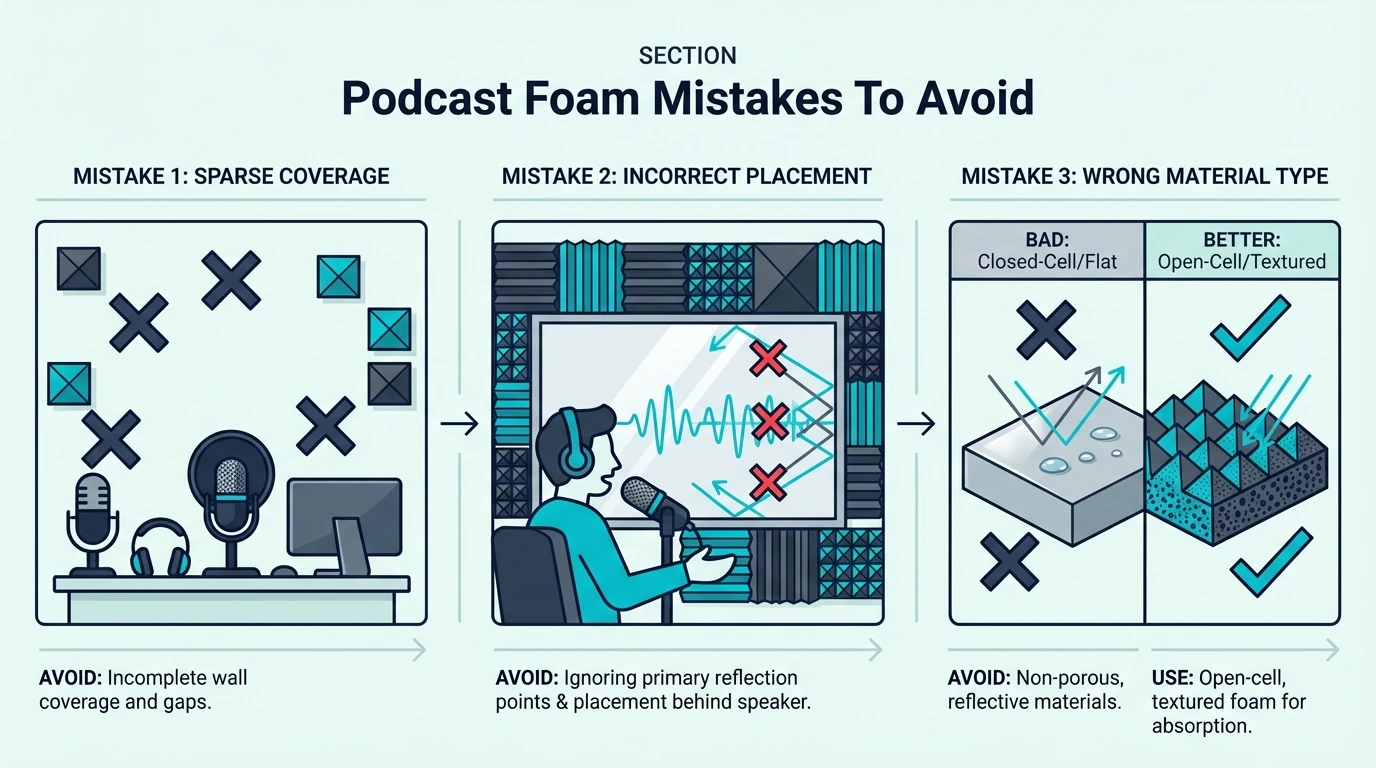
Use scissors for thin foam and tiny trims, an electric knife for thick foam or lots of cuts, and a hot wire cutter only when you truly need precision shapes and can work safely.

If your foam won’t cut cleanly no matter what you do, it may be the foam—not you. In that case, upgrading the material can save more time than perfecting the technique.
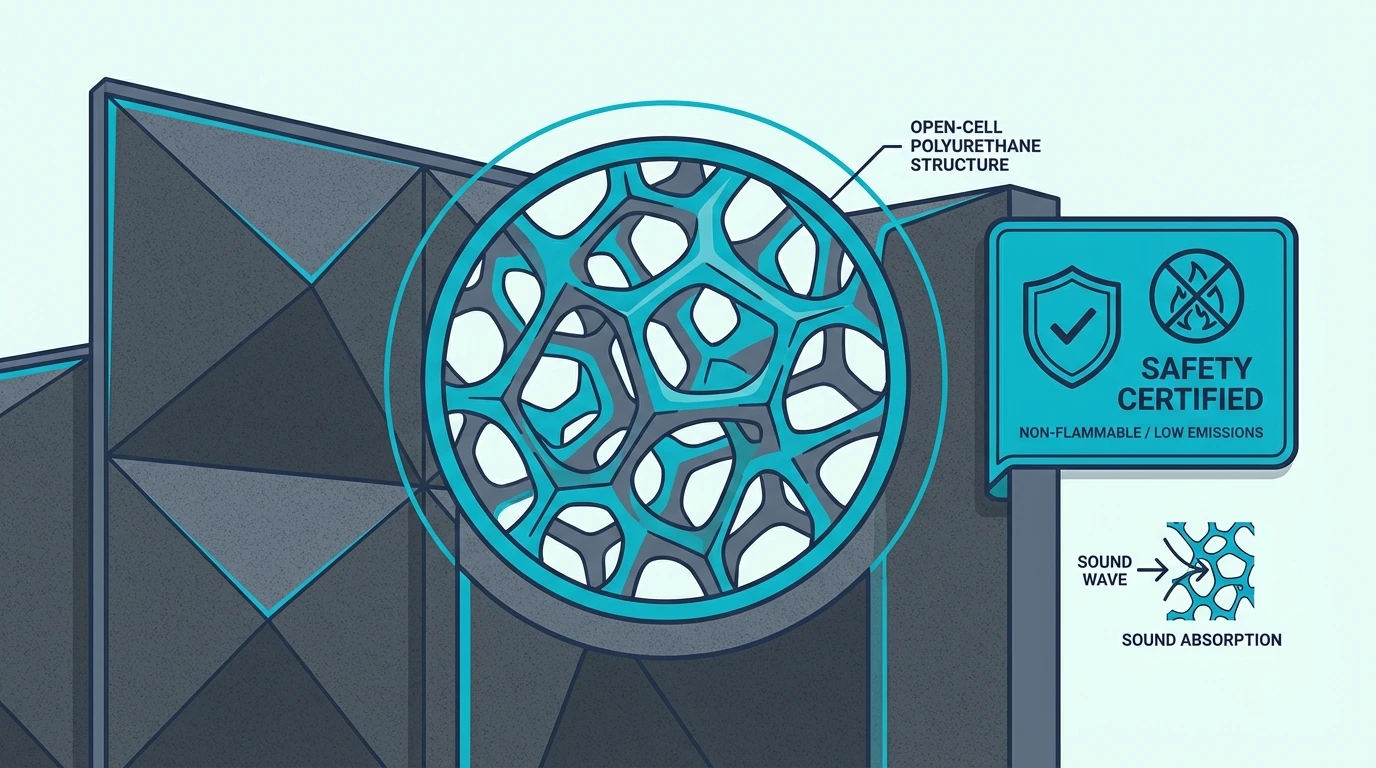
Frequently Asked Questions

Can you cut acoustic foam while it’s on the wall?

You can, but it’s rarely worth it. Removing the panel first gives you cleaner cuts and helps you avoid tearing the foam or the wall.
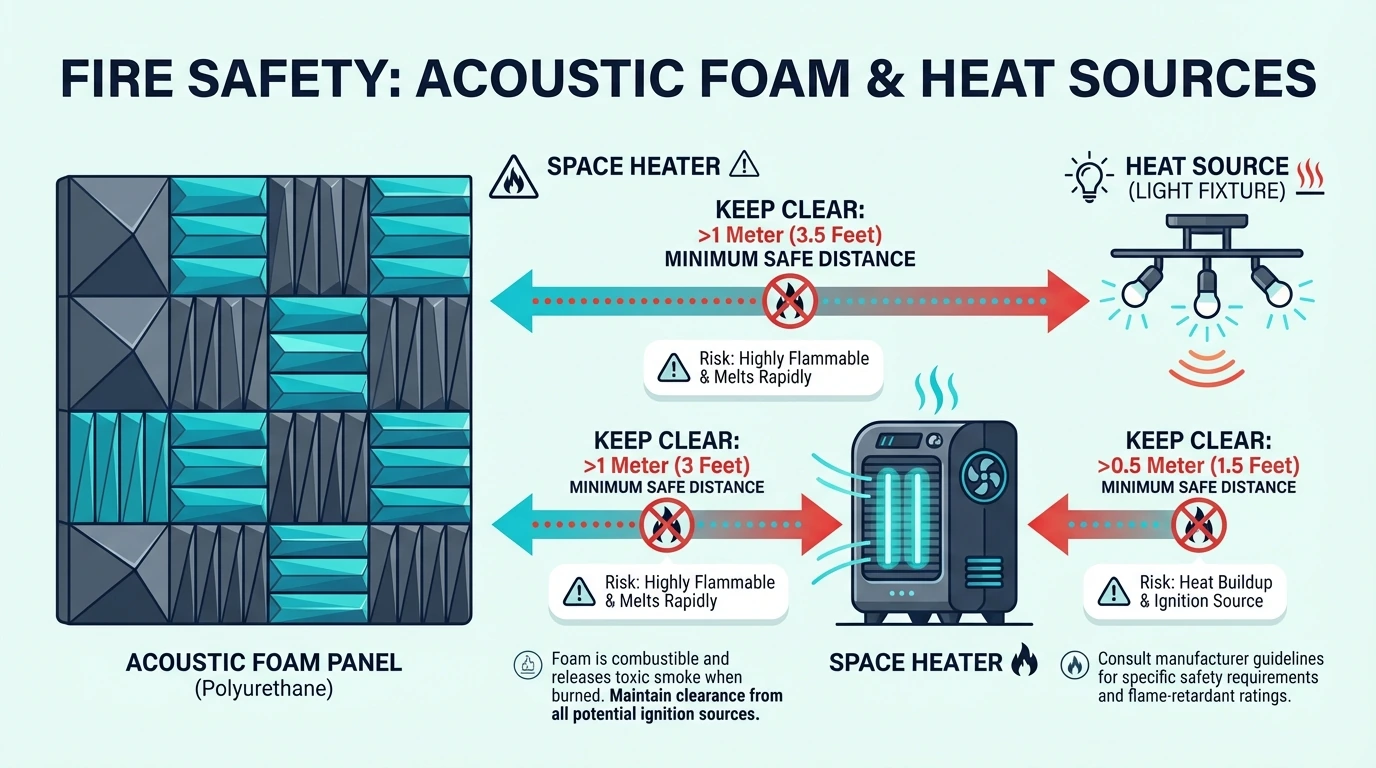
Does cutting acoustic foam reduce its performance?

Not by itself. The problem is tearing or crushing the foam cells during cutting, which can make edges less effective and look messy.

How do you cut foam around outlets or switch plates?

Make a paper template, trace it on the back of the panel, and cut the opening slightly small. You can always shave a little more off, but you can’t put foam back.

Can you use a serrated bread knife on acoustic foam?

Sometimes, especially on thick foam, but it’s easier to tear the ridges if you saw aggressively. If you use one, go slow and keep the foam supported.

What’s the cleanest cut for visible edges?

A sharp blade, a straightedge, and light passes from the back side. If you need a perfect edge for a visible seam, plan your layout so the seam lands in a less noticeable spot.