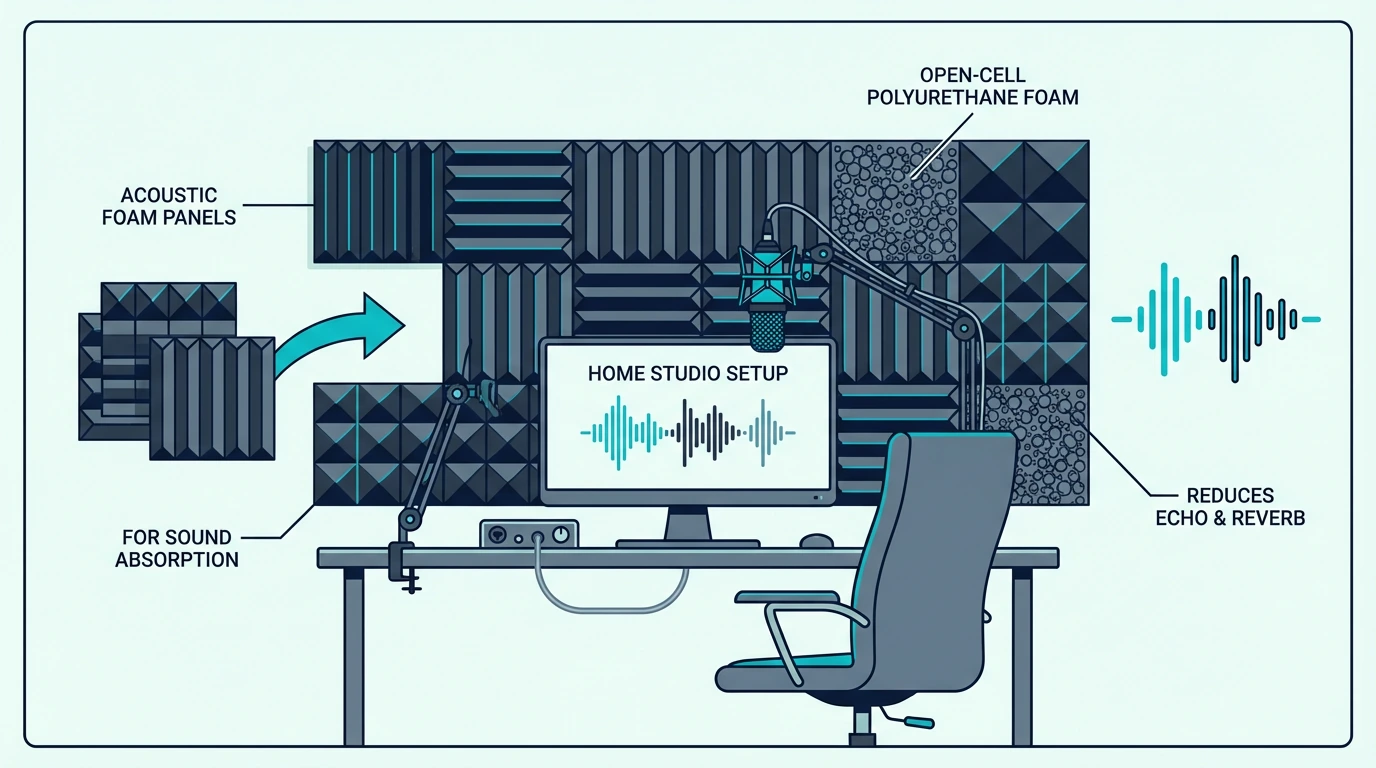
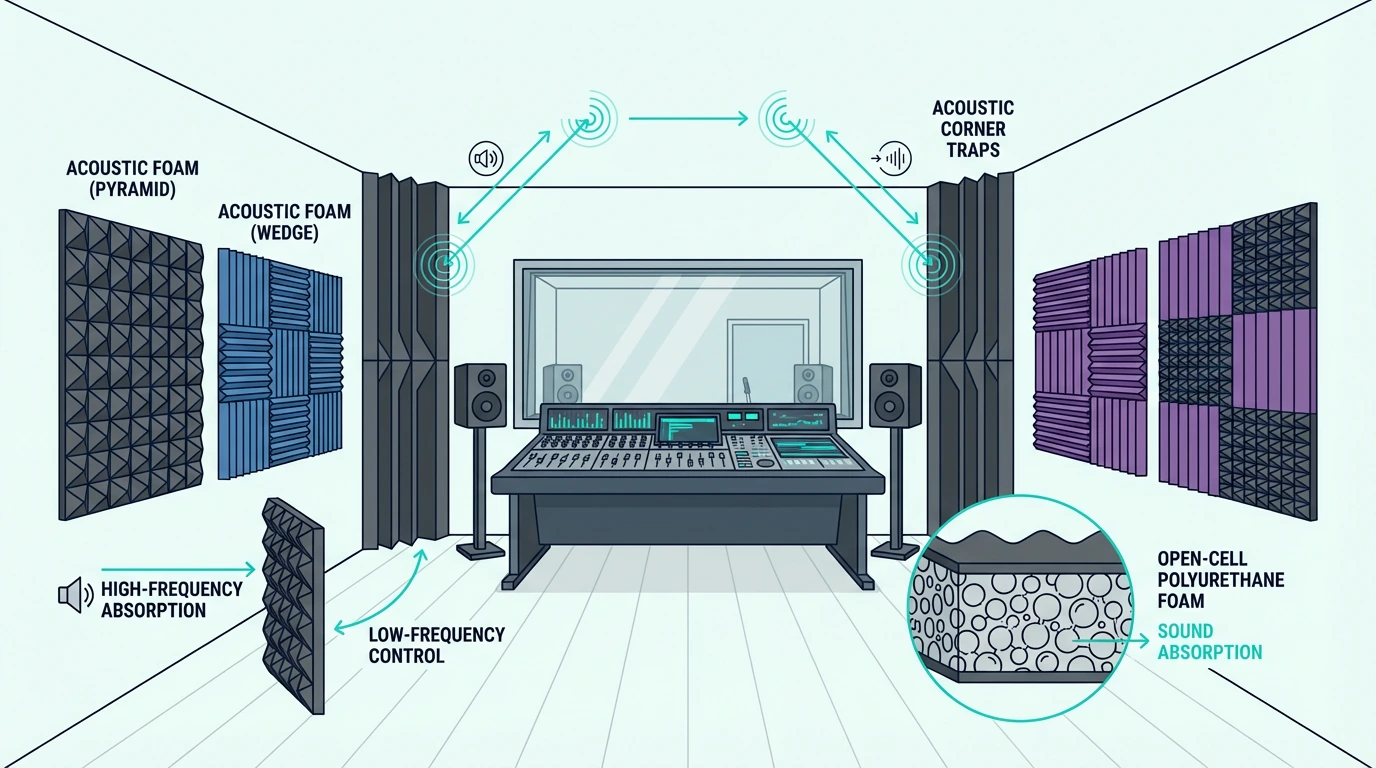
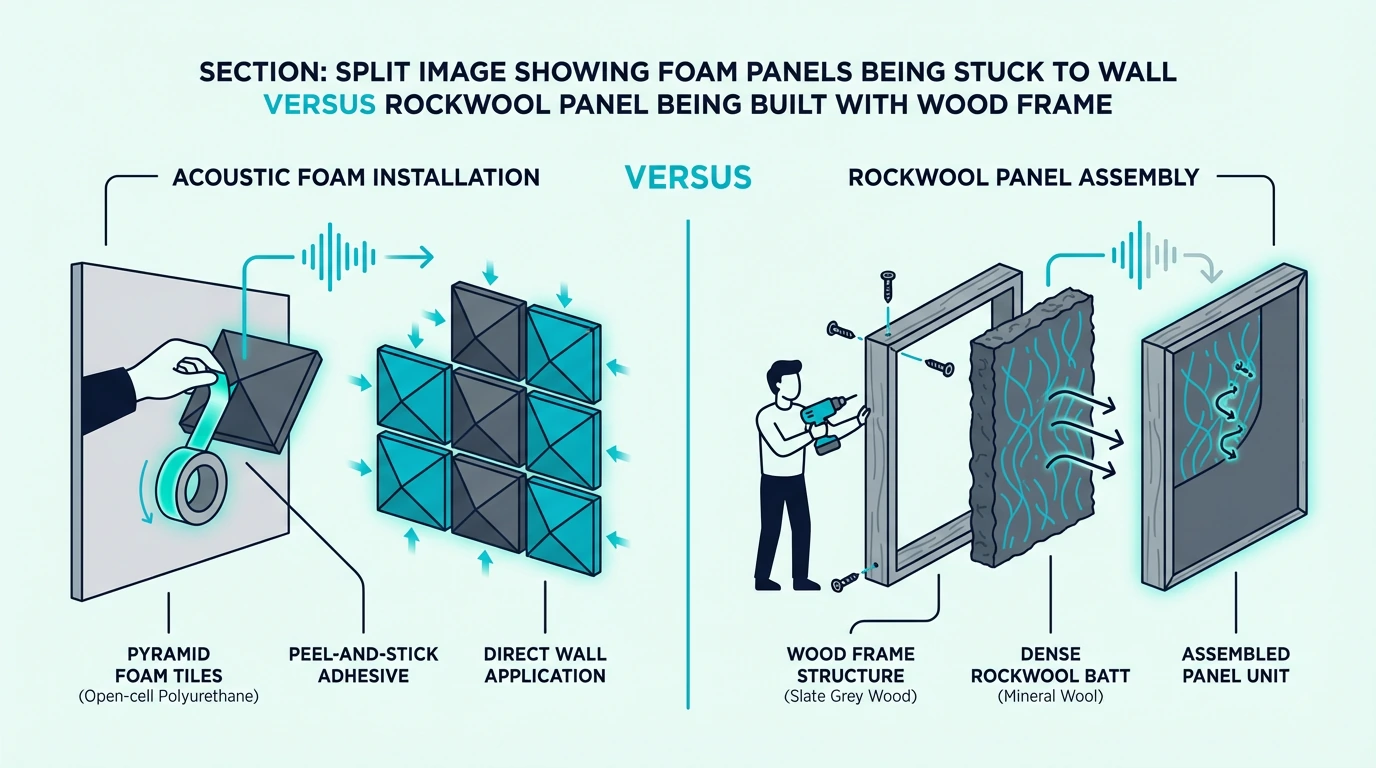
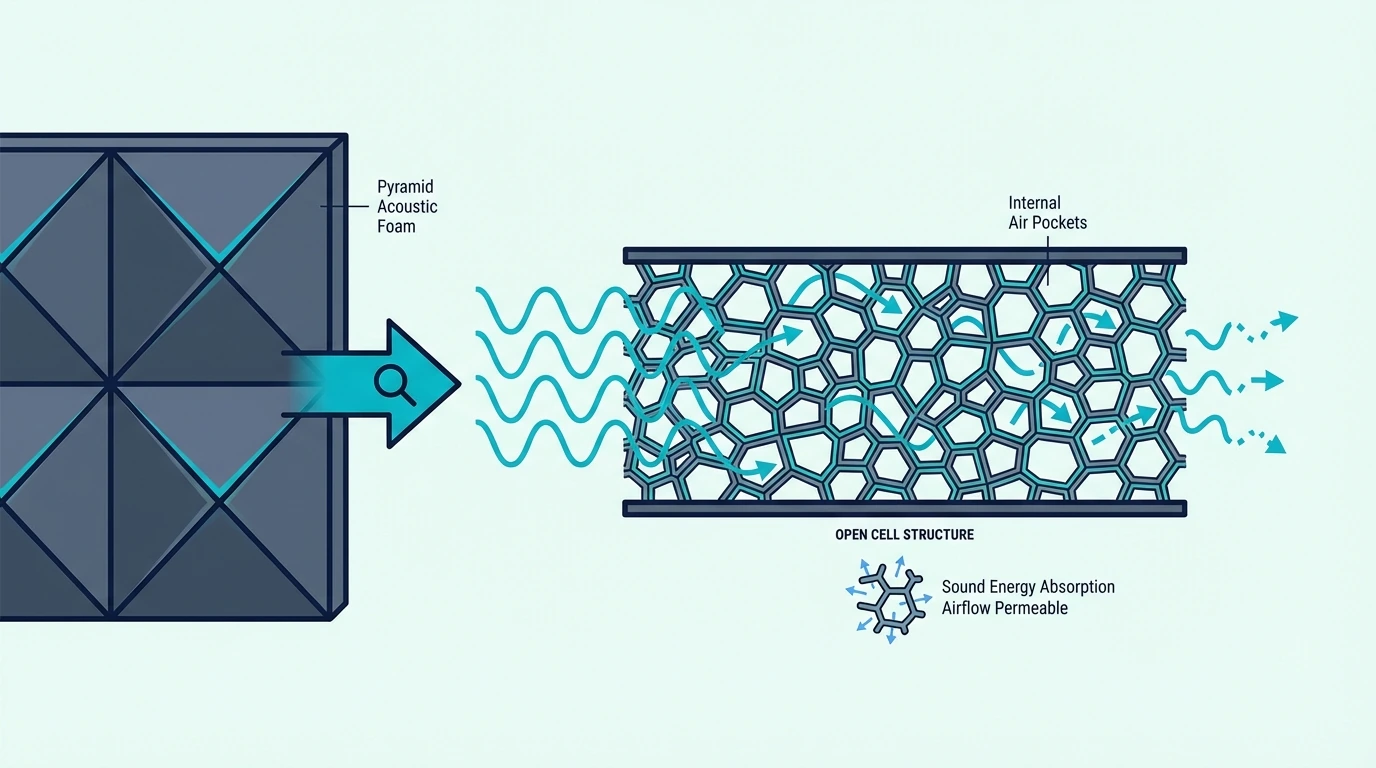
How to Attach Acoustic Foam to a Ceiling: 5 Methods That Actually Hold (2026)

Attaching acoustic foam to a ceiling works — but only if you mount it like a ceiling project, not like a wall project.

Gravity never takes a break, so the same method that “held fine on the wall” can fail overhead — corners peel, panels fall, and you’re left with adhesive residue and foam bits to scrape.

Pick the right method and you get stable coverage at the reflection points without turning your ceiling into a repair job.

Start with your constraint (permanent vs removable), then match the mount to your ceiling type.

Quick Takeaway

Spray adhesive (like 3M Super 77) provides the strongest permanent bond for ceiling foam. For renters, mount foam on cardboard backing first, then attach the cardboard with heavy-duty Command strips — this protects both the ceiling and allows removal later.

What’s the Best Way to Attach Foam to a Ceiling?
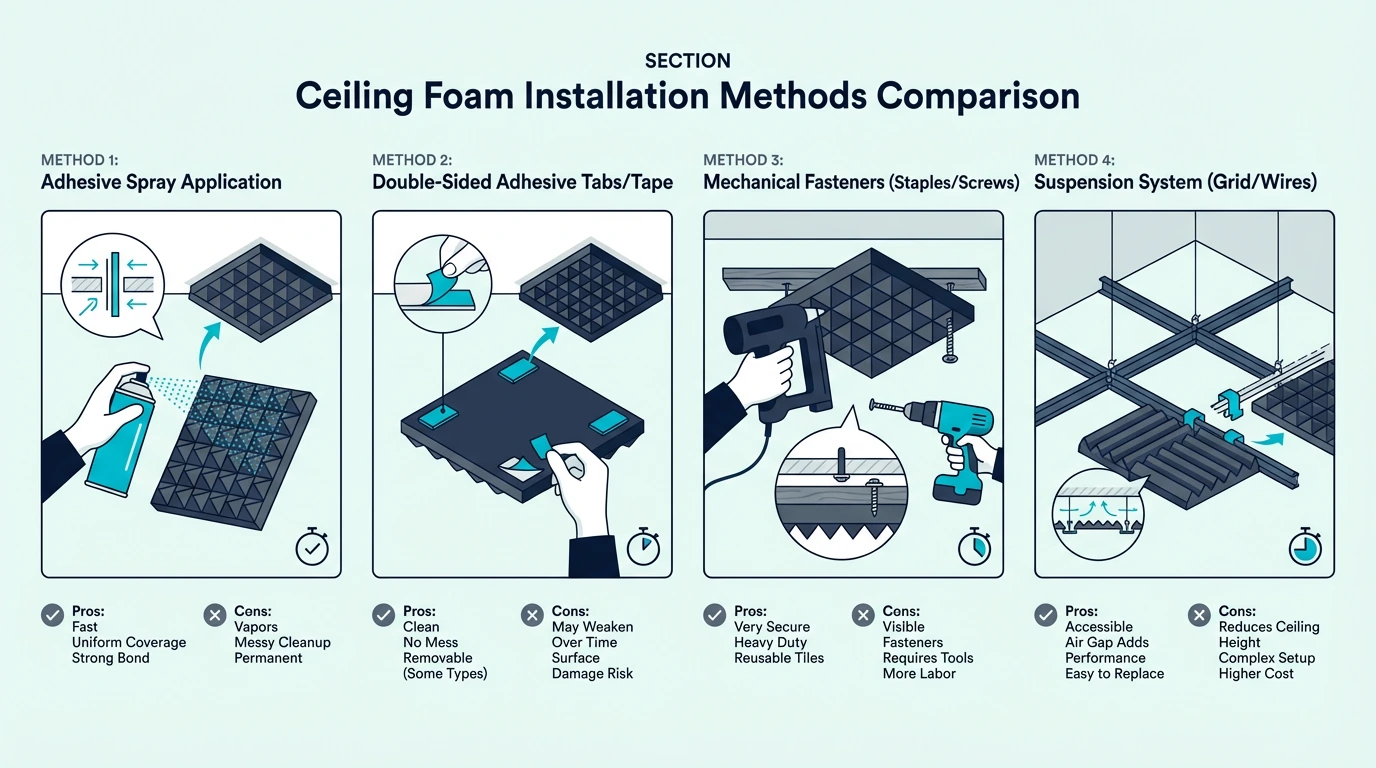
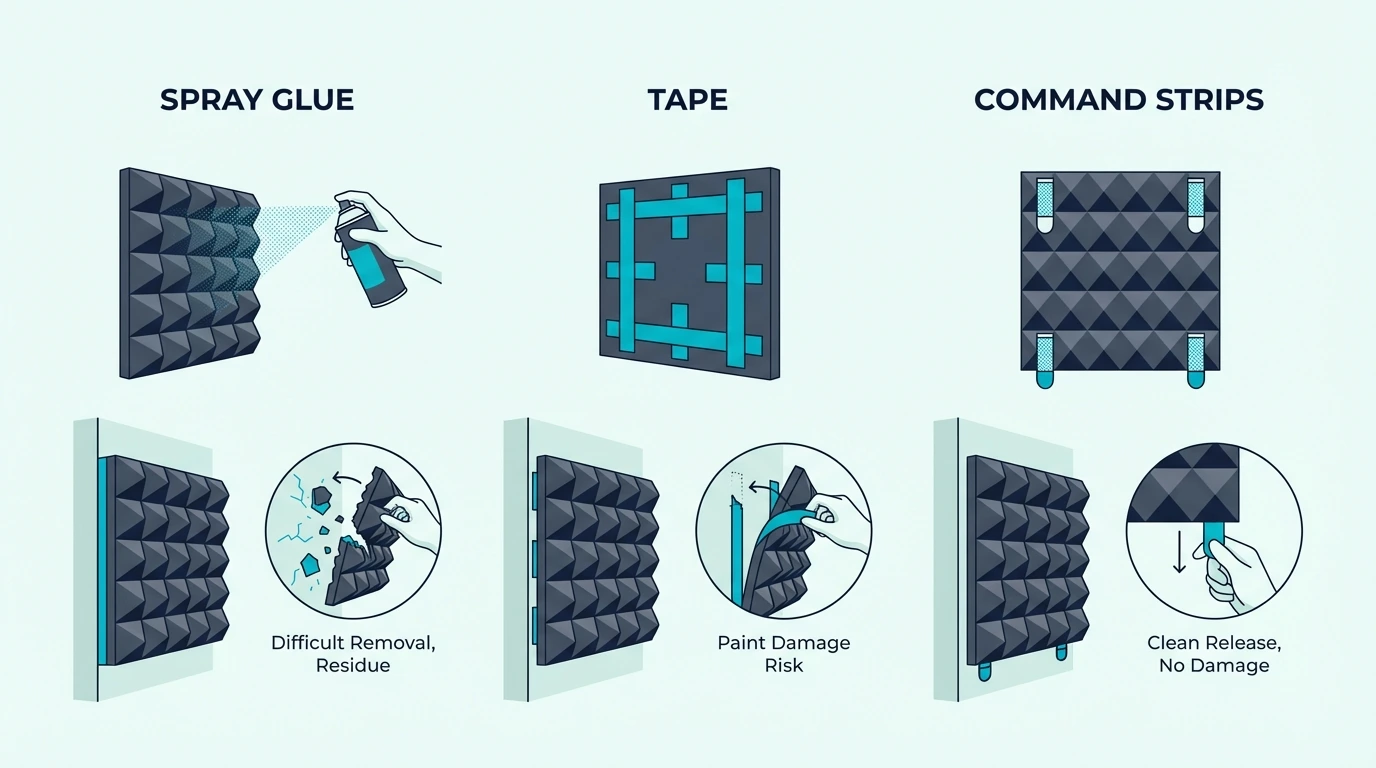
Ceiling foam installation methods comparison

The short answer depends on whether you need permanent installation or renter-friendly removal. Spray adhesive wins for strength, but cardboard backing gives you flexibility.

The Short Answer: Spray Adhesive or Cardboard Backing

For permanent installs, spray adhesive creates the strongest bond between foam and the ceiling. It spreads evenly, cures quickly, and holds panels against gravity long-term.

If you want the full breakdown (spray vs removable options), start with our acoustic foam adhesive guide. It’ll help you match the product to your ceiling and your “I might move later” reality.

Spray adhesive works because it penetrates the porous foam and bites into ceiling texture. It can hold on drywall, painted ceilings, and many textured finishes when your prep is solid.

If you want the wall version first, see our acoustic foam wall install guide. Ceilings are the same idea, just less forgiving when you rush.

For renters or anyone who might remove the foam later, the cardboard backing method is your best option. You glue foam to a rigid cardboard panel first, then mount that panel using removable mounting strips.

This two-layer approach distributes weight better and protects your ceiling from direct adhesive contact. When you move out, the cardboard comes down cleanly.

Why Ceiling Installation Is Harder Than Walls

Gravity works against you constantly with ceiling mounts. A foam panel that holds fine on a wall will peel away from a ceiling within days if you use the same adhesive.

On a wall, adhesive mostly prevents the panel from sliding. On a ceiling, it has to fight the full panel weight pulling down, 24/7.

Temperature swings make things worse. Heat rises, so ceilings experience more variation than walls.

That expansion-and-contraction cycle slowly weakens many adhesives over time. It’s one of the reasons “it held for a week” doesn’t mean much on a ceiling.

Ceiling texture also complicates adhesion. Popcorn, stipple, and textured paint reduce how much surface area the adhesive can grab.

That’s why “it sticks fine on the wall” isn’t good evidence. You need a method that still holds when contact isn’t perfect.

That’s why spray adhesive is usually the first method to consider — it’s the most forgiving on real-world ceilings.

How Does Spray Adhesive Work for Ceiling Foam?
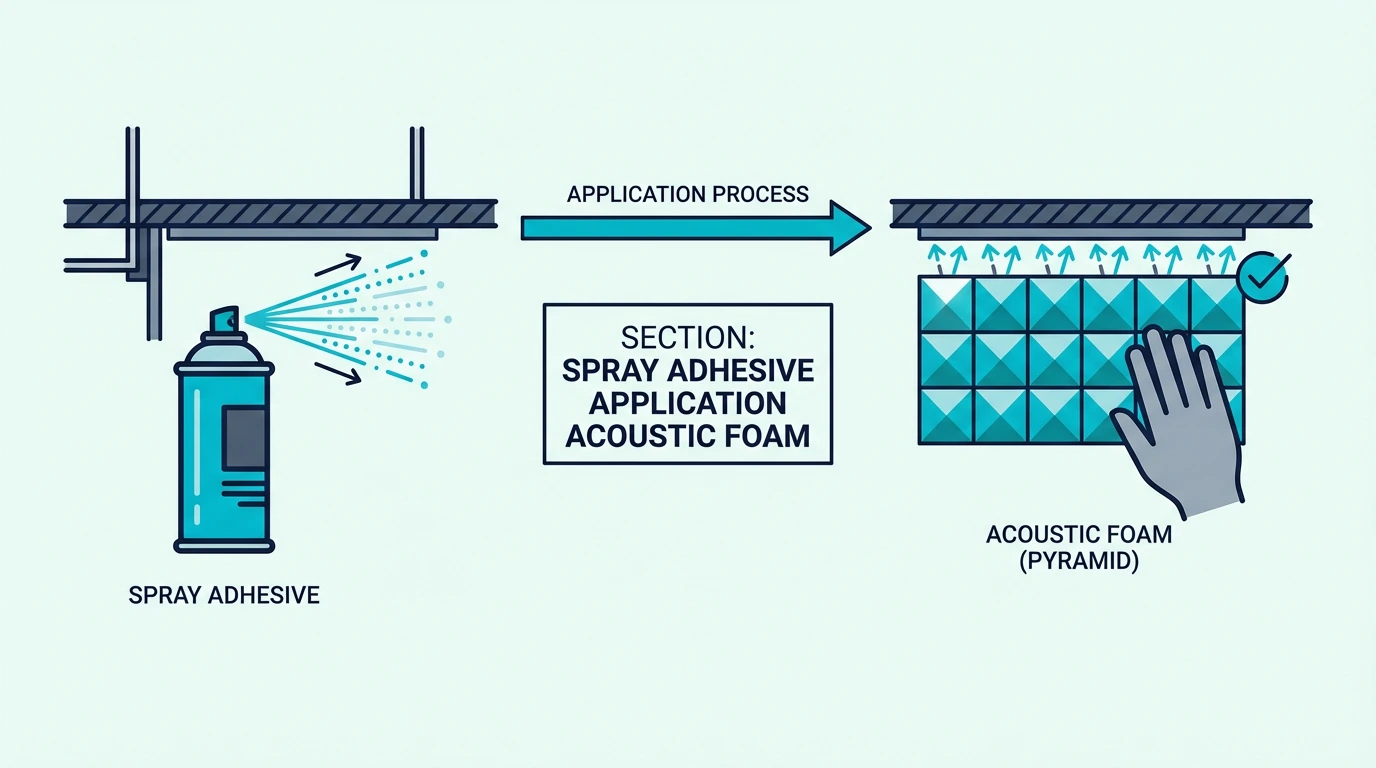
Spray adhesive application acoustic foam

If you’re okay with a permanent install, spray adhesive is the strongest option. It’s the closest thing to a “put it up once and stop thinking about it” ceiling install.

Tape and strips can work in specific cases, but spray wins on raw holding power. That matters when the ceiling is dusty, textured, or slightly uneven.

Best Spray Adhesives for Ceiling Foam

3M Super 77 Multipurpose Adhesive has become the industry standard for acoustic foam installation. It bonds foam to most ceiling surfaces within 15 seconds and reaches full strength in 24 hours.

The spray pattern covers large areas quickly without dripping, which makes overhead work less messy. One 16.75-ounce can typically handles 10–15 standard 12×12 panels.

If you’re treating a ceiling reflection zone, thicker foam tends to work better than 1-inch. For example, 2-inch pyramid foam panels give you more meaningful absorption.

Just remember: thicker foam also weighs more, so your mounting method matters even more. Don’t pick “better foam” and then mount it like a poster.

If you’re treating a bigger area and want lighter panels, a 52-pack foam bundle can be easier to keep up on a ceiling. Just expect it to tame flutter and brightness more than it controls low-end reflections.

Loctite General Purpose Spray Adhesive offers similar performance at a lower price point. It’s slightly tackier during application, which actually helps on textured ceilings where instant grab matters.

For the best hold, spray both the foam and the ceiling surface. When the two tacky layers meet, the bond is stronger than spraying only one side.

If you’re still deciding whether foam is the right material for your goal, see our foam vs rockwool comparison. It’ll keep you from over-expecting what foam can do.

Step-by-Step Instructions

Start by cleaning the ceiling area with a damp cloth to remove dust and cobwebs. Any debris between the adhesive and surface will create weak spots that fail first.

Mark your panel positions with painter’s tape before applying any adhesive. You won’t have time to adjust once spray adhesive touches both surfaces. If you need to trim panels to fit, our guide to cutting acoustic foam covers clean techniques.

Shake the can vigorously for at least one minute to ensure proper mixing. Cold cans spray unevenly, so warm the adhesive to room temperature if needed.

Hold the can 6-8 inches from the surface and spray in a sweeping motion. Cover about 80% of both the foam back and the ceiling area — you don’t need edge-to-edge coverage.

Wait 30-60 seconds for the adhesive to become tacky before pressing the foam into place. This tackiness stage is crucial — wet adhesive won’t hold as well as tacky adhesive.

Press firmly for 30 seconds, paying extra attention to edges and corners. Use a stepladder or scaffold that lets you apply even pressure without straining.

Pros and Cons

The strength of spray adhesive is unmatched by any other consumer-grade method. Properly applied, foam will stay attached for years without maintenance.

Coverage cost is reasonable — one can handles a typical home studio ceiling. The learning curve is minimal if you follow the tackiness timing.

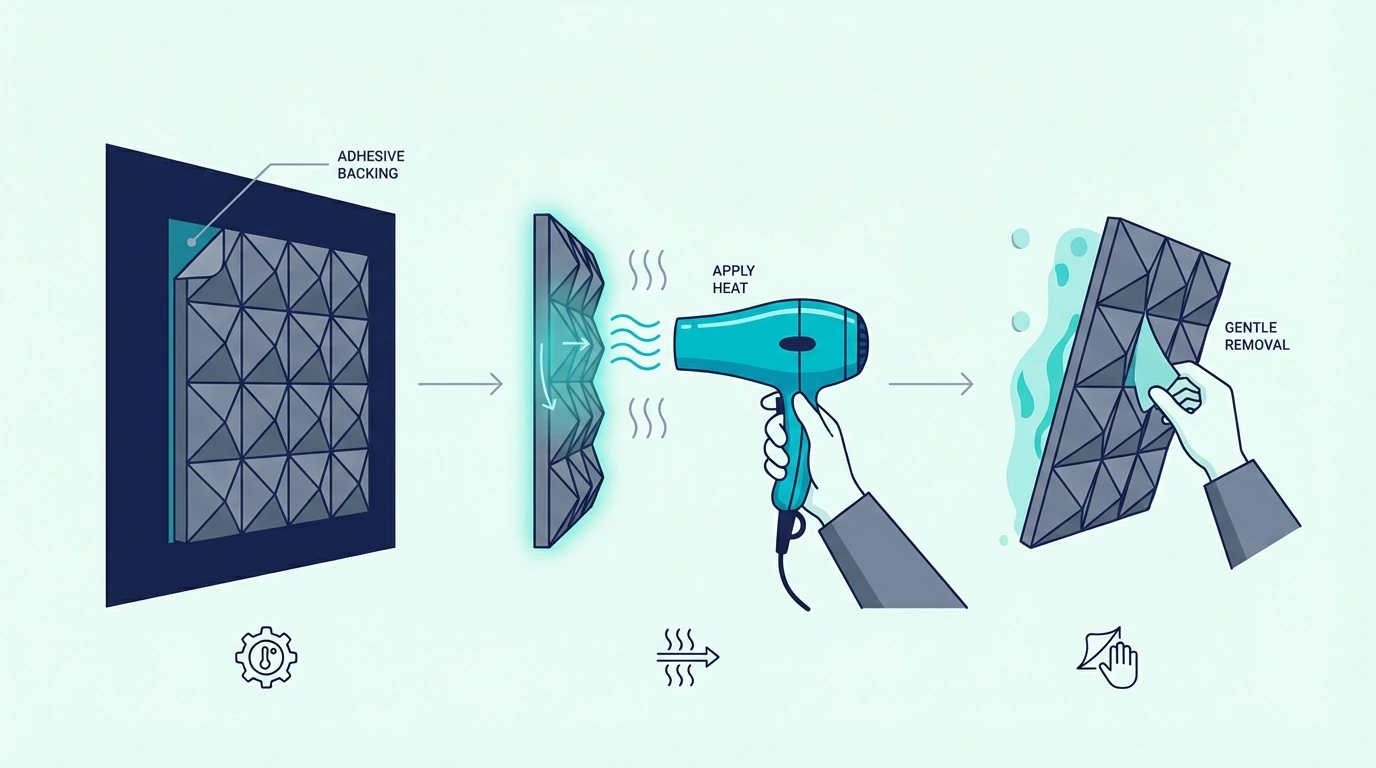
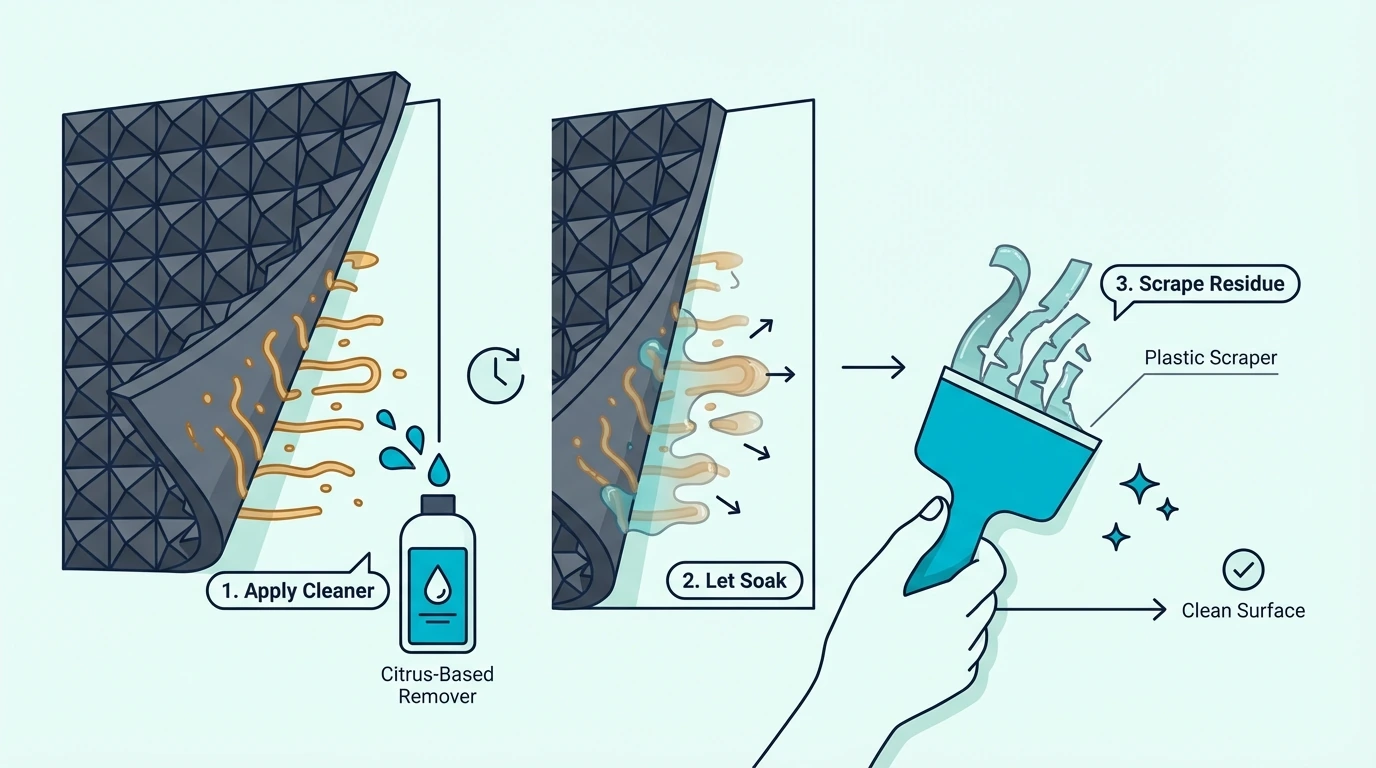
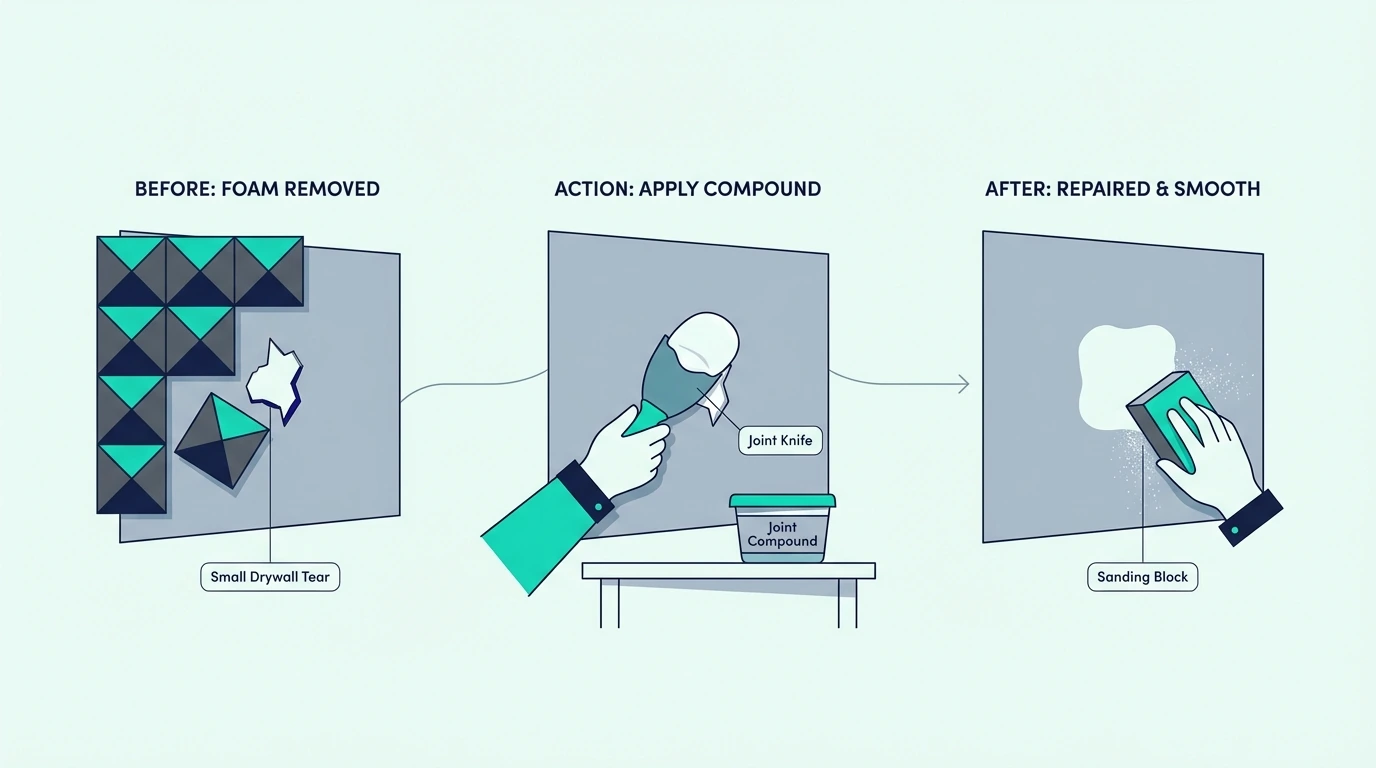
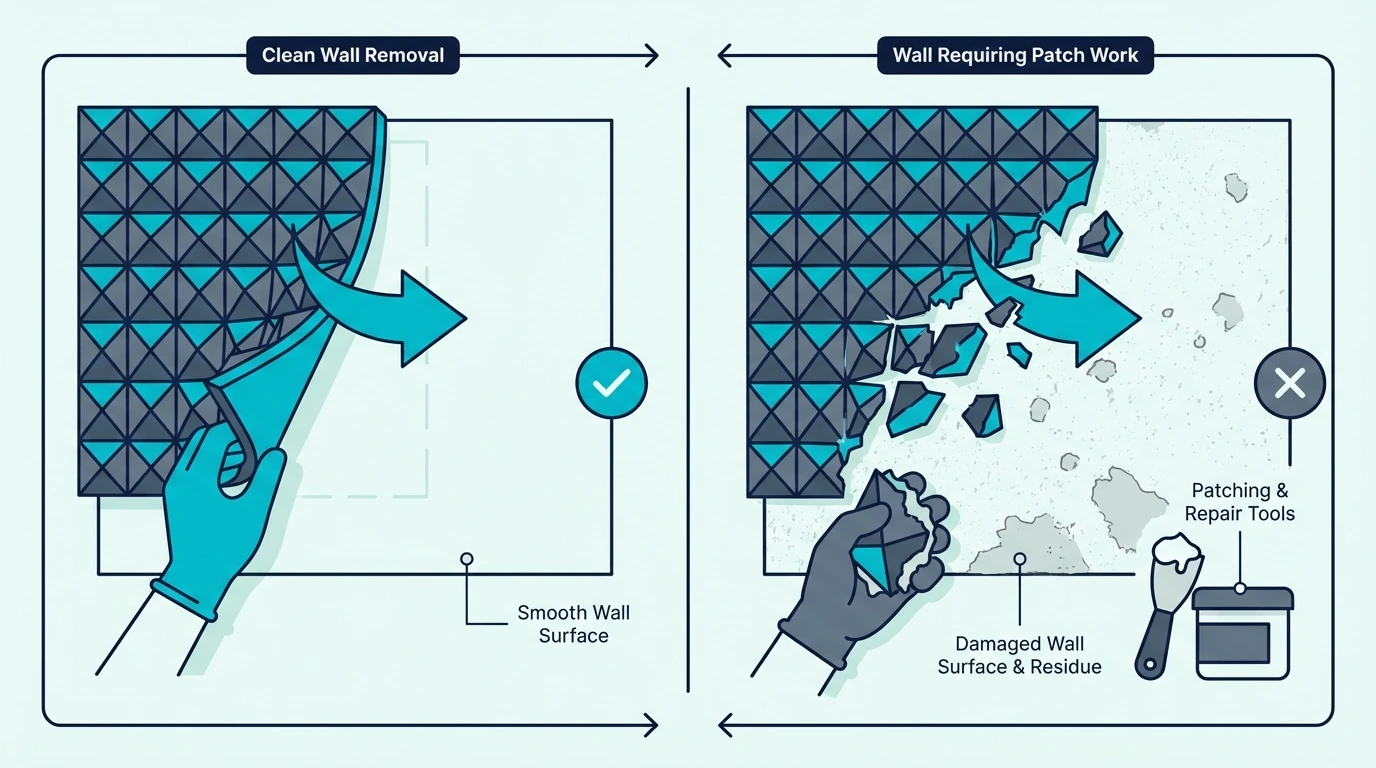
The downside is permanence: removing spray-glued foam usually damages both the foam and the ceiling. If you ever take it down, plan on patching and repainting.

Ventilation during application is essential. These adhesives contain solvents that require fresh air circulation while they cure.

Can You Use Command Strips for Ceiling Foam?
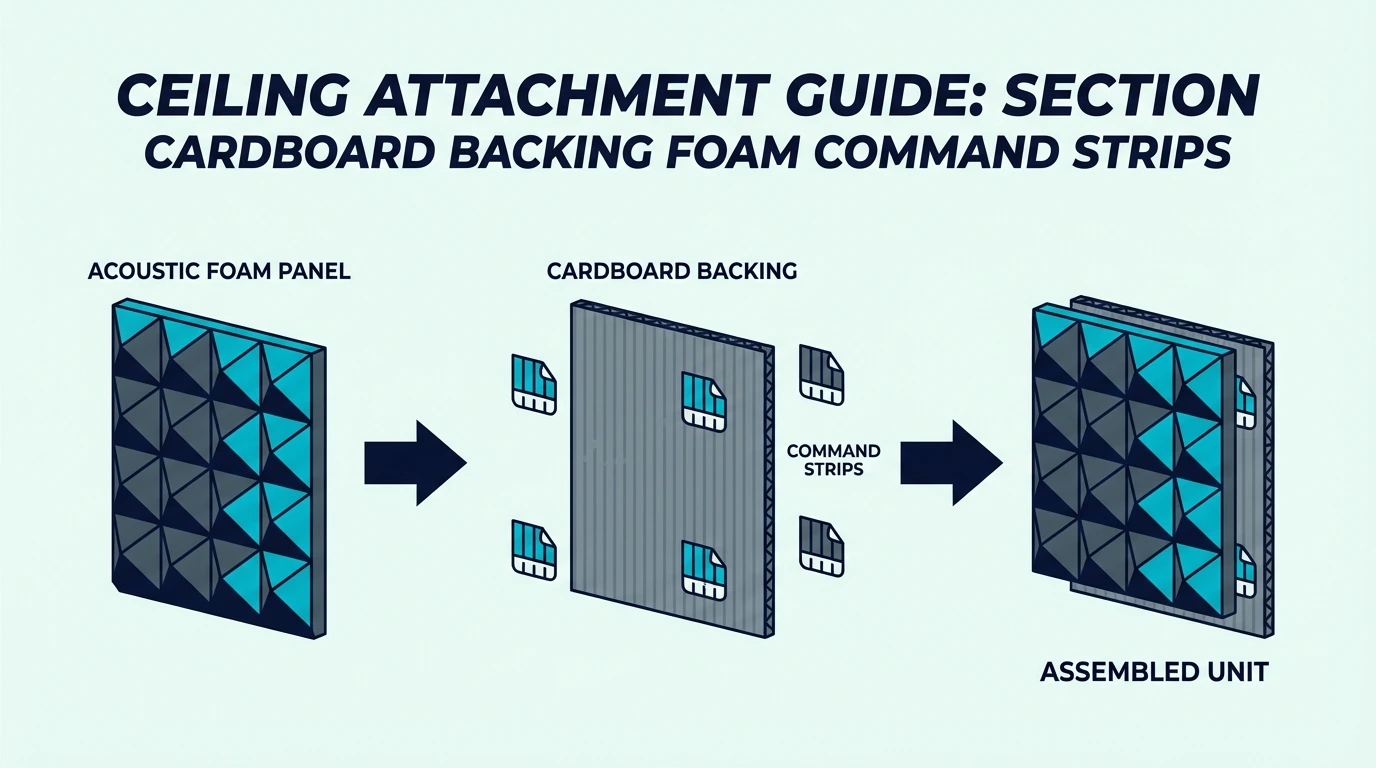
Cardboard backing foam command strips

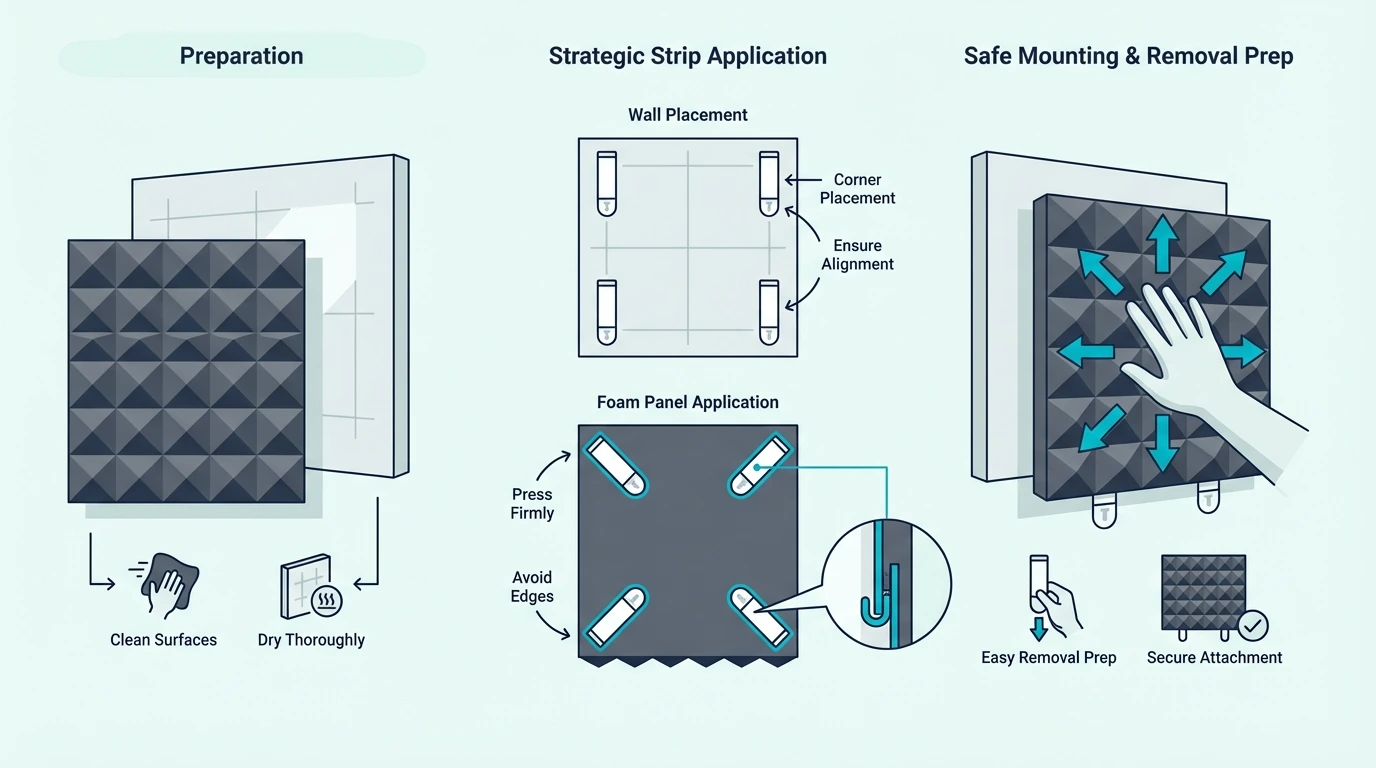
Spray adhesive works great, but it’s a bad idea if you’re renting. You can use Command strips for ceiling foam—you just don’t use them directly on the foam.

The trick is a backing board (cardboard/foam board) that the strips can actually grip. It spreads the load and gives you a clean removal point later.

Why This Method Works for Renters

Command strips alone often fail on ceilings because foam panels exceed their rated capacity. A 12×12 inch foam panel weighs about 4-6 ounces, which sounds light — but gravity’s constant pull eventually overwhelms the strips.

Cardboard backing changes the equation in two ways. First, the rigid surface distributes strip adhesion across a larger area, reducing stress at any single point.

Second, the foam-to-board bond (using spray adhesive) is permanent and strong, while the board-to-ceiling connection (using strips) stays removable. You get a “stays up” install without turning your ceiling into a glue project.

When removal time comes, the strips release cleanly from the backing board. Your ceiling never touches permanent adhesive.

If you’re also choosing panels on a budget, see our budget foam recommendations. Cheap foam is fine—as long as you mount it the right way.

Step-by-Step Instructions

Cut cardboard panels about half an inch smaller than your foam panels on all sides. This creates a hidden mounting surface that doesn’t show from below.

Use corrugated cardboard from shipping boxes — the thicker, the better. Single-layer cardboard bends under foam weight and creates visible warping.

Apply spray adhesive to both the foam back and the cardboard front. Wait for tackiness, then press together firmly.

Let this bond cure for at least two hours before ceiling mounting. Rushing this step risks the foam separating from the cardboard while hanging overhead.

Apply Command Large Picture Hanging Strips to the cardboard according to package directions — typically one strip per corner for a 12×12 panel.

If you’re hanging heavier boards (2-inch foam, larger panels, or humid rooms), step up to Command 20 lb X-Large Picture Hanging Strips and use extra pairs per board. You’re buying contact area and redundancy, not a single-point failure.

Press the assembly to the ceiling and hold for 60 seconds. Wait the full hour before considering the installation complete.

Pros and Cons

Damage-free removal is the primary advantage. Your security deposit stays intact, and you can take your foam investment to your next apartment.

The cardboard adds minimal weight while significantly improving strip performance. Total cost adds maybe two dollars per panel beyond foam and strips.

Installation takes longer than spray adhesive alone — roughly double the time when accounting for cardboard prep and cure time between steps.

Visual appearance is nearly identical to direct mounting if you cut cardboard smaller than the foam edges. Nobody sees the cardboard layer from normal viewing angles.

Do T-Pins Work for Drop Ceiling Installation?
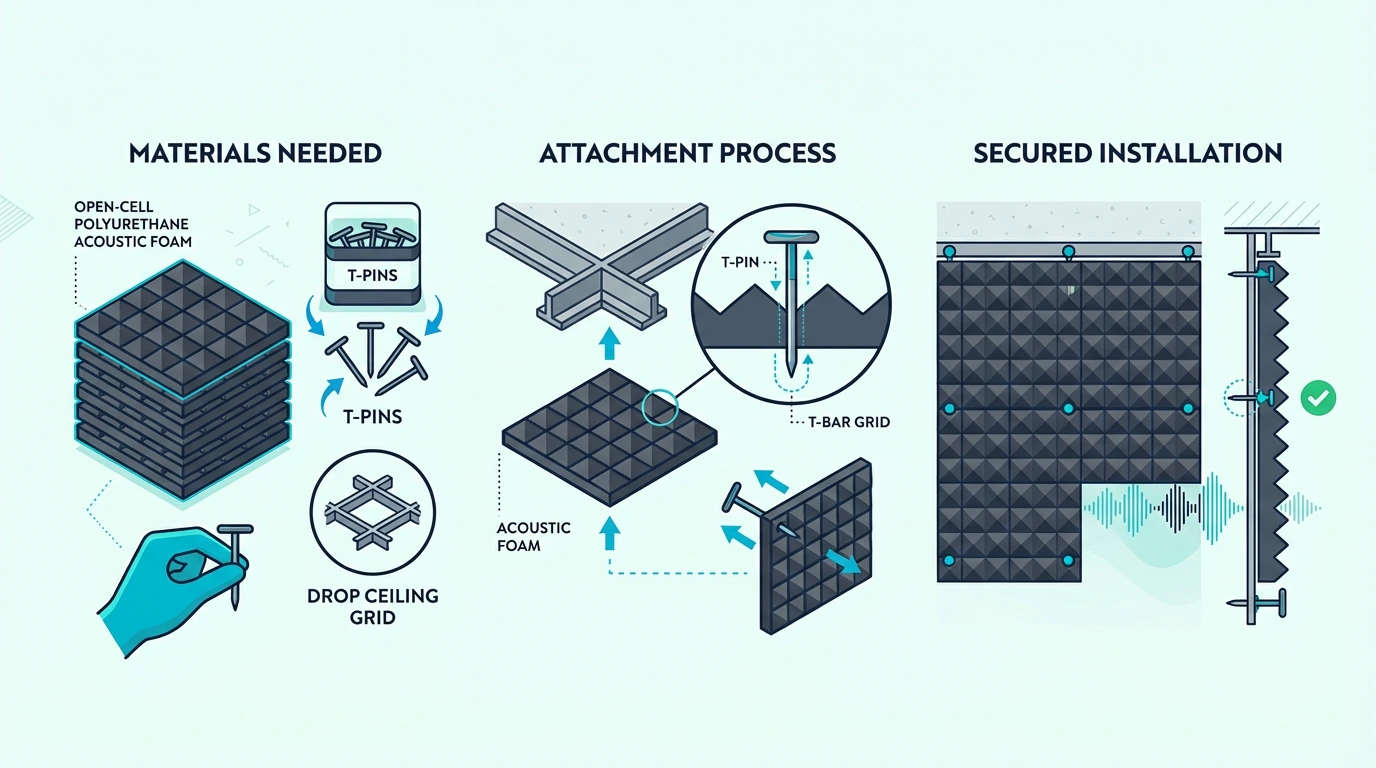
T pins drop ceiling acoustic foam

Both methods above work on standard drywall ceilings. But if you have a drop ceiling, the rules change.

Drop ceiling tiles are soft enough to accept pins, so you can mount foam without adhesive. That makes installation reversible and tool-free.

When This Method Works

Drop ceiling tiles are made from compressed mineral fiber or fiberglass — materials soft enough for T-pins to penetrate easily. Standard drywall ceilings won’t work with this method.

The pins push through the foam edge and into the tile behind, creating mechanical attachment without adhesive. You’re essentially pinning the foam to the tile like fabric to a corkboard.

This approach is ideal for office spaces, basements, and commercial buildings where drop ceilings are common. Installation and removal take minutes, not hours. If you’re deciding between pyramid and wedge panels for this method, our best acoustic foam shape guide helps you pick.

This only works with suspended tile systems. If you have drywall, plaster, or concrete overhead, skip to another method.

Step-by-Step Instructions

Use T-pins instead of standard push pins for this application. The T-shaped head spreads pressure across the foam and won’t pull through as easily.

A basic pack of 1.5-inch T-pins is enough for most small rooms. If you’re mounting a lot of panels, buy extra—pin quantity is what keeps edges from sagging.

Position your foam panel where you want it on the ceiling tile. Hold it in place with one hand while inserting pins with the other.

Push pins through the foam edge at a 45-degree angle, directing them toward the ceiling tile behind. This angle locks the pin in place and prevents the foam from sliding.

Use four pins minimum per 12×12 panel — one near each corner, about an inch from the edges. Larger panels need six to eight pins for secure mounting.

Press each pin until the T-head sits flush against the foam surface. Pins that stick out will catch on things and eventually work loose.

Pros and Cons

Completely reversible installation is the biggest benefit. Pull the pins and the foam comes down without any surface damage to either material.

Zero tools required beyond the pins themselves. A package of T-pins costs about three dollars and covers dozens of panels.

The method only works on drop ceilings — that’s a hard limitation. Drywall, plaster, and concrete require adhesive-based approaches.

Aesthetic results depend on pin visibility. From directly below, T-pin heads may be noticeable, especially on lighter-colored foam.

Should You Use Furring Strips for Professional Installation?
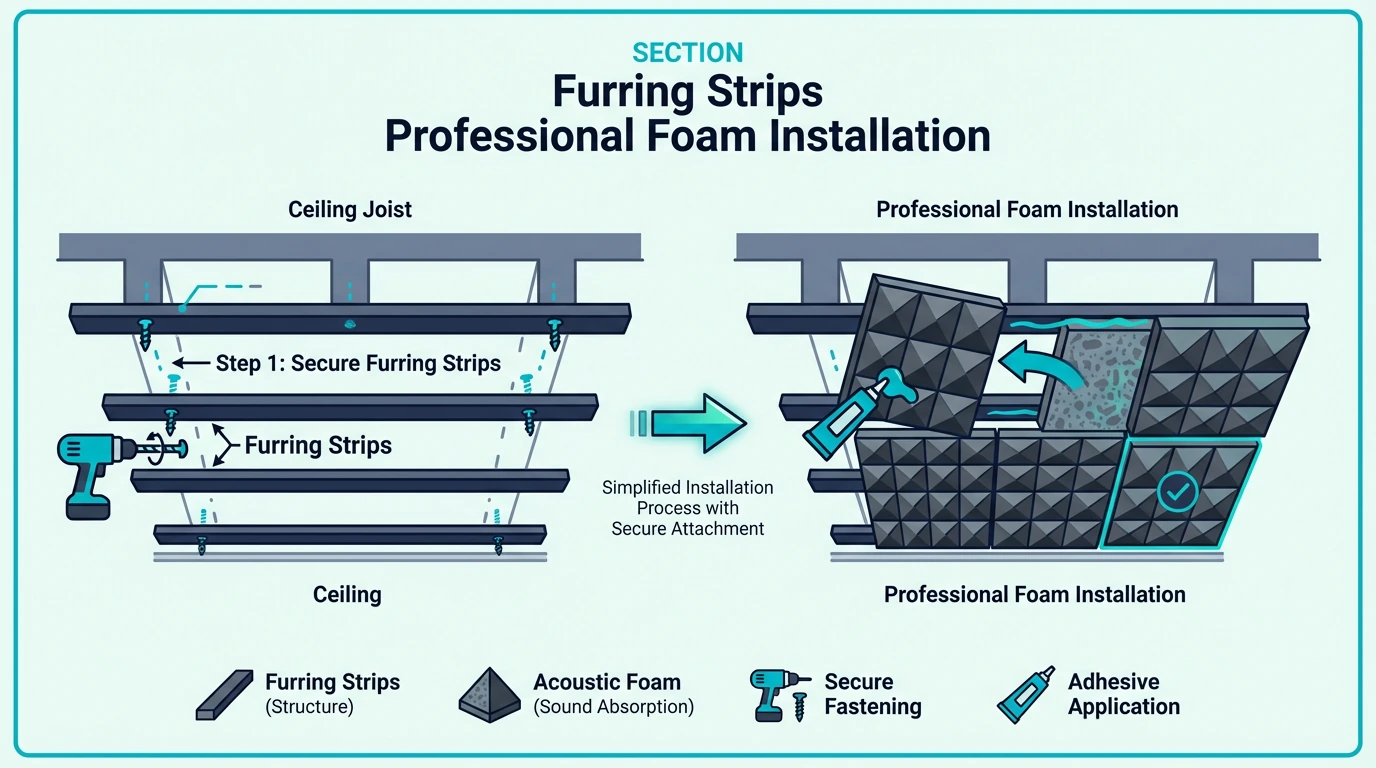
Furring strips professional foam installation

Everything we’ve covered so far is DIY-friendly. If you want a more “built-in” install, furring strips are the pro approach.

You mount thin wood strips into joists, then attach foam to the wood instead of gluing it to the ceiling. That gives you a consistent mounting surface and easier panel replacement later.

Professional-Grade Installation

Furring strips are thin wooden boards (typically 1×2 or 1×3 inches) screwed directly into ceiling joists. The foam then attaches to these strips rather than the ceiling surface itself.

This approach decouples the foam from the ceiling structurally. Vibrations and temperature changes affect the strips, not the foam-to-ceiling bond.

Professional recording studios use this method because it allows easy panel replacement and creates a consistent mounting surface regardless of ceiling texture or condition.

The initial installation requires more work — you’re essentially building a grid framework — but long-term maintenance becomes trivial.

Step-by-Step Instructions

Locate your ceiling joists using a stud finder. Mark their positions across the entire installation area before mounting any strips.

Cut furring strips to span your foam panel layout. Plan the grid so strip edges align with foam panel edges — this creates invisible mounting lines.

Screw strips into joists using 2.5-inch wood screws. Pre-drill pilot holes to prevent splitting, especially at strip ends.

Once your strip grid is complete, attach foam using either spray adhesive or staples driven through foam edges into the wood. Staples allow easier replacement later.

Paint furring strips to match foam color before foam installation. Any visible wood between panels becomes part of your acoustic aesthetic.

Pros and Cons

The most professional-looking results come from this method. Commercial studios worldwide use furring strip frameworks for good reason. If aesthetics matter, our guide to making acoustic foam look good pairs well with this approach.

Panel replacement is simple — remove the old foam and attach new material to the existing framework. No ceiling repairs needed.

Installation time and material costs exceed simpler methods significantly. You’re building infrastructure before you even touch the foam.

This method isn’t renter-friendly at all. The screw holes in ceiling joists are minor but present, and removing the entire framework later requires proper repair.

When Should You Suspend Foam Instead of Mounting It?
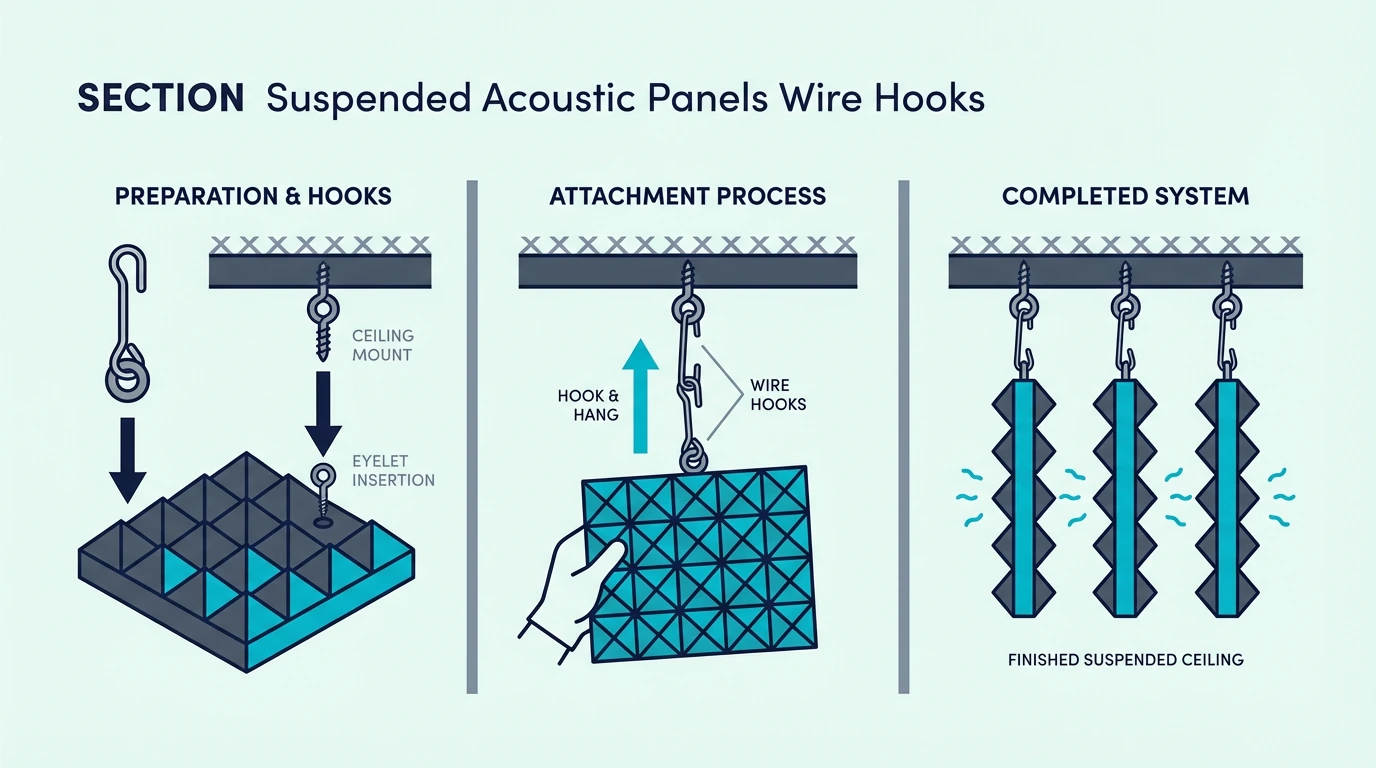
Suspended acoustic panels wire hooks

Every method so far attaches foam directly to the ceiling. Suspension is different: the panels float below the ceiling instead of sticking to it.

That air gap can improve absorption, especially in the low-mids. It’s also useful when you don’t want to touch the ceiling surface directly.

When to Suspend Instead of Mount

High ceilings benefit most from suspension. If your ceiling is 10+ feet high, sound bouncing off it creates significant reverb problems that panels need to address at ear level, not at the ceiling itself.

Suspension also works well when you can’t or don’t want to touch the ceiling surface directly. Historic buildings, textured ceilings, and rental restrictions all make suspension attractive.

The air gap behind suspended panels actually enhances low-frequency absorption. Sound waves interact with both the panel surface and the cavity behind it.

Cloud panels in professional studios are essentially this concept — large acoustic absorbers hung horizontally below the ceiling to control reflections in the listening zone. If you’re building a complete studio setup, consider the best acoustic foam panels for your budget.

Step-by-Step Instructions

Install hooks into ceiling joists—not drywall alone. Use a stud finder so you’re hanging from structure, not just paint and paper.

If you want a ready-made option, a ceiling hook + wire kit saves you a trip to the hardware aisle. Just make sure you’re anchored into a joist.

Spacing depends on panel size. For 24×24 panels, hooks at opposite corners can work, but larger panels should use four hooks—one per corner.

Cut picture hanging wire or monofilament to equal lengths for each hook point. Consistent lengths ensure the panel hangs level.

Thread wire through panel edges using large upholstery needles or by creating holes with a screwdriver. Foam compresses around the wire, creating a secure grip.

Attach wire ends to ceiling hooks, adjusting until the panel hangs level. Check from multiple angles — what looks level from one position may tilt from another.

Pros and Cons

The air gap can also improve absorption, not just convenience. Lower frequencies respond well to that “panel + cavity” effect.

Adjustability exceeds any direct-mount method. Raise, lower, or reposition panels by simply adjusting wire lengths.

Visual appearance differs noticeably from flush-mounted foam. Some people prefer the floating aesthetic; others find it busy or unfinished.

Ceiling hook installation still creates screw holes, though fewer than furring strip grids. Damage is minimized but not eliminated.

What Methods Will Fail on Ceilings?
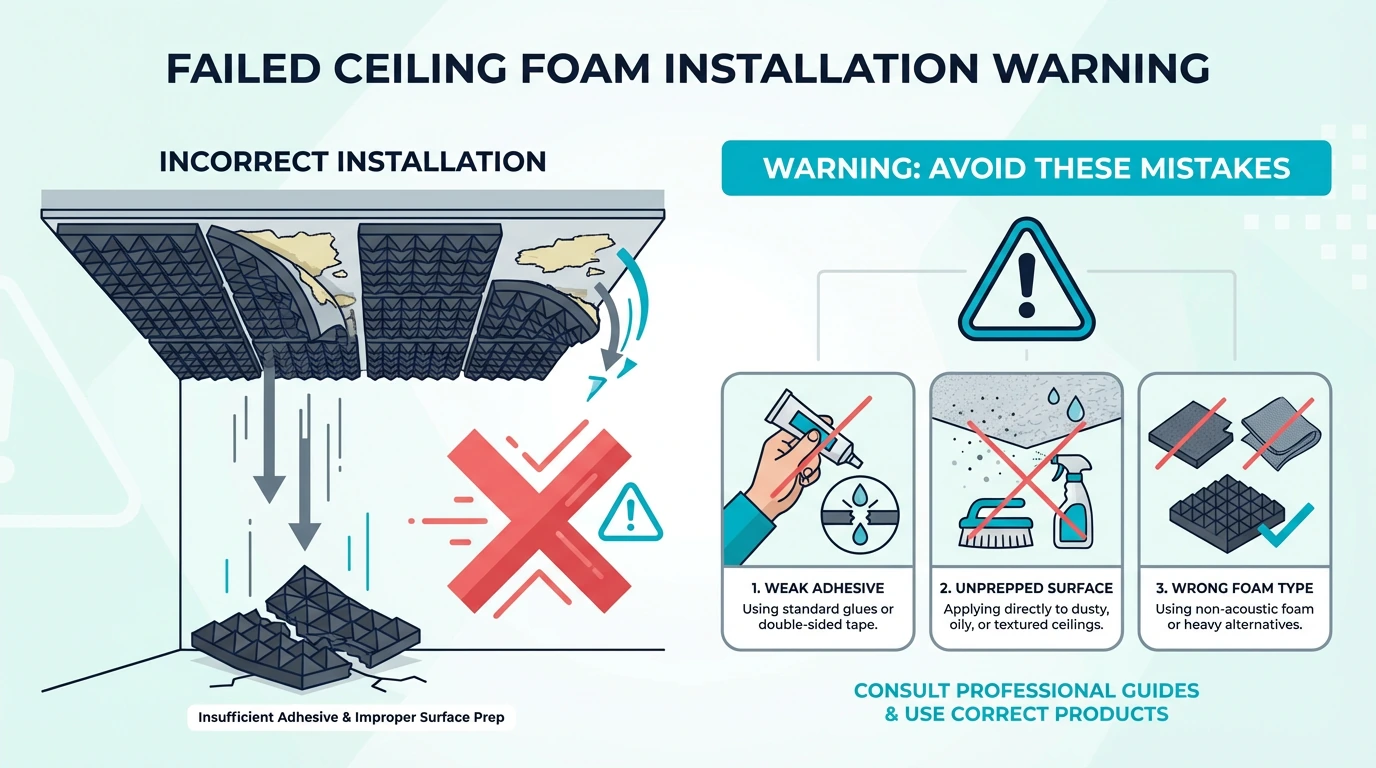
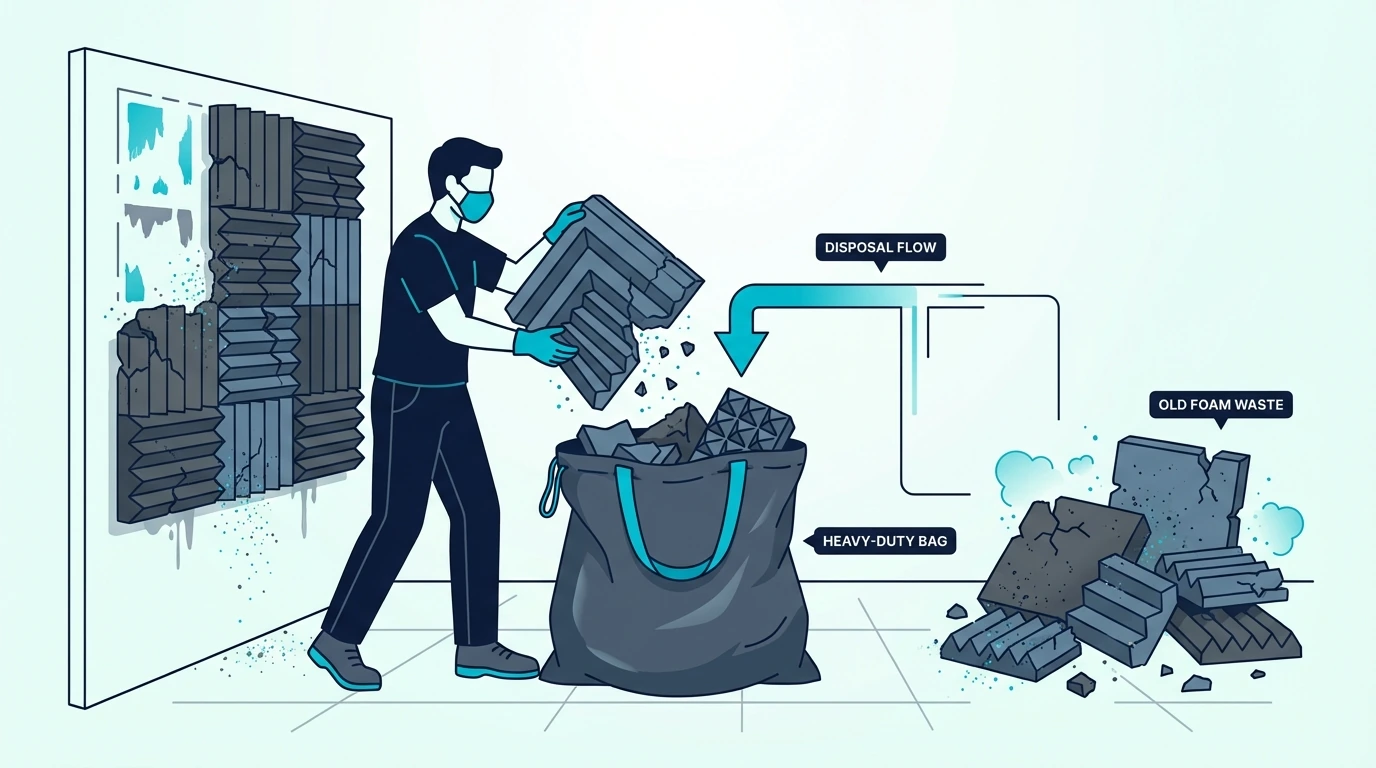
Failed ceiling foam installation warning

We’ve covered five methods that work. Now let’s talk about what fails.

Some wall-safe methods fall apart on ceilings. Knowing what to avoid saves you cleanup headaches and wasted panels.

Regular Double-Sided Tape (Will Fall)

Standard double-sided tape lacks the shear strength needed to resist gravity’s constant pull. On walls, tape only needs to hold foam in place horizontally — gravity actually helps keep it down.

On ceilings, that same tape must support the entire panel weight indefinitely. Thermal cycling loosens the bond, and typically within two to four weeks, you’ll find foam on the floor.

The foam-to-tape bond usually fails before the tape-to-ceiling bond. You’ll see tape residue overhead and clean foam panels below.

Even “heavy duty” double-sided tape isn’t rated for ceiling applications. The manufacturers know this — check the packaging, and you won’t find ceiling use mentioned.

Command Strips Alone (Too Heavy)

Command strips work by distributing weight across their adhesive surface. They’re engineered for specific weight ranges, clearly stated on the packaging.

Most Command strips max out at 4-7 pounds depending on the variant. That sounds adequate for lightweight foam — until you account for constant gravitational stress versus occasional wall bumps.

The rated capacities assume wall mounting where force is intermittent. Ceiling applications apply maximum force continuously, exceeding the engineering assumptions.

That cardboard backing trick from earlier? It works around this limitation by improving weight distribution and creating a better adhesive surface.

Nails/Screws Through Foam (Damages Foam)

Driving fasteners directly through foam panels seems logical but destroys the material over time. The foam compresses around the fastener, creating stress points that tear.

Within weeks, the foam sags around each nail or screw head. The torn areas expand until eventually the panel drops or hangs awkwardly.

Foam is meant to absorb impact, not resist point loads. That same flexibility that helps acoustics makes it structurally weak under screws and nails.

If you’re choosing panel thickness for ceiling use, start with our 1-inch vs 2-inch acoustic foam guide. Heavier panels demand better mounting.

If you must use mechanical fasteners, the furring strip method we discussed creates wood surfaces that accept screws without damaging foam.

Conclusion

After covering all five methods, ceiling installs come down to two reliable approaches. Spray adhesive wins for permanent strength, while a backing board preserves removal options.

Renters should always use the backing board method. The extra setup time is worth protecting both your security deposit and your foam investment for the next space.

Homeowners with permanent studio plans can confidently use spray adhesive. The bond strength exceeds anything else available to consumers, and the application learning curve is minimal.

For drop ceilings, T-pins are a completely reversible option that takes minutes to install. This method is ideal for temporary setups or spaces where you might reconfigure the layout later.

If you’re building a DIY vocal corner, our vocal booth foam guide helps you keep reflections out of the mic. It’s the same “treat the reflection path” idea, just focused on recording.

Those gravity challenges we discussed at the start are why method choice matters. Whichever approach you choose, skip the predictable failures: regular tape, strips directly on foam, and fasteners through foam.

Check out our acoustic foam adhesive guide for product options, or visit our acoustic foam hub for full treatment planning.

Frequently Asked Questions

Will foam fall off the ceiling?

Not if you use the right mounting method. Spray adhesive and cardboard backing both create permanent or semi-permanent bonds that resist gravity indefinitely.

Foam falls when people use wall-appropriate methods on ceilings. Regular tape and basic Command strips simply aren’t designed for constant gravitational stress.

How long does spray adhesive take to dry?

Initial bond happens within 30-60 seconds — that’s when you press the foam into place. Full cure strength develops over 24 hours as the solvents evaporate completely.

You can safely stop holding the panel after about 30 seconds of firm pressure. Just don’t stress the bond heavily during the first day while it finishes curing.

Can I remove foam from ceiling later?

That depends entirely on your mounting method. Cardboard backing, T-pins, and suspension systems all allow clean removal without ceiling damage.

Spray adhesive creates permanent bonds. Removal will damage both the foam and the ceiling surface — plan on both being destroyed if you need to take directly-adhered foam down.

Do I need to cover the entire ceiling?

Rarely. Most ceiling treatment goals are achieved with 25-40% coverage concentrated at reflection points directly above your listening or recording position.

Full ceiling coverage can make a room feel unnaturally dead. Strategic placement above reflection points gives better results with less material—our foam placement guide walks you through the logic.
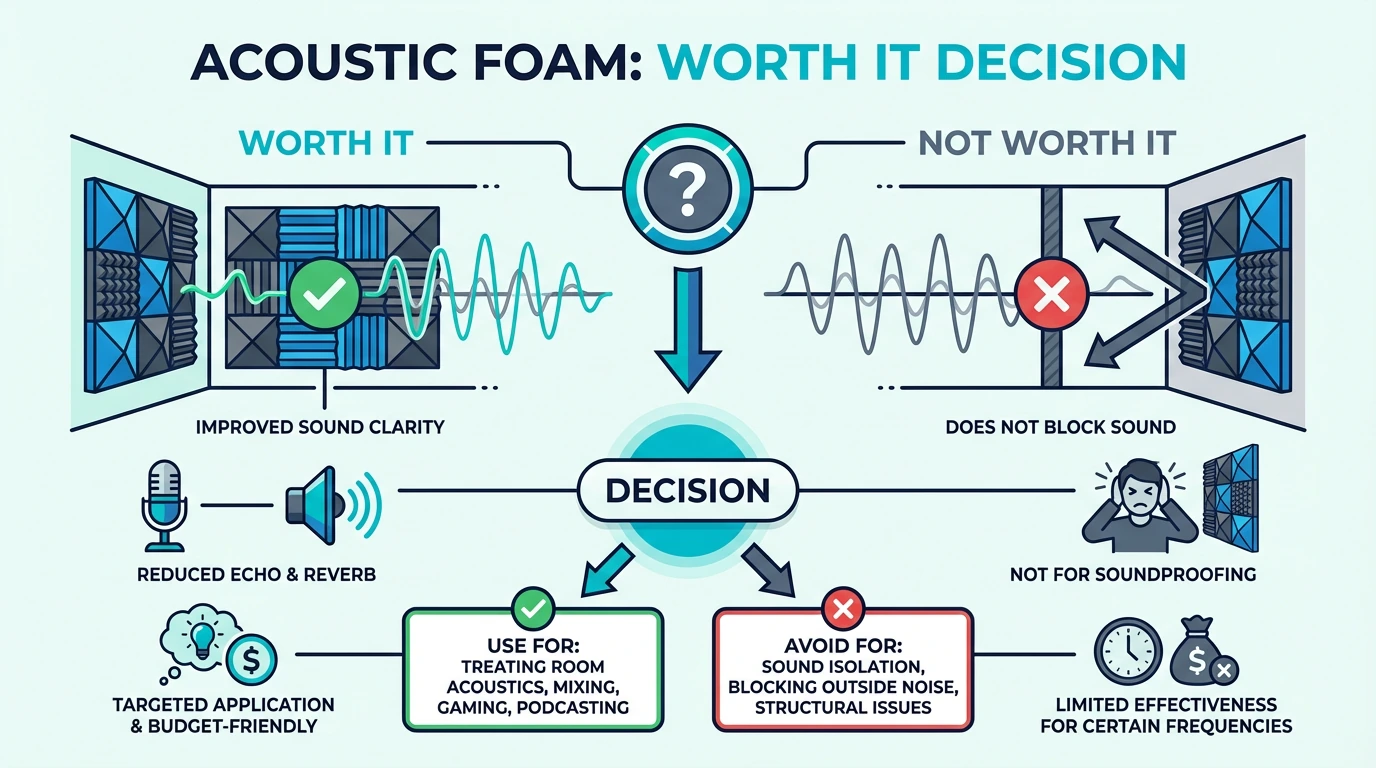
Is Acoustic Foam Worth It? Honest Answer [2026]

Is acoustic foam worth it? Yes — but only when you’re fighting echo, and no when you’re trying to soundproof a room.

If your recordings sound “roomy” (or your calls sound like you’re in a hallway), your mic is hearing reflections off bare walls and ceilings.

A small amount of foam in the right places can tighten up speech and vocals immediately.

Below, you’ll see when foam is the right spend, when it’s a waste, and what to do instead if the real problem is noise coming through walls.

Quick Takeaway

Acoustic foam is worth it for reducing echo and tightening up speech/voice recordings (it works best in the mid-to-high frequencies). For soundproofing or blocking neighbor noise, skip foam — those problems need mass, sealing, and decoupling.

Is Acoustic Foam Worth It?

Decision guide for whether acoustic foam is worth it

Here’s the straight answer: foam is a tool for controlling reflections inside a room. The moment you expect it to stop sound traveling through a wall, you’re buying the wrong thing.

The Honest Answer: It Depends on Your Goal

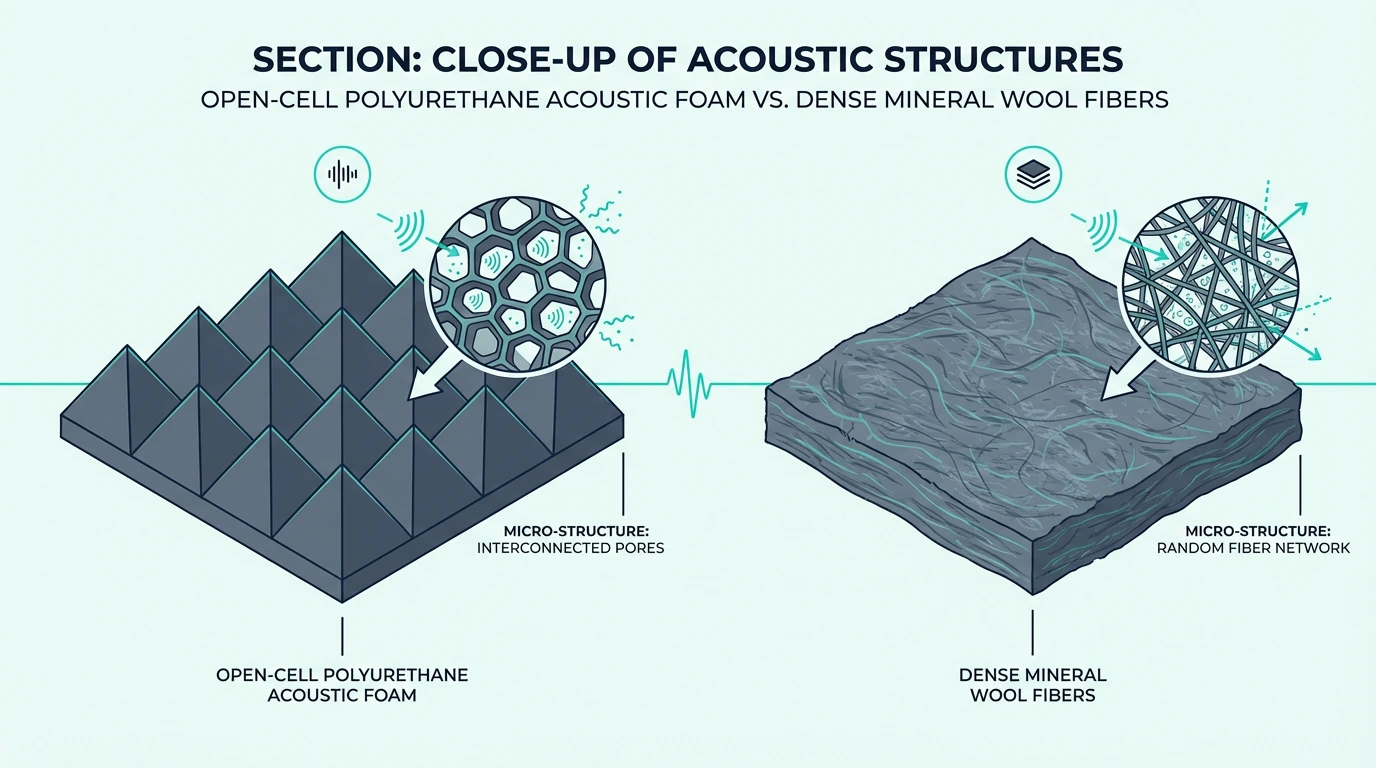
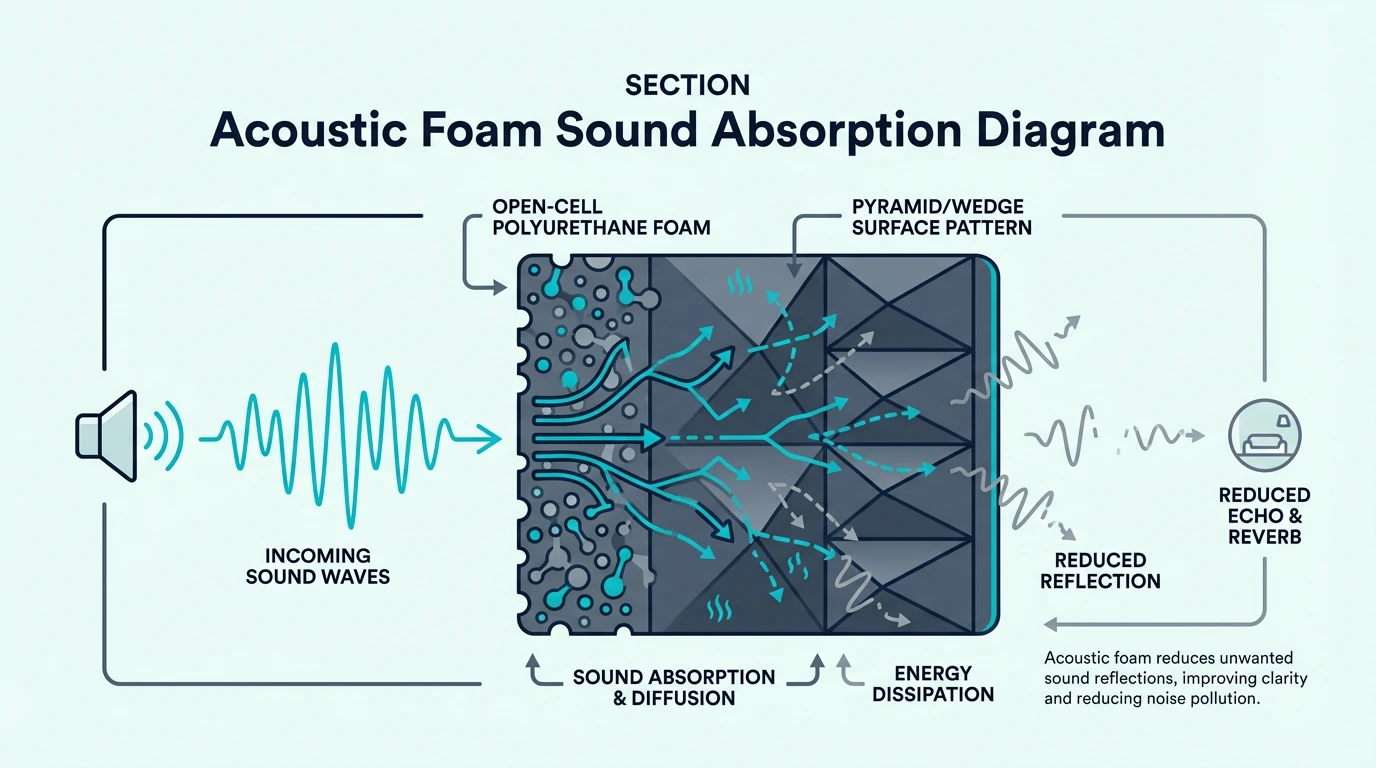
Acoustic foam absorbs sound waves bouncing around inside a room. It reduces the reflections that make a bedroom sound like a bathroom.

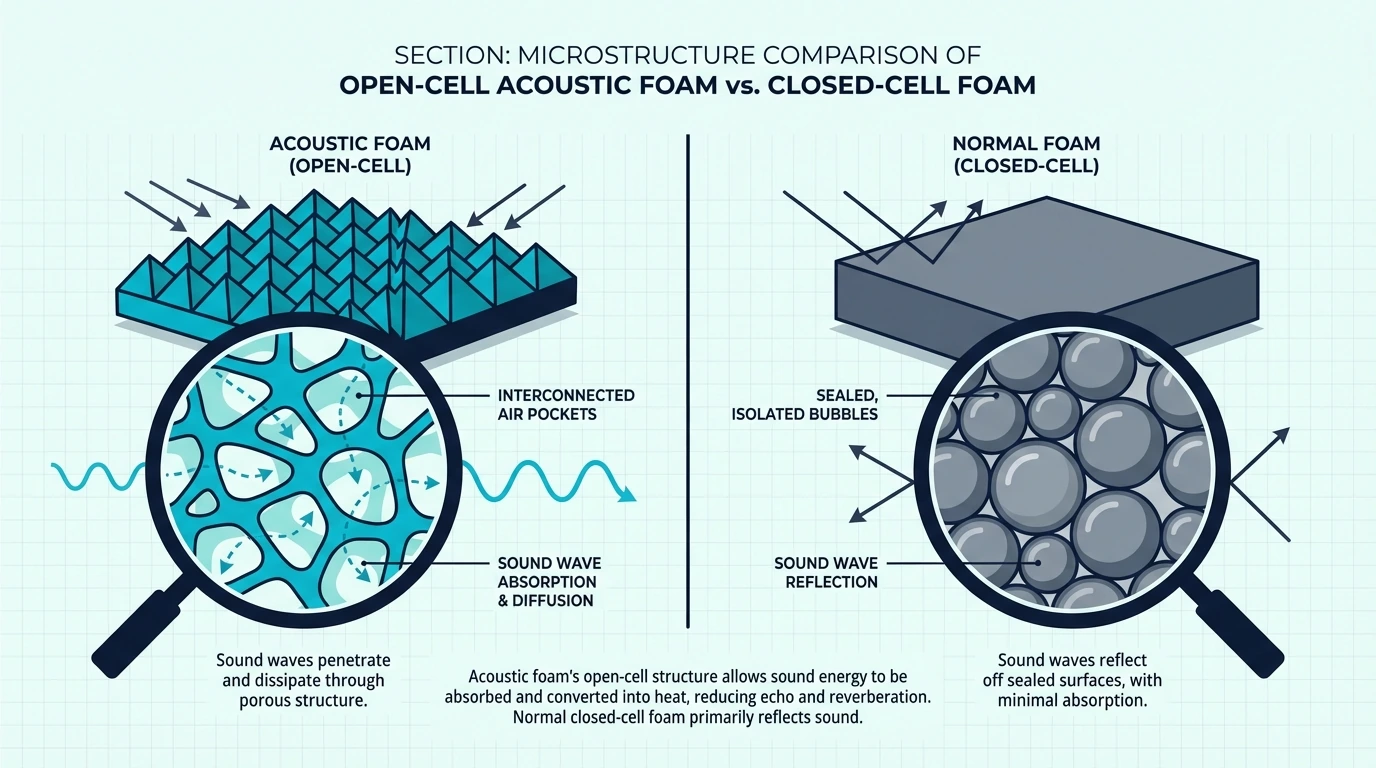
It does this because open-cell foam creates friction as sound waves pass through it. That friction turns a little sound energy into heat and shortens the reverb tail your mic hears.

If you want a quick reality check, clap once in the middle of the room and listen to the decay. If you hear a ringy tail that hangs on, foam can help.

If your goal is cleaner audio in the same room you’re recording in, foam delivers real results. You’ll hear less splash, tighter vocals, and a “closer” voice that sits better in a mix.

If you want the deeper breakdown of why that happens (and where it stops), read does acoustic foam work?.

Once you’re clear on what problem you’re solving, the decision gets a lot less fuzzy. Let’s start with the situations where foam actually pays you back.

When Foam IS Worth It

Foam is worth it when your problem is echo, not “noise leaking in.” That includes bedroom studios, podcast corners, streamer setups, and home theaters that sound harsh.

It can also be worth it in everyday rooms that feel uncomfortable to talk in. If a space has hard floors, parallel walls, and minimal furniture, flutter echo can make it exhausting.

That’s the upside. The downside is that foam gets blamed for problems it can’t touch, so people keep buying more instead of switching tools.

When Foam ISN’T Worth It

Foam will not block sound coming through walls, ceilings, or floors. So if you’re trying to stop neighbors, traffic, or drums from traveling between rooms, skip the foam.

Soundproofing requires mass, decoupling, and sealing. Foam is light and porous, so it doesn’t meaningfully slow down transmission.

If you want the basics broken down, start with our acoustic foam hub. It covers the difference between absorption (inside the room) and soundproofing (between rooms).

If you’re in the “worth it” camp, don’t make the next common mistake: buying too much. Here’s the minimum setup that gets you most of the audible win.

Minimum Treatment for Home Studios (What Actually Works)

Most people over-buy foam because they treat it like wallpaper. You usually get a bigger jump by treating the strongest reflection paths first.

1) Behind your mic (or behind your monitors): Treat the wall you face while recording or mixing. This catches the strongest early reflections before they bounce back into the mic.
2) First reflection points on side walls: Put foam where sound “hits” first from your speakers or your voice. Use the mirror trick: sit in position and slide a mirror along the wall until you can see the speaker in it.

3) Corners (optional): If you notice low-end buildup, add corner treatment before you plaster more foam everywhere. A set of corner bass traps can help with the worst corner resonance, but they won’t replace thick panels for serious bass control.

Start small, record a quick before/after clip, and add coverage only if you can still hear a specific room problem. Going from zero treatment to “some” is huge, but going from “a lot” to “a little more” is usually subtle.

What Does Acoustic Foam Actually Do?

Diagram showing acoustic foam absorbing sound reflections

Once you understand the physics, the “worth it” question gets easy. Foam handles reflections inside your room, and that’s a different problem than sound traveling through construction.

Reduces Echo and Reverb (Yes)

In an untreated room, sound bounces off walls, ceilings, floors, desks, and monitors. Those reflections hit your ears (and your microphone) a split-second after the direct sound.

That small delay creates the “echoey” or “boxy” character that makes home recordings feel amateur. Foam shortens the decay by absorbing some of that energy before it bounces again.

If you’re recording vocals, voiceover, or streaming, this is exactly what you want. You’re not changing your microphone, you’re changing what the microphone is listening to.

That’s why foam can make voice and dialogue feel cleaner fast. But it has a hard limit: thin foam doesn’t do much for low frequencies.

But Only for High Frequencies

Standard 1–2 inch foam is strongest in the mid-to-high frequencies. That’s why it helps speech clarity and tamps down harshness.

Lower frequencies have much longer wavelengths, so thin foam barely touches them. If you’re producing music with heavy bass, you’ll eventually need thicker treatment (panels and bass traps), not more foam.

If you’re stuck deciding between “more foam” and “real panels,” start with acoustic foam vs panels so you don’t buy the wrong fix twice.

That low-frequency limit is why foam can make a room sound less harsh while still leaving it a bit boomy. It also explains why foam won’t help with neighbor bass coming through a wall.

Blocks Sound From Neighbors (No)

When you hear a neighbor’s bass, your wall is vibrating like a giant speaker cone. That’s transmission through structure, not reflections in air.

Foam can’t stop that because it doesn’t add meaningful mass or separation. For actual sound blocking, you need materials designed for soundproofing.

One common option is mass-loaded vinyl. It’s not a magic sticker, but it does add mass where foam can’t.

So if you’ve been shopping for “soundproof foam,” this is where the wiring gets crossed. Here’s the one-line distinction that keeps the rest of this guide honest.

The Critical Difference

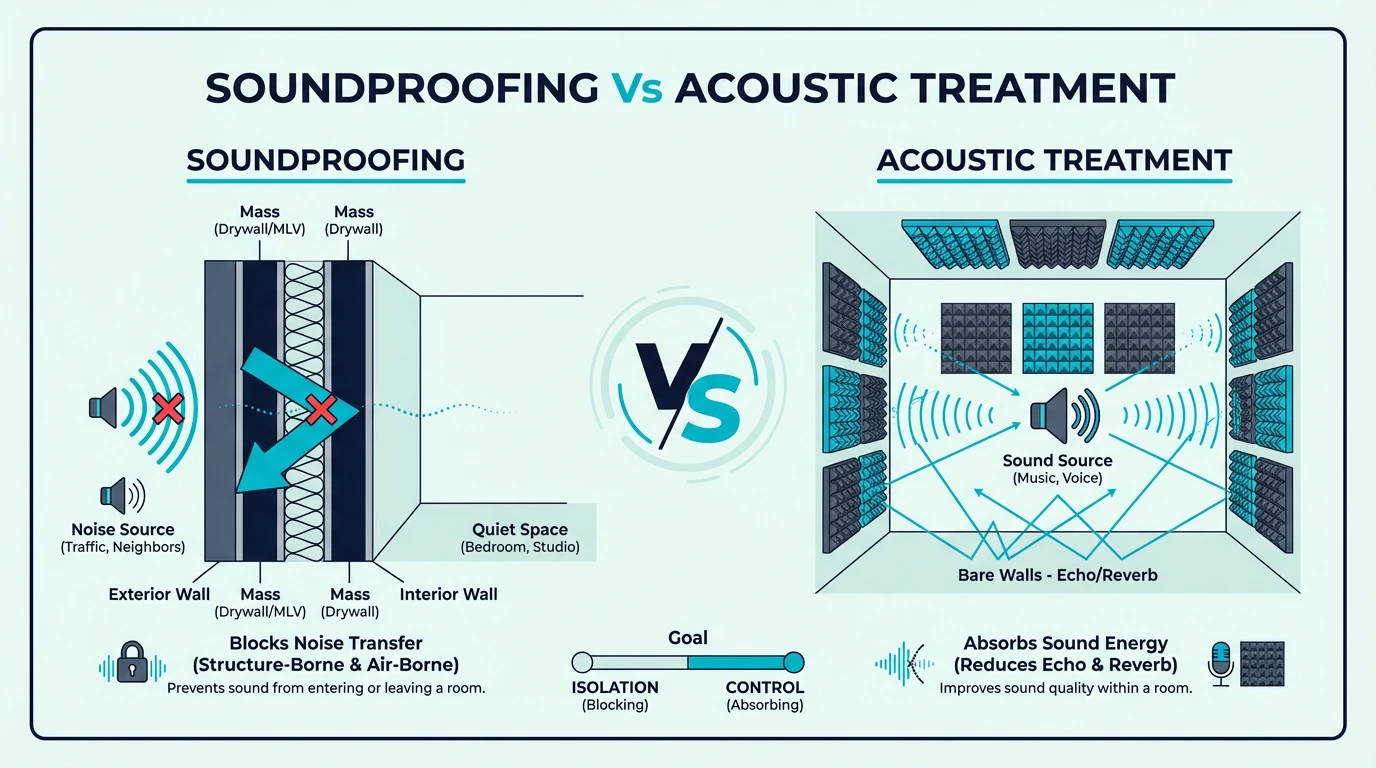
Absorption controls what happens inside the room. Soundproofing controls what passes between rooms.

Foam is a good absorption tool when used strategically. It’s a bad soundproofing tool no matter how much you buy.

When Acoustic Foam IS Worth It

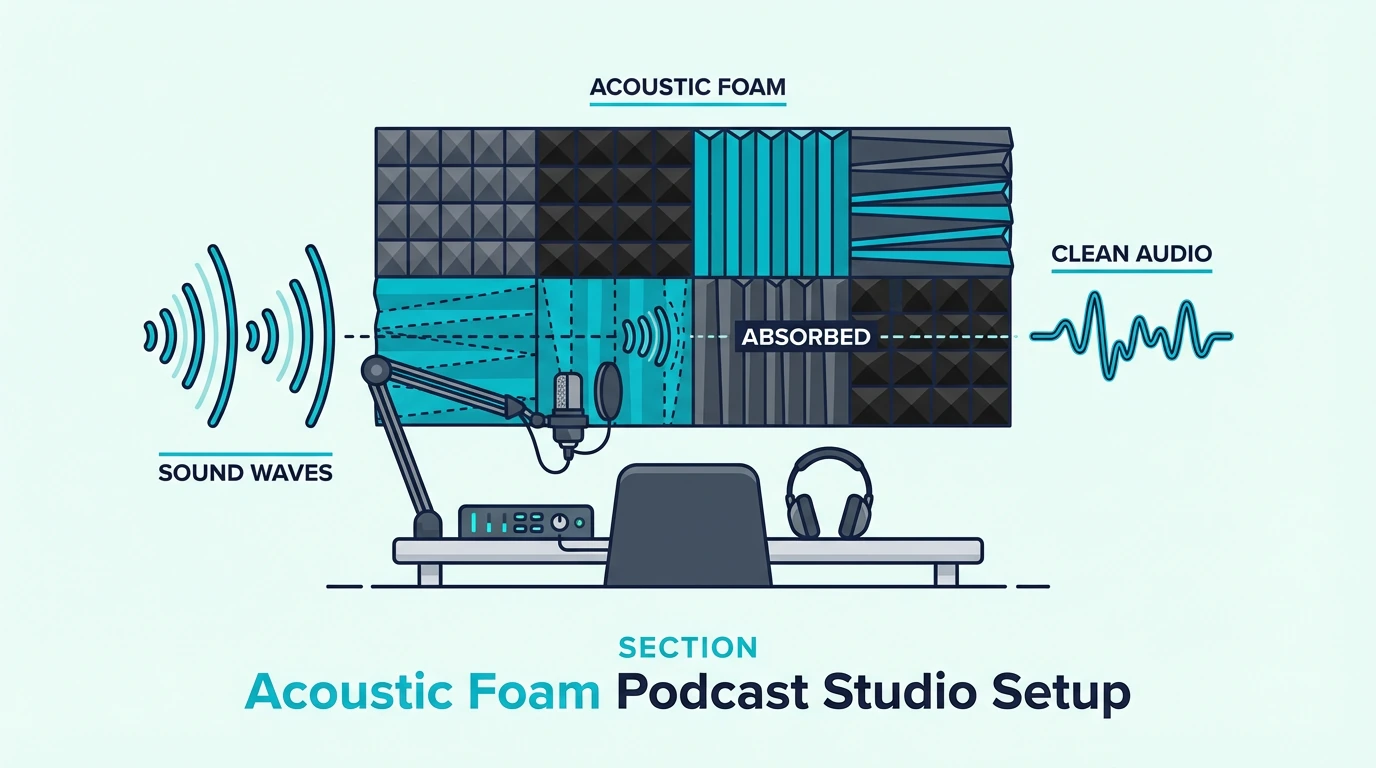
Podcast studio setup using acoustic foam panels

If your goal is cleaner recordings, foam can be one of the fastest upgrades you can make. The key is matching it to voice-focused problems, not expecting it to fix bass or neighbor noise.

Home Recording Studios

Recording in an untreated room captures flutter echo, comb filtering, and “room tone” you can’t EQ out later. Foam at first reflection points reduces the worst of it and makes takes easier to mix.

You don’t need to cover every wall. Even modest coverage in the right spots can make a bedroom studio usable.

If you want a buying shortlist, see our best acoustic foam panels guide. It also shows placement patterns that look clean instead of chaotic.
If you’re mostly recording voice, foam often feels more dramatic because you’re fixing the midrange reflections it actually absorbs. That’s why podcast setups are one of the easiest places to hear a quick before/after.
Podcast Rooms

Podcast listeners don’t forgive hollow audio for long. If your voice sounds distant and splashy, people click away.

Foam helps create that “close mic” sound by lowering early reflections. It won’t fix a bad mic technique, but it will stop your room from fighting you.

Streaming adds a different kind of mess: constant little noises bouncing off a desk and bare walls. Foam won’t silence your keyboard, but it can stop the room from amplifying it.

YouTube and Streaming Setups

Streamers deal with noisy PCs, keyboards, and reflective desks. Room reflections make those noises feel louder and more distracting.

Foam won’t remove the source noise, but it can keep it from bouncing around the room. That usually translates to cleaner voice tracks and less aggressive noise reduction in post.

If you’ve ever turned subtitles on because dialogue felt smeared, that’s an early-reflection problem. Here’s how foam fits (and where it doesn’t) in a home theater.

Home Theaters

In home theater rooms, foam is often used to control first reflections that smear dialogue. It can make speech easier to understand without cranking the volume.

You don’t want to deaden the whole room. Treat the early reflection points and keep some natural life in the space.

And you don’t need a “studio” use case for foam to be worth it. If a room is just harsh to talk in, killing the slap echo is a comfort upgrade.

Rooms With Bad Echo

Some rooms just sound harsh even for conversation. If claps ring or flutter, foam can make the space feel calmer.

You don’t need perfection here. You just need enough absorption to kill the “ping” that bounces between hard surfaces.

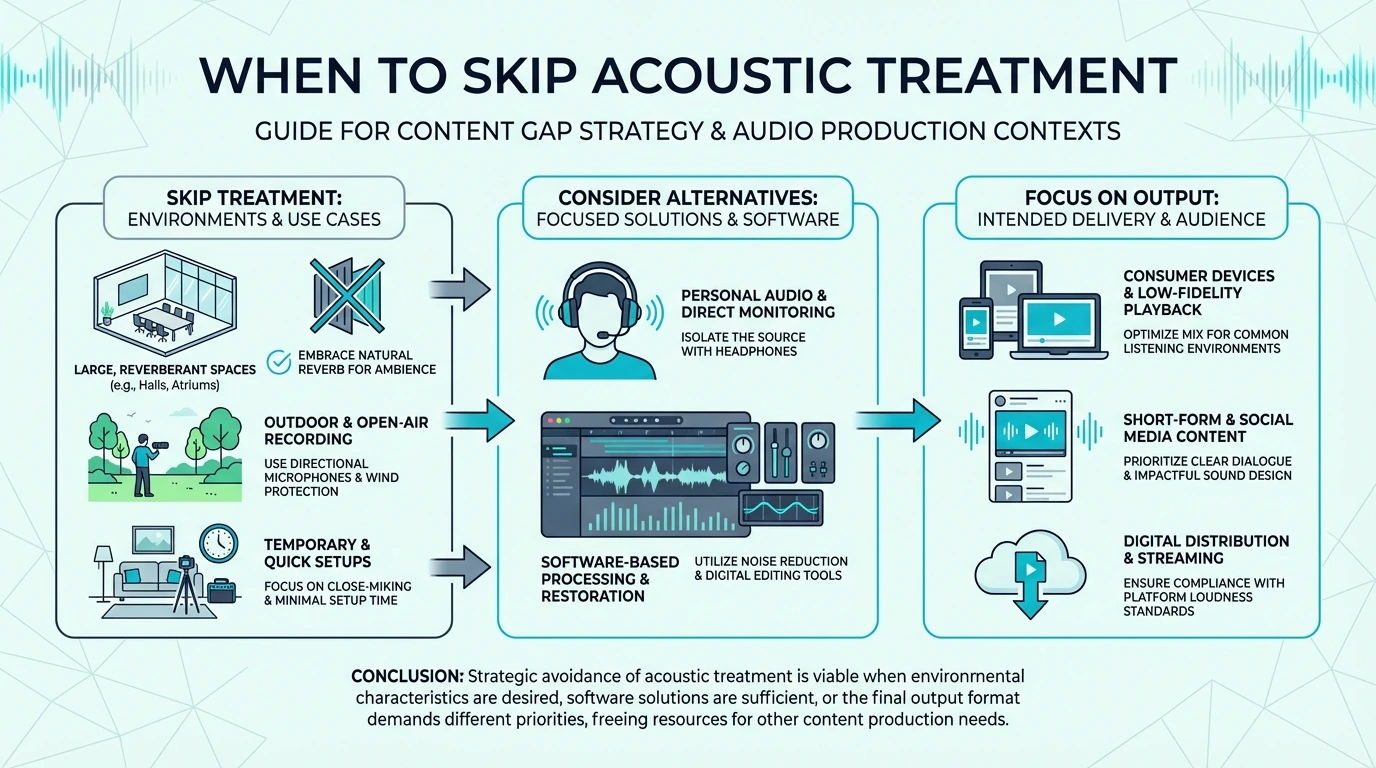
When Can You Skip Acoustic Treatment Entirely?

When to skip acoustic foam and choose other treatment

Not every room needs foam. Some spaces already have enough soft material and diffusion that treatment is overkill.

Rooms That Don’t Need Treatment

Carpet, heavy curtains, and upholstered furniture absorb a surprising amount of high-frequency energy. A big couch can do the job of a stack of foam panels.

Bookshelves can also help because they break up reflections. A wall of uneven surfaces acts like a cheap diffuser.

Closets used as vocal booths often need very little extra treatment. Hanging clothes do a lot of absorption naturally.

If you’re not sure whether your room is already “soft enough,” don’t guess. The clap test gives you a quick, repeatable read on whether you have a reflection problem.

The “Clap Test” Decision Point

Stand in the center of the room and clap once. Listen to how long the tail hangs around.

If it dies quickly and sounds natural, you may not need foam at all. If it rings, flutters, or feels metallic, you have a reflection problem worth treating.

If the ring is gone, stop there — you’ve already hit the main goal. Pushing past that is how rooms start feeling weird and lifeless.

When Treatment Makes Things Worse

Over-treating can make a room feel uncomfortable and lifeless. It can also make music playback feel unnatural.

The goal is controlled reflections, not a totally dead box. If your room already sounds fine, save your money for gear that moves the needle more.

When Acoustic Foam ISN’T Worth It

Comparison of soundproofing versus acoustic treatment

This is where foam gets people in trouble. If you buy it for transmission problems, you’ll be disappointed.

Trying to Block Neighbor Noise

If you can hear conversations, TVs, or footsteps through the wall, foam won’t solve it. The sound is traveling through the building, not bouncing around your room.

At best, you might notice a small change in harsh high frequencies. The midrange and bass that actually bother you will still come through.

That’s the neighbor version of the problem. If your goal is any kind of soundproofing, the fixes live in construction and sealing, not surface treatment.

Soundproofing a Room

True soundproofing is a construction project. It depends on mass, separation, and sealing every air gap.

Extra drywall layers, isolation clips, and acoustic caulk work because they change the structure. Foam doesn’t change the structure, so it can’t do the job.

And it’s not only neighbors — outside noise follows the same rules. If the sound is entering through gaps, foam on a wall won’t touch it.

Noise From Outside

Outdoor noise usually enters through windows, doors, vents, and small gaps. Foam on interior walls doesn’t address the entry point.

If you want less outside noise, start with weatherstripping and door seals. Then look at window upgrades or secondary glazing if the problem is serious.

So what does work? It’s not one magic product — it’s a stack of changes that attack the problem from three angles.

What You Actually Need Instead

For soundproofing, think in three buckets: mass, decoupling, and sealing. Each solves a different part of the problem.

Mass resists vibration. Decoupling breaks the path vibration uses to travel.

Sealing stops sound from leaking through tiny gaps that act like open windows. If you only treat one bucket, you usually get limited results.

Is Cheap Foam a Ripoff?

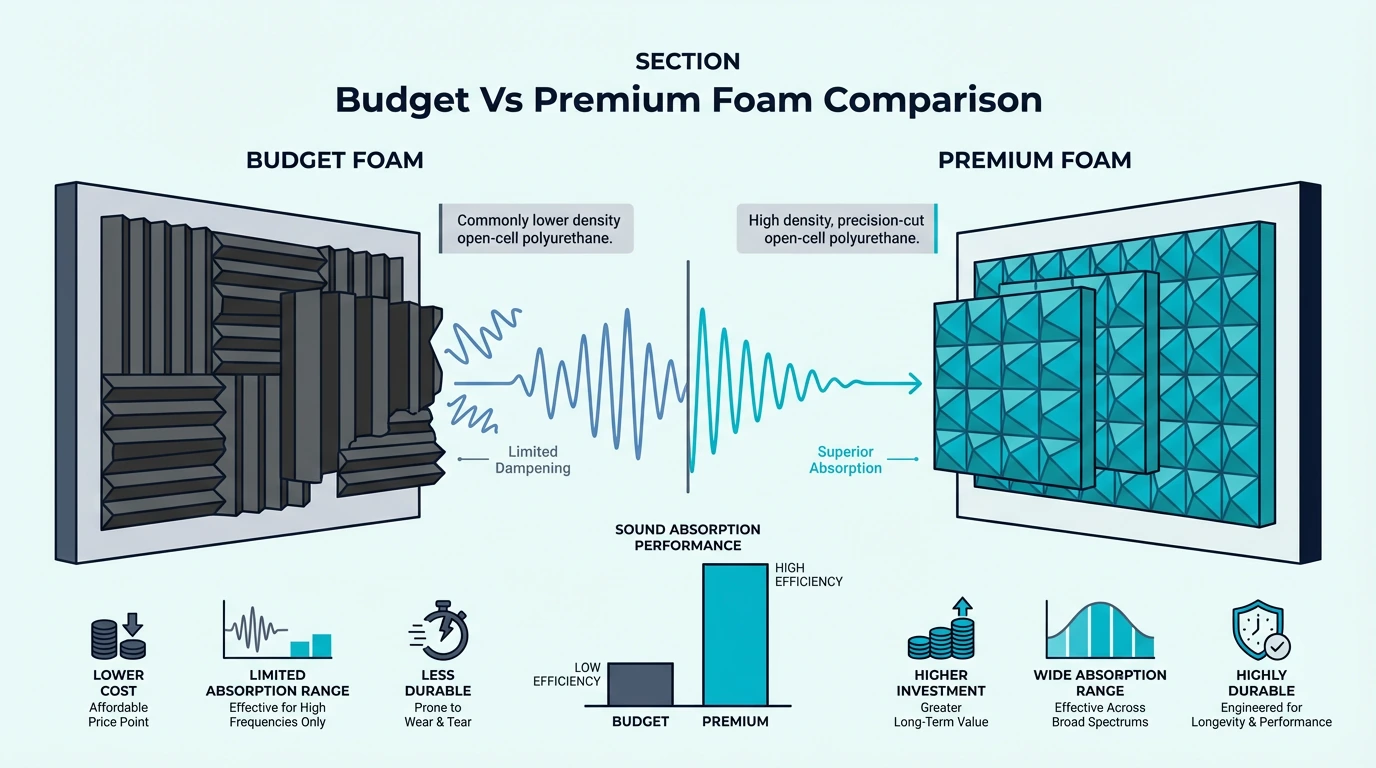
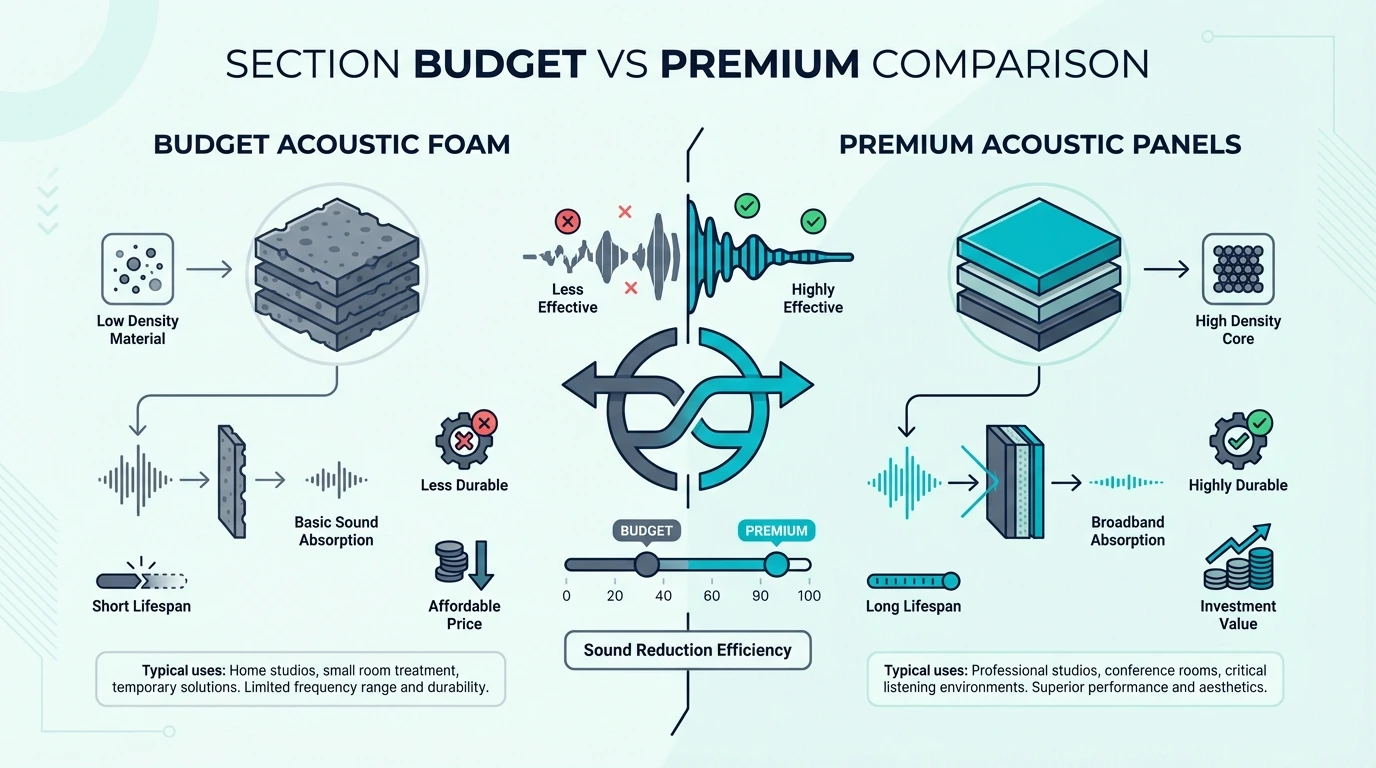
Budget versus premium acoustic foam comparison

Cheap foam isn’t automatically a scam, but it is often oversold. The real question is whether it solves your problem well enough.

Budget Foam vs Premium: Real Differences

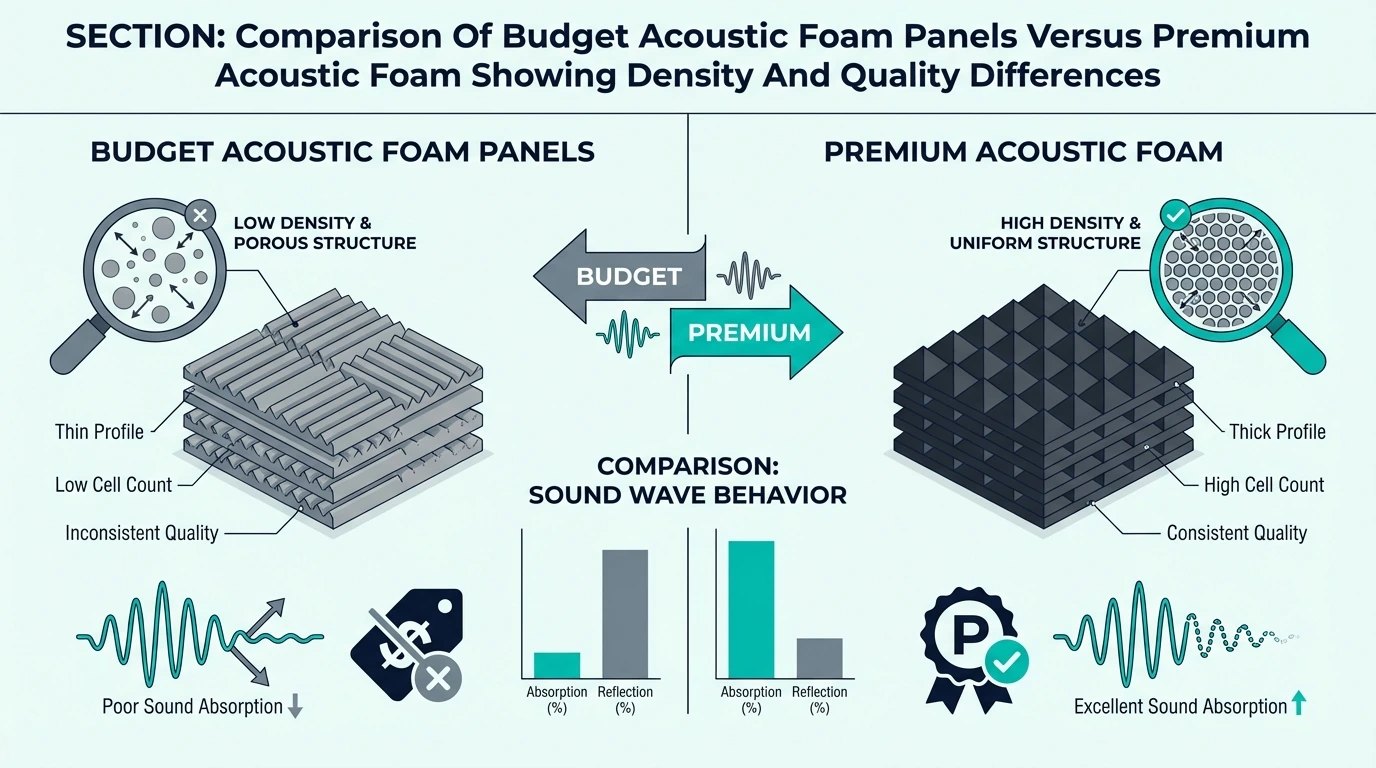
Density and consistency matter more than fancy marketing. Denser foam tends to absorb a bit better, especially as frequencies drop.

Budget foam often varies panel-to-panel. Premium foam is usually more consistent, which matters when you’re treating a room on purpose.

Those differences matter most if you’re chasing consistency and durability. If you’re just trying to tame slap echo, budget foam can still do the job.

When Cheap Foam Works Fine

If you’re treating a home office, casual streaming setup, or hobby recording space, budget foam can be totally fine. You’re mostly trying to knock down slap echo and harsh reflections.

Start with a small amount and test. If you like the change, add more coverage where your room still rings.

But if you’re using the room daily, cheap foam’s weaknesses show up faster. That’s when spending more stops being “upgrade bait” and starts being practical.

When You Should Spend More

If you’re recording professionally, small improvements compound over time. Consistency and durability matter when you use the space every day.

Cheap foam can yellow and crumble faster depending on material quality and sun exposure. If this is a long-term room, it’s worth buying something that stays stable.

If you want vetted options, see our best acoustic foam panels guide. It covers picks across budget tiers so you can find panels that are cheap without being useless.

How Much Should You Spend?

Acoustic foam cost breakdown by treatment option

There isn’t a single “right” budget because rooms and goals are different. But there is a right order of operations: treat the biggest reflection problems first.

Budget Tier: Entry-Level Treatment

Entry-level packs are best for testing if your room is the problem. You can cover key reflection points with a small set and immediately hear whether treatment helps.

If you want a simple starting pack, this 12-pack foam starter kit is enough for a first pass. Treat one wall properly before you buy enough to cover everything.

If that starter pack gets you the improvement you wanted, great — you can stop. If the room still sounds roomy after you treat the key surfaces, mid-range thickness and coverage is where the next jump lives.

Mid-Range: Serious Home Studios

Mid-range setups give you more coverage and thicker foam where it matters. That’s usually where rooms start sounding “controlled” instead of just “less echoey.”

A set of 24-pack 2-inch pyramid panels can handle first reflections plus a back wall. If you’re making music (not just voice), plan for bass control too.

Once you’re in the “serious” zone, foam usually becomes one piece of a mixed plan. That’s what premium setups are really about: balance, not more wedges.

Premium: Professional Applications

At the high end, foam is usually part of a mixed treatment plan. Studios combine foam with panels, bass traps, and sometimes diffusion for balance.

This is also where measurement tools matter. REW (Room EQ Wizard) can show you what your room is doing instead of guessing.

If you’re building a dedicated vocal area, see our acoustic foam vocal booth guide. It explains coverage and thickness choices for voice-first rooms.

No matter what tier you choose, coverage is where people overspend. Use a simple coverage target so you add foam where it matters, not everywhere.

How to Estimate Coverage (Without Overbuying)

Most home setups do well starting around 15–30% wall coverage, focused on reflection points. That doesn’t mean “cover every wall,” it means “treat the walls that matter.”

If you have a typical bedroom-size room (say, around 10×12 feet), you can get a big improvement without going extreme. Start with side wall reflections, the wall behind your mic, and the wall behind your monitors.

The Bottom Line: Worth It for Echo, Not for Soundproofing

Acoustic foam is worth it when you use it for what it’s designed to do: control reflections. If you want tighter voice recordings, clearer dialogue, and less slap echo, it’s a smart buy.

If soundproofing is the goal, foam isn’t worth it. If the problem is sound traveling through walls, foam won’t change the physics.

If you’re ready to buy, start with our best acoustic foam panels guide. You’ll get product picks and placement patterns that don’t turn your room into an ugly checkerboard.

Frequently Asked Questions

Is acoustic foam a waste of money?

No, not when you use it for echo control. It becomes a waste only when you buy it expecting soundproofing.

Does foam make a noticeable difference?

Yes, especially in small hard rooms. Even basic treatment can make speech and vocals sound less “roomy” right away.

Should I buy foam or DIY panels?

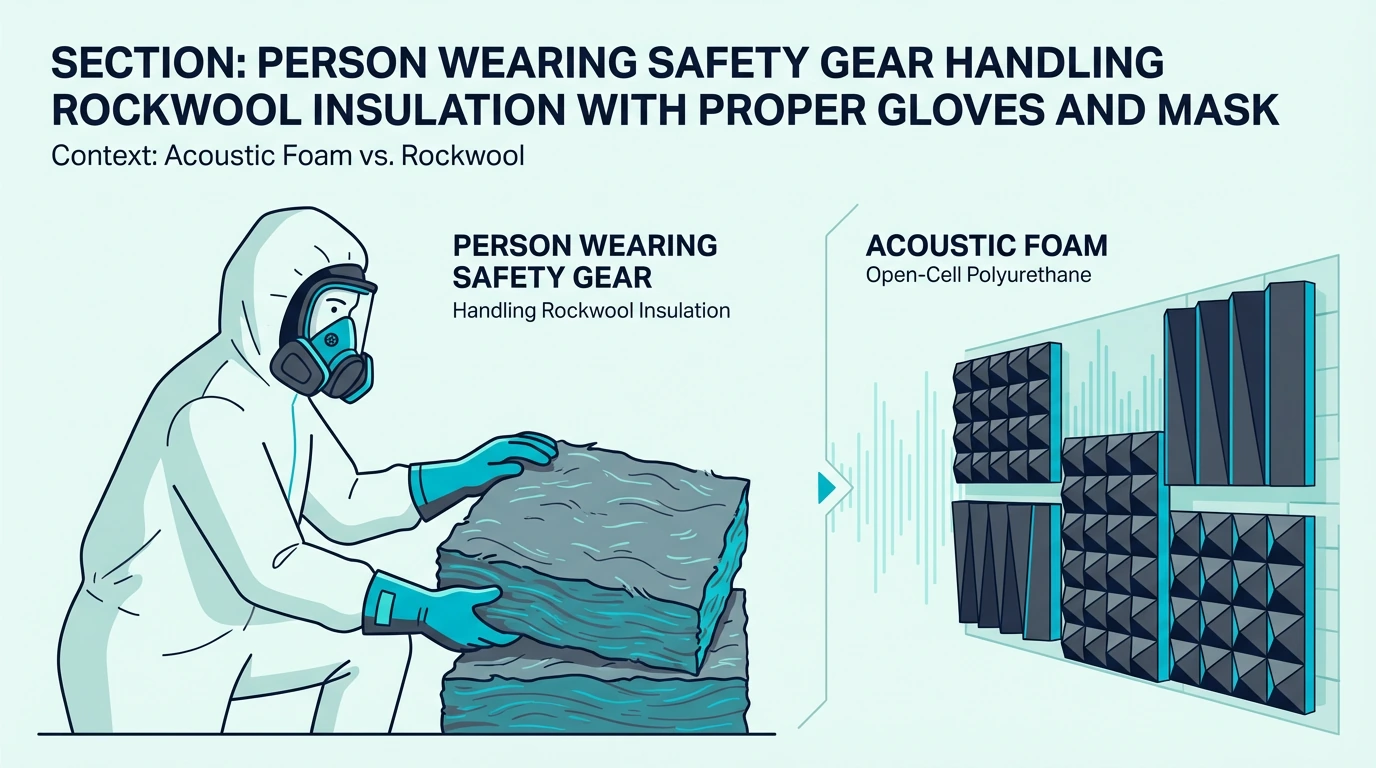
DIY mineral wool or fiberglass panels usually outperform foam, especially for bass. But they take time to build and require careful handling of the materials.

Foam wins on convenience. If you want improvement fast without a build project, foam is the easier starting point.

How much foam do I actually need?

Most rooms benefit from 15–30% coverage focused on first reflections and problem surfaces. Start small, test, and add only if you can still hear a clear reflection issue.

The where to place acoustic foam in a home studio guide covers reflection points without the “cover every wall” myth.

How to Clean Acoustic Foam: Safe Methods That Won’t Damage It [2026]

To clean acoustic foam safely, you need a light touch—but only if you keep it mostly dry.

Scrub it like a kitchen sponge, and you’ll crush the cells that do the absorbing (and sometimes rip the panel right off the wall).

That’s because foam is open-cell: it grabs dust, but it also holds moisture and tears when you overwork it.

Follow the routine below and you’ll get cleaner foam without odor, sagging panels, or a surprise mold problem.

We’ll start with vacuuming (best for dust), then move to spot cleaning, and finish with a low-risk deep-clean + drying sequence.

Quick Takeaway

Vacuum acoustic foam with a soft brush for routine cleaning, and avoid soaking it with water. If you must spot-clean, use minimal moisture, pat (don’t rub), and dry the foam fully to prevent odor and mold.

Can You Clean Acoustic Foam?

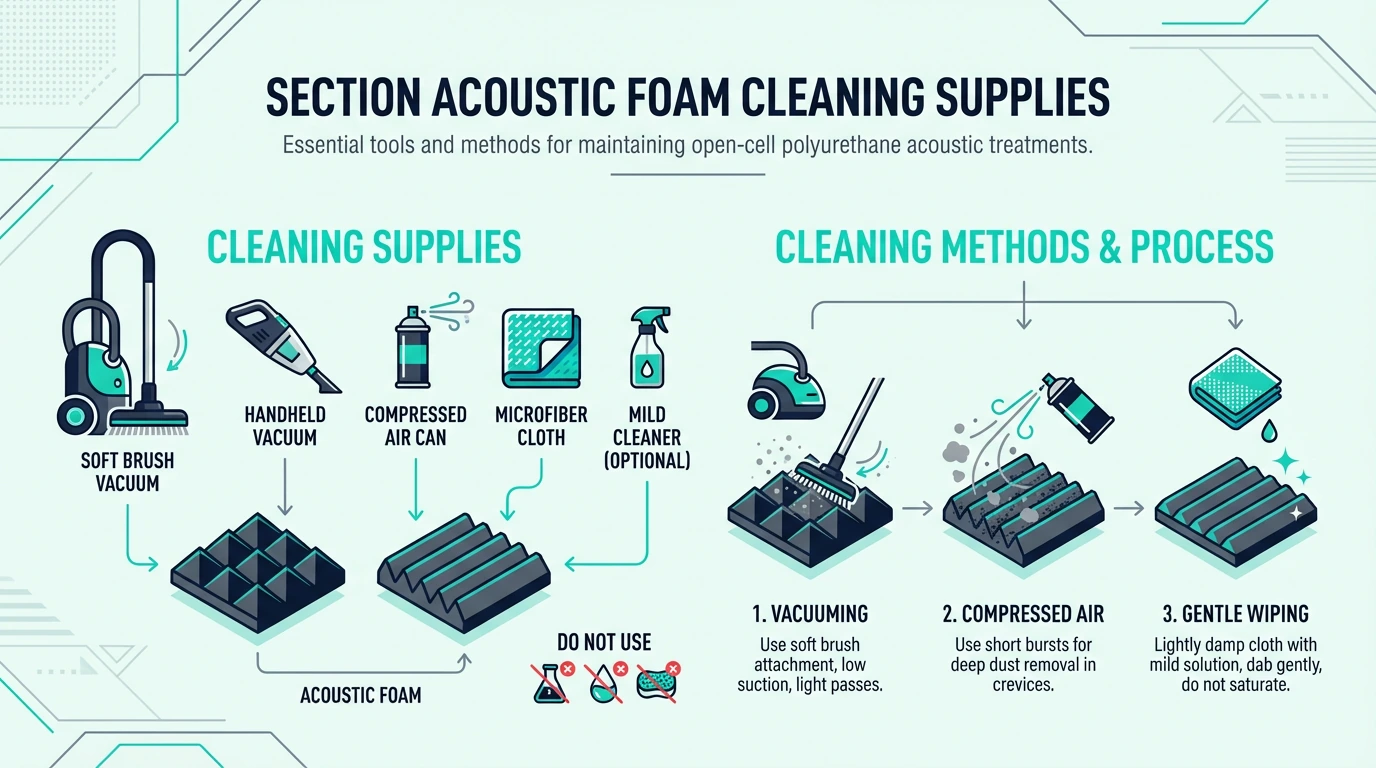
Cleaning supplies for acoustic foam panels

Yes—you can clean acoustic foam, but you’re mostly cleaning the surface. Foam is open-cell and full of tiny pockets, so aggressive scrubbing pushes dirt deeper and damages the structure.

Think of cleaning as “remove dust and light grime without saturating the foam.” If the foam is stained through, brittle, or crumbling, cleaning won’t bring it back.

If your foam is already old and shedding dust, check can acoustic foam get old before you spend time cleaning. Sometimes replacement is the healthier move.

If you’re not sure what you’re dealing with, start by identifying the foam type and thickness. The buying guide in how to choose acoustic foam makes it easier to tell “real treatment” from cheap foam that won’t survive much handling.

Also decide whether you’re cleaning panels that are mounted or panels that are loose. Mounted foam is easier to dust, but it’s harder to dry safely if you accidentally soak it.

If you want the foam to stay cleaner longer, clean the room first. Vacuum the floor, wipe nearby shelves, and clear the main dust sources before you touch the panels.

For a bigger “treatment plan” (placement, coverage, and what foam can’t fix), start at the acoustic foam hub. It’ll help you decide whether you’re maintaining foam or upgrading your setup.

Before you start: do a fast damage check

Grab one panel and do a quick “is this worth saving?” check. It takes 30 seconds and prevents the most common mistake: turning a small cleaning job into a bigger replacement job.

If you see any of the signs below, cleaning is usually a losing battle. You can still remove loose dust, but don’t expect stains, odor, or texture to “come back.”

  • Crumbling or chalky residue when you pinch a corner.
  • Permanent flattening where the ridges no longer spring back.
  • Musty odor that returns after the room dries out.
  • Dark spotting that looks like mildew or mold.

If you suspect mold or the foam makes allergies worse, treat it like a health issue. Read is acoustic foam dangerous and err on the side of removal instead of trying to “sanitize” porous foam.

Method 1: Vacuuming (Best for Dust)

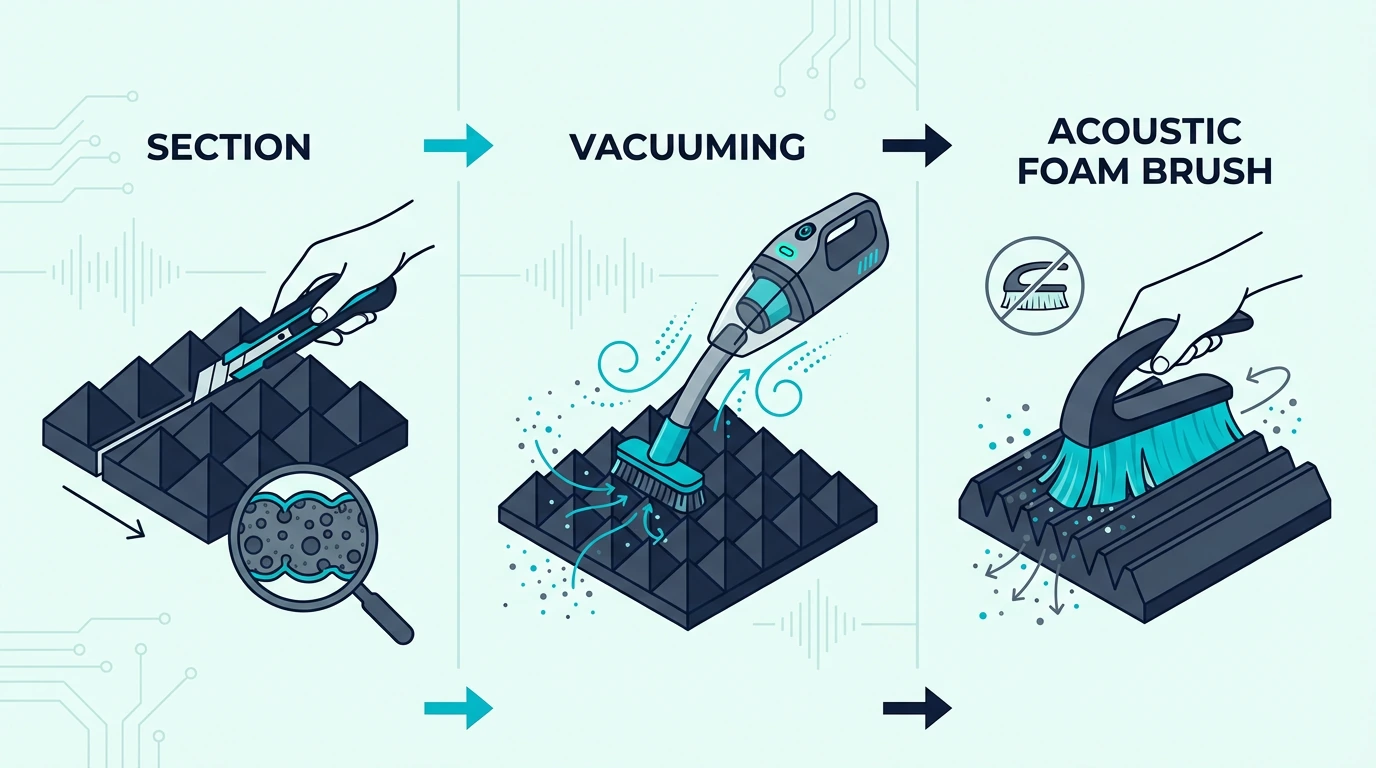
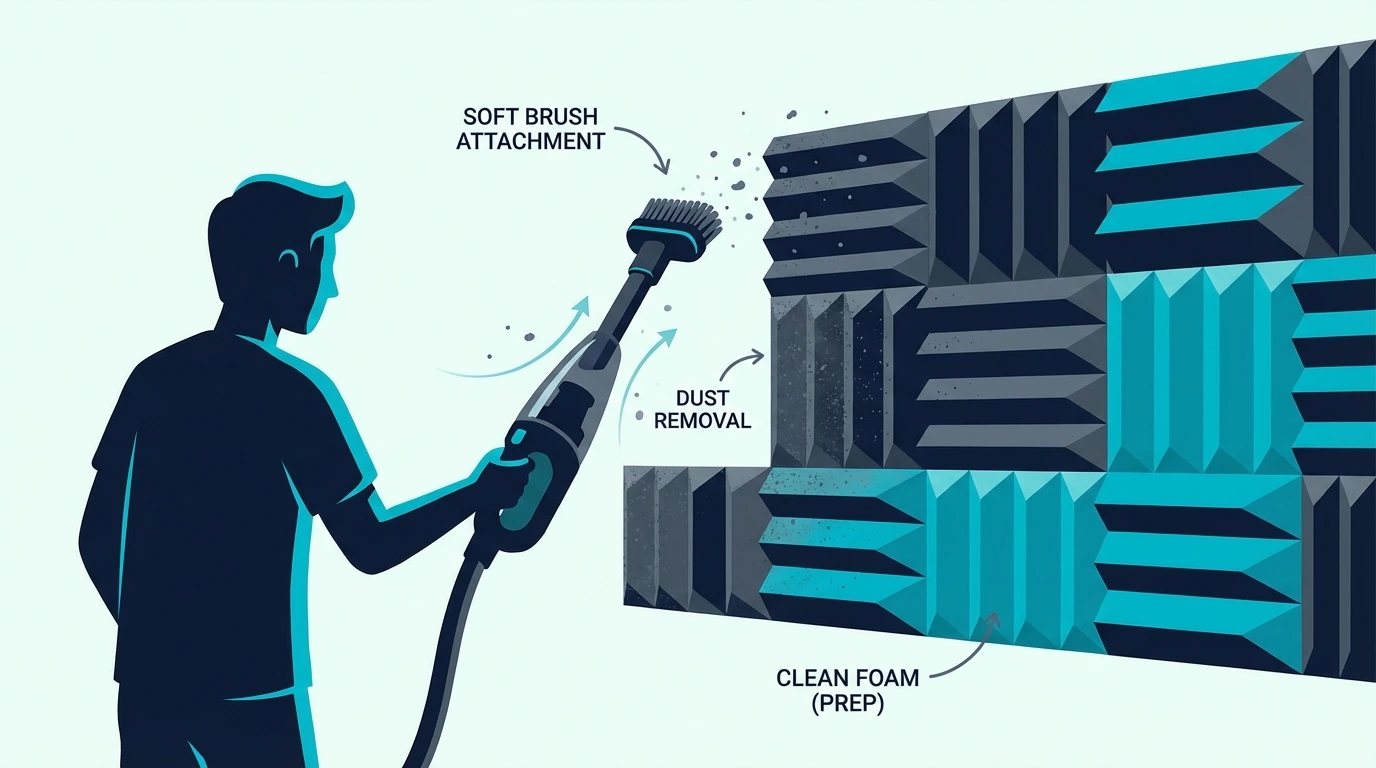
Vacuum brush cleaning dust from acoustic foam

Vacuuming is the safest “default” because it removes dust without soaking the foam. The key is low suction and a brush that won’t snag the ridges.

If you don’t already have a gentle brush, a soft brush attachment is the right tool for this job.

Avoid motorized “beater bar” heads. Those are designed for carpet, and they can shred foam ridges fast.

How to vacuum foam safely

Run the brush lightly over the foam surface and let the suction do the work. Don’t “press in” to dig out dust, because that crushes the foam and can tear edges.

If panels are mounted with weak adhesive, support them with your free hand while vacuuming. You want the foam to stay still while the brush moves.

Vacuum slowly and work in one direction so you don’t catch the ridges. If you see the foam flexing a lot, reduce suction or back off pressure.

If the foam is very dusty, do a quick “first pass” to remove loose dust, then repeat. A second gentle pass usually beats one aggressive pass.

If you’re dealing with pet hair, start by vacuuming the surface lightly, then follow with a microfiber wipe. Hair tends to cling to the ridges, and pulling it by hand can tear peaks off.

When you’re done, check the floor line where the foam meets the wall. Dust that falls during cleaning is a good reminder that foam also collects debris in the room, so a quick sweep helps keep it from re-settling.

Method 2: Spot Cleaning (For Stains)

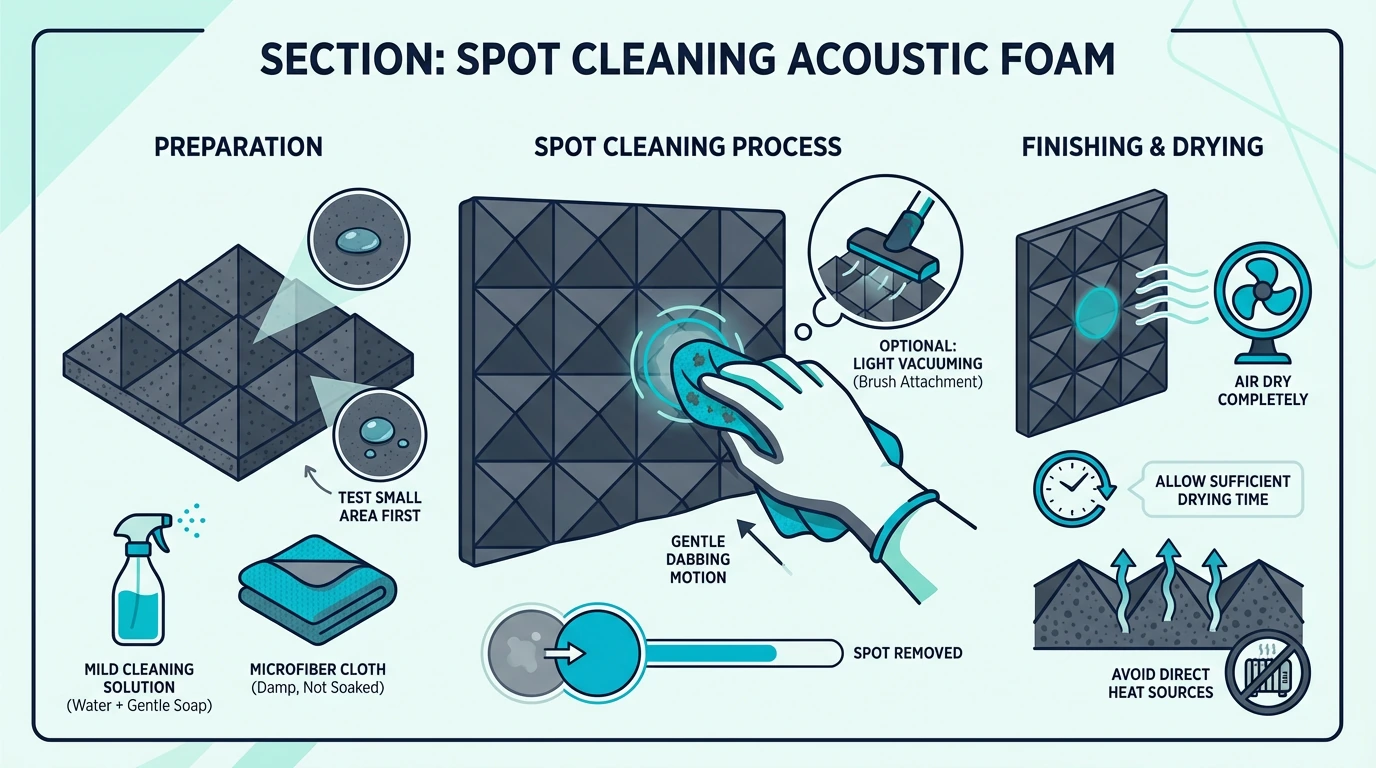
Spot cleaning stains on acoustic foam

Spot cleaning is for small stains, not for “washing the panel.” The more water you add, the longer the foam stays wet, and wet foam is where odors and mold start.

Use a quality microfiber cloth so you can dab without shredding the foam surface.

If your foam is mounted, put a towel on the floor and keep the moisture on the cloth, not on the panel. Spraying the foam directly is how water runs into the wall and leaves a damp spot you can’t see.

How to spot-clean without ruining foam

Lightly dampen the cloth (do not soak it) and blot the stain. Avoid rubbing back-and-forth, because that fuzzes the surface and can deform the peaks.

If you use a tiny amount of mild soap, wipe once with a barely-damp cloth afterward to remove residue. Soap left inside the foam can attract more dirt later.

Always test in a small hidden corner first. Some foams discolor easily, and it’s better to find that out on the edge than in the center of a panel.

If the stain is on the tips of wedge/pyramid ridges, focus on dabbing the high points only. Pressing liquid into the valleys is how foam stays wet for too long.

Stains from smoke, cooking grease, or aerosols are the hardest to “spot clean” because the residue spreads. If the foam smells smoky even after drying, deep cleaning often doesn’t fix the odor, and replacement is usually the honest answer.

After spot cleaning, dry the foam completely. If the foam ever gets damp through, follow acoustic foam dryer instead of leaving wet panels on a wall overnight.

Method 3: Deep Cleaning (If Really Necessary)

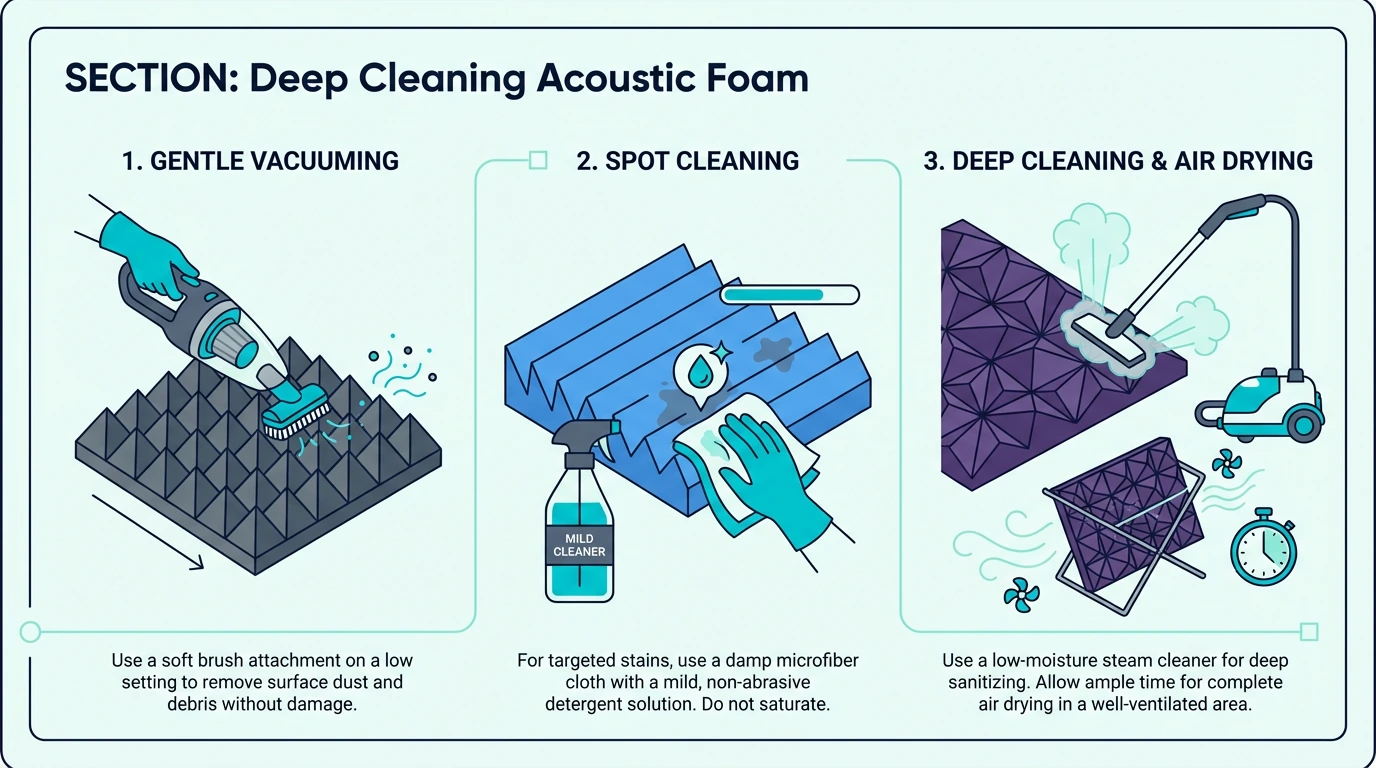
Deep cleaning method for acoustic foam panels

Deep cleaning is a last resort for foam that’s truly filthy or was exposed to smoke/dust. It’s also where people accidentally destroy panels by saturating them.

If your foam is mounted, consider removing only the worst panels and cleaning those. Cleaning everything at once increases the chance you trap moisture in the room.

For deep dust removal, an electric air duster can blow loose debris out of the cells without soaking the foam.

If you have to use water, use as little as possible and dry aggressively afterward. The safest “wet” approach is light misting, gentle blotting, then airflow until the foam is fully dry through.

Drying matters as much as cleaning. A panel can feel dry on the surface while still holding moisture inside the cells.

A safer “deep clean” sequence (without soaking the foam)

Start with the lowest-risk steps and stop as soon as the foam looks acceptable. You’re trying to improve the panel, not make it perfect.

  • Take the panel down carefully if it’s mounted, especially if it’s glued. The guide at remove acoustic foam helps you avoid tearing the foam or the drywall.

  • Shake and blow out dust outdoors using low power first. Hold the foam so air flows across the ridges rather than straight into the foam’s valleys.

  • Blot the worst grime with a barely damp cloth, then blot again with clean water to remove residue. If the cloth is wet enough to drip, it’s too wet.

  • Press (don’t wring) between two dry towels to pull out moisture. Wringing twists and permanently deforms the foam.

  • Air-dry with moving air until the foam is dry all the way through. A fan plus time beats heat every time.

Reinstall only when the foam is truly dry. If it’s even slightly damp, adhesives fail and you can trap moisture behind the panel.

If foam is greasy, smoky, or smells bad, replacement can be the smarter option. Foam holds odors, and you don’t want your room to smell like “cleaner” or “old sponge.”

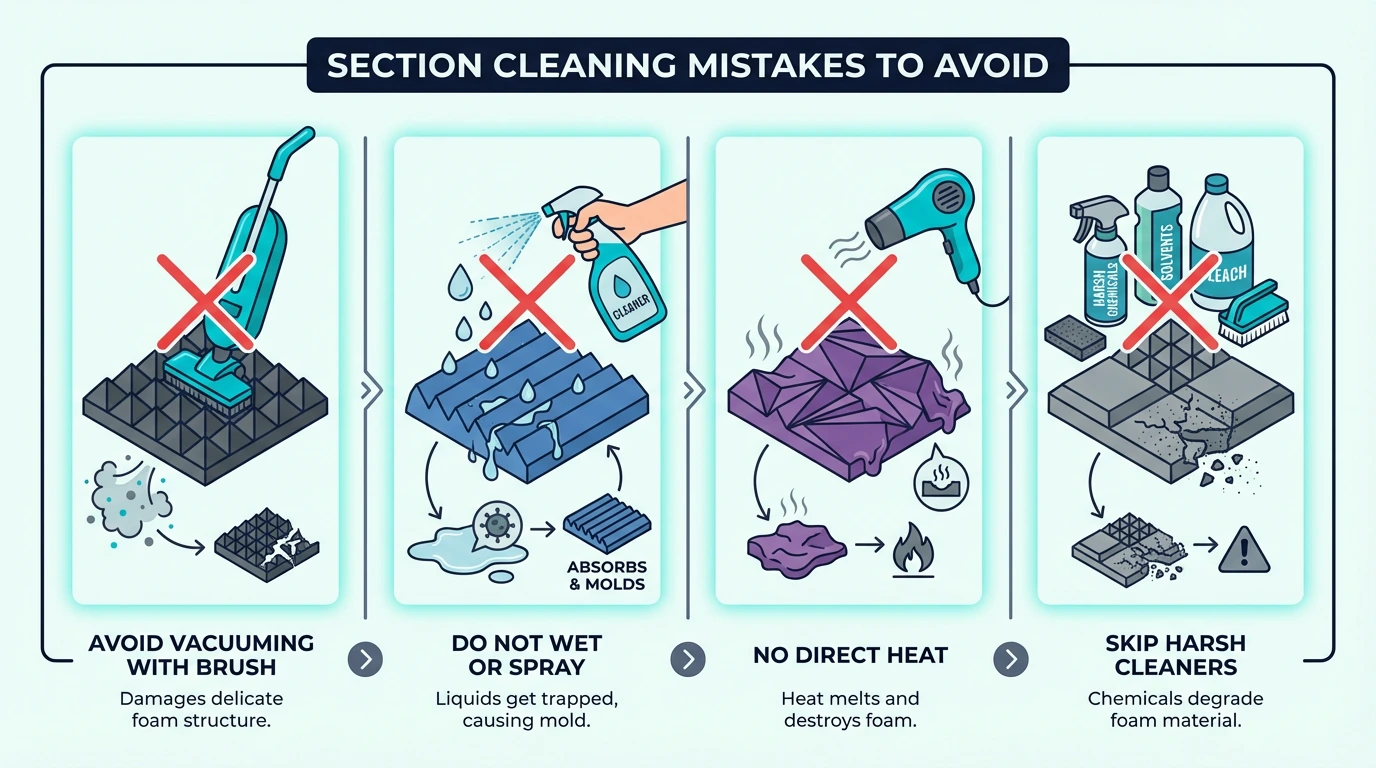
What Not to Do When Cleaning Acoustic Foam

Acoustic foam cleaning mistakes to avoid

Don’t soak foam in water and “let it dry later.” Water can sit inside the cells for a long time, especially in humid rooms.

Don’t use harsh chemicals or solvents. If it can melt plastics or strip paint, it can damage foam and leave residues you’ll breathe.

Don’t scrub aggressively. If the foam surface is shredding, you’re literally removing the material that does the absorbing.

Don’t “speed dry” foam with high heat. Heat can deform foam, and warm, damp foam is exactly where odors and mold can develop.

Don’t leave damp foam stacked or pressed under weight. Compression plus moisture is how panels end up permanently deformed.

Avoid “DIY disinfectant experiments.” Vinegar, bleach, and heavy fragrances often leave a smell you can’t get out of the foam, and some chemicals can weaken the structure over time.

If a corner is torn or ragged, you can sometimes trim it cleanly instead of scrubbing harder. Use cut acoustic foam so you get a clean edge without shredding the panel.

If the foam is too dirty to clean without damage, it’s time to remove and replace it. Use remove acoustic foam so you don’t turn the job into drywall repair.

Conclusion

Vacuuming with a soft brush is the safest way to clean acoustic foam, because it avoids moisture and avoids crushing the foam’s structure. Spot cleaning can work, but only when you keep water to a minimum and dry the foam completely.

If your foam is crumbling, permanently compressed, or smells musty even after drying, cleaning won’t fix it. At that point, replacement is the more honest solution.

If you’re deciding whether to replace foam or upgrade to longer-lasting treatment, start with acoustic foam vs acoustic panels. It’ll save you from buying the same foam twice.

If you’re still debating whether foam is worth maintaining at all, read acoustic foam worth it. Sometimes the best “cleaning” decision is swapping to treatment that doesn’t trap dust as easily.

Frequently Asked Questions

Can you wash acoustic foam in a washing machine?

No. Washing machines soak and agitate foam, which can tear it, deform it, and leave it wet inside for too long.

Can you use alcohol or disinfectant on acoustic foam?

Use caution. Some cleaners can leave residues or damage foam, so test on a small hidden area and use minimal liquid.

How often should you clean acoustic foam?

As needed. Light vacuuming every few weeks is usually enough in dusty rooms, and most foam doesn’t need frequent “wet” cleaning.

Can you paint acoustic foam to cover stains?

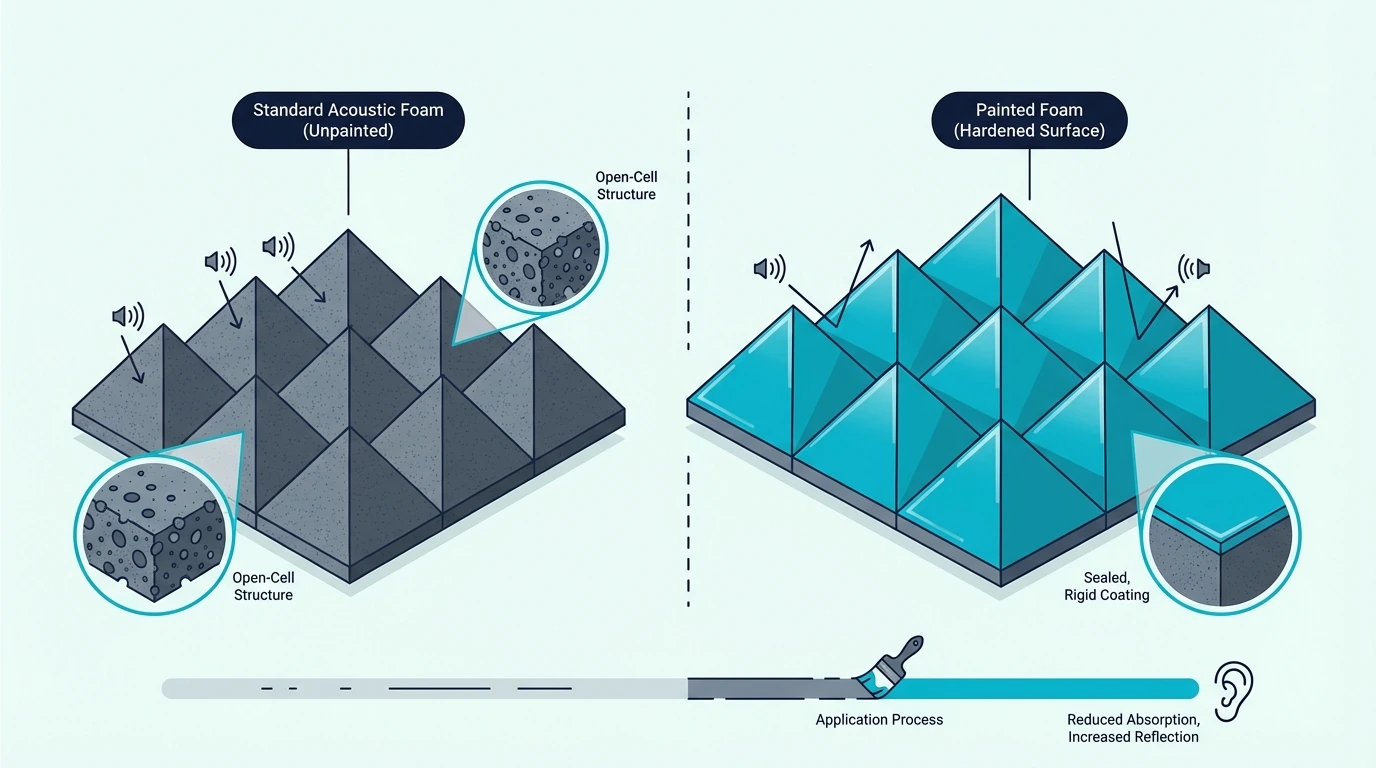
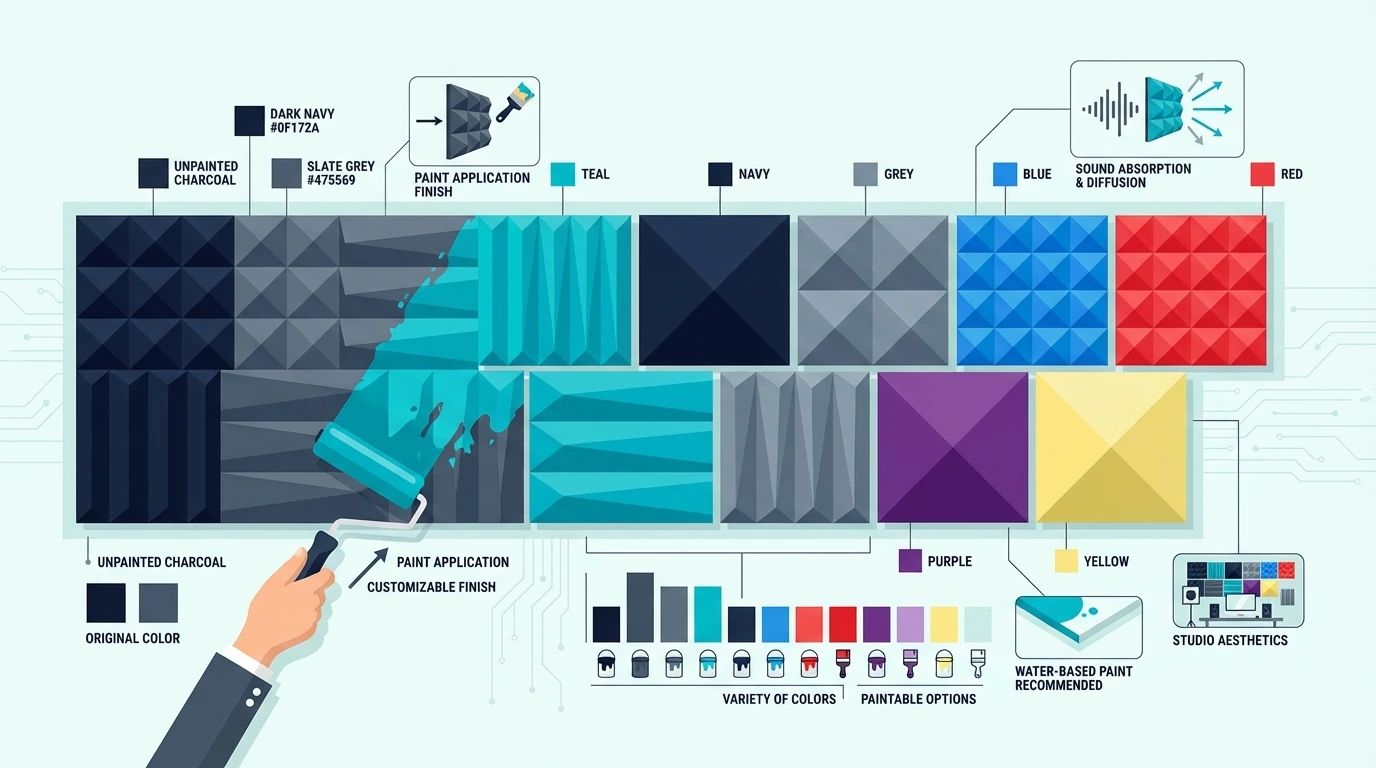
Sometimes, but it’s easy to make foam stiffer and less effective if you overdo it. If you’re considering paint, follow paint acoustic foam so you don’t seal the surface.

What if the foam is too dirty to save?

If cleaning would require soaking or aggressive scrubbing, replacement is usually smarter. Remove it cleanly first using remove acoustic foam so you don’t destroy the wall underneath.

Can you clean acoustic foam without taking it off the wall?

Yes, as long as you stick to dry methods. Vacuuming with a soft brush is the safest option because it won’t introduce moisture into the wall.

Does cleaning acoustic foam make it work better?

It can help a little if the foam is coated in dust, because dust blocks the pores that absorb sound. Cleaning won’t turn thin foam into “real soundproofing,” but it can keep your treatment from slowly getting less effective over time.

Can you use canned air instead of a vacuum?

You can, but it’s messy and it tends to blow dust deeper into the room. If you go that route, do it outdoors (or right next to an open window), and finish with a light vacuum pass.

Best Budget Acoustic Foam: Top Cheap Panels That Actually Work

Best budget acoustic foam doesn’t mean settling for garbage — but most cheap packs cut corners on density, which is the one spec that determines whether foam actually absorbs sound or just decorates walls.

The performance gap between a $15 budget pack and a $50 premium pack is smaller than manufacturers want you to believe. The difference that matters is foam density, not price tag or brand.

Below are eight budget picks ranked by value per panel, a buying guide to spot low-density junk, and coverage calculations so you order the right amount the first time.

For a broader look at foam types and placement, start with the acoustic foam hub.

Quick Takeaway

Look for high-density foam at under $1 per panel — that’s the sweet spot where you get real absorption without premium pricing. Skip anything under $0.50 per panel (the density is usually too low to work). Stick with 1-inch minimum thickness and prioritize dense material over brand names. A 48-52 pack in the $30-40 range covers most bedroom studios.

What’s the Best Budget Acoustic Foam?

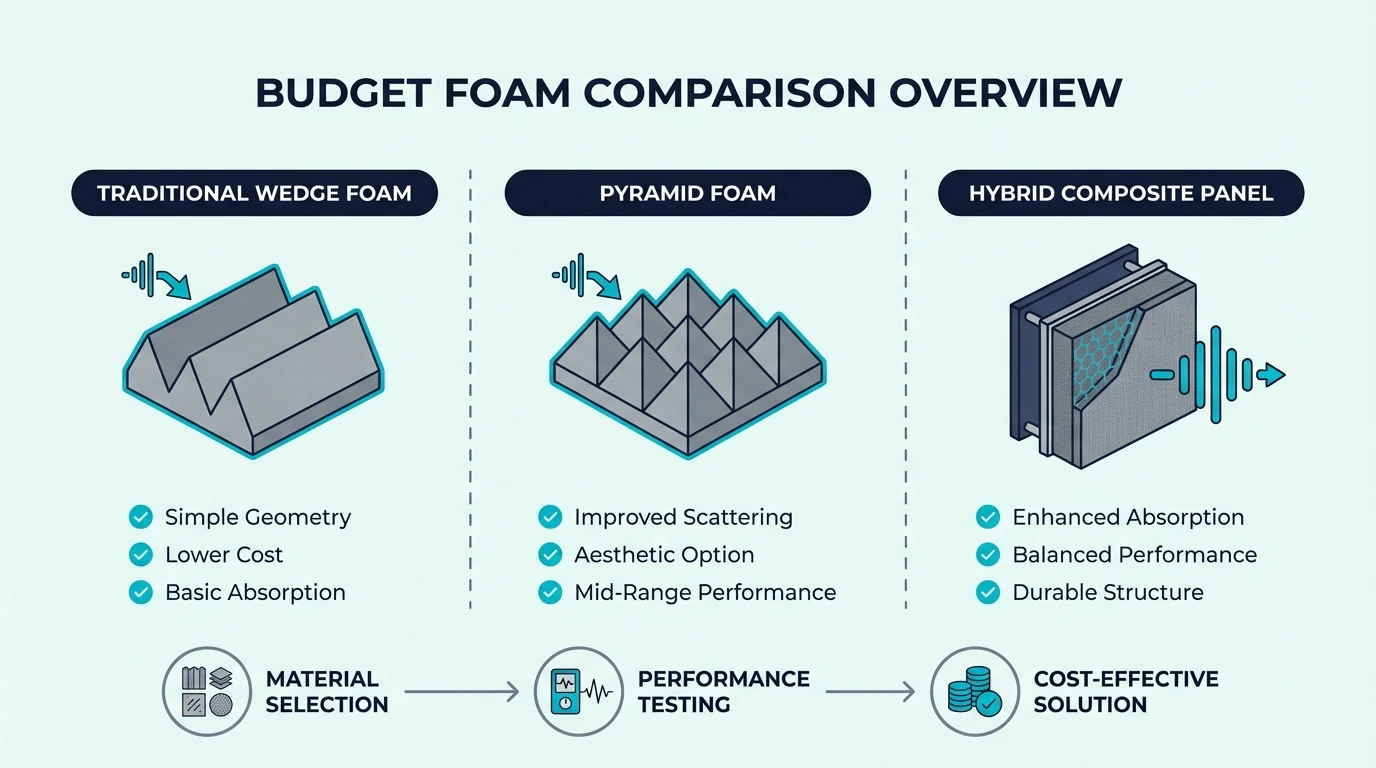
Comparison overview of budget acoustic foam options

Here’s the uncomfortable truth about cheap acoustic foam: most of it works fine. The performance gap between a $15 budget pack and a $50 “premium” pack is smaller than manufacturers want you to believe.

That said, some budget foam genuinely outperforms others. The difference comes down to foam density, not price.

Top Pick: 52 Pack High Density Panels

The 52 Pack Acoustic Panels delivers the best value in budget foam. At under $35 for 52 panels, you’re paying roughly $0.67 per panel — less than a coffee.

The high-density construction actually matters here. Cheap low-density foam compresses easily and loses absorption capacity within months.

This pack maintains its structure because the foam is denser than typical budget options.

Coverage-wise, 52 panels means 52 square feet of treatment — enough for a small home studio or podcast corner. You’ll cover more wall space for less money than any premium alternative.

Best for Tight Budgets: JBER 12 Pack

If you’re testing the waters or treating a small space, the JBER 12 Pack is the lowest-risk entry point. Under $15 gets you 12 panels — enough to treat the wall behind your microphone and hear immediate improvement.

The quality matches JBER’s larger packs, so panels you buy now integrate seamlessly when you expand later. This is the smart starting point for anyone unsure how much foam they actually need.

Top 8 Budget Acoustic Foam Panels

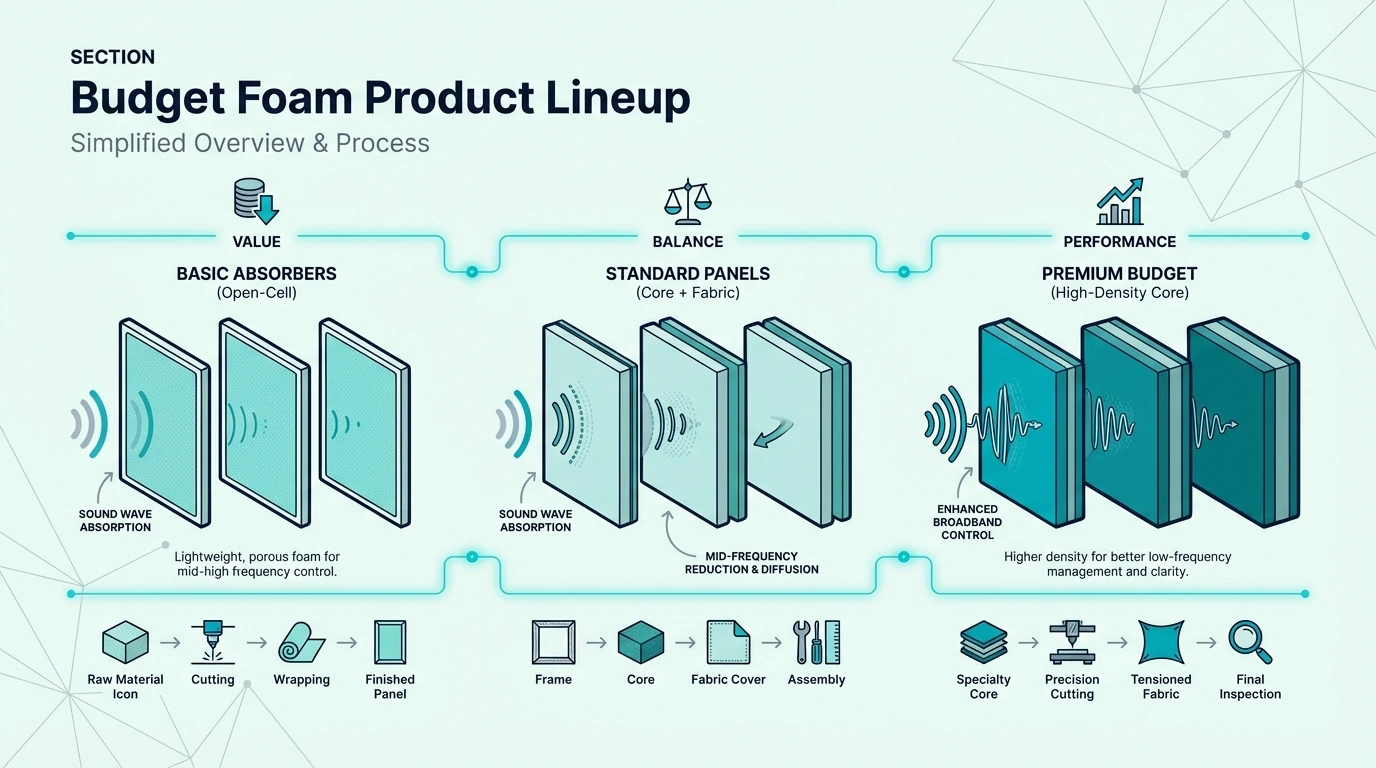
Lineup of budget acoustic foam products

These picks balance price, quality, and coverage. Every option here delivers real echo reduction without the premium price tag.

1. 52 Pack High Density Panels — Best Overall Value

The 52 Pack Acoustic Panels wins on pure economics. The math is simple: 52 panels for under $35 means more coverage per dollar than anything else on this list.

High-density foam in a budget pack is rare. Most cheap options cut costs by using lighter, airier foam that doesn’t absorb as effectively — this pack doesn’t make that compromise.

The 1-inch thickness handles high frequencies well, which is where most voice and music recording issues live. For echo reduction in small to medium rooms, this is the pack to beat.

If you’re setting up a recording space, the best acoustic foam for recording guide covers studio-specific picks.

One limitation: 1-inch foam won’t control bass frequencies. Add bass trap corner treatment separately if low-end rumble is a problem in your space.

2. JBER 12 Pack — Best Under $15

The JBER 12 Pack is where budget-conscious buyers should start. Under $15 for 12 panels means you can test placement and hear results before committing to larger purchases.

JBER maintains quality consistency across their product line. These 12 panels perform identically to their 24 and 48 packs — you’re just buying fewer of them.

The 12-pack covers approximately 12 square feet. That’s enough for the wall directly behind your microphone — the single most important treatment spot in any recording setup.

Start here, record some test audio, then expand based on what you hear. Most people find this approach saves money compared to guessing how much coverage they need.

If you’re new to foam entirely, the best beginner acoustic foam guide walks through first-timer decisions.

3. JBER 48 Pack — Best Coverage

When you need serious wall coverage without premium pricing, the JBER 48 Pack delivers. With over 10,000 reviews and a 4.1 rating, this is Amazon’s most-purchased budget foam for good reason.

The 48-pack provides enough coverage for two full walls in a small room, or full first-reflection treatment in a larger space. At under $37, that’s still less than $0.80 per panel.

Consistency matters when you’re buying in bulk. JBER’s quality control means all 48 panels arrive the same size, density, and color — no sorting through rejects.

The wedge design creates visual interest while increasing surface area for absorption. These won’t win design awards, but they look more professional than flat foam sheets.

4. 24 Pack Pyramid Panels — Best 2-Inch Budget

If you want thicker foam without premium pricing, the 24 Pack Pyramid Panels hits the sweet spot. The full 2-inch thickness extends absorption into lower frequencies that 1-inch foam can’t touch.

Pyramid foam scatters sound slightly differently than wedge patterns. Some voice artists prefer this for a more natural room tone in recordings.

For more on how shape affects absorption, see the best acoustic foam shape guide.

At 24 panels, you’re getting less coverage than the 48 and 52 packs above. But the 2-inch thickness provides better absorption per panel — so you might need fewer panels overall.

The tradeoff is clear: better performance per panel, but higher cost per square foot of coverage. For critical listening positions behind your monitors, the extra thickness is worth it.

5. JBER Corner Blocks — Best Corner Treatment

Corners accumulate bass energy that flat panels can’t address. The JBER Corner Blocks solve this specific problem without the cost of professional bass traps.

These aren’t replacements for wall panels — they’re supplements. Install them in upper corners where bass energy concentrates, and you’ll notice tighter low-end in your recordings.

The triangular design fits snugly into 90-degree corners with minimal installation fuss. The professional studio look is a bonus.

At under $29, this is the most affordable way to address low-frequency issues that budget flat panels miss entirely.

6. 50 Pack 2-Inch Panels — Best Premium Budget

The 50 Pack 2-Inch Panels bridges the gap between budget and premium. You get the thicker 2-inch profile across all 50 panels — no mixing thin and thick foam.

This is the pack for anyone who wants to treat a room properly the first time. The 2-inch thickness provides consistent absorption across mid and high frequencies, with better low-mid control than 1-inch alternatives.

At $54.99, it’s no longer “cheap” — but 50 panels of 2-inch foam at just over $1 per panel is still exceptional value compared to premium brands charging $3-5 per panel.

For dedicated home studios where audio quality matters, the extra investment eliminates the need to upgrade later.

7. 50 Pack High Density Premium — Best for Daily Use

The 50 Pack High Density Premium prioritizes foam density over everything else. Higher density means longer lifespan and more consistent absorption over years of use.

Voice artists who record daily should consider this pack. Budget foam degrades faster under constant use — the premium density here maintains performance where cheaper options would compress.

The 2-inch thickness combined with high-density construction means better absorption at all frequency ranges. This is as close to professional panel performance as foam gets.

At $58.99, you’re paying more than true “budget” options. But the per-panel cost still undercuts premium brands by a wide margin.

8. 96 Pack Bulk Panels — Best Large Space Value

For walk-in closet conversions or larger home studios, the 96 Pack Bulk Panels provides unmatched coverage value. Nearly 100 panels means you can treat multiple walls completely.

At under $65 for 96 panels, you’re paying approximately $0.68 per panel — the absolute lowest per-panel cost on this list. For large spaces, the bulk discount is substantial.

The 1-inch thickness works well for side walls and ceiling, where thinner foam actually performs better than over-treating with thick panels. Use the bulk pack for general coverage, then add thicker panels behind your listening position.

Buying in bulk like this eliminates worrying about whether you have enough panels mid-project.

How to Find Good Cheap Acoustic Foam

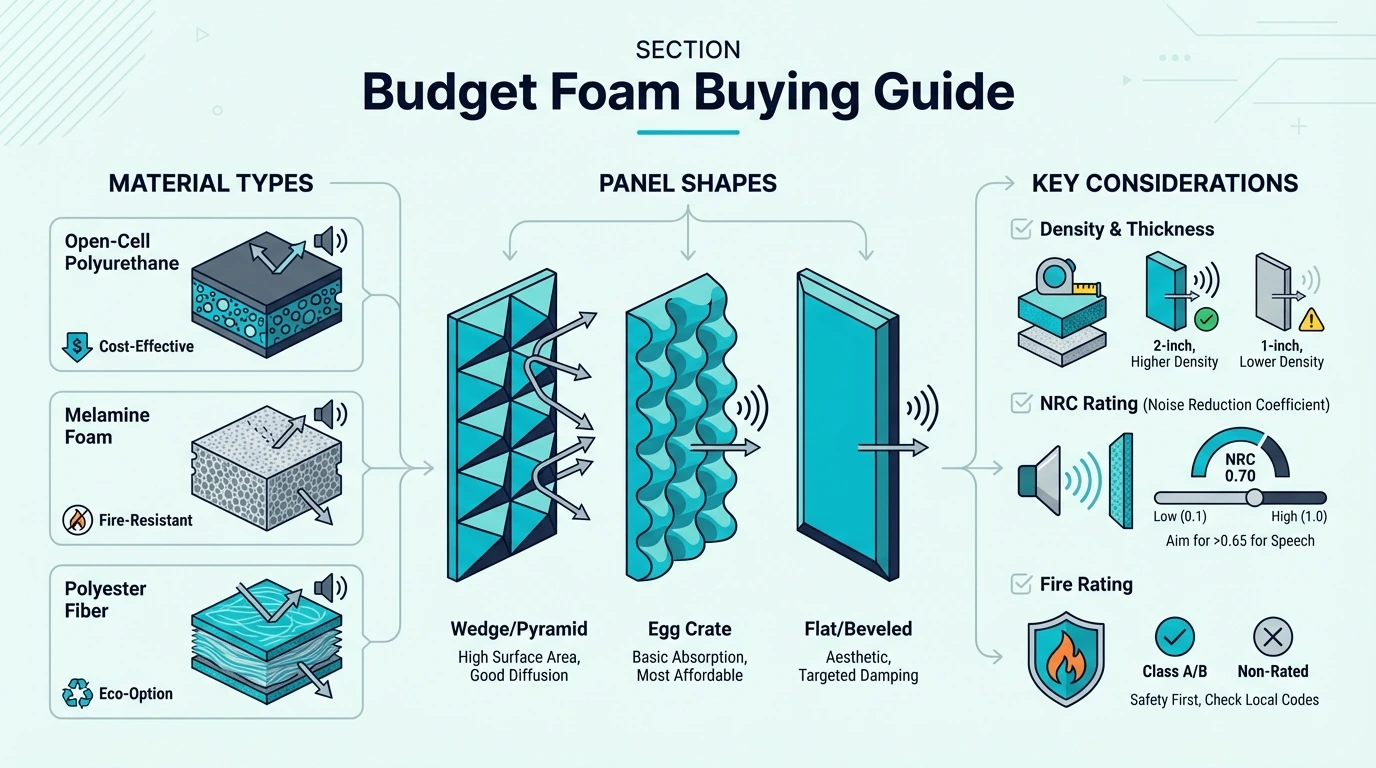
Buying guide for budget acoustic foam

Not all budget foam works. Here’s how to separate the good cheap options from the garbage.

What to Look for in Budget Foam

Foam density matters more than brand. Pick up cheap foam and squeeze it — if it compresses easily with light pressure, it won’t absorb sound effectively.

High-density budget foam exists. The 52 Pack High Density Panels proves you don’t have to pay premium prices for quality foam construction.

Thickness determines frequency range. 1-inch foam handles frequencies above roughly 1000Hz — fine for voice recording and high-frequency echo.

2-inch foam extends down to around 500Hz, catching more of the mid-range where vocals live.

What NRC Rating Is Acceptable?

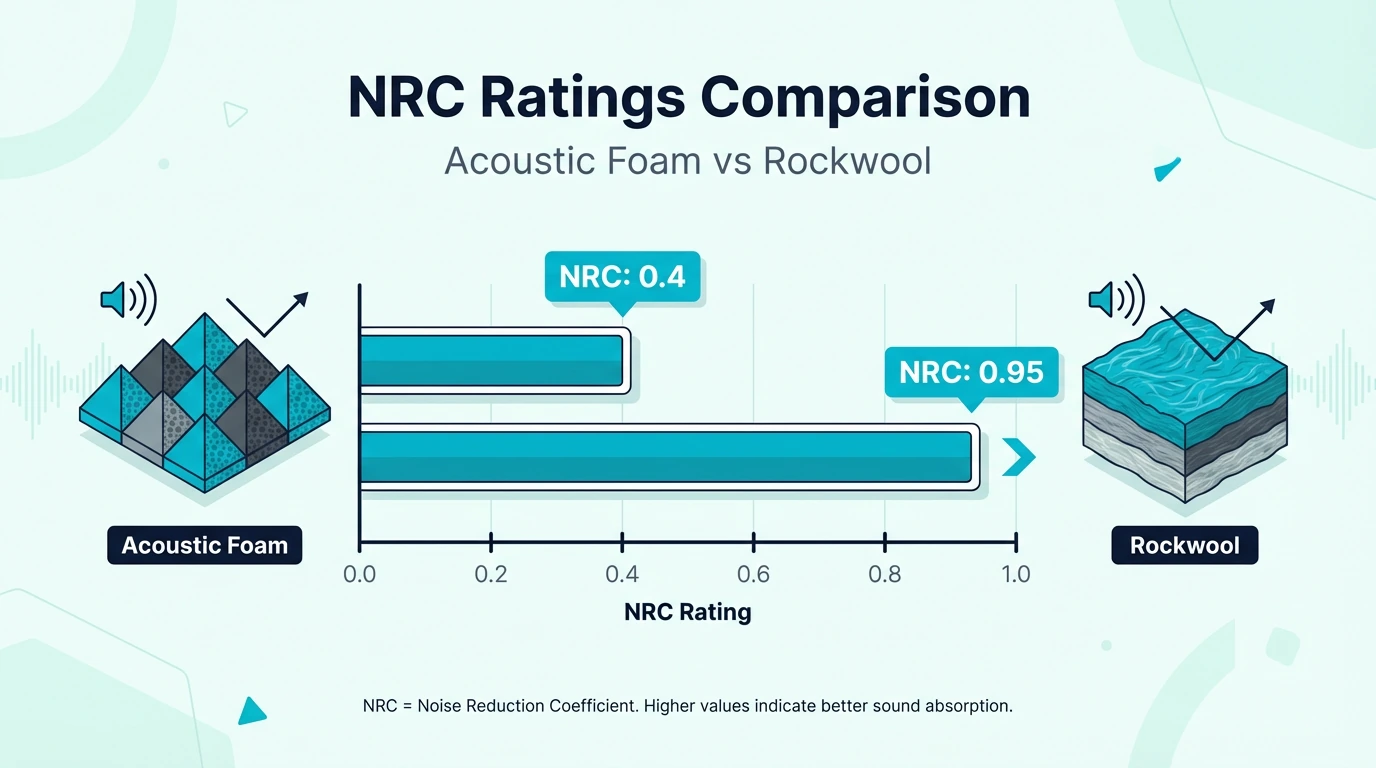
NRC (Noise Reduction Coefficient) measures absorption effectiveness from 0 to 1.0. Budget foam typically rates 0.3-0.5 NRC, while professional panels hit 0.85-1.0.

Here’s the catch: most budget foam sellers don’t publish NRC ratings. They’d rather you didn’t compare.

Without official ratings, trust reviews and foam density as proxies. If thousands of buyers report noticeable echo reduction, the foam works regardless of what an NRC test would show.

Red Flags: When Cheap Is TOO Cheap

Avoid anything priced under $1 per panel. At that price point, manufacturers cut corners on foam density — you’re buying air pockets, not acoustic treatment.

Suspiciously light packaging indicates low-density foam. Quality budget foam still has weight to it.

No reviews or brand-new listings with suspiciously perfect ratings suggest products to skip. Stick with established options like the JBER packs that have thousands of verified purchases.

Is Cheap Acoustic Foam Worth It?

Budget versus premium acoustic foam comparison

Here’s the honest take: cheap foam has real limitations. But for many use cases, those limitations don’t matter.

Budget vs Premium: Real Differences

Premium acoustic panels use fiberglass or rockwool cores wrapped in fabric. They achieve NRC ratings of 0.85-1.0 and absorb sound across a wider frequency range than foam.

Budget foam uses polyurethane. The NRC rating tops out around 0.5, and effective absorption is limited to mid-high frequencies.

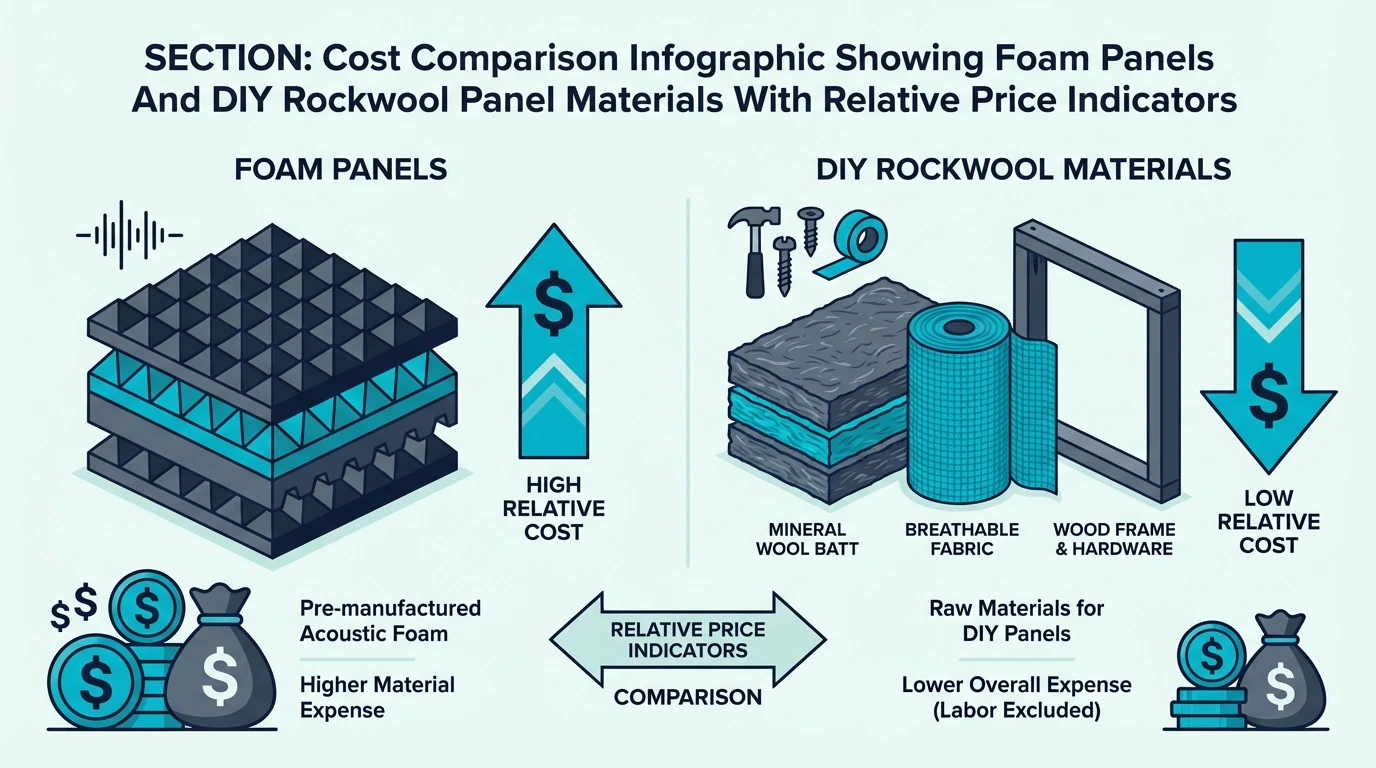
The gap is real — but so is the price difference. Premium panels run $5-15 per square foot; budget foam runs $0.50-1.50 per square foot.

When Cheap Foam Works Fine

Echo reduction in home studios, podcast corners, and streaming setups. For these use cases, eliminating the obvious reverb is the goal — and budget foam accomplishes that.

The best acoustic foam for podcasts guide has voice-specific picks if that’s your main use case.

Temporary setups where permanence isn’t needed. Foam installs with command strips or tape and removes cleanly.

Professional panels require more commitment.

Budget constraints where something is better than nothing. Treating a room with cheap foam beats leaving walls bare.

When You Need to Spend More

Critical listening environments where accurate sound reproduction matters. Mixing and mastering engineers need the wider frequency absorption that only professional acoustic panels provide.

Bass-heavy genres where low-frequency control matters. Foam doesn’t absorb bass effectively — you need corner acoustic foam or thick panels.

Permanent installations where longevity matters. Foam degrades over 3-5 years; quality panels last 10-20 years.

The acoustic treatment hub covers the full range of long-term solutions.

How Much Budget Foam Do You Need?

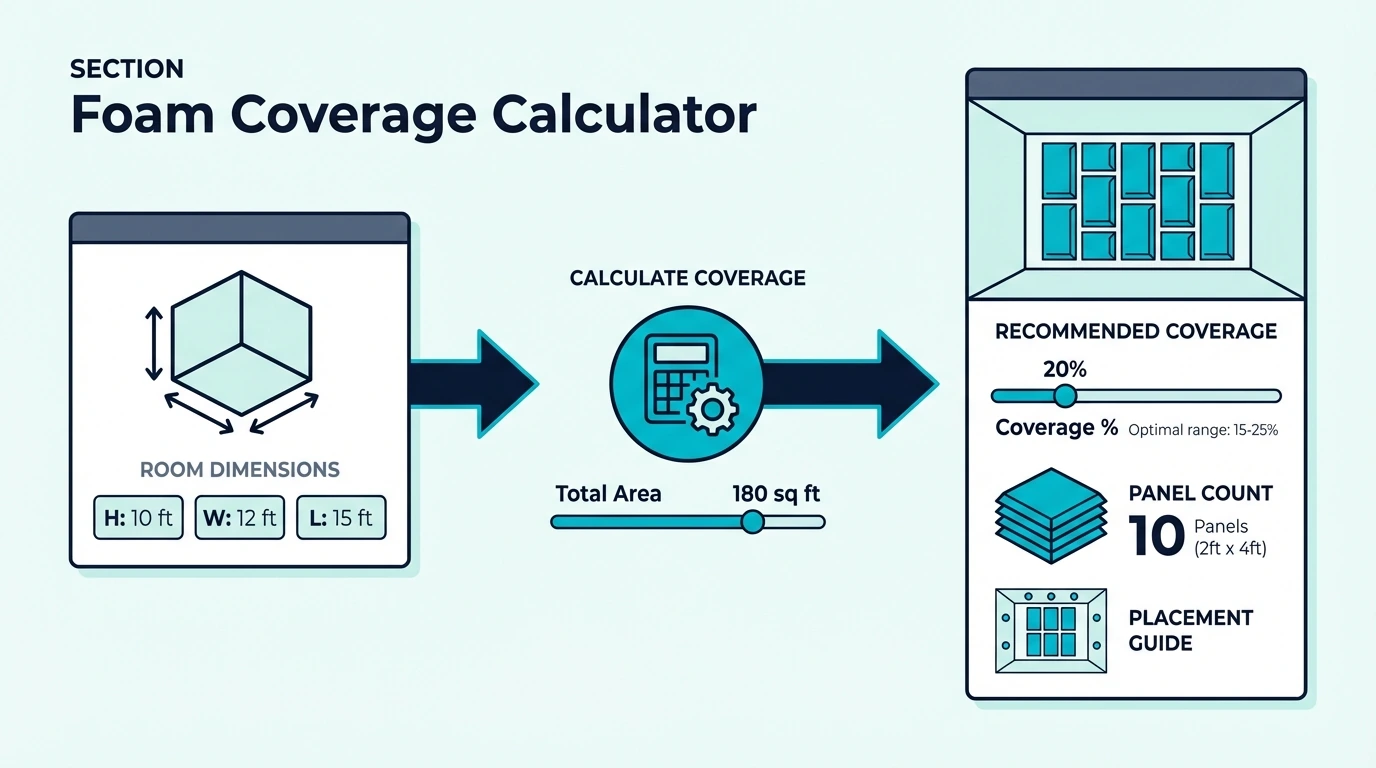
Foam coverage calculator for room treatment

More foam isn’t always better. Over-treating creates a dead, unnatural sound.

Here’s how to calculate the right amount.

Small Room: Coverage Guide

For rooms under 100 square feet (think small bedrooms or closet studios), treat 40-60% of wall surface. That typically means 20-30 panels for a basic treatment.

Start with the wall behind your microphone or listening position — this is the highest-impact treatment zone. The JBER 12 Pack covers this zone completely.

Add side wall treatment at first reflection points if echo persists. Use the mirror trick: sit in your position, have someone slide a mirror along the wall — wherever you see your speakers in the reflection, place foam.

Medium Room: Coverage Guide

Rooms from 100-200 square feet need 40-60 panels for proper treatment. The JBER 48 Pack or 52 Pack Panels handles this in one order.

Distribute treatment across multiple walls rather than concentrating on one. The goal is balanced absorption — covering 100% of one wall while leaving three bare creates uneven acoustics.

Corner treatment becomes more important in larger spaces. Add JBER Corner Blocks to address the bass buildup that flat panels miss.

Cost Calculator by Room Size

Here’s what budget treatment actually costs:

Small room (20-30 panels): $25-40 using the JBER 12 Pack or small orders.

Medium room (40-60 panels): $35-55 using the 52 Pack Panels.

Large room (80+ panels): $65-100 using the 96 Pack Bulk Panels.

For exact panel counts, the best acoustic foam shape guide includes sizing tips by room type.

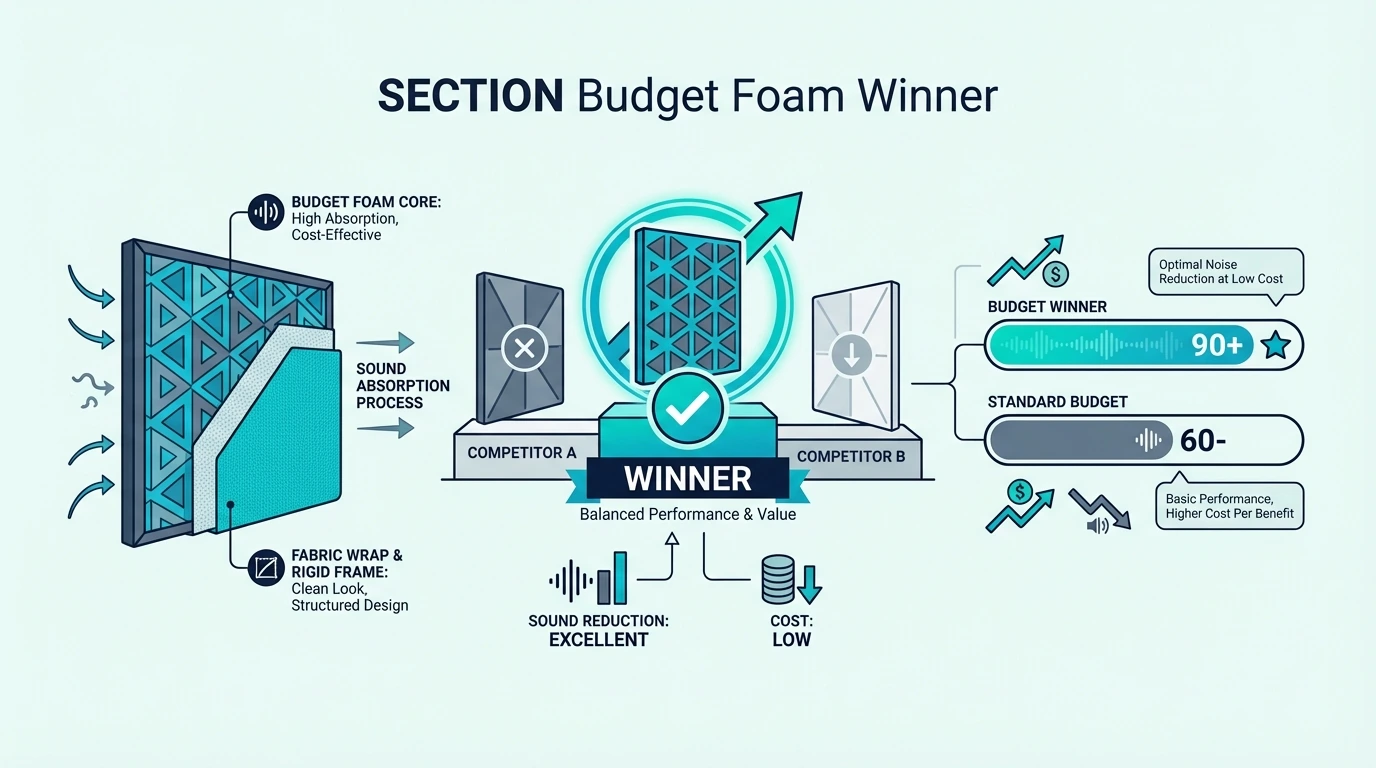
The Bottom Line: Best Budget Pick

Best budget acoustic foam winner

For most home studios and podcast setups, the 52 Pack High Density Panels delivers the best overall value — more coverage per dollar than anything else, with foam quality that actually works.

For tighter budgets, start with the JBER 12 Pack. Under $15 gets you enough panels to hear immediate improvement — then expand based on what your ears tell you.

If 2-inch thickness matters for your recordings, the 24 Pack Pyramid Panels hits the sweet spot between performance and price.

For complete room treatment, the acoustic foam hub covers placement tips and installation methods. The best acoustic foam panels guide ranks options across all price tiers.

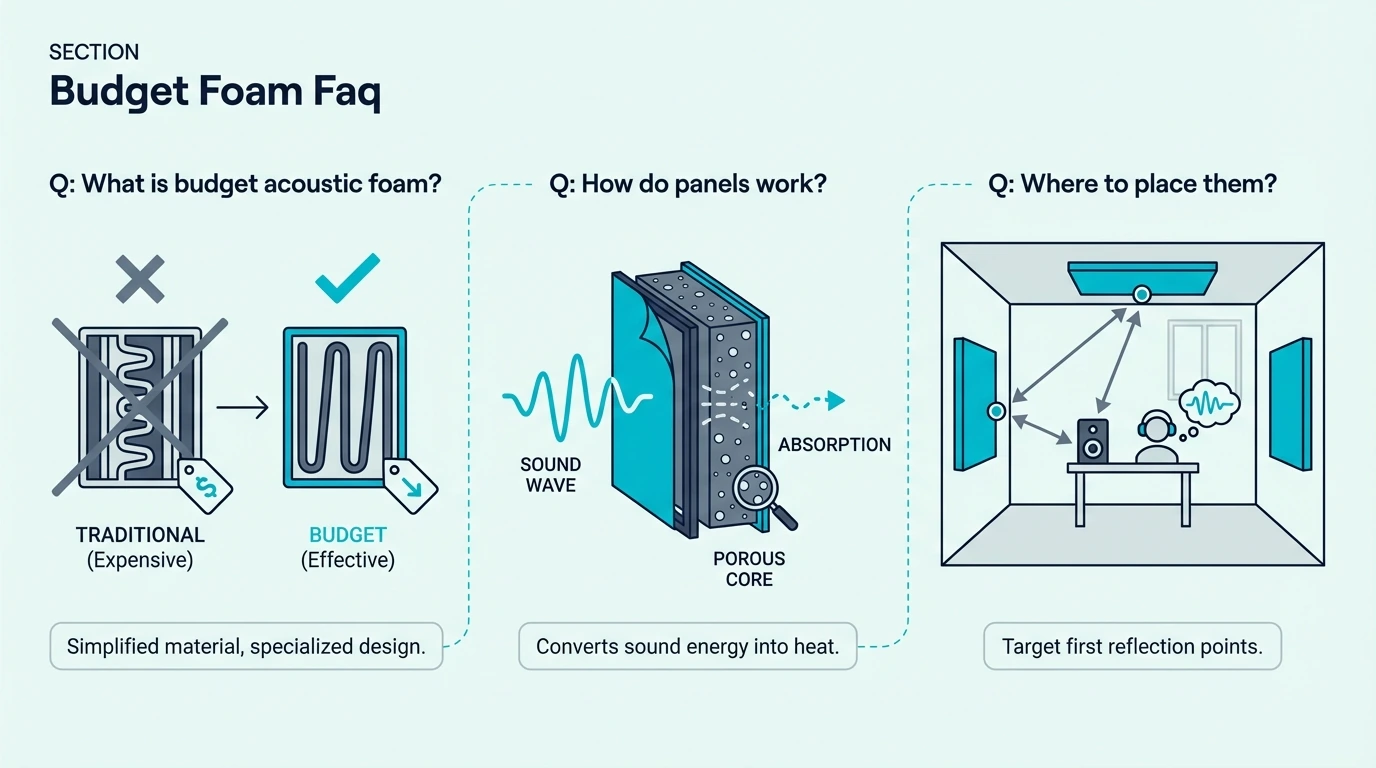
Frequently Asked Questions

Frequently asked questions about budget acoustic foam

Is Cheap Acoustic Foam Safe?

Quality budget foam from established Amazon sellers is safe for indoor use. The polyurethane material is the same used in furniture and mattress foam.

Look for foam labeled as fire-retardant for added peace of mind. Most reputable budget options include this treatment as standard.

Avoid suspiciously cheap foam from unknown sellers — poor manufacturing can include harmful chemicals or inadequate fire retardant.

Does Budget Foam Actually Work?

Yes, for echo reduction and voice recording improvement. Budget foam won’t match professional panel performance, but it noticeably improves room acoustics compared to bare walls.

The thousands of positive reviews on products like the JBER 48 Pack aren’t lying — people hear real differences in their recordings.

What budget foam won’t do: soundproof a room (nothing will), absorb bass frequencies effectively, or match the precision of professional studio treatment.

How Long Does Cheap Foam Last?

Expect 3-5 years of useful life from budget foam before visible degradation. The foam won’t suddenly stop working, but it will compress and lose absorption capacity gradually.

High-density foam like the 50 Pack High Density lasts longer because the denser material resists compression better.

UV exposure accelerates degradation. Keep foam out of direct sunlight to maximize lifespan.

What’s the Best Place to Buy Budget Foam?

Amazon dominates budget acoustic foam for good reason: competitive pricing, easy returns, and verified reviews from thousands of buyers.

The products on this list are all Amazon-available with Prime shipping. Returns are easy if foam arrives damaged or doesn’t meet expectations.

Avoid boutique audio retailers for budget foam — they typically markup the same products available on Amazon for less.

Acoustic Foam Vocal Booth: Placement, Coverage & Thickness (2026)

Acoustic foam vocal booth setups can sound dramatically cleaner — but only if you treat the reflections the mic is actually hearing.

If your takes sound boxy, metallic, or like you’re singing into a cardboard tube, that’s usually early reflections slapping back into the capsule — kill those and you’ll need less EQ, less de-reverb, and fewer takes.

Foam isn’t magic and it definitely isn’t soundproofing, so don’t buy it expecting silence — use it for what it’s good at: cleaning up the inside of the booth.

This guide locks in thickness, coverage, and placement in the order you’ll actually hear on a take.

Quick Takeaway

Start with 2-inch foam behind the mic, then aim for 60-80% coverage and adjust using real recordings. Foam improves reflections inside the booth, but it won’t block outside noise — sealing and mass are separate jobs.

Does acoustic foam work in a vocal booth?

Comparison of different acoustic foam types for vocal booth

Yes—acoustic foam works in a vocal booth when the problem is reflections, not isolation. It won’t turn a closet into a world-class studio, but it can take the “small box” edge off by reducing early reflections.

What foam actually fixes (the sound your mic hears)

In a tight booth, your voice hits nearby walls so fast that reflections blend into the direct vocal. That’s why everything feels cramped even when the mic is fine.

Acoustic foam absorbs part of that reflected energy, so the mic hears more “you” and less “room.” When you get this right, vocals usually feel more forward and less scratchy.

Try this: record 10 seconds of speaking, then clap once in the booth and listen for a sharp ping or flutter. If you hear it, foam placed at the first reflection points will usually tame it immediately.

This is why foam helps podcasts and voiceover so much: the important vocal range lives roughly in the 250 Hz to 4 kHz area, and small rooms exaggerate it. Thickness decides how much of that range foam can actually touch—and it also explains why foam won’t do much for street noise or HVAC rumble.

What foam does not fix (and why people get disappointed)

If the issue is street noise, HVAC rumble, or a loud roommate, foam barely moves the needle because sound is still traveling through walls and gaps. That’s soundproofing territory, not treatment.

If your real problem is low-end boom or isolation, foam may not be the right spend – rockwool behaves differently. Our acoustic foam vs rockwool breakdown helps you pick the right tool for the job.

Before thickness, get this straight: foam fixes reflections inside the booth; it does not block noise coming through walls and gaps. If you’re chasing isolation, you’ll need sealing + mass first, then foam as the last step.

Will acoustic foam soundproof a vocal booth?

Sound absorption vs soundproofing diagram

No—acoustic foam does not stop sound from entering or leaving a booth. It only changes what happens to sound once it’s inside, which is treatment, not soundproofing.

Soundproofing vs treatment, in plain English

Think of soundproofing like a brick wall: you add mass, seal gaps, and build an airtight barrier so sound has a hard time getting through. Think of acoustic foam like a sponge: it soaks up reflections so your voice does not bounce around.

Both are useful, but they solve different problems, and confusing them is why people say “foam doesn’t work.” Foam works great for reflections, but isolation starts with sealing leaks and adding mass.

If outside noise is the real issue, start here

Start with the door and any air gaps, because even a pencil-thin crack can leak a surprising amount of sound. Add weatherstripping, a door sweep, and make sure the booth closes tightly before you buy more foam.

After that, use foam as the finishing move to clean up the inside tone, not as the main tool for blocking noise. For broader room strategy, our guide on how to arrange acoustic foam helps you prioritize the highest-impact spots.

When foam is doing the right job (reflection control), thickness is the spec that actually changes what you hear. In booths, the jump from 1-inch to 2-inch is usually obvious on the first take.

What thickness of acoustic foam is best for vocal recording?

Foam thickness comparison diagram for vocal booth

For vocals in a booth, 2-inch foam is the practical starting point because it reaches further into the lower mids. One-inch foam can still be useful, but it is better as a supplement than the foundation.

Why 2-inch foam is the “booth minimum”

One-inch foam mainly grabs higher frequencies, which can make a booth sound less sharp but still boxy. Two-inch foam has more depth for sound to travel through, so it does a better job on the low-mid reflections that make vocals sound cramped.

In a closet-sized booth, that low-mid buildup is the whole game because the walls are inches from the mic. That’s why thicker foam behind the mic usually beats thin foam everywhere.

Don’t overthink NRC numbers if the listing does not publish real data, because sellers love to guess. Start with thickness and density, then fine-tune coverage with recordings.

Treat 2-inch as your baseline for the mic wall, because that’s where a booth gets most boxy. Then use 1-inch foam where space is tight and you just need to knock down fast reflections.

When 1-inch foam still makes sense

One-inch foam is handy on ceilings, doors, or tight spots where thicker panels steal too much space. It is also a solid way to add “just a bit more control” once the behind-the-mic wall is already treated with thicker foam.

If you’re choosing shapes, wedge vs pyramid is more about coverage consistency and aesthetics than some magical frequency difference. The best acoustic foam shape comparison covers when each pattern makes sense.

If you want a broader shortlist beyond booth-only setups, our best acoustic foam panels roundup gives you options across room types. Bring those picks back here and apply the booth placement order so the foam actually lands where it matters.

Thickness tells you what the foam can affect, but coverage decides how much of the booth stops throwing reflections back. Here’s the quick math using rough square feet.

How much acoustic foam do you need for a vocal booth?

Vocal booth coverage diagram showing foam placement

Most booths sound better with targeted coverage than with wall-to-wall foam. Start with 60-80% on the surfaces closest to the mic, then adjust after each step with a quick recording.

A coverage target that works for most booths

Treat the wall behind the mic first, then the two side walls at head height, then the ceiling if it is hard and reflective. Record a quick before-and-after clip after each step, because your ears will tell you faster than any chart.

If you go too far, the booth can start sounding unnaturally dry and tiring, especially for spoken voice. That’s why “more foam” is not always better—and why it’s worth doing quick wall-area math before you buy packs.

Quick calculator (4×4 and 6×6 examples)

For a rectangular booth, wall area (not counting the ceiling) is roughly 2 x (width + depth) x height, minus the door. If you’re using 12”x12” panels, each panel covers about 1 square foot.

Example: a 4×4 booth with a 7-foot ceiling has about 2 x (4 + 4) x 7 = 112 square feet of wall area before subtracting the door. At 70% coverage, plan for roughly 75-80 square feet of foam.

That usually means a mix of packs, because you rarely want the same thickness everywhere. Many people start with a thicker “mic wall” and add lighter coverage only if the booth still sounds boxy.

Example: a 6×6 booth at 7 feet tall is about 2 x (6 + 6) x 7 = 168 square feet of wall area before subtracting the door. At 60% coverage, plan for about 100 square feet of foam.

If your booth is taller than 7 feet, scale the math linearly with height. If your booth has a big door, count it as a reflective surface unless you treat it too, and don’t forget the ceiling if it’s hard and low.

The two places people forget: the door and the ceiling

A hollow-core door is basically a big reflector, which is why some booths still sound “papery” even after you treat the walls. If you rent and cannot modify much, even a thin layer of foam on the door can reduce the slap you hear in the mic.

Ceilings matter because the mic “sees” them, especially with vocals where sound projects up and out. If you’re not sure where to start, use the mirror trick to find your reflection points and treat those spots first.

Clean cuts make installs look less DIY, especially around outlets and corners. The cut acoustic foam guide covers tools and techniques for clean edges.

With a coverage target in mind, placement beats brand every time. Put foam where the mic actually “sees” hard surfaces, not where the wall looks empty.

Where should you place acoustic foam in a vocal booth?

Vocal booth setup complete with foam placement

The goal is to stop early reflections from bouncing back into the mic. So you treat the surfaces the mic can “see” from your mouth, not random squares on the wall.

Start behind the mic (highest ROI spot)

Put your thickest foam directly behind the microphone position, because that reflection path is short and loud. In small booths, this one surface can make a bigger difference than covering the entire opposite wall with thin foam.

Record a few lines with no foam, then add foam behind the mic and record again at the same gain and distance. If the vocal suddenly feels more forward and less roomy, you’re doing it right.

Then move to the side walls and ceiling reflection points so the booth stops “talking back” from the sides.

Side walls and ceiling: treat reflection points, not grids

Next, treat the side walls at mouth height and the ceiling above the mic, because those are the other fast reflection paths. You do not need a perfect checkerboard, and a slightly staggered pattern often sounds more natural than a uniform grid.

Use the mirror trick: sit where you sing, have someone slide a mirror along the wall, and mark the spots where you can see the microphone capsule. Those marked zones are where foam gives you the most return; if the booth still feels thick and boomy after that, you’re dealing with low end.

Corners and low end: what foam can (and cannot) do

Corners build up low-frequency energy, and booths exaggerate that because there is nowhere for bass to go. Foam corner pieces can help a little, but they will not replace real bass trapping because the wavelengths are simply too long.

If your booth still sounds boomy after you fix reflections, you may need thicker materials or a different booth design, not more thin foam. This is why it helps to treat placement first – it prevents you from buying more of the wrong thing.

With placement dialed in, installation matters because sagging foam and messy adhesive turn into a maintenance problem. Start with the best adhesive for acoustic foam and how to put acoustic foam on a wall.

If the booth is also on camera, you can still make foam look clean without covering everything in black wedges. Our make acoustic foam look good guide has layout tricks that do not hurt acoustics.

At this point you’re shopping with specs: thickness for the problem range, coverage for reflection control. Below are a few sane picks – plus what to ignore.

What should you buy for a vocal booth (and what to skip)?

Acoustic foam products lineup for vocal booth

Start with a thick set for the mic wall, then add coverage packs for side walls and ceiling if you still hear slap or flutter. Ignore anything that promises soundproofing, and skip ultra-thin foam if your problem is boxiness.

A simple shopping checklist for booth foam

For most vocal booths, the cleanest combo is 2-inch foam behind the mic plus lighter coverage elsewhere. That matches what we covered in the thickness section, and it keeps the booth from feeling claustrophobically dead.

If you’re not sure what shape to buy, choose based on fit and coverage, then use placement to dial the sound. You can always tweak later, but it is hard to fix a booth that is under-treated behind the mic.

5 product examples for common booth setups

1) 2-inch starter pack for the mic wall

If you want one pack that covers a solid chunk of a small booth and gives you true 2-inch thickness, start with the 50 Pack Acoustic Foam Panels. This is the fastest way to hear the “boxy booth” problem start to disappear.

Use it behind the mic first, then expand to side walls if you still hear slap or flutter. That sequence matches the placement order we covered earlier, and it keeps you from over-treating by accident.

2) 1-inch coverage pack for side walls and ceilings

When space is tight, 1-inch foam is often the practical choice for ceilings and side walls. The JBER Sound Proof Foam Panels is a straightforward way to add coverage without shrinking your booth.

Treat it as the “fill in the reflection points” pack, not the thing that fixes low mids. Pair it with thicker foam behind the mic if your recordings still feel cramped.

3) Budget coverage when you just need more square footage

If you’re mainly trying to tame high-frequency slap on a budget, the 52 Pack Acoustic Panels is the cheapest path to a noticeable improvement over bare drywall. It is also useful for rentals, because you can experiment and replace a few panels later if they get crushed.

Start with behind the mic and the two closest side walls, then record again. If the vocal is already cleaner, stop there and resist the urge to cover everything.

4) Bulk pack for larger booths and closet builds

For bigger booths, bulk packs help you hit your 60-80% coverage target without buying ten small boxes. The 96 Pack Acoustic Foam Panels is the “cover a lot of wall fast” option.

Use it for ceiling and side-wall coverage, then add a smaller amount of 2-inch foam where the mic “sees” a hard surface. That combo usually sounds more natural than going all-in on thin foam everywhere.

5) Denser 2-inch option when you want more consistent results

If you record often and want a more uniform 2-inch setup, the 50 Pack Premium Acoustic Foam is a good “buy once” choice. Higher-density foam tends to hold its shape better over time, which keeps your booth sound consistent.

The best acoustic foam panels roundup covers options beyond booth-only setups. Use the specs from this guide (2-inch behind the mic, 60-80% coverage) and you’ll choose faster.

The Bottom Line

If you want a cleaner booth vocal, start by treating reflections, not by chasing a perfect product. That means 2-inch foam behind the mic, a sensible coverage target, and placement based on reflection points.

When those three pieces are right, your booth stops sounding like a small box and starts sounding like a controlled space. If you want to go deeper, start at the acoustic foam hub and the best acoustic foam panels guide.

Frequently Asked Questions

Do you need foam on all sides of a vocal booth?

No, you do not need 100% coverage, and too much treatment can make vocals feel unnaturally dry. Most booths sound best when you control early reflections but keep a little life in the room.

Start behind the mic with thicker foam, then add panels at the closest side-wall reflection points. If the booth still sounds boxy after that, add ceiling coverage before you cover every remaining inch.

Is thicker foam better for vocals?

Thicker foam generally affects lower frequencies than thin foam, which is why 2-inch is the common minimum for vocal booths. Past that, returns diminish quickly for voice, and thick foam eats into usable booth space.

Use your thickest foam behind the mic and keep side walls thinner if the booth is cramped. If you’re chasing deep bass control, foam will not replace real bass traps.

Can you use egg crate foam for a vocal booth?

Egg crate mattress foam is better than bare walls, but it is not the same as purpose-made acoustic foam. It is usually thinner and less consistent, so you need more of it to hear the same improvement.

If budget is extremely tight, use it as a temporary step while you save for real 2-inch foam. Focus first on behind the mic and the closest reflection points.

Where should foam go first in a vocal booth?

Start behind the microphone, because that is the strongest early reflection path back into the capsule. It is the highest ROI placement in most small booths.

After that, treat side walls at mouth height and the ceiling above the mic. Use the mirror trick to find reflection points so you are treating the right spots, not guessing.

Acoustic Foam vs Rockwool: Stop Buying The Wrong Treatment

Acoustic foam vs rockwool is the argument that never dies in home studio forums — and both sides oversimplify it.

Foam handles high-frequency reflections well, but it does almost nothing below 500Hz, while rockwool absorbs down into the bass range where most room problems actually live.

If you don’t treat those low frequencies, your room will lie to you, making your mixes sound completely wrong everywhere else. Getting the right material in the right spots gives you the honest sound needed for mixes that translate perfectly.

Start with the quick takeaway below, then we’ll walk through the physics and the exact hybrid setup that gives most home studios the best results for the least money.

Quick Takeaway

Acoustic foam absorbs above 500Hz but does almost nothing for bass, while rockwool absorbs down to 125Hz and below — where most room problems live. If you only record voice, foam works fine; for music mixing or home theater, rockwool bass traps are non-negotiable.

What’s the Difference Between Acoustic Foam and Rockwool?

Open-cell acoustic foam next to dense Rockwool mineral wool fibers

The gap between these two materials starts at the molecular level and only gets wider from there. Once you see how each one actually absorbs sound, the performance difference stops being surprising.

How Acoustic Foam Actually Works

Acoustic foam is open-cell polyurethane — air pockets throughout the structure that trap sound waves and bleed off energy through friction. High frequencies with short wavelengths lose energy quickly inside those cells, which is why foam handles the 1kHz-and-above range reasonably well.

The trouble is physics. A sound wave needs to travel roughly one quarter of its wavelength before it loses meaningful energy, and a 1000Hz wave has a wavelength of about 1.1 feet — short enough for 2-inch foam to work with.

Drop to 100Hz and the wavelength stretches to 11.3 feet. That same 2-inch foam covers maybe 3% of the distance needed, so the bass passes through like the foam isn’t even there.

No amount of clever design changes this — it’s a hard limit baked into the material. Which acoustic foam shape absorbs best matters for mid-range performance, but no profile fixes the bass problem.

How Rockwool Actually Works

Rockwool is spun from molten rock into densely packed fibers — 3 to 8 pounds per cubic foot versus foam’s 1 to 2 pounds. That density difference is where everything changes.

The denser fiber matrix gives sound waves two ways to lose energy: the same frictional losses foam uses, plus the sheer mass of the fibers resisting movement. Together, those mechanisms keep working at much lower frequencies than foam can reach.

A 4-inch rockwool panel absorbs effectively down to around 125Hz — right where bass buildup, muddy mixes, and room modes live. That’s the frequency range where the material choice stops being a preference and becomes a physics constraint.

This isn’t just about rockwool, though.

Fiberglass or Rockwool — Does It Matter?

You’ll see “fiberglass panels” and “rockwool panels” used interchangeably in studio acoustics, and honestly, they’re close enough that the choice between them is minor compared to the choice between either one and foam. Owens Corning 703 (fiberglass) and Rockwool Safe’n’Sound (mineral wool) are the two most common cores, and both outperform foam by the same margin.

The practical difference: rockwool is naturally non-combustible and earns a Class A fire rating without additives, while fiberglass is slightly lighter, which helps for ceiling-mounted panels. Both need PPE during handling and both become inert once wrapped in fabric.

The Numbers That Actually Matter

Those density differences show up clearly in absorption coefficients. Here’s what 2-inch versions of each material actually do at different frequencies:

Frequency2” Acoustic Foam2” RockwoolWhat This Means
125Hz0.11 (11%)0.52 (52%)Bass guitar fundamental, kick drum body
250Hz0.28 (28%)0.93 (93%)Male vocal low end, snare body
500Hz0.68 (68%)1.00 (100%)Female vocals, guitar midrange
1000Hz0.90 (90%)1.00 (100%)Vocal presence, cymbal body
2000Hz0.93 (93%)1.00 (100%)Vocal sibilance, hi-hat attack
4000Hz0.96 (96%)1.00 (100%)Cymbal brightness, consonants

At 125Hz — where most small-room problems concentrate — rockwool absorbs nearly 5x more sound than foam of the same thickness. Above 500Hz the gap narrows, which is exactly why foam works fine for voice-only setups.

Why Bass Absorption Matters More Than You Think

NRC rating comparison between acoustic foam and Rockwool panels

That absorption table explains the material science, but the real question is: does bass absorption actually matter for your room? For anyone mixing music, the answer is more urgent than most people realize.

Bass doesn’t just pass through foam — it gets amplified by your room.

The Room Mode Problem

Every room has resonant frequencies — called modes — where bass piles up. In a 10-foot-long room, there’s a mode at 56Hz where bass can be 10 to 15dB louder than it should be.

Your monitors play a bass note at the correct level, but the room amplifies it by 12dB. You hear too much bass, turn it down in the mix, and when that mix plays in a car — no room modes — suddenly the low end has vanished.

This is why bedroom producers consistently make bass-light mixes. The room lies to them, and foam does nothing to fix it because those 56Hz wavelengths are almost 20 feet long.

Rockwool bass traps in corners absorb that excess energy. The modes don’t disappear, but they drop 6 to 8dB — enough to hear what your mix actually sounds like instead of what the room wants you to hear.

The other problem you hear is more obvious, but often confused with bass issues.

Flutter Echo vs Standing Waves

Flutter echo — that metallic ringing when you clap in an empty room — is the problem most people notice first. Foam kills it almost instantly because flutter echo is high-frequency energy bouncing between parallel walls.

Standing waves are the bass version of the same physics, but they don’t sound like echo — they sound like resonance, the way a guitar body makes a string louder. Foam can’t touch standing waves because the wavelengths are simply too long for the material to interact with.

The distinction matters for diagnosis: clap your hands and hear ringing, foam fixes that. Walk around the room and notice bass changing volume depending on where you stand, you need rockwool — and whether acoustic foam is worth it depends entirely on which of those two problems you’re actually hearing.

The Mirror Test for High Frequencies

Here’s a practical way to find where foam actually earns its keep. Sit in your mixing position and have someone slide a mirror along each wall — wherever you can see your monitor’s tweeter in the mirror, that’s a first reflection point.

Sound bouncing off those spots reaches your ears milliseconds after the direct signal, creating comb filtering that wrecks stereo imaging. Foam at those specific locations — usually two per side wall, one ceiling, one rear wall — tightens the image dramatically.

That’s foam’s real job: targeted treatment at 8 to 12 reflection points, not wallpapering the room. The money saved by not covering every surface is better spent on corner bass traps, which brings us to what things actually cost.

Real Cost Breakdown: Foam vs Rockwool for a 10×12 Room

Cost comparison of foam panels and DIY Rockwool panel materials

Saying “foam is cheaper” doesn’t help you plan a budget. Here’s what treating a typical 10×12 home studio actually costs with each approach, so you can compare real numbers instead of vibes.

Foam-Only Treatment Cost

A solid foam setup covers 8 panels at first reflection points plus corner pieces. Using quality 2-inch wedge foam:

  • First reflection panels: 8 panels × 24”×24” = ~$80-120
  • Corner pieces: 4 corners × bass trap foam = ~$60-80
  • Adhesive/mounting: ~$20-30
  • Total: ~$160-230

The TroyStudio 2-inch Foam Panels cover reflection points at a reasonable price for a 36-pack.

This handles the flutter echo and high-frequency reflections from the absorption table above, but leaves bass completely untreated. For voice-only recording, that’s usually enough.

DIY Rockwool Panel Cost

Full-spectrum treatment means 6 to 8 wall panels plus 4 corner bass traps. Building them yourself:

  • Rockwool batts: 2 bags of 2” mineral wool = ~$100-140
  • Lumber for frames: ~$60-80 for 1×4 pine
  • Fabric: 15 yards acoustic fabric = ~$75-120
  • Hardware: Staples, hangers, screws = ~$30-40
  • Total: ~$265-380

The Rockboard 60 Mineral Wool Panels are rigid boards that skip the “floppy batt” problem and make frame construction much simpler.

This covers the full frequency range including bass — the minimum for music production where you need to trust what your monitors are telling you. If you don’t have the tools or time, you’ll pay someone else to do it.

Pre-Made Panel Cost

If building panels isn’t your thing, commercial options from ATS Acoustics run about $80 each.

  • 8 wall panels: 8 × $80 = ~$640
  • 4 corner bass traps: 4 × $100 = ~$400
  • Total: ~$1,040

Three times the DIY cost, but zero build time and a look that belongs in a client-facing studio. For spaces where appearance matters as much as performance, that premium pays for itself in credibility.

You don’t actually have to choose just one material for your whole room, though.

The Hybrid Approach Most People Should Use

Here’s where the cost math gets interesting. Instead of choosing one material, spend 60% on rockwool bass traps and 40% on foam for reflection points:

  • 4 DIY corner bass traps: ~$120
  • 8-12 foam panels for reflections: ~$80-100
  • Total: ~$200-220

Bass traps handle the low-frequency buildup that wrecks mix translation, foam handles the high-frequency reflections that smear imaging, and together they outperform either material alone. The total lands right between the foam-only and rockwool-only budgets.

How to Build Rockwool Panels That Actually Work

Person wearing gloves and a mask while handling Rockwool insulation

If the hybrid budget above convinced you, the next question is how to actually build rockwool panels without them falling apart or underperforming. The process is straightforward, but a few details separate panels that work from panels that disappoint.

Material Selection That Matters

Not all rockwool is created equal — you want mineral wool rated for acoustic use, typically 3 to 8 lb per cubic foot density. Standard pink fiberglass building insulation is too light at 0.5 to 1 lb per cubic foot and absorbs far less than the numbers in that table above.

For wall panels, Rockwool Safe’n’Sound, Owens Corning 703, or Rockboard 60 all perform well at 2-inch thickness. For 4-inch corner bass traps, double-stack two batts or source 4-inch mineral wool directly.

Fabric needs to be acoustically transparent — sound passes through instead of bouncing off. Speaker grill cloth and burlap both work, but tight-weave cotton reflects too much.

Quick test: hold the fabric over your mouth and breathe. If you feel noticeable resistance, it’s too tight for acoustic use.

Frame Construction Details

The standard build uses 1×4 lumber for the frame perimeter with the rockwool recessed about 1/4 inch from the front edge. That recess gives fabric room to wrap cleanly without compressing the insulation.

For corner joints, use pocket screws or metal brackets — wood glue alone fails eventually from seasonal wood movement. The back panel is optional; leaving it open actually performs slightly better because sound can enter from both sides.

The Fabric Wrap Process

Start by stretching fabric tight across the front face, stapling to the back of the frame every 2 to 3 inches. Work from the center of each side toward the corners — this prevents the wrinkles that make DIY panels look amateur.

Corners are the hardest part — fold fabric like you’re wrapping a present, one flap over, then the perpendicular flap over it, staple through both layers, and trim the excess. The acoustic foam adhesive guide covers mounting methods that work for heavier rockwool panels too, and French cleats are the safest option for anything over 10 pounds.

Safety During Construction

Rockwool fibers will make you miserable if you skip protection. This isn’t optional-but-recommended — it’s skip-at-your-own-regret.

N95 respirator (not a paper dust mask), long sleeves and pants, work gloves, safety glasses. If you’re building more than a couple panels, disposable coveralls are worth the $10.

Cut rockwool outdoors or in a ventilated garage with a serrated bread knife — not scissors, not a utility knife. And shower immediately after handling, because fibers trapped in clothing will itch for hours.

When Foam Actually Makes Sense

Home studio with acoustic foam panels behind a desk and microphone

Everything above might sound like rockwool wins every time, but that’s not the full picture. There are real situations where foam is the smarter choice — not a compromise, but the right tool for the job.

Voice-Only Recording

Podcasters, voice-over artists, streamers, and YouTubers work almost entirely in the frequency range where foam performs well. Voice fundamentals sit between 85Hz and 255Hz, but the energy you actually need to control is mostly harmonics in the 500Hz to 4kHz range — exactly where foam shines.

Foam at first reflection points plus behind the microphone creates a dead zone that strips room sound from vocal tracks. The 48 Pack Self-Adhesive Foam Panels cover a full voice setup with peel-and-stick mounting, and for speech frequencies, bass treatment adds almost nothing.

For voice work, foam isn’t a compromise — it’s the appropriate tool. The acoustic foam vocal booth guide covers the exact placement and thickness order for booth setups.

Rental Spaces and Temporary Setups

Building rockwool panels assumes you’re staying put. If you’re renting and might move within a year or two, portable foam makes more sense financially.

Foam attaches with command strips or removable adhesive — peel it off when you move, pack it in boxes, reinstall in the new space. Rockwool panels weigh 10 to 25 pounds each and often damage walls when removed, so moving eight panels plus four bass traps becomes a real hassle.

The how to arrange acoustic foam guide covers positioning for renters who need results without permanent wall commitment.

Budget-First Situations

When $100 is the entire budget, foam treats more surface area than rockwool materials alone would cost. Something treating first reflections beats nothing treating anything.

Start with foam, learn your room’s remaining problems by ear, then add DIY rockwool bass traps when the budget opens up. This staged approach often works better than buying half the rockwool you need and ending up with incomplete bass treatment.

Plenty of studios that sound great now started with foam and upgraded over time. Perfect treatment isn’t required for good work — it just makes good work easier.

When Rockwool Is Non-Negotiable

Control room with fabric-wrapped acoustic panels on walls and corners

Those foam-friendly scenarios share one thing: bass accuracy doesn’t matter. The moment it does, rockwool stops being optional.

Music Mixing and Mastering

If you’re making EQ decisions on anything with bass content — so basically all music — you need to hear the low end accurately. Foam-only treatment means your room is lying about bass levels, and every mix decision you make below 300Hz is a guess.

Professional mixing engineers obsess over room treatment because they’ve learned the expensive way — a kick drum that sounds punchy in an untreated room sounds flabby on every other system. Those room modes from earlier are exactly where it costs you money in revision requests.

Corner bass traps using 4-inch rockwool are the minimum for mixing work. The investment pays back immediately through fewer “can you bring up the bass?” emails.

Home Theaters

Movie sound design puts enormous energy in the 30 to 80Hz range — explosions, scores, effects. Untreated home theaters have massive bass problems that turn every action scene into a boomy, fatiguing mess.

That overwhelming bass isn’t the movie — it’s the room resonating at its modes. Proper bass treatment reveals the detail and punch the sound designers actually intended.

Corner traps plus panels at first reflection points improve home theater sound more than a speaker upgrade in most rooms — and cost less.

Any Room Smaller Than 15×15 Feet

Small rooms have worse bass problems than large rooms, which surprises most people. The reason: resonant modes are spaced further apart in frequency, so some notes boom while others vanish.

A 10×10 room has its first length mode at 56Hz and the second at 113Hz — a massive gap where bass response is wildly uneven. Larger rooms have modes clustered closer together, which averages out to smoother bass naturally.

If your room is under 200 square feet, budget for rockwool bass traps before anything else. The bass problems in small rooms overpower everything.

Fire Safety and Foam Off-Gassing

Beyond acoustics, there’s a safety angle worth knowing — rockwool and fiberglass are both non-combustible, with most mineral fiber panels carrying a Class A fire rating without chemical additives. That matters for commercial studios, basement builds, and anywhere code compliance is a factor.

Foam is the opposite — standard polyurethane is highly flammable, releases toxic smoke when it burns, and even with fire retardants rarely earns better than a Class B rating. New foam also off-gasses VOCs that cause the “new foam smell,” headaches, and respiratory irritation for the first few weeks, which is worth factoring in if you’re chemically sensitive.

The Practical Hybrid Setup

Foam panels stuck to a wall beside a Rockwool panel in a wood frame

If you’ve read this far, you’ve probably figured out the punchline: most rooms need both materials, not one or the other. The trick is putting each one where it does the most good. Here’s exactly how to mix them.

Placement Strategy That Works

Corners — rockwool. Bass energy piles up where walls meet. Floor-to-ceiling traps in at least two corners (all four if you can swing it) handle the biggest chunk of low-frequency problems.

First reflection points — foam or rockwool. The mirror test spots from earlier benefit from any absorption. Foam works fine here; rockwool works better but costs more, and the difference at these frequencies is smaller than in the corners.

Behind monitors — rockwool. Low frequencies radiate from monitor rear ports. A rockwool panel directly behind each monitor stops that energy from bouncing back and muddying the stereo image.

Ceiling — foam. Ceiling reflection points matter for imaging, and lightweight foam is dramatically easier to mount overhead than a 15-pound rockwool panel. The acoustic foam ceiling install guide covers adhesive and mounting options for overhead panels.

Rear wall — depends on distance. If your listening position is less than 4 feet from the rear wall, rockwool helps catch bass reflections. More than 6 feet back, foam is sufficient.

Common Mistakes to Avoid

Covering entire walls with foam. More foam doesn’t mean better treatment — it means you’ve over-damped the highs while the bass is still untouched. Rooms treated this way sound oppressively dead in the upper range and still boomy in the low end.

Believing foam “bass traps.” Those triangular foam wedges marketed as bass traps absorb almost nothing below 300Hz. The name is marketing fiction. Real bass trapping requires the density and thickness that only rockwool or fiberglass provides.

Thin panels everywhere instead of thick panels strategically. One 4-inch rockwool panel absorbs more bass than four 1-inch foam panels combined. For low frequencies, thickness beats coverage every time.

Skipping corners. Bass problems concentrate in corners because that’s where room modes build up most. Treating walls while ignoring corners addresses maybe 20% of the problem while the other 80% continues unchecked.

Asymmetric treatment. Treatment should be roughly symmetrical left-to-right, or the phantom center of your stereo image drifts toward the more absorptive side. This is subtle enough to miss but significant enough to affect mix decisions.

Conclusion

The foam vs rockwool decision comes down to frequency range. Foam handles 500Hz and above — fine for voice recording, podcasting, and spaces where bass isn’t a concern.

Rockwool absorbs into the 125Hz-and-below range where room modes, muddy mixes, and bass buildup live. For music mixing, home theaters, and any situation where bass accuracy matters, rockwool is the only affordable option that actually works.

For most home studios, the answer is both: rockwool in corners for bass, foam at reflection points for imaging. That combination costs roughly $200 and outperforms either material used alone.

Start with corner bass traps if budget is tight — they solve the biggest problems first. Add reflection treatment second, and acoustic foam wall install covers the mounting details so nothing ends up on the floor at 3 a.m.

Frequently Asked Questions

Is rockwool better than foam for recording?

Rockwool absorbs more sound across a wider frequency range, but “better” depends on what you’re recording. For voice-only work, foam at reflection points handles the frequencies that matter and costs less.

For music with instruments that produce bass — guitars, drums, synths — rockwool prevents the room from coloring your recordings with its own resonances. The practical answer for most studios: rockwool bass traps in corners regardless, then whichever material fits your budget for wall panels — the acoustic foam vs panels comparison covers that decision in detail.

Is rockwool safe to breathe?

The fibers irritate respiratory passages during handling but don’t cause permanent lung damage the way asbestos does — the fibers are larger and can’t penetrate deep into tissue.

Wear an N95 respirator during cutting and installation, and work in a ventilated space. Once wrapped in fabric, rockwool panels pose zero ongoing risk — the fabric permanently contains all fibers, and properly built panels are completely safe to live with indefinitely.

Can you use rockwool without covering it?

Technically yes, practically no. Uncovered rockwool sheds fibers that irritate skin and lungs, looks industrial, and provides no clean way to mount it.

Fabric wrapping contains the fibers, makes the panel look intentional instead of like exposed insulation, and gives you a surface for mounting hardware. If budget is tight, landscaping fabric at about $0.50 per square foot contains fibers nearly as well as acoustic fabric with minimal performance difference.

How thick should rockwool panels be?

For wall panels treating mid and high frequencies, 2 inches works well — going thicker doesn’t significantly improve absorption above 250Hz.

For bass traps targeting below 250Hz, 4 inches is the minimum and 6 inches is better — corner traps should be as thick as practical, because the floor-to-ceiling dimension matters more than width. The most common mistake is using 2-inch panels everywhere including corners, then wondering why those bass problems from earlier in this guide haven’t improved.

Can You Paint Acoustic Foam? No — Here’s What to Do Instead [2026]

Can you paint acoustic foam?

You can, but it usually turns into a double loss: it looks uneven and it stops working as treatment.

That’s because acoustic foam relies on open cells to let sound enter and die off inside the material.

Paint clogs those pores and turns the surface into something much closer to a reflective skin.

The good news is you don’t have to choose between “looks decent” and “sounds decent.”

Start with the quick takeaway, then I’ll show you what paint does, how to minimize damage if you insist, and better alternatives that keep performance intact.

If you want the fast version of the science, see how acoustic foam works.

Quick Takeaway

Don’t paint acoustic foam. Paint seals the open-cell structure that absorbs sound, so your best move is to buy foam you like as-is or switch to fabric-wrapped panels for the look you want without sacrificing performance.

Why Can’t You Paint Acoustic Foam?

Cross section of open-cell acoustic foam before painting

Acoustic foam isn’t just “soft stuff on a wall.” It’s engineered with open cells that trap and dissipate sound energy.

When sound hits unpainted foam, it can enter those cells and bounce around inside. That friction is where absorption happens.

If you’re still deciding whether foam is the right tool at all, read does acoustic foam work? for the real-world limits.

How Does Paint Ruin Foam’s Acoustic Properties?

To understand why paint is the enemy of foam, you have to look at how sound actually moves. Sound isn’t just a wave; it is the physical movement of air molecules back and forth.

In an open-cell absorber, these molecules must be able to travel into the pores where they lose energy through friction against the cell walls. When you apply a layer of paint, you increase the “airflow resistance” of the surface to near-infinite levels.

Instead of molecules entering the maze of the foam, they hit the solid wall of dried paint and bounce back. This converts your expensive acoustic treatment into a simple reflector, essentially turning your foam into a jagged piece of plastic.

Paint fills and seals the tiny openings that sound needs to enter. Even a “light” coat can create a skin that reflects more than it absorbs.

Think of it like putting plastic wrap over a sponge and expecting it to soak up water. The sponge still exists, but the function is blocked.

The more paint you add, the worse it gets. That’s why painted foam often ends up looking like treatment while behaving like decor.

The Risk of Melting: Polyurethane meets Solvents

Acoustic foam is almost always made of polyurethane, which is sensitive to certain harsh chemicals found in traditional paints. Many oil-based spray paints and industrial coatings contain solvents like acetone or toluene that can actually dissolve the foam on contact.

If you use the wrong product, you won’t just clog the pores; you could literally melt the wedges and pyramids into a sticky, misshapen mess. This is why water-based acrylics or latex-based “breathable” sprays are the only viable candidates for a cosmetic tint.

Why Are Brushes and Rollers Worse Than Spray?

Brushes and rollers push liquid paint down into the pores instead of dusting the surface. That makes it easier to “seal” the foam in one pass, even if you didn’t mean to.

They also create uneven thickness across ridges and valleys. Thick spots cure into a semi-hard crust, which is exactly what you’re trying to avoid.

What Happens to Acoustic Performance After Painting?

There’s no single universal number because the damage depends on paint type, coat thickness, and foam shape. However, the scientific consensus is clear: painting foam reduces absorption by creating what engineers call “The Skin Effect.”

Acoustic foam is an open-cell material, meaning it is essentially a labyrinth of interconnected air pockets. When sound waves hit unpainted foam, the air molecules vibrate within these pores, creating friction that converts sound energy into trace amounts of heat.

By applying paint, you create a non-porous “skin” over these openings. Instead of sound entering the material to be dissipated, it hits this dried paint layer and reflects immediately back into the room.

This turns a high-performance absorber into a surface that behaves more like painted drywall, defeating the entire purpose of the treatment.

This loss of performance isn’t limited to high-frequency sounds. While the “skin” primarily reflects shorter wavelengths, the reduction in effective surface area impacts the entire absorption curve.

You are essentially paying for high-performance acoustic material and then manually converting it into low-quality, reflective plastic.

Even a light dusting of paint behaves like a partial mirror in the 1 kHz to 4 kHz range where human speech and harsh reflections are most prominent. This is why painted foam rooms often sound brighter, harsher, and more “ringy” even if you have covered every square foot of the wall.

The Impact on Absorption Coefficients

To understand the loss, you have to look at the absorption coefficient across the frequency spectrum. A standard 2-inch unpainted wedge typically has an NRC (Noise Reduction Coefficient) of around 0.70 to 0.80.

After just two heavy coats of latex paint, that NRC can drop by as much as 40-50% in the mid-range. The foam still looks soft, but the surface tension of the dried paint creates a physical barrier that sound energy simply cannot penetrate.

If you are choosing a profile specifically to handle these reflections, the shape dictates how much “unpainted” area actually remains effective. Use pyramid vs wedge acoustic foam to understand which profile offers the most effective surface area for your specific room.

If you care about performance more than aesthetics, it is always better to choose high-density foam that is pre-dyed. Use our guide on how to choose acoustic foam to avoid the mistake of buying cheap foam and trying to “fix” it with a can of spray paint.

The Myth of “Acoustically Transparent” Paint

Some manufacturers claim to sell acoustically transparent paint, but in the world of open-cell foam, this is largely a marketing term. While some paints are thinner or have lower solids content, any liquid that dries into a hard film will naturally reduce the porosity of the foam.

If you are determined to try one of these products, look for stains or dyes rather than film-forming paints. Stains soak into the fibers without bridging the gaps, preserving more of the original absorption than a standard latex or acrylic coat.

Visual Cues: How to Tell When the Foam is Ruined

When painting, you must watch the surface texture closely rather than the color coverage. As soon as the “pores” of the foam begin to disappear and the surface looks like a solid sheet, you have crossed the line from absorber to reflector.

Another red flag is “bridging,” where paint spans the gap between two peaks or ridges in the foam. This creates a drum-head effect that vibrates and reflects sound, effectively killing the foam’s ability to handle mid-range energy.

How Can You Paint Acoustic Foam Safely?

Person lightly spray painting an acoustic foam panel

Sometimes aesthetics matter more than “best possible” performance. If you’re going to paint anyway, spray paint is the least-bad option.

Why Is Spray Paint the Only Option That’s Even Close?

Spray paint can be applied in thinner, more even passes than a brush or roller. That gives you a chance to add color without completely flooding the surface.

Water-based sprays are usually easier to control than heavy, oily coatings. The goal is tinting the surface, not soaking the foam.

How to Spray Paint Foam (If You Must)

Test on one scrap tile first. If it starts looking glossy, wet, or “sealed,” stop before you touch the panels that actually matter.

Use multiple very light passes instead of one heavy coat. Hold the can roughly a foot away and keep it moving so you are tinting the surface instead of soaking it.

Let each pass dry before you decide if you need more. If you are chasing perfectly solid, opaque color, you are already in the “too much paint” zone.

Think in tiers instead of perfection. A light dusting that just knocks down the original color does far less harm than trying to match a swatch on the can.

Avoid primer and clear coats because they are literally designed to seal porous surfaces. Avoid high-gloss finishes for the same reason — they behave more like a thin plastic film than a breathable tint.

As soon as the foam starts looking shiny or feeling even slightly stiff under your fingers, treat that as a red light. From that point on you are decorating a prop, not maintaining a working piece of acoustic treatment.

What Are the Best Alternatives to Painting Acoustic Foam?

Pre-colored acoustic foam panels arranged decoratively

If you want a better-looking room without breaking the acoustics, you’ve got options. None of them involve clogging foam with paint.

Option 1: Replace the Foam (Don’t Paint It)

If the foam already on your wall is the wrong color, replacing it is usually cleaner than repainting it. You’ll keep the open-cell surface that makes foam work.

If you’re covering a bigger area on a budget, a bulk pack like 96-pack acoustic foam wedge tiles is a practical “start here” option.

For buying guidance (not just the cheapest pack), see best acoustic foam panels.

If you’re doing a full re-install, don’t skip placement. Use where to place acoustic foam so you’re not covering the wrong wall just because it’s visible.

Option 2: Make It Look Like Decor (Without Losing Performance)

If you’re painting because you hate the “studio foam” look, consider artwork-style acoustic panels instead. They hide the treatment behind printed fabric, so the room feels finished.

The key is placement, not quantity. One or two panels in the right spot can clean up a room more than a full wall of random foam tiles.

For a smaller, decorative setup, art-style acoustic panels can be a good compromise.

If you want larger coverage with fewer pieces, large art acoustic panels are easier to make “look designed.”

Option 3: Hide Foam Behind a Frame or Grille

You can also mount foam behind a decorative grille or a fabric frame. The foam stays unpainted and functional, while the front surface matches your room.

This is often the best compromise if you like what foam does but hate how it looks. From the front it reads as wall art or a simple panel, not as jagged studio tiles.

If you build a frame, don’t compress the foam. Compression flattens the surface and reduces the air movement you want for absorption.

Use breathable fabric that you can literally blow air through without much resistance.

This approach is highly effective for home theaters where the aesthetic requirements are strict but the acoustic goals are equally high. You get the look of a solid, professional wall while the hidden foam continues to work exactly as intended behind the scenes.

If air can’t pass, sound won’t either, and you end up with a pretty wall and a loud room.

If you go this route, placement matters more than perfection. Use where to place acoustic foam so the treatment is actually doing something.

Lighting and Placement: Aesthetics Without the Paint

Studio with black acoustic foam highlighted by RGB strip lighting

If you want to paint your foam because the room looks “too dark” or “too boring,” try using light instead of chemicals. Strategic lighting can change the color of your foam panels instantly without clogging a single pore or reducing any absorption.

Using RGB LED Strips for Dynamic Color

LED strips are the ultimate hack for acoustic foam aesthetics because they leverage the natural shadows of wedges and pyramids. By grazing the panels with light from an angle, you highlight the textures and can change the room’s entire “vibe” with a remote.

This approach keeps your foam functional while giving you every color in the rainbow. Plus, if you ever change your studio’s color scheme, you just click a button instead of tearing down and replacing 48 panels.

Strategic Spacing and Checkerboard Patterns

You don’t have to cover every square inch of your wall with charcoal foam to get results. Using a “checkerboard” pattern with the existing wall color can break up the visual monotony and make the treatment look like a design choice.

Spacing panels 2-4 inches apart often looks cleaner than a solid block of foam. It also allows you to use fewer panels while still catching the primary reflections that ruin your recordings.

For more layout ideas that look intentional rather than accidental, check our guide on how to arrange acoustic foam. We also cover how to handle the edges so your room looks finished rather than like a construction site.

When Painting is Actually a Design Choice (Diffusion vs. Absorption)

Painted acoustic foam showing a hardened surface texture

In some rare cases, professional designers actually want to paint foam, but not for the reasons you might think. If a room is too “dead” (meaning it has zero reflections and sounds unnatural), painting some of the foam can help.

Creating a Hybrid Surface

By painting a few specific panels, you create a surface that absorbs low frequencies (which can still penetrate the skin) while reflecting high frequencies. This can help keep a room feeling “live” while still controlling the boomy mid-range energy that causes recording issues.

However, this is an advanced acoustic technique that requires measurement tools like Room EQ Wizard (REW). For the average home studio user, this usually happens by accident and ruins the room’s balance.

Painting for Video and Set Design

In the world of streaming, the visual “vibe” often dictates the gear choice. If you are painting foam to create a high-contrast background for a camera, you are making a tradeoff between video production and audio quality.

For most creators, the “voice” is more important than the background. If you paint every panel in your shot, you will likely need to boost your digital processing to handle the new echoes you’ve introduced.

If your room is purely a video set and you are using a separate “lavalier” or “shotgun” microphone very close to your mouth, the room’s acoustics might matter less than the visual branding. In this specific scenario, painting foam to match a brand color is a common practice in set design.

Just be aware that the moment you move the microphone away from the source, the “ringy” sound of the painted foam will become obvious. If you go this route, plan on using heavy digital noise reduction or “de-reverb” plugins in post-production to fix the audio damage.

What Colors Does Acoustic Foam Come In?

Different acoustic foam colors displayed on a studio wall

Most foam manufacturers stick to a practical palette. Black and charcoal are common, with some red, blue, purple, or green options depending on the brand.

Some listings offer multi-color packs so you can build a pattern instead of a foam “wall.” Just don’t assume color equals performance.

If you’re designing a wall pattern, symmetry helps. Repeating blocks (like a simple checker or stripe) tends to look intentional, while random colors often look accidental.

Do Different Colors Affect Sound Absorption?

Color doesn’t change absorption by itself. What matters is the foam type, thickness, density, and where you place it.

If you’re trying to get the most out of foam, the install matters at least as much as the purchase. Use how to put acoustic foam on a wall to avoid common mounting mistakes.

How Much Does Pre-Colored Acoustic Foam Cost?

Cost comparison between colored acoustic foam and painting supplies

Pre-colored foam can cost a bit more than the same foam in black. Painting can look cheaper on paper, but it adds supplies, time, and usually a performance hit.

Painting also has a “hidden cost” most people forget. If you hate the result, you’re still buying new foam after spending time and money on paint.

If you’re weighing the tradeoff, here’s what sneaks up on you.

Prep and masking takes longer than you expect if you want clean edges. Drying time adds up too, because multiple light passes mean waiting between coats.

In a small room, smell and ventilation become the real bottleneck. Plus there’s the mess and cleanup from overspray and drips.

The worst case is that you end up with sealed foam that looks better but sounds worse. Then you still buy new foam after spending time and money on paint and cleanup.

If you’re mounting new foam anyway, choose the right adhesive and do it cleanly the first time. This guide to the best adhesive for acoustic foam will save you a lot of wall damage.

If you’re deciding between “foam for looks” and “panels for performance,” read acoustic foam vs panels before you commit. It’s the fastest way to avoid buying something pretty that never solves the sound problem you actually have.

Triage Checklist: Should You Actually Paint Your Foam?

Checklist for deciding whether to paint acoustic foam

Before you reach for the spray can, run through these priority checks to see if painting is actually your best move.

If your primary goal is recording, you should replace the foam with pre-colored panels or upgrade to fabric-wrapped fiberglass instead of painting. For those focused on visual set design, you can proceed with light misting coats, but keep your microphone as close to your mouth as possible to avoid picking up new reflections.

When budget is the main constraint, try using colored LED lighting or strategic spacing before risking the performance of the foam you already own. If the foam is old and discolored, painting will only accelerate the degradation, so disposal is the only safe option in that scenario.

How to Maintain and Clean Acoustic Foam Without Painting

Person cleaning acoustic foam panels with a soft vacuum brush

If your primary motivation for painting is that your foam looks “dusty” or “faded,” there are several non-destructive ways to refresh the panels. Maintaining the open-cell structure is far easier than trying to repair it after a heavy coat of paint.

Deep Cleaning the Pores

Over time, dust and skin cells can clog the microscopic channels in the foam, which slightly reduces absorption performance. Instead of painting over the mess, use a high-powered vacuum with a soft brush attachment to lift debris without tearing the material.

For persistent smells or stains, a light misting of a 50/50 water and white vinegar solution can neutralize odors. Never soak the foam, as trapped moisture can lead to mold growth deep within the polyurethane core.

UV Fading and Foam Longevity

Polyurethane naturally yellows when exposed to direct sunlight over several years. If you are painting to hide this yellowing, consider rotating the panels or moving them to a wall that doesn’t receive direct UV rays.

In most professional studios, foam is replaced every 5-7 years because the chemical bonds in the plastic eventually break down and become brittle. If your foam is crumbling to the touch, painting will only create a sticky mess and won’t save the structural integrity of the panel.

The Bottom Line

You can paint acoustic foam, but you’ll usually reduce the very absorption you bought it for. If you want treatment that still works, keep the foam surface open.

If the real goal is aesthetics, replace foam or switch to decor-friendly panels instead of sealing foam with paint. You’ll get a room that looks finished and still sounds controlled.

For more on maintaining your setup, see how to clean acoustic foam properly. If you’re dealing with older panels, learn when to replace acoustic foam.

To avoid mounting issues, check the best adhesive for acoustic foam.

Frequently Asked Questions

Does painting acoustic foam affect fire safety?

Yes, it can. Most acoustic foam is treated with fire retardants, but adding a layer of traditional paint (which is often flammable when wet and can change the burning characteristics when dry) may compromise the original fire rating. If safety is a priority, avoid painting or use a specialized fire-rated paint.

Can I use fabric dye instead of paint?

Fabric dye is often better than paint because it doesn’t create a hard “skin.” However, polyurethane foam is notoriously difficult to dye evenly, and the process usually requires soaking the foam, which can lead to warping or mold issues if not dried perfectly.

Can You Spray Paint Acoustic Foam?

Yes, but it’s still a compromise. Use very light coats, and expect a noticeable drop in absorption compared to unpainted foam.

Can You Use Acrylic Paint on Acoustic Foam?

You can, but thick craft paint is one of the fastest ways to seal the surface. If you’re going to try anything, thin spray coats are still the safer direction.

Can You Dye Acoustic Foam?

Dye can soak into the foam and clog the pores in a similar way to paint. If you care about performance, it’s usually better to buy the color you want instead.

Can You Paint Only the Tips or Edges?

Painting only the high points can reduce damage compared to full coverage. But it’s still easy to overdo it, and you may end up with patchy color anyway.

Will Painted Foam Still Absorb Any Sound?

Some absorption remains, especially if the paint is extremely light. But once you seal the surface, performance can drop enough that the effort isn’t worth it.

How to Decompress Acoustic Foam (Make Flat Panels Expand Faster) [2026]

To decompress acoustic foam, you mostly just unbox it and wait, but the first 10 minutes matter more than you think.

Leave panels half-wrapped, stack them, or blast them with heat, and you can ruin the shape and waste a day waiting on foam that still looks wrinkled.

That happens because vacuum-packed foam needs air and space for the cells to re-open evenly.

Follow the steps below and you’ll avoid warped panels, get faster expansion, and know when it’s time to return a bad batch.

We’ll start with the unboxing routine, then cover safe ways to speed it up when you’re in a hurry.

Quick Takeaway

Remove all packaging immediately, lay panels flat with airflow, and give them time to expand naturally. If you need to speed it up, use gentle warmth and moving air, not high heat or steam.

Why Acoustic Foam Arrives Flat

Acoustic foam removed from vacuum-sealed packaging

Most acoustic foam ships vacuum-compressed to save space during shipping. It’s not a scam by itself—it’s just how sellers pack bulky foam cheaply.

Foam is open-cell, which means it can compress dramatically and still “want” to spring back. The catch is that it needs air, time, and the right shape support to do it evenly.

Decompressing foam is really just letting those cells re-open after being crushed. You’re not “inflating” it with heat—you’re getting out of the way so the material can return to its normal thickness.

If you’re shopping and want fewer surprises, start with the quality cues in how to choose acoustic foam. Low-density foam tends to arrive more wrinkled and can take longer to look normal.

How to Decompress Acoustic Foam (Step-by-Step)

Acoustic foam panels laid flat during expansion

Think of this as “let the foam breathe and don’t crush it again.” The goal is to give the cells space to re-open.

Step 1: Unpack everything completely

Remove the foam from any plastic wrap, compression sleeves, or sealed bags. Don’t leave it “partially wrapped” while you work on something else.

If the foam smells strongly at first, that’s common with fresh polyurethane. Let it air out in a ventilated room while it expands.

Avoid bending panels aggressively to “help” them. Every time you fold or squeeze the foam, you’re temporarily re-compressing the same cells you’re trying to open.

Once everything is fully unwrapped, the next job is simple: keep the foam flat and uncompressed so it can expand evenly.

Step 2: Lay panels flat (don’t stack them)

Lay the panels on a flat surface with the textured side up. Avoid stacking multiple panels, because the weight re-compresses the foam you’re trying to expand.

If you’re short on floor space, rotate panels through the same flat spot. It’s slower, but it prevents permanent creases.

Try to keep panels off carpet if you can. Carpet fibers block airflow underneath, and you’ll often get uneven expansion across the back side.

After the foam is laid out, airflow and stable room warmth do the rest (without you “fighting” the material).

Step 3: Give it airflow and stable warmth

Room-temperature air and time handle most cases. Warmer rooms tend to expand foam faster than cold rooms.

Avoid direct sunlight as a “heat source.” Sun can warm unevenly and can fade some foams over time.

Now comes the hardest part for most people: don’t cut or mount until expansion has settled.

Step 4: Wait before cutting or mounting

Let panels expand fully before you cut them to size or stick them to a wall. If you cut while the foam is still “puffing up,” your final dimensions can drift slightly.

Mounting too early can also lock in wrinkles. Once a wrinkled panel is stuck on a wall, you’ll stop handling it, and the creases often stay.

If you’re staging a full room’s worth of foam, treat it like a mini workflow. Decompress first, then cut, then install, instead of bouncing between steps.

For the full system approach (coverage first, then placement, then install), the acoustic foam hub is the easiest starting point.

How Long Does Acoustic Foam Take to Expand?

Fully expanded acoustic foam compared with compressed foam

Most foam looks close to full thickness within a day, but stubborn panels can take longer. Thicker foam and deeply compressed packaging usually mean more waiting.

Instead of staring at the ridges, measure thickness at a few points and check again later. If the foam is still noticeably thin after a full day, give it another day before you assume it’s defective.

Here’s a realistic timeline so you don’t panic (or melt the foam trying to “fix” it). In the first 10–30 minutes, panels usually go from brick-flat to recognizably foam, but the ridges can still look shallow.

After 1–3 hours, most tiles are close to their final footprint, but thickness can still be uneven corner-to-corner. Flip them once and make sure nothing is pinning a corner down.

At 24 hours, you should be within a few millimeters of final thickness across most of the panel. If one corner is still clearly half-thickness while everything else looks normal, that’s when “bad compression crease” becomes a real possibility.

At 48 hours, you’re usually at the “this is what it will be” point. If it still looks like a crumpled sponge, you’re not being picky — you got a dud batch.

While you’re waiting, let the foam air out in a ventilated room. If the smell is strong or you’re sensitive to off-gassing, skim is acoustic foam dangerous? and keep fresh foam out of bedrooms until it settles.

Expansion speed usually comes down to a few variables.

Density and thickness matter first, because thicker, denser foam can take longer to “relax” after compression. Room temperature is next, since cold rooms (and cold deliveries) slow expansion dramatically.

Airflow matters because stagnant air often leaves the underside expanding slower than the top. And the way it was packed leaves “memory”: tightly rolled or sharply creased foam tends to hold shape longer than flat-compressed foam.

If you want a practical “is this normal?” check, focus on thickness and symmetry. A panel that is evenly a little thin usually expands with time, while a panel with one crushed corner that never changes is more likely defective.

If you’re building your room plan around panel thickness, it helps to pick foam with a reputation for consistent expansion. The curated lists in best acoustic foam panels and best budget acoustic foam can save you from “cheap foam roulette.”

If you’re on a deadline, you can speed expansion up—but only with gentle warmth and airflow.

How to Speed Up Expansion Safely (Without Melting Foam)

Person using a low-heat hair dryer on acoustic foam

If you’re in a rush, the safest accelerators are gentle warmth and moving air. You’re trying to warm the foam slightly, not cook it.

Here’s what tends to work without damaging panels.

Start by moving air across the foam (a fan is fine) instead of blasting heat into one spot. If you need warmth, warm the room rather than heating the foam directly.

Then flip panels once or twice so both sides get the same exposure.

Avoid high heat, heat guns, and steam. Foam can deform, and once the cells collapse from heat, it won’t “bounce back.”

If you use a hair dryer, keep the heat low and keep it moving. Hold it far enough away that the foam feels only slightly warm, not hot.

If the foam starts to look shiny, glossy, or unusually soft, stop immediately. That’s a sign you’re overheating the surface.

Avoid these “fast fixes” even if you see them online.

Avoid steam and high heat; both can damage foam in ways it won’t recover from. Steam soaks the foam and adds odor risk, while heat guns or a space heater pointed at one spot can deform and collapse the cells.

Also avoid stacking panels to “press them flat,” because weight re-compresses the foam and leaves dents.

If none of that gets a panel to full thickness, the next step is figuring out whether you got a bad batch or a fixable crease.

What to Do If Foam Never Fully Expands

Fully expanded acoustic foam ready for installation

If a panel stays thin, warped, or permanently creased after a couple of days, you’re probably looking at one of three issues: low-density foam, a manufacturing defect, or foam that was crushed again during storage.

At that point, the best move is usually returning it and buying a better batch. Fighting bad foam with more heat and pressure is how panels end up melted, warped, or permanently misshapen.

If the foam is expanded but the edges are still uneven, cut only after it fully relaxes. Cutting early can “bake in” the wrong thickness into your final shape.

If you want foam that’s easier to work with right away, start with 12-Pack Acoustic Foam Wedge Panels (1 in) if you’re treating a small area or you just want to test your workflow.

If you’re staging a bigger wall plan, 50-Pack Acoustic Foam Wedge Panels (2 in) is a cleaner way to get coverage without piecing together multiple small packs.

And if you want an all-in-one kit for quick installs, Focusound 50-Pack Pyramid Acoustic Foam Panels (2 in) + Adhesive bundles foam with mounting strips (just test one panel first if you’re unsure about your wall finish).

Once the foam is expanded, you’ll get better results cutting and installing it with a plan. If you need to trim panels, follow cut acoustic foam before you mount anything.

For mounting, use the right method for your walls so panels don’t peel off later. Start with acoustic foam wall install and acoustic foam adhesive to match the adhesive to your paint, texture, and renter vs homeowner situation.

If you’re using branded foam like Auralex, it helps to follow the install method they’re designed for. The walkthrough in install Auralex acoustic foam prevents the common “falls off in a week” mistakes.

The Bottom Line

To decompress acoustic foam, fully unbox it, lay it flat, and let it breathe with airflow. Most panels just need time.

If you’re in a hurry, add gentle warmth and moving air, but avoid high heat and steam. If a panel still won’t expand after a couple of days, it’s usually better to return it than to try to “force” it into shape.

Frequently Asked Questions

These are the questions we hear most when foam arrives brick-flat or expands unevenly.

Is it normal for acoustic foam to arrive flat?

Yes. Many sellers vacuum-pack foam to reduce shipping size, so it often arrives compressed and needs time to expand.

Can you install foam before it fully expands?

It’s better to wait. Installing early can lock in wrinkles and makes it harder to align rows cleanly.

Does heat damage acoustic foam?

Too much heat can. Gentle warmth is usually fine, but high heat can deform foam and permanently collapse the cells.

What if only the corners won’t expand?

Give it more time and make sure the panel isn’t being pressed under weight. If corners stay sharply creased after a couple of days, that’s usually a sign of low-quality foam or bad compression during storage.

Should you put books or weights on foam to flatten it?

Avoid heavy weight while the foam is expanding, because it re-compresses the cells and can leave dents. If a corner is curling after the panel is fully expanded, a very light weight for a short time can help, but don’t stack panels under a pile of books.

Can you soak acoustic foam to make it expand?

No. Water can sit inside the foam cells for a long time, and it’s easy to end up with odor or mildew if the foam doesn’t dry fully.

Acoustic Foam vs Normal Foam: Why Regular Foam Fails

Acoustic foam vs normal foam seems like a distinction made just to charge more money, but trying to save cash by gluing packing foam to your walls is a guaranteed way to ruin your room’s sound.

If your recordings still pick up every flutter echo or your calls sound like you’re trapped in a tiled bathroom, those closed cells are bouncing sound waves instead of catching them.

Getting true open-cell material instantly stops that hollow reflection, giving you the clean, direct audio needed for professional results.

Start with the quick takeaway below to see why regular foam fails, then each section covers the microscopic differences that actually kill room reflections.

Quick Takeaway

Acoustic foam uses an open-cell polyurethane structure that absorbs sound waves. Regular foam (packing foam, memory foam, closed-cell foam) has a closed structure that reflects sound instead of absorbing it — making it useless for acoustic treatment.

What’s the Real Difference Between Acoustic Foam and Normal Foam?

Microscopic cross section diagram showing open cell foam structure with interconnected air pockets versus closed cell…

So what exactly separates these two materials? The difference isn’t visible to the naked eye, but it’s everything.

Acoustic foam has interconnected air pockets throughout its structure. Sound waves enter these channels and lose energy bouncing around inside.

Normal foam has sealed, independent cells that act like tiny balloons. Sound hits the surface and reflects right back because there’s nowhere for the energy to go.

If you want the bigger picture on what foam can (and can’t) fix in a room, read does acoustic foam work.

The Short Answer: Open-Cell vs Closed-Cell Structure

Open-cell foam has a NRC (Noise Reduction Coefficient) rating between 0.3 and 0.6 depending on thickness. That means 30-60% of sound energy gets absorbed rather than reflected.

Closed-cell foam? Its NRC hovers around 0.05 — basically the same as bare drywall.

You’d get roughly the same acoustic benefit from hanging cardboard on your walls.

Quick Comparison Table

Factor Acoustic Foam (Open-Cell) Normal Foam (Closed-Cell)
Cell Structure Interconnected air pockets Sealed independent cells
NRC Rating 0.3–0.6 0.05–0.10
Sound Absorption Yes — waves enter and dissipate No — waves bounce back
Typical Uses Studios, podcasting, home theaters Insulation, packaging, flotation
Price Point Budget-friendly for acoustic treatment Cheaper, but useless for sound

What Is Acoustic Foam Actually Made Of?

Cutaway illustration of polyurethane acoustic foam showing the manufacturing process that creates open cell structure

Understanding the cell structure difference is one thing, but what actually creates it? Acoustic foam is polyurethane manufactured with a process that produces open cells.

During production, gas bubbles form and then pop, leaving interconnected channels throughout the material. That’s what gives sound a path into the foam instead of reflecting off the surface.

This isn’t marketing — it’s physics. The open structure creates friction that converts sound energy into tiny amounts of heat, effectively “eating” the sound waves.

Open-Cell Polyurethane Structure

The manufacturing process intentionally ruptures cell walls during production. What remains is a sponge-like network of channels that sound waves can penetrate.

This is where those NRC ratings come from — the more consistent the open-cell structure, the higher the absorption coefficient. Manufacturing quality directly affects acoustic performance.

When you’re shopping, focus on real open-cell polyurethane foam and enough thickness to matter. The best acoustic foam panels guide breaks down practical picks by thickness and use case.

Why the Cell Structure Matters for Sound

Sound travels as pressure waves through air. When those waves hit open-cell foam, they enter the porous structure and encounter resistance.

The air inside the foam’s channels creates friction against the moving sound waves. This friction converts acoustic energy into thermal energy — the sound literally becomes heat, though you’d never notice the temperature change.

That’s why thicker foam works better than thin foam. More depth means more channels for sound to travel through, more friction, more absorption.

A 2-inch panel absorbs far more than a 1-inch panel, especially in the mid frequencies that matter most for speech clarity. The frequency absorption guide covers exactly which ranges each thickness handles.

Can You Use Normal Foam for Acoustics?

Visual comparison showing packing foam memory foam and pool noodles with x marks versus acoustic foam with a checkmark

Short answer: no — the physics don’t allow it, regardless of how thick you make it or how much you use.

People try this constantly because normal foam is cheaper and more available. But you can’t change closed-cell foam into open-cell foam by stacking it, cutting it, or arranging it differently.

Regular Foam: Why It Doesn’t Work

Closed-cell foam was designed to resist penetration — that’s the whole point. It keeps water out of life jackets, cushions impacts in packaging, and insulates against temperature changes.

Those same properties that make it useful for other applications make it terrible for sound. Sound waves need somewhere to go, and closed-cell foam gives them nowhere.

Remember those interconnected air pockets from earlier? Closed-cell foam has none of them.

Each cell is a sealed bubble that bounces sound back instead of letting it in. That’s why it behaves more like a reflective surface than an absorber.

Packing Foam: Does It Absorb Sound?

Packing foam — the stuff that comes in boxes protecting electronics — is almost always closed-cell polyethylene. It’s designed to absorb physical impacts, not sound waves.

Try this test: squeeze a piece of packing foam and listen. It makes a crunchy, plasticky sound because you’re compressing sealed air pockets.

Acoustic foam compresses quietly because air flows freely between cells.

Memory Foam: Is It the Same?

Memory foam confuses people because it feels soft and absorbent. But viscoelastic memory foam has a different cell structure optimized for pressure distribution, not sound absorption.

Some memory foam has partially open cells, giving it minimal acoustic properties — around NRC 0.15-0.25. That’s better than packing foam but still nowhere near purpose-built acoustic foam.

You’d need multiple layers of memory foam to achieve what a single layer of proper acoustic foam does. At that point, you’ve spent more money and used more space than just buying the right product.

For a closer look at why mattress foam falls short, see the acoustic foam vs mattress foam breakdown.

What Types of Foam DON’T Work for Sound?

Grid showing foam types that fail for acoustics styrofoam pool noodles yoga mats packing peanuts with brief explanation…

With the physics clear, here’s a specific list of about what doesn’t work. People keep trying these alternatives, and every single one has the same fundamental problem: closed or semi-closed cell structure.

Understanding why each fails reinforces the core principle. It’s not about brand names or marketing — it’s about physics that can’t be cheated.

Closed-Cell Foam (Doesn’t Absorb)

Any foam marketed as “closed-cell” is automatically disqualified for acoustic use. This includes most insulation foams, flotation devices, and protective padding.

Closed-cell foam mats are useful for vibration damping, not airborne sound absorption. If your problem is rattles and vibration, read sound deadening vs acoustic foam for the right materials.

Styrofoam and Packing Material

Expanded polystyrene (Styrofoam) is approximately 95% air by volume. Sounds like it should absorb sound, right?

Wrong. That air is trapped in completely sealed cells.

The material is so rigid that sound waves reflect off it almost as effectively as a solid surface.

Pool Noodles and Mattress Foam

Pool noodles are closed-cell polyethylene — the same material as packing foam, just shaped differently. Hanging pool noodles in a studio is a waste of effort and looks ridiculous.

Mattress foam varies, but most modern foam mattresses use high-density memory foam or latex, neither of which has meaningful acoustic absorption. The softness that makes them comfortable for sleeping doesn’t translate to sound absorption.

Is All Acoustic Foam the Same?

Comparison of budget acoustic foam panels versus premium acoustic foam showing density and quality differences

So you’ve decided to buy actual acoustic foam – smart choice. Not all acoustic foam is created equal, and that difference shows up fast in real rooms.

The category spans from barely-functional budget options to higher-density foam that performs more consistently. If you buy the wrong kind, you get the “treated wall” look without the “cleaner recordings” result.

Quality differences affect how much sound gets absorbed, how long the foam lasts, and whether it maintains its shape over time. Understanding these differences helps you avoid wasting money on foam that looks right but underperforms.

Quality Differences in Acoustic Foam

Density is the primary quality indicator — and it ties directly back to that open-cell structure covered earlier. Higher-density foam absorbs more sound and lasts longer without sagging or compressing.

Budget foam often uses lower-density polyurethane that’s cheaper to manufacture. It works initially but may lose 20-30% of its effectiveness within 2-3 years as the cell structure breaks down.

The cell walls in cheap foam are thinner and more fragile. Over time, they collapse and the foam loses its porous structure — essentially becoming more like the closed-cell foam described above.

NRC Ratings: How to Compare

Always check NRC ratings when comparing products. A rating of 0.50 means the material absorbs 50% of sound energy at test frequencies.

The catch: not all manufacturers test or report NRC honestly. The best acoustic foam panels guide focuses on options with consistent reviews and clear specs.

Cheap vs Premium Acoustic Foam

Ultra-cheap foam usually means lower density, inconsistent cell structure, and a shorter useful life. It can still reduce some flutter echo, but it’s easier to end up with panels that look right and barely change the room.

Better foam costs more because you’re paying for higher density that maintains shape and a more consistent open-cell structure. In practice, that means more predictable absorption and less “sagging foam” over time.

For most home studios and podcasting setups, prioritize thickness and enough coverage to treat first reflection points before you obsess over shapes and marketing claims. If you’re ready to buy, the three picks below are solid starting points.

Three solid open-cell foam picks (by use case)

If you want a simple option for treating a small room, start with these 24 self-adhesive 2-inch foam panels. You’ll still need decent placement, but 2-inch thickness makes it easier to hear a difference on voice and guitars.

If you’re just testing first reflection points (or treating a tiny setup), a 12-pack of 1-inch wedge panels is an inexpensive way to learn what treatment actually changes in your room.

If corners are your worst hotspots, add corner pieces like these 12 foam bass traps. They’re not a magic fix for deep bass, but they can help tame corner buildup in small rooms.

What About Egg Cartons and DIY Alternatives?

Egg cartons on wall with x mark showing they dont work for sound absorption

Egg cartons are the most persistent myth in DIY acoustics — they look like acoustic foam with their bumpy surface, but the similarity is purely visual.

Cardboard egg cartons have an NRC around 0.05-0.10 — essentially zero acoustic benefit. The bumpy shape doesn’t create the open-cell structure that actually absorbs sound.

If you want the full breakdown, see egg cartons vs acoustic foam.

Why the Egg Carton Myth Persists

The myth started because pyramid-shaped acoustic foam looks vaguely similar to egg carton patterns. People assumed the shape was what mattered.

Shape helps with diffusion — breaking up sound waves so they don’t reflect directly back. But absorption requires the right material structure, not just the right shape.

DIY Alternatives That Actually Work

If you want budget acoustic treatment, look for open-cell materials like rockwool or fiberglass (wrapped in breathable fabric), heavy moving blankets, and thick curtains. None of these will match purpose-built acoustic foam, but they provide real acoustic benefit unlike cardboard or closed-cell foam.

Corner hotspots are real, but coverage and placement still matter most. If you want the broader pros/cons of different alternatives, start with acoustic foam vs insulation.

The Bottom Line: Don’t Waste Money on Regular Foam

Everything in this article comes down to one principle: open-cell structure. The cell structure difference between acoustic foam and normal foam isn’t a minor technical detail — it’s the entire mechanism that makes sound absorption possible.

Regular foam, regardless of type or thickness, lacks the open-cell structure needed to absorb sound waves. Using packing foam, memory foam, or egg cartons for acoustic treatment is like using a colander to hold water — the physics simply don’t work.

Invest in actual acoustic foam with verified open-cell construction. The cost difference between real acoustic foam and useless alternatives is minimal compared to the time and frustration you’ll waste trying to make the wrong materials work.

For more details on how acoustic foam actually reduces sound, the what is acoustic foam guide covers how absorption actually works. If you’re ready to choose panels, the best acoustic foam panels guide covers top options by use case and budget.

Frequently Asked Questions

Can I mix acoustic foam with regular foam?

You can, but the regular foam contributes nothing acoustically. It’s like mixing working batteries with dead ones — the dead ones don’t help and take up space that could hold working components.

How do I test if my foam is open-cell or closed-cell?

Blow air through a small piece. Open-cell foam allows air to pass through with minimal resistance.

Closed-cell foam blocks airflow almost completely — you’ll feel back pressure against your lips.

Is thicker foam always better for sound absorption?

Yes, up to a point. Thicker foam absorbs lower frequencies that thin foam misses.

But beyond 4 inches, you get diminishing returns for most applications. The thickness difference between 1-inch and 2-inch foam matters more than 4-inch versus 6-inch.

Does the shape of acoustic foam matter?

Shape mainly affects surface area and a bit of diffusion. Pyramid and wedge patterns add texture that helps break up reflections.

In practice, thickness and placement matter more than whether you pick wedge or pyramid. If you’re choosing between shapes, the pyramid vs wedge comparison covers the tradeoffs.

How to Remove Acoustic Foam From Walls Without Damaging Paint

If you’re trying to remove acoustic foam from walls, you can do it fast — but that’s how you end up peeling paint.

The problem isn’t the foam.

It’s the adhesive behind it (especially spray glue) and the first hard pull that takes drywall paper with it.

Done right, you can get panels off cleanly, soften residue instead of scraping, and keep repairs to small touch-ups.

Start by identifying how the foam was mounted, then follow the matching method below.

Heat + slow peeling is the default approach for most installs.

Quick Takeaway

Warm the adhesive, then peel the foam slowly from a corner while keeping tension low and steady. Clean the leftover residue with an adhesive remover and a plastic scraper, then spot-prime and touch up paint if you expose drywall.

How Do You Remove Acoustic Foam From Walls?

Person carefully peeling an acoustic foam panel from a wall

The removal method depends on how the foam was attached. Different adhesives fail in different ways, and the “wrong” approach is what usually causes paint to tear or pull off drywall paper.

The Short Answer: Heat + Slow Peeling

Most acoustic foam removal follows the same basic pattern. Warm the bond, then peel slowly from a corner.

Heat matters because cold adhesive is brittle and grabs harder. Warming it makes the glue more pliable, so the foam releases with less force.

If you take one thing from this page, it’s this: don’t rush. Fast pulls rip paint even if your technique is “correct.”

Will Removing Foam Damage Your Walls?

It depends on the adhesive. Command strips and some tapes come off clean, while spray adhesive often takes at least some paint with it.

Wall texture and paint quality matter too. Flat paint on fresh drywall is easier to damage than a well-cured eggshell or semi-gloss finish.

Age matters just as much as product choice. Older installs bond harder than foam that has only been up a few weeks, so “quick fixes” are more likely to rip paint.

If spray adhesive was used, plan on minor touch-ups even if you are careful. If the foam has been up for years, you may need primer and a small repaint instead of just spot dabs.

If you’re debating whether the foam is even worth saving, skim can acoustic foam get old? before you spend an afternoon scraping.

How Do Wall Types Change the Risk?

Drywall with flat or matte paint is the easiest to scar because the paint molecules don’t form a tight, plasticized bond. When you pull foam off fast, the adhesive often grabs the paint and the top layer of paper, leading to a “fuzzy” scar that is hard to hide.

Semi-gloss and satin finishes are a bit tougher and more resistant to solvents, but they still peel if you shock the bond. In these cases, the paint often comes off in large, crisp flakes rather than tearing the paper underneath.

Plaster walls are usually more forgiving structurally because they are much denser than drywall cores. However, old paint on top of plaster can still delaminate in large sheets if moisture or age has already weakened the bond.

Concrete and masonry surfaces rarely peel or tear, but they present a different challenge. Adhesive residue can be much harder to dissolve and scrape out of the tiny pits and textures found in concrete.

When to Accept Residue vs. Risking Damage

If you start to see paper fibers or raw gypsum peek through, treat that as a hard stop. From that point on you are in repair mode, not “just cleaning up,” and every extra pull without primer will make the patch larger.

Sometimes it is smarter to leave a thin, tack-free layer of residue rather than chasing perfection. If the residue is flat and doesn’t smell, you can often prime right over it before repainting the section.

If you know the wall will need repainting anyway, focus on keeping the damage in one contained zone. That mindset makes it easier to skim and roll a small section instead of chasing dozens of tiny chips across the room.

What is the Best Removal Method for Each Adhesive Type?

Comparison of spray glue, tape, and command strips on acoustic foam

Start by identifying what’s holding the foam up. If you’re not sure, peel back one corner and look for tape, strips, or a sprayed glue film clinging to the wall.

Think of it as a small decision tree. If you see sprayed glue, treat it as high-risk and move slowly; if you see strips or pads, you can usually focus on the release mechanism instead of brute force.

If you want a deeper breakdown of what people use to mount foam (and what it does to walls), see acoustic foam adhesive.

Spray Adhesive Foam: Heat Gun Method

Spray adhesive creates the strongest bond. It’s also where most wall damage happens if you get impatient.

Start with a hairdryer, and only move to a heat gun if the bond won’t soften. If you use a heat gun, keep it on low, keep it moving, and don’t let the foam get hot enough to deform.

Heat a small area, then test a corner with gentle pressure. If it doesn’t release, add time and keep the heat moving.

Work in small sections. Warm, peel a few inches, then warm the next section.

Command Strips: Pull Tab Method

Command strips are the easiest because they’re designed to release cleanly. Look for pull tabs at the bottom edge of each strip.

Stretch the tab slowly and keep it parallel to the wall. Don’t yank outward.

If tabs are hidden, peel back one corner of the foam to expose them. If you’re reinstalling later, our acoustic foam wall installation guide shows damage-minimizing mounting options.

If you’re starting over, this how to put acoustic foam on a wall guide covers cleaner mounting methods than spray glue.

Double-Sided Tape: Dental Floss Method

Double-sided tape responds well to the dental floss trick. Floss is thin enough to slice adhesive without gouging the wall.

Slide floss behind one corner and use a gentle sawing motion. If the tape starts tearing paint, stop and use heat to soften it first.

Work across the entire panel before you pull. That keeps the release even instead of tearing in one spot.

Mounting Squares: Slow Peel Method

Mounting squares sit between Command strips and spray adhesive. They don’t have pull tabs, but they’re usually less aggressive than spray glue.

Start at a corner and peel slowly. If you feel the paint start to lift, stop and apply heat to that section.

Most of the time, slow peel plus spot heat is enough. If the squares are rock-hard, treat them like spray adhesive and plan on touch-up.

How Do You Remove Spray-Adhesive Foam Step-by-Step?

Hair dryer softening adhesive before acoustic foam removal

Spray adhesive is common and it’s the trickiest to undo cleanly. This is the step-by-step that keeps damage small and repairable.

Step 1: Heat the Adhesive

Start with a hairdryer on high. If you use a heat gun, stay on low and keep it moving.

Use slow, overlapping passes for even heat. Hot spots can deform foam while cold spots stay bonded.

Heat until the foam feels warm, not hot. Then test a corner.

Step 2: Peel Slowly From One Corner

Start at a bottom corner where gravity helps. Peel back slowly at an angle instead of yanking straight outward.

Use steady, gentle pressure. If you feel strong resistance, stop and reheat.

Work across the panel in a rolling motion. You’re peeling a sticker, not ripping tape.

Step 3: Remove Adhesive Residue

Some residue is normal with spray adhesive. The goal is to remove it without scuffing drywall.

Apply adhesive remover and let it sit before you scrape. You want the solvent doing the work, not your wrist.

Use a plastic scraper to lift softened glue. Avoid metal blades.

Step 4: Touch Up Wall If Needed

Check the wall as you go. Small paint lifts are common and easy to repair.

Prime any exposed drywall before you paint. That prevents flashing and uneven sheen.

Match your wall color as closely as you can. For larger damage, plan on rolling a small section instead of dabbing dots.

How Do You Remove Sticky Adhesive Residue After Foam Removal?

Citrus remover and plastic scraper cleaning glue residue

Residue is usually the most annoying part. The foam is gone, but the wall stays tacky and grabs dust.

Best Products for Adhesive Removal

Citrus-based removers are a safe starting point for painted walls. One reliable option is Goo Gone Original Liquid.

If you want a small kit for stubborn spots, Perco Glue Off adhesive remover kit is another solid option.

Apply remover, then wait a few minutes before you touch it. Rushing is what turns “residue” into “paint damage.”

For stubborn glue, apply a second coat and cover it with plastic wrap. That slows evaporation and keeps the solvent working longer.

Tools That Won’t Damage Your Walls

Plastic scrapers are your friend here. Metal blades are faster, but they can gouge drywall in one slip.

A simple tool upgrade is a plastic razor scraper set like a plastic razor blade scraper.

Microfiber cloths pick up dissolved residue better than paper towels. Paper towels tend to smear glue instead of lifting it.

If you’re planning to reuse the foam after removal, clean it before you reinstall it. This guide on cleaning acoustic foam will help you avoid grinding residue and dust into the pores.

What If Paint Gets Damaged?

Some paint damage is inevitable with spray adhesive. The question isn’t whether damage will occur — it’s how to fix it properly.

Minor Damage: Touch-Up Paint

Small spots of exposed drywall need primer before paint. Skip the primer and the repair will show as a different texture and sheen.

Apply thin coats and feather the edges. Heavy paint application creates visible ridges around the repair.

Let each coat dry completely before judging the color match. Wet paint looks different than dried paint.

Major Damage: Skim Coat and Repaint

Large areas of damage may need skim coating with joint compound. This creates a smooth surface for repainting.

Sand the dried compound lightly with fine-grit sandpaper. Heavy sanding creates depressions that show through paint.

Prime the entire repaired area before painting. This ensures consistent sheen and color absorption.

How Do You Fix Damaged Walls After Removing Acoustic Foam?

Drywall repair after a small tear from acoustic foam removal

Once the foam is gone, the real work of restoring the room begins. Depending on the adhesive used, you will likely face one of three scenarios that require specific repair steps.

Scenario 1: Tacky Residue but No Paint Damage

If the wall is still sticky but the paint is intact, your priority is removing the tack without softening the paint. Apply a citrus-based remover and use a clean microfiber cloth to “lift” the glue rather than scrubbing it.

If you scrub too hard, you can create “burnish marks” on flat paint which look like shiny spots. Always work from the outside of the glue spot inward to prevent spreading the adhesive further.

Scenario 2: Small Paint Chips and “Fuzziness”

This occurs when the adhesive takes the top coat of paint but leaves the drywall paper mostly intact. Sand the edges of the chip lightly with 220-grit sandpaper to “feather” the transition between paint and paper.

You want to remove the hard “lip” of the remaining paint so the repair feels flush to the touch.

For deeper tears, start with a 120-grit to level the area, then move to 220-grit for a smooth finish before priming. Applying a thin layer of primer-sealer specifically designed for drywall repair is crucial here.

Standard water-based primer can actually cause exposed paper fibers to swell, so using a dedicated sealer ensures the paper remains flat before you apply the final coat of wall paint.

Apply a thin layer of primer-sealer specifically designed for drywall repair. This prevents the paper from bubbling when you apply the final coat of water-based wall paint.

Scenario 3: Deep Tears and Exposed Gypsum

If you see the brown paper layer or white chalky gypsum, you must use a specialized “problem surface” primer. Standard wall paint will cause the exposed paper fibers to swell and create a permanent bump.

After priming, apply a thin skim coat of lightweight joint compound using a 6-inch putty knife. Wait for it to dry, sand it smooth, and then apply a second coat of primer before your final paint.

Tenant vs. Homeowner: Choosing Your Removal Strategy

Comparison of clean wall removal versus foam removal requiring patchwork

The stakes of foam removal change depending on who owns the wall. If you are a tenant, your priority is avoiding security deposit deductions; if you are a homeowner, you may prioritize speed over surface perfection.

The Renter’s “Zero-Damage” Protocol

If you are renting, you should always assume the adhesive is stronger than the paint. Use the hairdryer method for every single panel, even if the first few seem to come off easily.

Never use metal scrapers or harsh chemical solvents that can discolor the paint sheen. If you hit a stubborn spot, it is better to leave a tiny bit of foam residue than to create a crater in the drywall that requires professional matching.

The Homeowner’s “Clean Slate” Strategy

Homeowners often remove foam because they are ready to upgrade to professional panels or change the room’s function. In this case, you can move faster by accepting that a full skim coat and repaint might be the best path to a “like-new” wall.

Instead of spending hours with a hairdryer, you can use a wider scraper to remove the bulk of the foam. Once the wall is bare, sand the entire section down to the primer layer before applying a fresh coat of high-quality eggshell paint.

How Do You Prevent Wall Damage in Your Next Studio Setup?

Command strip placement on acoustic foam for safer mounting

If you’re reinstalling foam or helping someone else set up their space, use removal-friendly mounting methods from the start.

Renter-Friendly Mounting Options

Command Picture Hanging Strips work well for lightweight foam panels. The pull-tab design allows clean removal without wall damage.

Mounting boards create a removable backing. Attach foam to a thin board, then hang the board with easily-removed hardware.

T-pins work on textured walls and leave only tiny holes. Push pins through foam edges into drywall — no adhesive needed.

If you want a clean install that won’t turn into a repair job later, start with the right adhesive. This guide to the best adhesive for acoustic foam breaks down the tradeoffs.

If you removed foam because it was warped or vacuum-packed, let it recover before you mount it again. Here’s the practical guide to decompressing acoustic foam.

When Spray Adhesive Makes Sense

Spray adhesive is appropriate for permanent installations where you own the space and don’t plan to move the foam.

Accept that removal will require touch-up paint. Factor this cost into your decision when choosing mounting methods.

The acoustic performance is identical regardless of mounting method. Choose based on your removal needs, not sound quality.

How Do You Safely Dispose of Old Acoustic Foam?

Old crumbling acoustic foam being placed in a heavy-duty trash bag

Once the foam is removed, you must decide whether it is worth saving or if it belongs in the trash. Polyurethane foam is a petroleum-based product, and its disposal requires a bit more thought than standard household waste.

Can Acoustic Foam Be Recycled?

In most municipalities, standard curbside recycling programs do not accept acoustic foam. The open-cell structure and chemical fire retardants make it difficult to process alongside common plastics.

However, some specialized foam recyclers can grind down old panels to be used as carpet padding or “rebond” foam. Check with your local waste management authority to see if a foam-specific drop-off center exists in your area.

Dealing with Crumbling and “Dry Rot”

If your foam is more than five years old, it may have developed “dry rot,” where the chemical bonds break down and the material becomes brittle. Crumbling foam creates fine dust that can be a respiratory irritant and a significant mess to clean.

If you see fine yellow or gray powder coming off the panels during removal, do not try to save them. Seal the panels in heavy-duty plastic bags immediately to prevent the dust from spreading through your HVAC system or into your recording gear.

The Bottom Line

Removing acoustic foam from walls ranges from trivial to tedious, depending on the adhesive. Command strips and mounting tape usually come off clean.

Spray adhesive is the one that requires heat, patience, and probably some touch-up paint.

The universal rule is slow down. Every rushing mistake creates more wall damage than careful, patient removal.

Heat the adhesive, peel gradually, and have adhesive remover ready for the residue.

If you’re reinstalling foam elsewhere, consider renter-friendly mounting methods. The acoustic performance is the same, and future you will appreciate the easy removal.

For more on maintaining your setup, see how to clean acoustic foam properly. If your foam is old, learn when to replace acoustic foam instead of reinstalling it.

Before mounting new foam elsewhere, learn how to put acoustic foam on a wall properly to avoid repeating these mistakes. If you are starting over with a new studio layout, check our guide on where to place acoustic foam for maximum impact.

Frequently Asked Questions

Will pulling off acoustic foam rip off paint?

With spray adhesive, usually yes — at least in some spots. Command strips and mounting tape typically come off clean if removed properly using their designed release methods.

Can I use a razor blade to remove foam adhesive?

Not recommended. Razor blades cut into drywall and leave visible marks.

Use plastic scrapers instead — they’re effective without damaging the wall surface.

How long should I heat the foam before peeling?

Start with about a minute of heat for spray adhesive. You want the adhesive warm and pliable, not the foam melting.

Test a corner after heating — it should release with gentle pressure.

What’s the best adhesive remover for foam residue?

Goo Gone citrus-based remover is a standard choice. Apply it and wait a few minutes for it to penetrate.

Then scrape with a plastic tool and repeat for stubborn spots.