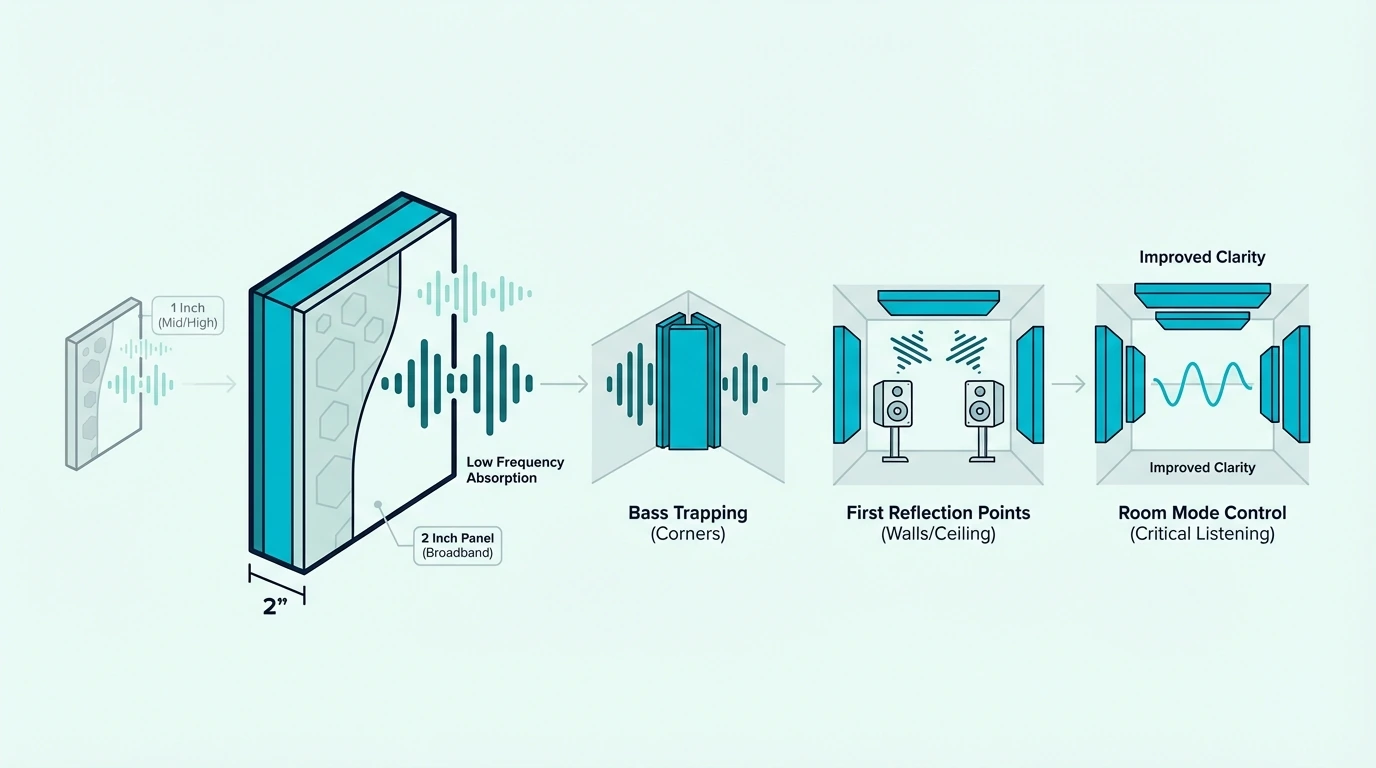
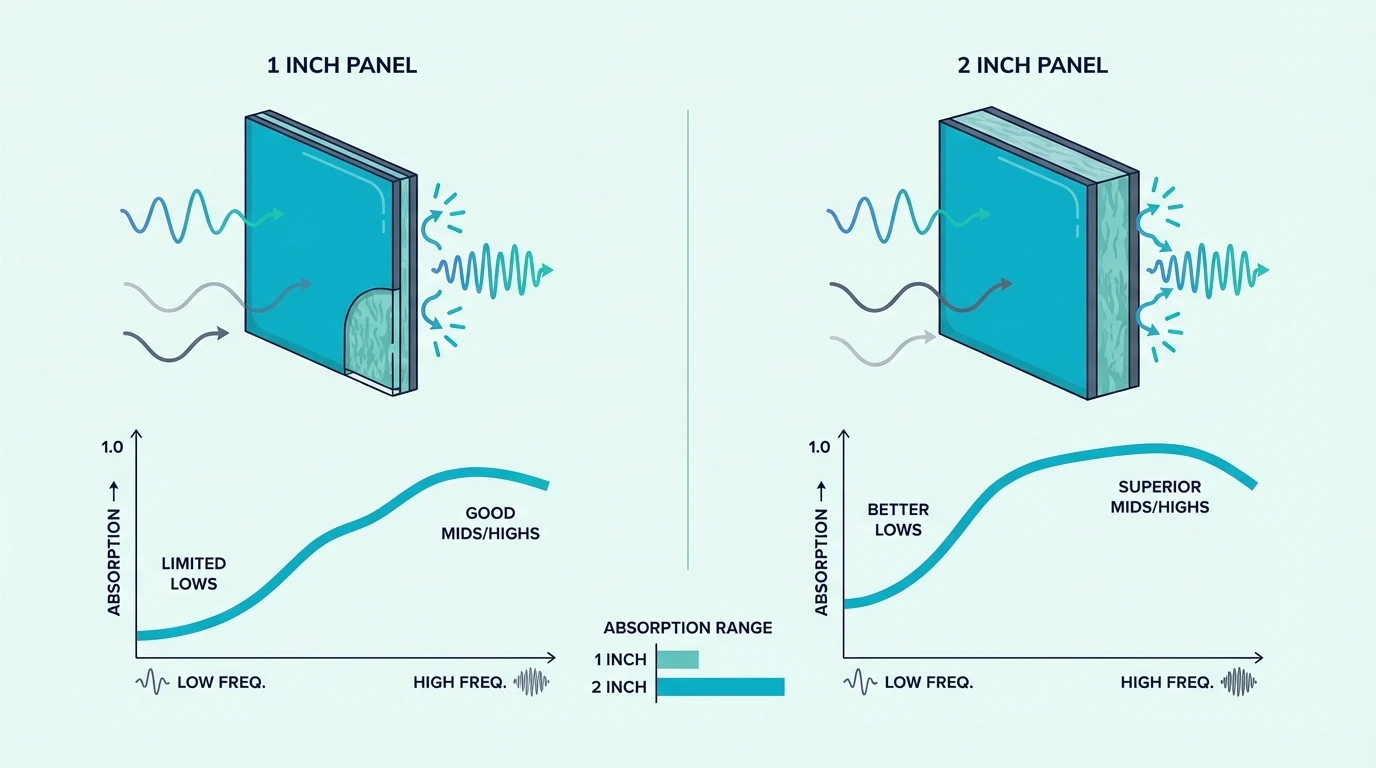
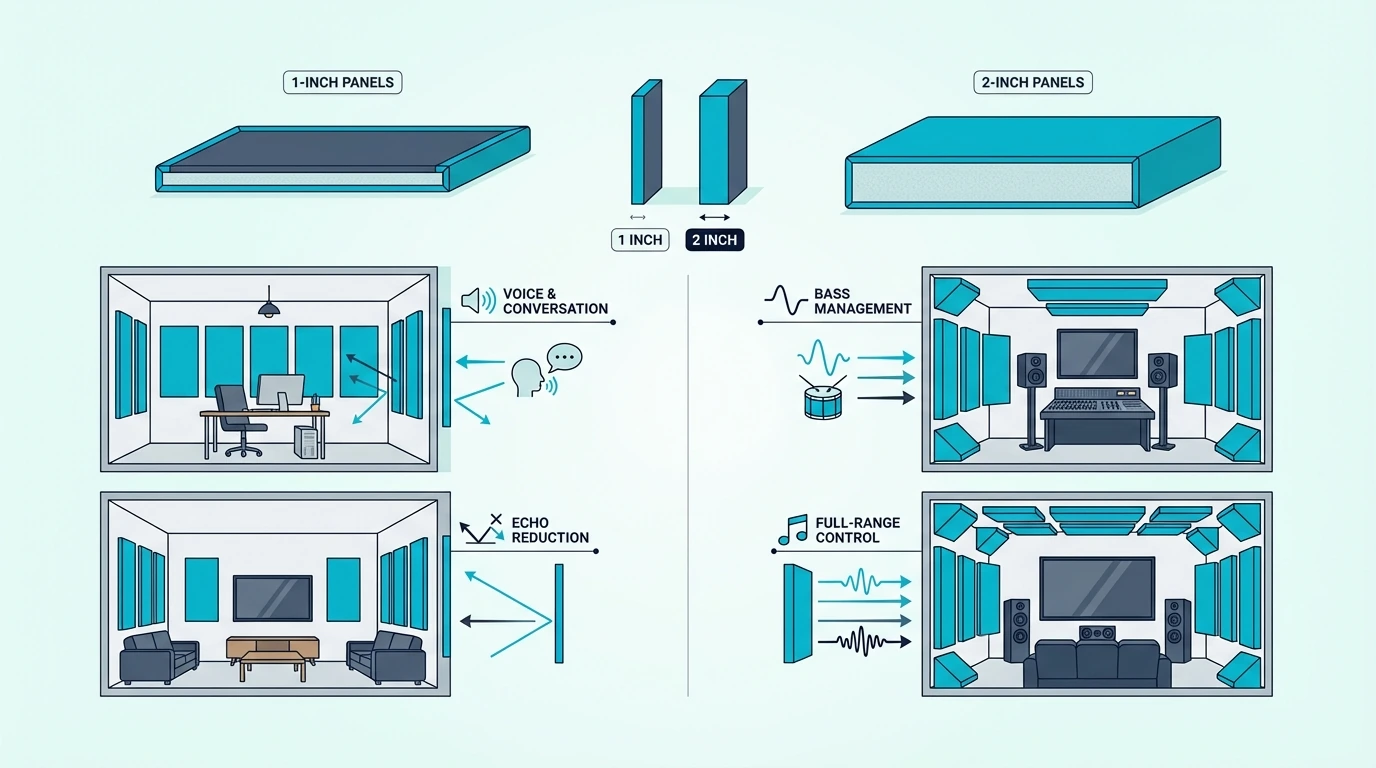
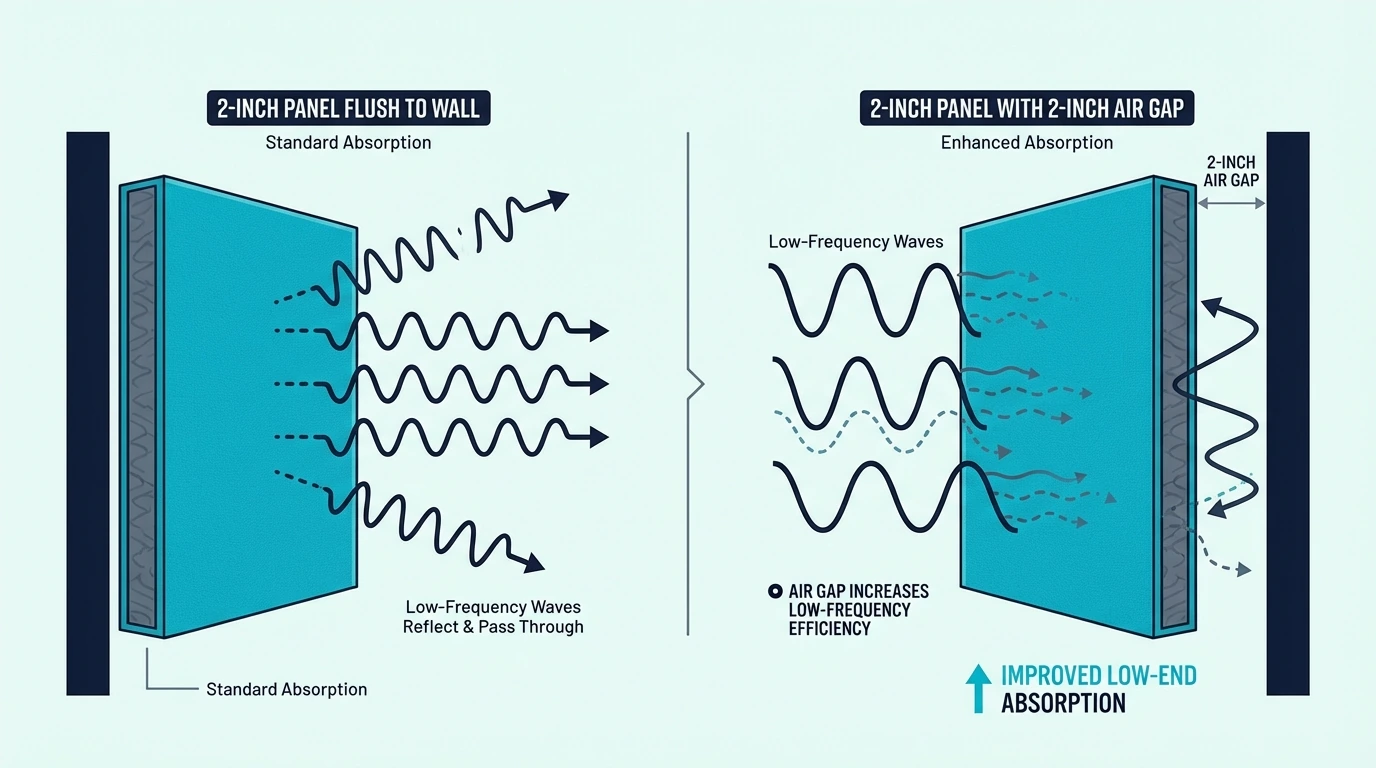
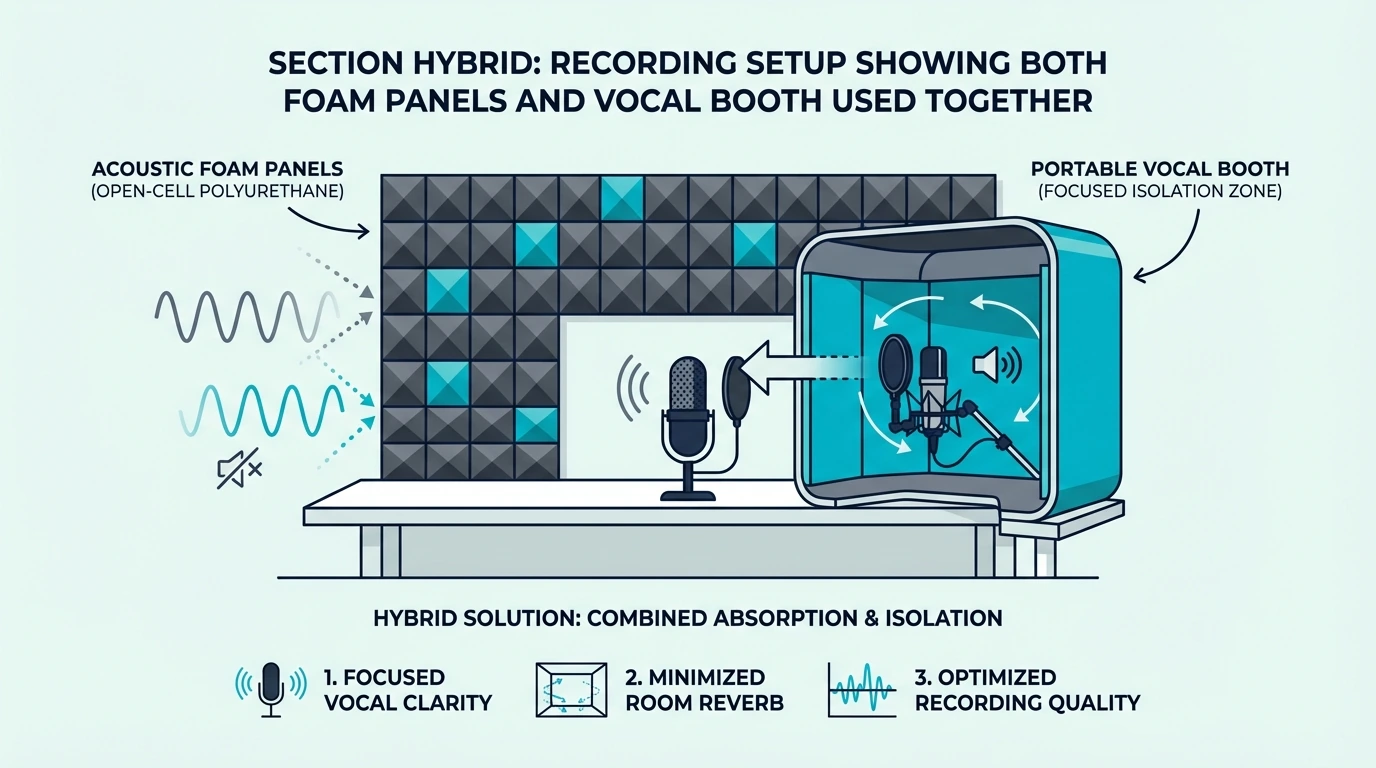
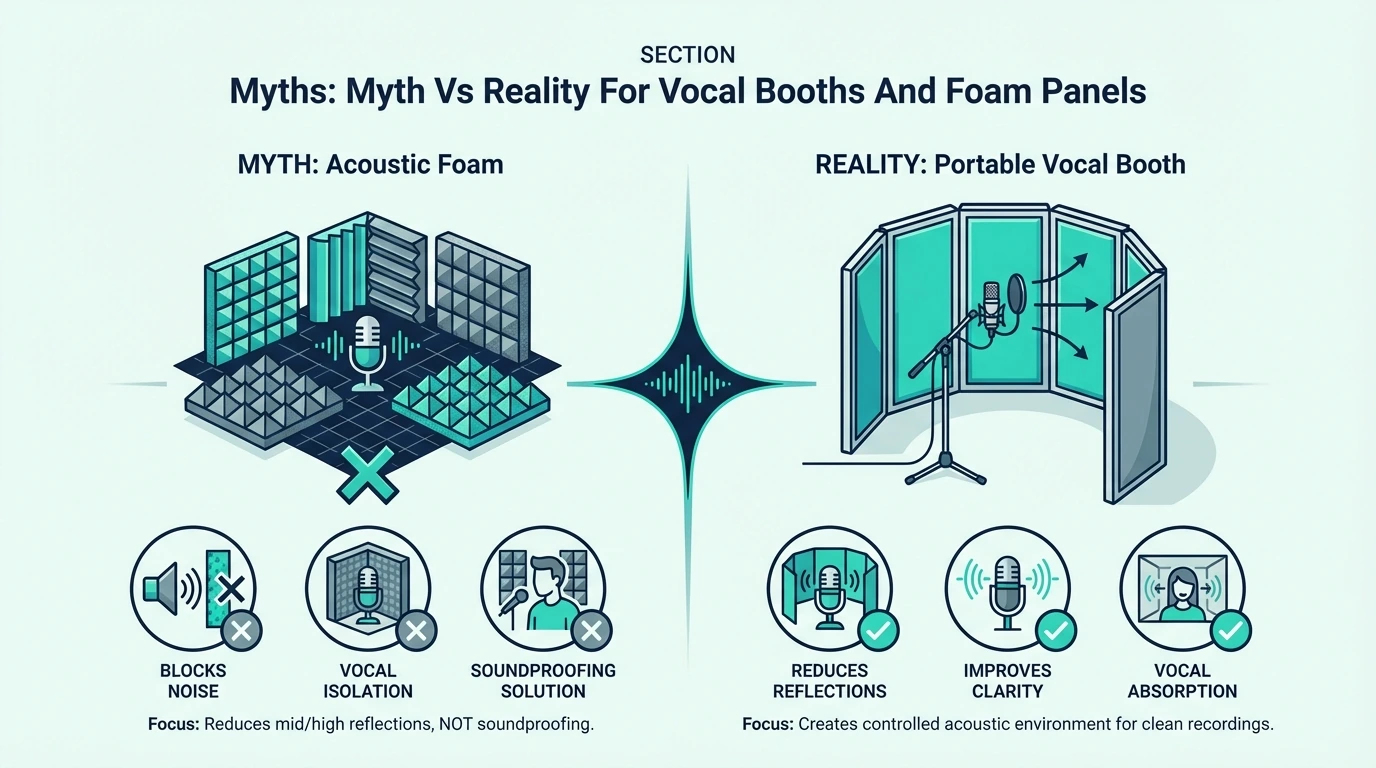
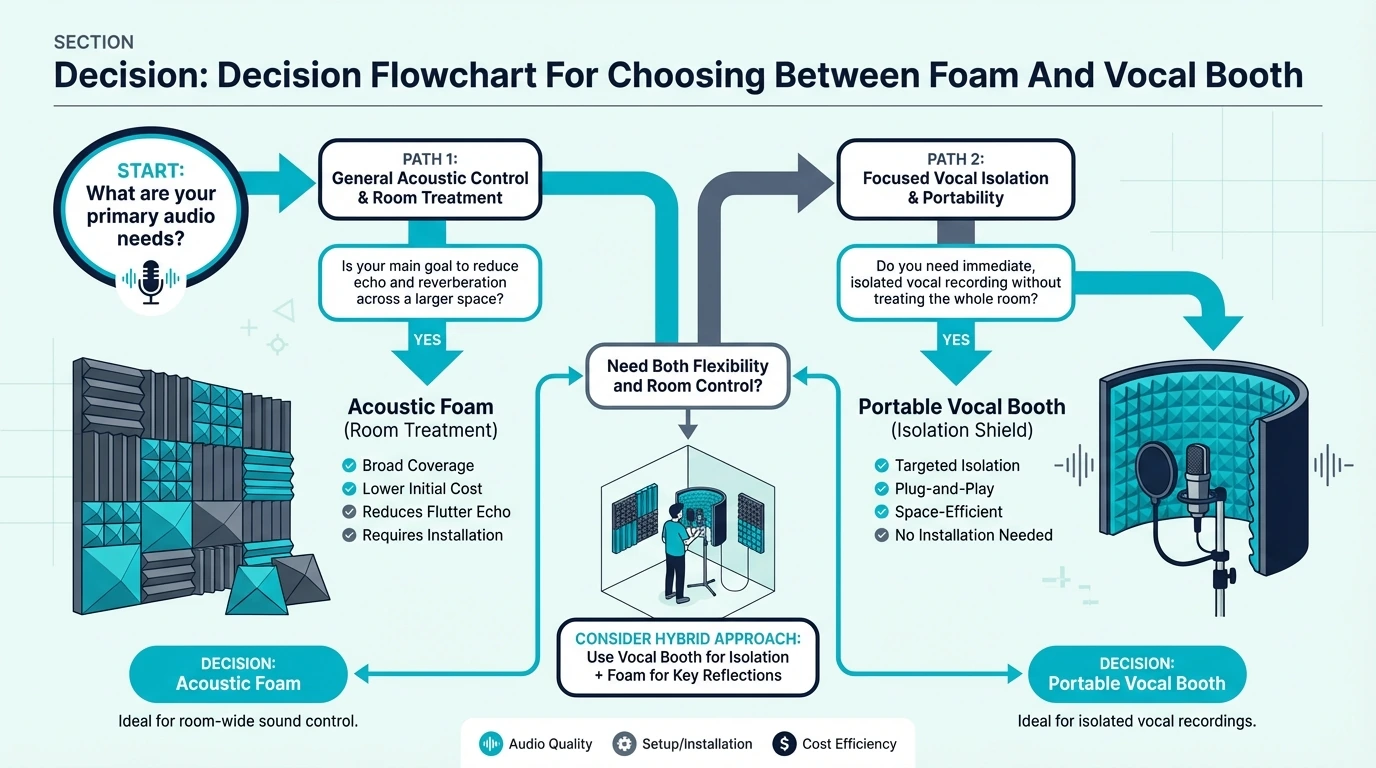
Does Acoustic Foam Help in an Apartment? The Honest Answer

Does acoustic foam help in an apartment? Yes—when your problem is echo and harsh reflections inside your room.

But if you’re trying to stop footsteps, bass, or TV noise coming through the wall, foam won’t move the needle.

That’s because foam absorbs sound in the air. It doesn’t add mass to your walls or stop the building from vibrating.

Foam is an acoustic treatment tool, not a soundproofing tool.

Below, you’ll figure out whether you’re hearing room echo or neighbor noise. Then you’ll know exactly what to do next in a rental without wrecking your paint.

Quick Takeaway

If your apartment sounds hollow on calls or your recordings feel “roomy,” foam helps because it absorbs reflections bouncing around your room. Start with the wall behind your mic/desk and the first reflection points—don’t cover everything.

If your real issue is neighbor noise (footsteps, bass, voices through the wall), foam won’t fix it because the wall is vibrating. Skip to the “neighbor noise” section for the options that actually change what you hear.

Aim for controlled treatment (roughly 30–50% coverage in the problem zone), then stop and retest. If you want a deeper walkthrough, use this acoustic foam placement guide.

What does acoustic foam actually do in an apartment?
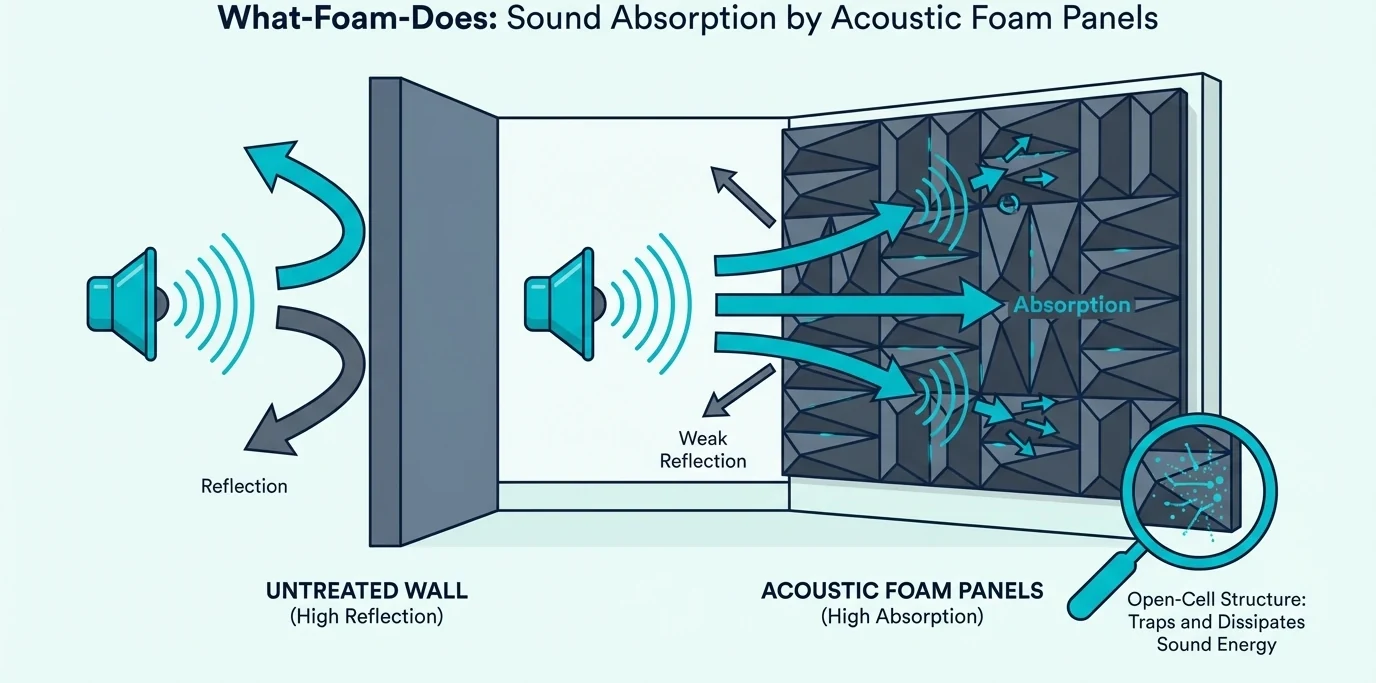
Diagram showing acoustic foam absorbing sound reflections inside an apartment room

Once you stop expecting foam to “block” sound, the benefits become obvious. Foam’s job is to reduce reflections so your voice (or speakers) sounds more direct and less like it’s bouncing around a tiled bathroom.

Why it kills echo faster than you’d expect

In most apartments, the worst culprit is mid‑to‑high frequency reflections coming off drywall, windows, and bare floors. That’s the harsh “ring” you hear when you clap, and it’s why calls can sound distant even with a good mic.

Foam works when you place it where the reflection path actually hits. A few panels in the right spots can shorten the reverb tail dramatically without changing the overall “quietness” of the room.

Try this: clap once in the middle of the room, then clap again while facing a different wall. If the ring changes, you’re hearing reflections—and that’s exactly what foam is meant to control.

If you want a step-by-step echo fix, treat in stages and retest after each change. That keeps you from buying a second box of foam when the real issue is placement.

Why recordings and video calls sound “closer”

So once you’ve tamed the obvious ring, the next thing you notice is what your mic is picking up. Foam makes recordings feel “closer” because it cuts the early reflections that smear your direct voice.

When you record in an untreated room, your mic captures your voice and the reflections that arrive a fraction of a second later. That’s the “roomy” haze that makes audio sound amateur even if the microphone itself is high quality.

Foam doesn’t have to cover the whole room to help—you just need to reduce the reflections your mic hears first. That usually means the wall behind your mic and the nearby side walls at head height.

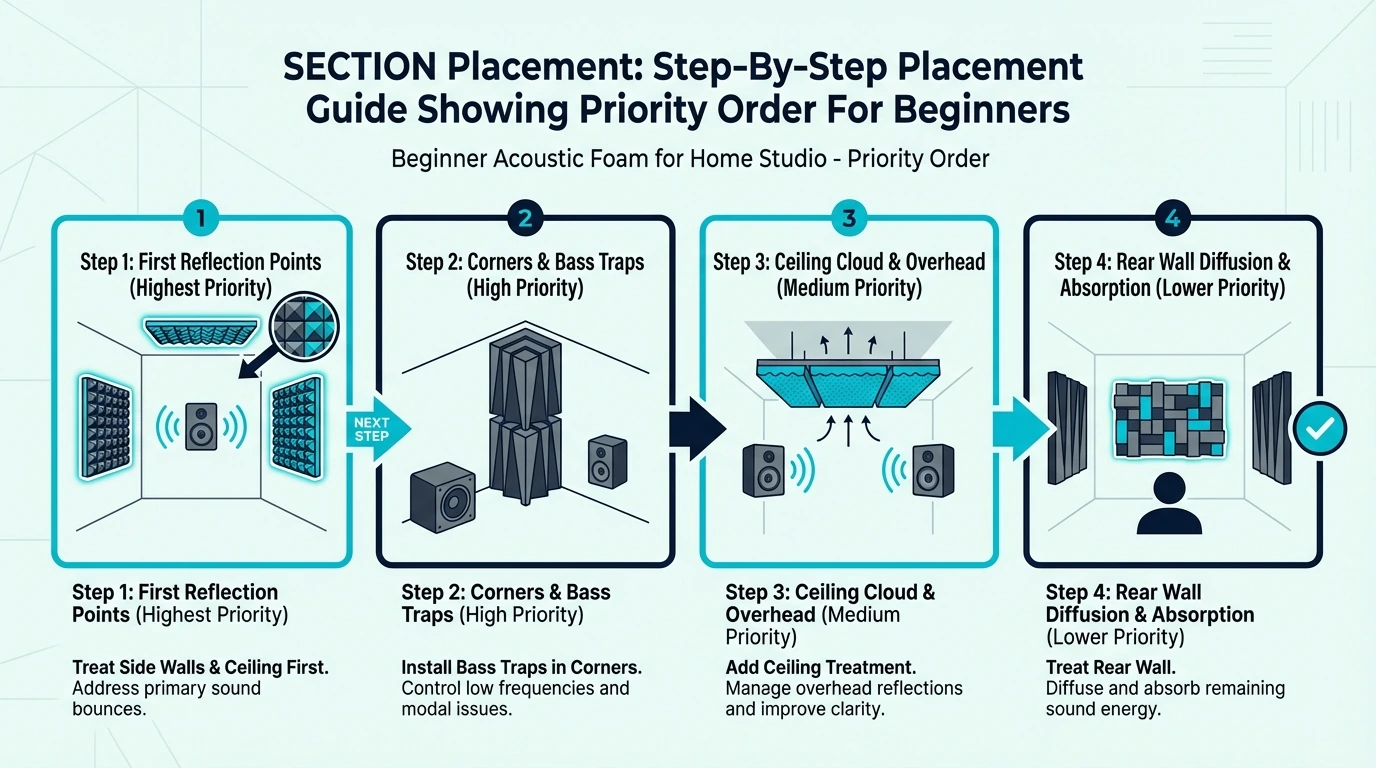
The easiest way to pick those spots is the mirror trick: sit where you work, slide a mirror along the wall, and mark where you see your speaker or mic position. Those marks are your first reflection points, and they’re priority #1.

If you’re still unsure what foam can and can’t do, this “does acoustic foam work?” breakdown sets expectations with real-world examples. It also explains why thickness matters more than shape for most apartment setups.

What it changes for day-to-day comfort

And even if you never hit record, fewer reflections change how the room feels. This is the part you notice in conversation, TV dialogue, and music playback.

Even if you don’t record, cutting reflections can make a hard-surface apartment feel less stressful. Conversations stop sounding sharp, and music playback feels cleaner because you’re hearing less of the room’s splash.

This is most noticeable in minimally furnished spaces—hard floors, bare walls, and lots of glass. Foam won’t replace rugs and curtains, but it can tame the worst “ping” without remodeling your living room.

Why doesn’t acoustic foam block neighbor noise?
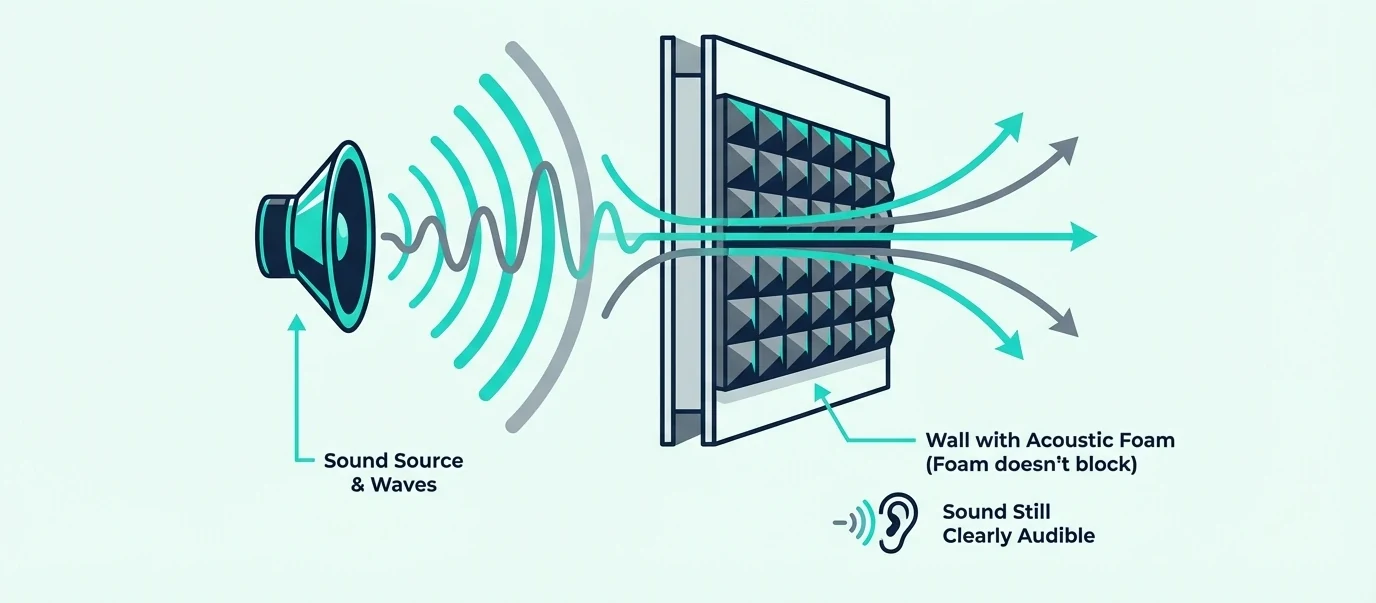
Split image showing neighbor noise passing through a wall despite acoustic foam

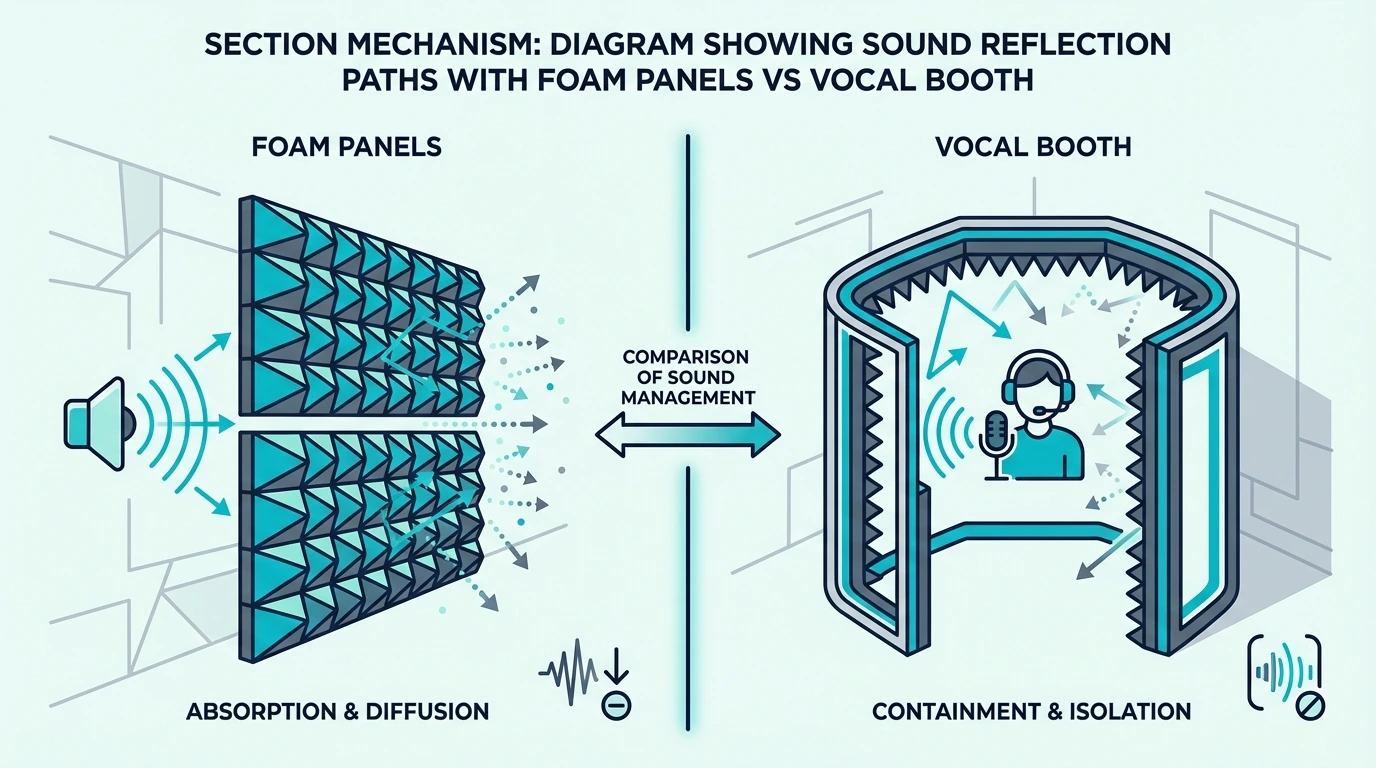
Here’s the part most people get wrong: neighbor noise is usually a structure problem, not an air problem. If the wall or ceiling is vibrating, foam on the surface is like putting a sponge on a drum—it doesn’t stop the drum from being a drum.

Airborne sound vs structure-borne sound (the wall becomes the speaker)

Your neighbor’s bass and footsteps travel through the building framing and shake the surfaces in your room. Those surfaces then re-radiate sound into your air, which is why it feels like the noise is “coming from the wall.”

Foam only absorbs sound after it’s already in your room and moving through the air. It doesn’t add mass, it doesn’t decouple the structure, and it doesn’t seal gaps, so it can’t meaningfully stop transmission.

That’s why marketing phrases like “soundproof foam” are misleading. If you’re chasing soundproofing, start with a “does acoustic foam work?” breakdown so you don’t burn money on the wrong tool.

Will foam stop you from bothering neighbors?

So even if you don’t care about incoming noise, you might wonder about keeping your sound in. Foam can tidy up your room sound, but it won’t stop transmission through walls.

Foam can take the edge off high-frequency reflections inside your room, but that’s not what neighbors complain about. Most complaints are about audible vocals, TV, and especially bass—exactly the stuff that travels through structure.

If you want to be a better neighbor, the biggest wins are volume management, speaker placement, and decoupling (like putting monitors on isolation pads). Foam is great for improving your room sound, but it’s not a “keep sound in” solution.

What soundproofing actually requires

That’s why the fix isn’t “more foam,” it’s a different category of work. Soundproofing is about mass, sealing, and breaking vibration paths.

Real soundproofing means adding mass, sealing air leaks, and reducing vibration paths. That’s why the real fixes look like weatherstripping, door sweeps, decoupling, and sometimes construction.

In a rental, you’re limited, which is why the practical question becomes: what can you do without opening a wall? We’ll cover the renter-friendly moves in the neighbor-noise section below.

When is acoustic foam worth it in an apartment?
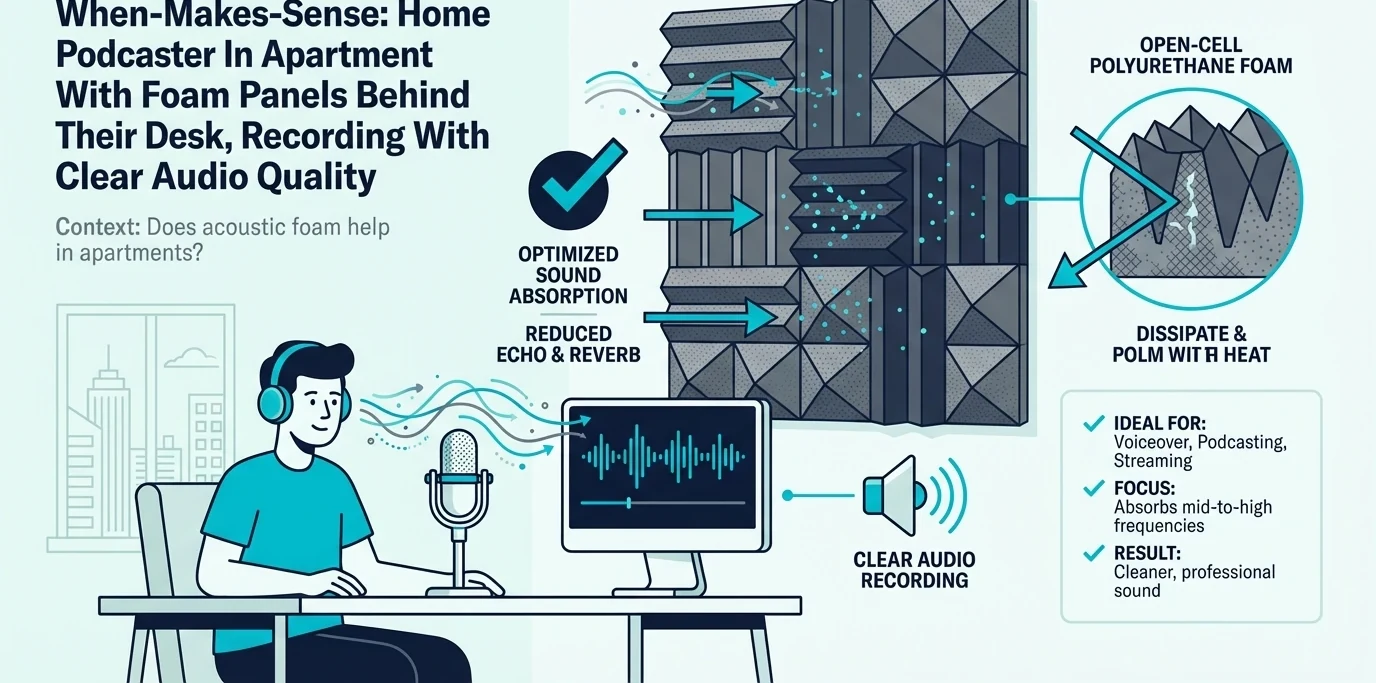
Apartment podcaster recording with foam panels behind a desk

So if foam isn’t for neighbor noise, when is it still a smart buy? Any time you care about how your room sounds inside the room, foam can be a shortcut to “good enough” acoustics.

Video calls and remote work

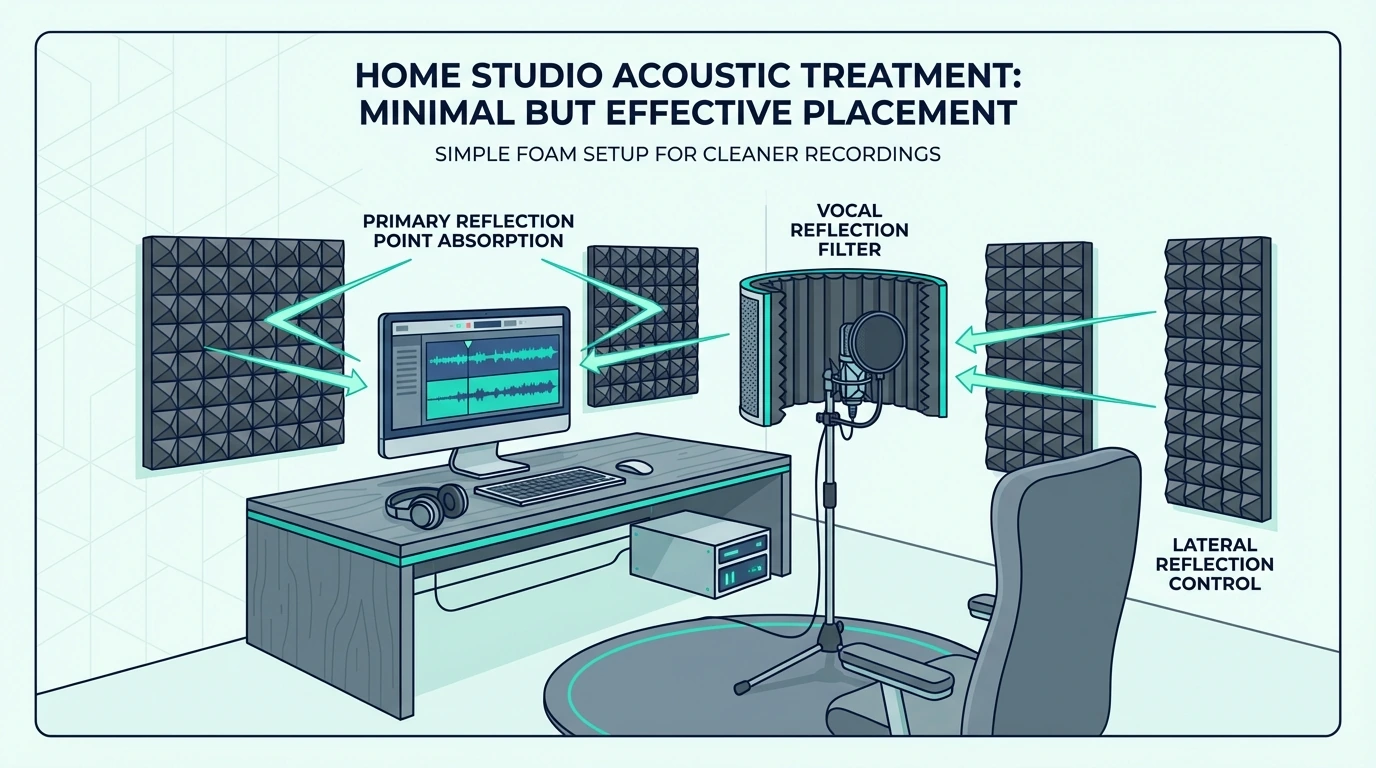
For calls, you don’t need a studio look, you need fewer reflections hitting your mic. Two to four panels near your desk (especially behind your monitor/camera) can remove the hollow “conference room” sound.

If you can only treat one area, treat the surfaces closest to your mouth and mic. That small change often beats scattering foam across the room.

Podcasting, streaming, and vocals

So if calls are the baseline, voice recording is where foam feels like a cheat code. Voice lives in the midrange, which is exactly where foam absorbs best.

This is foam’s best apartment use case because voice lives in the midrange foam absorbs well. You don’t need perfect treatment—you just need to remove the obvious room sound.

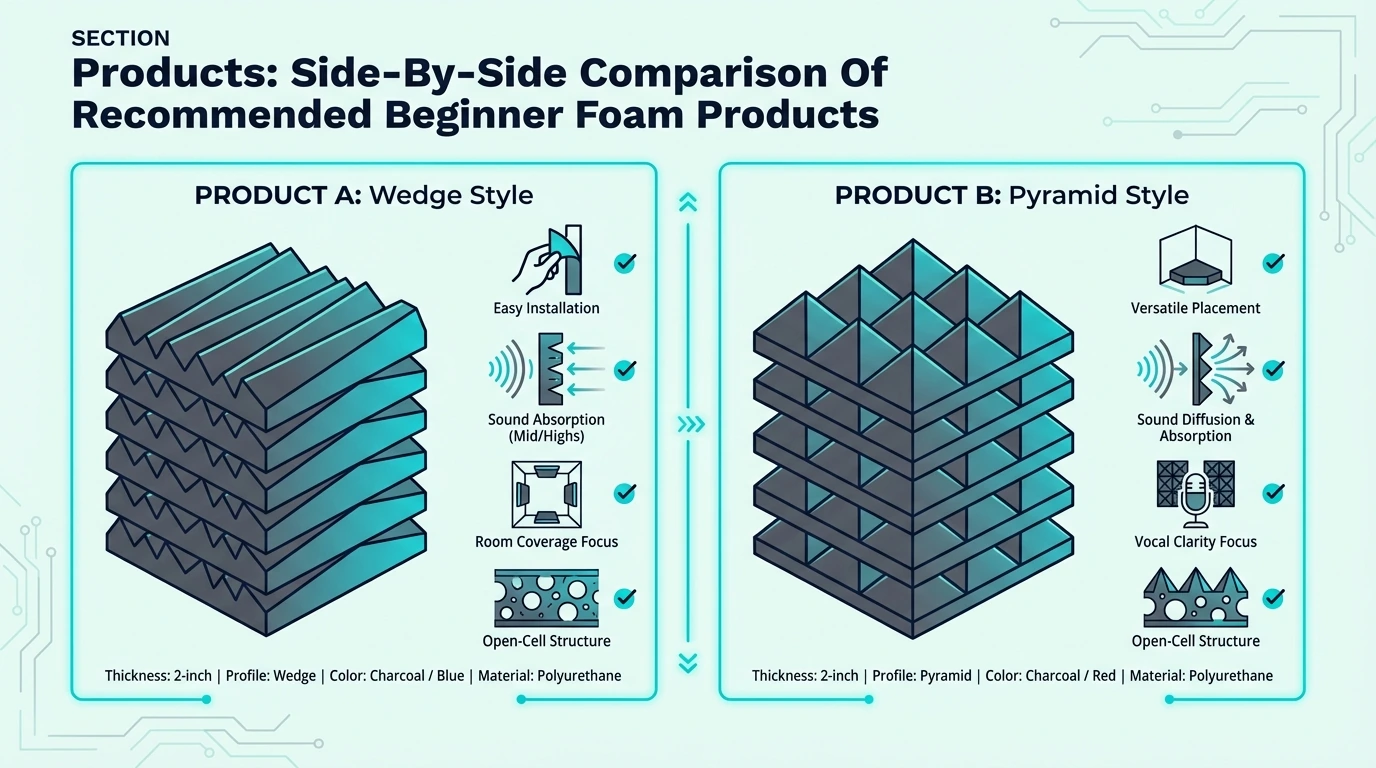
A starter set like 2-inch wedge acoustic foam panels is enough to treat the wall behind your mic and your first reflection points. Mount them, record the same sentence twice, and you’ll hear the difference immediately.

Music listening (and basic mixing)

Once your voice sounds tighter, the same reflection rules apply to speakers. Treating first reflection points is what sharpens stereo image and dialogue clarity.

If you listen on speakers, reflections smear the stereo image and make everything feel less focused. Treating first reflection points helps you hear what your speakers are actually doing, not what your walls are adding.

Use a placement guide for the highest-impact surfaces, then stop and reassess. In small rooms, smart placement beats maximum coverage every time.

How can you install acoustic foam in a rental without damaging walls?
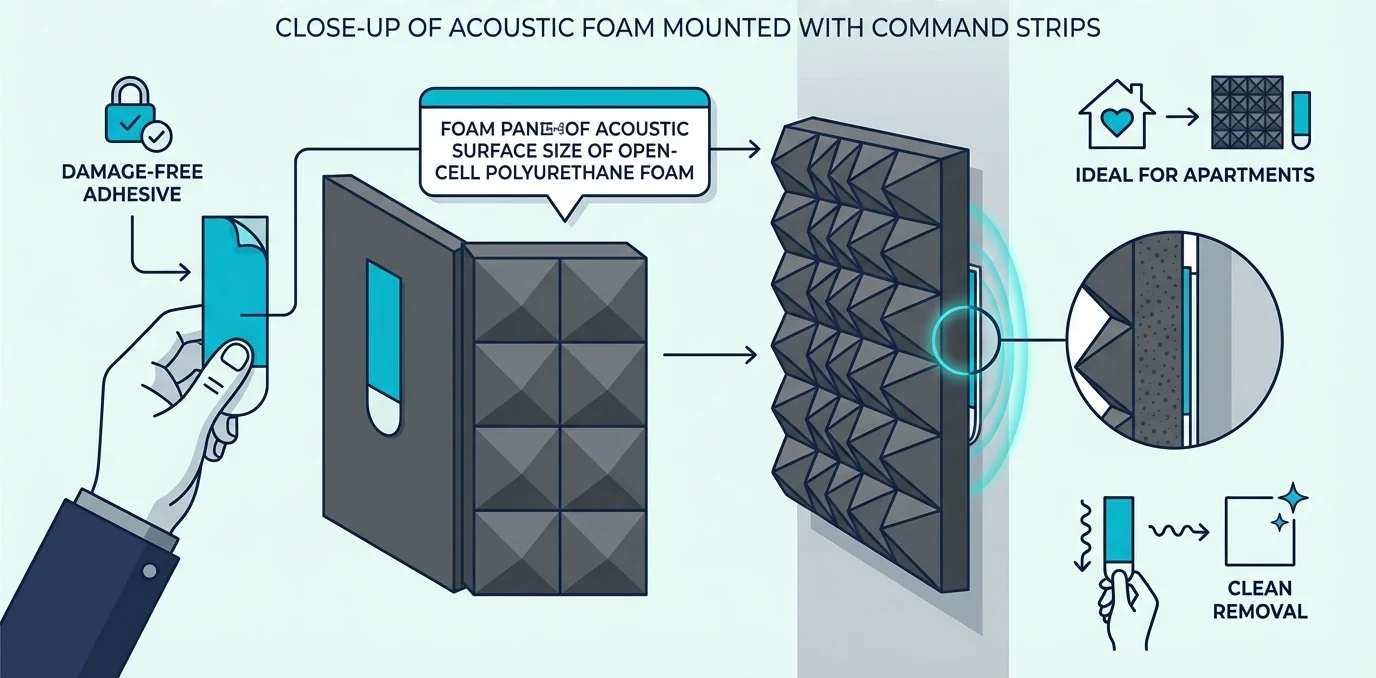
Damage-free acoustic foam mounting with command strips on an apartment wall

Renters usually don’t hate foam—they hate losing paint when they move out. The trick is choosing mounting that’s strong enough to hold, but reversible when your lease ends.

Do the boring wall prep first

Before you stick anything up, wipe the wall and let it dry. Dust and oily paint are why panels fall at 2am, not “bad foam.”

Do a small test patch in a hidden spot and remove it the next day. If the paint peels, switch to a freestanding or backer-board approach.

Use mounting you can reverse later

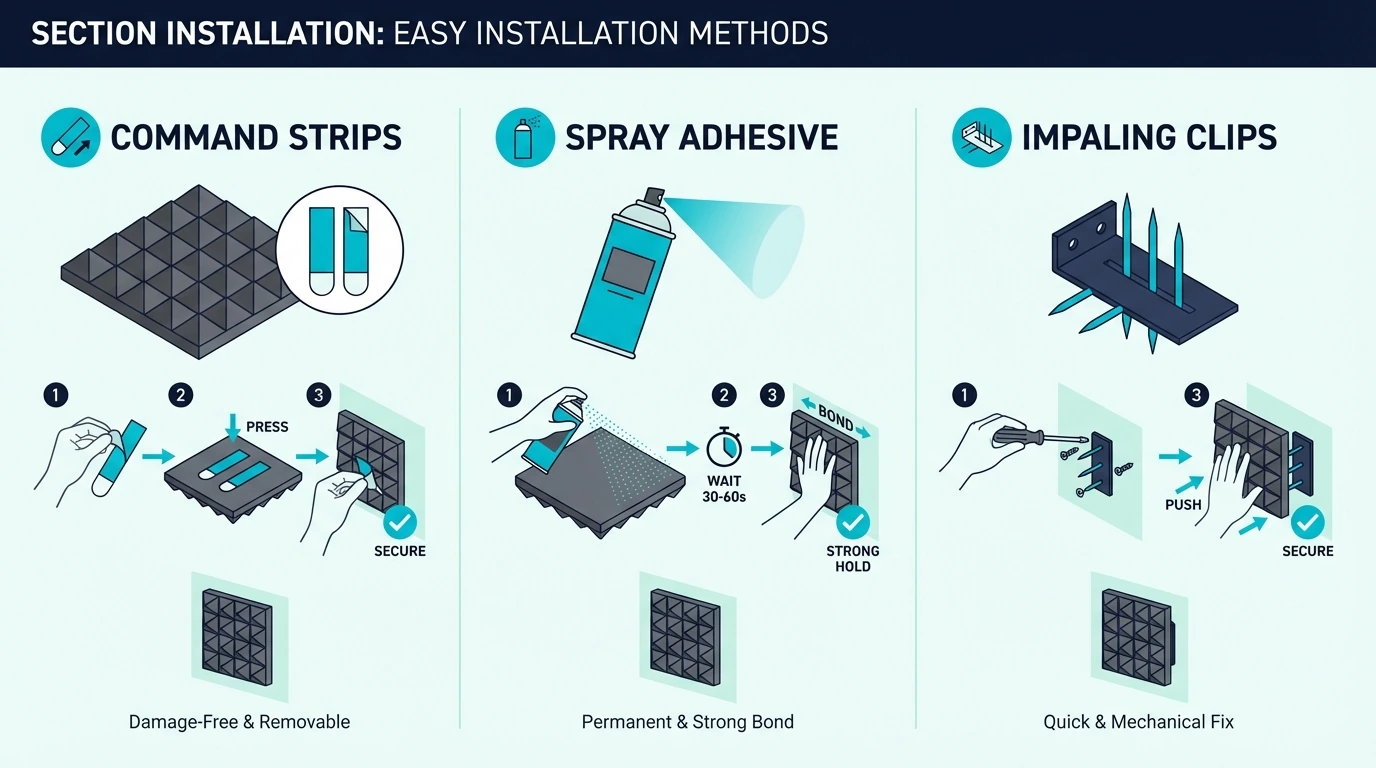
So after you prep the wall, the next decision is whether you want the setup to be removable. Reversible mounting lets you test placement without turning your paint into a science experiment.

Start with the methods in our acoustic foam wall install guide. It covers renter-friendly adhesives, backer boards, and how to avoid residue.

If you want something repositionable (move panels while you test placement), 3M Dual Lock reclosable fastener can work well on clean, smooth walls. Treat it like a strong adhesive: test first, and don’t use it on flaky paint.

Zero-wall-contact setups (when your lease is strict)

If your lease is strict (or your paint is fragile), skip adhesives entirely. A backer-board setup gives you absorption where you need it with zero wall contact.

You can treat the room by mounting foam on lightweight boards and leaning them behind your desk or couch. You get absorption where you need it, and you leave zero evidence when you move.

This also makes removal easy later, which matters if you learn you placed panels in the wrong spots. If you ever need to take foam down cleanly, this removal guide is worth bookmarking.

What actually helps with neighbor noise in an apartment?
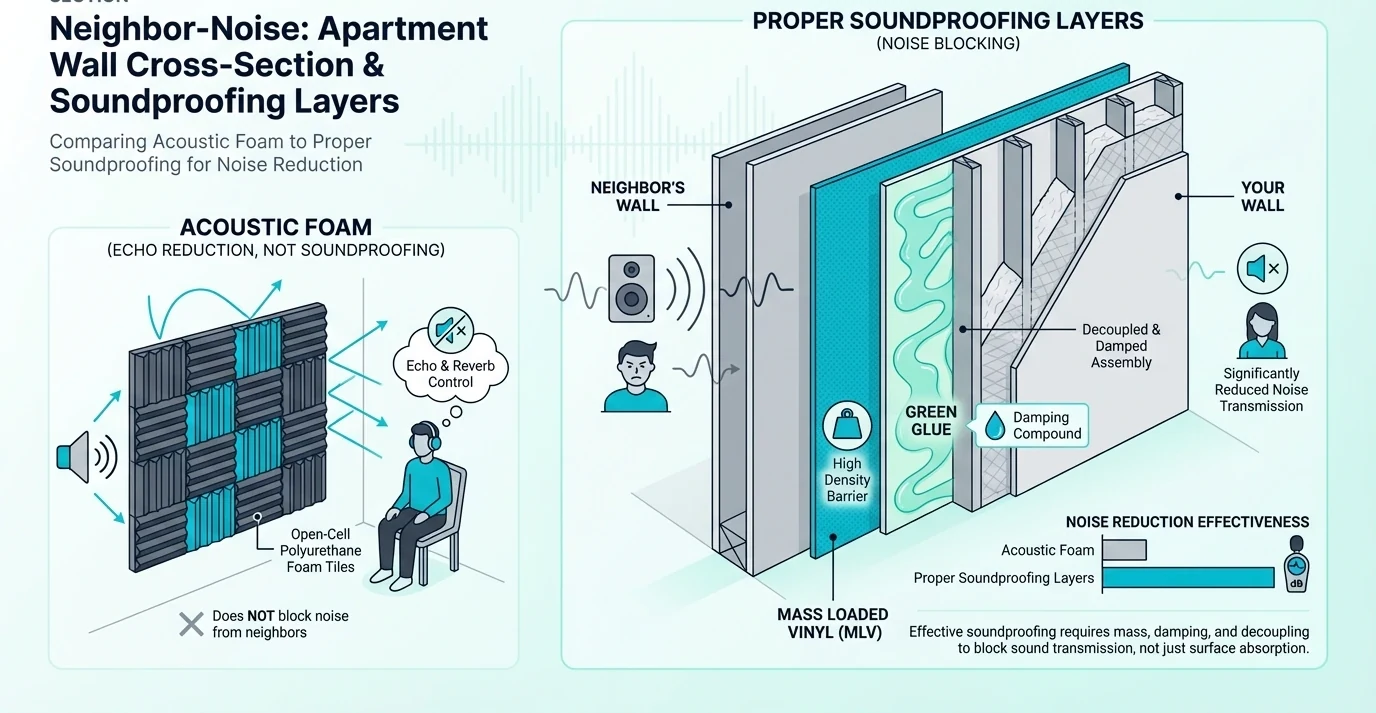
Apartment wall cross section showing soundproofing layers for neighbor noise

If your goal is sleep and sanity, this is the section that matters. Foam can make your room sound nicer, but it won’t change what comes through the wall.

Seal the obvious leaks first

The fastest renter-friendly win is sealing gaps around doors and windows. Hallway noise often comes through the door perimeter and the gap at the bottom, not through the drywall.

A door sweep and weatherstripping won’t stop bass, but they can cut voices and TV bleed enough to make evenings tolerable. Do the cheap sealing steps before you spend on any “soundproof” product.

Add mass where you can (without construction)

So start with leaks because they’re cheap wins, but don’t expect them to stop bass. To actually reduce transmission, you need mass on the shared wall—usually in the form of dense furniture and textiles.

Mass is what blocks sound, which is why foam can’t substitute for it. In a rental, the most practical “mass” is furniture: bookcases full of books, wardrobes, and dense textiles against the shared wall.

It’s not perfect, but it shifts the problem in the right direction without asking your landlord for drywall work. If you want the deeper “why,” acoustic foam alternatives lays out what actually works for isolation.

Masking: the “works tonight” option

And when the building is the problem and you need relief tonight, masking is the practical move. It won’t lower the noise, but it can make it much easier to ignore.

Sometimes the best apartment fix is masking, not blocking. A consistent background sound makes intermittent noise (voices, hallway footsteps) less attention-grabbing.

A device like the LectroFan white noise machine is a simple, non-destructive way to improve sleep when the building is loud. Place it between you and the shared wall to get the most benefit.

How much acoustic foam do you need for an apartment?
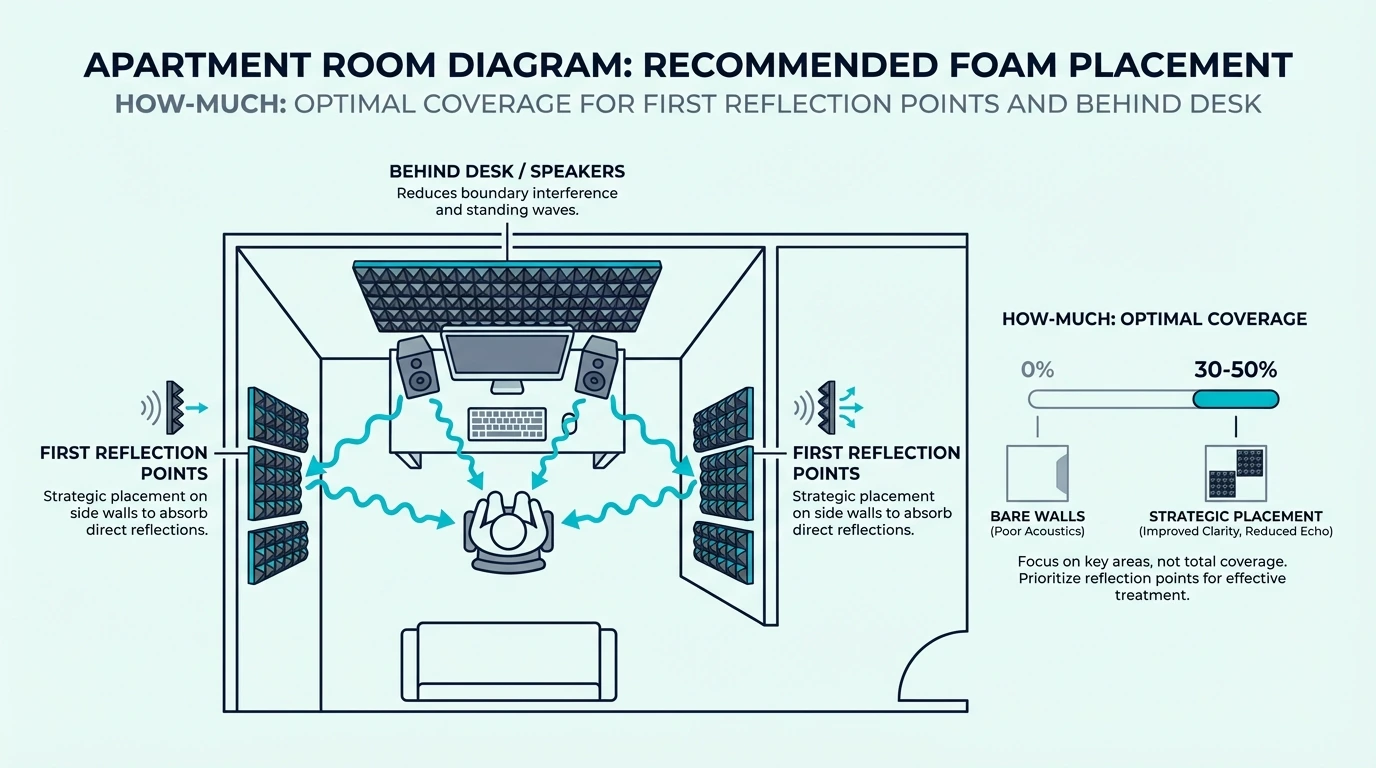
Apartment room diagram with foam at first reflection points and behind a desk

Once you’re buying foam for the right reason, the next trap is buying too much. You’re aiming for control, not a dead, muffled room.

A simple coverage target (30–50%)

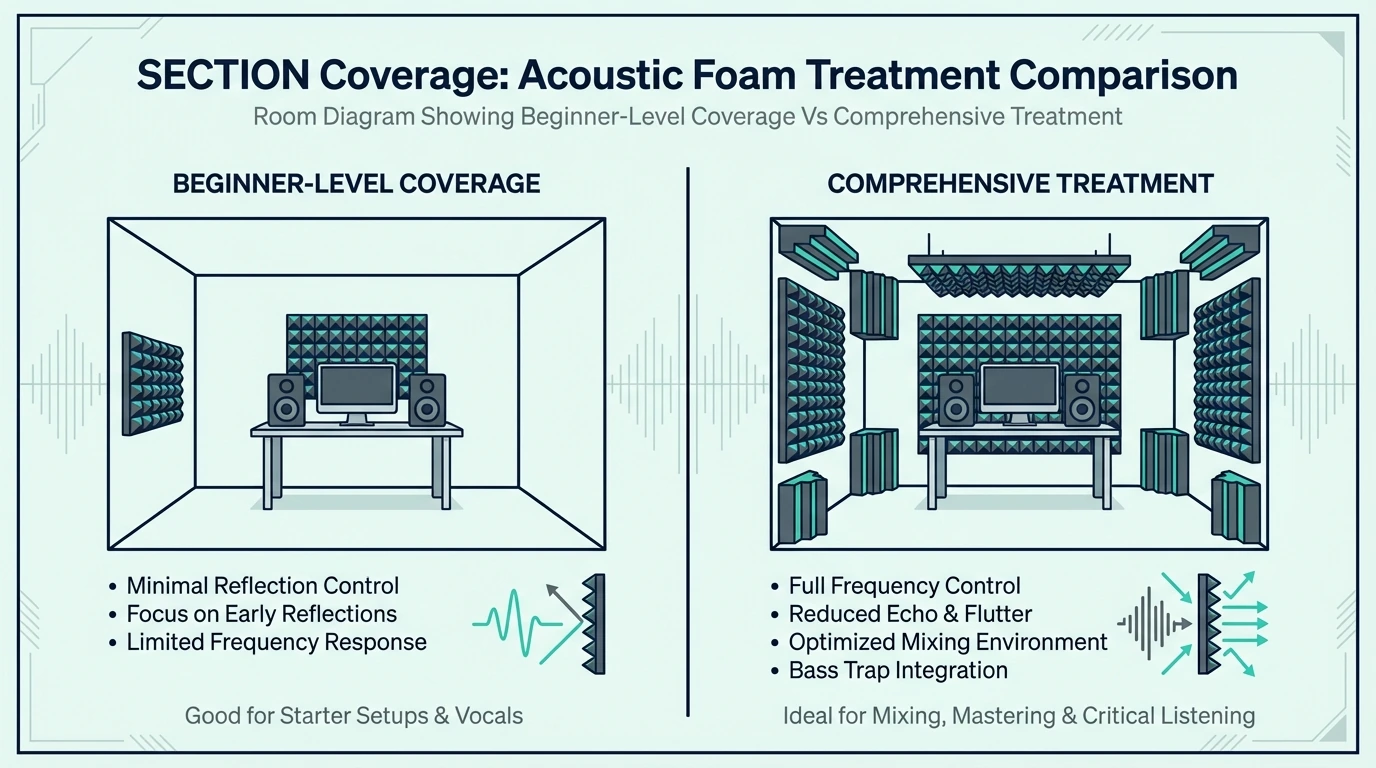
A practical starting range is treating about 30–50% of the wall area in the problem zone. That’s usually enough to kill the ring without turning the room into a foam cave.

If you go far beyond that, you can end up with a room that feels weirdly lifeless. If you’re worried you’ve overdone it, this guide to too much acoustic foam explains the signs.

Where to place your first panels

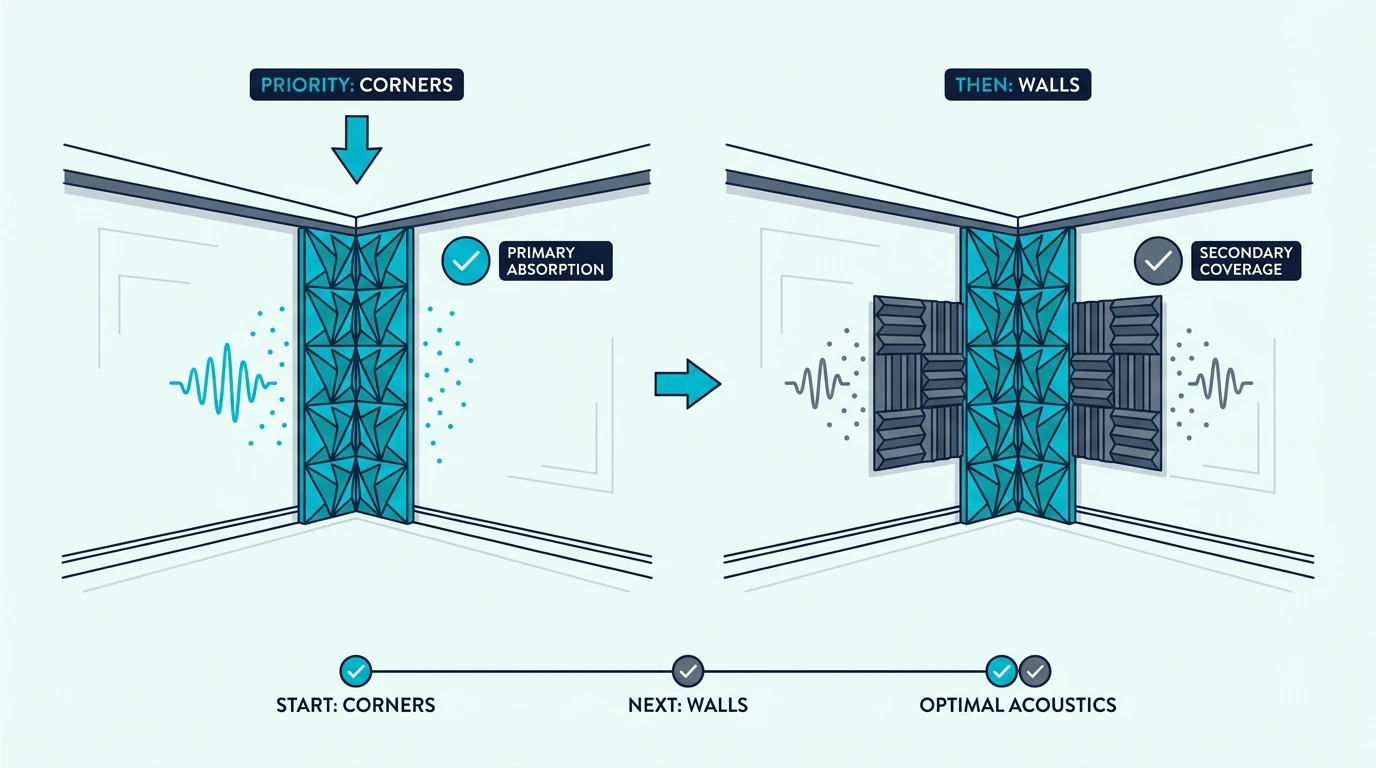
So once you have a coverage target, placement is what makes it work. Start with first reflection points and the wall behind your desk, then retest before you buy more.

Start with first reflection points on the side walls and the wall behind your desk or mic. Those spots give you the biggest “before and after” change per panel.

Use a quick placement map to pick your first surfaces, then retest with a clap or a short voice recording. If the ring is gone, stop buying panels and start enjoying the room.

When corners matter (and when they don’t)

If the ring is gone but the room still feels boxy, you’re hearing a different problem. That’s when corners and thicker treatment matter more than adding another row of thin tiles.

Thin foam is not a bass solution, so don’t chase low-frequency problems with more wall foam. If the room is still boomy, that’s when corners and thicker treatment matter.

For the clear explanation, read bass traps vs acoustic foam so you know what foam can’t do. It’ll save you from buying the wrong “bass foam” products.

What results should you realistically expect?
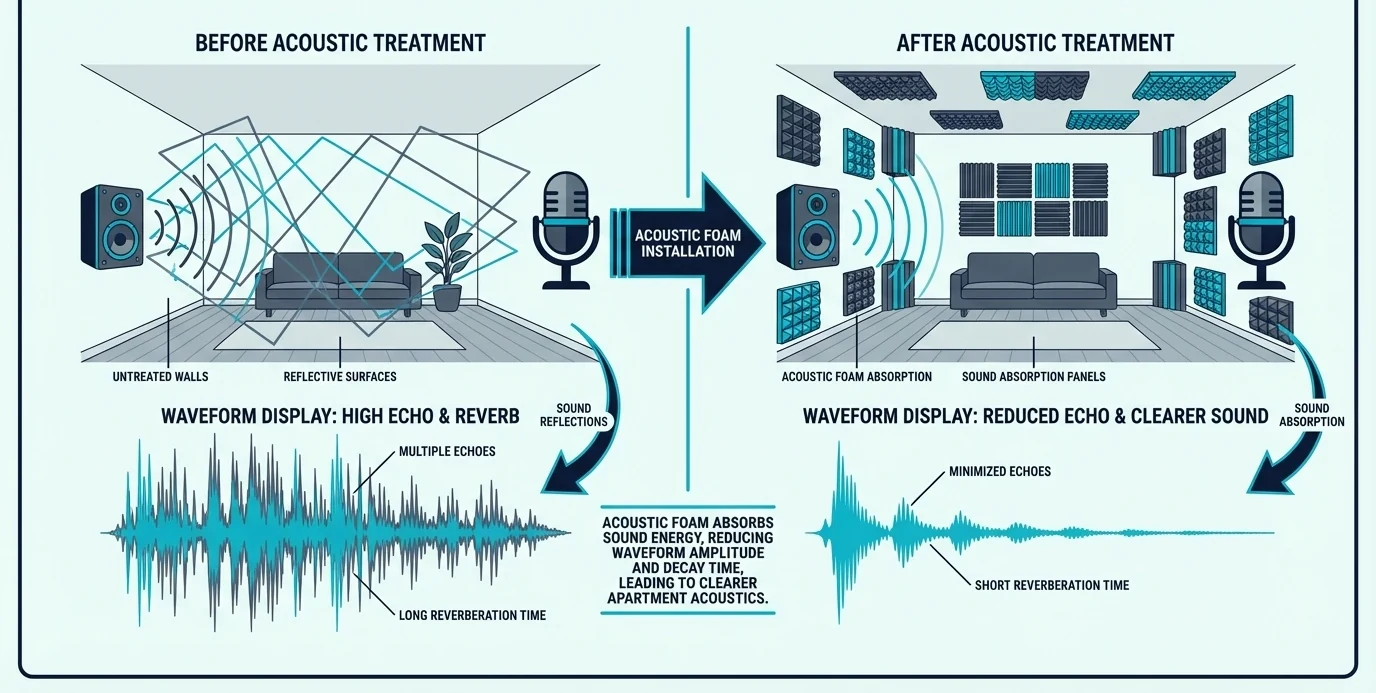
Before-and-after waveform comparison showing reduced apartment room echo

This is where expectations make or break your satisfaction. Foam can deliver a big upgrade inside your room, but it has a hard ceiling in an apartment.

What you’ll notice immediately

Echo reduction is instant—you can hear it on the first clap test. Calls sound closer, and your voice stops bouncing around the room.

Recordings also clean up fast because the mic hears fewer reflections. It’s one of the rare upgrades where you don’t need “golden ears” to notice the difference.

What won’t change

So you’ll hear a fast echo improvement, but don’t expect it to change what comes through the wall. Neighbor bass is transmission, and foam is the wrong tool for transmission.

If your neighbor’s bass is the problem, the bass will still be the problem tomorrow. Foam doesn’t change wall transmission, so it won’t fix the main apartment complaint.

The same goes for your noise reaching neighbors. Foam helps your sound quality, not your sound leakage.

How to test whether you’re done

Once you know what should change, you need a simple way to confirm you’re done. Use a repeatable clap/recording test so you’re adjusting placement, not guessing.

Use a repeatable test: clap in the same two spots, and record the same sentence with the same mic position. If the ring is gone and the voice sounds tighter, you’re done—even if your walls aren’t covered.

If you still hear a sharp flutter, it’s usually placement, not quantity. Go back to the echo guide and treat the specific reflection path.

How much should you spend on apartment acoustic treatment?
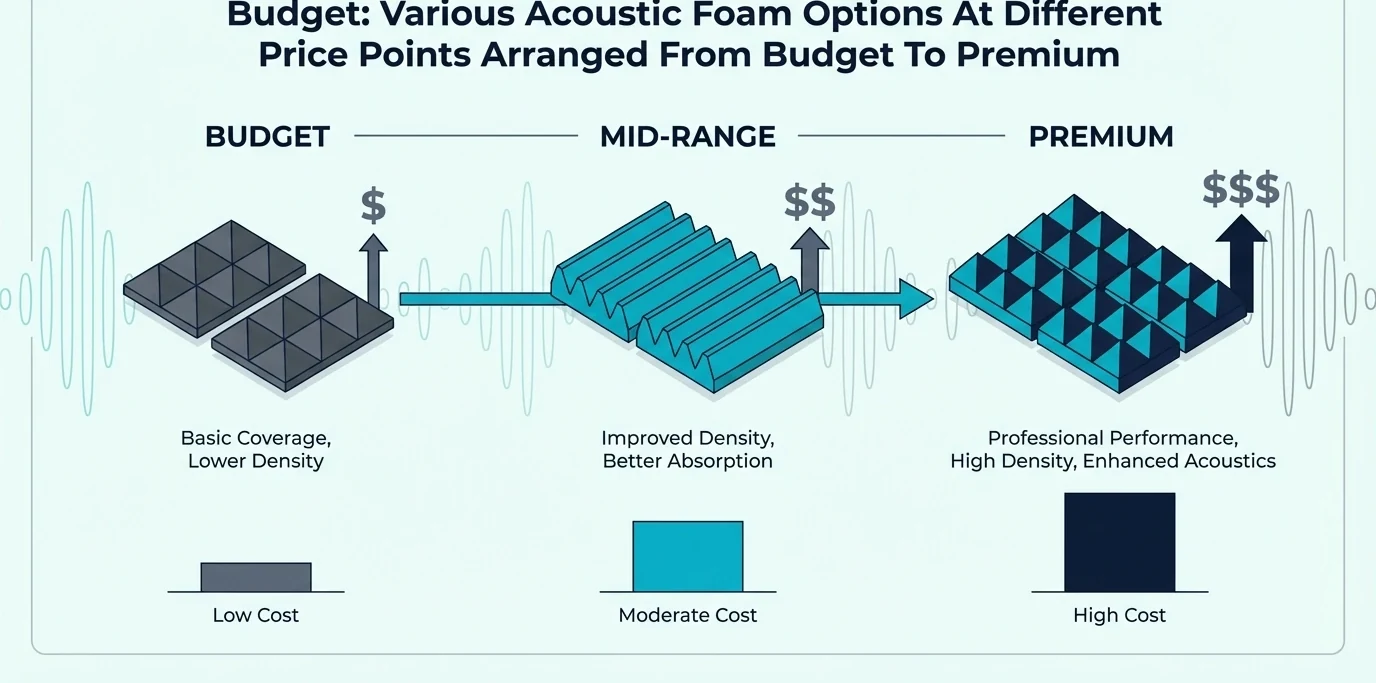
Budget-to-premium acoustic foam options for apartment rooms

Price isn’t the real problem—wasted purchases are. The goal is to buy just enough treatment for the outcome you want.

When budget foam is enough

If you’re mainly trying to make calls and voice recordings sound cleaner, budget foam is usually fine. You’re fixing mid/high reflections, and you don’t need boutique specs to hear an improvement.

If you’re shopping, start with best budget acoustic foam and look for consistent reviews and realistic thickness. That avoids the ultra-thin “decor foam” packs that barely absorb anything.

When paying more makes sense

So if budget foam gets you most of the result, paying more only makes sense when it solves a real pain. Thickness and consistency are the two upgrades you actually feel in an apartment.

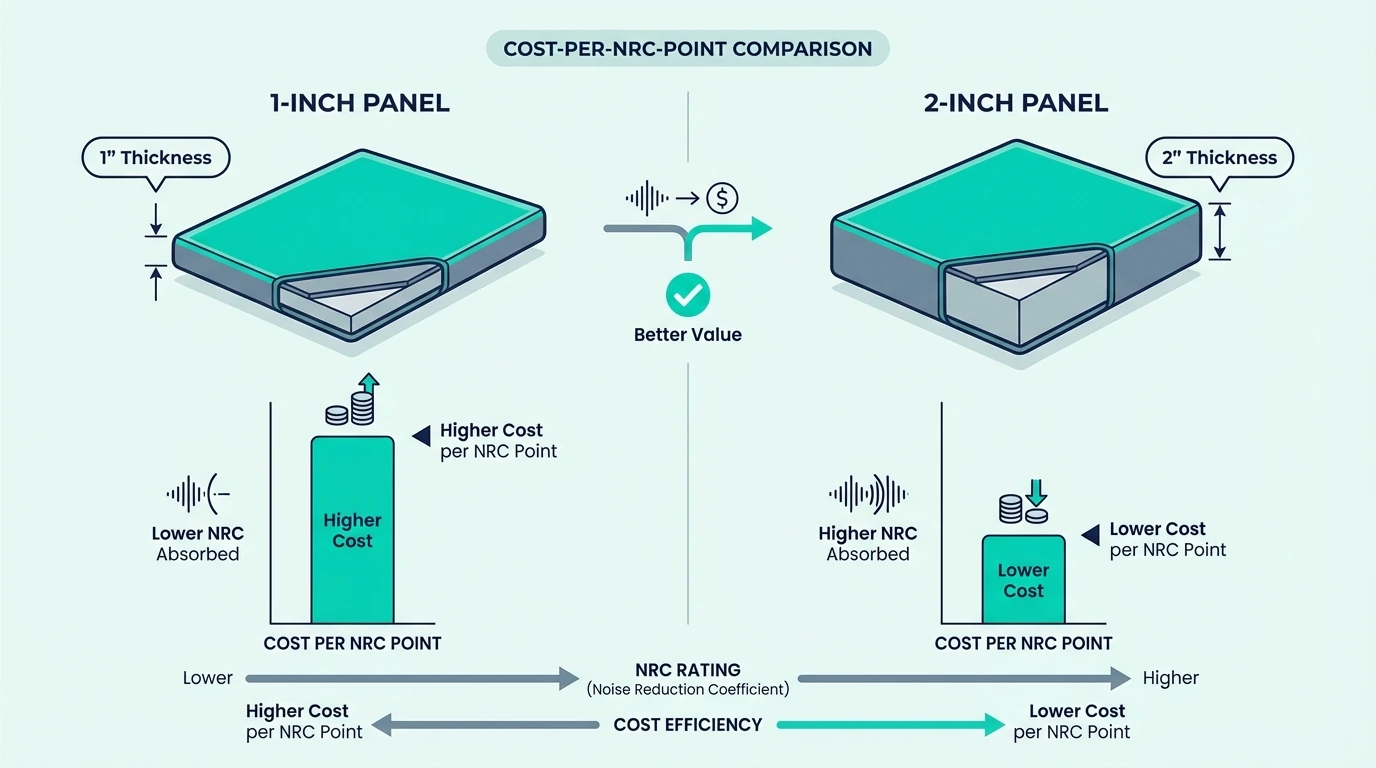
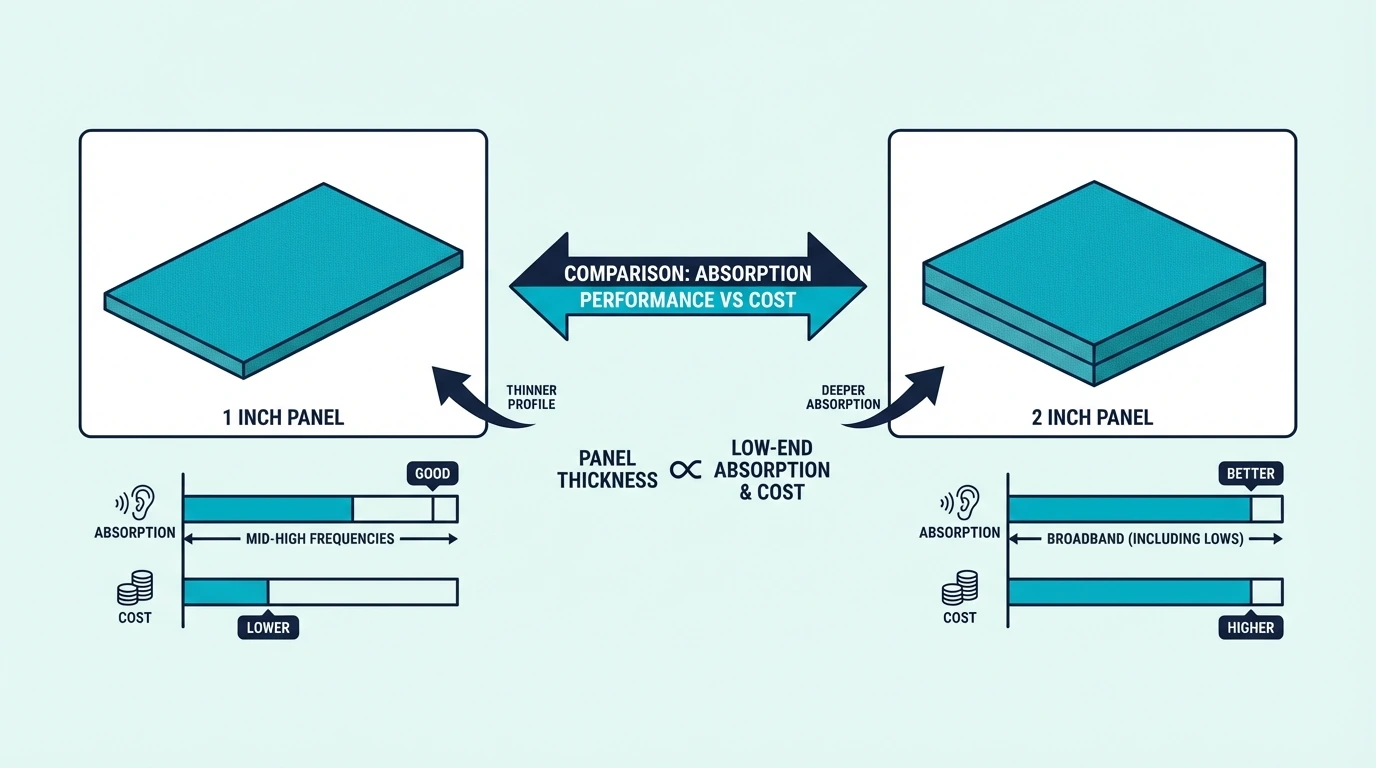
If you want more consistent performance, thickness matters more than shape. For most apartments, 2-inch foam is a practical minimum for audible echo control, and this foam buying guide breaks down what to look for.

Safety matters too, especially in rentals where you don’t control building rules. If you’ve never thought about fire ratings, read our acoustic foam safety guide before you buy the cheapest option.

The “don’t waste money” shortcut

And the best money-saving move isn’t finding a cheaper tile—it’s pausing after the first install. Treat reflection paths, live with it for a day, then decide whether you need more.

Treat the reflection paths first, live with it for a day, then decide if you need more. That one pause saves you from over-treating and from buying foam to solve a neighbor-noise problem.

If you’re on the fence, our “is acoustic foam worth it” guide helps you decide based on your goal, not marketing claims. It’s the difference between a smart upgrade and a box of foam you never install.

The Bottom Line

Acoustic foam helps an apartment when your problem is echo, harsh reflections, or “roomy” recordings. It makes calls and content sound cleaner because your mic hears fewer reflections.

Acoustic foam does not help with neighbor noise in the way most people mean it. If the noise is coming through the wall, you’ll get more relief from sealing gaps, adding mass with furniture, and masking at night.

Buy less foam than you think, place it smarter than you think, and stop once the ring is gone. When you match the tool to the problem, foam is one of the fastest upgrades you can make in a rental.

Frequently Asked Questions

Does acoustic foam help with neighbor noise?

Not in the way most people mean it. Foam reduces echo inside your room, but it doesn’t stop sound traveling through walls and ceilings.

Will acoustic foam stop my neighbors from hearing me?

No—most sound that bothers neighbors travels through the structure, not through the air in your room. Foam can improve your room sound, but it won’t “contain” your audio.

How many panels do I need for a small apartment room?

Most people get a noticeable improvement with a starter set and smart placement, not full-wall coverage. Start at first reflection points and the wall behind your desk, then add only if the clap test still rings.

What’s the best place to put foam for video calls?

Treat the wall behind your monitor/camera and the side walls closest to your desk. Those are the surfaces that throw your own voice back into your mic.

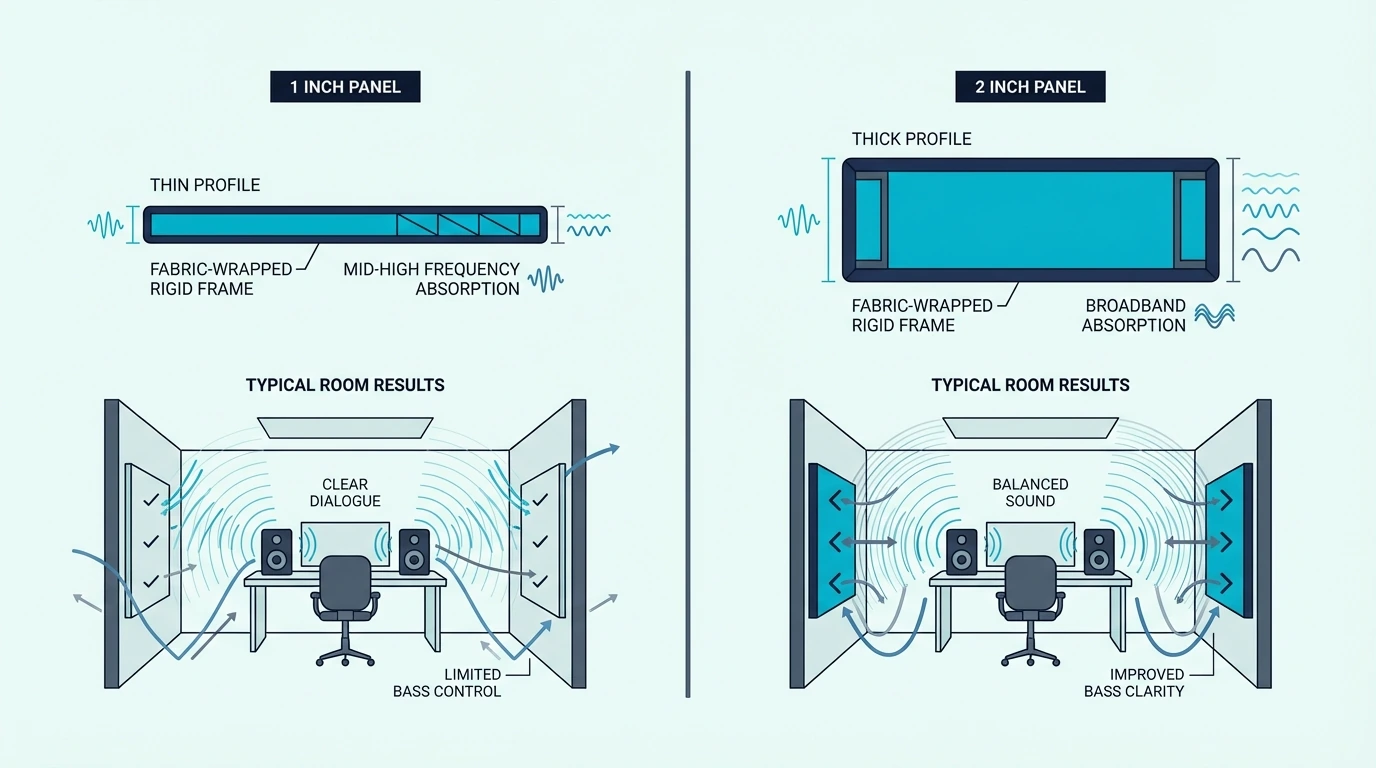
Is 1-inch foam enough for an apartment?

It can help with the sharpest reflections, but it’s limited. For most rooms, 2-inch foam is the more reliable “you’ll actually hear it” starting point.

Can I remove foam without damaging paint?

Yes if you use renter-friendly mounting and test your wall first. The biggest risks are aggressive adhesives and flaky paint, so a small test patch saves a lot of regret.
DIY Acoustic Foam Panels: Build Better Sound Treatment at Home

DIY acoustic foam panels can cost less than store-bought treatment — but only if you build them with the right core and thickness.

If your room still sounds hollow or “roomy,” thin foam is usually absorbing the easy highs while leaving the harder reflections and lower mids untouched.

Build simple mineral wool or rigid fiberglass panels so your recordings sound tighter and less reflective without covering every wall in foam.

Start with a basic 2×4 frame, choose a safe insulation thickness, then wrap it in breathable fabric.

Below is a step-by-step build (with cut list, insulation options, and mounting methods) so you can make panels that work and still look clean in your space.

Quick Takeaway

Build a 1×4 lumber frame, fill it with mineral wool or rigid fiberglass, and wrap it in breathable fabric (burlap, speaker cloth, or cotton). Each panel takes 30-60 minutes and costs roughly one-third to one-half of commercial panel prices. DIY mineral wool panels typically outperform common foam panels, especially when you build them thicker.

Why Build DIY Panels Instead of Buying Foam?

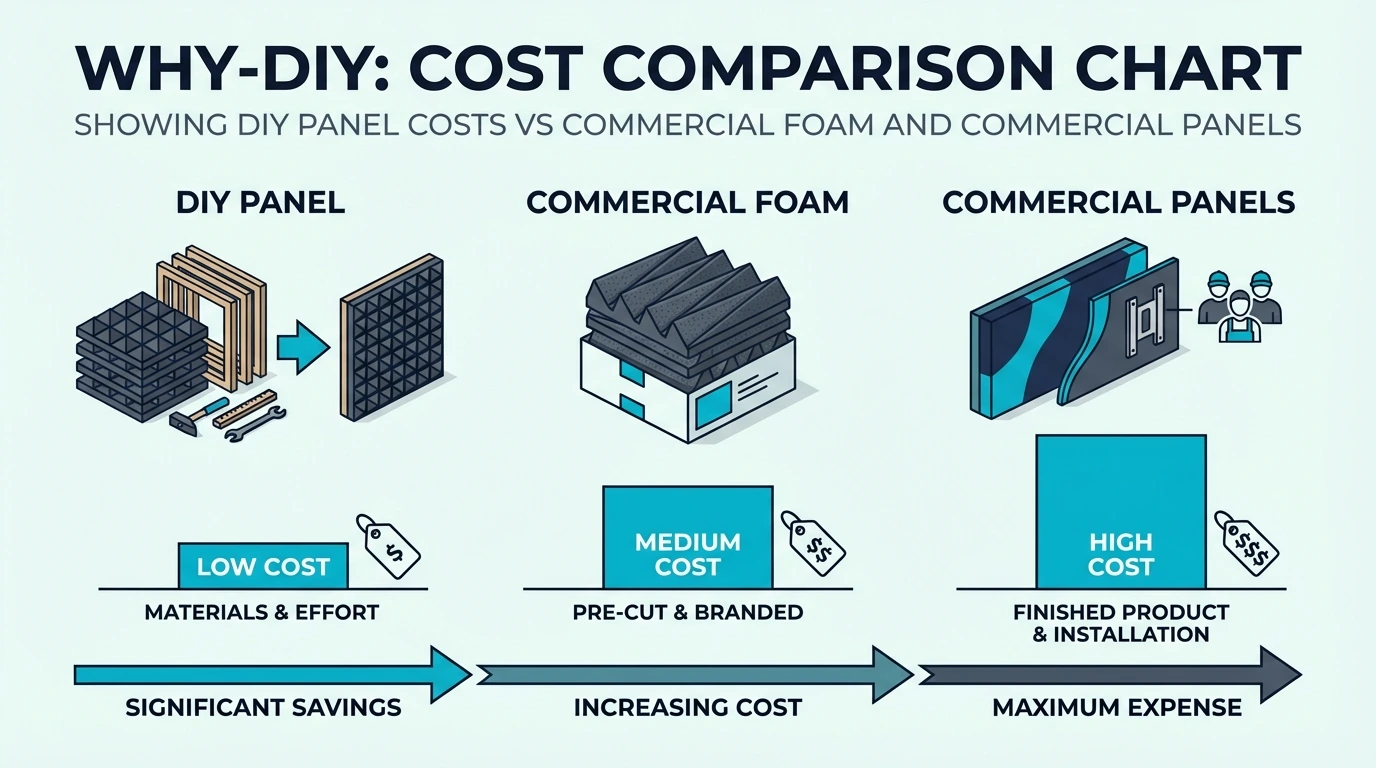
Cost comparison between DIY acoustic panels and commercial foam

DIY is mainly about performance per dollar.

Once you hear what a few panels do to the room, the time investment starts to make sense.

Superior Acoustic Performance

Commercial acoustic foam often improves higher-frequency reflections, but DIY panels built from dense fibrous cores can absorb more broadly and more effectively.

In practice, that means fewer “slap” reflections and less boxy room tone on recordings.

If you want the deeper explanation of why foam hits a wall (and what panels do differently), see how acoustic foam works.

The materials that make professional studio panels expensive—rigid fiberglass, mineral wool—are cheap when you buy them as insulation. You’re paying for the same materials, just without the markup.

Real Cost Savings

A commercial 2×4 foot acoustic panel can get expensive fast.

The same size DIY panel usually costs about one-third to one-half as much in materials.

For a whole room, the gap gets bigger.

Eight DIY panels often cost about what two or three pre-made panels run.

The time investment is real, so expect 30–60 minutes per panel.

If the savings matter more than the build time, DIY is the obvious trade.

Complete Customization

Commercial panels come in standard sizes.

DIY panels can be whatever size your room needs, including odd walls and awkward corners.

Fabric choice is basically unlimited.

You can match the room instead of settling for whatever color a brand sells.

Thickness is adjustable too.

If you want 4-inch panels, you can build them without paying the premium most brands charge.

For more background on what foam can and can’t do (and when panels make more sense), see does acoustic foam work.

For a direct comparison between foam and the mineral wool approach used in most DIY builds, see acoustic foam vs rockwool.

Materials You’ll Need

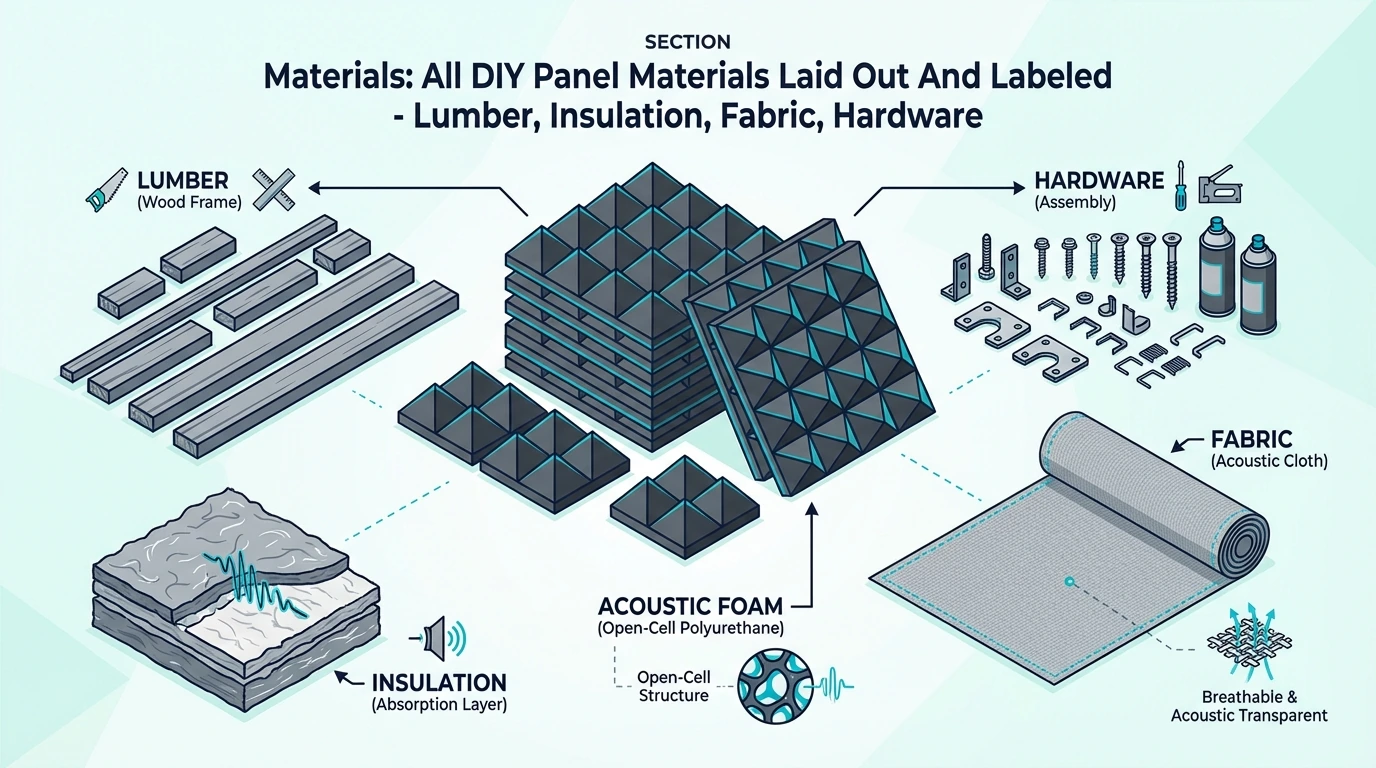
DIY acoustic panel materials including lumber, insulation, fabric, and hardware

Buying everything first saves you from the mid-build hardware-store run.

This is the short list you actually need.

Frame Materials

Lumber: 1×4 boards (actual dimension 0.75” x 3.5”) work well for 2-inch panels.

For thicker panels, use 1×6 or build up with multiple boards.

Fasteners: Wood screws, pocket screws, or corner brackets.

Pocket screws look cleaner but need a pocket hole jig, while butt joints work fine for most builds.

Wood glue: Optional but adds strength to joints. Any wood glue works.

Insulation Options

Mineral Wool (Recommended): – Mineral wool batts or rigid mineral wool board – Excellent absorption across frequencies – Fire resistant, moisture resistant – Easy to cut with bread knife or insulation knife – Slightly irritating to skin—wear gloves

If you want a rigid board that’s easy to frame and tends to perform well for broadband absorption, start with Rockwool ComfortBoard 80.

Rigid Fiberglass: – Industry standard for professional panels – Excellent absorption, especially 703 – More irritating than mineral wool—full PPE recommended – Requires fabric wrapping to contain fibers

Avoid: Soft fiberglass batts (pink insulation), foam board, polystyrene. These don’t provide adequate absorption.

To understand why foam behaves differently than fibrous insulation, see does acoustic foam work.

Fabric Selection

The fabric must be acoustically transparent—sound passes through it to reach the insulation. Test by holding fabric to your mouth and blowing; if air passes easily, sound will too.

Good options: – Acoustic panel fabric (made to stay breathable) – Burlap (cheap, effective, rustic look) – Speaker grill cloth – Breathable cotton or linen – Microfiber

Avoid: Vinyl, leather, tightly woven fabrics, anything that blocks airflow.

Tools Required

  • Saw (miter saw, circular saw, or hand saw)
  • Drill/driver
  • Staple gun with 3/8” or 1/2” staples
  • Measuring tape
  • Square
  • Scissors or rotary cutter for fabric
  • Safety equipment (gloves, mask, eye protection)

Building the Frame

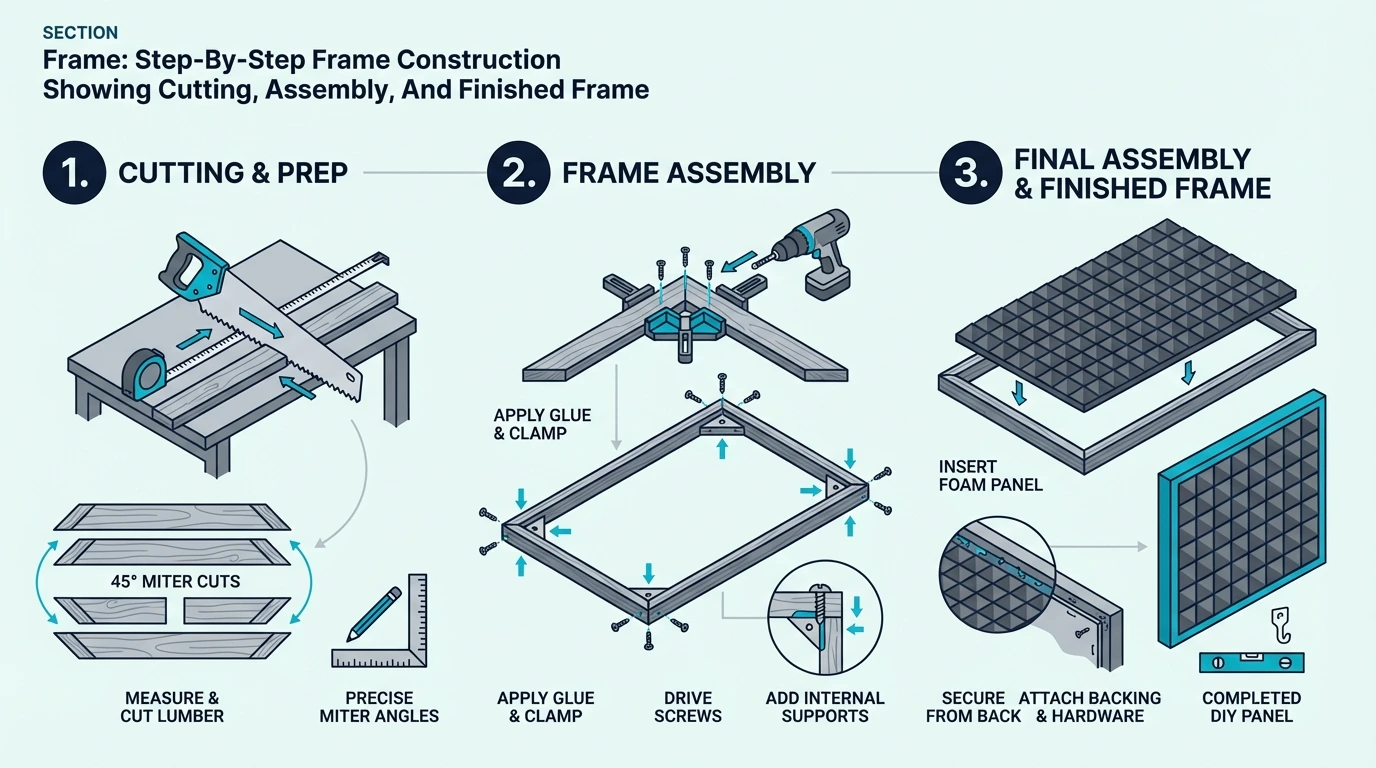
Step-by-step wooden frame construction for a DIY acoustic panel

The frame is just a shallow box that holds the insulation and gives you something to hang.

If you can cut straight and keep things square, you can build these.

Cutting the Lumber

For a 24×48 inch panel using 1×4 lumber: – Cut two pieces at 48 inches (long sides) – Cut two pieces at 22.5 inches (short sides, accounting for lumber width)

Measure twice, cut once.

Consistent cuts make the corners line up and keep the panel from twisting.

Assembly Methods

Butt joints (simplest): Position short pieces between long pieces.

Pre-drill to prevent splitting, then drive two screws through each joint.

Pocket screws (cleanest): Drill pocket holes in the short pieces, then clamp everything square.

Drive the pocket screws to pull the frame tight.

Corner brackets (fastest): Use metal corner brackets on the inside of each corner. Quick but visible if you look inside the panel.

Adding a Cross Brace

For panels larger than 24×24 inches, add a center cross brace to prevent warping.

Cut a piece to fit across the middle and secure it with screws or pocket holes.

The brace also helps hold insulation in place, especially with softer materials like mineral wool batts.

Frame Tips

  • Check for square before final tightening—measure diagonals, which should be equal
  • Sand any rough edges that might snag fabric
  • Consider painting or staining frames if edges will be visible
  • Build all frames at once for efficiency

Installing the Insulation

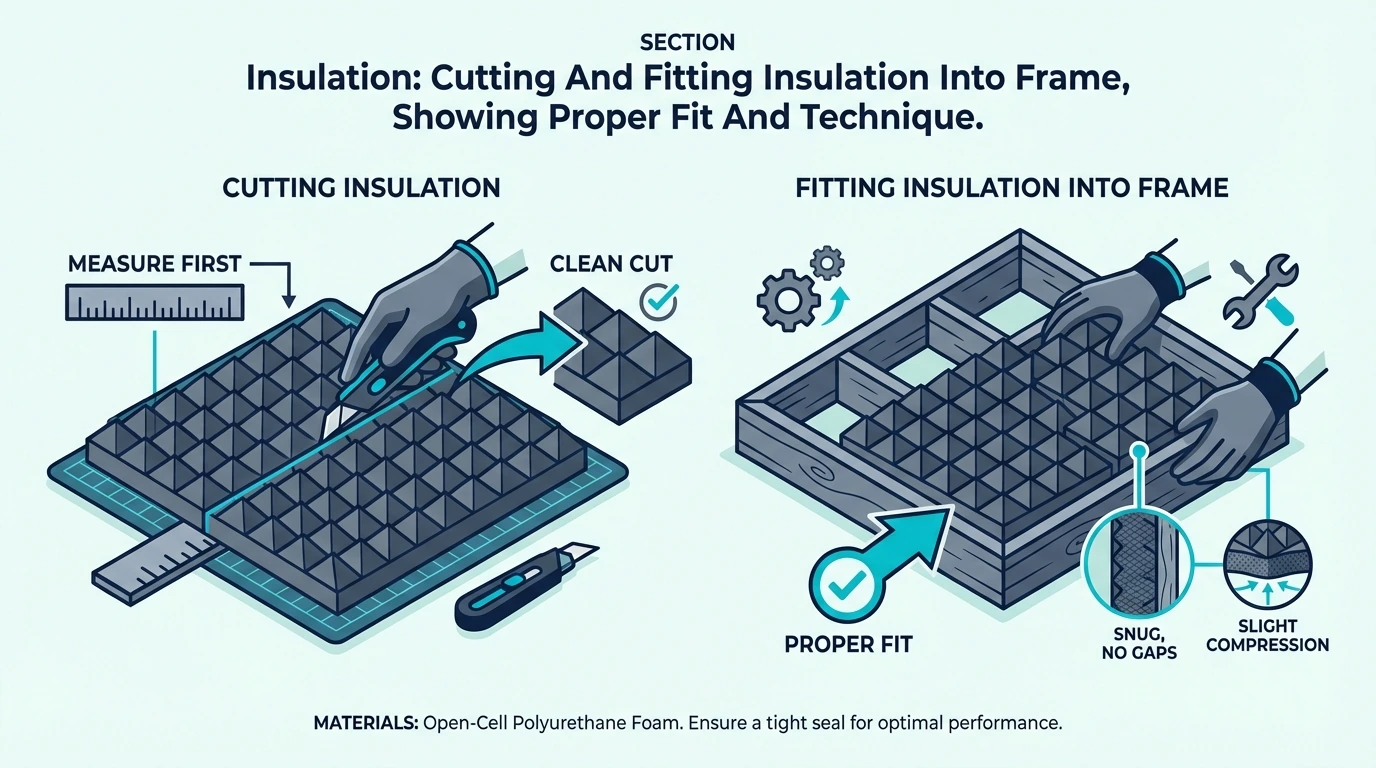
Insulation being cut and fitted inside an acoustic panel frame

Insulation is easy to install, but fit matters.

Gaps and sloppy edges are where performance drops.

Cutting Insulation

Mineral wool and rigid fiberglass cut easily with a long serrated knife (a bread knife works well) or a dedicated insulation knife.

Mark your cut line and use a straightedge as a guide.

Cut slightly oversized so it friction-fits without leaving gaps.

For mineral wool batts, you can often tear to size along the fibers rather than cutting.

Safety Precautions

Both mineral wool and fiberglass contain fibers that can irritate skin, eyes, and lungs:

  • Wear long sleeves and pants
  • Use work gloves
  • Wear safety glasses
  • Use N95 respirator or dust mask
  • Work in ventilated area
  • Shower after handling

The irritation is temporary but unpleasant.

Basic protection makes the whole build a lot more comfortable.

Fitting Insulation in Frame

Press the insulation into the frame.

It should fit snugly without being crushed.

If the insulation is loose and wants to sag, add a fabric backing or a simple backer.

You’re just trying to keep it from drooping over time.

For 4-inch panels, stack two 2-inch layers.

Stagger the seams between layers.

Proper arrangement matters as much as materials—see the how to arrange acoustic foam guide for reflection-point placement examples.

Wrapping with Fabric

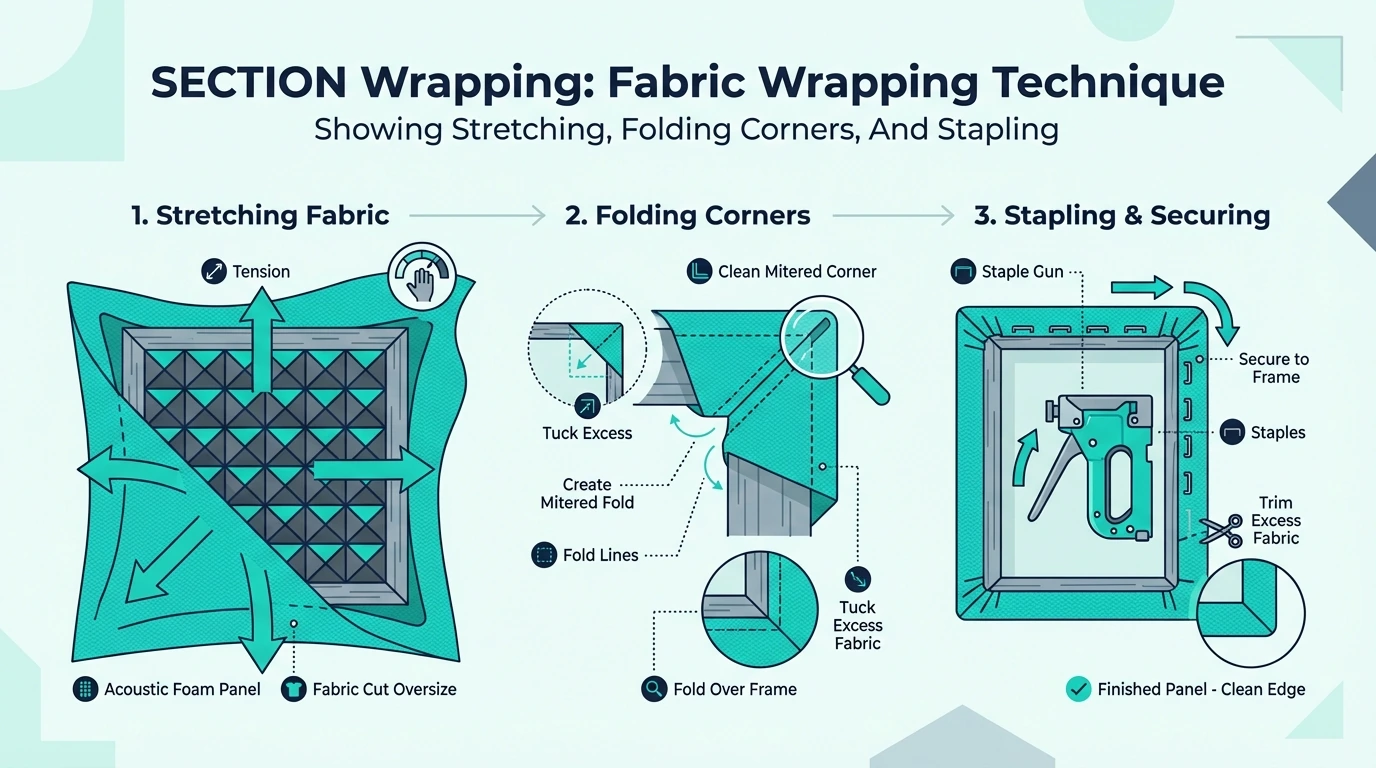
Fabric wrapping technique for DIY acoustic panel corners and staples

This is the step that turns “a box of insulation” into a panel you’ll actually want in the room.

Take a minute here and the finished panel will look clean.

Preparing the Fabric

Cut fabric 4-6 inches larger than the panel on all sides.

That gives you enough slack to pull it tight and staple the back.

Iron the fabric if it’s wrinkled.

Work on a clean surface so you don’t press dust into the face.

Wrapping Technique

  • Lay fabric face-down on a clean surface
  • Center the panel face-down on the fabric
  • Pull fabric taut over one long edge and staple every 2-3 inches
  • Pull the opposite long edge taut and staple (tight, but not bending the frame)
  • Repeat for the short edges
  • Fold corners neatly (like wrapping a gift) and staple

Aim for even tension.

Too loose looks saggy, and too tight can warp the frame.

Corner Folding

Hospital corners (like making a bed) create the cleanest look:

  • Fold the corner point toward the center
  • Fold one side over
  • Fold the other side over
  • Staple through all layers

Alternatively, pleat the excess fabric into a neat fold.

Either method works, so choose what suits the fabric.

Finishing the Back

The back doesn’t need to be pretty, but neat staples make it feel finished.

Some builders add a thin dust cover over the back to contain loose fibers.

If panels will be visible from behind (freestanding use), wrap the back with fabric too or add a finished backer board.

For fabric covering techniques on existing panels, see the how to decorate with acoustic foam guide for fabric covering techniques.

Mounting Your DIY Panels

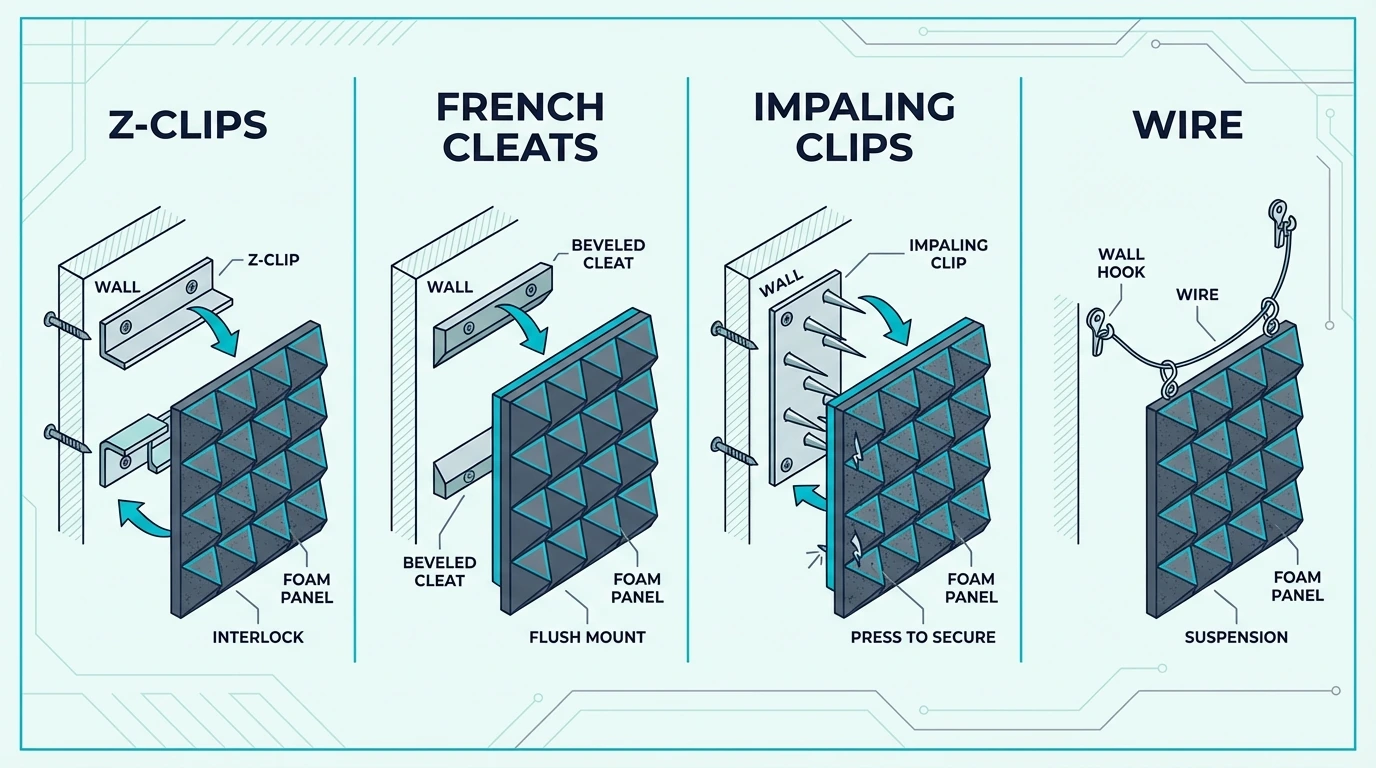
Mounting options for DIY acoustic panels including Z-clips and French cleats

Mounting is mostly about safety.

Use hardware you trust, especially for heavier panels.

Z-clips are interlocking brackets.

One half goes on the wall, the other goes on the frame, and the panel lifts on and off.

Attach the panel half to the frame’s top rail. Mount the wall half level where you want the panel.

Hang the panel by hooking the clips together.

They hold weight well and make it easy to reposition panels after you do a few test recordings.

French Cleats

French cleats are angled wooden strips that interlock. Cut a board at 45 degrees lengthwise, mount one piece to wall (angle pointing up), one to panel (angle pointing down).

If you want the “buy it once” version without cutting your own cleat, French Cleat Aluminum Z-Hangers are a simple alternative.

French cleats are strong, adjustable side-to-side, and can be made from scrap lumber. They’re slightly more visible than Z-clips but completely DIY-able.

Impaling Clips

Impaling clips are metal plates with sharp points.

Mount the clips to the wall, then press the panel onto the points. They grab the frame or insulation.

For a multi-panel install, Surface Mount Impaler Panel Hardware (36 Pack) is a fast option.

They work for lighter panels.

For heavier 4-inch builds, cleats and Z-clips are the safer bet.
Wire Hanging

Picture wire attached to eye hooks works for lighter panels.

It’s adjustable, but panels can shift more than they do with clips.

For detailed mounting guidance, see the how to put acoustic foam on walls guide.

Cost Breakdown: DIY vs Commercial

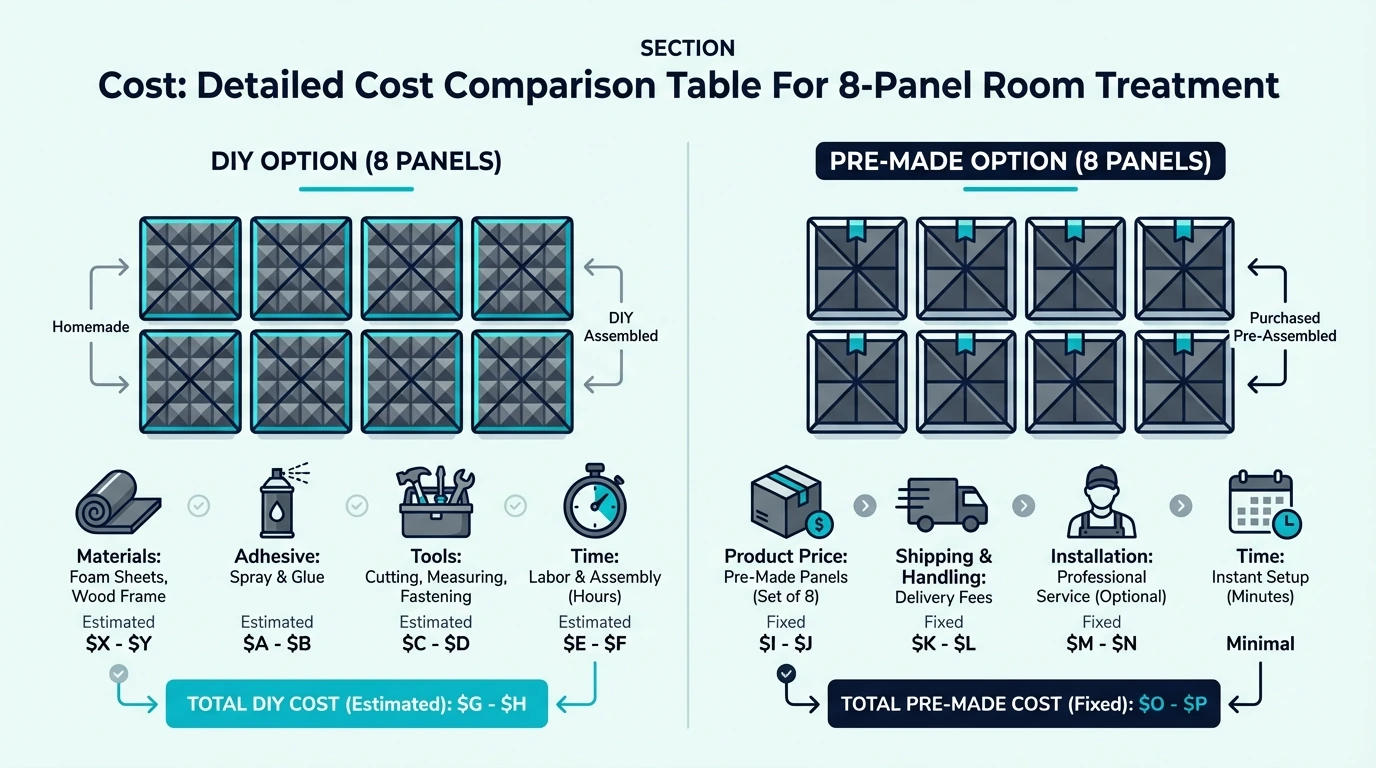
Cost table for treating a room with eight DIY acoustic panels

Here’s what it usually looks like for an 8-panel setup.

DIY Panel Costs (8 panels)

Material Quantity Approximate Cost
1×4 lumber 80 linear feet Variable
Mineral wool batts 2 bags Variable
Fabric (6 yards) 1 bolt Variable
Screws, staples 1 box each Variable
Z-clips 8 pairs Variable
TotalRoughly 1/3 to 1/2 of commercial

Commercial Panel Costs (8 panels)

Quality commercial panels cost considerably more per panel.

Eight panels usually comes out to several times the DIY total.

Commercial Foam Costs (Equivalent Coverage)

Budget foam panels cost less per unit but typically require more coverage to get similar reflection control, and the absorption bandwidth is different.
The Verdict

DIY panels cost roughly one-third to one-half of commercial panels with equal or better performance. The savings fund additional panels, bass traps, or other studio improvements.
If you’re curious why finished panels carry higher price tags, see why acoustic panels are so expensive.

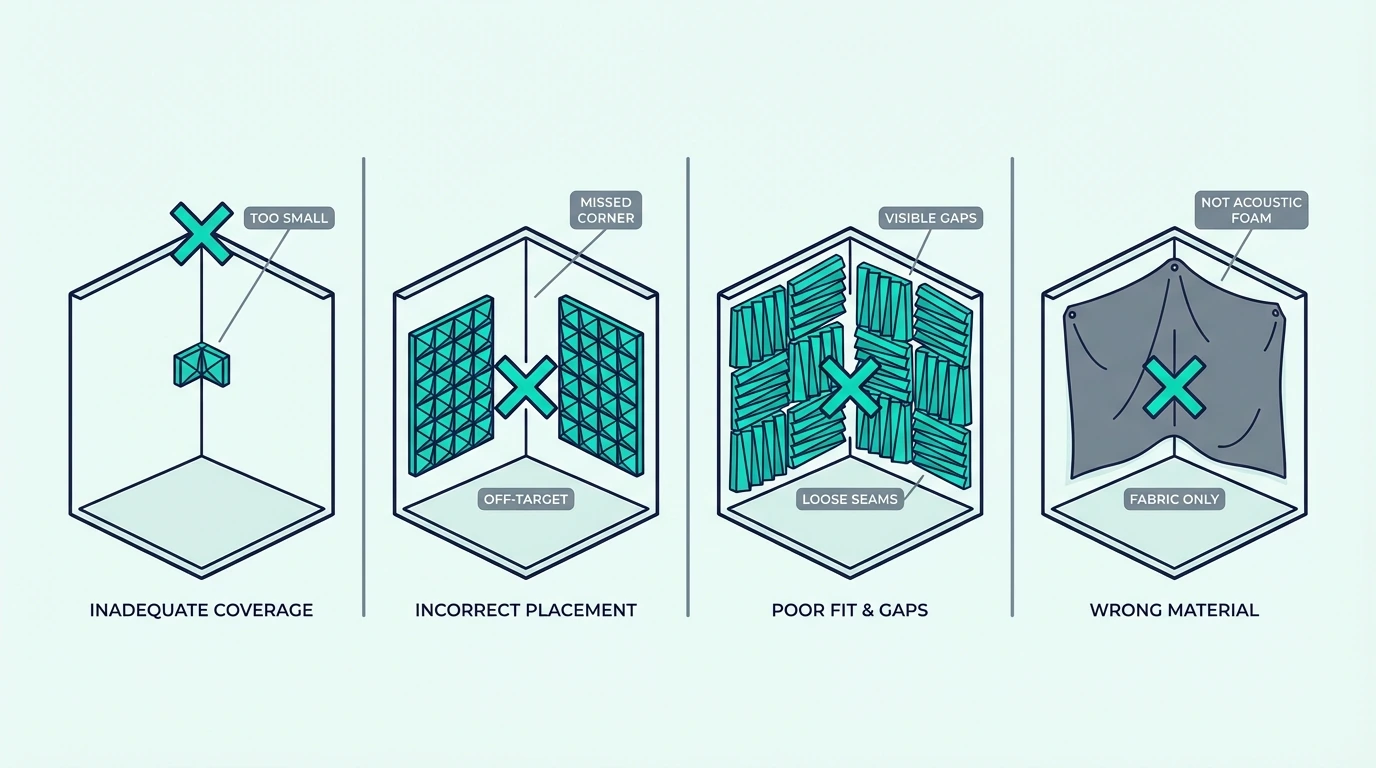
Common DIY Mistakes to Avoid

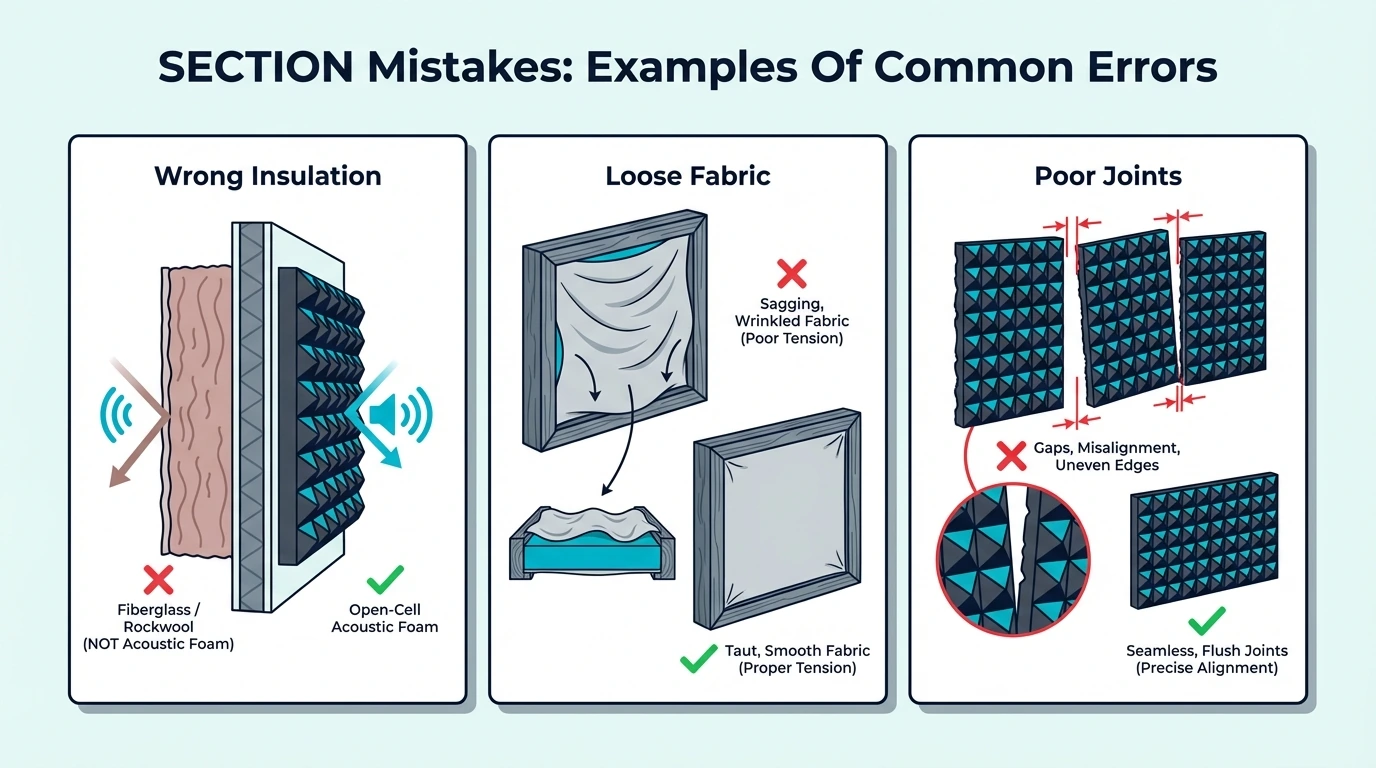
Common DIY acoustic panel mistakes including loose fabric and poor joints

Most DIY panel problems come from the same handful of mistakes.

Avoid these and your first set will come out clean.

Using Wrong Insulation

Soft fiberglass batts compress too easily and don’t absorb the same way.

Foam board and polystyrene reflect more than they absorb.

Stick with mineral wool or rigid fiberglass. These materials are specifically effective for sound absorption.

Fabric Too Tight or Loose

Over-tensioned fabric warps frames and creates stress points that may tear. Under-tensioned fabric sags and looks unprofessional.

If you’re unsure, do a quick test wrap on a scrap frame.

You’re aiming for taut, not stressed.

Gaps in Insulation

Gaps between insulation and frame reduce effectiveness. Sound passes through gaps without being absorbed.

Cut insulation slightly oversized for friction fit. Fill any gaps with scraps.

Skipping Safety Gear

The irritation is real.

The few minutes saved by skipping protection aren’t worth hours of itching.

Always wear gloves, long sleeves, eye protection, and a dust mask when handling insulation.

Frames Not Square

Out-of-square frames look bad and don’t hang properly. Always check diagonals before final assembly.

Variations and Advanced Builds

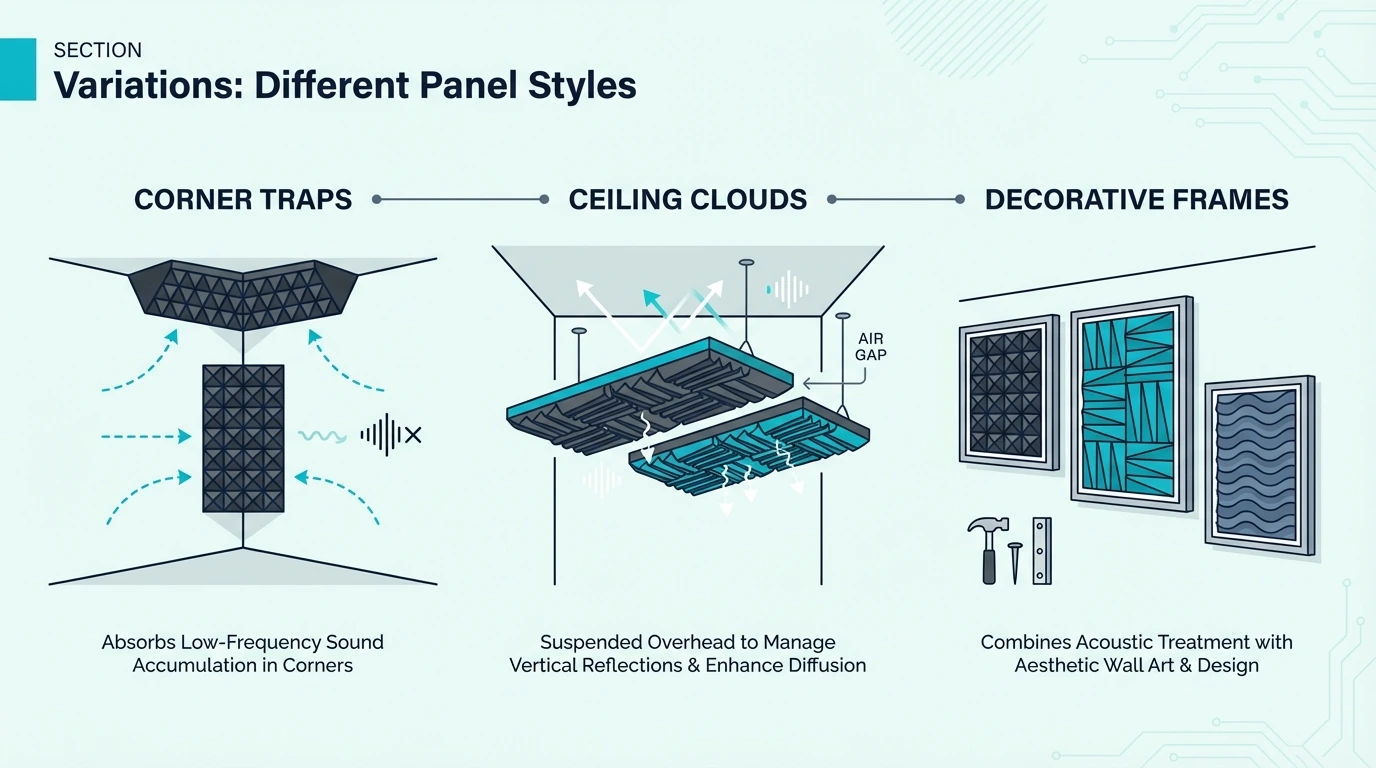
DIY acoustic panel variations including corner traps and ceiling clouds

If you like what panels do for your room, these are the next builds people usually add.

Pick the one that matches the reflection you’re still hearing.

Corner Bass Traps

Build triangular frames that fit across room corners. Fill with thicker mineral wool for low-frequency absorption.

Corner traps address bass problems that flat wall panels can’t solve. They’re critical for complete room treatment.

For more on bass treatment, see acoustic panels vs bass traps.

Ceiling Clouds

Build standard panels but add hanging hardware instead of wall mounts. Suspend from ceiling using wire or chain.

Ceiling clouds are great if your room sounds bright or “tappy” from above.

They also clean up overhead reflections in small rooms.

Decorative Frames

Add decorative molding to frame edges for a high-end look. Paint or stain frames to match room décor.

You can use prints or patterns.

Panels don’t have to look like studio gear.

Portable Gobos

Build panels with legs or casters for moveable treatment. Useful for recording different instruments in different positions.

The Bottom Line

DIY panels are one of the cheapest ways to make a room sound less reflective.

Mineral wool or fiberglass in a simple frame, wrapped in breathable fabric, is enough for most home setups.

Build one first.

Once you have your workflow down, batch-building the rest is much faster.

Compared to thin foam, panels absorb more broadly.

That’s why a few panels can do more than covering a wall with 1-inch tiles.

If you can spare a weekend, DIY panels are usually the best move.

The savings can go into more panels, bass traps, or a better mic. For a broader overview of acoustic treatment options, see the acoustic treatment hub.

Frequently Asked Questions

How long does it take to build DIY acoustic panels?

Expect 30-60 minutes per panel once you have materials ready and a basic system.

The first panel usually takes longer, and batching steps (frames first, then insulation, then wrapping) speeds things up.

What’s the best insulation for DIY acoustic panels?

For most DIY builds, a rigid mineral wool board like Rockwool ComfortBoard 80 is a solid starting point.

Mineral wool batts and rigid fiberglass can work too, but fiberglass is usually more irritating to cut and handle. For store-bought alternatives, see the best acoustic foam panels guide.

Can I use regular home insulation for acoustic panels?

Soft fiberglass batts (pink insulation) compress too easily and don’t hold their shape.

Use mineral wool or rigid fiberglass products that stay firm inside a frame.

How do DIY panels compare to commercial acoustic foam?

DIY mineral wool panels generally absorb more broadly than common foam. They also tend to be more effective in the low-mids that thin foam often misses.

What fabric works best for acoustic panels?

Any acoustically transparent fabric works, so test by blowing through it.

Burlap, speaker grill cloth, and breathable cotton or linen are common choices, and vinyl/leather/tight weaves should be avoided.

Do I need special tools to build acoustic panels?

Basic tools are enough: a saw (any type), drill, staple gun, measuring tape, and scissors.

A miter saw and pocket hole jig help, but the most important “tool” is proper safety gear for handling insulation.

Can You Put Acoustic Foam in the Dryer? Why Heat Ruins Panels

If your acoustic foam got wet and your first instinct is “throw it in the dryer,” don’t. A dryer is one of the fastest ways to permanently deform foam, because heat softens polyurethane and tumbling tears the shapes that help panels absorb reflections in your room.

The better path is boring but safe: remove as much water as you can, then dry with airflow and time. You’ll find what goes wrong in a dryer, what to do right away, and how to dry panels without inviting mold.

The steps below start with why dryers are dangerous for foam, then walk you through the drying method that keeps panels usable.

Quick Takeaway

Can you put acoustic foam in the dryer? No. Heat can soften polyurethane foam, and tumbling can tear or crease panels so they never sit flat again.

Do this instead: gently press out water with towels, then air-dry with strong airflow (a fan helps). In humid homes, a dehumidifier can make the difference between “dries in time” and “starts smelling musty.”

Why Do Dryers Damage Acoustic Foam?

Heat-damaged acoustic foam showing warping and breakdown

A dryer hits foam with two things it hates: heat and mechanical abuse. Either one can ruin a panel; together they almost guarantee it.

Heat Softens Foam (And Can Change How It Absorbs)

Most acoustic foam is polyurethane, and it softens when it gets warm. In a dryer, that can lead to warping, shrinkage, or hardened spots once it cools.

Even if the panel still looks “fine,” heat can deform the open-cell structure that does the absorbing. That’s why “it survived the cycle” doesn’t necessarily mean “it performs the same.”

Tumbling Tears and Creases Panels

Heat isn’t the only problem. Tumbling slams the foam around and compresses it over and over.

Wedges and pyramids snap, edges tear, and panels can come out with permanent folds that won’t mount flat. Even on “no heat,” the mechanical action alone can destroy foam.

You Can Also Damage Your Dryer

The risk isn’t just to the foam. If foam softens or sheds bits, it can smear onto the drum, clog the lint path, or leave residue that transfers to clothes.

That’s a messy cleanup at best and a safety risk at worst. Saving a few panels isn’t worth turning your dryer into a project.

Fire Safety Still Matters

Polyurethane is combustible, and a dryer is already a heat + lint environment. Even “fire retardant” foam isn’t “dryer safe” foam.

If you want the bigger picture on ratings, materials, and safe use, read whether acoustic foam is dangerous.

What Happens When Acoustic Foam Gets Wet?

Saturated acoustic foam panel showing how water fills the material

Water doesn’t automatically “kill” acoustic foam. The real risk is what happens while it stays wet: trapped moisture, musty odors, and mold.

Open-Cell Foam Holds Water (Just Like It Holds Air)

Acoustic foam is open-cell, which is why it absorbs reflections in the first place. That same structure also soaks up water, and a panel can hold a surprising amount.

What’s Temporary vs What Becomes Permanent

While it’s wet, foam won’t absorb sound properly because the cells are full of water instead of air. Once it’s fully dry, it usually returns to normal unless it was heat-damaged or started breaking down.

The permanent problems tend to be biological and structural: mold growth, deep musty smell that won’t leave, crumbling foam, or adhesives failing behind mounted panels.

Time Matters (Especially in Humid Rooms)

The longer foam stays wet, the higher the risk of permanent damage. In warm, humid conditions, mold can start within a day or two, so the best move is to start drying immediately.

Understanding foam composition helps explain why water is problematic—see our guide on what type of foam is acoustic foam.

How Do You Dry Acoustic Foam Safely?

Air drying acoustic foam panels with space for airflow

The goal is to remove moisture without stressing the foam, then keep air moving until the core is dry. If you do that, most panels recover just fine.

Step 1: Get Water Out (Without Wringing)

Start by taking panels off the wall if they’re mounted. Trapped moisture behind foam is one of the fastest ways to end up with mold.

Lay the foam between clean towels and press evenly to wick water out. Don’t twist, wring, or crush it, because that can permanently crease the material.

Step 2: Air-Dry With Space and Airflow

Dry foam in a well-ventilated room where air can reach both sides. A drying rack, spaced slats, or propping panels on their edges works better than laying them flat on a solid surface.

Skip direct sunlight for long periods, because UV slowly ages foam and can make it brittle. Indirect light is fine.

Step 3: Add a Fan (Cool Only)

A standard fan is the safe “speed boost” because it adds airflow without heat. If you want faster drying than a box fan, a compact air mover like XPOWER P-80 air mover fan pushes a lot of airflow across the surface.

Avoid hair dryers, heated fans, or putting foam near heaters. Hot air feels “efficient,” but it’s the same risk profile as a dryer in miniature.

Step 4: Use a Dehumidifier in Humid Rooms

If your home is humid, a small dehumidifier like TABYIK 35oz dehumidifier can be the difference between “dries in time” and “starts smelling musty.” Put the foam in a smaller room, run the dehumidifier, and keep air circulating with a fan.

When Is It Safe to Reinstall?

Lightly damp foam can dry in a day, but saturated or thick foam can take several days. Don’t remount until it feels dry through the middle and smells neutral.

If you’re unsure, give it an extra 12–24 hours. Remounting “almost dry” foam is how you end up with a musty smell that never quite leaves.

How Can You Prevent Acoustic Foam From Getting Wet?

Ways to protect acoustic foam from spills, leaks, and humidity

Once you’ve dealt with wet foam once, prevention starts to feel very worth it. Most water damage is predictable, which means it’s avoidable.

Keep Foam Away From Obvious Water Risks

Avoid installing foam under leaky windows, near plumbing, or in rooms that stay humid without ventilation. Also be honest about your space: if you regularly eat or drink at your desk, treat the wall behind it like a splash zone.

Use a “Sacrificial Layer” When You Need Protection

If you’re worried about spills, mounting foam to a removable backing board can help, because you can take the whole piece down to dry. Fabric covers can also reduce direct splashes, as long as they’re breathable so moisture doesn’t get trapped.

If a room is consistently damp, the better fix is humidity control, not trying to make foam “waterproof.” If you’re not sure how humid the room runs, a cheap hygrometer like TempPro TP50 hygrometer (2-pack) makes it obvious.

Clean Foam Without Soaking It

Vacuuming with a brush attachment handles most dust and keeps foam from becoming a sponge. If you need spot cleaning, use a barely damp cloth and let the area dry fully before you leave it mounted.

Our how to put acoustic foam on walls guide includes mounting and care tips that help prevent moisture getting trapped behind panels.

For regular maintenance that avoids water entirely, see our how to clean acoustic foam guide.

Should You Replace Wet Acoustic Foam or Try to Save It?

Wet acoustic foam comparison: salvageable vs replacement needed

Most wet foam can be saved if you start drying quickly and it dries clean. The decision usually comes down to mold risk and whether the foam’s structure still feels normal.

When It’s Worth Saving

Try to salvage the foam if the water exposure was brief, you started drying the same day, and the panel dries without a persistent musty smell. Foam that’s still springy, returns to shape, and smells neutral is usually fine to keep using.

When Replacement Is the Safer Call

Replace the foam if you see visible mold, it keeps smelling musty after drying, or the panel feels hardened, warped, or crumbly. If you accidentally ran it through heat and it no longer compresses and rebounds normally, it’s unlikely to perform the same.

The Practical Cost Reality

If you’re using budget foam, replacement often makes more sense than days of “maybe it’s okay.” If you’re upgrading anyway, our best acoustic foam for recording guide can help you choose a better set.

If you’re unsure whether you’re dealing with water damage or age-related breakdown, see whether acoustic foam gets old. For a broader look at foam drawbacks, our cons of acoustic foam guide covers all nine limitations.

What Should You Do If Acoustic Foam Gets Moldy?

Identifying and handling mold on acoustic foam panels

If foam smells musty after drying, treat it like a mold problem even if you can’t see obvious spots yet. The sooner you act, the better the odds you can safely salvage it.

How to Tell if It’s Mold

Common signs are a persistent musty smell, discoloration, or fuzzy/powdery patches (often black, green, or white). If you’re unsure, trust the smell, because mold can start inside the foam where you can’t see it.

If It’s a Small Surface Patch

Take the foam outside and wear a mask, because brushing can kick spores into the air. Gently remove loose growth, wipe or mist with diluted white vinegar, then let the panel dry completely with strong airflow.

Avoid leaving foam in harsh sun for hours, because UV ages foam over time. A short period outdoors for airflow is fine, but finish drying in a ventilated spot out of direct sun.

If It’s Widespread or Keeps Coming Back

If mold is spread across the panel, keeps returning, or the smell won’t leave, replacement is usually the safer call. Mold can penetrate the foam structure, and “looks clean” doesn’t always mean “is clean.”

Fix the Moisture Source

Whether you salvage or replace, fix the leak, spill pattern, or humidity issue that caused the problem. Otherwise the next set of panels can end up in the same cycle.

Conclusion

Don’t put acoustic foam in the dryer, even on low heat. Heat can deform polyurethane and tumbling can tear the shapes that help panels mount and perform properly.

Save panels by pressing out water with towels, then drying with airflow until the core is dry. A fan and (if needed) a dehumidifier are safe ways to speed the process up.

If foam smells musty, shows mold, or feels warped or hardened, replacement is usually the safer call. Going forward, keep foam away from spill zones and clean it with dry methods first.

Frequently Asked Questions

Can I use a hair dryer on acoustic foam?

Avoid it, because concentrated hot air can soften and warp foam even on low. Use a cool fan instead.

How long does acoustic foam take to dry?

Most panels dry in 24–72 hours depending on thickness, humidity, and airflow. Wait until it feels dry through the core, not just dry on the surface.

Will wet acoustic foam still work?

While wet, foam absorbs poorly because water blocks airflow inside the cells. Once fully dry, it usually returns to normal unless it warped, hardened, or grew mold.

Can I wash acoustic foam?

Full washing soaks the foam and raises mold risk, so it’s usually not worth it. Vacuum first, then spot-clean with a barely damp cloth and dry immediately.

What if my foam smells musty after drying?

A lingering musty smell usually means mold or mildew inside the foam. If vinegar plus thorough drying doesn’t clear it, replace the panel.

Can I put foam in the sun to dry faster?

Brief sun exposure is fine, but avoid hours of direct UV because it ages foam over time. Dry with airflow in shade and bring it inside once surface-dry to finish without baking it.

Can Acoustic Foam Get Old? Lifespan, Degradation & When to Replace [2026]

Can acoustic foam get old—yes, but it doesn’t just fade; it can go from “fine” to brittle dust once the cells start breaking down.

If your panels are yellowing, smelling musty, or leaving residue on your fingers, you’re already seeing the first failure modes.

Below, you’ll learn what actually causes foam to degrade, how long different foam types tend to last, and how to decide whether to keep, patch, or replace.

We’ll start with the biggest accelerators (sunlight and humidity), then walk through a quick replace-vs-keep decision flow.

Quick Takeaway

Acoustic foam degrades over time—especially cheap polyurethane exposed to sunlight and moisture. If it’s brittle, crumbling, permanently compressed, or smells moldy, replacement is usually the right call; mild yellowing alone usually isn’t.

How Acoustic Foam Ages

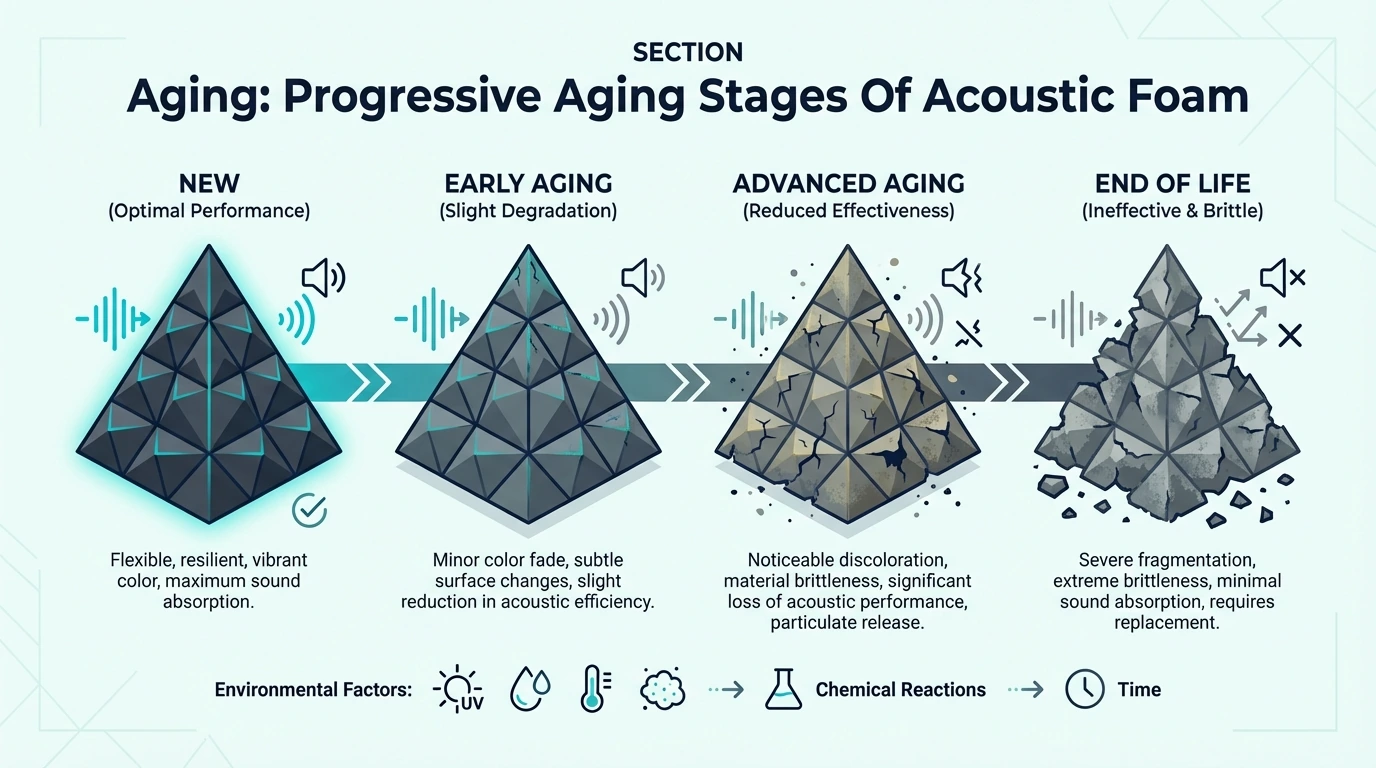
Progressive aging stages of acoustic foam over time

Foam “aging” is mostly chemistry plus stress. The cells that make foam absorb sound also make it vulnerable to UV, moisture, and repeated compression.

UV degradation (sunlight)

UV light breaks down polyurethane chains, which is why foam near windows yellows first. Once the surface turns brittle, the cell structure starts collapsing and absorption drops.

Even indirect light adds up over years. If you can’t move the foam, treat sunlight like a slow leak—control it or expect faster replacement.

Oxidation (air exposure)

Foam also oxidizes just from being exposed to air over time. You’ll often see this as gradual stiffening and loss of “spring,” even in a darker room.

Oxidation is slower than UV, but it’s inevitable. That’s why a decade-old foam panel can feel “dry” even if it was never in direct sun.

Humidity and temperature swings

Moisture doesn’t just cause mold—it stresses the foam structure through wet/dry cycles. High humidity can also make adhesives fail, which leads to panels sagging or tearing during removal.

If your foam ever gets damp, dry it fully and fast to avoid odor and mold. Use the safe process in acoustic foam dryer rather than leaving damp foam on a wall.

Physical wear (touching, cleaning, moving)

Foam degrades faster when it’s constantly pressed, brushed, or remounted. Oils from hands and aggressive cleaning can also change the surface texture and speed up breakdown.

If you’re cleaning foam, be gentle and keep expectations realistic. Cleaning removes dust, but it doesn’t “restore” collapsed cells.

Lifespan by Foam Type

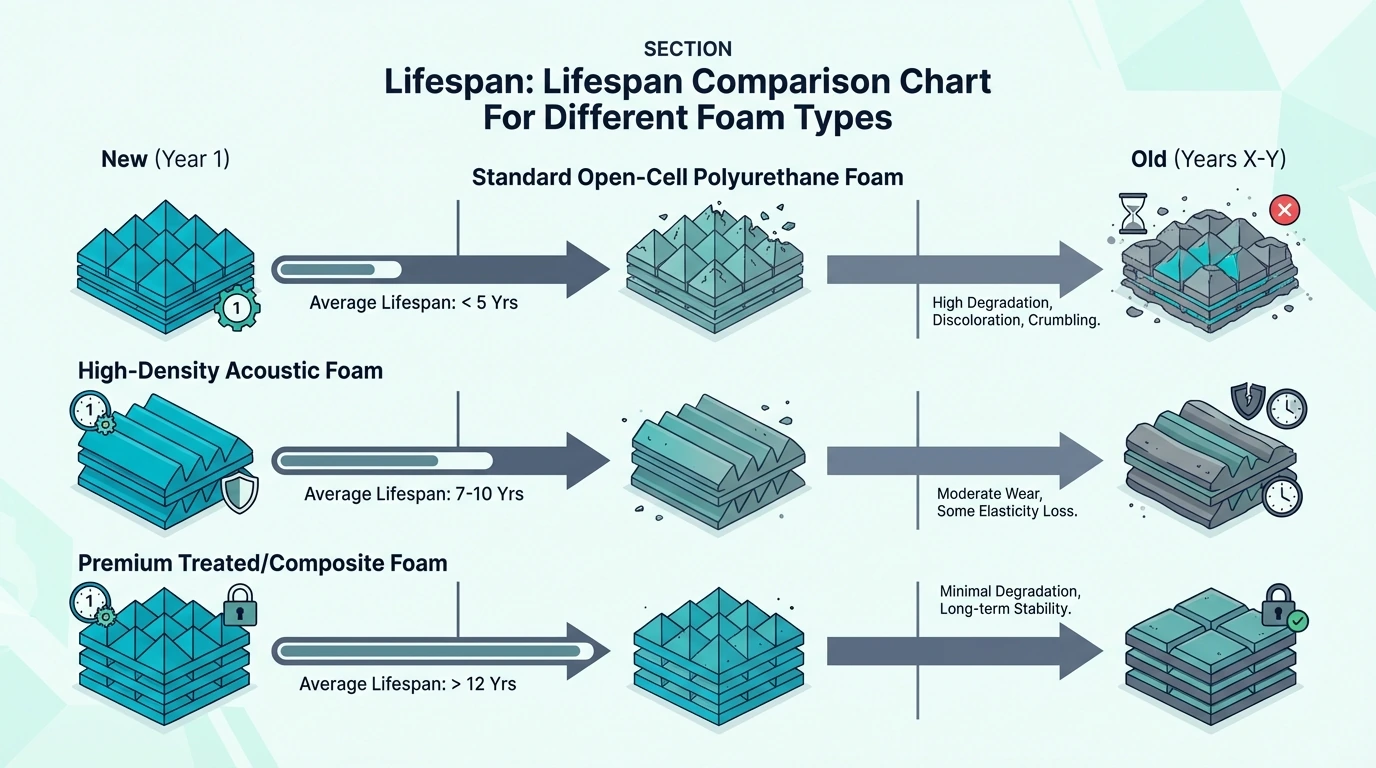
Lifespan comparison chart for different acoustic foam types

There isn’t one universal lifespan, because “acoustic foam” includes a lot of very different materials and manufacturing quality. The range is mostly driven by density, stabilizers, and what kind of environment the foam lives in.

If you’re still building your first treatment plan, start with the acoustic foam hub. It’ll help you separate “echo control” problems from “bass” problems before you spend money.

Budget polyurethane foam

Budget foam often lasts a few years before it starts getting brittle or losing shape, especially if it’s thin. The common pattern is cosmetic yellowing first, then soft crumbling at edges and corners.

If you bought foam that felt extremely light and spongy out of the box, expect a shorter lifespan. It’s not always “bad,” but it’s not built for long service life.

Higher-quality polyurethane foam (Auralex-class)

Higher-quality foam typically holds up longer because the cell structure is more consistent and the foam is less fragile. In practice, it tends to stay springy longer and sheds less dust as it ages.

If you’re replacing foam and you want something that feels less disposable, quality matters more than shape. Start with the buying checklist in how to choose acoustic foam.

If you’re not sure what kind of foam you have, acoustic foam materials can help you identify the common types and what they’re good at.

Melamine foam (stable, long-lived)

Melamine foam is generally more stable than cheap polyurethane. It’s also commonly chosen when safety and longevity matter, because it’s less prone to the “crumbly sponge” failure mode.

If your room is harsh and reflective, melamine can be a smart upgrade. It still won’t solve bass like a thick panel, but it ages more gracefully than bargain foam.

Fabric-wrapped panels (not foam, but worth mentioning)

If you’re tired of replacing foam, fabric-wrapped panels are the “buy once” alternative. The core doesn’t degrade the same way, and even the fabric can often be refreshed later.

If you’re considering switching, compare outcomes in acoustic foam vs acoustic panels. That page helps you decide whether you’re actually trying to fix echo, bass, or both.

Signs Your Foam Needs Replacement

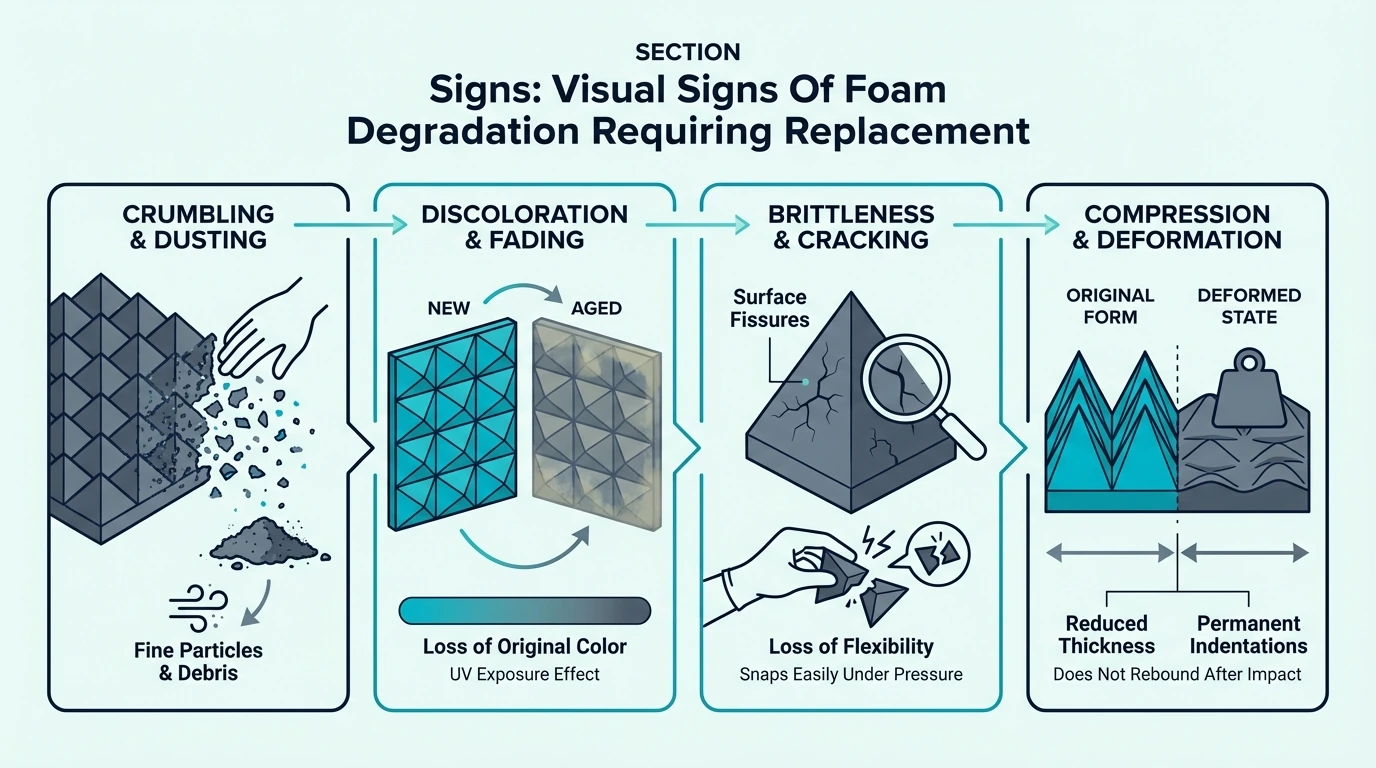
Visual signs of acoustic foam degradation that require replacement

The most important question is simple: does the foam still behave like foam? Color is a clue, but structure is the real test.

Cosmetic changes (often OK)

Light yellowing is common and doesn’t automatically mean “replace.” If the foam is still flexible and springs back when you press it, it’s usually still doing its job.

Structural failure (replace)

If foam crumbles when you touch it, flakes at the edges, or leaves powder behind, it’s past the useful stage. At that point, it’s also harder to remove cleanly without damaging your wall.

Permanent compression is another strong replacement signal. If the foam stays dented or feels “dead,” the cells that absorb sound have already collapsed.

Smell and health signals (replace)

Musty odor usually means moisture got into the foam and mold is possible. If the smell persists after drying and gentle cleaning, replacement is safer than trying to salvage it.

Chemical or “old sponge” odor can also show breakdown. The room shouldn’t smell like the treatment.

Extending Foam Lifespan

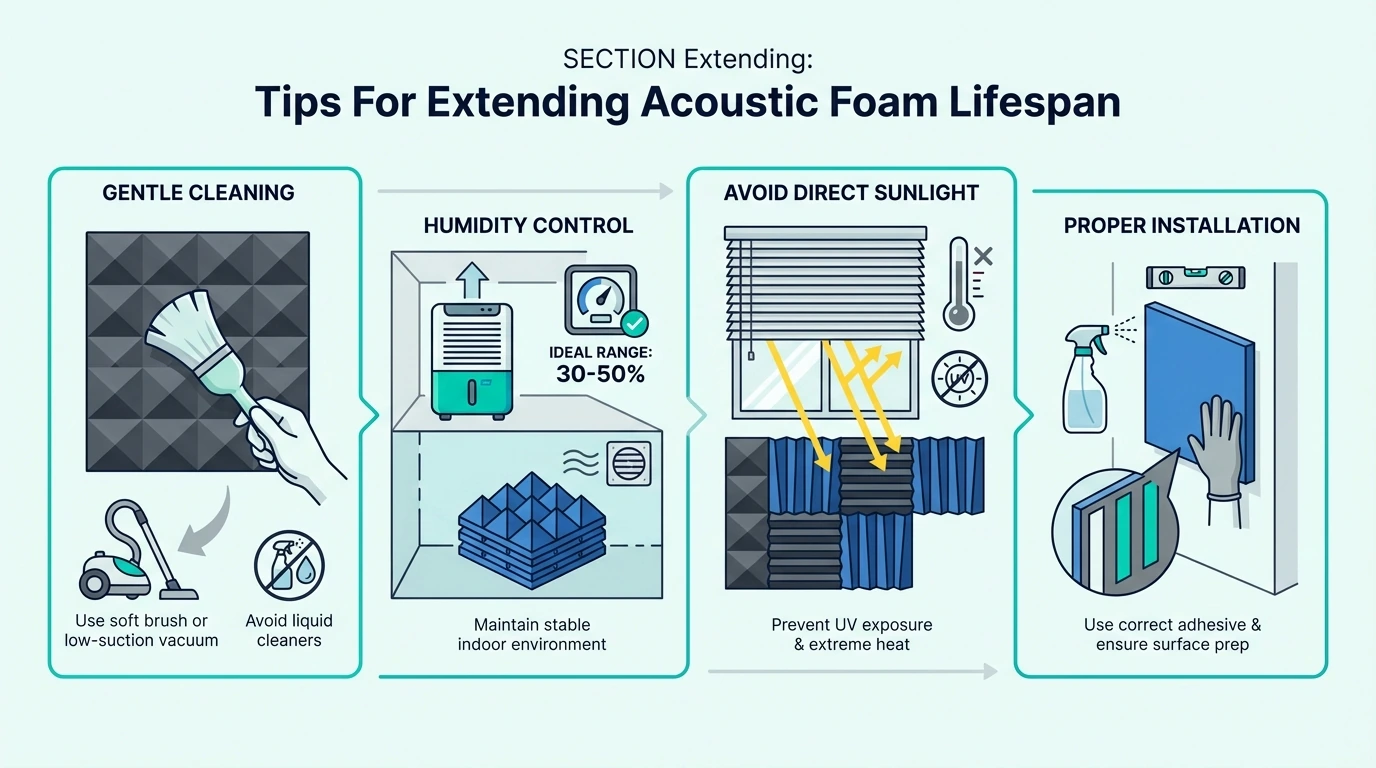
Tips for extending the lifespan of acoustic foam

The goal is to reduce the three accelerators: UV, moisture, and wear. You won’t make foam immortal, but you can stop “fast failure.”

Keep foam out of sunlight

Move foam away from windows whenever possible. If the room has strong sun, use curtains or UV film so the foam isn’t cooking slowly every afternoon.

Control humidity and airflow

Foam lasts longer in a stable, dry environment. If you’re dealing with damp walls, leaks, or frequent condensation, fix that first or you’ll keep replacing foam forever.

Install in a way you can remove cleanly

Bad mounting accelerates aging because panels tear and deform during removal. Use methods that don’t rip foam apart and keep the wall surface intact.

If you’re re-mounting or replacing panels, use the safest approach in acoustic foam wall install so you don’t turn “replacement” into a drywall repair project.

When to Replace vs Repair

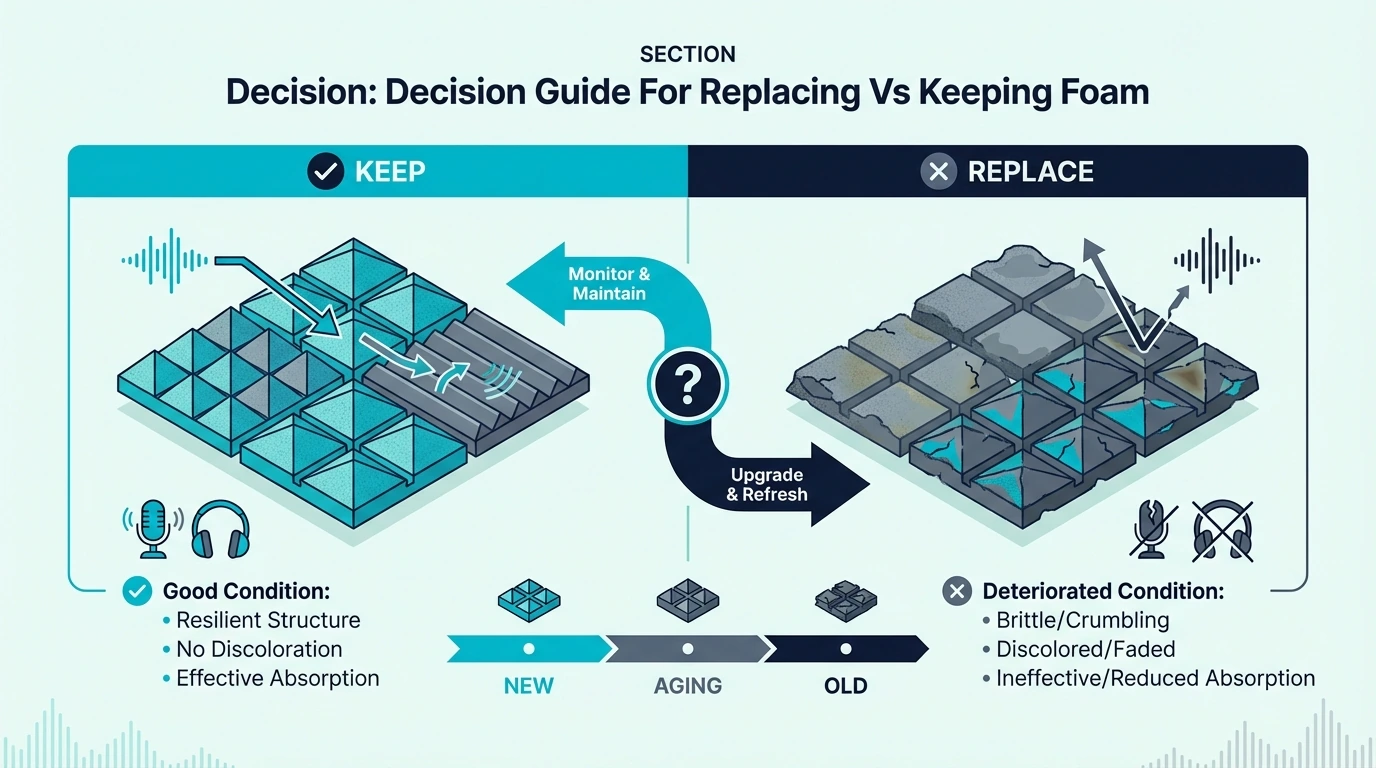
Decision guide for replacing or keeping old acoustic foam

Most of the time, foam is worth repairing only when the foam is still structurally healthy. Once the cells are collapsing, “fixing” just delays the inevitable.

If the foam is slightly yellowed but still springy, you can usually keep it and focus on preventing further UV/moisture exposure. If it’s brittle, crumbling, permanently compressed, or smells moldy, replacement is the smarter move.

If only a few panels are failing, replace those first and keep the rest. Prioritize the panels closest to windows and the panels in your most important reflection zones.

If you’re replacing: three foam options worth considering

If you’re replacing foam, it’s a chance to stop the cycle of buying the cheapest panels and replacing them again. These picks are common “step up” options without jumping straight to full fabric panels.

If you want a high-count coverage pack for a full refresh, the 96 Pack Acoustic Foam Panels is the “replace a lot at once” style of buy.

If you want thicker foam that’s less fragile than most 1-inch tiles, the TroyStudio Thick Acoustic Foam Panels is a better “small-room” upgrade.

If you want a more premium foam that’s known for consistent quality, the Auralex SonoFlat Panels is the quality-first pick.

Cost Considerations

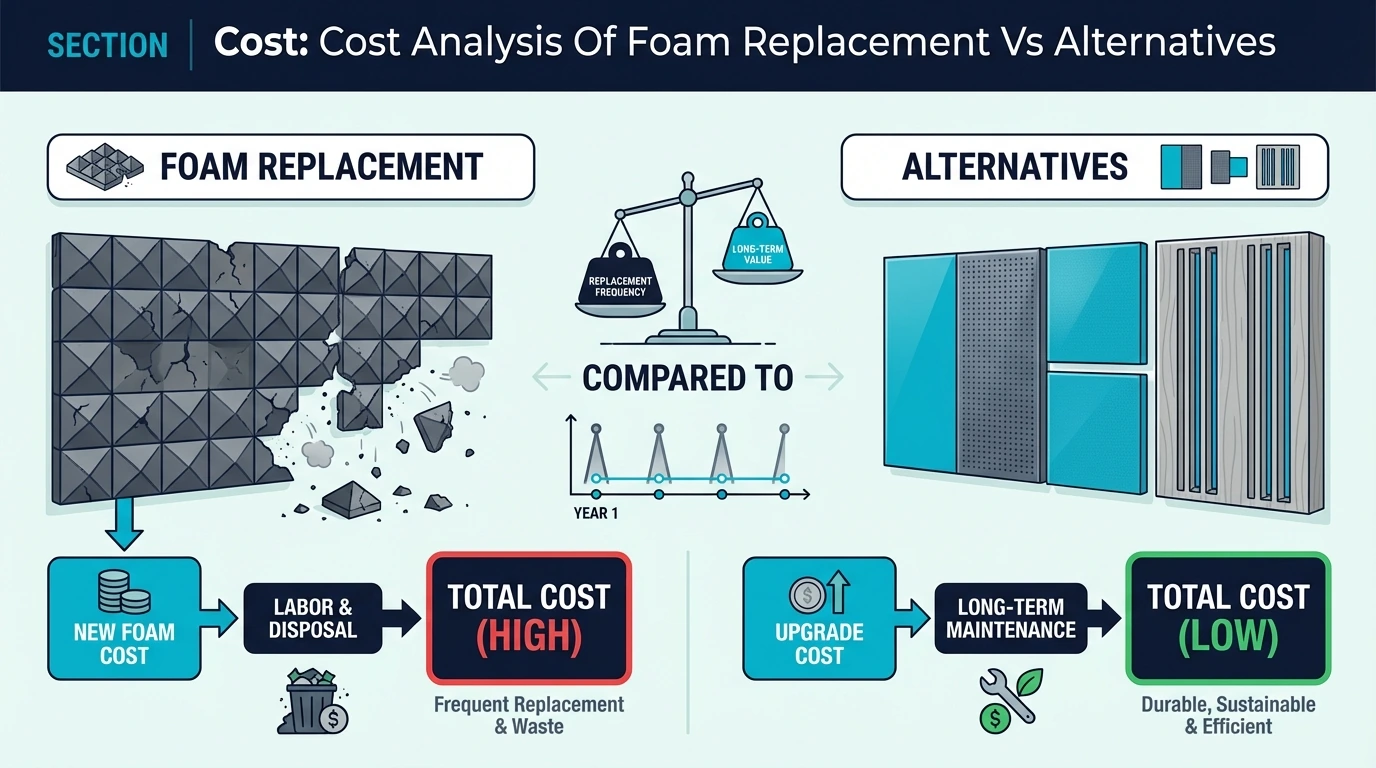
Cost analysis of acoustic foam replacement versus alternatives

The real cost of foam isn’t just the product—it’s the replacement cycle. If you replace foam every few years, the “cheap” option becomes less cheap over time.

It also costs time: removing old foam, cleaning residue, and mounting new panels. If you’ve already done that once, upgrading to a longer-lived option can be worth it even if the initial spend is higher.

If you’re debating whether foam is worth replacing at all, read is acoustic foam worth it. It’s a good reality check on what foam can and can’t do.

If you’re thinking about switching away from foam entirely, start with acoustic foam alternatives. It’s the fastest way to decide whether you want thicker panels, PET felt, blankets, or a hybrid.

Disposal Considerations

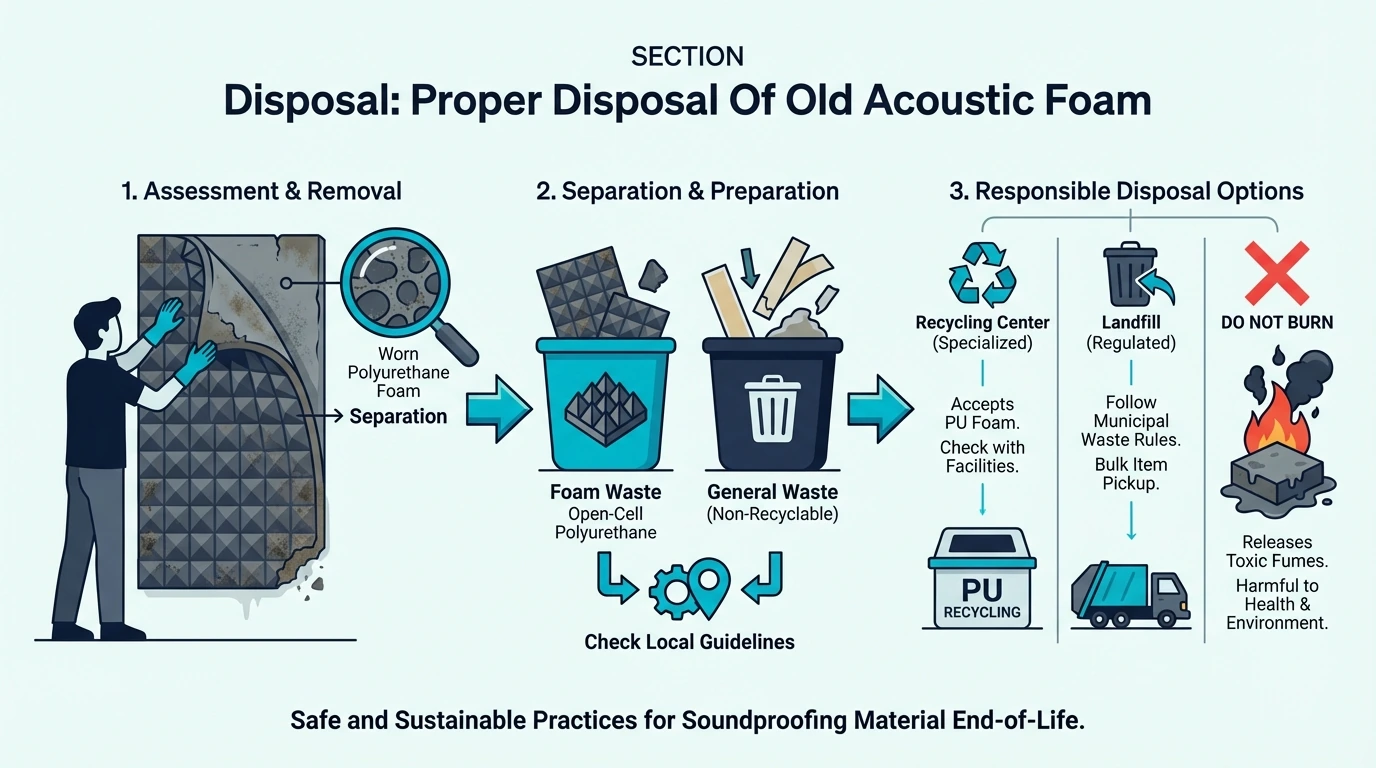
Proper disposal method for old acoustic foam

Most acoustic foam ends up in the trash because recycling options are limited. If you’re replacing a whole room, plan disposal like any other bulky material job.

If you’re removing foam from drywall and you want to avoid wall damage, follow remove acoustic foam before you start scraping. Old adhesive plus brittle foam is where most of the mess happens.

If the foam is dusty or moldy, bag it and remove it from the room promptly. The goal is to avoid spreading residue through your space.

Some people repurpose old foam for packing material or non-critical experiments, but don’t expect it to perform like new treatment. If it’s crumbling, it’s better gone than “reused.”

Conclusion

Acoustic foam gets old because its cell structure breaks down from UV, moisture, and repeated stress. Yellowing alone isn’t the end, but brittleness, crumbling, permanent compression, and persistent odor usually mean it’s time to replace.

If you want foam that lasts longer, buy better material, install it cleanly, and protect it from sun and humidity. If you’re tired of replacing foam, use acoustic foam vs acoustic panels to decide whether it’s time to upgrade.

Frequently Asked Questions

How long does acoustic foam last?

It depends on foam quality and environment, but budget foam tends to age faster than premium foam. Sunlight and humidity are the two biggest accelerators.

Does old acoustic foam still work?

Sometimes. If it’s still flexible and springy, it can still absorb sound, but performance usually drops as cells collapse and the foam hardens.

Can I restore old acoustic foam?

Not in a meaningful way. You can remove dust and reduce odor, but you can’t rebuild the foam’s cell structure once it has degraded.

Why is my acoustic foam turning yellow?

Usually UV exposure. Yellowing is often cosmetic at first, but it’s also a sign the polymer is breaking down over time.

Should I replace yellowed foam?

Not automatically. Replace it when yellowing comes with brittleness, crumbling, permanent dents, or noticeable performance loss.

Is old acoustic foam a fire hazard?

It can be, especially if it’s very old, degrading, or of unknown origin. If you’re concerned, replace it with foam that has clear, current fire-rating information.

How to Put Acoustic Foam on Cinder Blocks (4 Methods That Stick)

How to put acoustic foam on cinder blocks starts with a simple assumption: “easy mounting” is a trap. Yes, foam can go on block, but only if you plan for dust, porosity, and texture.

If you’ve tried spray adhesive and watched panels sag, that’s the wall soaking up glue and shedding chalky dust. You end up re-hanging foam, scraping residue, and still hearing slapback.

Do it the right way and you get panels that stay put and a room that sounds tighter and less harsh. If you’re still choosing foam, compare the best acoustic foam panels and the best acoustic foam shape options before you commit to something that’s a pain to mount.

Start by picking the wall/area you’re treating (usually the reflection path near your mic or speakers), then clean and test the surface. After that, choose either a board/strip approach for the cleanest finish or screws/washers when you want maximum security.

If your main problem is boomy bass rather than harsh reflections, foam won’t fix that by itself. Start with the bass traps hub and the broader acoustic treatment hub so you’re treating the right problem.

Quick Takeaway

Bare block usually needs boards/strips or fasteners. Painted or sealed block can work with heavy-duty strips if the surface is truly clean.

Why Cinder Blocks Are Challenging

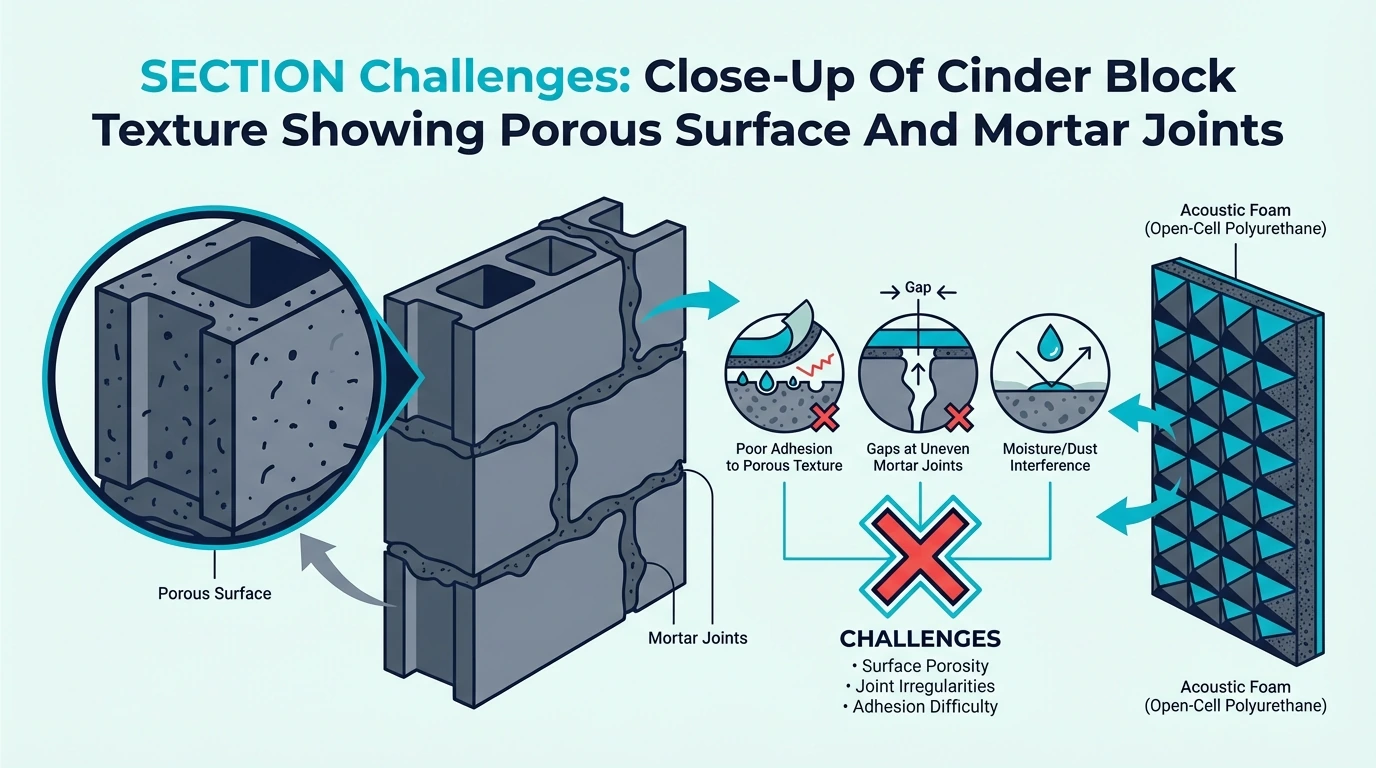
Challenges close up of cinder block texture showing porous surface and mortar joints

Cinder blocks fight you in three ways: they absorb adhesive, they don’t give you full contact, and they shed dust.

Once you understand those constraints, the “best” mounting method becomes obvious. You either create a smoother mounting surface (boards/strips) or you fasten mechanically.

Porous Surface

Cinder blocks absorb adhesive, weakening the bond. Standard spray adhesives get sucked into the block before they can grip the foam.

This porosity is why methods that work on drywall fail on masonry. On cinder blocks, you need a gap-filling adhesive or a mounting method that doesn’t depend on full surface contact.

The absorption rate varies by block age and composition—older blocks tend to be more porous, while painted or sealed blocks are less so. Testing adhesive on a small area first reveals how your specific blocks behave and prevents you from wasting a full can on an approach that won’t stick.

If your foam needs trimming to fit around obstacles, our guide to cutting acoustic foam covers clean techniques.

Rough Texture

The uneven surface means foam only contacts high points. Less contact area means weaker adhesion.

Where drywall provides nearly full contact, cinder blocks might only provide partial contact depending on texture. That’s why you either need more adhesive to fill gaps or fasteners to physically secure the foam.

This reduced contact area requires either more adhesive (to fill gaps) or mechanical fasteners (to physically secure the foam regardless of surface contact).

Mortar Joints

Joints between blocks create gaps where foam can’t make contact. Panels spanning multiple blocks may bridge over joints, creating air pockets behind the foam.

These gaps don’t significantly affect acoustic performance—foam still absorbs sound regardless of what’s behind it. But they can affect adhesion if panels are only secured at the blocks and not the joints.

Dust and Debris

Cinder blocks shed dust continuously. Surface contamination prevents adhesive bonding.

Even blocks that look clean often have a fine dust layer that compromises adhesive grip. If your wipe comes away gray, you’re not ready to mount yet.

Thorough cleaning is non-negotiable for adhesive methods. Skip this step and your foam will eventually fall off, regardless of which adhesive you use.

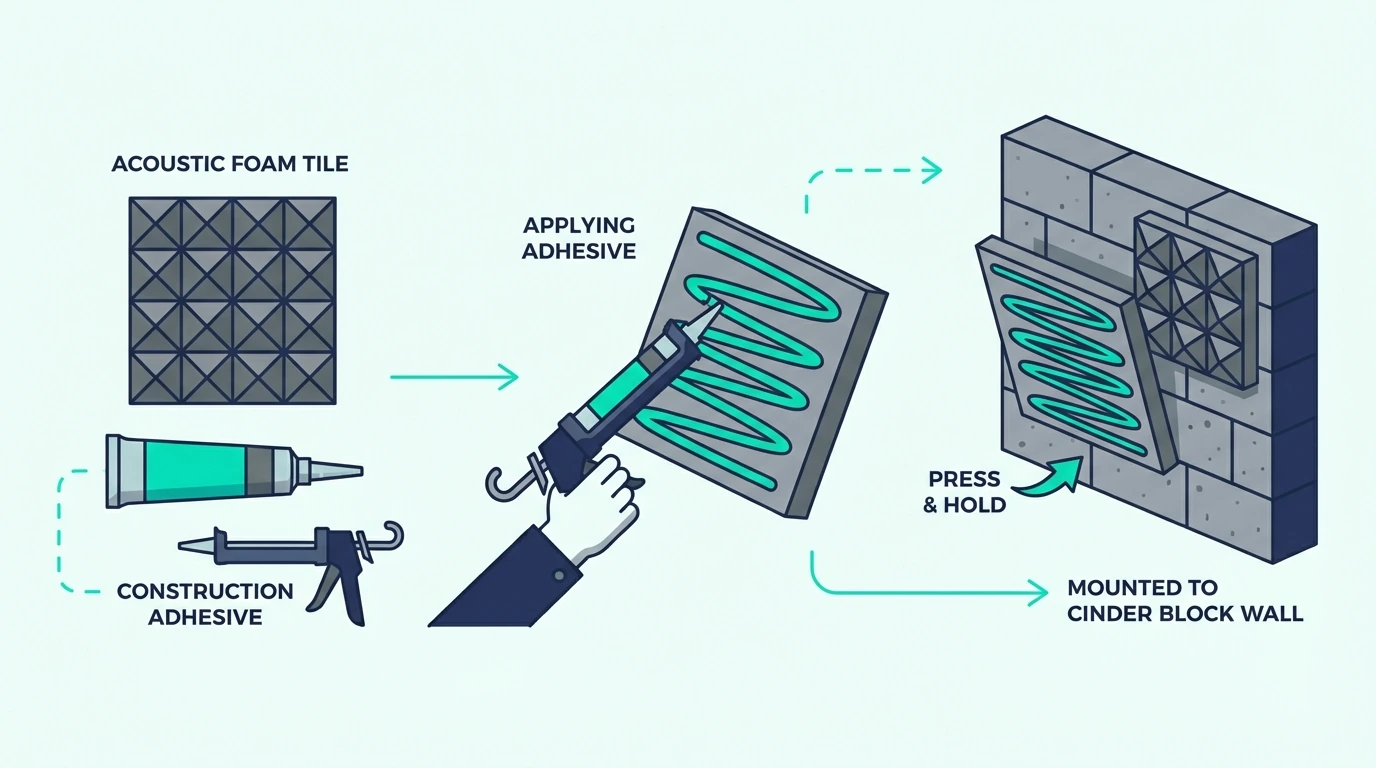
Construction adhesive applying construction adhesive to foam for cinder block mounting

Construction adhesive provides the strongest bond for porous surfaces.

If you’re bonding foam to a backing board first (the cleanest way on rough block), 3M Super 77 Multi-Surface Spray Adhesive spreads evenly and grabs quickly.

For a more controlled application (and less mess), Auralex Tubetak Pro lets you run beads and press the foam in place without overspray.

Start by brushing or vacuuming the block, then do a wipe test; if the cloth still comes away gray, keep cleaning.

Apply adhesive in thick beads or a zigzag so it can bridge the block texture, then press the foam (or board) firmly for about a minute.

Support the panel while it cures using painter’s tape or temporary props.

Give it a full day before you trust it without support, and longer if the room is cold or humid.

Use more adhesive than you would on drywall and push the foam into the high points so you get real contact.

Work in small sections so the adhesive doesn’t skin over before you seat the panel.

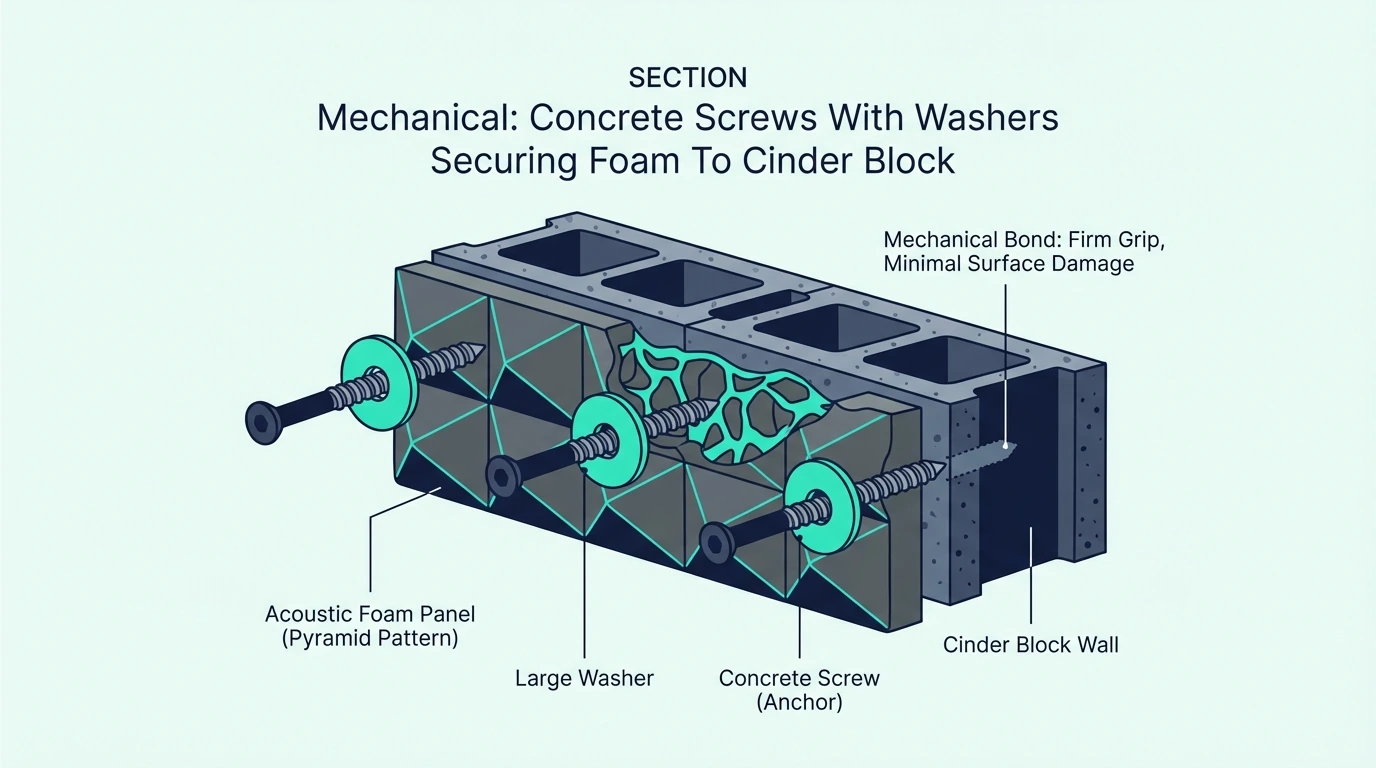
Method 2: Mechanical Fasteners

Mechanical concrete screws with washers securing foam to cinder block

For maximum security, mechanical fasteners can’t fail.

You’ll need concrete screws, large fender washers, a hammer drill with a masonry bit, plus safety glasses and a dust mask.

If you want to mount a backing board cleanly and keep it removable later, a hanging system like Aluminum Z-hanger wall-mount brackets makes the board lift on/off once it’s secured to the wall.

Mark corner and center points, then pre-drill clearance holes through the foam so the screw doesn’t tear it.

Drill into the block, add a washer, and tighten just until the foam is held, not compressed flat.

Mechanical fastening is the most reliable option because it doesn’t depend on adhesion at all, and you can remove panels later by backing the screws out.

The tradeoff is visible hardware and permanent holes, plus the added time and masonry dust from drilling.

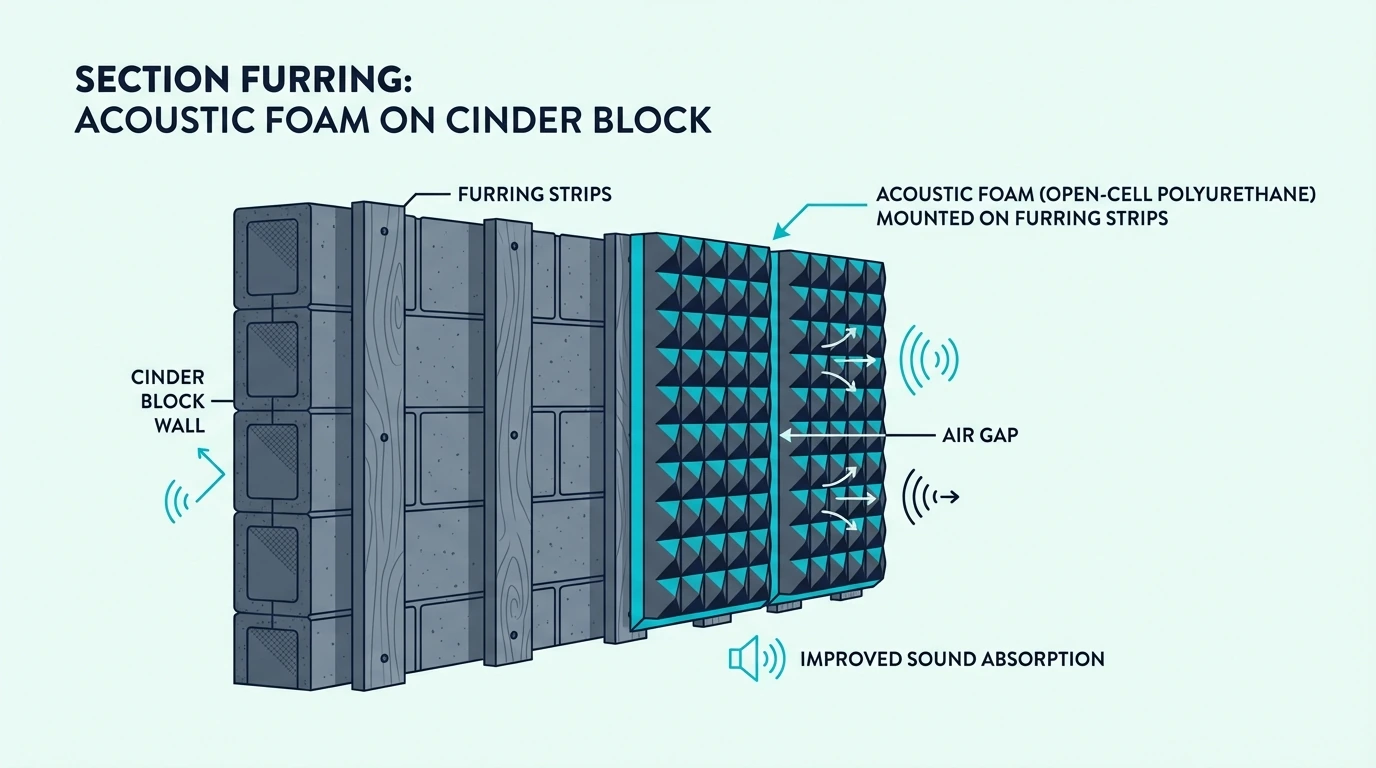
Method 3: Furring Strips

Furring strips mounted to cinder block with foam attached to strips

Furring strips create a smooth mounting surface, enabling standard installation methods.

Mount wooden furring strips to the cinder blocks, then attach foam to the wood using standard methods.

First mount the strips with masonry fasteners and check they’re flat and aligned.

Then attach foam to the strips using adhesive, fasteners, or staples, depending on how permanent you want it.

The main benefit is that you create a smooth mounting surface, which makes straight rows and consistent adhesion much easier.

You also get an air gap behind the foam, which can slightly improve low-frequency absorption compared to foam pressed directly against the block.

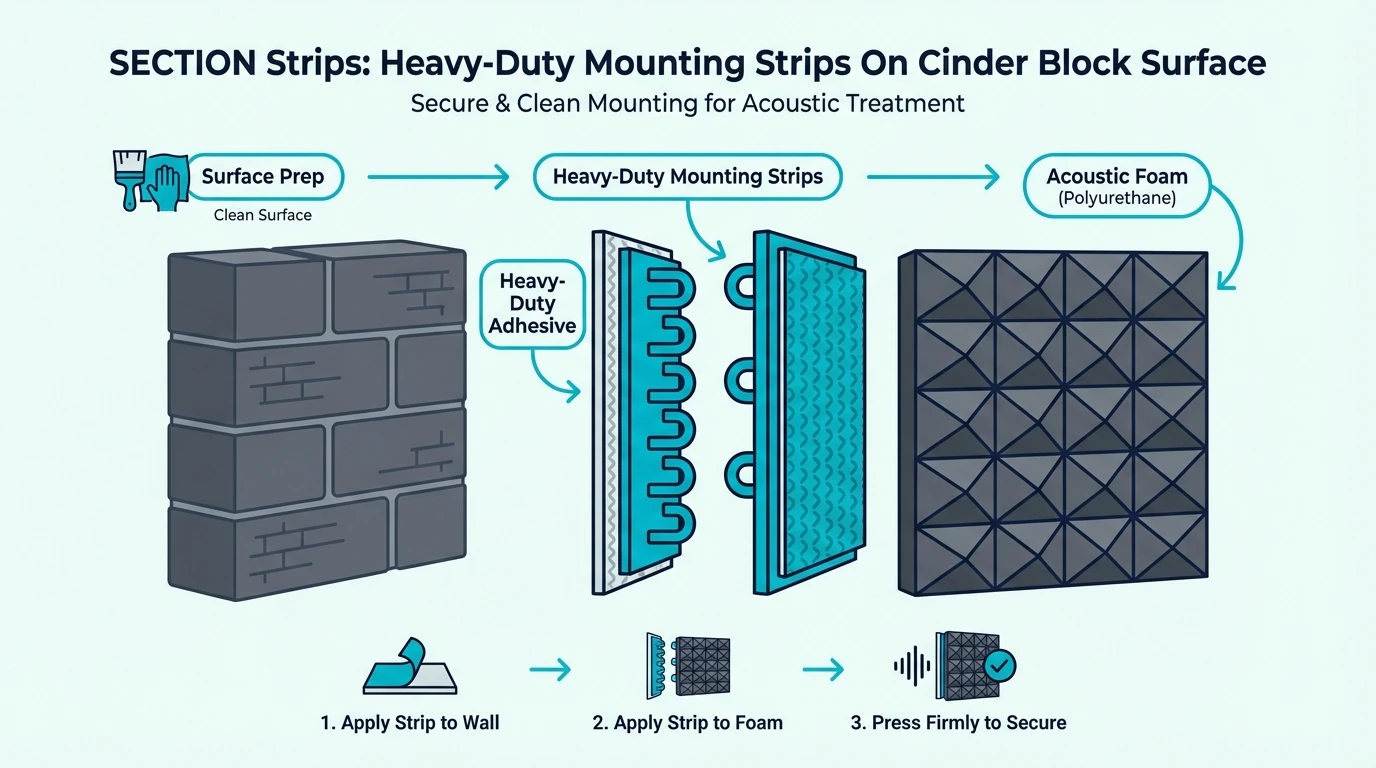
Method 4: Heavy-Duty Adhesive Strips

Strips heavy duty mounting strips on cinder block surface

For removable installation, heavy-duty strips can work—with limitations.

For painted or sealed block, Command 20 lb X-Large Picture Hanging Strips are one of the few removable options that can work.

For small, light foam tiles (and only on a truly clean surface), Command Poster Strips can be useful.

Clean the surface thoroughly with rubbing alcohol, then let it fully dry. If the wall still feels chalky, stop and switch to furring strips or fasteners.

Apply strips to the high points on the block texture and use more pairs than you would on smooth walls. Press firmly for 30+ seconds per strip, then allow 24 hours before full load.

This approach is less reliable than permanent methods, and humidity can weaken adhesive over time.

It also depends on a very clean surface, and it’s a poor choice for ceiling mounting.

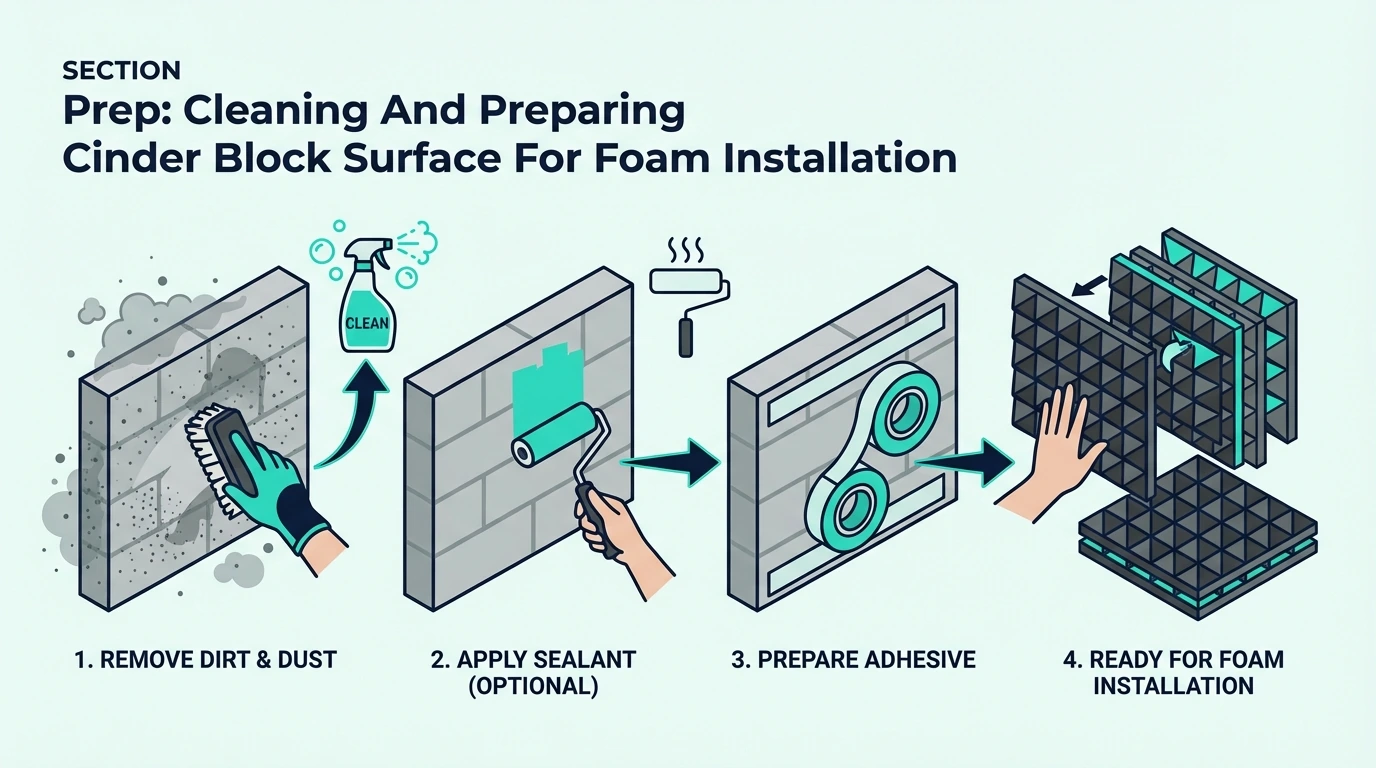
Surface Preparation

Prep cleaning and preparing cinder block surface for foam installation

Proper prep is critical for any adhesive method.

Start with a wire brush to knock loose material off, then vacuum the pores so you’re not trapping dust under adhesive.

Finish with a damp wipe and give the wall enough time to dry before you mount anything.

If blocks are painted:

Make sure the paint is well-bonded and not peeling, then scuff glossy paint lightly and clean the sanding dust thoroughly.

For very porous blocks, a concrete sealer helps in several ways. It reduces adhesive absorption, creates a more consistent bonding surface, and can help with moisture management in damp spaces.

Apply sealer, let cure per product instructions, then mount foam.

Basement and Garage Considerations

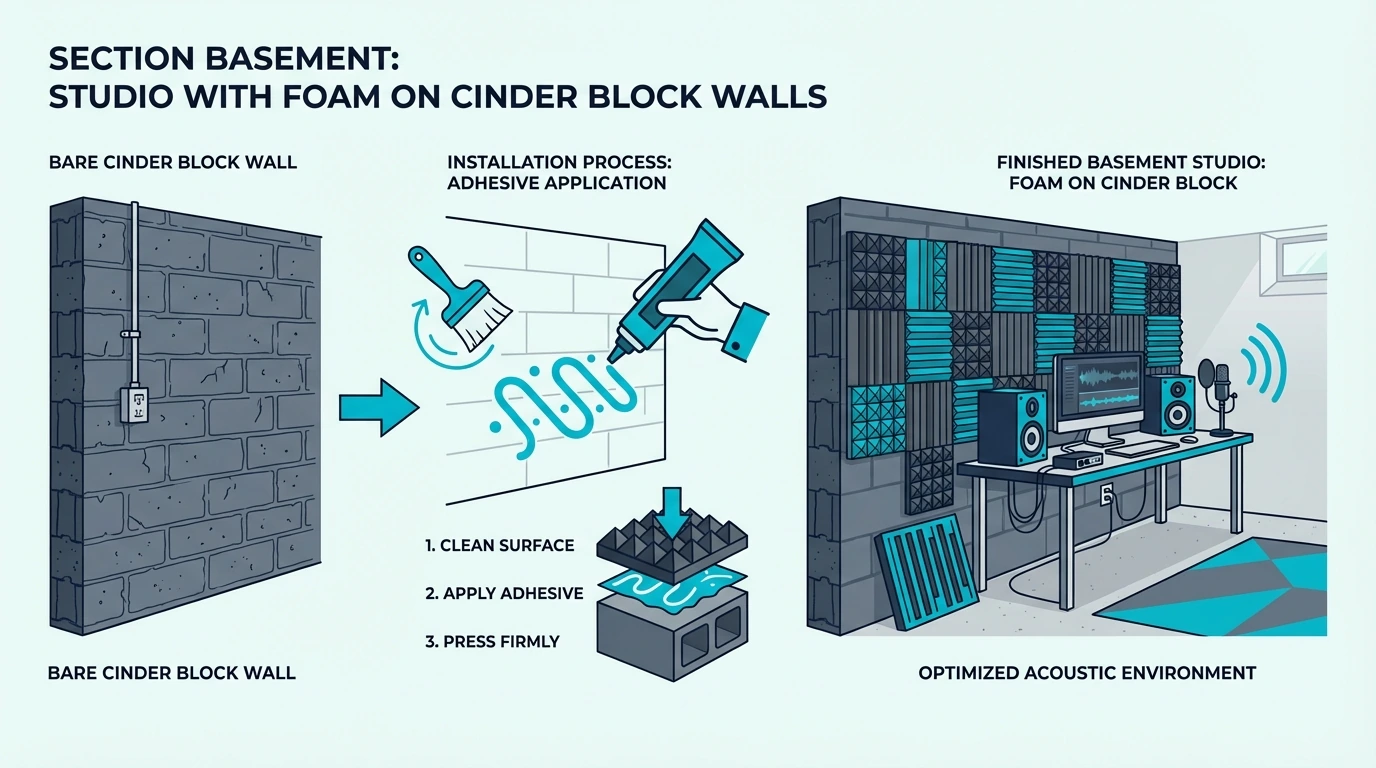
Basement studio with foam on cinder block walls

Cinder block walls are common in basements and garages, which have additional considerations.

If you’re treating a vocal corner in a small, reflective room, the best acoustic foam for podcasts roundup can help you pick foam that’s easy to work with.

Before you mount foam, check for water infiltration and deal with it first, because trapped moisture is a mold risk.

If the basement runs damp, prioritize ventilation and consider a barrier behind any boards you mount.

In garages, big temperature swings can weaken adhesives over time.

If you want set-and-forget reliability, use mechanical fasteners or mount boards/strips and hang them.

These spaces tend to be dustier, so plan to vacuum the foam occasionally with a brush attachment. Our guide to cleaning acoustic foam covers safe techniques that won’t damage the cells.

If maintenance is a priority, consider treatment options that are easier to wipe down than open-cell foam.

For more foam buying and placement guides, start at the acoustic foam hub.

Combining Methods

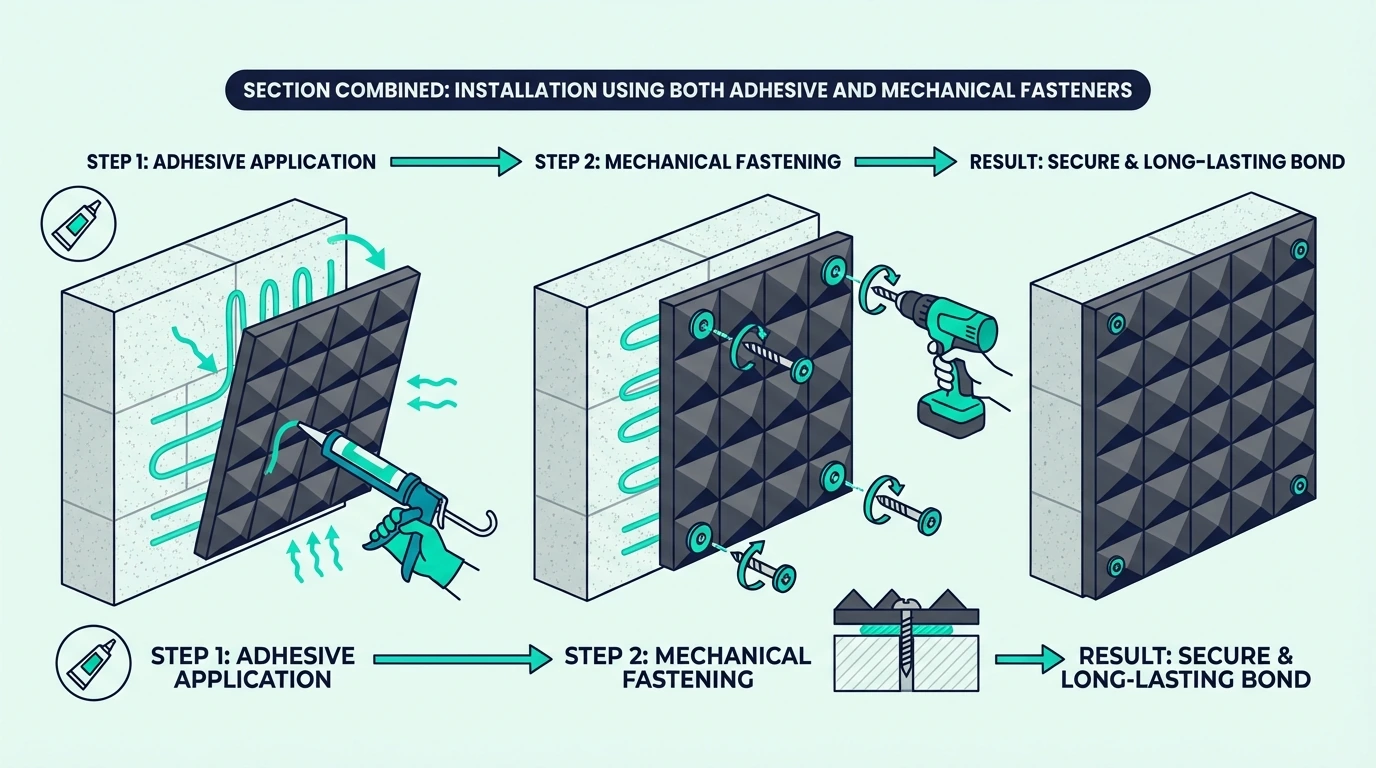
Combined installation using both adhesive and mechanical fasteners

For maximum security, combine methods.

Apply adhesive, then add one or two screws per panel so the foam can’t slide while the adhesive cures.

This “belt-and-suspenders” combo is ideal when failure would be expensive to fix.

Mount strips mechanically, then attach foam to the strips with adhesive for a clean look.

If you want removable boards instead of permanent strips, French Cleat Picture Hanger 2 Inches Aluminum Z Hanger can make it easy to lift panels on and off.

Consider combining methods when you’re mounting overhead, using large/heavy panels, or working in high humidity. The more “consequences” you have from a panel falling, the more redundancy you want.

Alternative Approaches

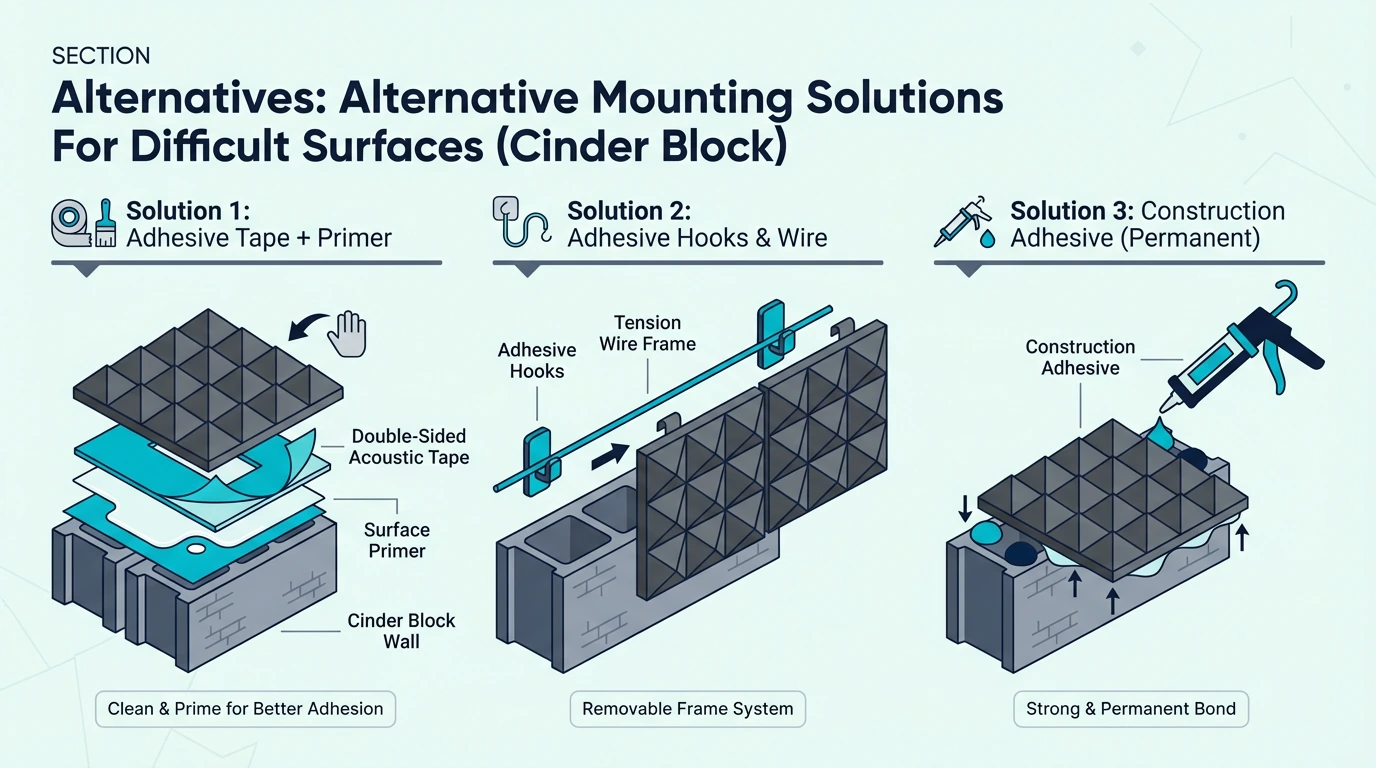
Alternatives alternative mounting solutions for difficult surfaces

If traditional mounting proves too difficult, consider alternatives.

Freestanding panels lean against the wall, which avoids mounting entirely and works on any surface.

They’re also easy to reposition, which is useful if you’re still experimenting with placement.

Ceiling-hung panels can treat reflections without touching the wall at all.

The downside is that you need safe ceiling anchor points and you have to plan your height and spacing.

DIY frames let you build panels you can lean, hang, or mount to boards without fighting the block texture.

They can also look better than bare foam, and if you want foam packs that mount cleanly on boards, see best acoustic foam panels.

Conclusion

Cinder block walls require more effort than drywall, but secure foam installation is achievable. The best method depends on whether you want permanent mounting or the ability to take the setup down later.

For most people, furring strips (or boards) are the cleanest long-term solution because they create a smooth mounting surface. Mechanical fasteners are the most secure option when you need near-zero failure risk.

Whatever method you choose, thorough surface preparation is essential. Clean blocks, remove dust, and allow adequate drying time.

For basement and garage installations, also account for moisture and temperature swings, since those conditions can weaken adhesives over time. When in doubt, combine methods so screws hold while adhesive cures.

Frequently Asked Questions

Will regular spray adhesive work on cinder blocks?

Not reliably. Standard spray adhesive gets absorbed into porous cinder blocks before it can bond properly.

If you want adhesive-only mounting, use a construction adhesive formulated for porous surfaces. For cleaner results, mount a backing board first and glue the foam to the board.

Can I use Command strips on cinder blocks?

Heavy-duty strips can work on clean, painted cinder blocks, but they’re less reliable than on smooth surfaces. Use more strips than recommended, press firmly, and allow 24 hours before full load.

Avoid this method for ceiling mounting or humid environments. If you need reliability, switch to boards, strips, or fasteners.

Do I need to seal cinder blocks before mounting foam?

Sealing isn’t required, but it can help. A concrete sealer reduces porosity, which can create a more consistent bonding surface for adhesives.

If your blocks are very porous or you’re seeing adhesion problems, sealing is worth considering. Test on a small area first to see whether it changes grip.

How do I remove foam from cinder blocks later?

Removal depends on your mounting method. Construction adhesive is usually permanent, so expect the foam to tear and leave residue.

Mechanical fasteners allow clean removal by unscrewing. If you used strips, removal depends on how smooth the surface is and how long the adhesive has been in place.

Should I paint cinder blocks before mounting foam?

Paint can help or hurt. Quality paint in good condition provides a smoother bonding surface, while peeling or chalky paint will cause adhesive failure.

If you paint, use masonry primer and allow full cure time before mounting anything. Treat it like you’re preparing for tape, not just making the wall look nicer.

What about the gaps at mortar joints?

Mortar joints create gaps where foam doesn’t contact the wall. For most acoustic purposes, this doesn’t matter, because the foam still absorbs sound.

If gaps bother you visually, use smaller panels that fit within individual blocks, or mount foam to boards so the layout ignores the joint pattern. That also makes it easier to keep rows straight.

Best Corner Acoustic Foam & Bass Traps for Home Studios

Best corner acoustic foam can tighten up a home studio’s low end — but only when you treat corners as a bass problem, not a decoration problem. Foam wedges alone won’t fix deep sub-bass.

Boomy corners smear kick and bass, which makes mixes translate poorly and recordings sound muddy. That happens because low frequencies pile up where walls meet, and flat wall panels barely touch the buildup.

The right corner treatment gives you a more even low end and clearer midrange detail when you record or mix. It also helps you spend money on depth and coverage instead of flashy shapes.

Below, start with the two front corners behind your monitors, then add coverage to the rear corners if the room still sounds uneven — and decide when foam is “good enough” versus when you need thicker fiberglass or rockwool traps.

For a broader look at foam options, start with the acoustic foam hub.

Quick Takeaway

Most corner acoustic foam is a mid-bass tool, not a magic fix for deep sub-bass. Start by treating the two front corners behind your monitors, listen for tighter low end, then expand to all four corners if the room still sounds boomy.

Why Corners Need Special Treatment

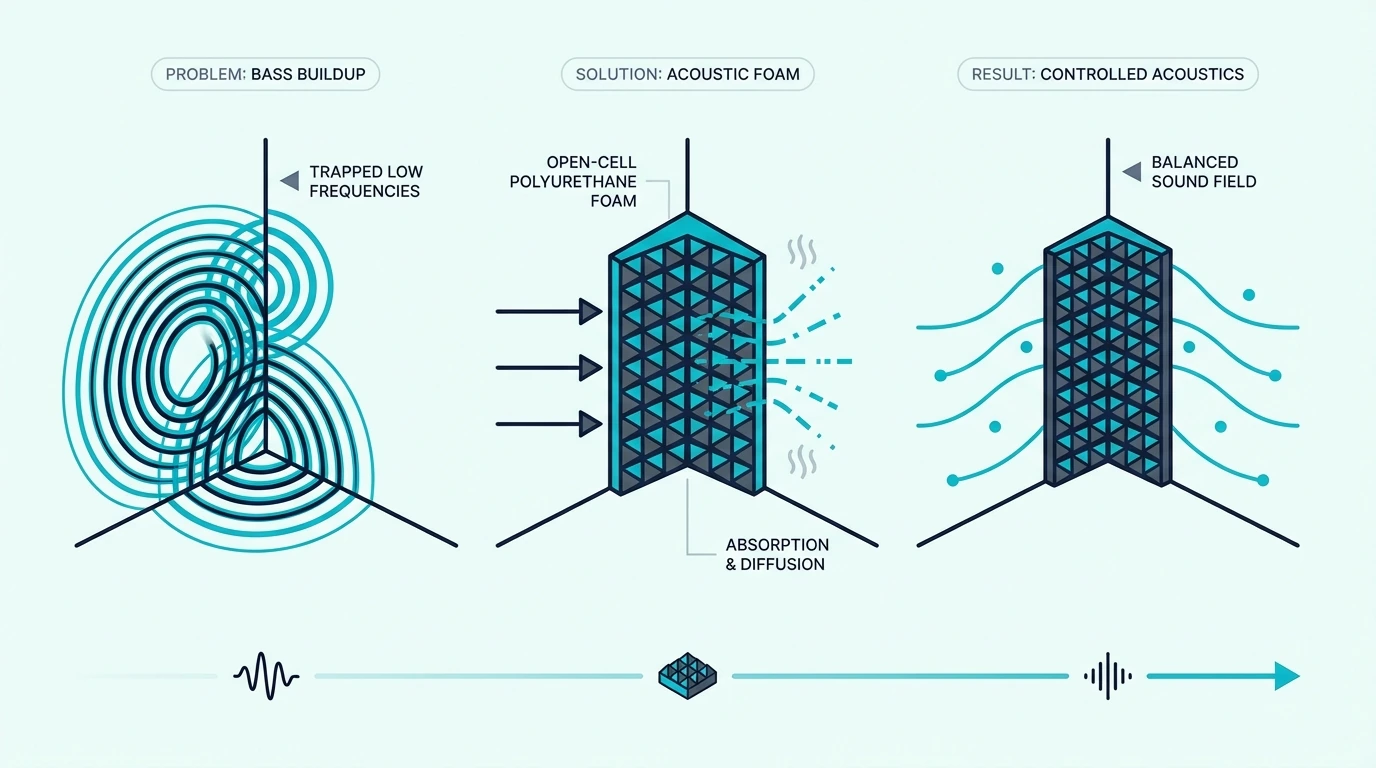
Diagram showing bass buildup in room corners

Understanding corner acoustics explains why standard foam panels don’t solve bass problems.

Bass Buildup in Corners

Low-frequency sound waves are large—a 100 Hz wave is over 11 feet long. These waves reflect off walls and accumulate where surfaces meet.

Corners, where three surfaces converge, concentrate the most bass energy. This concentration creates “room modes”—frequencies that resonate based on room dimensions.

At certain frequencies, bass becomes unnaturally loud; at others, it nearly disappears. The result is uneven, unreliable bass response that makes mixing and recording difficult.

If you’re building a studio setup, start with best acoustic foam for recording to match foam type and thickness to your use case.

Why Flat Panels Don’t Work

Standard acoustic foam panels are typically 2-4 inches thick. They absorb frequencies with wavelengths roughly four times their thickness—meaning 2-inch foam works above 500 Hz, and 4-inch foam works above 250 Hz.

Bass frequencies (20-200 Hz) have wavelengths of 5-56 feet. No practical thickness of flat wall foam absorbs these frequencies effectively.

Corner treatment requires different approaches: either very thick absorbers or designs that use corner placement to enhance effectiveness.

For foam selection by thickness and typical performance, see the best budget acoustic foam guide.

Corner Placement Advantage

Placing absorbers in corners provides a physics advantage. Sound pressure is highest at room boundaries, and corners represent the intersection of multiple boundaries.

Absorbers in corners encounter higher sound pressure, which increases their effective absorption. A bass trap in a corner can absorb 2-4 times more low-frequency energy than the same trap placed flat on a wall.

Best Corner Acoustic Foam & Bass Traps

Top five corner acoustic treatment product options

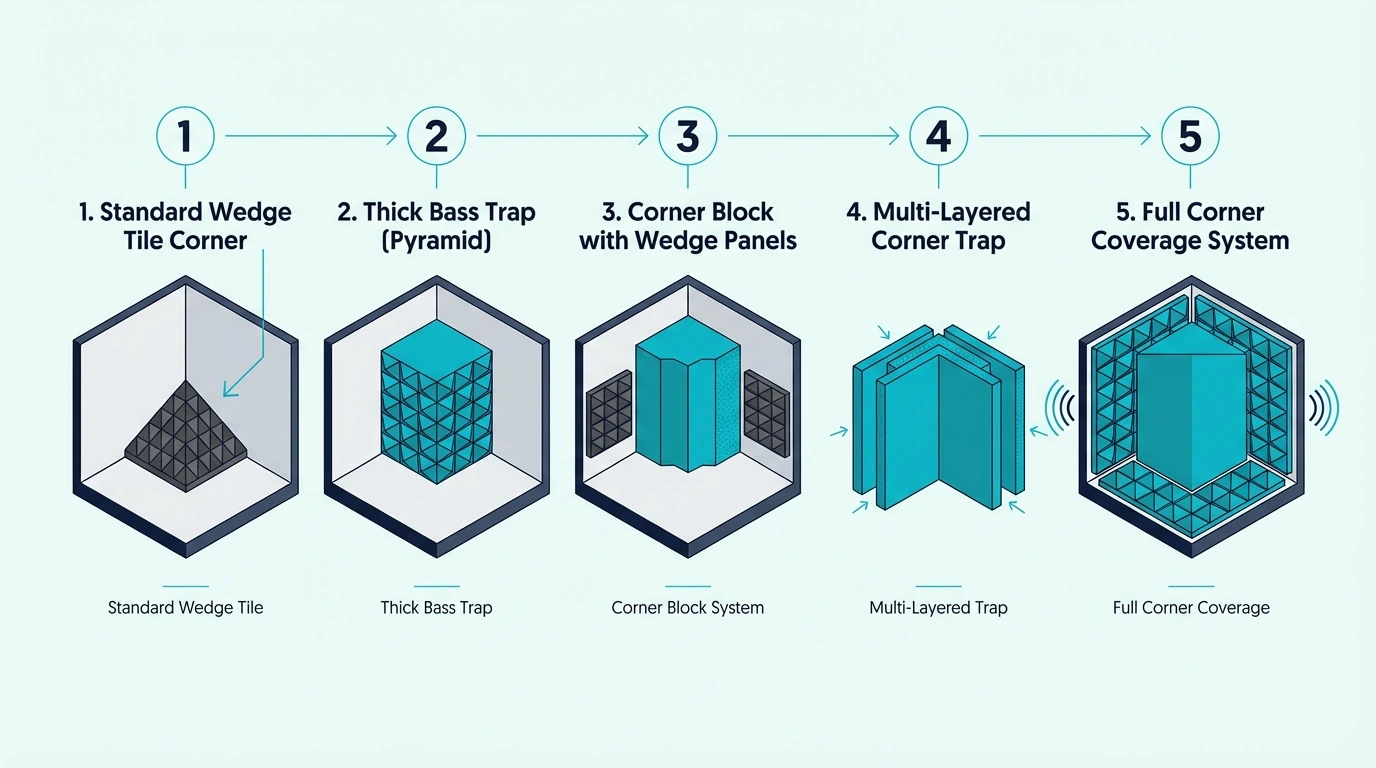
These picks focus on corner-style acoustic foam bass traps you can install quickly.

Foam corner traps primarily help mid-bass, so if you’re chasing truly flat low end, combine corners with a broader foam setup and treat the rest of the room methodically.

Best Overall

8-Pack Corner Bass Trap Foam Blocks is a simple way to start treating corners without overthinking the setup.

Use it to cover at least the two front corners first, then expand to the rear corners if the room still sounds uneven.

Best for Low-End Control

2-Pack Delta Corner Bass Traps uses a larger profile that fills more of the corner than small wedges.

That extra depth is the main lever foam has for reaching a bit lower.

Best Value

12-Pack Corner Bass Trap Foam Set is a good fit when you want enough pieces to treat multiple corners on a tight budget.

Treating more surface area usually beats buying a single “premium” foam piece for one corner.

Best for Small Rooms

4-Pack Corner Bass Trap Wedges works well when you have limited space and just need a practical first pass on corner boom.

In a bedroom studio, even a small reduction in mid-bass buildup can make monitoring feel more consistent. The best beginner acoustic foam guide covers starter setups for small rooms.

Best for Ceiling Corners

TroyStudio Bass Trap Strips (12 pcs) is useful for treating wall-ceiling corners where larger corner blocks won’t fit.

These strips are most effective as a complement to thicker corner foam on the vertical corners.

Best for Tight Corners

TroyStudio Bass Trap Strips (12 pcs) (Alternative) is another flexible option when you need multiple pieces to fit around trim, outlets, or awkward corner geometry.

If you’re unsure which foam shape is easiest to place in your room, compare options in best acoustic foam shape.

Foam vs Fiberglass Corner Traps

Foam versus fiberglass absorption comparison for corners

The material inside corner traps has a major effect on performance.

Foam Corner Traps

Advantages: – Lower cost – Lightweight, easy to install – No fiber concerns – Available in colors

Limitations: – Effective primarily above 200 Hz – Limited deep bass absorption – May compress over time – Lower density limits performance

Best applications: Mid-bass control, voice recording, rooms without severe bass problems.

Fiberglass/Rockwool Corner Traps

Advantages: – Effective to 60 Hz and below – True broadband absorption – Maintains performance over time – Professional-grade results

Limitations: – Higher cost (commercial options) – Heavier, more complex installation – Requires fabric wrapping – Fiber handling precautions needed

Best applications: Music production, mixing, mastering, rooms with serious bass problems.

The Verdict

For serious bass control, fiberglass or rockwool bass traps far outperform foam. The physics are clear: denser materials with greater thickness absorb lower frequencies.

Foam corner traps help—they’re better than nothing and address mid-bass effectively. But if bass problems are your primary concern, invest in proper bass traps rather than foam alternatives.

How Many Corner Traps Do You Need?

Corner trap quantity and placement levels

Corner trap quantity depends on room size and problem severity.

Minimum Effective Treatment

2 corner traps: Place in the front corners of your room (behind your monitors). This addresses the most critical bass buildup affecting your listening position.

Even minimal corner treatment improves bass clarity noticeably. Start here if budget is limited.

4 corner traps: All four vertical corners, floor to ceiling or as high as practical. This provides balanced bass control throughout the room.

Four corners treated creates symmetrical absorption, preventing bass from being controlled on one side but not the other.

Full-Room Treatment

8+ corner traps: All vertical corners plus wall-ceiling and wall-floor corners. This level of treatment suits professional mixing and mastering rooms.

Horizontal corners (where walls meet ceiling and floor) also accumulate bass. Treating these provides additional control, though vertical corners remain the priority.

Room Size Considerations

Larger rooms have lower-frequency room modes and may need more treatment. Smaller rooms have higher-frequency modes that foam traps address more effectively.

For small rooms (under 150 sq ft), foam corner traps may provide adequate control. For larger rooms, fiberglass traps become increasingly important.

Installation Guide

Corner bass trap mounting methods for acoustic foam

Proper installation ensures corner traps perform as intended.

Floor-to-Ceiling Stacking

For maximum effectiveness, stack corner traps from floor to ceiling. Bass energy exists throughout the corner’s height—treating only part leaves problems unsolved.

Most commercial traps are designed for stacking. Secure bottom traps to the floor or wall, then stack additional units on top.

Mounting Methods

Freestanding: Simply place traps in corners. Works for heavy fiberglass traps that won’t tip. Easiest installation, fully removable.

Wall-mounted: Attach mounting hardware to walls, hang traps. Necessary for foam traps that might shift. Use appropriate anchors for your wall type.

Suspended: Hang from ceiling in upper corners. Useful when floor space is limited or for treating ceiling-wall corners.

Air Gap Considerations

Leaving a small air gap (1-4 inches) behind corner traps can extend low-frequency absorption. The gap allows the trap to absorb sound from both front and back surfaces.

This technique works better with fiberglass traps than foam. Experiment with gap size—larger gaps extend absorption to lower frequencies but reduce high-frequency performance.

For adhesive vs removable mounting options, see best budget acoustic foam.

Corner Treatment vs Wall Treatment

Priority order showing corners before wall treatment

Limited budget? Prioritize corner treatment over wall panels.

Why Corners First

Bass problems affect everything. Boomy, uneven low end masks mid-range detail, makes mixing decisions unreliable, and creates listener fatigue.

Fixing bass first provides the foundation for accurate sound.

Wall panels address reflections and flutter—important, but secondary to bass control. A room with treated corners and bare walls sounds better than a room with treated walls and bare corners.

Balanced Approach

Ideal treatment combines corner traps and wall panels. Corner traps handle bass, while wall panels handle mids and highs.

Together, they create a controlled, accurate listening environment.

If budget requires choosing, start with corner traps. Add wall panels as budget allows. The best acoustic foam panels guide ranks wall treatment options across price tiers.

This progression builds effective treatment systematically.

Be careful not to over-treat once you start adding panels — choose the right amount and thickness for your room before ordering.

For a room-ready set of options (including placement considerations), use best acoustic foam for recording as a reference.

Common Corner Treatment Mistakes

Common corner acoustic treatment mistakes

Avoid these errors that waste money and limit effectiveness.

Using Standard Foam Panels in Corners

Placing flat foam panels across corners doesn’t create a bass trap. The foam is still too thin to absorb bass frequencies.

You’ve just moved ineffective treatment to a corner.

True corner traps are either very thick (4+ inches of dense material) or specifically designed to use corner placement physics.

Insufficient Coverage

One small foam wedge in a corner provides minimal benefit. Bass traps need mass and coverage to be effective.

Floor-to-ceiling treatment in multiple corners creates real improvement.

Treating Only Some Corners

Treating front corners but not rear corners creates asymmetrical bass response. Sound that should be absorbed in back corners reflects forward, undermining front corner treatment.

Treat corners symmetrically when possible. If you must prioritize, front corners (near monitors) matter most for mixing.

Expecting Foam to Fix Deep Bass

Foam corner traps help with mid-bass (200-500 Hz) but don’t meaningfully affect deep bass (under 100 Hz). If your room has problems at 60-80 Hz, foam won’t solve them.

Be realistic about foam limitations. For deep bass control, fiberglass or rockwool traps are necessary.

For a practical breakdown of foam shapes and how they perform, see the best acoustic foam shape guide.

Conclusion

Corner treatment is the most impactful acoustic investment for rooms with bass problems. The physics are clear: bass accumulates in corners, and treating corners addresses problems at their source.

If you want a low-commitment starting point, begin with 8-Pack Corner Bass Trap Foam Blocks in the front corners.

If you need more pieces to cover multiple corners, 12-Pack Corner Bass Trap Foam Set is a practical way to expand coverage.

Whatever you choose, prioritize corner treatment over wall panels if budget is limited. Treat corners symmetrically and stack floor-to-ceiling when possible.

Be realistic about what foam can and can’t accomplish. Proper corner treatment transforms room acoustics, while inadequate treatment just decorates corners.

Frequently Asked Questions

Do foam corner bass traps actually work?

Foam corner traps mainly absorb mid-bass frequencies (200-500 Hz), which reduces boominess and improves clarity in that range. They’re much less effective below 200 Hz where many bass problems occur.

For rooms with moderate bass issues, foam traps can help noticeably. Podcast setups with voice-only recording may need less corner treatment — the best acoustic foam for podcasts guide covers that use case. For severe bass problems or frequencies below 100 Hz, fiberglass or rockwool traps perform far better.

How many corner bass traps do I need?

Minimum: 2 traps in front corners (behind monitors). Recommended: 4 traps covering all vertical corners.

Full room: 8+ traps including wall-ceiling corners. Start with front corners and add more as budget allows.

Floor-to-ceiling coverage in each corner usually provides better results than partial coverage spread across more corners.

Where should I put corner bass traps?

Prioritize vertical room corners, starting with the front corners behind your monitors or speakers. These corners most directly affect what you hear at your listening position.

Next, treat rear corners for balanced absorption. Wall-ceiling and wall-floor corners are lower priority but beneficial for full-room treatment.

Are bass traps better than acoustic foam panels?

For bass frequencies, yes — far better. Standard foam panels (2-4 inches) don’t absorb bass effectively regardless of placement.

Bass traps using thick fiberglass or rockwool absorb frequencies that foam can’t touch. For mid and high frequencies, foam panels can still work well.

Ideal treatment combines bass traps in corners with foam panels on walls.

Can I make DIY corner bass traps?

Yes, and DIY traps often outperform commercial foam options at lower cost. Stack mineral wool batts or rigid boards in corners and wrap them with acoustically transparent fabric.

A 4-inch thick DIY mineral wool trap absorbs more bass than commercial foam traps costing twice as much. The tradeoff is construction time and handling mineral wool safely.

What’s the difference between corner bass traps and regular acoustic panels?

Corner bass traps are designed for low-frequency absorption using thick, dense materials and corner placement physics. Regular acoustic panels are thinner and designed for mid/high frequency absorption on flat walls.

They serve different purposes: bass traps control low-end buildup, while panels control reflections and echo. Most rooms benefit from both.

Best Beginner Acoustic Foam for Home Studios: Starter Guide

Best beginner acoustic foam for home studio setups can turn a boxy bedroom into a usable recording space — but most first-time buyers pick panels that are too thin and stick them in the wrong spots.

The result? Recordings still sound roomy and reflective, and the foam gets blamed for not working.

The actual problem is almost always 1-inch thickness (which barely absorbs anything) or random placement that misses the walls your microphone actually hears.

The fix is simple: start with 2-inch foam, treat the wall behind your mic first, then hit the closest side-wall reflection points. That alone cleans up most bedroom-studio takes.

Below are four starter picks, a placement priority list, and the mistakes that trip up most first-time buyers.

For a broader look at how acoustic foam works, start with the acoustic foam hub.

Quick Takeaway

Start with minimum 2-inch thick foam — 1-inch panels barely absorb anything useful. Treat the wall behind your microphone first (4-6 panels), then side walls at first reflection points. A 12-pack is enough to hear a clear difference in most bedrooms. Expand only after you hear what your room still needs.

What Beginners Actually Need

Simple home studio with effective beginner acoustic foam placement

Before buying anything, understand what acoustic foam does and doesn’t do.

What Foam Accomplishes

Acoustic foam absorbs sound reflections within your room. When you speak or play music, sound bounces off walls, ceiling, and floor. These reflections reach your microphone milliseconds after the direct sound, creating:

  • Echo and reverb in recordings
  • Harsh, “roomy” sound quality
  • Inconsistent frequency response
  • Difficulty hearing mix details accurately

Foam reduces these reflections, giving you cleaner recordings and more accurate monitoring. For a deeper look at what foam can do for recordings, see the best acoustic foam for recording guide.

What Foam Doesn’t Do

Foam does NOT soundproof. It won’t stop noise from entering your room or prevent your recordings from disturbing neighbors.

Soundproofing requires mass, decoupling, and sealing—completely different from absorption. The acoustic panels hub covers heavier panel options for more demanding setups.

Foam also doesn’t effectively absorb bass frequencies. Low-end control requires bass traps or thick fiberglass panels.

Standard foam handles mid and high frequencies only.

Understanding these limitations prevents disappointment and wasted money on products that can’t deliver what you expect.

Beginner vs Professional Needs

Professional studios require full-room treatment: bass traps, broadband absorbers, diffusers, and precisely calculated placement. This costs thousands and requires acoustic knowledge.

Beginners need targeted treatment in the recording area. A few well-placed panels around your microphone and listening position provide 80% of the benefit at 20% of the cost.

Start simple, expand as your skills and needs grow.

Best Beginner Acoustic Foam: Top Picks

Side-by-side comparison of recommended beginner acoustic foam products

Best Starter Pack: JBER 6 Pack Acoustic Foam Wedge

The JBER 6 Pack Acoustic Foam Wedge is a low-risk way to hear what foam treatment does in your room.

At $14 for six 2-inch wedge panels, it’s cheap enough to experiment with placement before committing to a bigger order. Place all six behind your microphone and you’ll hear the difference on your next vocal take.

Six panels won’t treat a full room, but they cover the single most important wall. Order two or three packs once you confirm the improvement.

Best Value Pack: TroyStudio Thick Acoustic Foam Panels

The TroyStudio Thick Acoustic Foam Panels deliver 36 panels at a price that works out to roughly $1.25 per panel.

That’s enough to treat the wall behind your mic, both side-wall reflection points, and still have panels left over for the ceiling. The consistent 2-inch thickness means every panel pulls its weight.

For beginners who want one order that covers an entire bedroom studio, this pack hits the sweet spot between quantity and quality.

For recording-specific recommendations, see the best acoustic foam for recording guide.

Best Coverage: 50 Pack Sound Proof Foam Panels

The 50 Pack Sound Proof Foam Panels give you maximum coverage for the money when you need to treat a larger space or multiple walls.

Fifty 2-inch panels cover roughly 50 square feet — enough for a full bedroom studio. At just over a dollar per panel, the per-unit cost is hard to beat.

Start by installing half the pack on priority walls. Keep the rest for expansion once you hear where your room still needs help.

Best for Vocals: TroyStudio Portable Vocal Booth

The TroyStudio Portable Vocal Booth wraps around your microphone and absorbs reflections from three sides without touching a single wall.

For renters, podcasters, or anyone who records in different spots, this portable shield delivers immediate improvement. It folds flat for storage and sets up in seconds.

The trade-off: it only treats what’s directly behind and beside the mic. Wall reflections from behind you still reach the capsule.

For the best results, pair it with a few wall panels at your primary recording position.

For podcast-specific setups, see the best acoustic foam for podcasts guide.

How Much Foam Do Beginners Need?

Room diagram comparing beginner foam coverage with full treatment

More isn’t always better. Strategic placement beats maximum coverage.

Minimum Effective Setup (12-16 panels)

Treat these areas first: – Wall behind your microphone (4-6 panels) – Walls to either side of your recording position (2-4 panels each) – Optional: ceiling above recording position (2-4 panels)

This minimal setup addresses the most problematic reflections—those arriving shortly after the direct sound. It’s enough for noticeably cleaner recordings.

Expand to include: – First reflection points at your listening position – Wall behind your monitors – Additional ceiling coverage

This level provides good recording quality and improved monitoring accuracy. Most home studios don’t need more than this.

Signs You Need More

  • Audible echo or reverb in recordings
  • Difficulty hearing mix details
  • Inconsistent sound when moving slightly
  • Flutter echo (rapid repeating reflections)

If problems persist after treating the basics, add more panels strategically rather than covering every surface. The acoustic treatment hub covers broader room treatment strategies.

Be careful not to over-treat — too much absorption creates an unnaturally dead sound that’s fatiguing to work in.

Where to Place Foam First

Step-by-step beginner priority order for acoustic foam placement

Placement matters more than quantity. Treat the right spots first.

Priority 1: Behind Your Microphone

Sound from your voice or instrument travels past the microphone and hits the wall behind it. That reflection bounces back into the mic, creating a hollow, roomy sound.

Place 4-6 panels on this wall, centered on your microphone position. This single treatment often provides the most noticeable improvement.

Priority 2: Side Walls (First Reflection Points)

Sound also bounces off side walls. These “first reflections” arrive at your microphone (and ears) shortly after the direct sound, causing comb filtering and coloration.

Find first reflection points using the mirror trick: sit at your recording/listening position and have someone move a mirror along the wall. Where you see your speakers or mic position reflected, place treatment.

Priority 3: Ceiling Above Recording Position

Ceiling reflections are often overlooked but impactful. If your ceiling is standard height (8-9 feet), reflections arrive quickly and affect recordings noticeably.

Mount 4-6 panels on the ceiling directly above your primary recording/listening position.

Priority 4: Wall Behind Listening Position

For mixing and monitoring, treat the wall behind where you sit. This reduces reflections that bounce back toward your ears, improving stereo imaging and clarity.

For more on choosing the right shape for each spot, see the best acoustic foam shape guide.

Installation for Beginners

Easy acoustic foam installation methods including strips, adhesive, and clips

You don’t need professional installation skills. Several beginner-friendly methods work well.

Command Strips (Easiest, Removable)

3M Command strips attach foam to walls without damage. Perfect for renters or anyone wanting removable installation.

How to: 1. Clean wall surface 2. Attach strips to foam back (3-4 per panel) 3. Press firmly to wall 4. Wait 1 hour before releasing

Pros: No wall damage, fully removable, repositionable Cons: May fail in humid conditions, limited weight capacity

Spray Adhesive (Permanent, Professional)

3M Super 77 or 78 spray adhesive creates a permanent bond for professional results.

How to: 1. Protect surrounding areas from overspray 2. Spray both foam back and wall 3. Wait until tacky (30-60 seconds) 4. Press foam firmly to wall

Pros: Strong permanent bond, professional results Cons: Permanent (damages wall on removal), requires ventilation

Impaling Clips (Semi-Permanent)

Metal clips with sharp points mount to walls; foam presses onto the points.

How to: 1. Mount clips to wall with screws or adhesive 2. Press foam onto clip points 3. Clips grip foam securely

Pros: Foam removable without damage, clips reusable Cons: Leaves small holes in wall, clips visible if foam removed

For detailed mounting instructions, see the acoustic foam hub.

Common Beginner Mistakes

Common beginner acoustic foam mistakes including thin foam and poor placement

Learn from others’ errors to get better results from the start.

Buying 1-Inch Foam

One-inch foam is cheap but nearly useless. It only absorbs very high frequencies, leaving the problematic mid-range reflections untreated.

Always buy minimum 2-inch thickness. The small price difference delivers noticeably better results. The best budget foam guide compares affordable 2-inch options.

Covering Every Surface

More foam isn’t better. Rooms need some reflection to sound natural.

Over-treated rooms sound dead, uncomfortable, and fatiguing.

Start with 25-35% wall coverage in your recording area. Add more only if problems persist.

Expecting Soundproofing

Foam absorbs reflections inside your room. It doesn’t block sound transmission.

If you need to stop sound from entering or leaving, you need mass (drywall, mass-loaded vinyl) and sealing—not foam.

Understand foam’s purpose before buying. It improves how your room sounds inside, not how much sound passes through walls.

Random Placement

Foam stuck randomly on walls provides random results. Strategic placement at reflection points delivers consistent improvement.

Use the mirror trick to find first reflection points. Treat those spots first.

Ignoring Corners

Standard foam panels don’t address bass buildup in corners. If your room sounds boomy, corner treatment (bass traps) helps more than additional wall panels.

Consider corner treatment if bass is problematic. The best corner acoustic foam guide covers dedicated corner solutions.

Budget Allocation Guide

Budget allocation chart for beginner studio acoustic treatment

How to spend your acoustic treatment budget wisely.

Tight Budget (Under $100)

Recommended allocation: – 12-pack budget foam panels (Foamily or similar) – Focus on recording position only – DIY mounting (command strips)

This provides basic treatment for noticeably cleaner recordings. Upgrade later as budget allows.

Moderate Budget ($100-250)

Recommended allocation: – 24-pack quality foam (Auralex or equivalent) – 2-4 corner foam pieces – Proper mounting hardware

This covers recording and listening positions adequately. Suitable for serious hobbyists.

Comfortable Budget ($250-500)

Recommended allocation: – Quality foam panels for walls – Dedicated bass traps for corners – Ceiling treatment – Professional mounting

This approaches project studio quality. Sufficient for most home recording needs.

Where NOT to Spend

  • Expensive “designer” foam (performance rarely justifies premium)
  • Foam bass traps when fiberglass traps cost similarly
  • Full room coverage before treating priority areas
  • Soundproofing products when you need absorption

Foam vs Alternatives for Beginners

Comparison of foam panels, moving blankets, DIY panels, and portable booths

Foam isn’t the only option. Alternatives may suit some beginners better.

Moving Blankets

Heavy moving blankets absorb sound reasonably well. Hang them behind your mic or on reflection points.

Pros: Very cheap, readily available, no installation Cons: Look unprofessional, less effective than foam, temporary solution

DIY Rockwool Panels

Building panels from rockwool insulation and fabric costs less than commercial panels while performing better.

Pros: Superior performance, lower cost, customizable Cons: Requires construction time, handling precautions needed

DIY panels are a strong alternative if you have the time to build them.

Portable Vocal Booths

Collapsible booths surround your microphone with absorptive material.

Pros: Portable, no installation, focused treatment Cons: Only treats one direction, doesn’t help room acoustics overall

The Verdict for Beginners

Foam panels offer the best balance of effectiveness, ease, and cost for most beginners. They’re simple to install, reasonably priced, and provide immediate improvement.

The best acoustic foam panels guide ranks the full range of options.

DIY panels are better if you have time and enjoy building. Moving blankets work as a temporary solution while you save for proper treatment.

Conclusion

The best beginner acoustic foam balances quality, coverage, and cost. The JBER 6 Pack is the lowest-risk entry point, while the TroyStudio 36-Pack covers most bedroom studios in a single order.

Whatever you choose, prioritize 2-inch minimum thickness and strategic placement over maximum coverage. Treat the wall behind your microphone first, then side walls and ceiling.

Start with 6-12 panels and expand only if problems persist.

Avoid common mistakes: don’t buy 1-inch foam, don’t cover every surface, don’t expect soundproofing. Understand what foam does (absorbs reflections) and doesn’t do (block sound transmission, absorb bass).

Your first acoustic treatment doesn’t need to be perfect or cover every wall. Basic treatment at key positions provides most of the benefit.

Start simple, learn what your room needs, and expand thoughtfully.

Frequently Asked Questions

How much acoustic foam does a beginner need?

Start with 12-24 panels (12”x12” size) for a typical bedroom studio. This covers the key areas: wall behind your microphone, side walls at first reflection points, and optionally the ceiling above your recording position. You can always add more later—starting minimal helps you learn what your specific room needs.

What thickness acoustic foam should beginners buy?

Minimum 2 inches, always. One-inch foam only absorbs very high frequencies and leaves problematic mid-range reflections untreated. Two-inch foam effectively absorbs frequencies above 500 Hz, covering the range most important for voice and instrument clarity. Four-inch foam extends absorption lower but isn’t necessary for most beginners.

Is expensive acoustic foam worth it for beginners?

Quality foam (Auralex, Primacoustic) offers better density, consistency, and longevity than budget options. For serious hobbyists planning to grow their studio, investing in quality makes sense—you won’t need to replace it. For casual use or tight budgets, mid-range options (Foamily) provide adequate performance. Avoid the cheapest options, which often underperform after a few months.

Where should beginners put acoustic foam first?

Behind your microphone—this single placement often provides the most noticeable improvement. Sound travels past your mic, hits the wall, and bounces back into the mic creating a hollow sound. Treating this wall first addresses the most direct reflection. Next, treat side walls at first reflection points, then ceiling above your position.

Can acoustic foam soundproof my home studio?

No. Acoustic foam absorbs sound reflections within your room but doesn’t block sound transmission through walls. Soundproofing requires mass (thick walls, mass-loaded vinyl), decoupling (isolated wall structures), and sealing (no air gaps). These are construction projects, not foam installations. Foam improves how your room sounds inside; it won’t stop sound from entering or leaving.

Should beginners buy foam panels or a vocal booth?

For voice-only recording (podcasts, voiceover), a portable vocal shield provides focused treatment without wall installation—good for renters or temporary setups. For music production, instrument recording, or mixing, wall panels provide broader treatment that improves the entire room. Many beginners benefit from both: panels for general treatment, shield for close-mic vocal recording.

Best Acoustic Foam for Recording: Top Picks for Home Studios

Best acoustic foam for recording can clean up that boxy, harsh “bedroom studio” sound.

But it only works if you treat the reflections your microphone is actually hearing.

If your takes sound smeared or “roomy,” the mic is capturing your room a split-second after your voice.

Start with the wall behind the mic, then hit the closest side-wall reflection points so your takes sound tighter and more direct.

Below are eight foam picks that fit real home-studio scenarios, plus a simple way to choose the right pack for your room and mic position.

For a broader overview of foam categories, start with the acoustic foam hub.

Quick Takeaway

For recording, start with 2-inch foam at the wall behind your microphone and first reflection points on side walls. These two zones eliminate the strongest early reflections that smear vocal takes. Eight to twelve well-placed panels can outperform thirty scattered randomly. If budget is tight, treat behind the mic first — that single wall delivers the biggest improvement.

Quick Picks: Best Acoustic Foam for Recording

Eight acoustic foam panel options for recording compared by use case

Here is a quick side-by-side look at the top picks to help you compare specs and use cases at a glance.

What Makes Acoustic Foam Good for Recording?

Open-cell acoustic foam structure absorbing sound waves near a microphone

Recording is less forgiving than casual listening. A microphone will capture quick reflections your ears might ignore, and those reflections can smear detail in a take.

NRC Rating Matters for Recording

NRC (Noise Reduction Coefficient) measures how much sound a material absorbs. A rating of 0.85 means 85% of sound energy gets absorbed; 0.50 means only half.

For recording, aim for NRC 0.6 or higher. Lower ratings can leave more reflected sound reaching your microphone.

Budget foam often lands around NRC 0.3-0.5. It can help, but higher-rated panels tend to control reflections more effectively.

Thickness Determines Frequency Range

Thin foam (1 inch) only absorbs high frequencies effectively. Mid frequencies—where most vocal and instrument energy lives—pass through largely unaffected.

For recording, 2-inch foam is a common minimum. This thickness absorbs effectively down to about 500Hz, covering much of the vocal range.

Thicker panels (3-4 inches) extend absorption lower but cost more and take up more space.

The wall behind your microphone benefits most from thicker treatment. First reflection points can use standard 2-inch panels since you’re primarily catching direct reflections rather than bass buildup.

Density Affects Performance

Denser foam tends to absorb more sound. Two panels of identical thickness can perform very differently based on foam density.

Quality acoustic foam uses higher-density polyurethane that maintains its structure over time. Budget foam often uses lower-density material that compresses, sags, and loses effectiveness within a year or two.

You can’t always tell density from product listings, but price often correlates. Very cheap foam is often low-density.

Mid-range and premium options typically use denser, more durable materials. For a complete overview of all top options, see the best acoustic foam panels roundup.

Best Acoustic Foam Panels for Recording

Acoustic foam shapes compared: wedge, pyramid, flat, and hexagon

These picks are based on how the foam behaves in common home-studio setups, not just marketing claims.

Best Overall: Foamily 12-Pack Acoustic Wedge Panels

Foamily 12-Pack Acoustic Wedge Panels are a solid balance of absorption and coverage for home recording. At 2 inches thick, they can help tame early reflections on vocals and close-miked instruments.

What sets this pack apart is consistency. In many rooms, more even absorption helps you avoid obvious “hot spots” where one wall area sounds different than another.

The 12-pack covers approximately 12 square feet, enough for basic treatment around a recording position. Most home studios need 2-3 packs for full coverage of first reflection points plus the wall behind the microphone.

Installation is simple with adhesive strips or spray adhesive, and the foam cuts cleanly with a sharp knife if you need custom sizes. Color options include charcoal, burgundy, and blue for basic aesthetic matching.

Best for Vocals: Auralex Studiofoam Wedgies

Auralex Studiofoam Wedgies are widely used to tighten up early reflections in small vocal booths and voice-over corners.

Placed behind and to the sides of the mic, the wedge pattern helps break up flutter echo and reduce the “boxy” sound you hear in untreated rooms.

The difference isn’t magic, and placement still matters most. But denser, consistent foam often does a better job in the midrange where vocal detail lives.

The 24-pack is enough to build a focused “vocal zone” around your microphone. If you record vocals often and want predictable results, it’s a solid upgrade from ultra-cheap foam.

Best Budget: DEKIRU 12-Pack Acoustic Panels

DEKIRU 12-Pack Acoustic Panels are an approachable way to start treating a recording corner. They won’t match denser foam, but they can reduce obvious flutter echo and high-frequency splash.

The pyramid shape offers slightly better high-frequency diffusion than wedge patterns. For recording, this translates to a more natural sound with less harshness in the upper frequencies.

They won’t match denser sets, but the difference vs bare drywall is usually noticeable. For beginners, that’s often enough to confirm that placement matters before upgrading.

Expect to replace them sooner than premium foam as the material compresses over time. Many people start with a budget pack, then upgrade once they’ve learned what placement works in their room.

Best Premium: Auralex SonoFlat Panels

Auralex SonoFlat Panels sit at the premium end of foam treatment. The flat profile maximizes surface contact, and the larger 24×24 inch size covers more area per panel.

They also look more polished than spiky foam, which can matter in client-facing rooms. A flatter look is easier to integrate into a studio backdrop.

Absorption is strong in the mid and high frequencies where foam helps most. The 2-inch thickness is a workable baseline for vocals and many instruments, and the higher-density material tends to hold up over time.

The 16-pack covers a good amount of wall area for a small recording room. If you’re building a dedicated space and want a cleaner look, it can be a good fit.

Best for Small Spaces: Sonic Acoustics Pyramid Panels

Sonic Acoustics Pyramid Panels offer solid coverage for bedroom studios and small recording spaces. The 12-pack provides enough panels to treat a compact recording corner, and two packs can cover a small room without uneven results.

The pyramid pattern works well in small rooms where flutter echo between close walls is common. The angled surfaces scatter reflections while the foam body absorbs them—a combination that’s particularly effective in tight spaces.

Quality sits in the mid-range: better than many budget panels, not as dense as premium foam.

Best Variety Pack: BUBOS Art Acoustic Panels

BUBOS Art Acoustic Panels help with the aesthetics problem that plagues most acoustic foam. The hexagonal shape and color variety create patterns that look more intentional than typical pyramid foam.

For recording spaces that double as living areas or client-facing studios, appearance matters. These panels can be a nicer-looking option for background walls, especially if you’re on camera.

The thinner profile (0.4 inch) means less absorption than 2-inch panels. Use these for visible areas and supplement with thicker panels behind your microphone where performance matters most but visibility doesn’t.

Best Value Pack: TroyStudio Thick Acoustic Foam Panels

If you want meaningful coverage without playing “panel math,” larger packs can be the simplest way to treat a small room consistently.

The TroyStudio Thick Acoustic Foam Panels are a good fit when you need enough foam to cover first reflection points plus the wall behind the mic without mixing multiple small packs.

Because the panels are 2 inches thick, they’re better suited to vocals and acoustic instruments than the 1-inch “starter” foam you often see bundled in bulk packs.

Best Starter Pack: JBER 6 Pack Acoustic Foam Wedge

If you’re trying to hear a difference fast, a small pack can still be useful — as long as you place it where it matters.

The JBER 6 Pack Acoustic Foam Wedge makes the most sense when you use it behind the microphone (or directly behind you if you face the mic), where early reflections do the most damage.

Six panels won’t treat a full room, but they can be enough to tame a “hard wall” reflection in many bedroom-studio setups.

How Much Foam Do You Need for Recording?

Overhead diagram of recording room foam coverage zones

Recording usually needs less coverage than you might expect—if you treat the right spots.

The Recording Position Priority

Your microphone position needs the most treatment. Sound travels from your mouth (or instrument) to the mic, but it also bounces off nearby walls and returns milliseconds later.

Those early reflections can muddy your recordings.

Treat the wall directly behind your microphone first. This catches sound that would otherwise reflect back into the mic.

A 4×4 foot treated area behind the mic often reduces the most obvious “room” in the recording.

Next, treat the walls to either side of your recording position at ear/mic height. These first reflection points are often the biggest offenders after the wall behind the mic.

Two panels per side wall typically suffices.

Coverage Calculation for Recording

For a dedicated recording space, aim for 30-40% wall coverage focused on the recording area. A 10×10 room has about 320 square feet of wall surface; 30% coverage means roughly 96 square feet of treatment.

That sounds like a lot, but you’re concentrating treatment around the recording position, not distributing it evenly. The wall behind your mic might be heavily covered while distant walls have minimal treatment.

The acoustic foam hub walks through coverage calculations for different room sizes.

For recording in a larger room, you can create a “recording zone” with heavier treatment in one area while leaving the rest of the room relatively untreated. This approach often costs less and still works well.

Minimum Effective Treatment

If budget is tight, this minimum setup can still improve recording clarity:

  • 4-6 panels directly behind microphone position
  • 2 panels at each side wall first reflection point
  • Total: 8-10 panels minimum

This configuration targets the reflections that most often show up on close-mic recordings. It won’t create a fully treated room, but it can reduce the boxy sound you hear in many untreated spaces.

If you’re on a tight budget, the best budget acoustic foam guide has more affordable options.

Foam Placement for Recording Studios

Top-down room layout showing foam placement at reflection points

Where you put foam often matters more than how much you buy. Strategic placement of fewer panels usually beats buying a lot and placing them randomly.

Behind the Microphone

The wall behind your microphone is priority one. Sound that passes by the mic reflects off this wall and returns, creating a “roomy” quality in recordings.

Cover as much of this wall as practical, focusing on the area at microphone height. Floor-to-ceiling coverage is ideal but not required—concentrate on the 3-4 foot vertical range where your mic sits.

Thicker foam (2-3 inches) works best here because you’re catching direct sound, not just reflections. The extra thickness absorbs more energy before it can reflect back to the mic.

First Reflection Points

First reflection points are where sound bounces from your mouth/source to the microphone via the side walls. These reflections arrive just milliseconds after the direct sound and cause comb filtering.

Find these points using the mirror trick: sit at your recording position and have someone slide a mirror along the side wall. Where you can see the microphone in the mirror, that’s a first reflection point.

Standard 2-inch panels work well at first reflection points. You’re catching reflections, not direct sound, so extreme thickness isn’t necessary.

Ceiling Treatment

The ceiling above your recording position contributes reflections too, especially if it’s a hard surface like drywall.

A ceiling “cloud”—panels mounted horizontally above the recording area—addresses this. Even 2-4 panels directly overhead make noticeable improvement in recording clarity.

Ceiling mounting requires more effort than wall mounting. Adhesive alone often fails; consider mechanical fasteners or a suspended frame for reliability.

What About Behind You?

The wall behind the performer (facing the microphone) matters less for recording than the wall behind the mic. Sound traveling away from the microphone has less impact on recordings.

That said, treatment here reduces overall room reverb, which can help. If you have panels left after treating priority areas, the wall behind the performer is a reasonable place for them.

For more placement strategy ideas, start with the acoustic foam hub.

Recording-Specific Considerations

Vocal vs instrument recording setup foam placement comparison

Different recording applications have different treatment needs.

Vocal Recording

Vocals benefit most from treatment directly around the microphone. The human voice carries most of its energy in the 200Hz-4kHz range, which 2-inch foam absorbs effectively.

Create a “vocal zone” with heavy treatment on three sides: behind the mic and both side walls. Some vocalists add a portable reflection filter behind them as well, which can further reduce room reflections.

For voice-over and podcast recording, focused treatment around the mic can get you much closer to a controlled, dry sound without treating the entire room. The best foam for podcasts guide covers mic-focused setups in more detail.

Instrument Recording

Instruments vary widely in their frequency content and recording requirements. Acoustic guitars often need treatment similar to vocals.

Drums typically benefit from broader room treatment. Electric guitars recorded through amps may need less treatment if you’re trying to preserve some natural room ambience.

For most home recording of acoustic instruments, treat the area around the microphone(s) as you would for vocals. Add treatment based on what you hear in recordings—if the room sound is problematic, add more panels.

Multiple Microphone Setups

Recording with multiple microphones (drum kits, ensemble recording) requires fuller treatment. Each mic captures room reflections, and the interactions between mics can create phase issues.

For multi-mic recording, aim for fuller room treatment: 40-50% coverage distributed more evenly throughout the space. This reduces reflections reaching all microphones, not just one position.

Corner treatment with bass traps becomes more important in these setups. The best corner acoustic foam guide covers dedicated corner solutions.

Comparing Foam Shapes for Recording

Wedge, pyramid, flat, and egg-crate foam profile comparison

Acoustic foam comes in various shapes. Here’s how they compare for recording applications.

Wedge Foam

Wedge patterns are the most common and work well for recording. The angled surfaces provide some diffusion while the foam body absorbs.

Wedges perform consistently across the frequency range they’re designed for. They’re a safe, effective choice for most recording setups.

The best foam shape guide goes deeper on how profile geometry affects absorption.

Pyramid Foam

Pyramid patterns offer slightly more high-frequency diffusion than wedges. The four-sided peaks scatter sound in more directions.

For recording, this extra diffusion can help in small rooms where high-frequency flutter echo is problematic. The difference from wedges is subtle but real.

Flat Foam

Flat panels maximize surface contact for absorption. They provide the most absorption per square foot but no diffusion.

For recording, flat panels work well behind microphones where maximum absorption is the goal. They’re also easier to cover with fabric if aesthetics matter.

Egg Crate Foam

Egg crate patterns are mostly aesthetic. The shallow depressions often don’t add much benefit over flat foam.

For recording, wedge, pyramid, or flat options are usually a better starting point than egg crate.

For more on shape selection, see the best acoustic foam shape guide.

Installation Tips for Recording Spaces

Step-by-step acoustic foam panel mounting with adhesive strips

Proper installation ensures your foam performs as expected and stays in place.

Adhesive Options

Spray adhesive (like 3M 77) provides strong, permanent bonds. It’s the professional choice for studios where panels won’t need to move.

Command strips offer removable mounting for renters or temporary setups. Use more strips than you think necessary—foam is light but gravity is persistent.

Construction adhesive works but makes removal difficult and may damage walls. Use only if you’re certain about placement and don’t need to remove panels later.

Mounting Height

For recording, mount panels at the height where recording happens.

Vocalists standing at a mic need treatment at standing head height. Seated instrumentalists need treatment lower.

Most recording happens in the 3-6 foot range from the floor. Concentrate your treatment in this zone rather than covering floor-to-ceiling uniformly.

The best beginner foam guide covers starter kits sized for common mounting heights.

Air Gaps Improve Performance

Mounting panels with a small air gap (1-2 inches) behind them improves low-frequency absorption. The gap acts as additional absorptive space.

Use furring strips or standoffs to create consistent gaps. This technique extracts more performance from the same panels—worth the extra installation effort for recording spaces.

The acoustic treatment hub covers air-gap mounting in more detail.

Cutting Foam for Custom Fits

Acoustic foam cuts easily with a sharp utility knife or electric carving knife. Mark your cut lines and use a straightedge for clean edges.

Fabric-wrapped acoustic panels are another option if you want a cleaner look without cutting foam.

Cut panels to fit around outlets, windows, and other obstacles. Custom-fit treatment looks more professional and eliminates gaps that could allow reflections.

For detailed mounting instructions, see the acoustic treatment hub.

The Bottom Line

The best acoustic foam for recording balances absorption, durability, and value. For most home studios, Foamily 12-Pack Acoustic Wedge Panels are a practical starting point.

If you focus heavily on vocals, Auralex Studiofoam Wedgies are a strong upgrade. If you’re starting on a tighter budget, DEKIRU 12-Pack Acoustic Panels can still make a noticeable difference when placed well.

For recording specifically, prioritize the wall behind your microphone and first reflection points on side walls. These locations have the highest impact on recording quality.

Don’t over-buy. Eight to twelve well-placed panels can beat thirty panels scattered randomly.

Quality acoustic foam is an investment that can pay off over time. Cleaner captures usually mean less corrective EQ and denoising, especially on close-mic vocals and spoken word.

The best acoustic foam panels roundup covers the full range of options beyond recording-specific picks.

Frequently Asked Questions

How many acoustic foam panels do I need for recording?

For a basic setup, 8-12 panels usually cover the essentials: 4-6 behind your microphone and 2-3 at each side wall reflection point. That’s often enough to hear a clear difference on close-mic vocals and spoken word.

If you’re treating a larger room or recording multiple sources, you may need more coverage. Focus on placement first, then add panels where reflections show up in your test recordings.

What thickness acoustic foam is best for recording?

Two-inch foam is a common starting point for recording because it helps with mid and high frequency reflections. Thicker panels (3-4 inches) can help more, but they cost more and take up more space.

Does acoustic foam shape matter for recording?

Shape has a modest impact compared with thickness, density, and placement. Wedge, pyramid, and flat foam can all work well when you cover early reflection points around the mic.

Where should I put acoustic foam for vocal recording?

Prioritize the wall directly behind your microphone. Next, treat first reflection points on side walls at microphone height.

If you can, add a small ceiling “cloud” above the recording position as well. This focused treatment around the mic typically gives the biggest improvement for vocals.

Is expensive acoustic foam worth it for home recording?

Mid-range foam (like Foamily 12-Pack Acoustic Wedge Panels) is often a good value for home recording. Premium options (like Auralex SonoFlat Panels) can be worth it if you want better durability or you’re recording often.

Budget foam can work for beginners, but it may need replacement sooner. The biggest improvement usually comes from adding any treatment and placing it well.

The best budget foam guide has more affordable picks worth comparing.

Can I use regular foam instead of acoustic foam?

Regular foam (mattress foam, packing foam) isn’t optimized for sound absorption and may lack fire-retardant treatment. It can help a little, but performance is less predictable.

Acoustic foam uses open-cell structures and densities designed for absorption. It’s also generally a safer choice for permanent installation.

1 Inch vs 2 Inch Acoustic Panels: Which Thickness Do You Need? [2026]

1 inch vs 2 inch acoustic panels sounds like a small upgrade on paper—yes, 1-inch panels can tame harsh reflections, but they often leave the low-mid “box” untouched.

If your vocals still sound like they’re trapped in cardboard, that’s usually 250–500Hz energy ping-ponging between hard surfaces. Thin panels can darken the room while that smear stays put.

Choose the right thickness and the room gets clearer without sounding dead. You’ll hear tighter speech, more readable guitars, and fewer EQ band-aids in post.

Start by treating the wall behind your mic (or the first-reflection points at your listening seat). From there, the quarter-wavelength rule makes the 2-inch case obvious—and shows when you should skip straight to 4-inch panels or bass traps.

Quick Takeaway

2-inch panels absorb frequencies down to approximately 250Hz, while 1-inch panels only work effectively above 500Hz. For most rooms, 2-inch is the sweet spot—it costs slightly more but delivers noticeably better treatment.

Neither thickness handles bass frequencies well; you need 4+ inches for low-end absorption.

How Does Panel Thickness Affect Sound Absorption?

Typical applications for 1-inch acoustic panels

Thickness is really a “how low can it go” question. Once you understand the quarter-wavelength rule, the 1-inch vs 2-inch decision stops being guesswork and starts being predictable.

The Quarter-Wavelength Principle

Sound absorption happens when moving air rubs through fibers and converts a little motion into heat. Mounted on a wall, that air motion peaks roughly one-quarter wavelength away from the surface.

At lower frequencies, that distance is big, so a 1-inch panel never reaches the high-velocity zone. A lot of that energy passes through the shallow material, hits the wall behind it, and comes right back into the room.

A 2-inch panel puts more material in play where midrange energy is actually moving, which is why the upgrade is so audible on voice and instruments. You’re not just absorbing “more” sound—you’re absorbing lower.

Thickness isn’t the only factor, though. The core material inside the panel affects how efficiently each inch absorbs, especially once you start chasing lower frequencies.

Cost Difference

That extra material depth also changes the math on your budget. Expect 2-inch versions of the same panel to cost about 20-40% more.

The price jump feels bigger than it is because the result jump is bigger too.

On paper, a 1-inch panel might sit around 0.65 NRC and a 2-inch version around 0.85 or higher. The important part isn’t the NRC bump—it’s the extra reach into the low-mids.

For a low-cost proof-of-concept, the 2-Pack Fabric Acoustic Panels are a reasonable starting point. Most rooms still feel noticeably more “finished” once you move to a true 2-inch panel.

What Frequencies Can 1-Inch and 2-Inch Panels Handle?

Typical applications for 2-inch acoustic panels

A practical way to choose is to look at the lowest frequency each thickness can realistically touch. Here’s what 1-inch, 2-inch, and bass treatment each cover in plain numbers.

1 Inch: High Frequencies Only

One-inch panels absorb effectively above roughly 500Hz. That’s the treble and upper-mid content that makes rooms sound “splashy” or harsh.

For speech clarity in conference rooms, 1-inch panels can do a lot of good because intelligibility lives up high. For music, though, you can end up dulling the sparkle while leaving the low-mid “box” untouched.

2 Inch: Mid + High Frequencies

That 500Hz floor is exactly where 2-inch panels pick up the slack. Doubling the thickness pushes absorption down to about 250Hz—catching voice fundamentals, guitar body, piano midrange, and the punch of drums that 1-inch panels let walk right past.

The audible difference is bigger than the numbers suggest, because those low-mids are the frequencies that cause muddiness. Rooms treated with 2-inch panels tend to sound controlled instead of just quieter.

The UMIACOUSTICS 2-Inch Acoustic Panels (4-Pack) hit that sweet spot for most home studios and listening rooms.

Neither: Bass (Need 4”+)

So 1-inch handles highs, 2-inch reaches the mids—but neither one touches bass. Anything below roughly 200Hz passes through both thicknesses like they aren’t there, and you’ll need 4-inch panels, bass traps, or both to catch it.

If bass buildup is your main problem, adding more 1-inch or 2-inch panels won’t solve it. The 2-inch vs 4-inch acoustic panels comparison covers what happens when you step up to real bass-range thickness.

Many rooms hide bass problems under the obvious flutter echo. That “boom” that makes speech sound chesty and mixes feel cloudy often lives in the low end that standard panels can’t reach.

When Does 1-Inch Acoustic Panel Treatment Make Sense?

Frequency response comparison for 1-inch and 2-inch panels

One-inch panels aren’t “bad”—they’re just narrow-purpose. The budget case is real, but so are the limits you’ll hit once you move beyond basic flutter-echo control.

Budget Treatment

When budget is the primary constraint, 1-inch panels offer a cheaper way to get a before-and-after baseline. You can cover more wall area for the same money and learn quickly what’s actually bothering you in the room.

In bedrooms where the visual vibe matters, the thinner profile can be a bonus — several bedroom-friendly acoustic panels are designed to stay slim while still taming flutter echo.

Limitations to Consider

But there’s a catch to that budget approach: you’ll usually need more panels to get the same audible change you’d get from fewer 2-inch panels. And if the room still feels muddy, you can’t “upgrade” the inches—you have to replace or supplement.

For critical listening spaces like studios and home theaters, 1-inch panels rarely go far enough. Those rooms are sensitive to the same low-mid mess that 2-inch panels are designed to tame.

Is the 2-Inch Upgrade Worth the Investment?

Room application guide for 1-inch vs 2-inch panels

Once you know what 1-inch can’t do, the upgrade question gets easier. The price difference is often just a few dollars per panel, and the improvement lands right where most rooms sound worst.

For the Budget-Minded Creator

In a typical 10×12 room, swapping 1-inch for 2-inch panels can reduce mid-range decay time (RT60) by an additional 25-30% for roughly the same installation effort. If your recordings still sound “boxy” after hanging 1-inch panels, it’s usually because the low-mids are untouched.

In that situation, four well-placed 2-inch panels at first reflection points beat twelve 1-inch panels scattered everywhere. Strategic depth beats random coverage when you’re fighting mid-range mud.

Why Are 2-Inch Acoustic Panels the Professional Standard?

Diagram showing a 2-inch air gap improving low-end absorption

In studios, 2 inches is the default because it’s the first thickness that consistently sounds like “treatment,” not just “less brightness.” It’s also the point where your total project cost can drop because you need fewer panels to get a real change.

Better Performance

That “treated” sound happens because 2-inch panels finally reach the midrange where most room problems live. Flutter echo and harshness are obvious, but the low-mid buildup is what makes audio feel amateur.

For recording studios and music rooms, the UMIACOUSTICS Large 2-Inch Panels (2-Pack) deliver the depth and coverage you want at first reflection points.

Worth the Extra Cost?

That midrange coverage is why the price premium almost always pays for itself. The 20-40% bump buys absorption down to about 250Hz, a higher NRC (often 0.85+ vs ~0.65), and fewer panels to reach the same audible change.

Four 2-inch panels at first reflection points can outperform eight scattered 1-inch panels — so even when the per-panel cost is higher, total project cost often lands in the same range.

Can an Air Gap Make Thin Panels Perform Like Thick Ones?

Side-by-side comparison of panel specs and room results

Here’s the practical twist on the quarter-wavelength rule: distance from the wall matters. If you already own thin panels, adding an air gap is the fastest way to make them behave “thicker” without rebuying everything.

Mounting panels with space behind them shifts the absorption curve lower—and the method is simpler than it sounds.

Why Air Gaps Mimic Thickness

Sound waves behave differently near boundaries depending on distance. When a panel is flush against drywall, it sits in a pressure zone where air isn’t moving much.

Pull the panel off the wall and you move it closer to the velocity zone where absorption actually happens.

A 2-inch panel with a 2-inch air gap can often behave closer to a thicker panel in the 250Hz–500Hz range. That’s the same low-mid zone this whole article keeps circling back to.

Practical Spacing Methods

And practically speaking, you don’t need special hardware to create that gap. Wooden standoffs or simple corner spacers can hold the panel off the wall without making the install complicated.

Air gaps matter most at first reflection points, where small improvements are obvious. If you’re treating side walls in a small room, prioritize air gaps for thicker panels first.

How Do You Choose the Right Thickness for Your Room?

Cost per NRC point comparison for 1-inch and 2-inch panels

The answer changes depending on how much the room’s acoustics matter to the end result. A recording studio punishes sloppy treatment harder than a home office does, so the thickness bar moves with the stakes.

Recording and Mixing Studios

Studios sit at the top of the sensitivity scale — every low-mid reflection that sneaks past your panels ends up baked into the recording or fooling your monitor mix. Two-inch panels are the minimum here.

The BXI High-Density Acoustic Panels (4-Pack) use self-adhesive backing, which makes first-reflection-point installs fast — especially in rental studios where drilling isn’t an option. The recording studio acoustic panels roundup has more options for small and mid-size rooms.

Home Theaters

The same low-mid smear that ruins a studio mix also makes movie dialogue sound chesty and muddy — so home theaters land in the same 2-inch camp, just with a different placement priority. First reflections and the rear wall matter most for dialog clarity and surround imaging.

Six to eight 2-inch panels at those key spots usually deliver the biggest audible jump. Action scenes and music expose the weakness fastest: bass-heavy moments smear into the midrange when untreated walls bounce reflections back.

A dedicated home theater acoustic panel setup can keep the room lively while still taming those problem reflections.

Home Offices and Casual Spaces

Unlike studios and theaters, casual rooms don’t punish you for missing the low-mids — most of the annoyance on Zoom calls is high-frequency “zing” bouncing off bare walls, and 1-inch panels handle that fine. Step up to 2 inches if the room is large, tall, or mostly hard surfaces.

One or two panels behind your monitor and one on the nearest side wall is usually enough to take the fatigue out of long calls. The TONOR 2.36-Inch Acoustic Panels (4-Pack) split the difference at 2.36 inches — enough extra depth to catch some low-mids without the bulk of a full 2-inch fiberglass panel.

How Do 1-Inch and 2-Inch Panels Compare at a Glance?

Chart showing absorption performance versus cost by panel thickness

Here’s the cheat sheet. It’s the same story as the sections above, condensed into the decision points you’ll actually use.

Factor 1 Inch 2 Inch
Effective Range 500Hz+ 250Hz+
Typical NRC 0.60-0.70 0.80-0.95
Wall Projection Minimal Moderate
Cost Lower 20-40% more
Best For Offices, decoration Studios, theaters, serious treatment
Bass Absorption None None (need 4”+)

The biggest jump in the table is the NRC row—going from 0.65 to 0.85+ means the panel absorbs roughly 30% more energy per square foot. That gap is what separates “slightly less echo” from “the room actually sounds treated.”

Both columns show “None” for bass absorption, which is the one thing no amount of 1-vs-2 comparison can fix. If low-end rumble is your main complaint, skip this debate and look at 4-inch panels or corner bass traps instead.

The Bottom Line

For most real rooms, 2-inch panels are the safer bet. They reach into the low-mids where “roomy” recordings and hollow dialog live, so the space sounds controlled instead of just darker.

Choose 1-inch panels when you need a slim profile, you’re prioritizing speech clarity, or the treatment is mostly décor-driven. Just go in knowing you may need more coverage—or a later upgrade—if the room still feels muddy.

When you’re comparing products, don’t just chase marketing claims. Look at NRC ratings and think about panel spacing, because placement can matter as much as thickness.

The best acoustic panels roundup covers more options if you’re still narrowing down. And if you want absorption without the studio look, acoustic slat panels and art-style acoustic panels blend treatment into the room’s décor.

Frequently Asked Questions

Can You Stack Panels for More Thickness?

Technically yes, but it’s usually not the best use of money or space. Stacking layers can create weird gaps between panels that behave unpredictably.

If you need more absorption than your current panels provide, buying dedicated 2-inch panels is usually more effective than doubling up 1-inch panels. The cost difference rarely justifies the compromise.

The one exception is an air gap behind the panel (not between layers), and the panel installation guide has several mounting options that keep the gap clean and consistent.

What About 3 or 4 Inch Panels?

Thicker panels follow the same pattern: more thickness means lower frequency absorption. Four-inch panels can reach down to roughly 125Hz, so they start doing real work in the bass.

The downside is wall projection and cost, which is why 4-inch panels are often used selectively. For most people, 2-inch panels at first reflections plus dedicated corner bass traps beats covering the whole room in 4-inch material.

Acoustic Foam vs Vocal Booth: Which Fixes Roomy Vocals Faster?

Acoustic foam vs vocal booth seems like a choice between two identical solutions, but picking the wrong one means wasting money on treatment that won’t fix your specific recording problem.

Getting the right type of absorption in place stops those reflections before they hit the mic, giving you the clean, direct audio needed for professional results.

Start with the quick takeaway below to see which approach matches your workflow, then each section explains why treating the room is completely different from treating the microphone.

Quick Takeaway

If you can’t mount panels (rental), record in multiple locations, or need a fast “set it up anywhere” fix, a portable vocal booth is the quickest win — it mainly reduces reflections hitting the mic from behind, which is often the loudest offender in untreated rooms.

If you’re treating a permanent room and you want the whole space to sound better, acoustic foam is the better long-term move. Neither option soundproofs, but both can cut echo and roominess when you use enough coverage and place it well.

How Do Acoustic Foam and Vocal Booths Work?

Diagram comparing sound reflection paths with foam panels and a vocal booth

Here’s the simplest way to think about it: foam treats the room, while a vocal booth treats the microphone. Once you see what each one actually reduces (and what it can’t), the choice gets a lot clearer.

Acoustic Foam Panels

Foam panels mount on room surfaces — typically the wall behind you, the side walls, and sometimes the ceiling. They absorb and scatter reflections so less of your room bounces back into the mic a split second later.

That’s why foam can make your voice sound less hollow even when you don’t move the mic. A 2-inch kit like TroyStudio 2-inch foam panels is a practical starting point for treating the wall behind your mic position.

The does foam improve recording guide helps set realistic expectations for both solutions.

The frequency absorption guide covers exactly which ranges foam handles best.

Portable Vocal Booths

Portable vocal booths (also called isolation shields or reflection filters) wrap around the back and sides of your microphone. Instead of fixing the whole room, they try to stop the nearest reflections from smacking the mic capsule.

That’s why they’re popular for renters and mobile recording: you clamp it to a stand and your setup stays consistent room-to-room. A 5-sided shield like Moukey’s 5-sided shield is the common “grab-and-go” style.

Which Improves Vocal Recordings More: Foam or a Vocal Booth?

Waveform comparison of an untreated room, foam-treated room, and vocal booth

This isn’t a “one is always better” situation. It depends on whether your problem is the room around you or the wall right behind the mic.

Acoustic Foam Performance

When you cover the right reflection points, foam reduces flutter echo and shortens reverb, which makes vocals sound tighter and more forward. The change is usually obvious in a quick before/after voice test, especially in small bedrooms.

The catch is coverage: a couple of panels won’t move the needle, but a meaningful patch behind and beside the mic often will. A pack like a 24-pack of 2-inch pyramid foam makes it easier to treat one problem wall without playing panel Tetris.

Portable Vocal Booth Performance

A vocal booth reduces reflections reaching the mic from behind, which can clean up the harshest “room slap” in an untreated space. It’s also consistent: if you record in a bedroom one day and a hotel the next, the shield goes with you.

But it doesn’t treat reflections coming from behind you, and some designs can make vocals feel a bit boxed-in if you’re already in a tight corner. If you want an easy all-in-one kit, Dmsky’s shield + stand kit is a good example of the “set up and record” approach.

The Real-World Difference

In a properly treated room, foam usually wins because it reduces reflections from multiple directions, not just one. If you’re recording in one room every week, that “whole room gets quieter” effect is hard for a shield to match.

In an untreated room, a vocal booth usually beats doing nothing, especially for the wall right behind the mic. Think of it as a band-aid that travels, while foam is the upgrade you install once. The isolation shield vs acoustic foam comparison digs deeper into the performance gap.

Is Acoustic Foam or a Vocal Booth Cheaper?

Cost comparison chart for equivalent recording improvements

Price depends on how far you’re trying to take the improvement. A vocal booth is a single purchase, while foam scales with room size and coverage.

Acoustic Foam Costs

Foam is cheap to try and expensive to finish. A small starter kit can improve one reflection zone, but full-room treatment takes a lot more surface area.

The best acoustic foam for recording guide covers starter kits by budget.

Portable Vocal Booth Costs

Vocal booths have a higher entry price than a small foam kit, but the cost is contained because you only buy one. Budget shields can be good enough for voice work, while heavier kits are steadier and more convenient if you record often.

Value Analysis

If you only care about improving vocals at one mic position, a booth is often the fastest way to hear a difference. If you also care about monitoring, instruments, or the room sounding better on camera, foam tends to be the better long-term value.

Which Is Easier to Use Day-to-Day?

Setup time and portability comparison for foam panels and vocal booths

This is where a lot of people decide without realizing it. The best-sounding option you don’t actually use is still the wrong one. Starting with the permanent option:

Foam Panel Convenience

Foam is a one-time install: you plan placement, mount it, and it’s always there. The downside is removal can be annoying in rentals, and bad placement means you covered a wall without fixing the reflection path.

Once it’s up, there’s no setup step—you just hit record, and the room stays more consistent session to session. The arrangement guide covers which walls to treat first.

Vocal Booth Convenience

A vocal booth clamps to a mic stand in minutes and disappears when you’re done, which is why renters love it. It also lets you bring the same “recording bubble” to different rooms.

The tradeoff is it takes up desk and stand space, and it’s only as stable as the stand it’s mounted on. If you swap microphones a lot, you’ll also spend a minute re-positioning it each session.

Convenience Verdict

If you’re a renter or you record in different places, the booth wins on convenience because it’s portable and removable. If you have a dedicated room you use every week, foam wins because it’s “set and forget.”

When Should You Choose Foam (and When Should You Choose a Vocal Booth)?

Recording use cases with the best treatment option for each

This is the part most people skip, then they wonder why the purchase didn’t help. Start with your room constraints, then your recording workflow.

When Foam Panels Are Better

Foam makes the most sense when you record in the same room and you want that room to sound better for everything: vocals, instruments, and playback. It’s also the cleaner choice if your space is on-camera or you’re building a dedicated podcast corner.

If you do any monitoring or mixing in the same room, treating the space is almost always the smarter move. The best acoustic foam panels roundup covers top picks for room treatment. For a placement starting point, use the arrangement guide.

When Portable Vocal Booths Are Better

A portable vocal booth is the practical choice when you can’t or won’t modify walls, especially in rentals. It also shines when you record in multiple locations and want the same sound wherever you go.

It’s a good “test before you commit” tool too: if a booth cleans up your recordings, you know treatment matters and you can decide whether to treat the room next. For renters who still want to try foam, the wall installation guide covers removable mounting methods.

Should You Use Both Together?

Hybrid recording setup using foam panels and a vocal booth together

You don’t have to pick one forever. A hybrid approach is often the cleanest way to upgrade a room step-by-step.

Foam + Vocal Booth Together

A treated room makes a vocal booth work better because the mic is surrounded by less bounce in the first place. The booth then adds an extra buffer for critical takes, like voice-over and close-mic vocals.

This combo is common because it solves both problems: the room gets tighter overall and the mic gets a little extra isolation. If you already own a shield, adding foam behind you is often the highest ROI next step. If you’re starting from zero, you need to decide what to buy first.

Prioritization Strategy

If you’re choosing one purchase first, start with the thing that fixes your biggest constraint. For many renters, that’s a vocal booth because it improves recordings without touching the walls.

Then add foam behind your mic position to reduce the reflections the booth can’t catch, and only then think about broader room coverage. That sequence gives you a real improvement at each step instead of spreading your budget too thin.

For DIY alternatives that can supplement either approach, see DIY acoustic foam panels.

What Do People Get Wrong About Vocal Booths and Foam?

Myth versus reality comparison for vocal booths and foam panels

Most disappointment comes from expecting these products to do a job they can’t.

“Vocal Booths Soundproof Your Recording”

Vocal booths don’t block external noise; they reduce reflections. If your issue is traffic, neighbors, or HVAC, you need soundproofing (sealing + mass), not a reflection shield. The foam vs insulation comparison explains the difference.

“Foam Panels Are Only for Studios”

Foam works in any room that has hard surfaces reflecting into the mic. Bedrooms, offices, and even closets can sound cleaner with a small amount of treatment placed well.

You don’t need a “studio” label for acoustic treatment to help, especially in rentals where rooms are bare. If you’re recording in an apartment, start here: does acoustic foam help apartments.

“More Expensive Vocal Booths Work Much Better”

Premium vocal booths usually offer incremental improvements, not a night-and-day jump. In most cases, a solid mid-range shield gets you most of the benefit.

“Vocal Booths Replace Room Treatment”

Vocal booths supplement room treatment; they don’t replace it. A booth in an untreated room helps, but a booth in a treated room helps more—and room treatment improves everything you do in that space.

How Do You Decide Between Foam and a Vocal Booth?

Decision flowchart for choosing between acoustic foam and a vocal booth

If you’re stuck, don’t overthink it—answer these questions in order. They map directly to the constraints that decide the winner in real rooms.

Can You Mount Panels?

If you can mount panels (homeowner or landlord approval), foam is on the table and usually the better long-term fix. If you can’t, a vocal booth is the practical choice because it doesn’t touch the walls.

Do You Record in Multiple Locations?

If you record in multiple locations, a booth wins because you can take the improvement with you. If you always record in the same room, foam usually wins because it improves the space itself.

What Do You Record?

If it’s voice-only at one mic position, a vocal booth may be enough to get you out of “roomy” territory. If you record instruments or do any monitoring and mixing, treating the room with foam matters much more.

What’s Your Budget?

If your budget is tight, start with the option that solves the biggest constraint in your situation (often the booth for renters, or a starter foam patch for owners). If budget is comfortable, foam treatment first is usually smarter, then add a booth later if you want extra isolation.

How Permanent Is Your Setup?

If the setup is temporary, the booth makes more sense because you can pack it away. If it’s permanent, foam makes more sense because you can treat the room once and stop thinking about it.

The Bottom Line

Foam and vocal booths both reduce “roominess,” but they do it in different places: foam treats the room, while a booth treats the mic position. That’s why the “better” choice depends on whether you need a permanent room upgrade or a portable, renter-friendly fix.

If you can mount panels and you record in the same room, foam is the better foundation because it improves recording, monitoring, and anything else you do in that space. If you can’t mount panels or you move locations, a vocal booth is the fastest way to get a cleaner vocal without committing to the walls.

If budget allows, the hybrid is the sweet spot: treat the room enough to calm the reflections behind you, then add a booth for extra control on critical takes. Do that and you’ll spend less time fighting your room in post.

Frequently Asked Questions

Can a portable vocal booth replace acoustic foam panels?

It can replace some of the benefit for voice-only recording at one mic position. It mainly reduces reflections from behind the mic, so your voice can sound cleaner even in an untreated room.

But it doesn’t treat reflections coming from behind you, side walls, or ceiling, and it does nothing for monitoring or mixing. If you want the whole room to behave, you’ll still need treatment on the room surfaces.

Do I need both a vocal booth and foam panels?

No—most people can get solid results with just one, as long as they match it to their constraints. Foam alone is often enough in a dedicated room, and a booth alone can be enough for portable voice work.

The combination is best when you want maximum consistency: foam calms the room, and the booth adds an extra buffer at the mic. Think of the booth as an enhancement, not a requirement.

Which is better for podcasting—foam or a vocal booth?

For a dedicated podcast room, foam usually wins because it improves the room sound for both audio and on-camera video. You also don’t have to set anything up each session.

For podcasters who record in different places or can’t modify walls, a booth wins because the improvement travels. Many people start with a booth, then add some foam once they settle into a permanent space.

Are portable vocal booths worth the money?

They’re worth it when you need portability or you can’t treat the walls, and you want immediate improvement on voice. The gain is real, but it’s not the same as treating the whole room.

Aim for a design that’s stable and doesn’t crowd the mic too tightly, because “boxy” tone is the common downside in tiny setups. If you can treat behind you as well, the booth tends to sound better.

Can I build a DIY vocal booth?

Yes, you can build a simple reflection shield using rigid absorptive material mounted behind the mic. DIY can be cheaper and you can size it to your space. The DIY acoustic panels guide walks through the build process.

The downside is it’s not as portable and it takes time to build and mount safely. For true grab-and-go use, commercial shields are usually more practical.

How much foam do I need to match a vocal booth’s improvement?

To match a booth’s benefit at the mic, start by treating the wall behind the mic and the wall behind you (the main reflection paths). In many rooms, that’s a handful of 2-inch panels placed around the recording position, not scattered randomly.

For broader room improvement, you’ll need more coverage across multiple surfaces. Think of a booth as one-direction control, while foam scales with how much of the room you treat.